Roughstalk bluegrass (RB) is a cool-season, perennial-grass species that can spread via seeds or stolons. This species grows well in wet soil conditions but lacks heat and drought tolerance (Budd Reference Budd1970; Haggar Reference Haggar1979). RB has become a frequent weed problem in desirable cool-season turfgrass lawns and seed crops. There are very limited chemical or cultural control methods for this weed species in mixed-stand conditions (McCullough and Hart Reference McCullough and Hart2011). Unfortunately, in the Willamette Valley of Oregon, the major production area of cool-season forage and turfgrass seed in the world, this weed species has increased rapidly in the past decade in some waterlogged fields of tall fescue (TF) and other cool-season grass seed crops. The small size and sticky nature of RB seed also increases the difficulty and cost of seed cleaning. Apparently the flooded environment helps RB outcompete other cool-season grass species. However, data on RB and its response to waterlogging stress are limited.
The competition between weeds and crops may start as early as seed germination (Holst et al. Reference Holst, Rasmussen and Bastiaans2007; Nadem et al. Reference Nadem, Tanver, Naqash, Jhala and Muben2013). Biological advantages, including rapid germination and early establishment, may contribute to the competitive success of invasive species (Bohumil Reference Bohumil2003). Selection during crop breeding produces seeds with a high germination percentage immediately after sowing. In contrast, weeds under natural selection over a range of ecological conditions may display different strategies in germination behavior (Benoit et al. Reference Benoit, Kenkel and Cavers1989). The differing behaviors of germinating seeds in response to flooding of different durations and levels may influence the competition between crop and weed species. Estioko et al. (Reference Estioko, Miro, Baltazar, Merca, Ismail and Johnson2014) reported that flooding with 100 mm of water immediately after sowing produced much less inhibitory effect on the tolerant rice genotype ‘Khao Hlan On’ and allowed it to outcompete intolerant weed species. Thus, an investigation of the germination behavioral differences between RB and TF under waterlogging conditions may help explain the RB invasion and competition with cool-season grass seed crops.
Oxygen shortage is the primary environmental stress for plants in flooded soils as a result of limited gas diffusion (Drew Reference Drew1997). Because molecular oxygen serves as the terminal electron acceptor for many chemical and biological processes in soil, limited gas diffusion in flooded soil may lead to oxygen deficiency (anoxia or hypoxia) and a reduction in soil redox potential (Eh), followed by a chain of soil chemical changes (Pezeshki and DeLaune Reference Pezeshki and DeLaune2012). Prolonged or severe waterlogging may result in lower Eh. Thus, the reduction of redox potential in flooded soils is often used as an indicator of extent of waterlogging. Oxygen deficiency–induced tissue damage and cell death in plants arise principally because of the combined effects of cytoplasmic acidosis due to reduced aerobic-energy supply and toxic metabolite accumulation due to increased anaerobic fermentation (Drew Reference Drew1997).
Even though oxygen is necessary for seedling development (Fukao and Bailey-Serres Reference Fukao and Bailey-Serres2004), germination success under oxygen deficiency varies among species. Germination under anoxia conditions has been observed in some species such as rice (Oryza sativa L. cv ‘S-6’) (Alpi and Beevers Reference Alpi and Beevers1983) and barnyardgrass (Echinochloa crus-galli L.) (Kennedy et al. Reference Kennedy, Barrett, Zee and Rumpho1980). Conversely, seeds of some species, such as wheat (Triticum sativum L. cv ‘MEC’) and oat (Avena sativa L. ‘line 912’), cannot germinate when the oxygen concentration is low (Alpi and Beevers Reference Alpi and Beevers1983), and this response may help the seedlings avoid cell damage from seasonal flooding (Kolb and Joly Reference Kolb and Joly2010).
To understand seed ecology and to predict seed germination, we must determine the response of seeds to temperature (Roberts Reference Roberts1988). A previous study indicated that RB seed starts germinating when the soil temperature exceeds 10 C (Budd Reference Budd1970), but germination in response to higher temperatures is not well understood. Annual bluegrass (Poa annua. L.) has a germination period in the field similar to that of RB. McElroy et al. (Reference McElroy, Walker, Wehtje and Santen2004) found that the germination of eight annual bluegrass biotypes ranged from 1% to 23% at temperatures of 39 C day/29 C night, 49% to 89% at 29 day/19 C night, and 76% to 94% at 19 C day/10 C night. In the Willamette Valley, RB germination peaks during early November and late February through March. Seedlings of RB overwinter in the vegetative state and produce seed in late spring and early summer. According to the environmental data archives from the Hyslop Research Farm, Corvallis, OR (44.63°N, 123.19°W), the temperature range in the Willamette Valley during November, February, and March is between 5 and 27 C. Thus, the optimum germination temperature for RB is probably below 30 C.
Environmental stress may reduce the number of seedlings that survive through the establishment stage (Hager et al. Reference Hager, Quinn, Barney, Voigt and Newman2015). Biotic or abiotic conditions may limit the establishment performance of plants and alter competitive relationships between species (Larson et al. Reference Larson, Renz and Stoltenberg2016; Richmond et al. Reference Richmond, Cardina and Grewal2005). A previous study indicated that the species diversity of grass communities was influenced when waterlogging occurred during germination and early-establishment phases (Kotowski et al. Reference Kotowski, Beauchard, Opdekamp, Meire and Diggelen2010). In crop fields, weed–crop competition during plant establishment has been linked to reductions in the establishment and seed yield of TF (Charles et al. Reference Charles, Blair and Andrews1991; McElroy and Breeden Reference McElroy and Breeden2006). However, information regarding waterlogging influences on seedling establishment is lacking for both RB and TF.
The objectives of these studies were to compare the influence of oxygen and temperature levels on germination of RB and TF seeds and to compare the influence of waterlogging on the early establishment of RB and TF seedlings.
Materials and Methods
Seed Germination
A seed germination study was conducted in a laboratory and a greenhouse at Oregon State University, Corvallis, OR (44.5638°N, 123.2794°W), from August 2014 to March 2015. The RB (‘Quasar’, Seed Research of Oregon, Tangent, OR) and TF (‘Rebel XLR’, Pennington, Madison, GA) used in this study were commercially available cultivars. We compared germination of RB and TF seed at three oxygen and three temperature levels. The study was conducted as a randomized complete block design with four replications. Three different growth chambers with different temperature levels were used in the study. Twenty-five seeds of a species were placed in a petri dish (Disposable Petri Dish, 90 by 15 mm, Genesee Scientific, Mount Lake Terrace, WA) containing a moistened blotter paper (BB44 Steel Blue Blotter. Hoffman Manufacturing Inc., Albany, OR). Four petri dishes of each species were used for each treatment. For each of the two species, we used 100 seeds per treatment. The study was repeated.
Normoxic, hypoxic, and anoxic oxygen levels were used in the germination study. The normoxia group served as the control, in which the oxygen concentration was equal to the concentration in the surrounding environment. The hypoxia treatment based on Kolb and Joly (Reference Kolb and Joly2010) was achieved by filling the petri dishes with deionized water to reduce oxygen diffusion. A cheesecloth covering (VWR Cheesecloth Bolt, VWR, Visalia, CA 93291) kept the seeds submerged. For the anoxia treatment, the petri dishes were placed into a laboratory anaerobic container (BD GasPak™ EZ Anaerobe Container System Sachets with Indicator, Becton Dickinson and Company, East Rutherford, NJ 07417). The container and gas pack provided an anaerobic environment by absorbing the oxygen in the container.
The germination study was conducted in three growth chambers with constant temperature settings of 10, 20, or 30 C. A 24-h-light environment was supplied by six fluorescent light tubes (TL85032F32T8/TL850, 32 W at 5,000 K, Philips North America LLC, Andover, MA) in each chamber. Based on a preliminary study, the germination data were recorded every 4 d after the treatments (DAT) were applied. Seeds were counted as germinated when the radicle was visible. Germination was calculated independently for each of the four petri dishes and was represented as the percentage of the 25 seeds. The test for speed of germination (SG) index was based on Baalbaki et al. (Reference Baalbaki, Elias, Marcos-Filho and McDonald2009) and calculated using Equation 1:
 $$SG\,{\equals}\,\displaystyle {{number\,of\,seedlings\,at\,{\it 1}st\,count} \over {days\,of\,{\it 1}st\,count}}{\plus} \cdots \displaystyle \atop \displaystyle {\plus} {{number\,of\,seedlings\,at\,the\,final\,count} \over {days\,of\,the\,final\,count}}$$
The oxygen-limitation treatments were removed at 28 d, but the seeds were kept in the same chamber at the same temperature. The accumulated germination was quantified again 10 d later to determine if the ungerminated seeds could germinate when oxygen concentration was not limited.
Early-Establishment Study
A study to compare emergence and seedling performance of untreated control and waterlogged RB and TF was conducted in a greenhouse at Oregon State University, Corvallis, OR, from December 2014 to May 2015. The aforementioned seed was used in this study. The greenhouse environment was 25 C/20 C day/night with ambient sunlight plus lights (Greenhouse Sun System®, Digital 400 W, Sunlight Supply, Inc., Vancouver, WA) installed 1.8 m above the plants providing 14 h light per day. For each treatment, 50 seeds were planted in a plastic growing tray (black growing tray, 25 by 25 by 6 cm; McConkey & Co., Sumner, WA) filled with commercial potting medium (Sunshine Mix 1 Potting Mix; Sun Gro Horticulture, Bellevue, WA). For each treatment, 100 seeds were used per species. The trays were put into a plastic box (22-L clear plastic box, Sterilite, 32 by 58 by 12 cm, Sterilite Corporation, Townsend, MA). Waterlogging treatments were applied randomly by adding water to four of the eight plastic boxes 2 wks after the seeds were planted. The water level in the boxes was kept at the soil surface during the study. The untreated control boxes were only watered when necessary. The study was conducted as a randomized complete block design with four replications and was repeated.
The level of oxygen deficiency caused by the waterlogging treatment was evaluated by measuring the reduction of soil redox potential compared with the untreated controls. Soil redox potential was measured weekly by reading soil voltage (Eh) with an oxidation-reduction potential probe (WD-35649-50, Oakton Instruments, Vernon Hills, IL 60061) inserted 1 cm below the soil surface.
The seedlings were counted every 4 d for 28 d. The aboveground biomass was harvested 28 DAT and dried at 65 C for 48 h. The percent dry weight of the treated plants relative to the untreated plants was calculated using Equation 2:
 $$percent\,dry\,weight\,of\,treated\,plants\,{\equals}\,\atop \displaystyle {{dry\,weight\,of\,treated\,plants} \over {dry\,weight\,of\,untreated\,plants}}{\times}100$$
Data Analysis
Open-source statistical software R (R version 3.2.1, R Development Team, http://www.r-project.org/) was used in this study. ANOVA tests were performed for germination data to analyze the effects of species, oxygen level, temperature, and treatment duration. ANOVA analyses were also performed for early-establishment data to determine differences among species, treatments, and treatment durations. Fisher’s LSD test was performed for multiple comparisons, and Student’s t-test was used for paired comparisons.
Results and Discussion
Seed Germination
Because no seed of either species germinated under anoxic conditions, the data from anoxia treatment were removed from the analysis. Assumptions were met for ANOVA tests performed on raw data (number of germinated seeds) without a transformation. There were no differences between the two studies in the germination data, so they were combined for analysis. There were significant effects of species, temperature, oxygen level, and treatment duration on seed germination.
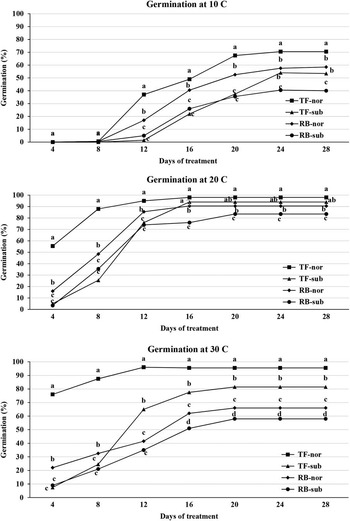
No seed of either species germinated under the anoxia treatment. However, seeds of both species germinated under the hypoxia treatment (Figure 1). At 28 DAT, TF generally had higher accumulated germination under all treatments. Under normoxia conditions, the accumulated germination of TF at 28 DAT was 71%, 98%, and 95% at 10, 20, and 30 C, respectively. Under normoxia conditions, the accumulated germination of RB at 28 DAT was 59%, 91%, and 66% at 10, 20, and 30 C, respectively. Lower germination was observed for hypoxia-treated TF and RB, except at 10 C before 8 DAT. At 10, 20, and 30 C, accumulated germination at 28 DAT was 54%, 94%, and 82% for hypoxia-treated TF, respectively. At 10, 20, and 30 C, accumulated germination at 28 DAT was 40%, 84%, and 58% for hypoxia-treated RB, respectively.
Germination of normoxic tall fescue (TF, ■), normoxic roughstalk bluegrass (RB, ♦), hypoxic TF (▲), and hypoxic RB (●) seeds at 10, 20 and 30 C. Data represent the average of eight replications pooled over two studies, with 25 seeds per replication (200 seeds total). Means with the same letter at the same date are not different based on Fisher’s multiple range test at 0.05 probability. Abbreviations: nor, normoxia (control); hyp, hypoxia.

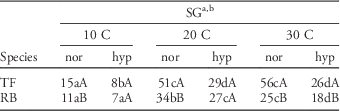
The SG index indicated that the seed germination for both species under the hypoxia treatment was slower compared with the seeds under normoxia treatment, except for RB at 10 C (Table 1). The delay between the normoxia and hypoxia groups was numerically greater for TF than for RB, and these delays for both TF and RB were greater in temperatures of 20 and 30 C than in 10 C. The optimum germination temperature was 20 C for both species. Lower (10 C) or higher (30 C) temperatures slowed the SG of both TF and RB.
Speed of germination index (SG) for tall fescue (TF) and roughstalk bluegrass (RB) under different temperature and oxygen level treatments. Data represent pooled data of two studies, with four replications each of 25 seeds (200 seeds total).

a Abbreviations: nor, normoxia (control); hyp, hypoxia.
b Based on Fisher’s LSD test at 0.05 probability, means followed by the same lowercase letter indicated that within the same species, there is no difference among the treatments. Means followed by the same uppercase letter indicated that within the same treatment, there is no difference between the species.
With increasing waterlogging duration, the inhibition of hypoxia for both species decreased under 20 and 30 C temperatures but increased under 10 C (Figure 1). At 10 and 20 C, hypoxia treatment reduced accumulated germination more in RB than in TF. In contrast, higher temperatures (30 C) may have enhanced the effects of oxygen deficiency on TF compared with RB.
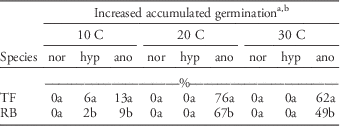
After the oxygen-limitation treatment was removed, a germination increase was observed for previously anoxia-treated RB and TF seeds and for hypoxia-treated RB and TF seeds at 10 C (Table 2). The greatest germination increases for anoxia-treated seeds were 76% for TF and 67% for RB at 20 C.
Accumulated germination (%) increase for tall fescue (TF) and roughstalk bluegrass (RB) in 10 d after treatment removal. Data represent pooled data of two studies, with four replications each of 25 seeds (200 seeds total).

a Abbreviations: nor, normoxia (control); hyp, hypoxia; ano, anoxia.
b Means followed by the same letter in the column are not different based on Student’s t-test at 0.05 probability.
Seed germination is a process with high energy requirements, which may be provided by metabolism either aerobically or anaerobically (Soham et al. Reference Soham, Vijayan and Sarkar2016). Neither RB nor TF seeds germinated under the anoxic environment, suggesting that oxygen is required during the germination of these two species. Ungerminated anoxia-treated seeds recovered after treatment removal, indicating that anoxic treatment did not cause permanent tissue damage. The major effect of the hypoxia treatment was reducing the oxygen concentration around the germinating seeds, by limiting the gas flux rates (Tamang and Takeshi Reference Tamang and Takeshi2015). In this study, the lower oxygen concentration reduced the total germination (Figure 1) and delayed seed germination (Table 1). Between these two species, the hypoxic treatment delayed the seed germination of TF more than that of RB (Table 1). Because seed germination under oxygen deficiency is regarded as a capacity of seed to survive submerged conditions (Angaji et al. Reference Angaji, Septiningsih, Mackill and Ismail2010; Kretzschmar et al. Reference Kretzschmar, Pelayo, Trijatmiko, Gabunada, Alam and Jimenez2015), RB seed may either be more tolerant to oxygen deficiency or have a lower oxygen concentration requirement for germination.
Early-Establishment Study
Assumptions were met for ANOVA tests performed on raw data (seedling number or dry weight). There were no differences between the two studies in the early-establishment data, so they were combined for analysis. The effects of species, treatment, and treatment duration were significant on early-establishment.
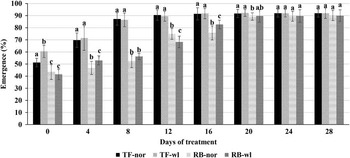
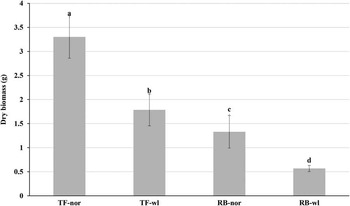
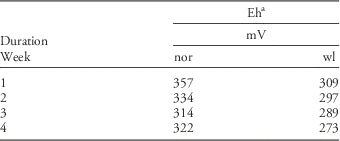
The average Eh values during the 28-d study in control and waterlogged soils were 332 and 292 mV, respectively (Table 3). The waterlogging treatment did not reduce the percent emergence of either TF or RB (Figure 2). At the end of the study (28 DAT), the seedling numbers of TF were 91% and 92% of planted seed in the control and waterlogging-treatment groups, respectively. The seedling numbers of RB were 91% and 90% of planted seed in the control and waterlogging-treatment groups, respectively. The waterlogging treatment applied at early-establishment stage reduced the aboveground biomass of both RB and TF (Figure 3), and the reduction in RB was 58% compared to 46% in TF.
Effects of waterlogging treatment (wl) during early-establishment stage on seedling numbers. Seedlings were counted every 4 d for 28 d. Data represent the average dry biomass±SE of eight replications pooled over two studies, with 50 seedlings per replication (400 seeds total). Means with the same letter on the same day are not different based on Fisher’s multiple range test at 0.05 probability. Abbreviations: TF, tall fescue; RB, roughstalk bluegrass; nor, untreated control.

Dry biomass of RB and TF seedlings at 28 d after waterlogging treatment (wl) during early-establishment stage. Data represent the average dry biomass±SE of eight replications pooled over two studies, with 50 seedlings per replication (400 seeds total). Means with the same letter are not different based on Fisher’s LSD test at 0.05 probability. Abbreviations: TF, tall fescue; RB, roughstalk bluegrass; nor, untreated control.

Soil redox potential readings during the early-establishment experiment.

a Abbreviations: Eh, soil redox potential measured as voltage between a reference electrode and a sensor electrode inserted into soil; mV, millivolts; nor, normoxia (control); wl, waterlogging treatment.
No reduction in seedling survival in either waterlogged RB or TF indicates these two species may have similar survival rates when waterlogging happens during the early-establishment stage. However, greater reduction in RB seedling biomass may suggest less active growth under waterlogging conditions compared with TF. Roughstalk bluegrass is one of the species that reduces physiological activities under environmental stresses. Previous studies indicated that RB can quickly go dormant during drought and hot weather to improve its survival rate (Budd Reference Budd1970; Rutledge et al. Reference Rutledge, Volenec, Jiang and Reicher2012). Under oxygen-limitation conditions, reduced growth activity may contribute to avoidance of tissue and cell damage, because maintaining high-level metabolism during oxygen-deficiency conditions may involve increased fermentation (Dennis et al. Reference Dennis, Dolferus, Ellis, Rahman, Wu, Hoeren, Grover, Ismond, Good and Peacock2000; Magneschi and Perata Reference Magneschi and Perata2009). Thus, lower growth activity may help RB outcompete TF in waterlogged soils.
Implications from this Research
The influence of oxygen deficiency on the germination of TF and RB varied with the temperature level. When oxygen deficiency occurs at a higher temperature, the influence of oxygen deficiency may be greater on TF than RB, and the influence tends to be less with the increase of treatment duration. The growth activity was reduced more in RB when waterlogging occurred at the early-establishment stage, which may minimize the anaerobic cell damage induced by flooded soil. Therefore, RB management in flooded TF fields should be at early seed germination. Reducing waterlogging by increasing surface and tile drainage in TF production fields may minimize the influence of waterlogging on TF germination. Flooded fields, slower growth of RB during early establishment, or germination at a higher temperature may reduce the effect of herbicides. Therefore, herbicides used to manage RB in TF should be applied when RB is actively growing to maximize efficacy.