Over the past three decades, Egypt has experienced a significant decrease in infant and childhood mortality rates. Owing to the extensive network of healthcare facilities operated by the Ministry of Health and Population, most Egyptians have access to at least basic primary healthcare services, although there are disparities by region and income levels. According to the 2008 Egypt Demographic and Health Survey,Reference El-Zanaty and Way 1 an Egyptian child is six times less likely to die before his or her fifth birthday in the early 2000s than during the mid-1960s. The infant mortality rate for the period covered by our study (2005–2006) was 25 deaths/1000 births – a 40% decrease from the period of 1994–1998.Reference El-Zanaty and Way 1 Similarly, there was a 48% decrease in under-5 mortality during the same time periods.Reference El-Zanaty and Way 1 According to the World Health Organization, in Egypt, prematurity caused 45% of all neonatal deaths in 2010, followed by congenital anomalies, which was the causal factor in 23% of deaths among children in this age group. 2
Congenital cardiovascular malformations, also known as congenital heart disease or heart defects, are abnormalities that develop before birth, affecting the structure and function of the heart and great vessels. Globally, although there is a paucity of data regarding the number of children born with congenital cardiovascular malformations, the World Health Organization has estimated that congenital anomalies in general affect ~1 in 33 infants and result in ~3.2 million birth defect-related disabilities every year. 3 Congenital cardiovascular malformations are estimated to account for nearly one-third of all major congenital anomalies.Reference Van der Linde, Konings and Slager 4
In Egypt, Shawky and SadikReference Shawky and Sadik 5 assessed the prevalence of congenital malformations among Egyptian infants and children (ages 0–18 years), reporting that 20/1000 had a congenital abnormality. The prevalence of congenital cardiovascular malformations has not been estimated in Egypt, nor is there a country-wide birth defect monitoring system; however, there are several studies conducted at hospitals and universities that report prevalence at a local level.Reference Shawky and Sadik 5 , Reference Arafa, Zaher and El-Dowaty 6 Refat et alReference Refat, Rashad el and El Gazar 7 reported a CHD prevalence of 2.6/1000 among primary school children in Menoufia, Egypt. In a similar study, Bassili et alReference Bassili, Mokhtar and Dabous 8 reported that the prevalence of congenital cardiovascular malformations among school children in Alexandria, Egypt, was 1.01/1000. Such studies are likely to underestimate the total prevalence as affected neonatal deaths were not counted, nor were disabled children with congenital cardiovascular malformations who could not attend school.
Parental knowledge, beliefs, and stressors may affect health outcomes in children with congenital cardiovascular malformation. Parents of children with congenital cardiovascular malformation with better knowledge of the disease and disease process have been shown to cope better with the disease. Furthermore, parents with a religious background have also been shown to have better coping strategies.Reference Ahn, Lee and Choi 9 Research regarding parental perceptions is of particular importance in the Egyptian context, where personal and societal perceptions of illness may differ from better-studied Western populations.
The perceptions of parents of children with congenital cardiovascular malformations have been studied for >40 years.Reference Linde, Rasof and Dunn 10 Parents of such children often have feelings of guilt, resentment, anger, and denial.Reference Rozansky and Linde 11 , Reference Garson, Benson and Ivler 12 Most of the literature on this subject has dealt with psychosocial aspects such as parental stress and maladjustment. LawokoReference Lawoko 13 reviewed the literature over the past 25 years to assess the well-being of parents of children with congenital cardiovascular malformations, finding that parents were faced with a variety of psychosocial problems, including concerns regarding medical prognosis, financial and caregiving burdens, and their child’s physical and psychosocial adaptation. In a qualitative pilot study in the United States, Sparacino et alReference Sparacino, Tong and Messias 14 found that parents of children with congenital cardiovascular malformations experienced feelings of social isolation. Moreover, parents of children with congenital cardiovascular malformations have been found to be more likely to experience distress, depression, and hopelessness than parents of healthy children.Reference Lawoko 13 , Reference Carey, Nicholson and Fox 15 , Reference Lawoko and Soares 16 On the other hand, Visconti et alReference Visconti, Saudino, Rappaport, Newburger and Bellinger 17 found that compared with normative samples, parents of children with CHD experienced less stress. Although parental stress has been found to be a risk factor for behavioural problems in children, maternal perceptions have been shown to be a greater risk factor for emotional maladjustment than the severity of disease.Reference DeMaso, Campis and Wypij 18
Very few studies on the perceptions of parents of children with congenital cardiovascular malformations have been carried out in low-income contexts. Previous studies of Arab and Muslim perceptions of disease have centred on certain populations such as Bedouins in Israel and hospital patients in Saudi Arabia. These studies have mainly been descriptive and small, and a few have assessed parental perception of disease among children in particular. A study of parents of children with cancer in Saudi Arabia found that parents had a prominent faith-based explanation for their child’s disease.Reference Bahakim 19 A study of Israeli Arab parents of children with inborn errors of metabolism found that parents who had a more faith-based or fatalistic explanation were less likely to understand the hereditary nature of the disease.Reference Saleem, Gofin and Ben-Neriah 20 That study’s underlying assumption, however, was that one can either have a faith-based explanation or a “scientific” understanding of the hereditary nature of the disease. This underlying assumption may not be true. The effect of this possibly fatalistic outlook on clinical variables has not been studied thus far.
Regarding Egypt, a paucity of research exists about the well-being of parents of children with congenital cardiovascular malformations; however, a study by Arafa et alReference Arafa, Zaher and El-Dowaty 6 found that parents of affected children reported significantly lower health-related quality of life, and the most significant differences were observed in vitality, general health, and role limitation due to physical health problems. Therefore, our overall goal was to assess parental attitudes and perceptions towards congenital cardiovascular malformations in their children, from an existing case–control study that previously reported associations between congenital cardiovascular malformations and environmental exposures.Reference Saleh, Ezzat and Hamzaet 21 Our previous results suggested that the prevalence of pre-pregnancy diabetes was elevated in mothers of infants with congenital cardiovascular malformation compared with mothers of controls, as were self-reported exposures to agricultural pesticides, whereas cases and controls did not differ significantly regarding other maternal and paternal exposures and sociodemographic characteristics. The specific aims of the present analysis were to determine the perceived causal attributions of disease among parents of children with congenital cardiovascular malformations; to determine the relationship of these attitudes and perceptions to time to diagnosis; to assess stress among mothers and its relationship to their knowledge of and health beliefs about congenital cardiovascular malformation in their children; to assess knowledge of congenital cardiovascular malformations and its relationship to parental health beliefs; and to assess religiosity among mothers and its relationship to stress and health beliefs.
Materials and methods
During 2005–2006, Georgetown University, in collaboration with Cairo University, conducted a case–control study in Cairo, Egypt, to assess potential risk factors for congenital cardiovascular malformations and to assess perceived causal attributions of disease among parents of affected children. A detailed description of the study and its findings regarding potential risk factor associations has been previously published.Reference Saleh, Ezzat and Hamzaet 21 The study was approved by the Institutional Review Boards of Georgetown University and Cairo University.
Study population
This study was a hospital-based, mixed method, cross-sectional study conducted at the Pediatric Hospital of Cairo University, Egypt. Interviews were conducted with purposively selected mothers of children with CHD, specifically a cross-sectional sample of those with conotruncal malformations of the heart and great vessels (outflow defects), as well as mothers of control children without CHD. Mothers of these patients were approached by the interviewers at the clinic for permission to join the study, and all the patients provided either signed or witnessed informed consent, depending on the level of literacy. Cases were infants and children up to the age of 2 years who had been diagnosed with congenital cardiovascular malformations, confirmed by echocardiography, cardiac catheterisation, or surgical inspection; diagnoses were confirmed by an external paediatric cardiologist, as previously reported.Reference Saleh, Ezzat and Hamzaet 21 Controls were infants and children free from CHD, who were recruited during the same time period as the cases from the outpatient clinic of the same hospital: we contacted mothers whose children were being evaluated for acute illnesses such as the common cold, tonsillitis, or gastroenteritis. We frequency-matched the control group to the cases by age and sex.
Data collection
Mothers were interviewed at the hospital, on the same day their children were being treated, by trained interviewers using a semi-structured questionnaire. The semi-structured questionnaire included six parts such as demographic information; access to and use of healthcare services for the child’s congenital cardiovascular malformations and related conditions; Parent Health Locus of Control Scale;Reference DeVellis, DeVellis and Blanchard 22 knowledge of heart disease and its treatment; the Parenting Stress Index Short Form;Reference Abidin 23 and religiosity.
The Parent Health Locus of Control tool was used because it is a validated and widely used tool and because this study was specific to parents. Locus of control generally refers to the extent to which individuals perceive that they can control events that affect them, on a spectrum ranging from internal factors, meaning that the individual controls their life, to external factors, meaning that other forces such as fate control the individual’s life. Specifically, parental locus of control refers to parental perceptions of their power in the parent–child relationship.Reference Campis, Lyman and Prentice-Dunn 24 This has been studied extensively, and previous studies have suggested that parental locus of control affects childhood health outcomes and use of preventative services in childhood.Reference Tinsley and Holtgrave 25
The Parenting Stress Index Short Form was used to measure maternal stress. Both the Parenting Stress Index and the Parent Health Locus of Control instruments were translated into Arabic, with some terminology revised for linguistic and cultural appropriateness. The questionnaire modules regarding demographics, use of healthcare services, knowledge of congenital cardiovascular malformations – that is, asked to name the child’s diagnosis and what surgical and medical treatments had been completed or planned – and religiosity were developed de novo for this study; all instruments were developed in English, translated to Arabic, back-translated to ensure accuracy, pilot tested, and finalised before data collection.
In the Parenting Stress Index, mothers were asked to answer 36 questions about their parenting experience on a five-point scale from strongly agree to strongly disagree. The Parenting Stress Index is subdivided into four subscales: defensive responding, parental distress, parent–child dysfunctional interaction, and difficult child. These subscales are based on factor analyses of samples in the United States and have not been validated in Egypt or in any Arabic-speaking country as far as we can ascertain. A higher score on the index and its subscales indicates more stress. The subscales – except for defensive responding – and overall score were reliable with a Cronbach’s α of 0.87 for the total Parenting Stress Index, 0.73 for parental distress, 0.75 for parent–child dysfunctional interaction, 0.79 for difficult child, and 0.57 for defensive responding. The defensive responding subscale was not reliable and it included items from all the other subscales, and therefore it was dropped from further analysis.
Causal attribution regarding the child’s health was measured using the four subscales of the Parent Health Locus of Control Scale: professionals, parent, fate, or divine.Reference DeVellis, DeVellis and Blanchard 22 Items were scored on a 1–5 scale with 1 indicating ‘strongly agree’ and 5 indicating ‘strongly disagree’. Subscales were formed by taking the means of the relevant items.Reference DeVellis, DeVellis and Blanchard 22 For professionals, the items were 1, 3, 5, 10, and 21; for parents they were 2, 13, 18, 20, 24, 26, and 29; for fate they were 7, 12, 19, 27, and 30; and for divine they were 11, 16, and 23. Cronbach’s αs for these subscales in our sample were 0.63 for professionals, 0.64 for parents, 0.74 for fate, and 0.56 for divine. These were much lower than the αs reported by DeVellis et alReference DeVellis, DeVellis and Blanchard 22 for the Parent Health Locus of Control Scale, which ranged from 0.78 for parents to 0.88 for divine. The overall scale – for items in the four subscales – had a Cronbach’s α of 0.72. Lower scores indicate greater endorsement of that locus of control.
Data analysis
For quantitative analysis, we used SPSS to compare cases and controls for possible differences in the questionnaire variables. χ2 testing was performed to screen categorical variables for statistical significance, and Fisher’s exact test was performed if 25% or more of the cells had expected counts <5. The Student t-test evaluated continuous variables for association with case status. A p-value of 0.05 was considered to be statistically significant. Owing to the small sample size of several subgroups, exact confidence intervals were calculated for every association reported here, using StatXact software (Cytel Software Corp., Cambridge, Massachusetts, United States of America). For the Parent Health Locus of Control Scale and the Parenting Stress Index, the researchers used published analytic tools to calculate the measures and identify differences between the case and control groups.Reference DeVellis, DeVellis and Blanchard 22 , Reference Abidin 23
Qualitative data – for example, the mother’s description of the phenotype and its treatment – were transcribed verbatim in Arabic and then translated to English. The researchers analysed the data using the grounded theory method as described by Corbin and StraussReference Corbin and Strauss 26 and, specifically, the open coding approach to analyse the open-ended items in the questionnaire.Reference Malterud 27 At least two researchers independently identified key words or phrases in each of the responses to each of the open-ended questions. At the same time, they initially identified potential, anonymous, quotations that could be used in the findings. The research team then met to discuss the key words and reach agreement; two of the researchers then independently identified categories of responses, which were used as the basis for coding the open-ended responses. The researchers used these categories to synthesise the findings and identify broad themes. The reviewers of the open-ended questions that related to parental knowledge – for example, where the child’s heart defect is located – included an epidemiologist specialising in congenital cardiovascular malformations and a paediatric cardiologist. These items were coded for accuracy. The other open-ended questions – that is, related to perceptions of causal factors – were reviewed and coded by these two researchers and a qualitative health researcher. All of them used the open coding approach and met frequently to reach consensus regarding the findings. The use of grounded theory was not specifically intended to yield a conceptual framework based on this cross-sectional study, but rather to use the structured analysis approach to help ensure rigorous analysis of the qualitative findings, and thus contribute to knowledge regarding parental perceptions of congenital cardiovascular malformations.
Results
Demographics
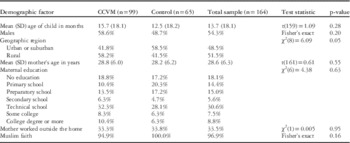
Interviews were completed with mothers of 99 consecutively diagnosed children with congenital cardiovascular malformations and 65 controls, for a total sample size of 164. Controls were recruited sequentially from the same hospital system as the cases, within the same defined time period of accrual. Demographic characteristics are shown in Table 1. There were no significant demographic differences between cases and controls. The mean age of the children at the time of the maternal interview was 13.7 months, with similar distributions between cases and controls. Children ranged in age from birth to 114 months. Although the control children were on average slightly older than the children with congenital cardiovascular malformations, the difference was not statistically significant. Just over half of all children were male. Mother’s ages at the time of interview ranged from 18 to 55, with a mean age of 28.6 years. There was no significant difference in the mean age of mothers between cases and controls. Virtually, all the mothers were married; only one was separated and one was divorced. Nearly a third of the mothers had a primary education or less; another third had technical training. Only 16% had attended college. About one-third of the mothers had ever worked outside the home. All the control cases were Muslim, as were 94.9% of cases.
Demographic characteristics of cases and controls.

CCVM=cases with congenital cardiovascular malformation
Child’s health
The vast majority (95.9%) of cases had been hospitalised at some point before the interview, compared with only 16.9% of controls. Regarding the specific types of congenital cardiovascular malformations, approximately half had d-transposition of the great arteries and the remainder had conotruncal malformations in the presence of normally related great arteries, including tetralogy of Fallot, truncus arteriosus, and double-outlet right ventricle; the distribution of the specific heart malformations has been previously reported.Reference Saleh, Ezzat and Hamzaet 21 Among the congenital cardiovascular malformations cases, one also had a cleft palate, one had extremity defects, five had blood disorders, and eight had some other type of minor congenital defect, according to their mothers’ reports.
Access to and use of the healthcare system
In all, two-fifths of the mothers of cases did not answer the questions about frequency of physician visits and frequency of cardiology clinic visits. Of those who did answer, nearly one-third reported visiting the cardiology clinic monthly – the most frequent answer. The mean interval between visits to the paediatric cardiology clinic was 15 days (SD=31).
Only 28.3% of the mothers of cases reported knowing that there was something wrong with their child at birth, and 18.2% realised that something was wrong within the 1st week of their child’s life. For most of these mothers, it was weeks (8.1%) or months (45.5%) before they realised their child had a problem. Most (87.9%) of them took their child to a paediatrician and 9.1% to a paediatric cardiac specialist for the initial evaluation; all cases seen by the paediatrician were referred to a cardiologist for care. Only 41.4% of mothers reported an age at which their child was first taken to a physician to have the cardiac problem evaluated. Of those, the range was from 1 to 54 weeks. The number of doctors seen before referral ranged from 0 to 11.
Most (85.6%) of the mothers of children with congenital cardiovascular malformations were satisfied with the care their child was receiving at the tertiary-care centre. Over three-quarters (78.8%) said that the cost of care for their sick child was a financial burden. Only 29.3% said they had applied for government funding to help pay for medical procedures such as cardiac catheterisation, echocardiograms, or operations. The vast majority (89.9%) reported no difficulty administering all medications to their child according to the instructions.
There was no difference in the frequency of visits to doctors or cardiologists by maternal education level. This finding may reflect that the national healthcare system in Egypt provides access for low-education, low-income populations.
Mothers’ knowledge of congenital cardiovascular malformations
Mothers of children with congenital cardiovascular malformations were asked to name and describe their child’s heart defect. These answers were compared with the actual diagnosis to ascertain how much mothers understood about their child’s congenital cardiovascular malformations. Less than half (45%) of the mothers indicated correct knowledge of their child’s diagnosis, and another 31% were partially correct. Only 9% of the mothers gave incorrect information, and the remainder did not know about the diagnosis. Mothers with less than secondary education were significantly less likely (p<0.05) to have correct knowledge (36.1%) than those with a college degree (66.7%) or those with a secondary degree or some college training (64.1%) (χ2(2)=6.71, p=0.04).
Mothers’ stress
The Parenting Stress Index findings are summarised in Table 2. The results suggest that the women in our sample had extremely high levels of stress: on average, these mothers scored at the 88.8th percentile. More than two-thirds of the sample had total stress raw scores >90, indicative of clinically significant levels of stress requiring referral and professional diagnosis, according to the Parenting Stress Index manual; however, the Parenting Stress Index has not been used extensively with the Egyptian population, and thus caution must be used in interpreting these findings. As seen in Table 2, the mothers of controls had statistically significantly higher scores on total stress and all the subscales than did the mothers of cases.
Parent Stress Index scores in mothers of cases and controls.

CCVM=congenital cardiovascular malformation
Mothers’ locus of control
Table 3 reports the results of the Locus of Control survey. God or the divine as a determining factor in a child’s health was given the highest endorsement by these mothers, followed by parents. They only slightly agreed that professionals controlled their child’s health and were neutral about the role of fate. Mothers in the congenital cardiovascular malformations group gave parents a significantly lower score (M=1.91, SD=0.43) than did the control group (M=2.08, SD=0.53), suggesting that the congenital cardiovascular malformations group felt more empowered to control their child’s health than did the control group mothers (t(162)=2.24, p<0.05).
Health Locus of Control in mothers of cases and controls.

CCVM=congenital cardiovascular malformation
Mothers with any level of college education were significantly more likely to agree with God or the divine as a determining factor in locus of control than those with less than secondary or secondary education (F(2, 159)=4.44, p<0.05). Notably, college-educated mothers were less likely to endorse fate as the key factor in locus of control, relative to those with lower levels of educational attainment (F(2, 159)=8.09, p<0.001).
Relationship between mothers’ stress and health beliefs about congenital cardiovascular malformations
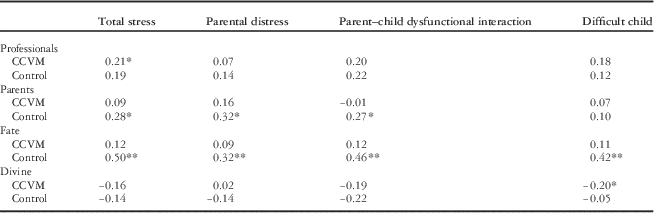
Spearman’s correlation coefficients between mothers’ stress and health beliefs indicated significant positive relationships regarding professionals, parents, and fate as the determinants of children’s well-being (Table 4). As a higher score on locus of control means less agreement with that factor as determining the child’s well-being, positive correlations indicate that more stress is associated with less endorsement of that factor. Although these relationships were statistically significant, the correlations were relatively weak, accounting for less than a quarter of the variability in scores. Overall, stress was not correlated with ratings of the divine as responsible for children’s health. Different patterns emerged for the various stress subscales, as can be seen in Table 4. Parental distress was significantly correlated with parents and fate as determining factors. The higher the parental distress, the less likely parents were to see themselves or fate as determining their child’s well-being. Parent–child dysfunctional interaction was significantly and positively correlated with professionals and fate and was negatively correlated with the divine. The higher the parent–child dysfunctional interaction score, the less likely that professionals and fate were seen as determining factors, and the more likely that the divine was endorsed as a determining factor. Difficult child was significantly correlated with professionals and fate; the higher the difficult child score, the less likely the endorsement of professionals and fate as determining a child’s well-being.
Correlations (Spearman’s ρ) between subscales of Parenting Stress Index and Parent Health Locus of Control.

*p<0.05; **p<0.01
When examined by case or control status, the correlations were quite different, as shown in Table 5. The correlations between subscales of the Parent Stress Index and the Parent Health Locus of Control Scale were stronger in mothers of controls compared with mothers of cases, and the magnitudes of the correlations were greater as well in the control group. For mothers of cases, the only significant relationships were between total stress and professional locus of control as well as between difficult child and divine locus of control. Mothers of controls had relatively high correlations between stress – both total and all subscales – and fate locus of control. The higher the stress levels for controls, the less likely they were to endorse fate as a determining factor.
Correlations (Spearman’s ρ) between subscales of Parenting Stress Index and Parent Health Locus of Control.

CCVM=congenital cardiovascular malformation
*p<0.05; **p<0.01
Relationship between mothers’ stress and their knowledge of the child’s congenital cardiovascular malformations condition
Stress was not related to mothers’ knowledge of their child’s diagnosis (data not shown). Mothers whose understanding of their child’s congenital cardiovascular malformation diagnosis was correct or partially correct had similar mean stress scores and other subscale scores as those who did not have a correct understanding of their child’s heart malformation.
Religiosity
The majority of mothers in the study (82.7%) considered themselves to be religious or spiritual, with no statistically significant difference between the two groups. Somewhat different questions about religious practices were asked of Muslims and Christians, and therefore the responses are reported separately here. Although 82.7% of Muslim mothers mentioned that they were religious, nearly half of them mentioned that they never or rarely visited a mosque, 14.7% mentioned that they visited once per month or less, 21.7% weekly, and 5.1% daily or more often. They did report praying regularly, with 82% of them praying five or more times per day. All of them participated in fasting. Just over a quarter did not read the Quran; another quarter read it monthly or less; nearly one-fifth (19.1%) of them read the Quran weekly; and 26.7% said they read it one or more times a day. Of the five Christian respondents, three mentioned that they attended church weekly, one reported less than once per month, and one gave a response of “other”; two of the Christians said they did not pray; the remainder prayed at least twice a day. Moreover, two of them mentioned that they read the Bible weekly and the rest did not read it. Among the Muslims, one mother did not participate in fasting, and the others participated either regularly or during certain times for religious reasons; four of the Christians regularly participated in confession and communion, and three contributed financially to the church.
Stress was not related to whether or not mothers considered themselves to be religious (data not shown). Total stress and all stress subscale scores were virtually identical for those who mentioned that they were religious and those who mentioned that they were not. Stress was not related to whether or not Muslim mothers prayed regularly, how often they attended the mosque, or how often they read the Quran. Similarly, scores for health locus of control were not related to religiosity. Mothers who considered themselves religious, however, were significantly more likely to agree with divine locus of control compared with mothers who did not consider themselves religious (t(155)=3.00, p<0.01).
Discussion
The study results generally confirm the conclusions reached in other studies regarding stress and perceptions of illness in children in general. These findings have also yielded important information regarding perceived causal attribution of disease among parents of children with congenital cardiovascular malformations – a group that has been less well studied. Furthermore, our findings shed light on the counter-intuitive relationship between a mother’s stress and her health beliefs of congenital cardiovascular malformations, knowledge of congenital cardiovascular malformations, and religiosity. These results also confirm findings of other studies addressing a serious disability or illness in the child. It is notable that the subscale measuring parent–child dysfunctional interaction, which assesses the parent’s perception that the child does not meet expectations and that interactions with the child are not reinforcing to the parent, received the highest scores, followed by the parental distress and difficult child subscales.
Similar to our results on low levels of knowledge among parents about their child’s disease, a comprehensive study conducted in Hong Kong showed important parental knowledge gaps regarding the child’s diagnosis.Reference Cheuk, Wong and Choi 28 In addition, in a study among parents of children with small ventricular septal defects in Australia, around 80% perceived the severity of disease to be minor, but only two-thirds knew about the need for endocarditis prophylaxis.Reference Lok and Menahem 29
In our study, the statistically significant relationship between total stress and professional locus of control, as well as the relationship between the difficult child subscale and divine locus of control, provide additional information as to the attitudes of parents of children with congenital cardiovascular malformations regarding the causal attributions of disease. If one attributes the locus of control of a child’s well-being to medical professionals, then it is likely that one has faith in the efficacy of medical treatment versus prayer and alternative forms of treatment. These mothers, however, attributed their child’s well-being to the divine and to parents themselves, rather than to medical professionals. The more total stress they reported, the less they endorsed the importance of medical professionals. This could possibly indicate a lack of faith in the efficacy of medical treatment for congenital cardiovascular malformation among these mothers. Their reliance on themselves and prayer may place the burden of their children’s well-being on these mothers, which could increase their total stress.
The finding regarding attendance at mosques – nearly half of the women said they never or rarely visited a mosque – is consistent with other findings; in Egypt, 61% of adults attend mosque once a week or more and 39% attend mosque rarely or never, and the gender gap in mosque attendance differs by only 2 percentage points. 30 Moreover, the finding that 28% reported not reading the Quran is not surprising given that 18.4% had no formal education and just 10.2% had attended primary school only.
Our findings revealed that no significant statistical relationship exists between stress and mothers’ knowledge of congenital cardiovascular malformations, health beliefs concerning congenital cardiovascular malformations, awareness of their child’s diagnosis, and religiosity. Regarding religiosity, in fact, not only do these variables bear no statistically significant relationship to stress but also mothers of children in the control had significantly higher scores on total stress and all subscales than the mothers of children with congenital cardiovascular malformations. This finding correlates with the conclusions reached by Visconti et alReference Visconti, Saudino, Rappaport, Newburger and Bellinger 17 in their study concerning stress levels among parents of children with disease and those of children without it. We cannot rule out the possibility that mothers of cases denied stress – as an explanation for these results – or the possibility that they benefitted from forms of social support that blunted the effects of stress related to congenital cardiovascular malformations.
The relationship between the cost of treatment and stress is another interesting observation from our study; 78.8% of the mothers of children with congenital cardiovascular malformations reported that the cost of care was a financial burden, and yet only 29.3% reported that they had applied for available government funding to help pay for medical procedures. This disparity suggests the presence of barriers to access to care, whether practical, bureaucratic, or otherwise, and indeed the World Bank has found evidence of such barriers in studies of primary-care access in Egypt. 31
Parents of children with congenital cardiovascular malformations in this study generally perceived the causal attributions of disease as a type of divine influence. Inferences drawn from the results of the Parental Locus of Control Scale in this study and other studies support this finding, although it should be noted that the locus of control items referred generally to the child’s health status and not specifically to the congenital heart condition. Ultimately, perceptions regarding causal attributions of disease vary as a result of each individual’s knowledge and health beliefs, awareness of the condition, and, to a much lesser extent, religiosity. None of these variables, however, was associated with levels of stress. Furthermore, mothers of children who did not suffer from congenital cardiovascular malformations reported even higher levels of stress than their counterparts. It is possible that the parents of children with acute illness were more likely to be stressed than parents of those with chronic disease. This was not examined in this study. It is important to note that the Parenting Stress Index is designed to measure stress in the context of parenting; it is not designed to measure individual stress in a broad sense – that is, as related to other aspects of the individual’s life circumstances. Using other measures might have yielded additional and perhaps different results.
In terms of the limitations of this study, we interviewed mothers of both cases and controls in the hospital on the same day that their children were being evaluated and treated, which could have influenced parental stress and their responses to the Parenting Stress Index; however, in the control group, we excluded any type of congenital malformation and the presence of any severe illness that would have required referral to higher level of care, in order to minimise any possible effect on parental responses. Concerning the cases, the presence of associated illnesses was not assessed, and thus it is unknown whether any additional health concerns added to the burden of parental stress. Finally, as our study was the first to implement the translated Arabic version of this scale, further evaluation needs to be carried out in similar populations.
Future studies can explore the roles that other factors such as the cost of treatment and financial hardship play in exacerbating stress levels among parents of sick and healthy children. This may be especially important in countries such as Egypt that have suffered recent low economic growth, rising poverty and unemployment rates, worsening food insecurity, and unequal distribution of wealth. A prospective, mixed method study with a strong qualitative component could build on the findings of this cross-sectional study, adding to the body of knowledge of this neglected but important childhood disease.
Acknowledgements
The authors thank the interviewers who worked diligently to engage with the parents and ensure that the questionnaires were completed. The Parenting Stress Index was adapted and reproduced by special permission from the Publisher, Psychological Assessment Resources (PAR), Inc., 16204 N. Florida Avenue, Lutz, FL 33549, from the Parenting Stress Index developed by Richard Abidin, Ed. D., Copyright 1990 by PAR, Inc. The back-translation was approved by the survey’s creators. Further reproduction is prohibited without permission from PAR, Inc.
Financial Support
The study was funded by the US–Egypt Joint Science and Technology Fund, grant number BIO8-002-007. Dr Saeedi was funded by a Fulbright Fellowship to Egypt (2005–2006).
Conflicts of Interest
None.
Ethical Standards
The authors assert that all procedures contributing to this work comply with the ethical standards of the relevant national guidelines on research involving human subjects (United States Department of Health and Human Services (Federal regulation 45 CFR 46.102(f)) and with the Helsinki Declaration of 1975, as revised in 2008, and was approved by the institutional review boards of Georgetown University and Cairo University.