1. Moral attribution: scholarly and quotidien
Listening to the laity discuss group morality can be a disturbing experience. Listening to scholars discuss group morality, with an attentive ear, can be equally disturbing. The former is conducted with a parsimony of reason and evidence. The latter is conducted with complex reasoning and evidence, but, on closer examination, leaves one puzzled. One reason for this is that, when we see something good or bad happen, it is a natural human instinct – to the laity, the philosopher, and the economist, alike – to place the responsibility at the doorstep of some agent. It leaves us uncomfortable not to be able to attribute agency to anybody.
This is not an easy problem because to err on either side is likely to have grave consequences. To wantonly hold individuals responsible for bad group behaviour can be dangerous. It can lead to the wrong person being punished, and promote facetious group labelling. On the other hand, to consistently hold no one responsible for bad group behaviour is to risk encouraging bad behaviour. It can result in the ‘tragedy of the commons’, which is, in turn, a manifestation of the ‘many hands problem’, where a group of individuals drive society to a disastrous outcome, in a manner where no one person’s unilateral change of behaviour can make any difference (Braham and Holler Reference Braham, Holler, Gekker, Boylan and New York2009; Braham and van Hees Reference Braham and van Hees2012).
This is a philosophical challenge with enormous implications for real-life outcomes, ranging from preventing large corporations from hiding behind the excuse that no one in the corporation is responsible for the damage it inflicts on society, to drafting laws for preventing climate change disaster. Not surprisingly, there is a substantial literature in moral philosophy, law and economics, dissecting the link between group behaviour and the moral intention of the members of the group.Footnote 1
This paper follows the strategy of bringing concepts and arguments from game theory to investigate this problem. This is not as common as one would expect, even though as a method, especially if we include bargaining games as part of game theory, this has a long history (see Braithwaite Reference Braithwaite1955) and a growing contemporary literature (Bacharach Reference Bacharach1999; Chocker and Halpern Reference Chocker and Halpern2004; Braham and van Hees Reference Braham and van Hees2012; Friedenberg and Halpern Reference Friedenberg and Halpern2019).Footnote 2
What is attempted here is however different from what happens in much of that literature. What this paper does is to study a counterfactual. Instead of asking what would happen if the individuals chose differently, I ask an antecedent question: What would happen if the individuals were different, becoming, for instance, moral creatures? In other words, I consider the fallout of a change in people’s motivation. The problem is brought into sharp focus by creating a new game, the Samaritan’s Curse, which illustrates the paradoxical result where all individuals becoming moral makes the group’s behaviour more immoral. By constructing this example, the paper shows that not only is it difficult to allocate to individual members of a group moral responsibility for some bad action by the group as a whole, as already pointed out in a large literature,Footnote 3 but that there are contexts where individual morality is in fact the source of the group’s immoral behaviour. The game is then used to analyse some of the problems of moral attribution of group behaviour and raise new questions concerning morality and game-theoretic reasoning, and to develop the concept of ‘conferred morality’.
The problem is important because the attribution of moral responsibility to groups occurs all the time, on television, in newspaper opeds, and in our quotidien discourse. Here are Nancy Altman and Linda Benesch in the Huffington Post Footnote 4 on the immorality of ‘Republican leaders’ in the US: ‘The Republican elite’s immorality goes well beyond Donald Trump … The immorality and disdain of today’s Republican elites shine through in the policies that they embrace.’ And, to ward off any charge of partisanship, let me quote Dave KingFootnote 5 on the ‘immoral Democrat Party’: ‘Here is a short list of the damage being done to our country by the immoral Democrat party.’ I may add that his list is not short.
Such indictments are not exclusive to America. We talk about the lack of morals of big corporations around the world; we use collective moral epithets to describe the Houthis, Tutsis, and protest groups as in the Arab Spring. Such loose group moral attributions do a lot of harm because they prevent us from devising sensible policies to improve our collective behaviour. In fact, when it comes to selfish behaviour we no longer make such mistakes. The long history of games such as the Prisoner’s Dilemma has sensitized us to this. No longer do we say that the depletion of our common resources is occurring because we are not acting in our individual self-interest. It is now understood that our common resources are being depleted because individuals so often act solely in their self-interest. It is this recognition that has helped us make some progress towards managing climate change, and having global contracts to save our environment.
We need to develop a similar awareness about the possible paradoxes of moral behaviour. The Samaritan’s Curse tries to bring this into sharp focus. In the process the game also forces us to grapple with questions concerning the place of consequentialism and deontological ethics. This paper takes a broad position of normative methodological individualism. It argues that this is the only reasonable way to approach groups and collectives. It argues that we have been too hasty in treating a group or a collective as ‘a moral agent in its own right’, with its own ‘rational point of view’ (see Hess Reference Hess2014: 203) and with its ‘collective intention’.Footnote 6 The critique that arises from the game, the Samaritan’s Curse, leads to the concept of ‘conferred morality’, which helps us think of practical problems, such as environmental degradation and dealing with the problem of corporate responsibility. How should we allocate responsibility for bad corporate behaviour among the individual decision-makers within the corporation?Footnote 7 The existing literature distinguishes group moral responsibility that can and cannot be distributed among the individuals of the group. When it cannot be distributed, ‘groups sometimes might be regarded as independent agents … Hence, it seems possible that groups as such can be morally responsible for the effects of their acts, in a sense that cannot be reduced to judgments about individual members’ acts’ (Petersson Reference Petersson2008: 244; see also Pettit Reference Pettit2007).
I contest this, arguing that in such cases we have no innate reason to hold the group morally responsible, but we may, nevertheless, create penalties and rewards, which give rise to a ‘conferred morality’ that can lead society to a better outcome. The need is to draw a distinction between different kinds of responsibility, of which moral responsibility is one (Tannsjo Reference Tannsjo2007) and within that there may be a priori or natural morality, and conferred morality.
The other use of the Samaritan’s Curse is that it draws attention to implicit assumptions that underlie conventional game theory. The explicit assumptions of game theory are well-known, as outlined by Braham and van Hees (Reference Braham and van Hees2012) in the context of group morality. However, like all theory, game theory has explicit assumptions but also many hidden assumptions – assumptions in the woodwork. The challenge of group morality compels us to recognize and contest some of these assumptions in the woodwork.
2. The Samaritan’s Curse
Consider a game with two players, 1 and 2, with each player having three actions to choose from: A, B and C. In other words, person 1 can choose from the set of alternative possibilities {A, B, C}. And likewise for person 2. I should clarify that person 1’s A, B and C are not the same as 2’s A, B and C. Thus 1 may be choosing whether 1 should be a farmer, lawyer or philosopher and 2 may be choosing from three career options for 2. I could have labelled 2’s alternatives as A’, B’, C’, but I prefer to economize on the primes.
The set of actions to choose from represents the alternative possibilities from which each person can freely choose and those are the only actions from which she can choose. The ‘outcomes’ (meaning all possible eventualities) of the game are pairs of choices, one choice by each player. Hence, this game has nine possible outcomes: (A, A), (A, B), (A, C), (B, A), and so on, where an outcome such as (B, A) refers to the case where 1 chooses her B and 2 chooses his A.
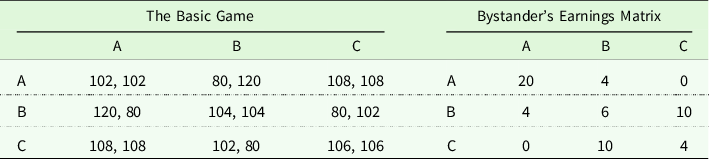
To describe a game fully we must specify what each player earns once an outcome is reached. This is summarized in the ‘payoff matrix’, labelled The Basic Game in Table 1. Following standard convention, the rows represent player 1’s choice and columns represent player 2’s choice. Thus, if player 1 chooses B and 2 chooses C, the outcome is (B, C), and from the Basic Game matrix we can see 1 earns 80 and 2 earns 102. In each box, the first number is player 1’s payoff and the second number is 2’s payoff. Without loss of generality, I shall refer to the payoffs as dollar earnings of the individuals.
A Society

While there are minor differences in terminology with Braham and van Hees (Reference Braham and van Hees2012), in essence, the description of a game here is the same as in their paper, which, in turn, is the same as the description in any standard game theory text. In their paper, Braham and van Hees consider different solution concepts or predictions of outcomes, whereas I shall focus here on one solution – the Nash equilibrium. This is for the good reason that I consider a specific game where there is a unique Nash equilibriumFootnote 8 which happens to be strict. When that happens it seems natural to expect that the Nash equilibrium is where the players will settle. In fact, in such games virtually all equilibrium concepts of game theory coincide with the Nash equilibrium.
For completeness, a ‘Nash equilibrium’ is defined as an outcome such that no individual can do better by unilaterally deviating to some other alternative. The Nash equilibrium is called ‘strict’, if every unilateral deviation actually leaves the deviator worse off.
To see why the Nash equilibrium is the natural concept to use here, assume that the players are selfish, and playing the Basic game. It is reasonable to see that this society will get to (B, B). This is the only outcome from which no player has an interest in deviating unilaterally. For any other outcome pair, either player 1 or player 2 will prefer to deviate unilaterally. Hence, (B, B) is the only Nash equilibrium and it is the only place where this society would settle down. Since the Nash equilibrium is the only solution concept used here, I henceforth drop the adjective Nash.
Thus the game I just described, shown in the left-hand panel of Table 1, has a unique equilibrium at (B, B). Note that there are other outcomes where both would be better off, such as at (A, C) and (C, C) but society can never settle there because someone will, in each case, unilaterally deviate.
Note that in this interaction neither player paid any attention to the fallout of their behaviour on bystanders (or the other player, for that matter). Bystanders are marginalized people whose well-being depends on the choices made by the players. As of now I have not even described how the bystanders fare. In a society with selfish players, such as what I described thus far, that is of no material consequence.
Let me now describe how bystanders fare. Assume, for simplicity, that there is only one bystander, and the payoff to this person is as shown in the ‘Bystander’s Earnings Matrix’ in the right-hand panel of Table 1. The way to read this matrix is to first find out what the outcome of the game is (that is what the players do) and then read off how much the bystander earns. Thus if the two players choose (B, C), the bystander earns 10. I shall henceforth do what I have already done, refer to the full description of the two players plus the bystander as a ‘society’. Table 1, with the two matrices describes the full society.Footnote 9
With selfish players, since the equilibrium will be (B, B), the bystander will get a payoff of 6 in equilibrium. In this society, when the players make their decision, they do not pay any attention to the effect their actions have on the bystander.
Now suppose a good Samaritan comes to town. She is dismayed by the moral degeneracy of the players, and the fact that they pay no attention to the poor bystander’s well-being. Here they are, rich individuals, earning 104 dollars each, whereas the poor bystander gets only 6. Observing this, the Samaritan gets down to teaching the players some basic morals. Morals can be of many kinds.Footnote 10 For simplicity, I shall suppose that the Samaritan focuses on a consequentialist ethic – a kind of utilitarianism,Footnote 11 with some attention to equity, which seems like a natural moral in this context. Thus the Samaritan tells them: Your choice of (B, B) gives you (104, 104), but do you not see this leaves the bystander with a miserable payoff of 6? If you, the super-rich, opted for (A, A), you would each lose only 2 and the bystander would get 20. Surely you should be prepared to sacrifice $2 for an additional $14 for the poor bystander? Ignore the other player, if you wish, since she is super-rich like you, but be mindful of what happens to the poor when you choose. With that the Samaritan vanishes.
Suppose the players now become moral creatures, who value the earnings of the bystander (or anyone who is below the poverty line of less than, say, $25) as much as his or her own payoff. If the outcome is, for instance, (A, B), player 1 gets a consolidated payoff of 84, which consists of 80 for herself and 4 for the bystander, and player 2 gets a consolidated payoff of 124, consisting of 120 for himself and 4 for the bystander. The consolidated payoffs for both players, for each of the possible outcomes, gives us a new game, the Samaritan’s Curse.Footnote 12 This is shown in Table 2. It is easy to see that the equilibrium of the new game is (C, C). This is in fact the only equilibrium. This is an outcome from which each moral player will not have reason to deviate.
The Samaritan’s Curse

We have seen games like this in standard game theory, where a better collective outcome, such as (A, A) eludes the players. What is special about this game is what lies behind it – the fact that it emerges from another game by virtue of players becoming moral. What is interesting is that it is starting from another game and the players turning into good Samaritans, concerned about the bystander, that worsens the bystander’s welfare. The bystander was earlier getting 6, and now gets only 4. What we have is a kind of Prisoner’s Dilemma, or a related game, such as the Traveller’s Dilemma (Basu Reference Basu1994) or the Gingerbread game (Hollis Reference Hollis1994), but in a moral domain. The Samaritan’s Curse illustrates how transforming players into good Samaritans can lead to a new equilibrium that hurts rather than helps the poor. In short, individually moral behaviour makes the group’s behaviour more immoral.
Hence, the Samaritan’s game warns us that when we look at a group’s immoral behaviour, and implicitly think of the individuals constituting the group as immoral, we may be wrong. Further, more interestingly, it is the fact of people becoming more moral that makes the group behave morally worse.
Let me pause here to connect with the existing literature on moral responsibility. I am taking the standard view that if a bad outcome occurs and there was an action that was available to a person such that by taking that action the outcome would have been changed to a good one, then we would say that this agent is morally responsible for the bad outcome. In the above example, suppose we take the view that an outcome is morally good if and only if the poor bystander gets more than $15. All other outcomes are bad. Suppose that society happens to be settled in the equilibrium at (C, C). Clearly, no individual can take the society from this bad outcome to a good outcome. It needs coordinated action by all individuals, which is in nobody’s feasible set.Footnote 13
In short, every individual can be genuinely moral, try to do whatever he or she can do to enhance the modified utilitarian objective but nevertheless find that they have collectively taken society to an outcome that all of them consider morally inferior.Footnote 14 This is the central problem highlighted by the Samaritan’s Curse. It illustrates the helplessness of individually moral people. All agree that there is a morally better state but the players are hindered, ironically, by their own morality, from taking society there.
Some may argue that in the Samaritan’s Curse, the players described as moral are not truly moral. If they were, they should analyse the consequences of their behaviour and see that their morality is doing harm. This should prompt them to change their behaviour – for instance, be selfish in order to achieve the moral outcome.Footnote 15 The problem with this is that a moral person would always be tempted to cheat and play morally after having duped the other person into thinking that the person is selfish. But, knowing this, the other person will not be duped.
This same problem arises in standard game theory with selfish players. When a certain behaviour does harm to all individuals, why don’t individuals change their own behaviour? This has been discussed in the context of individual rationality and there is no easy resolution of the problem (see Basu Reference Basu1994; Hollis Reference Hollis1994).
In similar situations, there has been discussion of group agency and group responsibility that is a collective responsibility, one of the most ingenious being the work of List and Pettit (Reference List and Pettit2011). If we think of the group, namely, players 1 and 2 together – call it group G – as having agency, then we could say that the group has a feasible set consisting of (A, A), (A, B), (A, C), (B, A) and so on – basically all the 9 outcomes of this game, from which to choose one. In that case, of course, G is morally responsible for the bad outcome (C, C), because G is assumed to have agency and G chose (C, C), when G could have chosen (A, A). The problem with this approach is that it would seem to violate methodological individualism.Footnote 16 Further, even if we agreed that the group is morally responsible, this would be a semantic attribution and of little consequence if we could not apportion that responsibility to the individuals who constitute the group. In case we tried to do this by arguing that there was evidence that this group was consciously formed by players 1 and 2 in order to play this game, we could hold 1 and 2 individually responsible. But then, we would be talking of a different game than the one we have described. The formation of the group would have to be a part of the game. I shall pick up on both these ideas later in the paper, namely, how morality may be conferred in retrospect and what might it mean to step beyond the game of life.
Essentially, what the Samaritan’s Curse does is to remind us that, when it comes to policymaking, we need to do for moral behaviour what we have done for selfish rationality. A major contribution of game theory was to demonstrate that individually rational behaviour may not lead to rational outcomes for the group, as a lot of the orthodoxy in economics had come to believe. This led to thinking about how we as a collectivity can introduce laws, taxes and rewards to bring individual behaviour into alignment with our group interest. There are interesting examples of this kind of theorizing being used to design regulation for preserving the commons and global agreements on climate change (Barrett Reference Barrett1994).
The Samaritan’s Curse prompts us to think in similar terms to bring individual morality into alignment with group morality. I do not have a full resolution of the problem. One of the objectives of the paper is to bring this paradox to the attention of scholars and policymakers, and to open up discussion for its resolution. As a tentative first step, I argue below that the paradox may be reason to consider certain kinds of deontological ethics to guide our behaviour, recognizing that these deontological principles may be derived from distant consequential aims which are not within the reach of any individual, somewhat in the spirit of team reasoning (Bacharach Reference Bacharach1999). There is also the possibility that we may have sets of actions, such that each action has no consequence but the set of actions together has a significant consequence, which is a formalization of the sorites paradox or the paradox of the heap, the original formulation of which goes back to Eubulides of Miletus (Parfit Reference Parfit1984; Basu Reference Basu2000; Voorneveld Reference Voorneveld2010). In such contexts, to justify taking each action we have to appeal to some rule-based behaviour. Indeed, it is arguable that morally optimal outcomes cannot be assured by creating incentive compatible structures. In the end we may have to rely on players giving up opportunism, even moral opportunism, and altering their behaviour types, such as nurturing trust (Francois and Zabojnik Reference Francois and Zabojnik2005).
3. Conferred morality
The Samaritan’s Curse is one specific construction where the paradox of morality arises but the game is not a pure figment of imagination. It is possible in reality, if for no other reason, because we could simply create a board game with exactly the features of the Samaritan’s Curse. How ubiquitous the problem is, is open to debate. The Samaritan’s Curse warns us that just being moral may not always yield the moral outcome.
Is it solvable in the sense of there being a way to alter the disconnect between individual intention and group outcome? While I do not have a full answer, one particular approach that I want to explore here to suggest a way out involves the idea of ‘conferred morality’. I should point out, even at the outset, that this is merely a pointer towards a resolution, rather than a resolution.
Braham and van Hees (Reference Braham and van Hees2012) use a game-theoretic analysis, where, unlike in this paper, individual motivations remain unchanged. Each player wants to maximize his or her own payoff. They conclude that all individuals who deplete a resource, as in the commons problem, cannot each claim no moral responsibility on the ground that ‘my contribution to the depletion of resources would not have any noticeable effect’. They construct an argument in which, even if individuals are miniscule parts of the game, each can be held morally responsible.Footnote 17
The Samaritan’s Curse, by considering the case of individual motivation undergoing a change, from selfish to moral, blocks this path to resolve the problem. In the Samaritan’s Curse we cannot hold the individuals morally responsible for the bad group outcome because it is, in fact, their morality that makes the problem worse. However, this paradox, along with the argument used by Braham and van Hees, suggests a way of resolving the problem of moral responsibility that is different from theirs but reaches the same ultimate goal. To see this, we need to recognize that there are situations where the law confers a morality that may not have been there prior to the announcement of the law. This does not happen with all laws but there are contexts where, after some behaviour is declared illegal, such behaviour is deemed immoral by us. Once this happens, individuals may not need the law to uphold the moral outcome. Our acquired morality does the job of monitoring our behaviour. I shall refer to such morals as ‘conferred morality’.
Consider the case of income tax. Most societies consider it a moral lapse not to pay one’s income tax. The same money not paid to the government would not be a moral lapse if the nation did not have a law requiring individuals to pay income tax. Hence, the same action can become moral or immoral by virtue of the existence of a law. That is the idea of morality conferred by the law. I shall explain later that this is true not just for some laws but can also happen with some proclaimed or publicly declared morality.
But before that, I want to present a stark and interesting example of conferred morality where, of two otherwise identical actions, one becomes a moral act. Consider an unusual commons problem. There is a village with 100 people and 2 ponds, X and Y. Garbage in this strange village must be thrown into a pond, any pond. Suppose that every pond in this strange world has a large fish stock that survives if and only if fewer than two people throw garbage in it. If two or more persons throw garbage in a pond, all the fish in that pond perish.
The game that these villagers play is the following. Each villager chooses a pond to throw garbage in. As long as the fish stock is unaffected by their choice of pond, they are indifferent about which pond they throw garbage in, and in that case, by force of habit, people throw garbage in the pond closest to their residence. But if by unilaterally choosing to throw garbage in a particular pond the fish stock in the village becomes higher, the person would choose that pond.
Assume that half the population lives close to pond X and the other half close to Y. It is possible that, to start with, half the population will be throwing garbage in X and the other half in Y. In this society, there will be no fish but there is nothing any individual can do to change this. In short, this is a Nash equilibrium.
Now suppose a law is enacted which prohibits throwing garbage in one pond, which is arbitrarily chosen, say pond X. It is arguable that, once this law becomes effective, and people stop throwing garbage in X, this acquires a moral status. Once people begin to abide by the law, it is in each individual’s self-interest to abide by the law. Drawing on Schelling’s (Reference Schelling1960) powerful idea of the focal point, it is arguable that the the power of the law derives from its ability to create a focal point (Sunstein Reference Sunstein1996; McAdams Reference McAdams2000; Posner Reference Posner2000; Basu Reference Basu2018). Starting from the fishless equilibrium in which half the village population throws garbage in each pond, what the law does is to nudge society to another equilibrium, where everybody throws garbage in pond Y and everybody is better off because there is quite a lot of fish available.
It is, further, arguable that this law, which leaves pond X clean and reserves the other one, namely Y, as the garbage dump, once in place, will acquire a moral status. For anybody to throw garbage in X will be considered not just an illegal act but an immoral act (like not paying one’s taxes to a legitimate government). Since ponds X and Y are a priori identical it is the law that confers this morality. In the original equilibrium, where garbage was freely thrown in both ponds, the act of throwing garbage in pond X (or for that matter in Y) was not an immoral act.
There are real life examples of this. The law that one should not smoke in an auditorium with other people is now so much a part of our morality that it is arguable that even if the law is revoked today, people will not smoke in an auditorium. A more immediate example, unfolding in front of our eyes, concerns rules of behaviour pertaining to controlling the spread of coronavirus. Most governments are beginning to develop rules and on some occasions actual laws about how many persons can congregate in one place, in what kinds of situations people are supposed to wear masks, and how much social distance one should maintain from other people. There is an arbitrariness concerning the choice of rules, somewhat akin to the above example of ponds and pollution. But once those rules are chosen and people begin to follow them, they acquire the added force of morals and even social sanctions to enforce them.
What the above example does is to open up the question about what laws should be enacted with the explicit purpose of conferring morality on certain actions? I would argue that in the standard commons problem where the environment is damaged by a large group of well-intentioned individuals, each of whom is too small to be of any consequence, we cannot describe each of their actions as immoral. In other words, I am expressing a disagreement with Braham and van Hees (Reference Braham and van Hees2012) and, in fact, with a commonly held view. However, their argument serves an important role. It provides grist for selecting cases where we should confer morality. Their argument suggests that we should enact laws to prevent the over-exploitation of the commons. Once such a law is in place, then for someone to exploit the commons is to be immoral, even if such unilateral action is inconsequential. It is not a naturally immoral act (on the part of any single individual, since a single person’s action does not have any effect) but an act of conferred immorality.
There is a subtle but important distinction between the traditional view of legitimacy and natural law, and what is being suggested here. There is a long tradition of writings on legitimacy which take the view that the legitimacy of the law is based on our prior, natural sense of morality (for recent discussions see Singer Reference Singer2006; Tyler Reference Tyler2006; Akerlof Reference Akerlof2016). The line being taken here is that moral legitimacy is important but, at times, the legitimacy is a consequence of the law. The idea of conferred morality stresses that there are situations where, instead of nature providing us with a priori morals, the need is to design and enact laws, such that they subsequently acquire a moral status, because of the law.Footnote 18 It is not that every behaviour rule can acquire a moral status but a subset of rules has this potential, and to promote good group behaviour we need to choose from this subset, make that into a law, then have morality conferred on it.Footnote 19
Let me clarify the brief observation about proclaimed or publicly declared morality made above. The argument I just presented pertains not just to laws but also to the proclamation of morality. In brief, there are some actions which are not a priori immoral, but once they are publicly declared to be immoral, they trigger behaviour such that after a while they become immoral. The immorality (and by virtue of that, morality) of certain actions gets conferred. In other words, morality can, in certain situations, be self-fulfilling. Therefore, the argument here is that, faced with the commons problem, it is not that individuals who are part of this large collective tragedy are morally responsible. But we may nevertheless want to publicly declare them as morally responsible. This can trigger behaviour change and the preservation of the commons, so that the few who may violate the norm and over-exploit the commons are then commiting an immoral act. A morality that was not there gets conferred by the proclamation of a moral judgement. There is a small ethical problem with the proclamation because when that is made we know that is not true but are aware that it will eventually be true. It is like a central bank forecasting a certain inflation rate, knowing that it is the central bank’s announcement that will cause the inflation to be that.
In the context of the Samaritan’s Curse, having analysed the context, we may decide to enact a law that declares it illegal to choose actions B and C. Once this law is implemented and society stabilizes at (A, A), this can acquire a moral connotation. Anyone who deviates to B or C (and hurts the poor bystander) will be viewed as being immoral. This would then be a conferred morality, a deontological ethic, which, once it becomes ingrained, allows society to get to the morally good outcome without third party enforcement and purely by our own sense of morality.
The discussion of conferred morality in the context of the Samaritan’s Curse explains the above caveat, namely that this is merely a step towards a resolution of the problem. Note that conferred morality entails an element of psychology. Not every proclamation or law would acquire moral force. When and how that happens is an open matter. It is possible to argue that if the proclamation is too ad hoc, it will not acquire moral force. Therein lies the problem. In life we are likely to encounter many gaming situations. If the law devised is not from any general principle but an ad hoc response to the specific game that has suddenly cropped up, it is unlikely to acquire the force of conferred morality. Ideally, we should be able to proclaim some rules of behaviour, before we confront the game, have those rules be ingrained in us and then we can hope that laws derived from these will be reinforced with moral force. Whether we can always do this and, so to that extent, whether problems such as the Samaritan’s Curse (and there can be many variants to it) are always solvable remains for now an open question.
What I have done here is to give formal shape to an argument that has been hinted at in the literature, such as when Pereboom (Reference Pereboom and Shoemaker2017) argues, ‘On one type of revisionary account, our practice of holding agents morally responsible in a desert sense should be retained, not because we are in fact morally responsible in this sense, but because doing so would have the best consequences relative to alternative practices’. What I argued is that in such cases we should create laws or norms that declare certain behaviours as wrong since that creates a conferred morality, which acts as a deterrence against such behaviour.
4. Morality behind the veil of ignorance
Though I am largely reconciled that faced with moral paradoxes of the above kind we either have to live with them as unresolvable problems of life or, in some cases, as just shown, resort to some kind of deontological ethic via a conferred morality to avert the problem, there is one more avenue of inquiry that has not been explored thus far.
Note that the paradoxical result that the Samaritan’s Curse game draws attention to, involves people becoming moral in somewhat different ways. Each of them values their own incomes plus that of the poor but not of other rich people. This results in moral preferences whereby one moral person may prefer outcome p over q, while the other prefers q over p.
Some readers may argue that truly moral preferences cannot be different. If each of us views society as an impartial spectator or from behind the veil of ignorance, we will reach the same conclusion. Whether or not this is a valid observation concerning moral preference, let me go along with it here.Footnote 20 Without loss of generality, assume that when people become moral they all rank outcomes the same way. For simplicity, in the above example, assume that when they become moral they are utilitarian in a Benthamite sense. Their aim is to maximize total well-being in society (in this case equated with total dollar incomes earned by society). In this case, of course, if one person considers outcome p morally superior to q, so will the other. In other words, after people become moral, what we have is a ‘unanimity game’, namely, a game in which all players are unanimous about what they seek to maximize (Basu Reference Basu2010a). They all have the same payoff function. Thus, the question being asked in this section is whether the Samaritan paradox can occur in a unanimity game?
This has an interesting answer. The paradox cannot arise in the same way and in the same sense as above but a different problem can emerge. It cannot arise in the same way because if all players have the same preference, for instance when everybody becomes a Benthamite utilitarian, the morally best outcome in society will always be a Nash equilibrium. This is for the simple reason that there is no way to do morally better by a unilateral deviation because nothing morally better exists. So becoming moral cannot lead society to an immoral outcome in the way that this happened in the Samaritan’s Curse. But it can, in a different way. So the short answer is the same problem cannot occur when everyone is utilitarian but a related one can. The rest of this section illustrates this.
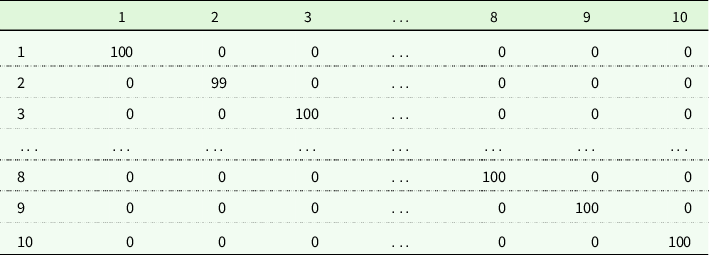
Consider a society with 10 rich players and one poor bystander.Footnote 21 Each player has to choose an integer from 1 to 10. If all of them do not choose the same integer each gets a payoff of 0 dollars. If all choose the same integer they are paid as follows. If the integer chosen is 2, they all get 99 dollars each. Otherwise they get 100 dollars each. In this game, there are exactly 10 equilibria, where the players earn a positive amount of money, since any integer chosen by all players is an equilibrium, and in such an equilibrium they all earn either $99 or $100. Let me call each of these equilibria a ‘good equilibrium’. Of no consequence here but it is worth noting that the game has other equilibria. Any choice of integers such that less than 9 players choose the same integer is also a Nash equilibrium. In such a situation all players earn 0 and there is nothing anyone can do individually to earn more.
Clearly, what the players will want is to converge on a good equilibrium – that is, have all of them choose the same integer. Of course, $100 would be ideal but $99 is not bad, and both much better than 0. But with so many good Nash equilibria which one will actually happen? In fact, there is a question as to whether a good equilibrium will happen at all, because players may fail to coordinate.
An intriguing answer can be constructed using an argument by Thomas Schelling in his seminal Reference Schelling1960 book. Schelling realized that while there is no ‘hard’ answer to questions of this kind involving multiple equilibria, there is an intuitive answer, based on human psychology, which is quite compelling. This is best understood by looking at the payoff matrix of the game just described. A truncated version of the game is shown in Table 3. This is a 2-player version of the above 10-player game. If both choose 2, they get $99; if both choose some other number but the same they get $100. If they choose different numbers they get 0.
A Coordination Game

All players want to choose the same integer, since any mismatch will mean they will all get 0. But how will they coordinate (no conversation is allowed)? One way to do so is to look for something ‘salient’ in one of those many equilibrium points. If there is a salient outcome and you have a strong hunch that the other players will also consider this salient, you would go for the salient outcome and hope that so will all others. That is the idea behind the concept of ‘focal point’.
It is a powerful, if mysterious, idea rooted in humanity’s common psychology. In the game just described, one choice by all players is special – the choice of 2. This is the only outcome where you are paid differently. You get 99. Everywhere else you get 100. It is likely that all players will realize this. So this is what you will go for and hope that so will the others.
It may be pointed out that this is a rather unusual focal point. It is the lower payoff that makes it salient. But most players will feel that a one dollar loss in order to be able to coordinate is well worth it. In other words, if this game were to be played in a laboratory, I feel confident, that virtually all players will choose 2.
Now suppose, with the waving of a magic wand, all the players become utilitarian. So they aggregate everybody’s payoff and try to maximize that. Let us also suppose (a matter that was nobody’s concern earlier in the selfish society) that this society has a poor bystander, whose payoff is as follows. If all 10 players choose 2, he gets 11; if all choose 9, he gets 0; and for all other choices by the players he gets 1.
It is now easy to see that a new unanimity game emerges. The reader may wish to write up a payoff matrix, such as in Table 3, for this new game. If all players choose the same integer and the integer is different from 9, the payoff (the aggregate dollar earnings or aggregate utility) is 1001. If all players choose 9, the payoff is 1000. If all players do not choose the same integer the payoff is 1.
What will be the outcome in this game of utilitarians? By creating a payoff matrix like in Table 3 it becomes obvious that one strategy – every player choosing 9 – is salient. This is the only Nash equilibrium with a different payoff. It is safe to predict that all players will choose 9, since, as before, not being able to coordinate leads to a disastrous outcome. In other words, while as selfish players they were choosing 2 where aggregate welfare was 1001, now, after they turn utilitarian and want to maximize aggregate welfare, they choose 9 and aggregate welfare drops to 1000.
The byproduct of this argument is that the bystander earns the lowest conceivable utility, namely, 1 dollar, by virtue of the players turning moral. This is a very different argument from the one used in section 2 but, in essence, it is the same. It shows that players turning moral can prompt group immorality.
In closing, I should mention that the use of focal points is often contested by economists. The reason why they reject it is, their argument that anything that cannot be formally defined should be rejected. I would however argue that it is this argument that ought to be rejected.
The importance of focal points in real-life is ubiquitous. We use it all the time. Consider a group of friends, who want to meet on a Sunday. Each has to choose a time to show up in the park. All they want is for all of them to be there at the same time. This is a game full of Nash equilibria. Any time, chosen by all, is a Nash equilibrium. We usually solve such problems by someone saying, ‘Since we are indifferent about when we meet, I suggest we meet at 6 pm’. All players nod, and leave. This interaction (the announcement and the nods) does not change the game and hence the Nash equilibria of the game. What it does is it creates a focal point. Everyone knows that everyone else will come to the park at 6 pm and everyone shows up at 6 pm. Indeed, a major purpose of language is to create focal points in order to solve coordination problems.
Of course, the idea of focal point has its fragilities, and we should be aware of it. In the above game, the focal point emerges by looking at the final payoffs (the aggregation of everybody’s utility). But all players can also see the components of this aggregate payoff. And this may make different players believe in different ‘focal points’, which basically means there is no focal point. In short, there is no surefire way of knowing what is a focal point. We may need laboratory experiments to get a sense of what players do focus on and what kinds of outcomes are likely to be focal.
Further, it has been shown, for instance, that when the salience of the focal point derives from the labels used for the strategies, its definition can be fragile with respect to minor changes in payoff descriptions (Crawford et al. Reference Crawford, Gneezy and Rottenstreich2008). There are also less-scholarly examples of the failure of language to create focal points, such as when in an Indian television serial a group of friends in Bombay talk about going from Bombay to Goa. The next day at the designated time some of them arrive at the railway station, bags in hand, while others arrive at the cinema showing the popular Bollywood film, Bombay to Goa.
5. The meaning of a game
Bringing game theory to help understand the challenge of group morality has the advantage of imposing a certain discipline on the discourse. The point is made strongly by Nguyen (Reference Nguyen2019). Game theory compels us to a precision that we may otherwise lack. Nguyen makes this out to be an advantage and, indeed, that is the spirit in which this paper has been written. I want, however, to close with a word of warning. All disciplines and, in fact, all discourse use explicitly stated assumptions or axioms, but they cannot avoid using implicit, unstated assumptions. What makes this a challenge is that those engaged in the discourse are often not even aware of them.
But before getting into that, let me ask what is the upshot of the discussion thus far (based on the previous four sections) concerning group moral responsibility? I believe we should recognize the fact that there are some bad group behavioural outcomes for which no moral responsibility can be attributed to anyone. Such a conclusion hurts us because most of us have an instinct whereby we like to apportion blame. But it would be folly to deny that there are collectively committed bads for which we have no option but to treat them like earthquakes or meteor hits. We can lament the outcome but cannot apportion blame on anybody. In brief, some collective human behaviours are morally akin to natural calamities where no one has a hand. If the Samaritan’s Curse was truly a ‘game of life’ (Binmore Reference Binmore1998), which describes the ultimate game with no restrictions on individual choice beyond what arises from the laws of physics (Mailath et al. Reference Mailath, Morris and Postlewaite2017), then the two players and the bystander would be the only three persons on the planet, playing exactly the game described, with no other actions available to anyone. And in that case the outcome described in section 2 would be a foregone conclusion.
However, it will be equally wrong if we reacted to all bad group outcomes with resignation, treating them like meteor hits. After all, even with the Samaritan’s Curse we know that the three persons in that society are not the only ones involved. The writer of this paper and the readers engaged in discussing the problem and trying to devise solutions are a part of a larger game. This is in some ways contradictory. To describe a game of life and then talk about some characters who are not a part of the game and can come out with a solution amounts to describing the undescribable.
What I would argue is that this is an unavoidable problem of all theory. Some of our problems and paradoxes arise from assumptions that are hidden in the woodwork. There are everyday examples of this. Consider the case where your dinner host asks you if there is something you do not eat, and you say, ‘Just crab’. Then at the party your host serves you a block of wood and you realize that the implicit universal sets in your heads, when you said that crab is the only thing you do not eat, were different. While to some this may appear to be a point of logical nitpicking that we cannot imagine happening in reality, if we replace ‘block of wood’ with ‘grasshoppers’ or ‘dog meat’ we can visualize actual scenarios where this happens.
A stark example of this comes from geometry. Euclid developed geometry laying out the axioms carefully. But there was at least one assumption that he was, in all likelihood, not even aware of. The assumption was that the entire exercise was being done on a 2-dimensional plane. His axioms (at least some of them) would not work if the same exercise was being done on a sphere, like the earth. It was the realization of this assumption in the woodwork in the 18th century that triggered the development of non-Euclidean geometry.
In all of economics, from general equilibrium theory to game theory, we start by specifying a feasible set of actions open to individuals. Thus in neoclassical equilibrium models we assume that, given the prevailing prices of goods and services, consumers can buy whatever their incomes allow. The set of all the things they can buy with their income is their ‘feasible set’. Some conservative economists point out that as long as individuals are left free to choose from this set without anybody else, such as the government, placing restrictions on their choice, society will achieve optimality. What they do not realize is that when we talk of all the things that consumers can do in neoclassical economics, we have already slipped in many assumptions without stating them and often without being aware of them. Thus we do not start our analysis by assuming that the feasible set of actions open to consumers includes punching another consumer on the nose and running out of the store without paying. Indeed, if all these options were there to choose from, freedom to choose anything would typically not lead to an optimal outcome. The central result of neoclassical economics would then cease to be valid. This deep and unwitting use of norms and customary restrictions on individual choice is only now beginning to be recognized in economics (see Basu Reference Basu2010b; Richter and Rubinstein Reference Richter and Rubinstein2020). This is a method that opens up a large research agenda.
In game theory too we begin by specifying the set of all the actions available to each individual. This is made explicit in the important concept of the game of life. But, as we know from the occurences of certain paradoxes in philosophy, there is no such thing as the set of everything. Analysts solve the problem by artificially restricting the set of all the things that each person can do. It is important to realize that the set of all the actions open to a player is an analyst’s construct. We agree for the sake of discourse to limit ourselves to that pre-specified set, while being aware that there are other elements beyond this set, since there is no such thing as the set of everything.
Let us return to the Samaritan’s Curse. Here each agent is assumed to choose from among A, B and C. In reality, an agent can also get up and say, ‘I propose that, since we are both moral creatures, we make an agreement to play A and not veer from that’. Or, one player can make it clear that if the other player does not play A, she will punch the other player on the nose. Whether or not this will have any effect on actual play is an open question, but the point is, in standard game theory, we do not allow such actions, which lie outside the feasible set. There are also those outside of the game analysing it, who could say this is how we should hold the players responsible, so that they change their behaviour, which makes these outsiders a part of a larger game.
Opening up these avenues of interaction can open up the possibility of achieving a morally good outcome. That, in turn, creates novel ways to hold individuals morally responsible for immoral outcomes. When we see the bad outcome, (C, C), occur in the Samaritan’s Curse, some of us argue that the players are responsible for this brutish behaviour. Why could neither of them show a little leadership and say that, since they both want to help the poor bystander, they should choose A and violators will be punished?
Economists and philosophers proposing such a resolution are often unaware that they are stepping beyond the game they began with, since they are proposing that the players should do what was never a part of the game. This tension of describing the game of life, specifying everything a player can do, and then saying that there is something else the player ought to do is a contradiction. But this may be the only way out of the problem of moral attribution in games such as the Samaritan’s Curse. This is a seemingly contradictory suggestion, at least at this stage of our knowledge. What we need to do is to try and unearth some of the hidden assumptions of game theory, which would allow us to legitimately deal with more open-ended alternative possibilities which we as individuals have in reality, and which can solve the problem of moral creatures leading society to immoral outcomes.
Acknowledgements
This paper began as an informal talk in the Philosophy Department of Cornell University, and developed as versions of it were later presented at a game theory conference in IIT Bombay, a conference in honour of Jorgen Weibull at the Stockholm School of Economics, and the Moral Psychology Brown Bag at Cornell. I also benefited from my seminar and discussions as part of the Hamburg Lecures in Law and Economics. I would like to thank Richard Ashley, Abhijit Banerjee, Chris Barrett, Karna Basu, Larry Blume, Matthew Braham, Tad Brennan, Utteeyo Dasgupta, Avinash Dixit, Robert Duval, James Foster, Meir Friedenberg, Nicole Hassoun, Karla Hoff, Rachana Kamtekar, Peter Katzenstein, Theodore Korzukhin, Rajlakshmi Mallik, Ajit Mishra, Diganta Mukherjee, Derk Pereboom, Ariel Rubinstein, Sudipta Sarangi, Eric Van Damme and Joseph Zeira. For extensive comments which helped me with the final round of revision, I am grateful to Frederik Van De Putte, and Itai Sher, in his capacity as editor, and two anonymous referees of the journal.
Kaushik Basu is Professor of Economics and Carl Marks Professor of International Studies at Cornell University, and President of the International Economic Association. He was formerly Chief Economist and Senior Vice President of the World Bank. URL: kaushikbasu.org