INTRODUCTION
Surprisingly, given the ubiquity and scale of central authority regimes in modern societies, little is known about how the opportunity to communicate might impact their effectiveness. Central authority institutions monitor behavior and enforce established rules. The rules, established through a political process, specify which behavior warrants sanction and the level of the punishment. Whether or not individuals have an incentive to alter their behavior depends on the probability that a violation is observed and on the magnitude of punishment. The central authority is said to be deterrent when the expected cost of a violation is greater than the expected benefit (Becker, Reference Becker1968; Ehrlich, Reference Ehrlich1996; Polinsky and Shavell, Reference Polinsky and Shavell1979; Stigler, Reference Stigler1970).
In public good games (PGGs), greater deterrence has been shown to significantly increase contributions (Kamei et al., Reference Kamei, Putterman and Tyran2015; Markussen et al., Reference Markussen, Putterman and Tyran2013; Tyran and Feld, Reference Tyran and Feld2006).Footnote 1 As discussed below, in the central authority described here, there exists a monitoring and sanctioning mechanism outside of the group. In stark contrast, one can consider a peer punishment mechanism that allows subjects to impose a fine, for a fee, on other group members after observing their behavior.Footnote 2
Since the pioneering work of Elinor Ostrom and her colleagues, a significant amount of research has been dedicated to investigating the effectiveness of peer punishment within social dilemmas (Ostrom et al., Reference Ostrom, Walker and Gardner1992). In the common pool resource (CPR) games devised by Ostrom et al., peer punishment enhanced cooperation; however, once the costs of punishment were accounted for, overall earnings were lower than in the “no-punishment” condition (Ostrom et al., Reference Ostrom, Walker and Gardner1992).
Within the linear public goods literature it has been shown that the induced level of cooperation can be sufficient to overcome the cost of punishment (Fehr and Gächter, Reference Fehr and Gächter2000; Gächter et al., Reference Gächter, Renner and Sefton2008; Chaudhuri, Reference Chaudhuri2011).Footnote 3 However, like Ostrom et al. (Reference Ostrom, Walker and Gardner1992) it is not uncommon to observe the benefits of peer punishment be negated by excessive, misplaced, or anti-social punishment (Herrmann et al., Reference Herrmann, Thöni and Gächter2008). Subjects in PGGs appear to recognize this and when given the opportunity to determine who among them can be punished, groups never allow the punishment of high contributors (Ertan et al., Reference Ertan, Page and Putterman2009). Overall, the literature suggests that the positive impacts of peer punishment are not robust and are unlikely to solve complex social dilemmas observed in the field.
Relative to peer punishment mechanisms, central authority institutions have both advantages and disadvantages. One advantage is that the rules can remove the possibility that cooperative behavior is punished. Just as is the case with peer punishment, when given the opportunity to vote on the parameters of a central authority, subjects never voted to punish cooperative behavior (Putterman et al., Reference Putterman, Tyran and Kamei2011). Another advantage is that it solves a potential second-order free-riding problem where group members refrain from punishing free-riders (Sigmund et al., Reference Sigmund, De Silva, Traulsen and Hauert2010).Footnote 4
On the other hand, one significant disadvantage is that, unlike peer punishment, which is only costly when used, central authority regimes are costly regardless of observed behavior. For example, consider how speed limits are enforced. Groups at some level (town, county, or state), decide to collectively fund a police force to monitor the behavior of drivers. Regardless of behavior, deploying police officers is costly. Again, the literature suggests that groups understand this trade-off and self-impose peer punishment whenever the central authority imposes a modest fixed cost (Markussen et al., Reference Markussen, Putterman and Tyran2013; Kamei et al., Reference Kamei, Putterman and Tyran2015).
Beyond the role of institutions, researchers have also investigated the impact of communication on cooperation. While the importance of communication in establishing cooperation is intuitive, standard economic theory predicts that non-binding communication will have no impact on behavior (Olson, Reference Olson1965). However, communication has been shown to have strong, and robust, positive effects on the level of cooperation in social dilemmas (Sally, Reference Sally1995). While the reasons for communications’ success remain debated there is largely consensus around two prominent mechanisms: fostering group identity and eliciting credible commitments to cooperate (Mendelberg, Reference Mendelberg2002; Bicchieri, Reference Bicchieri2002).
In the CPR games devised by Ostrom et al. (Reference Ostrom, Walker and Gardner1992), the combination of communication and peer punishment most effectively increased earnings. Ostrom et al. (Reference Ostrom, Walker and Gardner1992) find that this combination was effective because communication allowed groups to develop, and credibly commit to, welfare-improving strategies that enhanced cooperation and reduced the instances of misplaced punishment.Footnote 5 In the public goods literature, the interaction of communication and peer punishment has been shown to be similarly effective (Bochet et al., Reference Bochet, Page and Putterman2006).
In the design implemented here, the deterrence is manipulated by altering the probability that the central authority observes a subject’s contribution, holding the magnitude of punishment constant. The fixed cost of the central authority increases with the level of deterrence. Thus, there is an incentive to maintain cooperation at low levels of deterrence in order to reduce the fixed cost of the central authority.
Across three treatments, described below, we investigate the impact of communication when the level of monitoring is exogenously imposed and when the level of monitoring is endogenously chosen. Our first result is straightforward, when the level of monitoring is exogenously imposed communication increases average contributions sufficiently to increase average earnings.
Our main contribution is to investigate the impact of communication when the level of monitoring is endogenously selected. With the opportunity to communicate groups practically eliminate monitoring (self-imposing a low cost, non-deterrent, central authority) while maintaining cooperation. In contrast, in the absence of communication, groups maintain cooperation by self-imposing a costly, deterrent, central authority. Overall, average earnings are significantly higher with communication than without.
Analysis of the chat transcripts suggests that coordination of an unanimous agreement to cooperate underlies the effectiveness of communication. We speculate that allowing groups to discuss the social dilemma may enable them to develop Horizontal Trust among themselves in a way consistent with the social connectedness that builds social capital (Coleman, Reference Coleman1993; Putnam, Reference Putnam1995; Scholz and Lubell, Reference Scholz and Lubell1998). Social capital is thought to constrain self-interest, reducing the cost of monitoring and enforcing contracts making groups less dependent on formal institutions. Here, communication makes groups less dependent on costly, institutional deterrence. This allows groups to benefit from the rules-based central authority while mitigating the fixed costs associated with it.
EXPERIMENTAL DESIGN
Each treatment consisted of 25 periods broken into three phases. Instructions were distributed at the beginning of each phase and required subjects to correctly answer a set of comprehension questions before the experiment would continue.Footnote 6 Groups of five subjects were randomly formed and maintained for all 25 periods. Phase 1 (periods 1–3) introduced a standard linear public good with the following payoffs:
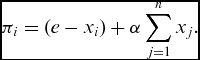 $$\begin{equation}
\pi _i=(e-x_i)+\alpha \sum _{j=1}^{n} x_j.
\end{equation}$$
where e = 20 was the subject’s endowment, x i the subject’s contribution, and α = 0.4 the marginal per capita return (MPCR) from the group account. With α < 1 < nα and a known last period, the game has a unique Nash equilibrium in which every subject free-rides, but group earnings are maximized only when every subject contributes their entire endowment.
In phases 2 and 3, a central authority was introduced with the following payoffs:
 $$\begin{equation}
\pi _i=(e-x_i)+\alpha \sum _{j=1}^{n} x_j-\frac{mz}{n}-ps(e-x_i),
\end{equation}$$
where the expected number of subjects monitored, z ∈ {0, 1, 2, 3, 4, 5}, determined the probability of being observed, p = z/n. This probability was independent for each group member. The fixed cost to monitor a single group member, m = 5, was distributed across all group members, so that each of the five group members paid 1 Experimental Dollar (ED) for each member expected to be monitored. For example, if z = 2, then each group member paid 2 EDs and faced a 40% chance of having their contribution monitored.
The level of the sanction, s = 1, was held constant, such that a group member who was monitored would be punished according to how many EDs remained in their private account, (e − x i). A participant who contributed their entire endowment could not be punished (i.e. even if monitored, 1 × (20 − 20) = 0), while a free-rider may not be punished in the event that their contribution was not observed. To illustrate, consider again the speed limit example. A driver obeying the speed limit may very well be observed by the police but will pay no fine while a speeding driver may also avoid paying a fine if the behavior is not observed by the police.
With s, n, and α held constant, solving the first-order condition with respect to x i expresses the relationship between the expected cost of free-riding, ps, and the benefit, 1 − α. Solving for z, reveals that the expected cost is greater than or equal to the benefit (and assuming risk aversion that the institution is deterrent) when z ∈ {3, 4, 5}. Similarly, when z ∈ {1, 2} the institution is non-deterrent, and at z = 0 no institution is implemented.
In phase 2 (periods 4–15), in all treatments, each level of monitoring, z, was exogenously imposed in two cycles.Footnote 7 Prior to making their contribution decisions each subject was informed about the expected number of group members to be monitored (z). In each phase 3 period (periods 16–25), in all treatments, the monitoring level was endogenously determined. Subjects voted individually for their preferred level of monitoring and the median of their 5 votes was implemented during that period.Footnote 8 Once determined, the level of monitoring was reported to each subject prior to their contribution decision, just as in phase 2.
The only manipulation across treatments was whether, and if so when, groups were able to communicate. Communication took the form of open-ended anonymous chat-room discussions. They were told that they could discuss the decision they faced within the experiment. Each chat-room discussion lasted up to one minute although if all group members agreed they were able to exit the chat-room early.Footnote 9 They were not allowed to identify themselves, use offensive language, or make threats of any kind.
In our baseline treatment, referred to as NoComm, no communication was allowed at any time and the game proceeded just as described above.Footnote 10 The second treatment, referred to as Phase2Comm, allowed group members to communicate before making their contribution decisions during phase 2 (when the level of monitoring was exogenously imposed). All other aspects of Phase2Comm were identical to NoComm. Therefore, during phase 3 of Phase2Comm subjects voted on the level of monitoring without the opportunity to communicate.
The third treatment, referred to as Phase3Comm, allowed group members to communicate before voting on the level of monitoring during phase 3 (when the level of monitoring was endogenously determined). Immediately after the discussion ended, each group member would vote for their preferred level of monitoring just as subjects in the other treatments did. For all periods through the end of phase 2, Phase3Comm and NoComm were identical.
Hypotheses
Communication is thought to promote cooperation within social dilemmas by either fostering group identity or eliciting credible commitments (Mendelberg, Reference Mendelberg2002; Bicchieri, Reference Bicchieri2002). Fostering group identity suggests that through communication subjects effectively internalize the groups’ welfare as their own. In the context of PGGs this implies that subjects prefer to contribute because doing so increases group earnings. Support for the group identity mechanism stems from research suggesting that communication enhances cooperation only when the group unanimously agrees, suggesting that it is the commitment to group identity that alters behavior (Orbell et al., Reference Orbell, Van de Kragt and Dawes1988). Other researchers question the importance of group identity and focus on the capacity of communication to elicit credible commitments to cooperate (Kerr and Kaufman-Gilliland, Reference Kerr and Kaufman-Gilliland1994). For example, fostering group identity, by itself, did not enhance cooperation but communication concerning the social dilemma promoted cooperation by creating a perceived consensus to cooperate (Bouas and Komorita, Reference Bouas and Komorita1996).
Understanding the impact of communication is important because behavior, within the context of central authority regimes, has been shown to depend not only on the objective level of deterrence. Research suggests that trust, both in government and in others, significantly increases tax compliance (Scholz and Lubell, Reference Scholz and Lubell1998). Of particular interest here is what Scholz and Lubell (Reference Scholz and Lubell1998) refer to as Horizontal Trust or, trust among citizens. Scholz and Lubell (Reference Scholz and Lubell1998) use American tax return data, tax policies, and surveys to examine taxpayers’ behaviors and perceptions. They measured how citizens’ subjective perceptions of the threat of being audited as well as their sense of duty (i.e. group identity (Scholz and Pinney, Reference Scholz and Pinney1995)) determined taxpaying behaviors. Their research suggests that individuals’ perceptions of monitoring probability were inflated by a sense of obligation to the group that was associated with greater trust among citizens.
The argument in this literature is that trust among citizens can reduce the need for costly monitoring and punishment. In a broader context, the horizontal trust provided by communication may enable groups to build social capital. Social capital captures the stock of social norms, networks of civic engagement, and the trustworthiness that defines a society or group (Coleman, Reference Coleman1993). Social capital is thought to constrain self-interest, reducing the cost of monitoring and enforcing contracts making groups less dependent on formal institutions. Communication may therefore underlie the trust and social connectedness that allows groups to sustain cooperation for mutual benefit (Putnam, Reference Putnam1995).
Hypothesis 1 With the opportunity to communicate, average contributions will be greater when the level of monitoring is exogenously imposed.
During phase 2, the level of monitoring is exogenously imposed. The only decision made by subjects is how much of one’s endowment to contribute. Groups in linear PGGs, even in the absence of any institutional constraints on behavior, successfully maintained cooperation when allowed to communicate (Bochet et al., Reference Bochet, Page and Putterman2006).
Hypothesis 2 With the opportunity to communicate, the average level of monitoring will be lower when the level of monitoring is endogenously selected.
Our second hypothesis represents our main contribution. During phase 3, the level of monitoring is endogenously selected. Welfare improving cooperation requires that groups agree to limit the level of monitoring while maintaining a high level of contributions.
RESULTS
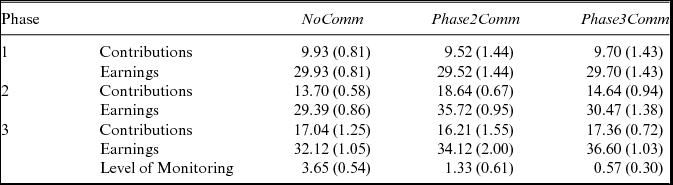
One hundred five subjects (21 groups of 5) participated in the experiment with 8 groups in NoComm, 6 in Phase2Comm, and 7 in Phase3Comm. The Phase2Comm and Phase3Comm treatments were collected at the Cleve E. Willis Experimental Economics Laboratory at the University of Massachusetts Amherst in December 2015.Footnote 11 The experiment lasted approximately 75 min and subjects earned an average of 412 EDs ($20.60). Average contributions and earnings in each phase, expressed in EDs, across each treatment are presented in Table 1. The table also displays the average level of the monitoring selected in phase 3. Contributions and earnings in phase 1 across treatments are statistically indistinguishable (KW: p = 0.89).Footnote 12
Contributions, Earnings and Monitoring across Treatments
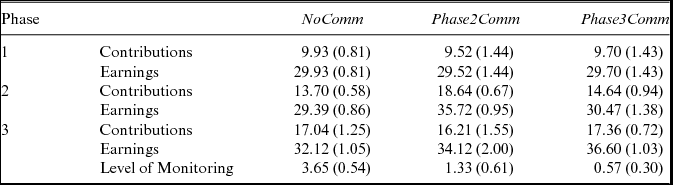
Note. Average contributions and earnings, expressed in EDs, in each phase across treatments. Average level of monitoring in phase 3 is also reported.
Standard errors, reported in parentheses, are calculated at the group level.
Communication and Exogenous Deterrence
In this section, we report on hypothesis 1 by comparing average contributions, within the phase 2 periods, across treatments. Recall that through phase 2 the NoComm and Phase3Comm treatments were identical. Not surprisingly, average contributions (NoComm v. Phase3Comm) are statistically indistinguishable overall: 13.70 vs. 14.64 (WRS: p = 0.36). Therefore, in what follows, the data is analyzed across Phase2Comm and the pooled (NoComm and Phase3Comm) data.Footnote 13 Our first result supports hypothesis 1.
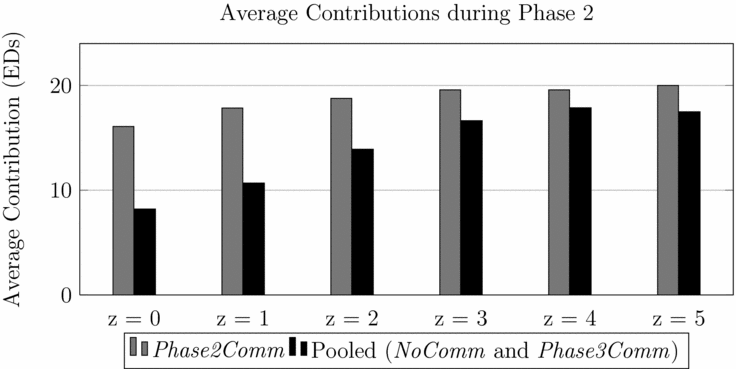
Result 1 The opportunity to communicate significantly increases average contributions overall and at each level of monitoring during phase 2 (when the level of monitoring is exogenously imposed).
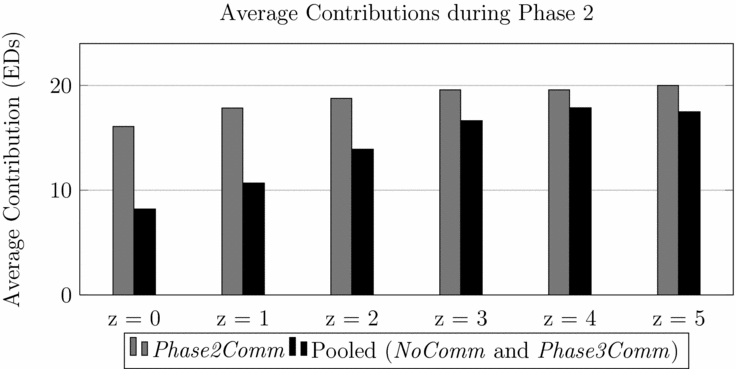
Figure 1 displays the average contributions in phase 2 at each level of monitoring. Average contributions are significantly higher, without regard to the level of monitoring, with communication (Phase2Comm) than without communication (Pooled): 18.64 vs. 14.13 (WRS: p < 0.01). This relationship holds at each level of monitoring: Level 0 (16.08 vs. 8.21 (WRS: p < 0.01)), Level 1 (17.85 vs. 10.69 (WRS: p < 0.01)), Level 2 (18.77 vs. 13.91 (WRS: p < 0.01)), Level 3 (19.58 vs. 16.64 (WRS: p < 0.01)), Level 4 (19.58 vs. 17.87 (WRS: p < 0.01)), and Level 5 (20.00 vs. 17.49 (WRS: p = 0.02)). While intuitive it is worth noting that the largest effects of communication are found at the non-deterrent levels of monitoring.
Average contributions at each level of monitoring in phase 2 across Phase2Comm and the Pooled (NoComm and Phase3Comm) treatments.
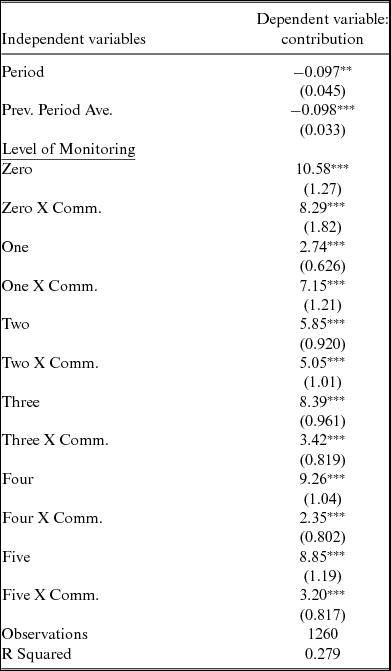
These non-parametric results are confirmed in the subject random effect model presented in Table 2. The dependent variable is the observed contribution for each subject. The independent variables include the level of imposed monitoring, z, interacted with the an indicator for Phase2Comm. The model also controls for time effects (period) and for the average group contribution on the previous period. The error terms are clustered at the group level to allow correlation within groups but not across.
Contributions during Phase 2
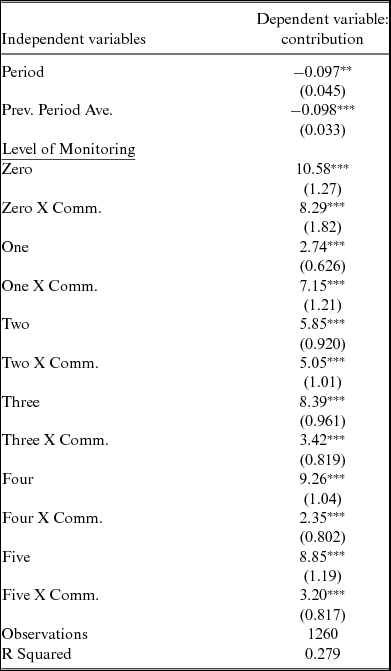
Note. Subject random effect model. Robust standard errors, clustered at group level, are reported in parentheses. Marginal effects of interaction terms reported.
**p < 0.05 and ***p < 0.01
Both period and previous group contribution are negative suggesting that contributions tend to decrease across periods and in response to the declining contributions of the group. The marginal effects of communication at each level of monitoring are reported in Table 2. Results suggest that at each level of monitoring communication significantly increases contributions.
The increase in contributions observed in Phase2Comm is sufficiently large to significantly increase average phase 2 earnings: 35.72 vs. 29.90 (WRS: p < 0.01). These results suggest that communication allows groups to successfully coordinate on a welfare improving increase in contributions when the level of monitoring is exogenously imposed.
Communication and Endogenous Deterrence
In this section, we report on hypothesis 2 by comparing the average level of self-imposed monitoring, within the phase 3 periods, across NoComm and Phase3Comm. Our second result supports hypothesis 2.
Result 2 The opportunity to communicate significantly lowers the average level of self-imposed monitoring during phase 3 (when the level of monitoring is endogenously selected).
Groups in NoComm, on average, self-impose a deterrent central authority where 3.65 group members are expected to be monitored. On the other hand, groups in Phase3Comm, on average, self-impose a non-deterrent central authority where only 0.57 group members are expected to be monitored. This difference is statistically significant (WRS: p < 0.01).Footnote 14
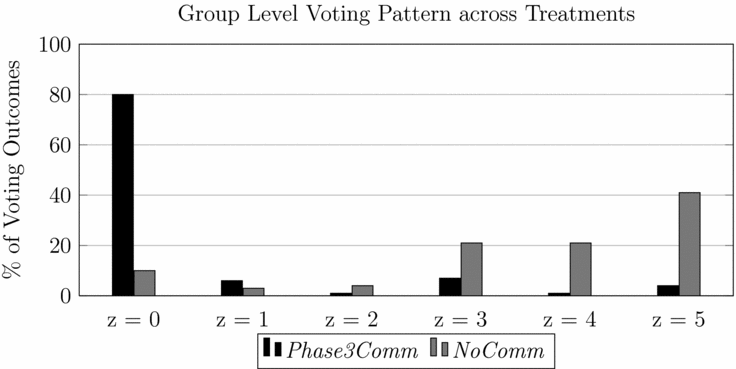
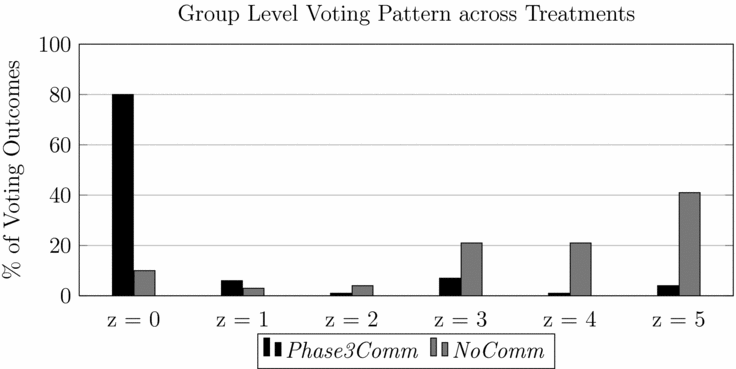
Figure 2 depicts the percentage of group level votes resulting in each level of monitoring across treatments. With communication (Phase3Comm), 80% (56 of the 70) group level votes resulted in no monitoring. Without communication (NoComm), only 10% (8 of 80) group level votes resulted in no monitoring. At the other extreme, only 4% of group level votes resulted in complete monitoring in Phase3Comm, while 41% of votes did so in NoComm. Overall, groups in Phase3Comm and NoComm self-impose non-deterrent levels of monitoring on 87% and 17% of occasions, respectively.
Percent of group level votes at each level of monitoring across Phase3Comm and NoComm. The total number of group level votes in Phase3Comm and NoComm is 70 and 80, respectively.
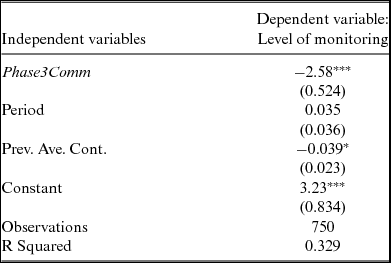
Again, these results are confirmed in a subject random effect model with the error terms clustered at the group level. In Table 3, the dependent variable is the subject’s choice of monitoring level. The model includes an indicator variable for the Phase3Comm treatment, controls for time effects (period), and the average group contribution on the previous period. Results suggests that the opportunity to communicate enables groups to significantly reduce the level of monitoring. The average group contribution in the previous period is negative and significant suggesting that as average contributions increase groups tend to reduce monitoring.
Level of Monitoring during Phase 3
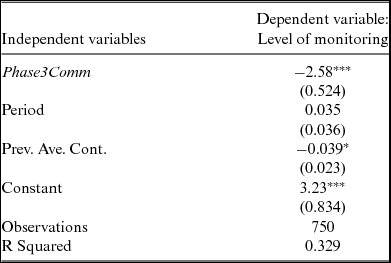
Note. Subject random effect model. Robust standard errors, clustered at group level, are reported in parentheses.
*p < 0.1, *** p < 0.01
Importantly, average contributions (NoComm vs. Phase3Comm) are statistically indistinguishable: 17.05 vs. 17.36 (WRS: p = 0.64)). In the absence of communication, groups willingly self-impose a deterrent level of monitoring. Doing so enables them to maintain high contributions but is costly. With communication, groups are able to coordinate the reduction of costly monitoring to non-deterrent levels while maintaining equivalently high contributions. As a result, average earnings during the phase 3 periods in Phase3Comm are significantly greater than those observed in NoComm: 36.60 vs. 32.12 (WRS: p = 0.03).Footnote 15
Analysis of Communication
Transcripts of the chat discussions allow us to investigate the underlying, although non-causal, mechanisms leading to cooperation. Using the literature as a guide, chat categories (discussed below) were created to capture the prominent mechanisms thought to enhance cooperation. Once the chat codes were created, two undergraduate students were recruited to independently analyze the chat transcripts. They were asked to look at each group-period as a single observation and to determine which of the provided categories the discussion fit best. To obtain a conservative estimate, chat categories were only deemed “present” if both coders independently agreed.Footnote 16
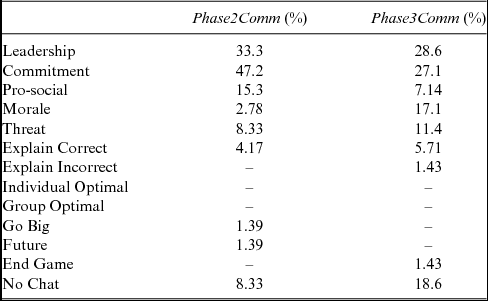
In our analysis only 6 chat categories were prevalent, the others were either never coded or were only observed during one group-period discussion (Table 4). Here, we summarize the most prevalent chat categories. Leadership implies that a group member proposed a specific course of action and was able to elicit positive responses from each group member. Importantly, this suggests that the agreement was unanimous. Following recent research investigating strategic thinking within PGGs we code Leadership as time-invariant (Cox and Stoddard, Reference Cox and Stoddard2017). That is, if unanimous agreement was reached we assumed that it had long lasting effects and coded Leadership as present for all periods within the relevant group.Footnote 17 On the other hand, Commitment suggests that group members signaled a willingness to cooperate but there lacked a leader and/or unanimous consensus. We code these as contemporaneous implying that such discussions have, if any, short lived effects on behavior. Pro-Social/Group Identity captures the idea that group members appear to interpret the incentives from the groups’ perspective. That is, rather than behave in their own self-interest the group expresses a desire to behave in the group’s interest.
Prevalence of Chat Categories
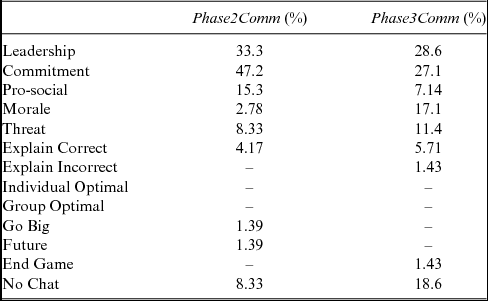
Note. Percent of group-period observations coded.
There are 72 (70) group-period observations in Phase2Comm (Phase3Comm).
The Morale/Congrats category suggests that group members expressed positive statements concerning previous cooperation. Similarly, the Anger/Frustration/Threats category suggests that group members expressed negative statements concerning previous behavior. As the name suggests, the Explaining Correct category means that group members correctly discussed the incentives within the game.
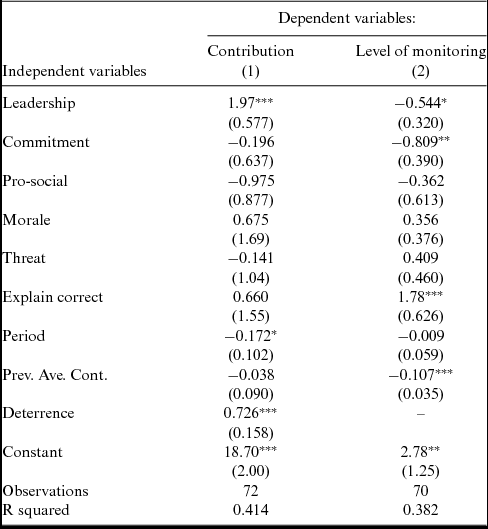
To investigate the relationship between the content of group discussions and behavior, two random effect models are presented. For the Phase2Comm (Phase3Comm) data the dependent variable is the average group contribution (average level of monitoring). Both models include the 6 relevant chat categories, control for time effects (period), and the average group contribution on the previous period. Additionally, the Phase2Comm model includes the level of monitoring as a control. Recall that the unit of observation for each chat-code is a group-period; as such, there are 72 and 70 observations in Phase2Comm and Phase3Comm, respectively. Group random effects are used to account for the repeated observations at the group level.
Column (1) in Table 5 displays the results for the Phase2Comm data. The only chat category that is significant is Leadership suggesting that groups benefiting from coordinated, unanimous agreement, contribute significantly more. Period is negative suggesting that contributions tend to decrease over time. As expected, contributions rise with the level of monitoring. Column (2) in Table 5 displays the results for the Phase3Comm data. In this case, Leadership and Commitment both reduce the average level of monitoring. Also, when the incentives within the game were correctly explained, groups tended to increase the level of monitoring. Last, there is an inverse relationship between the average contribution in previous periods and the level of monitoring.
Analysis of Communication
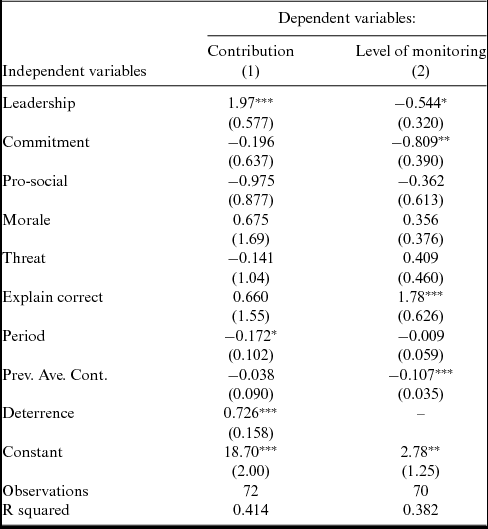
Note. Group random effect models. Standard errors reported in parentheses
*p < 0.1, ** p < 0.05, *** p < 0.01
In summary, the impact of communication is consistent with the related literature. Communication is effective when groups perceive that a consensus to cooperation has been established (Bouas and Komorita, Reference Bouas and Komorita1996). Leadership has a robust and positive relationship with cooperation in both models suggesting that unanimity is important (Orbell et al., Reference Orbell, Van de Kragt and Dawes1988). On the other hand, Commitment has a positive relationship with cooperation only in Phase3Comm suggesting that non-unanimous, more contemporaneous, signals of commitment have less effect on what groups perceive as consensus. Further, it does not appear that group identity, by itself, has a significant effect on cooperation. The Pro-Social/Group Identity category is insignificant in both treatments.
DISCUSSION AND CONCLUSION
In the central authority investigated here, the deterrence is manipulated by altering the probability that the central authority observes a subject’s contribution. The magnitude of punishment is held constant so that the fixed cost of the central authority increases with the level of deterrence. Thus, there is an incentive to maintain cooperation at low levels of deterrence in order to reduce the fixed cost of the central authority.
When given the opportunity to communicate groups are able to coordinate and commit to welfare improving behavior. When the level of monitoring is endogenously selected, communication allows groups to practically eliminate monitoring. In contrast, without the opportunity to communicate groups willingly self-impose a deterrent level of monitoring. Groups in both treatments induce and maintain cooperative levels of contributions. However, by significantly lowering the level of costly monitoring groups with the opportunity to communicate earn significantly more.
Analysis of the chat transcripts suggests that leadership and the coordination of unanimous agreement to cooperate underlie the effectiveness of communication. This is important as it suggests communication is one way that groups, and societies, can benefit from a rules-based central authority while mitigating the fixed costs associated with it.
Recall that one advantage of central authority is that it avoids the potentially anti-social punishment associated with peer punishment (Herrmann et al., Reference Herrmann, Thöni and Gächter2008). However, the disadvantage is that regardless of behavior, central authority regimes impose a cost on the group. By effectively eliminating monitoring while maintaining cooperation, communication makes the groups less dependent on institutional deterrence.
This is consistent with literature suggesting that social capital makes societies less dependent on formal institutions to induce cooperation (Coleman, Reference Coleman1993). Specifically, communication may enable groups to develop Horizontal Trust among themselves in a way consistent with the social connectedness that builds social capital (Scholz and Lubell, Reference Scholz and Lubell1998; Putnam, Reference Putnam1995). More speculatively, this research suggests that open societies that freely allow their citizens to communicate may have an advantage over less open, authoritarian, societies. For example, open societies may provide higher levels of public goods through central authority institutions at significantly lower cost because there is less need to monitor behavior.
APPENDIX
Each undergraduate research assistants was given the following menu of chat categories. They were asked to treat each group-period discussion as a single observation and to indicate whether they thought the discussion met the criteria below.
• Leadership
A group member proposes a specific course of action and explicitly elicits an affirmative response from each of the other group members (unanimous agreement). This might be a contribution amount like How about we all contribute 20 or a level of monitoring How about we monitor 0.
• Commitment
Group members state what they intend to do: I will contribute 20 or I will vote for 0 monitoring. This may also simply indicate a course of action such as Contribute 20 or Monitor 0.
• Pro-Social/Group Identity
Group members discuss behavior from the perspective that it is good for the group: We should put in 20 because it is good for the group or We should monitor 0 and contribute 20 because the group will make the most.
• Morale/Congrats
Group members express positive statements concerning previous rounds where the group cooperated and/or encourage future cooperation: Nice job guys or lets do it again.
• Anger/Frustration/Threats
Group members express negative statements concerning previous rounds: Who went cheap or We were doing so well, come on guys. These statements might involve threats to increase monitoring: If we cant all contribute we will have to start monitoring.
• Explaining Incorrect
Group members incorrectly discuss the incentives of the game.
• Explaining Correct
Group members correctly discuss the incentives of the game.
• Individual Optimal
Group members incorrectly believe that it is in their self-interest to allocate 20 regardless of whether others contribute. The group members do not understand (or at least do not express an understanding) that it is in their self-individual interest to keep their EDs.
• Group Optimal
Group members incorrectly believe that it is in their own self-interest to allocate 20 conditional on positive allocations from other group members. The group members do not understand (or at least express an understanding) that it is in their self-individual interest to keep their EDs.
• Go Big
Group members state that they should allocate 20 for the heck of it without any rationale or that they should monitor 0 or 5. They appear to focus on the endpoints without a particular reason.
• Future
Group members discuss strategy heading into future periods implying a concern for maintaining cooperation. Groups members state that continuing to contribute in current periods will encourage contributions in future periods: Lets keep contributing, if we start putting in 0 everyone will and we will not make money or everyone keep putting in 20, dont start being cheap now.
• End Game
Group members state a belief that as they approach the end of game behavior might change, typically towards contributing less: The game is almost over, lets keep putting in 20.
• No Chat
Nothing was discussed.
SUPPLEMENTARY MATERIALS
To view supplementary material for this article, please visit https://doi.org/10.1017/XPS.2017.33