Introduction
As AD research focuses increasingly on prevention, early detection and timely treatment, interest in the identification of at-risk individuals is intensifying. The concept of aMCI as a risk and prodromal state for AD has been well established for several years, and there is now growing interest in an even earlier preclinical stage.
The Petersen's criteria for a diagnosis of mild cognitive impairment (MCI) are: (i) a memory or other cognitive complaint, preferably corroborated by an informant; (ii) objective memory or cognitive deficits; (iii) normal general cognitive function and; (iv) intact activities of daily living (Petersen et al., Reference Petersen, Stevens, Ganguli, Tangalos, Cummings and DeKosky2001). aMCI is a subtype of MCI where the deficit is primarily in episodic memory and is a high-risk state for AD, with an annual conversion rate of 10–15% (Petersen et al., Reference Petersen, Stevens, Ganguli, Tangalos, Cummings and DeKosky2001). Given that both subjective memory complaints and impaired episodic memory are present in aMCI, it is plausible that there may be a distinct, earlier clinical stage where subjective memory complaints exist in the absence of detectable objective cognitive deficits. This may represent the clinical manifestation of a disease stage where early neuropathological damage is offset by compensatory mechanisms.
The terminology between studies varies but an increasingly accepted term is SCI (Gauthier et al., Reference Gauthier2006; Reisberg and Gauthier, Reference Reisberg and Gauthier2008). In the present study, SCI was defined as: (i) subjective memory deficit that is perceived by the participant as persistent and concerning; (ii) absence of objective cognitive impairment (performance on neuropsychological testing within 1.5 SD of expected mean for age and education) and; (iii) absence of physical or mental illness accounting for the perceived deficit.
Evidence regarding the association between subjective memory complaints and objective cognitive deficits is somewhat conflicting. Several studies of without dementia older adults have identified a positive association (Gagnon et al., Reference Gagnon1994; Jonker et al., Reference Jonker, Launer, Hooijer and Lindeboom1996; Jessen et al., Reference Jessen2007) but others have not (Oconnor et al., Reference Oconnor, Pollitt, Roth, Brook and Reiss1990; Dik et al., Reference Dik2001; Jungwirth et al., Reference Jungwirth, Fischer, Weissgram, Kirchmeyr, Bauer and Tragl2004). Of note, none of these studies excluded patients with MCI. If SCI represents a disease stage where objectively normal cognition is maintained by compensatory mechanisms, a correlation between perceived and objective performance would not necessarily be expected. There is some evidence that subjective memory complaints increase in the prodromal stages of AD (Lehrner et al., Reference Lehrner2014).
The majority of longitudinal community-based studies of subjective memory complaints in older adults without dementia have demonstrated an association with either incident dementia (Schmand et al., Reference Schmand, Jonker, Geerlings and Lindeboom1997; Palmer et al., Reference Palmer, Backman, Winblad and Fratiglioni2003; Wang et al., Reference Wang2004; Kim et al., Reference Kim, Stewart, Kim, Yang, Shin and Yoon2006), AD (van Oijen et al., Reference van Oijen, de Jong, Hofman, Koudstaal and Breteler2007) or cognitive decline (Dik et al., Reference Dik2001; Jorm et al., Reference Jorm, Christensen, Korten, Jacomb and Henderson2001; Dufouil et al., Reference Dufouil, Fuhrer and Alperovitch2005), although some have not observed any association (Jorm et al., Reference Jorm, Christensen, Korten, Henderson, Jacomb and Mackinnon1997; Mol et al., Reference Mol, van Boxtel, Willems and Jolles2006). A recent meta-analysis showed that patients with SCI and no cognitive deficits were twice as likely to develop MCI or dementia compared to persons without SCI (Mitchell et al., Reference Mitchell, Beaumont, Ferguson, Yadegarfar and Stubbs2014). A study of memory clinic samples found high rates of incident MCI and dementia in cognitively normal memory clinic patients who were followed longitudinally (Reisberg et al., Reference Reisberg, Shulman, Torossian, Leng and Zhu2010). However, not all patients with MCI progress to dementia. Studies based on community samples show lower rates of progression from MCI to dementia than clinic-based studies (Mitchell and Shiri-Feshki, Reference Mitchell and Shiri-Feshki2009). However, some patients with MCI revert to normal although this is less likely with increasing age (Gao et al., Reference Gao2014).
Rationale and aims
Current evidence supports the concept of a preclinical and prodromal phase of AD where pathological and functional imaging changes are present in the brains of asymptomatic individuals. SCI may represent the earliest point on the continuum of clinical Alzheimer's symptomatology. A better understanding of the baseline characteristics of this group of patients may enhance our knowledge of the underlying disease processes, facilitate early diagnosis, appropriate follow-up and treatment. The aim of this study was to investigate which factors at the baseline predict cognitive decline defined as a progression to aMCI or dementia at follow-up.
Methods
This was an exploratory observational study examining baseline variables that predict which patients with SCI will have declining cognition at subsequent memory clinic assessments. This study examined the database records and case notes of patients diagnosed with SCI between 2001 and 2007. Only patients with a longitudinal follow-up were included. All patients were assessed and followed-up in a National Health Service Memory Clinic in North Essex, UK.
All patients received a standard memory clinic assessment at each visit. This included a full medical and psychiatric history, mental state examination and physical examination. Scales performed were the Clinical Dementia Rating (CDR; range 0–3; (Morris, Reference Morris1993)); the rating of severity of physical illness (range 0–3); the Unified Parkinson Disease Rating Scale part III (UPDRS; range 0–112; (Fahn and Elton, Reference Fahn, Elton, Fahn, Marsden, Calne and Goldstein1987)); and Modified Hachinski score (range 0–11). Patients with significant depressive or anxiety symptoms fulfilling ICD-10 diagnosis of a mood disorder or a neurotic, stress-related and somatoform disorder were excluded.
Cognitive testing included the National Adult Reading Test for verbal IQ (NART; range 70–127; (Nelson and Wilson, Reference Nelson and Wilson1991)) performed at baseline visit only, CAMCOG-R (range 0–105; (Roth et al., Reference Roth, Huppert, Mountjoy and Tym1999)) (subscales: orientation, language comprehension, language expression, remote memory, recent memory, new learning, attention/calculation, praxis, abstract thinking, and perception), Wechsler Memory Scale (third edition abbreviated) Logical Memory Test (immediate and delayed recall percentiles; WMS LMT (Wechsler, Reference Wechsler1997)), Mini-Mental State Examination (MMSE; range 0–30; (Folstein et al., Reference Folstein, Folstein and Mchugh1975)) and tests of executive function (TMTs, category-, letter-, and ideational-fluency).
Following neurocognitive testing a consensus diagnosis was reached at a multidisciplinary team meeting involving old age psychiatrists, a clinical psychologist, and a memory clinic nurse. aMCI was diagnosed according to Petersen et al.'s criteria (Petersen et al., Reference Petersen, Stevens, Ganguli, Tangalos, Cummings and DeKosky2001) as outlined in the introduction, with the additional criterion of a CDR score equal to 0.5. Patients with aMCI were offered annual review appointments in the memory clinic; patients with SCI were offered two-yearly appointments.
All patients on the database with a diagnosis of SCI were included (n = 63). Scores from the WMS LMT (immediate and delayed) were examined for each patient to ensure that results were not below 1.5 standard deviations of the norm expected for age. One patient with SCI was excluded on this basis.
Patients with SCI were judged to have declined if, at a subsequent memory clinic assessment, their diagnosis changed to aMCI or dementia. Some were unstable over a number of years which was incompatible with the binary variable of decline (yes or no). Such cases were re-examined and the last diagnosis was compared to the first to determine if there was a decline.
Statistical analysis
SPSS for Windows 19 was used for the analysis. Baseline demographics and test scores were compared between decliners and non-decliners using Mann–Whitney U-tests for continuous variables and χ2 for categorical data. A Kruskall–Wallis test for non-parametric data was performed on variables of interest. The variables we chose were number of prescribed drugs for physical illnesses, severity of patients’ physical illnesses, age at baseline assessment, age at onset of symptoms, systolic blood pressure sitting and standing, Hachinski score, score on the motor scale of the UPDRS, score on the NART, MMSE score, CAMCOG-R score and all subscales separately, all scores of WMS LMT, FAS fluency score, Category Fluency score (animals), TMT A and B scores in seconds and ideational fluency. Cox regression survival analyses were performed with number of months from baseline to decline or from baseline to final assessment at which decline had not occurred as the time variable. The covariate was any variable found to differ at baseline between the groups.
Ethical approval
The necessary ethics committee approval was sought from the NRES committee for East of England – Essex 1. The favorable opinion of the committee was secured for this study under reference 08/h0301/43.
Results
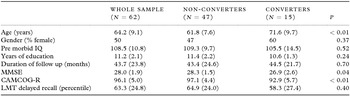
Baseline and follow-up data were available for 62 patients with SCI (31 male, 31 female). Mean follow-up duration was 44 months (range 12–112 months). Fifteen (24%) SCI patients declined during the period of follow-up (11 to aMCI, 2 to MCI and then on further follow-up to dementia, and 2 to dementia without MCI stage). Table 1 describes the sample characteristics.
Sample characteristics

Mean (Standard Deviation; p values compare Non-Decliners to Decliners and are taken from Mann–Whitney U-tests except for the categorical variable gender tested using χ2). LMT = Logical Memory Test; CAMCOG-R = Cambridge Cognitive Examination-Revised; MMSE = Mini-Mental State Examination.
Patients that declined were taking more medications for physical illnesses at baseline, (χ2(1) = 6.7, p = 0.01). They were older by 9.8 years (M = 71.6 years compared to M = 61.8 years; χ2(1) = 11.9, p < 0.01) and reported that the onset of their memory problems was 10.3 years later than those that did not decline (M = 68.9 years, compared to M = 58.6 years; χ2(1) = 10.1, p < 0.01). The mean score on MMSE was lower for those who declined than those who did not (χ2(1) = 4.0, p = 0.04). The mean overall score on the CAMCOG-R at baseline was lower for those that declined (χ2(1) = 7.75, p < 0.01) with the difference evident on the attention subscale (χ2(1) = 4.91, p = 0.03). The baseline performance on TMT-B was 46 seconds slower for patients who declined than for those who did not (M = 115.7 vs. M = 69.7; χ2(1) = 4.44, p = 0.04). There were no significant differences between the groups on any of the other baseline variables. In order to test whether group differences on TMT-B and CAMCOG-R were due to the older baseline age of converters, we entered age at onset and TMT-B, and age at onset and CAMCOG-R into cox regression survival analyses with follow-up time in months as the time variable and outcome as converter or non-converter. Worse performance on TMT-B and CAMCOG-R were associated with subsequent decline even when controlling for age (TMT-B: HR, 1.02, 95% CI 1.01–1.03, p = 0.003; and CAMCOG-R: HR, 0.85, 95% CI 0.77–0.94, p = 0.002).
A Cox regression survival analysis of binary decline in cognitive abilities was performed. The time variable was the number of months from baseline to diagnosis of MCI or dementia. Participants that did not decline, were censored and, for these, the time variable was length of follow-up. Two of the four patients diagnosed with dementia transitioned through an MCI phase. Therefore, for those two patients we used MCI as the outcome measure. The other two patients diagnosed with dementia did not transition through MCI and therefore the diagnosis of dementia was the outcome. The variables found to differ between groups at baseline were entered as categorical covariates individually. The data were split at the median to dichotomize into two groups. It was not possible to dichotomize MMSE, CAMCOG-R attention subscale or number of medications since a large proportion of the participants fell on the median. These variables were therefore not analyzed for survival.
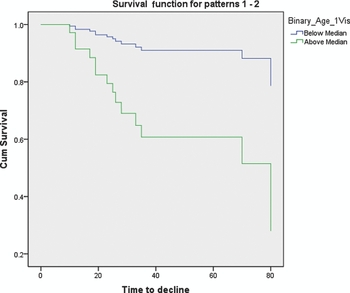
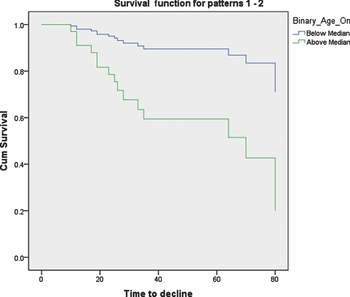
Those presenting at the memory clinic under 61 years old were less likely to decline cognitively (hazard ratio (HR), 0.19, 95% confidence interval (CI) 0.04–0.85, p = 0.03; Figure 1). Persons whose memory problems onset was before 60 years old were less likely to decline cognitively (HR, 0.21, 95% CI 0.06–0.76, p = 0.02; Figure 2). Persons with a baseline CAMCOG-R score lower than 98 had a trend for an increased risk of decline but it did not reach significance (HR, 2.81, 95% CI 0.77–10.18, p = 0.12). There was no significant difference between persons scoring low or high on TMT B (HR, 0.72, 95% CI 0.23–2.23, p = 0.57).
Time to decline for persons above and below 61 years of age at baseline.

Time to decline for persons above and below 60 years of age at onset.

Discussion
We found that all patients presented to the clinic 2–3 years after the perceived onset of their problems, but those who were likely to decline were older by almost 10 years. Age was a strong predictor of decline, particularly being over 61 years when seeking help. From the point of view of a practicing clinician the message is clear: patients with SCI younger than 61 years are less likely to decline. This supports the hypothesis that SCI in persons over the age of 61 years may represent a prodromal stage of AD.
Although there was a significant difference on the CAMCOG-R score between converters and non-converters, even the mean converters’ baseline CAMCOG-R score of 93 is well within normal with traditionally the cut-off for dementia being a score of 80/81. A similar observation was made by Reisberg et al. (Reference Reisberg, Shulman, Torossian, Leng and Zhu2010) who also found that converters had a lower MMSE at baseline than converters, but that the score was still well within normal limits. Reisberg et al. (Reference Reisberg, Shulman, Torossian, Leng and Zhu2010) explain the relatively high score of converters by the unusually high educational attainment of their cohort, but this does not apply to the present cohort whose educational attainment is representative of the UK population. A recent meta-analysis (Mitchell et al., Reference Mitchell, Beaumont, Ferguson, Yadegarfar and Stubbs2014) of SCI and the risk of MCI and dementia did not stratify patients by age and therefore could only show that SCI overall is a risk factor for subsequent decline without being able to relate this to age at baseline.
Patients who declined were, on average, 46 sec slower at completing the TMT B at baseline. This executive function test requires intact working memory to (a) encode the novel rule about switching sets and (b) to remember which number/letter you are on in order to determine the next move. This result suggests that there should be more clinical and research emphasis on assessing executive functioning in patients with SCI.
In a study of aMCI, executive functioning was found to be more sensitive to conversion to AD than memory deficits over a one year period (Rozzini et al., Reference Rozzini2007). In our study, worse performance on TMT B was associated with subsequent cognitive decline in people with SCI. We also replicated the findings of Reisberg et al. (Reference Reisberg, Shulman, Torossian, Leng and Zhu2010) which showed that patients with SCI that declined were older and had a lower MMSE score at baseline than non-decliners. However, the mean difference in MMSE score between decliners and non-decliners was small in both our and Reisberg et al.’s (Reisberg et al., Reference Reisberg, Shulman, Torossian, Leng and Zhu2010) study.
The strengths of this study include the representative memory clinic sample, prospective acquisition of the data, in-depth assessment of patients and consensus diagnosis. A further strength was that we specifically defined SCI patients as persons with no objective cognitive deficit on standardized neuropsychological tests. The mean length of follow-up was nearly four years and patients with anxiety or depressive symptoms were excluded.
The limitations of this study include a lack of autopsy confirmation of follow-up diagnoses, the variable length of follow-up, and the self-selected nature of memory clinic attenders who may not represent the general population. A study by van Harten et al. (Reference van Harten2013) found that CSF biomarker evidence of preclinical AD in patients with SCI predicted cognitive decline over time. No CSF or imaging biomarkers were available in the present study.
Conclusion
Patients with SCI, by definition, have no cognitive deficit. However, in this sample there were differences at baseline between patients that declined cognitively and those that did not. The best predictors of conversion were late age at presentation and onset of symptoms, and poorer performance on CAMCOG-R and TMT B. Knowing which demographic factors and test results predict conversion to MCI or dementia is beneficial for early detection and treatment.
Conflict of interest
None.
Description of author's roles
JR and ZW initiated the study and contributed to the concept of the paper. JASF was responsible for initial statistical analyses and wrote the first draft of the paper with RD. Data acquisition was performed by JR, CN, and RD under the supervision of ZW. All authors (JASF, RD, JR, TW, CN, KS, TS, ZW) contributed to interpretation of the data and drafting/revising the manuscript for content. ZW and TW performed additional statistical analyses and wrote the final draft of the manuscript which was approved by all authors.
Acknowledgments
The authors thank Mr Robert Blizzard, statistician at University College London, for initial advice on the statistical aspects of the project. RD's and TW's posts were funded by the UK National Institute for Health Research.