Partial hospitalization programs (PHPs), which offer a crucial intermediate level of treatment for individuals referred from either outpatient or inpatient settings, are effective in reducing acute mood symptoms; however, residual symptoms at discharge are common and may put individuals at higher risk for relapse (Björgvinsson et al., Reference Björgvinsson, Kertz, Bigda-Peyton, Rosmarin, Aderka and Neuhaus2014; Kallert et al., Reference Kallert, Priebe, McCabe, Kiejna, Rymaszewska, Nawka and Schützwohl2007). Indeed, many individuals will end up being re-hospitalized within 2 years (with readmission rates ranging from 10–50% depending on populations studied; Marshall, Crowther, Sledge, Rathbone, & Soares-Weiser, Reference Marshall, Crowther, Sledge, Rathbone and Soares-Weiser2011). The highest risk of relapse occurs in the first weeks following the end of acute care (Vigod et al., Reference Vigod, Kurdyak, Dennis, Leszcz, Taylor, Blumberger and Seitz2013). Patients typically experience the transition from the highly structured and supportive environment provided by PHPs to unstructured daily life as challenging/abrupt and may have difficulty following up on outpatient treatment recommendations (Boyer, McAlpine, Pottick, & Olfson, Reference Boyer, McAlpine, Pottick and Olfson2000; Larivière, Desrosiers, Tousignant, & Boyer, Reference Larivière, Desrosiers, Tousignant and Boyer2010; Steffen, Kösters, Becker, & Puschner, Reference Steffen, Kösters, Becker and Puschner2009). Therefore, investigating how people fare in everyday life immediately after treatment ends – an important but understudied transition period – may be useful. Research examining everyday life experiences of recently discharged individuals can help identify contextual (e.g. life stress, social contact) and individual (e.g. behaviors) factors associated with improved mood (Johnson, Lundström, Åberg-Wistedt, & Mathé, Reference Johnson, Lundström, Åberg-Wistedt and Mathé2003; Kessler, Kendler, Heath, Neale, & Eaves, Reference Kessler, Kendler, Heath, Neale and Eaves1992; Lethbridge & Allen, Reference Lethbridge and Allen2008; Paykel, Reference Paykel1994).Footnote 1Footnote † Such research however requires the use of methods designed to reliably capture relevant day-to-day experiences in real-world contexts. The present study used ecological momentary assessment (EMA) to examine predictors of momentary affect during the 2 weeks following discharge from a PHP. EMA consists of repeated assessments designed to capture individuals' current (or very recent) thoughts, feelings, and behaviors in real-time and real-world environments, minimizing biases associated with retrospective memory recall and maximizing ecological validity (Ebner-Priemer & Trull, Reference Ebner-Priemer and Trull2009; Shiffman, Stone, & Hufford, Reference Shiffman, Stone and Hufford2008). We specifically examined the dynamic role of stressful events, social interactions, and therapeutic skills use in momentary positive affect (PA) and negative affect (NA) following discharge.
In nonclinical samples, experimental and EMA studies have shown that stress predicts increased NA, especially for older individuals and those high in neuroticism (e.g. Mroczek & Almeida, Reference Mroczek and Almeida2004; Suls, Green, & Hillis, Reference Suls, Green and Hillis1998; Zautra, Reich, Davis, Potter, & Nicolson, Reference Zautra, Reich, Davis, Potter and Nicolson2000; for a review see Finan, Zautra, & Wershba, Reference Finan, Zautra, Wershba, Contrada and Baum2011). In clinical samples, EMA studies have shown that individuals with depressive disorders experience less PA and more NA throughout the day than controls in general as well as in response to stressful events (aan het Rot, Hogenelst, & Schoevers, Reference aan het Rot, Hogenelst and Schoevers2012; Bylsma, Taylor-Clift, & Rottenberg, Reference Bylsma, Taylor-Clift and Rottenberg2011; van der Stouwe et al., Reference van der Stouwe, Groenewold, Bos, de Jonge, Wichers and Booij2019; Wichers et al., Reference Wichers, Myin-Germeys, Jacobs, Peeters, Kenis, Derom and Os2007). Thus, we hypothesized that higher momentary stress levels would predict lower PA and higher NA in the post-discharge period from a PHP.
Additionally, social isolation and/or conflict predicts deteriorated affect (Fuller-Tyszkiewicz, Karvounis, Pemberton, Hartley-Clark, & Richardson, Reference Fuller-Tyszkiewicz, Karvounis, Pemberton, Hartley-Clark and Richardson2017; Pemberton & Fuller Tyszkiewicz, Reference Pemberton and Fuller Tyszkiewicz2016; Snippe et al., Reference Snippe, Simons, Hartmann, Menne-Lothmann, Kramer, Booij and Wichers2016; Vranceanu, Gallo, & Bogart, Reference Vranceanu, Gallo and Bogart2009). For example, Brown, Strauman, Barrantes-Vidal, Silvia, and Kwapil (Reference Brown, Strauman, Barrantes-Vidal, Silvia and Kwapil2011) found that in a young adult sample, social isolation was associated with NA and depressive symptoms, whereas spending time with close ones was associated with improved affect. We therefore hypothesized that social contact, especially spending time with close ones, would predict improved affect (higher PA/lower NA) in our sample.
Finally, little evidence to date speaks to the immediate effects of therapeutic skills use in mood recovery. Adherence and engagement with skills practice typically predict enhanced treatment outcomes (Conklin & Strunk, Reference Conklin and Strunk2015; Kazantzis, Whittington, & Dattilio, Reference Kazantzis, Whittington and Dattilio2010), but this is generally only assessed using retrospective reports from patients or therapists (e.g. at the end of treatment, or since the last session) (Kazantzis, Deane, & Ronan, Reference Kazantzis, Deane and Ronan2004; Kazantzis, Brownfield, Mosely, Usatoff, & Flighty, Reference Kazantzis, Brownfield, Mosely, Usatoff and Flighty2017). Nonetheless, in a randomized controlled trial, Hoet, Burgin, Eddington, and Silvia (Reference Hoet, Burgin, Eddington and Silvia2018) assessed skills use twice a week using a phone-based system and found that on days on which participants reported greater use of therapeutic skills, they also reported improved mood and functioning. Thus, we hypothesized that therapeutic skills use would predict improved affect (higher PA/lower NA) in our sample.
The present study
The present study is (to the best of our knowledge) the first to use EMA to examine the daily experiences of individuals discharging from partial hospitalization, a transition that is typically experienced as challenging and presents significant risk for symptom relapse. This study assessed three main predictors of momentary PA and NA (stressful events, social contact, and therapeutic skills use) during a period of 2 weeks. Participants also provided daily depressive symptom reports. Based on previous findings in the literature, we tested the following hypotheses and exploratory aims: (a) lower momentary stress severity will be associated with higher PA and lower NA (we also explored whether stressor type mattered), (b) social contact (in particular, spending time with close ones) will be associated with higher PA and lower NA, and (c) using therapeutic skills will be associated with higher PA and lower NA (we also explored whether skill type mattered).
Method
Setting
Participants were recruited from a PHP located in a non-profit, private psychiatric hospital in New England. The PHP delivers group and individual therapy to patients experiencing a wide range of psychiatric conditions (primarily mood, anxiety, personality, and psychotic disorders). Treatment focuses on learning and practicing core cognitive-behavioral skills (CBT; Beck, Rush, Shaw, & Emery, Reference Beck, Rush, Shaw and Emery1979) such as behavioral activation and cognitive restructuring, as well as core dialectical behavior therapy skills (DBT; Linehan, Reference Linehan1993) such as mindfulness, distress tolerance, emotion regulation, and interpersonal effectiveness. In addition to individual and group therapy, patients work with a case manager and psychiatrist, who together coordinate treatment with other members of the treatment team including psychologists, nurses, counselors, and trainees. Treatment is tailored to the needs of each individual patient. Depending on symptom presentation, treatment may primarily focus on CBT or DBT skills, but most commonly integrates components of both modalities (for a review of the treatment approach, see Forgeard, Beard, Kirakosian, & Björgvinsson, Reference Forgeard, Beard, Kirakosian, Björgvinsson and Codd2018). Participants in this study received an average of 10.1 treatment days (s.d. = 1.4) at the PHP before discharge.
Participants
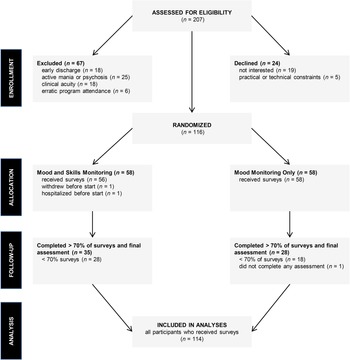
Participants were recruited via flyers and in person by a research assistant during their stay in the PHP between December 2016 and July 2017 (see Fig. 1 for a CONSORT diagram of participant flow including criteria for exclusion). A total of 114 individuals participated in the study. Prior to discharge from the PHP, participants met with the research assistant for a 30-min orientation session to review all procedures, download the smartphone app used in this study, and practice completing surveys.
CONSORT diagram detailing recruitment and enrollment of participants, as well as information about allocation of participants to group (mood and skills monitoring v. mood monitoring only), follow-up (whether participants completed >70% of surveys), and inclusion in statistical analyses.

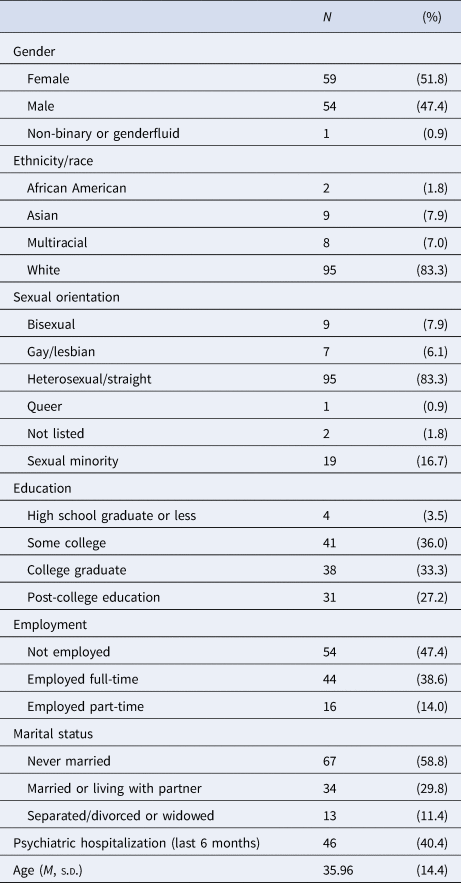
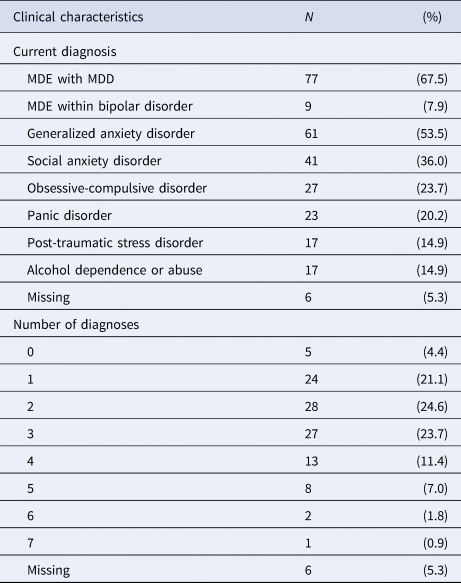
The 114 participants were 36 years old on average (s.d. = 14, range = 19–70). Most reported their ethnicity/race as White and non-Latinx (83%); about half (52%) reported their gender as female; 40% had been hospitalized for psychiatric reasons during the past 6 months. The most common current diagnosis in this sample was a major depressive episode in the context of major depressive disorder (68% of the sample) and most participants (69%) met criteria for two or more disorders (see Tables 1 and 2 for more detailed information).
Demographic characteristics for the sample (N = 114)

Clinical characteristics for the sample (N = 114)

MDE, major depressive episode; MDD, major depressive disorder.
Diagnoses were established using the Mini International Neuropsychiatric Interview for DSM-IV-TR (MINI; Sheehan et al., Reference Sheehan, Lecrubier, Sheehan, Amorim, Janavs, Weiller and Dunbar1998). Participants completed the MINI with a clinician at the beginning of treatment in the PHP (typically on their second day of treatment). The MINI has strong reliability and validity in relation to the Structured Clinical Interview for DSM-IV (SCID-IV), with inter-rater reliabilities ranging from kappas of 0.89–1.0 (Sheehan et al., Reference Sheehan, Lecrubier, Sheehan, Amorim, Janavs, Weiller and Dunbar1998). In this study, the MINI was administered by doctoral practicum students and interns in clinical psychology who received weekly supervision by a postdoctoral fellow. Training included reviewing administration manuals and completing mock interviews, as well as participating in bi-annual reliability ratings.
Materials and procedures
Participants completed surveys using MetricWire, a secure HIPAA-compliant smartphone app. All participants provided informed written consent for the study. All materials and procedures were reviewed and approved by the local Institutional Review Board.
EMA surveys
Participants completed EMA surveys four times a day for 14 days, at semi-random intervals between 10 am and 8 pm (separated by at least 2 h). Participants had up to an hour to answer each surveyFootnote 2 (see online Supplementary Materials for all EMA items).
Positive/negative affect (PA/NA). Participants reported how they felt right before they received the notification using six PA adjectives and six NA adjectives, on a 7-point Likert scale from 1 (not at all) to 7 (extremely). The adjectives were selected from existing self-report measures and previous EMA studies examining momentary affect (e.g. Bylsma & Rottenberg, Reference Bylsma, Rottenberg, Nyklicek, Vingerhoets and Zeelenberg2011; Peeters, Berkhof, Rottenberg, & Nicolson, Reference Peeters, Berkhof, Rottenberg and Nicolson2010; Watson, Clark, & Tellegen, Reference Watson, Clark and Tellegen1988). However, we modified existing scales for brevity (as the use of longer scales such as the PANAS was not feasible), and to include an equal number of activated (i.e. ‘excited,’ ‘energized,’ ‘active’), and deactivated (i.e. ‘calm,’ ‘peaceful,’ ‘relaxed’) PA states, as well as activated (i.e. ‘frustrated,’ ‘angry,’ ‘nervous’) and deactivated (‘bored,’ ‘sad,’ ‘tired’) NA states. Because traditional estimates of reliability are not appropriate for use in multilevel data such as the EMA reports collected in this study, we used a multilevel approach to examine reliability of the PA and NA scales used in the EMA surveys (Geldhof, Preacher, & Zyphur, Reference Geldhof, Preacher and Zyphur2014; Nezlek, Reference Nezlek2007; Nezlek & Gable, Reference Nezlek and Gable2001). Both estimates of between-person reliability (PA = 0.94, NA = 0.91) and within-person reliability (PA = 0.75, NA = 0.70) confirmed that these scales had adequate internal consistency.
Social contact and relationship type(s). Participants indicated how many people they were interacting with right before they received the notification using a 10-point dropdown menu (with 10 corresponding to 10 or more people) and selected relationship types using a checklist. We recoded relationship type into two binary variables for analyses (since multiple relationship types could be selected): close relationships (i.e. friends, romantic partners, or adult and child relatives) and non-close relationships (i.e. acquaintances, coworkers, strangers, or others).
Stressor severity and stressor type(s). Participants indicated whether they experienced a stressful event since the last notification. If they answered yes, they rated how stressful the event was from 1 (mildly) to 5 (extremely). A rating of 0 was entered when participants reported no recent stressor. They also indicated the type of stressful event experienced using a checklist. We recoded stressor type into two binary variables for analyses (since multiple stressor types could be selected): external stressors due to outside circumstances (i.e. interpersonal, financial, daily living, work-, school-, housing-related, or other) and internal stressors due to personal health factors (i.e. physical or mental health-related). Participants who experienced more than one stressful event since the last notification were prompted to base their answer on the most stressful event they experienced.
Skills use. Finally, half of participants indicated which skills they used since the last notification using a checklist of CBT and DBT skills. The skills listed form the basis of treatment PHP and we therefore expected that participants would be familiar with them. However, participants had access to very brief descriptions of each skill on the app for reference. We randomly assigned half of participants not to answer these items because answering questions about skills use could plausibly impart additional benefits and thus constitute an active intervention. Although we did not expect that such additional benefits would occur because participants did not receive any additional prompting to use skills in this very simple checklist, we still wanted to be able to compare individuals who did and did not answer this module to ensure that this component of surveys did not influence outcomes.
Daily depressive symptom measure
Participants completed the Patient Health Questionnaire-9 (PHQ; Kroenke & Spitzer, Reference Kroenke and Spitzer2002) to assess depressive symptoms over the past 24 h between 6 am–11 am every day for 14 days (participants had also completed this measure daily during the PHP). Participants were instructed to complete this measure as early as possible after waking up. Response anchors range from 0 (not at all) to 3 (nearly all the time). The PHQ-9 had high internal consistency in this study (day 1 α = 0.80). To encourage participation, participants viewed their PHQ-9 score every morning along with interpretation guidelines.
Compensation
Participants received $20 per week for completing any survey, with an additional $30 per week for completing at least 80% of surveys (up to $100 in total).
Data analytic strategy
We conducted analyses using SPSS 24 and Mplus 8 (Muthén & Muthén, Reference Muthén and Muthén2017).
Group comparisons
We examined whether answering questions about skills use was associated with different rates of survey completion using one-way ANOVAs. We also assessed whether groups differed on demographic or diagnostic characteristics as well as symptom severity at baseline. Finally, we used growth curve modeling (Grimm, Ram, & Estabrook, Reference Grimm, Ram and Estabrook2017) to verify that tracking skills did not impart additional benefits.
Preliminary analyses
We provide descriptive information about the percentage of surveys completed by participants. We also assessed whether demographic or diagnostic characteristics, as well as symptom severity on day 1 of the study were associated with survey completion using one-way ANOVAs and correlations.
Momentary predictors of positive/negative affect
Multilevel models tested whether momentary stress, social contact, and skills use related to PA and NA at each time point (concurrent analyses), as well as whether they also prospectively predicted PA and NA at the next time point, and vice-versa (lagged analyses). In addition to examining p-values and unstandardized B coefficients, we manually computed standardized β coefficients to aid with interpretation. In preparation for multilevel models, power analyses (as described by Bickel, Reference Bickel2007) showed that the required r to detect within-person effects of predictors on both PA and NA (n = 112) was 0.20. For skills (n = 55), the required r was 0.28. In other words, using a two-tailed α of 0.05, we had 80% power to detect small-to-medium within-person effects.
Results
Group comparisons
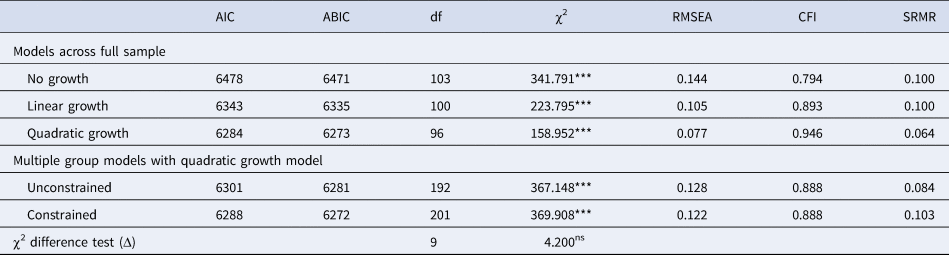
Groups did not differ on any baseline variables or the percentage of daily symptom surveys completed (all ps > 0.05). However, participants who tracked skills use completed more EMA surveys (M = 71%, s.d. = 23, n = 55) than those who did not (M = 60%, s.d. = 30, n = 57), F(1, 112) = 4.54, p = 0.035, Cohen's d = 0.40. Growth models showed that participants across groups overall experienced a small and decelerating increase in depressive symptoms after discharge as indicated by significant means for intercept (B = 7.30, s.e. = 0.49, p < 0.001), slope (B = 0.30, s.e. = 0.12, p = 0.01), and quadratic terms (B = −0.02, s.e. = 0.01, p = 0.02). Multiple group growth models confirmed that trajectories did not differ based on whether participants tracked skills use, Δχ2 (9) = 4.20, p = 0.90. Thus, we collapsed groups for our main analyses (see Table 3 for more information about these analyses).
Fit statistics for growth models characterizing depressive symptom trajectories, across the full sample and comparing participants who did or did not track skills use

AIC, Akaike Information Criterion; ABIC, sample size adjusted Bayesian Information Criterion; RMSEA, Root Mean Square Error of Approximation; CFI, Comparative Fit Index; SRMR, Standardized Root Mean Squared Residual.
We concluded that a quadratic growth model best described changes in PHQ-9 scores across the full sample based on lower AIC and sample-size adjusted BIC values and appropriate values for other fit statistics (RMSEA = or <0.08, CFI = or >0.90, SRMR = or <0.08; see Hu & Bentler, Reference Hu and Bentler1999; Kline, Reference Kline2005). We confirmed that trajectories did not differ between groups by comparing the fit of a constrained model (in which the means, variances, and covariances of the intercept, slope, and quadratic terms were set to be equal) to that of an unconstrained model (in which these freely varied by group).
***p < 0.001, ns = not significant.
Preliminary analyses
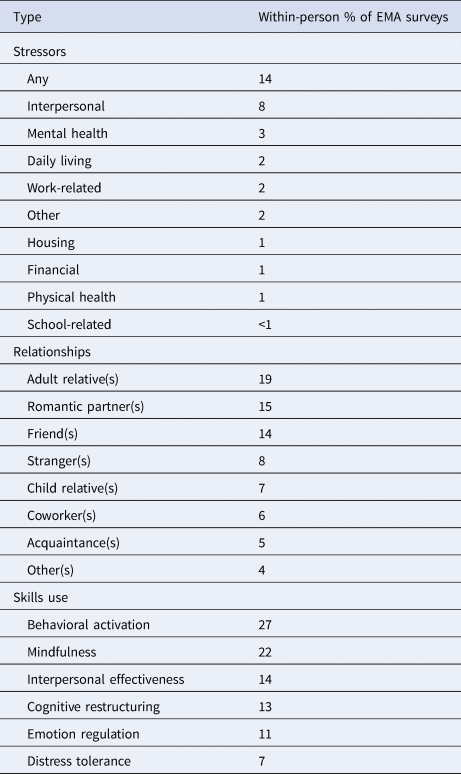
On average, participants completed 65% of EMA surveys (s.d. = 27, median = 75%) and 79% of daily symptom surveys (s.d. = 26, median = 89%). Age was correlated with the percentage of daily symptom surveys completed (r = 0.27, p = 0.004). No other baseline or diagnostic variables were associated with the percentage of EMA or daily symptom surveys completed (all ps > 0.05). Table 4 provides information about types of stressors, relationships, and skills use reported by participants.
Types of stressors, relationships, and skills use reported by participants

Concurrent associations between stress, social contact, skills, and affect
Stress and social contact (n = 112)
We built two multilevel models (using full information likelihood with robust standard errors) that included the following Level 1 within-person predictors of current PA or NA: recent stressor severity (0–5), recent internal stressor (binary), recent external stressor (binary), current social contact (number of individuals the participant was with), current close relationship (binary), and current non-close relationship (binary). As explained under Method, stressor and relationship types were not mutually exclusive, which is why we included two binary variables for each. All within person-predictors were person-centered, and the within-person slopes were allowed to vary between people (i.e. treated as random). At Level 2, we allowed all random slopes to covary. We also regressed the outcome on the between-person means of the within-person predictors. All between-person predictors were grand-mean centered. As a starting point, these concurrent models only examined associations between predictors and affect at the same time point (thus, they did not control for affect at the previous time point, a limitation addressed by lagged analyses).
Concurrent models showed that recent stressor severity was associated with lower PA (B = −0.16, s.e. = 0.03, β = −0.14, p < 0.001) and higher NA (B = 0.25, s.e. = 0.03, β = 0.22, p < 0.001). Being with close relationships was associated with higher PA (B = 0.23, s.e. = 0.04, β = 0.10, p < 0.001) and lower NA (B = −0.18, s.e. = 0.03, β = −0.07, p < 0.001). Social contact was associated with higher PA (B = 0.02, s.e. = 0.01, β = 0.04, p = 0.02)Footnote 3. None of the other within-person predictors were significant (all ps > 0.05; see online Supplementary Materials).
Skills use (n = 55)
We used the same approach to model concurrent relationships between recent use of three CBT (behavioral activation, exposure, and cognitive restructuring) as well as four DBT (mindfulness, distress tolerance, emotion regulation, and interpersonal effectiveness) skills since the last notification and PA/NA. The recent use of behavioral activation (B = 0.15, s.e. = 0.05, β = 0.05, p = 0.004) and interpersonal effectiveness (B = 0.25, s.e. = 0.06, β = 0.07, p < 0.001) were associated with higher PA, whereas the recent use of distress tolerance was associated with both lower PA (B = −0.21, s.e. = 0.09, β = −0.04, p = 0.03) and higher NA (B = 0.28, s.e. = 0.13, β = 0.06, p = 0.02). None of the other within-person predictors were significant (all ps > 0.05; see online Supplementary Materials).
Lagged associations between stress, social contact, skills, and affect
Stress and social contact (n = 112)
We built two cross-lagged models to determine whether stress and social contact at one time point (t) predicted PA or NA at the next time point (t + 1) (and vice-versa) while controlling for associations between each variable and itself at the next time point (autoregressions). To reduce model complexity, we restricted our model to the significant within-person relationships found in the concurrent models reported above. To do this, we specified three sets of paths. First, each variable at time t predicted itself at time t + 1. Second, variables at time t predicted PA/NA at time t + 1. Third, we included the reverse relationships with PA/NA at time t predicting the same variables at time t + 1. We used the LAGGED function in MPlus version 8 (Muthén & Muthén, Reference Muthén and Muthén2017) to conduct analyses using dynamic structural equation modeling (Asparouhov, Hamaker, & Muthén, Reference Asparouhov, Hamaker and Muthén2018), specifying the time interval (from t to t + 1) as 0.10 (which corresponds to 2.4 h, approximately the average amount of time between administration of daily EMA surveys in this study). Analyses used Bayesian estimation with 2000 iterations; person-mean centering was accomplished as part of model estimation. Again, between-person predictors were grand mean centered and each outcome was regressed onto the between-person means of the within-person predictors at Level 2. In addition, all variables and random slopes were free to covary.
Being with a close relationship at time t predicted increased PA at time t + 1 (B = 0.14, posterior s.d. = 0.05, β = 0.06, p = 0.004). PA at time t predicted social contact at time t + 1 (B = 0.34, posterior s.d. = 0.12, β = 0.17, p = 0.004). Recent stressor severity predicted NA at time t + 1 (B = 0.06, posterior s.d. = 0.02, β = 0.05, p = 0.02). NA at time t also predicted a lower likelihood of being with a close relationship at time t + 1 (B = −0.03, posterior s.d. = 0.02, β = −0.07, p = 0.04). None of the other within-person relationships were significant (all ps > 0.05; see online Supplementary Materials).
Skills use (n = 55)
We repeated the same models for skills use, again restricting our model to the significant within-person relationships found in the concurrent models (by only including behavioral activation, interpersonal effectiveness, and distress tolerance in the PA model, and distress tolerance only in the NA model). None of the lagged associations were significant (all ps > 0.05; see online Supplementary Materials).
Discussion
The present study is the first to use EMA to examine predictors of affective states during the high-risk period following discharge from partial hospitalization. Studying this population at this specific juncture is important because residual symptoms are common at discharge and the transition to outpatient care is generally experienced as abrupt and anxiety-provoking for patients, putting them at risk for relapse (Horvitz-Lennon, Normand, Gaccione, & Frank, Reference Horvitz-Lennon, Normand, Gaccione and Frank2001; Larivière et al., Reference Larivière, Desrosiers, Tousignant and Boyer2010). A strength of this study is that we examined both concurrent and lagged relationships between variables of interest, given that concurrent analyses preclude any inference regarding the directions of effects.
Our study yielded several findings regarding the immediate experiences of individuals discharging from partial hospitalization that may inform treatment. We found that recent stressor severity was associated with lower PA and higher NA at the same time point and also prospectively predicted higher NA during the next 2–3 h period. These findings are in line with previous research demonstrating that stress is related to everyday affect (especially NA) in clinical samples (aan het Rot et al., Reference aan het Rot, Hogenelst and Schoevers2012; Bylsma et al., Reference Bylsma, Taylor-Clift and Rottenberg2011). In the context of discharge from a PHP, these findings also suggest that preventing, anticipating, and/or being able to cope with stressful events constitutes an important target for intervention.
Second, we also found that spending time with close relationships (i.e. friends, romantic partners, and relatives) was associated with improved affect at the same time point, and prospectively predicted higher PA during the next 2–3 h period. Conversely, NA prospectively predicted a lower likelihood of spending time with close relationships (similar to the findings of Brown et al., Reference Brown, Strauman, Barrantes-Vidal, Silvia and Kwapil2011). Regardless of the type of social contact, PA prospectively predicted spending time with more people (though the corresponding effect was small, as a 3-point increase in PA out of 7 would be needed to translate into spending time with one additional person). Together, these findings are in line with the limited body of previous research showing that positive social interactions are associated with improved affect in everyday life contexts (Pemberton & Fuller Tyszkiewicz, Reference Pemberton and Fuller Tyszkiewicz2016). Thus, the quality (rather than quantity) of social interactions may be most likely to immediately influence affective states, though all effects found were small.
Finally, we found that the recent use of one specific CBT skill (behavioral activation) and one specific DBT skill (interpersonal effectiveness) was concurrently associated with PA. In contrast, the recent use of distress tolerance was concurrently associated with NA. However, the use of these skills did not prospectively predict affective states over the next 2–3 h period. These concurrent associations can be explained in multiple ways. First, it is possible that practicing behavioral activation and interpersonal effectiveness is beneficial, but effects are not long-lasting enough to be captured 2–3 h later. The core principle underlying behavioral activation is the idea that engaging in potentially rewarding activities improves affect (Martell, Dimidjian, & Herman-Dunn, Reference Martell, Dimidjian and Herman-Dunn2013). Interpersonal effectiveness skills may be especially useful given that interpersonal challenges were the most frequently endorsed type of stressor in this study. However, it is also possible that reporting high PA and low NA instead led participants to endorse having recently used these two skills, as the question about skills use followed affect items (e.g. when feeling good, participants may be more likely to post-hoc frame activities as behavioral activation, or interactions as interpersonal effectiveness). Similarly, individuals may be most likely to report using distress tolerance skills when they are in a bad mood (since distress tolerance is explicitly framed to address such situations).
The results of this study must be interpreted within the context of certain limitations. First, answers to EMA surveys are given via self-report and may therefore still be subject to biases (Shiffman et al., Reference Shiffman, Stone and Hufford2008). Furthermore, rates of survey completion were modest though comparable to previous reports in similar samples (e.g. Armey, Brick, Schatten, Nugent, & Miller, Reference Armey, Brick, Schatten, Nugent and Miller2018). Second, the brief assessments used in this study could not capture important variables (e.g. the number of individuals a participant was with may not reflect how actively or skillfully they interacted, and may also have a nonlinear relationship with outcomes, a hypothesis not tested here). Third, though we took care to rule out the possibility that answering questions about skills use specifically would impart additional benefits, engaging in self-assessment more broadly may have still influenced affect. Fourth, this study used a very simple checklist to track therapeutic skills use, which would not be suitable for participants not previously exposed to this information as part of treatment and did not capture skillfulness (Kazantzis et al., Reference Kazantzis, Brownfield, Mosely, Usatoff and Flighty2017). Related, the very brief definitions of skills provided as reminders did not capture the nuances necessary to their proper application. For example, the definition of behavioral activation, ‘I intentionally engaged in an activity (regardless of my initial level of motivation for this activity)’, did not include all features of this skill (as described by Martell et al., Reference Martell, Dimidjian and Herman-Dunn2013) and was specifically tailored to how behavioral activation is taught to individuals in an acute partial hospital setting who often do not derive immediate reinforcement from behavioral engagement. Fifth, additional studies using longer timeframes or multi-wave EMA designs are needed to determine whether findings generalize to time periods beyond the 2 weeks following discharge. Sixth, results from this study may not generalize to the experiences of participants discharging from other intensive treatment programs. Although our sample was transdiagnostic and high in severity and comorbidity (as is typical in PHPs), it was also limited in ethnoracial diversity and relatively high in education levels. Finally, we compensated participants in this study to minimize attrition and encourage consistent responding, which could have introduced a selection bias.
Despite these limitations, results from the present study provide a detailed examination of the daily experiences of individuals transitioning from partial hospitalization to outpatient care. Using EMA, we found that stressful events, social contact, and skills use were related to everyday affective states. Future work may expand on these findings to test other relationships (e.g. whether stress or social factors predict skills use) as well as indirect relationships. For example, social contact may be especially important for recovery after discharge insofar as it mitigates the experience of stress (Cohen & Wills, Reference Cohen and Wills1985). In keeping with growing interest in mobile health interventions (Myin-Germeys, Klippel, Steinhart, & Reininghaus, Reference Myin-Germeys, Klippel, Steinhart and Reininghaus2016; Schueller, Aguilera, & Mohr, Reference Schueller, Aguilera and Mohr2017), our results can also provide preliminary information to design ecological momentary interventions for the post-acute period to enhance recovery during the transition from hospital-based to outpatient care.
Supplementary material
The supplementary material for this article can be found at https://doi.org/10.1017/S0033291719004057.
Acknowledgements
We are very grateful to the staff and patients of the Behavioral Health Partial Hospital at McLean Hospital.
Financial support
We would like to thank McLean Hospital for the financial support provided for this project.
Conflict of interest
None.