Introduction
Water conservation is crucial to the ecological success of diverse insect taxa as well as terrestrial arthropods (Edney, Reference Edney1977; Hadley, Reference Hadley1994; Chown & Nicolson, Reference Chown and Nicolson2004). The ability to maintain water balance is associated with species distribution patterns (Willmer et al., Reference Willmer, Stone and Johnston2000; Rajpurohit et al., Reference Rajpurohit, Nedved and Gibbs2013). Insects can increase their desiccation resistance through three different avenues of water balance: higher bulk water, reduced rate of water loss and greater dehydration tolerance (Hadley, Reference Hadley1994; Gibbs et al., Reference Gibbs, Chippindale and Rose1997). Long-term desiccation-selected lines of Drosophila melanogaster have shown increased body mass, carbohydrate level and body water content (Gibbs et al., Reference Gibbs, Chippindale and Rose1997). However, in short-term selection experiments, there are no changes in body water content in desiccation-selected lines of D. melanogaster (Hoffmann & Harshman, Reference Hoffmann and Harshman1999). In contrast, storage of body water and carbohydrate content did not vary between xeric and mesic Drosophila species despite significant differences in desiccation resistance (Gibbs & Matzkin, Reference Gibbs and Matzkin2001). There is no consistent relationship between desiccation resistance and components of water balance (stored body water and dehydration tolerance) in wild versus laboratory selected as well as among different Drosophila species. Thus, mechanisms underlying evolution of desiccation resistance in diverse Drosophila species are likely to be multiple and complex.
Insects occupy a wide range of ecologically diverse niches and exhibit a variety of strategies to cope with desiccation stress. For Drosophila species, variation in desiccation resistance has been observed both at the inter- as well as intra-specific levels but most often such studies are based on laboratory-reared stocks (Gibbs & Matzkin, Reference Gibbs and Matzkin2001; Matzkin et al., Reference Matzkin, Watts and Markow2007) but data on wild populations of Drosophila species have received lesser attention. Drosophila species can improve their stress resistance through reversible adult acclimation or irreversible developmental acclimation to abiotic stress conditions (Angilletta, Reference Angilletta2009). For Drosophila species, very few studies have reported the effects of adult acclimation to desiccation stress (Hoffmann, Reference Hoffmann1990, Reference Hoffmann1991; Bazinet et al., Reference Bazinet, Marshall, MacMillan, Williams and Sinclair2010) but previous studies did not consider the effects of thermal developmental acclimation effects on desiccation-related traits. Drosophila species from Western Himalayas are likely to experience changes in water availability and temperature due to global climatic warming; and distribution and abundance level of diverse Drosophila species might undergo changes (Rajpurohit et al., Reference Rajpurohit, Parkash and Ramniwas2008). For cold-adapted Drosophila species, assessment of genetic as well as plastic changes for stress-related traits can help in evaluating their survival strategies, but such studies have received lesser attention.
Several studies have shown that variations in body size of insects are correlated with different physiological variables (Schmidt-Nielsen, Reference Schmidt-Nielsen1990; Hadley, Reference Hadley1994; Chown & Nicolson, Reference Chown and Nicolson2004). The effects of body size on desiccation resistance have been reported in keratin beetles from South Africa (Chown et al., Reference Chown, Le Lagadec and Scholtz1999); and in xeric versus mesic Drosophila species from North America (Gibbs & Matzkin, Reference Gibbs and Matzkin2001). The former study on keratin beetles has shown that most variance in body size and the associated physiological traits (dehydration tolerance and rate of water loss) are partitioned at the generic level (50–70%) and 20–50% at the species level but only 2–18% at the individual level (Chown et al., Reference Chown, Le Lagadec and Scholtz1999). Another study has shown the effect of larger body size on greater desiccation resistance of the African dung beetle – Circellium bacchus which has adapted to xeric Southern and Eastern Cape as compared with other Savanna – dwelling dung beetles (Chown et al., Reference Chown, Scholtz, Klok, Joubert and Coles1995). Among drosophilids, xeric species are about 40% larger in body mass than mesic Drosophila species and such body size differences are correlated with desiccation resistance but not with rate of body water loss (Gibbs & Matzkin, Reference Gibbs and Matzkin2001). Apart from climatic variables, even reduction in food quality could result in a decline in body size in the sub-Antarctic weevils despite selection for increased desiccation resistance (Chown & Klok, Reference Chown and Klok2003). Previous studies have considered wild-caught individuals of beetles or Drosophila flies reared at a common growth temperature (Chown & Nicolson, Reference Chown and Nicolson2004) but lesser attention has been paid on the effects of different developmental temperatures on the body size as well as desiccation-related traits. In general, there is a negative relationship between rearing temperatures and body size in diverse insect taxa (Atkinson, Reference Atkinson1994). Thus, rearing thermal conditions are likely to affect the body size as well as the cuticular traits of Drosophila species but the previous studies have not considered changes in these traits simultaneously as a consequence of developmental acclimation. Furthermore, adult acclimation to desiccation stress has received lesser attention (Hoffmann, Reference Hoffmann1990, Reference Hoffmann1991; Bazinet et al., Reference Bazinet, Marshall, MacMillan, Williams and Sinclair2010). It would be interesting to assess adult versus developmental acclimation potential of thermal changes on desiccation-related traits of different Drosophila species living under harsh climatic conditions.
For ectothermic insects, more than 80% of body water loss occurs through the cuticle under desiccation stress (Hadley, Reference Hadley1994; Chown & Nicolson, Reference Chown and Nicolson2004). In diverse insect taxa, changes in the composition or amount of cuticular lipids significantly affect cuticular permeability (Toolson, Reference Toolson1984; Hadley, Reference Hadley1994; Rourke, Reference Rourke2000). In contrast, in D. melanogaster, the laboratory-selected desiccation-resistant lines (Gibbs et al., Reference Gibbs, Chippindale and Rose1997) and latitudinal populations have shown no changes in the amount of cuticular lipids despite significant differences in desiccation resistance (Parkash et al., Reference Parkash, Kalra and Sharma2010). Thus, there is lack of evidence to support the water proofing role of cuticular lipids in D. melanogaster. Like cuticular lipids, cuticular melanins (polymers of dopa and other tyrosine derivatives) are also hydrophobic and could affect cuticular permeability (Chapman, Reference Chapman1998). There are supporting indirect evidences, i.e. assorted darker and lighter individuals of a given population of D. melanogaster (and some other melanic Drosophila species) differ in the rate of water loss (Parkash et al., Reference Parkash, Rajpurohit and Ramniwas2008a , Reference Parkash, Kalra and Sharma2010). Furthermore, darker and lighter strains of D. melanogaster selected for 60 generations in the laboratory showed significant differences in the rate of water loss, i.e. rate of body water loss was significantly higher in lighter body color strains than darker strains (Ramniwas et al., Reference Ramniwas, Kajla, Dev and Parkash2013). Widespread Drosophila species have also shown higher body melanization associated with lower rate of water loss as compared with tropical Drosophila species with lighter body color and higher rate of water loss (Parkash et al., Reference Parkash, Kalra and Sharma2010). Thus, within as well as between species differences in body melanization of some Drosophila species are associated with changes in the rate of body water loss under desiccating conditions (Rajpurohit et al., Reference Rajpurohit, Nedved and Gibbs2013). Previous studies have considered melanization differences among flies of Drosophila species reared at a constant growth temperature at 21°C (Parkash et al., Reference Parkash, Ramniwas, Rajpurohit and Sharma2008b , Reference Parkash, Singh and Ramniwas2009). Thus, for different Drosophila species, it would be interesting to find whether effects of thermal developmental acclimation on the amount of cuticular lipids as well as cuticular melanization are associated with changes in the rate of body water loss.
Drosophila nepalensis is a Himalayan endemic species, which occurs abundantly under colder and drier climatic conditions. D. nepalensis was first described from collections made from Nepal by Okada (Reference Okada and Kihara1955). Field studies have shown higher relative abundance of D. nepalensis associated with lower temperature as well as lower humidity in highland localities of Western Himalayas (Parshad & Paika, Reference Parshad and Paika1964; Rajpurohit et al., Reference Rajpurohit, Parkash and Ramniwas2008). However, physiological basis of adaptations to stress resistance remain largely unknown for D. nepalensis. This species is likely to differ in its relative abundance as well as desiccation-related traits across seasons consistent with adaptations to climatic conditions in the Himalayas. D. nepalensis might employ developmental phenotypic plasticity as a strategy to cope with colder and drier conditions in Himalayan regions but this aspect has not been tested so far. In the present study, we examined relative abundance of D. nepalensis across rainy and winter seasons. We analyzed the effects of developmental phenotypic plasticity (at 15, 21 and 25°C growth temperatures) on desiccation-related traits as well as energy metabolites of D. nepalensis. We tested three different routes of water balance (bulk water, rate of body water loss and dehydration tolerance) that may be affected by body size due to rearing flies at three different growth temperatures. We assessed whether higher desiccation potential is associated with body melanization and greater storage of energy metabolites. Finally, we compared adult versus developmental acclimation potential for desiccation-related traits that may affect adaptations to drier climatic conditions.
Materials and methods
Collections and cultures
Wild living individuals of D. nepalensis were collected during rainy as well as winter season (2008 and 2009) from a highland locality (Kasuali, Lat. 30.89°N; Long. 76.94°E; Alt. 1951 m) of the Western Himalayas. Percent relative abundance was estimated as the number of individuals of a particular Drosophila species divided by the total number of individuals of all the different Drosophila species in the samples collected from a given locality (Kasuali) during rainy and winter seasons. Wild-caught female individuals of winter were used to initiate 20 isofemale lines. For each isofemale line, each of five culture vials contained 60–70 eggs per vial so as to minimize the possible effects of nutrition on the body size of resulting flies. All cultures were maintained on the cornmeal–yeast–agar medium for five generations before experimental analysis. For each isofemale line, multiple independent groups of ∼100 eggs were allowed to develop at 15 or 21 or 25°C. Based on developmental time differences between low versus high growth temperatures, the eggs were collected at different times so as to sample adults for different rearing temperatures simultaneously. For experimental analysis of desiccation-related traits, all assays were performed on 7-day-old female flies. Climatic data for thermal variables and relative humidity (RH) were obtained from the Indian Meteorological Department, Government of India, New Delhi.
Seasonal analysis of desiccation-related traits
For each season (rainy or winter of 2008 and 2009), wild-caught female individuals of D. nepalensis (n=150 for each season as well as year) were analyzed for desiccation-related traits. Each wild-caught fly was weighed on a Sartorious microbalance, followed by scoring of abdominal melanization and measurement of desiccation survival hours at ∼5% RH. Subsequently, each fly was treated with hexane solution and the amount of cuticular lipids was obtained by the gravimetric method. Finally, each fly was dried at 60°C in an oven followed by estimation of dry mass.
Analysis of body melanization
Body melanization of individual female flies (n=20 I.F. lines×10 replicates per isofemale line) was visually scored with Olympus stereo-zoom microscope SZ-61 (www.olympus.com). In D. nepalensis, the abdomen is spindle shaped and the size of last two abdominal segments (sixth and seventh) is much reduced, whereas other abdominal segments vary in size to a lesser extent. For each segment, the area was calculated as length×breadth with a micrometer fitted in the eye piece of stereo-zoom microscope. The area of all the six abdominal segments was standardized by dividing the area of each segment with the area of the fourth segment (which was always higher than the others). These ratios represented relative sizes of six abdominal segments. These relative sizes were similar for flies grown at lower (15°C) or higher temperature (25°C), if an abdominal segment was completely melanized (score 10) or not melanized (score 0). If any segment was melanized upto a quarter, half or three-fourth, the melanization score was 2.5 or 5 or 7.5, respectively. Accordingly, it was possible to get repeatable and error-free scores of each of six abdominal segments of a fly. Since the abdominal segments differ in size, their relative sizes (i.e. 0.86, 0.94, 1.0, 0.88, 0.67 and 0.38 for second to seventh segments, respectively) were multiplied with segment-wise melanization scores. Data on percent melanization were calculated as (Σ observed weighted melanization scores of abdominal segments per fly/Σ relative size of each abdominal segment×10 per fly) × 100 (Parkash et al., Reference Parkash, Rajpurohit and Ramniwas2008a ). For example, if melanization scores were 8, 8, 9, 10, 10, 10 for second to seventh abdominal segments of wild-caught female flies D. nepalensis from winter season. The numerator Σ relative size×melanization score for six abdominal segments was calculated as Σ (8×0.86)+(8×0.94)+(9×1.0)+(10×0.88)+(10×0.67)+(10×0.38)=42.70. The denominator Σ (relative size×10) for six abdominal segments was calculated as: (10×0.86)+(10×0.94)+(10×1.0)+(10×0.88)+(10×0.67)+(10×0.38)=47.30. Thus, total percent melanization score was (42.70/47.30×100)=90.3%. In contrast, for a D. nepalensis fly caught during warmer rainy season, the melanization scores were 1, 1, 1.5, 0, 0, 0 for second to seventh abdominal segments. Using the above method, the numerator was 3.3 whereas denominator was 47.30 and percent melanization score (3.3/47.30×100) was 6.98. Melanization scoring was found repeatable among two independent observers.
Analysis of assorted darker and lighter flies
In an independent experiment, we reared mass culture with 80 wild-caught flies from a midland locality (Solan, 1440 m; autumn season, T ave=22±2°C). After four generations of laboratory cultures, ∼800 female flies (7-day-old) were assorted into darker (∼57±2% melanization; n=150) and lighter flies (∼23±2% melanization; n=150). Such assortment of darker and lighter flies was not possible for flies reared at 15 or 25°C because of greater thermal plastic effects in D. nepalensis. Individual flies of each group (darker versus lighter) were analyzed for wet mass, desiccation survival hours, rate of water loss, cuticular lipid mass and dry mass.
Assessment of cuticular lipid mass
We assessed cuticular lipid mass in individual adult flies (20 I.F. lines×10 replicates each) reared at 15, 21 and 25°C. Each individual fly was dried for 24 h at 60°C to get dry mass, i.e. devoid of body water. Each dried individual was kept in HPLC-grade hexane in 2 ml Eppendorf tube (www.tarsons.in) for 3 min and thereafter, it was removed from the solvent and was again dried at room temperature and finally reweighed on a Sartorius microbalance (Model-CPA26P; 0.001 mg precision; www.sartorious.com). Each such fly was given a second treatment with hexane for 3 min, the solvent was discarded and the fly was dried at room temperature (22°C) and finally reweighed in order to find any residual mass of cuticular lipids. Our assay ensured complete removal of cuticular lipids in the first treatment with hexane. Cuticular lipid mass cm−2 was calculated as the difference in mass following solute extraction divided by surface area (cm2). The surface area was calculated by following Edney's formula 12M0.67 (Edney, Reference Edney1977).
Desiccation resistance
Desiccation survival hours were measured as the time to lethal dehydration effect under dry air (with silica gel as desiccant). Seven days old flies were placed individually in dry plastic vials (40×100 mm) in which open end was covered with muslin cloth. These vials were kept in the desiccator chamber with silica gel (Secador electronic desiccator cabinet; www.tarsons.in) which maintained ∼5% RH and 22°C temperature. The number of immobile flies was counted after every 1 h intervals, and LT100 values in dry air were recorded.
Basic measures of water balance
To estimate total body water content, ten flies of each isofemale line (20 I.F. lines×10 replicates each) were used. First, individual flies were subjected to mild anesthesia (for 1 min with ether) followed by weighing on Sartorius microbalance (Model-CPA26P; 0.001 mg precision). These flies were reweighed after drying for 24 h at 60°C. Total body water content was estimated as the difference between mass before and after drying at 60°C. Dehydration tolerance (i.e. the ability to sustain greater loss of body water before succumbing to death under desiccation stress) was calculated by the formula (wet body mass−body mass at death)/(wet body mass−dry body mass)×100 (Gibbs et al., Reference Gibbs, Chippindale and Rose1997). For this, we estimated loss of total body water in living flies under desiccation stress (∼5% RH) until death of the flies by the gravimetric method, i.e. weighing each fly before and after loss of body water at death.
For calculation of the rate of water loss, we followed Wharton's method (Wharton, Reference Wharton, Kerkut and Gilbert1985). Total body water content (m) was calculated as the difference between wet or fresh (f) and dry mass (d), i.e. m=f−d. Individual flies were weighed and placed at ∼5% RH for a specified time at 1 h intervals (1–8 h), and reweighed. The rate of water loss was derived from the slope of regression line on a plot of 1n(m t /m 0) against time according to Wharton's exponential equation m t =m 0 e −kt , where m t is the water mass at time t and m 0 is the initial water content (Wharton, Reference Wharton, Kerkut and Gilbert1985). Rate (k t) is the slope of the regression line and was expressed as percent water loss per hour.
Assessment of extractable hemolymph content
Hemolymph water content was measured with the hemolymph blotting method following Folk et al. (Reference Folk, Han and Bradley2001). Each individual fly was carefully fixed at its anterior end with microdissection pin, and a narrow incision was made through the cuticle while observing through a stereo-zoom microscope (SZ-61; www.olympus.com). The leaking extractable hemolymph was absorbed with an absorbent tissue. The extractable hemolymph content was estimated as reduction in the mass following hemolymph blotting (Cohen et al., Reference Cohen, March and Pinto1986; Hadley, Reference Hadley1994). The extractable hemolymph assay gave good repeatability among five replicate flies of each isofemale line. This method provided indirect estimate of extractable hemolymph among flies of three acclimation groups.
Assessment of adult desiccation acclimation response
To measure pretreatment duration, ten adult individuals of each replicate (20 I.F. lines×10 replicates each) were subjected to desiccation stress at ∼5% RH. The initial body water content in each replicate group was recorded. The time period in which flies lost ∼15–17% body water was considered as the pre-treatment time duration (adult acclimation time=6 h). Furthermore, for the recovery period, individuals were placed on laboratory food until the original mass was regained. Such individuals were subjected to desiccation stress until death in order to find increased desiccation survival hours due to adult acclimation. The absolute acclimation capacity of adults (increased desiccation survival hours) was calculated by subtracting the desiccation survival (h) of non-acclimated (control at 21°C) from desiccation survival (h) of acclimated individuals (either 15 or 25°C). Control and treatment experiments were run simultaneously under identical experimental conditions.
Analysis of body lipid content
We followed the method of Hoffmann and Parsons (Reference Hoffmann and Parsons1989) to estimate body lipids of D. nepalensis. Individual adult female flies were initially dried in an oven at 60°C for 48 h and then homogenized in ether for 2 h in a centrifuge (200 rpm) at 37°C so as to extract body lipids. Thereafter, the ether with dissolved body lipids was discarded. Two more washings of 6 h each with ether were given for the remaining dry mass of each individual fly so as to ensure removal of any lipid residues. Finally, the solvent was removed and individuals were again dried at 60°C for 24 h and reweighed. Lipid content was calculated per individual by subtracting the lipid free dry mass from initial dry mass per fly. This method gave repeatability of estimates of body lipids in replicate flies of each isofemale line.
Estimation of trehalose and glycogen
For trehalose and glycogen content estimation, ten adult flies of each isofemale line were homogenized in an ultrasonic homogenizer (Labsonic@ M; www.sartorious.com) with 300 μl Na2Co3 and incubated at 95°C for 2 h to denature proteins. An aqueous solution of 150 μl acetic acid (1 M) and 600 μl sodium acetate (0.2 M) was mixed with the homogenate. Thereafter, the homogenate was centrifuged (Fresco 21, Thermo-Fisher Scientific, Pittsburgh, USA) at 12,000 rpm (9660 g ) for 10 min. This homogenate was used for independent estimations of trehalose and glycogen as given below.
For trehalose estimation, aliquots (200 μl) were placed in two different tubes; one was taken as a blank, whereas the other was digested with trehalase at 37°C using the Megazyme trehalose assay kit (K-Treh 10/10, www.megazyme.com). In this assay, released D glucose was phosphorylated by hexokinase and ATP to glucose-6-phosphate and ADP, which was further, coupled with glucose-6-phosphate dehydrogenase and resulted in the reduction of nicotinamide adenine dinucleotide (NAD). The absorbance by NADH was measured at 340 nm (UV-2450-VIS, Shimadzu Scientific Instruments, Columbia, USA).The pre-existing glucose level in the sample was determined in a control reaction lacking trehalase and subtracted from total glucose concentration.
For estimation of glycogen, a 50 μl aliquot was incubated with 500 μl Aspergillus niger glucoamylase solution (8.7 U ml−1 in 200 mM of acetate buffer) for 2 h at 40°C with constant agitation and the suspension was centrifuged at 4000 rpm (1073 g ) for 5 min. It mainly hydrolyzed α-(1,4) and α-(1,6) glycosyl linkages and was suited for breakdown of glycogen. Glucose concentration was determined with 20 μl of supernatant from the suspension and added with 170 μl of a mixture of G6-DPH (0.9 U ml−1); ATP (1.6 mM); and NADP (1.25 mM) in triethanolamine hydrochloride buffer (380 mM TEA–HCl and 5.5 mM of MgSO4) and 10 μl of hexokinase solution (32.5 U ml−1 in 3.2 M ammonium sulfate buffer), and the absorbance was measured at 340 nm.
Protein assay
Protein levels were determined using the bicinchoninic acid method as followed by Marron et al. (Reference Marron, Markow, Kain and Gibbs2003). For protein assay, ten female flies per isofemale line (n=10 replicates×20 I.F. lines of each species) were homogenized in 3 ml distilled water and centrifuged at 10,000 rpm for 5 min. Furthermore, 50 μl of aliquot was taken from supernatant and treated with 2 ml of Sigma BCA reagent and incubated at 25°C for 12 h. Absorbance was recorded at 562 nm and protein concentration was determined by comparing with standard curve.
Statistical analyses
For each trait, mean values (±SE; 20 isofemale lines, ten replicate each) were used for illustrations and tables. Effects of developmental acclimation temperatures (15, 21 and 25°C) on desiccation-related traits, energy metabolites, basic measures of water balance and dehydration tolerance were compared with ANCOVA (with body mass as a covariate). Multiple comparisons of trait values at three different developmental acclimation temperatures were made with Dunn's test (K–W values). For multiple comparisons, α value was adjusted at P<0.01 or 0.001 with Bonferroni corrections. Pearson's correlation coefficients were calculated on the basis of isofemale line data (20 I.F. lines). We calculated phenotypic plasticity for each trait by considering maximum traits across 15 versus 25°C growth temperatures. Statistica (Statsoft Inc., Release 5.0, Tulsa, OK, USA) was used for calculations as well as illustrations.
Results
Seasonal changes in drought resistance
For wild-caught female flies of D. nepalensis from Kasauli (1951 m), the rainy season (July–August) is warm (T ave=25.00±1°C) and humid (RH=70±2.6%), whereas the winter (December) is colder (T ave=14.50±2°C) and drier (RH=30±2%). These seasonal changes in climatic conditions correspond to contrasting levels of relative abundance of D. nepalensis, i.e. low abundance (55/340=16%) during rainy season, while this species is much abundant during winter (650/1355=48%). Thus, seasonal changes in T ave and RH are likely to impact relative abundance of D. nepalensis.
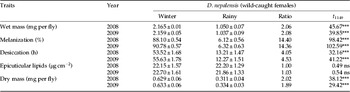
Data on body size and desiccation-related traits of wild-caught female flies (n=150 per season and year) of D. nepalensis of winter and rainy seasons of two different years (2008 and 2009) from an altitudinal locality (Kasauli, 1951 m) are shown in table 1. The flies collected during winter showed twofold higher wet weight as well as dry weight as compared with flies of rainy season (table 1). The winter flies showed a fourfold higher desiccation resistance (h) than flies of rainy season despite lack of seasonal difference in the surface lipid amount. We observed a highly significant seasonal effect on the body melanization, i.e. winter flies are quite dark (∼90%), while rainy season flies are very much lighter (∼7%). Except epicuticular lipids, all other traits showed significant seasonal differences in each of two data sets for 2008 and 2009 (t 1149 values; P<0.001: table 1). For each trait as well as season, the yearly data sets showed no differences based on t-test (data not shown). There are significant changes in body size as well as body melanization which may reflect seasonal adaptations of D. nepalensis.
Data (mean±SD) on seasonal changes in wet mass, body melanization, desiccation resistance, epicuticular lipid mass and dry mass of Drosophila nepalensis collected during rainy as well as winter season from one northern locality (Kasauli; 1951 m) in the years 2008 and 2009. For each season, wild-caught female flies (n=150) were individually tested for different traits. For each trait seasonal data in showed significant differences with t-test.

Asterisk denote the significance level. *** P<0.001; ns – non-significant.
Effects of growth temperatures on desiccation-related traits
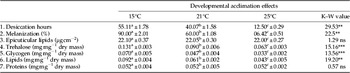
In order to assess developmental plastic effects, independent batches of eggs of each isofemale line were allowed to develop at 15 or 21 or 25°C and the resulting data on desiccation-related traits of adult females are shown in table 2. For desiccation-related traits (desiccation survival hours, body melanization and energy metabolites), there is significant decrease with increase in growth temperature, i.e. trait values are approximately fivefold higher for desiccation resistance, ∼15-fold more body melanization and approximately twofold higher carbohydrates (trehalose and glycogen) for flies reared at 15°C as compared with 25°C (table 2). These traits showed significant differences across growth temperatures when compared with Dunn's multiple comparison test (table 2). It may be noted that two traits (epicuticular lipid mass and protein content) showed no effect of growth temperatures. The developmental acclimation effects for desiccation-related traits are highly significant in D. nepalensis (table 2).
Data (mean±SEM) on thermal developmental acclimation effects on desiccation resistance hours, cuticular traits (cuticular melanization and amount of cuticular lipid) and dry mass-specific energy metabolites (trehalose, glycogen, lipids and proteins) in adult female flies (n=20 I.F. lines×10 replicates) of Drosophila nepalensis grown at 15, 21 and 25°C.

** P<0.01 and *** P<0.001, indicate significant differences based on Dunn's multiple comparison's test (K–W values) and post hoc comparisons are shown as superscript letters.
Developmental acclimation effects on water balance-related traits
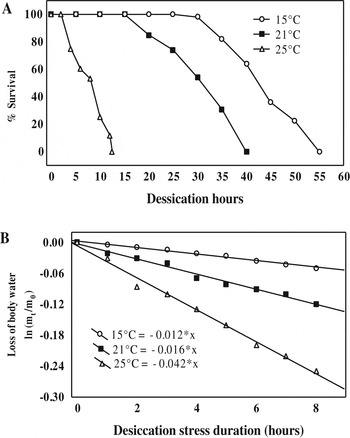
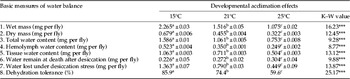
D. nepalensis flies reared at 25°C revealed desiccation sensitivity (∼13 h) while there was approximately fivefold higher desiccation resistance of flies reared at 15°C (fig. 1A). We followed Wharton's method to compare rate of water loss in flies reared at 15, 21 and 25°C and there was about 3.5-fold higher rate of water loss for flies grown at 25°C as compared with 15°C. The rate of water loss varied with increase in growth temperature, i.e. flies reared at 15, 21 and 25°C showed 1.2, 1.6 and 4.2% h−1 water loss, respectively (fig. 1B). Data on changes in water balance-related traits as a consequence of three different rearing temperatures (15, 21 and 25°C) are shown in table 3. Changes in body size (measured as wet and dry mass) are twofold across a growth temperature difference of 10°C (i.e. 15 versus 25°C). Total body water content, hemolymph and tissue water content are twofold higher in 15°C reared flies as compared with 25°C. There is linear decrease in body water content with increase in growth temperature (table 3). Furthermore, we observed effects of developmental acclimation on the ability to sustain greater loss of body water before death under desiccation stress, i.e. greater dehydration tolerance (∼86%) were evident in flies reared at 15°C, while the corresponding value at 25°C was ∼60%. Thermal plastic effects (assessed as maximum ratio between acclimation groups (15 versus 25°C) were more than twofold for total body water, hemolymph and tissue water content (table 3). For each water balance-related trait of D. nepalensis, Dunn's multiple comparison test (K–W values) showed significant differences among flies of three thermal acclimation groups reared at 15, 21 and 25°C (table 3).
A comparison of developmental acclimation effects on dessication survival hours (A); water loss rate (according to Wharton's method); (B) in adult female flies of Drosophila nepalensis grown at 15, 21 and 25°C. The water loss rate was derived from the slope (b) of ln(m t/m 0) as a function of different durations of desiccation stress at <5% RH (where m t is the body water mass at time t; and m 0 is the initial body water content). Slope values for rate of water loss vary significantly for flies grown at 15, 21 and 25°C.

Data (mean±SEM) on different measures of water balance and dehydration tolerance of Drosophila nepalensis isofemale lines (I.F.=20×10 replicates) grown at 15, 21 and 25°C. Changes in the trait values across different growth temperatures were analyzed with Dunn's multiple comparison test and post hoc comparisons are shown as superscript letters.

Percent data were arcs in transformed *** P<0.001.
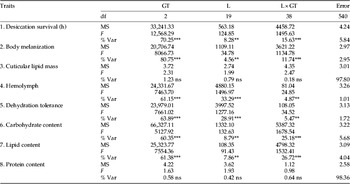
The data on the effects of growth temperatures on desiccation-related traits of D. nepalensis were subjected to analysis of covariance (ANCOVA) (with body mass as a covariate) and the results are shown in table 4. For cuticular lipid mass and protein content, we found non-significant differences across growth temperatures as well as between lines. The percent variance due to growth temperatures were significantly higher (80% for melanization, 70% for desiccation resistance and 60% for carbohydrates as well as body lipids) while interaction effects (lines×growth temperature) were also highly significant (∼25%) for two energy metabolites and 12–15% for body melanization and desiccation resistance (table 4). For different isofemale lines, the effects of thermal rearing conditions varied in magnitude for changes in the amount of carbohydrates and lipids but the trait values were higher at lower temperature and lesser at higher growth temperature and not vice versa. Thus, trait variability due to rearing temperatures (plasticity) is quite high for desiccation-related traits of D. nepalensis.
Results of ANCOVA (body mass as a covariate) for explaining variability in the ecophysiological traits and energy metabolites due to growth temperatures (GT), isofemale lines (L) and their interactions in Drosophila nepalensis (n=20 I.F.×10 replicates each) grown at 15, 21 and 25°C. Dehydration tolerance refers to percent of total body water lost before succumbing to death under desiccation stress.

Percent data were arcs in transformed for ANCOVA.
** P<0.01 and *** P<0.001; ns – non-significant.
Associations between body size changes and desiccation-related traits
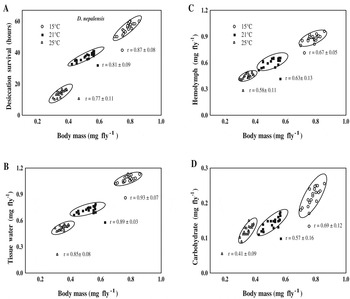
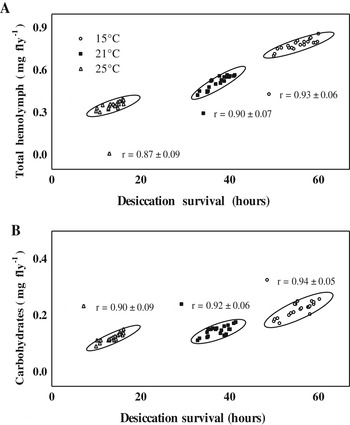
We used isofemale line data on body mass and four desiccation-related traits (desiccation resistance, tissue water content, hemolymph and carbohydrates) to illustrate trait associations (fig. 2). An increase in the growth temperatures of D. nepalensis flies showed significant reduction in body mass as well as desiccation-related traits. Furthermore, traits associations between desiccation resistance and hemolymph as well as carbohydrate content in D. nepalensis reared at three different growth temperatures are shown in fig. 3. Higher levels of hemolymph as well as carbohydrates were observed in flies reared at 15°C as compared with 25°C (fig. 3).
Traits correlations between body mass per fly and desiccation resistance (A); tissue water content (B); hemolymph (C); and carbohydrate content (D) based on 20 isofemale lines of Drosophila nepalensis grown at 15, 21 and 25°C. Correlation coefficients (r) are shown as ±SE.

Trait associations between desiccation resistance and hemolymph (A) and carbohydrate content (B) based on 20 isofemales line of Drosophila nepalensis grown at 15, 21 and 25°C. Correlation coefficients (r) are shown as ±SE.

Effects of body melanization on desiccation-related traits
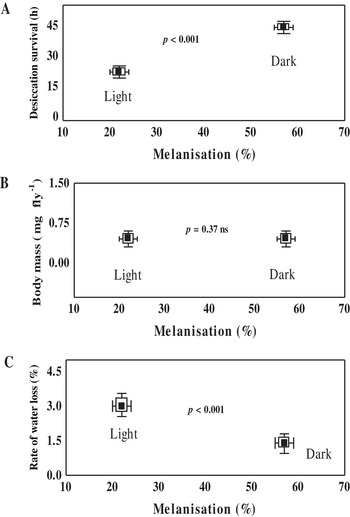
In order to test whether changes in body melanization are associated with corresponding changes in desiccation-related traits of D. nepalensis, we examined assorted darker (57±2%) and lighter flies (22±2%) from a mass culture reared at 21°C to find possible differences in desiccation resistance. These two groups of flies (darker versus lighter) did not vary in their dry mass (fig. 4A) but showed significant differences in desiccation survival hours (fig. 4B) and rate of water loss (fig. 4C). These observations were possible for flies reared at 21°C because coefficient of variation for body melanization was quite high (CV=9.46), i.e. significant differences in melanization between individual flies. In contrast, at higher (25°C) as well as lower growth temperature (15°C), the CV for body melanization were quite low (<3.10). All the flies were darker (with little variation in body color) when reared at 15°C and all flies were lighter in body color at higher developmental temperature (25°C). Thus, assortments of body color phenotypes (darker versus lighter) were feasible only for flies grown at 21°C.
A comparison of body mass (A), desiccation survival (hours) (B); and rate of water loss (C) in assorted darker (57±2%) and lighter (22±2%) flies out of a mass culture (n=∼600 flies) of Drosophila nepalensis from a midland locality (Solan, 1440 m; autumn season T ave=20±2°C) and reared at 21°C.

Comparison of developmental acclimation versus adult acclimation effects
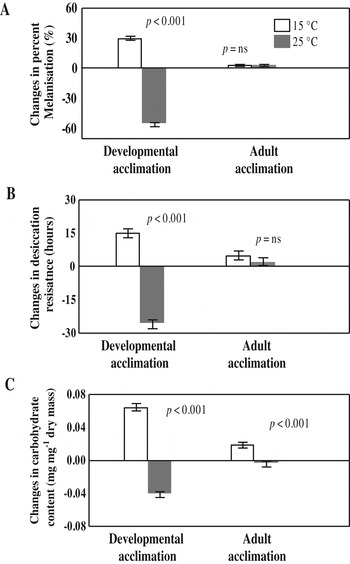
For three desiccation-related traits, changes in thermal developmental or adult acclimation at 15 or 25°C were assessed as compared to 21°C and the results are illustrated in fig. 5. For body melanization, desiccation resistance and carbohydrate content, we found significant increase in trait values in flies grown at 15°C while trait values were significantly lower for 25°C reared flies (fig. 5A–C). In contrast, D. nepalensis adult flies acclimated at 25°C showed no changes in body melanization, desiccation resistance and carbohydrate content (fig. 5) as compared with adult flies acclimated at 21°C. For D. nepalensis adult flies acclimated at 15°C, we found a lesser increase (5 h) in desiccation resistance associated with a smaller increase in carbohydrate content as well as dry mass despite lack of changes in the body melanization (fig. 5). Thus, our results on D. nepalensis have shown contrasting effects of low versus high developmental growth temperatures on desiccation-related traits while adult acclimation effects were quite lower (fig. 5).
A comparison of developmental versus adult acclimation capacity for percent melanization (A); desiccation resistance (B) and carbohydrate content (C) of Drosophila nepalensis at 15 or 25°C when compared with 21°C.

Discussion
In the Himalayan endemic Drosophila species – D. nepalensis, we found significant effects of thermal developmental acclimation on desiccation-related traits consistent with differences in the seasonal relative abundance (48% in winter versus 16% in rainy season). The isofemale lines of D. nepalensis grown at 15, 21 and 25°C showed significant differences (a linear decrease with increase in growth temperature) in body mass, body melanization as well as for different desiccation-related traits. Changes in body mass due to developmental plastic effects are associated with differences in the desiccation resistance. Assorted darker and lighter flies from a mass culture of D. nepalensis reared at 21°C revealed differences in desiccation resistance and rate of water loss despite lack of differences in their dry mass. These observations suggest the role of body melanization in drought resistance of D. nepalensis in addition to the influence of body mass changes. In D. nepalensis flies reared at 15°C, there is significant increase in body water content, hemolymph, dehydration tolerance and carbohydrate content as compared with flies grown at 25°C. We did not find changes in the amount of cuticular lipid mass as a consequence of developmental plastic effects. The adult acclimation potential of D. nepalensis is constrained by its basal levels of desiccation resistance, i.e. significant effect for flies grown at 15°C but no effect for 25°C reared flies. Our results suggest that survival of D. nepalensis under drier climatic conditions depends largely upon thermal developmental plastic effects. Finally, we found that developmental as well as adult desiccation acclimation capacity is quite low in D. nepalensis reared at 25°C and this might reflect its future vulnerability under global climate warming.
Effect of body size changes on water conservation
Insects are known to conserve body water under drier climatic conditions either through storing more water or reduction in the rate of water loss or sustaining greater loss of body water before death (Edney, Reference Edney1977; Hadley, Reference Hadley1994; Chown & Nicolson, Reference Chown and Nicolson2004). Several studies on diverse insect taxa have shown that a larger body size is associated with higher body water content which confers greater desiccation resistance (Willmer et al., Reference Willmer, Stone and Johnston2000; Chown & Nicolson, Reference Chown and Nicolson2004). The analysis of xeric and mesic Drosophila species did not show differences in body water content as well as dehydration tolerance despite differences in their body mass as well as desiccation resistance (Gibbs & Matzkin, Reference Gibbs and Matzkin2001). In contrast, at the interspecific level assorted darker and lighter body color phenotypes of female flies of D. melanogaster showed differences in rate of water loss as well as dehydration tolerance despite lack of differences in their body size (Parkash et al., Reference Parkash, Singh and Ramniwas2009, Reference Parkash, Kalra and Sharma2010). Thus, desiccation resistance is a complex trait among diverse insect taxa which may involve multiple strategies to conserve body water under drier climatic conditions.
The effects of body size on desiccation resistance have been recorded at the interspecific level in diverse insect taxa (Edney, Reference Edney1977; Hadley, Reference Hadley1994; Chown & Nicolson, Reference Chown and Nicolson2004). For example, the survival of a geographically restricted South African dung-beetle (C. bacchus: Scarabacidae, Coleoptera) in xeric habitats has been associated with its large body size associated with greater desiccation resistance as compared with other Savanna-dwelling dung-beetles (Chown et al., Reference Chown, Scholtz, Klok, Joubert and Coles1995). However, there is paucity of data on the magnitude of differences in body size due to developmental acclimation in different insect taxa. D. nepalensis is capable of increasing its body size (wet and dry mass) twofold higher when grown at 15°C as compared with 25°C. We also found corresponding changes in water balance-related traits (total water, hemolymph and tissue water content) in flies reared at 15°C than at 25°C (table 3). The thermal developmental acclimation effects are significant for body size and such changes are associated with fourfold higher desiccation resistance (55.1 h at 15°C while 12.5 h at 25°C). At the intra-specific level, the observed changes in body mass as well as desiccation resistance in D. nepalensis are significantly higher as compared with the cosmopolitan D. melanogaster (Parkash et al., Reference Parkash, Aggarwal, Singh, Lambhod and Ranga2013). In that previous study, we found a modest increase of ∼35% in body mass when D. melanogaster flies were grown at 15°C as compared with 25°C. The thermal plastic effects are highly significant in the Himalayan D. nepalensis. It would be interesting to find generality of such observations in other cold-adapted Drosophila species which are likely to encounter drier and colder climatic conditions in their natural habitats.
Developmental acclimation effects on cuticular traits
Insect cuticle is a complex structure and its components might vary between species and populations (Willmer et al., Reference Willmer, Stone and Johnston2000). Several studies have shown variable cuticular permeability due to changes in the composition or amount of cuticular lipids in diverse insect taxa (Edney, Reference Edney1977; Toolson, Reference Toolson1984; Hadley, Reference Hadley1994; Rourke, Reference Rourke2000) and also due to changes in body melanization of some Drosophila species (Parkash et al., Reference Parkash, Rajpurohit and Ramniwas2008a , Reference Parkash, Kalra and Sharma2010). Few previous studies have examined development plastic effects (due to growth temperatures) on cuticular lipid mass of some insect taxa (Hadley, Reference Hadley1994) but consequences of developmental plasticity on water conservation of drosophilids have received lesser attention. In the present work, we observed lack of differences in the cuticular lipid mass of D. nepalensis flies reared at 15, 21 and 25°C but significant developmental plastic effects were evident for cuticular melanization. We may argue that cuticular lipids may not affect desiccation survival hours of D. nepalensis. Between individual variations of body melanization of this species did not differ much when reared at lower (15°C) or higher growth temperature (25°C) which is likely due to greater thermal plastic effects. However, from a mass culture of flies grown at 21°C, we assorted darker and lighter female flies of D. nepalensis which did not vary in their dry mass. We found associations between body melanization differences of darker and lighter flies with corresponding changes in desiccation survival hours as well as rate of body water loss. These observations suggest possible association between body melanization and rate of water loss of D. nepalensis. Our present results on D. nepalensis find support from previous studies on differences in the rate of body water loss in assorted darker and lighter body color phenotypes of D. melanogaster (Parkash et al., Reference Parkash, Rajpurohit and Ramniwas2008a ). Our results suggest association between D. nepalensis flies with higher melanization score and greater desiccation stress resistance but the underlying mechanisms remain unresolved. Further studies are needed to establish a mechanistic basis of water proofing role of body melanization in Drosophila species and in other insects.
Effects of developmental plasticity on water balance-related traits
In insects, hemolymph is a major source for changes in the level of body water to support longer survival under dehydration stress (Hadley, Reference Hadley1994; Folk et al., Reference Folk, Han and Bradley2001; Chown & Nicolson, Reference Chown and Nicolson2004; Folk & Bradley, Reference Folk and Bradley2005). In contrast, several studies on wild populations of various Drosophila species have not considered changes in hemolymph content to enhance survival under desiccation stress (Gibbs & Matzkin, Reference Gibbs and Matzkin2001; Gibbs et al., Reference Gibbs, Fukuzato and Matzkin2003; Parkash et al., Reference Parkash, Kalra and Sharma2010). In the present study, we found changes in hemolymph content as a consequence of developmental plastic effects (i.e. 15, 21 and 25°C) which are consistent with their different levels of desiccation resistance potential. Most arthropods can tolerate ∼30–50% loss of body water but some taxa adapted to drier habitats have evidenced higher dehydration tolerance, i.e. ability to tolerate greater loss of body water before succumbing to death under desiccation stress (Hadley, Reference Hadley1994; Willmer et al., Reference Willmer, Stone and Johnston2000; Benoit et al., Reference Benoit, Yoder, Rellinger, Ark and Keeney2005). In the present study, we found significant increase (16%) of dehydration tolerance at 15°C as compared with 25°C which are consistent with differences in desiccation survival hours. D. nepalensis is able to significantly increase its body water content, hemolymph and dehydration tolerance as a consequence of developmental acclimation at 15°C as compared with 25°C.
The acquisition of greater energy reserves has been associated with increased survival under dehydration stress (Djawdan et al., Reference Djawdan, Chippindale, Rose and Bradley1998; Folk et al., Reference Folk, Han and Bradley2001; Gibbs, Reference Gibbs2002). Laboratory-selected desiccation-resistant lines (D) have shown higher storage of carbohydrates as compared with control (Graves et al., Reference Graves, Toolson, Jeong, Vu and Rose1992; Gibbs et al., Reference Gibbs, Chippindale and Rose1997; Chippindale et al., Reference Chippindale, Gibbs, Sheik, Yee, Djawdan, Bradley and Rose1998; Djawdan et al., Reference Djawdan, Chippindale, Rose and Bradley1998; Folk et al., Reference Folk, Han and Bradley2001; Folk & Bradley, Reference Folk and Bradley2005). However, wild Drosophila species from xeric and mesic habitats vary in desiccation resistance, despite lack of differences in the storage of energy metabolites (Marron et al., Reference Marron, Markow, Kain and Gibbs2003). No previous study has examined changes in the storage levels of energy metabolites due to thermal plastic effects in diverse Drosophila species. In the present study, we observed higher levels of carbohydrates when D. nepalensis was reared at 15 as compared with 25°C. D. nepalensis has the ability to store higher levels of carbohydrates at 15°C to alleviate the effects of desiccation stress. In contrast, we found low storage level of carbohydrates at 25°C. Our results suggest that storage of energy metabolites is constrained by growth temperature in D. nepalensis.
Developmental versus adult acclimation responses
Ectothermic organisms are capable of increasing their adult stress resistance level due to prior exposure of few or more bouts of thermal stresses (Bale, Reference Bale2002; Hoffmann et al., Reference Hoffmann, Sørensen and Loeschcke2003). For Drosophila species, a few studies have shown increase in desiccation resistance due to prior treatment of non-lethal level of desiccation stress in adult flies, i.e. two Australian populations of D. melanogaster and Drosophila simulans (Hoffmann, Reference Hoffmann1991); and in one Canadian population of D. melanogaster (Bazinet et al., Reference Bazinet, Marshall, MacMillan, Williams and Sinclair2010). Two pairs of sibling species grown at 25°C (Drosophila serrata versus Drosophila birchii; and D. melanogaster versus D. simulans from Australia) have shown species-specific differences in the adult acclimation to desiccation stress (Hoffmann, Reference Hoffmann1991). However, the effects of developmental as well as adult acclimation at ecologically relevant growth temperatures have received lesser attention for Drosophila species so far. In the present study, we found significantly higher developmental acclimation capacity in D. nepalensis when grown at 15°C as compared with 25°C (fig. 5). In contrast, there was lack of adult acclimation response at 25°C but flies grown at 15°C showed a modest increase (∼5 h) in desiccation survival hours. Our results suggest that contrasting levels of acclimation responses are constrained by their basal levels of desiccation resistance at different growth temperatures. D. nepalensis at warmer growth temperature have shown lower desiccation survival hours as well as lower acclimation response as compared with little adult growth temperatures. The developmental acclimation effects at 15°C on desiccation-related traits can explain better survival of D. nepalensis under drier climatic conditions.
Consequences of higher plasticity in D. nepalensis
In insects, phenotypic plasticity is relevant to understanding adaptations to changes in the climatic conditions (Willmer et al., Reference Willmer, Stone and Johnston2000). Some investigations have shown the role of thermal plastic effects on life history traits for adaptations to temporal and spatial changes in climatic conditions (Willott & Hassall, Reference Willott and Hassall1998; Mousseau et al., Reference Mousseau, Sinervo and Endler2000). In the present study, D. nepalensis have shown significant developmental plastic effects for desiccation-related traits. The seasonal changes in these traits can be explained on the basis of developmental trait plasticity. In D. nepalensis, trait values are significantly reduced at 25°C which corresponds to the upper thermal limit of this species. D. nepalensis is a stenothermal species and physiologically adapted to a narrow range of developmental temperatures (12–26°C) and the summer ambient temperature of the investigated locality is close to its upper thermal limits (∼26–27°C). Such a thermal sensitivity has the potential to influence ecology and fitness of this species. In the Western Himalayas, thermal warming differences are sufficiently pronounced across seasons, i.e. duration of winter has shortened by almost 6 weeks and pre-winter conditions have become warmer (Rajpurohit et al., Reference Rajpurohit, Nedved and Gibbs2013). We found contrasting differences in seasonal abundance during rainy and winter season. For D. nepalensis, changes in its seasonal abundance are consistent with its developmental plastic effects on water balance-related traits. The extent of thermal phenotypic plasticity for body size, body melanization and water balance-related traits of D. nepalensis are ∼3 times higher as compared to already reported plastic effects in the cosmopolitan species D. melanogaster (Parkash et al., Reference Parkash, Aggarwal, Singh, Lambhod and Ranga2013). There are evidences that thermal acclimation groups (reared at 15 or 25°C) differ in their cold tolerance, i.e. flies reared at 15°C recovered from chill coma in ∼1 min while those reared at 25°C recovered after half an hour (unpublished observation). In contrast, D. nepalensis flies reared at 25°C were heat tolerant (25 min for heat knockdown at 37°C) as compared with 4 min heat knockdown for flies reared at 15°C (unpublished observation). Thus, D. nepalensis reared at low temperature (15°C) are resistance to cold and desiccation stress, whereas flies reared at higher temperature (25°C) are resistant to heat but cold sensitive. The acclimation to drought conditions is adaptive for D. nepalensis only at lower growth temperature. D. nepalensis can be vulnerable in the warmer season when global climate warming effects are likely to be significant. These observations find support from a previous study on demographic changes in drosophilids, which reported that range retraction of D. nepalensis is a likely consequence of global warming effects at the lowland border limits (Rajpurohit et al., Reference Rajpurohit, Parkash and Ramniwas2008). Further studies on thermal tolerance of D. nepalensis would be helpful in predicting the likely effects of global warming.
Acknowledgements
We are indebted to the reviewers as well as the editor for several helpful comments which improved the MS. Financial assistance to RP under Emeritus scientist project number 21(0847)/11/EMR-II from Council of Scientific and Industrial Research (CSIR), New Delhi is gratefully acknowledged. Chanderkala Lambhod and Divya Singh are grateful to University Grants Commissions (UGC) New Delhi for award of Rajiv Gandhi National Senior Research Fellowship.