1. Introduction
No one questions the desirability of improving labor standards internationally. The issue is whether a system of penalties should be incorporated into the rules and procedures of the World Trade Organization and/or into bilateral trade agreements in order to advance the improvements. The proponents of using trade agreements to improve international labor standards advance two familiar arguments: there is a need to protect high labor standards at home in the face of competition from countries with low standards; and there is a moral obligation to promote the universal spread of labor rights as a part of human rights.
Most trade economists are deeply skeptical of the first argument.Footnote 1 They suspect that a protectionist intent lurks behind its skirts. They fear that the consequence of market intervention to protect labor standards is to restrict trade and reduce economic welfare. It is better accordingly to encourage structural adaptation to shifting comparative advantage (without compromising domestic labor standards). Any losses sustained by firms or workers in import-competing industries could be covered out of the gains in national economic welfare. Moreover, the empirical evidence appears to bear out that countries do not, in fact, experience declining labor standards in the face of globalization. It is the case nonetheless that the United States and the European Union (EU) have sought to introduce labor standards into the WTO, but have been rebuffed to date by the developing country membership in the WTO. As a fallback, the United States and the EU are now insisting that developing country partners in their bilateral free trade agreements accept improved and presumably binding labor standards as a condition for approval of the agreements.
On the second argument, economic theory can offer no compelling response. The human-rights advocates correctly argue that trade takes place within certain ethical boundaries; slavery or the sex and drug trades are, for instance, impermissible activities. They are arguing that, even though economic costs may be incurred, these boundaries should be tightened. Many are sympathetic to this aim as attested by the numerous international conventions and declarations that address human rights. In ratifying these instruments, governments show their support, binding themselves to comply with their (often loosely expressed) terms. In endeavoring to incorporate labor standards in their trade agreements, the EU and the US are taking compliance to a new level by introducing externally enforced trade penalties. Most economists, however, are more inclined to argue that, as labor standards appear to rise with long-term increases in per capita income, policy would do best to focus on promoting economic growth, not on frustrating trade.
This is the point at which we take up the argument. We accept the position of the human-rights advocates – officially blessed by governments in the ILO Declaration on Fundamental Principles and Rights at Work – that countries have an obligation to promote the improvement of labor standards. The question is then whether the linking of labor standards with multilateral or bilateral trade agreements is an effective way of accomplishing this aim. As a step toward answering this question, it seems reasonable to ask what we know about the determinants of labor standards over time. If we could accept the benign belief that labor standards are positively related to economic growth, the answer might seem to lie readily at hand. However, though the proposition is difficult to reject when expressed at a sufficiently high level of generality, the relationship appears more complex when we seek to identify causal links. In Section 2, we review the findings of some cross-country studies that have explored the relation between labor standards and several broad variables. These provide several partial clues. But, in our view, cross-country studies need to be supplemented by historical studies in order to understand more fully what causes changes in labor standards within countries over time.
Since the number and range of specific labor standards are large, it would be a huge task to analyze the evolution of all these standards within individual countries. Fortunately, as our primary interest is in the relation between labor standards and trade agreements, we can focus mainly on the four standards identified by the ILO as core standards and repeatedly referred to by the US and the EU as the standards they would like to see incorporated in trade agreements. These are the civil rights standards that relate to child labor, non-discrimination, and forced labor, and the industrial relations standards concerning freedom of association and collective bargaining. In Section 3, we offer a pocket guide to some of the factors that appear to affect the evolution of these standards within countries. The analysis is admittedly cursory and incomplete, but it allows us to illustrate the different factors affecting improvements in labor standards.
We maintain that improvements in the standards relating to child labor, discrimination, and, in good part, forced labor, can be traced largely to two sets of causes: (a) long-term changes in demand and supply conditions that alter the economic incentives and responses of employers and households, and (b) changes in the social norms affecting labor supply and demand. The fourth core labor standard – freedom of association and the right of collective bargaining – is in a category of its own. Unlike the other standards, which have objective outcomes, it is valued mainly as an instrument or process for realizing improvements in other labor standards. Improvements in freedom of association and the right of collective bargaining are bound up with the political history of countries and, more particularly, with shifts in the distribution of political power at the macro-level.
In Section 4, we draw from our analysis some inferences that bear on the possible effectiveness of penalties in trade agreements to improve labor standards. We also review the limited efforts of the US to include labor standards in the North American Free Trade Agreement (NAFTA) and in its bilateral FTAs, and the modest advances of the EU in the determination and enforcement of labor standards for its member countries. We conclude in Section 5, noting in the light of the significant role that social norms appear to play as a determinant of domestic labor standards, that we are skeptical of the effectiveness of externally imposed penalties.
2. What does cross-country analysis tell us?
Before going any further, we should first clarify the scope of labor standards. We follow the useful classification of Botero et al. (Reference Botero, Djankov, La Porta, Lopez-deSilanes and Shleifer2004), which identifies four categories of standards: (a) civil-rights standards, including the prohibition of child labor, non-discrimination in the workplace on grounds of gender, race, or religion, the prohibition of forced labor, and the rights of migrant workers; (b) standards for industrial relations, including the freedom of association, collective bargaining, and the right to strike; (c) employment standards that relate to the employment contracts of individuals and govern such matters as wages, hours of work, overtime, leave, and terms of dismissal; and (d) social protection standards that cover social responses to the broader needs of workers affecting their quality of life, such as provisions for old age, sickness, unemployment, and disability.
In exploring possible determinants of labor standards, some studies have sought to aggregate components falling within one or more of the four categories just noted and to relate their aggregates to a variety of macro-economic variables. Lindert (Reference Lindert2004) undertook an extensive historical study of social spending for around 20 countries (mostly OECD countries today) over the periods 1880 to 1930 and 1962 to 1995. He defined social spending to include welfare or poor relief, unemployment compensation, old-age pensions, public health, housing subsidies, and public education. He found per capita income growth to play only a modest role in accounting for rising social spending. Other main determinants were population aging and electoral patterns.Footnote 2
Huberman (Reference Huberman2002) devised a broad composite index of 11 equally weighted labor-market regulations and social-insurance entitlements for 17 European countries over the period beginning in 1830 and ending in 1913. These covered particular components of all our categories of labor standards.Footnote 3 Using this broader index, Huberman concluded that differences in labor standards, or changes in labor standards, were not related to differences in income levels or changes in income levels. However, he did find that there was a positive relation between openness (measured as the ratio of foreign trade to GDP) and the extent of labor protection. He illustrated this finding by drawing on the historical experience of the workers movement in Belgium in the late nineteenth and early twentieth centuries. When the workers movement gained political influence through the introduction of proportional representation, it used its parliamentary support for free trade to make gains in social protection.
Huberman's analysis of the role of openness during the first wave of globalization that ended in 1913 followed earlier work by Rodrik (Reference Rodrik1997) and Agell (Reference Agell1999) on more recent years. Both the latter found evidence of a positive relation between openness and various measures of labor protection. Rodrik related openness (again measured by the ratio of foreign trade to GDP) to the scope of government (measured by the ratio of government consumption expenditure to GDP) in the early 1990s for 23 OECD countries and found it positive. He found that the relation still held (though for a smaller sample of countries) when he refined government spending to include only social security and welfare spending.Footnote 4 He further qualified his measure of openness to allow for differences among countries in their exposure to external risk (measured as exposure to fluctuations in world prices). Rodrik interpreted the evidence to support the contention that, as societies expose themselves to greater risk from the instability of external markets, they demand more social protection from their governments.
Agell came to a similar conclusion by a different route. For some 20 OECD countries, he related openness to several indicators of labor standards that fall, not only within our category of social protection, but also within the other categories of industrial relations and employment contracts. He found that countries more open to trade are more likely to have sizable unions, more centralized wage bargaining institutions, tighter job-security laws, more generous unemployment benefits, less dispersion between the minimum and average wage, and less wage or income inequality. All of these characteristics, as he noted, are quite consistent with the notion that labor market institutions can be seen as devices for social insurance. But as he also observed (p. 160), ‘the social insurance argument is a narrow one, paying no attention to the complex interactions, of history, economics and politics that shape the structure of the institutions of the real world’.
Quite another, and more comprehensive, approach to the explanation of labor standards was taken by Botero et al. (Reference Botero, Djankov, La Porta, Lopez-deSilanes and Shleifer2004), who undertook a remarkably detailed analysis of labor laws in 85 countries as these stood in 1997. They concentrated on the three categories of industrial relations, employment contracts, and social protection. Within each of these categories, they coded national laws to measure worker protection and thereafter correlated labor laws with other variables.Footnote 5 They found that, while social protection laws were correlated with income levels, neither industrial relations laws nor employment contract laws were. Supporting the theory that the nature of the labor laws reflects the political power of labor, they found that the political orientation of governments over the past 50 years – whether left- or right-leaning – was related to whether or not the labor laws were favorably disposed toward labor. But what they identified as the key determinant of the differences among countries in their labor laws was the origin of each country's legal system. They differentiated among the English, French, Germanic, Scandinavian, and socialist legal systems, all of which have been transplanted in one degree or another to other countries throughout the world. They contrasted the English common law tradition with the French civil code and other traditions. They found that, for industrial-relations laws and employment-contract laws, there was a consistent relation between the degree of labor protection and the origins of the legal system. Countries following the common-law tradition had less favorable labor laws. But on social protection, the result was somewhat more complicated. That is, countries with common-law traditions had less favorable social-protection laws than the others, but there was an exception in countries following the German legal tradition.
While the Botero et al. analysis raises interesting questions, it does not directly explore the causes of changes in labor standards. A cross-country analysis of labor laws at a point in time (1997) makes no allowance for changes in national laws over time. For instance, the labor laws – or at least their interpretation – of most of the rich countries following the English legal tradition – of which the United States and the United Kingdom are leading members – were distinctly more protective of labor in, say, the mid-1950s than in the mid-1990s; but their legal traditions were unchanged. Indeed, it seems quite plausible to argue that legislation protective of labor has undergone an inverted U-shaped rise and decline in the English-speaking countries since the 1930s that has not been repeated in other countries. Take, for example, the United States. Paradoxically enough, it was at a time of mass unemployment during the 1930s that pro-labor Federal legislation reached its peak; and this was largely sustained during the high employment and high economic growth years of the late 1940s, 1950s, and 1960s. The erosion of legislation, both in legislatures and in the courts, later gathered strength, especially after the sea change in favor of free market policies that began in the 1970s. A comparable pattern of decline in the political power of labor – with a diminution in effective pro-labor legislation – took place in other rich English-speaking (and common law) countries – notably, Australia, Canada, New Zealand, and the United Kingdom. But there was no parallel erosion in the continental European countries.Footnote 6
We conclude from these several studies that improvements in labor standards are not related to rising per capita income in any simple way, and that generalizations to the contrary imply a causal link that is largely unexplained. Research into the evolution of different specific standards in individual countries – at the level of detail at which Botero et al. (Reference Botero, Djankov, La Porta, Lopez-deSilanes and Shleifer2004), have conducted their work – appears a necessary basis for any generalizations about labor standards as a whole. That is much more than what we can accomplish here. However, in focusing on the four labor standards identified by the ILO as core standards, we can attempt to illustrate the multiple influences that are at work. This is what we set out in the sections below. But we begin with some general comments about the relation between economic incentives and social norms in bringing about changes in labor standards.
3. Economic incentives and social norms
There is general acceptance that labor markets are social institutions. While economic incentives dominate behavior in labor markets, responses to these incentives are constrained by social norms. The norms define acceptable modes of behavior, and failure to comply with them invites social disapproval or loss of reputation.Footnote 7 When the market is in equilibrium, no one disregards the norm for the sake of pecuniary gain. In the present context, however, our interest is in how economic incentives and social norms change as an economy moves from a low productivity, high underemployment state to a high productivity, low unemployment state.
Coleman (Reference Coleman1990) – a leading exponent of the rational choice school of social theory – offers one analysis of the rise or decline of social norms. Of particular importance for labor markets would be what he calls disjoint norms.Footnote 8 These imply an inherent conflict between those who benefit from the existence of the norm and those whose freedom of action is restricted by the norm. The norm emerges in circumstances in which actions of the beneficiaries have adverse consequences for the freedom of action of those restricted. But the beneficiaries cannot engage in a simple market transaction to compensate those restricted by the negative externality and thereby gain control over their behavior. In these circumstances, the beneficiaries may attempt to do so through the imposition of a social norm. They will succeed only when they are able, through their social relationship with others, to sanction disobedience.
An implication of this analysis is that, over the course of time, norms may change because of shifting economic interests. Changing economic incentives may alter the value to the beneficiaries of preservation of the norm, or they may enhance the reluctance of those whose behavior has been controlled by the norm to forego economic benefits through their obedience. The technological advances and increasing specialization that accompany long-term economic growth clearly alter incentives in the labor market; the shifting mix of industries, occupations, and specific skills progressively alters the composition of demand for labor. At the same time, the economic preferences of households shift in response to rising income as well as to other more indirect influences like the spread of education, declining fertility rates or the introduction of labor-saving devices in the home. These together affect the pecuniary rewards and preferences of different classes of labor, including those relating to women and children.
Akerlof (Reference Akerlof1980) and Lindbeck et al. (Reference Lindbeck, Nyberg and Weibull1999) have indicated the mechanism through which a change in economic incentives may progressively undermine an established social norm. If changing incentives increase the pecuniary gain from disobeying a social norm, a few employers or workers may be tempted to disregard the norm. If others follow suit, the cumulative defections begin to weaken the social disapproval that disobedience incurs, which encourages yet more to join their ranks. This sets in train a sequence of increasing disobedience and diminishing social disapproval that progressively erodes the norm.
In our view, it is not only shifting economic incentives that may bring about changes in social norms. Norms have roots in other sentiments besides those of individual economic interest; they may derive from broader social, cultural, or religious values and beliefs. All of these may be greatly affected by the social transformations associated with long-term economic growth – like urbanization, the weakening of communal links, rising educational levels, or women's increased control over reproduction, to mention only a few. Their effects on values and beliefs may weaken acceptance of established social norms that affect behavior in the labor market, or they may enhance receptivity to new principled ideas about right and wrong that are advanced by social reformers.
In the context of our discussion, a major instance of such broad changes in social norms is the progressive shift over the last two centuries in Western countries of the status of women and children. In the more patriarchal societies of the nineteenth century, when women had no political voice, little legal protection, and few economic opportunities, the norm was for women to manage the home, care for the children, and perform household labors. Aside from poor young women, it was the men and the children in poorer families who were members of the gainfully employed labor force. In the course of the twentieth century, norms about family roles have been altered greatly. Children were no longer expected to be income earners for the family while women, whose political civil rights were much enhanced, expected to acquire marketable work skills and become long-term participants in the paid labor force.
Social norms are slow to change. They tend to become embedded in laws, regulations, customs, institutional arrangements, and more informal understandings that persist from generation to generation. In their endeavor to change accepted practices, social reformers – at least in countries where the rule of law prevails – often stress the introduction of new legislation as a key instrument of reform. Compliance with the law, however, may leave much to be desired. This may partly be because of a limited capacity to enforce the law. More fundamentally, laws may not be effective in restricting the freedom of individuals to behave as they choose if their disobedience does not incur broad social disapproval. If economic incentives induce large numbers to disregard the law, it is rendered ineffective. The law and social norms are, in other words, closely related. Legislation may serve to embed a social norm in the system of jurisprudence. But how far new legislation independently contributes to advancing social reform is more open to debate. For some observers, the law follows rather than leads shifts in social norms.Footnote 9
4. A pocket guide to historical determinants of the core labor standards child labor
We should first define what we mean by child labor. No one identifies all work by children as child labor. In many parts of the world, work is a central part of daily life for children as well as for adults. The concept in Western countries of childhood as a time for education and play is, after all, a comparatively recent notion. But at what point does work by children become child labor? We follow the definition employed by ILO statisticians in applying the two ILO Conventions (138 and 182) that concern child labor. In distinguishing between economically active children and child labor, they make allowance for ‘light’ work by children below the age of 15. Their definition of child labor thus includes all children below age 15 who work more than 14 hours a week, or who work in hazardous occupations, or who are engaged in ‘other worst forms of child labor’ (slave or slave-like conditions, child prostitution or pornography, illicit activities, or child soldiers).Footnote 10 For the year 2000, it was estimated that there were some 211 million economically active children in the age group 5–14, or nearly one-fifth of all children in the group. It classified about 186 million of these as child labor (ILO, 2002).
It is widely appreciated that there is a broad relation between child labor and per capita income. When rich and poor countries are compared, there appears to be a strong correlation between child participation in the labor force and the level of per capita GDP (Krueger, Reference Krueger1996). However, this should not be taken to imply a direct causal relationship. There are numerous possible links between child labor and the level of development, for which per capita income is only a proxy.
It is not immediately obvious that, over the long term, market forces are likely to cause a substantial decrease in the demand for child labor. Historical evidence indicates that the contrary can happen. In the British textile industry of the late eighteenth century, some technological innovations were specifically designed to take advantage of the low-cost child labor (McLeod, Reference McLeod1988; and Humphries, Reference Humphries, Basu, Horn, Roman and Shapiro2003). Likewise, certain industries – like lace-making in Britain and Belgium – were largely conceived in the nineteenth century as effective ways of utilizing child labor (Cunningham and Viazzo, Reference Cunningham, Viazzo, Cunningham and Viazzo2001). However, in manufacturing industry as a whole, the main thrust of technological innovation over the generations has surely been to design plant and machinery manageable by adults. The cost difference between child and adult labor has not sufficed to outweigh the physical and mental limitations of children. Indeed, it can be argued – with some substantiation from historical evidence – that, by supporting the introduction of school education, employers have sometimes restricted their demand for child labor because of their recognition of the need for a more educated labor force. Even so, outside of large-scale industry, simple labor-intensive techniques remain everywhere common in artisan-type manufacturing, in which child labor can still prove to be efficient. Moreover, in other branches of production like agriculture, construction, retailing and domestic services, numerous activities remain labor intensive even in the rich countries. In sum, while technological advances may have curtailed demand for child labor, the main explanation for the reduction of child labor over time appears to lie more in changing economic incentives on the supply side and in shifts in social norms.
Most revealing in assessing economic changes on the supply side are the studies of factors affecting family strategies that have been carried out in several countries.Footnote 11 These studies generally explore the role of economic incentives in accounting for parental decisions to use or withhold child labor. Most of these studies confirm that the income of the household is a significant factor, though the relationship is not simple. It appears that it may be non-linear; for families at or below the subsistence level – as for those well above the subsistence level – income differentials do not matter (Edmonds, Reference Edmonds2007). Indeed, for poorer families in rural areas, an increase in family income – say, because of rising crop prices – may be an inducement over the short term to use children more intensively. A particular focus of the studies has been on how far the availability of school education has raised the opportunity cost for parents of using their children in work. That is, has the expected return from school education been an inducement for parents to withdraw child labor from the market? Again, the evidence suggests that the answer is complex. Parents with greater household assets may be more inclined to invest in their children's education, but much depends on the composition of these assets. If they take the form of a family-owned farm or small artisan enterprise, parents may see the labor of their children as complementing their capital assets. Other factors that have been noted as possibly influencing parental decisions are the cost of school education, its quality, and credit constraints in financing education, but the evidence is inconclusive. On the other hand, there is some evidence that the children of larger families may have better prospects of going to school because the number allows some specialization in the family or some distribution of the labor. A non-economic factor found in Grootaert (Reference Grootaert, Grootaert and Patrinos1999) is that households appear more likely to send children to school if the parents have gone to school themselves.
While the evidence from family-strategy studies suggests some of the factors that, in the long term, may cause parents to withdraw their children from the labor market, these studies focus mostly on (the more measurable) economic variables and, being studies at a point in time, take market forces and social norms as given. They thus appear to provide only a partial, and incomplete, explanation of why child labor has declined with long-term economic growth.
Historical studies tracing the changes in child labor over long periods of economic growth provide another perspective. Again, studies of present-day developed countries mostly bear out the importance of long-term gains in real wages in altering family strategies (Cunningham and Viazzo, Reference Cunningham, Viazzo, Cunningham and Viazzo2001). They suggest that rising real wages, combined with an associated reduction in family size, tended to restrict child labor to the poorest families, especially to those in which the adult members had lost their earning capacity. The introduction of compulsory education – often quite late in the process of industrialization – was also widely associated with the decline in child labor. Other legislation establishing a minimum working age or prohibiting the use of children in hazardous occupations played an earlier role in some countries (it appeared to be quite decisive in Britain thanks to the agitation of social reformers like the evangelicals), but the legislation was often restricted in coverage, and enforcement was lax.
The differences among countries in their historical experience are as interesting as their similarities. Child labor played a much smaller role in the early industrialization of Japan than it had, say, in Britain during a comparable phase of its history. The official importance given to education was probably part of the explanation, but cultural differences also appear to have influenced family strategies. Numerous travelers to Japan at the time were struck by the devotion and indulgence that Japanese parents showed to their children (Saito, Reference Saito, Cunningham and Viazzo2001). By contrast, elimination of an extensive market for child labor in Belgium happened late when compared with other European countries, although Belgium industrialized early. The opposition of manufacturers to child-labor legislation and compulsory schooling was reinforced by the class conscious ideology of bourgeois liberalism that prevailed in the country (De Herdt, Reference De Herdt, Cunningham and Viazzo2001).Footnote 12
More broadly, as noted earlier, a major shift took place in most Western countries between the nineteenth and twentieth centuries in cultural attitudes toward children. While, in the nineteenth and early twentieth centuries, the children of working-class families were expected to work and contribute to the family income, by the mid-twentieth century, the norm was for children to attend school and no longer to have work obligations. It became the duty, or the privilege, of the parents to make financial sacrifices for the children. Zelizer (Reference Zelizer1985) has observed that, in the United States, the shift in prevailing attitudes took place over 50 years or so from the 1870s to the 1920s during which there was a continuing public debate about the role of children. The largely middle-class reformers – whose children went to school and did not work – encountered strong opposition, not only from some employers, but also from working-class families. For the latter, it had long been a fact of life that a role of children was to perform useful work. The need for their labor was reinforced in an industrializing society by the dependence of the family on the adult male; since he had no insurance against unemployment or illness, a child's earnings were a buffer against such contingencies. Several attempts were made in the US Congress during the early decades of the twentieth century to introduce federal legislation restricting child labor, but they failed. It was not until the 1930s that such legislation finally came into force. Even then, divergent views about what did or did not constitute exploitative child labor made for some exceptions. These included children working within the family and – because of their popular images – child actors and newspaper delivery boys. Work on the farm was also lightly regulated.
Legislation prohibiting the use of child labor and making school attendance compulsory is on the statute books of most poor countries today. But in many countries, parents, children, and employers do not comply with the legislation, and child labor is widespread.Footnote 13 The inspectorates needed to enforce child-labor laws are often inadequate, but a more serious flaw may be that the legislation runs ahead of the prevailing social attitudes toward child labor. Apart from opposition from employers to the prohibition of child labor, the decision among poor families to use child labor may appear quite rational in the economic circumstances that they face, and they may sometimes be ignorant of the risks attaching to hazardous occupations. However, as per capita income rises and the balance of public sentiment shifts in favor of a proscriptive norm, households and employers who supply and demand child labor begin to experience a social stigma that affects their behavior – and makes the legislation more effective.
We conclude that rising per capita income is hardly sufficient in itself to explain the reduction and eventual elimination of child labor. While the reduction of poverty is a significant positive factor, public action to make school education widely available and to make child labor illegal have also appeared important. Legislation alone, however, may be ineffective if it does not rest on supporting social norms. It seems plausible to suppose that the role of these norms may be of particular importance in stopping the employment of children in hazardous occupations where market forces alone will not compensate for the ignorance of parents or the callousness of employers. Non-market action is required even more to eliminate the other ‘worst forms of child labor’ that flourish in the criminal underworlds.Footnote 14
Gender discrimination
The ILO Convention on Discrimination (111) defines it as ‘any distinction, exclusion or preferences, made on the basis of race, color, sex, religion, political opinion, national extraction, or social origin, which has the effect of nullifying or impairing equality of opportunity or treatment in employment or occupation’. We focus here on gender discrimination as a particular instance and briefly discuss the possible roles of economic incentives and social norms in the lessening of such discrimination.
The general supposition is that, in the course of economic development, women – like men – are increasingly drawn into the formal labor market. Indeed, some might take the extent to which women participate as indicative of the level of development that a country has attained. However, if we compare the experience of women across countries, this appears to be a quite erroneous conclusion. How far women participate in the labor market of any country does not appear to bear any relation to the level of per capita income. Rather, their participation is heavily influenced by the cultural, religious, and social milieu in which labor markets function.
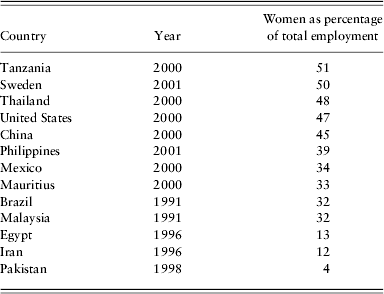
This is clear enough from the data on women's participation in total employment that are available for a number of countries. The inter-country comparability of the data shown in Table 1 is admittedly weak, particularly because of differences in the treatment of unpaid family workers and part-time workers (both of which are important in defining employment relating to women). But the statistical discrepancies hardly falsify the large differences that we see. As we might expect, women's participation in employment is high in the developed countries of Sweden and the United States, but the much poorer countries of China and Thailand have similarly high rates. On the other hand, women's participation is very low in certain Muslim countries in the Middle East and Asia (though not so in Malaysia).
Participation of women in total employment
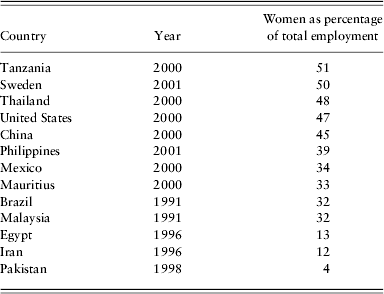
Source: ILO website. Data are from labor force surveys or population censuses.
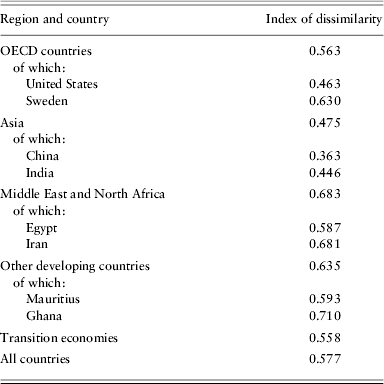
Whatever the extent of women's participation in employment, some degree of gender discrimination appears to be universally present in labor markets.Footnote 15 It is manifest most clearly in the strong tendency for the employment of women to be concentrated in a relatively narrow range of occupations (a factor that contributes to the wage gap between men and women that is universally observed). Anker (Reference Anker1998) has constructed one measure of such occupational concentration – a standardized index of dissimilarity for 75 occupations in 41 countries – and the results are shown in abbreviated form in Table 2. (If women were employed in the same proportion in all the different occupations, the index would read zero; and if there were complete segregation by occupation, it would read 1.) The results indicate that there is everywhere a substantial degree of occupational segregation by sex. Women are almost always heavily represented in some occupations, such as nursing and primary-school teaching among the professional occupations, the clerical occupations, and the service occupations such as shop assistants and maids. Again, as Anker finds from regression analysis, there is no relation between the extent of occupational segregation in individual countries and their levels of development (as measured by per capita income, the level of women's education, or the percentage of the labor force in agricultural occupations). These findings suggest that the occupational distribution of women is everywhere heavily influenced by the norms rooted in beliefs about activities appropriate for women (in traditionally male-dominated societies).
Occupational segregation by sex in non-agricultural sectors
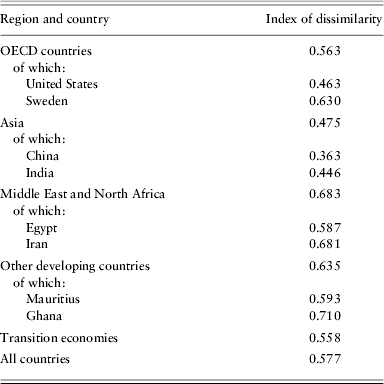
Note: The index is based on occupational data for 41 countries. The country data have been standardized to fit a classification of 75 non-agricultural occupations (as in ISCO-68 at the two-digit level). For definition of the index, see Anker (Reference Anker1998: 75). The averages for regions and for all countries are unweighted averages.
Source: Anker (Reference Anker1998: Table 9.1).
This view is also supported by the fact that there tend to be more noticeable differences among regions in the extent of occupational segregation than there is among countries within regions.Footnote 16 In other words, in countries sharing similar cultural, religious, or social histories, similar norms operate in their labor markets with regard to the employment of women. Of course, this is not to exclude the possibility that economic factors may also contribute to an explanation of the differences among regions in the extent of segregation. In Asian countries, for example, the fast growth of the export-oriented textile, apparel, and electronic assembly industries has caused large numbers of women to be classified as production workers, a category in which women are usually under-represented; and this may have contributed to the comparatively low degree of segregation recorded for this region.Footnote 17
There is unfortunately much less in the way of historical data available for individual countries that would throw more light on changes in occupational segregation in the course of economic development. Changes in the United States over the last century or so, however, are well documented and, though they may reflect only one specific pattern of experience, they are illustrative of the roles that economic incentives and social norms play.
The proportion of women (aged 15 and over) who participated in the labor force in the United States rose strongly from under 20% in 1890 to more than 60% (aged 16 and over) in 2000.Footnote 18 Occupational segregation in the nineteenth century was extreme: the great majority of women worked in low-paying factory jobs, especially in textiles and apparel, and in domestic service. But this began to break down around the turn of the century. Technological changes – exemplified most graphically by the invention of the typewriter and the introduction of telephone systems – raised the demand for women to work in offices and in sales activities, while the rising educational levels of young women from better off families increased the supply of suitably trained workers. Nevertheless, a great many occupations continued to be seen as unsuitable for women, and this attitude persisted through much of the twentieth century. It was reinforced by the opposition of employees in all the predominantly male occupations who resisted the entry of women for fear that it might lower their earnings.
The influence of social norms was particularly striking in affecting the participation of married women in paid employment. At the turn of the twentieth century, fewer than 5% of married women were working for pay, and by 1950, the number had risen to only 21%.Footnote 19 Thus, the ‘marriage barrier’ powerfully constrained both the demand for, and supply of, women in the labor market until the mid-twentieth century. The practice of firing young women when they got married, or of not hiring women already married, was widespread both in the public and the private sectors. Up to the Second World War, most school districts, for example, refused to employ married women – though teaching (along with nursing) was one of the few occupations open to educated women. In industry, employers tended to exclude women from jobs where employees could gain some training and experience to advance to higher paying positions. The rationale was that women would leave once they got married or had children. The erosion of this norm gathered strength during and after the Second World War, aided by the introduction of labor-saving equipment in the home and by women's greater control over reproduction; and, by 2000, the participation of married women in the labor force exceeded 60%. This greatly boosted the participation of women in general in the labor market.
Some economists have argued that the increasing participation of women during the twentieth century very largely reflected the operation of familiar market forces in the form of responses to changes in incomes and wages (Mincer, Reference Mincer and Gregg Lewis1962; Smith and Ward, Reference Smith and Ward1984; and Killingsworth, Reference Killingsworth1983). Empirically calculated elasticities for ‘other’ income (meaning income of the rest of the family) and for wages of women were claimed to explain the historical data well. The income elasticity was negative, suggesting that as the income of the family rose, women withdrew from the labor market. However, this effect was more than offset by the positive wage elasticity. As real wages rose, this progressively raised the opportunity cost for women of remaining at home. Thus, the argument was that the demand function shifted out along a stable, but fairly elastic, supply function. Were this argument correct, it would at least lessen the significance of other factors, such as the erosion of social norms, in affecting labor supply.
In commenting on this work, however, Goldin noted that the estimated parameters were calculated for a point in time and that their calculation for different time periods indicates that they are not stable. In fact, estimates of income and wage elasticities for a succession of time periods between 1900 and 1980 reveal a distinct pattern of change (Goldin, Reference Goldin1990: Table 5.2). The income elasticity was large and negative around 1900 and progressively declined afterwards. The wage elasticity rose to about 1950 and thereafter declined. These changes are consistent with the historical evidence about the influence of changing social norms – along with other factors such as rising educational levels, declining fertility, and more labor-saving appliances at home – in affecting the participation of women in the labor force. In 1900, married women eschewed paid employment and did so only when their husbands proved to be unreliable or insufficient income earners. Paid employment for women was confined very largely to unskilled factory jobs and domestic service. As the educational levels of women rose, however, and as the demand for white-collar workers increased, the stigma for married women (and their husbands) of going out to work faded, and they were more responsive to rising real wages. In more recent decades, however, the wage elasticity for women has joined the income elasticity in declining in magnitude, tending to approximate those for men. This reflects a further change in attitudes: women now give greater importance to their own lifetime earning capacity and to having careers in the world of paid work.
While the persistence of disparities in female and male earnings suggests the continued presence of discrimination, there is no doubt that in the United States – as in numerous other countries – gender discrimination has lessened substantially, if slowly, over the last century. Besides the long-term effects of the changing demand for labor, the rising educational levels and the falling fertility rates, it seems very clear that the political voice of women, expressed through the feminist movement, has substantially altered attitudes toward the treatment of women in the labor market. This was reflected in the Civil Rights Act of 1964, which, while primarily addressing racial discrimination, embodied the newly accepted, and more democratic, social norm that women – like all other classes of persons – should enjoy equality of opportunity in the economic as well as the political spheres. But it was the feminist movement, not the legislation per se, that was the driving force behind the erosion of the barriers – embedded in older social norms – to the entry of women in the full range of occupations and to improving their career opportunities within occupations.
Forced labor
The original ILO Convention (29) on forced labor described it as ‘all work or service which is exacted from any person under menace of any penalty and for which the said person has not offered himself voluntarily’.Footnote 20 It is not the nature of the activity but the coercive relationship between the ‘employer’ and the person that characterizes forced labor. The coercion can take many forms and vary in degree, making exact definition difficult.
The ILO classifies forced labor into state-imposed and private-imposed, and it subdivides the latter into forced labor for economic exploitation and for commercial, sexual exploitation. While reliable national estimates are scarce, the ILO has endeavored to quantify the global and regional extent of forced labor. It estimates that globally, at least 12.3 million people are victims of forced labor. States or rebel military groups impose work on some 2.5.million of these people, while private agents exploit the remaining 9.8 million, mostly in economic activities but also in the sex trade (ILO, 2005). State-imposed labor appears to be on the decline, but there are not enough data to know what has happened in the private sector over recent decades.
In many countries, the practice of using forced labor in economic activities has its origins in social institutions – largely rural – like the system of land tenure, the bonding of labor through financial and other means, social customs relating to communal work, and tribal or caste structures. It is plausible to expect that, over time, as economic growth takes place, these institutions will weaken as more efficient markets for productive resources emerge. Evidence in support of this belief is that forced labor engaged in economic activities is virtually absent in the well-to-do market economies of today. However, reforms like those relating to land-tenure systems or financial practices are often necessary to create these markets. Labor laws alone are not sufficient in themselves to eradicate such forced labor.
The cessation of forced labor – and perhaps especially state-imposed labor – is also bound up with the recognition of human rights. Forced labor appears less likely to occur in states where some form of representative government and the rule of law protect individual rights. However, as an ILO report observes, many states have ratified the Conventions on forced labor but have not successfully translated their intent into national laws and practices. Labor law ‘may be couched in very general terms rather than identifying the various ways in which forced labor could be exacted by the private actors, or it may fail to provide for appropriate penalties for using different forms of forced labor’ (ILO, 2005: 7). Perhaps still more critical, as the report notes, is the need to ensure that forced labor is treated as an offense against human rights under criminal law.
We cannot, however, be sanguine that economic growth will tend to lessen all forms of forced labor. Some more recent manifestations of forced labor have arisen as a result of the spreading commercialization of economic activity within and among countries. Private agents, sometimes with criminal affiliations, have found it profitable to become providers of forced labor, using deception to hire ignorant workers and threats of penalties to retain them. One most egregious instance is the trafficking in women and children for the purpose of sexual exploitation, but it also occurs widely among migrant workers who are tricked into debt bondage. Such commercial activity goes beyond the limits of acceptable behavior in modern labor markets, whether national or international.
Freedom of association and collective bargaining
Among the core labor standards of the ILO, freedom of association and the right to collective bargaining are in a special category of their own. They are primarily seen by labor activists as direct instruments for gaining improvements in working conditions generally. They enhance the bargaining power of the individual employee, and they make possible the realization of collective benefits (public goods like health and safety standards in the workplace) that employees could not obtain in individual negotiations. Trade unions, moreover, can often have a wider purpose embodying, as Alfred Marshall (Reference Marshall1946) noted, ‘an effort to obtain conditions of life consistent with true self-respect and broad social interests, as much as a struggle for higher wages’. (We do not pass judgment here on the possibly deleterious effects that unions may have in redistributing income in their favor or in dislocating economic activity in the pursuit of sectional interests.)
How far these standards are realized within countries depends upon their political histories and the distribution of political power. Liberal democracies, with their broad diffusion of power among different interest groups and their protection of civil rights, might be expected to favor these standards; and, since some political scientists and economists now assert that there may be some relationship between the level of per capita income and the extent to which government is democratized, it might seem plausible to suppose that these standards improve with rising income. However, that may be too simplistic. The study of Botero et al. (Reference Botero, Djankov, La Porta, Lopez-deSilanes and Shleifer2004) referred to in Section 2, suggests that the reason for differences in national standards are complex – even if we have reservations about how closely labor laws on the books correspond to actual practice. As we noted earlier, they found no evidence that differences in standards were related to levels of development, while they did find that laws relating to freedom of association and collective bargaining were more favorable to labor in countries that had longer histories of leftist or centrist governments between 1928 and 1995. At very least, it seems plausible to suppose that the unique nature of political developments within individual countries assures many different gradations in how far the freedom of association and right of collective bargaining are accorded recognition. By way of illustration, we briefly recount the history of these standards in three countries: the United States, Germany, and South Korea.
We need not remind readers that, in the United States during its years of rapid industrialization in the late nineteenth century, industrial relations were punctuated by often bitter, and sometimes brutal, confrontations. Employers were politically in the ascendant and, by and large, state legislation supported the doctrine that the contract between the employer and the individual employee was inviolable. It was legal for employers to use such methods as black listing, lockouts, yellow dog contracts, and injunctions to break unions. The courts were also disposed to consider instances of actions by union members engaged in protests as forms of criminal conspiracy under common law. In the In re Debs case of the 1890s, the Supreme Court even extended the doctrine of conspiracy to include civil offenses, so that any actions in restraint of inter-state trade could be deemed illegal (Rayback, Reference Rayback1966: 206). The labor movement long sought relief from such severe restrictions on the freedom of association and right to bargain collectively. The Clayton Act of 1914 seemed to be a forward step; it recognized that the labor of a human being was not ‘an article of commerce’, and that laws relating to the restraint of trade in products, such as the anti-trust Sherman Act, did not apply to labor organizations. However, it was not until the passage of the Norris-LaGuardia Act in 1930 that the freedom of association and the right to bargain collectively were effectively recognized in federal law. The Roosevelt Administration incorporated these principles in the National Labor Relations Act of 1935 and went further by establishing a National Labor Relations Board to supervise the exercise of these rights. The Act was binding on the states.
This was a high point in pro-labor legislation. Interpretation of the 1935 Act has since changed as shifting relations between government, business, and labor have produced amending legislation and new rulings by courts and administrative tribunals. The Taft-Hartley Act of 1947 narrowed the interpretation in some important respects. For example, it prohibited the closed shop; it gave the National Labor Relations Board new powers to supervise attempts to organize unions in the workplace and to engage in collective bargaining; and it authorized the Attorney General to issue injunctions against strikes for a period of 80 days. Since the 1950s, employers have made increasing use of both legal and illegal means to discourage the formation of unions (Freeman and Medoff, Reference Freeman and Medoff1984). In addition, numerous judicial and administrative decisions have further modified the interpretations of these rights. Workers, for instance, have been restricted in their ability to engage in such ‘concerted activity’ as intermittent strikes or secondary boycotts. Striking workers can be permanently replaced, and the replacement workers can vote to decertify a union. Such detailed interpretations of the broad standards have significantly affected their meaning and their practical value for employees.Footnote 21
The history of these standards elsewhere also bears out how closely they are interwoven with shifting domestic political circumstances. In Germany's first phase of industrialization in the late nineteenth century, for instance, the main workers' movements were rooted in socialist beliefs and incurred the powerful hostility of Chancellor Bismarck. Trade unions were slow to emerge and employers effectively resisted collective bargaining. In the 1930s, trade unions in Nazi Germany – as in Fascist Italy – were either prohibited or co-opted by the state. It was only after the Second World War that freedom of association and the right of collective bargaining became firmly established. A principal reason was the recognized political need, in the face of the ideological struggle with communism, to form a social compact between workers, employers, and the state (‘Rhineland capitalism’). German trade unions have played a central role in the political and economic governing of the country ever since, and labor-protection standards are famously high. In the indices of labor-protection law devised by Botero et al. (Reference Botero, Djankov, La Porta, Lopez-deSilanes and Shleifer2004), Germany scored sharply higher than the United States. (The indices are on a scale in which the degree of labor protection rises from 0 to 1.) In collective-relations laws, which encompass laws relating to trade union organization, collective bargaining, and industrial action, the index for Germany stood at 0.61, while that for the United States was at 0.26. In employment law, which relates to the individual employment contract and includes security against dismissals, the scores were 0.70 and 0.22 respectively.Footnote 22 Thus, because of their different political histories and institutions, the interpretations in Germany and the United States of the freedom of association and the right of collective bargaining differ in many significant respects.
South Korea is a more recent instance of rapid industrialization, where it began less than 50 years ago under authoritarian regimes. While its laws and constitutions have since 1948 always given formal recognition to freedom of association and the rights of collective bargaining and industrial action, governments have consistently sought to exercise control over labor organizations. With the shift toward greater openness in the society that began to take place in the late 1980s, some redistribution in the balance of power from the central authorities to other interest groups – like business and labor – began to occur. However, government has continued to restrict the activities of labor organizations in a number of ways. These include the recognition of company-supported unions, the prohibition of dismissed workers to remain union members, the restrictions on civil servants rights to organize, and the broad definition of essential services in which the right to strike is prohibited.Footnote 23 Allegations have been made of the unjust prosecution and imprisonment of union officials,Footnote 24 and companies have been permitted to seize the financial assets of union officials and workers, or to make deductions from wages, in order to compensate themselves for losses arising from strikes declared illegal.
A brief summary
The above analysis, while admittedly limited in scope, allows us to make a few generalizations that appear to be consistent with the evidence:
• There is not a simple relationship between long-term increases in per capita income and improvements in the core labor standards.
• Economic incentives and social norms both affect behavior in labor markets. These determine the labor standards relating to child labor, discrimination, and, in part, forced labor. Both incentives and norms vary widely among countries, depending on their level of development and their values and beliefs.
• Long-term economic growth is associated with shifts both in the pattern of economic incentives facing employers and workers and in household preferences. Long-term economic growth is also associated with a social transformation that alters the values and beliefs from which social norms derive. Both alter behavior in labor markets.
• Changing economic incentives may erode prevailing norms and ease the way for acceptance of other norms advocated by social reformers. Prevailing social norms, however, change slowly since they become institutionally embedded in labor markets.
• Legislation or its enforcement is often seen as a key instrument in any movement to alter social behavior. But the effectiveness of the law depends on the extent to which it is supported by shifts in the underlying social norms. Shifts in social norms implied in the new laws have to receive wide support from citizens in the country if the laws are to be effective.
• the core standards of freedom of association and the right of collective bargaining are special cases. They are closely interwoven with the shifting distribution of political power within countries
5. Implications for using trade agreements to improve international labor standards
So we are saying that improvements in labor standards respond mainly to the changes within countries that occur as domestic economic and social development takes place, as the old social norms give way to new, and as the distribution of political power shifts among the main economic groups. External influences are distinctly secondary. We recognize, however, that in a shrinking world where the cross-border interactions among people and ideas are being almost daily enhanced by the technological advances in transport and communications, these external influences are becoming more pervasive. Popular pressures on multinational corporations to raise labor standards in their foreign affiliates or in the factories of their sub-contractors have spillover effects in local labor markets. The support that trade unions and other non-governmental organizations in rich countries provide to their counterparts in poor countries assists the latter in their advocacy of improved standards. At the official level, the ILO – which we should not forget is a tripartite organization of governments, business associations, and trade unions – exercises influence through its monitoring and reviewing of the compliance of member countries with its Conventions. And both the ILO and individual governments provide technical assistance to improve labor laws and their enforcement.
How does the use of trade agreements to enforce compliance with the core labor standards fit into this world? Both the US and the EU have already sought to do so in some of their own trading arrangements, so what has been their experience? The North American Agreement on Labor Cooperation (NAALC) – signed as a side agreement to NAFTA in 1994 – is the longest standing free trade agreement incorporating labor standards. The agreement placed the obligation on all its members to abide by their own domestic labor laws; it established a consultative and dispute settlement process to resolve complaints; and it included a provision, as a last resort, for the imposition of a monetary penalty or suspension of trade benefit if the complaint related to health and safety conditions, child labor, or minimum wages. (Complaints about other standards such as freedom of association or collective bargaining were not subject to these penalties.) Since the inception of the agreement, quite a number of complaints have been dealt with by the consultative or dispute settlement machinery, sometimes resulting in practical improvements. The most common outcome, however, has been an agreement between governments to inform workers and employers more fully of their rights and obligations under existing law. In the several additional free trade agreements that the US has signed with other countries since 2000 similar conditions have been included, though with the added provision that signatories ‘ shall strive to ensure’ that their own labor standards are consistent with ‘internationally recognized labor rights’. As of 2006, no formal complaints had been lodged under these agreements. It can be argued in their favor, however, that – as with the NAALC – the procedures incorporated in these agreements at least provide a channel for consultations on labor standards.Footnote 25
For the proponents of incorporating labor standards in trade agreements, a central difficulty is the specification of standards – acceptable to all parties – in sufficiently concrete terms to allow a dispute settlement process to work effectively. When standards are expressed in fairly broad, aspirational terms – as in the ILO Declaration and supporting Conventions – countries are able to agree. But when they are translated into more specific and operational language, the diversity among countries in their levels of development, institutions, social norms, political and cultural histories, rises to the surface; and, except where the most extreme abuses of labor standards are under consideration, agreement becomes elusive. Moran (2002) has observed that, notwithstanding the body of jurisprudence built up by ILO in assessing compliance with its Conventions, there remain large uncertainties about the interpretation of internationally agreed labor standards. One example is that the labor laws of a few countries – including the United States – permit employers to replace striking workers on a permanent basis, while other countries view such laws as inconsistent with the right to organize and to engage in collective bargaining.Footnote 26
The experience of the EU since its inception as the European Economic Community illustrates the difficulty of reaching agreement on shared standards. The realization of some convergence in labor standards has been an aim of the EU since the Treaty of Rome was signed in 1957, but only modest advances have been made over the last 50 years.Footnote 27 Some steps were taken in the first few decades – notably, agreements by member states to move toward equal pay for men and women and toward uniform occupational health and safety standards – but it was not until the adoption of the Social Charter in 1989 and the signing of the Maastricht Treaty in 1991 that a broader advance materialized. Having relinquished the idea of harmonizing regulations in their common market, what member states sought to do was to arrive at a set of minimum labor standards. However, they were careful to circumscribe the power of the EU to elaborate on, or extend, the principles agreed in the treaty. Directives that the EU Commission might issue concerning workers' protection, employers' or employees' representation, or social security, were made subject to a unanimous vote of the EU Council. Other issues like health and safety standards or gender equality were subject to a qualified majority vote.Footnote 28 Moreover, some issues, like those relating to the freedom of association or the right to strike, were deliberately excluded from the purview of the EU altogether (Raines, Reference Raines1998). In a still more recent initiative, the EU established a set of guidelines for the reform of national policies, laws, and institutions relating to employment. As the guidelines were not binding, it was evidently the hope that some revision of national polices might take place through the process of discussion and persuasion. In brief, while member states of the EU have cooperated in establishing minimum norms and rules for some aspects, they have largely retained national autonomy over both the determination of labor standards and their enforcement.
6. Concluding remarks
There are a few especially egregious forms of behavior in labor markets – like slavery or apartheid, for instance – that are almost universally repugnant and that nations (acting collectively) may seek to punish with trade sanctions or penalties.Footnote 29 But for the most part, we are skeptical of the use or threat of trade penalties to force improvements in labor standards. First, as just illustrated, the specification of enforceable and mutually agreed labor standards presents large practical difficulties. Second, as we have sought to demonstrate throughout this paper, improvements in labor standards are largely driven by domestic economic and social events. Using trade penalties as a form of external pressure is unlikely to strengthen the hand of the domestic social reformers, unless these are so well timed that they coincide with, and support, an internal social reform movement. To be effective, efforts to improve labor standards have to be tailored to the economic and social circumstances prevailing in a country at the specific time. Outside agents may prod governments into revising their laws, but they will not be successful if there is insufficient domestic support for their enforcement. Moral suasion from both domestic and external sources may appear to work more slowly than the more legalistic means that are favored by the United States and the EU. But moral suasion works more surely because it contributes to altering the social norms that underlie the acceptance of effective labor standards.