Nazi art looting in Western and Central Europe focused principally on private holdings owned by Jews, as declared “Enemies of the Reich.” These involved seizures from families and individuals who fled or were deported, “forced sales” from those attempting to flee the Nazi regime, as well as Jewish dealerships forced to “Aryanize.” They ranged from the world-class collections of the Rothschilds—from renowned family estates and bank vaults—to paintings hanging “over the mantelpiece” in more modest, abandoned Jewish homes emptied by the Möbel-Aktion. By contrast, in the Soviet Union, especially within pre-1939 borders, where private collections had all been nationalized and some sold by the state abroad, significant Nazi art looting victimized state collections of the declared “Bolshevik” enemy. Some initial trophy seizures were carried out by the Künsberg Battalions from the German Foreign Office and the German Army Art Protection (Kunstshutz) officers, such as the Amber Chamber and other treasures from the Russian imperial palaces in suburban Leningrad, most destined for Königsberg. The most serious art looting from occupied Soviet territories, however, occurred during German retreat after defeat in Stalingrad in February 1943.
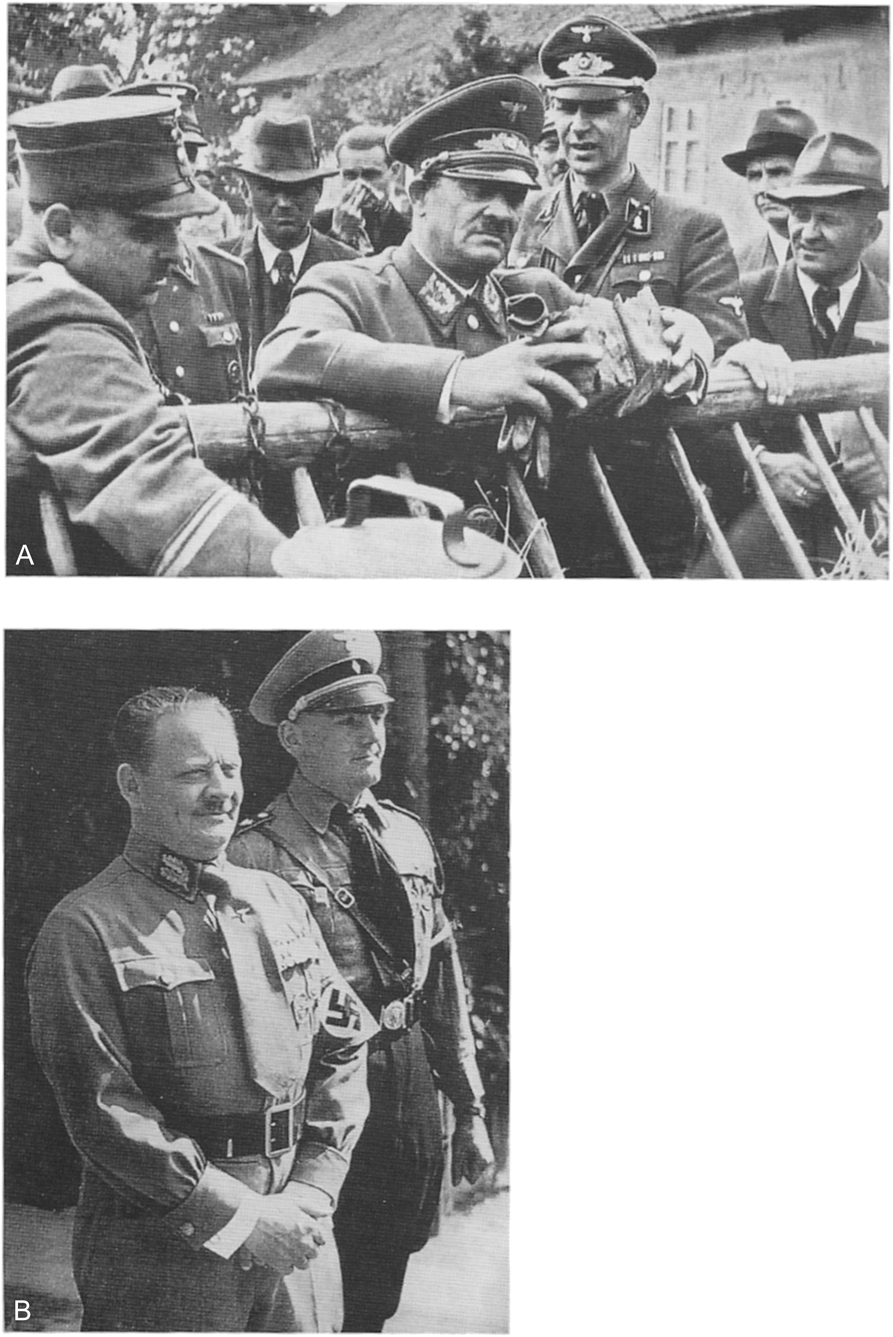
Königsberg (now Rus. Kaliningrad) was a special case on the Eastern Front, because the surrounding Baltic countries, with bordering Lithuania and eastern Poland, were annexed to the Soviet Union in 1939, while East Prussia remained part of the German Reich. Königsberg and most of East Prussia was annexed to the Soviet Union following the Potsdam Conference in August 1945 as Kaliningrad Oblast of the RSFSR, while the southern area became part of Poland. During the N-S regime, East Prussia was ruled by Erich Koch (1896–1986), whom Adolf Hitler had appointed NSDAP Gauleiter of East Prussia in 1928 (Figure 1). After the N-S Party came to power, recognizing Koch’s administrative and economic talents, Hitler appointed him Oberpräsident of East Prussia in 1934. Koch had arrived in East Prussia with hardly a pfennig in his pocket. He found more than ample personal “living space” and developed a fortune (no less that 400 million Reichsmarks) to match the economic development of the area he helped engineer before the German invasion of Poland in 1939.Footnote 1 Subsequently, Koch was also charged with German administration of the Polish region centered in Bialystok.
Erich Koch, Gauleiter and Oberpräsident of East Prussia, Reich Commissar of Ukraine. A) in East Prussia, 1944; B) on his estate of Gross Friedrichsburg, near Königsberg, 1945.
Courtesy of Avenir Ovsianov, from his book, U nikh est’ rodina (2010).

Following invasion of the Soviet Union in Operation Barbarossa, Hitler appointed Reichsleiter Alfred Rosenberg, Reichsminister of the Occupied Eastern Territories (RMbO) in July 1941. Following occupation of Ukrainian lands, Rosenberg, in turn, against his will but urged by Reichsmarschall Hermann Göring, appointed Koch Reich Commissar of Ukraine. Running disputes between Koch and Rosenberg continued throughout the war, with Rosenberg even complaining to the Führer on occasion about Koch’s policies and excessive brutality.Footnote 2 While the Reich Commissariat was headquartered in Rivne (Rus. Rovno), Koch spent most of his time in Königsberg, where he continued to hold forth as Gauleiter and Oberpräsident of East Prussia until his escape to Denmark in April 1945. Although Lutheran by background, as an ardent convert and defender of the Nazi cause, Koch himself had no more respect for Slavs than he did for Jews, considering all of them üntermenschen (literally sub-human). He showed particular contempt for Ukrainians, whose only purpose in life, he stated, was to serve the German Reich.Footnote 3 Meanwhile, Koch, or Grand Duke Erich as he was often dubbed, pursued his brutal command of Nazi-occupied areas from the Baltic to the Black Sea, where the Holocaust and art looting ran rampant.Footnote 4
Already in the fall of 1941, Koch had ordered the famous amber panels in the Catherine Palace in Tsarskoe Selo (renamed Pushkin during the Soviet period) dismantled and shipped to Königsberg, where they had originally been crafted. The Amber Room was installed in the impressive Teutonic Castle under the direction of German art historian Dr. Alfred Rohde (1892–1945), a world-renowned specialist in amber.Footnote 5 Koch had hopes, with Rhode’s help, of making Königsberg—with its magnificent castle—a major art center. Rohde was in charge of all of the artistic treasures arriving from occupied Soviet territories as well as the castle art gallery. The leading Kaliningrad regional studies specialist, Avenir Ovsianov, tends to believe that the legendary amber panels were undoubtedly destroyed in the castle bomb shelter—in part by the British bombing raids in August and September 1944, and definitively by the Soviet assault on Königsberg in 1945. Rhode had no desire to evacuate the amber, even at the end of the war. He had refused to leave the city himself when his family fled early in 1945, and he died there in December 1945.Footnote 6 Koch also tried unsuccessfully to have some of the Czartoryski treasures from Kraków and Łancut shipped to Königsberg, but he ran into resistance from Reichsmarschall Herman Göring and Adolf Hitler’s chief art looter, Kajetan Mühlmann, both of whom nonetheless furnished Koch with paintings in Königsberg, some of which he probably co-opted for his own collection.Footnote 7
Koch had an impressive new palace constructed and heavily armed on the estate of Gross-Friedrichsburg, just outside Königsberg, with English gardens surrounding a private lake and all the trappings of the high Nazi elite. He also appropriated a neighboring estate for hunting; his dacha on the Baltic coast had a private landing strip and additional bunkers. Before he fled in 1945, he ordered all the buildings and contents destroyed. Following Soviet annexation, his main estate became a Soviet state farm—Sovkhoz “Maiskii,” now virtually abandoned with a few scattered, rundown houses and an agricultural cooperative. Thanks to minute details in the long-secret records of the top-level Moscow Commission with the Kaliningrad Geological-Archeological Expedition that unsuccessfully combed the area for the Amber Chamber (1958–1983), we even have floor plans of Koch’s palace and underground bunkers.Footnote 8 The post-Soviet writings of Ovsianov, who participated in that Commission and other expeditions, provide many details of Koch’s extensive real estate, all destroyed by the “scorched earth” the Germans left behind.Footnote 9 Postwar investigators found an 80 kg bomb in one of the bunkers but no sign of the cultural treasures that many speculated were stored there at the end of the war.Footnote 10 Today, not even the mangled ruins of Koch’s luxurious underground bunkers were publicly accessible when Ovsianov escorted me to the locale, while Koch’s dacha on the coast is still in a forbidden military defense zone.
Like many of the Nazi elite, Koch had his own personal collection of art and amber, which has gone unaccounted for until recently. Ovsianov, now retired, has found only a few hints. He published a Russian version of a German list of the paintings Koch evacuated to Germany in 1945, but he had no idea of their provenance.Footnote 11 While Kaliningrad has tried to forget the names of Koch and Königsberg, the still-unfinished House of Soviets now symbolically dominates the central open square with a host of temporary market booths. An elderly woman in a shabby kiosk collects admission fees for viewing the covered excavation area of the ruined Teutonic Castle, destroyed more definitively by Soviet dynamite under 1958 orders from Leonid Brezhnev. Today, a progressive local architectural firm has plans to rebuild the castle to rival the impressive restored Malbork (German Marienburg) Castle, an even larger stronghold of the Teutonic Order, now a bustling tourist mecca, a few hours’ drive to the southwest across the Polish frontier (between Elblag and Gdańsk).
Here we focus on the art collection that Koch assembled in Königsberg during the war, part of which he succeeded in evacuating to Weimar. As a case study, this attempt to identify provenance necessarily remains a work in progress, given the hitherto lack of access to the paintings themselves. To set the historical context, we should recall the estimated 900 paintings and 450 icons from three Kyiv museums Koch ordered to Königsberg at the end of 1943, when the Germans were hastily retreating from Kyiv. The Germans intentionally destroyed most of those art treasures when the Red Army arrived in East Prussia in February 1945.Footnote 12 Koch had already appropriated some choice paintings arriving from Kyiv for his personal collection, which he evacuated to Weimar that same month. Others had been seized by Göring in Western Europe, from Jewish dealers such as Jacques Goudstikker (Amsterdam) and Georges Wildenstein (Paris). None of the paintings Koch sent to Weimar have been seen in public since: one surfaced briefly at Western auctions; two are reportedly in private collections (London and the United States); and those remaining in Weimar were transported to the Hermitage in 1948/49. Meanwhile, one early Dutch painting that Koch “purchased” from Göring in 1940 is hanging today in the National Museum in Gdańsk. As far as is known at this stage of research, that is the only looted painting Koch acquired during the war now on public view.
ROSENBERG ON TRIAL, KOCH IN HIDING
Erich Koch was still in hiding in February 1946 when Reichsleiter Alfred Rosenberg stood trial at the International Military Tribunal (IMT) in Nuremberg for war crimes under his Ministry (RMbO) and his special Einsatzstab (ERR) for cultural plunder. Yet Erich Koch was in fact the one implicated in an RMbO report to Rosenberg, dated 14 September 1944, cited against Rosenberg by the Soviet prosecutor in the IMT session of 21 February 1946:
The Reich Commissioner for Ukraine has stored the paintings and art objects which were brought back from [Kiev and Kharkov] in East Prussia in the following safe places:
1. The estate of Richau near Wehlau,
2. Wildenhoff Manor (owner Count Schwerin).
Exact list of the contents of 65 wooden crates is attached. As to the other twenty crates, fifty-seven portfolios and one roll of engravings, their inventory has not been taken to date…. Among the paintings there are a great number of very early icons, works by famous masters of German, Italian and Dutch schools of the sixteenth, seventeenth and eighteenth centuries, as well as works of the best Russian masters of the eighteenth and nineteenth centuries. [They comprise] the most valuable works of the known Ukrainian art possession …the only collections of this sort with international repute now within German territory.Footnote 13
The Soviet prosecutor failed to mention that most of the art listed from Kyiv had been intentionally destroyed a year earlier by retreating Germans when the Red Army arrived in February 1945. He submitted the document quoted as an official IMT exhibit (USSR-372/ 055-PS), which accordingly was published with the trial records, but the attached inventories of the art destroyed were never made public. The “exact list of the contents of 65 wooden crates” supposedly “attached” has still not been located.Footnote 14 In fact, archival copies of the IMT exhibit (USSR-372/ 055-PS) in Moscow and other Allied archives contain German inventories for only 37 crates from the Kyiv Museum of Russian Art shipped to Königsberg.Footnote 15
The four missing pages, we now know from other sources, should have contained existing German inventories for 7 crates with 47 Western European paintings and 4 crates with sculptures from what is today the Bohdan and Varvara Khanenko National Museum of Art shipped at the same time.Footnote 16 Known in the Soviet period as the Museum of Western and Oriental Art, its present name honors the most important prerevolutionary art collectors in Ukrainian lands. During occupation, initially under control of the Einsatzstab Reichsleiter Rosenberg (ERR), the Germans combined the two neighboring Kyiv museums as divisions of the Kyiv Provincial Museum (Landesmuseum Kiew) in 1942, under the Provincial Authority for Archives, Libraries and Museums (LV ABM), under the RKU. They transferred to the Eastern (Russian) Division the most important icons from the Kyivo-Pechers’ka Lavra (Kyiv Monastery of the Caves), which were also among the 78 crates (with inventories for only 47) that arrived in Königsberg.
Copies of those 47 crate lists were apparently originally attached to the shipping papers for the 78 crates of art sent from the initial German evacuation center in Kamianets-Podilskyi (southwest Ukraine) to Königsberg at the end of January 1944, signed by LV ABM chief Georg Winter. Winter’s original outgoing memorandum, but not the inventories, remains in Kyiv.Footnote 17 An original German copy of the inventories remains attached to a July 1944 version of the IMT document prepared by an American unit for a subsequent US war crimes trial.Footnote 18 I first found copies of those 47 crate lists in another Moscow archive, among the records of the top-secret Soviet Commission mentioned above. Those copies had been furnished by the Stasi from US Nuremberg microfilms in Potsdam (East German State Archive) with Russian translations.Footnote 19
LOOTED ART FROM KYIV DESTROYED
The 78 crates from Kyiv contained most of the remaining paintings from both museums, along with icons from the Lavra, seized as the Germans were retreating from Kyiv in September and October of 1943. Accompanying the shipment to Königsberg was Ukrainian art historian Polina Kul’zhenko, who directed the combined museum during German occupation. She was apparently responsible for the 37 crate lists from the Russian Museum in Kyiv. Winter expected her to prepare inventories for the rest after arrival in Königsberg, but there is no evidence that she did.Footnote 20
The first shipment to Königsberg arrived on the 19th of December 1943. Quite possibly, some paintings were removed before Kul’zhenko and the second shipment arrived in mid-January 1944.Footnote 21 Kul’zhenko and the 78 crates of art in her care were first housed on the Richau family estate—70 kilometers east of Königsberg (now Rus. Tel’manova). Today, there are open fields where the manor house once stood; a hamlet with three small family homes and sheds remains down the road. In mid-November 1944, Rohde moved Kul’zhenko and the 78 crates of art to the impressive baroque palace on the Von Schwerin estate of Wildenhoff (now Polish Dzikowo Iławeckie), 70 kilometers south of Königsberg (Figure 2a).Footnote 22 Rohde had good relations with the family, and probably had no better alternative. During the summer of 1944, he had refused the Berlin-recommended evacuation of the art from Ukraine to central Germany.Footnote 23 In December 1944, he also evacuated 21 second-priority paintings from Königsberg Castle to Wildenhoff, which has led to unsubstantiated speculation that the crates with panels from the Amber Chamber had also been evacuated there.Footnote 24
The Baroque palace on the Von Schwerin estate of Wildenhoff (now Polish Dzikowo Iławeckie), 60 km south of Königsberg, intentionally destroyed with crates of art and icons from Ukraine by retreating Germans in February 1945.
Image from a nineteenth-century engraving by Alexander Duncker.
Wildenhoff was clearly in the path of the Red Army en route to Königsberg from the South. Kul’zhenko declined Countess von Schwerin’s offer to accompany her when she fled to her family estate in Brandenburg on the 22nd of January 1945 (her husband had just been killed at the front). When the Germans turned the mansion into a military hospital, Kul’zhenko supervised Polish prisoner-of-war laborers on the estate move the crates of plundered art to the cellars.Footnote 25
The Red Army started bombardment of Wildenhoff in mid-February. On the fateful night of 17–18 February when Soviet soldiers arrived, the Germans fled. But not without an SS commando setting the mansion ablaze, reportedly remarking that they could not “leave all this for Ivan.” Kul’zhenko was arrested and taken to a neighboring Red Army post by Soviet SMERSH officers.Footnote 26 Under interrogation in Kyiv later in 1946, she explained (as quoted from her KGB file): “On the 18th of February, together with a colonel and major of the Red Army, we returned to Wildenhoff, but it was impossible to save the museum exhibits.… On the 19th I was taken to Bartenstein [now Polish Bartoszyce] to a filtration-repatriation center and there was interrogated extensively.”Footnote 27 Sentenced in Kyiv to ten years in prison as a collaborator, she served nine and was subsequently exiled to Kostroma, where she died in 1983. Following her rehabilitation after Ukrainian independence, her 1946 memoir about her trip to East Prussia was published in Ukrainian in 1998.Footnote 28
While the Assumption Cathedral in the Lavra was undoubtedly the most symbolic monument destroyed in Kyiv during German occupation, the paintings from the Kyiv museums and icons from the Lavra that perished in Wildenhoff were among the most substantial Ukrainian cultural losses in the Second World War. Perhaps most symbolic was the twelfth-century Ihorivs’ka icon Mother of God. Symbolically, too, its gilded cover was found after the war in the rubble of the dynamited cathedral, but the more elaborate jeweled cover had been sold abroad in the 1920s, when the icon itself was restored.Footnote 29 Germany contributed significantly to the restoration of the Assumption Cathedral in the Lavra, although many still claim it was destroyed when the Germans attempted removal of the dynamite laid down by Soviet partisans.
Not only did the Soviet prosecutor in Nuremberg not mention the destruction of the art from Ukraine in Wildenhoff, Soviet authorities never thoroughly investigated the area for surviving fragments, similar to the Commission investigations in Kaliningrad Oblast in search for the Amber Chamber. Lands of the former estate ended up on the Polish side of the frontier (now Polish Dzikowo Iławeckie). A Polish investigation of the ruins in August 1960 found “a folder of charred drawings and etchings, some Chinese porcelain fragments, remnants of seven other badly destroyed sculptures … and metal pieces used in icon frames. But no sign of the Amber Room” (Figures 2b and 2c).Footnote 30 At present, those surviving remnants could not be located in Poland, although an illustrated Polish report survives.Footnote 31 When we visited the site of the former estate in August 2014, my son found the overgrown ruins of the foundation with the help of a Polish art student, and we identified the stone entry posts of the former driveway.
The same lake in the present village of Dzikowo (August 2014),
Photograph by Almon John Grimsted.
Part of the overgrown ruins of the Von Schwerin mansion above the lake in Figure 2b.
Photograph by Almon John Grimsted.
Although among the worst, if not the worst war criminal on the Eastern Front, Koch managed to avoid the Nuremberg trials and remained at large until the British finally captured him as Ralf Berger, disguised as an agricultural worker in a village near Hamburg in 1949.Footnote 32 The British turned him over to Poland for prosecution rather than complying with the Soviet extradition demands.Footnote 33 Koch managed to avoid the death sentence handed down by the Warsaw Court and lived until the age of 90 in 1986 in a Polish prison in Barszewo (earlier German Wartenburg), symbolically midway between the ruins in Dzikowo Iławeckie and the ruins of Hitler’s Eastern Front headquarters, Wolf’s Lair (Ger. Wolfsschanze; Pol. Wilczy Szaniec), dynamited a month before the destruction of Wildenhoff. Despite many interrogations before his death, Koch never revealed any credible secrets about the fate of the Amber Chamber, much less about the art treasures from Kyiv or the collection he had evacuated to Weimar.Footnote 34
SAVED FROM WILDENHOFF? KYIV ART “SURVIVORS” EAST AND WEST
Suspicions arose during the Soviet period about possibly surviving art “saved” from destruction in East Prussia. The most significant came when two seventeenth-century paintings from the Khanenko Collection surfaced in Perm in the 1960s and 1970s. Ovsianov and others mistakenly assumed they were from Wildenhoff.Footnote 35 It turns out, however, both had been “borrowed” on behalf of the Kiev General Commissar as listed on a German receipt dated 23 March 1942. No one has paid adequate attention to the surviving German “borrowed” receipts for items from Kyiv museums, most of them hidden away in Moscow archives that were opened for public research only in the late 1980s. There is no evidence that either were in the 78 crates in Wildenhoff, although they had apparently been brought by the Germans to Königsberg. They were acquired there by Soviet soldiers at the end of the war in the active black market and then gifted to a museum in Perm, whence they returned to Kyiv.Footnote 36
Finally, in 1998, the Kyiv Museum published an English-language catalogue describing 474 Western European paintings lost as a result of the Second World War (some with images), correcting the earlier 1944 ChGK report.Footnote 37 More recently, a copy was submitted to the Art Loss Register in London and entered in their database. Thanks to the German-Ukrainian Commission on War Losses, that data was also submitted to the Magdeburg database lostart.de.Footnote 38 Those submissions are already paying off. Thanks to those postings, two paintings from the Khanenko Museum that were long feared lost in the war recently surfaced in the West.
First, a seventeenth-century Dutch painting by Cornelis van Poelenburgh (1586–1667) from the Khanenko Collection, when recently consigned to auction in Western Europe, was identified by the Art Loss Register as corresponding to the oil-on-panel entitled Acadian Landscape listed in the Khanenko catalogue.Footnote 39 The museum curator in charge of European painting, Olena Zhyvkova, authenticated the painting in Amsterdam as the first to have turned up among the many cultural trophies removed by the retreating Germans. The painting is listed (with registration number) on both the September 1943 German receipt for the first crate shipped to Kamianets-Podilskyi and similarly in the first crate shipped to Königsberg. It is not listed among the paintings Koch evacuated to Weimar in February 1945. Gaps in its post-1944 provenance, or its route to London, where it first surfaced at auction, have yet to be discovered. The Dutch “good-faith” purchaser, when confronted with its Khanenko provenance, offered to sell the painting to the Khanenko Museum for a reasonable sum, and the museum found a private Ukrainian sponsor.Footnote 40
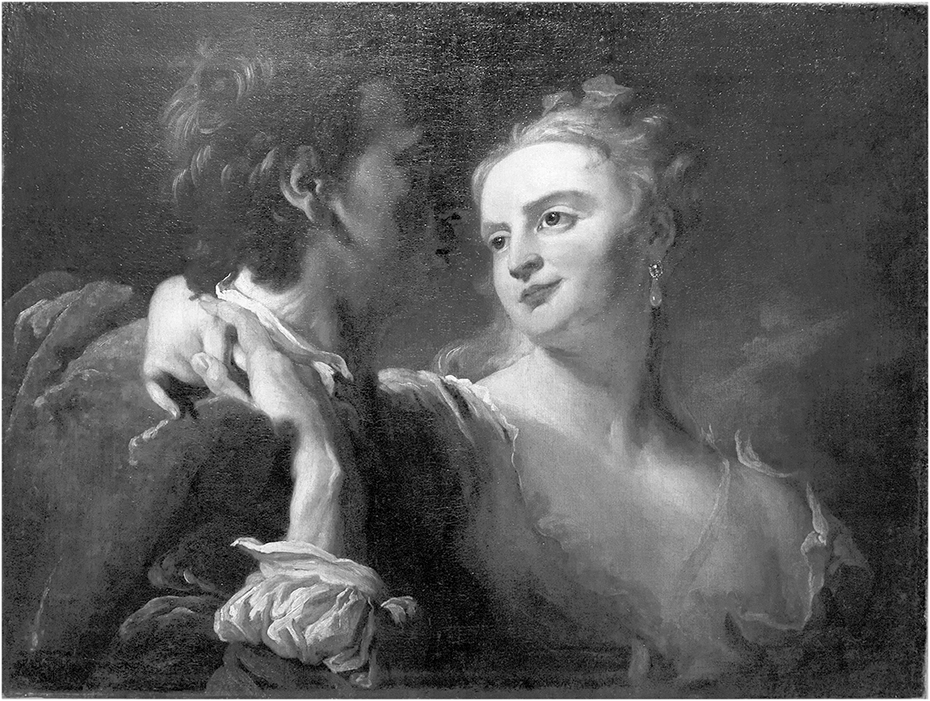
Loving Glance, attributed to Jean-Pierre Goudreaux (1694–1731), seized during German occupation from what is today the Bohdan and Varvara Khanenko National Museum of Art, Kyiv; now held by Doyle New York pending restitution to Kyiv.
Image courtesy of Doyle New York.
Second, an early eighteenth-century French painting, Loving Glance (earlier known as An Amorous Couple), attributed to Pierre-Louis Goudreaux (1694–1731), surfaced at auction in New York in January 2013 (Figure 3). Fortunately again, when identified by the Art Loss Register, it was withheld from auction.Footnote 41 It does not appear on any of the German wartime inventories or receipts for “borrowed” art, nor was it listed with the paintings Koch evacuated to Weimar, so we cannot be sure it reached Königsberg. Reportedly, it had also first surfaced in London in 1953, but details are not available. Given the convincing provenance documentation submitted by the Khanenko Museum, US and New York laws should enable its eventual return to Ukraine.Footnote 42 Its wartime and postwar migration have yet to be determined.
These two cases raise lingering hope of retrieval abroad of more Ukrainian wartime survivors with “just and fair solutions” for restitution to Kyiv. Clearly, however, those wartime losses from Ukrainian state museums contrast sharply with the private Holocaust-related Jewish losses predominating in recent restitution cases in the West.
KOCH’S “SURVIVORS” FROM KÖNIGSBERG TO WEIMAR
In contrast to the art treasures from Kyiv museums the Germans intentionally destroyed in Wildenhoff in February 1945, ironically, that same month, Gauleiter Koch succeeded in evacuating at least part of his personal art collection from Königsberg to Weimar (soon to be under Soviet occupation in Germany). Transported by Koch’s trusted estate administrator, SS-Standartenführer Albert Popp (1904–1978), the collection was deposited in the Weimar Provincial Museum under the care of the director, Walther Scheidig (1902–1977), a well-known German art historian.Footnote 43 An inventory of the 67 paintings and estimated 100 engravings, together with an impressive collection of silver received, is preserved in the Weimar State Archive.Footnote 44 As noted earlier, Avenir Ovsianov published a Russian translation in 1998 and briefly described the collection.Footnote 45 He attributed the inventory to Günther Wermusch, who had earlier published a German version in his popular account of the search for the Amber Chamber. Wermusch provided no archival attribution, but we now know that he was one of the head Stasi investigators in what was known as “Operation Pushkin.”Footnote 46 The Stasi had launched that major effort to help—and/or surpass—the secret Soviet Commission find the Amber Chamber, following allegations that Popp’s transport also included crates with the amber panels. While the Stasi did not find the Amber Chamber, they did find considerable information about the Koch Collection and SS officer Popp, along with inventories from the Weimar State Archive.Footnote 47
The 9 February 1945 list of items Popp originally deposited in Weimar has several sections, the first listing six tapestries, four of which were antique—the earliest from Flanders (1580). One is described as seventeenth-century; two are from the eighteenth century, one from Brussels (1730) and another ca.1750. One of the two contemporary works was a large representation of Koch himself.
The second section, “Paintings (Gemälde)”—numbered in the Weimar original—lists surnames of artists, titles, and dimensions for approximately 67 painting. Sixteenth- and seventeenth-century Dutch painters predominate, as they were undoubtedly the most valuable. Named artists include Pieter Aertsen (1507/08–1575), Marten van Cleve (1520–1570), William Claesz Heda (1594–1680), Aelbert Cuyp (1620–1691), Jan Weenix (1642–1719), Ludolf Backhuysen (1630–1708), and Godfried Schalcken (1643–1706). The names of Rubens and Rembrandt appear, but only with paintings “of their school.” From Italy are seven views of Venice by Canaletto (Giovanni Antonio Canale, 1697–1768), and three paintings by Giovanni Paolo Panini (1691–1765) depicting ruins of antiquity. German landscape painters Andreas Achenbach (1815–1910) and his brother, Oswald Achenbach (1827–1905), are also represented, and a Romantic landscape by Carl Spitzweg (1808–1885). Several paintings are labeled “French” but none are by known artists; number 6 is a set of mid-eighteenth-century French paintings representing the four seasons. Approximately 100 graphic works included “92 framed facsimiles of Ridinger engravings” (no. 65)—undoubtedly referring to the eighteenth-century German painter and engraver Johann Elias Ridinger (1698–1767).Footnote 48
A third large section listing some 106 items of “Silver” and other metalwork provides no provenance details, nor does the fourth section for “Non-precious Metal.”Footnote 49 Only the paintings will be subject to further analysis here.
After a bomb hit part of the Weimar Museum in March 1945, Popp returned 9/10 April in a Red Cross van with Swiss registration plates and absconded with almost two-thirds of the paintings; that was just when Koch himself was fleeing to Denmark. Only one painting Popp removed in April has since surfaced at auction in the West—namely, Still Life with Fowl (Geflügelstilleben), attributed to Jan Weenix and probably from the Goudstikker Collection, which Göring had sold to Koch, though its present whereabouts is unknown. Two others are reported to be in private collections.Footnote 50
Thanks first to Scheidig and then to the Stasi, we nonetheless now also have a February 1947 listing of the 27 paintings that remained in Weimar just before their deposit in a Weimar bank safe.Footnote 51 That list includes one tapestry and 99 graphic works (intermixed with the paintings). Scheidig noted one painting (and four with questions) had markings from a Kyiv museum; four had markings from the occupied Netherlands and three from occupied France.Footnote 52
A separate document in the Stasi files lists 11 items (all on the February 1945 list) of apparent personal relevance to Koch. These include the large wall hanging of Koch (Tapestry no. 5—Seinem Gauleiter Erich Koch das Heimwerk Samland, 1.35 x 2.00 cm); portraits of Erich Koch and an elderly woman (possibly his mother) by the [Dusseldorf?] artist Willy [sometimes Wilhelm] Reetz (1892–1965); and a portrait of Koch’s wife, Frau Koch, along with portraits of Adolf Hitler and Hermann Göring. The graphics include engravings of Elberfeld (Koch’s birthplace), a Portrait of Copernicus, and Napoleon at Wagram.Footnote 53 The portraits of Hitler, Göring, and Koch and his wife, were missing from the 1947 Weimar list, presumably removed under Allied occupation denazification regulations.
Several other removals from the Koch Collection in Weimar are noted (without documentation) in a short register for the collection. Notably, one tapestry (Gobelin) was sold to an American Army lieutenant on 15 May 1945 for office décor; a receipt has not been found. Later in July 1945, a Russian officer and Weimar painter, on orders from the Restitution Office, took “various paintings and tapestries,” but again, no details are available.Footnote 54
While we now know more about the composition of the collection, conclusive identification and provenance data cannot be provided in many cases. Hardly the world-class collections of Hitler or Göring or rivaling collections of other high-ranking Nazis, the Koch Collection nonetheless reveals the artistic taste of the Nazi elite. More importantly, it reveals patterns of Nazi art looting—not only from Ukraine and but also from Western Europe, and the resulting pan-European migration of looted art during and after the war.
KYIV “SURVIVORS” AMONG KOCH’S LOOT
No fewer than 13 paintings from the Western Division, the Kyiv Museum of Western and Oriental Art, can be provisionally identified on the list deposited in Weimar in February 1945. Following Nazi art preferences, Koch gave priority to Western Old Masters and German artists. In addition to the 78 crates sent by rail to Kamianets-Podilskyi and then Königsberg, the Germans earlier evacuated five priority crates (65 paintings) from the Western Division by truck to RKU headquarters in Rivne. Surviving German shipping inventories in Moscow (copies in Kyiv) for all five crates give artists, titles, museum registration numbers, and dimensions for the paintings they contained.Footnote 55 Later shipping papers have not surfaced, but we assume safe arrival in Königsberg because four nineteenth-century German paintings from Crate I match listings for paintings deposited in Weimar.Footnote 56 There was a Dutch seventeenth-century painting by Godfried Schalcken in Crate II entitled Game of Cards, but the Schalcken on Koch’s 1945 deposit list was The Lacemaker (Spitzenklöpplerin) and was 5 centimeters narrower. Yet the 1947 list suggests the Schalcken Koch sent to Weimar had “markings from a Kyiv museum,” so questions remain. While none of those paintings have returned to Kyiv, we do not know if others sent via Rivne that did not reach Weimar survived.Footnote 57 Only an estimated eight from Kyiv remained when the collection was deposited in the Weimar bank in 1947.
No paintings by known Russian or Ukrainian artists or icons appear on the list that reached Weimar, but then, Koch had only contempt for Slavic culture. Only three items on the 1945 list are labeled Russian, and all are by unknown late-nineteenth-century artists—two of the works depict maidens: Oval Portrait of a Maiden (1858) and Maiden Binding Sheaves (1877), and a third is View of a Wide River (1896).Footnote 58 None of those are found on the 1947 Weimar list, so probably either Popp took them in April 1945, or they were removed by Soviet officials in Germany.Footnote 59 Curators in the Russian Museum in Kyiv today are unable to match any of the three paintings with those lost during the war, nor do they appear on existing German shipping lists from Kyiv to Königsberg.Footnote 60
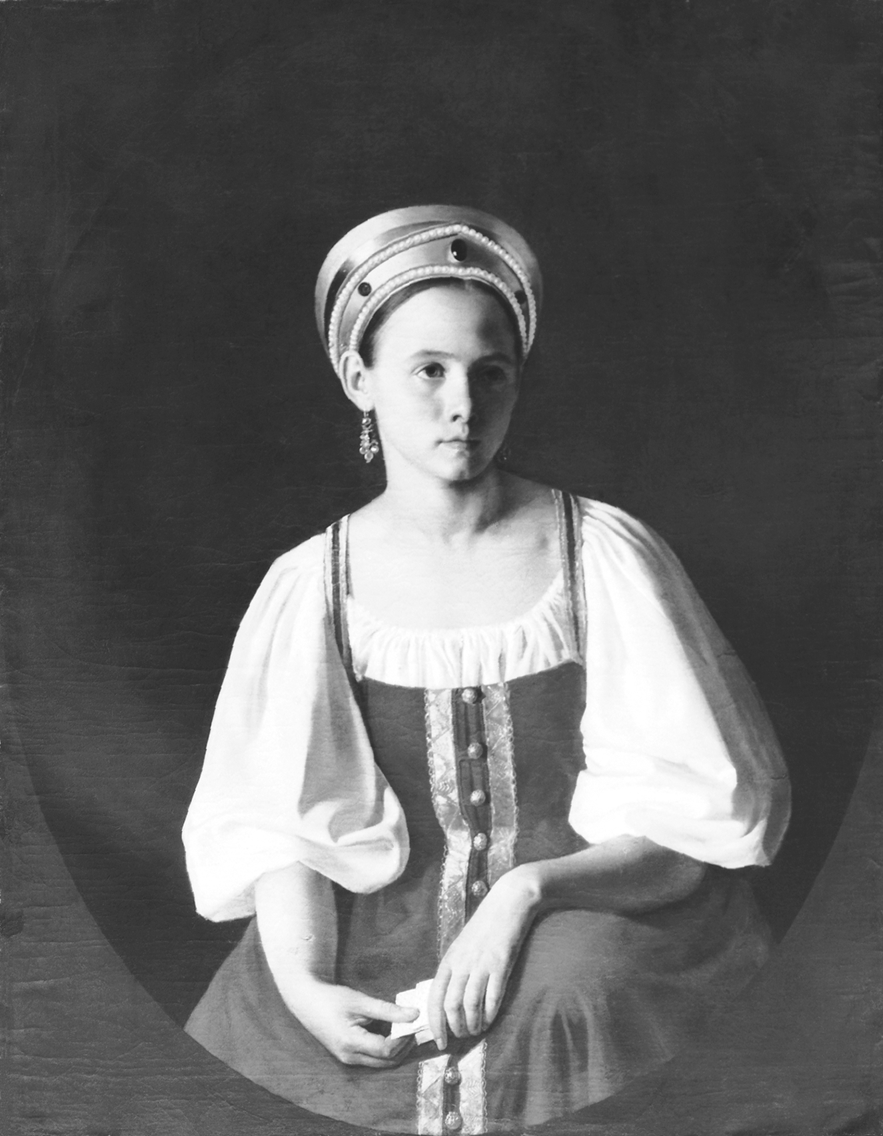
The Russian Museum published a rather sketchy and poorly printed list of their losses after Ukrainian independence in 1994. Museum registration numbers are given, but only a few of the lost icons from the Lavra could be identified with prerevolutionary catalogues, because only wartime museum acquisition numbers were available. There are no illustrations, and only a handful survive in Kyiv.Footnote 61 During occupation in Kyiv, only one painting from the Russian Museum is known to have been seized personally for Koch. When he visited in August 1942, Koch took a fancy to a nineteenth-century painting, A Maiden in a Red Peasant Dress (Debushka v krasnom sarafane) (Figure 4); a surviving loan receipt specifically designates the Reich Commissar as borrower.Footnote 62 That painting is still missing from the museum in Kyiv, but it does not appear on either of the Weimar lists of Koch’s paintings.
Maiden in Red Peasant Dress (Sarafan) by an unknown artist from Vinnytsia Oblast, Ukraine, removed ‘on loan’ during German occupation for Reich Commissar of Ukraine Erich Koch, August 1942, from what is today the Kyiv National Museum of Russian Art, and never returned.
Image courtesy of the National Museum of Russian Art, Kyiv.
“TWICE SAVED” OR THRICE SEIZED IN WEIMAR
New Archival Revelations – I
Senior Hermitage curator Ksenia A. Agafanova was sent to Germany in 1948 to serve with the Soviet Military Administration in Germany (SVAG/SMAD) and investigate “looted artistic valuables taken out of the Soviet Union by the Germans during the war.” Thanks to Weimar Art Gallery director Scheidig, she learned about the “collection of the Fascist leader Koch,” then on deposit in a Weimar bank.Footnote 63 She was working in Germany with Sergei Sidorov, Chief Inspector for Visual Arts and veteran of several earlier Trophy Brigades.Footnote 64 She first mentioned the “fascist Koch collection” in Weimar (Thuringia) “containing paintings from Soviet museums” in a summary report dated 15 September 1948.Footnote 65 The SVAG discovery was soon followed by the removal of 27 paintings from the Koch Collection from the Weimar bank.
Agafonova later reported,
[On] 29 September 1948 …, nineteen crates were received in the Rummelsburg warehouse under [SVAG] Headquarters (Central Comendatura) in Berlin from the Senior Inspector of the Land of Thuringia.
In crates nos. 1 through 17 were packed various paintings, engravings, and objects of decorative art (154 items). …
The Koch Collection was comprised of cultural-artistic valuables stolen by him from Kyiv and other Ukrainian museums.Footnote 66
In a joint report with Sidorov in December, they concluded,
During occupation of the UkrSSR, the German Koch was the military governor of Ukraine.… All of those valuables were seized by the Thuringia Restitution Section and reported as belonging to the USSR, although a small part of the objects were registered as of unknown provenance.
It is such a small part that it should be considered the same as the rest, and hence all 17 crates should be considered as belonging to the USSR.
They accordingly recommended “shipping all of the contents of the 17 crates from Thuringia to the USSR to the address of the All-Union Committee [i.e., Moscow].” They advised against sending two remaining crates (nos. 18 and 19) containing “only frames for paintings of French provenance.”Footnote 67
We know these details thanks to the long-missing SVAG cultural restitution/retrieval files that surfaced in 2009 in the Russian State Archive of the Economy (RGAE) in Moscow, where they had become intermixed with the records of the Ministry for Foreign Trade. Originally they would have been part of the departmental records of the SVAG Administration for Reparations and Deliveries (Upravlenie reparatsii i postavok SVAG), and its subdivision for Restitution, which in the Soviet Zone of Occupation had been presided over by Major General Leonid Zorin, who later became Deputy Minister of Foreign Trade.Footnote 68
We now know it was on the basis of a few documents from one or two files among those records that Russian art journalist Evgraf Konchin was the first to have broken a sensational note in the 1990s about Zorin’s “finding 19 crates with canvases and other art objects from Soviet museums that had been brought together by Gauleiter Koch” in Thuringia.Footnote 69 Konchin explained that his story was drawn from documents Leonid Zorin had shown him privately in the mid-1970s, when those files were still under top-secret wraps in the agency archive of Zorin’s Ministry of Foreign Trade. Finally declassified in 2006 in the Russian State Archive of the Economy (RGAE), those files were regrettably withdrawn from the series and again reclassified after my 2009 examination and identification.Footnote 70
Thanks to those same files, we also learned that Agafonova simultaneously was involved in the SVAG discovery and seizure of the fabulous collection of Impressionist paintings owned by German industrialist Otto Krebs (1873–1941), not far from Weimar. A US Army command had occupied the mansion on Kreb’s former Holzdorf estate from April through June in 1945. Subsequently taken over by the Soviet command for Thuringia under General Vasilii Chuikov, it was not until Agafonova’s visit in 1948 that the SVAG art prospectors gained access to the special climate-controlled basement strong room that preserved the Krebs Collection. The fact that Agafonova’s initial description of the Krebs collection remains in the same file as her reports about the Koch Collection explains why art journalist Evgraf Konshin was also the first to reveal the story in Russia (in the early 1990s). Krebs’ “Impressionist Masterpieces in a Cellar” was well-publicized internationally in a chapter by Konstantin Akinsha and Grigorii Kozlov in their book about the Beautiful Loot brought to the USSR by Soviet Trophy Brigades.Footnote 71 That book came out five decades later in 1995, coinciding with the Hermitage exhibition Hidden Treasures Revealed, featuring 56 masterpieces from the Krebs Collection never previously seen in public.Footnote 72
FROM WEIMAR TO LENINGRAD: HIDDEN TREASURES NOT REVEALED
New Archival Revelations – II
Thanks to the Hermitage’s 250th anniversary publication in 2014 of a revealing volume of long-secret documents on State Hermitage: “Displaced Art”, 1945–1958, we can now confirm that the paintings SVAG removed from the Weimar bank arrived safely at the Hermitage in January 1949. In a report published later that year, Agafonova summarized the contents of the special echelon from Berlin under the auspices of the firm Raznoeksport, which, together with the Krebs Collection, also contained retrieved treasures seized from Soviet museums, including an “archeological collection from Kherson Oblast Museum and paintings and engravings from suburban Leningrad palace museums.” Under the category of “Accessions by the State Hermitage for Temporary Storage,” Agafonova continued:
Among the returned works of art it is worth noting the collection of Koch, ruler (Gauleiter) of Ukraine during the days of German occupation, found in a bank in Weimar (Soviet Zone), which he assembled of things with provenance in the Soviet Union and France. Koch was one of the greatest looters in the Hitlerite army, although the collection found in Weimar is undoubtedly only an insignificant portion of the treasures he looted. The collection includes paintings of Russian and foreign artists, among the most important being: Morland, Landscape, A. Cuyp, Boy with a Falcon, three paintings of the circle of Canaletto, Views of Venice, and Winterhalter, Portrait of a Small Boy.
It has been possible to establish only partially the provenance of the works seized by Koch.
1. Known paintings removed from Soviet museums in Kyiv, Yalta, and elsewhere.
2. Painting of Opie, Portrait of a Woman, listed in an album of items removed from France, from the Wildenstein Collection.
3. Paintings owned by Goudstikker antique dealer.Footnote 73
Agafonova also mentioned receipt of a medieval portal with sculptured drum found in the forest of Göring’s Carinhall Estate, ten paintings from the collection of the Duke of Anhalt from Quedlinburg, and—most important—the Krebs Collection from Holzdorf, which she considered “the most significant collection acquired by the Hermitage in 1949.”Footnote 74
By contrast, the much more meager Koch Collection, consisting entirely of Nazi-looted art, had no such hidden masterpieces to reveal. The fact that its surviving Weimar portion arrived in the Hermitage together with the Krebs Collection in 1949 may explain why it was soon forgotten. Hermitage curators were too busy with the Krebs Collection and unable to determine provenance of all the paintings Koch had collected.
Agafonova’s colleague Vladimir Levinson-Lessing, who then headed the Hermitage Division of Western Art, gave an equally glowing account of those 1949 receipts, but understandably, he had only a few words to say about the paintings from the Weimar bank: “Among items coming from the possessions looted by Gauleiter Koch,” he mentioned only one: “the most interesting is the Landscape with Children, by the English eighteenth-century painter George Morland.”Footnote 75 The reported Morland receipt remains puzzling, however, because no Landscape by Morland—or even a possible landscape to match that attribution—appears on either Weimar list for the Koch Collection. Neither Levinson-Lessing’s, nor Agafonova’s reports after her return to Leningrad, suggest they had realized that the Koch collection had been assembled in Königsberg during the war.
UNIDENTIFIED KYIV “SURVIVORS” AND VICTIMS
Once back in Leningrad, neither Agafonova nor Levinson-Lessing mentioned any specific paintings received from Weimar in their reports as being of Kyiv provenance—or from other Soviet museums—at least in the Hermitage documents published thus far. Agafonova did name Franz-Xavier Winterhalter’s (1806–1875) Portrait of a Small Boy (1859) among those received with the Koch Collection, although she neglected to mention its Kyiv provenance. Although number 51 on the 1945 list of Koch deposits in Weimar, it did not appear on the list of 27 remaining in Weimar in 1947.Footnote 76 That was also true of another German painting suspected of being in the Hermitage today, Boy Fishing on the Beach by Friedrich Fritz Hildebrandt (1815–1855). Two other nineteenth-century German paintings were also listed with Koch’s deposit in Weimar in February 1945, but not on the 1947 list, although they may have remained in Weimar. All four were shipped from Kyiv in the first of the five priority crates the Germans had sent by truck to RKU headquarters in Rivne in September 1943.Footnote 77 Three of the four, including the Winterhalter, also appear on a surviving German “borrowed” receipt dated 23 March 1942.Footnote 78
Nevertheless, with the help of Kyiv curators, possible Khanenko Museum provenance can be established for 7 or 8 of the 27 paintings listed in 1947, which SVAG presumably removed from the Weimar bank. According to the 1947 Weimar list, Scheidig suggested five had “markings from a Kyiv museum,” including one by Godfried Schalcken, but the other four Scheidig had indicated lacked an artist name—two Dutch and one sixteenth- or seventeenth- century Italian. Another four or five presumably from Kyiv, including Ship in Storm by Ludolf Backhuysen and Canaletto’s Grand Canal in Venice, were deposited in Weimar in February 1945 but not listed in 1947. Obviously, in the search for more Kyiv survivors, the “displaced” paintings from the Koch Collection in the Hermitage will require more provenance research.Footnote 79
Meanwhile, the Soviet Union was only minimally cooperating in Allied cultural restitution efforts. While internal restitution to Soviet museums was hardly a priority in 1949, efforts to retrieve and claim art seized from the Soviet Union continued until the Western Allies closed down their major restitution programs in 1949. However, unlike their Western Allied counterparts, no Soviet specialists were analyzing the many relevant German documents Soviet authorities had collected regarding German cultural seizures in the USSR. Besides, as far as is known, there was no central office tracking seized cultural property, nor were there centralized data files coordinating losses of Soviet museums with related retrievals that might have assisted appropriate restitution. That may explain why, in July 1949, SVAG restitution officers in Germany submitted claims to French authorities for 385 paintings seized during occupation from the Kyiv Museum of Western and Oriental Art, based on the 1944 ChGK report of losses from the museum.Footnote 80 Apparently they had not found the German shipping documents in Kyiv covering those paintings Koch had ordered to Königsberg, most of which were presumably destroyed in Wildenhoff. Nor were they taking into account the 1946 Kyiv KGB file with Polina Kul’zhenko’s testimony about the destruction.
KOCH AND GÖRING’S CASTOFF WESTERN LOOT
Despite Agafonova’s initial claim of “only a small portion” as being of non-Soviet provenance, in fact, probably at least two-thirds were from foreign sources and were undoubtedly the most valuable paintings in the collection Koch sent to Weimar. The American wartime intelligence agency, the Office of Strategic Services (OSS) Art-Looting Investigation Unit (ALIU), was admittedly not informed of developments on the Eastern Front during the war and immediately thereafter, nor were they aware of the collection Koch evacuated to Weimar. Nonetheless, their 1946 report on the Göring Collection (CIR #2) documented many paintings that “Gauleiter Koch (Danzig)” had “purchased” from Reichsmarschall Hermann Göring.Footnote 81 In fact, he acquired no fewer than 16 or 17 paintings—10 or 11 in 1940 and 6 in 1943—mainly seized from the Netherlands. Koch also acquired several transfers of paintings seized in France. As the most significant component of Koch’s collection, at least 13 of those from Göring were deposited in Weimar in February 1945.
We know that Göring was one of Koch’s strong supporters for the post of Reichskommissar of Ukraine. Göring, as Master Huntsman of the Third Reich, spent much time in East Prussia, and had constructed his own hunting lodge near the traditional Prussian royal lodge in the Rominten Heath (Kurfürstliche Jagdbude Rominten), a game reserve of 40,000 hectares (c. 25 square miles) close to the Soviet border. Records remain of several paintings Koch gifted Göring on different birthdays. In Koch’s personal collection evacuated to Weimar, a portrait of Göring was the only representation of a Nazi leader except for portraits of Adolf Hitler.Footnote 82 A May 1943 memorandum from Göring to Kajetan Mühlmann outlining Hitler’s instructions for disposal of Polish art treasures makes clear the extent of Koch’s close involvement in such issues. Immediately following Hitler’s confirmation that Leonardo da Vinci’s The Lady with the Ermine, the Raphael [Portrait of a Young Man], and the Rembrandt Landscape from Kraków [Czartoryski Collection] were intended for the Kaiser-Friedrich Museum in Berlin, and the Viet Stoss Altarpiece for the City of Nurnberg, other cultural treasures (details not provided) were specified for Gauleiter Koch on behalf of the Königsberg Museum. A personal meeting with Koch was suggested to discuss the future disposition of cultural treasures at war’s end, but for the present, the Czartoryski Łancut treasures, which apparently Koch had requested, were to remain in the local castle.Footnote 83
The impressive 2009 catalogue raisonné of the Göring Collection compiled by Nancy Yeide provides important leads regarding Göring’s sales to Erich Koch, and it corrects some details in the ALIU report.Footnote 84 Expanded documentation in the Göring papers and Dutch records in The Hague augment provenance attributions from other sources, such as the Göring database on the website of the Deutsches Historisches Museum (DHM) in Berlin.Footnote 85
Among Koch’s initial purchase from Göring in 1940, 10 and possibly 2 other paintings came from the well-documented collection of the Dutch Jewish art dealer Jacques Goudstikker, an important specialist in Old Masters (Figure 5[inset]). The Goudstikker family fled the Netherlands the same day in 1940 that Göring’s Luftwaffe bombed Rotterdam, leaving the world-class art collection behind. Goudstikker himself lost his life in a tragic accident aboard the ship that was carrying him to safety across the English Channel. Göring hastily arranged seizure of some 1400 paintings that comprised the Goudstikker Collection, most of which were expedited to his Carinhall estate (see Figure 5a). The Goudstikker Gallery in Amsterdam (Herengracht 458) and some of the inventory were “aryanized” and placed under control of Göring’s chosen agent Alois Mieidl (1903–1990); some of those paintings went to auction in Berlin. A number of Göring’s “cast-offs” were subsequently “sold” to various chosen individuals, including Gauleiter Erich Koch. Goudstikker’s daughter-in-law and sole heir, Marei von Saher, now a US citizen, has recently successfully reclaimed many paintings in the lost Goudstikker legacy, including 200 returned to the family in the United States by the Dutch Government in 2006.Footnote 86 Her task has been aided by the survival of Goudstikker’s famous “Black Book,” a small notebook recording most of the paintings in his collection (Figure 5b). He had it in his pocket when he died aboard ship; the original is now preserved in the Amsterdam Municipal Archives.Footnote 87
Reichsmarschall Hermann Göring exiting the Goudstikker Gallery, Heerengracht 458, Amsterdam, 1941. Inset is a business card from the Jacques Goudstikker Gallery, Heerengracht 458, Amsterdam.
Image from the National Archives of the Netherlands, Spaamestad Fotoarchief, courtesy Bureau Herkomst Gezocht (Origins Unknown Agency), The Hague.
Inset image courtesy of the Amsterdam City Archive.
Goudstikker’s pocket notebook catalogue of his collection, the Black Book, here open to his listing of the Four Views of Venice by the School of Canaletto (Fig. 6), nos. 2165–2168.
Image from the original, courtesy of the Amsterdam City Archive.
KOCH, GÖRING, AND THE DANZIG CONNECTION
Of special interest, some paintings among Koch’s initial purchase of 10 or 11 from Göring in 1940 were apparently intended for the Danzig Museum, although Koch’s relationship to Albert Förster, Gauleiter of Danzig, or to the museum, is not clear. Göring’s art agent and curator Walther Andreas Hofer (1893–1971?) named four items that Göring sold to “Gauleiter Koch, Danzig” in the summer of 1940.
The first consisted of Four Views of Venice by Canaletto (Giovanni Antonio Canale, 1697–1768), “all purchased from Goudstikker and numbered 2165, 2166, 2167, and 2168” (Figure 6).Footnote 88 Yeide’s Göring catalogue further identifies them with images and documented provenance (Italian titles are added here):
A332 – Piazza Santa Margherita – (Goudstikker #2166)
A333 – Il Campo di San Polo – (Goudstikker #2165)
A378 – Isola San Giorgio – (Goudstikker #2167)
A379 – La Riva degli Schiavoni – (Goudstikker #2168).Footnote 89
The four Canalettos evidently went to Königsberg rather than Danzig, given the lack of Danzig museum listings and the fact that all four appear on the February 9, 1945 list of Koch paintings deposited in Weimar along with three others by Canaletto or his followers.Footnote 90 The latest edition of W.G. Constable’s Canaletto catalogue raisonné (1989) cites the set of four as being “by the same hand… from the school of Canaletto.”Footnote 91 They were last exhibited together in 1934 in the Stedelijk Museum in Amsterdam.Footnote 92 As further confirmation of their provenance and the fact that they were last together in Weimar, museum director Scheidig recalled in a later note that, among the Koch Collection, were “four large Italian city views in the art of Canaletto, landscape format, on the verso with signs and ownership marking of Goudstikker.”Footnote 93 Constable (Reference Constable1989) reports that the view of Il Campo di San Polo (Yeide A333) was in a London private collection, but that the “present location [is] unknown” for the other three.Footnote 94
School of Canaletto (Giovanni Antonio Canale, 1697–1768), Four Views of Venice, from the Collection of Jacques Goudstikker, Amsterdam; last exhibited together at the Stedelijk Museum, Amsterdam, 1934. Seized following German occupation of the Netherlands, 1940, on behalf of Reichsmarschall Hermann Göring; sold to Gauleiter Koch, 1940. Evacuated to Weimar, February 1945, and subsequently dispersed.
A) Piazza Santa Margherita (=Goudstikker #2166), received by the Hermitage, Leningrad, 1949; B) Il Campo di San Polo (=Goudstikker #2165), reported in a private collection, London, 1989; C) Isola San Giorgio (=Goudstikker #2167), present location unknown; D) La Riva degli Schiavoni (=Goudstikker #2168), present location unknown.
Images from Catalogue de la Collection Goudstikker, No 36 (1928–1929), Nos. 9–12. Courtesy of the Fine Arts Library, Harvard University.
Only two of the four Goudstikker Canalettos appeared on the 1947 Weimar list, which would suggest previous removal of two. Constable’s 1989 report of Il Campo di San Polo in London would account for one of those.Footnote 95 A recently published Hermitage document noted the 1949 receipt of “three paintings from the Venetian School of Canaletto,” and also several paintings with Goudstikker labels, but it was unclear if those two phrases referred to the same paintings. A Hermitage report with a list of receipts (1955) specifically mentions a Goudstikker label for a Venetian view of the Piazza Santa Margherita, which would correspond to the first of the four above (Yeide A323). The same list of four paintings with Goudstikker markings includes a second city view from the Italian School, but provides no further identification.Footnote 96 Presumably that would also be one of the set of four from Venice, but further investigation will be required to verify which one and if both of them still remain in the Hermitage.
Koch apparently liked Venetian scenes by Caneletto and his circle, as is evident in the seven “Art des Canaletto” entries on the initial 1945 Weimar list. At least one of those may have been from Kyiv: the Khanenko Museum lost a Canaletto painting of the Grand Canal and one by a follower depicting the Piazza San Marco in Venice.Footnote 97 Koch may well have purchased yet another Canaletto in 1942 from Walter Bornheim, an art historian and dealer in Munich who was well-protected by Göring. Koch was specifically listed by ALIU investigators as one of Bornheim’s clients, with a Canaletto (title lacking) as one of his purchases, which Bornheim had in turn purchased in Paris from the dealer Joan Schmitt. An additional three paintings of Marieschi and his followers that Koch acquired from Bornheim may also suggest similar subjects, although details are as yet not available.Footnote 98
The other three named paintings Koch purchased from Göring in 1940 were all Dutch Old Masters, none of which apparently reached Weimar:
(2) Godfried Schalcken (1643–1706), “Girl Holding a Candle – bought from Douwes”;
(3) Abraham van Beyeren (1620/21–1690) – “Still Life –bought from Hofer”;
(4) Jan van Goyen (1595/96–1656) – “River Landscape – bought from Goudstikker.”
According to Hofer, three or four additional Dutch seventeenth-century paintings, the details of which he did not recall, were included in the sale for RM 130,000.Footnote 99
The fourth painting on that list by Van Goyen is the only painting Koch purchased from Göring that this author has been able to examine to date. Bearing the Polish title Chałupy nad kanalem (literally, Huts by a Canal), it currently hangs on the wall of the National Museum (Muzeum Narodowe) in Gdańsk (Figure 7a). The Goudstikker label bearing number 1629 is still intact in the middle of the stretcher, the same number listed for a painting with that title and dimensions in Goudstikker’s “Black Book” (Figure 7b).Footnote 100 That number is also confirmed on the Goudstikker Dutch loss registration document held by the Origins Unknown Bureau (Herkomst Gezocht) in The Hague.Footnote 101 When a local Gdańsk journalist raised the issue of Göring-related provenance in June 2012, museum director Wojciech Bronisławski publicly denied that the Van Goyen painting had come from Göring or from the Goudstikker collection: “Absolutely not!” he replied, “Huts by a Canal was purchased during the war on the Dutch art market by Albert Forster [Gauleiter of Danzig],” naming a price of RM 50,000. “Willi Drost, director of the Danzig City Museum, thanked Forster in his catalogue of ‘New Acquisitions 1940/41.’”Footnote 102
Jan van Goyen (1595–1656), Huts on a Canal (Polish, Chałupy nad kanalem) or Landscape with Peasant Farm (=Goudstikker #1692); ‘purchased’ by Goring in 1940, following seizure of the Goudstikker Gallery in Amsterdam; sold to Gauleiter Koch, Danzig. Now exhibited in the National Museum in Gdańsk
Image courtesy of the Muzeum Narodowe, Gdańsk.
Goudstikker label for Huts on a Canal on stretcher (with Goudstikker BlackBook #1692).
Image courtesy of the Muzeum Narodowe, Gdańsk.
To the contrary, purchase from Göring is indeed confirmed, as noted above, but neither current director Bronisławski, nor the German wartime director Drost before him, provided a name for the seller or previous provenance, let alone a bill of sale. After my several hours of discussion with the director and curator at the museum in Gdańsk, and with the documents from The Hague with which I furnished them, including a copy of the Dutch postwar SNK “missing” registration form confirming the Goudstikker number, the museum should be prepared to accept the Göring, and before him the Goudstikker, provenance attribution. The wartime evacuation lists the museum provided to me confirm that the painting was twice evacuated during the war, the second time to Schloss Reinhardsbrunn near Gotha in 1944. Seized there by a Soviet Trophy Brigade together with other Danzig paintings, it was returned to Gdańsk from Leningrad in 1956.Footnote 103 Some of the other paintings from Danzig taken at the same time, alas, still remain in Russia.
The German art historian Willi Drost (1892–1964), who directed the Danzig Art Gallery from 1938 to 1945, published in 1943 a glowing account of paintings acquired in the early 1940s, for most of which by implication he had been responsible. In his text and captions for accompanying images of the paintings purchased “on the Dutch art market,” however, he provides no provenance or other indications from whom the 13 Dutch Old Masters pictured, including the Van Goyen, were purchased.Footnote 104 Gauleiter Koch is not mentioned in Drost’s N-S Era wartime account, but Koch’s purchase from Göring is clearly indicated in other sources, as is noted above. As has become apparent today, wartime purchases need to be investigated thoroughly, because even “good faith” purchases from legitimate Dutch dealers during occupation raise “red flags” where the dealers’ sources cannot be documented by the holding museum.
Apparently the US State Department or the US borrowing museums’ scrutiny did not catch the Goudstikker label or the questionable provenance gap when the Van Goyen was exhibited in the Milwaukee Art Museum in 2002 in the exhibition, Leonardo da Vinci and the Splendor of Poland, with paintings from several Polish museums. The same exhibition featured two additional paintings from Gdańsk that Drost acquired at the same time—one by Ferdinand Bol (1616–1680) and the other by Jan Ruttgers Niewael (1620–1661).Footnote 105 Postwar loss-registration documents in The Hague indicate both of them are likewise “missing” from the Netherlands. Hagar and the Angel by Ferdinand Bol, sold to Drost by D.A. Hoogendijk, was registered as being of Dutch ownership.Footnote 106 No evidence has yet been found that either went through the hands of Göring or Koch.
The fate of the other two named paintings purchased by Koch from Göring in 1940, or their possible acquisition by the Danzig Museum, remains unresolved though more complicated in terms of their identification. In the case of Schalcken’s Girl Holding a Candle, either of two different paintings may have been involved, both of them allegedly going to Koch. Yeide based her provenance notes on Hofer and the ALIU interrogation listing the painting as Girl Holding a Candle (or in German, Madchen mit Kerz), as purchased from Douwes (Amsterdam), sold to W.A. Hofer (Berlin), and then sold to Koch (Danzig), as likewise listed in the DHM Göring database. However, a Dutch SNK claim form for a painting with that same title gives the Goudstikker number 461, indicating it was acquired by Miedl and sold at the Lange Auction (Berlin) of December 3, 1940.Footnote 107 Alternate documents in the SNK files list a larger Schalcken painting, Mandoline-speeleter bij karrslicht (Mandoline Player by Candlelight), as having been purchased by Douwes (half owned by Laren Koetser) on 30 April 1940, and sold to Hofer (Berlin), 17 July 1940 [presumably for Göring] with a penciled note that it was purchased by Gauleiter Koch (Königsberg). Neither Schalcken painting is listed in the Gdańsk museum documents examined, nor has either painting been located elsewhere. As noted above, the only Schalcken on the Koch Weimar deposit list from Königsberg was entitled The Lacemaker (Spitzenklüpplerin), which also appeared on the 1947 Weimar list with a note that it had markings from a Kyiv museum. The Kyiv Museum, however, reported the loss of a Schalcken entitled Game of Cards, which was on a German shipping list to Rivne in September 1943 (see above). The Hermitage did not report a Schalcken among receipts from Weimar in documents available thus far.Footnote 108
Further analysis of existing Dutch documents likewise suggests that two different Still Life paintings by Abraham van Beyeren were involved: the first went to Koch, and later in 1943, a second went to the Danzig Museum. Van Beyeren’s Still Life with Grapes (Stilleben mit Trauben) was apparently purchased by Hofer for Göring in 1940 in Berlin and then sold to Koch, as confirmed in the Göring database; its subsequent disposition is unknown, and no Van Beyeren appears among Koch’s Weimar deposits.Footnote 109 A second Van Beyeren, Marine Still Life (Vischstilleven) from the Huygen Collection, was sold to the Danzig Museum in June 1943 by Dutch dealer Pieter de Boer; it would have arrived after the Drost Reference Drost1943 volume was published, and hence not pictured there. Besides, by 1943, most of the paintings were evacuated from Danzig. No painting by Van Beyeren is listed in surviving Danzig museum registers or wartime evacuation lists, nor did Koch evacuate a Van Beyeren to Weimar.Footnote 110
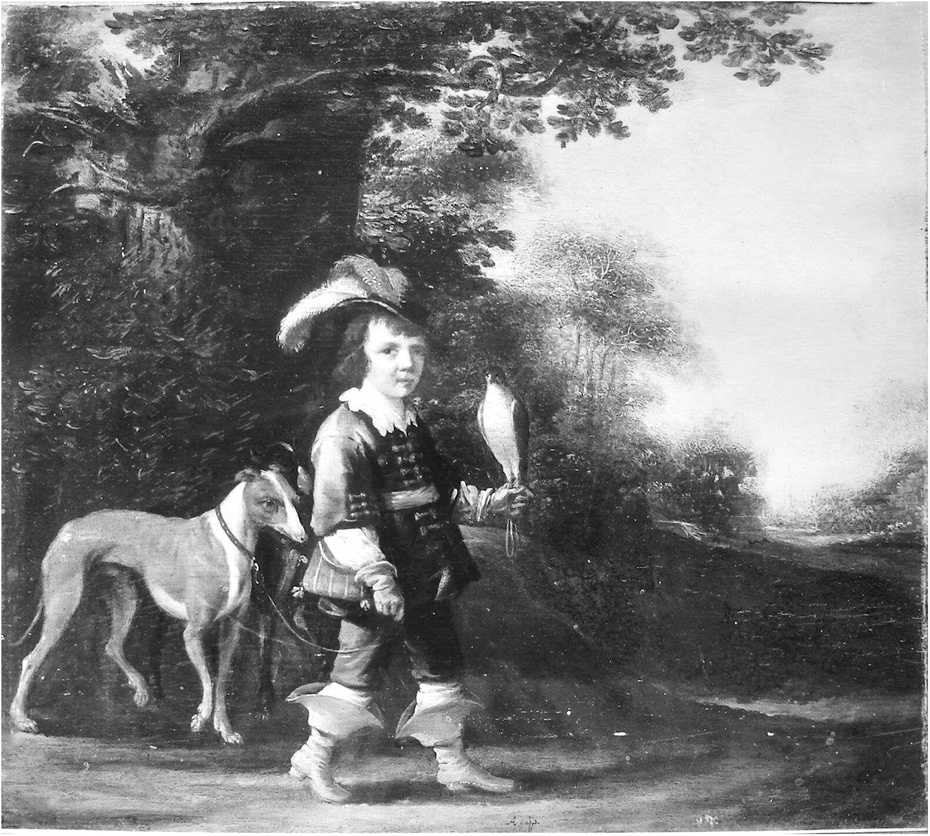
While neither the Schalcken nor the Van Beyeren on the 1940 Göring sale list to Koch appears to have been acquired by Danzig, questions also must remain about the “three or four other Dutch seventeenth-century paintings” Hofer intended in Göring’s 1940 sale to Koch. Possibly two of them went to Königsberg rather than Danzig, because two additional Dutch paintings, both with alleged Göring and Goudstikker connections, appear on both of Koch’s Weimar lists. Besides, newly published Hermitage documents reference two such receipts in 1949. Both Agafonova and Levinson-Lessing report receipt with the Koch paintings of Aelbert Cuyp’s (1620–1691), Boy with a Falcon, which Scheidig noted as having “markings from the occupied Netherlands” on the 1947 list (Figure 8). The Dutch SNK listing gives the Goudstikker number 1284 (with an image), as does the Göring database, also suggesting it went to Koch.Footnote 111 Also received on the 1955 Hermitage document under Goudstikker was a second Dutch painting, Landscape with Windmill from the Rembrandt School, which appears on both Weimar lists.Footnote 112
Aelbert Cuyp (1620–1691), Boy with a Falcon (=Goudstikker # 1284); seized from the Goudstikker firm on behalf of Reichsmarschall Hermann Göring, 1940, and subsequently sold to Gauleiter Koch. Evacuated from Königsberg to Weimar, February 1945; receipt by the Hermitage, Leningrad reported in 1949.
Image courtesy Bureau Herkomst Gezocht, The Hague, from the Dutch National Archive.
Quite possibly, alternatively, one or more among the unnamed Dutch paintings sold by Göring to Koch in 1940 may have come to Danzig, even if such details would not be indicated in the now-incomplete Gdańsk Museum acquisition records. Drost’s images of 12 new Dutch acquisitions in 1940–41 open a number of possibilities, while corresponding Dutch SNK postwar registration documents can be matched to most of them. Unfortunately, the museum has yet to undertake adequate provenance research on its Nazi-era acquisitions.Footnote 113
An initial check of Dutch loss registration/claim papers in the Origins Unknown files in The Hague reveals that Drost himself had purchased in the Netherlands many of the other 12 Dutch Old Masters described and pictured with titles and dimensions in his 1943 publication. Danzig N-S period acquisitions, however, did not stop with those pictured. As revealed, for example, an SNK file for the respected Dutch dealer D.A. Hoogendijk documents a total of nine paintings that he sold to Drost for the Danzig Museum, four of those not mentioned by Drost. Several are indicated as being of Dutch state ownership.Footnote 114
Sales of three paintings to the Danzig Museum by the Amsterdam dealer Pieter de Boer (with no mention of Drost or Koch) have also been identified in the early years of German occupation, in addition to the 1943 Van Beyeren purchase mentioned above. One of them, Interior with Dancing Couples by Jan Miense Molenaer (c.1610–1668), names the purchaser as Gauleiter Förster; but none of those are included in the Drost volume.Footnote 115 Drost is also not mentioned as purchaser on an SNK form for the painting by Johannes van Noort (1644–1676), The Artist’s Family (Ger. Die Familie des Künstlers, or Die Malerfamilie) pictured in the Drost Reference Drost1943 publication. But a red flag arises, because it came from Nathan Katz, another Dutch Jewish dealer forced to flee the Netherlands in 1940. A recent Dutch Restitution Commission ruling nevertheless found most of the Katz sales to be legitimate; so, in this case, the legal issues will need further analysis. Subsequently, the painting came into possession of the Goudstikker firm after it was “aryanized” and taken over by Alois Miedl and was then sent to the H.W. Lange auction in Berlin.Footnote 116 Yet another handwritten note in the files of Kajetan Mühlmann in the NIOD suggests that another six paintings, including two by Bruegel, went to Gauleiter of Danzig Albert Förster, but details and confirming documentation have yet to be found.Footnote 117
Koch was not named in these additional Dutch documents examined, but obviously the whole issue of sales to Danzig from the Netherlands and Göring’s sales to Koch will require more expert analysis. While the Dutch component may have been the most significant among Danzig acquisitions, as is illustrated in the Drost volume, important Flemish and German acquisitions also pictured will likewise require scrutiny. So far, however, no indications have been found that either Koch or Göring were involved with other Danzig acquisitions during the N-S period, but research is only beginning.
MORE GOUDSTIKKER OLD MASTERS FROM GÖRING TO KOCH
Göring’s art manager Walther Andreas Hofer also documented Koch’s purchase of an additional six Dutch Old Masters from Göring in March 1943. Those had earlier been part of a lot slated for sale to Dr. Friedrich Flick (1883–1972), one of Germany’s wealthiest industrialists and a strong NSDAP supporter; Flick subsequently declined their purchase, as is confirmed by Yeide’s research, which corrects the CIR #2 (Göring) listing regarding which paintings were involved in the sale to Koch.Footnote 118
(1 and 2) Two paintings by Maerten van Cleve (1527–1577/81), both entitled Genrebild (Yeide and the DHM Göring Database both suggest possibly from Goudstikker, but they are not listed in the Goudstikker Black Book);Footnote 119
(3) River Landscape with Boats (c. 1635) by Salomon van Ruysdael (1602–1670) (Goudstikker #1880);Footnote 120
(4) Still Life (1638) by William Claesz Heda – 0.62 x 0.49 cm (probably Goudstikker #1952; notebook accession #1341); SNK 9308/752/9945. Most probably matching #44 on the February 1945 Weimar list; not on 1947 list;Footnote 121
(5) A1567 – Still Life with Game by Jan Weenix (1642–1719) – 1.23 x 1.04 cm (122 x 103 cm) (Goudstikker #720; notebook accession #1341); SNK 8044/762/9267). Weimar 1945 list #13; not on 1947 list;Footnote 122
(6) A411 – The Wedding Night by Pieter Aertsen (1507/1508–1575) – 0.95 x 1.33 cm (93 x 133 cm) (Goudstikker–Nyenrode #464); SNK 0033/748/9268. Both Weimar lists (1945=#36; 1947=#14) suggest it may be a fake (Fälschung ?).Footnote 123
Four of the six have been attributed to the Goudstikker Collection, with a question mark remaining for the first two paintings by Maerten van Cleve. Except for those two, all were registered in the Netherlands SNK files as belonging to the Goudstikker heirs in 1946. The fate of the one by Salomon van Ruysdael and the two Van Cleve paintings is unknown. The last three appear on the list Koch evacuated from Königsberg to Weimar in 1945. Only the last one, Pieter Aertsen’s The Wedding Night, remained in Weimar on the 1947 list, but Weimar Museum director Scheidig thought it was a fake. If it was removed from the bank by Agafonova under SVAG auspices, she does not mention its receipt by the Hermitage in 1949. The Weenix, as mentioned earlier, is the only painting Popp removed with other Koch paintings from Weimar in April 1945 to have surfaced at auction since, although its current location is unknown.
During the 2012 newspaper interview at the Gdańsk museum mentioned above in connection with the Van Goyen provenance, a question also arose about a possible red flag for the Jacob van Ruisdael, Landscape with Ruin, which Drost had purchased in the Netherlands, and which now hangs in Gdańsk. Was it also of Goudstikker provenance and seized by Göring? Again, the Gdańsk museum director Bronisławski denied that possibility, explaining that the painting had hung in Drost’s office before being evacuated to Gotha with the other holdings from the Danzig Museum, whence it was seized by a Soviet Trophy Brigade and returned from Leningrad in 1956. The suggestion of Goudstikker provenance was undoubtedly an error, and may have arisen in confusion with Salomon van Ruysdael’s River Landscape with Boats (no. 3 above), which was indeed purchased by Koch from Göring in 1943, and came from the Goudstikker Collection (Figure 9). Its present location is currently unknown. While there is no suggestion of Goudstikker provenance for Jacob van Ruisdael’s Landscape with Ruin, now in Gdańsk , the postwar SNK registration form submitted by the Dutch art dealer Hoogendijk, from whom Drost purchased the painting, nevertheless does suggest Dutch ownership.Footnote 124 Its legal status vis-à-vis a possible Dutch claim needs further investigation together with the legal status of other Drost purchases in the Netherlands.
Salomon van Ruysdael, River Landscape with Boats (c. 1635) (=Goudstikker #1880); seized by Reichsmarschall Hermann Göring, 1940; subsequently “sold” to Gauleiter Erich Koch, 1943. Present location unknown.
Image from Catalogue de la Collection Goudstikker, No 36 (1928–1929), No. 69. Courtesy of the Fine Arts Library, Harvard University.
FRENCH CONNECTIONS FROM WILDENSTEIN AND BORNHEIM
Provenance for another seven paintings Koch evacuated to Weimar can now be traced to several possible sources in France, although migration routes are still hazy, with gaps in provenance. Most significantly, confirmation is possible that the Koch Collection evacuated to Weimar included four and possibly five paintings owned by the important Paris Jewish art dealer Georges Wildenstein (1893–1963). The Hermitage identified two arriving in 1949 with the Koch paintings from Weimar; quite possibly there was one more. Wildenstein and his notable family of art connoisseurs, collectors, and dealers fled the Nazi German invasion of France in 1940. They were stripped of French citizenship and the Paris gallery “aryanized.” Fortunately, the family had already set up a branch of the firm in New York. A large part of the Georges Wildenstein inventory seized from his Paris gallery, along with most of his private holdings in the country, came under the control of the Einsatzstab Reichsleiter Rosenberg (ERR) and was subsequently registered in the Jeu de Paume.Footnote 125 None of the four Wildenstein paintings identified in the collection Koch deposited in Weimar, however, were assigned ERR codes, or at least they do not appear on ERR inventories.Footnote 126
At least two of the Wildenstein paintings that never made it to ERR Jeu de Paume inventories are now identified in the Koch Collection but appear on the list of over 120 paintings seized by the German Field Police (GFP) from Château de Moyre (Colombiers) on 2 August 1940. Two elegant eighteenth-century women’s portraits in question were soon co-opted by Reichsmarshall Hermann Göring and transported with others to his Carinhall estate. The date and circumstances of their subsequent transfer to Gauleiter Koch in Königsberg has not been determined. However, four paintings owned by Georges Wildenstein can now be identified on the 1945 list of Koch’s deposits in Weimar and are also listed as Georges Wildenstein losses in the official 1947 printed French Répertoire for property removed from France during the war. One of them was apparently removed from Weimar by Popp in April 1945, while the remaining three appear again on the 1947 Weimar list. Two of those have now also been identified as arriving at the Hermitage in 1949, but we do not know if the third was with them.
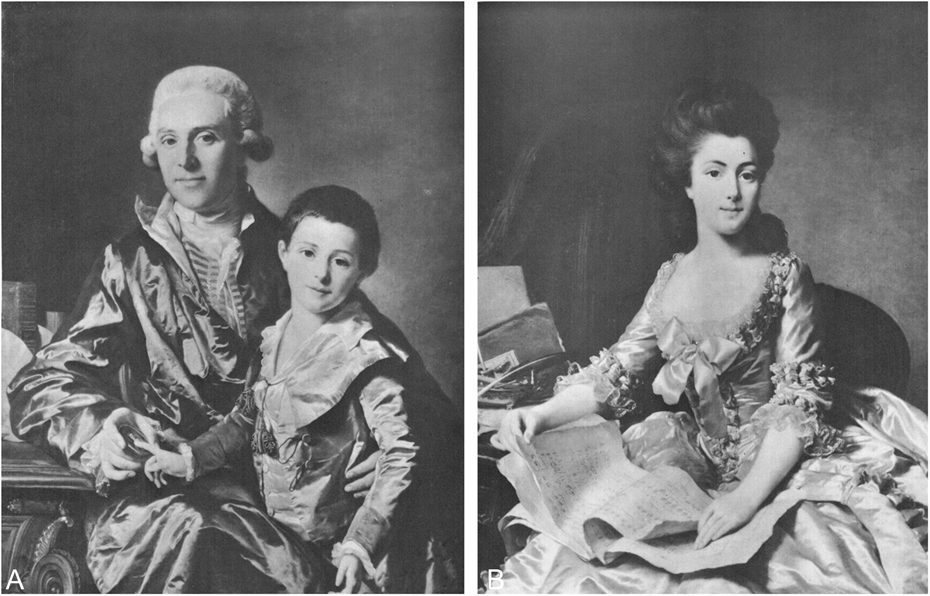
Within the 2014 published volume of documents cited above, in a May 1955 report, the Hermitage listed within its “Temporary” or “Special Collection”(total 822,631 items) three “displaced” paintings under “France,” all three of them portraits bearing markings of the “antique dealer Wildenstein.” The artist was named for only the first, identified as the work of well-known Swedish painter Alexander Roslin (1718–1793)—“Portrait of Count [d’Arlincourt](d’Alencour [sic]) and Son, received in an echelon with paintings from Berlin” (Figure 10a).Footnote 127 That remark suggests it did not arrive with the other Koch paintings, and indeed, the Roslin painting of Count d’Arlincourt does not appear on either Weimar list. Nor was it recorded in the French Répertoire (vol. 2), although the Wildenstein firm confirms it was seized from Georges Wildenstein.Footnote 128
A) Alexander Roslin (1718–1793), Portrait of Count d’Arlincourt and his Son – seized from the Collection of Georges Wildenstein, 1940; subsequent gap in provenance; reported as received by the Hermitage, Leningrad, January 1949.
B) Alexander Roslin (1718–1793), Portrait of Countesse d’Arlincourt – seized from the collection of Georges Wildenstein in Château de Moyre (Columbiers), 1940; passed to Göring and subsequently to Erich Koch, deposited in Weimar, February 1945; last reported in private collection in USA, 1957.
Images from Gunnar Lundberg, Roslin. Liv och werk (1957), Nos. 568 and 570, Images 165 and 166. Courtesy of the Fine Arts Library, Harvard University.
The Weimar 1945 list does, however, include the corresponding elegant depiction of the Count’s wife, “Portrait of Countess [d’Arlincourt] (d’Alincourt [sic])” by Roslin (Rarsin [sic]) (Figure 10b). It was not on the Hermitage list, but it is listed (with image) in the French repertory of losses as belonging to Georges Wildenstein.Footnote 129 Both the Count and Countess were painted by Roslin in Nice in 1764, and the portraits long remained with the family. They came into the possession of Georges Wildenstein well before the Second World War. Roslin is well known for his many paintings of European royalty and aristocrats, including the Russian imperial family (among them portraits of Catherine the Great). The painting of the Countess was one of the two Wildenstein seizures to have reached Carinhall, and it is accordingly registered in the Göring Collection, unlike that of her husband, the Count. It is not known when the painting passed from Göring to Koch in Königsberg, but it was deposited in Weimar in February 1945 and apparently removed by Popp in April, as it does not appear on the 1947 list. The Göring DHM database and the Lundberg Roslin catalogue raisonné both note that after the war it was located in a private collection in the United States.Footnote 130 The Swedish Roslin catalogue raisonné similarly locates the portrait of the Count, but apparently they did not cross the ocean together, because that conflicts with the Hermitage 1949 and 1955 documents mentioned above.
The Koch paintings from Weimar were first sent to the SVAG Rummelsburg warehouse in Berlin, and then shipped via Brest by the firm Ranoeksport. That is specified for the two Wildenstein-owned portraits of women and four of the five Goudstikker paintings listed under “Holland” in the same Hermitage document (discussed above).Footnote 131 It is not known, however, with what German collection “received from Berlin” the Hermitage acquired the Roslin portrait of Count d’Arlincourt. The same Hermitage 1955 report lists paintings from several German private collections as well as a few paintings from Königsberg (Kaliningrad) and Danzig.
The second Wildenstein painting listed by the Hermitage with no artist name, Portrait of a Woman, “French School, XVIII century,” received with the Ranoeksport shipment, probably corresponds to Frauenbildnis, no. 4 on the Weimar 1947 list with “markings from occupied France.” Further identification is impossible at this point, because several French eighteenth-century portraits of women seized from Wildenstein are listed in the French Répertoire with no artist or further description; the only one for which dimensions are given does not correspond to the Weimar listing.Footnote 132
The recently released Hermitage documents are more explicit about another woman’s portrait in the Koch Collection. Agafonova’s 1949 published report that mentions the Koch Collection included receipt of “an Opie painting, Portrait of a Woman, listed from the Wildenstein Collection in an album of objects removed from France.” That reference matches a portrait by John Opie (1761–1807), Woman in White (Femme en blanc), lost by Georges Wildenstein, which indeed is pictured in the French Répertoire (Figure 11).Footnote 133 The 1945 Weimar equivalent “portrait of a woman,” dated 1770, has neither artist nor title, while the 1947 list noted “markings from occupied France.” That would appear to match the third portrait with Wildenstein markings on the Hermitage 1955 report, identified as “English School, XVIII century.”Footnote 134
John Opie (1761–1807), Lady in White –– seized from the collection of Georges Wildenstein in Château de Moyre (Columbiers), August 1940; passed to Göring and subsequently to Erich Koch, deposited in Weimar, February 1945; received by the Hermitage, Leningrad, 1949.
Image courtesy of France, Ministère des affaires Étrangères, Archives diplomatique, La Courneuve (209SUP).
A final 1947 Weimar listing with “markings from occupied France” was “Régnaud, Triumphzug [sic].” Quite probably that would conform to the painting by Jean-Baptist Regnault (1754–1829), Triomphe de Napoléon, which the French Répertoire indicates among Georges Wildenstein losses. That may have been a smaller version of the much larger Regnault canvas with that title hanging in Versailles. A postwar Wildenstein claim for German compensation noted that the Regnault and two eighteenth-century Portraits of Women were seized in August 1940 from the Château de Marienthal, the Wildenstein residence in Verrières (10 km south of Paris).Footnote 135 The Hermitage did not mention it among receipts, but noted they were not able to identify all of the Koch paintings.
The date and circumstances for Koch’s acquisition of the three or four Wildenstein paintings mentioned, at least two of which first went to Göring, will require further investigation. Likewise will the migration route and provenance for Roslin’s Portrait of Count d’Arlincourt and His Son, also seized from Georges Wildenstein but not documented in the Göring Collection or among the Koch paintings deposited in Weimar.
More serious questions remain about the paintings of alleged French provenance among Koch’s reported acquisitions from Walter Bornheim, a German art historian who ran the Galerie für Alte Kunst in Munich, and one of Göring’s favorite dealers. Research is needed to determine the provenance of the paintings Bornheim reportedly “purchased” in France, and whether such sales were legitimate. The Erich Koch Foundation, Königsberg, was listed as the destination for seven paintings that Bornheim reportedly purchased in Paris in 1942, according to the postwar OSS ALIU “Detailed Intelligence Report” on Bornheim. All but the three Panini were identified as coming from specific dealers in Paris (listed on the right):
Canaletto 1 Painting (oil) Joan Schmitt
Panini 3 Paintings ?
Marieschi 1 Painting Pierre Landry
School of Marieschi 2 Paintings Toulino.Footnote 136
Inadequate data makes it impossible to match any of these with specific paintings listed among Koch’s deposits in Weimar. The name of Marieschi does not appear on the Weimar lists, and there were seven Canalettos on the 1945 list of Koch’s Weimar deposits.
A French Foreign Ministry database index to Rose Valland’s postwar research files investigating French art sold to German dealers confirms these listings and suggests that the three Panini paintings (unnamed titles or subjects) were of French provenance, but the referenced document appears to be missing from the Foreign Ministry Archives, now moved to La Courneuve. The database entry also references a fourth Panini with the subject, Landscape with Ruins. The latter might well conform to either of the first two Panini paintings listed in the Koch Collection deposited in Weimar in February 1945.Footnote 137
40. Panini Charming Scene in Ancient Architecture
(Zauberszene. In antiker Architektur) 1.16 x 1.54 cm
43. Panini Landscape with Ruins, Roman Architecture 1.77 x 1.25 cm
(Ruinenlandschaft, Römische Architektur)
62. Panini Courtyard Arcade with a Game of Cards
(Arkadenhof mit Kartenspielern) 0.97 x 1.17 cm
Those three Panini paintings (without frames) deposited with the Koch Collection in Weimar were not listed in February 1947. Hence, presumably they were seized by Popp in April 1945, or otherwise removed before the collection was transferred to the Weimar bank and subsequently removed by SVAG. Five Panini paintings with ancient ruins are listed in the 1947 French Répertoire of paintings removed from France during the war, but the only one specifically described as Landscape with Ancient Ruins has smaller dimensions than either of the first two Panini landscapes on the Weimar lists for Koch’s 1945 deposits.Footnote 138
THE CASE OF AN “ART-LOOTING SUSPECT”
As far as is known, the art collection Koch deposited in Weimar was presumably housed in Königsberg, but serious provenance and migratory analysis will be required for all of his known acquisitions, as is the case with the art collections of other Nazi elite. Toward the end of the war, the US Roberts Commission had good reason to list Erich Koch in its file for “Art-Looting Suspects,” explaining that the “Gauleiter of Ostpreussen and Commissioner of the Ukraine, not only gave GOERING several pictures, but purchased confiscated art from the GOERING Collection.”Footnote 139 Apparently neither the Roberts Commission nor the Soviet prosecutor at the Rosenberg trial in Nuremberg (cited at the outset) were aware that Koch, much more than the accused Rosenberg, was responsible for the seizure and destruction in East Prussia of an estimated 900 paintings and close to 450 icons seized on German retreat from Ukraine and transported under his orders to Königsberg. While a Polish court handed down a death sentence to Koch for crimes against humanity, crimes of art looting was not one of the counts against him.
Yet under Koch and Rosenberg, Nazi destruction of cultural heritage in and from the former Soviet Union was even more brutal than any experienced in the West. German “scorched earth” policy carried out under Erich Koch in East Prussia may be seen symbolically as retaliation for Stalin’s scorched earth policy, which greeted the Germans on arrival in Kyiv in 1941. But in 1945, it also anticipated Soviet annexation. The art from Ukrainian museums destroyed in East Prussia contributed to estimates that two-thirds of the extensive Soviet art losses resulting from the war came from Ukrainian museums.Footnote 140 Yet in the case of the Koch Collection, not even one of the paintings seized from Ukraine and later retrieved by SVAG in Weimar has returned to Kyiv.
While analysis of the available Weimar lists suggests that many paintings in Koch’s personal collection had indeed been seized by retreating Germans from Kyiv and transported, there were even more that Koch purchased from Göring or his cohorts that came from Western European Holocaust victims. Recently released Hermitage documents provide the examples above from the Netherlands and France that arrived in the Hermitage with Goudstikker labels and Wildenstein markings still intact. Still other paintings Koch evacuated to Weimar in 1945 came from as-yet-undetermined sources. Provenance for them will be more difficult to determine, given inadequate data on the Weimar lists and dispersal of the still-missing paintings themselves. International cooperative provenance research is needed with access to those paintings themselves now in Russia and those dispersed by Popp. Some paintings may have come from other Soviet museums, others from abroad. But even as the above examples make clear, identifying the paintings Koch acquired from different sources and tracing their migration and possible survival will not be an easy task.
While well demonstrating the pan-European migration of Nazi-looted art, the Koch Collection takes on added significance as the only known Nazi elite collection “retrieved” in part after the war by Soviet authorities. As far as is known, it is also the only Nazi elite collection combining questionable “purchases” of potentially looted art from private victims and Jewish dealers in the West with seizures from Soviet state museums. Thus it also provides an important case study underscoring the major divergence in patterns of Nazi art looting in Eastern and Western Europe. The significant art looting from private Jewish collections in the West stands in blatant contrast to German art seizures primarily from state collections in Russia, Belarus, and Ukraine. Unlike the extensive private Jewish cultural losses in Western Europe, given Bolshevik nationalization and abolition of private property, Nazi loot from the Soviet Union was mainly from state institutions, especially from within pre-1939 borders, where the brutal Holocaust was rampant but not accompanied by the same measure of art looting from private Jewish collections and the world-class losses experienced in other parts of Europe.
Those differences also raise alternate moral and legal issues in terms of potential restitution East and West, as the Koch Collection itself likewise poses striking dilemmas. Today, a quarter century since revelations about the “beautiful loot” from Soviet secret repositories, there may now be less hope for art restitution from Russia. But even more serious has been the lack of publicly available information about the art in Russia—from victimized state museums, such as those in Ukraine and Poland, as well as the many thrice-seized or “twice-saved” art treasures belonging to Holocaust victims in the West. The new 2014 Hermitage publication of documents on “displaced art” is a welcome step forward; subsequent volumes are eagerly awaited. Perhaps the inconclusiveness of this case study and the many questions remaining could encourage not only more international cooperative efforts in provenance research, but also an exhibition of some of the surviving artistic victims of war.
The Koch Collection is a striking example of the difficulties in tracing art treasures as victims as well as survivors of war. Obviously if we are to hope for eventual identification and public access to displaced art, much more international dialogue is needed in the art and museum world, instead of secret storage of unidentified “trophies” and confrontation or isolation in a renewed cultural Cold War. Seventy years after the end of fighting, too many cultural treasures remain “displaced” prisoners of the Second World War and victims of the silence, repression, and sensitivities that still often surround our subject. If the broader problems of displaced art throughout the European continent could become our focus, perhaps both East and West would be prepared for more transparent identification as well as “just and fair solutions” for the “survivors” among wartime looted art from state museums of the former Soviet Union as well as from Western victims of the Holocaust.
ACKNOWLEDGMENTS:
An earlier version of this paper was presented at a seminar in Kaliningrad organized by Polish and Russian colleagues, sponsored by the Kaliningrad Regional Studies Association, at the State Archive of Kaliningrad Oblast (GAKO), 6 August 2014. A shortened version was presented at the conference “Looted Art and Restitution in the Twentieth Century: Europe in Transnational and Global Perspective,” at Newnham College, Cambridge, UK, 18–20 September 2014. The author is grateful to Konstantin Akinsha, Wesley Fisher, and Victoria Reed for careful readings, and to András Riedlmayer at the Fine Arts Library of Harvard University for assistance with the illustrations.
ACRONYMS and Abbreviations
ALIU Art-Looting Intelligence Unit, OSS
AMAE Ministère des affaires étrangères RF, Archives diplomatiques (Ministry of Foreign Affairs of the French Republic, Diplomatic Archives), La Courneuve
BADV Bundesamt für zentrale Dienste und offene Vermögensfragen (Federal Office for Central Services and Unsettled Property Issues), Berlin
BStU Bundesbeauftragten für die Unterlagen des Staatssicherheitsdienstes der ehemaligen Deutschen Demokratischen Republik (Federal Commissioner for the Records of the State Security Service [Stasi] of the Former Germany Democratic Republic), Berlin
ChGK Chrezvychainaia Gosudarstvennaia Komissii po ustanovleniiu i rassledovaniiu zlodeianii nemetsko-fashistskikh zakhvatchikov i ikh soobshchnikov i prichinennogo imi ushcherba grazhdanam, kolkhozam, obshchestvennym organizatsiiam, gosudarstvennym predpriiatiiam i uchrezhdeniiam SSSR (Extraordinary State Commission for the Establishment and Investigation of Crimes of the German-Fascist Aggressors and their Accomplices and for the Appraisal of the Losses Incurred by Citizens, Collective Farms, Social Organizations, State Enterprises, and Institutions of the USSR)
CIR Consolidated Intelligence Report (issued by OSS ALIU)
DIR Detailed Intelligence Report (issued by OSS ALIU)
DHM Deutsches Historiches Museum (German Historical Museum), Berlin
ERR Einsatzstab Reichsleiter Rosenberg (Special Command Force of Reichsleiter Alfred Rosenberg)
GA RF Gosudarstvennyi arkhiv Rossiiskoi Federatsii (State Archive of the Russian Federation), Moscow
GDA SBU Galuzevyi derzhavnyi arkhiv (Central State Archive of the Security Services of Ukraine), Kyiv
GDR German Democratic Republic
IMT International Military Tribunal, Nuremberg
KGB Komitet gosudarsvennoi bezopasnosti (Committee on State Security)
LV ABM Landesverwaltung der Archive, Bibliotheken und Museem (Provincial Authority for Archives, Libraries and Museums) (under RKU)
MCCP Munich Central Collecting Point (under OMGUS)
MFA&A Monuments, Fine Arts & Archives (officers under OMGUS)
NACP National Archives of the United States, College Park MD
NARA National Archives and Records Administration, USA
NG (IMT document series in Nuremberg)
NIOD NIOD Instituut voor Oorlogs, Holocaust en Genocide Studies (NIOD Institute for War, Holocaust and Genocide Studies), Amsterdam
NKVD Narodnyi komissariat vnutrennikh del (People’s Commissariat of Internal Affairs)
NSDAP Nationalsozialistische Deutsche Arbeiterpartei (National Socialist German Workers’ Party)
OBIP Office des biens et intérêts privés (Office of Private Property and Interests), France
OMGUS Office of Military Government for Germany, United States
OSS Office of Strategic Services (US WW2 intelligence agency)
PS Paris-Storey (IMT document series in Nuremberg)
RG record group (fond in US National Archives)
RGAE Rossiiskii gosudarstvennyi arkhiv ekonomiki (Russian State Archive of the Economy), Moscow
RGALI Rossiiskii gosudarstvennyi arkhiv literatury i iskusstva (Russian State Archive of Literature and Art), Moscow, before 1992, TsGALI SSSR, Moscow
RKU Reichskommissar/ Reichskommissariat Ukraine (Reich Commissar/ Commissariat for Ukraine), Rivne
RM Reichsmark
RMbO Reichsministerium für die besetzten Ostgebiete (Reich Ministry for the Occupied [Soviet] Eastern Territories)
RSFSR Russian Socialist Federative Soviet Republic
SMERSH Soviet military intelligence agency (literally “Death to Spies”)
SNK Stichting Nederlands Kunstbezit (Netherlands Art Property Foundation), The Hague
SVAG Sovetskaia voennaia administratsiia v Germanii (Soviet Military Administration in Germany), German SMAD
TNA The National Archives (formerly Public Record Office), London, Kew
TsDAHO Tsentral’nyi derzhavnyi arkhiv hromads’kykh ob’ednan’ Ukraïny (Central State Archive of Social Organizations of Ukraine), Kyiv, formerly PA TsK KPU – Party Archive of the CC, Communist Party of Ukraine, Kyiv
TsDAVO Tsentral’nyi derzhavnyi arkhiv vyshchykh orhaniv derzhavnoi vlady ta upravlinnia Ukraïny (Central State Archive of the Highest Agencies of Power and Administration of Ukraine), Kyiv
TsGALI Tsentral’nyi gosudarstvennyi arkhiv literatury i iskusstva (Central State Archive of Literature and Art of the USSR), Moscow, after 1992, RGALI, Moscow
TsGAOR SSSR Tsentral’nyi gosudarstvennyi arkhiv Oktiabr’skoi Revoliutsii SSSR (Central State Archive of the October Revolution of the USSR), now part of GA RF, Moscow
VGBIL Vserossiiskaia gosudarstvennaia biblioteka inostrannoi literatury im. M.I. Rudomino (All-Russian State Library for Foreign Literature in the name of M.I. Rudomino), Moscow