An unprecedented increase in the proportion of the population who are reaching late life in recent decades has resulted in a burgeoning literature that has sought to extend our understanding of age and aging processes beyond a focus on disease and disability states. There has been a proliferation of theoretical models and empirical investigations into the mechanisms by which individuals cope and maintain a positive self-image and outlook in the face of increasing risk of age-associated disease and with declines in physical and psychological functioning. Examination of the causes and outcomes of individuals’ capacity to live well in the face of age-normative declines in functioning and with increasing exposure to chronic disease states has become an important avenue of research in its own right. This is a far cry from Baltes and Baltes (Reference Baltes and Baltes1993) proclamation 25 years ago that “there was a dearth of research into the precursors and conditions of successful aging” (p. xiii).
The literature base is awash with terms such as positive aging, successful aging, and healthy aging, all of which emphasize a focus on wellness and health. Rowe and Kahn's model of successful aging (Rowe and Kahn, Reference Rowe and Kahn1998) is perhaps the most pervasive model. Their model was defined by (1) the absence of disease, (2) the maintenance of physical and cognitive functioning, and (3) social and purposeful engagement. The fact that the absence of disease was a central tenet of their model is not surprising since aging is strongly associated with declines in functioning and increased likelihood of reporting chronic disease (Wolff et al., Reference Wolff, Starfield and Anderson2002). However, defining successful or positive aging primarily on the basis of an absence of disease has limitations. Across the lifespan, individuals are born with or acquire disease and disability, but they are able to live meaningful lives. With increasing age, particularly in late life, diagnosis of a chronic disease is a normative experience (Cheng, Reference Cheng2014; Araujo et al., Reference Araujo, Ribeiro, Teixeira and Paul2015). The challenge therefore is to promote a concept of aging within society that emphasizes one's capacity to age well irrespective the presence of single or multiple chronic conditions that are widely prevalent among aging people (Young et al., Reference Young, Frick and Phelan2009; Cheng, Reference Cheng2014).
A number of theoretical models emphasize the notion of “living well.” Ryff's model of Psychological Well-being (Ryff, Reference Ryff1989) emphasized those dimensions of psychological functioning that were described by people as indicative of living meaningful and fulfilling lives. Similarly, Kahana and Kahana's (Reference Kahana, Kahana and Bengtson1996) Proactivity Model of Successful Aging emphasized the capacity of older adults to maintain well-being and social engagement in the face of disease or disability. Successful aging can therefore be conceptualized not as a disease-free state, but as a state of living a positive and meaningful life irrespective of disease and functioning. Kendig and colleagues reported an approach in which individuals viewed themselves as “aging well” defined in terms of their continuing to remain living in a community setting with a positive perception of their health state (irrespective of their actual disease state), positive emotions, and independence in daily living (Kendig, Reference Kendig, Chappell, Kendig and Walker1996; Kendig et al., Reference Kendig, Browning, Thomas and Wells2014). This is line with recent theoretical models from the psychological well-being literature that have similarly emphasized positive emotions, functioning, and social interaction as important indicators of flourishing and well-being (Huppert et al., Reference Huppert2009). Such approaches emphasize individuals’ capacity to utilize resources to adapt to chronic illness or functional loss. Recently, Kahana and colleagues demonstrated that older adults can maintain affective well-being (the presence of positive and absence of negative affect), meaning in life, and social resources (e.g. activities and relationships), which buffer adverse states, including declines across various health and social dimensions (Kahana et al., Reference Kahana, Kelley-Moore and Kahana2012).
Such approaches are intuitively appealing for older adults; they emphasize a positive capacity to live meaningful lives in spite of the increased risk for poor health and disease states. Although physical health is clearly an important factor in determining one's overall sense of wellness, older adults have themselves noted that other psycho-social components, including well-being, attitudes of self, and social engagement were as important (Hung et al., Reference Hung, Kempen and De Vries2010; Cosco et al., Reference Cosco, Prina, Perales, Stephan and Brayne2013; Kendig et al., Reference Kendig, Browning, Thomas and Wells2014; Martin et al., Reference Martin, Palmer, Rock, Gelston and Jeste2015). Older adults also prioritize social and cultural factors (Hung et al., Reference Hung, Kempen and De Vries2010; Cosco et al., Reference Cosco, Prina, Perales, Stephan and Brayne2013). There is clearly a convergence of evidence for the need to consider successful aging as a multi-dimensional construct that taps multiple dimensions of human functioning (Cosco et al., Reference Cosco, Prina, Perales, Stephan and Brayne2014; Martin et al., Reference Martin, Palmer, Rock, Gelston and Jeste2015) but which do not exaggerate the importance of physical health that has been so ubiquitous in definitions of successful aging (Rowe and Kahn, Reference Rowe and Kahn1998; Reference Rowe and Kahn2000).
The current paper extends the literature base by using multiple bi-annual observations of 1,000 older adults (aged 65+) originally living in the community, who provided up to 16 years of data for the MELSHA study (Browning and Kendig, Reference Browning and Kendig2010). We follow these older adults over time in order to explore the concordance of “living well” with chronic disease state as individuals age. By defining living well in terms of participants’ positive self-rated health, psychological well-being, and independence in daily living, and not in terms of the presence/absence of chronic disease, we can quantify the extent to which living well and chronic disease co-vary. First, we determine the increased likelihood of reporting a chronic disease and living well (or not living well) with increasing age. Second, we examine the extent to which living well and having a chronic disease co-vary in both cross-sectional and lagged regression. Third, we quantify the extent to which adults report living well with chronic disease as they age. Finally, we demonstrate the utility of our defining living well as independent of chronic disease by testing the likelihood of mortality associated with combinations of living well and chronic disease states.
Methods
Participants
Participants were from the Melbourne Longitudinal Studies on Healthy Ageing (MELSHA) study who were living in the community. The background and methods of the study have been reported in detail elsewhere (Browning and Kendig, Reference Browning and Kendig2010). To summarize, participants (n = 1,001) in the 1994 baseline survey were living in private dwellings in metropolitan Melbourne, aged 65 years and over, and followed for up to 16 years. The response rate for the baseline interview was 70%, yielding a sample representative of older people living in the Melbourne community at the time, except for those too ill to be interviewed and non-English speaking people. Respondents in the baseline survey were followed up biennially in telephone interviews and by mail. The baseline data collection conducted in respondents’ homes included a face-to face interview, a brief physical assessment, and a self-completion instrument that was returned later by mail. At baseline, 58% of participants were partnered, whereas 33% were widowed, the remaining participants were evenly distributed as divorced or never married. Just over 53% of participants were female with a mean age of 73 years (range 65–94). Reflecting their age-cohort, significant minorities left school between the ages of 13 and 14 (47%), 15 and 16 (31%) with 19% leaving school older than 16 years of age. Death records were checked for individuals who were known to have died as well as for those who otherwise could not be contacted. A total of 448 (45%) of participants were confirmed dead by 2010.
Measures
Chronic disease
At each wave, chronic disease was derived from self-reported items that assessed whether individuals reported a range of health conditions including a heart attack or heart disease, stroke, cancer (prostate), diabetes, arthritis, and respiratory disease. These diseases have been identified as leading drivers of Years of Life Lost, Years lost to Disability, and Disability Adjusted Life Years for those aged 65+ years in both men and women (AIHW, 2016). In the first wave, participants indicated whether they had a diagnosis for a range of health conditions and then indicated when they were first diagnosed. In subsequent waves, participants indicated whether the disease had improved (e.g. remission for cancer), stayed the same or worsened in the last two years or since the last survey. Those who reported no improvement in chronic disease state were still counted as having a chronic disease. In order to maintain consistency with later waves, at baseline, only participants who reported having a health condition diagnosed in the last two years were classified as having a chronic disease owing to treatment management and remission of some conditions. A binary indicator indicating whether participants reported one or more of these chronic diseases was computed.
Living well
Following Kendig et al. (Reference Kendig, Browning, Thomas and Wells2014), living well was defined at each observation point in terms of the presence of positive affect, living in the community, independence on Instrumental Activities of Daily Living (IADL; shopping, gardening and housework) and report at least good self-rated health. Positive affect was measured using the positive affect component from The Brief Positive and Negative Affect Measures (Lawton et al., Reference Lawton, Kleban, Dean, Rajagopal and Parmelee1992). Participants were asked to indicate “how often they had felt (insert affect) over the last year.” Participants with Positive Affect scores greater than 17 were defined as having high levels of positive affect. Residential living arrangement indicated whether participants were living in the community. Independent living was derived from several IADL items that assessed whether participants could “shop for food on their own,” “prepare their own meals,” and “do their own housework.” Participants who reported “yes” to all of these items were classified as living independently. Self-rated health was assessed using a general item of self-rated health in comparison with others their age. Participants who reported high positive affect, living independently and reported Excellent/Very Good SRH were classified as living well.
Covariates
We adjusted for several socio-demographic characteristics that are associated with components of living well, including baseline chronological age, sex (reference = Male), partner status (reference = partnered vs. widowed, divorced and never married), and education (assessed in terms of age left school). We also adjusted our analyses with a time variable annualized to a year metric that reflects “aging.” We included linear and quadratic terms for both baseline age and aging processes; owing to the high correlation between linear and quadratic terms, all linear and quadratic age and aging variables were mean centered.
Statistical analysis
Statistical analyses were undertaken in STATA v.10. We utilized multi-level regression models with random intercepts to examine differences in the trajectories of both living well and having and number of chronic diseases. For binary outcomes (living well, having a chronic disease), the regression models were estimated with logistic regression. All regression analyses employed Maximum Likelihood Estimation. For ease of interpretation of Odds Ratios (OR) < 1 that are bounded by zero, we changed the coding of the binary outcome variable living well such that score OR > 1 indicated not living well; we refer to not living well as the outcome of our analytical results. Drop out in MELSHA has been reported elsewhere (Kendig et al., Reference Kendig, Pedlow, Browning, Wells and Thomas2010), but to summarize here, in our study, 83% of participants dropped out over the study period. When participants did not respond to a survey, most of them (94%) did not return; 54% of those who dropped out did so as death was reported by the next observation point. We therefore adjusted our analyses for a binary indicator to reflect whether a participant was a subsequent decedent or not.
Results
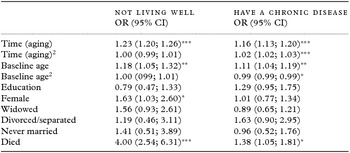
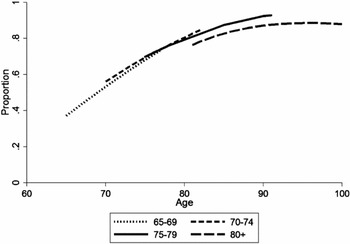
First, we examined the extent to which age was associated with living well and chronic disease. Baseline age differences were reported with increased age associated with higher odds of reporting not living well (OR = 1.18 (95% CI: 1.05; 1.32) p < 0.01) and having a chronic disease (OR = 1.11 (95% CI: 1.04; 1.19) p < 0.01). Similarly, individuals were also more likely to report not living well (OR = 1.23 (95% CI: 1.20; 1.26) p < 0.001) and having a chronic disease (OR = 1.16 (95% CI: 1.13; 1.20) p < 0.001) as they aged (Table 1). Of importance, we note that baseline age differences and aging effects were of comparable magnitude suggesting that attrition did not significantly impact on our variables of interest. Other socio-demographic factors were mostly not associated with odds of not living well or chronic disease, only gender was associated with increased odds of reporting not living well (OR = 1.63 (95% CI: 1.03; 2.60) p < 0.05). Future decedents reported increased odds of having a chronic disease (OR = 1.38 (95% CI: 1.05; 1.81) p < 0.05) and, in particular, not living well (OR = 4.00 (95% CI: 2.54; 6.31) p < 0.001). We plotted the trajectories (Figures 1 and 2) in the proportions of those with a chronic disease and not living well for the four baseline-age groups (65-69; 70–74; 75–79; 80+ years). Overall, although the oldest-old reported higher proportions with a chronic disease and not living well, the rate of this increase was consistent between baseline age groups with evidence of a convergence as our participants aged; 65 year olds reached the same level of proportion as 75 year olds after ten years. We therefore concluded that age differences reflect age and not cohort differences.
Trajectories in living well and chronic disease over time

Left School aged <17 years.
*** p < 0.001; ** p < 0.01; * p < 0.05.
Proportion with chronic disease by age group.

Proportion not living well by age group.

Associations between living well and chronic disease
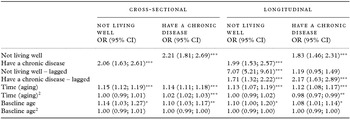
We examined the extent to which having a chronic disease and living well co-varied in both cross-sectional and longitudinal analyses (Table 2). Cross-sectional analyses indicated not living well as associated with having a chronic disease (OR = 2.21 (95% CI: 1.81; 2.69) p < 0.001) and conversely having a chronic disease was associated with not living well (OR = 2.06 (95% CI: 1.63; 2.61) p < 0.001). Temporal associations between our constructs of interest, whereby we regressed current living well and chronic disease state onto prior living well and chronic disease states, were reported (Table 2). Current living well and chronic disease states were strongly related to their prior state; prior living well state was the strongest predictor of subsequent living well state (OR = 7.07 (95% CI: 5.21; 9.61) p < 0.001), and lagged chronic disease was the strongest predictor of having subsequent chronic disease (OR = 2.17 (95% CI: 1.63; 2.89) p < 0.001). Both prior (OR = 1.71 (95% CI: 1.32; 2.22) p < 0.001) and current (OR = 1.99 (95% CI: 1.53; 2.57) p < 0.001) chronic disease states were strongly associated with the likelihood of not living well. In contrast, only concurrent not living well was strongly associated with the current chronic disease state (OR = 1.83 (95% CI: 1.46; 2.31) p < 0.001). Overall, time effects remained in these analyses supporting our earlier findings related to the increasing likelihood of reporting both not living well and chronic disease with increasing age, although we note that the age and aging differences were partly attenuated.
Examining the cross-sectional and lagged associations between living well and chronic disease in adjusted trajectories over time

Adjusted for education, sex, partner status, deceased state.
*** p < 0.001; ** p < 0.01; * p < 0.05.
Living well with chronic disease
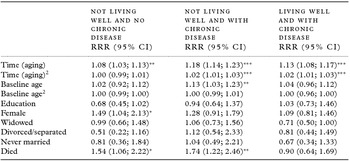
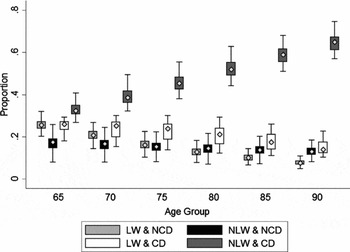
Given the strong association between living well and chronic disease status, we considered the extent to which older adults live well with chronic disease. Most notably, participants who deceased were more likely to reporting not living well with chronic disease (RRR = 1.74 (95% CI: 1.22; 2.46) p < 0.01) and not living well with no chronic disease (RRR = 1.54 (95% CI: 1.06; 2.22) p < 0.05). Otherwise, aging was predictive of whether older adults live well or not with chronic disease (Table 3). Graphing the distribution of older adults by living well and chronic disease states (see Figure 3) indicates declines in the proportion who were living well with chronic disease (from 20.4% at age 65–69 to 12.6 at age 90+), living well with no chronic disease (from 25.6% at age 65–69 to 13.8% at age 90+), and not living well with no chronic disease (from 21.3% at age 65–69 to 16.1% at age 90+). In contrast, there was a substantial increase in those older adults not living well with chronic disease (from 32.6% at age 65–69 to 57.5% at age 90+). Clearly, the defining normative experience for older adults as they age is that they are more likely to report not living well with a chronic disease.
Socio-demographic characteristics of likelihood of living well and chronic disease state over 16 years

Left School aged <17 years.
Ref: Living well with no chronic disease.
*** p < 0.001; ** p < 0.01; * p < 0.05.
Adjusted proportions of living well and chronic disease categories by age groups over 16 years of the MELSHA study. Notes: NLW & NCD: not living well and no chronic disease. NLW & CD: not living well and chronic disease. LW & NCD: living well and no chronic disease. LW & CD: living well and chronic disease.

The mortality risk of not living well and having a chronic disease
With a preponderance of participants not living well with a chronic disease, we sought to further demonstrate the utility of discriminating living well from chronic disease states by examining whether prior living well and chronic disease states predicted survival at follow-up. In comparison with those who were living well with no chronic disease, those living well with chronic disease did not report a statistically significant higher likelihood for mortality (OR = 1.32 (95% CI: 0.60; 2.88) p = 0.495). However those who were not living well, regardless of chronic disease state, were at substantial higher likelihood of death (with chronic disease: OR = 3.63 (95% CI: 1.86; 7.09) p < 0.001; without chronic disease: OR = 3.59 (95% CI: 1.75; 7.34) p < 0.001). We therefore conclude that not living well, and not chronic disease, is a particular vulnerability for mortality.
Discussion
Pervasive models of successful aging are defined by the presence or absence of chronic disease or disability (Rowe and Kahn, Reference Rowe and Kahn1998; Reference Rowe and Kahn2000). Other conceptual models argue for a definition of successful aging or aging well that reflect individuals’ assessment of their lives being lived well, regardless of the disease or disability that they may live with (Ryff, Reference Ryff1989; Kahana and Kahana, Reference Kahana, Kahana and Bengtson1996; Kendig, Reference Kendig, Chappell, Kendig and Walker1996; Huppert et al., Reference Huppert2009; Kahana et al., Reference Kahana, Kelley-Moore and Kahana2012; Kendig et al., Reference Kendig, Browning, Thomas and Wells2014). The primary aim of our study was to examine the long-term utility of assessing participants as living well, defined by self-reported perceptions of positive emotion, independence and health, and not in terms of the presence or absence of chronic disease. We did this by examining the 16-year trajectories of living well and chronic disease in a sample of older adults (aged 65+ years at baseline) who were living in the community.
Overall, our results suggest only a small difference in the proportions with chronic disease between the youngest and oldest-old; clearly, reporting a chronic disease is a normative experience for older adults. However, more startling were the changes in the proportions not living well as people aged. Young-old were far less likely to report not living well but then they reported substantial increases in the likelihood of reporting not living well as they aged. Changes in the proportions of participants with chronic disease and living well indicated a convergence such that the trajectories of 60–65 year olds were comparable with the levels reported by 70–75 year olds at baseline. This suggests that cohort effects do not appear to be impacting substantially on these results. Examining the concordance of living well and chronic disease clearly indicated a strong association between these constructs. Not living well was associated with increased likelihood of subsequently reporting a chronic disease. Rather than arguing for a direct cause association, we would posit that circumstances that adversely impact on the individuals’ not living well may reflect an underlying risk for future health outcomes. A more defensible and substantive causal association was the finding that having a chronic disease was a strong predictor of the likelihood of not living well at the next follow-up. Overall, it was clear that age and increasing age were associated with increased risk of reporting a chronic disease and for not living well.
Of particular interest for the authors are the increases in the proportion not living well as individuals aged. Although the authors would emphasize capacity and resilience of older adults, we do note that considerable negative changes in well-being must be occurring for the increasing rates in the proportion of older adults who are not living well. However, we caution drawing overly pessimistic conclusions about living well in later life. Although the literature argues for a multi-dimensional model of successful aging, we argue that increases in not living well may not necessarily reflect a cascade of decline across all living well indicators. It may be that individuals were not identified as living well simply because they may have failed inclusion on just one of the IADL tasks. It may be that individuals moved out of the living well status as they report fair or poor self-rated health as they recognize the impact of a chronic disease that might otherwise neither impact their positive emotion nor independence. Further exploration of these issues with item response and differential item functioning methods is needed to consider the complexity in which these different well-being indicators may change in different ways as individuals age and to examine the contribution of different indicators of living well that may or may not be important for different sub-groups of older adults.
We recognize that our findings are qualified by a number of limitations with our study. MELSHA was undertaken on older adults aged 65 years with baseline in the mid-1990s. Therefore, our results may reflect aging processes for these birth cohorts only and may not reflect normative trajectories for current older adults who have experienced different social and historical contexts throughout their life courses. However, we recognize that our youngest participants (65–69 years) appeared to converge with older adults (85 years and older), suggesting that of the 30+ years of age differences among our baseline sample, birth cohorts did not seem to strongly impact on our findings as evidenced by small and/or non-significant interactions between our age and aging covariates. We also empathize that the data were collected from self-report data. This is a common issue in population samples and it is recommended that our findings are replicated in studies that are validated against medical records and informant interviews. We also recognize that longitudinal studies of aging are compounded by the construct of interest under investigation such as living well and chronic disease. For instance, longitudinal studies of aging are influenced by drop-out related to mortality, a normal aspect of aging in later life. Also, we recognize that living well and chronic disease may be related to participants’ likelihood of continuing to participate in the study over the 16 years. Exploratory analyses indicated that drop-out was unrelated to baseline living well or chronic disease states. Similarly, prior chronic disease was unrelated to drop-out at the next wave. However, participants not living well at one point of time were more likely (OR = 1.55; p < 0.001) to drop-out for mortality and non-mortality reasons at the next wave. Changes in living well state may reflect mortality-related processes and so drop-out is to be expected; studies may need to concentrate their efforts on encouraging continued survey participation, but balancing this requirement with ethical standards that emphasize participants’ rights to discontinue their participation at their choosing. Adjusting our analyses specifically for an indicator of future decedent state did not substantially attenuate our findings.
In summary, our paper has drawn on 16 years of longitudinal data to better understand the complex relationships between aging, the onset and accumulation of chronic disease, and complex outcomes in terms of well-being, continuing to live independently in the community, and survival. Our current knowledge is limited because it is based primarily on either cross-sectional prevalence studies or longitudinal studies that examine outcomes for individuals at some point several years from some prior observation. Repeated observations of individuals continuing in ongoing studies are essential to understanding aging processes and outcomes. Chronic disease needs to be understood not just as an end state aspect of unsuccessful aging, because the majority of older people do or will acquire chronic diseases as they grow older yet they continue in states of independence and in psychological well-being or aging well in their own terms. We have begun to outline an improvement to the approach to understanding chronic disease as an intermediate outcome in an aging process, from late middle age onward, in which health behaviors and exposures are key influences on the likelihood developing chronic disease most of which are likely to persist for decades until the end of people's lives. In turn, these chronic diseases mark the beginning and indeed the accumulation of health decrements that eventually can cause or at least accentuate the consequences of deteriorating global health and related social losses with aging. Importantly, a majority of older people continue to make age-related adjustments in their expectations, self-assessments, behaviors, and even their residential environments in ongoing striving to continue to maintain identities and patters of living that accommodate to the changing realities of growing older.
In conclusion, we have demonstrated that chronic disease and living well are related to age and aging, but importantly, though there are strong associations between living well and chronic disease, a small but significant proportion of individuals are living well into late life regardless of their chronic disease state. Particularly, we note that the proportion of adults living well with chronic disease remain stable into very late life (>90 years of age). We do recognize that the proportion of older adults without chronic disease declines with increasing age suggesting that chronic disease is a normative part of the aging process and emphasizes our argument that chronic disease should not be used to define aging well in older adults. Of particular importance for clinical and health policy advocates was the clear increase in the proportion of older adults not living well with chronic disease as individuals aged. We recognize that inclusion of physical independence and limitations in our definition may drive this increase in the proportions not living well and so we encourage further investigation into the quantification of living well with indicators that are age sensitive and of relevance for older adults, particularly, in very late life.
Conflict of interest
None.
Description of authors’ roles
All authors have read and approved the final version of this manuscript. Specifically, RAB: Formulated the research question, determined the analytical methods and undertook the statistical analysis, and led the writing of the manuscript; CB and HK contributed to the data collection, and contributed to writing the manuscript.
Acknowledgments
We thank the study participants for their long-term commitment to the project. The Chief Investigators who have contributed to MELSHA are: Colette Browning (Monash University, Co-Director of MELSHA), Hal Kendig (The Australian National University, Co-Director of MELSHA), Maria Fiatarone Singh (University of Sydney), Leon Flicker (University of Western Australia), Robert Helme (University of Melbourne), Birgitta Lundgren Lindquist (Jonkoping University), Meg Morris (University of Melbourne), Daniel O'Connor (Monash University), Susan Quine (University of Sydney), Jane Sims (Monash University), Shane Thomas, (Monash University), Carolyn Unsworth (La Trobe University). Associate Investigators are Karen Teshuva and Yvonne Wells (La Trobe University). Burns is supported by the Australian Research Council Centre of Excellence in Population Ageing Research (project #CE110001029).