





Introduction: Diagnosing the problem
Ghana occupies a revealing position in the global conversation about climate change education. As a country that contributes minimally to global emissions yet experiences disproportionate climate impacts (flooding that swallows neighbourhoods in Accra, heat stress that empties classrooms, plastic waste that chokes coastlines), it offers an unusually sharp test case for the limits of awareness-based climate pedagogy. What happens when students know everything about climate change and still feel powerless to act? Ghana’s answer to that question carries lessons that extend well beyond its borders, into every postcolonial educational system where the apparatus of formal schooling was built to produce compliant graduates rather than engaged climate citizens (Acharibasam, Reference Acharibasam2022; Akrofi et al., Reference Akrofi, Antwi and Gumbo2019; Monroe et al., Reference Monroe, Plate, Oxarart, Bowers and Chaves2019; Ress et al., Reference Ress, Kendall, Friedson-Ridenour and Ampofo2022).
A troubling paradox characterises climate change education in Ghana and across sub-Saharan Africa: students who demonstrate reasonable familiarity with climate causes and consequences consistently report low confidence in their capacity to act on them (Akrofi et al., Reference Akrofi, Antwi and Gumbo2019; Monroe et al., Reference Monroe, Plate, Oxarart, Bowers and Chaves2019). The gap is visible in Ghanaian classrooms specifically. Asante et al. (Reference Asante, Yalley and Amissah2024) document that Ghana’s science curriculum incorporates climate content but frames it through globalised, decontextualised narratives that disconnect climate processes from students’ lived environments. Ress et al. (Reference Ress, Kendall, Friedson-Ridenour and Ampofo2022), analysing Ghanaian and Malawian school textbooks, find that representations of climate change position students as observers of environmental degradation rather than agents capable of responding to it. Takyi et al. (Reference Takyi, Asibey, Amponsah and Opoku2023), assessing environmental literacy in Kumasi, confirm the pattern: students can describe climate processes but cannot articulate what they themselves might do about the problems they observe daily.
This paper names that condition the awareness–agency gap and argues that it is not a knowledge deficit but an unmet need to learn how to act. Ghanaian students know enough about climate change. What they have not yet had adequate opportunity to learn is how to translate that knowledge into action: how to identify a local climate problem, design a collective response, implement it and connect it to broader demands for change. Their educational experience has systematically withheld three learning opportunities: mastery experiences of actually doing something about climate problems; institutional channels through which their observations of those problems might be heard; and emotional scaffolding needed to engage climate anxiety as a catalyst for action rather than a reason to withdraw.
Each of these three deficits has an identifiable structural cause within the Ghanaian educational system. Ahovi’s (Reference Ahovi2025) analysis of Sustainable Development Goal 13 (SDG 13) integration in Ghana’s standards-based curriculum, the national framework governing what is taught and assessed across all levels of schooling, finds that climate action competence remains unevaluated despite formal policy commitments. Acharibasam’s (Reference Acharibasam2022) empirical study of climate change education in Ghana identifies persistent colonial epistemological structures in classroom practice, imported knowledge frameworks that marginalise local environmental knowledge and position valid climate expertise as external to students’ communities. Opoku and James (Reference Opoku and James2020) document that Akan cultural environmental ethics, the ecological knowledge systems of the Akan peoples, the largest ethnolinguistic group in Ghana, whose communal stewardship traditions and seasonal agricultural knowledge are directly relevant to local climate adaptation, are explicitly excluded from Senior High School (SHS) biology curricula, not through oversight but through curricular logic that privileges examination-certifiable knowledge over Indigenous wisdom. Manteaw et al. (Reference Manteaw, Boafo, Owusu, Enu and Amoah2025) argue that what Ghanaian climate education urgently needs is transgressive pedagogy: approaches that ground climate learning in local communities rather than importing it from elsewhere.
This paper makes a conceptual and framework contribution to that agenda. We develop a theoretically integrated account of why the awareness–agency gap persists and what closing it demands pedagogically, institutionally and politically. We then advance and critically examine the Youth-Led Climate Action Lab (YCAL), a five-phase, design-thinking-grounded intervention framework for Ghanaian secondary and tertiary school contexts, as a concrete realisation of that account.
The paper’s contribution lies in bringing together three things the existing literature addresses separately but has not yet integrated: a theoretically unified account of the awareness–agency gap that draws on cognitive, political, cultural and affective dimensions simultaneously; a framework applied specifically to Ghanaian educational conditions rather than adapting solutions designed elsewhere; and an honest engagement with the critiques most threatening to the framework’s coherence, including those that cannot be resolved by design iteration. Nyatuame (Reference Nyatuame2026), whose work on place-based environmental education in Ghana appears in this journal, calls for approaches that are genuinely rooted in Ghanaian communities rather than locally flavoured versions of imported models. This paper is a response to that call.
Ghana is not without existing action-oriented environmental education initiatives, and intellectual honesty requires acknowledging them. Community-based projects, including mobile library and problem-solving competitions in Northern Ghana that engage youth in identifying local environmental challenges and developing funded solutions, suggest that action-oriented climate pedagogy is feasible within Ghanaian resource realities (Alhassan, Reference Alhassanforthcoming; Manteaw et al., Reference Manteaw, Boafo, Owusu, Enu and Amoah2025). YCAL does not claim to be the first such initiative. What it offers is a theoretically integrated, institutionally adaptable framework that addresses the structural roots preventing such approaches from becoming the norm rather than the exception.
We do not report empirical findings from a completed study. What we offer is the theoretical and practical architecture that makes the intervention worth testing and an honest account of where it may fail and why. Section “Diagnosing the awareness–agency gap” diagnoses the awareness–agency gap. Section “A four-pillar theoretical framework” develops the theoretical framework. Section “Design thinking as climate pedagogy: Affordances and irresolvable tensions” critically examines design thinking in this context. Section “The YCAL implementation framework” presents the YCAL Implementation Framework. Section “Confronting the framework’s internal tensions” confronts the framework’s internal tensions. Section “Implications for policy and practice” draws implications for curriculum and practice. Section “A directed research agenda and conclusion” closes with a directed research agenda.
Diagnosing the awareness–agency gap
The Ghanaian educational context
Ghana has made formal commitments to climate education at every level of its policy architecture. The National Climate Change Policy identifies education as a primary vehicle for building climate resilience, and Ghana’s revised standards-based curriculum, the National Council for Curriculum and Assessment (NaCCA) framework introduced from 2019, incorporates climate content across science and social studies strands (Ahovi, Reference Ahovi2025; Akla, Reference Akla2024). Yet Ahovi’s (Reference Ahovi2025) systematic analysis of SDG 13 integration in Ghana’s current standards-based curriculum finds that while climate awareness content is present, climate action competence (the capacity to design and execute responses to local environmental problems) is structurally absent from assessment frameworks. The curriculum teaches students that climate change is serious and that action is needed; it does not provide the pedagogical conditions under which students develop the belief that they are capable of that action.
The textbook analysis by Ress et al. (Reference Ress, Kendall, Friedson-Ridenour and Ampofo2022), covering both Ghana and Malawi, illuminates the mechanism. Across textbooks at multiple levels, climate change is represented as a phenomenon that happens to people and communities, something to be understood, feared or adapted to, not as a domain in which students themselves are positioned as potential agents. Asante et al. (Reference Asante, Yalley and Amissah2024) confirm that Ghana’s science curriculum frames climate through globalised narratives imported from international science education frameworks, creating what they term a curriculum-reality disconnect: the climate problems students study bear little resemblance to the flooding, waste accumulation and heat stress they encounter daily. The result, documented empirically by Takyi et al. (Reference Takyi, Asibey, Amponsah and Opoku2023) among secondary students in Kumasi, is students who score adequately on environmental literacy assessments but report low confidence in their capacity to act on what they know, which is precisely the awareness–agency gap this paper theorises.
The West African regional picture is consistent. Sorgho et al.’s (Reference Sorgho, Quiñonez, Louis, Winkler, Dambach, Sauerborn and Horstick2020) review of climate policies across sixteen West African nations finds that youth engagement is rhetorically foregrounded in nearly all national frameworks but operationally absent from implementation mechanisms. Obi and Ojo (Reference Obi and Ojo2026), reviewing climate change mainstreaming in school curricula across the Global South, identify transmission-based pedagogy as the structural constant that prevents policy commitments from translating into student agency. Dumbuya (Reference Dumbuya2025) documents the economic and social costs of this failure in West Africa: climate-vulnerable communities produce graduates who understand climate risk but lack the competence to contribute to local adaptation responses. Rushton et al. (Reference Rushton, Sharp and Walshe2023) review identifies a lack of action-oriented pedagogy as the single most consistently reported gap in school-based climate education worldwide, including across sub-Saharan Africa.
Three structural roots
We distinguish three roots of the awareness–agency gap, each demanding a different pedagogical response (Figure 1). The first is pedagogical: educational systems in Ghana remain organised around transmission of content rather than development of action competence (Jensen & Schnack, Reference Jensen and Schnack1997; Mogensen & Schnack, Reference Mogensen and Schnack2010). Students learn about climate change but never experience what it feels like to identify, design and execute a response. Drawing on Bandura’s (Reference Bandura1997) social cognitive theory, it becomes clear that self-efficacy, the conviction of one’s own capacity to act effectively is cultivated not by the passive reception of information, but through active, hands-on mastery experiences. A student who has never completed a climate action has no experiential foundation for believing they can.
The second root is structural and political: even students who develop individual confidence to act encounter institutions that offer no legitimate channels for youth environmental agency. Hwang’s (Reference Hwang2026) and Riniolo & Ortensi (Reference Riniolo and Ortensi2021) cross-national policy analysis establishes the pattern: national frameworks invoke youth participation while providing no actual mechanisms through which youth perspectives influence governance. Saaka’s (Reference Saaka2024) analysis of education policy reform in Ghana adds a local dimension: reform commitments in Ghanaian education policy are frequently resisted at school and district levels by administrative cultures that prioritise examination performance over experiential or community-facing learning. Students who have never been taken seriously as climate actors have good empirical reason to believe they will not be, which is a structural political reality, not a motivational failure.
The third root is affective. Olsen et al. (Reference Olsen, Lawson, McClain and Plummer2024) systematic review of 48 empirical studies establishes that eco-anxiety and ecological overwhelm are significant predictors of disengagement from climate action when those emotions are not explicitly scaffolded in educational settings. In high-risk climate contexts like Greater Accra where students live with flooding, heat stress and plastic waste as normalised daily conditions, the affective burden of climate awareness may be especially acute. Mfon (Reference Mfon, Singh and Yadav2024) documents how climate impacts, including flooding, directly interrupt school attendance and educational continuity in West African contexts, generating an additional layer of climate-induced educational disadvantage that compounds the affective challenge. A curriculum that teaches climate impacts without providing emotional tools for response does not build climate actors; it produces climate fatalists.
Why existing approaches fail
Current climate education practice in Ghanaian schools fails against all three roots simultaneously. Exam-focused curricula address none of them. Extracurricular environmental clubs, the most common institutional response, partially address the first root but typically collapse when individual champions depart, lack curricular legitimacy and rarely connect to political advocacy (Abdela, Reference Abdela2020). Nyatuame (Reference Nyatuame2026) observes that the dominant tendency in Ghanaian environmental education remains to present the environment as a context for learning rather than as a site of student action, a distinction that captures precisely what the awareness–agency gap requires inverting.
Imported climate education programmes from the Global North add a further dimension of failure. Acharibasam’s (Reference Acharibasam2022) empirical study identifies persistent colonial epistemological structures in Ghanaian climate classrooms: international science frameworks that marginalise local environmental knowledge, and Akan cultural environmental ethics systematically excluded from SHS curricula (Opoku & James, Reference Opoku and James2020). Manteaw et al. (Reference Manteaw, Boafo, Owusu, Enu and Amoah2025) argue that Ghanaian climate education urgently requires transgressive pedagogy grounded in local communities, not locally flavoured imports. Acharibasam and McVittie (Reference Acharibasam and McVittie2023) demonstrate that integrating Indigenous Ecological Knowledge (IEK), defined as locally held understanding of ecological systems, seasonal patterns and land management passed through community practice, into environmental education in Ghanaian early childhood settings produces richer engagement with local environmental problems than transmission approaches alone. Importantly, applying this finding to secondary and tertiary contexts requires more than scaling up: adolescents and young adults bring political awareness, social complexity and institutional pressures that young children do not and a framework for older learners must engage these explicitly rather than assume that what works in play-based early childhood settings translates directly. The question this paper addresses is precisely what such a framework would need to look like, and why it would need to be structured differently from early childhood models.
A four-pillar theoretical framework
The YCAL intervention is designed to address all three roots of the awareness–agency gap simultaneously. Doing so requires a theoretical framework that integrates the cognitive, political, cultural and affective dimensions of youth climate agency, because, as the diagnosis in Section “Diagnosing the awareness–agency gap” demonstrates, each root operates through a distinct mechanism that no single theory addresses. We draw on four bodies of theory, each contributing an indispensable dimension, and each producing internal tensions that the framework must navigate rather than dissolve. Figure 2 maps this architecture; the YCAL Implementation Framework that operationalises it is presented in Section “The YCAL implementation framework.”
The awareness–agency gap: a structural Diagnosis. Adapted from Bandura (Reference Bandura1997), Monroe et al. ( Reference Monroe, Plate, Oxarart, Bowers and Chaves2019), Hwang (Reference Hwang2026), Lotz-Sisitka et al. (Reference Lotz-Sisitka, Wals, Kronlid and McGarry2015), Ojala (Reference Ojala2021; Reference Ojala2023), and Olsen et al. (Reference Olsen, Lawson, McClain and Plummer2024).

The four-pillar theoretical framework underpinning the YCAL intervention. Pillar 1: Social Cognitive Theory (Bandura, Reference Bandura1997); Pillar 2: Transformative Learning (Mezirow, Reference Mezirow1991; Sterling, Reference Sterling2010); Pillar 3: Postcolonial Environmental Education and African IKS (Acharibasam, Reference Acharibasam2022; Lotz-Sisitka et al., Reference Lotz-Sisitka, Wals, Kronlid and McGarry2015); Pillar 4: Critical Emotional Awareness (Ojala, Reference Ojala2021, Reference Ojala2023). Internal tensions the framework must navigate are shown in the lower panel.

Pillar 1: Social cognitive theory and the mastery imperative
Social cognitive theory is needed in this framework because the awareness–agency gap is partly a self-efficacy problem. Bandura’s (Reference Bandura1997) theory identifies four sources of self-efficacy: mastery experiences (the most potent), vicarious learning, social persuasion and physiological and affective states. The diagnostic insight is that conventional climate education in Ghanaian classrooms addresses almost exclusively social persuasion (lectures, data, moral urgency) while systematically neglecting mastery experiences. A student who has never led or participated in a real climate action has no experiential foundation for believing they can. No amount of climate information compensates for the absence of that experience.
The YCAL design sequences all four sources deliberately, but crucially does so through collective rather than individual scaffolding. Micro-actions in Phase 3 generate mastery experiences, and these are always team actions, not individual projects, because the framework is built on the understanding that climate agency in Ghanaian communities is fundamentally a collective enterprise. The peer showcase in Phase 4 creates vicarious learning: students observe peers completing real actions and update their own efficacy beliefs through social comparison within a collaborative community. The facilitation process throughout provides social persuasion in its most authentic form: genuine recognition of student competence from peers and community members rather than generic encouragement from an authority figure. And the Critical Emotional Awareness (CEA) components address the affective states that condition whether efficacy-building is possible at all.
The tension this pillar creates is its individualism: social cognitive theory locates agency in the individual’s belief system and applied uncritically to a structural problem like climate change, it risks producing what might be called individual empowerment without collective transformation, students who feel capable but cannot connect that feeling to shared action or systemic demand-making. Pillar 3 exists precisely to correct this by grounding efficacy within community wisdom and collective empowerment rather than individual confidence alone, which is why both pillars are necessary together and neither suffices on its own.
Pillar 2: Transformative learning, conscientisation and third-order change
Transformative learning theory is needed because the awareness–agency gap is not merely a skills deficit; it is a framing problem. Ghanaian students who know that climate change is caused by fossil fuel burning and deforestation nevertheless frame their local flooding as bad weather, their local plastic accumulation as personal behaviour and their local heat stress as something to endure. Mezirow’s (Reference Mezirow1991) transformative learning theory holds that deep learning occurs when individuals encounter disorienting dilemmas, that is, experiences that challenge their existing frames of reference and necessitate perspective transformation. Sterling’s (Reference Sterling2010) elaboration adds a third-order dimension particularly important for climate education: not merely learning about climate change (first order), or learning to change behaviour (second order), but learning to re-perceive one’s own role in social–ecological systems and the assumptions underlying that role (third order).
For youth in peri-urban Accra, the central disorienting dilemma that YCAL is designed to create is not about climate facts but about agency and causation. The Phase 1 community climate walk, in which participants map local climate problems they themselves observe, is designed to disrupt the frame that positions climate impacts as global, distant and inevitable. When a student recognises that the flooding behind their canteen is partly the result of an uncleared drainage channel that students themselves could organise to clean, they are experiencing a micro-version of what Freire (Reference Freire1970) called conscientisation: the recognition that conditions previously accepted as natural are in fact products of social choices and are therefore amenable to social action. This is why Pillar 2 is not optional: without it, mastery experiences generated by Pillar 1 remain disconnected from structural analysis, producing competent individual actors who do not interrogate the systems generating the problems they address.
The Focus Group Discussion (FGD) closing question: “If you could tell Ghana’s president one thing about youth and climate, what would it be?” is the mechanism through which YCAL insists that participants connect their growing local efficacy to political demands at scale. Without this, the intervention risks producing what Lawrence et al. (Reference Lawrence, Skuce and Breen2022) call hope-displacement: participants feel better about acting locally while the structural conditions generating climate vulnerability remain unaddressed and unquestioned.
Pillar 3: Postcolonial environmental education and epistemic justice
Postcolonial environmental education theory is needed because the awareness–agency gap has a specific colonial genealogy in Ghana that neither social cognitive theory nor transformative learning addresses. We use the term postcolonial with awareness of its limitations: colonisation in education has not ended but transformed its features, operating now through curriculum frameworks, assessment regimes and knowledge hierarchies that continue to privilege imported epistemologies over local ones (Tuck & Yang, Reference Tuck and Yang2012). A more precise framing might be decolonial, pointing toward ongoing work of resistance and reimagining rather than a condition already passed (Mignolo & Walsh, Reference Mignolo and Walsh2018). We retain postcolonial environmental education as the field name under which the body of scholarship this paper draws on is indexed, including in Environmental Education Research and the Southern African tradition anchored by Lotz-Sisitka et al. (Reference Lotz-Sisitka, Wals, Kronlid and McGarry2015) while recognising that scholars within that tradition, including Acharibasam (Reference Acharibasam2022) in the Ghanaian context, increasingly use decolonial and decolonising framings to name the active, ongoing dimension of this work; we explicitly acknowledge that the colonial dynamics this field critiques remain actively present in Ghanaian classrooms. As Lotz-Sisitka et al. (Reference Lotz-Sisitka, Wals, Kronlid and McGarry2015) demonstrate, dominant global environmental education frameworks prioritise individualistic behaviour change over communal resource governance; decontextualise ecological knowledge from the cultural and political systems in which it is embedded; and position the Global South as a problem landscape rather than a repository of environmental knowledge. Acharibasam (Reference Acharibasam2022) provides empirical grounding for this critique specifically in Ghana, documenting colonial epistemological structures in Ghanaian climate classrooms that marginalise local environmental knowledge.
As conceptualised in this manuscript, postcolonialism is not merely a historical condition but an ongoing ethical orientation: postcolonial ethics embody the understanding that humans are mutually entangled within co-implicated realities, providing the conditions of possibility for teachers and learners to enact relational accountability (in the Ubuntu sense) for cultivating and sustaining affirmative relationships with the Earth. This is not responsibilisation in the neoliberal sense (which locates climate burden in individual behaviour) but a deterritorialising move: unsettling dominant habits of thought embedded in normalising social and cultural structures, opening space for new socioecological connections beyond the constraints of colonialism (Nxumalo, Reference Nxumalo, Cutter-Mackenzie-Knowles, Malone and Hacking2019). This framing is why postcolonial environmental education in YCAL is inseparable from epistemic humility and elder co-facilitation: both are enactments of relational accountability rather than supplementary programme features.
The resources Ghana’s own environmental traditions offer are substantial and systematically excluded. The Akan peoples, Ghana’s largest ethnolinguistic group, concentrated in the Ashanti, Eastern, Western and Central regions and accounting for approximately 47% of the population, possess rich traditions of communal environmental stewardship, seasonal ecological knowledge and Ubuntu-inflected ethics of collective responsibility toward shared resources. Opoku and James (Reference Opoku and James2020) document that these Akan cultural environmental ethics are explicitly absent from SHS biology curricula despite their direct relevance to local climate adaptation. Acharibasam and McVittie (Reference Acharibasam and McVittie2023) demonstrate that IEK integration in early childhood settings produces richer environmental engagement. Mthembu (Reference Mthembu and Mthembu2021) and Oloruntoba et al. (Reference Oloruntoba, Afolayan and Yacob-Haliso2020) establish the broader African case: Indigenous Knowledge Systems (IKS) are not supplements to environmental education; they are its missing epistemological foundation.
Reconciling IKS with the western science frameworks that continue to dominate assessment requires what Hatcher et al. (Reference Hatcher, Bartlett, Marshall and Marshall2009) call Two-Eyed Seeing (Etuaptmumk): learning to see from one eye with the strengths of Indigenous knowledge and from the other eye with the strengths of western science, and using both eyes together for the benefit of all. Ermine’s (Reference Ermine2007) concept of Ethical Space, defined as a relational zone created when fundamentally different knowledge traditions meet and deliberately negotiate how they will engage, offers a complementary framework for structuring the encounter between IKS and formal curriculum in YCAL’s co-design phases. These frameworks acknowledge honestly that Ghanaian students must still pass examinations dominated by western science, a real structural constraint that YCAL cannot dissolve, while creating a pedagogical space within which IKS is genuinely valued rather than treated as illustrative background.
YCAL responds to this epistemological challenge through what we term epistemic humility in facilitation, by which we mean the deliberate practice of treating one’s own expert knowledge as one input among many, resisting the urge to direct student ideation toward solutions the facilitator would approve and remaining genuinely open to learning from participants’ community-based knowledge. Nxumalo (Reference Nxumalo, Cutter-Mackenzie-Knowles, Malone and Hacking2019) extends this further through the concept of relational accountability: the responsibility of researchers and educators to honour the entanglements between human and more-than-human communities in place-based educational work. Her concept of deterritorialisation as a decolonial practice (unsettling fixed mappings of knowledge, land and community) offers YCAL a further analytical resource for resisting the tendency to treat local knowledge as merely supplementary content within a western-framed design process. This is operationalised through three structural features: the empathy mapping in Phase 2 positions participants’ own environmental observations as the primary input to problem definition; elder co-facilitation in Phase 3 treats IKS as co-equal with design methodology rather than as illustrative context; and the documentation form requires each action to be linked to a locally observed problem, insisting on local observation as the epistemological starting point.
The elder co-facilitation component raises legitimate and often-overlooked questions: which elders, and in what role? By elders we mean recognised knowledge holders within participants’ home communities, typically but not exclusively older community members whose authority in environmental matters is acknowledged by their community, including traditional land stewards, seasonal farmers with multigenerational ecological knowledge, community herbalists and leaders of community water governance structures. Their role in YCAL is not advisory or performative but co-epistemic: they participate in the empathy mapping phase as co-definers of the climate problem rather than as subjects of student observation. This also raises the financial question of who compensates them. Ghanaian educational institutions currently lack budget lines for knowledge-holder fees, and invoking elder participation without addressing this financial reality risks reproducing the extractive relationships that decolonial critique is designed to challenge. We address this directly within the Resource Justice enabling dimension in Section “Four enabling dimensions”: elder compensation must be built into institutional budgets, not absorbed by elders themselves, and YCAL implementations that cannot secure this funding should not proceed with elder co-facilitation. Following Tunstall (Reference Tunstall, Gunn, Otto and Smith2020), Indigenous co-leadership of the design process itself, rather than consultation within a researcher-designed framework, remains a standard YCAL does not yet meet, and acknowledging this is part of intellectual honesty about the framework’s current limits.
Pillar 4: CEA and hope-in-action
CEA pedagogy is needed as a fourth pillar because the affective dimension of the awareness–agency gap cannot be addressed by cognitive reframing (Pillar 2), skills development (Pillar 1) or epistemological repositioning (Pillar 3) alone. Olsen et al. (Reference Olsen, Lawson, McClain and Plummer2024) systematic review establishes eco-anxiety and ecological overwhelm as primary mechanisms of disengagement that operate independently of knowledge and motivation. A student who understands climate causation, believes they can act and values IKS may still disengage when the emotional weight of climate awareness becomes paralysing (and in Greater Accra, where climate impacts are not abstract future possibilities but present daily realities, that emotional weight is real).
Ojala (Reference Ojala2021, Reference Ojala2023) provides the YCAL facilitation framework’s affective architecture through her concept of CEA. CEA is distinguished from both emotional suppression (pretending climate anxiety is not real) and emotional amplification (dwelling in climate grief until it becomes incapacitating). CEA pedagogy acknowledges climate emotions as legitimate and significant, names them in educational settings rather than privatising them and channels them toward inquiry and action rather than despair. Crucially, Ojala (Reference Ojala2021) distinguishes between “safe space” pedagogies, which protect students from emotional discomfort but may reproduce fatalism, and pedagogies of discomfort, which productively engage anxiety as a motivational resource. YCAL is designed as the latter.
Lawrence et al. (Reference Lawrence, Skuce and Breen2022) contribute the concept of hope-in-action: not optimistic reassurance that everything will be fine, but the specific form of hope generated by participating in change, however small. Conventional optimism-boosting (“young people are the future”) is epistemically dishonest and pedagogically counterproductive: students in Accra who watch their streets flood annually are not comforted by generic affirmations. Hope-in-action is generated by doing something real: completing a micro-action, seeing its effect and experiencing the specific form of agency that comes from having intervened in one’s own environment, however modestly. This is why Phase 3 is non-negotiable in the YCAL design: it is the mechanism through which affective reorientation from paralysis to possibility occurs.
Design thinking as climate pedagogy: Affordances and irresolvable tensions
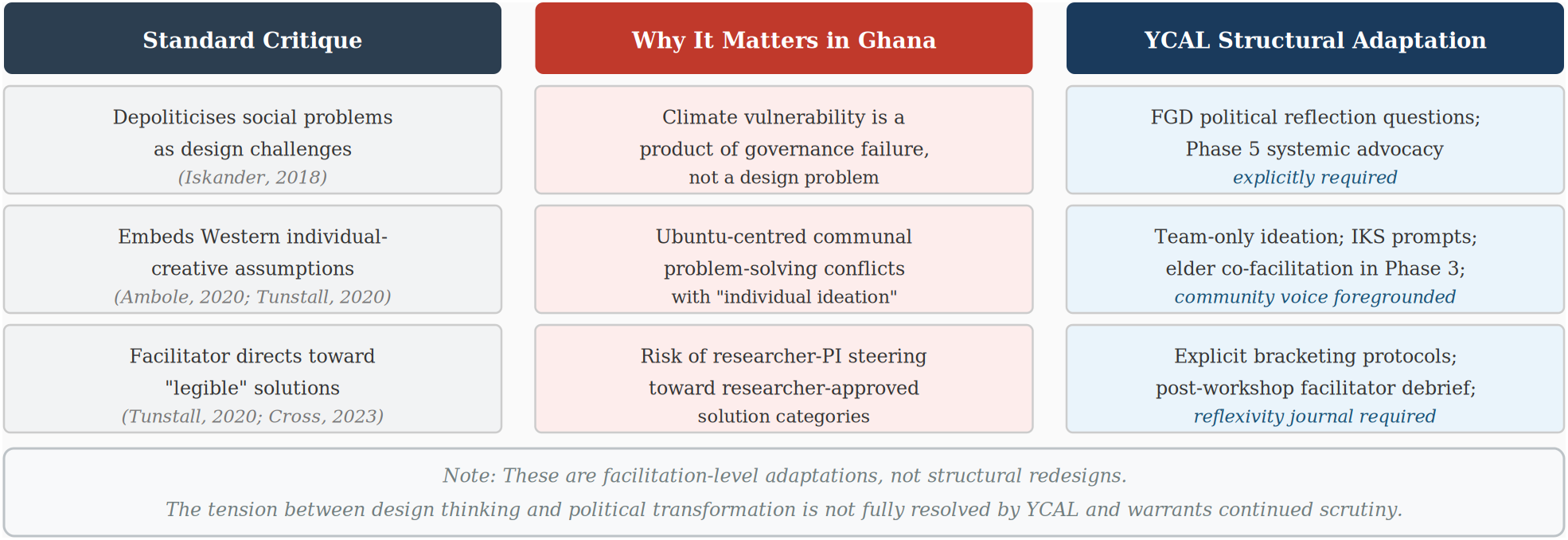
Design thinking occupies the operational core of the YCAL intervention. Its five-phase methodology (empathise, define, ideate, prototype, test) provides the structural scaffold through which the theoretical aspirations of the four-pillar framework are translated into practical activities. But design thinking is not a neutral methodology, and its deployment in a postcolonial African educational context requires confronting criticisms that cannot be resolved through facilitation technique alone. Figure 3 maps these critiques and the YCAL adaptations.
Design thinking critiques, their specific significance in the Ghanaian context, and YCAL’s structural adaptations. Three core critiques are addressed: depoliticisation of social problems (Iskander, Reference Iskander2018); embedding of western individual-creative assumptions (Ambole, Reference Ambole2020; Tunstall, Reference Tunstall, Gunn, Otto and Smith2020); and facilitator direction toward approved solutions (Cross, Reference Cross2023). Each critique is addressed in dedicated sub-sections. The note at the base acknowledges that these remain facilitation-level adaptations and the underlying tension is not fully resolved.

What design thinking offers
Design thinking’s specific value for YCAL lies not in its methodological elegance but in three practical affordances for the Ghanaian school context. First, it provides a structured scaffold for open-ended inquiry that teachers unfamiliar with facilitative pedagogy can follow, addressing the facilitative capacity deficit that Manteaw et al. (Reference Manteaw, Boafo, Owusu, Enu and Amoah2025) identify as a primary barrier to transgressive climate pedagogy in African schools. Second, its tolerance for iterative failure creates an educational culture in which trying and adjusting is normalised, reducing the perfectionism that can paralyse action in resource-constrained settings (Purcell et al., Reference Purcell, Song, Witenstein, Tung and Iyengar2025). Third, the empathy phase provides a methodologically recognised entry point for community knowledge collection, framing listening to elders and observing local environments as design methodology rather than informal deviation from curriculum. Malafaia et al. (Reference Malafaia, Diógenes-Lima, Pereira, Macedo and Menezes2025) and Purcell et al. (Reference Purcell, Song, Witenstein, Tung and Iyengar2025) provide empirical grounding for design thinking as a vehicle for youth-led climate action in resource-constrained settings. Obi and Ojo (Reference Obi and Ojo2026) identify action-oriented, participatory methodologies as the consistent gap in existing provision, which is precisely the gap design thinking addresses when its depoliticising tendencies are actively counteracted.
The depoliticisation problem
Iskander’s (Reference Iskander2018) critique is the most substantive threat to YCAL’s theoretical coherence, and it must be taken seriously rather than managed. Design thinking frames social problems as design challenges amenable to creative technical solutions, thereby deflecting attention from the structural conditions that generate those problems. Applied to climate change in Greater Accra: guiding students to design better recycling bins from old buckets, while the waste management infrastructure that should prevent plastic accumulation remains chronically underfunded, is not climate education; it is a form of responsibilisation that transfers the burden of structural failure onto individual students.
YCAL’s response operates at two levels, and it is important to be honest about the limits of each. At the intervention level, Phases 4 and 5 connect micro-action learning to systemic analysis and political advocacy. But these are facilitation-level responses. Whether they sufficiently counteract the depoliticising structure of a methodology built around individual-creative problem-solving remains an open empirical question. At the conceptual level, we argue that micro-actions in contexts of political marginalisation are not straightforwardly depoliticising. Trott (Reference Trott2021) demonstrates that youth-led climate actions produce multi-level effects extending well beyond their immediate physical output. In contexts where youth environmental agency has been systematically suppressed, collectively solving a local problem is itself a form of political claim-making. This does not make it sufficient. But it makes it something.
The African context: Ubuntu, communality and individual ideation
Ambole’s (Reference Ambole2020) critique, namely that design thinking embeds western assumptions about individual-creative agency, is directly applicable to the Ghanaian context and requires a structural, not merely stylistic, response. Ubuntu philosophy, which grounds much of West African communal ethics and is expressed in the Akan maxim onipa na ohia onipa (a person needs other people), positions problem-solving as inherently collective: solutions emerge from dialogue within community, not from individual ideation followed by community feedback. The standard design thinking sequence reverses this epistemological priority.
YCAL’s structural response involves three modifications. First, all ideation activities are conducted in mixed-level teams from the outset, with no individual brainstorming phases; the community is the ideating unit, not the individual. Second, the empathy mapping phase explicitly incorporates community elder input: students are not empathising on behalf of their community but with elders as co-participants in problem framing. Third, the facilitation protocol positions community-identified solutions as primary candidates for development, treating student-generated ideas as supplements to rather than substitutes for existing community knowledge. These are genuine structural modifications, not facilitation style adjustments. But Tunstall’s (Reference Tunstall, Gunn, Otto and Smith2020) deeper critique, namely that decolonising design requires Indigenous co-leadership of the design process itself and not merely consultation, remains a standard that YCAL does not yet meet, and acknowledging this is part of intellectual honesty about the framework’s current limits.
Facilitator direction and the closure of student ideation
Cross’s (Reference Cross2023) analysis of what he terms “design thinking drift” identifies a third critique with direct implications for YCAL: the tendency of facilitated design processes to converge toward solutions the facilitator already considers viable, producing the appearance of open inquiry while directing participants toward a predetermined outcome. In a Ghanaian classroom context, where asymmetries of authority between teacher-facilitators and students are structurally reinforced, this risk is heightened. Students habituated to producing responses that satisfy the teacher are likely to read facilitation cues as signals of which solutions will be approved, regardless of how open-ended the facilitation language appears. YCAL’s response involves two structural safeguards. First, the Documentation Form requires each team to record the full range of options generated during ideation before selecting one, creating an accountability mechanism that resists premature convergence. Second, the facilitation protocol includes a bracketing instruction: facilitators are explicitly prohibited from evaluating or ranking student ideas during the ideate phase, and the post-session reflexivity journal requires facilitators to document any moments where they felt the urge to steer. These are structural checks on facilitator direction, not merely attitudinal ones. Whether they are sufficient to counteract the authority asymmetries of Ghanaian classroom culture is, again, an empirical question the current framework cannot resolve in advance.
The YCAL implementation framework
The YCAL Implementation Framework translates the four-pillar theoretical architecture into a practical five-phase design adaptable across diverse Ghanaian and African school contexts. Figure 4 presents the framework, including the internal tensions each phase must navigate and the four cross-cutting enabling dimensions that determine whether the intervention produces isolated outputs or contributes to institutional change.
The YCAL five-phase implementation framework. Phases proceed from contextualise (Week 1) through co-design (Week 2), implement (Week 3), reflect and document (Week 4), to sustain and advocate (ongoing). Four cross-cutting enabling dimensions: institutional embedding, resource justice, epistemic humility and intersectional design, are shown in the base bar. Internal tensions within each phase are noted in the lower section of each column.

Phase descriptions
Phase 1: Contextualise (Week 1): A community climate walk maps local climate problems participants personally observe: clogged drains, plastic accumulation, bare ground, heat-stressed spaces. This is not motivational scene-setting; it is the primary data collection event of Phase 1. Observations generate the problem inventory from which Phase 2 works. A pre-intervention FGD explores participants’ existing climate frames and barriers to action. The closing FGD political question, “If you could tell Ghana’s president one thing about youth and climate, what would it be?” is administered here and in Phase 4, providing a pre-measure of political consciousness for comparison.
Phase 2: Co-design (Week 2, one day): The Climate Crew Bootcamp presents climate basics through locally grounded examples: Accra’s flooding, urban heat island effects, plastic waste, coastal erosion, before moving through empathy, define and ideate phases structured according to the Ubuntu-informed modifications described in Section “The African context: Ubuntu, communality, and individual ideation.” All ideation is team-based from the outset; elder input is incorporated during empathy mapping; community-identified solutions from Phase 1 are foregrounded during definition. Facilitators follow written bracketing protocols and complete a post-session reflexivity journal entry, part of the epistemic humility practice, before reviewing team outputs. Teams produce action plans by day’s end.
Phase 3: Implement (Week 3): Teams independently execute their micro-actions in school or community settings. The Action Guide offers five locally grounded problem-solution pairings as starting points: recycling infrastructure from salvaged materials; seedling nurseries using used cans; energy-awareness campaigns; gutter maintenance; and assembly-based communications, but teams may and should diverge based on Phase 1 problem identification. WhatsApp check-ins with the principal investigator (PI) provide support and serve as informal process data. The documentation form, requiring action description, problem rationale, community reach, materials used and one learning reflection, scaffolds metacognition and constitutes the primary data instrument for analysing solution types. Note that micro-actions are always collective team endeavours, deliberately structured to build community climate capacity rather than individual project portfolios.
Phase 4: Reflect and document (Week 4): Post-survey and reflection FGD close the inquiry cycle. The FGD asks both “What surprised you?”, calibrated to surface affective reorientation, and the political question repeated from Phase 1, enabling pre–post comparison of political consciousness. The peer showcase, in which all teams present their micro-actions, functions as the vicarious learning mechanism of Pillar 1. It is structured so that all teams present regardless of outcome quality; normalising action across a range of results is pedagogically more important than celebrating exceptional ones.
Phase 5: Sustain and advocate (ongoing): Teams share findings with school leadership, contribute to an institutional climate brief and produce at least one communication connecting their micro-action to a structural demand: a letter to a local official, an assembly presentation, a WhatsApp community post. This phase also connects naturally to active citizenship components already present in Ghana’s social studies curriculum (NaCCA, 2023), explicitly linking YCAL’s micro-action learning to the citizenship competencies Ghana’s NaCCA framework already values. Without Phase 5, YCAL is a well-designed feel-good project. With it, the micro-action becomes the first step in a chain of escalating agency. This phase is where the framework’s claim to address the structural root of the awareness–agency gap is either validated or exposed as aspirational.
Four enabling dimensions
Institutional embedding: YCAL cannot be sustained as an extracurricular add-on dependent on individual champions. The framework requires formal recognition within school structures: integration into time tables, acknowledgement in assessment frameworks or formalised university partnership agreements. Ghana’s NaCCA curriculum review process provides a policy window to argue for assessed experiential climate components in senior secondary curricula, with YCAL documentation forms as portfolio evidence. Without institutional embedding, the intervention will repeat the sustainability failure that Hohenhaus et al. (Reference Hohenhaus, Boddy, Rutherford, Roiko and Hennessey2023) identify as the dominant weakness of school-based sustainability programmes.
Resource justice: All YCAL activities are designed to be executable with minimal expenditure (old buckets, used cans, seeds, posters, WhatsApp). But resource justice demands more than low-cost design. The costs that do exist (facilitator time, SHS student transportation, institutional hosting and critically, elder compensation) must be carried by institutions rather than transferred to participants or knowledge holders. This final point is non-negotiable: elder co-facilitation without financial compensation reproduces the extractive relationships that Pillar 3 is designed to challenge. Any YCAL implementation that cannot secure institutional budget allocations for elder fees should substitute other community knowledge-holder roles or defer Phase 3 elder involvement until funding is secured. Any scaled implementation that expects participants or community members to absorb costs reproduces structural inequity under a participatory banner.
Epistemic humility in facilitation: As defined in Section “Pillar 3: Postcolonial environmental education and epistemic justice,” epistemic humility refers to the deliberate practice of treating one’s own expert knowledge as one input among many and remaining open to community-generated knowledge. The written bracketing protocols and post-session reflexivity journals are not optional enhancements but structural requirements for operationalising this practice. Epistemic colonialism in facilitation, defined as the unconscious direction of student ideation toward solutions the facilitator would approve, is a real risk that cannot be managed by good intentions alone. It requires structural countermeasures: written protocols that can be reviewed, journals that create accountability and a willingness to accept that student-generated solutions may be less technically elegant and more politically incisive than researcher-preferred ones, a possibility that YCAL’s facilitation protocols must be designed to welcome rather than inadvertently suppress (Cammarota & Fine, Reference Cammarota and Fine2008).
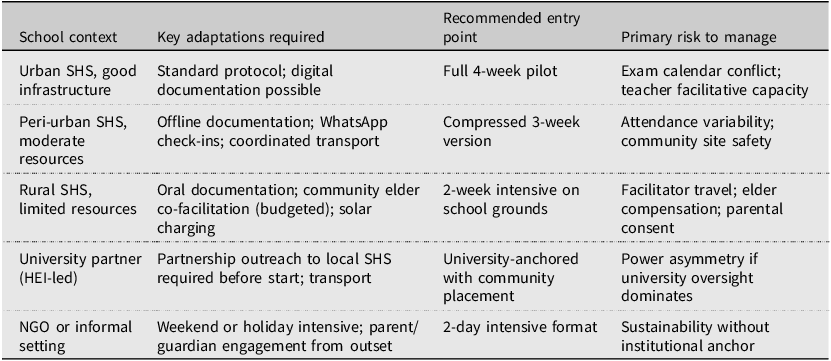
Intersectional design: The current YCAL protocol is intersectionally under-specified. Balan and Sreechandana (Reference Balan and Sreechandana2025) document that climate vulnerability, climate agency and participation in climate action programmes all vary substantially across gender, socio-economic status and other intersecting dimensions. Kronsell and Magnusdottir (Reference Kronsell, Magnusdottir, Kronsell and Magnusdottir2021) demonstrate that climate institutions reproduce gender inequalities unless explicitly designed to counter them. Future implementations must incorporate gender-disaggregated facilitation techniques, proactive recruitment of students marginalised by existing school social hierarchies and explicit attention to whether community action sites are equally safe and accessible for all participants. This is recorded not as a limitation to be corrected later but as a design requirement for the next iteration. Table 1 summarises the YCAL School Context Adaptation Matrix, outlining how the protocol requires modification across different school settings.
Confronting the framework’s internal tensions
A conceptual paper that advances a framework without honestly examining the framework’s vulnerabilities is advocacy, not scholarship. We identify three tensions that are not resolvable through design iteration and must instead be held productively open as the empirical work develops.
Individual efficacy in tension with structural change
The deepest tension in the YCAL framework is between Pillar 1’s focus on individual self-efficacy and the structural analysis demanded by Pillars 2 and 3. Social cognitive theory locates the problem in the individual’s belief system and the solution in providing experiences that update it. But the awareness–agency gap, as diagnosed in Section “Diagnosing the awareness–agency gap,” is not primarily a problem of individual belief; it is a problem of institutional design. Students who lack civic channels for voice do not lack them because they do not believe in themselves; they lack them because institutions have not created them.
This tension cannot be dissolved by the framework; it can only be managed through Phase 5’s advocacy requirements and the political reflection components embedded throughout. But an honest assessment must acknowledge that if Phase 5 is poorly implemented or institutionally unsupported, YCAL reduces to an individual behaviour-change intervention dressed in postcolonial language. The empirical work must specifically track whether YCAL produces changes in political consciousness and collective advocacy behaviour, not merely in self-rated individual confidence to act.
The cross-level partnership and power asymmetry
The university–SHS pairing is conceptualised as mutual defamiliarisation: each group rendering the other’s assumptions strange. But the conditions of the pairing are not symmetrical. SHS students are younger, transported to the university campus on the university’s schedule, hosted in an institutional setting they do not control and co-facilitated by a university-based researcher who is also the PI. The claim that this constitutes a relationship of epistemic equality requires scrutiny.
Lave and Wenger’s (Reference Lave and Wenger1991) communities of practice theory, which we invoke to theorise the cross-level partnership, describes learning as legitimate peripheral participation in authentic activity. It does not claim that peripheral participation is power-neutral. SHS students in YCAL are peripheral participants in a space that is institutionally the university’s, facilitated by a researcher with authority over the data that will be produced. The decolonial commitments of Pillar 3 apply not only to the relationship between YCAL and external knowledge frameworks; they apply also to the relationship between the university and SHS students within the intervention itself. Future protocol iterations must deliberately distribute decision-making authority, not merely describe participation as mutual.
The adequacy of micro-actions
The micro-action is the element of the framework most vulnerable to the charge of inadequacy. Plastic bins do not reduce plastic production. Seedling nurseries do not reverse deforestation. Awareness skits do not change government policy. If the standard of adequacy is structural change, micro-actions fail it. Following Trott (Reference Trott2021), we argue that micro-actions in YCAL are catalytic rather than terminal: they generate the mastery experience and hope-in-action that make subsequent, more ambitious collective engagement possible. In contexts of institutional abandonment, the act of communities of young people collectively solving a local problem is itself a form of political claim-making. Framed within Ghana’s existing active citizenship curriculum, micro-actions are not extracurricular additions but expressions of competencies NaCCA already values, which strengthens the case for their adequacy as pedagogical vehicles beyond the argument from catalytic efficacy alone.
But we hold this argument open to empirical challenge. If longitudinal follow-up of YCAL participants finds no trajectory toward more ambitious advocacy or structural engagement, the framework will need to be substantially reconsidered and the honest implication is that micro-actions alone may produce something closer to false consciousness than genuine climate agency.
Implications for policy and practice
Curriculum policy: From awareness to assessed action competence
Ahovi’s (Reference Ahovi2025) finding that Ghana’s standards-based curriculum contains climate content but not assessed climate action competence identifies the precise policy gap the YCAL framework is designed to fill. The implication is not to add more content – Ghana’s curriculum revision cycle has done that repeatedly without closing the awareness–agency gap – but to redefine what climate competence means for assessment purposes. Action competence, as Jensen and Schnack (Reference Jensen and Schnack1997) theorise it, is assessable: students can demonstrate the capacity to identify a local climate problem, design a response grounded in that observation, implement it collectively and connect it to a systemic demand. The YCAL Documentation Form provides a template for exactly this kind of portfolio evidence.
Policymakers and educational leaders reading this will immediately ask about costs. This is the right question. The direct financial requirements of institutionalising YCAL are modest: the materials cost per cohort is negligible; the significant costs are facilitator time, SHS student transportation, and, critically, elder knowledge-holder compensation, which must be formally budgeted. The more significant financial implication is curriculum reform: building action competence assessment into NaCCA’s framework requires examiner training, portfolio moderation infrastructure and teacher professional development. These are real costs that advocacy must acknowledge and cost realistically rather than eliding. The argument is not that YCAL is cost-free but that the current cost of not acting (climate-vulnerable communities producing graduates who understand risk but cannot contribute to adaptation) is substantially higher. Akla’s (Reference Akla2024) examination of Ghana’s National Climate Change Policy documents the gap between the policy’s stated commitment to community-based climate action and its implementation mechanisms, which remain largely technical and expert-facing. The NaCCA curriculum review process represents a concrete policy window to argue that this gap must be addressed at the school level.
Saaka’s (Reference Saaka2024) analysis of education reform resistance in Ghana is a necessary corrective to optimism about policy windows. Reform commitments in Ghanaian education frequently stall at district and school levels where administrative cultures prioritise examination throughput. Any curriculum advocacy that does not build alliances with district education officers, school heads and exam boards, rather than assuming ministerial policy cascades downward, will repeat the pattern Obi and Ojo (Reference Obi and Ojo2026) identify as endemic: ambitious policy, unchanged classroom practice.
Teacher education: Facilitative capacity and CEA
The YCAL framework requires teachers to facilitate open-ended, student-led inquiry without directing it toward predetermined outcomes, something most Ghanaian initial teacher education (ITE) programmes do not prepare them for. Ojala’s (Reference Ojala2023) CEA pedagogy adds a further requirement: teachers must engage students’ climate emotions as pedagogical resources. Manteaw et al. (Reference Manteaw, Boafo, Owusu, Enu and Amoah2025) argue specifically in the African context that climate educators need support for the emotional labour of teaching in communities directly experiencing the impacts they are teaching about. A companion Teacher Facilitation Guide for YCAL is a necessary development beyond this paper’s scope. But we resist calling facilitative climate pedagogy merely a component to be added. The genuine implication is more disruptive: if facilitative pedagogy, CEA and decolonial facilitation practice are prerequisites for effective climate education, then the transmission-oriented pedagogical model that still dominates Ghanaian ITE is itself the problem. The argument this paper makes is not that a climate education module should be inserted into existing ITE programmes, but that ITE needs to be structurally reconceived around facilitative, community-facing, emotionally aware pedagogy, of which climate education is one powerful vehicle. Transformative climate education requires transformed teacher education, and the two reform agendas must proceed together.
Restructuring ITE around facilitative, community-facing pedagogy carries real financial implications: revised curricula require redesign investment, field-based teacher preparation requires community placement budgets and CEA facilitation training requires sustained professional development funding that must be built into national teacher education budgets rather than left to individual institutions to absorb.
University–school partnerships: Mutual accountability
Heritage Christian University’s role in the YCAL pilot models engaged scholarship that Ghanaian higher education institutions could formalise through service-learning credit structures and community outreach mandates. But the power asymmetry analysed in Section “The cross-level partnership and power asymmetry” demands structural correction. Formalised partnership agreements that distribute decision-making authority, share data ownership with schools and communities and commit to multi-year rather than project-based engagements are minimum conditions for claiming genuine mutuality. The pattern Holecz et al. (Reference Holecz, Fernández and Giugni2022) and Fernandes et al. (Reference Fernandes, Proença, Ferreira and Arminda2021) identify, namely that structured cross-institutional practices measurably expand participants’ action repertoires, but only when the partnership structure does not reproduce the hierarchies it claims to disrupt, applies directly to the Ghanaian university–SHS relationship. Financially, this means universities must budget not only researcher time but community liaison roles, transport costs and knowledge-holder compensation, which are costs that service-learning frameworks and community engagement mandates must resource rather than assume will be borne by communities themselves.
A directed research agenda and conclusion
The research agenda: Theoretical questions
Converting this framework into evidence requires empirical work driven by theoretical questions, not merely methodological plans. We identify five questions the empirical literature cannot currently answer.
First, and most fundamental: does YCAL participation produce changes in political consciousness and structural advocacy, or only in individual self-rated confidence? This determines whether the framework’s third-order transformative learning claim is real or performative. It requires longitudinal tracking of participants’ civic behaviour: attendance at community meetings, letters to local officials, sustained environmental club engagement, at six and twelve months post-intervention. Rushton et al. (Reference Rushton, Sharp and Walshe2023) identify longitudinal follow-up as the most critical gap in global school-based climate education research; that gap is especially acute in the Ghanaian context.
Second: under what conditions does Phase 5 advocacy actually occur? This is the phase most dependent on institutional conditions outside the researchers’ control: school leadership receptiveness, non-governmental organisation (NGO) networks, local government responsiveness. Multi-site comparative study across urban, peri-urban and rural Ghanaian contexts is essential to document Phase 5 implementation variability.
Third: what is the minimum facilitative capacity a teacher needs for YCAL to function without Phase 2 depoliticising rather than conscientising? A comparative study pairing researcher-facilitated and teacher-facilitated YCAL cohorts, with systematic FGD analysis of political consciousness pre–post, would address this.
Fourth: does the cross-level partnership produce mutual defamiliarisation or reproduce institutional hierarchies? This requires data from both university and SHS participants on their experiences of voice and authority, not just aggregate self-efficacy scores.
Fifth: how does gender shape participation, action design and outcomes? The pilot must collect gender-disaggregated data and specifically analyse whether the YCAL design amplifies or attenuates existing gendered participation patterns in Ghanaian school contexts.
Conclusion
This paper has argued that the awareness–agency gap characterising youth climate engagement in Ghana has three structural roots that educational systems have consistently failed to address together. The pedagogical root: students are taught about climate change but never given the mastery experience of acting on it, so their knowledge accumulates without the self-efficacy to deploy it. The structural root: even students who develop individual confidence to act encounter institutions that offer no legitimate channels for youth environmental voice, so they correctly infer that no one is listening. The affective root: students living daily with flooding, heat and plastic waste carry a burden of eco-anxiety, grief and normalised fatalism that, without explicit emotional scaffolding, converts climate awareness into paralysis rather than action; they feel the crisis too close and too large to touch.
A framework that addresses only one or two of these roots will fail at the third. An intervention that builds self-efficacy through mastery experience but ignores political exclusion produces confident individuals who hit institutional walls. One that opens political channels but neglects the affective dimension sends anxious students into advocacy they are not emotionally equipped to sustain. One that processes eco-anxiety into hope-in-action but never generates mastery experience produces feeling without agency. YCAL is designed to address all three simultaneously, which is both the source of its complexity and the reason that no simpler design would be adequate to the problem.
We have not argued that YCAL is proven. We have argued that it is theoretically coherent, contextually grounded in Ghanaian educational research and honest about where it may fail. Nyatuame (Reference Nyatuame2026) calls for place-based environmental education genuinely rooted in Ghanaian communities. Acharibasam (Reference Acharibasam2022) calls for the decolonisation of climate change education in Ghana as an empirical and institutional project. Manteaw et al. (Reference Manteaw, Boafo, Owusu, Enu and Amoah2025) demand transgressive pedagogy that grounds climate learning in local realities. This paper is an attempt to take those calls seriously: to design something that might actually work in Greater Accra, on the basis of what we know about why existing approaches do not, and with the intellectual honesty to say what we do not yet know and what the intervention risks getting wrong.
YCAL school context adaptation matrix

Table 1. Long description
A table with four rows and five columns comparing school context adaptations. Column headers are School context, Key adaptations required, Recommended entry point, and Primary risk to manage. Row 1: Urban SHS, good infrastructure; Standard protocol; digital documentation possible; Full 4-week pilot; Exam calendar conflict; teacher facilitative capacity. Row 2: Peri-urban SHS, moderate resources; Offline documentation; WhatsApp check-ins; coordinated transport; Compressed 3-week version; Attendance variability; community site safety. Row 3: Rural SHS, limited resources; Oral documentation; community elder co-facilitation (budgeted); solar charging; 2-week intensive on school grounds; Facilitator travel; elder compensation; parental consent. Row 4: University partner (HEI-led); Partnership outreach to local SHS required before start; transport; University-anchored with community placement; Power asymmetry if university oversight dominates. Row 5: NGO or informal setting; Weekend or holiday intensive; parent/guardian engagement from outset; 2-day intensive format; Sustainability without institutional anchor.
Acknowledgements
The authors thank the students and staff of Heritage Christian University and the participating Senior High School in Amasaman, Greater Accra, for their engagement with the Youth-Led Climate Action Lab design process.
Financial support
This research received no specific grant from any funding agency in the public, commercial or not-for-profit sectors.
Ethical statement
This conceptual paper does not involve human participants. Ethical approval for the associated pilot study has been sought from the Heritage Christian University Research Ethics Committee. Nothing further to note for this manuscript.
Use of artificial intelligence
The authors used Claude (Anthropic, claude-sonnet-4-6, 2025–2026) to assist with language polishing, structural editing and readability of select text sections. No original text was generated by AI. All intellectual content, arguments, theoretical framing and conclusions are the sole work of the authors, who reviewed all text and take full responsibility for the published work.
Author Biographies
Michael Oppong is a Design Thinking and Sprint Coach and a PhD Candidate in Business Administration (Finance Option) at Accra Institute of Technology, Ghana, in partnership with the Open University of Malaysia. He is also affiliated with the Research and Grants Centre, Heritage Christian University, Accra. His research spans climate change education, youth-led sustainability innovation and the intersection of finance, women’s empowerment and environmental governance in sub-Saharan Africa. He is the principal investigator of the Youth-Led Climate Action Lab project, with a particular interest in design thinking as a vehicle for community-based climate pedagogy in Ghanaian schools.
Gideon Ninson holds an MPhil in Statistics from Southshore University College, Ghana, and is an Assistant Lecturer in the Department of Natural Sciences, Heritage Christian University, Accra. His research interests include applied quantitative methods, environmental data analysis and research design for sustainability education. He contributes methodological expertise to the Youth-Led Climate Action Lab project, with a focus on instrument development and mixed-methods research design for community-based interventions in West African educational contexts.




 Open access

