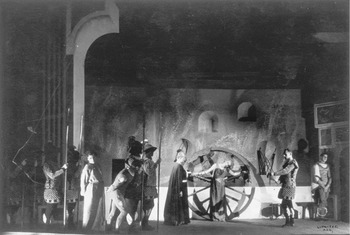
Antonin Artaud's production of Les Cenci at the Théâtre des Folies-Wagram in Paris in 1935 has been regarded as a notorious failure in theatre history, a precipitating event in the collapse of Artaud's mental health, and proof that Artaud was unable to realize his proposed ‘theatre of cruelty’ in practical terms. The long-standing estimation of Artaud as a failed theatre practitioner, abstruse writer and crazed person has granted importance to Artaud's ideas and to his influence on later theatre practitioners, but less so to his own theatrical endeavours. Kimberly Jannarone has re-evaluated this received opinion, showing that Artaud's productions with the Alfred Jarry Theatre in the late 1920s met with critical favour and that Artaud was well able to apply his theatrical ideas in practical terms.Footnote 2 I propose to advance the critical reconsideration of Artaud's theatrical work by examining the sonic aspects (both crafted and situational) of Les Cenci, attempting to ‘listen back’ to this production in order to consider it anew. By attending to Artaud's use of sound – a feature that has been commented upon but has not been analysed in depth – we may better understand his theatrical aesthetic and philosophy, his innovations as a theatre practitioner, as well as the interpretive cruxes that his work engenders.Footnote 3
A theatre soundscape is the product of multiple factors: it is a sound design (when instituted) plus (or ‘heard through’) the performance environment, and it is understood in relation to sociocultural, historical and material conditions.Footnote 4 My methodology for reconstructing the theatrical soundscape of Les Cenci involves a close reading of the dramatic text that proffers a logic for its sonic references; an audio analysis of an extant recording of music and sound cues composed for the play; and an examination of secondary materials, including Artaud's director's notebook, press interviews, personal correspondence, theatre theory and newspaper reviews of the production. I situate my interpretation of this evidence (which is necessarily partial and mediated) with reference both to an estimated acoustic ‘horizon of expectations’ of Artaud's audiences and to neuroscientific conceptions of how the brain processes auditory input.Footnote 5
A ‘network of sound vibrations’
Artaud's play (after P. B. Shelley's 1819 verse drama and Stendhal's 1837 novella) is based on the life and crimes of the sixteenth-century Italian nobleman Count Francesco Cenci, a tyrant who plots the murder of two of his sons, and beats, confines and rapes his daughter, Beatrice. Artaud's stated intention with regard to the sonic elements of the production was to place the audience in the centre of a ‘network of sound vibrations’ that would make audible, and sensible, the ‘incarnation of great forces . . . beings roaring . . . passing like great storms in which a sort of majestic fate vibrates’.Footnote 6 To accomplish this, Artaud pioneered the use of stereophonic sound in theatre, employing four loudspeakers at cardinal points in the auditorium, and instituted a sound design avant la lettre.Footnote 7 Artaud enlisted the aid of Roger Désormière, who, in collaboration with Artaud, devised prerecorded sound cues, billed as music (a mixture of short pieces of music, vocalizations and sound effects), that featured cathedral bells, echoing footsteps used to underscore the actors’ movements, metronomes running at different speeds and intensities, recorded voices and whispers, wind and thunder effects, flutes, a viola or other stringed instrument, percussive ‘factory’ sounds made by various metal objects, tam-tams and an ondes martenot (a recently invented monophonic electronic instrument that allowed for wide-ranging tonal manipulation, glissandi and vibrato effects).
The text of Les Cenci provides indications for the types of sound that are to be made, some quite specific, some more abstract, as in the direction ‘a thick heavy sound spreads out then dissolves, as though stopped by some obstacle which makes it rebound in sharp ridges’, or the description of the vocal utterance of the word ‘Cenci’, which is likened to the pendulum of a clock and then to ‘countless birds whose individual flights have converged together’.Footnote 8 It is evident that Artaud and Désormière put considerable thought into the sonic aspects of the production, which did not merely support the action but motivated it obliquely (although the text does provide cues reminiscent of melodrama and early cinema, e.g. ‘[very] soft, very sinister music gradually makes itself heard’Footnote 9). In the playtext, Artaud makes special use of acousmatic sound, sound that has no visual referent, and links this abstracted sound to the mysterious powers and affective force of Cenci, whose actions are meant to elicit the unconscious impulses that are central to Artaud's philosophy of cruelty and to his notion of the plague.Footnote 10 In a crucial scene, Cenci enchants Beatrice with the power of his voice, but his conjuration is also linked to what I refer to as the ‘acoustic imaginary’ of the playtext (the figurative rendering of a conceptual idea or a characterological principle through sonic means). The following example in the stage directions illustrates this concept:
beatrice and old cenci remain face to face. They stare at each other steadily for a long moment. cenci goes to the table and pours himself a fresh glass of wine. Several torches flicker out suddenly. The bells can be heard; their tone has become sepulchral. An extraordinary calm descends upon the scene. Something like the sound of a viola vibrates very lightly and very high up. beatrice sits down in a chair and waits. cenci approaches her gently. His attitude is completely transformed; it radiates a sort of serene emotion. beatrice looks at him and it seems that her own misgivings too have suddenly vanished.Footnote 11
The vibration of the viola-like sound forms part of an omnipresent network of sound vibrations that Cenci activates in the world of the play, and that Artaud – in concert with Désormière – realized in his production by means of a mechanically reproduced, de facto sound design.
The production featured crafted sonic elements intensively and extensively, such as in Act I, sc. iii, the loud playback of a recording of the bells of Chartres Cathedral, meant to denote the bells of Rome, and later the melée at Cenci's party, set to the accompaniment of metronomes, recorded voices, and the ondes martenot; in Act III, sc. ii, thunder and wind effects used to illustrate a storm that precedes the assassination attempt on Cenci's life, in addition to a recorded arrangement of voices that declaimed ‘Cenci, Cenci, Cenci, Cenci’ as the murderers approached; in Act IV, sc. i, the ‘terrifying’ (according to the script) fanfares that marked Cenci's murder; and in Act IV, sc. iii, the mechanistic sounds of the prison (‘like a busy factory’) where Beatrice is set on a Catherine wheel, for which Désormière and Artaud used sounds made by anvils, screw nuts, files, winches and other metal objects.Footnote 12 Abstract, acousmatic sounds made physical sense in that their vibrations were likely felt as well as heard (as a result of the loudspeaker placement) even if their semantic sense was unclear or non-existent: an attempt by Artaud to realize his desire to plunge the public into a ‘bath of fire’, making the spectator ‘participate with his soul and his nerves’.Footnote 13 In the world of the play, Beatrice functions as a surrogate participant in Artaud's theatre of cruelty, terrorized by the sounds that she hears and imagines, which are inextricably associated with her father and his threatened actions:
beatrice: Has he passed this way? Have you seen him, mother? She listens attentively. There! I hear his step on the staircase. Is that not his hand at the door? Since yesterday, I feel his presence everywhere. I am exhausted, Lucretia. Help us, mother, help us. I cannot go on fighting any longer. lucretia takes beatrice's head between her hands. Silence. Outside, the shrill cry of birds. Very high overhead, there is a sound like a footstep. Oh! this footstep which the walls echo. His footstep. I see him as if he were there: his dreadful face . . . His living image is within me like the conscience of a crime.Footnote 14
Artaud hoped that powerful acting, transgressive subject matter, innovative and daring mise en scène (set and costume design was by the French-Polish artist Balthus), and powerful sonic elements would work to shock, horrify and ultimately purge audience members of their psychic and spiritual maladies.
Sounds of the Other
The importance of the performance of Balinese dance theatre that Artaud witnessed at the Paris Colonial Exhibition of 1931 in helping him formulate his aesthetic of a ‘theatre of cruelty’ is well known, although theatre scholars have elided the potential significance of the soundscape of this event, namely the gamelan music that accompanied the dancers.Footnote 15 Artaud was struck not only by the exquisite gestural symbology of the dancers but also by the ‘hypnotic’ rhythms of the gamelan ensemble, its range of percussive effects, the variety of timbres that the musicians produced, and – most importantly, perhaps – the way in which the dancers’ movements interacted dynamically with the musical elements instead of simply functioning as a type of background accompaniment. Artaud's conception of Balinese music and dance helped him to theorize his developing theatre philosophy and aesthetic, and was also a conditioning element (with other influences) in the sound design for Les Cenci.Footnote 16
The recording of Désormière's music for the production (held at the Audiovisual Department of the Bibliothèque nationale de France) supports this thesis. The recording, which is approximately twenty-one minutes long, consists of twenty-four sound cues that were interspersed throughout the production. The sound cues are predominantly percussive, and include drumming, foot stomps, symbol crashes, bells and gongs, and metallic noises.Footnote 17 One cue is particularly striking: a short ostinato (repetitive) figure built on a compound time metre that generates a patterned, rhythmic syncopation between a drum and a mechanical horn-like sound, over which a fluctuating melodic line is played on the ondes martenot.Footnote 18 This is likely the music that accompanied Beatrice's execution at the end of the play, when she is set upon a Catherine wheel as punishment for having had Cenci killed (Fig. 1).
Beatrice (Iya Abdy) on a Catherine wheel in Les Cenci (photo: Lipnitzki-Viollet). © 2010 Artists Rights Society (ARS), New York/ADAGP, Paris.

Artaud's stage directions make reference to her execution march, set to ‘the sound of an Inca seven-part time rhythm’ and to a ‘kind of human voice [that] mingles its desperate tone with the music's compulsive rhythm’ (the ‘kind of human voice’ possibly orchestrated by Désormière using the ondes martenot).Footnote 19 The ‘Inca seven-part time rhythm’ may be a misnomer on Artaud's part; as far as I can tell, no such musical trope exists. It is more likely that this reference signals a familiar modernist coupling of the exotic and the primitive. This piece of music arguably owes more to Balinese gamelan music than to Incan music. In particular, it resembles the Balinese colotomic (cyclical gong) structure of Batel, used for intense action scenes in dance theatre, in which gongs and drums provide a steady (but alternating) ostinato framework, over which the suling (flute) may improvise freely.Footnote 20 Désormière's instrumentation is obviously different (the electronic ondes martenot lending a modern and technological sensibility, even as its glissandi approximate the ‘wide tuning’ of Balinese melodies and its warbling timbre that of the Indonesian flute), and his music is much less complex than the Balinese form, but it suggests an intriguing musical analogue, nonetheless. Was this a deliberate association on the part of Artaud and Désormière? Might audience members have made this connection, too? One reviewer, Armory, in the newspaper Comoedia, cryptically likened the music of the production to the so-called ‘black fanfares of the colonial exposition’.Footnote 21 However, would Artaud want his audience to make such a connection, given that the sound design for this production was intended above all else to be a felt experience?
‘Laughing like lunatics’
Almost all the reviews of Les Cenci mentioned its sonic elements and mise en scène, and while no reviewer claimed to have had the earth-shattering, metaphorical-plague-inducing experience to which Artaud aspired, many noted the increased use and impact of the sonic elements, even if they professed not to understand the reason for its usage. This aspect of the critical response is instructive, as I will suggest later. One critic disputed the musical credentials of the production (‘these roars, stampings and wheezing that Désormière calls “music”’), another damned it with faint praise (‘the music . . . stays within the confines of a shriek and a railroad disaster’), and one was indifferent (the ‘music had the same qualities and faults as the play’).Footnote 22 Several reviewers registered their discomfort with the intensity of the production, inadvertently crediting Artaud's efforts. Fortunat Strowski of the Paris-Midi wrote,
Everything is a paroxysm from beginning to end. No longer is there a rhythm created by a succession of strong and weak moments and by comings and goings. There is a continuity that is exhausting and at the end of which, if I dare use the expression, one remains inadequately ‘cencible’.Footnote 23
Similarly, Gerald D'Houville, writing in Le petit Parisien, asked and answered his own question:
Our ears tortured by deafening music produced by loudspeakers (Why? The talented M. Désormière could have done well to avoid this), we were in a state of alert as if we were hearing the wail of sirens during an evening of ‘air raids’. Without doubt, we were warned in this manner that this was an evening of massacres. But we resigned ourselves to it.Footnote 24
The most positive review was that of Pierre-Jean Jouve (a colleague of Artaud) in La nouvelle revue française, who noted that Artaud's mise en scène continually ‘animated’ the space in a creative manner: ‘Here we are constantly working. The complex lights, the movements of individuals and masses, the noise, and the music reveal to the spectator that space with time forms an affective reality’.Footnote 25
Artaud wrote a defensive note about the production in La Bête noire citing the ‘clash of contradictory and divided judgements’ that the production had engendered – ‘cheers and laughter, enthusiasm on the most part, sarcasms from a few, and even doubts from the Press’ – before concluding grandiloquently that ‘the French public is not mature enough for a feast of the Gods’.Footnote 26 In this note, he reproduces two letters extracted from his ‘abundant mail’ as ‘proof’ of the fact that more than one spectator recognized the ‘unprecedented atmosphere’ of the production as being ‘dangerous’.Footnote 27 One letter-writer, Eugène Gengenbach (address provided), declares,
I am disgusted by your rudeness and impertinence . . . You don't seem to give a damn. Continue. But don't think that you are launching such diabolical vibrations and spells over Paris with impunity. You are playing with fire . . . Around me spectators were laughing like lunatics, trembling with hysterical laughter . . . My poor Artaud, there is nothing more to be done for you.Footnote 28
In this note, Artaud also makes a dig at unnamed parties (reviewers? Audience members?), criticizing the ‘partisan dishonesty and the total prejudice of certain people who only came to the Cenci with the intention of seeing it fail and to destroy the play’.Footnote 29 While this may be paranoia and discontent on Artaud's part, we should not discount it from consideration. Artaud's relationship with the Parisian theatre critics was complicated: there was an ideological animus behind the resistance to his theatre work and to his dramaturgical theories. Constance Spreen has argued that critics of Artaud, particularly those associated with the reactionary, nationalist movement L'Action française, distrusted and rejected Artaud's theatre aesthetic because it subverted traditional French aesthetic values. Artaud's advocacy of a ‘poetry of the senses’ and of a theatre in which a violent, excessive mise en scène takes precedence over the literary text was decidedly ‘not French’ according to the more conservative critics, who associated Artaud's destructive impulses with a ‘barbarous’ Romanticism and a ‘deviance’ borne of avant-gardism and Jewishness.Footnote 30 One must be mindful of the politics that may have informed the hostile reception of Artaud's play from some quarters, which is not to posit a conspiracy, but to caution against simply accepting the negative judgement of Artaud's production made by some of his critics.
Although Artaud eschewed direct political engagement (one of the reasons why André Breton formally expelled him from the surrealist movement in 1926), he also wished to transgress the separation between stage and street and re-create street noise within the space of the theatre, as though ‘the walls of the theatre, like an eardrum, were threatened by the near catastrophic difference between the high pressure of noise in the street and the silence inside the building’.Footnote 31 As it happened, Artaud may have got more noise than he bargained for with this production. Or should that be the wrong type of noise? In his review of Artaud's production for the Paris-Midi, Raymonde Latour calls attention to the location of the Folies-Wagram Theatre and to the situational circumstances that complicated the meaning of the theatre event:
Every now and then, the imagination, the brilliance, the luck and the genius of Paris combine to create something bizarre and a little miraculous. Last evening at the Folies-Wagram was an example. The play had begun as early as nine o'clock on the [footpath] of Avenue Wagram. Fervent followers of Solidarité Française, meeting next door, stopped, stupefied, before the white rose bushes and sheaves of arums that attentive and excited friends had sent the new star [Iya Abdy, who played Beatrice]. And Antonin Artaud's guests, as they stopped at the theatre door, seemed visibly upset when they were obliged to slip through fifty or so policemen to go and applaud Les Cenci. I'm quite certain that at the same time there were some bystanders who assumed that the lilies and orchids were intended for the ardent orators [of the Solidarité Française], and that the policemen were tasked to protect Mr. Fortunat Strowski or Paul Reboux [theatre critics], given over to the perils of an excessive and tumultuous dramatic art.Footnote 32
The Solidarité Française was a fascist organization modelled after the Nazi Party that helped to stage the major street demonstrations and riots of the 1930s.Footnote 33 Latour's observation that Artaud's play began on the pavements of Paris with some awkward bustle, sidestepping, and confusion (on the night that he attended) may seem incidental, but I find it suggestive. It is ironic that Artaud, dogged by the right-wing critics of L'Action française for not being suitably ‘French’, staged Les Cenci (out of thrift) at a venue that happened to be next door to a right-wing, nationalist organization. The noise that Artaud sought was artistic (as part of the sound design of the production), experiential (for his auditors), and discursive (a succès de scandale), yet was potentially crossed with the political dissension and acoustical violence of right-wing protest groups like the Solidarité française. Indeed, the noise of Artaud's Cenci was perhaps unintentionally divisive: as such, it suggests certain problematical elements and misapprehensions in Artaud's poetics of theatre sound that merit closer attention.
Cruel vibrations
Artaud rejected the conventional, ‘supportive’ role of sound effects and incidental music in theatre, and instead developed a theatrical aesthetic in which sound attained foreground status, and functioned as a dynamic, destabilizing agent. Artaud proposed that sound (and, more precisely, vibration) could be used as a physical, material and tactile force to affect the nervous systems of those present, to break down their constitutions, and to attune them to the stage spectacle and to one another. Hence the importance of the proto-surround-sound loudspeaker system that was used in this production: the audience was to be buffeted on all sides by waves of physical vibrations, overloaded with sounds, in a manner not dissimilar to modern techniques of sonic assault and torture.Footnote 34 Artaud estimated that a ‘soul’ could be ‘physiologically reduced to a skein of vibrations’ in such an environment; in other words, the attendee of Artaud's ‘theatre of cruelty’ would not just hear incidental sounds in a disinterested fashion but would be made to experience a force of physical vibrations, viscerally, in his or her own body, and sympathetically in relation to the bodies of other audience members.Footnote 35
Artaud's theory of the theatre-as-plague held that destructive instincts and drives, activated in the subconscious by the visceral nature of the stage action, could be purged by the act of enduring such spectacles and ‘cruel’ auditory events. Theoretically, an audience member would be less likely to harbour criminal desires or to commit violence in the street – of the sort proposed by Solidarité française, for example – having experienced catharsis of these repressed impulses in the theatre. Sound would enable this by activating audience members’ senses and potentially causing them to overlap by way of synaesthesia, so that those in attendance might be attuned to one another and to the quasi-ritualistic performance. Despite the potentially cathartic and purifying intentions of Artaud's aesthetic, his conception of a ‘cruel’ auditory event – sonic bombardment intended to provoke communal ekstasis – is uncomfortably close to the way in which the Nazi Party utilized music and sound in public spaces in Germany in the early 1930s, particularly in urban street environments. In documenting this phenomenon, Carolyn Birdsall has coined the phrase ‘affirmative resonances’ to refer to the way in which sensory overstimulation and rituals of sonic dominance worked to delineate patterns of belonging (and exclusion), reinforce group identity and (ultimately) affirm the legitimacy of the Nazi Party.Footnote 36 Did Artaud deploy affirmative resonances of a similar or related order in his production (as in the examples from the sound design referenced earlier)? Was this related (even incidentally) to the fracas that (according to Latour) took place outside the Folies-Wagram Theatre on the night that he attended? I pose these questions in order to indicate (in passing) some potentially fascist elements of Artaud's aesthetic of cruelty, but more pressingly (for the purposes of this investigation) to posit a crux in his philosophy of theatre sound that Artaud derived from a productive misunderstanding of Balinese theatre, which promotes semantic confusion and that may have contributed to the difficult reception of Les Cenci.Footnote 37
Artaud proposed to treat the audience like ‘charmed snakes’, whose bodies reacted to the musical vibrations communicated to the ground (and not to the ‘mental ideas’ of music).Footnote 38 Artaud's concept of vibrational affectivity in theatrical sound design, while not without precedent, was unique in the way in which it was integrated into an aesthetic of theatrical cruelty.Footnote 39 Prefiguring modern sonic warfare (and perhaps also ‘rave’ parties), Artaud held that sonic vibrations could make manifest an embodied perception of cruelty. In other words, the physicality of sound (aided by technological diffusion) enabled Artaud to touch (literally) the bodies of audience members with violent sensations, to immerse them in a vibratory complex, and to operate on the levels of physiological excitation and sympathetic resonance. Vibrations were to be channelled in such a way as to unite participants in a communal sensation that was felt, if not exactly understood: a process that privileges affect over cognition.Footnote 40 Artaud derived this aesthetic in part from Balinese theatre. He understood the sounds, gestures and movements of this form to function in the manner of a hieroglyph, providing an instantaneous grasp of meaning linked to the subconscious. He writes,
These mental signs have an exact meaning that only strikes one intuitively, but violently enough to make any translations into logical, discursive language useless . . . There is no transition from a gesture to a cry to a sound; everything is connected as if through strange channels penetrating right through the mind!Footnote 41
In this model of auditory perception, the interpretation of sounds is beside the point: what principally matters is the ‘essential’, ‘instinctive’, ‘spiritual’ nature of the music – its basis as pure vibration – which Artaud professed to intuit in Balinese dance theatre, and which he hoped to replicate in his production of Les Cenci.
Balinese gamelan music has in fact been discovered to be rich in ultrasonic frequencies, some of which cannot be consciously perceived (recognized) but still have physiological effects on listeners and may enhance neuronal activity (leading to aesthetic pleasure) as part of a complex of high-frequency and low-frequency components.Footnote 42 Artaud was therefore correct in his assumption that a network of sound vibrations could affect audience members on a physiological level, so that, for example, the Balinese-inspired music that (I posit) accompanied Beatrice's execution might instil a hypnotic, trance-like state among the attendees, whipping them into a type of ritualistic fervour appropriate for his theatre of cruelty. Indeed, Artaud may have succeeded in his goal of affecting his audiences through their anatomies, making them feel the vibrational force of the production even though they could not fathom (or did not appreciate) its usage. The critical response to the production indicates that this may have been the case (the anecdote about spectators ‘laughing like lunatics’ is especially suggestive in this regard). Does this not dispute – or at least qualify – the purported failure of the production? In an admittedly circular logic, the fact that Artaud's critics noted the sonic force of the production but professed not to understand it may be interpreted as a partial vindication of Artaud's theory that ‘cruel’ vibrations in the theatre should be a function of sense perception rather than of ‘cognitive’ listening (listening for meaning). Artaud did not intend his audience members to understand his use of sound, and, lo and behold, they (or at least the critics) seem not to have done so. (Success – and failure!)
However, Artaud wanted the immersive atmosphere of sound vibrations in his production to unify the audience, and to promote a centripetal heightening of collective sensation (formed around his own performance as Cenci) that would enact his philosophy of aesthetic cruelty.Footnote 43 There is no evidence to suggest that the audiences for Les Cenci were bonded through sound vibrations in this manner; rather, it appears that they felt the vibrations, but made sense of them idiosyncratically, or not at all. In hindsight, this was to be expected. The cultural milieu that might enable absorbed participation in Balinese gamelan music (or a theatrical sound design that aped its attributes) was not that of Les Cenci, which took place in a former music hall, and which had a premiere that was something of a high-society affair. Without specific cultural networks of knowing and feeling, what ethnomusicologist Judith Becker calls the ‘habitus of listening’ (after Pierre Bordieu), the synaptic connections necessary to create a trance-like, musical perception in the brain will not take place; the ‘electrical storm’ of neurons will misfire.Footnote 44 Consequently, the sound design for Les Cenci could not elicit the hieroglyphic clarity, the ‘direct seizure of transcendental knowledge’, to which Artaud aimed, because the sounds it deployed probably multiplied or confounded meaning rather than ‘spiritually’ concentrating it.Footnote 45 The likelihood of cognitive dissonance increases with the degree of abstraction involved and with the relative novelty and difficulty of the auditory input. The sound design for this production mixed and matched sonic elements and drew on potentially unfamiliar aspects of avant-garde musical experimentation, such as the expansive, electronic diapason of the ondes martenot, which still sounds strange today. Despite Artaud's intent, the audiences of Les Cenci could not be attuned to a collective ‘wavelength’: there were too many potential distortions of meaning, too many signal carriers that could refer to the sounds both inside and outside the theatre. Without a consensus as to what constitutes music, or musical meaning, or theatre music, or the differences between music and ‘incidental’ sound (all of which was – and is – open to debate), the theatrical soundscape of Artaud's production was always going to be contested, and the din that it generated could connote disruptive street noise or artistic ‘failure’ more easily than it could incarnate great forces or throw audiences into a ‘magical trance’.Footnote 46 I offer this critique of Artaud's model of hieroglyphic sound not in order to prove the purported failure of the production, but to propose one reason why its aesthetic novelties may have inadvertently backfired.
In ‘listening back’ to Artaud's Les Cenci, one is struck by the ‘noise’ that it makes in terms of the history of modern theatre sound, theatre aesthetics, the history of theatrical ‘failures’, artistic sonic warfare, and the intersections between theatre and environmental sound. It is little wonder that its soundscape met with critical confusion: it was semantically overdetermined and experientially charged, which likely confused audiences that had yet to encounter a sonic experience of this sort. Artaud's production succeeded in generating sensation and noise (both acoustical and discursive), and arguably in proliferating ‘cruel vibrations’; but in doing so, it may have prevented its aesthetic achievements as well as its ideological suppositions and cultural formulations from being properly recognized.