


The collective end of history illusion
Middle-aged adults often deal with poor choices made by young adults. And not just any young adults, but the younger versions of themselves. They try to lose weight their young selves gained, cover up tattoos their young selves loved, and cut expenses because their young selves did not save. Although people make regretful decisions for many reasons, one contributing factor is the End of History Illusion (EOHI). In the EOHI, people often see themselves as having grown and changed in the past but underestimate growing or changing in the future (Quoidbach et al. Reference Quoidbach, Gilbert and Wilson2013). In other words, people live persistently at ‘the end of history’, assuming that their current values, personality, and preferences will stay unchanged forever. This tendency can lead them to make life choices that can be difficult to change or result in regret.
Curiously, people may also show this pattern when thinking about the groups they belong to. They may think that the group they are a part of now will be the same in the future, leading them to make decisions without considering that things might change. In the current article, our goal is to examine whether a collective End of History Illusion exists; that is, whether people underestimate how much their group will change in the future, and whether the amount of conflict people perceive to be occurring in their collective predicts estimates of change. Exploring this extension of the EOHI will contribute to research on collective temporal thought, or how people think about the past and future of the groups they belong to (Yamashiro et al. Reference Yamashiro, Liu and Zhang2023), which may have implications for people’s willingness to engage in collective action (Bain et al. Reference Bain, Hornsey, Bongiorno, Kashima and Crimston2013) and their social well-being (Sani et al. Reference Sani, Bowe and Herrera2008).
The end of history illusion
The End of History Illusion (EOHI) is a phenomenon where people see themselves as having changed in meaningful ways in the past but do not anticipate changing as much in the future. In a key article published in Science, Quoidbach and colleagues (2013) asked participants to rate how much their personality, values, and preferences had changed over the past 10 years or how much they would change in the next 10 years. Critically, they found that people believed they had changed a great deal across all three domains in the past but would change little in the future. This pattern occurs with people of all ages and can appear regardless of whether they are thinking about specific personal characteristics (like their values) or making a more holistic judgement. The basic phenomenon of the EOHI has been replicated multiple times (Haas and Omura Reference Haas and Omura2022; Sacchi et al. Reference Sacchi, Sah, Finlay and Starmans2024; Van Ryzin Reference Van Ryzin2016; but also see Harris and Busseri Reference Harris and Busseri2019 for a critique of the EOHI), appears to occur when thinking about others (albeit with a smaller effect size; Renoult et al. Reference Renoult, Kopp, Davidson, Taler and Atance2016), and has been shown to appear in both Western and Eastern cultures (although the effect size is smaller in Eastern cultures; Haas and Omura Reference Haas and Omura2022).
Why does the EOHI occur? In their discussion, Quoidbach and colleagues (2013) proposed two mechanisms. First, people tend to like who they are in the present, which makes them hesitant to think that they will change in the future. This thinking could stem from the desire to preserve pre-existing beliefs about oneself and enhance self-concept, a perspective that is generally supported by research examining self-enhancement (Taylor and Brown Reference Taylor and Brown1988; Sedikides and Gregg Reference Sedikides and Gregg2008). Second, people may find it easier to remember the past than to think about the future; while remembering requires retrieving past experiences, imagining the future requires constructing novel scenarios (e.g., Ross Reference Ross1989; Robinson and Clore Reference Robinson and Clore2002). Thus, memory retrieval is potentially a more fluent experience than imagining the future. As fluency can influence judgements in multiple ways (Alter and Oppenheimer Reference Alter and Oppenheimer2009), the relative disfluency of imagining change in the future may lead people to underestimate future change. The two mechanisms are likely not mutually exclusive, but in both cases may contribute to people underestimating how much they will change in the future. However, it is important to note that these mechanisms are speculative. To our knowledge, no study has clearly shown that one or both is responsible for the illusion.
Collective temporal thought
People do not just think about their personal past and future; they also think about the past and future of groups they belong to, such as families, religious groups, and nations. Collective temporal thought research (e.g., Liu and Szpunar Reference Liu and Szpunar2023) explores how people think about the groups they belong to across time, and how such cognitions compare to how they think about their own lives across time. On one hand, there are some similarities between personal and collective temporal thought, particularly within the processes guiding temporal cognition. Within both domains, there is evidence that people likely draw on memory representations when generating future scenarios (Deng et al. Reference Deng, Rosenblatt, Talhelm, Putnam and Putnam2023; Yamashiro et al. Reference Yamashiro, Liu and Zhang2023), and that day-to-day experiences influence both types of future prospections (Page and Putnam Reference Page and Putnam2026). Finally, in both domains, temporal thought is scaffolded by pre-existing schematic structures rather than constructed anew each time – personal self-schemas guide how people think about themselves across time (Ross Reference Ross1989), while schematic narrative templates play an analogous role in shaping how people think about their group’s past and future (Wertsch Reference Wertsch2008).
On the other hand, research has also highlighted salient differences between personal and collective temporal thought. For example, people tend to have a positivity bias when thinking about their personal future and a negativity bias when thinking about the future of their country (Shrikanth et al. Reference Shrikanth, Szpunar and Szpunar2018; Deng et al. Reference Deng, Rosenblatt, Talhelm, Putnam and Putnam2023; Yao et al. Reference Yao, Multhaup and Salter2025). They show a similar dissociation when thinking about the past (Shrikanth and Szpunar Reference Shrikanth and Szpunar2021). This crossover interaction is robust (for reviews, see Topçu and Hirst Reference Topçu and Hirst2022; Liu and Szpunar Reference Liu and Szpunar2023), although there are some differences across cultures (Deng et al. Reference Deng, Rosenblatt, Talhelm, Putnam and Putnam2023; Mert et al. Reference Mert, Hou and Wang2023; Yao et al. Reference Yao, Multhaup and Salter2025). Szpunar and Haksever (Reference Szpunar and Haksever2026), among others, have suggested that one of the main reasons such differences occur is that personal events (and events related to small collectives, such as a family) are directly experienced, leading to episodic memories, whereas collective events are less likely to be directly experienced and thus more likely to become part of semantic memory (Abel and Berntsen Reference Abel and Berntsen2021).
However, one important caveat is that most work showing negativity biases in collective future thinking uses the nation as the target collective. When people think about the future of other collectives, such as their family, workplace, or school, the negativity bias towards the collective future is reduced or reversed (Berntsen and Rubin Reference Berntsen and Rubin2024; Hicks et al. Reference Hicks, Rosenblatt, Bower and Putnam2026). For example, Szpunar and Haksever (Reference Szpunar and Haksever2026) showed that overall people were more positive about the future of their family than their country, but that the pattern was smaller for participants who identified more strongly with their country than their family, suggesting that how closely one identifies with their country may shape how they think about their country’s future.
Finally, while the majority of collective temporal thought research has focused on the content and valence of memory and future thinking (e.g., Topçu and Hirst Reference Topçu and Hirst2020), other research has examined how people mentally represent their socially constructed groups across time. For example, Yamashiro and colleagues have done work examining the implicitly held schemata that people use to guide remembering and future thinking. Two key findings are that Americans endorse a trajectory of decline – things were good in the past and likely to be worse in the future (Yamashiro and Roediger Reference Yamashiro and Roediger2019), and that implicitly endorsed trajectories correspond with explicit beliefs about the past and future (Yamashiro et al. Reference Yamashiro, Liu and Zhang2023). If people hold implicit beliefs about how things have changed in their country (things are progressing or declining), then it is also likely that they hold beliefs about the rate of change, which leads to the question of whether people would demonstrate a collective end of history illusion.
Is there a collective end of history illusion?
Although collective temporal thought researchers have examined the implicit trajectories that people hold when thinking about the past and future of their groups (Yamashiro and Roediger Reference Yamashiro and Roediger2019), to our knowledge there has been no research examining the overall amount of perceived collective change that has happened or will happen in the future. In other words, research has examined how people perceive groups to change over time but not yet examined whether they perceive their groups as being in a state of stasis or change. If the EOHI does not extend to collective domains, people would see their groups in a state of equilibrium or perceive more group-level change to occur in the future than it has in the past. A collective EOHI would suggest that people see their country (or other group) as having changed a lot in the past but as less likely to change in the future. If such a pattern were to exist, it would have important implications for how people think about the allocation of resources within a society, and people’s willingness to engage in collective action (Bain et al. Reference Bain, Hornsey, Bongiorno, Kashima and Crimston2013). There is scant research examining people’s beliefs about change in the context of a country, but some evidence suggests that people generally perceive themselves as having a greater ability to change than their country’s ability to change (Hazan et al. Reference Hazan, Hui and Chan2024), and that those perceptions of agency (either in an individual or collective) predict the valence of future thinking (Topçu and Hirst Reference Topçu and Hirst2020).
It is unclear whether a collective EOHI will occur. As noted above, Quoidbach et al.(2013) speculated that the personal EOHI was due to ego-protection and fluency effects. We hypothesized that these mechanisms may not play out in the same way in the collective domain. First, ego-protection effects would be weaker (or non-existent) because people typically do not identify as strongly with their country as they do with their personal life or family (Berntsen and Rubin Reference Berntsen and Rubin2024; Szpunar and Haksever Reference Szpunar and Haksever2026). Second, a fluency discrepancy may not occur when thinking about the collective. When people are thinking about their personal past, they can draw on episodic memory, but imagining their future requires drawing on semantic knowledge (Robinson and Clore Reference Robinson and Clore2002); this discrepancy may be contributing to a fluency imbalance. In contrast, when thinking about the public domain, people may be more likely to draw on semantic knowledge both when remembering the past (Abel and Berntsen Reference Abel and Berntsen2021) and when imagining the future of their country, meaning that a fluency imbalance may not occur.
On the other hand, it is possible that a collective end of history illusion could occur. People like to feel good about the groups they belong to (Cialdini et al. Reference Cialdini, Borden, Thorne, Walker, Freeman and Sloan1976), and other research has demonstrated that the valence of collective future thinking is more similar to the valence of personal future thinking if people identify strongly with their collective (Szpunar and Haksever Reference Szpunar and Haksever2026). Thus, they may show some ego-protection effects. Likewise, experiments using the fluency task demonstrate that people are happy to generate events related to the past and future of their countries (Shrikanth et al. Reference Shrikanth, Szpunar and Szpunar2018; Deng et al. Reference Deng, Rosenblatt, Talhelm, Putnam and Putnam2023). More importantly, Yamashiro et al. (Reference Yamashiro, Liu and Zhang2023) reported data from a fluency task showing that people generated fewer future collective events than past collective events, a pattern consistent with the fluency mechanism. Furthermore, other research suggests that imagined collective future events are rated as being less specific and vivid than remembered events (Topçu and Hirst Reference Topçu and Hirst2020). In sum, there is a reasonable argument both for and against the case of a collective EOHI.
Will perceptions of the present and conflict predict ratings of future change?
As a secondary research question, we also asked whether two factors predicted judgements of collective change: satisfaction with the current moment (either in one’s personal life or country) and perceptions of conflict in the United States. If ego-protection is driving the EOHI, then perceiving the current moment as good would lead to anticipating little future change, but perceiving the current moment as bad would lead to anticipating more future change. This may be a form of wishful thinking – people who are presently dissatisfied have more explicit reasons or a stronger motivation to imagine future change. Thus, in addition to having people remember or imagine change, we also had them evaluate the present moment.
Additionally, there is also reason to suspect that conflict – or at least people’s perception of conflict – might correlate with anticipated future change. Several empirical projects examining collective memory and how people remember history have demonstrated that people tend to remember – and rate as being important and consequential – war, organized violence, and other strongly negative events (Liu et al. Reference Liu, Paez, Slawuta, Cabecinhas, Techio, Kokdemir, Sen, Vincze, Muluk, Wang and Zlobina2009; Taylor et al. Reference Taylor, Burton-Wood and Garry2017). For example, Liu’s work found that WWII was often mentioned as the most important event in World history. Wars are lionized in history because loss of life is salient and the consequences are long-lasting: boundaries are redrawn, nations are destroyed or built, and decades-long occupations are begun. Additionally, negative events (like wars and terrorist attacks) can happen quickly, whereas positive social outcomes (improved health outcomes) tend to happen more slowly, and thus are harder to notice (Pinker Reference Pinker2011). In any case, wars and terrorist attacks are the epitome of conflict, and such conflicts frequently lead to change, thus leading to the prediction that perceiving conflict in the moment may lead to increased perceptions of change in the past or future.
The current study
The current study investigated whether Americans display a collective End of History Illusion; do they underestimate the degree of change that may occur in the future compared to what they remember from the past? To do so, we asked Americans how much they thought they or the United States had changed in the last 10 years or how much they anticipated themselves or the United States changing in the next 10 years. Additionally, we asked participants to rate how good they believed things were in their personal lives and in the country at the current moment. Finally, we asked participants to rate how much conflict the United States was currently experiencing both domestically and internationally. We gathered data at two time points – in 2022 and 2025, allowing us to examine whether the illusion would be displayed at a different sociopolitical moment.
For our 2022 sample (Experiment 1A), we preregistered hypotheses that we would replicate the personal EOHI and would not show a collective EOHI. Additionally, we expected that evaluations of the present moment would negatively correlate with estimates of future change. For our 2025 sample (Experiment 1B), we preregistered hypotheses that we would replicate Experiment 1A and additionally anticipated that perceiving the United States as currently experiencing large amounts of conflict would positively correlate with perceived change in the past and future.
Method
We ran the same experiment twice, once in 2022 (Experiment 1A) and once in 2025 (Experiment 1B). Both experiments were preregistered.
Participants
In Experiment 1A, we recruited 1,000 Americans from Prolific (www.prolific.com) (M age = 36.34, SD = 13.69, Range: 18–80; see other demographic information in Table 1). Participants were compensated $0.20 for completing our 1-minute survey. We initially recruited 1,003 participants, but we excluded the data from 3 participants who reported living in the United States for less than 1 year or who did not provide that information. The sample size was determined based on the resources available for the project. We ran a sensitivity analysis in G*Power (Faul et al. Reference Faul, Erdfelder, Lang and Buchner2007) aimed at finding a domain-by-temporal focus interaction, which indicated that, with our sample size, α = .05 and power = .80, we had sufficient power to detect a minimum effect size of f = 0.09.
Demographic information for Experiments 1A and 1B

Table 1. Long description
Percentages of participants in each demographic category for Experiment 1A (2022, 1,000 participants) and Experiment 1B (2025, 998 participants), given as 2022 then 2025. Gender: male 43.0, 45.0; female 54.7, 50.8; other 1.5, 1.1. Race: White/Caucasian 70.2, 74.3; Asian 9.6, 7.4; Latino/Hispanic 6.1, 2.8; Black 5.4, 9.7; multiracial 7.6, 5.0; other 1.0, 0.6. Education: some high school 0.8, 1.0; high school 10.5, 14.6; some college 31.7, 26.4; bachelor’s degree 41.8, 39.6; master’s degree 10.8, 14.0; advanced degree 3.7, 3.9; other 0.5, 0.4. Political affiliation: conservative Republican 4.6, 12.4; average Republican 5.0, 5.6; moderate Republican 8.7, 8.8; independent 28.6, 29.2; moderate Democrat 10.8, 9.7; average Democrat 16.1, 12.4; liberal Democrat 26.0, 21.8.
Note: Percentages may not equal 100 due to rounding and the demographic section being optional for participants. Note that there were some statistically significant differences between our samples, although the effect sizes in all cases were small (all Cramér’s V < .15).
In Experiment 1B, we recruited 998 Americans from Prolific (M age = 43.64, SD = 12.99, Range: 19–80). Participants were compensated $0.25 for completing our 1-minute survey. Our study initially had 1,001 participants, but we removed the data from 3 participants who reported using external sources (such as artificial intelligence) to complete the survey. A sensitivity analysis (with the same assumptions as above) indicated we had sufficient power to detect an effect size as small as f = 0.09.
Procedure
The critical questions used in our study were adapted from prior work on the EOHI (Quoidbach et al. Reference Quoidbach, Gilbert and Wilson2013, Study 3). We had participants report how much they felt they had changed as a person over the last 10 years or how much they thought they would change as a person over the next 10 years. In another version of the question, participants reported how much they believed the United States had changed over the last 10 years or how much they thought the United States would change over the next 10 years. We used a 2 (temporal focus: past vs. future) × 2 (domain: personal vs. country) between-subjects design, with subjects randomly assigned to answer one version of the question. We used a between-subjects design to align with prior research and to avoid the concern that seeing two versions of the same question would lead participants to provide similar responses (akin to how stability biases in metacognitive judgements disappear when examined in a repeated-measures design; Koriat et al. Reference Koriat, Bjork, Sheffer and Bar2004).
We collected data for Experiment 1A on July 18, 2022. For context, some of the major US events that occurred in 2022 were the Russian invasion of Ukraine in February, the overturning of Roe v. Wade, Ketanji Brown Jackson was sworn in as a US Supreme Court justice. Additional news stories were about inflation, high gas prices, and poor stock market performance (The Wall Street Journal 2022).
After providing informed consent, participants were randomly assigned to answer one version of the EOHI question (focusing on either the past or the future and either their personal life or the country). Participants responded to the question using a 5-point Likert-type scale with the following labels: ‘none at all’, ‘a little’, ‘a moderate amount’, ‘a lot’, and ‘a great deal’, where higher numbers corresponded to greater change.
Following that question, participants responded to a follow-up question, either ‘Overall, how good are things in your personal life right now?’ or ‘Overall, how good are things in the country right now?’, depending on which version of the EOHI they answered. Participants responded with a 5-point Likert-type scale with the following labels: ‘extremely bad’, ‘somewhat bad’, ‘neither good nor bad’, ‘somewhat good’, and ‘extremely good’. Finally, participants answered demographic questions and were thanked and debriefed.
Experiment 1B was a direct replication of 1A and was run on September 22, 2025. For context, some of the major US events from 2025 were as follows: Trump was sworn in for his second term at the start of 2025, which led to several events, including sweeping tariffs, Elon Musk and the Department of Government Efficiency, and the passage of the Big Beautiful Bill. Additional news stories were the LA fires, several plane crashes, the election of Pope Leo, controversy related to the Epstein files, and the assassination of Charlie Kirk (Power and Simon Reference Power and Simon2025).
The only differences in procedure were that participants answered an additional follow-up question where participants rated how much conflict they believed the United States was currently experiencing both domestically and internationally. Participants responded using a 5-point Likert-type scale with the following labels: ‘historically low levels of conflict’, ‘a little conflict’, ‘a medium amount of conflict’, ‘a lot of conflict’, and ‘historically high levels of conflict’, with higher numbers corresponding to more conflict. Finally, there was an additional question asking whether participants had used assistance from artificial intelligence (AI) or the web to complete the survey.
Results
Is there a collective end of history illusion?
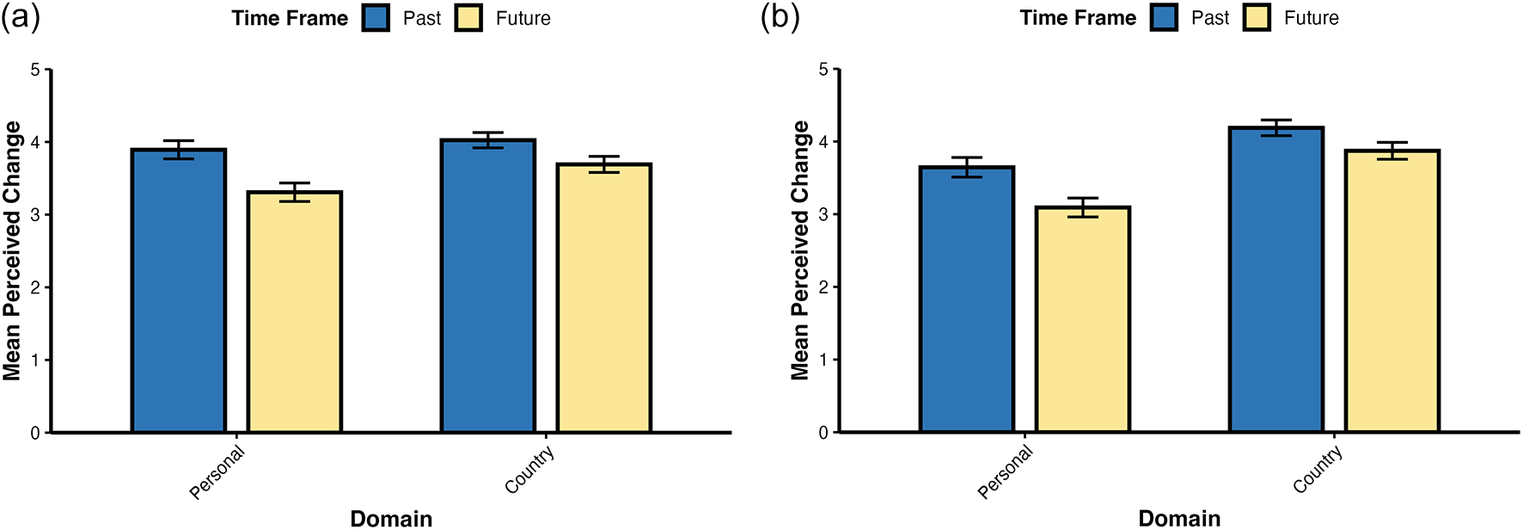
Our main question was whether the EOHI would occur when people considered their country instead of their personal lives. For Experiment 1A, we ran a 2 (domain: personal vs. country) by 2 (temporal focus: past vs. future) between-subjects ANOVA, with change rating as the dependent variable. As shown in panel A of Figure 1, participants provided higher change ratings when considering the country (M = 3.86, SD = 0.88) compared to their personal lives (M = 3.60, SD = 1.05), F(1, 996) = 18.60, p < .001,
$ {\eta}_p^2 $
 = .02. Additionally, participants reported perceiving greater change in the past (M = 3.96, SD = 0.93) compared to anticipated change in the future (M = 3.50, SD = 0.97), F(1, 996) = 59.07, p < .001,
$ {\eta}_p^2 $
 = .06. In other words, participants displayed an overall EOHI. Additionally, there was a domain-by-temporal focus interaction, F(1, 996) = 4.42, p = .036,
$ {\eta}_p^2 $
 = .004. Simple effects tests revealed that in both the personal and country domains participants perceived more change in the past than they anticipated in the future, but the effect size was larger in the personal domain (M
diff = 0.58, d = 0.58) than in the country domain (M
diff = 0.33, d = 0.39), suggesting that the EOHI is not as pronounced when people were thinking about their country.
Perceived change in the past and future by domain. Note: Figure 1 shows change ratings for past and future conditions as a function of domain from E1A (2022) (Panel A) and E1B (2025) (Panel B). Evidence for the EOHI comes from larger past ratings than future ratings. Error bars represent 95 percent confidence intervals.

Figure 1. Long description
A multi-panel figure with two bar graphs labeled a and b. Both graphs share the same axes and legend. The y-axis is Mean Perceived Change ranging from 0 to 5. The x-axis is Domain with categories Personal and Country. The legend at the top indicates blue bars for Past and yellow bars for Future. All bars include vertical error bars.
Panel a:
* Personal domain: The Past bar is approximately 3.9 and the Future bar is approximately 3.3.
* Country domain: The Past bar is approximately 4.0 and the Future bar is approximately 3.7.
Panel b:
* Personal domain: The Past bar is approximately 3.6 and the Future bar is approximately 3.1.
* Country domain: The Past bar is approximately 4.2 and the Future bar is approximately 3.9.
In both panels, perceived change is consistently rated higher for the Past than for the Future, and higher for the Country domain than the Personal domain.
Did the collective EOHI also occur in our 2025 sample? As shown in panel of Figure 1, participants provided higher change ratings when considering the country (M = 4.03, SD = 0.91) compared to their personal lives (M = 3.37, SD = 1.10), F(1, 994) = 112.58, p < .001,
$ {\eta}_p^2 $
 = .10. They also reported perceiving higher change in the past (M = 3.92, SD = 1.02) compared to anticipated change in the future (M = 3.48, SD = 1.06), F(1, 994) = 48.60, p < .001,
$ {\eta}_p^2 $
 = .05. Therefore, participants displayed an overall EOHI across domains for the 2025 data set as well. Additionally, there was a marginally significant domain-by-temporal focus interaction, F(1, 994) = 3.62, p = .057,
$ {\eta}_p^2 $
 = .004. Simple effects tests revealed that in both the personal and country domains, participants perceived more change in the past than they anticipated in the future. However, the effect size was larger for the personal domain (M
diff = 0.55, d = 0.56) than the country domain (M
diff = 0.32, d = 0.32), mirroring Experiment 1A.
Do perceptions of the current state predict anticipated change?
We hypothesized that current attitudes towards the present (current state ratings) would predict expected future change. To test this hypothesis, we examined the correlations between the future ratings and people’s ratings about how things were in the present. As seen in Figure 2, in Experiment 1A, within the personal domain there was no correlation between current state and expected change, rτ = −.005, p = .97, 95% CI [−.08, .07], but within the collective domain there was a small negative correlation, rτ = −.15, p = .007, 95% CI [−.22, −.07], indicating that participants who perceived the country as doing well anticipated less change in the future of the country.
Predicted change and current rating by domain. Note: Panel 2A shows a scatterplot from E1A (2022) for predicted change and current rating, split by domain. Panel 2B shows experiment E1B (2025) where the correlation was significant in both domains.

Figure 2. Long description
A two-panel figure labeled a and b. Both panels share a Y axis titled Current Rating of Present ranging from 1 to 5 and an X axis titled Predicted Change ranging from 1 to 5.
Panel a shows two sub-plots. The Personal sub-plot on the left uses light blue triangles. The data points are clustered around integer values. A horizontal black regression line with a grey confidence interval sits at a Y value of approximately 3.3, showing no trend. The Country sub-plot on the right uses dark blue circles. The regression line shows a slight negative linear decrease from a Y value of 2.6 at X equals 1 to a Y value of 2.0 at X equals 5.
Panel b shows two sub-plots. The Personal sub-plot on the left shows a negative linear trend where the regression line starts at a Y value of 3.8 at X equals 1 and descends to 3.1 at X equals 5. The Country sub-plot on the right shows a similar negative linear trend to panel a, with the regression line descending from a Y value of 2.7 at X equals 2 to 2.0 at X equals 5. In all plots, data points are jittered around the discrete 1 to 5 scale ratings.
In Experiment 1B (see Figure 2, panel B), we partially replicated E1A: we found that within the personal domain, the current ratings were now negatively correlated with expected change, rτ = −.14, p = .008, 95% CI [−.22, −.06]. Within the country domain, perceived current state of the country was negatively correlated with future change predictions, rτ = −.20, p < .001, 95% CI [−.28, −.13]. In other words, in Experiment 1B, for both domains, there was a negative relationship between current state ratings and anticipated change.
Do perceptions of conflict predict change ratings?
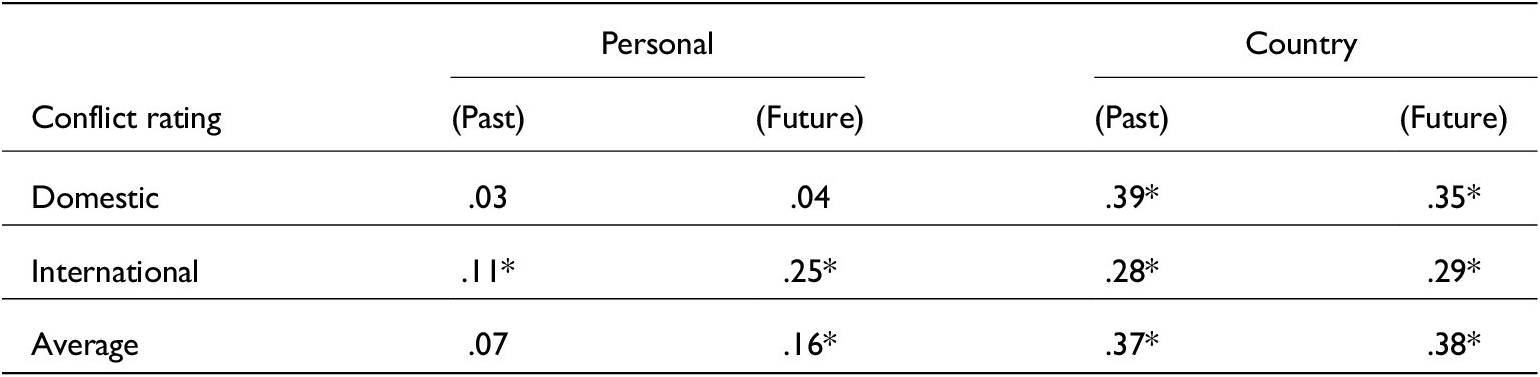
As an exploratory measure, Experiment 1B also asked about the conflict people perceived in the United States, both domestically and internationally. Table 2 shows the bivariate correlations between the conflict ratings (domestic, international, and the average of the two) and perceptions of change as a function of both domain (personal vs. country) and temporal focus (past vs. future). One clear observation is that there was a moderate, positive correlation between change ratings about the past and future of the United States and all the perceived conflict ratings, with Kendall’s tau values ranging from .28 to .39. In other words, seeing the United States as being involved in conflict was associated with greater perceptions of change in the past and future.
Bivariate correlations between perceived conflict in the United States and change ratings as a function of domain, temporal focus, and whether people were thinking about domestic or international conflict
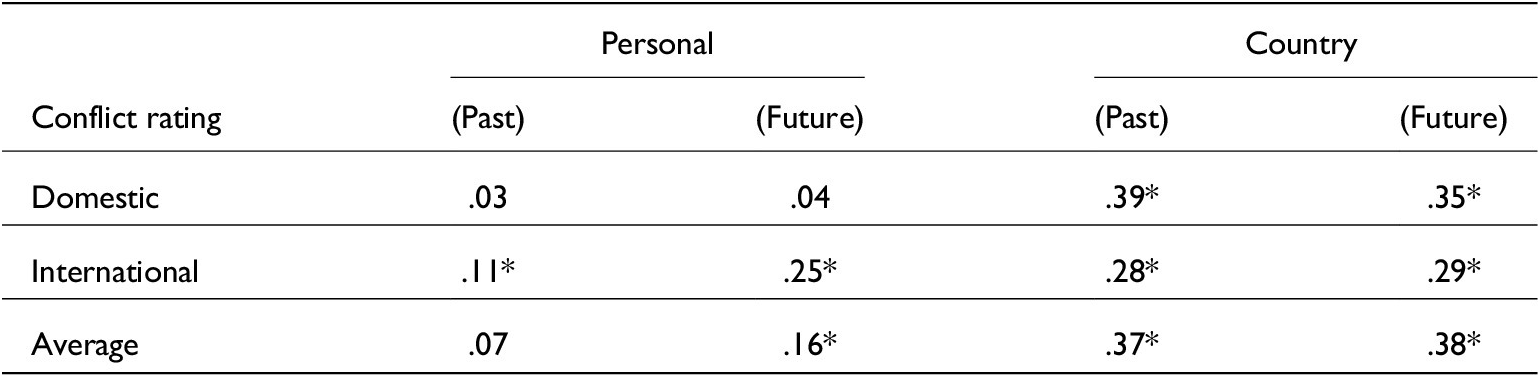
Table 2. Long description
Kendall’s tau correlations from Experiment 1B (2025) between perceived conflict in the US and change ratings, shown for four columns: personal past, personal future, country past, and country future. Domestic conflict: .03, .04, .39, .35. International conflict: .11, .25, .28, .29. Average of the two conflict ratings: .07, .16, .37, .38. All correlations are statistically significant at p < .05 except domestic conflict with personal past and personal future change, and average conflict with personal past change. Correlations are moderate and positive for the country and small or near zero for personal life.
Note: *p < .05. Correlations reported are Kendall’s τ.
In contrast, the relationship between perceived conflict in the United States and change in the personal past and future was less clear. There was a small to medium correlation between international conflict and personal change ratings – with a stronger relationship for the future than the past – but no such relationship for the domestic conflict rating. It is unclear why this occurred, but it does suggest that people may see international events as playing a larger role in affecting change in their personal lives.
One concern here is that the current state ratings of the country may correlate strongly with perception of conflictFootnote 1– and indeed they do: rτ = −.45, p < .001, 95% CI [−.49, −.40], suggesting that perceiving conflict is inversely associated with the overall state of the country. Additionally, as an exploratory analysis we ran a multiple regression where we used the current state ratings, conflict ratings, and temporal state (past vs. future) to predict the country change ratings. The overall model was significant, F(3,492) = 41.64, p < .001, R 2 = .20. Time frame predicted change ratings, β = −.29, p < .001, suggesting that the collective EOHI still occurred (meaning more change was perceived in the past compared to the future), even after controlling for current state ratings and conflict ratings. Additionally, perceived conflict was a significant predictor, β = .41, p < .001, whereas the current state rating was not, β = −.01, p = .808, indicating that the conflict ratings uniquely predicted perceived change.
Was the EOHI similar in 2022 and 2025?
Gathering data in two experiments across a 3-year period allowed us to test the generalizability of the collective EOHI – seeing the similar results across the two experiments suggest that the pattern is robust. However, newspaper headlines in 2025 suggest that America in particular and human society more generally experienced great changes and conflicts, ranging from attempts to restructure the US federal government to ongoing wars in different parts of the globe (Sullivan Reference Sullivan2025). As an exploratory analysis, we ran a 2 (domain: country vs. personal) by 2 (temporal focus: past vs. future) by 2 (year: 2022 vs. 2025) between-subjects ANOVA. Notably, there was no three-way interaction between domain, temporal focus, and year, suggesting that the EOHI occurred in both experiments, F(1, 1990) = .006, p = .937,
$ {\eta}_p^2 $
 < .001. However, there was a significant domain-by-year interaction, F(1, 1990) = 21.93, p < .001,
$ {\eta}_p^2 $
 = .01. In the personal domain, participants perceived more change in 2022 (M = 3.60, SD = 1.05) than in 2025 (M = 3.37, SD = 1.10), p < .001, whereas in the country domain, participants perceived more change in 2025 (M = 4.03, SD = 0.91) than in 2022 (M = 3.86, SD = 0.88), p = .005. Thus, the collective EOHI occurred during both time periods. However, participants perceived more change (in the past and future) in 2022 for the personal domain, but more change in 2025 for the country domain.
Discussion
How do people understand change in relation to their country? The present study demonstrated the presence of a collective End of History Illusion; in two separate years, a large sample of Americans perceived the country as having changed more in the past than they anticipated it changing in the future. Additionally, ratings of future change were negatively correlated with perceptions of the country’s current state and positively correlated with perceptions of US involvement in conflict. Finally, we showed that participants provided higher change ratings (for the past and future) about the United States in 2025.
Previous research on the EOHI has explored it in relation to various domains such as personality, values, preferences, and work-related motivations (Quoidbach et al. Reference Quoidbach, Gilbert and Wilson2013; Van Ryzin Reference Van Ryzin2016). Renoult et al. (2016) first suggested that the EOHI is not specific to the self and that underestimates of change occur when people make projections of how others will change in the future. However, our studies show that the EOHI extends to thinking about collectives, not just other individuals. Critically, the collective EOHI occurred when measured in two different years. Even though our participants perceived 2025 to have experienced more collective change than in 2022, the overall effect size of the EOHI was similar at both times.
This finding contributes to the field of collective temporal thought research, which investigates how individuals think about – via remembering and future prospection – the groups that they belong to (Wertsch and Roediger Reference Wertsch and Roediger2008; Roediger and Abel Reference Roediger and Abel2015; Hirst et al. Reference Hirst, Yamashiro and Coman2018). Past research in this area has examined how people feel about the past and future of their groups (e.g., Shrikanth et al. Reference Shrikanth, Szpunar and Szpunar2018; Deng et al. Reference Deng, Rosenblatt, Talhelm, Putnam and Putnam2023) and how people hold implicit theories about the trajectories of their countries over time (Yamashiro and Roediger Reference Yamashiro and Roediger2019). Rather than investigating directions of perceived change in the collective future, we look to determine if people perceive any change at all. A collective EOHI suggests that there are reliable patterns related to how people perceive change in the past and future of their groups, just as they do in their personal lives, and in particular, that people seem to view the country as having changed and less likely to change in the future. While much collective temporal thought research has highlighted differences between personal future thinking and collective future thinking (e.g., Shrikanth et al. Reference Shrikanth, Szpunar and Szpunar2018), the current results suggest that, at least in this area of temporal thought, there are some similarities between the personal and collective domains.
Our results also contribute to understanding the mechanisms contributing to the EOHI. Quoidbach et al. (2013) originally speculated that we may underestimate change for our personal futures because we like the person we currently are and do not want to change from that desired state. This argument is consistent with a large research literature in social psychology suggesting that egocentric biases have long impacted our cognition through mechanisms such as availability and attribution (Ross and Sicoly Reference Ross and Sicoly1979). Self-enhancing tendencies extend to the groups we are a part of, as we tend to publicly identify with successful groups (Cialdini et al. Reference Cialdini, Borden, Thorne, Walker, Freeman and Sloan1976). Therefore, perceptions of change regarding the country are likely impacted by individual beliefs that hold our own groups in an overly positive light.
Two of our results are compatible with Quoidbach and colleagues’ (2013) speculation. First, the current rating of the country was negatively correlated with predicted change, suggesting that when people liked the current state of the country, they were more likely to underestimate change for the country’s future. Second, the size of the EOHI was smaller in the collective domain compared to the personal domain. As noted in the introduction, while some people may identify strongly with their country (de Zavala et al. Reference de Zavala, Cichocka, Eidelson and Jayawickreme2009), in practice almost everyone is going to feel a stronger association and connection to their personal life than their nation. Thus, the drive to protect one’s ego may be smaller when considering the country.
However, future research should test this hypothesis more directly, for example, by explicitly measuring whether identification with one’s country moderates the size of the collective EOHI. Furthermore, examining the direction of change (whether things have improved or gotten worse) may prove essential in understanding whether self-enhancement is contributing to the EOHI.
Quoidbach et al. (2013) also suggested a second mechanism: that differences in fluency are responsible for the EOHI. They theorized that because it is easier to remember an experienced past than to generate a not-yet experienced future, this imbalance may be misattributed as signalling less change (Alter and Oppenheimer Reference Alter and Oppenheimer2009). Indeed, if asked to list upcoming events that may occur in their personal or collective futures, people consistently generate more personal than collective events (e.g., Shrikanth et al. Reference Shrikanth, Szpunar and Szpunar2018; Deng et al. Reference Deng, Rosenblatt, Talhelm, Putnam and Putnam2023; Yamashiro et al. Reference Yamashiro, Liu and Zhang2023). Thus, the smaller effect size in the collective EOHI could be due to both collective memory and collective future thinking relying on more semantic processes (rather than episodic; Abel and Berntsen Reference Abel and Berntsen2021), whereas in the personal domain there will likely be an imbalance as people are more likely to draw on episodic memory when remembering the past. We are speculating here, but future research could explore the degree to which perceptions of change are related to the fluency of generating events, or their features (such as specificity or vividness).
Another interesting finding is the correlation between conflict and change. Indeed, our exploratory regression analysis suggested that conflict was a stronger predictor of change than people’s evaluation of the current state of the country. However, it is unclear why conflict specifically is associated with perceiving more change. One possibility is that the negative valence associated with conflict leads people to wish for things to be different. A second is that conflict is associated with uncertainty, and this uncertainty may lead people to anticipate more change in the future. For example, research suggests that uncertainty reduces the fluency with which people can think about the future (Terpini and D’Argembeau Reference Terpini and D’Argembeau2024), and that it moderates people’s willingness to help future generations of humans (Law et al. Reference Law, Syropoulos, O’Connor and Young2026). Thus, uncertainty may reduce the fluency with which people think about the future, which may lead to the EOHI. Additionally, an important caveat is that conflict and change are not always negative – the civil rights movement, for example, was the result of numerous conflicts that ultimately led to changes that many agree are for the good of the country.
Finally, it is worth noting that we demonstrated the EOHI in both of our samples, suggesting the illusion is fairly robust regardless of what is happening in the world. However, we did see an unexpected domain-by-year interaction, with participants providing higher change ratings (about the past and the future) in the personal domain in 2022 and for the collective domain in 2025. One hypothesis is that the higher change ratings in the personal domain in 2022 could be due to people thinking about how the COVID-19 pandemic affected their lives. While in 2022, people’s personal lives may still have been rapidly changing due to the pandemic, by 2025 everyone’s personal lives may have mostly rebounded to ‘normal’ post-pandemic. Simultaneously, the beginning of Trump’s second term, the explosion of AI, and international conflicts are likely ushering in more feelings of change and conflict at the national level in 2025 compared to 2022. Even though Americans perceived more change in relation to the country (for both the past and future) in 2025, they continue to underestimate future change compared to past change in both years.
Limitations and future directions
There are some limitations to this study. One key limitation is that we only surveyed Americans, and yet research suggests that culture influences both how people think about change and how they think about the past and future of their groups. For example, compared to American participants Chinese participants, are more likely to predict that trends will change directions (Ji et al. Reference Ji, Nisbett and Su2001). A second limitation is that our study only focused on a 10-year temporal horizon (a time frame chosen to align with prior work on the EOHI) and focused on holistic change ratings, rather than evaluating specific characteristics of a country. However, current research in our lab is investigating whether the illusion still occurs when people consider longer temporal horizons, or when people consider specific aspects of the country (such as the economy or entertainment). Considering long time horizons may be important when thinking about countries, which naturally have longer histories than individuals. However, pilot data in our lab suggest that temporal horizons are shorter for the future than the past, and that events imagined at longer temporal distances are perceived to have fewer sensory details (Tamir and Mitchell Reference Tamir and Mitchell2011). Thus, if the fluency mechanism is correct, we would expect a larger collective EOHI at longer time frames. A final limitation is that we did have some differences in the sample demographics across experiments (see Table 1), which suggest that individual differences could be explaining some of the discrepancies in the results between E1A and E1B, rather than events that are occurring worldwide.
Conclusion
There is a general sense that society is currently experiencing significant levels of conflict (e.g., Sullivan Reference Sullivan2025) – American tariffs have disrupted global trade, ongoing conflicts in Ukraine and Gaza continue to challenge world order, and even measles outbreaks are surging. In the current study, we demonstrated that even with increased conflict and change in the country, Americans display a collective EOHI – they perceive the country to have changed more in the past than they imagine it will change in the future. Just as the EOHI may cause individuals to make choices they later regret, a collective EOHI may likewise cause societies to commit to courses of action that are difficult to undo. Of course, a society is composed of individuals, but any one person’s willingness to engage in collective action, or to work towards building a better society, may be reduced if they believe that the country will not change. Thus, while the collective EOHI may seem like an interesting cognitive quirk, it may shed light on how people think about history, politics, and ongoing conflicts.
Data availability statement
Preregistration, data, and materials for this project are available on the OSF: https://doi.org/10.17605/OSF.IO/RTW3S
Acknowledgements
The authors would like to thank Mary Boucher, Julia Biles, and Emma Page for their assistance.
Funding statement
This research received no specific grant from any funding agency, commercial, or not-for-profit sectors.
Competing interests
The authors declare no competing interests.
AI transparency statement
No AI was used in the preparation of this manuscript.
Lillian M. Smith was an undergraduate psychology major at Furman University and is now serving in AmeriCorps as a MedServe Fellow.
Olivia S. Miller is an undergraduate psychology major at Furman University.
Adam L. Putnam is an Associate Professor of Psychology at Furman University. His research explores memory broadly, with a focus on applying cognitive psychology to education and collective temporal thought.



 Open access

