In Texas v. Johnson (491 U.S. 397 [1989]), the Supreme Court held that the First Amendment protects burning the American flag in political protest as a form of symbolic speech. The Court concluded that even the country’s reverence for the flag does not outweigh individuals’ free speech rights. President George H. W. Bush (Reference Bush1989a) denounced the decision by saying that “flag-burning is wrong—dead wrong—and the flag of the United States is very, very special.” Bush continued to criticize the ruling in a series of speeches over the next year and called on Congress to begin the constitutional amendment process to overturn the decision (Bush Reference Bush1989b).
Congress reacted quickly, with many members aligning themselves with the president to support a constitutional amendment (Tiefer Reference Tiefer1992). Congressional leadership disagreed, however, and pushed instead for passage of the Flag Protection Act of 1989, which became law without the signature of President Bush, who insisted that a constitutional amendment was necessary to protect the flag (Luckey Reference Luckey2009). True to form, President Bush (Reference Bush1990) responded with another call for a constitutional amendment to protect the flag after the Court struck down the Flag Protection Act in United States v. Eichman (496 U.S. 310 [Reference Bush1990]). On June 21, 1990, Congress voted on a constitutional amendment to protect the flag. However, neither the House nor the Senate achieved the two-thirds majority necessary to send the constitutional amendment to the states (Tiefer Reference Tiefer1992, 377–78).
Presidential and congressional responses to Texas v. Johnson illustrate a unique and significant form of lawmaking in the American separation-of-powers system: when one branch of government (the executive) calls on a second branch of government (the legislative) to take action on the decisions of a third branch of government (the judiciary). In this article, we examine what motivates presidents to call on Congress to implement or override the Court’s decisions, as well as what provokes Congress to act in response to the presidents’ calls. We find that presidents call on Congress to pursue their policy goals and enhance the power of the presidency. Congress tends to react when they are invited to do so by both the president and the Court, as well as when they are asked to implement, rather than override, the Court’s decisions.
This inaugural examination into this topic is important for several reasons. First, it informs our understanding of lawmaking involving substantively important issues because presidential calls to Congress on the Court’s decisions implicate some of the most significant topics in American politics, including reproductive rights, prayer in public schools, and campaign-finance regulation. Second, it expands what we know about presidents’ decisions to go public by investigating how presidents consider the perspectives of both the Court and Congress in deciding whether to make public appeals to affect policy change, along with what impact they have. Third, this research enhances our understanding of interactions within the separation-of-powers system, which tends to emphasize the judicial nomination and confirmation process (e.g., Johnson and Roberts Reference Johnson and Roberts2004; Holmes Reference Holmes2008), the solicitor general (e.g., Pacelle Reference Pacelle2003; Nicholson and Collins Reference Nicholson and Collins2008; Black and Owens Reference Black and Owens2012), Congress’s ability to override the Court’s decisions (e.g., Meernik and Ignagni Reference Meernik and Ignagni1997; Blackstone Reference Blackstone2013; Uribe, Spriggs, and Hansford Reference Uribe, Spriggs and Hansford2014), and how the Court learns about congressional and executive preferences (e.g., Johnson Reference Johnson2004; Ringsmuth and Johnson Reference Ringsmuth and Johnson2013; Rogol and Montgomery Reference Rogol and Montgomery2021). By moving beyond these foci, this work allows scholars to link one of the president’s primary governing strategies—going public—to the decisions rendered by the Court and the activities of Congress, revealing a more complete set of interbranch interactions than is typically presented. This research thus demonstrates a new way of thinking about the president’s efforts to engage in lawmaking by shaping the congressional agenda in response to a Court decision. In so doing, it contributes to scholarship on going public, interbranch interactions, the ability of the president to set the congressional agenda, and congressional responses to Supreme Court decisions.
Presidential and Congressional Responses to Supreme Court Decisions
A variety of factors shape Supreme Court decision-making, including the justices’ ideological preferences, legal precedent, and public opinion (e.g., Epstein and Knight Reference Epstein and Knight1998; Friedman Reference Friedman2009). Evidence suggests that the executive and legislative branches of government also influence the justices’ decisions (e.g., Epstein and Jacobi Reference Epstein and Jacobi2010). According to the separation-of-powers model, the justices anticipate actions of the executive and legislative branches, and they alter their decisions based on external preferences (Johnson Reference Johnson2004) or to avoid retaliation (e.g., Epstein and Knight Reference Epstein and Knight1998). This work contributes to our understanding of this perspective on the separation of powers in three ways. First, it shows that, even if the justices issue decisions to avoid retaliation by the president and Congress, there are nonetheless many instances in which their decisions generate such retaliation. Second, it helps us comprehend what motivates the president and Congress to take both negative and positive action in response to the Court’s decisions. Third, it speaks to a specific way in which presidents go public to address the actions of Congress and the Supreme Court.
We argue that presidential and congressional responses to Supreme Court decisions are motivated by a similar set of interrelated goals: the pursuit of good public policy, reelection, and protecting the power and authority of their respective institutions. It is well known that these goals motivate the president’s interaction with Congress (Edwards Reference Edwards1989; Bond and Fleisher Reference Bond and Fleisher1990; Light Reference Light1999) and the public (Canes-Wrone Reference Canes-Wrone2006), as well as congressional behavior (e.g., Mayhew Reference Mayhew1974; Arnold Reference Arnold1990; Meernik and Ignagni Reference Meernik and Ignagni1997; Cox and McCubbins Reference Cox and McCubbins2007). We believe they also help to explain why presidents call on Congress to implement or override Supreme Court decisions, as well as congressional reactions to those calls. Because the bulk of the president’s relationship with Congress since at least the 1970s centers on a public relationship that affords the president enormous opportunity to lead Congress even in the face of divided government and gridlock (Kernell Reference Kernell1997), we focus on the president’s public calls on Congress, not on private communications with Congress.
From the perspective of presidents, calling on Congress to act on Court decisions helps them pursue their intertwined goals of making good public policy, aiding their reelection, and expanding or protecting the power of the presidency. For example, if presidents can convince Congress to alter a Court decision with which they disagree, this aids presidents in their pursuit of policy goals. Electorally, presidents can leverage public support for a Court decision to encourage Congress to take action to ensure its implementation, aligning themselves with the public in pursuit of reelection.Footnote 1 In both instances, public commentary on a Supreme Court case increases its salience, enhancing the chances that legislators will consider it as they pursue their own goals (Canes-Wrone Reference Canes-Wrone2006). Although less studied than other goals, presidential actions are often designed to protect the power of the presidency and, at times, even expand the institutional capacity of the executive branch (Moe Reference Moe, Edwards, Kessel and Rockman1993; Fisher Reference Fisher2019). After all, the Supreme Court can use its own authority to restrict the power of the presidency, which often results in presidents attempting to circumvent those limits by growing the power of the presidency (Scigliano Reference Scigliano1971; Rudalevige Reference Rudalevige2006). One way presidents can do this is to call on Congress to override Supreme Court decisions that restrict presidential power or limit the president’s policy agenda (Kauper Reference Kauper1952).
Members of Congress share similar goals. Legislators are motivated by a desire for reelection (Mayhew Reference Mayhew1974) and act to retain their seats in Congress. One way for legislators to ensure reelection is to pursue policy goals that demonstrate to their constituents their active involvement in salient issues (Fenno Reference Fenno1978; Arnold Reference Arnold1990). By responding to the president’s call to support or oppose a Court decision, legislators may influence the fate of that policy (Blackstone Reference Blackstone2013). Thus, responding to presidential calls on salient issues may be particularly relevant to a legislator’s reelection and public policy goals, as evinced by the reaction of rank-and-file members when they endorsed a constitutional amendment to overturn Texas v. Johnson.Footnote 2 In addition, members of Congress might act on the presidents’ calls to strengthen the legislative branch vis-à-vis the Court, particularly when the Court is viewed as having overstepped its role in the separation-of-powers system (Cox and McCubbins Reference Cox and McCubbins2007), such as by declaring federal laws unconstitutional (Meernik and Ignagni Reference Meernik and Ignagni1997).
There are risks to presidents who call on Congress to respond to Supreme Court decisions and for members of Congress who act on such calls. The norm of judicial independence holds that presidents and Congress should not interfere in the decision-making of the independent federal judiciary (Bermant and Wheeler Reference Bermant and Wheeler1995; Redish Reference Redish1995). When the president speaks publicly about Supreme Court cases, opponents may charge the president with violating the Court’s independence, something the public frowns on regardless of whether the president takes a position on a pending case or criticizes a Court decision (Collins and Eshbaugh-Soha Reference Collins and Eshbaugh-Soha2019). Opponents may also admonish presidents and legislators for trying to politicize issues before the Court, failing to safeguard rights and liberties, exerting inappropriate executive and legislative authority over the judicial branch, constitutionalizing personal animosity toward the Court, and confusing the country’s ability to arrive at settled constitutional meanings (Burgess Reference Burgess1992; Gant Reference Gant1997; Whittington Reference Whittington2001).
The coordinate construction of the Constitution perspective (Meernik and Ignagni Reference Meernik and Ignagni1997; Whittington Reference Whittington2001) counters the judicial-supremacy approach. According to this perspective, presidents are justified in supporting or criticizing Court decisions, and Congress is right to take action to support or oppose the Court’s decisions, given these branches’ independent authority to interpret the Constitution (Murphy Reference Murphy1986; Burgess Reference Burgess1992; Gant Reference Gant1997). Thus, although doing so may put the executive and legislative branches in conflict with the judiciary, this is not necessarily inappropriate in a separation-of-powers system, in which all three branches of government play a role in lawmaking (Chemerinsky Reference Chemerinsky1997; Miller Reference Miller2007; Fisher Reference Fisher2019).
Below, we build on this theoretical perspective for understanding the role presidents play in lawmaking, specifically as it concerns their efforts to go public and enlist congressional help to support or oppose Supreme Court decisions. To do this, we examine factors that (1) increase the likelihood that presidents will call on Congress to implement or override the Court’s decisions and (2) help explain the president’s success in achieving a legislative response to the Court’s decision. We think that presidents’ and legislators’ goals of reelection, good policy, and institutional preservation or enhancement shape these relationships, much as they influence presidential and congressional behavior more generally.
Why Do Presidents Call on Congress?
If presidents disagree with a Court decision, they can call on Congress to pass legislation or begin the constitutional amendment process to counter the Court’s decision. If they agree with a Court decision, presidents may appeal to Congress to codify into statute provisions necessary for the federal government to follow or implement the Court’s opinion (Epstein and Knight Reference Epstein and Knight1998; Canon and Johnson Reference Canon and Johnson1999). In either instance, presidents may use their public rhetoric to invoke congressional assistance. Although presidents undoubtedly make private calls to Congress (Covington Reference Covington1987), going public is the primary way presidents lead Congress in the modern era (Barrett Reference Barrett2004; Heith Reference Heith2013), and public statements have the added benefit of increasing public attention to issues the president cares about. Public calls to Congress therefore allow presidents to influence policy, credit claim for reelection purposes, and protect the institution of the presidency in a public manner. To explore these calls, our hypotheses explain situations in which presidents call for Congress to implement or override the Court’s decisions, relative to a baseline in which presidents make no calls to Congress.
First, presidents’ willingness to call on Congress will be affected by whether they are in ideological agreement with the Court’s decision. If the president agrees with the Court’s decision, the president’s primary goal is to motivate the implementation of the decision (Canon and Johnson Reference Canon and Johnson1999; Thrower Reference Thrower2017). In these situations, the president can ask Congress to ensure that the Court’s decision is carried out as decided. Presidents may do this for a variety of reasons, including to pursue their policy goals and to highlight issues that are important to their reelection campaigns or that are salient to the news media and American people (Eshbaugh-Soha and Collins Reference Eshbaugh-Soha and Collins2015). Legislators should respond to the president’s calls because salient issues are also most important to their reelection chances (Arnold Reference Arnold1990). Given this, presidents will be more likely to call for congressional action to implement decisions with which they agree.
If the president disagrees with the Court’s decision, the president can ask Congress to help counter the Court. Indeed, going public to call for congressional action is a particularly attractive option when the president disagrees with a decision. Going public on disagreeable decisions provides the president with the opportunity to bring Congress onboard to upset the status quo created by the Court (Meernik and Ignagni Reference Meernik and Ignagni1997; Blackstone Reference Blackstone2013). From an institutional power perspective, moreover, presidents may view losses as a threat to their sphere of influence and will act more forcefully to protect their turf (Scigliano Reference Scigliano1971; Kahneman and Tversky Reference Kahneman and Tversky1979). In addition, the president’s reelection campaign may benefit from a public spat with the Court since calling on Congress to act can generate publicity for the president’s words (Collins and Eshbaugh-Soha Reference Collins and Eshbaugh-Soha2019). Based on this, we think that presidents will be more likely to call on Congress to override the Court’s decisions when they are in ideological disagreement with the decisions.
Second, presidents will consider their relative ideological distance to the Court and Congress when deciding whether to call for legislative action, irrespective of whether they agree with the Court’s decision (Thrower Reference Thrower2017). When presidents are ideologically close to the Court, they may leverage this compatibility to pressure Congress to implement the Court’s decision. In this scenario, two ideologically proximate branches of government align against an outlier branch that may succumb to pressure by a presidential action (Scigliano Reference Scigliano1971). Thus, we should see more calls on Congress to implement the Court’s decision when the president and the Court share similar views.
When the president is more aligned with Congress than the Court, however, the president has more incentive to call on Congress to override the Court’s decisions (Thrower Reference Thrower2017). In this situation, presidents may believe that they can rely on an ideologically proximate legislative branch to counter the actions of an ideologically distant Supreme Court. This can help the president pursue his policy goals, and those of the legislative branch, by working with Congress to alter the decisions of an ideologically discrepant institution (Collins and Eshbaugh-Soha Reference Collins and Eshbaugh-Soha2019). Thus, presidents will be more likely to call for congressional overrides on the Court’s decisions when they are ideologically closer to Congress than the Court.
Third, presidents should be more likely to call on Congress to both implement and override the Court’s decisions during reelection years. It is during reelection years, after all, that the American public is most likely to pay attention to presidential speeches. With heightened public attention, Congress is also more likely to respond to presidential calls for legislative action (Canes-Wrone Reference Canes-Wrone2006). These calls may be to override a decision, whereby presidents can illustrate to voters that they are willing to stand up to the actions of an unelected institution should they gain reelection (Blackstone and Goelzhauser Reference Blackstone and Goelzhauser2014). Or, they can signal their intention to work with the other branches of government by calling for implementation of a decision. Either way, the president is likely to increase calls to Congress during reelection years given the benefit that heightened public attention may have on the president’s goals. Because this expectation aligns with evidence that presidents speak about all Court cases more frequently during reelection years (Eshbaugh-Soha and Collins Reference Eshbaugh-Soha and Collins2015), we think presidents will be more likely to call on Congress to both implement and override the Court’s decisions in presidential reelection years.
We also contend that presidents will be motivated to call on Congress to implement or override the Court’s decisions based on dynamics related to promoting the power of the presidency. The first such factor involves whether the federal government prevailed or lost a case. To be sure, the solicitor general—the executive branch’s chief attorney in the Court—is among the most prolific and successful litigators before the Supreme Court (Pacelle Reference Pacelle2003, Reference Pacelle2006; Nicholson and Collins Reference Nicholson and Collins2008; Black and Owens Reference Black and Owens2012). When the solicitor general emerges victorious, this incentivizes the president to call on Congress to implement the Court’s decision, therefore ensuring the executive branch’s success in the Court is implemented. Thus, presidents will be more likely to call on Congress to implement decisions won by the solicitor general.
Conversely, a loss by the solicitor general puts an agent of the president in direct conflict with the Court. This may be viewed as a threat to the president’s institutional power (as well as his policy preferences), which is likely to increase a presidential response, as losses may be viewed as particularly memorable by presidents (Kahneman and Tversky Reference Kahneman and Tversky1979). One way that presidents might work to forestall or minimize this threat is to turn to Congress to ask for legislation to alter or override the Court’s decisions. Therefore, presidents will be more likely to call for Congress to oppose the Court’s decisions if the federal government loses a case.
Fifth, cases that speak to fundamental issues of the separation of powers and shared governance are likely to invoke presidents’ constitutional responsibility to engage in their own interpretation of the Constitution. If the Court declares a federal law unconstitutional, this indicates that the Court has prioritized its will over duly elected counterparts in the legislative and executive branches (Meernik and Ignagni Reference Meernik and Ignagni1997). Since a declaration of unconstitutionality is a rare event (Spaeth et al. Reference Spaeth, Epstein, Ruger, Whittington, Segal and Martin2017), it is likely to be highly salient to the elected branches and draw the attention of Congress and the president. As a result, we believe presidents will be more are likely to call on Congress to respond to these decisions. Sometimes, this will result in presidents calling upon Congress to implement the Court’s decisions, and other times it will involve requesting action to override decisions. For example, President Ford repeatedly asked Congress to pass legislation consistent with Buckley v. Valeo (424 U.S. 1 [1976]), in which the Court struck down parts of the Federal Election Campaign Act of 1971, to prevent excessive spending in federal elections. Conversely, President Obama repeatedly attacked the Court’s decision in Citizens United v. Federal Election Commission (558 U.S. 310 [2010]), which declared unconstitutional parts of the Bipartisan Campaign Reform Act, and asked Congress to take action to redress the decision. As these examples indicate, presidents can leverage attention given to cases involving declarations of unconstitutionality to press Congress to take action to both implement and override the decisions. As a result, we expect that presidents will be more likely to call on Congress to both implement and override decisions involving a declaration of unconstitutionality.
Sixth, the president may be emboldened to call on Congress when the Court also calls on Congress to respond. Although rare, there are instances when the justices specifically invite Congress to address unresolved issues in their written opinions (Hausegger and Baum Reference Hausegger and Baum1999; Rice Reference Rice2019). Presidents may recognize that such calls may direct congressional responses—which would be supported by both the judicial and executive branches—in a manner consistent with the president’s preferences. In other words, we think presidents will recognize the opportunity created by congressional invites from the Court and use their speeches to direct Congress to implement the decision. Therefore, presidents will be more likely to call on Congress to implement decisions when the Court has also encouraged congressional action in its opinions. Conversely, when the Court invites congressional action, we think presidents will be less likely to call on Congress to override the Court’s decisions. In these instances, the Court provides Congress with guidance to implement its decisions to survive further statutory or constitutional scrutiny (Rice Reference Rice2019), thus mitigating the need to overrule the Court’s decision.
Finally, we propose that presidents will be attuned to whether the Court invites the solicitor general to participate in a case as an amicus curiae (“friend of the court”). Like invitations from the Court to Congress, invitations from the Court to the solicitor general are rare (Johnson Reference Johnson2003; Pacelle Reference Pacelle2006). Through these invitations, the Court signals that it desires the input of the executive branch to aid in its decision-making. As Johnson (Reference Johnson2003) reveals, one of the primary factors motivating invitations to the solicitor general is the fear that, if the Court rules against the interests of the executive branch, it may face retaliation from the president, such as by calling on Congress to override the decision (Rogol and Montgomery Reference Rogol and Montgomery2021). To avoid this, the justices ask the solicitor general to file amicus briefs, to which they then generally give great deference (Pacelle Reference Pacelle2006; Black and Owens Reference Black and Owens2012; Collins, Corley, and Hamner Reference Collins, Corley and Hamner2015). Thus, an invitation to the solicitor general indicates that the Court is interested in the views of the presidency and that the justices are likely to defer to the president’s viewpoint. As a result, we believe the president will be more likely to ask Congress to implement decisions, and less likely to request that Congress override decisions, when the Court invites the solicitor general to participate in a case as an amicus curiae.
Why Does Congress Take Action on Presidential Calls?
When presidents call on Congress to implement or override the Court’s decisions, they hope to translate their policy preferences into law. This helps them achieve their interrelated goals of making good policy, securing reelection, and protecting or enhancing the institutional power of the presidency. Going public is the primary means by which presidents may pressure Congress to respond to their priorities, and this should be no different when presidents call on Congress to respond to Court decisions. A first step for presidents to achieve legislative success is to influence the legislative agenda (Edwards and Barrett Reference Edwards, Barrett, Bond and Fleisher2000), which is the focus of this section. We argue that congressional responses to presidential calls for action are motivated by legislators’ desires to pursue their policy preferences, win reelection, and protect or enhance the power of Congress as an institution, and presidential influence over those goals is heightened when the president goes public and calls on Congress to act in line with his preferences.
First, we propose that Congress will be more likely to act on the president’s call if Congress is in ideological agreement with the Court’s decision. When Congress agrees with the Court’s decision, its incentive to enact policy ensures that the decision will be enforced. In such instances, the Court and Congress act as cointerpreters of the Constitution, working toward similar policy goals. For Congress, this can be accomplished by, for example, passing legislation to fund the implementation of the Court’s decision or using their oversight authority to direct the federal bureaucracy to enforce the decision (Canon and Johnson Reference Canon and Johnson1999). Of course, Congress also has an incentive to take legislative action when it disagrees with the Court’s decisions (Uribe et al. Reference Uribe, Spriggs and Hansford2014) to bolster members’ reelection credentials, support policy goals, or protect Congress’s institutional authority. However, legislative overrides of the Court’s decisions are much rarer events than efforts to implement the Court’s decisions, and they can come with substantial costs (Blackstone Reference Blackstone2013). For example, just as the president can be criticized for violating the norm of judicial independence when calling on Congress to overrule the Court’s decisions, Congress can be charged with violating this norm if it takes override action. This includes condemnation in the public sphere, in the media, in law reviews, and by powerful interest groups, such as the American Bar Association (Kline Reference Kline1999; Miller Reference Miller2007; Nelson and Uribe-McGuire Reference Nelson and Uribe-McGuire2017). Therefore, on balance, we expect that Congress will be more likely to act on the president’s call when legislators are in ideological agreement with the Court’s decision than when they disagree with the Court’s decision.
Second, Congress will consider their relative ideological distance to the Court and the president when deciding to act on the Court’s decision, regardless of their ideological agreement with that decision. When the president is ideologically closer to the Court than to Congress, this creates an incentive to take action consistent with the president’s call for legislative activity on the Court’s decision since such a situation puts two ideologically aligned branches of government (the executive and the judicial) against a third branch that may succumb to pressure by the president (Scigliano Reference Scigliano1971). In such instances, Congress may be motivated to act for fear that failing to do so may generate a negative public response that might threaten its members’ electoral fortunes (Mayhew Reference Mayhew1974). Therefore, Congress will be more likely to act on the president’s call for action when the president is ideologically closer to the Court than Congress.
Third, news coverage of a case will boost the chances that Congress will act on a president’s call. A Court decision that generates news coverage puts added pressure on Congress to respond to the president’s call for action because the case is in the media spotlight and thus on the radar of the American public (Meernik and Ignagni Reference Meernik and Ignagni1997; Canes-Wrone Reference Canes-Wrone2006). Since members of Congress care deeply about reelection (Mayhew Reference Mayhew1974), they may be inclined to respond to presidential calls for action involving high-profile cases, as the public is likely to expect some sort of action by the legislative branch. Thus, Congress will be more likely to act on the president’s call when a case garners media attention.
Fourth, we propose that Congress will be more likely to act when the Court declares a federal law unconstitutional. In such instances, the Court imposes its will in place of its elected counterparts in the executive and legislative branches and may threaten their institutional authority. By behaving in such a countermajoritarian way, the Court may draw the ire of Congress (Meernik and Ignagni Reference Meernik and Ignagni1997), which has an incentive to act to remedy any negative effects of the declaration of unconstitutionality. Because such actions by the Court are rare (Emenaker Reference Emenaker2013), these cases are likely to stand out to members of Congress, encouraging them to act. Thus, we expect that Congress will be more likely to react to a presidential call if the Court declared a federal law unconstitutional.
Fifth, Congress will respond to presidential calls when the Court also requests a congressional response. As noted above, such calls are rare (Hausegger and Baum Reference Hausegger and Baum1999; Rice Reference Rice2019) and provide the Court with an opportunity to dictate to Congress the means by which it can pass legislation that is likely to survive constitutional or statutory scrutiny, while also preserving the power of Congress. Moreover, it affords the Court the opportunity to be strategic in its actions, perhaps anticipating that the president will also support the Court’s decision in a public call on Congress. Indeed, when the president publicly requests Congress to take such action, this creates a situation in which two of the three branches of government agree about the proper course of action for Congress. This, in turn, creates a strong incentive for Congress to take action to respond to both the Court’s invitation to alter legislation and the president’s call to do so, while minimizing the risk that such legislation will face a veto or a threat to Congress’s power at the Supreme Court. Therefore, Congress will be more likely to act if the Court invites congressional action.
Finally, whether the president calls for Congress to implement, rather than override, the Court’s decision should matter. Since congressional overrides are rare (Blackstone Reference Blackstone2013; Christiansen and Eskridge Reference Christiansen and Eskridge2014; Uribe et al. Reference Uribe, Spriggs and Hansford2014) and may draw additional litigation, we believe it is more likely for Congress to take action to implement the Court’s decisions when the president requests such legislative activity. In such situations, Congress knows that legislation implementing the decision is unlikely to garner a presidential veto and that such legislation is likely to survive further Supreme Court review since it is consistent with the Court’s prior decision. This provides Congress with a low-risk opportunity to enhance the power of the institution in a manner that is consistent with the Court’s decision. Thus, Congress will be more likely to act if the president calls for Congress to implement, rather than override, a decision.
Data and Method
To investigate the factors that contribute to the president’s willingness to call on Congress to implement or override a Supreme Court decision and the fate of that call in Congress, we begin with data on cases presidents did and did not call for congressional action on from 1953 to 2017 (Eisenhower through Obama). First, we identified all instances in which presidents discussed a Supreme Court decision in their public rhetoric by searching for the term “Supreme Court” in the Public Papers of the Presidents (American Presidency Project 2019). This database contains all public presidential remarks in both oral (e.g., State of the Union Address, press conferences) and written (e.g., signing statements, legislative vetoes) form. We then read each statement to determine if the president’s reference to the Supreme Court was to a Supreme Court case, and, if so, we identified the case mentioned by the president. Second, we determined if the president called on Congress to implement or override a decision. To identify these calls, we searched each speech for the terms “congress,” “legislat,” “constitution,” “amend,” “statut,” and “bill.” If one of these terms appeared in the speech, we then read the relevant text of the speech to establish whether the president requested congressional action regarding the case, such as calling for a constitutional amendment, a legislative override, or implementation of the decision. We identified 168 calls to Congress, consisting of 74 calls to implement the Court’s decisions and 94 requests to override decisions.
Having identified the universe of calls to Congress, we then supplemented this data with a random sample of 192 Supreme Court decisions that presidents could have theoretically called for congressional action on but did not do so. For each year from 1953 to 2016, we randomly selected three months per year that the sitting president may have given a speech and paired each month with three randomly selected Court cases. One of the randomly selected cases was derived from the time frame from the oldest case a president called for congressional action on to the month of the hypothetical speech, and the other two cases were derived from within 1 standard deviation from the average age of the cases a president called for a congressional response on. For example, the oldest case President Obama requested Congress to act on was 6 years old, and the standard deviation of the age of cases he requested congressional action on was 2 years. So, one case was drawn from a 6-year window, and two cases were drawn from a 2-year window, before the month of the hypothetical speech Obama might have given calling for congressional action. This ensures that the data from the random sample correspond to a set of cases that the president was likely to draw from in calling on Congress. Our data are thus a choice-based sample and are weighted to reflect this (e.g., Manski and Lerman Reference Manski and Lerman1977; Kastellec and Lax Reference Kastellec and Lax2008).Footnote 3
The first dependent variable indicates whether the president called on Congress to implement or override a decision. We code this dependent variable 0 if the president did not call for congressional action in response to a Court decision (the baseline), 1 if the president called on Congress to implement the Court’s decision, and 2 if the president called on Congress to override the Court’s decision. Given that this variable is a nonordered choice, we use a multinomial logit model to estimate influences on the president’s decisions to call on Congress to implement or override the Court’s decisions (e.g., Dow and Endersby Reference Dow and Endersby2004), with robust standard errors to account for any heteroscedasticity in the data. In the interest of brevity, we discuss alternative modeling techniques and other statistical matters, as well as present our coefficient tables, in the online appendix.
We use 12 independent variables in the model to predict presidential calls on Congress to implement or override the Court’s decisions. Presidential Agreement captures whether the president is in ideological agreement with the Court’s decision and is based on existing work on executive-judicial relations (Nicholson and Collins Reference Nicholson and Collins2008). If the Court handed down a conservative decision (Spaeth et al. Reference Spaeth, Epstein, Ruger, Whittington, Segal and Martin2017), this variable takes on the value of the president’s Common Space score (Poole Reference Poole2015). If the Court issues a liberal decision, this variable is the president’s Common Space score multiplied by −1. Because positive Common Space scores indicate more ideologically conservative presidents, higher values on this variable mean that the Court’s decision is ideologically aligned with the president. Accordingly, we expect this variable will be positively signed in the implementation model and negatively signed in the override model.
Presidential Distance captures the president’s relative ideological distance to the Court and Congress. This variable is calculated as the absolute value of the president’s ideological distance to the Court, subtracted from the absolute value of the president’s ideological distance to Congress, based on the Judicial Common Space (Epstein et al. Reference Epstein, Martin, Segal and Westerland2007) and Common Space (Poole Reference Poole2015) scores for each branch of government.Footnote 4 Higher values on this variable indicate that the president is ideologically closer to the Court than to Congress. We expect this variable will be positively signed in the implementation model and negatively signed in the override model.
Reelection Year is scored 1 if the speech was made during a presidential reelection year and 0 otherwise. We expect this variable will be positively signed in both the implement and override models. US Lost is coded −1 if the federal government, appearing as a litigant or an amicus curiae, won the case, 0 if the solicitor general did not participate in a case, and 1 if the federal government, as litigant or amicus, lost the case (Collins Reference Collins2008; Spaeth et al. Reference Spaeth, Epstein, Ruger, Whittington, Segal and Martin2017; updated by the present authors). We expect this variable will be negatively signed in the implementation model and positively signed in the override model. The variable Unconstitutional is coded 1 if the Court declared a federal law unconstitutional and 0 otherwise (Spaeth et al. Reference Spaeth, Epstein, Ruger, Whittington, Segal and Martin2017). We expect this variable will be positively signed in both models. Court Invite is scored 1 if the Court’s majority, concurring, or dissenting opinion invited further congressional action on the case and 0 otherwise (Rice Reference Rice2019). We expect this variable will be positively signed in the implementation model and negatively signed in the override model. Solicitor General Invite is coded 1 if the Court extended an invitation to the solicitor general to file an amicus curiae brief in the case and 0 otherwise (Rogol and Montgomery Reference Rogol and Montgomery2021). We expect this variable will be positively signed in the implementation model and negatively signed in the override model.
We also include several control variables in the multinomial logit model. Presidential Approval represents the president’s job-approval rating in the Gallup poll nearest to and before the date of the president’s real or hypothetical speech (Ragsdale Reference Ragsdale2014; American Presidency Project 2018). This variable should be negatively signed in both models, as unpopular presidents are more likely to call for congressional action so they might alter the issues the public considers salient in their presidential evaluation (Ragsdale Reference Ragsdale1984; Eshbaugh-Soha Reference Eshbaugh-Soha2010). The variable Lawyer is coded 1 for presidents who had a career in the law before the presidency and 0 for those who did not. Because presidents who were trained in the law will have a greater deference to the norm of judicial independence (Miller Reference Miller2007), we expect that they will generally refrain from calling on Congress. We believe this variable will be negatively signed in the implementation and override models. News Coverage indicates whether a story about the case appeared on the front page of the New York Times on the day after the decision (Epstein and Segal Reference Epstein and Segal2000; updated by the present authors). Since presidents prefer to take positions on salient Court decisions (Eshbaugh-Soha and Collins Reference Eshbaugh-Soha and Collins2015), a case that has garnered news coverage is more likely to generate a presidential call on Congress. This variable should be positively signed in both models. Post-Carter Presidency is coded 1 for each observation that occurs after the Carter administration and 0 before. This variable is designed to capture the tendency of presidents to speak more frequently overall, and specifically on Court cases, beginning with Reagan (Eshbaugh-Soha and Collins Reference Eshbaugh-Soha and Collins2015). Thus, we expect this variable will be positively signed in both models. Finally, Previous Calls indicates the number of calls to Congress involving Supreme Court decisions presidents made in the year before each observation. Because presidents may continually call for congressional action on a similar set of cases over the course of a year (Collins and Eshbaugh-Soha Reference Collins and Eshbaugh-Soha2019), we expect this variable will be positively signed in both models.Footnote 5
The second dependent variable indicates whether Congress took some type of legislative action in response to the president’s call. We code this variable based on the variety of potential congressional responses (e.g., Clark Reference Clark2011; Blackstone Reference Blackstone2013), ranging from introducing legislation that does not make it into committee to passing legislation that is signed or vetoed by the president. To identify all possible types of congressional actions, we first searched for the name of each case using Westlaw’s Legislative History database (e.g., Eskridge Reference Eskridge1991; Uribe et al. Reference Uribe, Spriggs and Hansford2014). This database contains the legislative history of public laws based on the US Code Congressional and Administrative News from 1948 through 1989 and all congressional committee reports (including bills that were introduced but did not become law) from 1990 to 2017. For most of our data, we could tell whether there was a congressional response based on Westlaw. Nonetheless, we used other resources to verify the information we found in the Westlaw database and to ensure that Westlaw did not produce incomplete results. To do this, we examined each presidential call to Congress in our data in the yearly online volumes of Congressional Quarterly Almanac and the online database of Congressional Weekly Reports. Both sources contain detailed information about presidential calls for legislative action and congressional responses. This dependent variable is coded 1 if Congress took action on the Court’s decision after the president’s call and 0 if it did not. From 1953 to 2017, Congress responded to 31% of presidential calls for action on the Court’s decisions. Given the dichotomous nature of this dependent variable, we use a logit model with robust standard errors.
We employ 11 independent variables in the model to estimate whether Congress responded to the president’s call. To capture whether Congress is in ideological agreement with the Court’s decision, we use a Congressional Agreement variable. This is coded the same as our Presidential Agreement variable, but we replace the president’s Common Space score with that of the average of the median member of the House and Senate. We expect this variable will be positively signed, indicating that Congress is more likely to act on decisions with which they agree. We also include the Presidential Distance variable that appears in the multinomial logit model. Because higher values on this variable indicate that the president is ideologically closer to the Court than to Congress, we expect this variable will be positively signed. The News Coverage, Unconstitutional, and Court Invite variables from the multinomial logit model also appear in the congressional action model. We expect these variables will be positively signed. The variable Override is coded 1 if the president called for Congress to override the Court’s decision and 0 if the president called for Congress to fully or partially implement the Court’s decision. We expect this variable will be negatively signed.
We also include several control variables in this model. Presidential Approval is the same variable that appears in the multinomial logit model. Since presidents may be able to leverage high approval ratings into congressional support (Ponder Reference Ponder2018), we expect this variable will be positively signed. Spoken Remark is coded 1 for spoken presidential remarks and 0 for written remarks. Because spoken remarks tend to be used by presidents to mobilize public support for their policy proposals (Kernell Reference Kernell1997), this variable should be positively signed. First Term is scored 1 for presidents in their first term in office and 0 for presidents in their second term in office. The variable Honeymoon is coded 1 for the first year of a president’s first term and 0 otherwise. Because Congress tends to be more supportive of presidents during their first terms and during their honeymoon period (Eshbaugh-Soha Reference Eshbaugh-Soha2005; Cohen Reference Cohen2015; Ponder Reference Ponder2018), we expect these variables will be positively signed. Finally, Case Age indicates the number of years from the Court’s decision to the date of the president’s real or hypothetical speech. Since Congress is less likely to act on older decisions (Uribe et al. Reference Uribe, Spriggs and Hansford2014), this variable should be negatively signed.
Empirical Results
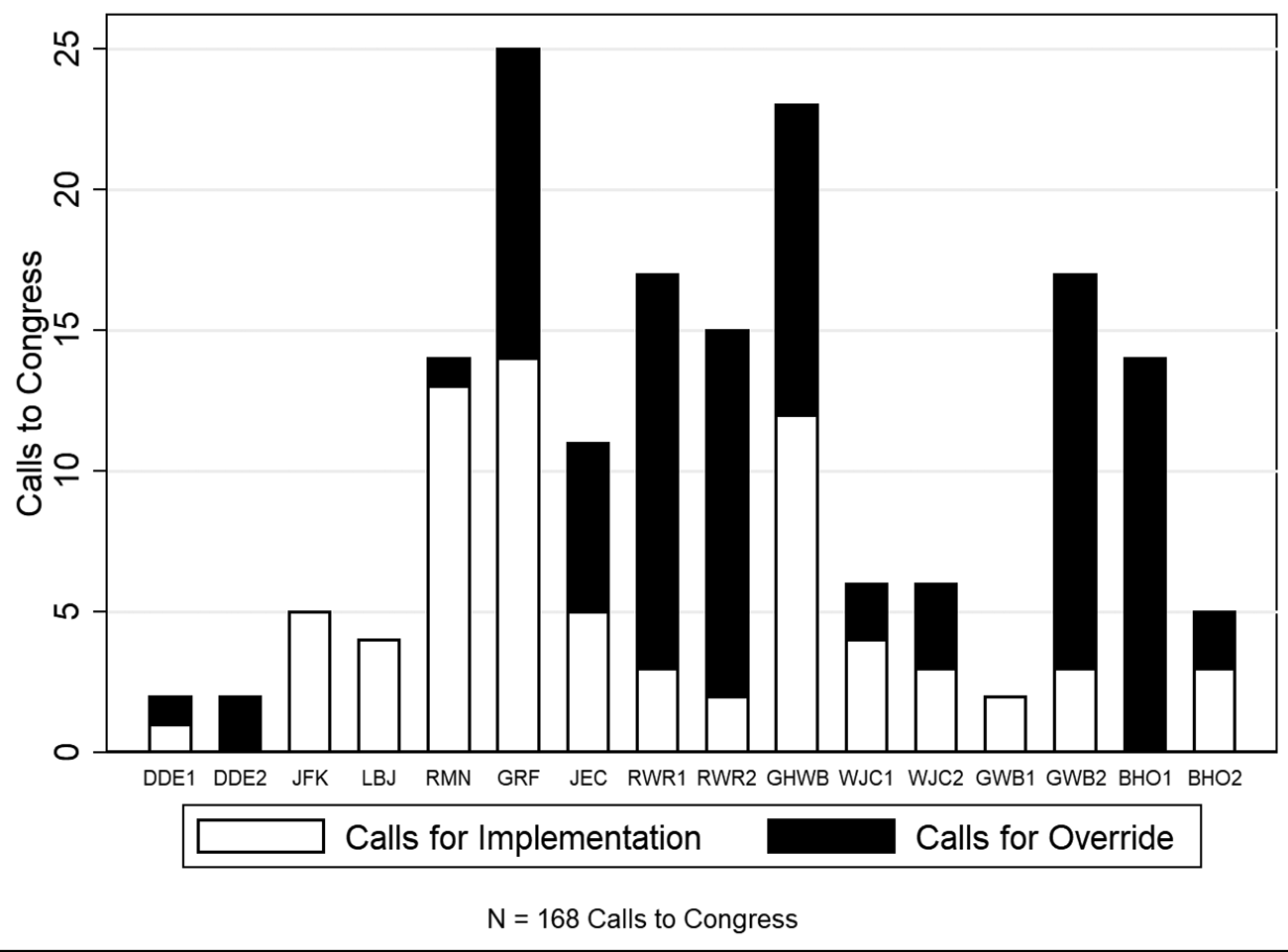
Figure 1 indicates the overall number of presidential calls to Congress by presidential term, demarcated by calls to implement or override the Court’s decisions. Overall, the number of calls to override the Court’s decisions (56%) moderately outnumbers calls to implement decisions (44%). Presidents Reagan and Obama made the most override calls, primarily involving Engel v. Vitale (370 U.S. 421 [1962]) and Citizens United v. Federal Election Commission, respectively. Presidents Nixon and Ford made the most calls for implementing the Court’s decisions. For example, Nixon called on Congress to expand Ginsberg v. New York (390 U.S. 629 [1968]) by passing legislation protecting minors from mailings involving sexual subject matter, and Ford requested campaign-finance legislation consistent with Buckley v. Valeo on 10 occasions. Roe v. Wade (410 U.S. 113 [1973]) is the case presidents most frequently called on Congress to override, and Buckley is the case presidents most frequently pressed Congress to implement.
Presidential calls to Congress to implement or override US Supreme Court decisions, 1953–2017

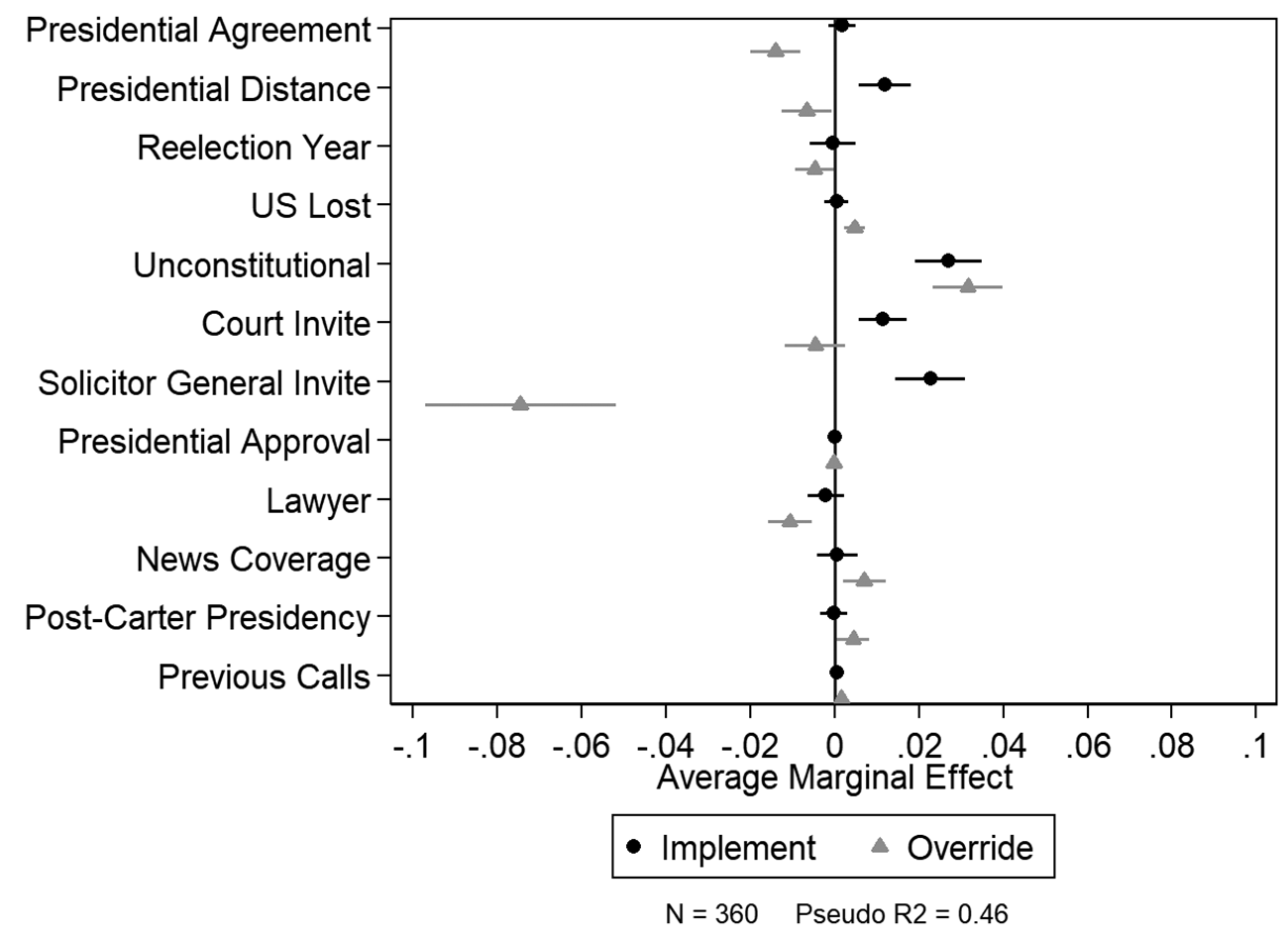
Figure 2 reports the marginal effects of the multinomial logit model. The plots represent the predicted change in the dependent variable given a 1-unit change in the independent variable of interest. The black circles represent the average marginal effects for the implementation model, and the gray triangles represent the average marginal effects of the override model. The horizontal lines coming off the circles and triangles are 90% confidence intervals.Footnote 6 Variables are statistically significant if the confidence intervals do not cross the solid line at 0. The baseline for comparison is instances in which presidents could have called for congressional action on a Supreme Court decision but did not.
Multinomial logit model of presidential calls to Congress to implement or override Supreme Court Decisions, 1953–2017

We find support for many of our key hypotheses involving why presidents call on Congress to implement or override the Court’s decisions. First, presidents are less likely to ask Congress to override decisions with which they agree. A 1-standard-deviation increase in this variable—indicating the president is more ideologically aligned with the Court’s decision—decreases the chances of asking for the decision to be overridden by 0.7 percentage points. However, presidents are not more likely to ask Congress to implement decisions they agree with. Second, presidents are more likely to call for congressional implementation, and less likely to call for congressional overrides, when they are ideologically closer to the Court than to Congress—independent of the president’s ideological agreement with the decision. A 1-standard-deviation increase in this variable—putting the president closer to the Court than to Congress—increases by about 0.4 percentage points the chance the president will call on Congress to implement a decision, and it decreases an override call by about 0.3 percentage points. Although the effect of these variables may seem small, many are, in fact, relatively large owing to the rarity with which presidents call on Congress (see also Uribe et al. Reference Uribe, Spriggs and Hansford2014). Of the 10,801 cases decided during the time frame under analysis, presidents called on Congress to implement the Court’s decisions in only 0.68% of cases, and they called for Congress to override the Court’s decisions in 0.87% of cases. Thus, the 0.7% increase in the Presidential Agreement variable almost doubles the chances that presidents will ask Congress to override a decision.
Taken together, these findings indicate that presidents use their public appeals to try to convince Congress to upset the status quo created by the Court’s decision when they disagree with that decision. However, when they are more ideologically aligned with the Court than Congress, presidents tend to pressure Congress to take action on the Court’s decision to ensure it is implemented and generally forgo calling on Congress to override a decision.
Contrary to our expectations, presidents are not more likely to call on Congress during reelection years, suggesting that the president’s goal of reelection is not prominent in his decision to call on Congress to override or implement Court decisions. Several factors related to presidents’ interest in protecting or enhancing the power of the presidency influence calls for action do matter. When the federal government loses a case before the Court, presidents are about 0.5 percentage points more likely to ask Congress to override the decision. Yet, they are no more likely to request the implementation of cases the federal government wins. If the Court declares a federal law unconstitutional—indicating the case is highly salient for the federal government—the chances that presidents will ask Congress to take action on the decision increase by about 3 percentage points in both the implementation and override models, which are very large effects.Footnote 7 We also uncover that presidents are more likely to call on Congress to implement decisions when the Court invited Congress to take action, although this does not affect requests to override decisions. In such instances, presidents ask for the implementation of decisions 1.1 percentage points more often than in situations in which the Court does request congressional action on the decision. In addition, presidential calls for implementation increase by 2.2 percentage points when the Court invites the solicitor general to participate in the case, and calls to override a decision decrease by 7.5 percentage points when the Court calls on the solicitor general.
These findings affirm our expectation that presidents will at times see a loss at the Supreme Court as a threat to the institutional sovereignty and power of the presidency and respond to such decisions by calling on Congress to work with them to counter these decisions. They also indicate that presidents view declarations of unconstitutionality as particularly salient, and they frequently call on Congress to both override and implement these decisions more so than in cases in which the Court does not declare a federal law unconstitutional. Presidents also seek to guide Congress in the implementation of Court decisions when the Court requests further congressional action, which provides another mechanism for protecting or enhancing the status of the executive branch. When the Court invites executive-branch input through invitations to the solicitor general, presidents see this as an opportunity to press for congressional implementation of the decision, rather than calling on Congress to override the decision. This is likely due to the very high success rates of the solicitor general in the Court and the deference the justices give to the solicitor general when they invite participation (Johnson Reference Johnson2003; Pacelle Reference Pacelle2006; Nicholson and Collins Reference Nicholson and Collins2008; Black and Owens Reference Black and Owens2012).
Several of the control variables also influence presidential calls to Congress to implement or override the Court’s decisions. First, presidents who were lawyers are less likely to call for Congress to override the Court’s decisions. Compared to their nonlawyer counterparts, attorney-presidents are 1 percentage point less likely to ask Congress to override the Court’s decisions. This corroborates our argument that presidents trained in the law may have a greater deference to the norm of judicial independence and frown on efforts to legislatively overrule the Court’s decisions. Second, when the Court’s decisions are featured in the media, there is a corresponding 0.7-percentage-point increase in the likelihood of a call to Congress to override the decision. By requesting congressional overrides of the Court’s salient decisions, presidents can demonstrate they are responsive to issues important to the American public while leveraging public attention to the case to generate a favorable legislative response. Moreover, this variable serves to enhance the extent to which presidents call for overrides with respect to decisions they disagree with: the marginal effect of the Presidential Agreement variable in cases featured in the media is 140% larger than in cases that do not generate media attention (1.7 compared to 0.7). Third, presidents since the Carter administration are 0.4 percentage points more likely to call on Congress to override the Court’s decisions. Finally, presidents are slightly more likely to call for congressional action as the number of yearly calls prior to the date of the speech increases. For each prior call to Congress, presidents are 0.1 percentage points more likely to request implementation and 0.2 percentage points more likely to request overrides.
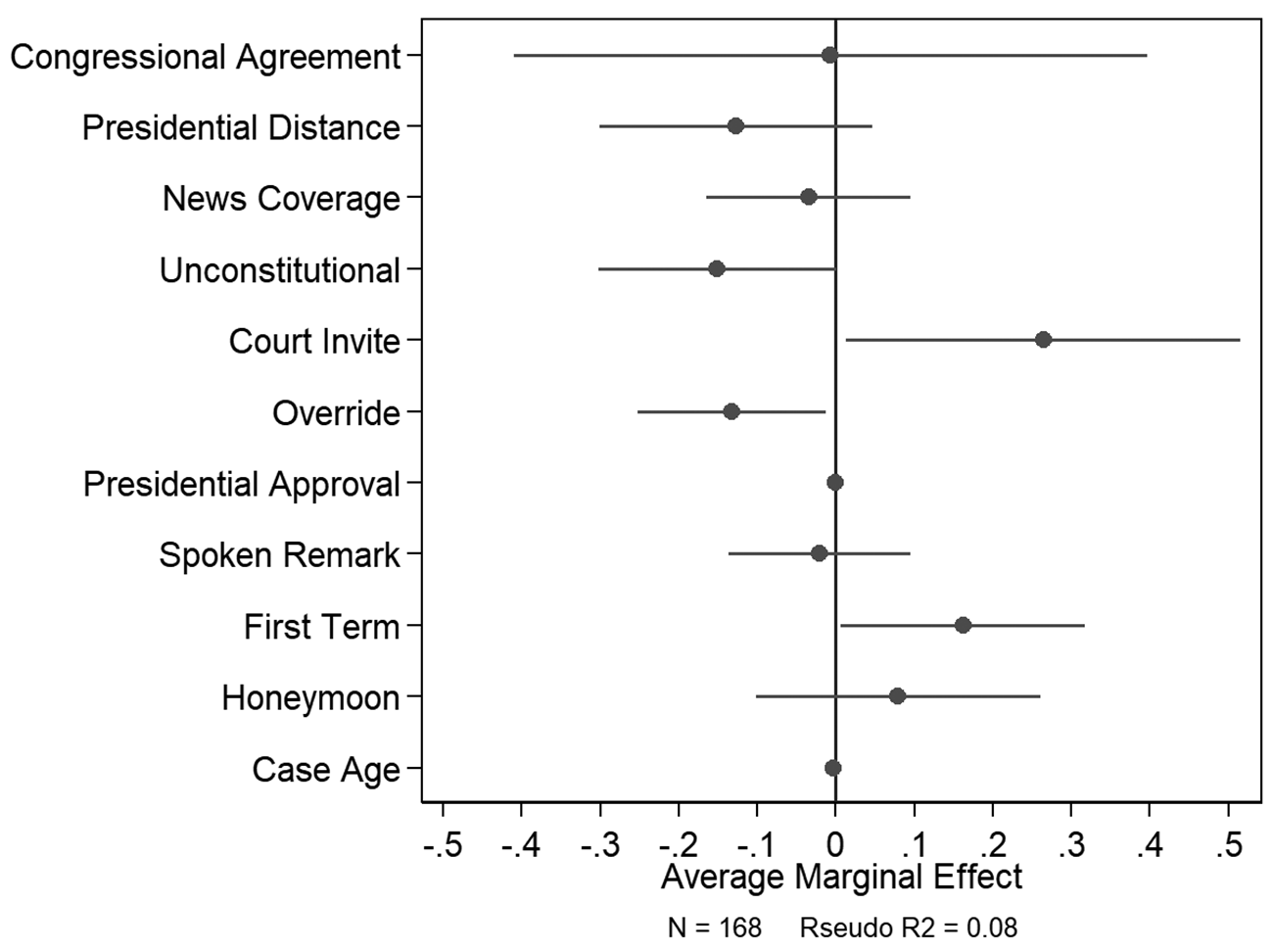
Figure 3 plots the marginal effects of the logit model that examines the factors that influence whether Congress acts on Court decisions in response to presidential calls. We find limited support for many of our hypotheses. For instance, the model fails to provide evidence that congressional ideological agreement with the Court’s decision influences whether Congress will respond to a presidential call, the legislative branch’s relative ideological distance to the president and the Court, and news coverage of a case. We also report a significant result that runs counter to our expectations: Congress is about 15 percentage points less likely to act on a presidential call involving a declaration of unconstitutionality. Although we cannot be certain, we think that these counterintuitive results may be a function of the advantages presidents have vis-à-vis Congress in expressing a unified message and otherwise overcoming the collective-action problem that faces Congress. Moe (Reference Moe, Edwards, Kessel and Rockman1993) argues that presidents are advantaged in an interinstitutional conflict with the legislature, and Congress may not wish to advertise their inability to mount an effective counterresponse to the president on a salient issue or when it involves fundamental considerations of constitutionality. Thus, although both the president and Congress have goals to preserve and promote their institutional power, the executive may be more likely to protect itself when its goals contrast with those of Congress (e.g., Rudalevige Reference Rudalevige2006).
Logit model of congressional responses to presidential calls to Congress to implement or override Supreme Court decisions, 1953–2017

The model supports several other expectations, nevertheless. First, Congress more frequently takes action on presidential calls involving cases in which the Court also requested congressional intervention. In such instances, Congress is about 26 percentage points more likely to act on a presidential call. This is a relatively large effect, and it shows that Congress is particularly motivated to take action when it receives signals from both branches of government. Second, the model indicates Congress is more likely to respond to requests to implement, rather than override, the Court’s decisions. Compared to requests for overrides, Congress is 13 percentage points more likely to act on calls to implement the Court’s decisions. This finding indicates that Congress may be strategic in its response to presidential calls to implement the Court’s decisions, in the sense that it considers the preferences of other actors in its decision-making (e.g., Mouw and MacKuen Reference Mouw and MacKuen1992; Epstein and Knight Reference Epstein and Knight1998). When presidents call for implementation, Congress has strong evidence that implementing such decisions will garner presidential support and will presumably survive further Supreme Court review. In these instances, Congress can take action to enhance its legislative authority within the parameters set by the president and the Court.
Turning now to the control variables, we find that Congress is 16 percentage points more likely respond to presidential calls during the president’s first term. This corroborates research indicating Congress is more supportive of presidential priorities in general during the president’s first term in office (Eshbaugh-Soha Reference Eshbaugh-Soha2005; Cohen Reference Cohen2015; Ponder Reference Ponder2018). The results provide no evidence that Congress is more or less responsive to presidential calls depending on presidential approval, whether the call is written or spoken, the age of a case, or whether the call is made during the president’s honeymoon period.
Conclusions
Lawmaking in a separation-of-powers system can be complex. In this article, we provided a first-of-its-kind look into a unique form of this complexity: what motivates one branch of government (the executive) to publicly call on a second branch of government (the legislative) to take action on the decision of a third branch of government (the judiciary), as well as the factors that shape responses to such calls. We argued that presidents are motivated to call on Congress in pursuit of their policy preferences and reelection goals, as well as to enhance or protect the power of the presidency. We posited that members of Congress respond to these calls based on similar, interrelated goals: to make good public policy, to enhance their reelection fortunes, and to grow or defend the institutional stature of the legislative branch.
Our empirical results demonstrate that presidential calls to Congress are primarily motivated by presidents’ desires to shape public policy and protect, or enhance, the institution of the presidency. For example, when presidents are in ideological disagreement with decisions, they tend to ask Congress to override them. In addition, presidents call on Congress to override decisions that the executive branch loses, since these decisions may threaten the power of the presidency. Presidents are also motivated to call on Congress when the Court declares a federal law unconstitutional, indicating they are interested in ensuring their perspectives are given consideration when Congress deliberates in reaction to the Court’s decision. Moreover, presidents are attentive to invitations from the Court. For example, when the Court invites congressional action on a decision, presidents tend to call on Congress to implement decisions consistent with executive preferences. When the Court invites the solicitor general to participate in a case, presidents recognize that this is an opportunity to influence both the Court and Congress, and they are more likely to request that Congress implement the Court’s decisions.
Congressional responses to the president’s requests for legislative action indicate that Congress is more likely to respond when the Court also suggests that Congress act, and Congress prefers to act on calls to implement rather than override decisions. Both of these factors provide Congress with the ability to enhance or protect legislative authority in a manner consistent with the Court’s decisions and, often, the president’s wishes. However, Congress’s ideological agreement with the Court’s decisions does not appear to influence its response, suggesting that presidents may have the upper hand in motivating Congress to act if they call on legislators to do so. Attesting to this, Congress responded to presidential calls for action 31% of the time, a very high percentage compared to congressional responses to Supreme Court decisions that do not involve presidential rhetoric (e.g., Clark Reference Clark2011; Blackstone Reference Blackstone2013; Uribe et al. Reference Uribe, Spriggs and Hansford2014). Although our empirical results do not allow us to state with certainty that presidential calls to Congress motivated these congressional responses, they are strongly suggestive of a relationship between the two. We therefore encourage future researchers to include presidential calls to Congress in examinations of congressional responses to Supreme Court decisions.
On the whole, this article provides fresh insight into a novel form of lawmaking, illustrating that all three branches of government play a role in constitutional and statutory interpretation (e.g., Gant Reference Gant1997; Meernik and Ignagni Reference Meernik and Ignagni1997; Whittington Reference Whittington2001). At once, this research expands on previous examinations of the interactions between the three branches by showing how presidents can actively play a role in setting the congressional agenda to implement or override decisions made by the judicial branch. This is a significant addition to the literature on the separation of powers, in that it helps paint a more complete picture of how the three branches do and do not work together to make policy involving some of the most pressing issues in America. In addition, we show how the tendency of presidents to go public—as well as the success of their actions—varies by the type of their commentary. Whereas party control and presidential approval ratings may affect going public in a broad examination of presidential influence of Congress, we show that other features of Congress and the Court matter more when presidential speeches are targeted to these institutions’ constitutional responsibilities.
Although we have attempted to provide a reasonably thorough look into this phenomenon, we recognize there are numerous opportunities for future research. For example, we group all legislative responses together in our empirical model, focusing on the president’s ability to set the congressional agenda. Yet, a variety of responses exist, ranging from introducing a bill that never reaches committee to passing legislation that is signed into law by the president. Future work might parse out these response types to determine whether different factors shape various types of legislative responses. In addition, we encourage future researchers to incorporate more completely the role of the public in constitutional and statutory lawmaking (e.g., Friedman Reference Friedman2009). This might be done by examining how public support for the Court’s decisions might influence presidential calls to Congress and eventual responses by Congress. While this is difficult to do in a large-N framework such as ours owing to a lack of public opinion polls on most decisions (Marshall Reference Marshall2008), it could be accomplished by using a rich case-study approach that allows for a more fine-grained analysis of individual decisions and their responses. Our hope is that this work will provide a starting point for additional analyses of this important form of lawmaking in a separation-of-powers system.