When William I of England commissioned the Domesday Book in 1085, he created a record of all his subjects together with their assets. By recording the addresses and wealth of his new populace, he demonstrated how surveillance can be used to define and categorise a population based on their level of resources (Webster, Reference Webster2002: 72). Since the time of William I, surveillance technologies have come a long way in constituting, measuring and dividing populations within the myriad of governmental spaces. In the twenty-first century, closed circuit television (CCTV) cameras in shopping malls and airports (Norris and Armstrong, Reference Norris and Armstrong1999; Coleman and Sim, Reference Coleman and Sim2000), large-scale databases being run by government supercomputers (Lyon, Reference Lyon1994; Poster, Reference Poster1990: ch. 3) and the use of drug-testing in workplaces (Holland et al., Reference Holland, Pyman and Teicher2005) are now part of the regular activity of social governance (Lyon, Reference Lyon2001). Surveillance technologies go to the heart of how we understand the ‘social’ in terms of assessing and calculating the risk to ourselves and others in everyday relations between people and social institutions, and between people and the constructed and natural environment. With the ever-increasing sophistication and entanglement of information technologies in social and public processes, concerns about data protection, privacy and surveillance will continue to surface as areas of concern for policy makers, politicians and the general public.
Despite the growing sophistication of surveillance-related technology, our policy responses and conceptual thinking about the level of surveillance in contemporary society are under-developed. If we accept that, in normative terms, social policy is concerned with the just distribution of burdens and benefits in any given society, then it follows that we need to approach the issue of surveillance as a relational concept, with unequal processes and outcomes. Conceptually, however, the discussion and debate about data protection, privacy and surveillance in society remain fixed on ideas of personhood and social governance inherited from the early days of western modernity. Firstly, concerns about privacy are predicated on a liberal ideal of personal property and personhood – an independent, rational, self-actualising human being – which in sociological terms represents a mythical and idealised subject. As Mary Ann Glendon (cited in Gilliom, Reference Gilliom2001: 8) argues, ‘the right to be let alone’ has become obsolete in a world of increasing interdependency and dangerous in a world needing new recognition of our collective fate. Secondly, the notion of privacy is based on a dichotomy of the public and the private, which is problematic from the perspective of social policy analysis where the divide between public and private responsibility shapes so many policy debates from childcare, to health care and housing. Thirdly, the contemporary image of surveillance is one of an omnipresent vision, as constituted in the writings of, for example, George Orwell's Nineteen Eighty-Four (Reference Orwell1974) and Michel Foucault's account of Bentham's panopticon in Discipline and Punish (Reference Foucault1977). Such conceptions of surveillance are of humans watching other humans, whereas much surveillance in contemporary western societies is of a person's data trailings or what Roger Clarke calls ‘dataveillance’ (Reference Clarke, Green and Guinery1994).
Due to this largely asocial understanding of surveillance, policy responses and political strategies remain fixated on the notion of securing personal privacy. These strategies have had limited success for both conceptual and practical reasons. As John Gilliom has recently argued:
The aging legal concept [of the right to privacy is] simply failing to help us make sense of and act upon our world . . . Politically, the privacy paradigm is pitted against important social values like safety, crime-fighting, and national security. In these contests it has failed to sufficiently galvanize publics or legislatures into producing legislation with the capacity to efficiently control surveillance. (2001: xi, 7)
Given these conceptual limitations, it is perhaps not surprising that the social policy literature seems to have taken a limited interest in recent developments in surveillance practices. Some exceptions include Gilliom's (2001) study of the surveillance of American welfare mothers. Gilliom's study reminds us that surveillance is an expression of power, domination and conflict, where surveillance technologies are applied more heavily to the most marginal members of ‘mainstream’ society. Another set of studies has highlighted the ways in which the power of surveillance operates to categorise and divide populations, thereby reinforcing social fissures and inequalities (Graham and Wood, Reference Graham and Wood2003; Lyon, Reference Lyon2003; Henman, Reference Henman2004, Reference Henman2005).
One of the more interesting contributions to the study of surveillance and social policy has been the debate on the need for ‘virtual rights’ to protect citizens in the information society. Drawing on a contribution of T. H. Marshall, Tony Fitzpatrick (Reference Fitzpatrick2000) has argued that, while the political rights and civil rights dimension of the internet have been widely discussed, the social rights dimension has been largely overlooked. He notes that, while the technophiles praise the internet and advanced ICTs for their democratising capabilities, ‘the fact [is] that cyberspace is not a flat, multilateral plane and the nodes of the network are not all equal’ (2000: 390). To promote critical engagement of the social impact of emerging information technologies, Fitzpatrick promotes the idea of virtual rights, to which Dornan and Hudson (Reference Dornan and Hudson2003) respond that such virtual rights are unnecessary because traditional rights are sufficient. Regardless of these interventions, the relative novelty of surveillance is evident in Tony Fitzpatrick's discussion of surveillance in his recent book New Theories of Welfare (Reference Fitzpatrick2005), with the emphasis on ‘new’.
Despite what appears to be limited social policy interest in the topic of surveillance, this article shows that a closer study of contemporary forms of surveillance reveals significant insights about advanced liberal societies and the changing nature of inequality, social division and human wellbeing, all issues of great concern to social policy analysts. In this article we seek to progress a more sociological account of surveillance, one that highlights the social context of surveillance and the unequal distribution of surveillance practices and burdens. To expand the ‘sociological imagination’ of surveillance practices, we draw on Richard Titmuss's classical conception of the social division of welfare to highlight the relational dimensions of surveillance and the often invisible inequalities that contemporary forms of welfare surveillance generate. By reference to contemporary Australia, we then show empirically and politically the value of such a concept for understanding contemporary social governance. We conclude by discussing the generalisability of our findings to other advanced welfare states, and consider the implications of a differentiated understanding of surveillance for social theory.
The social division of welfare
Just over 50 years ago, Richard Titmuss delivered his classical paper entitled ‘The social division of welfare: some reflections on the search for equity’ (Reference Titmuss1976 [1955]: ch 2). The paper's lasting legacy has been the argument that there are ‘three major categories of social welfare’: social, fiscal and occupational. ‘Social welfare’ is understood as the range of social services and benefits that are provided by the state, including education, health, housing, social security pensions and child allowances. ‘Fiscal welfare’ is the benefits that individuals receive through the taxation system such as allowances for dependent children, spouses and house-keepers, and mortgage relief. ‘Occupational benefits’ are those that individuals receive through employment, including sick pay, occupational superannuation and health care, training and meals.
Titmuss's articulation of the various ways in which people's wellbeing is provided has been important in going beyond a narrow conception of ‘welfare’ and making visible the relational aspects of welfare and wellbeing. According to Titmuss, welfare – regardless of its form – is to be analysed on the basis of who gets what, when and how.
Titmuss’ intervention has led to three important insights into the nature of human wellbeing in modern societies. Firstly, it highlights the essential equivalence of different forms of producing wellbeing. Whether it comes through social welfare, the taxation system or the workforce, certain contributions can be seen as equivalent.
The second insight follows from the observation that distinctions by ‘administrative methods or institutional devices’ do not signify fundamental differences in the production of human wellbeing. Rather, such distinctions often align with and reinforce particular moral or value approaches to welfare provision, and simultaneously define the ‘deserving’ and ‘undeserving’. In particular, fiscal benefits are often viewed as getting what is truly one's own, and occupational welfare is seen as being earned through one's labour and employment contract, having nothing to do with the operations of the state. In contrast, social welfare is often seen in contemporary political discourse as undeserved, as is the case with the discourse of ‘welfare dependency’ (Fraser and Gordon, Reference Fraser and Gordon1994). Bringing to light these moral distinctions and challenging their perceived ‘naturalness’ has been an important legacy of Titmuss’ framework. While it is obvious that many social welfare programmes are heavily biased towards poor people, there are other social services from which those with middle or high income disproportionally gain. Examples here include: higher education, public subsidies for rail transport, and public health care. In short, Titmuss’ framework has highlighted similarities when differences are perceived and differences when similarities are perceived.
Politically, Titmuss's contribution has been highly significant in casting a critical eye towards the less visible benefits which the more advantaged members of society receive, the inequitable distribution of some aspects of welfare (for example, higher education), and highlighting the hypocritical attacks on welfare received by the most disadvantaged individuals of society. Significant policy reform has occurred since Titmuss pointed out that in 1950s’ Britain employed fathers received substantially more assistance with raising dependent children through the taxation system than low-income fathers did through social welfare (1976: 47). In the example of family-related benefits, most developed welfare states have undertaken policy reform to remove these inequities. Indeed, many states now provide family benefits through only one form of welfare, or provide the one benefit seamlessly across both welfare and tax systems.
In addition to the social policy legacy, the Titmuss framework has also inspired other academics to apply it for understanding other aspects of the social world. For example, Mary Daly has articulated the idea of the ‘sexual division of welfare’ (Reference Daly2000), and in political geography Sparke (Reference Sparke2006) has deployed a similar framework to analyse the differential treatment that immigrants receive depending on what mode of transport they use when crossing the borders of the United States. Although academic interest in the social division of welfare has waned in recent years, the deployment of this framework still continues to provide a critical analysis of contemporary welfare provision and debates (see, for example, Bryson, Reference Bryson1992; Mann, Reference Mann1992: ch. 2; Hacker, Reference Hacker2002; Sinfield, Reference Sinfield and Powell2007). The purpose of this article is to develop a revised version of Titmuss’ framework that contributes to a critical understanding of the nature of surveillance practices as a form of social governance in the early twenty-first century. It is to this that we now turn.
Conceptualising the social division of welfare surveillance
Following David Lyon, surveillance refers to ‘the collection and processing of personal data, whether identifiable or not, for the purposes of influencing or managing those whose data have been garnered’ (2001: 2). While surveillance operates across many aspects of our lives, the focus in this article is ‘welfare surveillance’, namely the practices of surveillance operating in the operation, delivery and provision of occupational, fiscal and social welfare. The notion of the social division of welfare surveillance begins with the observation that the application and experience of surveillance is different for different people/s, depending on what sort of welfare benefit they are receiving and how it is delivered. This is not an innovative observation, but one which has received minimal attention in recent writings on the moral reordering (Williams, Reference Williams1999; Dean, Reference Dean2005) and political transformation of the western welfare state (Gilbert, Reference Gilbert2002; Pierson, Reference Pierson2001).
Following Titmuss's characterisation of social, fiscal and occupational welfare, there are three corresponding domains of welfare surveillance. Social welfare surveillance refers to surveillance practices within the social welfare system; fiscal welfare surveillance refers to surveillance practices within the taxation system; and occupation welfare surveillance refers to surveillance practices within the workforce. In parallel with the three insights arising from Titmuss’ social division of welfare, the idea of the social division of welfare surveillance produces three similar insights.
Firstly, the distinction between the three fields refers to different ‘administrative methods or institutional devices’ and not to fundamental differences in the need for welfare surveillance. This points to a normative stance. Just as Titmuss’ normative view that there should be an equivalence in the welfare received for a particular purpose from the different welfare domains, we hold that there should be an equivalence in the operation of surveillance for people receiving welfare (for a particular purpose) between the three welfare domains. For example, people receiving a family-related benefit from social welfare should receive similar levels of compliance checks to those receiving a family-related fiscal or occupational benefit. Thus, by critically examining the boundaries between the three forms of welfare, the concept of the social division of welfare surveillance makes visible the invisible inequalities in surveillance and points to the unequal distribution of burdens and benefits in society.
The second insight is that the moral or value distinctions – of ‘deserving’ and ‘undeserving’ – between the social, fiscal and occupational welfare systems signify differences in the intensity, intrusiveness and coverage of surveillance. Domains in which recipients are seen as deserving (particularly fiscal and occupational welfare) receive less surveillance than those regarded as undeserving (particularly social welfare). Thus, in the same way that the notion of a ‘social division of welfare’ brings to light and challenges the perceived ‘naturalness’ of differentials in welfare provision, the concept of a ‘social division of welfare surveillance’ brings to light and challenges the perceived ‘naturalness’ of differentials in welfare surveillance.
Thirdly, the concept of the ‘social division of welfare surveillance’ points to the existence of differential levels of surveillance for the same provision of welfare benefit/service. For example, the surveillance of individuals receiving unemployment allowances may not be treated equally. Some unemployed are considered more risky and/or regarded more suspiciously than others, with variations in the corresponding level of intrusion and surveillance (McDonald et al., Reference McDonald, Marston and Buckley2003). Thus, the concept makes visible the invisible distinctions within a seemingly single welfare provision. Gandy (Reference Gandy1993, Reference Gandy, Haggerty and Ericson2006) has argued that differential surveillance treatment represents a form of discrimination. Similarly, Lyon's (2003) discussion of ‘surveillance sorting’ points to the way in which surveillance can be used to categorise the subjects of surveillance into different groups for subsequent differential forms of surveillance and/or governance.
In the UK, Dee Cook (Reference Cook1989, Reference Cook, Adler, Bell, Clasen and Sinfield1991) examined the differential responses to tax and supplementary benefit fraud in the 1980s. She argues that:
Those who defraud the state by fiddling welfare benefits and by fiddling personal taxes commit essentially similar economic crimes – making false statements to government departments in order to gain illegal financial advantage from the state. The outcome is identical – loss of state revenue – though the costs for the state of the two forms of fraud do differ. (1989: 266)
She then notes that the cost of lost revenue through taxation fraud greatly exceeds the cost through social welfare fraud, yet the level of scrutiny and legal prosecution is greater for the latter. More recently, Gilliom's study of the surveillance of welfare mothers in the USA makes similar observations:
In the Social Security old age pension, there is an assumption of eligibility and need that is determined by age and administered through a relatively simple and non-invasive program of application and distribution. With Aid to Families with Dependent Children [AFDC], however, regulations were written . . . [with] a sharp emphasis on determining and verifying eligibility on the basis of demonstrable and verified need and verified moral worth . . . It is, in this light, quite telling that the government's proudest surveillance programs were aimed at ferreting out and eliminating fraud in its welfare programs rather than ferreting out and assisting any hungry children, needy families, or unmet needs that our welfare programs had failed. (2001: 127–8)
These contradictions in US-administered programmes highlight the uneven distribution of burdens and benefits in the social division of welfare surveillance. Some welfare state programmes offer forms of regulated freedom for those receiving payments, while others are administered with excessive interference. Such interference, whether it takes the form of restraint, state-sanctioned surveillance or coercion is morally questionable when it is applied to one part of the population but not another. Arguably, the intensity of electronic surveillance, particularly in the lives of those receiving social security payments from the state, routinely crosses this line. To explore this argument further we turn to empirical examples from Australia.
The social division of welfare surveillance in Australia
What are the empirical realities of welfare surveillance? In answering this question we draw on the concept of social division of welfare surveillance developed above and apply it to Australia's welfare state arrangements. We have chosen to illustrate our conceptual framework with examples from Australia for a few reasons. As with other liberal welfare states, over the past ten to 20 years Australia's embrace of New Public Management reforms has lead to a more fragmented and fractured system of social services than was evident in the immediate post-war period (Smyth, Reference Smyth, McClelland and Smyth2006). This trend towards contracting out responsibility for welfare service delivery has resulted in the development of highly sophisticated computer-based systems for tracking people as they move between government, private and non-profit organisations in the new mixed economy of welfare. Tracking people in these interactions requires complex computer programs and data-sharing protocols between levels of government and between government and non-government agencies. A discussion of these new surveillance capacities in the context of the Australian welfare state allows us to provide some analytical depth to common themes across advanced liberal welfare states in the twenty-first century.
Australia is also typical of other advanced English-speaking liberal welfare states in its enthusiastic embrace of information and communication technologies to classify and monitor multifaceted interactions between millions of citizens and the state that take place daily. In any system of government there are obvious limitations to the surveillance capacities of paper-based bureaucracies. ‘Screen-level bureaucracies’ (Bovens and Zouridis, Reference Bovens and Zouridis2002) have a much higher capacity to sort and monitor people, particularly those people who have much more frequent interactions with various government departments. Given the increasingly individualised explanations of disadvantage and social inequality in line with a pervasive neoliberal rationality (Deacon, Reference Deacon2003; Pierson, Reference Pierson2001), the governance of social problems demands a capacity to target and track subpopulations to calculate levels of individual and social risk, and in turn to regulate their behaviour. The Australian case thus draws attention to the contradictions embedded in liberal welfare states in relation to surveillance where the liberal principles of freedom of choice and individual liberties are suspended for populations receiving certain forms of welfare.
Finally, it is important to note that Australia is regarded as a world leader in the use of new technology for the conduct of governmental administration. The United Nations rated Australia sixth in the Global E-government Readiness Report (2005) and the Brown University Global E-government report for the same year placed Australia eighth out of more than 100 countries surveyed (West, Reference West2005). These cross-country comparisons signify the advances in e-government in the Australian welfare state. Here, we examine the surveillance practices across the social, fiscal and occupational welfare sectors in the receipt of cash benefits and the provision of housing.
Surveillance of cash benefits
As Titmuss ably demonstrated, individuals receive cash benefits from a range of sources. Receipt of social assistance for unemployment, sickness and the like and cash benefits for families are clear examples of cash benefits provided through the social welfare system. Taxation often provides similar cash benefits for families, but also tax rebates for various employment and investment costs. Wages and salaries and annual bonuses are clear examples of occupational cash benefits. What might an examination of the surveillance associated with these cash benefits reveal?
The social assistance system has a long history of highly intrusive, detailed and ongoing surveillance of claimants and recipients to minimise fraud and ensure eligibility. A deep suspicion pervades the system. As in most nation states, application for social assistance benefits in Australia is a highly rigorous and intrusive process that requires the claimant to produce independent evidence of who they are (that is, ‘proof of identity’), of their claim status (for example, new parent, sole parent, unemployed, disabled) and of their ‘means’ (income and assets). The onus of proof is on the claimant to demonstrate their identity and need for assistance. Virtually all the information provided by the claimant is regarded as suspect and requiring independent verification. Once eligibility to benefit is obtained, ongoing suspicion and surveillance are maintained through an elaborate web of intergovernmental data-matching, frequent reviews and regular reporting (Cahill, Reference Cahill1994; Henman, Reference Henman2004). Moreover, the level of surveillance within social assistance is graduated according to perceived level of risk and moral worth: those deemed low risk or the ‘worthy poor’ face lower levels of scrutiny than those who are regarded as more risky or suspect.
Australia's taxation system typically takes a different approach to accessing cash benefits. Rather than regarding every claim with suspicion requiring independent verification, the Australian Taxation Office operates with a much greater degree of trust. Although officially requiring taxpayers to have documentation to support their claims, in reality this is in the rare occasion of an audit of claims. Fiscal welfare is distributed when asked, without the hassle and suspicion evident in the social welfare system. In contrast to the detailed review of supporting documentation to a claim for social welfare, a taxpayer's annual tax return data is simply passed through an automated risk assessment process to pick up unusual or irregular claim patterns that might be suggestive of tax fraud. As long as one's claim for fiscal welfare looks appropriate, it is regarded as correct.Footnote 1
After a major review of customer relations in 2001, the Australia Taxation Office introduced an ‘easier, cheaper and more personalised program’ to tax administration aimed at removing the ‘burden of compliance’ and ‘making it easier to comply’ (ATO, 2006). In a somewhat different tone to compliance administration in social welfare, the latest version of this program states:
The Tax Office recognises that the easier, cheaper and more personalised program, and other initiatives to make it easier to comply, need to be client driven in order to meet our long-term objectives . . . We actively involve the community in administration design. (ATO, 2006: 9)
It would be almost unimaginable that the compliance processes of social welfare be similarly constructed in consultation with clients in a way that minimises compliance cost, burden and hassles!
Surveillance associated with the receipt of cash benefits from occupational welfare – in the form of wages, salaries and bonuses – provides another point of comparison.Footnote 2 Even more so than social welfare, the experience of occupational welfare and its surveillance is extremely varied. Journalistic accounts by Barbara Ehrenreich (Reference Ehrenreich2001) in the USA, Polly Toynbee (Reference Toynbee2003) in the UK and Elisabeth Wynhausen (Reference Wynhausen2005) in Australia have, unsurprisingly, demonstrated that workers in low-level, unskilled and low-paid fringe jobs are intensely scrutinised. It would seem from these accounts that the threat of humiliation, penalties for petty problems, the harassment by lower-level management and working to unachievable performance indicators are common among the low paid. Call centres is one location of low-paid work where the centrality of computer-based work is used to monitor every movement and second of workers (Barnes, Reference Barnes2004; Ball and Wilson, Reference Ball and Wilson2000). Through the use of drug-testing and genetic testing, the surveillance of low-wage workers also appears increasingly to operate beyond the confines of the workplace, even if drug use and genetic identity do not directly affect work performance (Holland et al., Reference Holland, Pyman and Teicher2005; Irvine, Reference Irvine and Grbich2004; Nelkin and Andrews, Reference Nelkin, Andrews and Lyon2003).Footnote 3 No doubt the performance of managers and CEOs has also increasingly been assessed with respect to quantitative indicators, but their capacity to define their work practices, to avoid micro-management and to define their remuneration makes their experience of surveillance qualitatively different. Indeed, the recent receipt of large performance bonuses by senior executives despite reduced share price, company losses, shareholder protest – and, in the case of the Australian Wheat Board, likely criminal prosecution for international bribery, the decimation of international corporate reputation and the loss of access to international markets (Overington, Reference Overington2007) – suggest that surveillance practices for the elite are meaningless.
This disparity between the different domains is also evident in the level of compliance reviews undertaken in each system, the levels of debt raised and the numbers of criminal prosecutions for fraudulent activity. In 2004–05 Centrelink – Australia's social security benefits agency – undertook 3.8 million reviews of social security eligibility and pay rates (Centrelink, 2005: 48), whereas the Australian Taxation Office undertook fewer than two million reviews, despite a much larger client population (ATO, 2005: 67). The reviews in Centrelink resulted in debts from 392,116 persons at an average debt of $996, giving a total of $390.6 million. In comparison, the reviews by the taxation office led to $5,143 million in debts and $1,636 million in penalties and interest. Although published data do not enable us to calculate the average taxation debt, it is at least many times greater than the average social security debt.Footnote 4 In the occupational welfare system, inaccurately obtaining cash benefits leads to criminal prosecution on rare occasions.
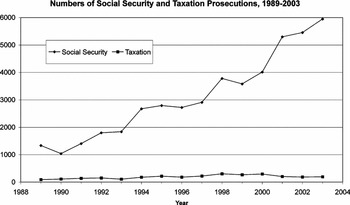
Despite the higher levels of taxation debt, incorrect tax claims are regularly dealt with administratively, while welfare fraud cases are routinely dealt with through the Commonwealth Department of Public Prosecutions and often end up in the Magistrates Courts of Australia. Figure 1 illustrates the differential between tax fraud cases and welfare fraud cases that are pursued and prosecuted by the Department of Public Prosecutions. It clearly demonstrates that the majority of public resources for fraud committed against the Australian government are devoted to pursuing cases of welfare fraud through the courts.
Numbers of Social Security and Taxation Prosecutions, 1989–2003.

Moreover, it would appear that big business can negotiate its own level of taxation through a process of ‘settlement’. Two former Australian taxation auditors, Robert Fitton (Reference Fitton2006) and Christopher Seage (Reference Seage2006), have separately argued that there appear to be two different taxation laws for business: one for large corporations and wealthy individuals who can negotiate their level of taxation, and one for small businesses and individuals who will be pursued by the tax office with interest and penalties. In supporting his argument, Seage recalled three high-profile settlements. In 1992, Adelaide Steamship Group managed to reduce its $1.058 billion tax bill by $800 million. In 1995 Frank Lowey's family company Cordera Pty Ltd negotiated a $25 million tax reduction. In 2003, Rob Gerard had his $150 million taxation bill for alleged ‘sham’ taxation arrangements reduced to $75 million and a prima facie case for criminal prosecutions was not pursued.Footnote 5
Comparatively speaking, the Australian government has been more or less complicit in tax evasion by failing to allocate adequate resources for compliance initiatives. One is made acutely aware of the benefit of resourcing compliance activity that combats tax fraud by the recent announcement by the Australian government to allocate additional monies to monitor wealthy individuals in the system and the government anticipates an ‘extra’ $615 million will be collected over the next four years as a result. Federal Labour MP Kevin Thompson commented that concentrating on tax avoidance rather than welfare fraud will return, for every dollar spent, ‘four times the amount in additional revenue’ (Australian Financial Review, 5 June 2006). According to budget papers, $7.53 of increased revenue would be returned for every dollar spent by the Australian Taxation Office taskforce chasing tax avoiders, while only $1.94 would be returned through the Department of Human Services compliance activity around social security fraud (Australian Financial Review, 5 June 2006).
Clearly, a moral rationale rather than an economic rational drives the heightened level of surveillance dedicated to detecting and prosecuting welfare fraud. Sainsbury (Reference Sainsbury1998: 18) argues that ‘claimants who defraud the benefit system have always occupied a place among the demons of modern society’, a position that the mass media and governments of all persuasions have been happy to enforce. Over the past 20 to 30 years, a preoccupation with benefit fraud has become a distinctive characteristic of governments in Britain, the United States and Australia (Dean, Reference Dean1998; de Parle, Reference de Parle2004). Cruikshank (Reference Cruikshank1999) argues that it is important to understand the development of welfare fraud administration over this period as a system established to discipline the system of welfare rather than the recipients per se. In other words, the scenario is not that the social state is under-funded but rather one where scarce resources are being drained away by ‘fraud and abuse’: hence the justification for expensive and extensive fraud surveillance technologies that fall unevenly on social security recipients (particularly the unemployed and sole parents).Footnote 6
The extraordinary differential in the intrusiveness and burden of surveillance practices between social welfare and fiscal welfare is particularly illustrated by the administration of Australia's Family Tax Benefit Part A, a means-tested payment to all but high-income households. The benefit is paid either fortnightly through the social welfare system by the benefits agency Centrelink, through reduced fortnightly tax instalments with one's wages, or through an annual lump sum paid at the end of the financial year through one's tax return. It thus can be seen as a benefit of both the social and fiscal welfare systems. In each case, the application process is different, and so are the compliance-testing processes. When applying through the social security system, a 32-page claim form is required as well as proof of the child's existence through a hospital certificate sticker or a birth certificate. However, when applying through the taxation system, a claimant simply ticks the box in the claim form and no evidence of the child's existence is required. In a similar manner to the taxation system, receipt of Family Tax Benefit as a reduction in wages is made through a simple form without a requirement for the proof of the child's existence.
Surveillance in housing
The provision of housing is another area in which the mode by which it is received greatly shapes the level of surveillance accompanying its receipt. Housing assistance in Australia is provided through the taxation system in the form of exemptions from capital gains tax for home owners and non-means tested First Home Owners Assistance grants, private rental assistance paid through the social security system to low-income private renters, and in the form of direct capital assistance and subsided rents through a highly residualised public housing system managed by state governments. In terms of tenure breakdown, most Australians are either buying or own their own home (70 per cent), while almost 25 per cent live in the private rental market and another 6 per cent live in public or community housing. The majority of public housing tenants and private renters are on lower incomes than home purchasers and owners, and as recipients of housing assistance are subjected to various forms of technological survelliance operated by the public and private sectors. Public housing tenants in Australia, for example, must first undergo a rigorous application process to prove their eligibility and then once in public housing they are subjected to regular dwelling inspections as per their tenancy agreements, regular income reporting to determine rent levels, CCTV survelliance on medium and high density public housing estates, and occupancy checks to verify the number of people residing in the dwelling.
Private renters face similar levels of inspections and checks consistent with residential tenancy law in Australia. However, they also face the prospect of being ‘blacklisted’ through the relatively recent introduction of electronic tenancy databases that are used by real estate agents across Australia to screen out prospective tenants with poor rental histories (Adkins et al., Reference Adkins, Short, Mead, Owens and Heffernan2002). The Tenancy Information Centre of Australasia (TICA) is probably the largest operator in Australia. Its website outlines some of the reasons that could result in tenants being listed on the electronic database. These include arrears of rent, breaking a tenancy agreement, breaches of body corporate laws, dishonoured cheques, unkempt gardens, poor periodic inspections and unauthorised pets. Tenants are advised by TICA that they will be listed for three years for non-financial matters and either five years or indefinitely for money-related listings, depending on the status of any outstanding debt (Seelig, Reference Seelig2003: 2).
The example of electronic tenancy databases used to screen out ‘bad tenants’ highlights the limitations of the privacy rights paradigm when responding to the problematic use of electronic surveillance practices in social services. First, many tenants are not even aware that they are listed on TICA, although over time a number of these tenants will undoubtedly start to suspect something is amiss if they are continually unsuccessful in making applications to lease rental properties from real estate agents. Second, while the concept of privacy focuses on the rights of individuals to verify the accuracy of information held within these databases, it does not allow for a critical discussion about the broader changes to housing tenures and the historical context of tenant/landlord relations that has always made it possible for agents to screen out ‘risky tenants’.
The use of electronic databases simply represents the latest episode in the ongoing relationships of power and domination along the well-established lines of race, class and gender (Gilliom, Reference Gilliom2001: 163). These structural issues are even more pressing in a policy context of home ownership becoming increasingly unaffordable for many Australians and a diminishing supply of public housing. Consequently, for many low-income Australian households, private rental is becoming a long-term, yet insecure, tenure. At the same time, access to this form of housing is increasingly being governed by highly efficient computerised screening tools operated by the private sector. The operation of these electronic databases represents a form of surveillance power beyond the state, yet these practices are implicitly authorised by the state in its reluctance to regulate the use of such databases.
Housing received from occupational welfare is unusual and is usually limited to senior executives, and to government and professional employees who are required to move regularly, such as teachers, defence personnel and the clergy. In each of these cases housing is provided as part of an employment package, and although the dwelling belongs to the employing organisation, employees generally are able to treat the dwelling as their private residence. Accordingly, they receive limited (if any) scrutiny in the dwelling's upkeep, and usually have scope to alter the dwelling to suit their tastes.
Summary
The foregoing discussion demonstrates the variations in welfare surveillance between the social, fiscal and occupational welfare domains. Just as different moral valuations – such as that between ‘deserving’ and ‘undeserving’ – significantly contributed to differences in welfare surveillance between welfare domains, the same moral valuations operate in a more graduated way to support differential levels of surveillance within the one welfare domain. For example, within the social welfare system, social insurance benefitsFootnote 7 often involve less intrusive surveillance than social assistance, and surveillance of old-age pensions are less intrusive than that for disability pensions, which are less onerous than those for unemployment benefits. Overlaying these moral distinctions are more calculative ‘scientific’ distinctions based on notions of ‘risk’.
Those groups calculated by complex statistical methods to pose greater risk (of fraud, or long-term unemployment and so on) face greater surveillance. For example, in Australia's social security system, ongoing compliance activities have operated on a risk logic since the mid-1980s.
The Department [of Social Security] believes that frequent, detailed reviews of all clients to be inappropriate because most are honest and meet their obligations under the law. Reviewing all clients also wastes resources. The Department, therefore, has developed a risk-based approach to select those cases most likely to need attention. Statistical surveys are analysed to provide an outline of people with an above average risk of incorrect payment. The computer selects clients with these characteristics and regional office staff are asked to review them. All results are recorded in the [computer] system so the Department can increase its knowledge of the characteristics of clients receiving incorrect payments. This means that there is regular improvement in the targeting of clients who are most likely to be incorrectly paid. (DSS, 1987: 24, emphasis added)
Note that such risk-based surveillance targets people on the basis of predicted – not actual – behaviour. It is expected that with the increasing levels of computer power, data capture and data mining practices, such differentiated surveillance will continue to intensify (Gandy, Reference Gandy1993; Elmer, Reference Elmer2004).
Similar to fiscal and social welfare, occupational welfare highlights the disparities in the social division of welfare surveillance. Quite clearly, professional classes are able to enjoy the benefits of the welfare state, enjoying a form of ‘regulated freedom’, while those outside or at the bottom end of the labour market or the housing market are subject to a range of intrusive screening instruments. Consideration of the nature of surveillance practices adds insights into accounts of contemporary society and the implementation of social policies. Ulrich Beck has argued that the emergence of ‘risk society’ in advanced modernity challenges traditional understandings of social inequality (Beck, Reference Beck1992: Ch. 3; Beck and Beck-Gernsheim, Reference Beck and Beck-Gernsheim2002: Ch. 3). The idea of ‘risk society’ raises the question of the unequal distribution of risks. Beck himself briefly discusses this reality:
The history of risk distribution shows that, like wealth, risks adhere to the class pattern, only inversely: wealth accumulates at the top, risks at the bottom. To that extent, risks seem to strengthen, not to abolish, the class society. Poverty attracts an unfortunate abundance of risks. (1992: 35)
While Beck does not examine this issue further, such an observation is highly suggestive for the practice of surveillance. Our empirical analysis demonstrates that surveillance practices – as a burden and a risk of being surveilled – operate and coagulate more heavily on the more disadvantaged members of society, while ‘high fliers’ can often bypass the more intrusive surveillance systems.
The foregoing discussion focuses on developments in public and private surveillance practices in the Australian welfare state. It is worthwhile considering to what extent these observations reflect similar practices in other liberal welfare states, and to what extent there are differences. It is reasonable to expect that other liberal welfare regimes (such as the USA, Canada, New Zealand and the UK), with their emphases on means-testing, cost-containment and ‘work first’, have similar arrangements to Australia. While there is no study that enables a clear comparison, the rapidly growing literature on surveillance practices in these countries (see, for example, Haggerty and Ericson, Reference Haggerty and Ericson2006; Lyon, Reference Lyon1994, Reference Lyon2001, Reference Lyon2003) provides a consistent picture to what we have presented about the Australian case. However, there remains insufficient comparative research to determine whether surveillance practices in social democratic and corporatist welfare state regimes are similar to those in Australia, or if there are noticeable differences. National comparisons of welfare surveillance within and between welfare regime types is an area requiring further research.
Conclusion
In this article we have argued that the social policy discipline needs to take more seriously the new developments in welfare surveillance and its consequent distribution of burdens across the population in nation states. In advancing such a critical awareness we have mobilised Titmuss’ classical account of the social division of welfare to provide a more sociological understanding of contemporary forms of surveillance. In directing attention away from the individual aspects of surveillance, to the sociopolitical, our Titmuss-inspired framework highlights both highly visible and less visible surveillance practices and the unequal operation of surveillance in society. In doing so, we emphasise that the distribution of what we call ‘welfare surveillance’ is not new: heightened surveillance of the poor has been well documented (for example, Fox Piven and Cloward, Reference Fox Piven and Cloward1971). Rather, we argue that the digitisation of surveillance – whereby one's activities are monitored through data – reconfigures the nature of surveillance and concentrates the power and capacity of authorities to assert norms, monitor behaviour and enforce compliance, leading to what Gilliom (Reference Gilliom2001) refers to as a ‘digital poorhouse’. We are of the view that the rapidly increasing capacity of networked information and communication technologies will continue to broaden and transform the conduct of welfare surveillance and its fissures in the twenty-first century.
A greater appreciation of risk society and the presence of social divisions would benefit from the observation and study of the social division of surveillance practices. Perri Reference 66 (2001) has argued that in the developing ‘personal information society’, information on individuals is being used to ‘digitally redline’ or exclude certain people from a range or products, services or opportunities that are regarded as essential for functioning in contemporary society. These include basic banking facilities, gas, electricity, articulated water, a telephone, life insurance, access to food of an appropriate standard and reasonable price, and an appropriate level of income. Not only individuals but also spaces are excluded from service provision and its accompanying surveillance (Speak and Graham, Reference Speak and Graham1999). Excluded from the service provision (and ongoing surveillance) of mainstream providers, such individuals and communities either have to engage in the fringe economy and its forms of surveillance (Karger, Reference Karger2005), or operate outside such institutions altogether. Indeed, from a global perspective, it is easy to find spaces of exclusion that are out of sight of the surveillance operations of global capital (Harvey, Reference Harvey2006).
To be fair, targeted forms of surveillance do not always reinforce disadvantage. As Dornan and Hudson (Reference Dornan and Hudson2003) argue, targeted surveillance can be an important tool in enhancing equity, by providing enhanced services and resources to those most in need. Australia's celebrated Job Seekers Classification Index, whereby the unemployed are categorised and given graduated services based on projected risk of long-term unemployment, is one example (DEWSRB, 1998; McDonald et al., Reference McDonald, Marston and Buckley2003). However, targeted services always risk reinforcing the very divisions they seek to undo (Henman, Reference Henman2005).
With its concern with human wellbeing, the social policy discipline would clearly benefit from a greater engagement with differential (welfare) surveillance and practices of exclusion. While considerable attention has been given to the question of privacy rights and data protection, it should be clear from our analysis that adopting such a framework as the sole public policy response to surveillance is limited because it fails to engage with relations of power and authority that pervade the social relations of welfare. Indeed, the privacy paradigm overlooks the capacity of various sectors of society to repel practices of surveillance or configure them to their own benefit, while the personal realities of other sectors of society are investigated in ever-greater intensity. As Tony Fitzpatrick observes:
While almost nobody fails to receive assistance from the state at some point during their lives, those wealthy enough to buy themselves out of the public sector are also thereby able to reduce the amount of state surveillance to which they are subject . . . Surveillance is first and foremost a form of classification and recording. What matters less is how the data is gathered and more the categories into which the information is sorted and the social uses to which it is put . . . these categories and their human contents are the effects of state surveillance: you prove yourself to be deserving by accepting or even welcoming the gaze of surveillance. (2005: 174, 178–9)
A social policy perspective on welfare surveillance interrogates the ways in which surveillance mechanisms operate to construct and categorise populations, to inequitably scrutinise citizens in the seemingly routine and mundane processes of distributing services and resources. In doing so, we can draw attention to the unequal distribution of both burdens and benefits in the social relations of welfare.
Acknowledgement
We thank Fiona Malcolm for the editorial support she provided in finalising this article. We also thank the anonymous referees for their insightful comments.