Since the 1970s, the industrial model has changed from production to services. Nowadays, the services sector is the main contributor to growth and employment in the EU, accounting for about two thirds of both EU employment and value added (European Comission, 2016). Indeed, in Spain, the services sector has become the most important sector in terms of Gross National Product (GDP) and job creation (Instituto Nacional de Estadística, 2018). However, this transformation has also created new demands and stressors. One of the main demands on workers is increased social interaction with customers, where emotional regulation plays a fundamental role. Services workers have to manage their emotions as part of their jobs. Therefore, workers portray emotions that are not necessarily felt to comply with display rules that dictate the kinds of emotions that are acceptable in particular situation (O’Brien & Linehan, Reference O’Brien and Linehan2019). This demand has been called work emotion, understood as “the psychological process of regulating organizationally desired emotions as part of one’s job” (Zapf & Holz, Reference Zapf and Holz2006, p. 3). Far from being an isolated problem, Eurofound (2019) data shows that work is becoming more emotionally demanding, which poses a risk to health, as well as the long-term sustainability of work itself.
However, employees cannot always display the organization’s desired emotions in a natural way. Hence, a facet of work emotion that is of theoretical and practical interest is emotional dissonance (Abraham, Reference Abraham1999a). Emotional dissonance is defined as the requirement for employees to express emotions that are not genuinely felt in a situation (Zapf & Holz, Reference Zapf and Holz2006). Given that employees’ responses conflict with the expectations arising from their role and the desired level of emotion, the literature on stress suggests that emotional dissonance is a form of person-role conflict (Kahn et al., Reference Kahn, Wolfe, Quinn, Snoek and Rosenthal1964), and therefore it can be understood as a work stressor according to the Conservation of Resources Model (COR). This model suggests that employees experience stress in three ways: when there is a threat to their resources, when there is a loss of resources, and when individuals do not get the expected return on invest of their resources (Hobfoll, Reference Hobfoll2001); in other words, COR model posits that people are intrinsically motivated to obtain, retain, and protect these resources, understanding resources as “those objects, personal characteristics, conditions, or energies that are valued by the individual or that serve as a means for attainment of these objects, personal characteristics, conditions, or energies” (Hobfoll, Reference Hobfoll1989, p. 516). In fact, resource loss is more important for employees than its gain, thus they strive to protect their resources from loss. Thus, when employees cope with events that may lead to possible loss of physical, personal, or social resources, they typically try to compensate for the lost resources (resource replacement) and minimize any potential threats to resources (resource protection). For this reason, employees are more susceptible to workplace stressors that threaten their resources (Hobfoll, Reference Hobfoll1989). Accordingly, emotional dissonance, being a stressor (Heuven & Bakker, Reference Heuven and Bakker2003), can lead to a depletion of the individuals’ energy (Molino et al., Reference Molino, Emanuel, Zito, Ghislieri, Colombo and Cortese2016) which have negative outcomes. As Grandey (Reference Grandey2003) stated, emotional dissonance involved an effort by front-line employees in service encounters difficult to restore.
Consequently, emotional dissonance leads employees to experience strain and various harmful changes in their attitudes toward their jobs, their behaviors, and their health (e.g., Alrawadieh et al., Reference Alrawadieh, Cetin, Dincer and Istanbullu Dincer2020; Andela et al., Reference Andela, Truchot and Doef2016; Hofmann & Stokburger-Sauer, Reference Hofmann and Stokburger-Sauer2017; Kwak et al., Reference Kwak, McNeeley and Kim2018; Pugh et al., Reference Pugh, Groth and Hennig-Thurau2010). Some of these outcomes have been extensively studied in the literature: Burnout (e.g., Kwak et al., Reference Kwak, McNeeley and Kim2018); job satisfaction (e.g., Hofmann & Stokburger-Sauer, Reference Hofmann and Stokburger-Sauer2017; Taxer, & Frenzel, Reference Taxer and Frenzel2018); intention to leave the organization (e.g., Diamond, Reference Diamond2005; Zito et al., Reference Zito, Emanuel, Molino, Cortese, Ghislieri and Colombo2018). However, some consequences of emotional dissonance still require further study, such as the role of emotional dissonance in deviance behavior (e.g., Bechtoldt et al., Reference Bechtoldt, Welk, Zapf and Hartig2007). Additional empirical evidence is needed to clarify these relationships. Hence, this study aims to contribute in the advance of understanding about effect of emotional dissonance on service employees’ reactions, and more specifically on job satisfaction, organizational deviance and intention to leave the organization.
In this context, a main concern of academics and professionals is the identification of potential coping strategies for emotional dissonance and protective constructs that can mitigate the harmful influence of emotional dissonance on employees. That is, and according to the COR model, the searching for resources that could refill the lost. Several studies have examined a number of personal buffers, such as self-efficacy (Indregard et al., Reference Indregard, Knardahl and Nielsen2018); emotional competence (Giardini & Frese, Reference Giardini and Frese2006); or self-esteem (Abraham, Reference Abraham1999b). Likewise, other studies have also considered the possible buffering role of the work context. For example, social support has been shown to have a beneficial influence on employees in relation to emotional dissonance (Abraham, Reference Abraham1998; 1999a; Brough et al., Reference Brough, Drummond and Biggs2018) as well as organizational resources (Andela et al., Reference Andela, Truchot and Huguenotte2018). In fact, Hobfoll et al. (Reference Hobfoll, Freedy, Lane and Geller1990), within the COR model, stated that social support played a central role. Specifically, they stated that social support provides a major reservoir for resources outside those endowed to the self. So, “people will strive to maintain social support both to meet their needs to preserve particular resources and in order to protect and maintain their identity” (p. 467).
Moreover, literature on social support argues that different sources of support can play distinct and essential roles for employees (Susskind et al., Reference Susskind, Kacmar and Borchgrevink2007). Research needs to be extended and more specifically address the role of different sources of support (Kim et al., Reference Kim, Donnelly and Choi2019; Kim & Choi, Reference Kim and Choi2018). This study will analyze two types of social support from a multilevel approach: one from an individual perspective (co-worker support) and other from an organizational perspective (organizational support). Literature on emotional dissonance is mostly focused on an individual perspective, overlooking the effect of context on employees. Neglecting the hierarchical nature of nested levels in organizations may lead to developing partial models for highly complex phenomena (Kozlowsky & Klein, Reference Kozlowski, Klein, Klein and Kozlowski2000). It is necessary to adopt multilevel perspective that involves factors at different levels to better understand individuals’ outcomes in service work settings. The multilevel perspective assumes the non-independence of perceptions. Individuals interact each other and are influenced by their social contexts; while these contexts are, in turn, influenced by individuals, facilitating so the emergence of common perceptions. As Rousseau (Reference Rousseau1985) and Chan (Reference Chan1998) pointed out, individual approach focus on the differences between individuals, while studies at higher level (eg. work unit or organizational level) focus on variation between groups and homogeneity within the groups. If only an individual perspective is adopted, the differences between the individuals are identified, but not the similarities between the individuals of the same group and the differences between groups. Hence, it is needed to adopt a multilevel perspective that allows studying the relationships at different levels of analysis (e.g., individual and organizational level). Applied to emotional dissonance, only a bunch of multilevel studies can be found. They examine contextual phenomena related to emotional dissonance, such as collective climate (Carrasco et al., Reference Carrasco, Martínez-Tur, Moliner, Peiró and Ramis2014; Ortiz-Bonnín et al., Reference Ortiz-Bonnín, García-Buades, Caballer and Zapf2016) or leader´s emotional labor (Li et al., Reference Li, Mehmood, Zhang and Crossin2019). So, Carrasco et al. (Reference Carrasco, Martínez-Tur, Moliner, Peiró and Ramis2014) concluded that even though emotional dissonance is an individual-level construct addressing internal phenomena can be affected by group perceptions (e.g., at organizational level). In this respect, in multilevel literature, social support plays an important role as a contextual buffer of work stress (e.g., Sora et al., Reference Sora, Caballer and Peiró2011). Hence, it seems plausible to suggest that social support can buffer the detrimental effect of emotional dissonance on employees’ attitudes and behaviors.
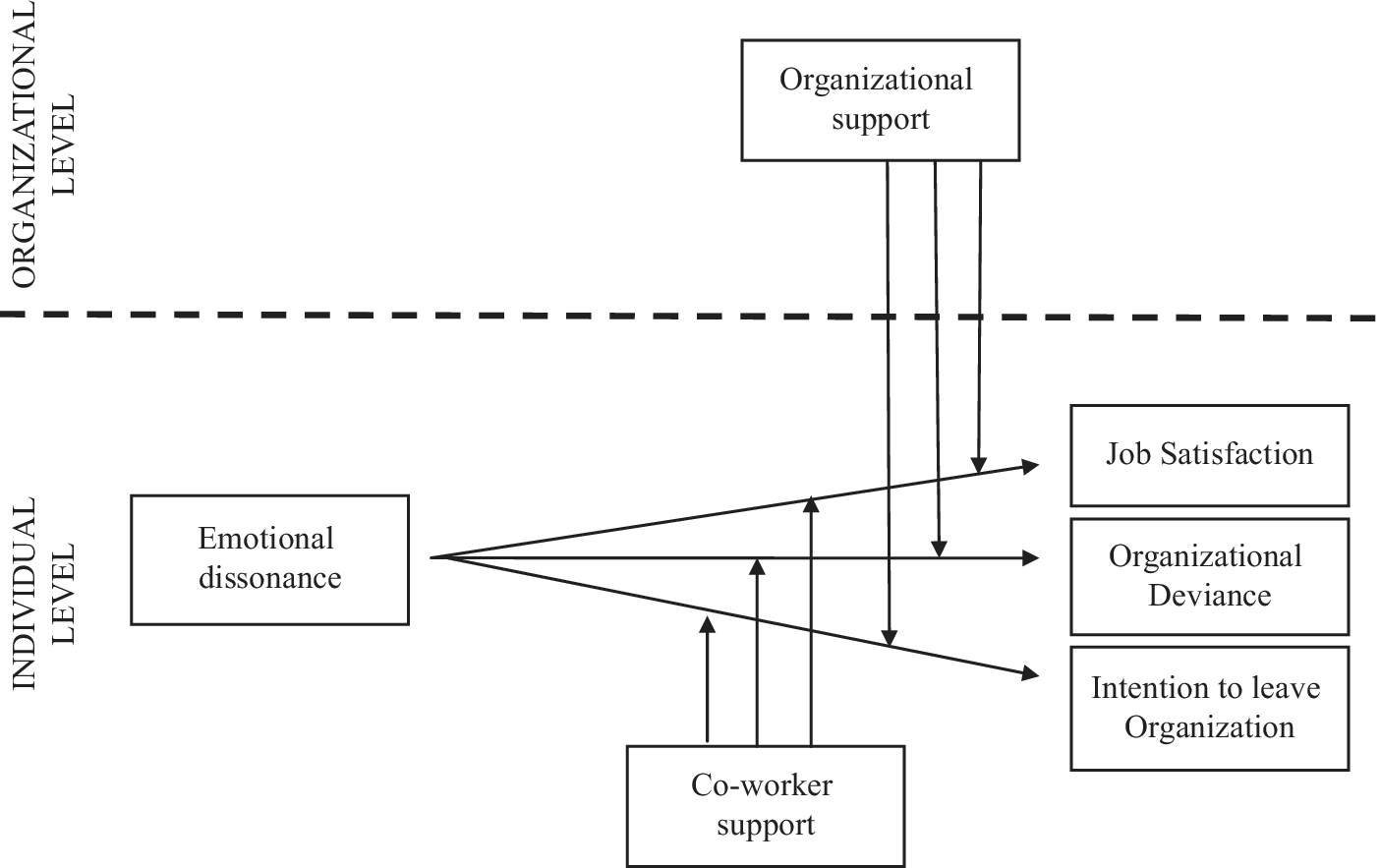
The present study contributes by answering these calls for more research. Thus, the purpose of this study is: First, to contribute to understanding the relationship between emotional dissonance and employee outcomes by providing additional empirical evidence; second, to analyze the potential moderating role of social support provided by different sources (i.e., by co-workers and organization); and third, to examine the buffer effect of organizational support from a multilevel perspective (see Figure 1).
Hypothesized Model

Emotional Dissonance Outcomes. As mentioned above, emotional dissonance involves a clash between personal true emotions and the emotions prescribed by the organization. Person-role stress literature defines emotional dissonance as a form of person-role conflict because there is a lack of complementarity between the person’s response and role expectations about the desirable emotions. Not being able to feel what one is supposed to feel may cause people to feel false and hypocritical, and lead to alienation from one’s feelings. Hence, and according to the COR model, emotional dissonance lead to a depletion of the individuals’ energy and this stressful situation can cause various stress reactions (Zito et al., Reference Zito, Emanuel, Molino, Cortese, Ghislieri and Colombo2018). Therefore, this discrepancy may be associated with an impairment in well-being, attitudes, and behaviors (Andela et al., Reference Andela, Truchot and Huguenotte2018; Andela et al., Reference Andela, Truchot and Doef2016; Kim et al., Reference Kim, Donnelly and Choi2019; Pugh et al., Reference Pugh, Groth and Hennig-Thurau2010; van Dijk & Kirk, Reference van Dijk and Kirk2007; Zapf, Reference Zapf2002).
One of the most extensively studied outcomes is job satisfaction (i.e., Abraham, Reference Abraham1999a; Cheung & Tang, Reference Cheung and Tang2010; Zito et al., Reference Zito, Emanuel, Molino, Cortese, Ghislieri and Colombo2018; Morris & Feldman, Reference Morris and Feldman1997; Taxer & Frenzel, Reference Taxer and Frenzel2018), understood as an attitude or emotional state toward work that is influenced by situational factors, such as the appraisal of one’s working conditions (Locke, Reference Locke and Dunnette1976). Based on Hochschild’s (Reference Hochschild1983) view, emotional dissonance may cause alienation and estrangement from one’s feelings and, therefore, be negatively correlated with job satisfaction (Hofmann & Stokburger-Sauer, Reference Hofmann and Stokburger-Sauer2017).
Similarly, in face of the loss of resources caused by emotional dissonance, specially, when employees do not get the expected return on invest of their resources, they could increase organizational deviance behavior, understood as an intentional employee behavior that is harmful to the legitimate interests of an organization (Gruys & Sackett, Reference Gruys and Sackett2003). Kundu and Gaba (Reference Kundu and Gaba2017) concluded that the service workers are more likely to show deviant behavior as a result of the discrepancy between the felt emotions and the expressed emotions. Moreover, Spector and Fox (Reference Spector and Fox2002) have claimed that negative emotions result into organizational deviance, whereas the positive emotions have a tendency to promote organizational citizenship behaviors. In this line, emotional dissonance was found to be negatively related to various individual outcomes such as employee’s citizenship behavior (Cheung & Cheung, Reference Cheung and Cheung2013) and service sabotage (JungHoon & Chihyung, Reference JungHoon and Chihyung2014).
Another consequence of emotional dissonance is employees’ intention to leave the organization. Hence, and according to the COR model, in the absence of resource refill, in order to minimize resource loss, employees engage in withdrawal behavior (Mishra & Kumar, Reference Mishra and Kumar2016). In this line, some studies (e.g., Abraham, Reference Abraham1999a; Diamond, Reference Diamond2005; Zito et al., Reference Zito, Emanuel, Molino, Cortese, Ghislieri and Colombo2018; Mobley, Reference Mobley1977) have positively associated emotional dissonance with an intention to leave the organization.
Hence, in the face of the threat, loss or not expected return of resources, employees are in a stress situation which could lead to negative outcomes, such as low level of job satisfaction, and high levels of organizational deviance and intention to leave. Specifically:
Hypothesis 1. Emotional dissonance is negatively related to job satisfaction (H1a) and positively related to organizational deviance (H1b) and intention to leave the organization (H1c).
Organizational Support: A Collective Phenomenon. Most research on organizational support has conceptualized organizational support from an individual perspective, focusing mainly on individual employees’ perceptions. However, Eisenberger et al. (Reference Eisenberger, Huntington, Hutchison and Sowa1986) suggested that employees from an organization can share their perceptions of how the organization value their contributions and take care their well-being. Thus, employees share the degree of their organizations are committed to them, that is, that there may be a collective perception of organizational support. This assumption is congruent with the bottom-up process for the construction of a collective perception (Kozlowski & Klein, Reference Kozlowski, Klein, Klein and Kozlowski2000) and the consensus composition model of Chan (Reference Chan1998). This model suggests that the agreement in perceptions of employees within an organization underpinned the basis for the conceptualization and operationalization of a construct at higher levels of analysis with an isomorphic functioning compared to lower levels (e.g., individual).
Although emotional dissonance and support has been widely studied, there is no existing literature that take into account the collective nature of support.
The Buffering Role of Social Support from a Multilevel Approach: Co-workers and Organization. Social support is, overall, a source of emotional resources (e.g., feelings of belonging, intimacy, improved sense of self-worth, and sense of control) and practical/informational resources (e.g., funding and advice) (Greenglass, Reference Greenglass2000; Himle et al., Reference Himle, Jarayatne and Thyness1989). Within the COR model, Hobfoll (Reference Hobfoll1989) argued that perception of social support is an important resource and this resource gain is especially important in the context of resource loss.
This social support in the workplace can be provided by different agents at different levels. The COR theory incorporates the notion of resource appraisal (Hobfoll Reference Hobfoll2001; Hobfoll & Kay Reference Hobfoll and Kay2007), suggesting that employees assess the extent to which the resource (e.g., source of support) matches the stressor. Taking into account that this study analyses different types of outcomes from a more individual focus (i.e., job satisfaction) to an organizational focus (i.e., organizational deviance). Support from co-workers (individual approach) and organization (organizational approach) were selected.
Co-worker support was defined as co-workers’ willingness to assist in carrying work-related duties to completion, in the form of sharing knowledge, providing encouragement, or supporting one another on assigned tasks. Thus, co-worker support involves emotional support, useful information, and directive guidelines to do things in new ways and with consideration (Guchait et al., Reference Guchait, Paşamehmetoğlu and Dawson2014).
According to Organizational Support Theory, employees perceive that they are supported by their organizations when the following practices occur: Allowing employees to express their opinions, showing concern, having regard for employees’ best interests, offering organizational rewards, caring about the employees’ well-being, providing help when needed, and devising favorable job conditions such as pay, training, promotions, and job enrichment (Eisenberger et al., Reference Eisenberger, Huntington, Hutchison and Sowa1986; Rhoades & Eisenberger, Reference Rhoades and Eisenberger2002). Therefore, perceived organizational support is the main design of the organizational support theory and it is the extent to which individuals assume that organization appreciates their participation and is responsible for their welfare and prosperity (Baran et al., Reference Baran, Shanock and Miller2012). According to Mishra and Kumar (Reference Mishra and Kumar2016, p. 782), “since emotional dissonance is considered as the state of discomfort, unease, and tension due to the discrepancy between felt and expressed emotions, perceived organizational support may provide resources that enable workers to cope with dissonance”.
Therefore, social support from co-workers and organizations may promote an atmosphere of support, understanding, and trust, helping employees to perceive the situation as less stressful (Viswesvaran et al., Reference Viswesvaran, Sanchez and Fisher1999). Thus, individuals who receive social support in their workplaces are better able to cope with stressful events and experience less detrimental attitudes and behaviors (Cohen & Wills, Reference Cohen and Wills1985; Jones et al., Reference Jones, Flynn, Kelloway, Sauter and Murphy1995). In summary, regardless of the source, social support can ameliorate the stress-strain link by protecting individuals from stressors (Cohen, Reference Cohen, Veiel and Baumann1992).
Applied to the stressor of emotional dissonance, it seems plausible to assume that social support from both the co-workers and the organization may moderate the link between emotional dissonance and employee outcomes, since and according to the COR model, we expect that support will provide resources to replenish the resource loss. However, there is little literature about this relationship, with some exceptions. For example, Kim and Choi (Reference Kim and Choi2018), showed that social support and organizational support moderated the relationship between emotional dissonance and burnout; and Kim et al., (Reference Kim, Donnelly and Choi2019) showed this same interaction between emotional dissonance and social-organizational support to explain turnover intention. Abraham (Reference Abraham1998; 1999a) observed the significant moderating effect of co-worker support on the relationship between emotional dissonance, on the one hand, and job satisfaction and organizational commitment, on the other, Abraham concluded that highly developed social networks effectively buffer the aversive effects of emotional dissonance.
In this vein, we propose that both co-worker and organizational support may ameliorate the negative effect of emotional dissonance on employees’ attitudes and behaviors. Hence, we aim to analyze the role of social support, taking into account its different sources (i.e., co-workers and organization), in the relationship between emotional dissonance and its outcomes (i.e., job satisfaction, organizational deviance, and intention to leave the organization). The following cross-level hypotheses are proposed:
Hypothesis 2. Co-worker support moderates the relationship between emotional dissonance and job satisfaction (H2a), organizational deviance (H2b), and intention to leave the organization (H2c). Employees with high co-worker support will react less negatively when they experience emotional dissonance compared to those who has low co-worker support.
Hypothesis 3. Organizational support moderates the relationship between emotional dissonance and job satisfaction (H3a), organizational deviance (H3b), and intention to leave the organization (H3c). Employees who work in organizations with high levels of organizational support will react less negatively when they experience emotional dissonance compared to those who work in organizations with low organizational support.
The research on social support mainly examines how different agents provide support in the workplace in isolation and independently. For instance, some literature has focused on co-worker support (e.g., Akgunduz & Eryilmaz, Reference Akgunduz and Eryilmaz2018; Malott et al., Reference Malott, Glasgow, O’Neill and Klesges1984), whereas other literature has focused on organizational support (e.g., Kossek et al., Reference Kossek, Pichler, Bodner and Hammer2011; Sora et al., Reference Sora, Caballer and Peiró2011). But much less research has examined the combination of different types of social support (e.g., Guchait et al., Reference Guchait, Paşamehmetoğlu and Dawson2014; Maertz et al., Reference Maertz, Griffeth, Campbell and Allen2007; Newman et al., Reference Newman, Thanacoody and Hui2012), and no studies have examined its relationship with emotional dissonance. It is important to note that, although each individual kind of support is significant per se, combinations of them maximize any given strategy. We use the term “combination” to refer to the presence of different types of social support in an organization. Organizational support is perceived as different and separate from co-worker support because employees are likely to have different relationships with their organizations and their co-workers (Guchait et al., Reference Guchait, Paşamehmetoğlu and Dawson2014). For example, even though an organization might create a plan for increasing social support at work (e.g., reward system by increasing employees’ efforts at work), co-workers also collaborate in this support (e.g., giving advice to a colleague). Along similar lines, we argue that the effect of organizational support on employees will be greater when co-worker support is also present than when it is not. Thus, workers who experience emotional dissonance but have high co-worker and organizational support will report higher job satisfaction and lower organizational deviance and intention to leave the organization than those who have lower levels of either of these types of support. Hence, we hypothesize:
Hypothesis 4. The combination of co-worker and organizational support moderates the relationship between emotional dissonance and job satisfaction (H4a), organizational deviance (H4b), and intention to leave the organization (H4c). Employees who work in organizations with high levels of organizational support and have co-worker support will react less negatively when they experience emotional dissonance compared to those employees who have low levels of one or both types of social support.
Method
Participants and Procedure
Researchers contacted the human resources managers of organizations to explain the purpose of the study and request their collaboration. In the organizations that agreed to collaborate, the researchers distributed questionnaires among the employees. Researchers set up an appointment to collect the completed questionnaires at a later time (approximately one week). Participation was voluntary, and anonymity and confidentiality were guaranteed. A total of 556 employees from 53 organizations participated in this study. They were all embedded in the services sector: 7% in the hotel industry (n = 4), 38% in the education sector (n = 20), 21% in retail (n = 11), 4% in the healthcare sector (n = 2), 6% in the communication sector, and 23% in other services (n = 12). Of the participants, 70% were women (n = 391), and 28% were men (n = 156). The average age was 40.65 (SD = 10.43). Regarding education, 7% of the sample only had primary studies (n = 65), 25% had graduated from high school (n = 142), 47% had a university degree (n = 258), and 13% had post-graduate qualifications (n = 71). Finally, we were unable to obtain data on sex for 2% (n = 9) and education for 4% (n = 20), due to missing data. Response rate in this study was 63%. Furthermore, this study followed the ethical protocol and guidelines of our university.
Measures
Sex (0, woman; 1, men) and age were measured as control variables. Different consequences of work emotion may be dependent on personal variables such as gender and age (Grandey, Reference Grandey2003). For example, Domagalski (Reference Domagalski1999) showed that women were more sensitive to others’ emotional signals and more proficient at emotional management than men. In addition, Kruml and Geddes (Reference Kruml and Geddes2000) pointed out that older employees were more proficient at emotion management and showed more suitable emotions than younger employees.
Emotional dissonance. This was measured with the 4-item scale for emotional dissonance developed by Zapf et al. (Reference Zapf, Vogt, Seifert, Mertini and Isic1999). The response scale ranged from 1 (strongly disagree) to 5 (strongly agree). One item is: “Display emotions which do not correspond to inner feelings”. The Cronbach’s alpha for this scale is .87.
Social support. This was measured using a reduced 4-item scale (Eisenberger et al., Reference Eisenberger, Fasolo and Davis-LaMastro1990). In order to measure both organizational and co-worker support, this scale was measured twice in the questionnaire, but modifying its referents. Accordingly, four items asked about the organization’s support, and the other four asked about co-workers’ support. The response alternatives ranged from 1 (strongly disagree) to 5 (strongly agree). An example of the items on the scale for organizational support is: “My organization strongly considers my goals and values”. For co-worker support, an item is: “My co-workers really care about my well-being”. The Cronbach’s alphas for the scales were .86 for organizational support and .79 for co-worker support.
Job Satisfaction. This was assessed with a 4-item scale developed by Price (Reference Price1997). An example of an item is: “I find enjoyment in my job”. The response range was from 1 (strongly disagree) to 5 (strongly agree). The Cronbach’s alpha was .79.
Organizational deviance. This was measured with a reduced 7-item scale (Bennett & Robinson, Reference Bennett and Robinson2000). For example: “Taken property from work without permission”. The response scale ranged from 1 (strongly disagree) to 5 (strongly agree). Cronbach’s alpha was .77.
Intention to leave organization. This was measured through a 3-item scale based on Sjöberg and Sverke’s (Reference Sjöberg and Sverke2000) measure. An example of an item is: “Finally, I have a strong intention to quit”. The response range was from 1 (strongly disagree) to 5 (strongly agree). Reliability was .82.
Data Analysis
Descriptive statistics (means, standard deviations), correlation analysis, and factorial confirmatory analysis were computed as preliminary analyses. The factorial confirmatory analysis was computed in order to further validate the measures involved in this study. Two models were tested: A one-factor solution and a six-factor solution. Later, random coefficient analyses were computed to test our multilevel hypothesis. However, first their prerequisites were examined (Bliese, Reference Bliese, Klein and Kozlowski2000): Group-level properties of outcomes variables were calculated through ICC1; the intercept variation in outcomes variables was computed by the chi-squared likelihood test, which compared a model with random intercept and another without random intercept; and to examine the between-groups slopes variation in outcomes variables, we tested the chi-squared likelihood between a model with a random slope for emotional dissonance and a model without a random slope. Random coefficient models (RCM) assume the non-independence of the variables, examining the data at different levels of analysis and including the random error associated with the membership in an organization. To explain the dependent variables at individual level (job satisfaction, organizational deviance and intention to leave), the following variables were included: Sex, age, and organizational support at individual level as control variables, emotional dissonance, and co-worker support at individual level and organizational support at organizational level, and the interaction of emotional dissonance and co-workers support at individual level and organizational support at organizational level. These analyses were performed using the program “Nonlinear and Linear Mixed Effects” (NLME; Pinheiro & Bates, Reference Pinheiro and Bates2000), in the R program (R Development Core Team, 2004). We used centered scores to solve possible problems of multicollinearity. Graphical representation was performed to better understand the nature of the interactions.
Results
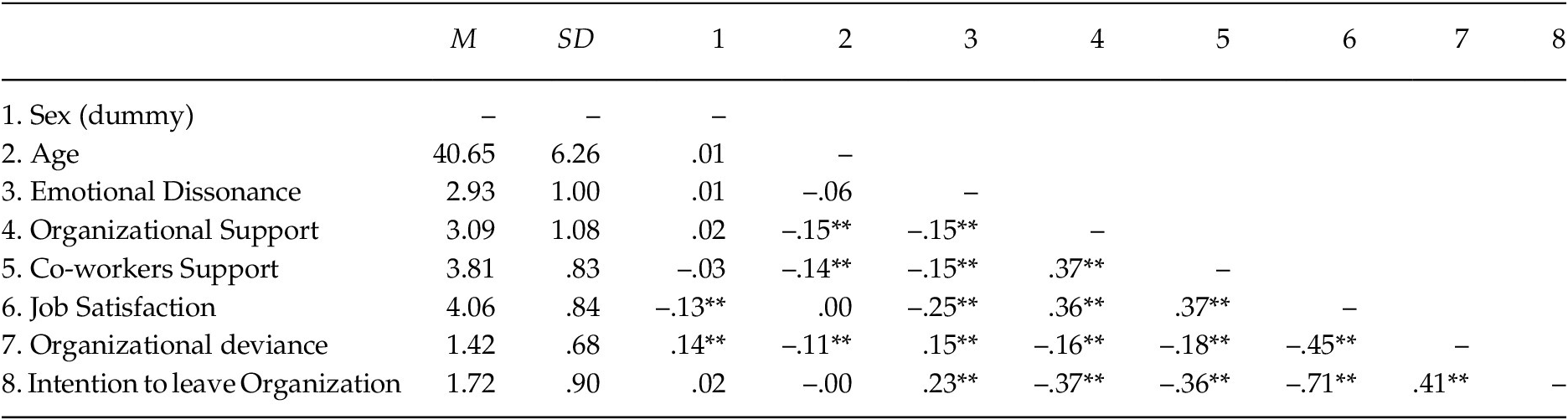
Descriptive statistics (means and standard deviations) and correlations among variables are presented in Table 1. The correlations among all the variables were significant and in the expected direction. Regarding the confirmatory factor analysis, this analysis presented a better fit for the six-factor solution than for the one-factor model (M0) and the five-factor model (M5). Both solutions showed an unsatisfactory fit between the data and the hypothesized model. The Chi-Squared Goodness-of-Fit Index (χ2) did not indicate a good fit, although this is probably due to the sample size (M0, χ2 = 4,089.05, p < .01; M5, χ2 = 1,595.93, p < .01). The Root Mean Square Error of Approximation (RMSEA) indicated a value of .15 and .09, respectively, showing an inadequate fit of above .08 (Browne & Cudeck, Reference Browne, Cudeck, Bollen and Long1993). CFI and NNFI values also showed an unsatisfactory fit because they were below .90 (M0, .42 and .33; M5, .80 and .76) (Jöreskog & Sörbom, Reference Jöreskog and Sörbom1993). By contrast, the six-factor model (M6), presented an excellent fit, except for the Chi-Squared Goodness-of-Fit Index, but, as mentioned above, this was probably due to the sample size (χ2 = 816.07, p < .01). The RMSEA index was .06 and showed a good fit, as its value was lower than .08 (Browne & Cudeck, Reference Browne, Cudeck, Bollen and Long1993). For CFI (.92) and NNFI (.90), the values exceeded .90, also indicating good fit (Jöreskog & Sörbom, Reference Jöreskog and Sörbom1993).
Descriptive Statistics (Means and Standard Deviations) and Correlations

Note.
*p < .05. **p < 0.1, two-tailed.
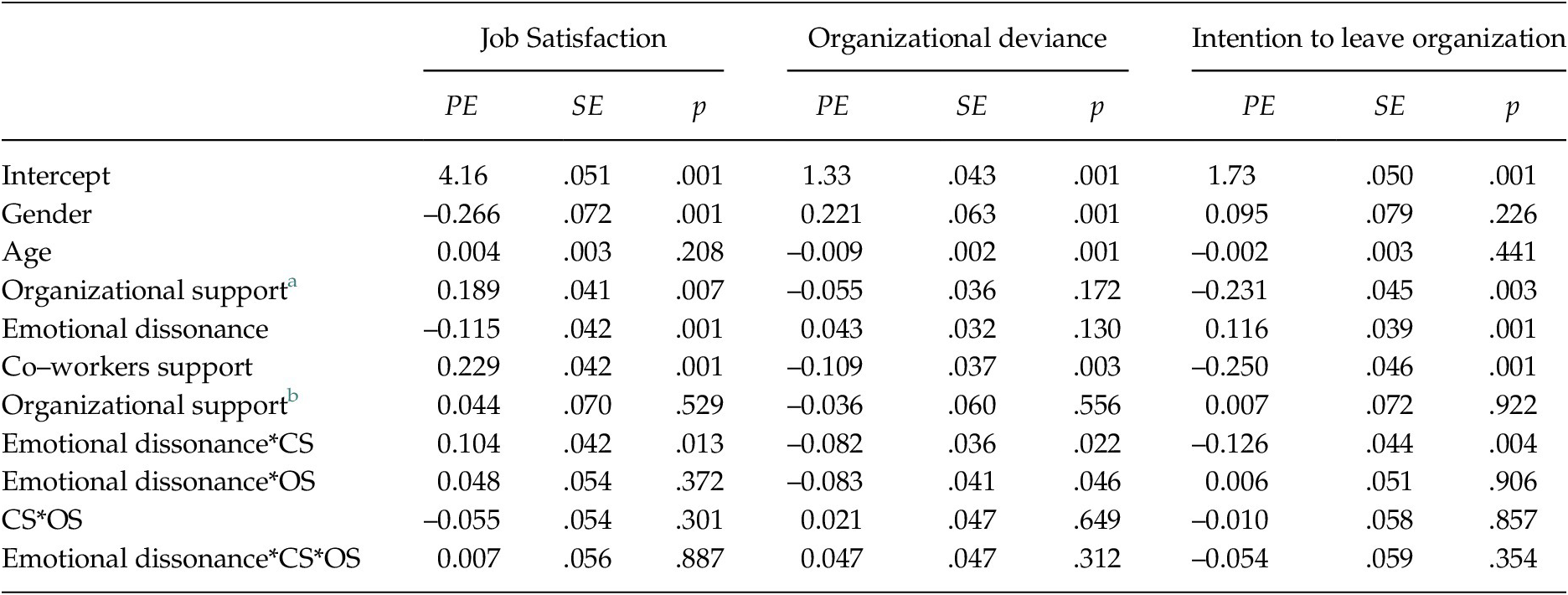
Table 2 shows random coefficient model results for emotional dissonance and social support in predicting job satisfaction, organizational deviance, and intention to leave the organization, after controlling for sex and age. The results showed that emotional dissonance was related to lower levels of job satisfaction (H1a confirmed) and intention to leave the organization (H1c confirmed). Furthermore, the main effects of co-worker support were significant, although they were not part of the hypothesis. Co-worker support were positively associated with job satisfaction and negatively associated with organizational deviance and intention to leave the organization.
Random Coefficient Models Predicting Job Satisfaction, Organizational Deviance and Intention to Leave Organization

Note. PE = parameter estimate; SE = standard error; OS = Organizational Support; CS = Co-workers.
a Organizational support is measured at individual level and it is considered as a control variable.
b Organizational support is at organizational level.
*p < .05. **p < .01.
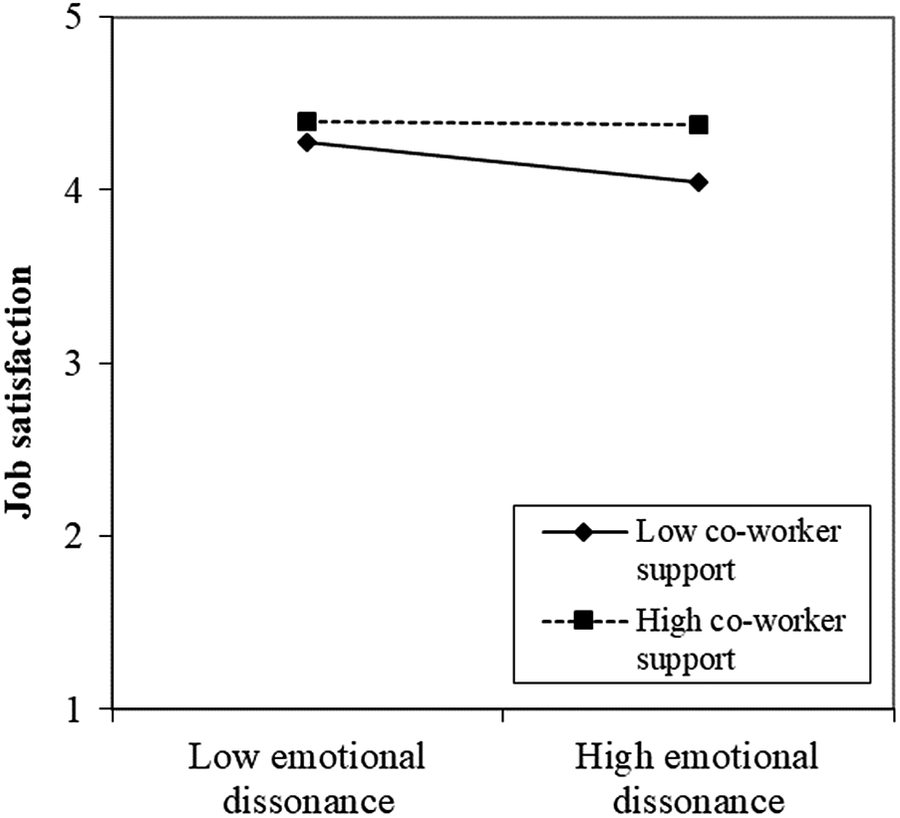
The results provided support for Hypotheses 2 significant interaction terms between emotional dissonance and co-worker support were found in the prediction of all the outcomes: Job satisfaction, organizational deviance, and intention to leave the organization. To better understand the nature of these interactive effects, we made graphic representations of them. Figures 2 shows that the negative effect of emotional dissonance on job satisfaction was buffered by high co-worker support. Thus, the level of job satisfaction remains stable in spite of high emotional dissonance if high co-worker support is perceived.
Interaction between Emotional Dissonance and Co-worker Support in Predicting Job Satisfaction

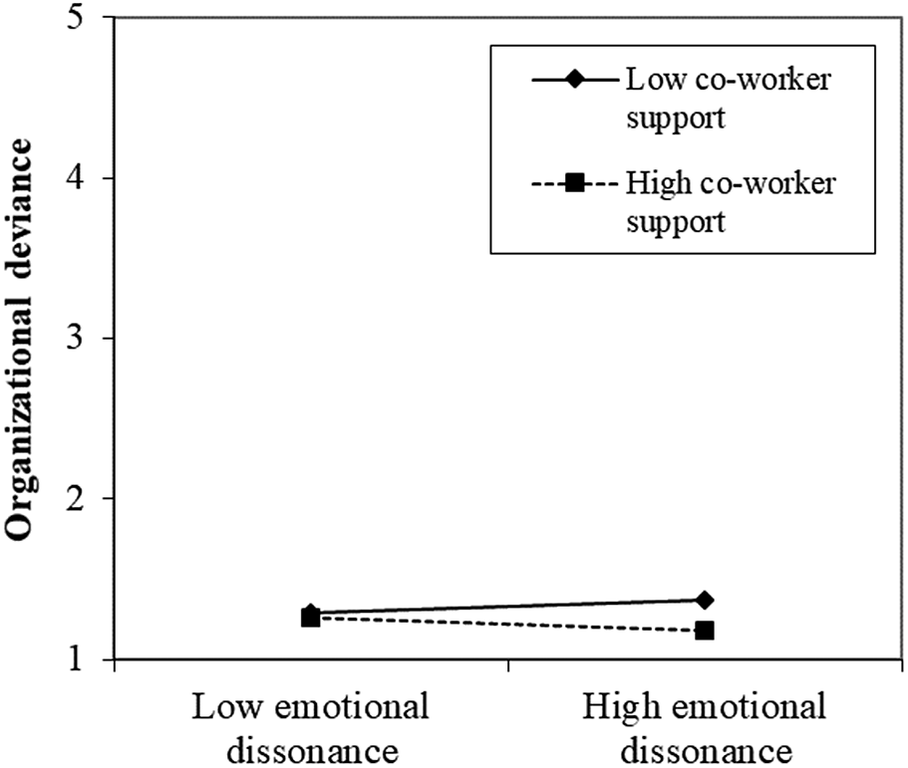
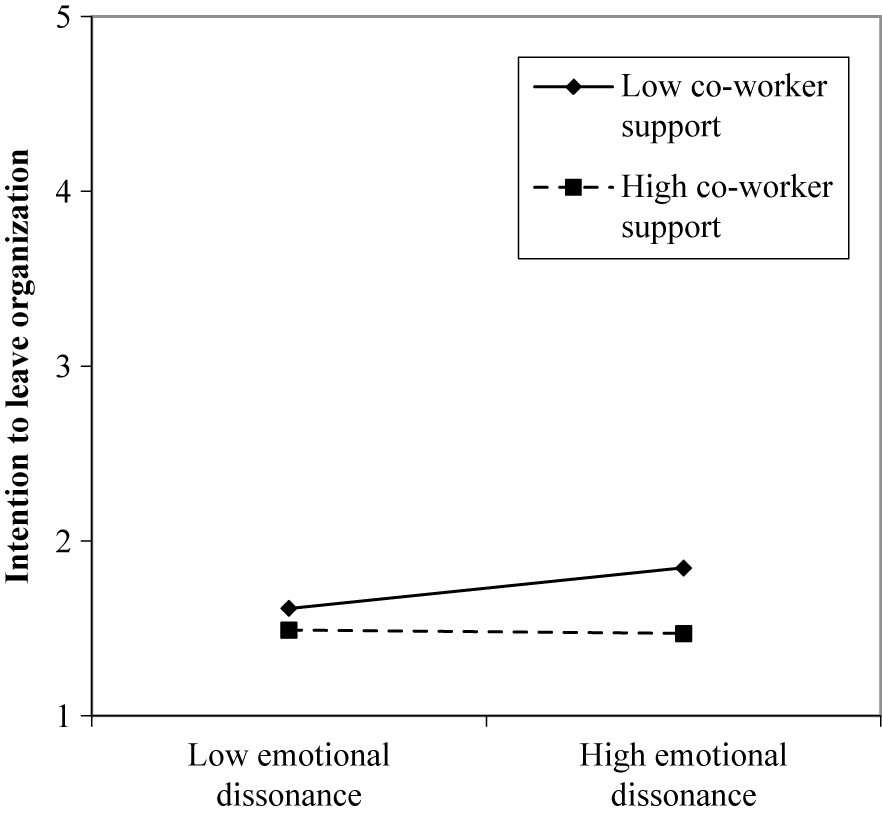
Figures 3 and 4 show a buffer effect of co-worker support on organizational deviance and intention to leave the organization. The increase in organizational deviance and intention to leave the organization is higher when low co-worker support is perceived. In fact, if high co-worker support is perceived, the levels of organizational deviance and intention to leave the organization are maintained when emotional dissonance is experienced.
Interaction between Emotional Dissonance and Co-worker Support in Predicting Organizational Deviance

Interaction between Emotional Dissonance and Co-worker Support in Predicting Intention to Leave the Organization

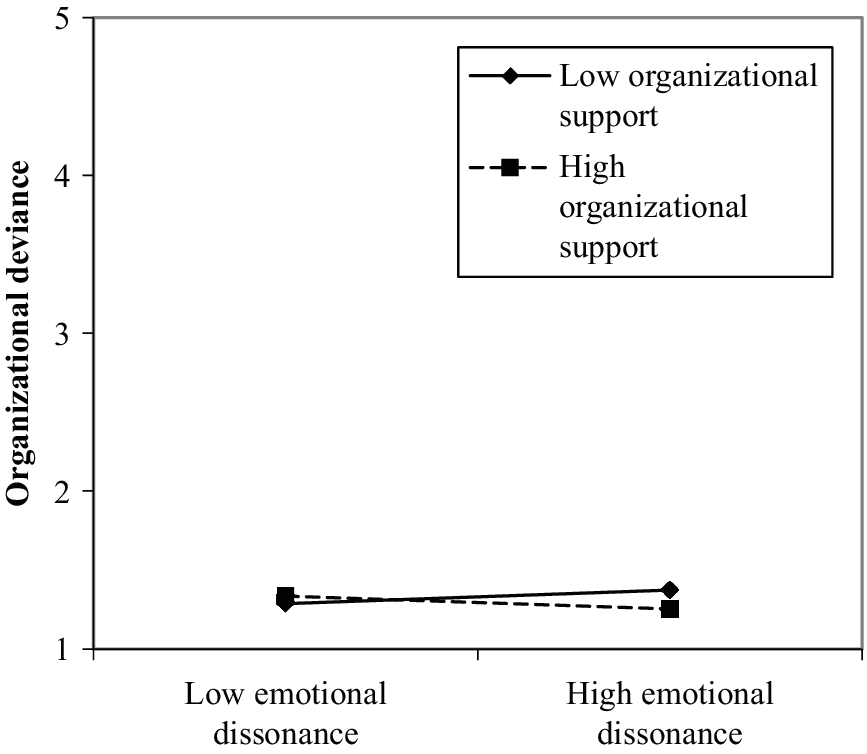
Interaction between Emotional Dissonance and Organizational Support in Predicting Organizational Deviance

Support was also found for the multilevel interaction hypothesis, but only in predicting organizational deviance, thus confirming Hypothesis 3, but only partially (H3b). Organizational support at organizational level moderated the relationship between emotional dissonance and organizational deviance. Thus, employees, who experience emotional dissonance, show higher levels of organizational deviance in organizations with low organizational support compared to those with high organizational support. In fact, in organizations with high organizational support, employees who experience emotional dissonance do not show organizational deviance independently of levels of perceived emotional dissonance (figure 5).
Finally, Hypothesis 4 was not supported. Results show that the combination of organizational and co-worker support do not moderate the relationship between emotional dissonance and employees’ outcomes.
In conclusion, low levels of co-worker support seem to be determinant in the relationship between emotional dissonance and employee job satisfaction, organizational deviance, and intention to leave the organization. However, organizational support is only key in the relationship between emotional dissonance and organizational deviance. An impairment in employees’ work attitudes and behaviors is experienced when they perceive emotional dissonance and low levels of co-worker support, and organizational support for organizational deviance. Finally, the presence of both types of social support do not improve employees’ outcomes.
Discussion
The present study contributes to previous research on emotional dissonance in several points. The first contribution was to provide additional evidence to the relationship between emotional dissonance and employees’ outcomes. More specifically, the first hypothesis, which states that emotional dissonance is related to lower levels of job satisfaction and higher levels of organizational deviance and intention to leave the organization, was supported. Therefore, service employees who were suffering from emotional dissonance were less satisfied and reported more deviant behaviors and intention to leave the organization than employees who did not experience emotional dissonance. These results are congruent with the general literature on emotion at work: Having to regulate their emotions may be especially stressful and detrimental to employees’ health and well-being because emotional dissonance can have negative consequences for employees (Abraham, Reference Abraham1999a; Molino et al., Reference Molino, Emanuel, Zito, Ghislieri, Colombo and Cortese2016).
The second contribution of our study was to show the buffer effect of social support from different sources (and levels) on the emotional dissonance-outcomes relationship. Hypothesis 2 was confirmed since significant interaction terms between emotional dissonance and co-worker support was found in the prediction of all outcomes (i.e., job satisfaction, organizational deviance, and intention to leave the organization). However, the cross-level interaction between emotional dissonance and organizational support only explained organizational deviance (Hypothesis 3b). Thus, our results evidenced that co-worker support is critical in moderating the harmful outcomes of emotional dissonance in general. However, organizational support only buffered the negative relationship between emotional dissonance and organizational deviance. Those employees who worked in organizations that provided support to their employees presented fewer deviant behaviors when experiencing emotional dissonance than those who worked in organizations with low support. These results evidence a wider buffer effect of co-worker support on employees’ outcomes compared to organizational support that only buffered the effect on an organizational deviance. Following the notion of resource appraisal (Hobfoll, Reference Hobfoll2001; Hobfoll & Kay Reference Hobfoll and Kay2007) within the COR model, that suggests the resource (e.g., source of support) must match the stressor, it can be plausible that feeling support from co-workers in facing the stress that produced the requirement to express emotions that are not genuinely felt in a situation, can have a global effect on outcomes. However, feeling the organization support does not affect the most individual outcomes such as job satisfaction and intention to leave, but yes in carrying out behaviors that are not beneficial to the organization. It seems that organizational support buffer the negative effect of emotional dissonance on employees’ outcomes with organizational nature.
Overall, these results were congruent with COR model (Hobfoll, Reference Hobfoll1989). Emotional dissonance lead to a depletion of the individuals’ energy, and in the face of this threat (loss or not expected return of resources), employees are in a stress situation which could lead to impairment in attitudes and behaviors, such as low level of job satisfaction, and high levels of organizational deviance and intention to leave. Furthermore, this paper was congruent with previous literature on emotional dissonance (Andela et al., Reference Andela, Truchot and Huguenotte2018; Andela et al., Reference Andela, Truchot and Doef2016; Kim et al., Reference Kim, Donnelly and Choi2019; Pugh et al., Reference Pugh, Groth and Hennig-Thurau2010; van Dijk & Kirk, Reference van Dijk and Kirk2007; Zapf, Reference Zapf2002; Zito et al., Reference Zito, Emanuel, Molino, Cortese, Ghislieri and Colombo2018), and it follows along the lines of other research (i.e., Kim & Choi, Reference Kim and Choi2018; Kim et al., Reference Kim, Donnelly and Choi2019; Scott et al., Reference Scott, Zagenczyk, Schippers, Purvis and Cruz2014) that demonstrated the importance of treating different sources of social support independently, and their different effects. In this case, we took two important sources into account: the co-workers and the organization.
Special attention should be paid to Hypothesis 4 because the moderation effect of the combination of both types of support was not significant. Our results evidence that whether there is one type of social support is enough to mitigate the detrimental relationship between emotional dissonance and employees’ outcomes (i.e., co-worker support). The combination of different types of social support do not help employees to cope with emotional dissonance and their resources loss. In conclusion, the present research showed that social support is relevant when coping with work stressors such as emotional dissonance. However, in contrast to our initial assumption, one kind of social support is enough to ameliorate the negative effect of a work stressor, having co-worker support a wider effect on employees’ reactions. So, the most important thing is for employees to feel supported in their workplaces by their co-workers. A combination of support from different sources does not significantly ameliorate the detrimental effect of emotional dissonance on employees’ reactions. However, we can also conclude that for explicit behaviors, such as organizational deviance, organizational support at organizational level can ameliorate the harmful effects of emotional dissonance.
Finally, the third contribution refers to adopt a multilevel perspective in the research on emotional dissonance. More specifically, this study provides additional evidence to the existing literature on various aspects. On the one hand, it adds to the statement about the need to adopt a multilevel approach in the study of emotional dissonance (Imose & Finkelstein, Reference Imose and Finkelstein2018). On the other hand, it supports the incipient research that proposes the conceptualization of organizational support as a collective phenomenon as a stress buffer (Bliese & Castro, Reference Bliese and Castro2000; Halbesleben, Reference Halbesleben2006; Wallace et al., Reference Wallace, Edwards, Arnold, Frazier and Finch2009). Our study follows Carrasco et al.’s (Reference Carrasco, Martínez-Tur, Moliner, Peiró and Ramis2014) assertion, which states that even though emotional dissonance is an individual phenomenon, it can be influenced by contextual or environmental factors, which must be take into account to a better know this stressful phenomenon.
Despite contribution of this study, it also presents some limitations. First, it is important to highlight that this study is cross-sectional; therefore, causal relationships cannot be inferred. Longitudinal research is needed to deal with this issue. Second, our data collection method was based on a convenience sampling. This method may limit the extrapolation of results. However, as in other works (e.g., Bakker et al., Reference Bakker, Sanz-Vergel, Rodríguez-Muñoz and Antino2019), it is not likely that this threat the validity of our results. It seems more probable that studied variables and their relationships are similar in other samples. Third, all the variables were measured by self-reported measures; therefore, the results may be influenced by common method variance. However, the results of Harman’s single-factor test revealed that common method variance was not necessarily a serious deficiency in this dataset. Future research should consider including other external or more objective source of data. In fact, it is already possible to find studies that collect data from different sources beyond self-reported measures (e.g., Krannitz et al., Reference Krannitz, Grandey, Liu and Almeida2015; Bakker et al., Reference Bakker, Sanz-Vergel, Rodríguez-Muñoz and Antino2019). So, future research could, for instance, collect the common perception of organizational support in a more objective way, such as based on a referent-shift consensus model (Chan, Reference Chan1998).
This study had two main theoretical implications. It empirically tested the relationship between emotional dissonance and job satisfaction, organizational deviance, and intention to leave the organization. Moreover, these relationships were moderated by co-worker support, and organizational support, in the case of behavioral deviance. These two findings are crucial for the emotional dissonance literature because they empirically relate different organizational behaviors: When an employee experiences emotional dissonance, s/he is more likely to behave contrary to the organization’s norms, thus having the potential to harm the organization or even the intention to leave the organization. For this reason, this paper has serious practical implications.
As Zapf (Reference Zapf2002) stressed, there is sufficient evidence that emotions, and particularly emotional dissonance, in organizations are an important issue, and that the associated negative effects on employees cannot be ignored. This research shows how important support is, taking into account its source. Co-worker support have a relevant moderating buffering role in the negative effects of emotional dissonance, in general, and organizational support at organizational level in organizational deviance. Also, our results, according to Roczniewska et al. (Reference Roczniewska, Richter, Hasson and Schwarz2020), evidence the necessity of considering the different levels and planes at which social job resources operate to better know the complexity of work phenomena at multiple levels and to design interventions that target the right level of the environment. On this point, it is important to remember that emotional work, and therefore, the possibility of suffering emotional dissonance, is not minimal. Moreover, special attention should be paid to the negative behaviors that this paper has analyzed, that is: Organizational deviance and intention to leave, both of which are especially harmful behaviors within the organization. It seems necessary to understand what kinds of processes lead employees to engage in these kinds of behaviors and amend them. In this case, we have shown that: (a) Emotional dissonance has a positive impact on these processes; and (b) support has a moderating role in this association.
Therefore, from a practical viewpoint, identifying which sources of social support are more beneficial for services employees is likely to be worthwhile for workplace interventions. We suggest that organizations implement better support systems within their departments to protect their employees from suffering the negative effects of emotional dissonance. This kind of support can come from careful and planned organizational strategies (such as having a good family-work reconciliation program), or from a positive climate where co-workers help each other and fulfil the values of fellowship within the organization.
More research is necessary with more sophisticated study designs, in order to further develop this interesting field. For instance, it would be interesting to analyze whether the role played by supervisor support would behave in the same way as other sources of support. Are there other potential sources of support, such as family, that ameliorate the effects of emotional dissonance? Moreover, it is also important to analyze other protective variables within organizations that can work alongside support to reduce the harmful effects of emotional dissonance.