Introduction
Marine suspended particulate matter (SPM), including terrestrial particulate matter and marine authigenic particulate matter and their mixtures, is an important indicator in marine material cycle research (Weston et al. Reference Weston, Jickells, Carson, Clarke, Meredith and Brandon2013). As most of the Antarctic continent is covered by glaciers, the material input from the Antarctic continent is relatively limited in coastal area, and like the open ocean, the main agent of material transport is particulate organic matter (POM) generated via phytoplankton primary production (Weston et al. Reference Weston, Jickells, Carson, Clarke, Meredith and Brandon2013). The content of suspended POM in the water column and its isotopic composition (δ13C) are important indicators of marine biogeochemical processes, including marine primary production processes, and they are of great significance for the study of the oceanic material cycle.
POM is an important indicator of phytoplankton primary production in the upper layer of the ocean, and the changes in POM flux reflect the variation of marine primary productivity and organic matter export from the upper layers downwards (Weston et al. Reference Weston, Jickells, Carson, Clarke, Meredith and Brandon2013, Ducklow et al. Reference Ducklow, Wilson, Post, Stammerjohn, Erickson and Lee2015). The δ13C of suspended POM can provide an important basis for studying the environmental conditions under which carbon fixation occurs (Laws et al. 1995, Lourey et al. Reference Lourey, Trull and Tilbrook2004). This is due to the preferential uptake of lighter isotopes (12C) by marine phytoplankton during photosynthetic uptake of CO2 in water, rendering the δ13C of the residual pool of dissolved inorganic carbon more enriched in 13C. In addition, the POM containing 12C also preferentially undergoes degradation (Lourey et al. Reference Lourey, Trull and Tilbrook2004). Therefore, δ13C can be used to indicate the elemental changes that occur during phytoplankton growth as well as POM degradation. Phytoplankton δ13C values were significantly lower in the high-latitude regions of the Southern Ocean than in mid- and low-latitude regions and gradually decreased with increasing latitude (Sackett et al. Reference Sackett, Eckelmann, Bender and Bé1965, Lara et al. Reference Lara, Alder, Franzosi and Kattner2010). This abnormally low δ13C value was initially thought to be due to changes in carbon isotope fractionation during photosynthesis caused by temperature changes (Sackett et al. Reference Sackett, Eckelmann, Bender and Bé1965, Degens et al. Reference Degens, Guillard, Sackett and Hellebust1968). However, subsequent studies have confirmed that the increase in dissolved CO2 concentration caused by lower temperatures, which in turn leads to changes in the carbon isotope fractionation factor of the photosynthesis process, is the key factor (Lourey et al. Reference Lourey, Trull and Tilbrook2004, Lara et al. Reference Lara, Alder, Franzosi and Kattner2010). In addition to the high dissolved CO2 concentration, phytoplankton growth rates and phytoplankton assemblages are also important factors affecting the δ13C value of suspended POM in the seas around Antarctica (Burkhardt et al. Reference Burkhardt, Riebesell and Zondervan1999, Popp et al. Reference Popp, Trull, Kenig, Wakeham, Rust and Tilbrook1999).
The Southern Ocean is a typical high-nutrient and low-chlorophyll region, with chlorophyll a concentrations being less than 0.5 mg m-3 in the upper waters of ~80% of the ocean (Fukuchi Reference Fukuchi1980). Studies show that the lack of active iron (Fe) is the most important factor limiting phytoplankton primary production in the Southern Ocean, because Fe is an essential nutrient for the growth of marine phytoplankton (Trull et al. Reference Trull, Davies and Casciotti2008, Lin et al. Reference Lin, Rauschenberg, Hexel, Shaw and Twining2011, Wang et al. Reference Wang, Chen, Chen, Jia, Li, Zheng and Qiu2020). As there is no large runoff input of terrestrial Fe around the Southern Ocean and the atmospheric Fe deposition flux is low, the active Fe in the Southern Ocean water is much lower than the phytoplankton growth demand, so phytoplankton growth is strictly limited. In addition, water stability is also an important factor affecting the growth of phytoplankton in the surface waters of the ocean (Long et al. Reference Long, Thomas and Dunbar2012, Wang et al. Reference Wang, Chen, Chen, Jia, Li, Zheng and Qiu2020). Therefore, when sea ice melts in summer, the released Fe meets the growth requirements of phytoplankton, and the freshwater input from sea-ice melting creates a more stable water column environment and a lighter environment that is more conducive to phytoplankton photosynthesis (Zhang et al. Reference Zhang, Zheng, Chen, Ma, Cao and Qiu2014, Wang et al. Reference Wang, Chen, Chen, Jia, Li, Zheng and Qiu2020), resulting in the formation of larger-scale phytoplankton blooms at the sea-ice edge (the main melting area), which produce large amounts of suspended POM.
Due to strong winds, high ventilation rates and extensive winter sea-ice cover, the waters around Antarctica are important cold sources and CO2 sinks for the global atmosphere, making the dissolved CO2 concentration in Antarctic waters significantly higher than in other waters (Arrigo et al. Reference Arrigo, van Dijken and Long2008). The Antarctic Peninsula, South Shetland Islands and surrounding areas are among the fastest-warming areas in Antarctica and even in the world over the last half-century (Höfer et al. 2019 and reference therein). With the increasing atmospheric and seawater temperatures in the region, the ice shelf has experienced large-scale disintegration and retreat, the continental and marine ice-free areas have expanded (Rignot et al. Reference Rignot, Bamber, van den Broeke, Davis, Li, van de Berg and van Meijgaard2008, Chen et al. Reference Chen, Wilson, Blankenship and Tapley2009) and the productivity of marine organisms has increased (Lin et al. Reference Lin, Rauschenberg, Hexel, Shaw and Twining2011, Henley et al. Reference Henley, Annett, Ganeshram, Carson, Weston and Crosta2012). These processes not only influence changes within the marine sedimentary environment in the region, but also have far-reaching effects on global climate change, ocean circulation and biogeochemical cycles. However, relatively few studies have been conducted on SPM in the water of this region. Data related to the composition of SPM and the chemical characteristics of POM in the region are urgently needed.
In this study, the composition of SPM samples collected from the sea around the Antarctic Peninsula were analysed using scanning electron microscopy (SEM) and energy spectrum analysis. The distributions of particulate organic carbon (POC) and particulate nitrogen (PN) in the surface water of the study area and their influencing factors were initially analysed by combining remote sensing chlorophyll a, sea-surface temperature (SST) and sea-ice concentration data, and the sources and transport processes of suspended POM in summer were explored using δ13C values. The findings of this study provide an important reference to help us gain a comprehensive understanding of SPM as well as carbon cycling in the seas around the Antarctic Peninsula, and they are also important for studying the material cycle in the Antarctic region under the conditions of global climate change.
Materials and methods
Study area
The study area is part of the Southern Ocean and is located in the north-eastern waters of the Antarctic Peninsula, at the junction of the Weddell Sea, Scotia Sea and Drake Passage, where the water depth up to > 5000 m (Fig. 1). The land surrounding the study area is mainly the Antarctic Peninsula, the South Shetland Islands and the South Orkney Islands. The stratigraphic lithology of the Antarctic Peninsula is dominated by moderately acidic volcanic rocks, with basaltic rocks dominating the western part of the peninsula and rhyolite dominating the eastern part (Barker et al. Reference Barker, Dalziel, Storey and Tingey1991, Kraus et al. Reference Kraus, Kurbatov and Yates2013). The South Shetland Islands are composed of Jurassic-Cretaceous Mesozoic volcanic rocks, mainly low-potassium calc-alkaline basalt and basaltic andesite, whereas low- and medium-grade metamorphic rocks are widely distributed on the South Orkney Islands (Barker et al. Reference Barker, Dalziel, Storey and Tingey1991). Glaciers represent the main transport medium and forcing agent of land-derived debris in the waters around the Antarctic Peninsula and the South Shetland Islands (Liu et al. Reference Liu, Chen, Jin and Wang2014). In addition to the terrestrial material input from surrounding islands, the Antarctic Peninsula material transported by the Antarctic Circumpolar Current (ACC) is also an important source of terrestrial material distributed in the sea around the South Orkney Islands (Liu et al. Reference Liu, Chen, Jin and Wang2014). The circulation system in the region is mainly controlled by the ACC and the Weddell Gyre (WG). The ACC is closely related to the prevailing westerly wind belt, and the eastward ACC flow velocity in the surface layer of the sea increases rapidly from north to south, from 0.04 to 0.15 m s-1 (Pudsey & Howe Reference Pudsey and Howe1998). The Weddell Sea is the marginal sea of the Antarctic, which is part of the South Atlantic Ocean. The WG moves in a clockwise direction and finally merges with the ACC (Fig. 1b). The Weddell Sea has a polar climate and is often covered with thick ice. In early summer, the sea ice in the west-central part of the sea drifts northward up to 60°S. The ACC water from the Drake Passage is Fe deficient (Hopkinson et al. Reference Hopkinson, Mitchell, Reynolds, Wang, Selph and Measures2007, Hewes et al. Reference Hewes, Reiss and Holm-Hansen2009), whereas the outflow from the WG becomes enriched in Fe during flow through the ice-marginal regions of the Antarctic Peninsula (Ardelan et al. Reference Ardelan, Holm-Hansen, Hewes, Reiss, Silva and Dulaiova2010).
a. Location of study area. b. Sampling stations. ACC = Antarctic Circumpolar Current; WG = Weddell Gyre.

Sampling
The suspension samples were collected during 31 December 2017–20 January 2018 by the Xiang Yang Hong 01 research vessel during the 34th China Antarctic Scientific Expedition. A Niskin seawater sampler was used to collect surface water samples from 21 stations (Fig. 1b).
The water samples were filtered on the vessel using an acetate membrane (pore size of 0.45 μm) and a glass membrane filter (pore size of 0.7 μm). The glass membrane filter was preheated at 450°C for 6 h and pre-weighed. The filtration volume was 3000–6000 ml, and distilled water was used for salt washing. After filtration, the membrane filters were stored at -20°C and the samples were weighed after returning to the land laboratory. Acetate membrane samples were used to calculate suspended particulate concentrations and for suspended particulate composition analysis, while glass membrane samples were used for measuring POC, PN and δ13C values.
The suspended particulate concentration was obtained by weighing and calculating on an electronic balance with an accuracy of 1 part per 100 000. Due to the low suspended particulate concentration in the water sample and the small mass of particulate matter relative to the mass of the filter membrane, it is easy to make errors in the filtration and weighing process. Therefore, a double-layer membrane was used for filtration. As the particles are basically intercepted by the upper membrane, the mass change before and after filtration of the lower membrane can represent the mass change of the membrane under the flushing of clean water (without particles), and the mass change of the lower membranes is used as the system error to calculate the particulate matter content (weight of the upper membranes).
Suspended particle compositions analysis
A 5 mm × 5 mm part of the weighed samples was cut and sprayed with carbon on Carbon Coater (JEE-420, NEC, Japan) for analysis. Due to the relatively small amount of particulate matter in the filters, SEM (JOEL-8100, NEC, Japan) was used to observe each field of view, and an energy-dispersive spectrometer (EDS; X-max, Oxford, UK) was used for elemental analysis of the particulate matter. Particulate matter was distinguished and classified according to its morphological and chemical composition (qualitative analysis). The particulate matter is divided into flocculation aggregates and single-particle fractions according to their components and morphological characteristics, for which the single-particle fractions are divided into biological particles, mineral particles and other particles.
The analysis was performed at the Third Institute of Oceanography, Ministry of Natural Resources, China.
POC, PN and δ13C measurement
After drying at 40℃, the filters were placed in a box and acid-steamed in a closed container with concentrated hydrochloric acid (usually with a drying dish) for 12 h. After removal of carbonates from the samples, the filters were folded and washed with deionized water to remove the residual hydrochloric acid until the pH value was neutral and then put into an oven for drying (60℃) after completion.
A fixed area of membrane filter was taken using a puncher and the sample was placed in a tin cup. The samples were analysed using an elemental analyser-isotope ratio mass spectrometer (EA-IRMS; Integra 2, SerCon, UK) for POC, PN and δ13C analysis. Three blank samples were measured before the samples, and two standard samples were inserted for every 12 samples. The mass of carbon and nitrogen on the whole membrane was calculated according to the area ratio, and finally the contents of POC and PN in the water (volume concentration) were calculated according to the volume of filtered water. δ13C was calculated with reference to Vienna Pee Dee Belemnite (VPDB) as follows:
 $${\rm \delta }^{13}{\rm C\perthousand } = \left[{\displaystyle{{R_{sam}} \over {R_{ref}}}-1} \right]\times 1000{\rm \;}( R =\, ^{13} \!\! C/^{12}C} ) $$
The analytical precision was ± 0.5% for POC, ± 0.4% for PN and ± 0.2‰ for δ13C.
Remote sensing data
The remote sensing data for chlorophyll a concentration and SST in the sea surface water were obtained from Aqua-MODIS (Moderate Resolution Imaging Spectroradiometer) for January 2018 at level 2 (L2; Ocean Color website: https://oceancolor.gsfc.nasa.gov/), with a spatial resolution of 4 km × 4 km. The L2 MODIS data were processed to level 3 (L3) data for the seas around the Antarctic Peninsula using the SeaDAS 4.9 Mercator projection (https://seadas.gsfc.nasa.gov/doc/utorial/sds_tut2.html). Sea-ice concentration data were obtained from the National Oceanic and Atmospheric Administration (NOAA) Earth System Research Laboratory (http://www.esrl.noaa.gov/psd/). The spatial resolution of the data is 0.5° × 0.5° (latitude and longitude). The unit (%) represents the percentage of area covered by sea ice.
Results
Distribution of chlorophyll a, sea-ice concentration and SST in the surface waters and their relationships
The chlorophyll a, sea-ice concentration and SST data for the surface waters around the Antarctic Peninsula were obtained using remote sensing inversion calculations, which were used to compensate for the limitations of the small observation area and short time period in the field. These data were used to indicate the summer marine environmental conditions around the Antarctic Peninsula from a macroscopic perspective and to provide a reference for the distribution of SPM.
The distribution of chlorophyll a concentration in the sea around the Antarctic Peninsula in January 2018 is shown in Fig. 2a. High levels of chlorophyll a mainly appeared in the eastern part of the study area (east of station DC-08) and around the South Orkney Islands, with the highest value of up to 5 mg m-3, whereas the chlorophyll a concentration was very low in the Drake Passage area. Compared with the distribution of sea-ice concentration in the seas around the Antarctic Peninsula (Fig. 2b), it can be seen that the high-chlorophyll a region was mostly distributed at the sea-ice edge, so it might be significantly influenced by the summer melt. The summer sea ice gradually decreased from south to north and from east to west, and it disappeared at the northern edge of the Weddell Sea. In addition, there was also sporadic sea-ice coverage around the South Shetland Islands and South Orkney Islands, but the concentration was mostly < 20% (Fig. 2b).
The distribution of chlorophyll a, sea-ice concentration and sea-surface temperature (SST) in the surface water of the study area.

Changes in sea-ice concentration significantly affect SST variability. The range of SST in the sea around the Antarctic Peninsula in January 2018 was from -2°C to 12°C, with an overall trend of gradual increases from south to north and from east to west (Fig. 2c). The low-temperature zone (< 0°C) mainly appeared in the northern part of the Weddell Sea, which corresponded well with the distribution of sea-ice concentration.
Composition and distribution characteristics of SPM in the surface waters
SPM mainly consisted of two components: single particles and flocculation aggregates, of which single particles are generally small in size (individual bioparticles are relatively large), whereas flocculation aggregates are relatively large in size.
Single particles
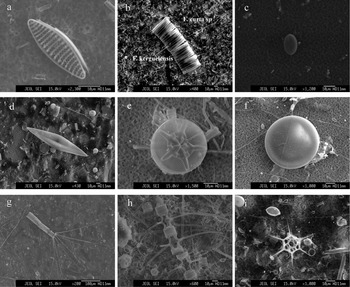
There are three main types of single particles: biogenic particles, mineral particles and other particles. According to the SEM and EDS results, the SPM was dominated by biological particles at most stations (Fig. 3). Biological particles in the study area were dominated by microscopic planktonic diatoms (2–20 μm, parts up to 50–100 μm), and the abundance, composition and cell size of diatoms varied greatly among stations. At most of the stations, the pennate diatoms were predominant, mainly including Fragilariopsis kerguelensis, Fragilariopsis curta and Cocconeis species, and a few Navicula and Amphora species were seen at some stations (Fig. 4). At the central stations of the study area (especially stations XFT08, XFT11 and D3-10), F. curta occurred abundantly (Fig. 3). The centric diatoms are mainly species of the genera Corethron, Chaetoceros and Thalassiosira and Asteromphalus hookeri, among which the Corethron species are dominant at stations XFT04, DA-01 and DC-05, while the Chaetoceros species are only abundant at stations XFT10 and DC-10. The Thalassiosira species and Asteromphalus hookeri were widely present in the study area, but their abundances were relatively low and their sizes varied widely. In addition, silicoflagellates, which are siliceous organisms other than diatoms, were also distributed in the study area, mainly occurring at stations SR01-04, XFT10 and D5-07.
Scanning electron microscopy images from different stations around the Antarctic Peninsula.

The biogenic particles in the suspended particles. a. Fragilariopsis kerguelensis; b. F. kerguelensis and Fragilariopsis curta sp.; c. Cocconeis; d. Navicula; e. Asteromphalus hookeri; f. Thalassiosira; g. Corethron; h. Chaetoceros sp.; i. silicoflagellate.

The samples from the study area contain relatively few mineral particles, mainly quartz and aluminosilicate rock-forming minerals (e.g. potassium feldspar, albite and anorthite), with occasional calcite and black mica (Fig. 5). Other particles were mainly fine organic materials, of which the elemental composition was mainly C, N and O.
The mineral particles in the suspended particles. a. & b. Potassium feldspar; c. & d. albite; e. & f. anorthite; g. & h. quartz; i. mica.

Flocculation aggregates
The contents of flocculation aggregates in the SPM of the study area varied widely. These contents can be divided into four types - biological aggregates (diatom aggregates and bioclastic aggregates), mineral aggregates, miscellaneous aggregates and organic films - according to the differences in the compositions of the main substances in the flocculation aggregates (Fig. 6).
The flocculation aggregates in the suspended particles. a. & b. Diatom aggregate; c. bioclastic aggregate; d. & e. mineral aggregate; f. & g. miscellaneous aggregate; h. & i. organic film.

Diatom aggregates were widespread in the surface waters of the study area and usually consisted of diatom particles of a few to tens of microns, with maximum diameters up to 300 μm (Fig. 6a & b). The bioclastic aggregates consisted mainly of diatom particles and other siliceous bioclasts (Fig. 6c), and their characteristics were similar to those of the diatom aggregates. Mineral aggregates are collections of many fine individual fragmented minerals under the action of organic matter in sea water (Fig. 6d & e). The occurrence of mineral aggregates in the study area was not frequent, only being observed at stations DC-01, DC-03 and DC-05. The miscellaneous aggregates are mainly formed by collision and adhesion between particles under the action of Brownian motion and biological mucus, and they mainly consist of various diatoms, biological debris, minerals and other particles (Fig. 6f & g). These were only observed at stations SR01-07, XFT10, D3-06, DC-03 and DC-05. Organic films are membrane-like colloidal materials that appeared as dark grey-black membranes covering the filter membrane under SEM (Fig. 6h & i). Their morphology differed from their original form in water because they were damaged during the water sampling and filtering process. The EDS results for organic films showed that their chemical elemental compositions were mainly C, N and O. Organic films were widely observed in the study area, with sizes ranging from 10 to 200 μm.
Distribution of POC, PN and δ13C of SPM in the surface waters
The concentration of SPM in the surface waters around the Antarctic Peninsula was low, with a range of 0.02–2.68 mg l-1 and an average concentration of 1.02 mg l-1. In this study, SPM concentrations were successfully determined only in the eastern part of the study area, while no valid data were obtained in the central and western parts of the study area because the SPM levels in the water were too low. The high-SPM concentration area occurred in the south-eastern part of the study area, and these values decreased from south to north and from east to west (Fig. 7a).
Distribution of a. suspended particulate matter (SPM) concentration, b. suspended particulate organic carbon (POC) concentration, c. suspended particulate nitrogen (PN) concentration, d. C/N molar ratio and e. carbon isotopic composition (δ13C) values in the surface water around the Antarctic Peninsula.

The POC concentration in the surface waters of the study area ranged from 0.02 to 0.33 mg l-1, with an average of 0.10 ± 0.07 mg l-1 (Fig. 7b). High POC concentrations appeared in the nearshore area, mainly to the south of the South Orkney Islands, where the chlorophyll a concentration could reach values > 3 mg m-3. The high-POC concentration region is consistent with the high-SPM concentration region. The PN concentration (0.008–0.092 mg l-1, with an average of 0.026 ± 0.020 mg l-1) was lower than the POC concentration, whereas the distribution of PN was essentially the same as that of POC (Fig. 7b). The C/N molar ratios ranged from 2.56 to 7.06 (average of 4.75 ± 1.03). The areas with low C/N ratios (< 4) mainly occurred in the deep-water area in the central part of the study area and at stations DC-03 and DC-06 in the eastern part of the study area, while the highest values were found at stations SR01-04 in the northern part of the Drake Passage (Fig. 7c).
The δ13C values of suspended POC in the study area varied from -31.8‰ to -22.9‰, with an average of -28.9 ± 1.8‰. High δ13C values mainly occurred around the South Orkney Islands, with values up to -22.8‰. The δ13C value in the eastern study area was higher than that in the western study area, whereas low δ13C values were mainly distributed in the central and south-western regions of study area, with δ13C being < -30‰ (Fig. 7d).
Discussion
Factors influencing the distribution of suspended POM in the study area
POM in the ocean is an important indicator of primary productivity (Ducklow et al. Reference Ducklow, Steinberg and Buesseler2001, Weston et al. Reference Weston, Jickells, Carson, Clarke, Meredith and Brandon2013), of which the concentration and distribution are affected by many factors. The source and composition of SPM are the most fundamental factors affecting POM in sea water. The suspended particulate fractions in the study area were mainly biogenic components (e.g. diatoms) and terrestrial mineral particles (e.g. quartz and feldspar), in which the diatom particles play a dominant role, indicating that in situ primary production might be the most important source of POM in the water column of the study area. In this study, regions with higher POC (the main component of POM) concentrations corresponded to higher diatom biomass (SEM results), such as at stations XFT10 and DC-10, and correspondingly the SPM concentrations in regions with low POC were significantly lower (Figs 3 & 7). Mineral particles represented one of the most significant components of SPM in the study area, which were mainly terrestrial volcanic rock-forming minerals such as feldspar and quartz from the weathering and denudation of rocks in the surrounding islands and the Antarctic Peninsula and were transported and dispersed by sea currents (Diekmann & Kuhn Reference Diekmann and Kuhn1999, Liu et al. Reference Liu, Chen, Jin and Wang2014). The supplying of terrestrial material may also bring terrestrial POC to the study area. However, the low C/N molar ratio (average of 4.75) in the study area suggests that the contribution of terrestrial POC to the total POC in the study area is almost negligible. In addition, there was a significant positive correlation (R 2 = 0.901, n = 21, P < 0.001) between PN and POC molar concentrations (Fig. 8a), indicating the same origin for POC and PN. However, the slope of the regression line (4.07) was lower than the Redfield ratio (6.63), which is difficult to explain using the current data. Therefore, more data need to be collected in subsequent studies to explain this abnormal phenomenon.
Correlations between a. particulate organic carbon (POC) and particulate nitrogen (PN) and b. carbon isotopic composition (δ13C) and POC. VPDB = Vienna Pee Dee Belemnite.

The chlorophyll a concentration can represent the level of phytoplankton biomass in surface waters, which determines the distribution of POC concentration in the water column to a certain extent (Lara et al. Reference Lara, Alder, Franzosi and Kattner2010, Weston et al. Reference Weston, Jickells, Carson, Clarke, Meredith and Brandon2013). There was a strongly positive relationship between chlorophyll a and POC concentrations in the study area (Figs 2 & 7), reflecting the significant contribution of in situ primary productivity to the suspended POC. In the nearshore areas with the highest POC concentrations (to the south of the South Orkney Islands), the chlorophyll a concentration could reach values > 3 mg m-3. These nearshore areas were mainly affected by terrestrial materials (mainly active Fe) carried into the sea by melting glaciers in summer, resulting in a phytoplankton bloom and a rapid increase in marine primary productivity, which generated large amounts of POC (Wang et al. Reference Wang, Chen, Chen, Jia, Li, Zheng and Qiu2020). In addition, high POC concentrations were also present in the sea-ice margin areas in the eastern and northern parts of the study area. These deep-water areas covered by sea ice in winter belong to the oligoproductive regions with high nutrient and low chlorophyll a levels, where primary productivity is mainly limited by the amount of active Fe (Lin et al. Reference Lin, Rauschenberg, Hexel, Shaw and Twining2011, Wang et al. Reference Wang, Chen, Chen, Jia, Li, Zheng and Qiu2020). The seasonal changes in sea ice affect the hydrological processes, water temperature and biological activities (mainly photosynthesis) in the corresponding marine waters, which control to a significant degree the survival of plankton in the water column (Vernet et al. Reference Vernet, Martinson, Iannuzzi, Stammerjohn, Kozlowski and Sines2008, Wang et al. Reference Wang, Chen, Chen, Jia, Li, Zheng and Qiu2020). Therefore, in summer, due to the release of large amounts of active Fe as well as ice algae brought about by the melting of sea ice, primary productivity rose rapidly and high chlorophyll a and POC concentrations occurred in the sea-ice edge region, where chlorophyll a concentrations can even be as high as 5 mg m-3.
The formation of both diatom aggregates and bioclastic aggregates is another factor influencing the distribution of POC in sea water. These aggregates are related to biological processes and are formed by the adhesion of extracellular polymeric substances produced by diatoms and other organisms (Alldredge & Silver Reference Alldredge and Silver1988, Bhaskar & Bhosle Reference Bhaskar and Bhosle2005). Similarly, organic films could control the distribution of POC by trapping and aggregating biological debris, and these films are important in marine biogeochemical processes (Alldredge & Silver Reference Alldredge and Silver1988).
Main driving forces of suspended POC δ13C variability in the surface water around the Antarctic Peninsula
The low δ13C values of suspended POC (δ13CPOC) in the study area are mainly controlled by the high CO2 content in the waters surrounding the Antarctic Peninsula (Lara et al. Reference Lara, Alder, Franzosi and Kattner2010, Tortell et al. Reference Tortell, Mills, Payne, Maldonado, Chierici and Fransson2013), which is a common feature of the Southern Ocean. On the basis of this, the growth rate of phytoplankton is also one of the significant factors affecting δ13CPOC (Popp et al. Reference Popp, Trull, Kenig, Wakeham, Rust and Tilbrook1999). A rapid growth rate of phytoplankton will lead to a higher δ13CPOC, which is due to the higher growth rate increasing the carbon demand and thus limiting the isotopic fractionation during carbon uptake, ultimately producing a significant positive correlation between the POC content and the δ13CPOC value (Henley et al. Reference Henley, Annett, Ganeshram, Carson, Weston and Crosta2012). According to the models of Rau et al. (Reference Rau, Riebesell and Wolf-Gladrow1997) and Popp et al. (Reference Popp, Laws, Bidigare, Dore, Hanson and Wakeham1998), a 25% increase in the growth rate of phytoplankton would be sufficient to produce a 2% enrichment in δ13CPOC. Thus, the δ13C value of POC produced in the high-productivity regions represented by high chlorophyll a contents in summer in the seas around Antarctica tend to be more positive compared to in other regions (Trull et al. Reference Trull, Davies and Casciotti2008). In this study, except for at stations D3-06 and DC-10, all stations showed a significant positive correlation between surface water POC content and δ13CPOC values (R 2 = 0.648; Fig. 8b), reflecting the control of the phytoplankton growth rate on δ13CPOC values. At stations D3-06 and DC-10, despite the high POC concentration, the δ13C values were relatively negative, which might have been influenced by the phytoplankton assemblages or by the ocean current (mainly ACC and WG). The existing data cannot explain this phenomenon, so more in-depth studies need to be conducted to explore and verify this finding. It is noteworthy that phytoplankton blooms in Antarctic waters are mainly controlled by melting sea ice (Zhang et al. Reference Zhang, Zheng, Chen, Ma, Cao and Qiu2014). The release of active Fe and ice algae from melting sea ice led to a greater susceptibility to phytoplankton blooms at sea-ice margins, which also resulted in significantly higher δ13CPOC values in sea-ice margin regions than in other regions (Henley et al. Reference Henley, Annett, Ganeshram, Carson, Weston and Crosta2012). Therefore, the distribution of sea ice was also an indirect factor controlling δ13CPOC, especially at stations XFT10 and DC-06 (Fig. 2 & Table I). In addition, the release of ice algae from melting sea ice, which had a high δ13CPOC value ranging from -25.7‰ to -12.9‰ as reported by Tortell et al. (Reference Tortell, Mills, Payne, Maldonado, Chierici and Fransson2013), could directly result in a higher δ13C value of the suspended POC. This mechanism could be used to explain the abnormal high δ13CPOC value at station XFT10.
The values for suspended particulate matter (SPM), particulate organic carbon (POC) and particulate nitrogen (PN) concentrations, C/N molar ratios and carbon isotopic composition (δ13C) in the sea around the Antarctic Peninsula.

Phytoplankton assemblages also have a significant influence on δ13CPOC due to differences in the mechanisms and processes of CO2 uptake and utilization in the water column by different phytoplankton species (Henley et al. Reference Henley, Annett, Ganeshram, Carson, Weston and Crosta2012), resulting in differences in the degree of fractionation of carbon isotope values during POC production. Therefore, against a background of low δ13CPOC due to high CO2 concentrations, the δ13CPOC value of different phytoplankton assemblages in the Southern Ocean differed significantly. According to Kopczyriska et al. (Reference Kopczyriska, Goeyens, Semeneh and Dehairs1995), the pennate diatoms have higher carbon isotope values than Phaeocystis, naked flagellates and autotrophic dinoflagellates, resulting in significant differences in δ13CPOC values in different areas. For example, in this study, station D3-06 had a low diatom content despite its high POC concentration, so most of this POC probably originated from phytoplankton other than diatoms, resulting in a low δ13CPOC value of -31.0‰. However, the morphology of these organisms was easily damaged during the filtration process, resulting in difficulties in identifying them from the SEM results of this study for further analysis. Therefore, combinations of phytoplankton morphology analyses may need to be considered in subsequent studies.
The importance of suspended POC for studying primary productivity under conditions of global climate change
Phytoplankton such as diatoms absorb dissolved silica from the water under summer light levels, temperatures and nutrient supplies to form biogenic silica, which is exported from the euphotic zone and deposited into the sea-floor sediments as biological relics, and organic carbon is simultaneously transported to the deep sea during this process (Tréguer Reference Tréguer2002, Isla & DeMaster Reference Isla and DeMaster2021). Diatoms, as major producers in the Southern Ocean ecosystem, contribute > 50% of the organic carbon flux to the deep ocean and are also the most significant contributors of biogenic silica in surface sediments (Serebrennikova & Fanning Reference Serebrennikova and Fanning2004, Isla & DeMaster Reference Isla and DeMaster2021). In the surface waters around the Antarctic Peninsula, siliceous biological remains, mainly diatoms, are the most important components of SPM. The variation in primary production resulted in significant differences in suspended POC concentrations in different regions of the study area. Therefore, the suspended POC content and δ13CPOC value can be used to suggest the primary production processes of relevant regions, and, furthermore, it is important for us to understand the biogeochemical cycles in the Southern Ocean.
An adequate supply of nutrients (including active Fe) is an important basis for phytoplankton growth within suitable water environments (i.e. suitable water temperature, light permeability and hydrological processes; Lin et al. Reference Lin, Rauschenberg, Hexel, Shaw and Twining2011, Wang et al. Reference Wang, Chen, Chen, Jia, Li, Zheng and Qiu2020). Compared to low-latitude regions, the nutrient supply and water environment in the high-latitude regions around Antarctica are significantly influenced by continental glaciers as well as sea-ice cover (Diekmann & Kuhn Reference Diekmann and Kuhn1999, Vernet et al. Reference Vernet, Martinson, Iannuzzi, Stammerjohn, Kozlowski and Sines2008). Continental glaciers are the main drivers of terrestrial material transport from the Antarctic continent and surrounding islands to the ocean, while sea-ice cover also significantly affects the exchange of material and energy between marine waters and other environments (Gibson & Trull Reference Gibson and Trull1999). Sea ice limits the input of nutrients and sunlight by isolating the ocean from other environments such as land and the atmosphere, directly affecting the growth processes of phytoplankton. Therefore, when the sea ice melts, this inputs nutrients and changes the water column environment, so phytoplankton tend to bloom, which in turn produces a large amount of POC and increases the δ13CPOC value. This POC degrades in the water column, and the undegraded portion settles to the deep sea or undergoes transport with ocean currents (Lara et al. Reference Lara, Alder, Franzosi and Kattner2010, Isla & DeMaster Reference Isla and DeMaster2021). In this study, the regions with high SPM concentration were largely consistent with high biogenic particle fractions and POC concentrations and mainly occurred in areas of high primary productivity, indicating a close association between SPM and phytoplankton primary productivity. In addition, despite the short phytoplankton growth period in the Antarctic shelf region, primary productivity during the short summer growth period is still higher than overall annual primary productivity in the rest of the Southern Ocean (Arrigo et al. Reference Arrigo, Weiss and Smith1998, Vernet et al. Reference Vernet, Martinson, Iannuzzi, Stammerjohn, Kozlowski and Sines2008). As one of the most important carbon sinks in the world, the summer phytoplankton bloom brings a large amount of POC as well as siliceous remains to the Antarctic region. Larger and heavier SPM (e.g. flocs) will rapidly settle and thus be removed from the surface waters, transporting organic carbon to the deep sea (Lourey et al. Reference Lourey, Trull and Tilbrook2004), although only ~1% of the carbon from primary production in the surface waters of Antarctica eventually settles to the sediment (Weston et al. Reference Weston, Jickells, Carson, Clarke, Meredith and Brandon2013).
In recent years, glaciers on the Antarctic Peninsula have retreated with global warming, leading to a reduction in the mass of ice shelves and increasing the supply of icebergs to the Southern Ocean (Rignot et al. Reference Rignot, Bamber, van den Broeke, Davis, Li, van de Berg and van Meijgaard2008, Chen et al. Reference Chen, Wilson, Blankenship and Tapley2009). The melting of glaciers has increased the transport of terrestrial material to the sea, promoting the growth of phytoplankton in the nearshore waters of the Antarctic Peninsula. In addition, free-drifting icebergs can be driven by currents to migrate, and their meltwater might be an important source of nutrients and reactive Fe within the surrounding waters (Lin et al. Reference Lin, Rauschenberg, Hexel, Shaw and Twining2011), which further expands the phytoplankton bloom in the waters around the Antarctic Peninsula. The water warming caused by global warming will inevitably reduce the CO2 solubility in the waters around Antarctica, and there might be significant effects on the primary production of phytoplankton and the isotopic composition of the POC they produce. Therefore, studying the suspended POC in Antarctic waters could provide a new perspective for the quantitative assessment of global climate change and its impact on the Antarctic region, and this is a topic on which follow-up studies should focus.
Conclusion
The SPM in the surface water around the Antarctic Peninsula mainly consisted of biological particles and flocculation aggregates, indicating that most of the POC may originate from the in situ primary production of phytoplankton, which consisted mainly of diatoms according to the SEM results. The close relationship between chlorophyll a and POC concentrations in the study area also reflects a significant contribution of in situ primary productivity to the suspended POC, which mainly occurred at the sea-ice edge, revealing a significant influence of sea-ice melting during summer. However, the δ13CPOC values (range of -31.80‰ to -22.79‰ and average of -28.92‰) were significantly lower than levels of marine source POC produced in the low-latitude region due to the high dissolved CO2 concentration in Antarctic waters. In addition, the variation in δ13CPOC values was influenced by the high growth rate of phytoplankton resulting from sea-ice melting and phytoplankton assemblages according to the chlorophyll a and SEM results. A surprising outcome of this study was that the C/N molar ratio (average of 4.75) was significantly lower than the Redfield ratio, but the PN concentration was significantly correlated with POC (R 2 = 0.901), suggesting that they may both originate from phytoplankton. Therefore, more data need to be collected in subsequent studies to explain this abnormal phenomenon. In addition, this study showed that the characteristics of POC in sea water can act as a record of the impacts of sea-ice melting on the ecological environment of the sea around Antarctica under conditions of global warming, providing an important reference for the study of polar carbon cycles. This is of great significance for the study of material cycling in the Antarctic region under conditions of global climate change.
Acknowledgements
We thank all of the explorers of the 34th Chinese National Antarctic Research Expeditions conducted on RV Xiangyanghong 01. This manuscript benefited from comments by two anonymous reviewers.
Financial support
This work was supported by the Chinese Arctic and Antarctic Administration, Ministry of Natural Resources (No. IRASCC2021-01-03-02 and 02-03) and National Natural Science Foundation of China (No. 41676191).
Author contributions
In this work, Y. Li and Y. Huang designed the research ideas, analysed the data and reviewed the manuscript. Y. Lin analysed the data, prepared the figures and wrote the manuscript. Z. Chen, L. Wang and D. Li took the lead in sample testing and contributed to the data analysis. S. Tao contributed to the data analysis and reviewed the manuscript.