Introduction
The physical and psychosocial impact of cancer often leaves patients feeling distressed and overwhelmed. Relevant patient education given at the right time can help cancer patients cope in their cancer journey. Useful patient education does not only include information about the patient's treatment and disease, but also information about their health-care system and supportive services so that the patients and their families can navigate the hospital system during their journey.Reference Houts, Nezu, Nezu and Bucher1, Reference Ream and Richardson2 Merluzzi et al.Reference Merluzzi, Nairn and Hegde3 explained that the coping process for cancer patients involves the use of resources within the patients themselves and that of the environment. Therefore, the ability for cancer patients to access and orient the health-care system and hospital environment helps them cope and adapt to their cancer journey.
Printed patient education materials are more often used as a tool to augment verbal patient teaching. Printed materials can serve as reference resources that can be reviewed at home or with the patient's family. However, patients do have barriers when using this printed resource owing to age, education, ethnicity and language skills.Reference Moody4 Therefore, when the printed patient education material is written with an incorrect readability level, the desired patient education outcome can be limited and may induce treatment anxiety.Reference Cutilli5, Reference Llewellyn, McGurk and Weinman6 The implementation of printed materials therefore requires careful design of the material, a well-organised distribution plan and, most importantly, evaluation of the material.Reference Butow, Brindle and McConnell7, Reference Rankin8 Dunn et al.Reference Dunn, Steginga and Rose9 indicated that assessing the learning outcome of cancer patients can be challenging and costly, because there is a lack of standard evaluation methodologies in determining the real learning outcome.
To facilitate patient orientation to the head and neck (H&N) cancer population in the study institution, a booklet entitled ‘starting radiation therapy: helpful tips for patients with head and neck cancer’ was developed. A multi-disciplinary team conducted a literature review and used in-house patient education needs assessment dataReference Cooley, Moriarty and Berger10–Reference Wizowski, Harper and Hutchings13 to develop the contents of the booklet. The team included H&N radiation oncologists (ROs), radiation oncology nurses and radiation therapists. The intent of the booklet was to facilitate patient orientation to the study hospital and to increase their awareness regarding available hospitals and community services.
‘Starting radiation therapy: helpful tips for patients with head and neck cancer’ is a 32-page booklet developed to facilitate patient orientation to the study hospital. There are 12 chapters in this book:
1. Frequently asked questions (FAQ)
2. Princess Margaret hospital services
3. Information sessions
4. Transportation and accommodation
5. Your healthcare team
6. Coping with cancer
7. Community support
8. General coping information
9. Coping with advanced disease
10. PMH patient and family library resources for H&N cancer
11. H&N cancer and general cancer web sites
12. PMH quick reference telephone list
LlewllynReference Llewellyn, McGurk and Weinman6 found that health-care professionals play an important role in the patient education process; they have an impact on patient accessibility to resources, patient satisfaction and learning outcome. Staff's use of the booklet is paramount to ensure patients’ accessibility to the information. Staff members are also responsible for content accuracy, and maintain updated patient education. The usefulness of the resource as a teaching tool should be ascertained and optimised to achieve the desired learning outcome.
Therefore, the goal of this study is to examine the distribution and the usefulness of the booklet from both perspectives of patients and the health-care providers (staff). In the context of quality improvement and patient-centred care, the findings will be used to revise the booklet owing to the patient demographics of the study hospital, and the results will also be a reference if any necessary translation into other languages is needed.
Methods
Study population
Patients with H&N or thyroid cancer receiving radical or adjuvant radiotherapy were recruited to this study. Patients with literacy difficulties were recruited to this study if family members agreed to assist with the translation. Patients with critical health conditions, requiring psychosocial assistance, and/or inpatients were excluded.
Radiation oncology health-care providers involved in the care of H&N cancer patients during the same period were recruited to this study, namely, the ROs, advanced practice nurses (APNs), registered nurses (RNs), radiation oncology residents, radiation oncology fellows in the H&N cancer site group and radiation therapists.
Study design
This is a single-centre, research ethics board-approved prospective study undertaken in the radiation medicine department of Princess Margaret Cancer Centre. A research team consisting of five radiation therapists, one clinical educator and one H&N cancer APN, designed a survey evaluating the usefulness and the distribution of the booklet from both patients’ and staff's perspective. The survey was adapted from the ‘Tell us what you think’, a patient education survey used by the University Health Network.Reference Wizowski14 To reflect patient-centred care principlesReference Gerteis, Edgman-Levitan, Daley and Delbanco15, Reference Stewart, Brown and Weston16 and health literacy,Reference Foltz and Sullivan11 the adapted survey design included open-ended questions so that the participants can provide additional comments. The final survey contained two questions regarding distribution, nine 5-point Likert scale (1 = strongly disagree, 3 = neutral, 5 = strongly agree) questions regarding usefulness, six open-ended questions and three demographic questions (Appendix A). The staff and the patient surveys were developed concurrently to ensure that same questions and contents were covered; however, the research team modified the questions for the patient group by using plain language to minimise readability issues.
A pilot study consisting of eight hospital volunteers was conducted to validate the length and readability of the patient survey. There were no changes made to the survey after the pilot study. $$$$
The recruitment plan for patient participants was designed on the basis of the patient care pathway for H&N cancer patients at the study hospital. New patients who attended clinic from February to June 2007 were recruited to the study. At the New Patient Clinic, the RO identified eligible patients. During the mandatory patient education session and CT simulation, the radiation therapist approached and explained the study rationale to patients. When the patient consented to the study, the radiation therapist provided an ‘H&N booklet survey package’ to the patient. The survey package contained a consent form, the printed survey, a self-addressed envelope and a copy of the booklet. The patient was asked to complete the survey independently or with help from a family member. After completion of the survey, the patient returned the anonymous survey in the sealed envelope to the designated drop box in the department on their first radiotherapy appointment.
The staff survey was administered anonymously using a licensed online survey tool. The study was conducted in a 4-week period in March 2007. A communication plan was launched 2 weeks before the implementation to encourage staff participation: the research study was announced at H&N weekly case-review rounds for ROs, fellows and residents, staff meetings for radiation oncology nurses and radiation therapists. Finally, staff were invited to participate via email with a cover letter describing the purpose of the study and the online survey link.Reference Chan17 Implied consent was obtained when the staff opened the web link to the survey. A reminder email was sent to staff at weeks 2 and 4 to enhance response. The participants took ∼10 minutes to complete the survey.
Data analysis
Data from the patient and the staff surveys were analysed. Quantitative responses were analysed using descriptive data such as percentages and frequencies. All qualitative responses were reviewed and categorised using thematic analysis. Finally, a count was done for each category. Subsequent to the completion of the independent analysis, data from the patient and the staff cohorts were compared.
Results
Demographics
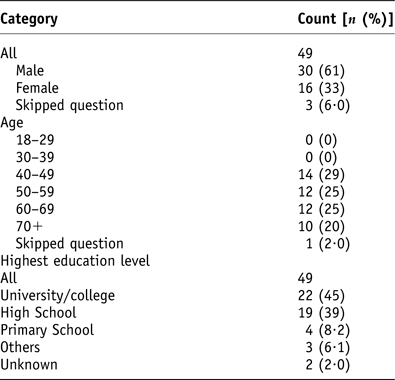
Table 1 shows demographics of recruited patients. A total of 49 patients were recruited, with 30 male (61%), 16 female (33%) and three patients who did not indicate their gender. More than two-thirds of patients were over 50 years old. This cohort of patients is well educated, with almost half (45%) of the patients completing university/college education. Figure 1 shows the composition of staff members. A total of 40 staff completed the online survey. They consisted of four ROs and residents, 10 RNs/APNs, 25 radiation therapists and one staff who did not specify his/her profession.
Patient demographics
Professional composition of staff cohort (n = 40).
Distribution of the booklet
Almost all patients (n = 48) indicated that they have received the booklet from the health-care team. The majority of them (n = 45, 94%) received the booklet before their first radiotherapy treatment. One patient indicated that they downloaded the booklet from the hospital website.
Of the staff, 85% (n = 34) were aware of the availability of the booklet. Of them, 70% (n = 24) used the booklet as part of patient education: at the New Patient Clinic (n = 9), at the Patient Education Session and CT Simulation (n = 11), at the First Radiotherapy Treatment (n = 6) and, finally, during the course of radiotherapy treatment (n = 4). Of the staff, 88% (n = 30) indicated that they had read the whole (n = 24) or parts (n = 7) of the booklet before the survey. Three staff members did not respond to this question; 15 staff members (44%) indicated that they have referred to specific contents in the booklet during their patient encounters; and 22 staff members (65%) indicated they would recommend this booklet to be adapted to other cancer sites.
Usefulness of the booklet
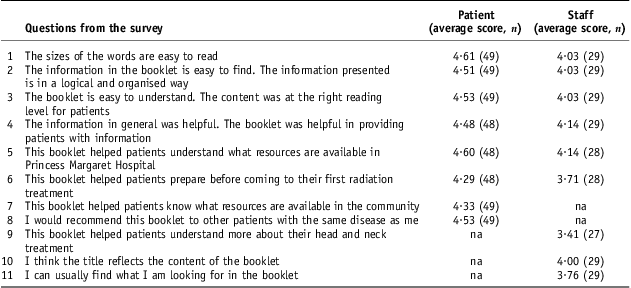
Table 2 illustrated a summary of five-point Likert scale responses comparing both the patient and the staff cohorts. These questions addressed the usefulness of the booklet. Patients were generally satisfied with this booklet: their average scores were all over 4, with the lowest score 4·29 out of 5. Staff scored lower in general, ranging from 3·71 to 4·03 out of 5.
Evaluation of the booklet (Likert scale)
Patients thought that the size of the words was easy to read (Q1, score 4·61), and the booklet helped them understand what resources were available at the study hospital (Q5, score 4·60). The patients felt that the book was easy to understand, the content was at the right reading level for them (Q3, score 4·53) and that they would recommend this booklet to another patients (Q8, score 4·53). The staff agreed that the booklet was helpful in providing patients with information (Q4, score 4·14), and it helped patients understand the resources available at the study hospital (Q5, score 4·14).
The lowest scored survey question for patients was Q6 ‘This booklet helped patients prepare before coming to their first radiation treatment’ (score 4·29). Staff scored lowest in Q9: ‘This booklet helped patients understand more about their head and neck treatment’ (score 3·41).
A total of 36 out of 49 patients and 29 out of 46 staff responded to the survey question regarding their preferred language. A total of 15 out of the 36 patients (41%) versus 24 of the 29 staff (83%) indicated that they prefer this booklet to be available in other languages. A few patients specified their preferred language: Portuguese (three), Italian (one), Russian (one) and Finnish (one). Staff further specified preferred languages for the booklet: Chinese (nine), Portuguese (seven), Italian (two), French (two), Spanish (two) and Vietnamese (two).
Response from open-ended questions
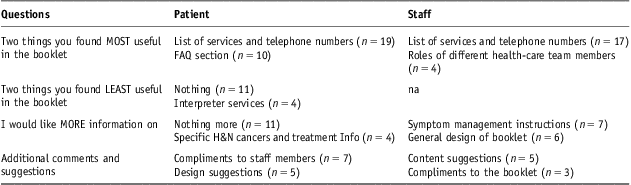
Table 3 summarised the response from the open-ended questions for both cohorts. The top two most frequently cited items by patients and staff were collated.
Responses from open-ended questions
Two most useful items
Both patients and staff responded that the list of services and telephone numbers (Chapter 2) was the most useful item in the booklet. Patients also thought that the FAQ section (Chapter 1) was useful: one patient wrote ‘having answers to questions that we had not even thought of’. The staff members indicated that the role of different Health Care Team Members section (Chapter 5) was the second most useful item. This item was ranked third by patients; one patient responded ‘the health care team's roles and responsibilities because they clarify things’.
Two least useful items
This question was only included in the patient survey. Four patients indicated that the information regarding interpreter services was least useful. Though, 11 patients wrote ‘Nothing’, indicating all contents were useful.
I would like more information on
Four patients and seven staff wanted more information on different types of head and neck cancer and their respective treatments and side effects. Six staff indicated that the general design of the booklet can be improved by having more photographs. Eleven patients wrote ‘Nothing’, one patient wrote ‘Perfect! Any more will cause information overload’.
Additional comments
Seven patients gave compliments to the staff members, such as ‘keep up the good work!’ Some patients provided design suggestions, such as ‘use more photos’. Five staff members provided specific content suggestions, for example, ‘add community and tumour specific info’ and ‘add what to expect in treatment’. Three staff gave compliments to the booklet, such as ‘booklet is comprehensive’.
Interpretation of results
Distribution
The data suggest that the booklet was distributed to the patients at the intended time points in their care pathway. The distribution pattern by staff is consistent with the patient response: 94% of the patients in this study received their booklet before their first radiation treatment.
Usefulness
Both the staff and the patients found this booklet useful for patient orientation only. Both cohorts found that this booklet was not as helpful in preparing patients for their clinical procedure and side effects from their H&N radiation treatments. This result was not surprising to the research team because the intent of this booklet was for patient orientation, as other resources were already in use to describe technical appointments such as CT simulation. As H&N cancer patients experience many diverse side effects with different treatment protocols,Reference Murphy, Gilbert and Ridner18 the study hospital routinely also offers specific patient education pamphlets, such as skin care, oral hygiene and xerostomia pamphlets, to address specific radiotherapy-induced side effects. This result suggested that the revise booklet should include specific reference so that patients are aware where to access these procedural and symptom management pamphlet if needed. This result also demonstrated that the staff thoroughly studied the booklet before incorporating it as part of the patient education.
Language preference
The data show that there is a difference in patient and staff preference in the language of the booklet. This finding may be attributable to a small patient sample size, and hence an education and language bias were induced. The staff was also more aware of the diverse linguistic needs of H&N cancer patients in the study hospital. According to an in-house audit,19 the overall cancer population of the study hospital consisted of 35% who indicated that English was their second language. Our study recruited a high percentage of educated patients: 39% patient completed high school and 45% completed university education. Therefore, we hypothesised that most patients recruited preferred English, regardless of their first language.
Most useful item
Both cohorts ranked list of services and telephone number section as the most useful item in the booklet; this result is consistent with the intent of the booklet to orientate patients to the study hospital. ZarcadoolasReference Zarcadoolas, Pleasant and Greer20 stated that a telephone list increases health literacy for patients, namely civic literacy, that is, by having the telephone numbers available, the patient can learn how the hospital infrastructure works.
The patient and staff indicated that the Roles of the Health-Care Teams section was very important. HalkettReference Halkett, Merchant and Jiwa21 validated this finding, as health-care professionals communicate and educate patients about their treatments, the interaction will be enhanced when the patient knows the role and expertise of each discipline and it helps them ask applicable questions. The complex hospital environment and the diverse health-care professional team can be overwhelming to the newly diagnosed cancer patients. This booklet helped patients develop their health literacy skills.Reference Zarcadoolas, Pleasant and Greer20 Patients’ awareness and understanding of the hospital infrastructure, services and the roles of the staff facilitate their adaptation to the new environment and new challenge.
Least useful item
Four patients found the information on Interpreter Services not useful. Similar to the patients’ language preference, this result can be attributable to the high education level of the patients who were recruited to the study. A more comprehensive in-house audit regarding interpreter services19 showed that ∼45% of Chinese, 9% Portuguese and 6% Polish interpreter services were utilised, implying that the overall cancer patient population is diverse in ethnicity and English language proficiency. Therefore, the patient cohort of our study may not be a true representation of the cancer population in the study hospital.
Improvement and suggestions
Both patients and staff indicated the need to improve the general design of the booklet by including more colour photographs. Although there is a need to produce patient-centred designed materials,Reference Llewellyn, McGurk and Weinman6 having photos and illustrations available in the booklet increases the production cost, and it may be challenging when funding is limited. Despite the high production cost, attractive and culturally sensitive illustrations can potentially increase comprehension and patient engagement. However, RhyanenReference Ryhanen, Johansson and Virtanen22 reminded educators that poorly selected pictures may also cause more problems than comprehension.
Study strengths and limitations
An important strength of this study was the collection of responses from both the patients and staff to the same patient education material. Most studies evaluating patient education materials were collected only either from the perspective of the learner (patient) or from the provider (staff). This study also included staff comments from a multi-disciplinary care setting in the H&N site group.
This study utilised a printed English self-administered survey to capture patients’ response. The patients recruited to the study did not reflect on the overall H&N cancer patient education level in our hospital. According to Semple,Reference Semple and McGowan23 individual learning needs can be related to age, education and stage of the disease. It is postulated that younger and better educated patients may demand more patient education information. Because of our well-educated patient participants, our results could potentially be biased because literature patients with low literacy and/or with low English proficiency were less inclined to complete this self-administered English survey.Reference Hoffman-Goetz and Friedman24 This limitation suggests that future research instruments should accommodate patients with low literacy and different language needs, and therefore a verbal survey or translated survey may be helpful.
Anticipating that most H&N cancer patients would experience severe radiotherapy-induced side effects such as fatigue, nutritional challenges or skin reaction, which may interfere with their desire to participate in the study at the later course of their treatment,Reference Murphy, Gilbert and Ridner18 the researchers deliberately chose to administer the survey during the first week of their radiotherapy treatment. However, this early time point in the patient care pathway allowed the patient to have the physical ability to complete the survey and precluded them from fully anticipating their learning needs in the rest of the treatment journey. This may be attributable to some of these patients’ comments, ‘not have the chance to review the booklet’, or ‘did not try the services yet’. To understand fully about the patient information and education needs, data should be collected at different time points of their patient care pathway, ideally at the commencement of radiotherapy, during radiotherapy and post radiotherapy, so that different needs at different time points of their cancer journey can be revealed.
Conclusion
The study showed both the patient and staff were well aware and satisfied with the use of this booklet. The content of the booklet was very useful to the patient as an orientation tool for the patient to navigate the hospital at the commencement of the radiotherapy treatment. Further studies need to be conducted to evaluate existing patient education resources used at all the time points of the patient care pathway. The results may provide insight for the development of a comprehensive patient education programme for H&N cancer patients.
Acknowledgements
The authors thank the head and neck site group in the Radiation Medicine Programme at the Princess Margaret Cancer Centre for their support.
Appendix A: Patient survey sample
$$$$
$$$$