1 Introduction
Most sound patterns are both surface-true (the process always applies in a particular environment) and surface-apparent (the motivation for the process is clear). If construed as a rule applying in a specific environment, we expect that the rule will apply in all such environments, and only there. Kiparsky (Reference Kiparsky and Dingwall1971, Reference Kiparsky and Fujimura1973) observes that not all patterns can be analysed in this way, but that there are instances in which a rule applies in an unexpected environment (counterbleeding opacity) or in which a rule fails to apply in the expected environment (counterfeeding opacity).
Opaque interactions are predicted by rule-based accounts. In counterbleeding opacity, the later rule removes some of the inputs for an earlier rule, so it seems to have unexpectedly applied. In counterfeeding opacity, a later rule creates additional inputs for an earlier rule, so it seems as if it has failed to apply. Parallel accounts, such as classic Optimality Theory, however, cannot capture most instances of opacity in a straightforward way. This has resulted in the development of OT-specific mechanisms to capture opacity. Sympathy Theory, for instance, establishes additional correspondence relationships that favour the opaque candidate (McCarthy Reference McCarthy1999). Another approach is to introduce some level of cyclicity in parallel OT, as in Stratal OT (Kiparsky Reference Kiparsky2000, Reference Kiparsky2011, Bermúdez Otero Reference Bermúdez-Oteroto appear). In Optimality Theory with Candidate Chains, evaluation is parallel, but candidates themselves are chains that connect the input to a final output through a series of intermediate forms. Specific constraints can favour an opaque candidate chain (McCarthy Reference McCarthy2007, Wolf Reference Wolf2008).
The opposite view is to reject opacity as a phonologically productive synchronic process altogether. Sanders (Reference Sanders2003) states this most explicitly; he provides mechanisms that can result in seemingly opaque patterns, including morphological exceptionality and historical change, and argues that opaque patterns are rarely productive. Similarly, Green (Reference Green2004) argues that Tiberian Hebrew opacity is a historical residue rather than synchronically active, and Mielke et al. (Reference Mielke, Armstrong and Hume2003) also characterise opacity as a result of language change. Kawahara (Reference Kawahara2015) provides a survey of known opaque interactions in Japanese, arguing that most do not involve a great deal of data and are not fully general, can be reanalysed as transparent or are not productive. Hall et al. (Reference Hall, Jurgec and Kawahara2018) take an intermediate position, in which opaque interactions involve allomorph selection rather than productive phonological patterns; they offer an analysis in Harmonic Serialism, a derivational version of OT.
One crucial insight found in existing literature is that opaque interactions are cross-linguistically rare. Parker's (Reference Parker2009) investigation of seven unrelated languages reveals that counterfeeding and counterbleeding orders are not only much less common than feeding and bleeding, but also less common that would be expected by chance. Furthermore, opaque interactions are often subject to additional phonological and morphological restrictions, including exceptionality. What is rare in the current literature is a large-scale study that shows two or more fully general sound patterns interacting opaquely. One example of such work is Poliquin's (Reference Poliquin2006) analysis of Canadian French laxing vowel harmony, which interacts opaquely with vowel tensing triggered by consonants. The data reveals a great deal of variation, but the opaque patterns are supported by phonetic data and small-scale nonce judgement tasks. Two further examples are the analyses of complex interactions of stress with syncope and epenthesis in Levantine Arabic (Abu-Salim Reference Abu-Salim1982, Farwaneh Reference Farwaneh1995) and stress, raising and vowel deletion in Bedouin Arabic (Al-Mozainy Reference Al-Mozainy1981, McCarthy Reference McCarthy2007: §4.3). All three instances focus on phenomena that typically interact cross-linguistically, such as stress assignment and segmental changes of vowels, or local and long-distance assimilation.
In this paper, I present novel data from Šmartno Slovenian that displays an opaque interaction of two segmental processes: final devoicing and vowel deletion. Obstruents devoice when underlyingly word-final, but not when they become word-final when the following vowel deletes. I present fieldwork data from all known speakers of Šmartno Slovenian, taking into account the phonetics (vowel duration and voicing), phonology (stress assignment and segmental interactions) and morphology (inflectional paradigms). I show that the opaque interaction is widespread and present throughout nominal paradigms. I outline the historical factors, and further demonstrate that the analysis of Šmartno does not need to make reference to other varieties of Slovenian (see Sanders Reference Sanders2003: §5.2.3 for further discussion of this issue). Finally, I show that any deviations from the expected forms in the Šmartno nominal paradigms can be explained by another interacting process: unstressed vowel and glide sequences coalesce into high vowels, which, unlike underlying high vowels, do not delete. The three processes combined can be seen as a synchronic chain shift.
The paper is organised as follows. First, §2 introduces the basic facts about Šmartno Slovenian, focusing on the inventory and prosody. §3 introduces vowel deletion and vowel lengthening. §4 looks at final devoicing and its interaction with vowel deletion. Finally, §5 focuses on data that at first appears to contradict the main generalisations, but turns out to provide evidence of further opacity.
2 Šmartno Slovenian
The focus of this paper is the dialect of Slovenian spoken in the village of Šmartno in Goriška Brda, located in the extreme west of Slovenia.Footnote 1 In comparison to other varieties of Slovenian, the dialect shows several atypical sound patterns. Logar (Reference Logar and Ivić1981) provides a phonological sketch in which he identifies these patterns: loss of unstressed high vowels and schwa, emergence of a new kind of vowel-length distinction, and possibly new tonal contrasts. Logar's (Reference Logar and Ivić1981) description is primarily diachronic.
The aim of this paper is to investigate these characteristics from a synchronic perspective. This paper draws data from three groups of sources: existing descriptions, an elicitation experiment and interviews. Among the descriptions, Logar (Reference Logar and Ivić1981) provides a short description of Šmartno Slovenian, including the vowel and consonant inventories, together with a diachronic account. Logar (Reference Logar1977) examines vowel alternations in Šmartno and several other dialects. The prompt-based production experiment was conducted in 2013 with three female native speakers of Šmartno Slovenian (aged 79–87). The stimuli are listed in Appendix B.Footnote 2 The interviews with the main consultant (henceforth Participant C) were conducted between 2013 and 2017, and include 14 hours of spoken dialogue, stories and paradigm elicitation. The paradigms are listed in Appendix A.
The participants are likely the last speakers of the dialect. Slovenian dialect speakers have been shifting to regional varieties of Slovenian (Kenda-Jež Reference Kenda-Jež2002, Žele Reference Žele and Smole2009, Lundberg Reference Lundberg2013); this is also the case in Šmartno. The regional variety shares most of the vowel and consonant inventory with the Šmartno dialect, but does not exhibit the phonological patterns that are the focus of this paper. The three participants were also fluent in Standard Slovenian, the language of the media and education, even though all participants had attended Italian schools before 1945, when the area was administered by Italy.Footnote 3 Many efforts were made to minimise the effects of Standard Slovenian, including the use of a short frame story to elicit the full range of case forms and multiple repeated elicitations. I also focused on lexical items that are absent or marginal in Standard Slovenian – or at least substantially phonologically distinct.
Before continuing to the discussion of opacity, I briefly discuss the main properties of Šmartno Slovenian that will be relevant for the rest of the paper. I first discuss the segmental inventory (§2.1), then the stress patterns (§2.2) and nominal paradigms (§2.3).
2.1 Inventory
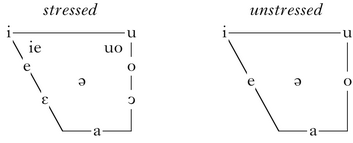
Šmartno has eight contrastive monophthongs in stressed syllables, along with two diphthongs, as in (1) (Logar Reference Logar and Ivić1981). As we will see in the rest of the paper, these vowels can be short (in any syllable of the word) or long (in stem-final syllables only). Unstressed positions contrast only six different vowels, with only one front and one back mid vowel, which I transcribe as /e o/. Stressed /e ε/ are neutralised to /e/ when unstressed, and stressed /o ɔ/ to /o/. The situation with the diphthongs is more complex: stressed /ie/ alternates with unstressed /e/ in roots, but with unstressed /i/ in suffixes. In contrast, stressed /uo/ always alternates with unstressed /o/. Vowel reduction in Slovenian is diverse, and fairly well described (Crosswhite Reference Crosswhite2001, Jurgec Reference Jurgec2011), and patterns similar to Šmartno are found in other dialects. Note that while many Slovenian dialects exhibit quantity distinctions inherited from Common Slovenian (Greenberg Reference Greenberg2000), Šmartno is not one of them.Footnote 4
(1)

The consonant inventory includes obstruent stops, affricates and fricatives, most of which contrast in voicing, as shown in (2), adapted from Logar (Reference Logar and Ivić1981). Stops are fully released even in word-final position, and voiceless stops are unaspirated. Obstruent clusters agree in voicing, without exception. Most obstruents contrast in voicing, but there are two exceptions: in the position before voiced obstruents, the voiceless labiodental fricative /f/ has a voiced allophone [v] (not shown), while the voiceless velar stop /k/ maps onto the voiced velar fricative [ɣ]. The articulation of the voiced velar fricative /ɣ/ has variable pronunciation as [ɦ] when not adjacent to an obstruent, but this variation does not appear to be conditioned by any other phonological factors (free variation). In the rest of the paper, I transcribe this fricative as /ɣ/. According to Logar (Reference Logar and Ivić1981), the voiced coronal anterior affricate /ʣ/ appears in presonorant positions only in loanwords, but no such words appear anywhere in the literature or this paper.
(2)
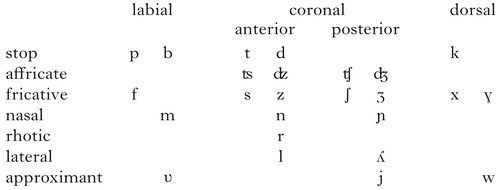
The sonorants include three contrastive nasals, three liquids and three approximants. The realisation of the labiodental approximant varies between [ʋ] (intervocalically) and [υ̝] in other onsets; it neutralises with the labiovelar glide /w/ in the coda. The variation of the voiced labiodental continuant strongly resembles the pattern in other varieties of Slovenian (Srebot-Rejec Reference Srebot-Rejec1981), and more broadly in Slavic (Padgett Reference Padgett2002). The rhotic is most typically realised as a trill [r], but can be realised as a tap [ɾ] in intervocalic positions before an unstressed vowel, particularly in rapid speech. The present data revealed a second lateral, /ʎ/, which is not given in Logar (Reference Logar and Ivić1981). None of the sonorants participates in voicing assimilation. Nasals assimilate in place to the following obstruent, resulting in two additional allophones, [ɱ ŋ]. For ease of reading, I will not transcribe the non-neutralising allophonic variants in this paper, unless relevant to vowel deletion. The nasals and laterals can be syllabic.
2.2 Stress patterns
Stress in Šmartno is contrastive and can fall on any syllable of the word. All vowels can bear stress, including schwa. The nasals and laterals can be syllabic, but can never bear stress. In this section, I focus on how stress is affected by various morphological factors.
The focus of the paper will be on the inflectional suffixation. Generally, roots fall into two groups: those with underlying stress and those without. The data in (3) shows representative nouns for the two groups; only cases which do not display segmental alternations are included. Stress is fixed throughout the paradigm in /ˈpəs/. In contrast, stress can shift to the suffix in /las/.
(3)
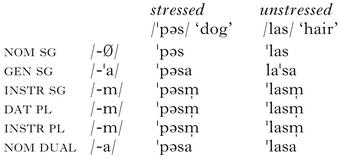
One way to interpret the data in (3) would be to say that it involves two separate paradigms. In such an analysis, the stress facts follow from the different distribution of stress on case suffixes: the genitive singular in the /las/ paradigm would have underlying stress, but not in the /ˈpəs/ paradigm, where stress would fall on the root by default. However, this interpretation leads to the conclusion that any similarities between the two paradigms are accidental. As we will see below, most cases are in fact identical, and all segmental differences between the two paradigms are phonologically predictable. Another reason to reject the separate paradigm analysis would be that the choice of paradigm would also have to be lexically specified for each stem, as the stems do not show systematic segmental differences. Finally, such an analysis also runs counter to one of the core assumptions of generative phonology, that phonological rules are preferred to listed allomorphs (e.g. Jakobson Reference Jakobson1948 for an early proposal along these lines).
The difference between the paradigms in (3) must thus be due to underlying stress on roots and affixes. The root /ˈpəs/ is underlyingly stressed, whereas /las/ is not, and underlying stress on the root outranks stress on the inflectional suffix, predicting fixed stress throughout the /ˈpəs/ paradigm. Underlyingly unstressed roots can become stressed in two situations: either when there is no suffix or when the suffix is not stressed underlyingly, as seen in the /las/ paradigm. The crucial comparison is the genitive singular as opposed to the nominative dual, which are segmentally identical: [lasa]. Yet stress falls on the suffix in the genitive singular, but not in the nominative dual. The difference between the two can only come from the suffix; the genitive singular suffix is underlyingly stressed and the nominative dual unstressed. Thus, when the root lacks underlying stress, the suffix retains its underlying stress. When the root and suffix are underlyingly both stressed or both unstressed, root stress again prevails. These patterns mirror two cross-linguistic tendencies: preference for root over suffix stress (Beckman Reference Beckman1997, Alderete Reference Alderete1999, Smith Reference Smith2005) and maximally one stress per word (culminativity; Prince Reference Prince1983, Hayes Reference Hayes1995).
2.3 Nominal paradigms
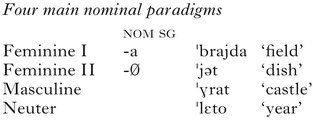
The vast majority of the data in this paper is taken from the nominal paradigms. Šmartno has four nominal paradigms, here termed Feminine I and II, Masculine and Neuter. All roots in Šmartno belong to one of these paradigms, except for a few exceptional nouns which have unique paradigms.Footnote 5 The membership of roots in the nominal paradigms is predictable from grammatical gender. The difference between Feminine I and II is not predictable from the phonological shape of the root, but is lexically specified. However, Feminine I nouns have a suffix /-a/ in the nominative singular form, while Feminine II nouns have a null suffix (or no suffix).Footnote 6 In the Slavic literature, these paradigms are known as a- and i- stems respectively (Kortlandt Reference Kortlandt, Houtzagers, Kalsbeek and Schaeken2008); because historical developments led to changes across paradigms and genders as well as paradigm levelling, using these terms would be misleading. The paradigms are presented in (4) (the nominative singular affixes are added to disambiguate the two feminine paradigms).
(4)
Because the focus of this paper is on inflectional morphology, morpheme boundaries between roots and derivational suffixes will generally not be indicated; instead, the root and any number of derivational suffixes appearing in the same word will be referred to as the stem (McCarthy & Prince Reference McCarthy and Prince1993, Downing Reference Downing1998, Jurgec & Bjorkman Reference Jurgec and Bjorkman2018).
All roots end in a consonant. The majority of roots are monosyllabic, while a smaller number are disyllabic or longer. Most of the elicited roots are identical to stems: Appendix A in the supplementary materials lists 104 monosyllabic stems (70%) and 44 disyllabic or longer stems. Each root can have underlying stress on one of its vowels, or can lack underlying stress (cf. (3) above). The paradigms distinguish six cases and two numbers, with a third number, dual, being contrastive only in the Masculine and Neuter nominative and accusative. In addition, Masculine distinguishes animate and inanimate roots, but only in the accusative singular.
All paradigms feature limited root allomorphy, which is lexically determined. For instance, some roots exhibit vowel and consonant alternations that are a residue of deletion of yers in inflectional suffixes and related changes in prosody.Footnote 7 While these forms are consistent with the generalisations presented in this paper, they will not be discussed further.
In what follows, I first focus on two interacting sound patterns: vowel deletion (§3) and final obstruent devoicing (§4). Devoicing applies only to underlyingly word-final obstruents, but, as evidenced by acoustic data, not to obstruents that are final as a result of deletion. From a broader perspective, the data provides a new instance of an emergent voicing contrast based on fieldwork data.
3 Vowel deletion
As compared to Common Slovenian, Šmartno has lost many unstressed /i u ə/ (Logar Reference Logar1977, Reference Logar and Ivić1981). These historical developments are unsurprising. Phonetically, high vowels and schwa have the shortest duration (Fougeron et al. Reference Fougeron, Gendrot, Burki, Crouzet and Angoujard2007, Solé & Ohala Reference Solé, Ohala, Fougeron, Kühnert, D'Imperio and Vallée2010, Toivonen et al. Reference Ida, Blumenfeld, Gormley, Hoiting, Logan, Ramlakhan and Stone2015), particularly in unstressed positions (see Srebot-Rejec Reference Srebot-Rejec1988 for Slovenian), which makes them susceptible to deletion.
Because many suffixes contain high vowels, vowel deletion has a profound effect on Šmartno nominal paradigms. For instance, all cases except the nominative are syncretised in the Feminine I singular. This morphological levelling could make it difficult to investigate vowel deletion synchronically, but because stress in Šmartno is variable, its interaction with vowel deletion results in a large number of alternations within paradigms.
Only high vowel data is considered in the paper, but the generalisations also hold for schwa. I will examine the distribution of high vowels in §3.1, and alternations in §3.2. Finally, I examine a related vowel-lengthening process in §3.3.
3.1 Gaps
Given the diachronic generalisations, unstressed high vowels are expected to be rare or unattested. However, unstressed high vowels do appear in roots, but their distribution is restricted: they are possible only if deletion would result in a phonotactically ill-formed word, as shown in (5a). For instance, Šmartno does not allow sequences of identical consonants, complex codas with a non-initial sonorant, initial sonorant consonants followed by obstruents, and many other clusters. In addition, [u] is permitted in word-initial positions before labial plosives, as in (5b) (from Logar Reference Logar and Ivić1981 and my own data).
(5)
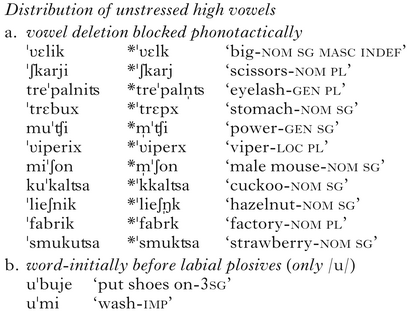
Unstressed high vowels are not possible in any other position, such as in unstressed suffixes of most nouns, where the root-final consonants form licit codas. These suffix high vowel alternations will be the focus of the paper.
3.2 Alternations
We have seen that phonotactics could be used as evidence for high vowel deletion, even though a full analysis would require a detailed examination of which environments block deletion and which do not. This would require a large-scale analysis of the Šmartno lexicon, but this data is not available. Rather, I consider a second type of evidence: alternations. Parallel to the gap data in (5), we will see that the nominal paradigms show (i) that it is only high vowels (but not others) that are deleted, and (ii) that high vowels are deleted in all unstressed positions, except when blocked by phonotactic restrictions.
To explore high vowel deletion, in (6) I present the full Masculine paradigm, with all six cases and three numbers. As noted in §2.3, all dual cases except nominative and accusative have forms which are identical to the corresponding plurals; these syncretic cases will not be shown in subsequent examples. Two inanimate roots are given here: one underlyingly stressed, the other not. As seen in §2.2, underlyingly stressed roots have fixed stress throughout the paradigm, whereas unstressed roots are stressed only when the suffix lacks underlying stress.
(6)
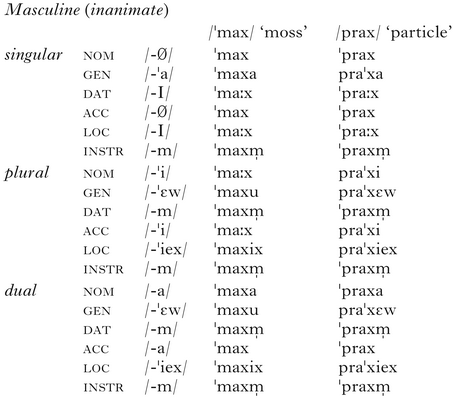
The cases can be grouped with respect to the properties of the suffix: null, underlyingly stressed or unstressed. Null suffixes are uninformative regarding vowel deletion. High vowels in underlyingly stressed suffixes surface when preceded by unstressed roots such as /prax/, but are deleted when following stressed roots such as /ˈmax/. High vowels in underlyingly unstressed suffixes are deleted regardless of root stress. Phonotactics can block deletion in both instances.
3.2.1 Stressed suffixes
There are seven cases in which stress falls on the suffix with the stressless root /prax/. The crucial example are the nominative and accusative plurals, which have a stressed vowel in [praˈxi], but no suffix vowel in [ˈmaːx]. The deleted vowel further leaves a trace on the root vowel, which is compensatorily lengthened; I leave this issue aside for now, and analyse it in detail in §3.3.
None of the remaining stressed suffixes contains an underlying high vowel, and the vowels surface as expected even when unstressed. This is despite the fact that some of these underlying vowels map to high vowels. For instance, the locative plural form of /ˈmax/ is [ˈmaxix]. The high vowel arises because of inventory restrictions (stressed [ie] alternates with unstressed [i] in suffixes; see §2.1), but the deletion of this derived vowel is phonotactically blocked: *[ˈmaxx]. The apparent exception to this generalisation is the genitive plural /ˈmax-ˈεw/, which is realised as neither *[ˈmaxew] nor *[ˈmaːx], but as [ˈmaxu]. As we will see in §5.1, forms with vowel–glide rhymes are not possible in unstressed positions; they coalesce into a high vowel, which does not delete, as in [ˈmaxu]. I will argue for a separate, fully general coalescence process that interacts opaquely with high vowel deletion. Apart from this, all vowels in stressed suffixes behave as expected: non-high vowels never delete, whereas high vowels delete if and only if phonotactics allow.
3.2.2 Unstressed suffixes
The remaining cases have unstressed suffixes. Some, including the instrumental singular [ˈmaxm̩] and [ˈpraxm̩] and the nominative dual [ˈmaxa] and [ˈpraxa], contain no high vowels in the suffix, and no deletion occurs. The remaining suffixes, including the dative singular [ˈmaːx] and [ˈpraːx], do not seem to exhibit deletion either, but do exhibit lengthening, which is otherwise associated with deletion. One could posit an entirely different mechanism to account for these cases (e.g. a floating mora), but the prediction of the current analysis is precisely that high vowel suffixes will be deleted when unstressed. Single unstressed high vowels can never surface in suffixes, because their deletion is never phonotactically blocked. As such, it seems reasonable to conclude that learners of Šmartno will posit an underlying vowel. This vowel could be either /-i/ or /-u/; I represent it as underspecified /-I/. This issue will be revisited in §4 and §5.2.
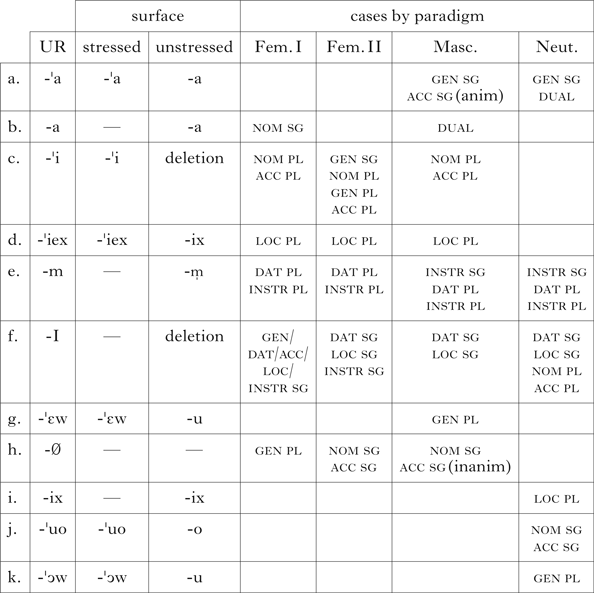
I next review each of the four paradigms for the behaviour of suffix vowels by summarising the patterns observed in suffixes in Table I. (Full paradigms by root and suffix stress are given in Appendix A.) Among these, we have already seen suffixes (a)–(h) in the Masculine paradigm. The remaining paradigms add the suffixes in (i)–(k). The unstressed suffix /-ix/ in (i) never deletes, as this would result in an illicit cluster ([Cx] codas are not allowed). This suffix contrasts with the stressed suffix /-ˈiex/ in (d), which nevertheless is also realised as [-ix] in unstressed positions. /-ˈuo/ in (j) surfaces as [-o] in unstressed positions (as expected, given the inventory), which does not delete. Finally, /-ˈɔw/ in (k) surfaces as [-u] in unstressed positions, due to the phonotactic restrictions on unstressed vowel–glide rhymes; this resembles the pattern seen with /-ˈεw/ in (g). These rhymes will be further discussed in §5.1.
Patterns observed in nominal suffixes (‘–’ indicates unattested realisations).

To summarise, the examination of nominal paradigms confirms that (i) underlying non-high vowels never delete, (ii) underlying stressed high vowels never delete and (iii) underlying unstressed high vowels delete if phonotactically allowable.
3.3 Compensatory lengthening
Further evidence for vowel deletion comes from an interacting process – compensatory lengthening. When unstressed high vowels delete, the preceding vowel is lengthened. Observe that most stressed vowels in the Masculine paradigm in (6) are short, with long vowels limited to forms with vowel deletion. There are two such groups of cases. The first has underlyingly stressed suffixes, which can surface when preceded by unstressed stems, as in /prax-ˈi/ → [praˈxi] ‘particle-nom pl’. When preceded by a stressed stem, however, the suffix high vowel is deleted, as in /ˈmax-ˈi/ → [ˈmaːx] ‘moss-nom pl’, and further preceded by a long stressed vowel. The second group has underlyingly unstressed suffixes that always delete, such as the dative singular (/ˈmax-I/ → [ˈmaːx]; /prax-I/ → [ˈpraːx]), where deletion is never blocked by phonotactics. These cases, too, show compensatory lengthening of the preceding vowel.
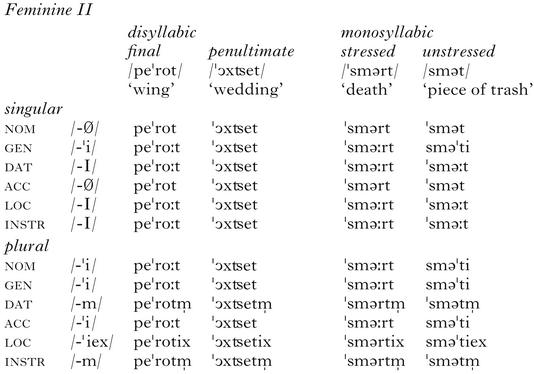
The generalisations observed in the Masculine paradigm are mirrored in all other paradigms. The Feminine II paradigm is given in (7), which shows two roots that differ in terms of underlying stress. The roots are near-minimal pairs, which is not expected to have an effect on stress or suffix vowel deletion.
(7)

Short vowels are found in the cases with null suffixes (nominative and accusative singular) and those in which there is no high vowel deletion (dative, locative and instrumental plural), regardless of the vowels in these suffixes. Additional evidence for the distinction between null suffixes and other suffixes will be discussed in §4. Lengthened vowels are found in all other cases. Some of these cases include evidence of non-null suffixes, such as the genitive singular, in which the underlyingly unstressed root surfaces with a stressed suffix (/mast-ˈi/ → [maˈsti]), whereas the stressed root exhibits deletion and lengthening (/ˈlast-ˈi/ → [ˈlaːst]). The remaining cases have no overt suffixes, such as the dative singular /ˈlast-I/ → [ˈlaːst] and /mast-I/ → [ˈmaːst]. The lengthening indicates a deleted unstressed high vowel suffix, consistent with the current analysis.
Compensatory lengthening is cross-linguistically well attested (de Chene & Anderson Reference de Chene and Anderson1979, Hock Reference Hock1986, Hayes Reference Hayes1989). Languages in which a deleted vowel lengthens the preceding vowel include Czech (Bethin Reference Bethin, Browne, Kim, Partee and Rothstein2003), Basque (Hualde Reference Hualde1990b), Korean (Kim Reference Kim1997), Yapese (Jensen Reference Jensen1977) and Estonian (Hayes Reference Hayes1989). Compensatory lengthening also occurred in Common Slavic (Timberlake Reference Timberlake and Flier1983, Bethin Reference Bethin1998, Kavitskaya Reference Kavitskaya2002), and is a synchronic rule in Friulian (Hualde Reference Hualde1990a), which is spoken close to Šmartno. Nevertheless, vowel length has been a contentious issue in the Slovenian literature. For instance, while most descriptions of Standard Slovenian assume contrastive vowel length (Herrity Reference Herrity2000, Toporišič Reference Toporišič2000, Reference Toporišič2001, Greenberg Reference Greenberg2008), phonetic studies have failed to discover significant durational differences between short and long vowels (Bezlaj Reference Bezlaj1939, Srebot-Rejec Reference Srebot-Rejec1988, Petek et al. Reference Petek, Šuštaršič and Komar1996, Tivadar Reference Tivadar2004, Reference Tivadar2008). It is worth pointing out, however, that Šmartno has lost the Common Slovenian vowel-length distinctions: both historically short and long vowels are transcribed here as ‘short’. These gaps motivate an acoustic investigation of vowel lengthening in Šmartno.
To determine whether vowel length is contrastive in Šmartno, I compiled a set of minimal pairs with underlying high vowel suffixes that delete (as in /ˈlast-ˈi/ → [ˈlaːst] ‘ownership-gen sg’ or /ˈlast-I/ → [ˈlaːst] ‘ownership-dat sg’) and with a null suffix (as in /ˈlast-Ø/ → [ˈlast] ‘ownership-nom sg’). The randomised stimuli were presented orthographically on a screen to the three participants, who were instructed to pronounce the words in the frame sentence ‘I say _ once’ [ˈrεʧem _ ˈajnkrat]. To elicit the desired inflectional case, a preposition or a verb was typically added. For instance, to elicit the genitive singular of /ˈnit/, the participants would see brez niti ‘without thread’ (item 57 in Appendix B), and for the dative singular k niti ‘to the thread’ (item 30). For /ˈɣɔb/, the nominative plural prompt appeared as 3 gobe ‘three mushrooms’ (item 29), whereas the genitive plural was brez 3 gob ‘without three mushrooms’ (item 78). For /ˈjeʒ/, the dative singular stimulus was dam ježu ‘I give (it) to the hedgehog’ (item 62).
Orthography was selected because the attempt at a pictorial elicitation proved challenging (ambiguous pictures, abstract meanings). The effect of orthography was considered minimal, as the standard orthography shows a very different distribution of vowels (no vowel deletion, no quantity difference), and because vowel length and obstruent devoicing is not marked in the orthography (which will play a role in the next section). To encourage dialectal responses, I provided many non-standard (colloquial) orthographic forms for the prepositions or verbs (e.g. pr instead of standard pri ‘at’, u instead of v ‘in’, vidla instead of videla ‘saw-fem’). The production experiment contained 87 words, which formed 36 minimal pairs; the rest were filler forms. The recording took place in the participants’ homes, and took about one hour. Participants repeated each elicited word in the corresponding frame sentence twice. I included the first token unless there were recording issues that warranted the use of the second token (e.g. overlapping speech, ambient noise).
In this section, I discuss the 14 minimal pairs of stems that have final stress and end in voiceless obstruents. Of the expected 42 minimal pairs across the three participants, only 36 (or 86%) were ultimately included. Exclusions were based on stringent criteria. In the entire dataset (36 minimal pairs × 3 participants = 108), 14 minimal pairs (13%), were excluded on the following grounds: because a participant lacked specific lexical items (ten minimal pairs), because speakers provided unexpected cases with certain prepositions (two) or because of recording issues (two). (Appendix B contains the list of stimuli in the order they appeared for all participants and Appendix C lists minimal pairs.) The sound files were segmented in Praat (Boersma & Weenink Reference Boersma and Weenink2016), and a script was run to determine the duration of stem vowels. The subsequent statistical analysis was performed in R (R Core Team 2013). All figures were plotted using the ggplot2 package (Wickham Reference Wickham2009).
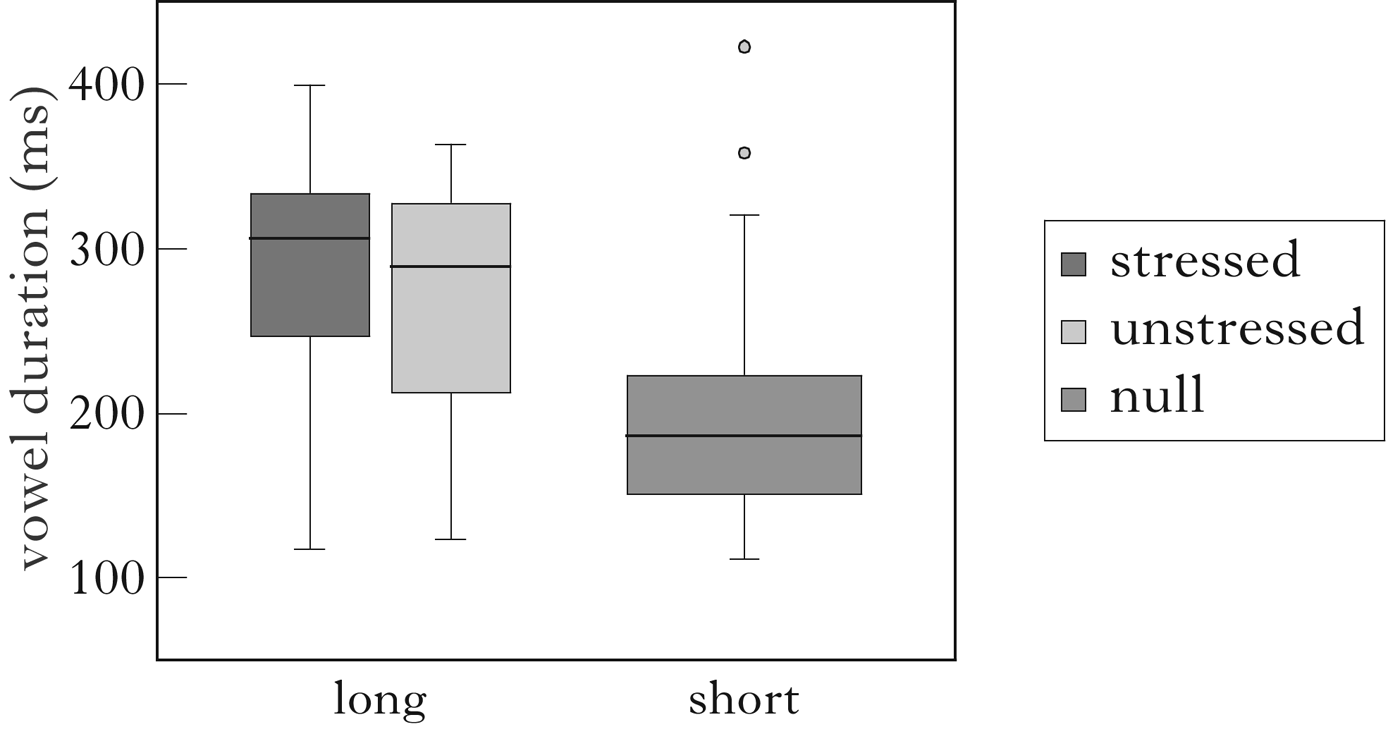
Figure 1 presents the duration differences between short and long stressed vowels in word-final syllables. Each boxplot shows the following information: the solid line indicates the median value for each dataset, the box frames show the upper and lower quartiles, and the whiskers include the most extreme value, as long as it is within 1.5 times the interquartile range from the median, with circles marking outliers beyond that range. The data for long vowels is split depending on whether the deleted high vowel suffix had underlying stress; all short vowels occurred in words with a null suffix.
Duration of long (lengthened due to deletion of a high vowel suffix) and short stressed vowels in word-final syllables, by underlying suffix type.

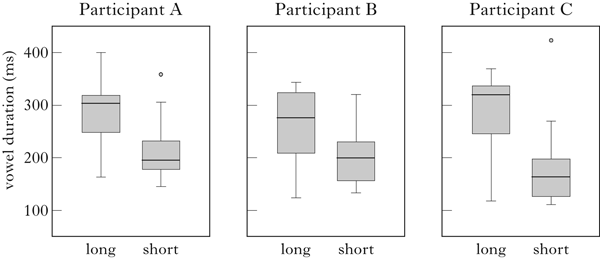
Vowels lengthened as a result of vowel deletion were on average 40% longer than short vowels without suffixes (long vowels: mean 279 ms, SD 73 ms; short vowels: mean 200 ms, SD 69 ms). The words with long vs. short vowels are perfect minimal pairs; they do not differ in any other variable. A paired t-test indicates that, as expected, lengthened vowels have significantly greater duration than short vowels (t = 4.80, df = 35, p < 0.001). Lengthening can be a result of the deletion of an underlyingly stressed or an unstressed suffix. Deletion of an underlying stressed suffixes lengthened the preceding vowel 6.3% more than deletion of an unstressed suffix (stressed suffixes: mean 285 ms, SD 71 ms; unstressed suffixes: mean 268 ms, SD 77 ms). However, a Welch two-sample t-test reveals that this difference is not statistically significant (t = 0.66, df = 23.39, p = 1). All p-values are given after Bonferroni adjustment. If we compare the long and short vowels by participant, we see the same pattern across all three: lengthened vowels have greater duration than short vowels, as shown in Fig. 2.
Duration of long (lengthened due to deletion of a high vowel suffix) and short stressed vowels, by participant.

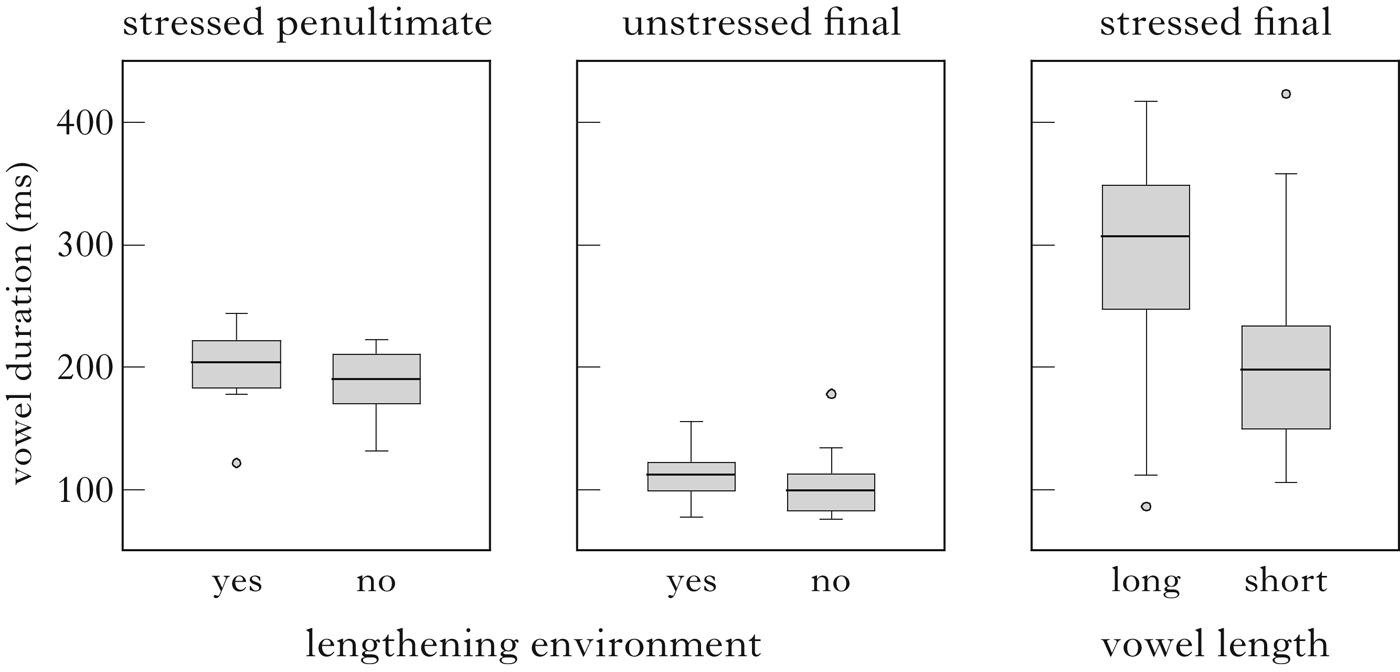
The discussion so far has been limited to stems with stress on the final syllable. Šmartno also allows stems with penultimate stress, although these are uncommon. In the paradigm data, 14 stems had penultimate stress, i.e. 9% of all stems (see Appendix A for a full list). Logar (Reference Logar1977, Reference Logar and Ivić1981) analyses these stems as lacking any lengthening. The data is presented in Fig. 3, which shows results for each of the vowels in stems with penultimate stress. Final stress data from Fig. 1 (but without the distinction in terms of suffix stress) is repeated for reference. In words with non-final stress, the results were not significant. Both the stressed penultimate vowel and the unstressed stem-final vowel in, for example, [ˈsmukuʦ] ‘strawberry’ were only slightly longer in lengthening environments than in short environments. Although the lengthened vowels were on average 11.4 ms (final V) and 7.8 ms (penultimate V) longer, the results were not statistically significant in a paired t-test (stressed penultimate vowel: t = 0.83, df = 9, p = 0.431; unstressed stem-final vowel: t = 1.23, df = 9, p = 0.250).Footnote 8
Duration of vowels in words with penultimate stress, by lengthening environment. Final stressed vowels are shown for comparison (long vowel data is pooled across the two types of suffixes in Fig. 1).

These results indicate that compensatory lengthening affects only stem-final stressed vowels, but not unstressed vowels or penultimate vowels (regardless of stress). That is to say, stems with penultimate stress do not vary in vowel length. Penultimate stress is found in all four nominal paradigms, even though it is much rarer than other stress patterns. Among disyllabic stems, final stress is 2.5 times as common as penultimate stress, but this may be due to the fact that elicitation focused on words specific to the dialect, excluding loanwords, which can be much longer in Slovenian (Jurgec Reference Jurgec2007). There are no disyllabic stems without underlying stress. This has historical origins: stress on final vowels retracted to pretonic vowels at a stage when the vast majority of roots was monosyllabic. Later retractions in disyllabic stems resulted in a different stress paradigm (Greenberg Reference Greenberg2000), which has fixed stress in contemporary Šmartno. This lack of disyllabic unstressed stems in Slovenian is shared with Serbo-Croatian (Kapović Reference Kapović2015: 202).
The data in (8) shows disyllabic Feminine II stems, as well as monosyllabic stems of the type given in (7). Observe that the disyllabic stem /peˈrot/ patterns with the monosyllabic stressed stem /ˈsmərt/ in all cases. We have already seen that unstressed stems show a different pattern with stressed high vowel suffixes, as in /smət/. There is a third pattern observed in stems such as /ˈɔxʦet/, with penultimate stress. Stems with penultimate stress exhibit rampant case syncretism. In the case of /ˈɔxʦet/, all singular forms are identical, even though the other three stems show distinctions. Other paradigms show exactly the same three stress patterns, even though the suffixes are different (see Appendix A).
We can conclude that deletion is fully general in Šmartno, as is evidenced by distributional restrictions and stress-conditioned alternations, and its interaction with compensatory lengthening.
(8)
4 Final devoicing
In Šmartno, vowel deletion interacts with final devoicing. Voiced obstruents become voiceless when word-final and not followed by a segmental suffix (9a). Devoicing affects all kinds of obstruents, in a broad range of morphological environments. Voiceless obstruents do not alternate, as shown in (9b) (Logar Reference Logar1977 and my own data).Footnote 9
(9)
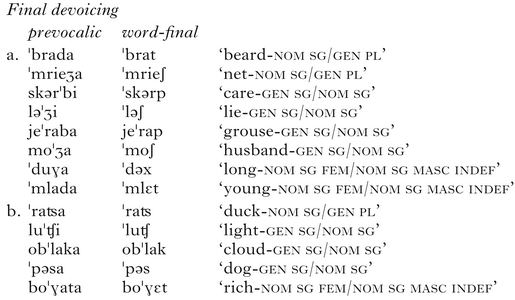
Contrary to what the data in (9) suggests, final devoicing does not apply in all word-final environments, as becomes clear once the nominal paradigms are examined. In most paradigms devoicing is found in the nominative and accusative singular, but in Feminine I, shown in (10), this is not the case: devoicing is instead found in the genitive plural. This is because this case has a null suffix, the only morphological environment in which final devoicing applies. Other cases in which the voiced obstruent appears word-finally do not exhibit devoicing. For instance, the nominative and accusative plurals have the underlyingly stressed high vowel suffix /-ˈi/, which surfaces only when attached to unstressed stems. Stressed stems exhibit vowel deletion (§3.2), which is further evidenced by compensatory lengthening when stress is final. When stress is penultimate, devoicing also fails to apply, even though there is no long vowel: /ˈjaɣod-Ø/ [ˈjaɣod] ‘berry-nom pl’. This suggests that compensatory lengthening and word-final voiced obstruents are not inherently linked; it is not the case that voiced obstruents can only occur in stems that have a long vowel in the final syllable. Finally, the non-nominative singulars exhibit contrastive word-final voicing (and vowel lengthening if stress falls on the stem-final vowel), indicating an underlying unstressed high vowel suffix.
(10)
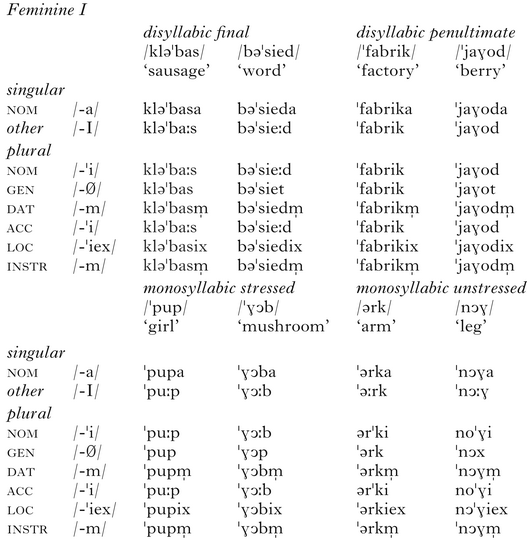
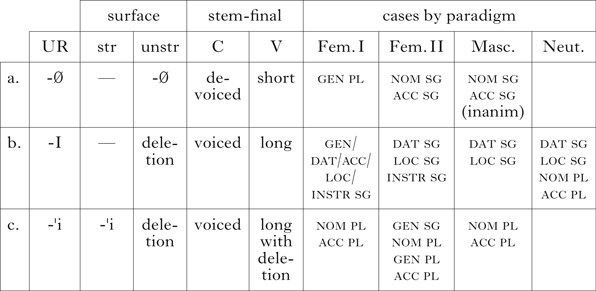
The patterns observed in Feminine I are representative of other paradigms. Table II summarises the different suffixes, grouped by their segmental content. For each suffix, the underlying form is shown, followed by the surface realisation of the suffix, the stem-final obstruent and lengthening of the stem-final stressed vowel. The cases fall into four groups. The null suffixes in (a) are the only ones to exhibit final devoicing. All other groups lack devoicing, whether they are unstressed high vowels (b), stressed vowels that are deleted (c) or any other suffix in which the stem-final obstruent is not word-final. When the suffix vowel is deleted, the preceding stressed vowel is always lengthened (but if stress is penultimate, there is no lengthening). Thus we can conclude that final devoicing applies only with a null suffix.
Patterns observed in stems ending in voiced obstruents.

The distinction between null and deleted suffixes extends beyond nominal paradigms, and is observed with adjectives as well, as shown in (11).
(11)
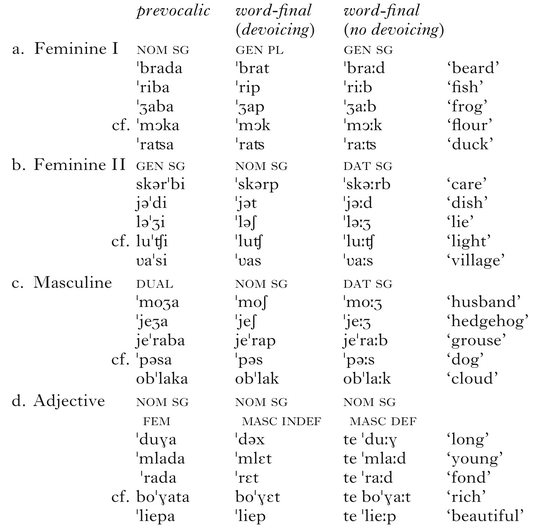
There does not seem to be a common morphosyntactic property shared by the forms with final obstruents. For example, it is hard to imagine a connection between nominative singular and genitive plural – or between dative and genitive singular – in some paradigms but not in others. Instead, I argue that the difference between the two sets of word-final obstruents is phonological.
This interpretation of the two types of word-final positions makes sense, given what we already know about vowel deletion. First, vowel deletion is accompanied by compensatory lengthening of the preceding stressed vowel. Words with surface voiced word-final obstruents have lengthened vowels, indicating that vowel deletion has applied. In contrast, words with devoiced obstruents have short vowels. Second, vowel deletion affects only unstressed vowels, and the suffixes in the third column are underlyingly unstressed (as seen in §3.2).
A possible alternative would be that voicing is preserved faithfully after long vowels, a generalisation that seems possible in the light of cross-linguistic evidence. Co-occurrence restrictions on vowel length and voicing of the following coda obstruent are attested in Friulian, a geographically adjacent language spoken in Italy (Hualde Reference Hualde1990a). Torres-Tamarit (Reference Torres-Tamarit2015) proposes an analysis based on the distribution of moraic codas. However, in Šmartno the restrictions are not absolute: underlyingly voiced obstruents can occur with short vowels (e.g. /ˈmadeʒ-ˈi/ → [ˈmadeʒ] ‘stain-nom pl’, /ˈjaɣod-ˈi/ → [ˈjaɣod] ‘berry-nom pl’). Šmartno is thus not compatible with a representational analysis of Friulian. Nevertheless, most final voiced obstruents do appear in syllables with long vowels. Out of 148 collected stems, only 14 have penultimate stress, which is the only context in which voiced consonants could appear with short vowels. Given this, it is possible to see stress and vowel length as positions that reinforce the underlying voicing contrast in Šmartno, thus contributing to diachronic stability and to the learning of the pattern.
The interaction of voicing and vowel deletion is somewhat unusual, given data from other Slovenian dialects and other languages. Furthermore, obstruent voicing is difficult to perceive in word-final positions, and several languages with incomplete neutralisation have been reported (see Warner et al. Reference Warner, Jongman, Sereno and Kemps2004, van Oostendorp Reference Oostendorp2008, among many others). For these reasons I analysed the obstruents acoustically. In the experiment described in §3.3, I also included minimal pairs with a voicing contrast. There were 14 minimal pairs with underlyingly voiceless obstruents, and 17 with underlying voiced obstruents. All pairs had stress on the final syllable of the stem, but there is no reason to assume a different pattern in stems with penultimate stress. I measured several variables, of which obstruent duration appeared to be the most consistent. For stops, it was the duration of the closure.
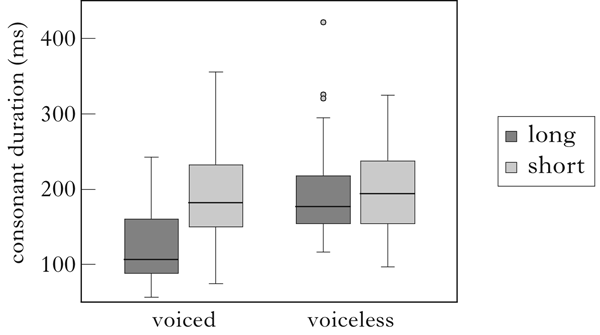
Figure 4 shows duration for all combinations of underlying voicing and vowel length. Recall that long vowels are the consequence of compensatory lengthening as a result of the deletion of the suffix vowel. Overall, voiced obstruents appearing after long vowels (mean 126 ms, SD 50 ms) have lower duration than devoiced obstruents after short vowels (mean 198 ms, SD 65 ms), and than voiceless obstruents after long vowels (mean 195 ms, SD 67 ms) and after short vowels (mean 204 ms, SD: 63 ms).
Duration of stem-final obstruents, by vowel length (due to compensatory lengthening) and underlying voicing.

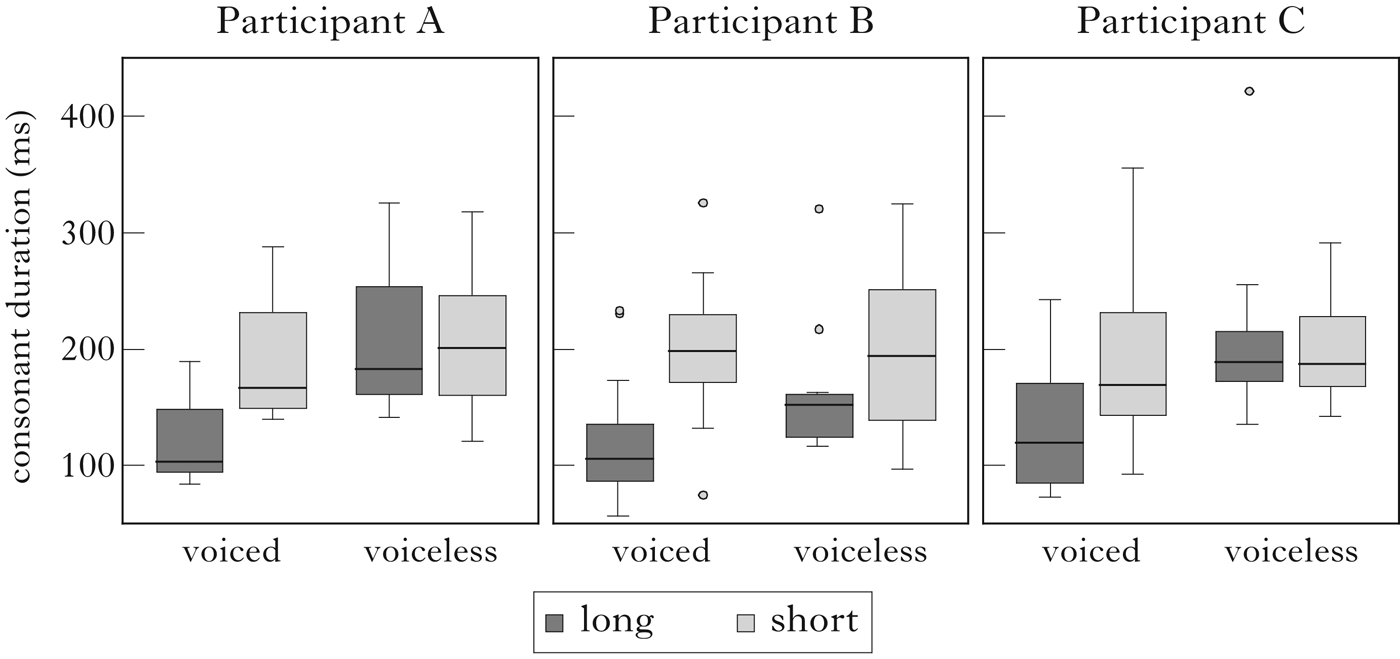
Figure 5 presents the data by participant. Here it appears that Participant A and C show distributions that are clearly in line with the overall pattern. Participant B shows a slightly lower duration for voiceless obstruents after long vowels.
Duration of stem-final obstruents, by vowel length (due to compensatory lengthening), underlying voicing and participant.

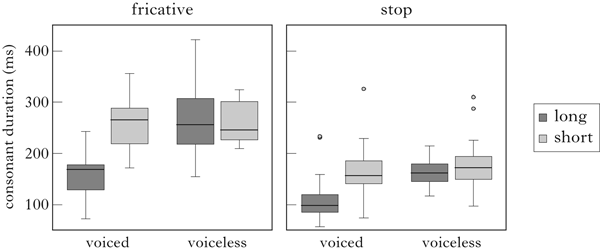
It is worth pointing out that while duration correlates with voicing, it is also affected by another variable, the manner of articulation of the consonant. Fricatives are over 50% longer than stops, regardless of voicing (fricatives: mean 230 ms, SD 72 ms; stops: mean 150 ms, SD 49 ms). Nevertheless, when broken down by manner, the voicing contrast persists: after long vowels, voiced fricatives are shorter than the corresponding devoiced or underlyingly voiceless fricatives, and the same is true for stops, as shown in Fig. 6. This suggests that voicing is retained in forms where the vowel is lengthened due to vowel deletion.
Duration of stem-final obstruents by vowel length (due to compensatory lengthening), underlying voicing and manner of articulation.

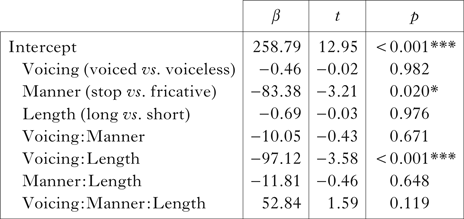
To test whether the voicing differences across conditions and participants are significant, I analysed consonant duration with a mixed-effects linear regression model, using the lmer function from the lme4 package in R (Bates et al. Reference Bates, Mächler, Bolker and Walker2015). The response variable was the duration of the final obstruent. I included three predictor variables: underlying voicing of the consonant (Voicing: voiceless and voiced), its manner of articulation (Manner: fricative and stop) and vowel length (Length: short and long). I used dummy coding for all three variables; the reference levels are in italics. The affricate data (six tokens across participants) was excluded from the model.
Interactions between the three predictor variables were included, in order to test whether underlyingly voiced obstruents are indeed different when they appear in words with long vowels and whether stops and fricatives differ from each other in this respect. To account for variability across participants, I included random intercepts for participants, with slopes for each fixed factor allowed to vary by participant. In other words, the model took into account the fact that different participants can show different patterns of effects. To account for variability by item, I included random intercepts for word. The model converged using the standard parameters, and no further adjustment was necessary. I used an α-level of 0.05 as the criterion for significance; p-values were computed using the lmerTest package in R (Kuznetsova et al. Reference Kuznetsova, Brockhoff and Bojesen Christensen2016).
Statistical results are reported in Table III. β-coefficients show the predicted increase (positive) or decrease (negative) in mean consonant duration when each parameter is manipulated (holding all else constant). The intercept refers to the reference level for each variable, i.e. the predicted mean duration for (underlyingly) voiceless fricatives appearing after short vowels, which roughly corresponds to the fourth boxplot in Fig. 6.
Statistical results from a mixed-effects linear regression model, with consonant voicing, manner and vowel length predicting duration of the final obstruent. The intercept is the mean duration of voiceless fricatives after short vowels. Significance levels are *** (p<0.001) and * (p<0.05). The formula used was: Consonant Duration ~ Voicing × Manner × Length + (Voicing + Manner + Length | Participant) + (1 | Word).

The results show no significant main effects of underlying voicing and vowel length. This is consistent with the generalisation that underlying voicing is not necessarily preserved. There is, however, a significant main effect of manner: stops are on average 83.38 ms shorter than fricatives. This result does not indicate a difference in terms of voicing: it merely shows that stops are inherently shorter than fricatives, as seen in Fig. 6. The crucial point involves the interactions. There is one significant interaction of voicing and length: voiced obstruents following long vowels are on average 97.12 ms shorter than voiceless obstruents after short vowels, which is highly significant. Voiced obstruents have shorter duration than voiceless obstruents, so this result confirms that underlying voicing is indeed preserved in words with vowels lengthened due to vowel deletion, whereas devoicing is observed with short vowels. The remaining interactions are not significant, and all involve manner: stops behave no differently than fricatives when it comes to voicing, vowel length or both at the same time. In short, these results indicate that voicing is retained after long vowels (in stems with surface final stress) for all obstruents.
We have seen that Šmartno exhibits an emergent word-final voicing contrast, which adds to the literature on languages where historical and morphological changes lead to new laryngeal contrasts at the end of words or syllables. This body of work includes Yiddish, an example of paradigm levelling (King Reference King, Herzog, Kirshenblatt-Gimblett, Miron and Wisse1980, Albright Reference Albright, Bachrach and Nevins2008), Welsh, which exhibits voicing and length restrictions similar to Friulian reported above (Wells Reference Wells1979), Somali, where final voiced obstruents surface due to vowel deletion (Saeed Reference Saeed1993, Edmondson & Esling Reference Edmondson and Esling2006), Lezgian, in which voiced stops surface in root-final positions but alternate with voiceless stops elsewhere (Yu Reference Yu2004), Lakota, where word-final [b] and [g] fail to devoice (Rood Reference Rood, Rudin and Gordon2016), and Tundra Nenets, where only [b] is possible syllable-finally, but other obstruents are neutralised (Salminen Reference Salminen1997). Such emergent contrasts can either be due to phonotactic restrictions or be triggered by some related process, as in Šmartno, with synchronically clear evidence for the interacting process, vowel deletion.
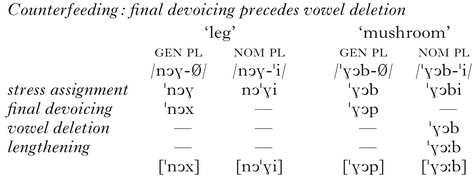
To summarise, examination of the nominal paradigms suggests that voicing depends on whether deletion has applied. This has a straightforward analysis in a rule-based account, with final devoicing applying before vowel deletion. This interaction of final devoicing and vowel deletion is counterfeeding on environment (McCarthy Reference McCarthy1999, Baković Reference Baković2007): final devoicing fails to apply in forms that contain an unstressed suffix high vowel.
A derivation is provided for four Feminine I forms in (12). The analysis includes four rules. Stress assignment is a set of rules which result in at most one stressed syllable per word, with deletion of stress in the suffix. The second rule devoices word-final obstruents, while the third rule deletes unstressed high vowels. There are various ways in which the final rule, vowel lengthening, can be formalised. The mora left after vowel deletion may attach to the preceding vowel if it is stressed (or subsequently deleted from unstressed vowels). Bethin (Reference Bethin1998) suggests another alternative to limit compensatory lengthening to target the preceding stressed vowel only: the mora delinked from the final vowel can dock to the vowel within the same foot. A stem-final stressed vowel is within the same foot, but an unstressed vowel will be part of some other foot. To illustrate the interaction of these rules, I give two roots, with two cases: the genitive plural displays devoicing because the voiced obstruents are also root-final, but this is not found in the nominative plural. The crucial example is /ˈɣɔb/. Devoicing fails to apply because the root-final obstruent is not word-final at the relevant derivational step. The vowel is subsequently deleted, at which point it is too late for devoicing to apply. The resulting output is opaque.
(12)
I have documented an instance of the counterfeeding opacity of vowel deletion and final devoicing, backed up by phonetic data, as well as additional phonological evidence based on stress assignment and compensatory lengthening. The phonetic examination has been supplemented by morphological data, and all nominal paradigms have been analysed, with attention to various combinations of underlying stress and final consonant. The data presented represents one of the best-documented examples of opacity in the literature. More specifically, this paper also constitutes an example of how to improve quality of fieldwork-based data (see de Lacy Reference de Lacy and van der Hulst2014 for further discussion on the quality of data in phonology).
5 Remaining issues
This section examines coalescence of vowel–glide sequences in unstressed positions (§5.1) and underlying unstressed high vowels (§5.2). As we will see, this data complements the present analysis of opaque interactions.
5.1 Coalescence
(13)
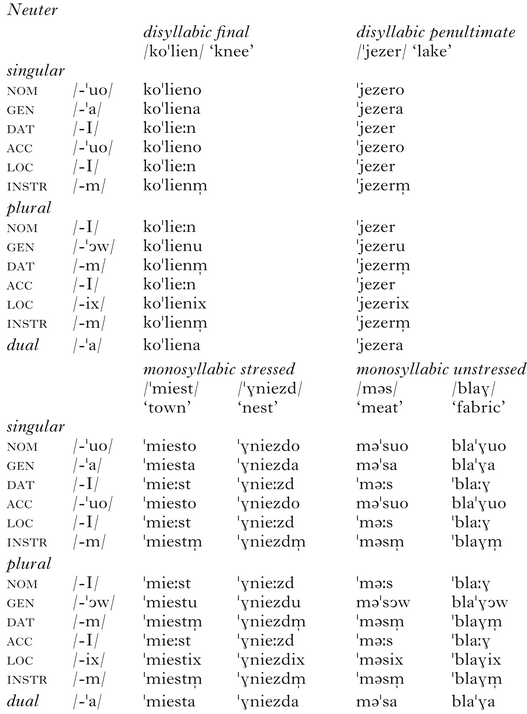
The data discussed so far has shown two interacting processes: vowel deletion and final devoicing. Recall that unstressed high vowels can surface in Šmartno roots and suffixes, but only when deletion is phonotactically blocked. We now move to those unstressed high vowels that appear to be the exceptions to this generalisation. In this section, I show that there are cases throughout the nominal paradigms which surface because of an interacting process – coalescence – which affects adjacent vowels and glides. High vowels that are created by coalescence do not delete, and thus constitute yet another example of counterfeeding opacity. Evidence for coalescence is also found in phonological patterns outside nominal paradigms.
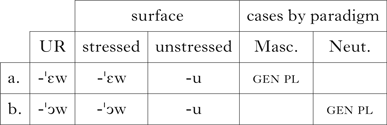
Consider first the Neuter paradigm in (13). All the data is entirely consistent with the paradigms discussed above. First, stems with penultimate stress never exhibit lengthening, and stems without underlying stress show stress shifts (as in [ˈməsm̩] ~ [məˈsuo] ‘meat-instr sg ~ nom sg’). Second, unstressed high vowels only surface when deletion is blocked (e.g. the locative plural). Third, stem-final vowels are lengthened in cases which can be analysed as having an unstressed suffix (e.g. the dative singular). Fourth, stressed vowels neutralise to the corresponding unstressed vowels (e.g. nominative singular [məˈsuo] vs. [ˈmiesto], but genitive singular [məˈsa] vs. [ˈmiesta]), as expected based on the vowel inventory in (1). There is a single exception to these generalisations: the genitive plural exhibits an alternation between [-ˈɔw] in stressed positions and [-u] in unstressed positions; the resulting high unstressed vowel does not delete as expected.
A similar pattern can be observed in the genitive plural of the Masculine paradigm in (6): [praˈxεw] vs. [ˈmaxu]. What the two examples have in common is a mid vowel + glide sequence in stressed position alternating with an [u] in unstressed position. These are the only vowel + glide sequences in all the nominal paradigms, as shown in Table IV. It is worth noting that cases with coalescence were particularly hard to elicit, because the phonological content of the suffix (ignoring regular sound changes) and the syntactic environment of the genitive plural are different in Šmartno than in Standard Slovenian.Footnote 10
Patterns observed in vowel–glide nominal suffixes.

How can we explain this unexpected data? Coalescence of vowels and glides is common cross-linguistically (Casali Reference Casali1998, Pulleyblank Reference Pulleyblank, van Oostendorp, Ewen, Hume and Rice2011). The fact that it is the more complex structure that is possible in stressed syllables is not surprising, as stressed syllables can license structures that are not allowed in unstressed syllables (Beckman Reference Beckman1998, Crosswhite Reference Crosswhite2001, de Lacy Reference de Lacy2006). The fact that the glide [w] – rather than the vowel – determines the quality of the coalesced vowel [u], however, is puzzling: non-high vowels are typically favoured over high vowels in coalescence environments (Casali Reference Casali1998). However, we have already seen that in Šmartno, stressed [ˈie] alternates with unstressed [e] in roots, but with unstressed [i] in suffixes (even though unstressed [e] is possible in suffixes). There are a few examples from other languages, including English trisyllabic laxing, as in the pair [aɪ] ~ [ɪ] ([dəɹaɪv] derive vs. [dəɹɪvətɪv] derivative). Other varieties of Slovenian also show alternations of vowel + [w] (or [ʋ]) sequences with [u] across nominal and verbal paradigms, even though these patterns are otherwise different from those found in Šmartno (Toporišič Reference Toporišič2000: 19–22).
In Šmartno, vowel–glide coalescence appears to be a more general pattern, found outside nominal paradigms. Consider the past participle data in (14).Footnote 11 Most past participle stems end in [l] when followed by a vowel in the suffix, such as in the feminine singular (which is identical to the masculine dual) or the feminine plural. When followed by a consonant or word boundary, however, the coda [l] becomes the glide [w], as in the masculine singular. However, we have seen that coalescence only applies to unstressed vowel–glide sequences: compare the stems with final stress in (a) with those with penultimate stress in (b). This shows that coalescence is a more general pattern, applying to all unstressed vowel–glide sequences.
(14)
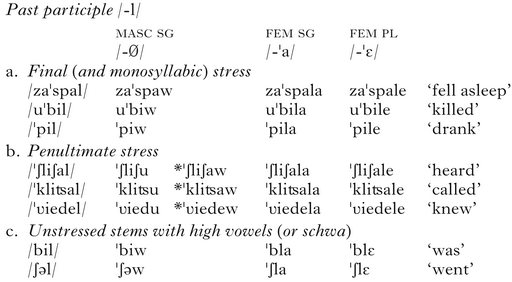
There is a further caveat. The examples in (14a) and (b) contain vowels that are not subject to deletion in stem-final syllables (i.e. stressed high vowels or other vowels regardless of stress). A small number of monosyllabic participle stems, however, contain unstressed high vowels. All are unstressed roots that become stressed when no suffix follows, as in (c). These fail to exhibit coalescence in the masculine singular (the high vowel or schwa becomes stressed, because there is no other vowel). However, vowel deletion applies in the feminine, where the suffix is underlyingly stressed. There is no compensatory lengthening in these words. This data is entirely consistent with the analysis of nominal patterns in terms of stress assignment, vowel deletion and coalescence.
Now that I have established that coalescence is a more general pattern in Šmartno, the next step is to look at its interaction with vowel deletion. One way to interpret the nominal paradigms on their own would be to say that high vowel deletion affects only the front vowel /i/, but not the back vowel /u/. This is possible because of a lexical gap: there are no underlyingly stressed /-ˈu/ inflectional suffixes in any of the nominal paradigms in Šmartno (and there are no unstressed verbal stems where [u] could be deleted). Hence it would be possible to analyse the data with a more specific rule affecting only the deletion of unstressed [i], whereas [u] is not deleted, as shown in this section. This analysis, however, would miss a major generalisation about high vowel deletion in Šmartno phonology. We have also seen that unstressed /u/ is restricted in roots (cf. (5)). This data suggests that the deletion rule must affect both high vowels (as well as schwa).
If high vowel deletion interacted transparently with coalescence, one would expect the derived/coalesced unstressed high vowel [u] to be subject to deletion, like most other unstressed high vowels, particularly since such deletion is phonotactically possible. As it turns out, high vowels derived by coalescence do not delete, which suggests that vowel deletion must apply before coalescence in a rule-based analysis. This is shown for two Masculine nouns in (15). The crucial example is ‘moss-gen pl’, which surfaces as [ˈmaxu], rather than *[ˈmaːx], as would be expected if vowel deletion had applied. In short, coalescence and vowel deletion show counterfeeding opacity.
(15)
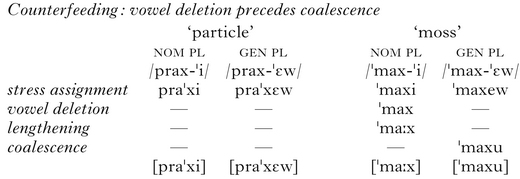
To summarise, while it initially appears that some suffixes exceptionally surface as high vowels which are exempt from deletion, this turns out to be phonologically conditioned. Some high vowels are retained for phonotactic reasons, whereas others are subject to coalescence affecting vowel–glide sequences. Šmartno thus displays two opaque interactions: (i) final obstruents generally devoice, with the exception of those that become final as a result of vowel deletion, and (ii) unstressed high vowels delete unless they are derived by coalescence. Considered together, these two interactions form a synchronic chain shift involving two kinds of counterfeeding. While chain shifts are common in historical linguistics, synchronic instances have been scarce. Kirchner (Reference Kirchner1996) analyses chain shifts in Bedouin Hijazi Arabic and Nzεbi. Šmartno presents a third example, which appears to be fully general in the language.
5.2 Unstressed suffixes
(16)
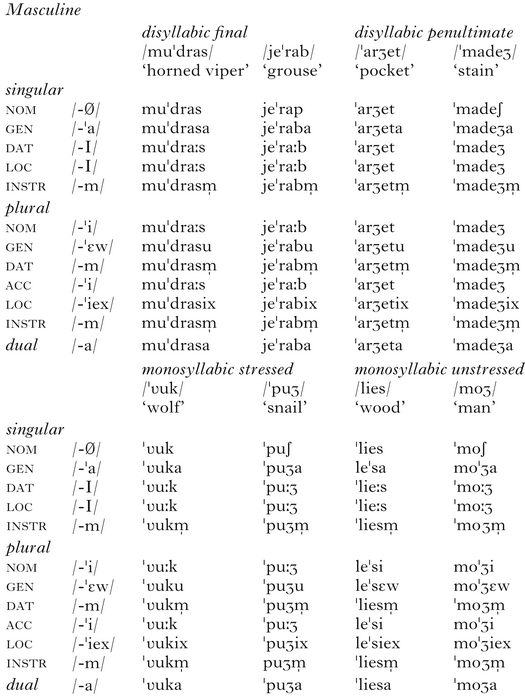
The final piece of evidence concerns cases which exhibit lengthening and no devoicing even though the suffix vowel does not surface. I argue that these cases can be accounted for assuming that the presence of an unstressed vowel is underlying, even though the evidence for the vowel is indirect. Alternative accounts fail to explain the attested data.
One prediction of this model is that suffixes consisting of only unstressed high vowels will always be deleted. The evidence for their presence, such as the lengthening of the preceding stressed vowel and the lack of devoicing, will be entirely indirect. To illustrate, consider the forms from the Masculine paradigm in (16). Of the cases that have lengthening and retain final voicing, some have underlying stressed vowels, which surface as stressed with roots without underlying stress (nominative and accusative plural). Other cases, such as the dative and locative singular, do not show segmental suffixes in any forms, yet exhibit lengthening and lack of final devoicing. The most straightforward way to capture the difference between the two groups of cases is to say they differ in terms of underlying stress, with the vowels that never surface having no underlying stress. Vowel deletion applies to all forms, deleting the high vowel regardless of the stem.
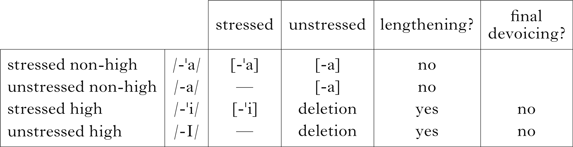
The challenge for this analysis is that an underlying vowel must be posited even though the evidence for it is indirect, and it never surfaces. This is because nominal roots have at least one syllable which will attract stress. As we saw in §3.2, suffixes can be grouped depending on underlying stress and whether they have a high vowel. This is summarised in Table V. The existence of these four groups of suffixes appears to predict exactly the situation observed in many paradigms: simultaneous lengthening and no devoicing. The current approach straightforwardly predicts this data.
Patterns observed in nominal suffixes.

This analysis thus relies on an abstract segment which never surfaces. Such analyses are found elsewhere in the literature. One case comes from Russian, where yers are mid vowels [e o] when stressed, but both reduce to [ə] before non-palatalised environments in unstressed positions (Lightner Reference Lightner1965). This means that yers that are never stressed could be derived either from underlying /e/ or /o/, and there is no way to tell them apart. This is directly parallel to the Šmartno deleted high vowel, which could be derived from unstressed /i/, /u/ or /ə/. Abstract representations can be used for other types of data in the literature, including the example of Menominee, where some n’s alternate with [s], but others do not. One way to account for this difference is to propose that the alternating segments are underlyingly some other segment, which is never observable directly (Bloomfield Reference Bloomfield1939, Bever Reference Bever1967, Kenstowicz & Kisseberth Reference Kenstowicz and Kisseberth1979). Another instance comes from Serbo-Croatian: Morén (Reference Morén2006) accounts for the fact that some i’s trigger velar palatalisation and others trigger velar fronting by positing two featurally different underlying /i/’s, which are then neutralised on the surface.
Finally, the present analysis appears to be simpler than alternatives that propose special structures for these suffixes. An anonymous reviewer suggests that such suffixes could have an underlying floating mora, which then docks to the preceding stressed vowel. The challenge for this alternative is that lengthening and obstruent voicing would need a separate account. Because linking of floating moras is different than linking of underlyingly linked moras, a specific rule would be required for floating moras to prevent docking to non-final stressed vowels. Positing floating moras also cannot easily explain why voicing is retained even when lengthening is not possible. This alternative would also make the absence of unstressed high vowels in suffixes appear to be an accidental gap. I therefore reject the floating mora alternative.
6 Conclusions
This paper has shown that Šmartno Slovenian displays a clear synchronic example of counterfeeding opacity on environment. Underlyingly word-final obstruents devoice, but not if they become word-final because of vowel deletion. I reviewed three pieces of evidence for this interaction. First, vowel deletion interacts with stress assignment. A detailed examination of all nominal paradigms revealed that unstressed high vowels delete whenever possible, whereas non-high vowels or stressed vowels do not. Second, vowel deletion lengthens preceding stressed vowels across nominal paradigms. A small-scale production experiment showed that lengthened vowels have significantly greater durations than short vowels. Third, obstruent devoicing is retained word-finally whenever a following underlying high vowel is deleted, again across nominal paradigms. This observation, too, was backed up by an acoustic analysis: underlyingly voiced obstruents appearing in words with vowel deletion (and compensatory lengthening) were longer than underlyingly voiced obstruents in words without vowel deletion (and short vowels), which in turn showed the same pattern as underlyingly voiceless obstruents.
Final devoicing and vowel deletion further interact with coalescence. Coalescence creates unstressed high vowels, which fail to delete. The three processes combined present a synchronic chain shift. In a rule-based approach, final devoicing applies first, followed by vowel deletion and finally coalescence. This order correctly predicts that obstruents devoice only if underlyingly final (but not if they become final when the following vowel deletes) and that vowels delete only if they are underlyingly vowels (rather than created by coalescence).