

I. Introduction
Policy responses to the coronavirus COVID-19 pandemic in 2020 have caused a global economic recession, the severity of which has not been seen since the 1930s. How is that affecting the world's beverage markets and, in particular, what does it mean for the wine industry in the short-to-medium term?
Of course, no one can answer this question with any precision because it depends on many factors that remain very uncertain. Early on, the European Commission (2020) warned that the volume of wine consumption in the European Union (EU) would be 8% lower in 2020 than the previous five years’ average, bearing in mind that the 70% of sales that are off-premise are expected to be above average this year as many people self-isolate at home and avoid restaurants, bars, and pubs. Social distancing made large celebrations and partying impossible in lockdown periods and so was especially damaging to sparkling wine sales. Maxime Toubart, Chairman of the Champagne producer's organization SGV, noted on 5 May 2020 that Champagne sales in March and April 2020 were down 80% compared with a year earlier.
How have sales declines during 2020 compared with wine production in the EU and other parts of the world? How different will those impacts for wine be from those affecting beer and spirits? With the help of a new model of global beverage markets (Wittwer and Anderson, Reference Wittwer and Anderson2020a), this article specifies hypothetical shocks and estimates their effects on various nations’ beverage production, consumption, trade, and prices. The latest global macroeconomic projections from the IMF (2020) are drawn on to simulate the market impacts of (1) downturns in incomes in 2020 and a switch from on-premise to off-premise consumption on various beverage demands and the response of suppliers and (2) a gradual recovery beginning in 2021 that is expected to be phased over several more years. Further recent disruption to the global wine trade has been the imposition by China in late 2020 of prohibitive tariffs on its imports of bottled wine from Australia (its largest source of imports). The diversionary and net-trade-reducing effects of that are estimated using the same global beverage market model and are compared with those due to COVID-19.
In what follows, we explain the nature of the exercise, present global and key national results, highlight caveats, and stress that these are not forecasts but simply projections based on explicit assumptions about an uncertain environment.
II. Basic Economics of COVID-19's Global Market Shock
Every sector of most national economies has been affected by COVID-19. Production has been curtailed, and product demand has fallen to varying extents across sectors thanks to social distancing and self-isolation measures or choices. In the case of beverages, sales to consumers are affected not only by declines in incomes but also by governmental measures that have led to closures of restaurants, bars, and clubs, plus a huge decline in international travel and tourism and hence also in duty-free sales, consumption on airlines and cruise ships, and visits to cellar doors.
Certainly, there has been some offsetting off-premise sales and, for smaller producers, more direct e-commerce sales; and there were some increases in consumer stocks in anticipation of one or more periods of self-isolation at home. Off-premise beverage sales typically tend to be lower priced than on-premise purchases. During the global financial crisis of 2008–2009, the decline in both quantity and quality of sparkling wine sales was especially marked—and the subsequent rate of growth from the lower 2009 base was slower than it had been in preceding years, notwithstanding the Prosecco boom of the past decade (OIV, 2020).
Wine production has been affected relatively little by COVID-19, even in the Southern Hemisphere, where the 2020 vintage timing coincided with when the coronavirus struck. This was because exemptions were made, including labor movements, to allow the industry to complete its crush. Unlike wine, the production of beer and spirits is not dependent on a perishable crop, and its production processes have not been seriously affected by social distancing measures. Hence supply adjustments to changed market signals can be expected to be as per usual when demand patterns change, albeit with some disposal of barreled beer after the first few weeks of on-premise closures. Small craft breweries and distilleries, like small wineries, have sought to expand their e-commerce channels to varying degrees that have only partly substituted for lost traditional sales.
III. Modeling Beverage Markets
Analysis of markets for the three main alcoholic beverage groups (wine, beer, and spirits) requires a global economic model of national markets connected through international trade, in which the interactions between each nation's producers and consumers of these three beverages are explicitly recognized. Wittwer and Anderson (Reference Wittwer and Anderson2020a) provide such a model. It is calibrated to 2016–2018 data, but for present purposes, it is updated to 2019 and then projected to 2020 and beyond calendar years.
In an early version of this analysis (Wittwer and Anderson, Reference Wittwer and Anderson2020b), following IMF macroeconomic growth rate projections of April 2020, which took into account expected COVID-19 impacts on GDP, a V-shaped recovery in 2021was assumed. In the present article, a much slower (“Nike tick”) recovery is assumed that stretches beyond 2021, based on the latest (October) projections by the IMF (2020). Results are reported each year relative to a no-COVID business-as-usual baseline simulation that reflects a medium-term global slowdown that was expected in the absence of COVID-19 (to avoid exaggerating the impact of the pandemic).
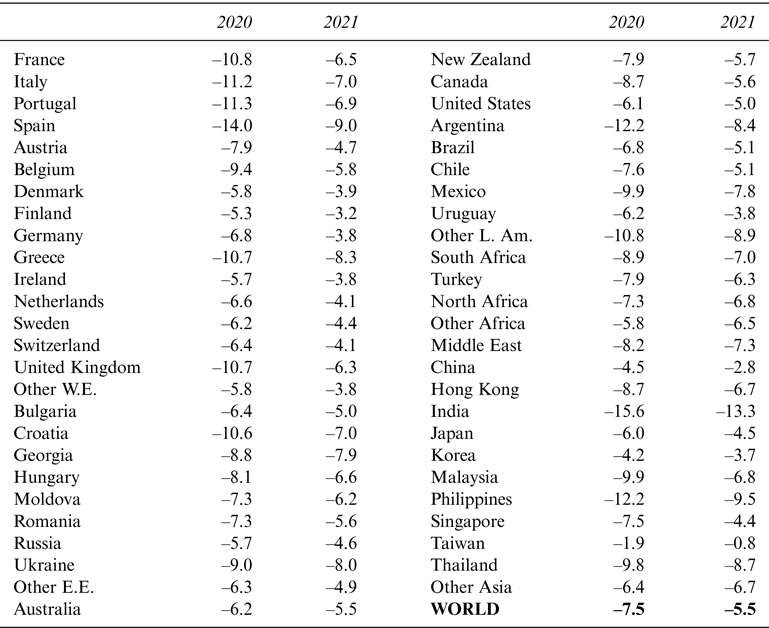
The assumed extent of the macroeconomic shock to aggregate household expenditure in 2020 and its subsequent partial recovery in 2021 are shown in Appendix Table A1 for 51 countries or residual country groups. The average assumed differences between the COVID and no-COVID scenarios in aggregate household expenditure globally are –7.5% in 2020 and –5.5% in 2021. The only other modeling change made in this global scenario is that wine demand is assumed to move away from high-quality sparkling wines (fewer celebratory events) and slightly toward high-quality still wine in 2020: as a consequence of the closure of restaurants, pubs, and clubs for several months, consumers were able to afford better wines to drink at home without on-premise mark-ups. Specifically, we assume there is a temporary 30% taste swing away from sparkling wine and a 5% swing in favor of super-premium still wine during 2020.
There is, of course, a huge amount of uncertainty around the “best guesses” by the IMF. In a lengthy global macro modeling article, McKibbin and Fernando (Reference McKibbin and Fernando2020) examine seven COVID scenarios in which the aggregate household expenditure shock for Australia in 2020 ranges from 0% to –9%, for example. The IMF projections appear to be close to national forecasts of major economies at that time for 2020. What is more uncertain is how rapidly economies will recover post-2020. The latest IMF projections for 2021 imply not a perfect V pathway but rather in the shape of a Nike tick (less than full recovery in 2021 due to, for example, older stood-down workers not being re-employable). An even more-gradual return to 2019 expenditure levels than assumed here, stretching over several subsequent years, is also possible.Footnote 1 This could be due to consumers, for example, being slow to return to crowded places even after restrictions are lifted. Also of concern is the rate at which vaccinations are distributed globally. As Bown, de Bolle, and Obstfeld (Reference Bown, de Bolle and Obstfeld2021) starkly put it, the pandemic is “not under control anywhere unless it is controlled everywhere.”
In the GLOBAL-BEV model, wine markets have been disaggregated into four types, namely non-premium (including bulk), commercial-premium, and super-premium still wines, plus sparkling wine. Commercial-premium still wines are defined to be those between US$2.50 and $7.50 per liter pre-tax at a country's border or wholesale. Beer and spirits are not split into regular and craft categories because the latter still have small market shares in volume terms and are minor players in international trade (and global trade data are not disaggregated by quality). The world is divided into 44 individual nations, with all other countries being captured in seven composite residual regions (listed in Appendix Table 1). The primary sources of data for constructing the GLOBAL-BEV model's baseline database for 2016–2018 are Anderson and Pinilla (Reference Anderson and Pinilla2020) and Anderson (Reference Anderson2020) for taxes on beverage consumption and imports, Holmes and Anderson (Reference Holmes and Anderson2017) for wine, beer, and spirits average consumer expenditure data, and United Nations (2019) for volume and value of international trade in beverages.
This GLOBAL-BEV model has income- and price-responsive demand equations, price-responsive supply equations, and hence quantities and prices for each of the grape and wine products and beer and spirits, plus for a single composite of all other products in each country such that it has elements of an economy-wide model. Grapes are assumed to be not traded internationally, but other products are both exported and imported. All prices are expressed in real (2017) U.S. dollar terms. However, to avoid complicating the scenarios, it is assumed that currency exchange rates and overall consumer price indexes for each country do not change over the two years examined, so value changes also can be interpreted as being nominal and in local currencies.
A. Producer Price and Consumption Effects
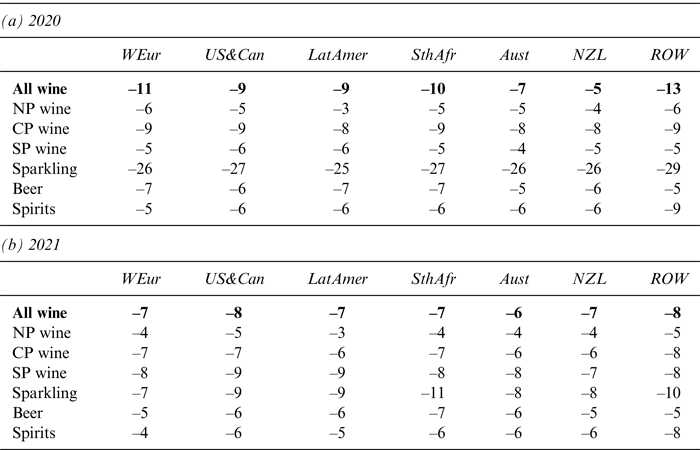
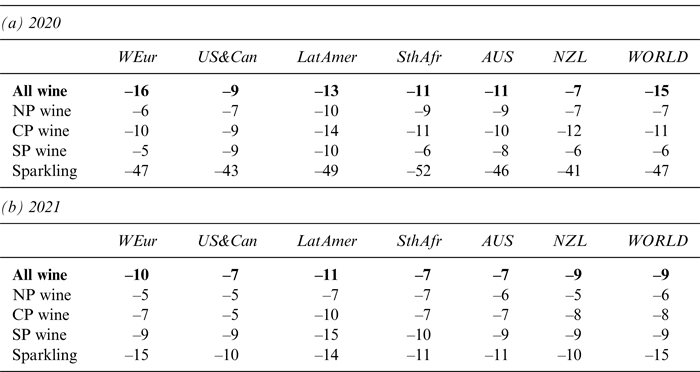
Real incomes and hence aggregate spending are expected by the IMF (2020) to be lower in most countries in 2020 relative to what they would have been without COVID but to varying extents (Appendix Table 1). The expected drops in aggregate national expenditure in 2020 are projected to lower real producer prices of beverages in all regions, but somewhat more for wine than for beer and spirits, due to the taste swing against sparkling wine (Table 1, Panel a). The falls in average prices vary across countries much more for wine than for other beverages. This is partly because of the cross-country difference in price drops for each of the four different types of wines. Prices for spirits drop less than for wine and beer because China and India dominate the global volume of spirits consumption (a combined share of almost 60%), and their incomes are expected to continue to grow in 2020, albeit far less rapidly than in the recent past.

Note: In this and subsequent tables, NP is non-premium, CP is commercial premium, and SP is super premium still wine.
a Expressed in U.S. dollars but in these simulations currency exchange rates are assumed not to change, so these are the same as national currency changes.
Source: Authors’ GLOBAL-BEV model results (Wittwer and Anderson, Reference Wittwer and Anderson2020a).
The assumed part-reversal of incomes in 2021 (Table 1, Panel b) is insufficient to make much impact in narrowing the difference between prices in the COVID and business-as-usual scenarios. This reflects the re-imposition of lockdowns and the spate of second-wave coronavirus infections in numerous countries, postponing the recovery that had initially been hoped for in late 2020.
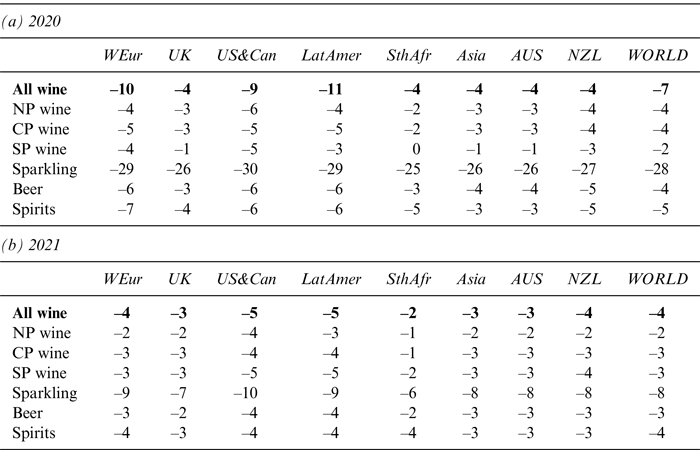
The projected changes in volumes of beverages consumed are reported in Table 2. The world is projected to involve 7% less overall consumption of wine and a somewhat smaller shortfall in beer and spirits consumption in 2020 (4–5%). Within the wine group, sales of super-premium still wine consumption drop less than lower-priced wine (due to a taste swing towards consuming higher-price wines off-premise as expenditure on-premise falls markedly). But sparkling wine is projected to be down by more than a quarter compared with business-as-usual in 2020, a reflection of the widespread cancellation of large celebratory activities in 2020. Beverage consumption is affected in Asia almost as much as elsewhere, despite its income growth being curtailed less than in other regions, because Asia's income difference between the COVID and no-COVID scenarios is still large in percentage point terms.
Changes in Volume of Domestic Consumption of Beverages, 2020 and 2021
(% Difference, Relative to No-COVID Baseline)

Source: Authors’ GLOBAL-BEV model results.
Sales growth is projected to occur in 2021, but the volume of consumption is still expected to be lower than it would have been without COVID. It would have been lower still had average prices not remained subdued.
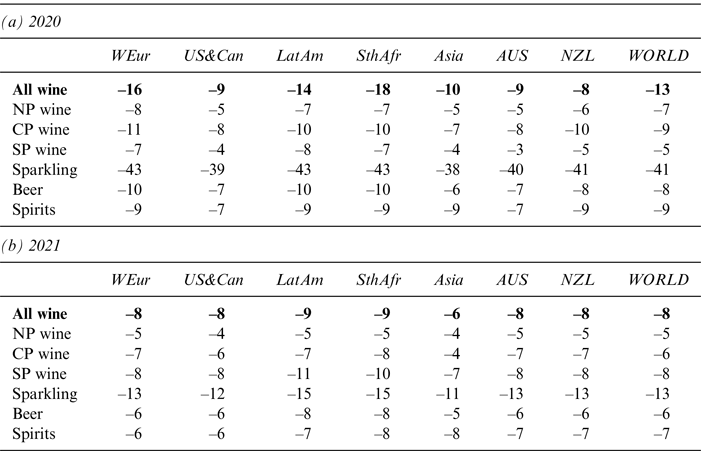
The values of consumption alter considerably more than their volumes because prices also fall and then begin to rise over the two years—they alter more for fine (especially sparkling) wines than for commercial and non-premium still wines. For the world as a whole, the volume of all wine consumption is 7% lower in 2020 than it would have been without COVID and 4% lower in 2021, whereas real expenditure on wine is 13% lower in 2020 and still 8% lower in 2021. For sparkling wine globally, the differences are even starker. Beer and spirits expenditures globally are projected to fall less than for wine (Table 3).
Changes in Real Valuea of Domestic Consumption of Beverages, 2020 and 2021
(% Difference, Relative to No-COVID Baseline)

a Expressed in U.S. dollars but in these simulations both exchange rates and overall national CPIs are assumed not to change, so these are the same as nominal national currency changes.
Source: Authors’ GLOBAL-BEV model results.
B. Effects on International Trade
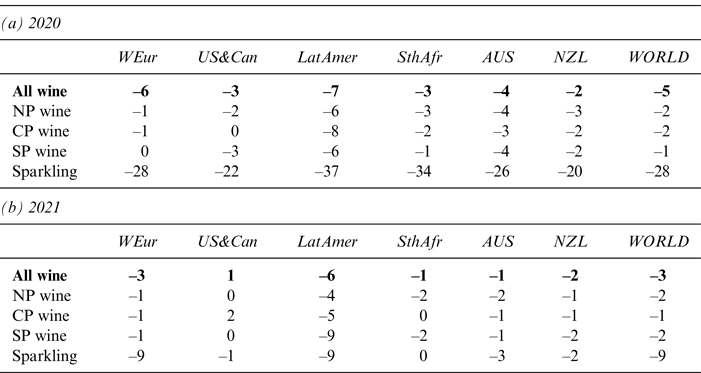
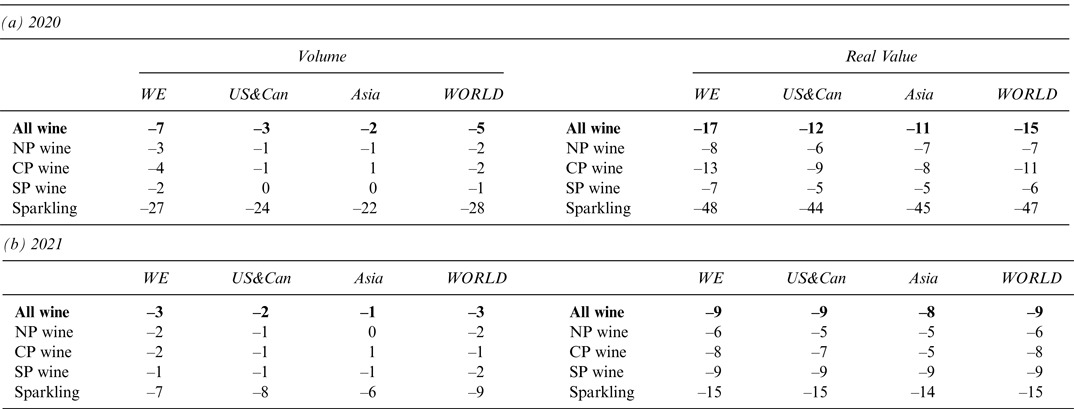
The volumes of world trade in the various wine categories alter by percentages slightly smaller in size to those for the volume of global consumption, but their values alter by somewhat larger percentages than changes in consumer expenditure because of the changes also in unit values of traded wines. In particular, the percentage fall in wine export value is three times the fall in their volume in both 2020 and 2021 (Tables 4 and 5). Australia and New Zealand are affected a little less adversely than other exporters of wine, but still harmed. Their exports are hurt less because sparkling wine is a smaller share of their exports than of the rest of the world's, and that is the wine type hit hardest by the COVID lockdowns.
Changes in Volume of Wine Exports, 2020 and 2021
(% Difference, Relative to No-COVID Baseline)

Source: Authors’ GLOBAL-BEV model results.
Changes in Real Valuea of Wine Exports, 2019 to 2021
(% Difference, Relative to No-COVID Baseline)

a Expressed in U.S. dollars but in these simulations both exchange rates and overall national CPIs are assumed not to change, so these are the same as nominal national currency changes.
Source: Authors’ GLOBAL-BEV model results.
World imports change to the same extent as world exports, of course. Table 6 shows that wine imports in 2020 are projected to be lower in Western Europe and North America by more than twice as much in percentage value as in percentage volume terms. In Asia, the value-to-volume difference is even greater because a relatively high share of Asia's imports are fine wines, and their prices have altered more than those of commercial wines.
Changes in Volume and Real Valuea of Wine Imports, 2019 to 2021
(% Difference, Relative to No-COVID Baseline)

a Expressed in U.S. dollars but in these simulations both exchange rates and overall national CPIs are assumed not to change, so these are the same as nominal national currency changes.
Source: Authors’ GLOBAL-BEV model results.
C. What about China's New Tariff on Bottled Wine Imports from Australia?
In late 2020 China imposed very high “temporary” tariffs on its imports of bottled wine from its largest supplier (Australia), pending its investigation into alleged producer subsidies to and dumping by Australian wineries. The tariffs vary by firm, ranging from 113% to 218% and averaging more than 170%, and they are expected to remain at a high level once those official investigations are completed in April 2021—possibly for five years. Their imposition, which is a response to a number of Australian government initiatives the China Communist Party disliked, contravenes the free trade agreement between the two countries. The Australian Government may take the matter to the World Trade Organization—but several years would elapse before the case is resolved there. That reality is forcing Australian producers to look to alternative markets and simultaneously is encouraging other wine-exporting countries to sell more to China.
The net effect of a near-prohibitive ban on imports from one country is less than the gross effect because shipments can be directed to alternative markets that will become more accessible as other exporters divert some of their trade to China. But this is harder for products that are more differentiated by country of origin. It is also harder when the market in the destination involved (China) is different from those of other destinations—as it is for Australian wine: the average export price of Australian wine destined for China in recent years has been three times the average sold in non-Asian markets, and most are red wines rather than being half white wines as in Australia's other markets.Footnote 2 Nor will it be easy to displace imports in Australia's domestic wine market since imports account for only 15 percent of the volume of domestic sales and a sizeable majority of those imports are white wines (most from New Zealand).
Wittwer and Anderson (Reference Wittwer and Anderson2021) have used their GLOBAL-BEV model to estimate the global trade consequences of this major blow to Australian wine exports. They did so by imposing a 170% tariff on China's imports of Australian bottled wine on the model's business-as-usual baseline (that is, ignoring COVID). That tariff virtually wipes out Australia's wine exports to China. It hits fine wine exports, especially since 52% of the value of sales to China recently have been above AUD15 per liter (compared with just 5% of Australia's sales to the United States and 3% to the United Kingdom). That loss in exports to China amounts to US$785 million per year. The total loss of exports is much smaller than that, at US$225 million, as some shipments from Australia are diverted to other countries. According to the GLOBAL-BEV Model, Australia will raise its annual exports to the United States by US$120 million, to Canada by $49m, to the United Kingdom by $45m, to other Asia by $42m, etc. Recall, though, that this is compared with business-as-usual: Australian wine exports grew by 30% in the four years to 2019 in US$ terms, so this just erodes some of that recent growth.
This shock is estimated to reduce the average producer price of wine in Australia by 11%, of winegrape prices by 12%, of the volume of its exports by 13%, and its total wine sales value by 14% (a drop of 22% for exports and 2% for the now-lower-priced albeit 3% larger volume of domestic sales). These price drops and export losses are greater than the estimates reported previously for COVID's impact on Australia, while its losses in domestic sales are smaller than those due to COVID.
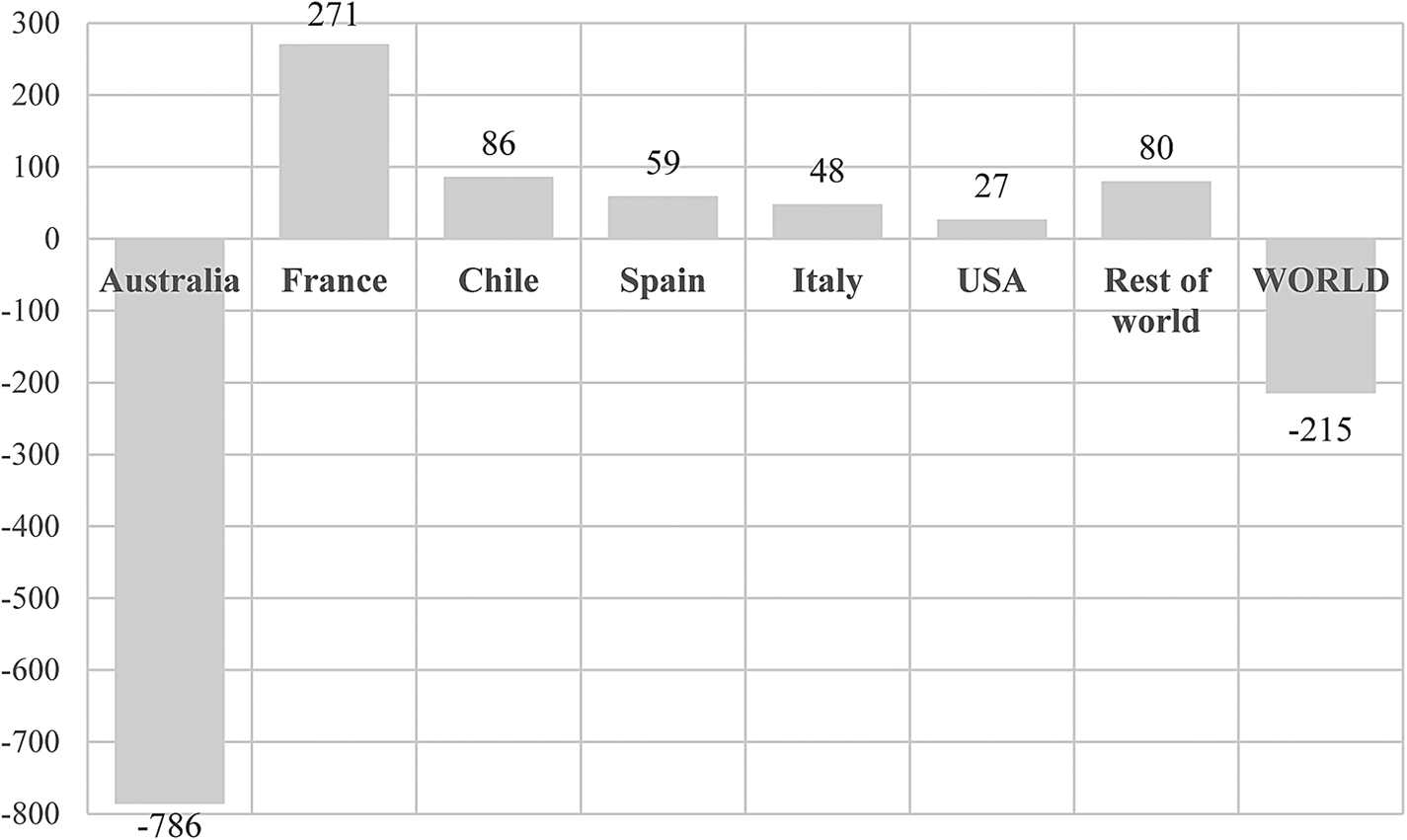
Figure 1 reveals how the origins of China's wine imports may change as a consequence of its new tariff. France, Chile, Spain, Italy, and the United States are projected to be the main beneficiaries (in that order). But their increase in imports only partly offset the fall in imports from Australia, with China's total wine imports being lower by US$215m per year because of this new protectionist barrier.
Change in Value of China's Wine Imports by Source, Pre- versus Post-Tariff Imposition of a 170% Tariff on Bottled Wine Imports by China from Australia (in US$ Million per Year)
Source: Authors’ GLOBAL-BEV model results (Wittwer and Anderson, Reference Wittwer and Anderson2020a).

D. Caveats
As mentioned at the outset, results depend heavily on our assumptions about the extent to which economies go into recession in 2020 and the extent and speed of recovery in the years to follow. The V-shaped projection in April 2020 by the IMF, implying a near-return to 2019 incomes by 2021, was more optimistic than many commentators suggested at the time and also than the IMF's October 2020 projections. Even our assumed Nike tick-type recovery may be too optimistic, as the trajectory may be more U-shaped, delaying the return to growth by one or more years. The International Wine and Spirits Research group, for example, projects it will take five years for global alcohol consumption to return to 2019 levels after the COVID-inspired slump of 2020, and possibly even longer in the United Kingdom and the United States.
Also assumed is that beverage-specific national policies affecting production, consumption, and trade are unchanged (apart from the China tariff simulation). Yet several are already in train or being contemplated. Excise taxes on alcohol may rise to help reduce fiscal deficits. U.S. tariffs on imports of EU wines and spirits (in retaliation for subsidies to Airbus) may be prolonged or removed by the new Biden Administration. And numerous bilateral preferential trade agreements following Brexit are expected to be negotiated from 2021 by both the United Kingdom and the EU27, which also are likely to have non-trivial effects on the world's wine trade (Anderson and Wittwer, Reference Anderson and Wittwer2018).
IV. Concluding Remarks
The results noted previously suggest wine sales globally are being hurt by COVID-19, and markets may take years rather than months to recover. The damage is greatest for premium sparkling wines, but all wine quality segments are affected. The impacts are not equal across countries: wine-exporting countries would lose from selling less at lower prices, while wine-importing countries would benefit from lower wine import prices. Within each country, consumers would be paying less for wine at the expense of grapegrowers and wineries. Meanwhile, on-premise sales will be lost to off-premise sellers, hurting small premium producers and independent retailers more than large-scale producers of lower-quality wines sold in supermarkets. Hopefully, the financial system and the current low-interest rates will be able to carry firms through the recovery period.
Aggregate Consumption Expenditure Relative to the No-COVID Business-As-Usual Baseline, 2020 and 2021 (% Difference)