Introduction
As a state-owned company, State Grid—the largest electric utility in the world based on its revenues—is a Chinese firm. But it is not always been easy to identify the nationality of the owners of an electric utility in China, especially when the investment of foreign residents is involved. For example, Hausman, Hertner, and Wilkins treat the Shanghai Municipal Council’s (SMC) 1893 takeover of a foreign-owned utility firm as an example of domestication.Footnote 1 In contrast, Jackson indicates that the SMC was colonial, ruled by foreigners beyond Chinese jurisdiction.Footnote 2 Indeed, because of the existence of exterritorial laws, domestication on Chinese territory did not always constitute domestication by the Chinese government or Chinese nationals. So what was the nationality of the owners of SMC? This is an important facet of Chinese history to explore, because the SMC was China’s earliest government-owned electric utility and the country’s largest power plant until the 1930s.
Controversy over the nationality of business in China is closely related to the definition of “foreign” in the Chinese context. In contemporary historical research on international investment—including that of Hausman, Hertner, and Wilkins—the term is typically defined in relation to residence, particularly in regard to foreign investment. Accordingly, an investor outside a country is a foreign investor, while an investor residing in the host country is defined as a local investor. While this definition is useful for international comparison, it can be problematic for Chinese business history. For example, Osterhammel indicates that the Hong Kong and Shanghai Banking Corporation was entirely “local” from an expatriate perspective.Footnote 3 Indeed, such “local” investment dominated the public utilities sector. In addition to SMC’s utility, Hong Kong Electric—a company owned and operated by British residents in Hong Kong—was categorized as a domestic firm by Hausman, Hertner, and Wilkins.Footnote 4 However, Hong Kong—together with Qingdao, Taiwan, and Manchuria—belonged to territorial stakes annexed or leased by foreign nations.Footnote 5 A domestic and local business in China was not necessarily a business owned and operated by the Chinese—when electrification had started in colonial enclaves such as Shanghai, Hong Kong, and Taiwan at the end of the nineteenth century, Chinese-owned utilities were still negligible. The typical definition of “foreign” investment thus overlooks the significant context.
The primary purpose of this article is to present a collective history of foreign direct investment in China’s electricity industry based on archival research.Footnote 6 Key questions asked are: How significant was foreign direct investment in China’s electrification? To what extent did colonialism and the Chinese nationalistic reactions matter in the rise and fall of foreign direct investment in China’s electric power sector? How does the history of electrification help us understand the presence of colonialism in China’s past and its legacy in general? This article pays tribute to the seminal research of Hausman, Hertner, and Wilkins, who explored how multinationals shaped electrification across the world. At the same time, this article provides a more nuanced and contextualized story concerning the Chinese aspect. Instead of identifying foreign investment based on location of residence, this article adopts Remer’s definition, which treats foreign investment as an income-generating business owned by a foreigner or a non-Chinese individual residing in China.Footnote 7 Based on Remer, this article makes a further distinction between investments from overseas and those made by foreign residents in China, with the former called “inward direct investment” and the latter “expatriate direct investment.”Footnote 8 The origin and evolution of the two foreign investment types in China’s electrification will be unraveled in the article. Moreover, in examining colonialism’s impact, this article will explore the extent to which the five definitions of economic imperialism listed by Cochran—wealth drainage, labor exploitation, raw materials exploitation, diplomatic support for foreign business, and foreign monopolies—are applicable to the case of China’s electrification.Footnote 9 In doing so, this article contributes to the history of foreign direct investment in China in particular and Chinese business history and the colonial history of China in general.Footnote 10
The article is organized chronologically. The first section examines the origin of China’s electrification. This is a story of how foreign direct investment brought technology and related regulation institutions to colonial enclaves in China. However, when Chinese-owned utilities appeared at the turn of the twentieth century, the Chinese government began implementing restrictive policies on foreign investment. As detailed in the second section, these policies resulted in tension between foreign-owned utilities and Chinese economic nationalism. The third section is a case study on China’s largest foreign-owned electric utilities in Taiwan, Manchuria, and Shanghai. The fourth section covers the Second Sino-Japanese War (1937–1945), a period in which the Japanese dominated both Chinese- and foreign-owned utilities. The final section describes the process of postwar domestication by the Chinese government.
Colonial Electrification, 1882–1905
China’s earliest electric utility, Shanghai Electric Company, was founded in 1882 by Robert W. Little, former secretary of the SMC.Footnote 11 The new firm held an exclusive license to sell the Brush arc-light system in China. With the exception of two local Chinese gentries, the company’s ordinary stocks were sold to foreign residents in the Shanghai International Settlement. In accordance with British traditions in municipal utilities regulation, Shanghai Electric was subject to regulation by the SMC in the form of a franchise. Under fierce competition with the British-owned Shanghai Gas Company, Shanghai Electric found itself on the brink of bankruptcy by 1888. After an unsuccessful overhaul, it continued to experience financial difficulty. While the SMC considered municipalization as early as 1884, it was only a decade later that it finally voted for a takeover.Footnote 12 Consequently, the SMC electricity department, a municipally owned utility, replaced Shanghai Electric in 1893.
The franchise between Shanghai Electric and the SMC was the earliest municipal regulation in China’s electrification; the municipalization created China’s first government-owned electric utility. However, the government was everything but Chinese. In 1863, the British and American settlements of Shanghai merged to form the Shanghai International Settlement. As its government, the SMC exercised power analogous to an independent state.Footnote 13 This was made possible by the 1842 Treaty of Nanjing, which granted foreigners exterritorial privileges. Foreigners and their property rights and liabilities were immune to Chinese jurisdiction.Footnote 14 SMC’s board excluded Chinese nationals until the end of the 1920s.Footnote 15 As such, China’s earliest electric utility was foreign in ownership, operation, and regulation.
China’s second-oldest electric utility, Hong Kong Electric Company, was founded in 1889. Originally a British company with headquarters based in London, Hong Kong Electric came under the purview of Gibb, Livingston & Co.—one of the most prominent foreign trading firms based in China—in the 1900s.Footnote 16 As such, Hong Kong Electric was owned and managed by British residents in Hong Kong. The same applies to the China Electric Light and Power Company, which was launched in 1901—three years after Great Britain acquired Kowloon as a leasehold. Registered in Hong Kong, China Electric Light and Power was owned and controlled by the Hong Kong–based trading house, Russell & Co.Footnote 17 The British governor of Hong Kong promulgated the Hong Kong Companies Ordinance in 1865— the earliest modern company law in China—enabling firms to be registered in Hong Kong.Footnote 18
In the 1900s, Russell & Co. expanded its interests in electrification to mainland China. In 1905, the Guangzhou (Canton) municipal government concluded a franchise with Russell & Co., granting the latter authority to sell electricity within a 6.4 km radius of the treaty port of Guangzhou.Footnote 19 The Chinese government recognized Russell & Co. as British (yingshang), perhaps because the firm was based in Hong Kong.Footnote 20 The franchise between the Guangzhou municipal government and Russell & Co. was monopolistic and had a duration of thirty years. In north China, a similar franchise was established in the treaty port of Tianjin between the Belgian-owned Electric Tramway and Lighting of Tientsin Company (ETL Tianjin) and Yuan Shikai, governor-general of Tianjin.Footnote 21 In the history of China’s electrification, Guangzhou and Tianjin are the only two cases in which fully foreign-owned firms were approved to operate electric utilities under Chinese jurisdiction.
The start of electrification in Qingdao (Tsingtao), Lüshun (Port Arthur), and Taiwan (Formosa) was more similar to what occurred in Shanghai, representing a pattern of foreign direct investment in which colonial governments in China created state-owned enterprises. In 1898, Germany leased Jiaozhou Bay from China. In the same year, Kuhlmeier & Co. launched a power plant in Qingdao, thus heralding the start of Shandong Province’s electrification. However, the business was soon sold, Kuhlmeier proving unable to afford a system expansion. With neither AEG nor Siemens & Halske interested in direct investment, the German governor-general of Qingdao municipalized the utility in 1904.Footnote 22 The colonial government fostered Qingdao’s electrification until 1914, when it was overthrown by the Japanese military.
In 1898, Russia leased Lüshun, a coastal city located at the southern end of the Chinese Eastern Railway. At the time, Lüshun was entirely administered by Russian officials because of their exterritorial privileges. Over the course of the following year, the Russians built modern urban infrastructure in the city and its surroundings, including a dockyard. In 1902, the Russian colonial authorities established a small power plant to produce electricity for the dockyard, heralding the beginning of electrification in northeast China (Manchuria).Footnote 23 Like Qingdao, the plant was usurped by the Japanese when they took over the city in 1905.
The Japanese annexed Taiwan following the First Sino-Japanese War (1894–1895). Taipei Electric Company—Taiwan’s earliest electric utility—was founded by Tsuchikura Ryujiro, a Japanese businessman who arrived on the island shortly after its annexation. Registered with Taiwan’s governor-general, Taipei Electric was awarded a franchise of twenty-four years in 1903. However, in the same year, the governor-general took over the firm when Tsuchikura sought to divest it to the Kyoto Electric Light Company due to financial difficulties.Footnote 24 Taiwan’s electricity industry was dominated by Japanese state-owned enterprises for the remainder of Japanese colonial rule.
Privatization by colonial governments is another way in which foreign-owned utilities were created in China. For instance, in 1902, the French Company of Electricity and Tramways (Compagnie Française de Tramways et d’Éclairage Electrique de Shanghai; hereafter, CFT Shanghai) was formed in the French Concession of Shanghai when the French municipal council privatized its electricity department. Registered in Paris, CFT Shanghai received a seventy-five-year franchise from the French Concession’s municipal council. It was the largest French investment in China’s electric utilities.Footnote 25
As such, by 1904 there were British, Belgian, French, German, Japanese, and Russian direct investments in China’s electricity industry. Direct investments can be divided into two categories: inward and expatriate. The nationality of inward investment firms is easy to identify and includes the British-registered Hong Kong Electric, French-registered CFT Shanghai, and Belgian-registered Electric Tramway and Lighting of Tientsin Company (ETL). Expatriate investment firms were either registered with or owned by a colonial government in China. For instance, SMC’s electricity department was capitalized in Shanghai before it was municipalized; following municipalization, it was owned and operated by a colonial government in China. As such, the SMC was based on investment by foreigners residing in China and did not involve inward capital flow. This is true of Russell & Co.’s ventures in Kowloon and Guangzhou, as well as the government-owned utilities in Qingdao and Taiwan.
Such expatriate investment is an aftermath of China’s colonial context. The utilities were an integral part of China’s electricity industry, but their nationality—if they had one—is difficult to identify. One could treat firms based on the colonial mother country—that is, those registered in Hong Kong as British firms, in Taiwan as Japanese firms, in Qingdao as German firms, and so on. However, this approach still fails to identify the nationality of the municipal utility in the Shanghai International Settlement—an enclave of transnational colonialism. Perhaps a safe argument is that colonial origin is more meaningful than nationality in the case of expatriate investment. Expatriate investment in the history of China’s electrification blurred nationality but highlighted colonialism.
China’s electrification started in a colonial context. From the 1880s onward, foreign direct investment in electricity flowed either to or from colonial enclaves in China. Meanwhile, Chinese-owned utilities remained negligible. Zheng’s data show that there may have been no more than two small-scale Chinese utilities before 1904.Footnote 26 The Chinese government was an insignificant player at this point, having been involved in the cases of Tianjin and Guangzhou only. However, if “government” is understood to include the foreign rulers of international settlements, as well as leaseholds and annexed territories, then state intervention in the form of communalization, privatization, and franchising was an indispensable part of China’s electrification from the outset (see Figure 1). The coexistence of Chinese and colonial governments reflected China’s colonial context. So did the coexistence of inward and expatriate investment. From 1882 to1905, China was but the stage for activity, with the main players—governments and businesses alike—being foreign. As such, this article introduces the term “colonial electrification” to summarize this period.
Treaty ports, leaseholds, and annexed territories in China. The map does not spell out territories annexed by a foreign country. Hong Kong, annexed by Great Britain in 1842, is the island adjacent to the south side of Kowloon on the map. Taiwan (commonly called Formosa at the time, but shown as Taiwan on the map) was annexed by Japan in 1895.
Source: John King Fairbank, China: A New History (Cambridge, MA: Harvard University Press). Copyright © 1992 by the President and Fellows of Harvard College.

Rise of Economic Nationalism, 1905–1937
Table 1 lists the major foreign-owned electric utilities in China by the year 1937, about fifty years after China’s electrification started. The division between expatriate and inward investment continued to hold. For example, both the Hankou Electric Light & Power Company (launched in 1906) and Chinese Engineering and Mining Company (launched in 1900) were registered in London.Footnote 27 The Shanghai Power Company (SPC) replaced the SMC’s electricity department in 1929, becoming the largest inward investment in China’s electrification. If foreign direct investment is understood as inward investment only, then—as Hausman, Hertner and Wilkins pointed out—foreign direct investment became significant in China after the creation of the SPC.Footnote 28
List of major foreign-owned electric utilities in China, 1934–1937

* The first part of the table is ranked in geographical order from north to south. This part is considered to include all the foreign-owned electric utilities in China, excluding Manchuria and Taiwan. All data are as they stand by the end of the year 1934, with two exceptions. Western District Power Co. was launched in 1935. It is included in the table because it was one of the few joint Sino-foreign ventures in electric utilities. Taiwan’s data is for the year 1937.
Source: Compiled by the author, based on “Zhong guo min ying dian qi shi ye zhi zu zhi” [Organization of private electric utilities in China], National Constructions Commission, March 1936, 23-25-00-017-02, ASIMH; “Chuka minkokuniokerudenkijigyo” [China’s electricity industry], Japan Ministry of Defense, C13032478300, May 1935, JACAR; Mantetsu Shanhai Jimusho, Shanhai ni Okeru Denkijigyo Chosho [Survey on Shanghai’s electricity industry]; Mitsubishigoshi [Mitsubishi & Co.], Shina no Denkijigyo Nikansuru Chosa Furoku [Statistic appendix of survey on China’s electricity industry]; Engineer Research Office North Atlantic Division,, Corps of Engineers, Engineering Study of Electric Power of China, vol. I, for China excluding Manchuria and Taiwan. Manchuria’s data are based on “Manshu niokeru denkijigyo gaisetsu” [Manchuria’s electricity industry], Japan Ministry of Defense, August 1935, C13010253700, JACAR. Taiwan’s data are based on Denkinenposha, Denkinenpo [Electricity newsletter], 263.
Compared with these inward investments from overseas, expatriate investment occurred within the Chinese border between colonial enclaves and the Chinese hinterland or within the colonial enclaves. For example, Peking Electric Light Company—which served Beijing’s Legation Street area, where foreign consulates were concentrated—had been registered in Hong Kong since 1906.Footnote 29 Macau Electric Lighting Company, which was launched in 1905, was also registered with British Hong Kong.Footnote 30 In Tianjin, the British settlement’s electricity department had been privately owned, but the local British resident council purchased it in 1920.Footnote 31 In contrast, the electric utility in the French settlement was launched by the French resident council in 1902 and privatized eight years later as L’Energie Electrique de Tientsin under C. Bourgery, who was probably residing in China.Footnote 32 The Japanese settlement in Tianjin was supplied by a firm called Tenshin Japanese Electric Light Company, the registration information for which is unclear. It was likely registered with the local Japanese consulate, as was in the case of Taisho Electric Light Company in Hankou. The Japanese settlement of Hankou had purchased electricity from the utilities of the adjacent German and British settlements but found the tariff too high. Thus, in 1914 the Japanese resident council (mindan) created a new utility, Taisho Electric Light Company, which was registered with the Hankou Japanese consulate. The consulate regulated the company’s tariff and supply conditions through a contract akin to a municipal franchise.Footnote 33
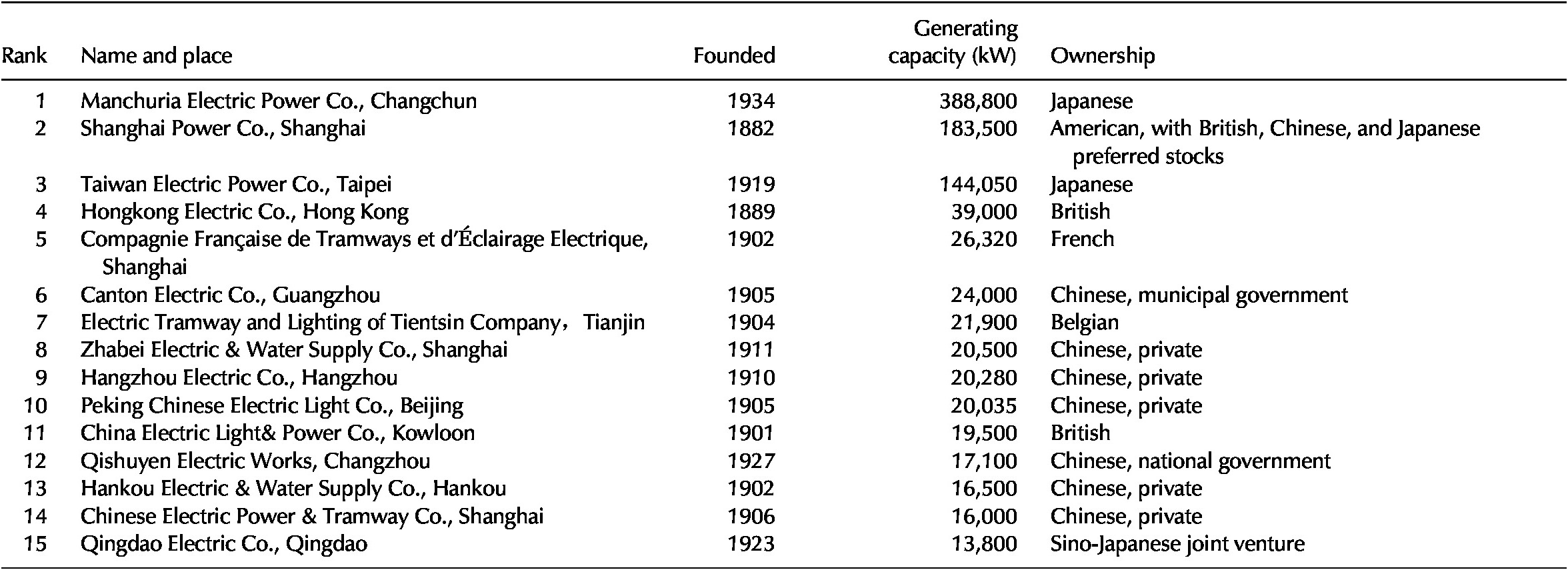
Chinese-owned utilities appeared after 1905 together with economic nationalism. The Qing dynasty’s promulgation of the 1904 Company Law formed the legal basis for modern limited liability corporations in China.Footnote 34 The majority of Chinese-owned firms included in the largest fifteen utilities of 1934 were launched in the early 1900s (Table 2). The earliest Chinese-owned utilities, as the affixation of “Chinese” (huashang or “Chinese business”) in some of their names suggests, reflected the growth of nationalism. For example, the corporate charter of the Peking Chinese Electric Light Company (launched in 1905)—the earliest Chinese-owned electric utility in north China—stipulated that only Chinese nationals could acquire its stock. Similar charters were adopted by other companies, including the Chinese Electric Power & Tramway Company in Shanghai (launched in 1906), the Canton Electric Company in Guangzhou (launched in 1905), and even the Taiyuan Electric Light (launched in 1909) in the interior Shanxi Province.Footnote 35 Such anti-foreign ownership clauses were enforceable because shareholders were required to put their names on stock certificates. In certain cases, Chinese residents in foreign settlements even domesticated electricity from foreign investors as part of a nationalist thrust. In the Gulangyü (Kulangsu) settlement of Fujian Province, for instance, local Chinese businessmen purchased a franchise from a British-owned utility in 1929 and re-registered with the Chinese government as the Gulangyü Chinese Electric Company, whose charter also denounced foreign ownership.Footnote 36
The fifteen largest power supply utilities in China ranked by generating capacity, 1934

Note: As Table 1 of this article shows, Western District Power Co. should be on the list if ranked by capitalization. It was not included in this table, because it was a power distributor for Shanghai Power Company, having no generation facilities of its own.
Source: Compiled by the author, based on “Zhong guo min ying dian qi shi ye zhizuzhi” [Organization of private electric utilities in China], National Constructions Commission, March 1936, 23-25-00-017-02, ASIMH; “Chuka minkokuniokerudenkijigyo” [China’s electricity industry], Japan Ministry of Defense, May 1935, C13032478300, JACAR; Wang, “Zhongguo Zaoqide Dianqishiye, 1882–1928” [The early phase of China’s electrification, 1882–1928”], 474–475.
As the number of Chinese-owned electric utilities increased, the government at both the central and provincial levels initiated a policy of restricting foreign stakes. In 1905, the Qing imperial government rebuffed the British-owned Peking Electric Light Company’s proposal to sell electricity beyond Beijing’s international settlement area.Footnote 37 In 1909, the Hunan provincial government proposed that the central state grant a monopolistic franchise to some Chinese businessmen after discovering that a foreign business intended to create an electric utility in the city of Changsha.Footnote 38 Consequently, the Chinese-owned Hunan Electric Light Company—the first electric utility in Hunan Province—was launched following the granting of the franchise by the imperial government in the same year.
In some cases, the Chinese government implemented nationalization as an alternative means of restricting foreign ownership. For example, in 1909, the Guangdong provincial government—under the banner of reclaiming Chinese business interests (liqüan)—cancelled Russel & Co.’s franchise, purchased the electric utility, and reorganized it into the Canton Electric Company, its corporate charter prohibiting the ownership of stock by non-Chinese individuals.Footnote 39 The provincial government originally held a third of the common stocks in the firm, but gradually diverted them so that the firm became privately owned after a decade.Footnote 40 Nationalism—rather than nationalization—constituted the real goal.
After the collapse of the Qing dynasty in 1912, China experienced a weak central state from 1916 to 1928. But an anti-foreign ownership policy was pursued by the Peking government (1912–1928) for as long as its jurisdiction as the central government could be exercised. In 1921, for instance, the Peking government prohibited the Russo-Chinese Bank from establishing an electric utility in Dihua (today Ürümqi), Xinjiang Province.Footnote 41 Two years later, the Peking government rebuffed an Austrian power plant project in Yili, Xinjiang, on the ground that it might infringe upon China’s sovereignty (zhuqüan).Footnote 42
Moreover, in 1918, the Peking government promulgated China’s first electricity regulatory law, making the central state responsible for the issuing of franchises. Electric utilities were required to re-register with the Peking government, which in that process scrutinized foreign stakes (ownership, loans, collaterals, and so on). From 1910, this was largely motivated by Japanese investment, with Japan providing private loans to several Chinese-owned utilities, their franchises acting as collateral in most cases.Footnote 43 Utilities that had received Japanese loans or had foreign ownership usually found it difficult to obtain a franchise from the Peking government, which was powerless to counter their replacement with new state-sponsored firms. Consequently, the majority of Japanese loans became bad debt.Footnote 44 Regulation on electrification started worldwide, mostly at the local, not regional or state levels. China was no exception in the case of SMC’s franchise with Shanghai Electric. But that was in the colonial enclaves. In the Chinese interior, the Peking government’s regulation marked the true beginning of electric utility regulation.
However, joint Sino-foreign ventures were still possible in exceptional cases. Japan’s interest in Qingdao and Siemens’s in Jiangsu were the only two joint ventures approved by the Peking government. The 1922 Washington Naval Conference concluded that Japanese business interests in Qingdao, which expanded rapidly after the Japanese military usurped the city from the Germans in 1914, should be registered with the Chinese government. Although the municipalization of electric utilities was anticipated by the Chinese government, Qingdao Electric Company was launched in 1923, with 53 percent being Chinese held and 47 percent being Japanese held. However, this occurred during a period of postwar recession in Japan, with Japanese investors showing little interest at first. Indeed, Ambassador Obata Yukichi was integral to the venture insofar as he warned the Japanese Foreign Ministry regarding the danger of the dwindling Japanese commercial influence in Shandong.Footnote 45 Qingdao Electric remained the largest electric utility in Shandong province in the following decades.
While Sino-Japanese interests in Qingdao proved successful, German ventures in Jiangsu did not. German citizens no longer enjoyed exterritorial privileges after World War I, but trade and investment with China were recovering.Footnote 46 In 1922, Siemens China Company, a subsidiary of Siemens & Schuckert, formed the Zhenhua Electric Manufacturing Company in Jiangsu Province.Footnote 47 However, Zhenhua was unable to raise enough ordinary stock among Chinese parties, forcing Siemens to cancel the manufacturing project. Consequently, the firm became an electric utility. As Siemens’s only directly operated power plant in China, Zhenhua constructed China’s earliest long-distance high-tension transmission system between Wuxi and Changzhou (33 kV, 33 km). Zhenhua’s power plant in Qishuyen was put into operation in 1924. Zhenhua remained a wholesaler. But the contracted retailer, the Chinese-owned Yaoming Electric Light Company, was poorly managed. Consequently, Zhenhua became so unprofitable that Siemens China divested its ownership in 1926.Footnote 48 In 1927, Zhenhua and Yaoming were nationalized by the Nationalist regime (1927–1949) as the earliest central government-owned electric utility in China’s history.
China’s anti-foreign ownership policies culminated in the Nationalist regime’s promulgation of the 1929 Privately-Owned Public Utility Regulation Law, which banned electric utilities from accepting foreign equity investment or raising debentures from a foreign nationality.Footnote 49 However, the new legislation was criticized by the trade association of the privately owned Chinese electric utilities on the grounds that higher domestic interest rates sometimes necessitated foreign capital. The Nationalist regime subsequently revised the law in 1933, legalizing foreign ownership and debenture on the condition of government approval. However, in practice, foreign direct and indirect investments were almost forbidden.
China’s nationalism surrounding electric utilities can be understood as part of national defense in a colonial context. The example of the railways—which also necessitated high sunk costs, network building, and rights of way—is useful in elucidating the electricity industry in China. Before the twentieth century, virtually all major rail firms operating in China were registered overseas, with some administered and policed by foreign officials enjoying extraterritoriality. They thus served to open the way for colonial expansion, such as in the case of the Chinese Eastern Railway and later the South Manchuria Railway.Footnote 50 Certainly, none of the foreign-owned electric utilities discussed in the first section of this article were registered with the Chinese government, and only a few received permission to conduct business based on Chinese jurisdiction. Moreover, foreign nationals enjoying exterritorial privileges were creating independent governments in China. With foreigners and their business bases not subject to Chinese law, Chinese legislation was powerless to curtail or mediate the activities of foreign direct investment within its borders. Colonialism was not an illusion but a reality. The rise of economic and political nationalism was a natural consequence.Footnote 51
But if foreign capital was restricted, how did China finance electrification? By denying foreign capital, China ran the risk of rejecting foreign technology and management know-how, which was packaged with capital flow in a business model called Unternehmergeschäft. Footnote 52 Indeed, in the 1910s, private Japanese loans to Chinese-owned electric utilities were typically accompanied by conditions like the hiring of Japanese engineers and the purchase of Japanese equipment and even coal. However, the Peking government’s policy blocked this Japanese version of Unternehmergeschäft. The Germans were equally unable to develop this model in China. As Kirchberg shows, Siemens China was losing money for most of the years between 1914 and 1940.Footnote 53 A contemporary report shows that when a Chinese-owned electric utility’s capital stock fell short, a short- or long-term loan would usually be contracted with individual persons, banks, or other financial institutions at a relatively high interest rate.Footnote 54 Financing through the issue of corporate bonds was uncommon and was limited to a few exceptional cases, with terms that were far inferior to those of foreign utilities. For instance, the Zhapei Electric & Water Supply Company (founded in 1911, ranked 8 in Table 2) had a CNY 6 million bond at an 8 percent interest rate issued in 1933. That was dwarfed by the SPC’s first mortgage debenture of CNY 88 million at 5.5 percent issued in 1929.Footnote 55 Although it seemed likely that foreign capital might cover the gap in money, technology, and know-how and thus promote China’s electrification, economic nationalism dominated.
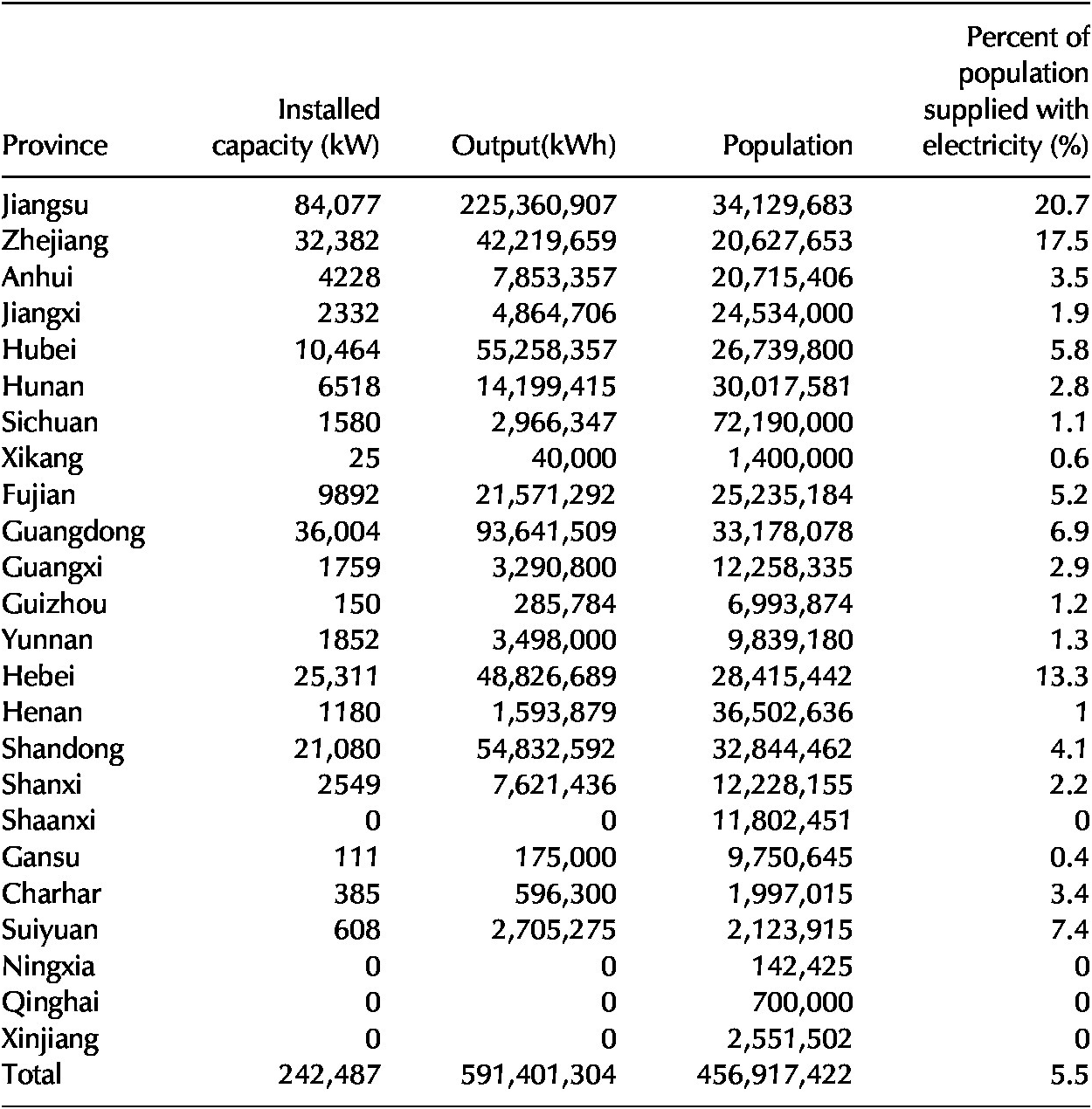
Furthermore, the Chinese hinterland was poor, representing a much smaller market compared with the treaty ports. Table 3 shows the total installed capacity and power output of Chinese-owned utilities in 1933–34. It also shows the percentage of the population with access to electricity in Chinese provinces, excluding the colonial enclaves. Across the country as a whole, only 5.5 percent of the population had access to electric light and power in 1933.Footnote 56 Electrification was unbalanced. Coastal provinces (Jiangsu, Zhejiang, Guangdong, and Hebei) had a much higher installed capacity and electrification rate than the hinterland provinces, some of which did not have a power plant at all. The collective installed capacity of China’s most electrified provinces—namely, Jiangsu, Zhejiang, Guangdong, and Hebei—still fell behind that of SPC alone. However, spillover was limited. By keeping foreign capital at bay, the Chinese government (Qing dynasty, Peking government, Nationalist regime) may have impeded the prospect of more rapid and balanced electrification in the Chinese hinterland and helped widen the gap between the electrified colonial enclaves and the underelectrified Chinese interior.
Total installed capacity and power output of Chinese-owned utilities and percent of Chinese population supplied with electricity,1933–1934

Note: The table does not include information on Chinese regions beyond the Nationalist regime’s jurisdiction such as Tibet, Manchuria, Taiwan, and other colonial enclaves.
Source: Information on installed capacity is of the year 1934 based on Jianshe weiyuan hui [National Constructions Commission], Zhongguo dianqi shiye tongji disihao [statistical report on electric utilities in China]; information on power output, population, and electrification rate is of the year 1933 based on Przygode, “Elektrizitätsversorgung Chinas” [China’s electricity supply].
In comparison to foreign-owned utilities, Chinese-owned utilities were relatively small in size. Indeed, while the number of Chinese-owned utilities increased to 248 for a total power-generating capacity of 105,801 kW by 1923, the twenty-two foreign-owned utilities had a collective capacity of 278,769 kW.Footnote 57 Even in 1936, foreign-owned utilities produced 75.9 percent of China’s power output while occupying 67.9 percent of China’s installed capacity.Footnote 58 This is astonishing if one considers that the number of foreign-owned utilities in China (excluding Manchuria and Taiwan) was no more than nineteen.Footnote 59
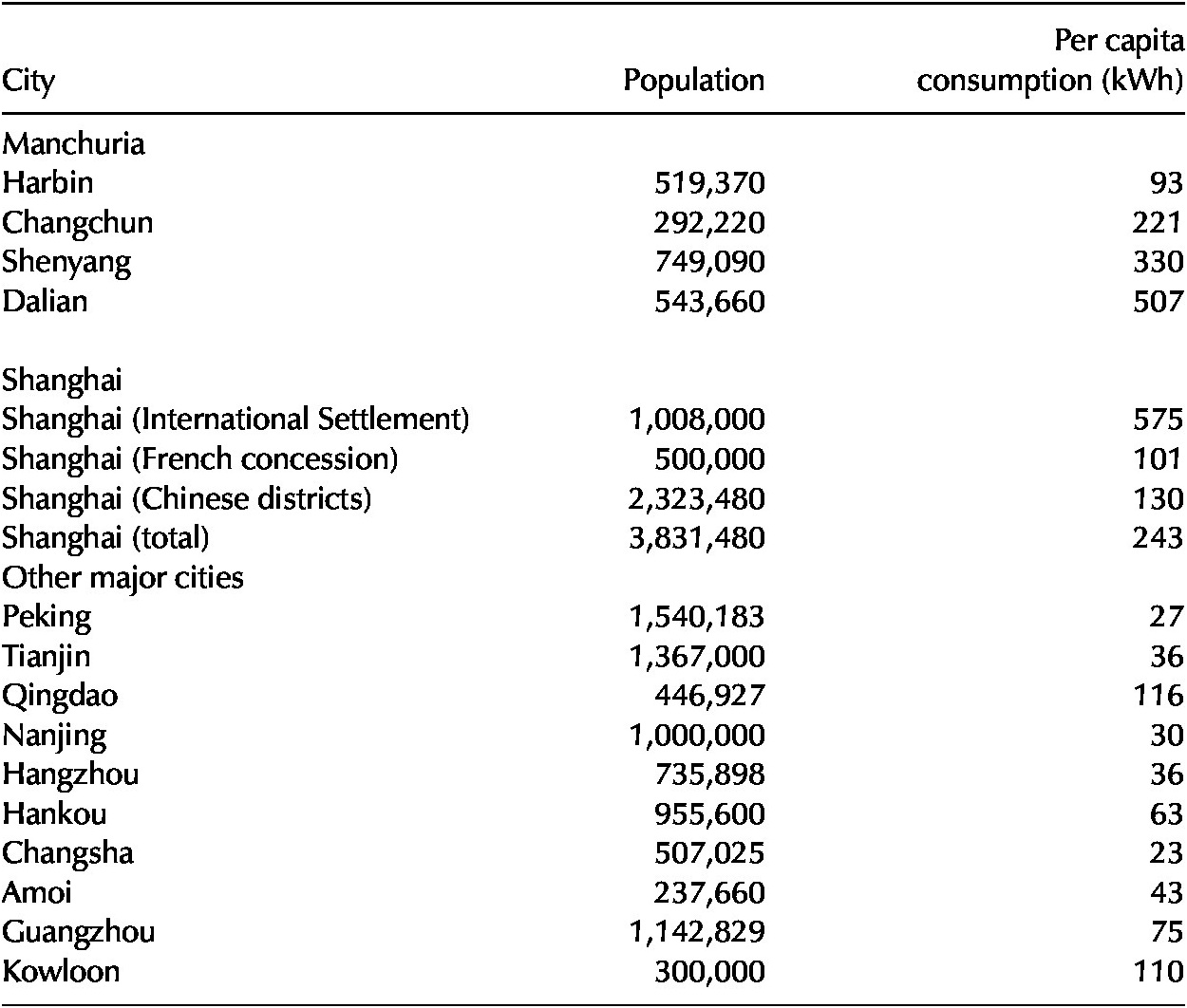
In addition to supply, foreign utilities played a significant role in promoting China’s electrification in terms of consumption. A comparison of per capita electricity consumption in major cities by 1935 indicates that cities served by foreign utilities usually enjoyed higher levels of power consumption (Table 4). Furthermore, by 1934 more than half of the fifteen largest electric utilities in terms of capacity were either foreign or jointly owned (Table 2). However, with the exception of Electric Tramway and Lighting of Tientsin Company and Qingdao Electric Company, the business bases of six of those largest foreign-owned utilities were located in foreign settlements (Shanghai), leaseholds and annexed territories (Taiwan, Hong Kong, and Kowloon), and occupied regions (Manchuria). Despite foreign utilities being responsible for the majority of China’s power production and consumption, their supply areas were restricted to a handful of colonial enclaves.
Per capita electricity consumption in major Chinese cities, 1935

Source: Mantetsu Shanhai Jimusho [Shanghai branch of South Manchuria Railway Company], Shanhai ni Okeru Denkijigyo Chosho [Survey on Shanghai’s electricity industry], 7–9.
Confronting Nationalism: Taiwan, Manchuria, and Shanghai
As shown in Table 1, the installed capacity of any of three largest electric utilities—Manchuria Electric Power Company, SPC, and Taiwan Electric Power Company—greatly surpassed that of the other smaller electric utilities. These three represented the highest achievement of foreign-owned utilities before China became involved in a devastating war with the Japanese (1937–1945) and its own civil war (1945–1949).
In Taiwan, the Japanese created the largest and most advanced hydro-based system in China when the mainland was still dominated by thermo power.Footnote 60 In 1919, the Japanese government founded the Taiwan Electric Power Company (TEP) as a national policy firm (kokusakukaisha) intended to develop hydropower in the Sun-Moon Lake area. The firm was registered in Taiwan, with a branch office in Tokyo. Although the Japanese government held a minority interest, Taiwan’s governor-general appointed its directors. Of privately owned shares, only 1.5 percent belonged to native Taiwanese. The original hydropower project was suspended for more than seven years as a result of the Great Tokyo Earthquake of 1923, which made it difficult to raise money in Japan. Finally, in 1931, a US$23 million corporate bond was issued to New York and guaranteed by the Japanese government.Footnote 61 Completed in 1934, the Sun-Moon Lake power plant increased TEP’s installed capacity by 100,000 kW, making the firm China’s third-largest electric utility. This achievement was hardly surprising. Japan was among the earliest countries in the world to develop long-distance, high-tension hydropower systems, and thus had the necessary technology and managerial know-how.Footnote 62
In Manchuria, Japan annexed Lüshun and the southern part of the Chinese Eastern Railway following Russia’s defeat in the Russo-Japanese War (1904–1905). This was Japan’s first territorial stake in mainland China. Private Japanese investment in Manchuria started in 1906 with the founding of the Yingkou Water & Electric Company, a joint Sino-Japanese venture with a 51 percent Japanese interest. In addition to private money, the Japanese state-owned South Manchuria Railway (SMR, founded in 1907) also began establishing power stations in major cities along the trunk line.Footnote 63 In 1926, the South Manchuria Electric Company was launched as an SMR subsidiary to manage the increasingly regional power system.Footnote 64 Chinese-owned electric utilities were small in comparison to Japanese-owned ones. For instance, in 1920, Chinese-owned utilities comprised no more than 14 percent of Manchuria’s collective installed capacity.Footnote 65
As Manchuria was still not fully controlled by Japan, electrification invariably involved tension with Chinese nationalism. This is aptly illustrated in the cases of Harbin and Shenyang. In 1918, the Oriental Development Company—a state-owned Japanese enterprise—purchased two Russian-owned power plants in Harbin, the most populated city in north Manchuria, forming the North Manchuria Electric Company. The Japanese consulate in Harbin regarded the purchase as a preliminary step toward a Japanese business monopoly replacing that of Russia in north Manchuria’s public utility sector.Footnote 66 At the time, North Manchuria Electric was applying for a streetcar franchise from the Russian-controlled Harbin municipal council. However, when the council approved the franchise, the Chinese provincial government and local Chinese business community organized fierce protests that eventually led to its cancellation. In the wake of such protest, the provincial government and local Chinese business community created the Harbin Electric Company in 1921, which successfully acquired the streetcar franchise desired by the Japanese firm. The coexistence of a Chinese-owned utility and a Japanese-owned utility in Harbin entailed fierce tariff competition between them. Under pressure from the Chinese, the Japanese utility was reportedly unable to pay dividends.Footnote 67 A similar case occurred in Shenyang (Mukden) between the Fengtian Electric Light Company and SMR.Footnote 68 Harbin and Shenyang constitute perhaps the only recorded examples of tariff competition caused by overlapping supply areas in the history of China’s electrification.Footnote 69
Following the Mukden incident in September 1931, Japan occupied Manchuria and launched the puppet state of Manzhouguo (Manchoukuo), which implemented the nationalization of electricity as part of a program aimed at industrializing Manchuria. This was achieved through the creation of the Manchuria Electric Power Company (MEP), launched by Manzhouguo in cooperation with SMR in 1934.Footnote 70 The MEP was a subsidiary of SMR’s diversified holdings and belonged to a part of the state-owned enterprise system under the aegis of the Japanese government. While Table 1 categorizes the MEP as an expatriate investment because it was registered in Manzhouguo, it was Japanese in both ownership and control. Similar to many of the so-called national policy companies launched in Manchuria—which ranged from aviation to iron to steel to coal to light metals—MEP was financed by Manzhouguo’s state-owned banks and SMR, both of which were further reliant on the Japanese capital market.Footnote 71 Under MEP, local Chinese- and Japanese-owned utilities were consolidated, most autonomous power plants were confiscated, and a 220-kV transmission system covering a distance of some 482 km and integrating the Manchurian grid was constructed.Footnote 72 By monopolizing and integrating Manchuria’s production, transmission, and distribution, MEP emerged as China’s largest electric utility in terms of capacity (388 MW as of 1934), dwarfing even the SPC (183 MW).
In 1929, American & Foreign Power Co. purchased the SMC electricity department to create the SPC. In the three decades after the 1893 communalization, the SMC created the largest and one the most efficient of China’s electric utilities in the center of Shanghai. Between1893 and 1929, the installed capacity of the electricity department increased from 197 kW to 161,000 kW. Power production was gradually concentrated in the Riverside Station, reaching economies of scale and improving load factors. Constructed in 1912, Riverside Station was the largest power station in the Far East in the 1920s. The station’s annual load factor and utilization factor were consistently better than those of the municipal works in Manchester, Sheffield, Glasgow, Birmingham, and Liverpool.Footnote 73 Indeed, in his report to the Institute of Electrical Engineers of Japan in 1912, Aoyagi Eiji noted that Shanghai’s power system was more advanced than Japan’s.Footnote 74 The electricity department took over the bulk of the SMC’s infrastructure investments. In 1914, for example, 55.4 percent of the SMC’s municipal bonds were for electricity purposes.Footnote 75 The electricity department had never lost money from 1893 to 1928, making it a lucrative revenue source for the SMC.Footnote 76
However, in the late 1920s, privatization emerged as an urgent issue. In 1928, the SMC voted to divest the electricity department to minimize political risks entailed in the unification of China by the Nationalist regime.Footnote 77 American & Foreign Power won the privatization deal—at an amount surpassing the total assets of Shanghai’s Chinese-owned industries.Footnote 78 The new firm, now named Shanghai Power Company, was registered in Delaware, becoming the largest American investment in Shanghai.Footnote 79 SPC was owned and managed in a multilayered business group under the utility holding company Electric Bond and Share Company.Footnote 80 Thus, China’s largest electric utility was transformed from an expatriate investment to an inward investment. To finance the purchase, American & Foreign Power raised US$3 million in common stock (3 million shares) in the United States in 1929.Footnote 81 A year later, 21 million taels of silver in preferred stocks (230,000 shares) were issued in Shanghai. During this process, SPC gained British, Chinese, Japanese, and American shareholders, with the latter owning the controlling interest.Footnote 82 In 1929–1930, a second preferred stock of US$5.5 million (162,251 shares) was offered in the United States. SPC also floated a twenty-year 6 percent gold debenture and a 5.5 percent mortgage dollar debenture due in 1973.Footnote 83 In 1936, SPC had a station load factor (based on maximum hour net output) of 64.8 percent, an installed capacity of 183,500 kW, an underground transmission system of 379 km, and a total distribution network of 1,220 km.Footnote 84 The Shanghai International Settlement’s per capita electricity consumption was the highest in China, despite SPC being confined to an area of 22.4 km2 in the center of Shanghai. With money, technology, and managerial know-how, SPC continued making capacity expansion plans until these were halted by the Sino-Japanese War.
The privatization deal leading to the creation of the SPC invoked protest from the Chinese business community and government. Besides nationalist sentiments, there were two practical concerns. First, the SMC’s board included no Chinese nationals, despite their comprising some 95 percent of the settlement’s residents and paying 55 percent of the total municipal tax. Second, the privatization decision concerned what was then China’s largest electric utility. However, the Nationalist regime’s shaky fiscal situation precluded nationalization, and the exterritorial privileges of the SMC and American capital limited the Nationalist regime’s intervention measures to a powerless protest to the United States consul-general and an ineffectual official renunciation of the deal.Footnote 85
Nonetheless, the Nationalist regime did create a harsher external environment for SPC. After the Nationalist regime created the City of Shanghai (or Shanghai Special City Government) in 1927, the municipal government began compelling Shanghai’s Chinese-owned utilities to terminate its franchises. In most cases, these franchises forbade foreign equity ownership and foreign debentures.Footnote 86 Moreover, the municipal government no longer tolerated the SPC selling power beyond the west border of the International Settlement without approval based on Chinese jurisdiction. Under pressure from the Chinese government, a Sino-American joint venture, the Western District Power Company of Shanghai, Federal Inc. (WDP), was launched in 1935. As its full name suggested, WDP was registered as a Chinese trade corporation, a U.S. federal incorporation exempt from U.S. corporate taxes.Footnote 87 WDP, the only American–Chinese trade corporation in electric utilities, was 51 percent owned by SPC but the other 49 percent was owned by the City of Shanghai. WDP purchased power from SPC, having no power-generating facilities of its own. Because WDP served regions under Chinese jurisdiction, it was compelled to acquire a franchise from the Nationalist regime in accordance with the Privately-Owned Public Utility Regulation Law.Footnote 88 Indeed, the WDP was the only instance in which the Nationalist government approved foreign direct investment in electricity before the regime fled to Taiwan in 1949. Because the Nationalist regime had already unified China’s voltage standard to 220/380 V, WDP was forced to abandon its 250-V system and adopt the Chinese national standard on the grounds that foreign firms operating in Chinese territories must comply with Chinese jurisdiction.Footnote 89 Nevertheless, within the border of the International Settlement—where Chinese jurisdiction could not reach—SPC continued its 200/350-V system.Footnote 90
There are significant similarities in the electrification of Taiwan, Manchuria, and Shanghai. First, the foreign-owned electric utilities—both inward and expatriate investments—had the necessary money, technology, and managerial know-how. Second, they had a market for electricity. Japan’s colonial designs involved state-led industrial development, thus creating a market for electricity. The Japanese also had mineral and mining interests in Manchuria, resulting in the growth of chemical-heavy industries. Shanghai was home to 77 percent of British investment in China and 65 percent of American interests in China. The demand for electricity came from not only foreign residents, but also Chinese residents (who made up 95 percent of Shanghai International Settlement’s population in late 1920s) and Shanghai’s Chinese-owned factories, which were responsible for 46 percent of China’s industrial production and employed 31 percent of the country’s workforce.Footnote 91 Third, the host governments were beyond Chinese jurisdiction. While this last may have been true of Manchuria and Taiwan, because they were either annexed or seized by Japan, Shanghai presents a special case. No more than a treaty port at first, Shanghai International Settlement developed a municipal government akin to an independent state over time. In both cases, the Chinese government’s nationalist policies could not work, thus paving the way for foreign direct investment. As such, colonialism created the conditions for Taiwan, Manchuria, and Shanghai’s electrification.
Japanese Hegemony, 1937–1945
The Sino-Japanese War (1937–1945) witnessed the expansion of Japanese utilities, as well as their hegemony over other foreign-owned utilities in China. Japan was the only major power that had territorial designs on China after the wane of Russian imperialism. Japanese political insinuation in north China had already started in 1935, creating pro-Japanese authorities semi-independent from the Nationalist government. Business expansion soon followed. As early as 1936, the China Development Company (CDC)—an SMR subsidiary—launched a Sino-Japanese utility in Tianjin in cooperation with the Japanese-controlled Tianjin municipal government.Footnote 92 The CDC was a diversified holding firm providing financial resources and technological expertise to host utilities. The Tianjin model was applied to Japanese-controlled regions in China following the outbreak of war in July 1937. Joint Sino-Japanese utilities—usually 1:1 showcasing the so-called Sino-Japanese collaboration—were immediately launched in Hebei, Shandong, and Inner Mongolia. However, these were essentially Japanese, because “Sino” usually inferred a puppet government or coerced payment in kind in the form of transferring land, machines, and equipment to newly created utilities—that is, de facto usurpation.
The Japanese electric power industry financed the usurpation of utilities in occupied Chinese regions and offered technological aid and managerial supervision. A group of fifteen Japanese electricity firms jointly launched the East Asia Electricity Enterprise Company (EAEE), which complemented CDC in usurping the ownership and control of Chinese utilities and replacing them with Japanese-controlled entities.Footnote 93 For instance, in Inner Mongolia, CDC and EAEE created the Mengjiang Electric Power Company, the two companies holding a 50 percent interest while the rest was owned by a local puppet government. Toho Electric Power, Japan’s second-largest electric utility, dispatched engineers to support Mengjiang Electric Power’s system plan, cycle and voltage unification, and its hydroelectric development. Tokyo Electric Light—Japan’s largest electric utility—sent forty employees to the occupied cities alongside the strategic Peking-Hankou Railway, while Daido Electric Power—the third largest—dispatched thirty-five employees to Shanxi Province.Footnote 94
However, the Japanese government implemented state control as the war proceeded. In November 1937, the National Diet of Japan promulgated a guideline subjecting strategic industries—including rail, shipping, mining, steel, and electricity—in occupied China to centralized state control.Footnote 95 The state control of China’s electricity industry was realized through the formation of umbrella holding companies that supervised the amalgamation of China’s electric utilities as its subsidiaries.
Consequently, in 1939, Japanese- and Chinese-owned electric utilities in Beijing, Tianjin, and Hebei were reorganized into a merger that gave rise to a vertically and horizontally integrated regional utility named North China Electric Power Company (NCEP). NCEP was a subsidiary of the state-owned holding firm North China Development Company, which held a 48 percent ownership, with the rest held by a puppet government. This was the first time north China, so far split by isolated urban plants, witnessed a regional utility and experienced nationalization of electricity. In the following years, NCEP monopolized north China’s electricity industry, undertook the reconstruction and operation of power facilities for both defensive and civil industries, and made long-term plans for system expansion and hydroelectricity development.Footnote 96 NCEP’s biggest achievement was in creating a regional grid. By 1944, it had constructed a 70-kV transmission system (total length 98 km)—by far the highest voltage ever in north China.Footnote 97
The Central China Electric Power and Water Supply Company (CCEP)—NCEP’s counterpart in central China—was created by another state-owned holding firm, Central China Promotion Company, in cooperation with a syndicate of Japanese electric utilities. CCEP was registered in Shanghai. As Chinese-owned utilities were compelled to merge with CCEP through in-kind investment, Chinese shareholders appeared to represent a majority interest (60 percent). However, Japanese personnel made up 59 percent of the workforce.Footnote 98 There was a massive demand for Japanese technological know-how, because Shanghai, Nanjing, Hangzhou, and the other big cities in the Yangtze Delta contained about 80 percent of China’s installed capacity at the time, excluding Manchuria and Taiwan. Similar to NCEP, CCEP monopolized power generation, transmission, and distribution in central China, especially in the Yangtze Delta. However, the regional system integration was poorly realized. This was largely due to most power plants in Shanghai, Hangzhou, and Nanjing having been destroyed, either by the retreating Chinese military themselves or by war damages. A puppet government became CCEP’s shareholder when the firm consolidated the mammoth American-owned SPC in 1942.Footnote 99
While non-Japanese foreign-owned utilities did not suffer direct damages during the early phase of the war, their growth potential was impeded. The Nationalist government, aware that China’s largest power plant would eventually fall under Japanese control, faced a dilemma over whether to destroy Riverside Station before retreat. Policy was contradictory in the early phase of war. Archival records indicate that in August 1937, Jiang Jieshi—the supreme commander of the Chinese military—once considered the bombardment of Riverside Station; however, the mayor of Shanghai, Yü Hongjun, pleaded with the Chinese air force not to intentionally or accidentally bomb SPC.Footnote 100Although both China and Japan refrained from attacking Riverside Station, it was cleverly used by the Japanese military as a shelter against China’s counteroffensives during the Battle of Shanghai because of its proximity to the border of the neutral Shanghai International Settlement.Footnote 101 The SPC suffered as a result of the war: its expansion plan was canceled and its installed capacity never returned to its prewar level. Beyond Shanghai, non-Japanese foreign ownership still accounted for 21 percent of north China’s installed capacity in 1940.Footnote 102
However, foreign-owned utilities were put under Japanese control after the outbreak of the Pacific War. In December 1941, the Japanese military marched into Shanghai International Settlement and began confiscating British-, American-, and Belgian-owned utilities in occupied territories. Reorganization soon followed: Electric Tramway and Lighting of Tientsin Company was merged with NCEP, and SPC was acquired by CCEP. Meanwhile, Taiwan Electric Power supervised the confiscation of British-owned utilities in Hong Kong and Kowloon. With the exception of Tianjin’s and Shanghai’s French concessions (due to Vichy France allying with the Axis Powers), foreign-owned utilities other than those owned by the Japanese had virtually disappeared from China by 1944.
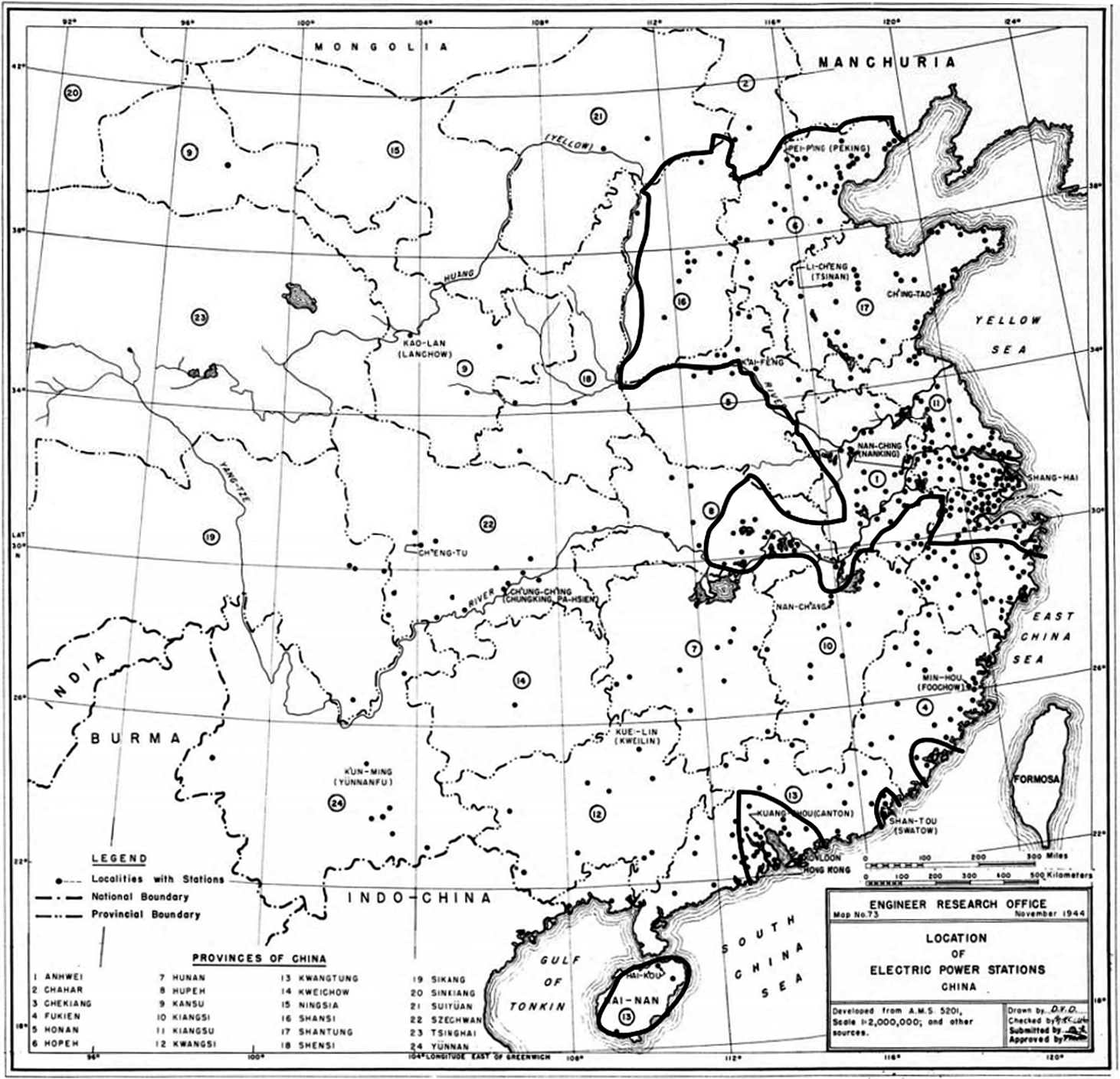
The war and Japanese hegemony devastated non-Japanese foreign direct investment in China. However, China still hosted tremendous capital inflow during the war, albeit predominantly from Japan. As such, the Sino-Japanese War involved the culmination of colonial electrification (Figure 2). The distinction between inward and expatriate investment became less meaningful as long as the Japanese wielded control, regardless of ownership.
Map showing the farthest boundary of Japanese-occupied regions and the location of China’s electric utilities in 1944. The boundary of Japanese-occupied regions is that of 1942, based on Kubo, Chugokukeizaishi Nyumon [Introduction to Chinese economic history], 164. Information regarding Manchuria and Taiwan (Formosa in the map) is not included in this map.
Source: Engineer Research Office North Atlantic Division, Corps of Engineers, Engineering Study of Electric Power of China, Vol. I. In Records of the U.S. Strategic Bombing Survey, entry 46, USSBS index section 6, report no. 12-a(4) (Printed by U.S. Army, November 1944).

Wartime Japanese direct investment is significant in China’s history of electrification. During the war, the Japanese put an end to split and isolated urban systems, which gave rise to a regional system in north China. Together with the regional systems created by expatriate Japanese firms in Manchuria and Taiwan, these were the earliest regional grids in Chinese history. The Japanese created big electricity firms that integrated power production, transportation, and distribution, reaching economies of scale previously unthinkable. Moreover, the Japanese nationalized the bulk of China’s electricity industry, implementing a state capitalistic development model in China. These traits set the Japanese utilities apart from other foreign-owned utilities in China’s electrification, which were usually small, isolated, urban utilities. This may have been because Japan had different motives in its colonial designs on China. Indeed, no other major power had ever claimed such vast territorial stakes in China, nor had they implemented economic development policies like the Japanese in Taiwan, Manchuria, and occupied China. Despite the evils of war and occupation, the structural change in China’s electricity industry brought by the Japanese constituted a significant legacy inherited by postwar China.
Domestication, 1945–1952
The Allied Powers’ victory over Japan in 1945 heralded the end of Japanese investment in China and the beginning of domestication. The Nationalist government returned to the formerly occupied territories, ready for the expropriation of Japanese assets. The confiscation process was supervised by the National Resources Commission (NRC), which during the war developed into the top of Nationalist China’s state-owned enterprises in heavy, chemical, and electricity industries.Footnote 103 MEP was reorganized into NRC’s Northeast Electricity Bureau. Taiwan Electric Power remained a state-owned enterprise, albeit the state was now a Chinese one. NCEP was reorganized into the Jibei Electric Power Company and Qingdao Power Plant, both as NRC subsidiaries.Footnote 104 The regional grids constructed by the Japanese in Manchuria, Taiwan, and north China were inherited and repaired by NRC.Footnote 105 Meanwhile, the bulk of CCEP—the assets of which were heavily damaged during the war—was returned to private ownership.Footnote 106 Overall, most of the monopolistic, vertically and horizontally integrated regional utilities created by the Japanese during the war were inherited by the Nationalist regime. The share of the Nationalist regime’s state-owned enterprises in China’s electric power sector witnessed a tremendous increase immediately after the war, growing from 32.4 percent in 1945 to 74 percent in 1946.Footnote 107 State ownership had long dominated China’s electricity industry if one views the country as a whole, considering the SMC, Taiwan’s governor-general, and Manzhouguo as “states.” But it was the post–World War II confiscation of Japanese electric utilities that led to state ownership dominating China’s electricity industry for the first time in history—until that time, colonialism was a critical element in the electricity industry’s business–state relations.
Victory over Japan also heralded the end of the political and legal conditions for colonial electrification. Based on treaties signed with allied nations during the war, the Nationalist government abolished exterritorial privileges and reclaimed sovereignty from all colonial enclaves in China, except Hong Kong, Kowloon, and Macau. How to determine the nationality of foreign-owned utilities and how to regulate them based on Chinese law became an urgent part of the Nationalist regime’s agenda. Indeed, China’s company law so far had no articles related to foreign-owned firms, because they were beyond Chinese jurisdiction under the exterritorial system.
Now that “Chinese law suddenly applied to British and American citizens,”Footnote 108 foreign-owned electric utilities were required to receive permission from the Chinese government in accordance with the 1946 New Company Law and the 1929 Privately-Owned Public Utility Regulation Law. To emphasize economic sovereignty, the New Company Law prohibited firms that were not registered in a foreign nation from conducting business in China, thus banning former utilities such as the SMC electricity department. Kirby’s research shows that the original draft of the New Company Law even defined a company’s nationality by the location where the firm did business, thus putting the nationality of foreign firms such as SPC in question. Nationalism was on the upswing once more.
While SPC was no longer the largest electric utility in China, it did reclaim its position as the largest foreign-owned utility. In July 1947, the City of Shanghai ordered SPC to renew its franchise with the Chinese government—to which the firm hesitantly consented on the condition that the Chinese government recognize the 1929 franchise between SPC and the SMC, which stipulated a forty-year duration. Anxiety before nationalization was not unwarranted. In the Nationalist government’s instructions to the mayor of Shanghai, the central state regarded SPC as an unwelcome legacy of unequal treaties.Footnote 109 At the time, the National Resources Commission was confiscating the former British Settlement’s electric utility and nationalizing the Belgian-owned Electric Tramway and Lighting of Tientsin Company.Footnote 110 After prolonged negotiations, SPC eventually surrendered and renewed its franchise with the City of Shanghai in February 1948—a symbolic move indicating the reclamation of Chinese sovereignty in the birthplace of China’s electrification.
Nevertheless, the Nationalist regime recognized the urgent need for importing foreign capital and learning foreign technology. The NRC estimated that the cost of equipment for reconstructing the electric power industry would stand at US$98 million.Footnote 111American financial aid was expected to cover part of this amount. Between1945 and 1947, the NRC cooperated with the U.S. Department of the Interior to investigate the possibility of building a dam on the Three Gorges in the upper Yangtze. Fifty-four Chinese engineers were dispatched by the NRC to Denver, Colorado, for this purpose.Footnote 112
The Nationalist government solicited foreign direct investment. In September 1947, the City of Shanghai publicized a prospectus for the United Power Company—a Sino-American joint venture anticipated to launch a 100-MW power-generation facility and create a regional 132-kV transmission network in five years. The project was anticipated to involve American bank loans. The United Power Company (UPC)—comprising SPC, Western District Power, Zhabei Electric & Water Supply, Chinese Electric Power & Tramway Company (Shanghai), Pudong Electric Company, Hangzhou Electric Company, and two Chinese-owned banks (Zhejiang Industrial Bank and Shanghai Commercial and Savings Bank)—was subsequently formed in August 1948. SPC and Western District Power, both affiliated with American & Foreign Power Co., claimed a 55 percent ownership, indicating a switch of the Nationalist regime’s policy toward foreign ownership in Chinese firms, because the older 1929 Company Law required a Chinese controlling interest in joint ventures.Footnote 113 The participation of Hangzhou Electric, the largest utility in the adjacent Zhejiang Province, indicated the plan’s regional scope. However, American banks refused to provide a loan without a collateralized franchise, while American investors feared the hyperinflation caused by the Chinese civil war (1945–1949).Footnote 114 The UPC project was suspended until political risk in the form of regime change and expropriation ultimately killed it.
In 1947, the People’s Liberation Army launched military counteroffensives against the Nationalist regime. In 1948, the Nationalist regime lost Manchuria. The NRC’s Northeast Electricity Bureau was dissolved, and the Communists gained control over Manchuria’s power system.Footnote 115 By the end of 1949, the NRC had lost almost all its industrial holdings in the mainland to the Communist regime. The majority of NRC engineers refused to flee to Taiwan with the Nationalist regime. Consequently, Communist China already possessed a large diversified holding in the basic industries, as well as the expertise of state-owned enterprise management, when it was inaugurated in 1949.Footnote 116 On Taiwan, Taiwan Electric Power—another legacy of Japanese investment—remained a state-owned entity under the Nationalist regime in the following decades. China was still poor and underelectrified in the new political map, its per capita power output stood at 7 kW, far behind Russia (291 kW) and Japan (418 kW), not to mention the United States (2130 kW).Footnote 117
PLA troops entered Shanghai in May of 1949. The business interests of SPC, Western District Power, and Compagnie Française de Tramways et d’Éclairage Electrique were originally kept intact. But following the outbreak of the Korean War, the United States and its Western allies implemented an embargo against mainland China in December 1950. In revenge, the Communist regime expropriated American, French, and British assets on the mainland. By the end of 1952, 94.5 percent of American assets—including those of SPC—were placed under state control.Footnote 118 As such, foreign direct investment in China’s electricity industry had come to an end. In the 1950s, Russian technological and financial aid would tremendously promote China’s electrification, but direct investment would be absent.
Nationalization and domestication summarizes the story of foreign utilities in China between1945 and 1952. Domestication began with the nationalization of Japanese assets by the Nationalist government. In this process, the ownership of some of China’s largest electric utilities—created through Japanese investment—was transferred to Chinese state. The abolishment of exterritorial laws put an end to the colonial governments in China, creating a new external environment for foreign firms now required by the Chinese government to comply with Chinese laws. New foreign direct investment in China’s electricity industry might have been possible had China not fallen into a civil war that ended with the rise of the Communist regime. Indirectly, the reorganization of basic industries—including the electricity sector—by the Japanese in occupied Chinese regions paved the way for the Communist regime’s state control. However, it was not Communist ideologies per se, but the breakdown of economic relations between China and the Western nations on the opposite side of the Iron Curtain that led to the end of foreign direct investment in China’s electricity industry. Expatriate investment was limited to Hong Kong and Macau. Excepting support from Russia, there would be no inward foreign investment in electricity after the 1950s.Footnote 119
Conclusion
A central theme in this history of foreign direct investment in China’s electricity industry is the conflict between colonialism and nationalism. China’s electrification started with foreign direct investment in colonial enclaves: settlements, annexed territories, and leaseholds. While investment itself did not mean colonialism, its host location and government did. Indeed, the regulation of China’s electricity industry began with franchises between foreign utilities and non-Chinese governments in China. Although foreign utilities represented superior technology, their penetration of the Chinese hinterland was impeded by the nationalism of both the Chinese government and business community. The areas supplied by foreign utilities had almost reached their limits as early as the turn of the twentieth century. This was not only because the Chinese interior was poor, but also a consequence and a cause of Chinese nationalism. Even though exceptions—represented by Manchuria—arose as a result of Japan’s colonial designs, nationalism still posed a challenge to the Japanese. While the Japanese eventually gained hegemony over Chinese- and other foreign-owned entities during the Sino-Japanese War, this too was based on colonialism. However, after the war, the Chinese government implemented nationalization, abolished exterritorial laws, and ensured that foreign utilities complied with Chinese legislation. As such, the history of foreign utilities in China’s electricity industry began with colonial electrification and ended with the triumph of nationalism.
By delineating between inward and expatriate investment, this article revises the argument of Hausman, Hertner, and Wilkins that foreign direct investment did not become a significant factor in China’s electricity industry until 1929, contending instead that foreign direct investment had been markedly significant in China’s electrification from the creation of Shanghai Electric in 1882 to the beginning of Chinese confiscation of Japanese assets in 1945. However, foreign direct investment was dominated by expatriate investment until 1929, especially in Shanghai. While inward investment increased after the creation of SPC and the entry of American & Foreign Power Co. into China, it was soon counterbalanced by Japanese expatriate investment in Manchuria.
The case of China’s electrification fits some of the five definitions of economic imperialism introduced earlier and suggested by Cochran. First, expatriate investment was so significant that a large part of foreign utilities’ capital accumulation took place within China. Consequently, wealth drainage was partial. Second, as a capital-intensive industry, electricity exploited less labor than labor-intensive industries. This means that labor exploitation definitions do not fit this case. Third, it is true that raw material exploitation occurred through Japanese investment in Taiwan’s and Manchuria’s hydropower, but no more. Thus, raw material exploitation was partial. Fourth, there is little evidence that foreign diplomatic support underpinned the expansion of foreign utilities, except in the case of the Japanese government, which had systematic industrialization plans for Manchuria and occupied regions. Finally, foreign monopoly seems less meaningful because the industry is a local service and a natural monopoly. But indeed, in Manchuria and occupied China, the Japanese created a regional monopoly from scratch by nationalizing small, isolated local systems that were not necessarily monopolistic beyond their urban supply areas. So overall, if economic imperialism can be detected, then it is invariably related to the Japanese. However, when the investment of other countries is also considered, then it may be safe to conclude that China’s electrification presented a form of economic imperialism in which foreign business was limited to, concentrated in, and became highly developed in the colonial enclaves within China.