Dung beetles (Scarabaeidae subfamily Scarabaeinae) are ubiquitous and play an important role in the removal of animal dung and the dispersal of seeds embedded therein. They exhibit a range of dung-acquisition and burying behaviours, from burying dung directly beneath the dung deposit to rolling dung balls up to several metres. Dung beetles act as important agents for secondary seed dispersal and seed survival: the burial of seeds is said to be of advantage against predators and desiccation (Andresen & Feer Reference ANDRESEN, FEER, Forget, Lambert, Hulme and Vander Wall2005, Culot et al. Reference CULOT, HUYNEN, GÉRARD and HEYMANN2009, Feer Reference FEER1999). In addition, burial of seeds by dung beetles is considered beneficial as seeds are not only deposited within the range of depths that are favourable for seedling establishment but also among organic fertilizer that is said to increase seedling growth rates (Andresen Reference ANDRESEN1999, Reference ANDRESEN2002; Estrada & Coates-Estrada Reference ESTRADA and COATES-ESTRADA1991, Shepherd & Chapman Reference SHEPHERD and CHAPMAN1998).
However, studying post-dispersal seed fate with and without the effects of dung beetles is a challenge and for a better understanding more detailed investigations are required (Vander Wall & Longland Reference VANDER WALL and LONGLAND2004); especially in Africa where research is far less developed than in Neotropical systems. Here we explore experimentally under natural conditions, how dung beetle burial can affect seed removal by predators in an undisturbed forest. Research took place at the LuiKotale research site, Central Congo Basin, Democratic Republic of Congo (DRC). Here, the bonobo (Pan paniscus Schwarz) is the primary seed disperser. The giant pouched rat (Cricetomys emini Wroughton) is the most common seed predator and dung beetles are secondary dispersers. For the seeds, post-dispersal mortality is affected by seed predators and dung beetles. Thus, seeds embedded in faeces could have both advantages and disadvantages. Advantages as mentioned above, and disadvantages as dung specifically may attract seed predators. In order to assess the impact of seed burial by dung beetles, we tested two hypotheses as follows: (1) Seed predators are attracted by faecal odours; and (2) Seeds buried by dung beetles escape the seed predators. In addition, we investigated dung beetle presence, behaviour and efficiency as well as dung beetle-related seedling establishment.
The LuiKotale research site is located at the south-western fringe of the Salonga National Park, DRC, within evergreen lowland equatorial rain forest (2°47′S, 20°21′E) (Hohmann & Fruth Reference HOHMANN and FRUTH2003). The climate is equatorial with abundant rainfall (> 2000 mm y−1), and two dry seasons, a short one in February and a longer one between May and August. Mean temperature at LuiKotale ranges between 21 °C and 28 °C with a minimum of 17 °C and a maximum of 38 °C (2007–2010).
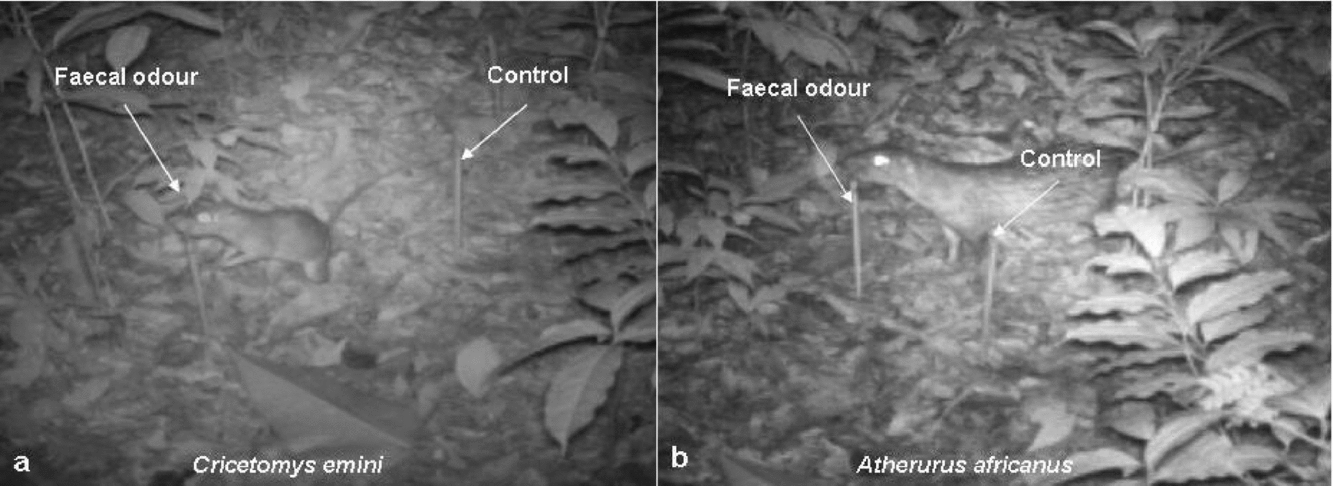
For the first hypothesis, two sticks from the same wood of 50 cm length, were placed 1 m apart 4 m in front of a camera trap (Wildview series3 & Bushnell® Trophy Cam™: Video mode 60 s/1 s interval/normal sensitivity) to test faecal olfactory attraction in animals: one stick was covered in fresh bonobo manure (without seeds or faecal material >1 mm; Figure 1) 2 cm of the top end, the other stick was without treatment serving as control. The experiment started at 17h00 and lasted for 24 h. It was run 30 times between January and March 2011 with new sticks each time. Sticks were randomly positioned where giant pouched rats had been observed previously. Only sites visited by predators were analysed. Olfactory attraction was considered when the rat rose on its hind legs and pointed its nose towards the top of the stick (at less than 5 cm) (Figure 1). From these 30 runs, a total of nine showed seed predators. Of these, eight recordings contained giant pouched rats at night. All of the eight videos showed a rat sniffing the stick with faecal odour (Figure 1a). None of the control sticks was sniffed. During their nocturnal activities, giant pouched rats were significantly attracted by bonobo faecal odour (non-parametric Wilcoxon signed rank paired test = 36, P = 0.01; power analysis = 91%, software: R 2.11.). One video recorded an African brush-tailed porcupine (Atherurus africanus Gray) sniffing the stick with faecal odour (Figure 1b).
Infrared records on faecal odour attraction. Arrows point at bonobo faecal odour and control stick with giant pouched rat (Cricetomys emini) (a) and African brush-tailed porcupine (Atherurus africanus) (b) each sniffing at the treated wooden stick.

In order to investigate granivore behaviour towards unburied bonobo faeces, fresh bonobo faeces collected during the day were positioned at night (19h00), 4 m away from a camera trap. The experiment was conducted twice in January 2011 at different sites. Both times fresh bonobo faeces were visited by C. emini which ate the seeds (19h32 and 02h19). For the second visit, dung beetles had probably started to bury the material because the rat was filmed digging.
For the second hypothesis, we investigated the removal rate of five seeds on the ground compared with five seeds of the same species buried at 5 cm depth with 40 replicates. Seeds of three plant species from three different families, Cissus dinklagei Gild & Brandt, Vitaceae; Polyalthia suaveolens Engl. & Diels, Annonaceae; Dialium corbisieri Staner, Caesalpiniaceae, were extracted manually from several bonobo faeces collected the previous day and tested from January to June 2010 and 2011. Seed dimensions were measured for 10 seeds each during their fruiting season between 2010 and 2011 as follows: C. dinklagei: weight 0.7 g, length 18 mm, diameter 10 mm; P. suaveolens: 0.6 g, 11 mm, 6 mm; and D. corbisieri: 0.6 g, 14 mm, 10 mm. Manure was removed manually to mimic dung beetle consumption but not washed to keep faecal odour. This experimental manipulation mimics a situation in which seeds primarily dispersed by bonobos (endozoochory) are secondarily dispersed by dung beetles and represents the two possible outcomes for these seeds: all dung removed by dung beetles but seed not buried vs. all dung removed and seed buried. The seeds of each species (n = 5 buried and n = 5 unburied 15 cm apart) were deposited in the forest and replicated along three transects of 1.2 km length each, resulting in three transects. The surface seeds were deposited in a surface depression (2 cm deep, 8 cm diameter, manually created) in order to avoid seed removal by rain. They were checked daily before and after the night (17h00 and 05h00). Presence and scratches of surface seeds were monitored daily, and presence of buried seeds was checked every 30 d by excavation. Seeds were reburied after each control. Camera traps were installed for identifying the seed removers and predators.
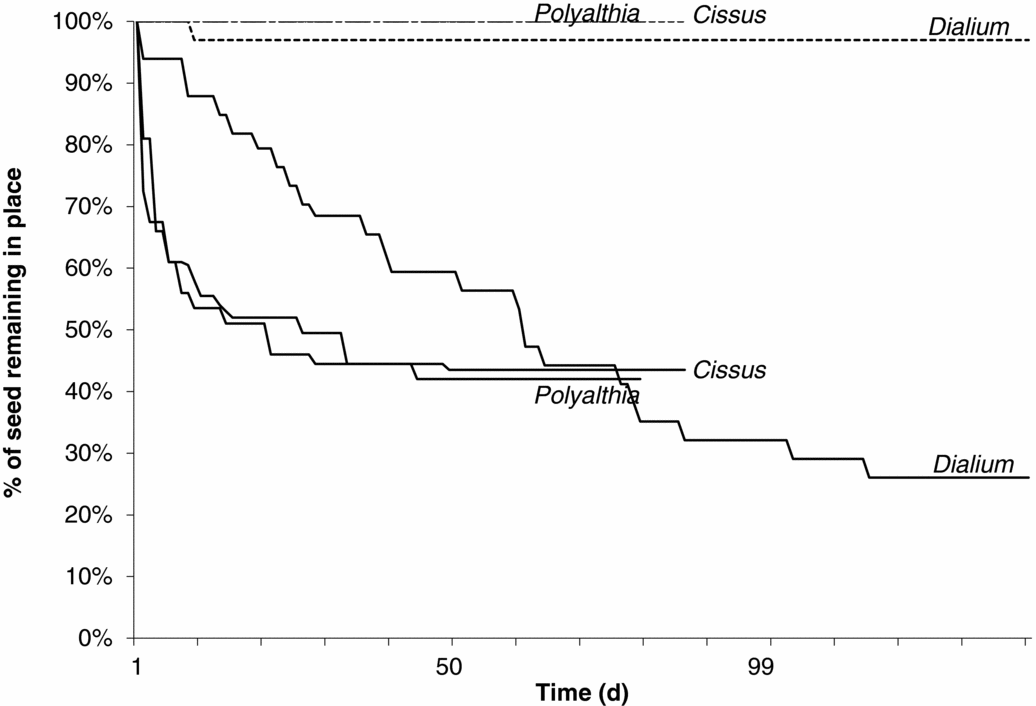
Buried seeds remained unaffected by seed predators. After 69 and 78 d of monitoring, 100% of the buried seeds from P. suaveolens and C. dinklagei, and after 154 d of monitoring, 94% of the buried seeds from D. corbisieri were still present (Proportion tests = 217, df = 1, P < 0.001; 154, df = 1, P < 0.001; 172, df = 1, P < 0.001 respectively; power analyses = 100%). In contrast, more than half of all surface seeds was removed by nocturnal seed predators (P. suaveolens: 56%; C. dinklagei: 58%; and D. corbisieri: 74%; Figure 2). All removal events occurred at night.
Effect of seed burial on seed predation. Percentage of buried (dotted line) vs. unburied (continuous line) seeds in relation to time of Cissus dinklagei, Polyalthia suaveolens and Dialium corbisieri.

In order to investigate dung beetle presence, behaviour and efficiency, between January 2010 and April 2011 we baited a total of 45 pitfall traps (10 cm diameter, 15 cm depth) with fresh bonobo faeces (100 g each) exposing each to nature for 24 h in random places of the forest undergrowth. Of these, 36 were found with several dung beetle species. The biggest identified was possibly Catharsius gorilla Thomson (P. Moretto pers. comm.). Catharsius sp. was also observed under natural conditions feeding on bonobo faeces (n = 45). Freshly deposited bonobo faeces were georeferenced and monitored directly or by help of camera-traps. Arrival time, burial time and burial behaviour were recorded. Catharsius sp. was able to bury numerous and large seeds (max: 3.5 cm diameter e.g. Grewia spp.) in an average depth of 5 cm in large tunnels of 3.5 cm diameter. Mean (± SE) time between bonobo faecal deposition and Catharsius sp. arrival was 42 ± 25 min (range = 5–188 min; n = 7). Catharsius sp. buried the faeces completely (average weight of bonobo faeces: 111 ± 76.1 g, n = 407) within an average of 56 ± 10 min (range = 27–89 min; n = 5).
In order to investigate dung beetle related seedling establishment, 45 faeces were monitored between March 2010 and June 2011. Of these, 67% ± 7% (CI95% = 53–81%) were observed to recruit seedlings between 1 and 18 mo from the beginning of monitoring. The following plant species were identified: C. dinklagei, Dacryodes yangambiensis Louis ex Troupin, Ficus spp., Grewia spp., Guarea laurentii De Wild, Landolphia spp., Manilkara sp., Pancovia laurentii Gild ex De Wild.
In the forest ecosystem of LuiKotale, the bonobo eats fruits and swallows seeds of hundreds of plant species (unpubl. data). Nocturnal seed predators such as the giant pouched rat or porcupine are attracted by faecal odour likely to indicate seeds dispersed by endozoochory. However, seeds are usually deposited by apes during the day, attracting tunnellers such as species from the genus Catharsius in less than 1 h. Seedling establishment is likely to occur in a narrow range of depths (3–10 cm), where seed removal by rodents is low but seedlings can still emerge (Estrada & Coates-Estrada Reference ESTRADA and COATES-ESTRADA1991, Shepherd & Chapman Reference SHEPHERD and CHAPMAN1998).
Deposited faeces disappear from the surface in less than 1 h due to tunnellers that can bury seeds of up to 3.5 cm diameter such as seeds of Grewia spp, allowing seeds to avoid nocturnal rodents and surface pathogens.
The net outcome of these plant–animal interactions is highly context-specific and deserves, particularly in the Afrotropics where related research appears to be underrepresented, further attention. This note, however, allows confirming the following Neotropical findings: dung beetles decrease the probability of seed predation by rodents and allow seedling establishment (Andresen & Levey Reference ANDRESEN and LEVEY2004, Culot et al. Reference CULOT, MANN, MUÑOZ LAZO, HUYNEN and HEYMANN2011, Lawson et al. Reference LAWSON, MANN and LEWIS2012, Santos-Heredia et al. Reference SANTOS-HEREDIA, ANDRESEN and ZÁRATE2010). However, more emphasis needs to be put on distinguishing rodent seed predation from secondary dispersal. Indeed, seeds removed by granivores such as rodents cannot be considered as 100% predated (Nyiramana et al. Reference NYIRAMANA, MENDOZA, KAPLIN and FORGET2011). A minority could be secondarily dispersed but the majority of the removed seeds is food for seed predators (Crawley Reference CRAWLEY and Fenner1992). In DRC, dung beetles such as Catharsius spp. and other large tunnellers are involved in secondary seed dispersal and thus play a critical role in post-dispersal seed survival.
ACKNOWLEDGEMENTS
We thank the ‘Institut Congolais pour la Conservation de la Nature (ICCN)’ for granting permission to conduct research at Salonga National Park, and Lompole village for granting permission to access the forest of their ancestors. Research at LuiKotale was conducted under the auspices and with financial support of the Max-Planck-Society, the Federal Ministry of Education and Research and the Conseil Régional de Bourgogne. The methods used to collect data in the field are in compliance with the requirements and guidelines of the ICCN, and adhere to the legal requirements of the host country, the Democratic Republic of Congo. Special thanks for continuous support go to G. Hohmann. We thank the international and local staff of LuiKotale and anonymous reviewers for valuable suggestions.