Introduction
Parasitic gastrointestinal (GI) nematodes are a serious threat to the livestock industry and farm profitability, responsible for considerable losses worldwide. The losses include decreased production, costs of treatment, growth retardation and mortality in severe cases (Esmaeilnejad et al., Reference Esmaeilnejad, Samiei, Mirzaei and Farhang-Pajuh2018). Also, some of the GI nematodes (e.g. Trichinella spiralis) are zoonotic, causing a variety of ailments in humans (Cook, Reference Cook1986). The annual costs associated with parasitic diseases in sheep and cattle are estimated to be tens of billions of dollars worldwide, excluding production losses (Roeber et al., Reference Roeber, Jex and Gasser2013). Therefore, stronger measures should urgently be taken to control the infection and decrease losses.
The main cause of parasitic gastroenteritis in small ruminants in temperate regions is the parasitic nematode, Teladorsagia circumcincta. Following ingestion of infective third-stage larvae (L3) by definite hosts, the developing parasites (L3 and fourth-stage larvae) and adult worms reside in the abomasum, where a combination of nematode-induced damages and host inflammatory/immune responses lead to protein-losing gastropathy (Nisbet et al., Reference Nisbet, McNeilly, Greer, Bartley, Oliver, Smith, Palarea-Albaladejo and Matthews2016). The prevalence of the infection is in a concerning state, as it is 38% with the average of 71.5 worms isolated per case of sheep from north-west of Iran (Naem & Gorgani, Reference Naem and Gorgani2011). Furthermore, the overall prevalence of GI nematodes has been reported to be 54.3% in India, of which 29.8% is because of T. circumcincta infection (Tariq et al., Reference Tariq, Chishti and Ahmad2009).
Currently, conventional anthelmintic treatments such as albendazole, ivermectin and levamisole are the main strategy to control parasitic nematodes. However, this approach is expensive and usually relatively effective. Moreover, the nematodes no longer optimally respond to the available drugs, due to resistance induced by the excessive and frequent use of anthelmintics (Roeber et al., Reference Roeber, Jex and Gasser2013). In this regard, Waghorn et al. (Reference Waghorn, Leathwick, Rhodes, Lawrence, Jackson, Pomroy, West and Moffat2006) conducted a cross-sectional prevalence study, using a standardized faecal nematode egg count reduction test for ivermectin, at a full (0.2 mg/kg) and half (0.1 mg/kg) dose rate, and albendazole, levamisole and albendazole–levamisole in combination, on farms selected from throughout New Zealand. They showed that 36% of the farms were resistant to all the anthelmintics. Furthermore, resistance to ivermectin at the doses of 0.1 and 0.2 mg/kg live-weight was evident on 36% and 25% of these farms, respectively (Waghorn et al., Reference Waghorn, Leathwick, Rhodes, Lawrence, Jackson, Pomroy, West and Moffat2006).
Hence, the development of resistance to conventional anthelmintic drugs has made researchers seek for more efficient and cost-effective ways of dealing with parasitic infection. Although some of them have proposed novel recombinant vaccines to control parasitic nematodes (Sharma et al., Reference Sharma, Singh and Shyma2015; Nisbet et al., Reference Nisbet, McNeilly, Greer, Bartley, Oliver, Smith, Palarea-Albaladejo and Matthews2016), others have focused on nanoparticles as a novel, safe, cheap and readily available antiparasitic agent (Preet & Tomar, Reference Preet and Tomar2017; Tomar & Preet, Reference Tomar and Preet2017). Particularly, zinc oxide nanoparticles (ZnO-NPs) have aroused considerable research interest in the field of drug discovery, and some papers have been published on their antiparasitic effects (Kirthi et al., Reference Kirthi, Rahuman, Rajakumar, Marimuthu, Santhoshkumar, Jayaseelan and Velayutham2011; Dorostkar et al., Reference Dorostkar, Ghalavand, Nazarizadeh, Tat and Hashemzadeh2017). All of these studies show that nanoparticles have remarkable anthelmintic properties; however, the anthelmintic mechanisms have rarely been investigated. In our previous study (Esmaeilnejad et al., Reference Esmaeilnejad, Samiei, Mirzaei and Farhang-Pajuh2018), we tested for the antiparasitic effects of ZnO-NPs on Haemonchus contortus and obtained promising results. Here, we conducted a similar study using the same nanoparticle samples on T. circumcincta to be able to compare the results to the aforementioned study. Considering that metallic nanoparticles can provoke oxidative stress and generate free radicals in biological systems, we hypothesized that ZnO-NPs might exert their anthelminthic effects via induction of oxidative/nitrosative stress and DNA damage. Therefore, we measured several biomarkers of oxidative damage to elucidate the possible anthelminthic mechanisms.
Material and methods
Nanoparticles
Our previous nanoparticle samples were used in this study (Esmaeilnejad et al., Reference Esmaeilnejad, Samiei, Mirzaei and Farhang-Pajuh2018). Briefly, ultrapure (>99%), high-quality ZnO-NPs (20–30 nm) were procured from a commercial supplier (Iranian Nanomaterials Pioneers Company, Mashhad, Iran). The nanoparticles had originally been synthesized by US Research Nanomaterials, Inc. (Houston, Texas, USA; stock number us3555). Characterization with an X-ray diffractometer revealed that the diffraction peaks could be indexed to the hexagonal phase of ZnO-NPs with a crystallite size of 212 Å. Moreover, a transmission electron microscope revealed a ball-like structure of ZnO-NPs ranging from 20 to 30 nm in diameter.
Collection of the parasites
Sixty samples of abomasum from freshly slaughtered sheep (Kurdi and Makoui breeds) were randomly selected and transported to the parasitology laboratory for isolation and characterization of the worms. After isolation and careful washing, the parasite was identified using a light stereomicroscope, and kept in PBS (pH = 7.4) at 37 ± 2°C until analysis.
Preparation of ZnO-NP suspension and treatment of parasites
Briefly, the nanoparticles were suspended in phosphate-buffered saline (PBS). The PBS (pH = 7.4) and stock solution were prepared at the concentration of 10 mg ZnO-NPs per mL by sonication based on a previously described procedure (Khan et al., Reference Khan, Singh, Ullah, Shoeb, Naqvi and Abidi2015). Then, the stock solution was diluted and the final concentrations of 1, 4, 8, 12 and 16 ppm were prepared (Esmaeilnejad et al., Reference Esmaeilnejad, Samiei, Mirzaei and Farhang-Pajuh2018). Twenty motile parasites were treated with each concentration in triplicates and the PBS solution served as a negative control. Parasites’ mobility and mortality were evaluated at four-hour intervals, up to 24 hours The movements of the parasites were estimated based on a five-grade qualitative scale. The number of dead parasites were counted at each interval.
Homogenization of worms
After 24 hours of exposure, the worms were washed with deionized water, cut into small pieces and homogenized according to the method of Hadaś & Stankiewicz (Reference Hadaś and Stankiewicz1998). In brief, homogenization was carried out separately in 0.1 M ice-cold PBS (pH = 7.4), and then the samples were sonicated (Branson Sonifier, Chicago, USA) in an ice bath for 3 × 1 min at 30-second intervals. After centrifugation at 9000×g for 15 min at 4°C, the supernatants were collected and stored at –20°C.
Assessment of oxidative/nitrosative stress biomarkers
All of the biochemical analyses were performed using an automated biochemistry analyser (BT1500), Rome, Italy. Activities of antioxidant enzymes were measured spectrophotometrically using standard assay kits of catalase (CAT) (Cayman, Michigan, USA; item number 707002), superoxide dismutase (SOD) (RanSod, RanDox Co., Crumlin, UK) and glutathione peroxidase (GSH-Px) (Ransel, RanDox Co., Crumlin, UK). Experimental conditions were set according to manufacturers’ recommendations and a previous study (Nazarizadeh & Asri-Rezaie, Reference Nazarizadeh and Asri-Rezaie2016). The activities of the aforementioned enzymes were expressed as U per mg protein. Considering that the units were according to the protein content of the homogenate, the protein level of the supernatant was measured using a simplified method of Lowry with bovine serum albumin as the standard (Peterson, Reference Peterson1977).
Lipid peroxidation was determined as thiobarbituric acid-reactive substance according to a previous method (Buege & Aust, Reference Buege, Aust, Fleischer and Packer1978). The total antioxidant status (TAS) was estimated using 2,2'-azino-bis(3-ethylbenzothiazoline-6-sulfonic acid) (ABTS) (2, 2′azino-di-(3-ethylbenzthiazoline sulfonate), Randox Laboratories Ltd., Crumlin, UK) as the substrate. The total nitrate/nitrite content of homogenized samples was measured according to the routine method of Griess reaction. Briefly, 100 µL of the sample was mixed with 100 µl of Griess reagent in a 96-well plate and the absorbance was read at 570 nm after 10 min (Ding et al., Reference Ding, Nathan and Stuehr1988). Protein carbonyl (PCO) was measured based on the method of Levine (Reference Levine1985), using 2,4-dinitrophenylhydrazine, hydrochloric acid, ethanol–ethyl acetate (1:1, v/v) and guanidine hydrochloride solution (6 M). The carbonyl content was calculated based on the molar extinction coefficient of 2,4-Dinitrophenylhydrazine (ε = 2.2 × 104 cm/M).
Assessment of DNA damage
The DNA damage to T. circumcincta was assessed by alkaline comet assay using a similar method described by Singh et al. (Reference Singh, McCoy, Tice and Schneider1988). After incubation of the worms, their coelomocytes were obtained according to the non-invasive extrusion method (Eyambe et al., Reference Eyambe, Goven, Fitzpatrick, Venables and Cooper1991). Comets were scored visually and classified according to the amounts of DNA in tails (Azqueta et al., Reference Azqueta, Meier, Priestley, Gutzkow, Brunborg, Sallette, Soussaline and Collins2011). Each image was classified according to the intensity of the fluorescence in the comet tail and was given a value of 0, 1, 2, 3 or 4. Total scores were between 0 and 400 arbitrary units (Esmaeilnejad et al., Reference Esmaeilnejad, Samiei, Mirzaei and Farhang-Pajuh2018).
Statistical analysis
The obtained data were analysed using the SPSS program version 22.0 (SPSS Inc, Chicago, Illinois, USA). All data were subjected to Levene's test for homogeneity of variances and the parameters were compared between the control and the treated groups using one-way analysis of variance followed by the Bonferroni post-hoc test. The data were presented as the mean ± standard deviation. Values were considered to be statistically significant at P < 0.05.
Results and discussion
Parasite mobility and mortality
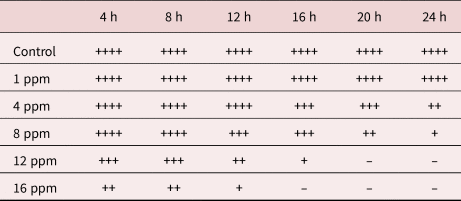
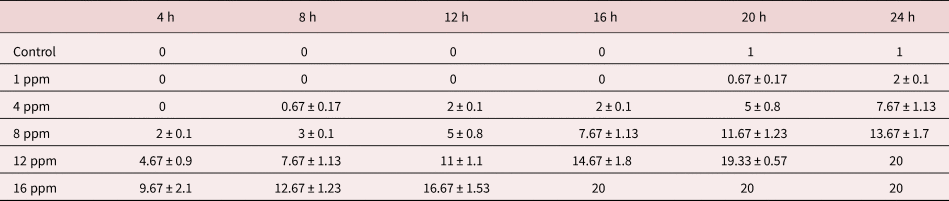
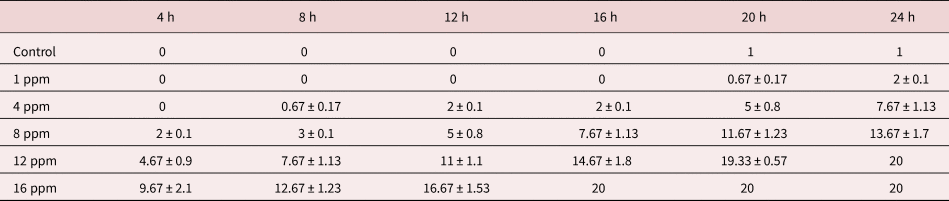
Table 1 shows any alteration in parasite movements recorded at four-hour intervals. As can be seen, with an increase in exposure time and ZnO-NP concentration, the mobility decreased accordingly. However, the worms were completely motile following incubation with the lower concentrations (1 and 4 ppm) until 12 hours. The moderate concentration of ZnO-NPs also did not have significant effects on the mobility until eight hours; however, the higher concentrations (12 and 16 ppm) could decrease the movement within the first four hours of exposure. After 12 hours of incubation with the highest concentration (16 ppm), none of the parasites were motile. Contrarily, the lowest concentration could not decrease the movements until the endpoint. Table 2 indicates that the anthelmintic effects of ZnO-NPs are concentration- and time-dependent. The lower concentrations (1 and 4 ppm) did not have any detrimental effects on the parasites within the first interval (4 h); however, the other higher concentrations could destroy the worms within four hours. Particularly, after16 hours, 100% mortality was observed with the highest concentration (16 ppm) of ZnO-NPs. This finding was completely consistent with our previous results (Esmaeilnejad et al., Reference Esmaeilnejad, Samiei, Mirzaei and Farhang-Pajuh2018). Moreover, in the previous study, we found that treatment with the lowest concentration of ZnO-NPs could decrease H. contortus mobility after 20 hours; however, in this study, no reduction in movement was recorded until the endpoint. The mortality was also higher in the previous study following incubation with 1 ppm concentration as compared to the current study (5 vs. 2). These observations suggest that H. contortus is more susceptible to ZnO-NPs as compared with T. circumcincta. The most obvious difference between T. circumcincta and H. contortus is their size, as T. circumcincta is three or four times larger than H. contortus. Most likely, size plays a significant role in host–parasite interaction. Many worms are not affected by the host's attempts to limit their activities or to destroy them simply because they are large and mobile. Size alone renders many defence mechanisms inoperative, as does the tough cuticle of adult roundworms (Wakelin, Reference Wakelin1996). However, the role of size in in vitro conditions has not yet been fully elucidated.
The effect of various concentrations and incubation time of ZnO-NPs on the mobility of Teladorsagia circumcincta.

++++, high; +++, moderate; ++, low; +, very low; –, no motility.
The effect of various concentrations and incubation time of ZnO-NPs on the mortality of Teladorsagia circumcincta (mean of three replicates, n = 20).
Assessment of oxidative/nitrosative stress parameters and DNA damage
As presented in table 3, almost all the oxidative/nitrosative stress biomarkers exhibited dramatic changes following incubation with 4, 8, 12 and 16 ppm concentrations; however, the lowest concentration (1 ppm) did not have any significant effects on the indicators compared to the control petri dishes. A gradual increase in the activity of SOD was noticed following treatment with the first three concentrations (1, 4 and 8 ppm), which remained constant with 12 and 16 ppm concentrations. Similarly, a gradual increase was also recorded in the activity of GSH-Px following incubation with 1 and 4 ppm concentrations; however, the other concentrations decreased GSH-Px activity. The probable explanation is that in a compensatory mechanism, the activities of SOD and GSH-Px have increased to cope with oxidative stress and neutralize reactive oxygen species (ROS). The plateau state observed in the activity of SOD may mean that the enzyme works with the highest possible capacity. CAT activity was also decreased with ZnO-NP treatment, and the highest concentration reduced the activity approximately six-fold as compared to the control worms. Most likely, the enzyme was overwhelmed by the severity of oxidative stress, or it is probable that free radicals invaded the functional site of CAT and caused denaturation.
The effect of various concentrations of ZnO-NPs on oxidative/nitrosative stress parameters and DNA damage after 24 hours.

Enzymatic activity (SOD, CAT, GSH-Px): U mg−1 protein; MDA, PCO and NO: nmolmg−1 protein; TAS: micro molmg−1 protein; DNA damage: arbitrary units.
Values within a column carrying different superscript letters (a–e) denote significant differences (P < 0.05).
Apparently, T. circumcincta is equipped with more efficient SOD compared to H. contortus, because SOD activity was not suppressed by the highest concentration of ZnO-NPs in T. circumcincta. Furthermore, the basic activity level of SOD in T. circumcincta was almost two times higher than H. contortus (8.38 ± 0.44 vs. 4.04 ± 0.02) (Esmaeilnejad et al., Reference Esmaeilnejad, Samiei, Mirzaei and Farhang-Pajuh2018). On the contrary, CAT activity was easily suppressed in T. circumcincta compared to H. contortus, suggesting its low efficiency. However, it has been claimed that SOD has the largest catalytic efficiency of any known enzyme. Therefore, considering that T. circumcincta is equipped with more efficient SOD, it can firmly stand against oxidative stress compared to H. contortus. The findings of mobility and mortality support this hypothesis. The activity of GSH-Px non-significantly increased following exposure to the first two concentrations of ZnO-NPs, probably to cope with oxidative stress; however, since then the activity decreased depending on concentration. The observed decrease in the activities of CAT and GSH-Px following exposure to the higher concentrations of ZnO-NPs (8, 12 and 16 ppm) could be related to the destruction of antioxidant enzymes or the depletion of their cofactors, including minerals or vitamins. In fact, when ROS and other free radicals are produced excessively, they attack and damage protein molecules, including antioxidant enzymes, and reduce their activities (Nazarizadeh & Asri-Rezaie, Reference Nazarizadeh and Asri-Rezaie2016). In support of this hypothesis, elevated levels of PCO were recorded in a concentration-dependent fashion. It has been suggested that under oxidative stress conditions, glutathione (GSH) is consumed by the GSH-related enzymes (such as GSH-Px) to detoxify peroxides produced due to increased lipid peroxidation. Therefore, the decreased activity of GSH-Px can be attributed to the overproduction of ROS, especially hydroperoxides by ZnO-NPs, and the depletion of its substrate (Cathcart, Reference Cathcart1985). Our data on the increased levels of malondialdehyde (MDA) support this hypothesis. The basal activity of GSH-Px in T. circumcincta was lower than H. contortus (35.54 ± 0.62 vs. 91.44 ± 0.39); however, the alteration pattern was almost the same following incubation with ZnO-NPs (Esmaeilnejad et al., Reference Esmaeilnejad, Samiei, Mirzaei and Farhang-Pajuh2018).
MDA and PCO levels increased as ZnO-NP concentration increased accordingly. Particularly, the highest concentration (16 ppm) could elevate MDA contents roughly six-fold and PCO levels around seven-fold. On the contrary, TAS levels were reduced concentration-dependently, as 16 ppm concentration could decrease TAS contents more than two-fold compared with the control worms (table 3). These findings clearly show that ZnO-NPs can induce severe oxidative stress. It can be deduced that lipids and proteins were extensively attacked by ROS and free radicals, resulting in the elevation of MDA and PCO levels. On the other hand, all of the known and unknown antioxidants were consumed to alleviate oxidative damage, leading to a reduction in TAS levels. These findings are consistent with the previous reports (Dorostkar et al., Reference Dorostkar, Ghalavand, Nazarizadeh, Tat and Hashemzadeh2017; Esmaeilnejad et al., Reference Esmaeilnejad, Samiei, Mirzaei and Farhang-Pajuh2018).
Table 3 shows that the incubation of the worms with ZnO-NPs could increase nitric oxide (NO) levels; however, the lowest concentration (1 ppm) did not have any significant effects as compared to the control worms. There was no significant difference between 4 and 8 ppm concentrations. Furthermore, 16 ppm of ZnO-NPs increased NO levels more that two-fold as compared to the untreated parasites. The results of alkaline comet assay show that ZnO-NPs significantly damaged DNA in a concentration-dependent fashion. Particularly, the highest concentration (16 ppm) could increase the damage roughly six-fold in comparison with the lowest concentration (1 ppm). These observations are in agreement with the previous reports in which H. contortus and Eisenia fetida were exposed to ZnO-NPs (Hu et al., Reference Hu, Li, Cui, Li, Chen and Yang2010; Esmaeilnejad et al., Reference Esmaeilnejad, Samiei, Mirzaei and Farhang-Pajuh2018). NO is a key participant in many physiological pathways; however, because of high reactivity, it has the potential to considerably damage cells and tissues in its vicinity. NO can react with DNA via multiple pathways. Once produced, the subsequent conversion of NO to nitrous anhydride and/or peroxynitrite can lead to the nitrosative deamination of DNA bases such as guanine and cytosine (Burney et al., Reference Burney, Caulfield, Niles, Wishnok and Tannenbaum1999).
In conclusion, our results show that ZnO-NPs have remarkable anthelmintic effects on T. circumcincta via induction of oxidative/nitrosative damage to biomolecules. The obtained data clearly show that the anthelmintic effects are concentration-dependent, and the highest concentration (16 ppm) severely suppresses the worm's antioxidant systems and damages biomolecules, including lipids, proteins and DNA. This study was performed in experimental conditions, but the in vivo effects of ZnO-NPs on the parasite remain unclear and should be covered in future studies.
Acknowledgements
This paper is part of the DVM thesis of Zeynab Baghbani, numbered 1664, under the supervision of Drs Esmaeilnejad and Asri-Rezaei.
Financial support
This work was supported by the Vice-Chancellor for Research and Technology, Urmia University.
Conflicts of interest
None.
Ethical standards
The authors assert that all procedures contributing to this work comply with the ethical standards of the relevant national and institutional guides on the care and use of laboratory animals.