


Introduction
Anxiety-based school refusalFootnote 1 occurs among approximately 1 to 2% of young people and between 5 and 16% of clinic-referred youth (Heyne and King, Reference Heyne, King, Barrett and Ollendick2004). It causes significant distress for a young person, their family, and school staff, and it jeopardizes the young person's development (Berg, Reference Berg and Lewis2002). Follow-up studies of clinically-referred young people presenting with school attendance problems indicate a risk for ongoing social and mental health problems in late adolescence (Buitelaar, van Andel, Duyx and van Strien, Reference Buitelaar, van Andel, Duyx and van Strien1994) and in adulthood (Berg and Jackson, Reference Berg and Jackson1985; Flakierska-Praquin, Lindstrom and Gillberg, Reference Flakierska-Praquin, Lindström and Gillberg1997; McCune and Hynes, Reference McCune and Hynes2005). Continued effort to better understand the nature of school refusal and to enhance treatment effectiveness is imperative (Heyne, Reference Heyne, Fisher and O'Donohue2006; King, Tonge, Heyne and Ollendick, Reference King, Tonge, Heyne and Ollendick2000).
Characteristically, school refusal comprises a behavioural component (e.g. avoidance of school; Heyne and King, Reference Heyne, King, Barrett and Ollendick2004; Ollendick and King, Reference Ollendick, King and Leitenberg1990), an affective component (e.g. anxiety, fear, depression: Bernstein, Reference Bernstein1991; Buitelaar et al., Reference Buitelaar, van Andel, Duyx and van Strien1994; Egger, Costello and Angold, Reference Egger, Costello and Angold2003; Hansen, Sanders, Massaro and Last, Reference Hansen, Sanders, Massaro and Last1998; MacShane, Walter and Ray, Reference MacShane, Walter and Rey2001), and a physiological component (e.g. headaches, stomach pain, nausea: Bernstein et al., Reference Bernstein, Massie, Thuras, Perwien, Borchardt and Crosby1997; Egger et al., Reference Egger, Costello and Angold2003; Honjo et al., Reference Honjo, Nishide, Niwa, Sasaki, Kaneko, Inoko and Nishide2001). To a lesser extent, cognitive factors have been associated with school refusal (Heyne, Reference Heyne, Fisher and O'Donohue2006). In an uncontrolled study, school refusers were found to have low expectations about their ability to cope with stressful situations associated with school attendance (Heyne et al., Reference Heyne, King, Tonge, Rollings, Pritchard, Young and Myerson1998). Place, Hulsmeier, Davis and Taylor (Reference Place, Hulsmeier, Davis and Taylor2000, Reference Place, Hulsmeier, Davis and Taylor2002) described school refusers as having a tendency to interpret problems as insoluble and to have a general pessimistic outlook, but such conclusions were based on a small sample (n = 17) and in the absence of a control group. Published case reports of school refusers also point toward the cognitions of potential relevance in understanding and treating school refusal. Anderson and colleagues (Reference Anderson, King, Tonge, Rollings, Young and Heyne1998) reported that a 13-year-old boy expected negative reactions from the other children at school (e.g. “I know they're going to tease me”) and Mansdorf and Lukens (Reference Mansdorf and Lukens1987) reported that a 12-year-old girl had the thought “the teachers might pick on me because of my absences”. Moreover, Kennard, Ginsburg, Feeny, Sweeney and Zagurski (Reference Kennard, Ginsburg, Feeny, Sweeney and Zagurski2005) suggested that the negative automatic thoughts of school-refusing youth were a major obstacle in the treatment of adolescent depression, although no suggestions were made as to which automatic thoughts might be associated with school refusal. In short, cursory attention has been paid to the cognitive constructs associated with school refusal. This is despite the fact that cognitive therapy techniques are commonly recommended in the treatment of school refusal (e.g. Heyne and Rollings, Reference Heyne and Rollings2002; Kearney and Albano, Reference Kearney and Albano2007; Kennard et al., Reference Kennard, Ginsburg, Feeny, Sweeney and Zagurski2005; Mansdorf and Lukens, Reference Mansdorf and Lukens1987).
The field of school refusal clearly lags behind other fields in youth psychopathology with respect to the systematic empirical investigation of cognitive risk factors. In the field of youth anxiety, for example, sophisticated models have been developed to explain and test the role of cognitive risk factors in the prediction and mediation of anxiety and its treatment (e.g. Bögels and Zigterman, Reference Bögels and Zigterman2000; Creswell, Schniering and Rapee, Reference Creswell, Schniering and Rapee2005; Kendall and Treadwell, Reference Kendall and Treadwell2007; Schniering and Rapee, Reference Schniering and Rapee2004; Silverman et al., Reference Silverman, Kurtines, Ginsburg, Weems, Rabian and Serafini1999; Treadwell and Kendall, Reference Treadwell and Kendall1996; Weems, Berman, Silverman and Saavedra, Reference Treadwell and Kendall2001; Weems, Costa, Watts, Taylor and Cannon, Reference Weems, Costa, Watts, Taylor and Cannon2007). To some extent, knowledge of the cognitive factors potentially associated with school refusal may be drawn from research on youth anxiety. Even though young people who refuse to attend school are not always anxious (Atkinson, Quarrington and Atkinson, Reference Atkinson, Quarrington, Cyr and Atkinson1989; Hoshino et al., Reference Hoshino, Nikkuni, Kaneko, Endo, Yashima and Kumashiro1987), school refusal is usually characterized by problematic levels of fear and anxiety (e.g. Berg et al., Reference Berg, Butler, Franklin, Hayes, Lucas and Sims1993; Bools, Foster, Brown and Berg, Reference Bools, Foster, Brown and Berg1990; Egger et al., Reference Egger, Costello and Angold2003).
Anxious youth are often found to report more negative cognition than nonanxious or low anxious youth, with respect to cognitive products (i.e. automatic thoughts) as well as cognitive processes (i.e. cognitive errors). For example, when the Children's Automatic Thoughts Scale (CATS; Schniering and Rapee, Reference Schniering and Rapee2002) was administered in a community sample (Schniering and Rapee, Reference Schniering and Rapee2002) and a clinical sample (Micco and Ehrenreich, Reference Micco and Ehrenreich2009), negative automatic thoughts concerning social threat, physical threat and personal failure were found to be significantly related to anxiety. When the Children's Negative Cognitive Error Questionnaire (CNCEQ; Leitenberg, Yost and Carroll-Wilson, Reference Leitenberg, Yost and Carroll-Wilson1986) was administered to community samples of youth (Leitenberg et al., Reference Leitenberg, Yost and Carroll-Wilson1986; Weems et al., Reference Weems, Berman, Silverman and Saavedra2001, Reference Weems, Costa, Watts, Taylor and Cannon2007), significant relations were observed between negative cognitive errors and anxiety.
No studies have investigated the role of positive cognitions in school refusal, and the relation between positive cognitions and youth psychopathology is unclear. In the case of youth anxiety, a dominant perspective on the role of positive cognitions is “the power of non-negative thinking”. That is, the absence of positive cognitions is considered to be less influential in the development and persistence of anxiety than the presence of negative cognitions (Kendall and Chansky, Reference Kendall and Chansky1991; Kendall and Korgeski, Reference Kendall and Korgeski1979). Indeed, negative self-talk has been shown to have a greater association with anxious symptoms relative to positive self-talk (Kendall and Treadwell, Reference Kendall and Treadwell2007; Treadwell and Kendall, Reference Treadwell and Kendall1996). Further, in two studies comparing anxious and nonanxious youth, no differences were found with respect to the presence of positive cognitions (Bögels and Zigterman, Reference Bögels and Zigterman2000; Miers, Blöte, Bögels and Westenberg, Reference Miers, Blöte, Bögels and Westenberg2008). However, in a recent study in which the CATS was extended to include items measuring positive automatic thoughts, positive thoughts were found to be negatively associated with youth anxiety (Hogendoorn et al., Reference Hogendoorn, Wolters, Vervoort, Prins, Boer, Kooij and de Haan2010).
To further understand the complex phenomena of school refusal and the role of cognitive interventions during treatment for school refusal, it is important to systematically examine the role of cognition in this problem area. The current study comprised two main questions. The first question addressed the differences between school-refusing youth and youth from a normal population with respect to negative automatic thoughts, negative cognitive errors, and positive automatic thoughts. Based on anecdotal evidence for a relationship between negative cognition and school refusal, it was hypothesized that youth with school refusal would report higher levels of negative automatic thoughts and higher levels of negative cognitive errors, relative to youth from the normal population. No hypothesis was formulated with respect to positive automatic thoughts given the mixed findings surrounding the role of positive cognition in youth psychopathology. The second question was exploratory in nature. We sought to determine whether negative automatic thoughts, negative cognitive errors, and positive automatic thoughts might make a unique contribution to the prediction of school refusal.
Method
Participants
Participants were 50 school-refusing children and adolescents (the school refusal sample) and 181 children and adolescents from the normal population (the community sample) aged between 11 and 17 years.
Youth were included in the school refusal sample if they met Berg's (Reference Berg and Lewis2002) criteria for school refusal: (1) reluctant or refusing to attend school; (2) at home during school hours, rather than concealing non-attendance from parents; (3) emotional upset at the prospect of attending school, reflected in excessive fearfulness, temper tantrums, unhappiness, or possibly in the form of unexplained physical symptoms; (4) an absence of severe antisocial tendencies, beyond the young person's resistance to parental attempts to get them to school; and (5) reasonable parental efforts to secure the young person's attendance at school, at some stage in the history of the problem. Similar to prior studies (e.g. Bernstein et al., Reference Bernstein, Borchardt, Perwien, Crosby, Kushner, Thuras and Last2000; Heyne et al., Reference Heyne, King, Tonge, Rollings, Young, Pritchard and Ollendick2002), criterion 1 was operationalized as absence from school for at least 20% of the time (excluding legitimate absences) during the 2 weeks prior to assessment. For the majority of the school refusal sample (58%; those from the “@school project” as described below) criterion 3 was operationalized as the presence of a DSM-IV (American Psychiatric Association, 1994) anxiety disorder (other than obsessive-compulsive disorder or posttraumatic stress disorder) and criterion 4 was operationalized as the absence of a DSM-IV conduct disorder. Silverman and Albano's (Reference Silverman and Albano1996) Anxiety Disorders Interview Schedule, Child and Parent Versions (ADIS-C/P) was used by Masters-level graduate students and registered psychologists to ascertain diagnostic status. For the remainder of the school refusal sample (42%), organizational issues dictated that criteria 3 and 4 were operationalized as the presence of anxiety and the absence of antisocial behaviour based on clinical interview conducted within the municipal mental health services from which these school refusers were drawn. Young people were excluded from the school refusal sample if they had IQ < 80 (Kort et al., Reference Kort, Schittekatte, Dekker, Verhaeghe, Compaan, Bosmans and Vermeir2005) or had participated in cognitive-behavioural therapy in the 2 months prior to assessment.
Initially 52 school refusers were recruited: 31 (60%) were consecutive referrals to the “@school project” (an academic clinic for evaluating an intervention for school refusal; Heyne, Sauter, van Widenfelt, Vermeiren and Westenberg, in press) and 21 (40%) were referred for school refusal to a municipal mental health services (n = 5) in the southwestern part of the Netherlands. Two of the school refusal cases drawn from the “@school project” were excluded from data analysis due to missing data. The mean age of the remaining 50 school-refusing youth was 14.6 years (age range 11–17 years; SD = 1.4), and 58% were male. The majority of school-refusing youth (92%) had a Dutch background, 2% were Turkish, and 6% reported “other” ethnic background. The mean level of school attendance in the 2 weeks prior to assessment was 24%. Almost half of the school-refusing youth (49%) had not attended school at all in these 2 weeks. Of those who had attended school some of the time (i.e. 51% of the school-refusing youth), the mean level of school attendance was 46%. As per our operationalization of school refusal, none of those who attended school in the 2 weeks prior to assessment were present at school for more than 80% of the time.
The community sample comprised 181 adolescents drawn from two elementary public schools and two secondary public schools also in the southwestern region of the Netherlands. This represents a 100% response rate from schools approached to participate in the study. The mean age of the community sample of youth was 13.6 years (age range 11–17 years; SD = 1.9), and 55% were male. The majority of the community sample (88%) had a Dutch background, while 3% were Surinamese, 2% were Turkish, 1% was Moroccan, and 5% reported “other” ethnic background.
The school refusal sample and community sample did not differ with respect to gender, X2 (1) = .12, p = .73, or ethnicity, X2 (4) = 2.36, p = .67. Youth in the school refusal sample were found to be significantly older than youth in the community sample, t(229) = 4.07, p < .001.
Measures
Children's Automatic Thoughts Scale-Negative/Positive (CATS-N/P; Hogendoorn et al., Reference Hogendoorn, Wolters, Vervoort, Prins, Boer, Kooij and de Haan2010) is a 50-item self-report measure designed to assess negative and positive automatic thoughts in youth aged 8 to 18 years. It yields scores for five subscales, namely “physical threat” (e.g. “I'm going to have an accident”), “social threat” (e.g. “Kids are going to laugh at me”), “personal failure” (e.g. “I can't do anything right”), “hostility” (e.g. “Bad people deserve to be punished”), and “positive thoughts” (e.g. “I enjoy life”). Children and adolescents rate the frequency with which they had each thought over the past week using a 5-point scale from 0 = not at all to 4 = all the time. The CATS-N/P has good internal consistency and test-retest reliability (Hogendoorn et al., Reference Hogendoorn, Wolters, Vervoort, Prins, Boer, Kooij and de Haan2010). The earlier version of the CATS-N/P (i.e. CATS; Schniering and Rapee, Reference Schniering and Rapee2002) contains four of the five subscales (i.e. all subscales except “positive thoughts”) and was found to have good internal consistency and satisfactory test-retest reliability, and to discriminate between young people with internalizing disorders and those with externalizing disorders (Schniering and Rapee, Reference Schniering and Rapee2002, Reference Schniering and Rapee2004).
Children's Negative Cognitive Error Questionnaire-Revised (CNCEQ-R; Maric, Heyne, van Widenfelt and Westenberg, Reference Maric, Heyne, van Widenfelt and Westenberg2011) is a 16-item self-report measure based on the Children's Negative Cognitive Error Questionnaire (Leitenberg et al., Reference Leitenberg, Yost and Carroll-Wilson1986). It assesses negative cognitive errors in youth aged 9 to 17 years. Two to three line descriptions of hypothetical situations or events are followed by a statement in the form of a thought about the situation or event. Using a 5-point scale, from 1 = not at all like I would think to 5 = almost exactly like I would think, children and adolescents rate the extent to which the statement represents how he or she would think if experiencing that same situation or event. Using exploratory and confirmatory factor analytic approaches Maric et al. (Reference Maric, Heyne, van Widenfelt and Westenberg2011) identified five subscales measuring the following negative cognitive errors:
1) “Underestimation of the ability to cope” (e.g. Because you are moving, you will go to a different school after the summer, make new friends and get used to a new place. You think, “I will not be able to handle all these new things.”);
2) “Personalizing without mind reading” (e.g. You and three other students completed a group science project. Your teacher did not think it was very good and gave your group a poor grade. You think, “If I hadn't done such a lousy job, we would have gotten a good grade.”);
3) “Selective abstraction” (e.g. You are trying out for the school softball team. You get up four times and get two hits and make two outs. You think, “What a lousy practice I had.”);
4) “Overgeneralizing” (e.g. Your class is starting a new unit in maths. The last one was really hard. When it's time for maths class you think, “The last stuff was so hard I just know I'm going to have trouble with this too.”); and
5) “Mind reading” (e.g. You are giving a talk in your class at school. You have just begun when some of your classmates suddenly start to laugh. You think, “They think I am not doing a good job.”).
The internal consistency of the CNCEQ-R total scale was found to be good and the internal consistency of the five subscales was moderate to good (Maric et al., Reference Maric, Heyne, van Widenfelt and Westenberg2011). The internal consistency of the five subscales in both community and school refusal sample in this study was moderate to good.
Multidimensional Anxiety Scale for Children (MASC; March, Parker, Sullivan, Stallings and Conners, Reference March, Parker, Sullivan, Stallings and Conners1997) is a 39-item self-report measure for youth aged 8 to 19 years, assessing anxiety in four domains (i.e. physical symptoms, social anxiety, harm avoidance, and separation anxiety). Young people rate the extent to which each item is true for them (0 = never; 1 = rarely; 2 = sometimes; 3 = often). Good internal consistency has been reported for both the English-language version (Rynn et al., Reference Rynn, Barber, Khalid-Khan, Siqueland, Dembiski, McCarthy and Gallop2006) and the Dutch-language version (Muris, Gadet, Moulaert and Merckelbach, Reference Muris, Gadet, Moulaert and Merckelbach1998; Muris, Merckelbach and Luitjen, Reference Muris, Merckelbach and Luitjen2002). The Dutch-language version also has good divergent and convergent validity (Muris et al., Reference Muris, Merckelbach and Luitjen2002) and good temporal stability (Muris et al., Reference Muris, Gadet, Moulaert and Merckelbach1998).
Procedure
The study was carried out according to the regulations and with the approval of the Psychology Ethics Committee of the University. For the school refusal sample, written informed consent was required from youth and their parents or primary caregivers. Youth from the community sample were required to provide written informed consent prior to the administration of study measures. For practical reasons and in keeping with ethics committee guidelines, a passive form of consent was used with the parents. Two of the 183 youth (1.1%) who were approached to participate in the community sample were not administered the measures because their parents did not approve of their involvement in the study. Study measures were completed by youth in the school refusal sample during an individual intake assessment with a psychologist or social worker. The community sample was administered the study measures in a classroom setting, during a free period in school time or after school hours. A teacher and at least one bachelor-level psychology student supervised the administration of the measures.
Data analytic strategy
Age and gender have previously been found to be associated with scores on the CATS-N/P (Hogendoorn et al., Reference Hogendoorn, Wolters, Vervoort, Prins, Boer, Kooij and de Haan2010) and on the CNCEQ (Leitenberg et al., Reference Leitenberg, Yost and Carroll-Wilson1986; Weems et al., Reference Weems, Berman, Silverman and Saavedra2001). Thus, analyses were conducted controlling for the effects of age and gender. Using the MASC score, we also controlled for the levels of anxiety, given that school refusal is defined in part by the presence of emotional upset (e.g. Berg, Reference Berg and Lewis2002; Last and Strauss, Reference Last and Strauss1990), often in the form of anxiety (e.g. Berg et al., Reference Berg, Butler, Franklin, Hayes, Lucas and Sims1993; Bools et al., Reference Bools, Foster, Brown and Berg1990; Egger et al., Reference Egger, Costello and Angold2003). This choice was further supported by the finding that the two groups differed with respect to anxiety levels, with school refusal youth having a significantly higher total mean score on the MASC,

The first research question (addressing differences in cognition between youth with school refusal and community sample of youth) was analyzed using MANCOVAs. In order to compare the two groups on automatic thoughts and cognitive errors, two two-step MANCOVAs were conducted. In the first MANCOVA the five automatic thought subscales of the CATS-N/P were the dependent variables. In the second MANCOVA the dependent variables were the five cognitive error subscales of the CNCEQ-R. In the first step, group (school refuser vs. community) was the independent variable, with gender and age as covariates. In the second step, anxiety was added to the covariates to check for the influence of anxiety on group differences.
For the second research question (addressing the prediction of school refusal on the basis of automatic thoughts and cognitive errors), the data were analyzed using logistic regression analysis. A three-step hierarchical logistic regression analysis was performed, with school refusal as the outcome and with demographic factors (age, gender) as predictors (Model 1). To determine the unique contribution of cognition to the prediction of school refusal, the five automatic thoughts subscales and the five cognitive error subscales were added to the model (Model 2). Finally, to determine whether automatic thoughts and cognitive errors contributed uniquely to the prediction of school refusal even when controlling for anxiety, anxiety was added to the model (Model 3). To compare the sizes of the different effects, standardized regression weights were presented for each predictor in addition to unstandardized regression weights and odds ratios. Standardized regression weights in logistic regression analysis were computed by the authors following the procedure described in Menard (Reference Menard2009).
Results
Differences in cognition between youth with school refusal and community sample of youth
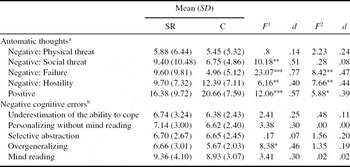
The results arising from the MANCOVAs are presented in Table 1. In the first series of analyses investigating the five automatic thoughts subscales, the multivariate test in step 1 was highly significant, Wilks’ lambda = .82, F(5, 223) = 9.95, p < .001. Univariate F tests (Table 1) revealed that the school refusal group had significantly higher levels of thoughts concerning social threat, and personal failure; significantly lower levels of thoughts concerning hostility; and significantly lower levels of positive thoughts. The groups did not differ with regard to the thoughts concerning physical threat. When anxiety was added as a covariate in step 2, the school refusal group was still found to report significantly higher levels of thoughts concerning personal failure, significantly lower levels of thoughts concerning hostility, and significantly lower levels of positive thoughts. However, there was no longer a difference between the school refusal group and the community group with respect to thoughts concerning social threat.
Group differences on measures of negative and positive automatic thoughts and negative cognitive errors

Note. SR = school refusal sample, C = community sample; F1: age and gender as covariates; F2: age, gender, and anxiety as covariates; SD = standard deviation; d = effect size.
a Total scores for each of the 5 automatic thoughts subscales range from 0 to 40, with higher scores indicating more negative or positive thoughts.
b Total scores for the first four negative cognitive error subscales range from 3 to 15, and the total score for the ‘Mind reading’ subscale ranges from 4 to 20, with higher scores indicating a greater level of the negative cognitive error in question.
*p < .05, **p < .01, ***p < .001.
In the second series of analyses investigating the negative cognitive error subscales, the multivariate test in step 1 was significant, Wilks’ lambda = .95, F(5, 223) = 9.95, p < .05. The two groups differed significantly with respect to overgeneralizing, whereby the school refusal group displayed more overgeneralizing relative to the community group. This difference was no longer observed when anxiety was added as a covariate in step 2.
All effect sizes of differences in cognitions between the two groups were small to medium except for the effect size for negative automatic thoughts of personal failure which was large.
Predicting school refusal
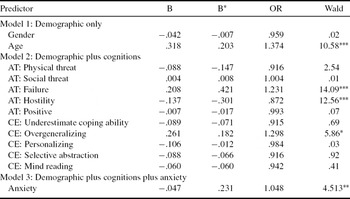
The results of the logistic regression analyses are presented in Table 2. Model 1, incorporating the demographic variables age and gender, was highly significant, X 2(2) = 11.89, p < .01, Nagelkerke R 2 = .077. The only significant predictor was age, indicating that older children were more likely to be school refusers (Table 2). Model 2, in which the 10 subscales for automatic thoughts and cognitive errors were added to the demographic variables, was highly significant, X 2(12) = 60.45, p < .001, Nagelkerke R 2 = .355, and significantly better than Model 1, X 2(10) = 48.56, p < .001. Of the 10 cognitive predictors, three made a unique contribution to the prediction of school refusal. More automatic thoughts concerning personal failure, fewer automatic thoughts concerning hostility, and a greater tendency towards the cognitive error of overgeneralizing, were associated with an increased likelihood of being classified as a school refuser. Model 3, in which anxiety was added as a predictor, was highly significant, X 2(13) = 67.30, p < .001, Nagelkerke R 2 = .390, and significantly better than model 2, X 2(1) = 6.85, p < .01. That is, after correction for demographic and cognitive variables, higher anxiety levels were associated with an increased likelihood of being classified as a school refuser. Importantly, after correction for anxiety, cognitions were still significantly related to school refusal, namely: automatic thoughts concerning personal failure, B* = .419, Wald(1) = 14.01, p < .001, automatic thoughts concerning hostility, B* = .257, Wald(1) = 8.84, p < .01, and the cognitive error of overgeneralizing, B* = .175, Wald(1) = 5.15, p < .01.
Hierarchical logistic regression analysis with automatic thoughts and cognitive errors as constructs to distinguish between school refusal youth (n = 50) and community group youth (n = 181)

Note. AT = Automatic Thought, CE = Cognitive Error.
*p < .05, **p < .01, ***p < .001.
Discussion
Cognitive therapy is suggested as an important component in the treatment of school refusal, but knowledge of the role of cognitions in school refusal is virtually absent. This study represents the first controlled study of cognitions (automatic thoughts and cognitive errors) potentially associated with school refusal. The two instruments that were used to assess the cognitions of the school refusers and the youth from the community sample are important adaptations of earlier measures used to assess cognitions in anxious and depressed young people. The CATS-N/P (Hogendoorn et al., Reference Hogendoorn, Wolters, Vervoort, Prins, Boer, Kooij and de Haan2010) permits assessment of negative as well as positive automatic thoughts, and the CNCEQ-R (Maric et al., Reference Maric, Heyne, van Widenfelt and Westenberg2011) comprises empirically-derived categories of negative cognitive errors.
The hypothesis that school-refusing youth would report more negative automatic thoughts and more negative cognitive errors relative to the community sample was partially supported. The school-refusing youth reported significantly higher levels of negative automatic thoughts concerning social threat, negative automatic thoughts concerning personal failure, and the negative cognitive error of overgeneralizing. Not in keeping with the hypothesis, they also reported significantly lower levels of negative automatic thoughts concerning hostility. Regarding positive automatic thoughts, school refusers reported significantly lower levels relative to youth from the community sample. After controlling for anxiety, the school refusers were still found to report significantly higher levels of thoughts concerning personal failure, significantly lower levels of thoughts concerning hostility, and significantly lower levels of positive thoughts. We also examined the unique contribution of cognition in the prediction of school refusal. Negative automatic thoughts concerning personal failure and hostility, and the negative cognitive error of overgeneralizing, were found to independently distinguish between youth with school refusal and the community sample, even after controlling for anxiety.
School refusal and negative automatic thoughts
As noted, negative automatic thoughts concerning personal failure were found to differentiate between school-refusing youth and the community sample and to uniquely predict school refusal. It is conceivable that the experience of regularly or consistently failing to attend school gives rise to thoughts of personal failure as measured by the CATS-N/P (e.g. “I've made such a mess out of my life”; “I will never overcome my problems”). Such thoughts may exacerbate a sense of hopelessness and hinder efforts towards school return. Of course, longitudinal research is required to determine the extent to which thoughts of personal failure contribute to the development of school refusal and the extent to which they are a consequence of school refusal.
The school refusal group reported fewer negative automatic thoughts concerning hostility (M = 9.70, SD = 7.32) relative to the community sample (M = 12.39, SD = 7.11), and it is worth noting that the mean for the community sample was similar to the mean observed in another community sample (Schniering and Rapee, Reference Schniering and Rapee2002; M = 13.30, SD = 8.06). The finding that school refusers reported significantly fewer thoughts concerning hostility contrasts with studies in which no differences were observed between anxious and nonanxious youth (Micco and Ehrenreich, Reference Micco and Ehrenreich2009; Schniering and Rapee, Reference Schniering and Rapee2002). Several explanations for the difference observed between the school refusers and the community sample are possible. In the current study, school refusal was defined in part by the absence of severe antisocial tendencies, following the criteria of Berg (Reference Berg and Lewis2002). This same criterion was not applicable to the recruitment of the community sample. Thus, the community sample is likely to have included more young people with antisocial behaviour and associated thoughts concerning hostility. A second possibility is that the school refusers were exposed to fewer hostile situations as a result of their absences from school. It is also possible that school-refusing youth are, in general, less inclined towards hostile thoughts. Early reports suggest that school-refusing youth tend to be against aggression and report no feelings of hostility (e.g. Jackson, Reference Jackson1964). The possibility that school refusal is characterized by lower levels of hostile intent is important for discussions about the classification of school attendance problems. Some authors (e.g. Kearney, Reference Kearney2007) discourage differentiation between school refusal and truancy based on the form of clinical symptoms (which could be taken to include the type of cognitions observed among young people with school attendance problems), while others regard a differentiation between school refusal and truancy as meaningful, especially with respect to treatment planning (e.g. Heyne, Reference Heyne, Fisher and O'Donohue2006). Future research comparing the cognitions of school-refusing youth with those of youth who truant but who do not display other antisocial tendencies could further our understanding of the cognitive differences (or similarities) between school refusal and truancy.
School refusal and negative cognitive errors
The negative cognitive error of overgeneralizing predicted school refusal. This result mirrors previous research in which overgeneralizing was found to predict youth anxiety (e.g. Epkins, Reference Epkins1996; Weems et al., Reference Weems, Berman, Silverman and Saavedra2001). Overgeneralizing resembles the “persistent” and “pervasive” ways of thinking that are associated with pessimism (Seligman, Reference Seligman1991), and indeed a pessimistic thinking style has been associated with school refusal (Place et al., Reference Place, Hulsmeier, Davis and Taylor2000, Reference Place, Hulsmeier, Davis and Taylor2002). Thus, the present study contributes to a small body of literature suggesting that an expectation of negative events is characteristic of school refusers. It should be noted, however, that the hypothetical scenarios represented in the CNCEQ-R items assessing overgeneralizing pertain to academic and sport situations at school. It remains to be seen whether school refusal is associated with overgeneralization in general, and not just with an overgeneralization of school-related experiences.
None of the other cognitive errors were found to predict school refusal, even prior to controlling for anxiety. In one sense, it is reasonable to expect that the error “underestimation of the ability to cope” would be characteristic of school-refusing youth, given the suggestion that youth with school refusal report low levels of self-efficacy (Heyne et al., Reference Heyne, King, Tonge, Rollings, Pritchard, Young and Myerson1998, Reference Heyne, King, Tonge, Rollings, Young, Pritchard and Ollendick2002). However, the suggestion that school refusal is characterized by low self-efficacy was based upon research employing a domain specific measure of self-efficacy; that is, specific to school attendance (e.g. being able to cope with answering classmates’ questions about absence from school). In the current study, only one of the three items assessing “underestimation of the ability to cope” pertained to school situations. It is also possible that the sampling procedure used in the current study explains why just one of five cognitive errors was predictive of school refusal. The sample comprised young people varying in the severity of school refusal, with school attendance ranging between 0% and 80%. Some cognitive errors (e.g. “underestimation of the ability to cope”) may be more characteristic of severe cases of school refusal relative to less severe cases.
School refusal and positive automatic thoughts
Several prior studies comparing anxious and nonanxious youth found no differences with respect to the presence of positive cognition (Bögels and Zigterman, Reference Bögels and Zigterman2000; Miers et al., Reference Miers, Blöte, Bögels and Westenberg2008), while the most recent study found that positive automatic thoughts were negatively associated with anxiety (Hogendoorn et al., Reference Hogendoorn, Wolters, Vervoort, Prins, Boer, Kooij and de Haan2010). In the current study, school-refusing youth were found to report significantly lower levels of positive automatic thoughts relative to the community sample of youth. Importantly, this difference held even when controlling for anxiety. Thus, the school refusers’ relative absence of positive automatic thoughts seems to be more than an epiphenomenon of anxiety. At the same time, the results of the logistic regression analyses suggest that positive automatic thoughts are not uniquely important in the prediction of school refusal. This is in line with research examining the role of positive cognitions in the prediction of youth anxiety (Kendall and Treadwell, Reference Kendall and Treadwell2007; Treadwell and Kendall, Reference Treadwell and Kendall1996), and indeed with Kendall and colleagues’ notion of “the power of non-negative thinking” (Kendall and Chansky, Reference Kendall and Chansky1991; Kendall and Korgeski, Reference Kendall and Korgeski1979).
Limitations and directions for further research
The cross-sectional nature of this study precludes inferences about causality. For example, it remains unclear as to whether the tendency for school refusers to overgeneralize negative events contributes to the development of refusal to attend school, or whether this style of thinking emerges mostly as a result of chronic difficulty attending school. Longitudinal studies are needed to understand the order of the associations found between school refusal, automatic thoughts, and cognitive errors. A second limitation concerns the absence of a measure of depression. Some cases of school refusal are associated with depression (Heyne, Reference Heyne, Fisher and O'Donohue2006), and in order to ensure that the results of the current study are not merely epiphenomena of depression, future research should include depression as a control variable. The cognitions of youth with anxiety-based school refusal should also be compared with those of anxious youth not refusing to attend school, to further clarify the specificity of cognitions associated with school refusal. It is also yet to be determined whether more domain-specific measures of negative automatic thoughts and cognitive errors (i.e. related to the school attendance only) would have yielded more significant relations between school refusal and negative cognitions. Finally, research using larger samples of school refusers would permit investigation of factors moderating the relationship between school refusal on the one hand and automatic thoughts and cognitive errors on the other hand. Given that age has been found to moderate the relationship between cognitions and internalizing problems in youth (Alfano, Beidel and Turner, Reference Alfano, Beidel and Turner2006; Weems et al., Reference Weems, Berman, Silverman and Saavedra2001), developmental factors should be considered in such investigations.
Conclusion
In conclusion, the current study provides preliminary support for the notion that negative cognition is a risk factor for school refusal. Even when controlling for anxiety, school refusers reported more negative automatic thoughts of personal failure, and the presence of school refusal was predicted by thoughts of personal failure and by the cognitive error of overgeneralizing. Irrespective of whether such cognition is involved in the development of school refusal or is a consequence of school refusal, it is likely that such cognition contributes to the maintenance of a refusal to attend school. Thoughts of personal failure and the tendency to overgeneralize negative events may hinder school refusers in undertaking action towards regular school attendance. Such cognitive products and cognitive processes may be important targets for therapists working with school-refusing youth.



Comments
No Comments have been published for this article.