When, on 17 February 1791, the London opera audience first entered the new auditorium for opera and ballet that had been constructed in the Great Room of Oxford Street's Pantheon, they were faced with a still-life spectacle on the new drop curtain that – if reports do it justice – represented all they could be expecting to see, hear and experience. The Pantheon Opera was the replacement venue for the performance of Italian opera in London in the wake of the fire that had gutted the King's Theatre in June 1789.Footnote 1 The drop curtain and its subject had already been used to puff this new enterprise through announcements in The Diary or Woodfall's Register, and was designed to glorify the ‘lyrick poet’ Pietro Metastasio, the most important librettist of Italian opera in the eighteenth century, who had died almost a decade earlier; Metastasio appeared at the centre of the curtain being carried up to heaven by two supporting spirits. It was the work of the artist Henry Tresham (c.1751–1814), an Irish history painter who had spent the years from 1775 to 1789 working in Rome and moving in a circle that included Thomas Jones, Henry Fuseli and Prince Hoare.Footnote 2 Once back in London, he tried to establish himself as a serious artist, but the paintings he showed at the Royal Academy after his return to England were not particularly well received. He does, though, appear to have been resourceful – he is described by scholar Judy Egerton as ‘ever the opportunist’Footnote 3 – and his employment (for all it was occasional) by the Pantheon Opera represented a new direction. While at the Pantheon, his admittedly small output included designs with Francesco Bartolozzi for the ‘dresses’ (costumes) for the 1791 stagings of Armida and La bella pescatrice. Footnote 4 After this brush with the theatre, his career went in a different direction, and he produced a range of paintings in different genres, including The Earl of Warwick's Vow Previous to the Battle of Towton of 1797.Footnote 5
The official interpretation of the Pantheon Opera curtain has long been known from a separately printed, anonymous pamphlet, Description of the Allegory, Painted for the Curtain of the King's Theatre, Pantheon.Footnote 6 And until recently, the author of the pamphlet remained anonymous, and the whereabouts of the curtain's illustrative material was unknown. Now, however, it has become possible to speculate that Tresham wrote the pamphlet himself, for the original version has been located in The Diary or Woodfall's Register for 17 February 1791, where it is headed:Footnote 7
It is very seldom that a profound knowledge of the THEORY of ART is combined with such admirable powers of EXECUTION, but in TRESHAM it may be fairly asserted that great modesty, extensive learning, and powerful genius are conspicuously united.Footnote 8
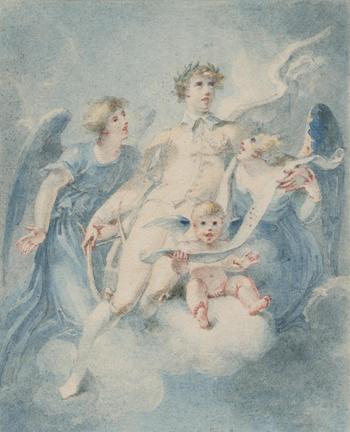
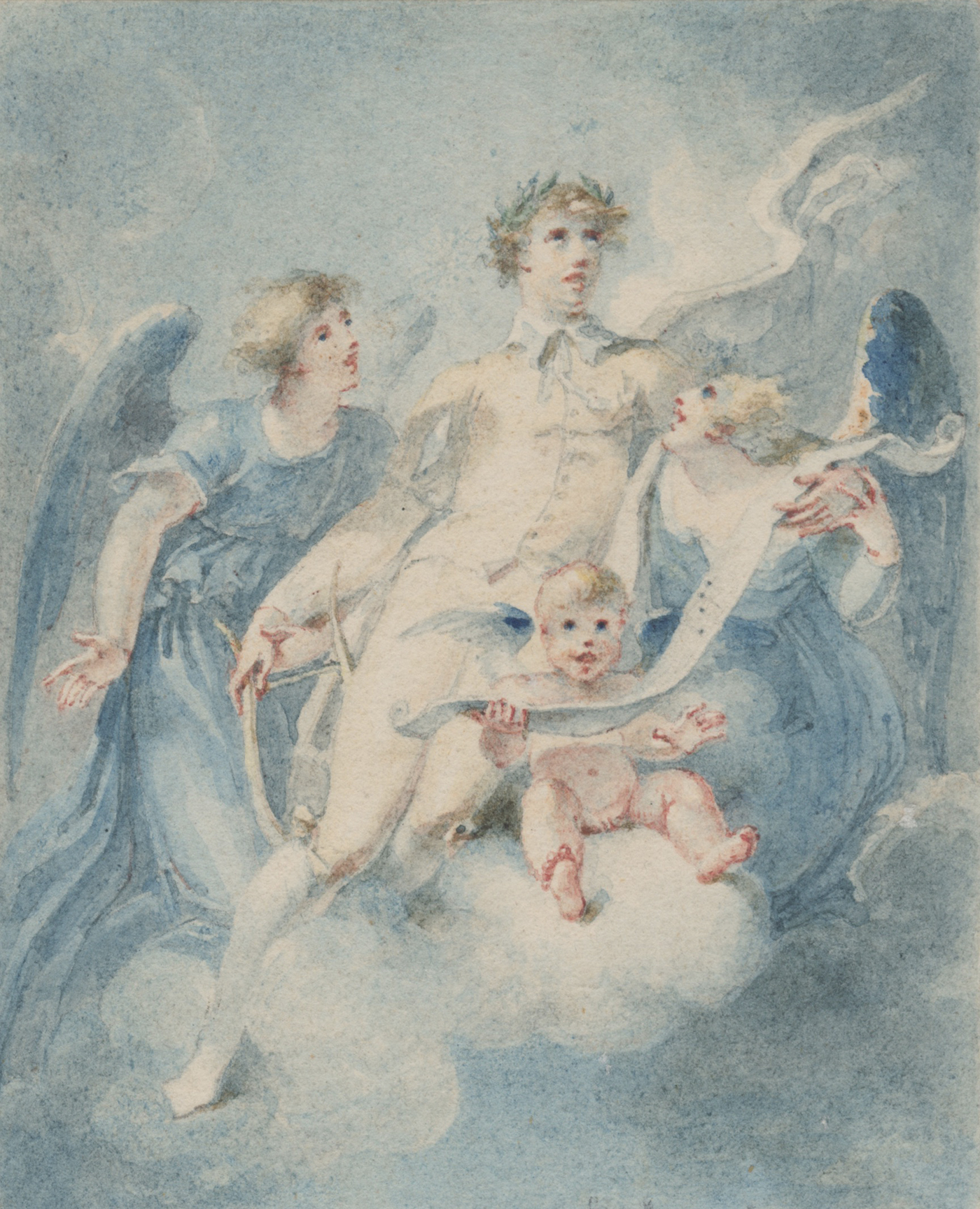
The ‘powerful genius’ of Tresham, then, enables him not only to paint the curtain, but also to be one of the few minds competent enough to compose the allegorical commentary; he combines artistic capability with intellectual breadth. The pamphlet appears to have been brought out at a later date, an often-found eighteenth-century publishing chronology. The curtain itself is lost; it may have been still in the theatre when it was burnt to the ground in 1792. Also missing is an original drawing that in 1808 was described as ‘fortunately preserved’ and ‘in the possession of a nobleman of acknowledged taste’.Footnote 9 This may well be the ‘wonderfully fine … original drawing’ of ‘Tresham's beautiful curtain at the Pantheon’, which according to Woodfall's Register was to be engraved and published, but there was no further announcement on the matter and no copy of such a print seems to survive.Footnote 10 However, a preparatory watercolour, also clearly attributed to Tresham, has recently emerged, which, although long believed to represent David Garrick, shows what is very likely to be the central portion of the curtain, the apotheosis of Metastasio (Fig. 1).Footnote 11 The watercolour is titled The Apotheosis of a Poet, and although small – it is 10.5 × 7.5cmFootnote 12 – it is possible that this was the picture Tresham included as part of his exhibit as item 578Footnote 13 at the 1791 show at the Royal Academy of Arts, the year he was elected an associate member.Footnote 14 The discovery of this watercolour has also made it possible to revisit the Pantheon drop curtain in the context of the late eighteenth-century usage of apotheosis, at the same time offering an opportunity to examine, through the image of Metastasio, the developments in Italian opera in London during these years.
The Apotheosis of a Poet. Watercolour, 1790. Henry Tresham. Private Collection.
The Pantheon Opera
The Pantheon Opera was born from the dismal history of London's Opera House (the King's Theatre) under the management – or interference – of the incompetent, fraudulent and dishonest William Taylor.Footnote 15 After Taylor's first regime collapsed in 1783, control of the theatre passed into the hands of the manager and dancing master John Gallini, who was in charge when it burnt the ground in June 1789. This was a spectacular fire, one so intense that all parts of the establishment were destroyed, with the exception of the grand staircase and the room over the arcade to the entrance.Footnote 16 The blaze was discovered at ‘five minutes before ten o'clock’ when the performers were ‘practising a repetition of the dances’ on a non-performance night;Footnote 17 it began at the top of the building in the flies, or perhaps in the scene room, and the ‘first notice they had of the mischief was sparks falling on their heads’.Footnote 18 The exciting account of the fire by the fencing master Henry Angelo builds to fever pitch until the final reprieve: the fire engines, placed at the theatre's frontage in Market Lane, prevented the fire from spreading to buildings across the street.Footnote 19 The fire was possibly arson, it having been set ‘not of accident but by design’;Footnote 20 the stories swirled around with blame being attached separately to ‘two foreigners’, seemingly French, who were challenged coming down from the upper part of the building by the door keeper, and ‘a man and a woman’ who ‘were seen to skulk out at the back door … both of them appearing uncommonly agitated’.Footnote 21 However, the usually reliable pseudonymous author ‘Veritas’ suggests that Pietro Carnevale confessed on his deathbed to ‘putting a torch to the original embarrassed theatre which he owned previous to his death’.Footnote 22 Carnevale had been deputy manager until Gallini replaced him with Antonio Ravelli for the 1788–9 season, the inference from the reports being that he bore both Gallini and Ravelli a grudge at being ousted. Further, that night was to have been Ravelli's Benefit, an event which later took place at the Pantheon.Footnote 23
While plans were developed for a replacement building, the Lord Chamberlain granted a year-long licence to Gallini to perform opera at the Little Theatre in the Haymarket, the venue on the opposite side of the street to the Opera House. Although much smaller, Gallini fitted it out as best he could: ‘the arrangements are of necessity in miniature’, but ‘all that can be done now, is to make the Little Theatre as large as it can be made’; Gallini would stage opera there from 7 January to 12 June 1790.Footnote 24 The press tended to stick to the name ‘Little Theatre’, but on the theatre's own advertisements, Gallini used ‘Italian Opera, Theatre-Royal, Haymarket’, an appellation first appearing when the programme was announced on 26 December 1789.Footnote 25 It would continue to be advertised as such throughout the season, being last used to announce the closing 12 June performance of Giovanni Paisiello's Il Barbiere di Siviglia. The name, of course, represented Gallini's aspirations for the opera company, but the actual status of the institution was determined by the Lord Chamberlain's licence. Thus the old King's Theatre, which was also known as the Opera House, would lose the name to the Pantheon, which then advertised itself as ‘The King's Theatre at the Pantheon’, while by custom only, its ruins (and their replacement) were referred to as ‘The King's Theatre’. For clarity's sake, throughout this article the original King's Theatre will be called the ‘Opera House’, and The King's Theatre at the Pantheon, the ‘Pantheon Opera’.
On this scene of an ever-convulsing opera administration there were three different proposals for replacement opera institutions, and ten different proposals for replacement theatres for opera on six different sites. The first of the three institutions was tied to a rebuilding of the Opera House, with a version of the pre-fire administration ultimately in the hands of William Taylor. The second was a new building and institution in Leicester Square, where it was announced that ‘Leicester-house is to be pulled down, and a new Opera-house built on the spot.’Footnote 26 This scheme was in the charge of Robert Bray O'Reilly, who appears to have been a front man for William Sheldon, who in turn fronted for the Duke of Bedford and Lord Salisbury; Salisbury was also the Lord Chamberlain and had obvious vested interests.Footnote 27 And the third was a version of the second scheme, one that eventually became the Pantheon Opera, promoted by the backers of the Leicester Square project when it became impossible to pursue their original proposal. Of the ten proposals for new buildings, two got no further than single suggestions in the press. One of these, offered in The Oracle Bell's New World, proposed the site of the King's Mews, a vast area to the east of Haymarket; its author can only have meant that part of it should be used.Footnote 28 The larger site certainly had the potential to establish the Opera House in a more prominent position in the cityscape, and might have gained some traction, given that by the end of the eighteenth century the future of the site was a matter for discussion; it was eventually cleared for the Trafalgar Square project from 1826 onward.Footnote 29 In contrast, another proposed site, that of Carlisle House, was cramped, but would have given the theatre frontages to Soho Square and Sutton Street.Footnote 30 This was practical in as much as Carlisle House had been empty since March 1784 – it would be demolished in 1791– and the lease from the Portland estate was at this time in the hands of the music publisher Thomas Jefferys, who might have been sympathetic to the scheme.Footnote 31 But it was, in turn, mischievous, Carlisle House having been the venue for the opera performances that had catapulted Teresa Cornelys – the notorious promotor of dubious entertainments – into the courts.Footnote 32
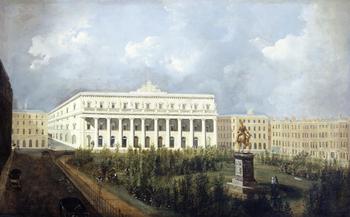
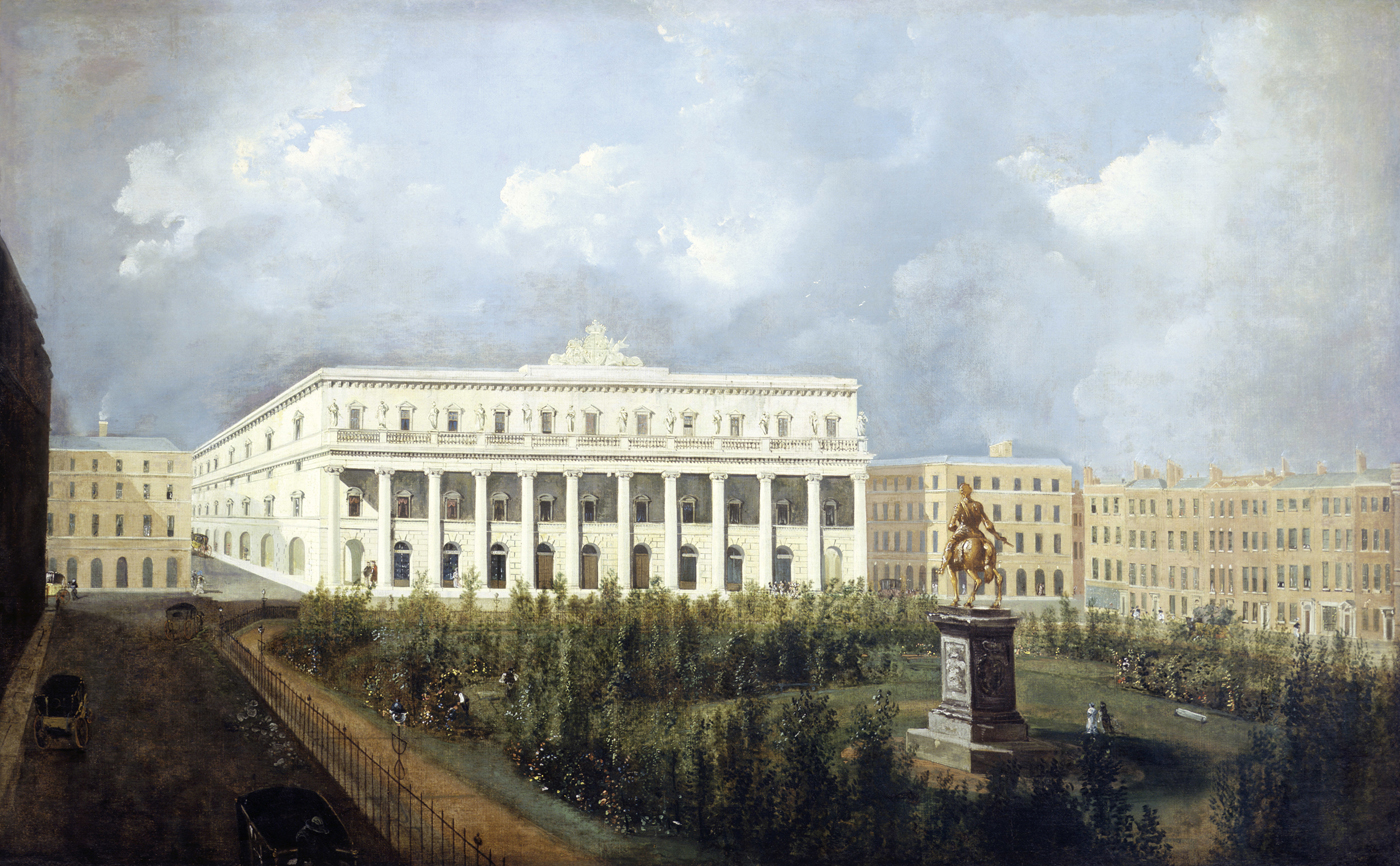
Three more proposals were for the original site of the Opera House; these were by Robert Adam, Michael Novosielski and Anthony Le Texier.Footnote 33 A version of Novosielski's design was adopted by Taylor and the foundation stone laid on 3 April 1790.Footnote 34 Four designs – seen in oils and watercolours by William Hodges, Thomas Sandby and John Soane's officeFootnote 35 – were for the Leicester Square site.Footnote 36 The oil painting by Hodges (Fig. 2) clearly represents a scheme based on the design of the Grand-Théâtre de Bordeaux that may (or may not) have been the ridiculed proposal put forward by Le Texier.Footnote 37 Again, the proposal had some possibilities.Footnote 38 Leicester House, which had been the home of Ashton Lever's Holophusikon in the 1780s, had been vacant since 1788; the freehold was sold in 1789 and the interior dismantled in 1789–90. It would be demolished in 1791–2.Footnote 39 The last scheme was for the conversion of the Pantheon in Oxford Street to an opera house. The building was in some respects ideal, in others not; a large exhibition space, it had been the scene of masquerades, balloon showings and similar extravagances, but the main salon was small when compared to the auditorium of Opera House.
One of the Opera Houses proposed for Leicester Square. Oil on canvas, 1790. William Hodges. © Museum of London.
The competition between the schemes and buildings then entered a new phase. Taylor achieved the impossible: he raised enough money to rebuild the Opera House. But when it was completed, he had no licence from the Lord Chamberlain to perform opera there. O'Reilly tried to exploit this situation, and had hopes that a patent to perform opera would be awarded to the Leicester Square scheme. The matter went before the Lord Chancellor, Edward Thurlow, who described Taylor's claims to ownership of the Opera House as ‘the wreck of a passing cloud’, but was unconvinced of – among other things – the wisdom of depriving that long-established venue of the right to operate by awarding a patent elsewhere.Footnote 40 The Lord Chancellor then put the facts before the King, and in the end, the matter was resolved by awarding no patent at all. The Leicester Square scheme then collapsed; it needed long-term stability to realise the plan of building such a large and extravagant venue. But time was now of the essence if those involved – O'Reilly as the front man for William Sheldon acting on behalf of Bedford and Salisbury – were to realise their plan for the coming season; they needed a venue quickly, and some time in June 1790 the notion of converting the Pantheon emerged. On 30 June, a resolution of sorts was reached: Salisbury awarded an opera licence to O'Reilly at the Pantheon for a four-year term for this new venue, told Gallini that the licence to perform Italian opera at the Little Theatre would not be renewed, and dashed finally Taylor's hopes for the Opera House. The Pantheon's original architect, James Wyatt, got to work, and a scheme of conversion was put in hand.
Those involved in the Pantheon Opera administration, though, seemed to want not just a new institution, but also a change in the nature of the administration of Italian opera in England. Robert Hume has argued that it was
conceived as a kind of ‘court opera’, in which more of the financial burden was to be borne directly by noble patrons, thus freeing the company to pursue innovations in opera and ballet and to hire the best performers in Europe.Footnote 41
Hume's model suggests a greater division between those who made the artistic decisions and those who provided the money, referring to the broader concept of a European-style court opera.Footnote 42 Funding the Pantheon Opera directly by noble patrons – with or without royal involvement – would also remove the subscribers from the equation; if the theatre did not have to rely on those subscriptions to make each season viable, then it would be possible to take a longer-term view of both the works staged there and the selection of performers. Evidence of this end-game can be found in the press as early as February 1788, and the fire offered an opportunity to push these plans forward.Footnote 43 And this the directors duly did. They also tried unsuccessfully to hire Mozart to compete with Taylor, who had hired Haydn and who was giving versions of ‘Entertainments of Music and Dancing’ in his unlicensed opera house, the entertainments ‘pretending themselves concerts’.Footnote 44 The directors’ aspirations can be seen on many fronts, right down to the greater physical grandeur of the Pantheon Opera's printed librettos, which were quarto rather than octavo and contained a fuller listing of the personnel than had been the norm; in showing a larger number of skilled personnel involved than in previous seasons, they encapsulated the desired change of institutional style.Footnote 45
And it was into the new institution at the Pantheon that Tresham's drop curtain was introduced. The Diary or Woodfall's Register remarked that Tresham had ‘displayed a boldness of imagination, a force of composition, a knowledge of effect, and a firmness of pencil that few artists of this, or any country, can hope to equal’.Footnote 46 This short puff has the feeling of being written by Tresham himself, who seems to have been the curtain's most outspoken admirer. It would seem that Tresham's ‘boldness’ of execution extended to his use of colour. A remark made several weeks after it was first hung – ‘the curtain of Tresham appears to be rather softened in some of its stronger tints’ – suggests that the artist, on seeing it hung, toned down some of the colours.Footnote 47 Perhaps Tresham had overestimated what colour intensities were required for the new auditorium. A later source, perhaps writing from memory, described the painting as
a view of the Heathen Deities employed in a manner appropriate to the subject of music and the fine arts. Perhaps it may be fairly said, that no painter, since the days of Michael Angelo, has introduced so many figures in a single work, and exhibited them in such a variety of attitudes. The whole of this work manifested a powerful mind, and great professional knowledge, but it was ‘caviare to the million’.
The reference to Hamlet – ‘pleased not the million; t'was caviare to the general’Footnote 48 – suggests that the public found that, like caviar, Tresham's imagery was too rich for its taste.
How and when the curtain was used is made plain by Lord Salisbury's response to the King, who visited the Pantheon on 22 February 1791. The Times reported that, initially, the monarch
seemed disappointed at seeing the green curtain, instead of the painted one his Majesty had heard so much of – the explanation from Lord Salisbury seemed perfectly satisfactory – that it was meant only as a drop between the acts.Footnote 49
As this quotation attests, the green – presumably baize – curtain was used when one was required within dramas, while Tresham's drop was the front curtain that went up at the beginning of the evening and came down at the end of the entire performance. On some occasions, too, it probably also descended between the opera and the ballet; there is also evidence to suggest that London theatres sometimes had a different scenic curtain of this sort to lower between the main piece and the afterpiece.Footnote 50 To his explanation above, the author added that ‘Tresham may well be proud’ of the King's inquiry, perhaps alluding snidely to the artist's vanity and his relentless efforts at self-promotion. As seriously as London audiences and critics seem to have taken the matter of the curtain, its use was not without humorous moments; on one occasion, ‘the Grenadier sentinel on the left wing’ was so ‘intent’ on the action on stage
that he suffered Tresham's whole curtain … to descend upon his devoted head, which very fortunately only knocked off his black-fur cap for the entertainment of the audience.Footnote 51
The author seems to have been referring to the wrath of the gods that annually fell ‘on the devoted head’ of a man sacrificed by the Athenians and the Massilians for the welfare of the state;Footnote 52 here, the grenadier at the Pantheon was nearly sacrificed for the welfare of the new opera ‘state’. Even the Pantheon audience smiled at this incident.
Reading the curtain
As the description of Tresham's allegory in The Diary or Woodfall's Register suggests, the opera directors, who had presumably suggested the subject of the curtain to Tresham, were determined that the public – and not just the audience – would be informed of the change of status of the Italian Opera. The anonymous author of the article claimed, as their opening gambit, that most of the sentiments of the interpretation sprang from Tresham's calling as a history painter, and the artist duly obliged, commenting:
To many lovers of the polite Arts the mere mention of an Allegory is alarming; they dread a sacrifice of Intellect at the shrine of Imagination, and suppress curiosity, rather than embark with the Painter in a passage through Chaos.Footnote 53
Not only ‘alarming’: it was also a matter of understanding, for even ‘the clearest efforts of the Pencil require Elucidation’, and that clues were ‘required to conduct us through the maze of Allegory’.Footnote 54
Tresham claimed that the curtain represented a ‘eulogium on music, dedicated to the memory of that great lyrick poet Metastasio’. The top of the curtain was shaded in ‘the majesty of darkness round’, but through the clouds, a part of the zodiac could be seen.Footnote 55 On this part of the scene, there were also personifications of seven of the planets representing the Music of the Spheres, each playing a musical instrument of a ‘classical description’. Below these, on ‘gayer’ clouds, were portraits of the composers regarded as ‘professors’ in the science of music: Giovanni Battista Pergolesi, George Frederick Handel, Johann Christian Bach and Antonio Maria Sacchini. These four composers, two ‘ancient’ and two ‘modern’, all stood high in the public's esteem. Pergolesi and Handel were, for example, considered to have the required status to be included in the programmes of the Academy of Ancient Music, while at the Concerts of Antient Music, they were initially the only composers whose works were scheduled when dramatic music was performed.Footnote 56 By the time Tresham painted them on his curtain, they were two ‘ancient’ composers whose works were considered classics. However, the ‘moderns’, J.C. Bach and Sacchini, had also both achieved classic status. Bach's works gained such status that in 1791 Haydn had arranged one of Bach's concertos ‘so that he might have an entrée to the Antient Concerts’.Footnote 57 The inclusion of Sacchini was an acknowledgement of the extraordinary reception the composer had had in London for the ten years that he had been composer at the Opera House. From 1772 until 1781, his operas were received with acclaim, music historian Charles Burney noting that he had ‘taken possession’ of the hearts of the London audience, and his death in Paris in 1786 was greeted in the English press by extensive columns of print.Footnote 58 The reputations of these four composers allowed Tresham to position them above Metastasio, welcoming him into heaven. It did not matter that no operas by Pergolesi, Handel, Bach or Sacchini were included in the Pantheon programme; the audience needed to know that the directors of the opera were knowledgeable and could judge quality when they heard it.
Tresham's commentary then moves down to consider the next part of the curtain, where the image of Metastasio could be found:
The distinction of Foreigner is lost in the blaze of extraordinary abilities: warmed by this pervading principle, we consecrate our Labour to the Manes of a Roman Bard, and name the Curtain
THE
APOTHEOSIS OF METASTASIO
His portrait is in the centre of the Picture, looking up, and listening with admiration to the Music of the Spheres: he bears with him that lyre to which he so pathetically has sung, and whose power he so justly describes!
Below this panel at the bottom of the curtain were two opposing scenes showing the effect of music on the passions: the ‘sombre group’ included Melancholy, Fear, Despair, Anger, Revenge, Pity and Jealousy, while in a ‘contrasted scene’ Love framed ‘with Mirth a gay fantastic round’ and Liberty and Laughter were in rapture over Melody. The artist pointed to William Collins's ‘The Passions, an ode for Music’ as the source for much of this inspiration.Footnote 59 The ode, which was already nearly fifty years old by this time, espoused a decidedly old-fashioned conception of music, yearning for a return to a golden age and the simplicity of innocence:Footnote 60
When Music, heavenly maid, was young,
While yet in early Greece she sung,
The Passions oft to hear her shell
Thronged around her magic cell,
Exulting, trembling, raging, fainting,
Possessed beyond the muse's painting.
Collins's text points once again to music's supposed classical origins. While Tresham's commentary gives no specific details on its realisation, some of the painter's other work does offer clues as to a likely treatment of the details mentioned in the description. Much of his output, such as the four unpublished illustrations (two each) for The Tempest and As You Like It, suggest an engagement with theatrical material.Footnote 61 His addition of the ornaments to the print celebrating George III as King of Great Britain suggests the manner in which he may have treated the rays of Apollo, the clouds and the rondels.Footnote 62 And his designs for other ephemera and prints ranging from the concert ticket for Mr Harrison's benefit concert in Hanover Square, to his trade card for Bate, the picture restorer, to the print ‘La Gara Fra L'Amore e la Musica’, to a design to head the dedication to an edition Robert David Hume's History of England (which included a chariot drawn by a lion and a unicorn with Britannia), all suggest that his was a fluent and inventive decorative hand.Footnote 63
In the centre of the curtain was the key Metastasio panel, seen in Figure 1. Tresham's watercolour suggests a youthful poet – or perhaps one eternally young – supported by a putto and two winged ladies in blue, possibly the calm-looking lady to the left being ‘reason’ and the more distrait one to right being ‘passion’; this grouping is also found in Tresham's drawing ‘Music’ Receiving Inspiration, Attended and Crowned by the ‘Loves’.Footnote 64 The putto and the ladies (and possibly Metastasio himself) appear to be singing, while one of the ladies and the putto hold a scroll on which a few musical notes can be seen. The poet's Van Dyck-style costume, champagne-coloured and suggestive of silk, is in line with the late eighteenth-century fashion for portraits that echo Van Dyck's work (Thomas Gainsborough's Blue Boy is perhaps the most famous example of this fashion). Fame, a frequently included figure in an apotheosis, is absent. She (or in some cases, he) is usually shown with a trumpet and holding a laurel wreath over the head of the subject. Tresham's Metastasio has already been crowned, perhaps implying that his earthly fame was such that his crown had already been awarded before his elevation.
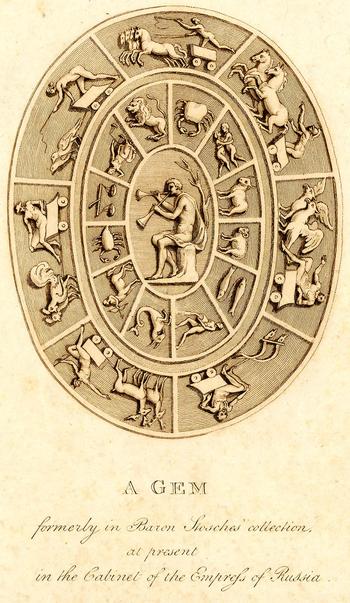
The separately printed pamphlet containing Tresham's text ensured that the allegory kept circulating. In this new form, the text was embellished with an engraving by Bartolozzi of a ‘gem’ (Fig. 3); its iconography was possibly the source for some of the curtain's details. Tresham represented the gem as having been in the collection of Baron Stosch but ‘at present in the Cabinet of the Empress of Russia’.Footnote 65 Baron Philipp von Stosch (1691–1757) was an antiquarian, a spy with the code name ‘John Walton’, and in the words of a later commentator, ‘an expatriated Prussian sodomite’, who had assembled a vast collection of 10,000 gems, many illustrated in his Gemmæ Antiquæ Cælatæ of 1724.Footnote 66 As some parts of the collection had by this time been dispersed, Tresham's cited provenance is certainly plausible. The ‘gem’ – more correctly, an intaglio – was a cut, semi-precious, gemstone; the engraving of the illustration suggests that although it was not a cameo (a carving that exploited layers of different colours) it was cut in relief. The figure placed in its central oval panel was an ‘aulote’, a performer on the aulos, a double-reeded instrument which came in single and – as here – double forms. The instrument was difficult to manipulate, and was usually played by a professional musician, or sometimes a dedicated slave; it was believed to have been very loud and shrill, less suitable as an instrument for the elite than the lyre. The performer is Apollo, supposed by some to have been the inventor of the aulos, a supposition that came into currency with attempts to ‘Hellenise’ the instrument's origins.Footnote 67 Surrounding Apollo is an outer circle of seven chariots drawn by a range of creatures, with an inner circle of the twelve signs of the zodiac, a motif which ties the iconography of the curtain to the gem.
A Gem. Illustration to Henry Tresham, Description of the Allegory, Painted for the Curtain of the King's Theatre, Pantheon. London, 1791. From GB-Lbl 117.i.25. © British Library Board.

As elsewhere in the decorative arts, the gem's use of the zodiac appears to have been influenced by Francesco Colonna's Hypnerotomachia Poliphili, the Neoplatonic text published in Venice in 1499.Footnote 68 Described as ‘influential but perplexing’,Footnote 69 the text's most commonly used English subtitle is ‘The Strife of Love in a Dream’, and is a romance with its central character, Poliphilo, pursuing his love Polia through a dream-like landscape.Footnote 70 How much of this was known to Tresham is unclear. His interpretation of the gem was as a representation of the ancient idea of the harmony of the universe, ‘an idea so sublime [that it] could not fail of warming the imagination of Poets and Sculptors’, an interpretation which he then tied to the curtain by way of Apollo and the zodiac. In so doing, he attempted to draw legitimacy from the classical world for the Italian opera project at the Pantheon via a long-standing luxury item.
Tresham and the apotheosis
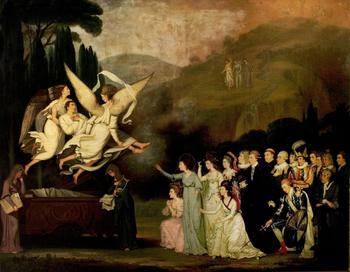
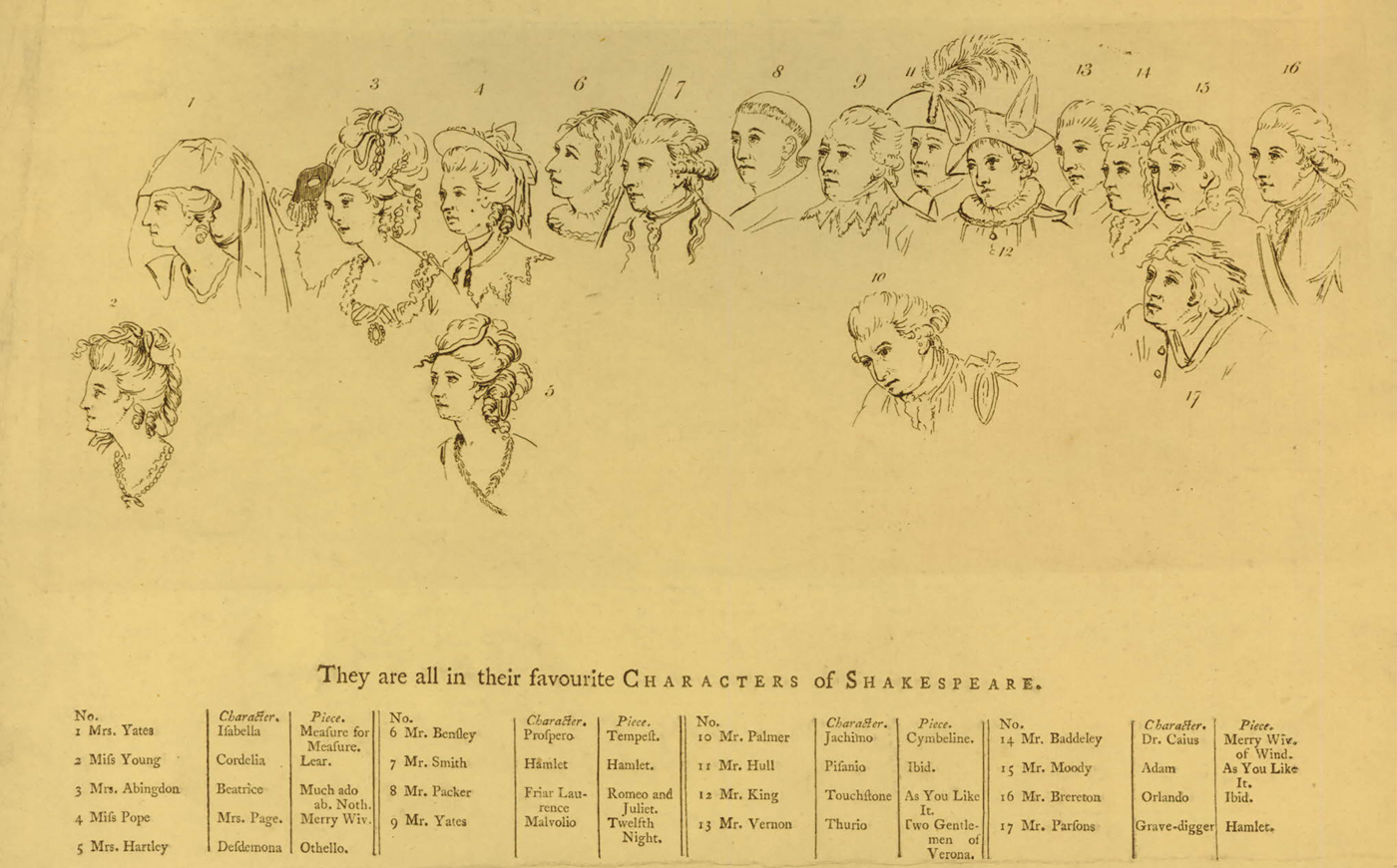
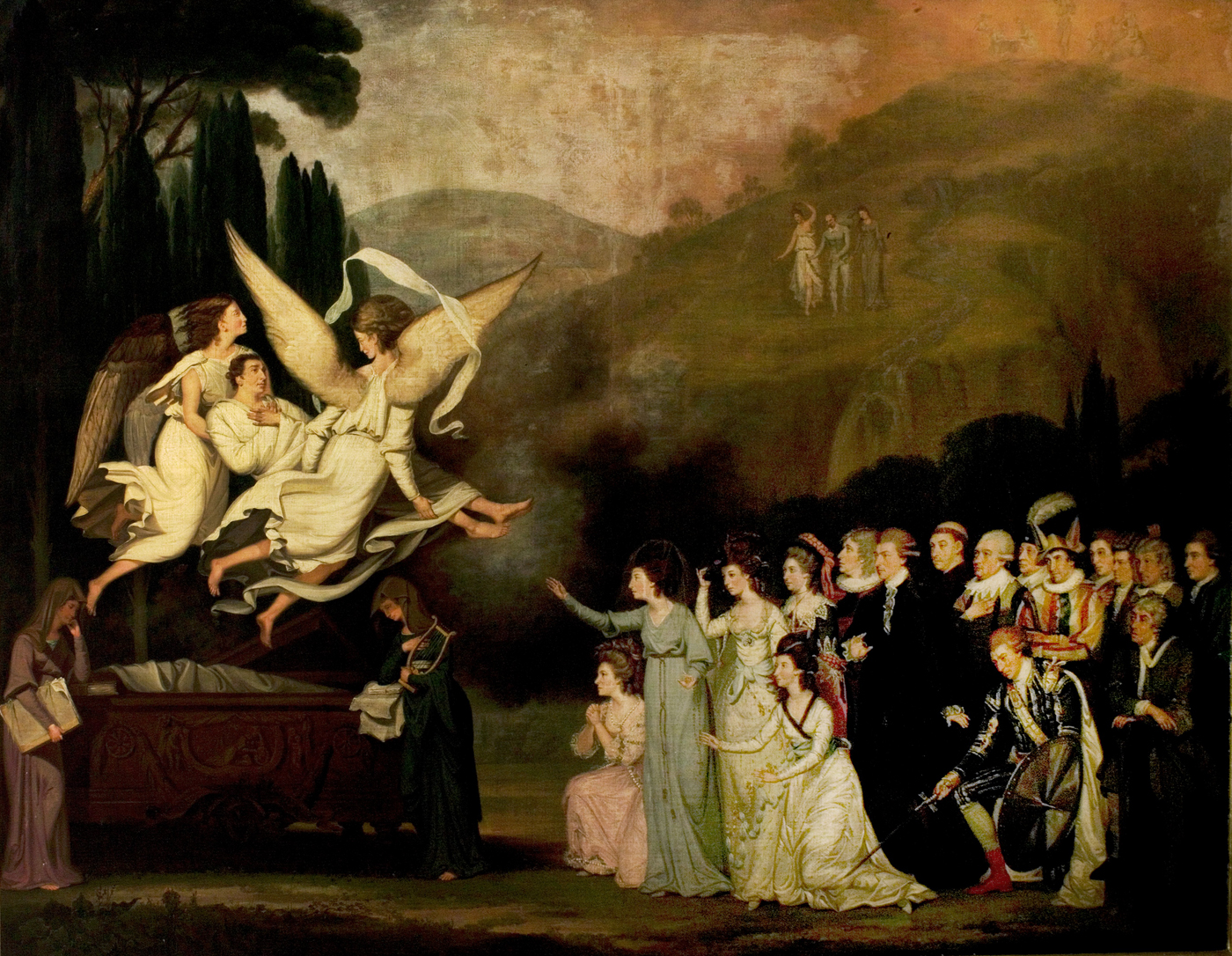
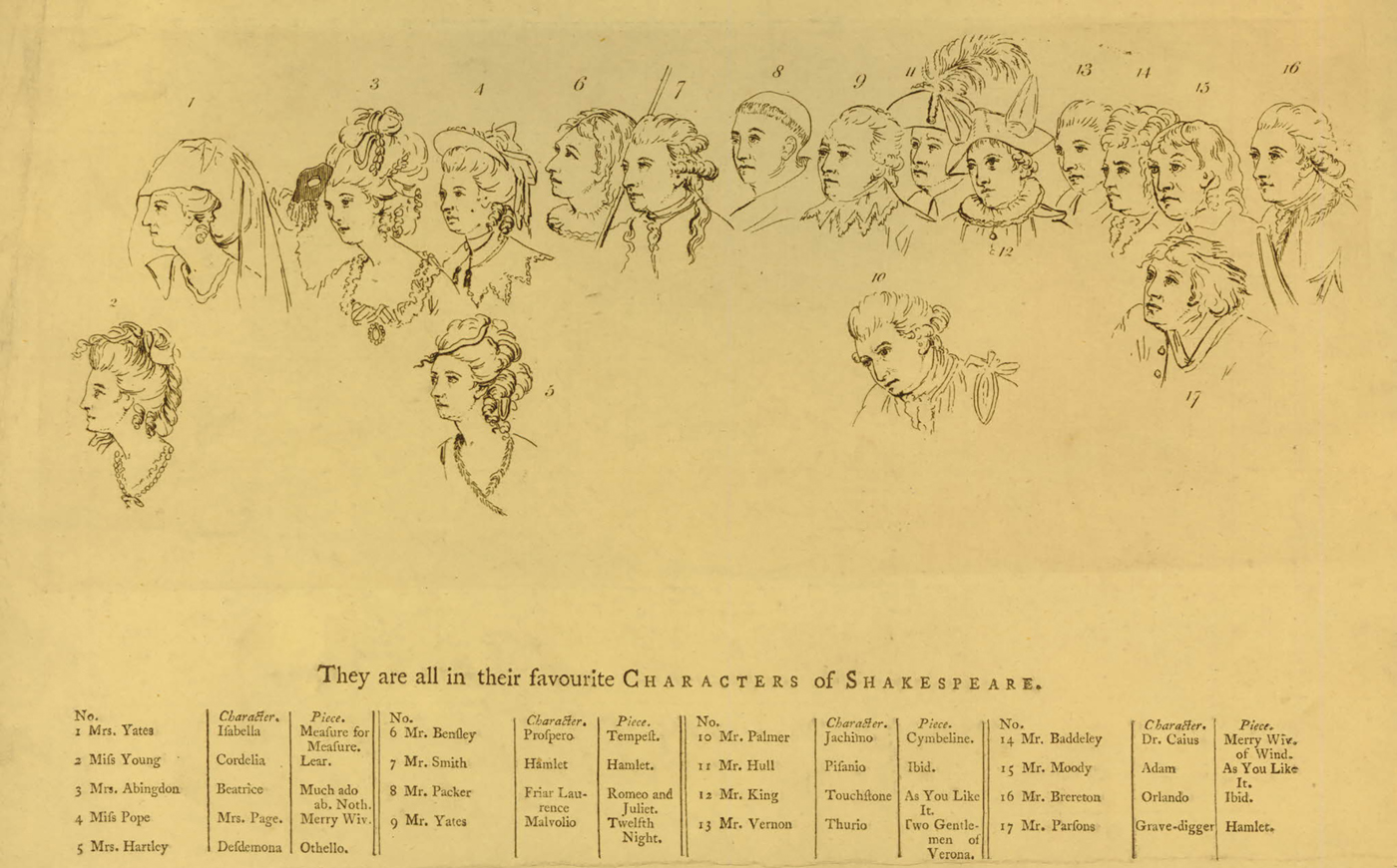
Why Tresham chose the apotheosis for the theatre curtain is not known, but the genre did have some currency in late eighteenth-century England. He may have been inspired by another theatrical allegory, The Apotheosis of David Garrick, painted in 1782 by George Carter after Garrick's death in 1779 (Fig. 4), and circulated as a print (Fig. 4). The central image of the picture – which has been described by Horace Walpole as ‘ridiculous and bad’, by Heather MacPherson as ‘histrionic’, and by Andrew Lambirth as ‘wonderfully camp’Footnote 71 – shows a resurrected Garrick being wafted by two angels towards the slopes of Mount Parnassus. The Mount's only human inhabitant is Shakespeare, shown coming forward between the figures of Thalia (Comedy) and Melpomene (Tragedy) to welcome Garrick to greater glory. On the right of the picture is a group of his fellow actors in Shakespearean costume, including Thomas King, Mary Ann Yates and Frances Abington. The actors’ identification rests on an engraved sheet of the numbered heads of the actors that appeared in the advertisement for the print published on 20 January 1783 as ‘The Immortality of Garrick’, although the print itself appeared without the key (Fig. 5).Footnote 72
The Apotheosis of Garrick. Oil on canvas, 1782. George Carter. Royal Shakespeare Company Collection, Stratford-upon-Avon, Warwickshire / Bridgeman Images.
The Apotheosis of Garrick ‘To the Public’. ‘Proposals by George Carter, For Publishing by Subscription, a Print, from a Poetical Picture Designed and Painted by Him, To the Memory of David Garrick, Esq…. 2 February 1779’. A printed key to The Apotheosis of Garrick. 260872. Used by permission of the Folger Shakespeare Library.
There are curious echoes in Carter's picture of the image, then in circulation, of the dying Alexander Pope, attended by a female figure wearing the creative sunburst of Apollo, and being visited by Milton, Spenser and Chaucer, which was used to decorate the title page of William Mason's Musæus; a monody to the Memory of Mr. Pope.Footnote 73 Tresham may or may not have been aware of Carter's picture (or for that matter, Mason's Musæus), although the image's theatrical context – not to say the widespread ridicule of its composition – suggests that Tresham would probably have heard of it, at least. Some of the conventions found at work in Carter's picture can also be found in the 1687 Le triomphe de Lulli aux Champs Elysées, a satirical piece of music in which the composer Jean-Baptiste Lully is put on trial by French musicians who bring both musical and moral charges against him.Footnote 74 This type of apotheosis had some currency as a late seventeenth- and early eighteenth-century musical idea, one usually French (and therefore an ‘apothéose’), not always satirical, and often with a written programme.Footnote 75 In Le triomphe de Lulli, the composer, having been successfully defended by Polyhymnia, is then honoured by the heroes of his operas and welcomed by Apollo to Mount Parnassus.Footnote 76 It is possible that in Carter's picture, Garrick, having successfully defended himself against a range of charges relating to Shakespeare's plays, is similarly honoured by his actors, and then welcomed by Shakespeare and Apollo to Parnassus.
Other points of reference for Tresham are the three apotheoses that circulated in London between 1783 and 1791, two in print, and one in the theatre. They all have one or two characteristics in common with Tresham's study of Metastasio's ascent: all have the subject being lifted up to heaven by a cast of supporters, and all have a skyline below with buildings or scenes that are relevant to the subject's life. Of the three, one has royal subjects; another, theatrical origins; and the last, musical inspiration.
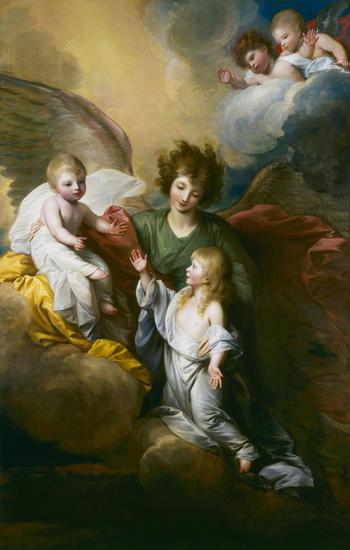
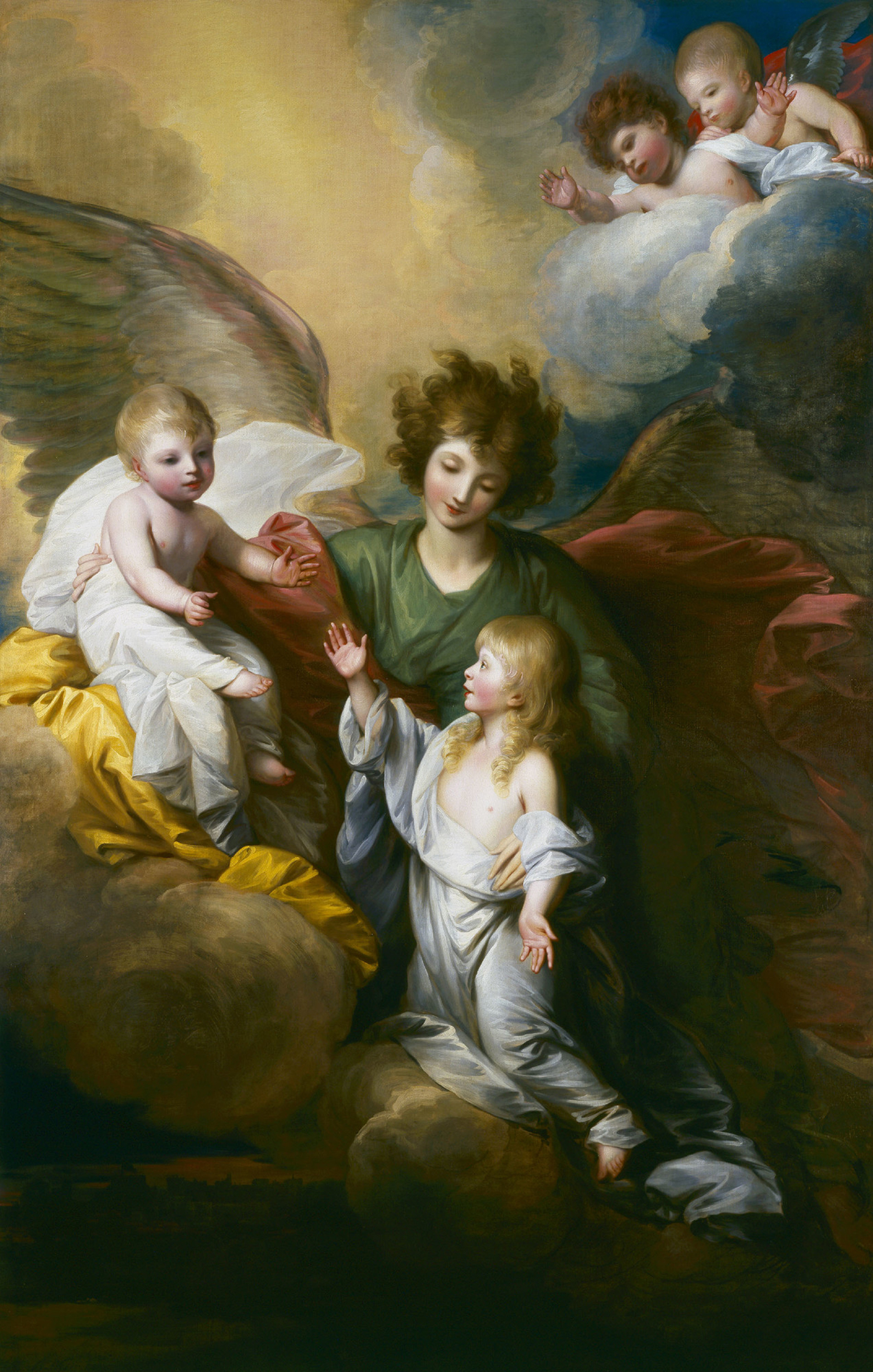
The first of these to appear was The Apotheosis of Princes Octavius and Alfred, a print published in 1783, and was an image that revisited the apotheosis as a suitable genre for the expression of grief in the late eighteenth-century public sphere. Almost every observer would have had no personal knowledge of the figure – or figures – concerned, but the loss would have been one with which they could empathise. The print, by Robert Strange, was based on a painting by Benjamin West, commissioned by George III and still in the Royal Collection; it depicts the two princes, his two youngest sons, being taken up to heaven by an angel (Fig. 6).Footnote 77 The younger of the two, Alfred, was the first to die; in acknowledgement of this, it is he that reaches down to his elder brother, Octavius, and they ascend over a south view of Windsor Castle. The divine translation of the Princes in West's painting – which marked their deaths, Alfred in 1782, aged 2, of smallpox, and Octavius in 1783, aged 5, of a failed smallpox vaccination – gives the picture religious overtones that echo those of works such as Raphael's popular La belle jardinière; here, Mary with the infant Jesus is welcoming the infant St John.Footnote 78 The resonance between these two pictures is emphasised by Robert Strange's print of a ‘companion’ to the engraving of West's painting.Footnote 79 Also published in 1787, it was of the 1629 Annunciation by Guido Reni, in which the figures of the Virgin Mary and the Angel Gabriel are seen as emblematic of purity and grace.Footnote 80
The Apotheosis of Princes Octavius and Alfred. Oil on canvas, 1782. Benjamin West. Royal Collection Trust / © Her Majesty Queen Elizabeth II 2019.
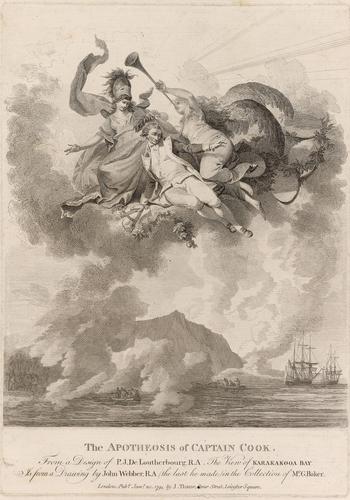
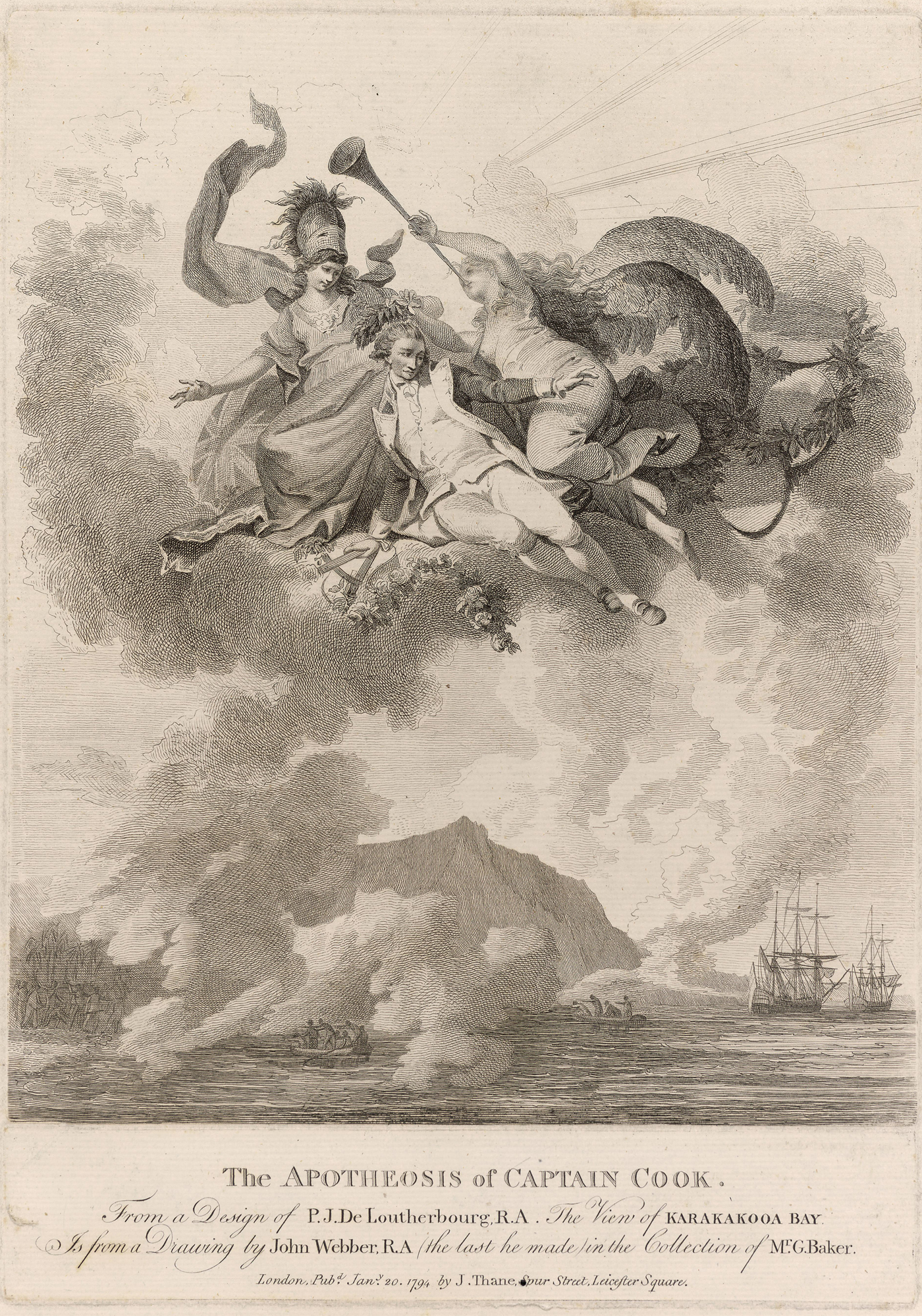
Although the print of The Apotheosis of Captain Cook by Philippe de Loutherbourg did not appear until 1792 (Fig. 7), the image was first seen in a staging that entranced audiences in 1785. The show in which it appeared was the pantomime Omai; or a Trip Round the World, first performed at Covent Garden in December 1785; and Cook's apotheosis was the finale to ‘this most admirable assemblage of curious views’.Footnote 81 The work's author, John O'Keeffe, claimed it to be
a grand spectacle … the incident, characters, &c appropriate to the newly-discovered island in the southern hemisphere, and closing with the apotheosis of Captain Cook … [T]he dresses and the scenery were done from the drawings of Mr Webber, the artist who had made the voyages with Cook.Footnote 82
The all-important background view here is the scenery of Hawaii, a view not invented but rather based on the drawings of John Webber.Footnote 83 This emphasises that in order to function as an apotheosis, the background had to be understood as a genuine. In the final scene of Omai there appeared
A most extensive & beautiful View of the Great Bay at Otahaite at Sun Set – the Two ships at Anchor at a distance – On one side in front the Royal Pallace adorn'd with Trophies & Flowers, and the whole Scene fill'd with the people of Otahaite rang'd in order to receive and crown their King, with warlike music, &c. The Boats of all the Islands are seen entring the Bay, and – when arriv'd, the Ambassadors from the different powers enter in procession with presents to Omai – preceded by the English Captain & Sailors, who – salute him as the Ally of Britain & compliment him with an English Sword, which he tells him has more virtue than all the Talismans in the Universe [all sic].Footnote 84
Captain Cook was then carried aloft into the skies above Karakakooa Bay by Britannia and Fame (with her trumpet and laurel crown), while Cook's companions, making for the moored ships, fire from small boats at the natives on the shore. It was above this scene that the audience then saw the apotheosis of Cook, a figure of considerable public fascination. Cook was not alone in being the subject of a staged (and therefore repeatedly enacted) apotheosis, for in June 1790 the Royal Circus staged The Siege of Quebec, which concluded with the Apotheosis of General Wolfe, one in which Britannia appeared ‘lamenting the loss of this Hero, while Fame raises him to a seat of immortality’.Footnote 85
The Apotheosis of Captain Cook. Etching, 1794. After Philip de Loutherbourg and John Webber; published by John Thane. British Museum 1867,1214.281. © The Trustees of the British Museum.
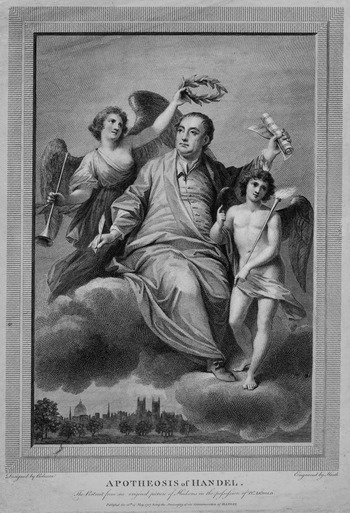
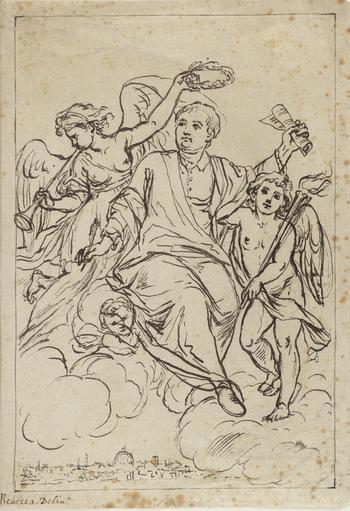
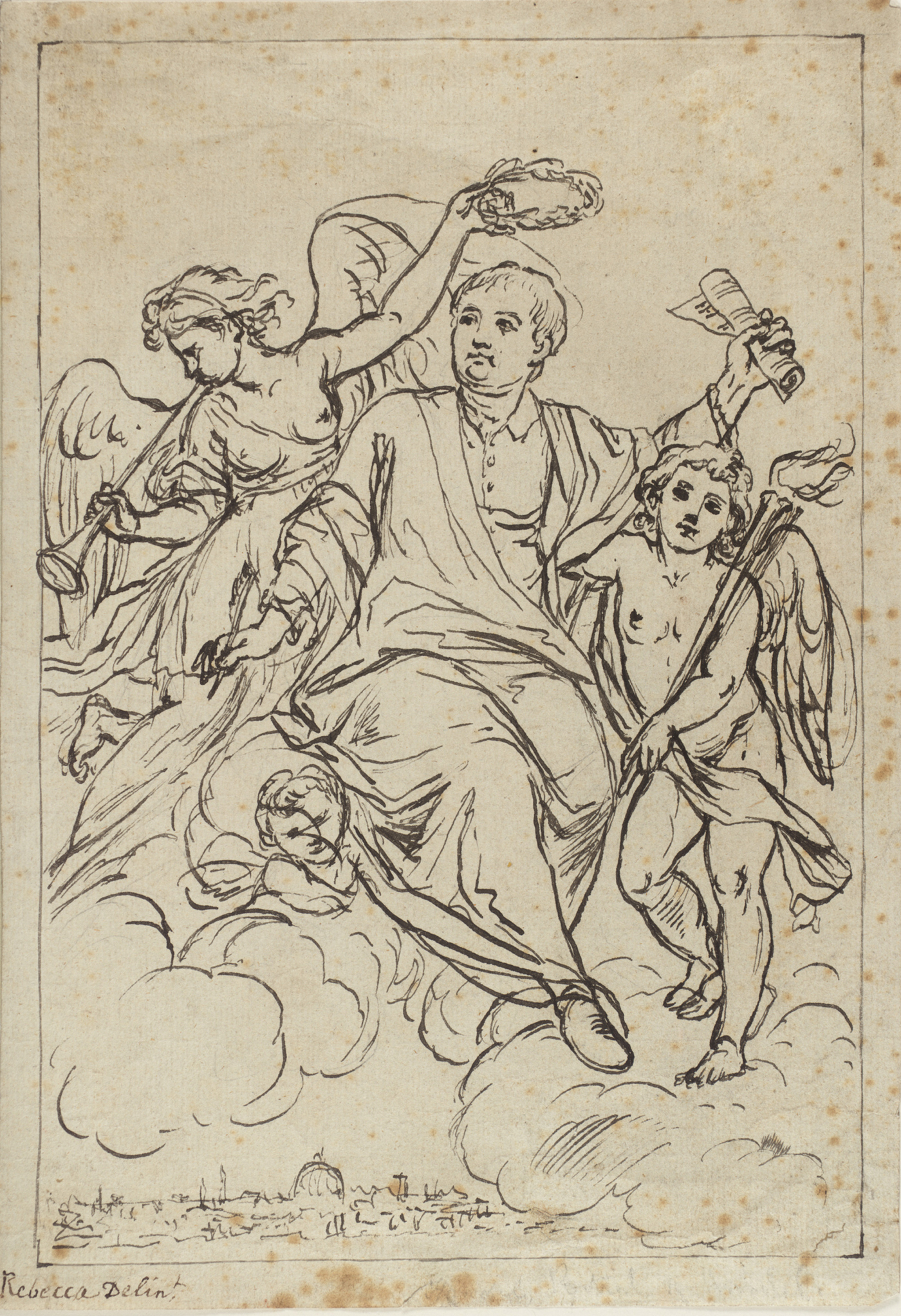
While the apotheosis of the princes was a royal commemoration and that of Captain Cook a re-creation of a theatrical event for an audience already familiar with the real story of the explorer, The Apotheosis of Handel of 1787 was contrived, one ostensibly aimed at capturing the image of the composer as re-invented with the 1784 Handel commemoration, but in fact designed to enhance Samuel Arnold's edition of Handel's music (Fig. 8).Footnote 86 It was certainly the product of a distinguished line-up of artists. The central portrait was based on one of the composer by Thomas Hudson, which was then (according to the printed legend) in the possession of Arnold himself, while the whole composition was drawn by the Italian decorative artist Biagio Rebecca.Footnote 87 Rebecca had close connections with West – the men had met in Rome, and Helmut Von Huff notes that Rebecca often assisted him thereafter – and the notion of an apotheosis may well have originated with West.Footnote 88 He certainly employed a similar integral frame to that which appears on the print of West's royal apotheosis. Rebecca was an obvious choice for Arnold; he had designed the admission ticket for the first performance of the Handel Commemoration in Westminster Abbey on 26 May 1784.Footnote 89
The Apotheosis of Handel. Engraving, 1787. Central figure after Thomas Hudson, drawn by Biagio Rebecca, engraved by James Heath. Private Collection.

Rebecca's design for the apotheosis shows Handel supported by Fame and Genius, the former holding a laurel wreath over his head and the latter bearing the torch of inspiration. Below the figure of Handel is a view of London, with the towers of Westminster Abbey prominently on show; as the venue of the 1784 commemoration, it hosted an event that not only promoted Handel, but one that has been described as ‘the most important single event in the history of English music’ for the role it played in establishing the fashion for large-scale choral music in which Handel's oratorios were central.Footnote 90 The event was further memorialized by Burney in An Account of the Musical Performances in Westminster-Abbey that appeared in 1785.Footnote 91 However, these details only serve to emphasise the extent to which this image was a construct; for the first part of Handel's career, the operas took precedence in his output, while the oratorios, only begun in earnest in the 1730s, were works performed largely in the theatre. Westminster Abbey did not figure regularly in Handel's personal or professional life; it had only become part of the image of Handel as a national figure after 1784. And the image of Westminster Abbey did not figure in the original iconography of Rebecca's design either, for as his preparatory sketch for the apotheosis shows, his chosen skyline was the City of London with a profile of St Paul's Cathedral (Fig. 9).
The Apotheosis of Handel. Drawing, graphite and ink on paper, 1787, by Biagio Rebecca. Purchased as part of the Oppé Collection with assistance from the National Lottery through the Heritage Lottery Fund 1996. © Tate, London 2019.
Rebecca's print was first announced in January 1787, and advertised as a benefit for those subscribing to Arnold's edition of Handel's works, where it would be ‘given with each Class of his Works, in order to form a frontispiece’.Footnote 92 By 24 October, it was announced that it would be delivered to ‘SUBSCRIBERS only, along with the Twelfth Number’.Footnote 93 By 10 January the following year, the print was offered separately, it being announced that ‘A Few Proof Prints of the Apotheosis of Handel … may be had of Dr. Arnold.’Footnote 94 And by 19 June 1789, ‘With the Forty-eighth Number, is now delivering (to Subscribers) the celebrated Apotheosis of Handel.’Footnote 95 This date also saw another announcement that suggested that ‘Every Twelfth Number will be embellished with Portraits, and emblematical Engravings of this celebrated Author.’ By the time the edition was finished, there would be seven of these ‘portraits’: Rebecca's, Louis-François Roubiliac's statue of Handel at Vauxhall Gardens (1789);Footnote 96 Hudson's portrait of Handel now in the Faculty of Music in Oxford (1789); Shepherds in the field with flocks and angels (c.1790); Handel's monument in Westminster Abbey (c.1790); Giovanni Battista Cipriani's medallion portrait of Handel, with three other figures (c.1790); and the second of Hudson's of portraits of Handel, then in the collection of Earl Howe.Footnote 97 This method of marketing has ensured that Handel's apotheosis can be found bound variously into volumes of the edition, ranging from Athalia to Messiah, from Joshua to Giulio Cesare to the Water Music. What we learn through this sequence of offers is that Arnold, in an effort to revive flagging interest in the publication, changed his tactics as the edition proceeded. But interest in it did not revive, and it collapsed incomplete in 1797. The collapse does not, however, negate Arnold's achievement, for it was the first attempt at a collected edition of any composer, and the interplay between the image of the much-advertised apotheosis and the grandeur of the edition was instrumental in furthering the creation of Handel's ‘classic’ status.Footnote 98
All the apotheoses discussed above reveal an eternal longing: the effect of loss, the desire to capture the spirit of the departed, and the need to take comfort from the lifting up to heaven of the subject where their spirit would, for eternity, endure. Further, to extrapolate from Michael Dobson's interpretation of Carter's Apotheosis of Garrick as representing a succession crisis in the theatre, it can be seen that such crises are a powerful motivating force behind the eighteenth-century apotheosis.Footnote 99 Dobson argues that Garrick was understood as the modern embodiment of Shakespeare, an analogy that Shearer West points out had been made in numerous ways, including in the verses on Garrick's tomb in Westminster Abbey:
Such a binary construction, Dobson suggests, meant that there was simply no one to take Garrick's place in the public imagination. And this notion underpins a later Royal apotheosis, a print published in London in 1799. Made by Bartolozzi after a painting by William Hamilton, it shows Louis XVI, Marie Antoinette and the first Dauphin, Louis Joseph (who died in 1789) in heaven, with an angel presenting the entire scene to the second Dauphin, Louis-Charles, the prince who survived the Revolution. Louis-Charles, however, died in 1795, and Hamilton's apotheosis, with its context of Louis XVI's execution during the French Revolution, marked a complete loss of dynastic power through the annihilation of the members of the French royal family closest to the throne.Footnote 101
Turning back to the images by West, de Loutherbourg and Rebecca, we find that a break in or loss of succession lies behind each of the apotheoses. Both Cook and Handel were presented as national – indeed, international – heroes, with no successors; no explorer or musician was worthy to succeed them. The loss of succession expressed in Rebecca's print was projected rather than actual; the Prince of Wales, later George IV, still had time to produce a male heir, his only remaining offspring then being his daughter Princess Charlotte Augusta of Wales, born in 1796. But the problems of his fickle and extravagant behaviour were all too apparent, and there would be no more children; Princess Charlotte would die in childbirth in 1817, with the crown eventually passing to George IV's younger brother, William, in 1830.
Tresham followed a similar approach to dynastic loss as these artists. He presented Metastasio as the ‘lyric Shakespeare’, with Shakespeare appearing above Metastasio's head illuminated by Apollo's rays. The Bard pointed to a scroll lettered in gold and held aloft by two genii, which contained his own text from The Merchant of Venice:
Metastasio had ‘music in himself’ in abundance, so when measured against Shakespeare's text, he can be seen not only as a man moved by the ‘concord of sweet sounds’, but also as a man above ‘treasons, stratagems and spoils’. He is worthy to be received by Shakespeare.
But Metastasio (who had died in 1782) was irreplaceable; there was no successor, either on the Continent or in London, to such a towering figure whose works had formed the core of the opera seria repertory for much of the century. Quoting the Spanish-Italian writer on theatre and music Stefano Arteaga, Tresham comments that Metastasio's
Scenes display a system of morals put into action; and the happy Bard, in his easy enchanting Numbers, borrows the language of the Heart to enforce the precepts of Reason.Footnote 103
Tresham's imagery suggests that the loss of Metastasio was all the more grievous, for he stood tall not just as a great lyric poet, but as a moralist, one whose ‘scenes display a system of morals put into action’.Footnote 104 His absence had not only robbed opera of the practitioner whose works were ‘without doubt, the greatest efforts of the joint beautiful arts’, but also removed the moral compass on which his type of opera seria depended.Footnote 105 As far as the new Pantheon Opera was concerned, however, the acceptance of Metastasio by Shakespeare in Tresham's apotheosis publicly accepted the foreign poet as a native – ‘With us, Stranger and Barbarian are not synonymous’Footnote 106 – and through a link made between Italian opera and British drama, allowed the painter to claim legitimacy for the new institution.
Metastasio at the London Opera
As a subject for the type of apotheosis constructed by Tresham, Metastasio was an obvious choice, and as far as a lyric poet was concerned, the only choice with a claim to universality. His texts had been the mainstay of the European opera industry since the 1720s, with over 300 settings of his librettos by numerous composers.Footnote 107 In London, the statistics for the period 1724 to 1801 (reaching from the date of Metastasio's first libretto Didone abbandonata to the end of the century) show that a total of some 680 Italian operas were staged, of which 419 were opera seria; these figures include repeated versions of Metastasio's works of the same title. Of these, some 104 had texts taken from Metastasio.Footnote 108 The librettos were not only set by composers in entirety, but also subject to numerous interventions by house librettists, composers, promoters and singers. These interventions – mostly of inserted arias; alterations for local needs, customs and occasions; or updating with the addition of new forms such as ensembles and choruses – usually left the essence, if not the action, of the original Metastasio libretto intact. But his librettos were also mined for their aria texts, to be newly set either as individual arias which were then inserted into other works, or having first been inserted into another libretto, now set as part of a whole new opera. And at times, the musical settings were transferred with the texts, which, when there were enough of them involved, saw the opera described as a pasticcio.Footnote 109 Nearly 300 different Metastasio aria texts appeared in contexts other than their original ones, finding their way into other librettos by Metastasio and those by other poets.Footnote 110 There seems to have been no particular pattern in the choice of the works from which the arias were drawn, and the popularity of any individual opera story had no bearing on what texts were redeployed.
As this narrative suggests, there are endless variations on these processes, and what survives in the eighteenth-century librettos and scores is no reliable guide to what was actually performed.Footnote 111 But what is clear is that Metastasio's texts had a portability that ensured that they could be found in opera houses from one end of the continent to other and beyond, and offered all those involved a flexibility of action and staging. No other librettist produced tales that so clearly caught the zeitgeist of early eighteenth-century opera seria, and in the context of London – a capital city of an island nation over the channel – such a flexibility was even more important. All – or nearly all – personnel for Italian opera had to be imported from abroad, often annually, and most of them arrived just in time for the beginning of the opera season in late October, or even later in some years. Given that almost every work was ‘new’, a season of say seven operas represented a considerable amount of learning, and the presence of a familiar Metastasio opera enabled singers to learn the music to known texts, or to insert with ease their own ‘suitcase’ arias they brought with them, or to perform familiar stories. Just how truly ‘new’ each opera was is open to debate; it appears frequently to have meant only new as far as a London audience was concerned, and there was always a chance that the singers would find themselves performing in a work billed as ‘new’ when it was one they had already sung on the continent.
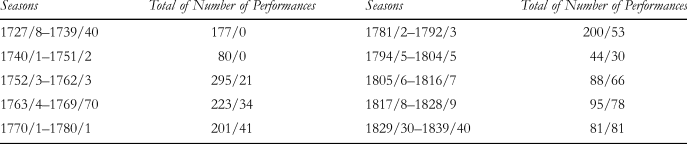
When all London theatre settings of Metastasian texts are analysed, there proves to be only one London theatrical season without such a text in the period 1724–1801. It is clear that opera in the capital could not have functioned without Metastasio, just as London theatre at the playhouses could not – or did not – function without Shakespeare. But the playhouses, too, had a major success with an English version of Metastasio's Artaserse, set for Covent Garden by Thomas Arne as Artaxerxes. Arne's opera had a remarkable longevity, being performed well into the nineteenth century; for example, it clocked eighty-one performances in the period between 1829 and 1840, mainly as a standard work for singers to make their debuts in the role of Mandane, much to the annoyance of critics.Footnote 112
But those eighty-one performances are also instructive for an understanding of the use Metastasio's texts in this later period, for Artaxerxes was the only Metastasio text then performed on the London stage (Table 1). Looking down the seasons from 1794/5 to 1804/5, it can be seen that not only does the number of Opera House performances of Metastasio's works become smaller as time goes on, but stagings of Arne's Artaxerxes at the playhouses make up the lion's share of those totals.
Performances of Metastasio on the London Stage 1727–1840a
In the column ‘Total Number of Performances’, the first figure is the total number of performances of Metastasio for the seasons; the figure after the forward slash is the total number of performances of Thomas Arne's opera Artaxerxes premiered on 2 February 1762.

a Figures taken from Michael Burden, ‘Metastasio on the British Stage 1728–1840’, Royal Musical Association Research Chronicle 49 (2007), whole issue, Appendix 1: ‘Metastasio's Works in Performance’ (305–10).
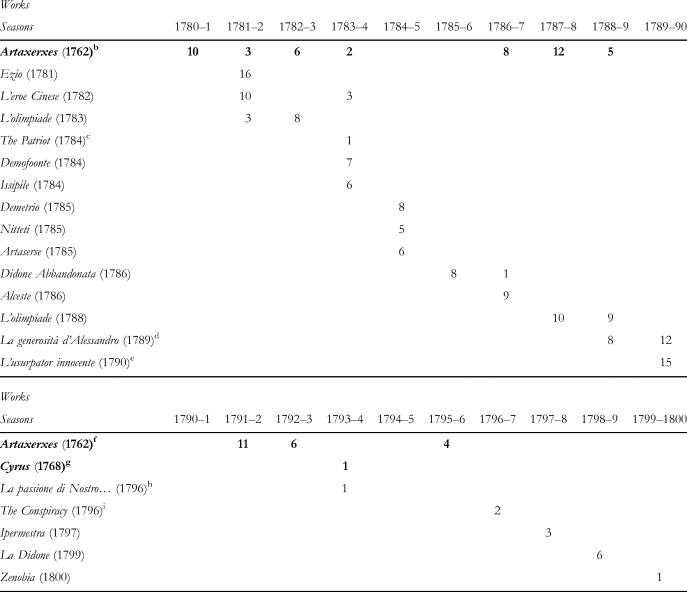
At the Opera House, as Table 2 shows, the staging of Metastasio's operas both in frequency of scheduling and in numbers of performances remained fairly consistent during the 1780s; these overall numbers are down on those of previous decades, but not catastrophically so.Footnote 113 But after the fire, from the seasons 1790/1 to 1795/6, no Metastasio opera was programmed; in 1796/7, Ipermestra was staged, followed in 1798/9 by La Didone. Both operas had low performance figures. The poet's rout was completed in 1800, when Zenobia with music by Richard Edgcumbe – an amateur's setting for a benefit for the soprano Brigida Banti – was given a single performance.Footnote 114
Performances of Metastasio on the London Stage 1781–82 to 1800–01a
The figures in bold record the number of performances of Thomas Arne's opera Artaxerxes, and John Hoole's Cyrus, both first staged in earlier seasons
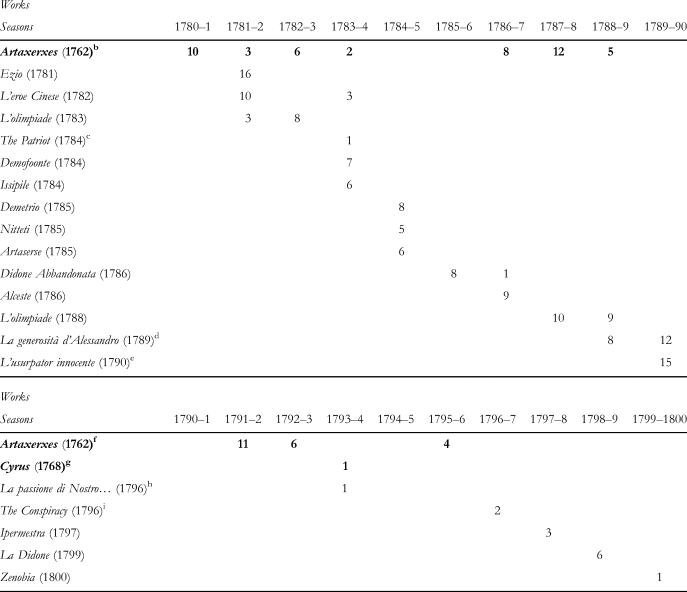
a Figures taken from Michael Burden, ‘Metastasio on the British Stage 1728–1840’, Royal Musical Association Research Chronicle 49 (2007), whole issue, Appendix 1: ‘Metastasio's Works in Performance’ (305–10).
b A revival of Thomas Arne's setting of a translation of Artaserse.
c A play by Charles Hamilton based on the libretto Temistocle in English, with a prologue by Thomas Stewart.
d An opera adapted by Charles Badini from Alessandro nell'Indie, set by Angelo Tarchi.
e An opera by an unknown adapter from Demofoonte, set by Vincenzo Federici.
f A revival of Thomas Arne's setting of a translation of Artaserse.
g A play by John Hoole based on the libretto Ciro roconosciuto, in English.
h Metastasio's oratorio, La passione di Nostro Signore Gesu Cristo, set by Michele Mortellari for a private performance.
i A play by Robert Jephson based on the libretto La clemenza di Tito, in English.
Although the suddenness with which Metastasio stagings fall out of the lists of London opera seasons is a surprise – it is almost as if the fire at the Opera House had cleansed the theatre's Augean stables of these ‘old’ operas – it did reflect more general changes in attitudes towards earlier opera seria. The genre was now seen as old fashioned in content, and the requirement for star singers certainly made eighteenth-century opera seria expensive to stage. There was also the issue of the castrato, a voice type central to the genre but with which some were increasingly uncomfortable, and the number of castrati had already begun to fall.Footnote 115 Indeed, the Opera House fire gave at least one correspondent, ‘Humanitas’, the hope that ‘the accident should eventually annihilate Italian Operas in this Kingdom’. The author argued the case on the basis of the horror of the
squeaking of a poor mis-shapen, mutilated unfortunate being, vilely misrepresenting an Alexander, a Pompey, or a Caesar, is so flagrant a violation of the semblance of Truth, and at the same time so shocking to Humanity, that nothing but an audience of no sex could possibly be entertained with it.Footnote 116
‘Humanitas’ closed with a comparison of the practice of castration with slavery, ‘which at present seems so violently to wound our tender feelings’. The London public had taken little practical notice of this sort of commentary in the past, but now that these were changes already afoot, the seeds of complaint had more fertile ground on which to fall.Footnote 117
Yet the first Pantheon season, while containing no Metastasio operas, did include a preponderance of opera seria, a conservative programme catering for its backers’ ‘aristocratic musical tastes’.Footnote 118 The programme consisted of one ‘musical drama’, Michele Mortellari's Venere e Adone; three opera buffe, Paisiello's La locanda, Pietro Guglielmi's La molinarella and his La bella pescatrice; and three opera serie, the pasticcio Armida, Giuseppe Sarti's Idalide; o sia, La vergine del sole and Ferdinando Bertoni's Quinto Fabio. Their reception was muted, with the commentary mainly confined to the state of the house, the unpreparedness of performances, and the general excellence of the star singers.Footnote 119 But in an otherwise positive account of the first opera, one newspaper commented: ‘The Serious Opera of Armida is so well known to every Musical Amateur, that it is not necessary for us to speak in its commendation.’Footnote 120 For those who had high expectations of the new institution and were beyond the inner circle of patrons, the use of such an obviously old opera in an unfashionable genre to open can only have been a matter for disappointment. By the end of the season, not only had the majority of performances been of opera buffa, but vast sums of money been spent on the Pantheon project, causing the administration to take action. Opera seria was abandoned in the second season (that of 1791/2), the managers being described as ‘dismissing the Sopranos [i.e., castrati, to] rest their strength, and [pinning] their hopes of success on the even tenor of a middling Opera, and attraction of superlatively fine Ballets’.Footnote 121 The season consisted of three new works – Guglielmi's La pastorella nobile, Domenico Cimarosa's Le trame deluse and Paisiello's La discordia conjugale – and restagings of two of the previous season's opere buffe, La bella pescatrice and La locanda. This offering was more popular, and was artistically successful. But this change in programming could not solve the growing financial crisis which threatened those involved in backing the Pantheon, and it is certain that the fire which gutted the building on 14 January 1792 was set as a way out of the situation.Footnote 122
Opera seria – and the castrati – did return to the Opera House in subsequent seasons, but from this point on opera buffa remained in the ascendant. The opera seria casts of the 1790s included few roles for castrati, and those singers that were rostered – such as Domenico Bruni and Agrippino Rosselli – were mostly minor singers attended by none of the razzmatazz previously associated with the voice type.Footnote 123 Indeed, the evidence from this decade suggests a relatively stable core cast, with regular appearances by Giovanni Morelli, Carlo Rovedino, Pasquale de Giovanni, Giovanna Pastorelli and Prospero Braghetti, with only one or two new singers each season. As Fenner puts it, the period was characterised by ‘the fading out of the castratos’, to be replaced by voices such as that of the tenor John Braham; commenting on his Opera House debut in 1796, The Morning Chronicle remarked that new singers such as he would chase from the English stage the ‘degrading and disgusting form of a Castrato’.Footnote 124
The end of Tresham's curtain, and the end of the Pantheon Opera
Tresham's curtain lasted only one season. Although he was paid £375. 16s for work that included its painting, the still-new curtain was removed as part of an overhaul of the theatre for the Pantheon Opera's second season.Footnote 125 Not everyone had admired it: The Public Advertiser noted that ‘Tresham's whole curtain’ was ‘full of leaden Gods and Goddesses’,Footnote 126 while The Morning Chronicle was equally unimpressed:
They who have spoken in praise of Mr Tresham's curtain, are neither friendly to the Arts, nor generous to Mr Tresham. The only good property that belongs to it, is its power of removal. It would be insufferable if it were stationary.Footnote 127
This quip on the curtain's ‘removal’ was echoed by Fuseli, of whom Joseph Nollekens recounted that Tresham, having found the artist in the auditorium, ‘roused’ him:
By the interrogative of, ‘How do you like the drawing of my figures?’ To which Fuseli, who heard the bell ring, observed, ‘The drawing bespeaks something clever; I mean the drawing of the curtain’, which the mechanists were just at that moment engaged in raising.Footnote 128
Nollekens hints here at Tresham's vanity, already noted above in relation to the visit of the King;Footnote 129 he also mentions the use at the Pantheon of the usual bell to indicate the movement of the sets and curtains. While Nollekens's comments are pitched to exploit Tresham's discomfiture at the hands of the ‘extraordinary and very entertaining’ Fuseli,Footnote 130 they do go on to make clear that Tresham was also responsible for the proscenium; this can be confirmed by the bills for the work, which show that he also painted the auditorium ceiling.Footnote 131 Nollekens remarked:
Tresham, the Royal Academician, who had been employed to decorate the front of the stage at the Pantheon, filled the tympanum with a profusion of figures, displaying the Sciences, of which performance he was not a little proud. Having taken his seat in the front to see the effect of his pencil, on looking behind him, he found his nearest companion was Fuseli, to whom he addressed himself with, ‘Well, Mr. Fuseli, how do you like my pedimental colouring?’.Footnote 132
This work on the proscenium was the subject of an unfavourable report by one commentator, who noted that ‘the frontispiece to the stage … has much the appearance of the Walls of Newgate’, while The Oracle described it as resembling ‘the most solid rustic ironwork, a sort of architecture which, we think, should not have been represented in that place’.Footnote 133
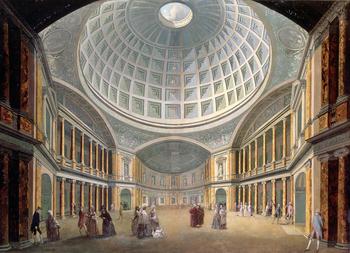
These satirical references to the drop curtain being ‘removed’ or ‘drawn’ became a reality sometime in late 1791, and Tresham's curtain was replaced by one from a different hand. The London Chronicle reported that the new curtain's subject was ‘a perspective of the Pantheon before it was converted into an Opera-house’.Footnote 134 This was presumably a representation of Wyatt's original first-floor grand salon. The Evening Mail thought this new curtain ‘tolerably sketched – but the colouring much too dead for any brilliancy of effect’.Footnote 135 No painter is recorded, and were it not for the fact that the artist Thomas Hodges had already resigned from the Pantheon Opera as ‘painter and inventor of the decorations’, he would be an obvious candidate to have painted the new curtain.Footnote 136 Although Hodges’s scenography was criticised in the press, he was first and foremost a landscape and architectural painter, and most comments on his work suggest that he had no experience in dealing with the perspectives and colours required for theatre sets. As noted above, Hodges had produced the painting of the Leicester Square Opera House proposal seen in Figure 2, and had already painted the interior of the Pantheon, a version in oils he exhibited at the Society of Artists in 1772 (Fig. 10).Footnote 137 The painting shows Hodges's trademark of a foreshortened perspective – used here to capture the building's dome – and demonstrates his love of architectural detail.Footnote 138
The Pantheon, Oxford Street. Oil on canvas. William Hodges, with figures by William Pars, before 1791. Leeds Museums and Art Galleries (Temple Newsam House) UK / Bridgeman Images.
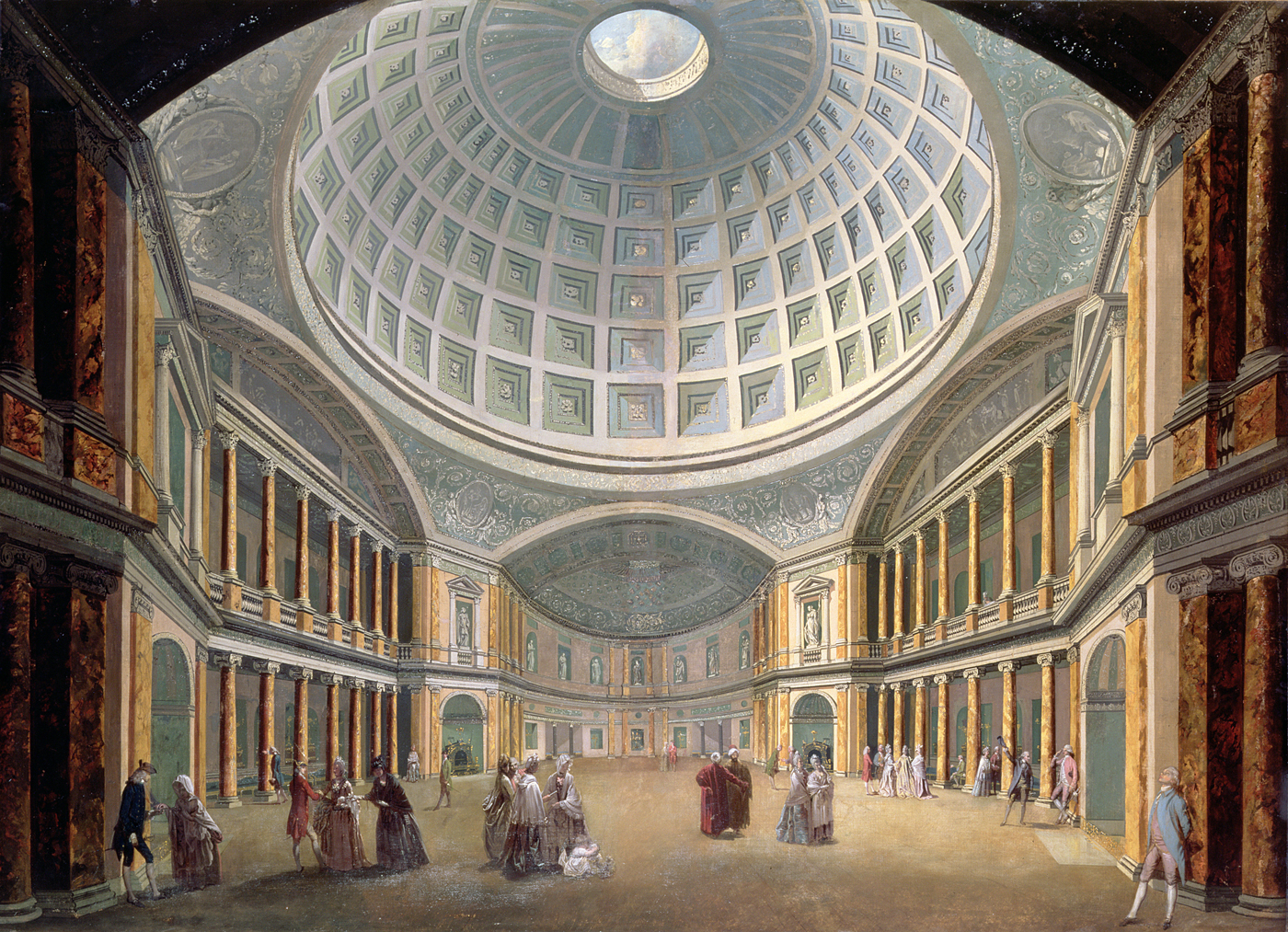
But while this image was certainly the new curtain's subject, the most likely candidate for its painter is Gaetano Marinari, an experienced scenographer whose Pantheon contract was drawn up during October 1791 and who was advertised from November as being in charge of the theatre's scenery.Footnote 139 He was well versed in architectural painting; as The Dramatic Mirror noted in 1808, he ‘specialised in architectural scenes’, and ‘displayed some of the finest specimens of scene painting known to the public’.Footnote 140 Few sources survive for Marinari's work, but it is recorded that he was later employed at Drury Lane where he painted ‘a rich drop scene’ of Grecian ruins to be ‘substituted for the curtain’; the figures were the work of Stanton.Footnote 141 Other works undertaken at the Pantheon for this second season included another re-working of the proscenium with ‘a vine item in luxuriant leaf’, probably to show off the replacement curtain.Footnote 142 Presumably, this second curtain was in turn destroyed in the Pantheon fire.
Ultimately, Tresham's curtain may have become a casualty of the beginnings of a fundamental change in aesthetic fashion, as the notion of allegory in public art lost favour. In the same season as Tresham's curtain went in, one commentator opined that ‘the public is in general grown cold to allegory, even in painting’.Footnote 143 In this remark was foreshadowed an anti-allegory agenda subsequently pushed by Allan Cunningham, who described allegorical pieces as ‘medley works, like mixed metaphors [that] are manufactured upon every public occasion’.Footnote 144 This was a view on which the authors of Chambers’ edition of The Pictorial History of England commented that ‘to use personification in art, if judiciously regulated, there can be no objection … but never has the resource been so abused as in the ambitious groups of the English School’.Footnote 145
Although the four apotheoses illustrated in this article use the same artistic and aesthetic conventions, the impetus for their production was, of course, entirely different. That of princes Arthur and Octavius by Benjamin West and that of Captain Cook by De Loutherbourg both reflect a genuine and immediate engagement with public grief and, to a certain extent, public curiosity. In contrast, there is no such attempt in either Rebecca's or Tresham's apotheosises of Handel and Metastasio; in each case, the deaths of both figures – Handel in 1759, Metastasio in 1782 – were by 1791 historical events, and they had been in any case mourned not by the general public but by the cognoscenti. The genre here is employed as an image-building mechanism for purposes other than collective mourning. In Handel's case, it was tied into a purely commercial effort to sell the volumes of Arnold's collected edition, while drawing on the image of Handel created – or at least enhanced – by the commemoration of 1784. In Tresham's case, the central aim of his allegory was to define the new Pantheon Opera by elevating Metastasio to the level of Shakespeare, thereby equating the best of Italian lyric poetry with the best of English drama. And it was only a step from this to Burney's 1789 assessment of Henry Purcell as ‘Our Musical Shakespeare’.Footnote 146 The latter reflected the position of Purcell as the only English composer whose music was continually performed both outside and inside the theatres, because of (in William Weber's words) ‘a deep respect for his music’, and one whose music by this time was central to the canon of ‘ancient music’.Footnote 147 With a line-up of a lyric poet, a playwright and a composer, it was possible to see the projection of the idea of a ‘national theatre’ in the minds of those with hopes for the new institution. The concept was already in circulation, and in the post-fire confusion, there had been an unsuccessful attempt involving the Prince of Wales to combine Taylor's and O'Reilly's enterprises to avoid the ‘lunacy’ of having competing companies in London; this was seen by some as creating a ‘national spectacle, becoming the opulence and taste of Great Britain’.Footnote 148 References to both the Opera House and the playhouses as ‘national theatres’ would begin to appear with increasing frequency in the press.
Obviously, the newspaper writers and opera-goers did not respond to Tresham's offering. His use of the apotheosis failed to draw the audience into its narrative, perhaps because, as discussed above, the loss it depicted was not an immediate one, and lacking that immediacy, required (as the artist himself admitted) a text to conduct viewers ‘through the maze of Allegory’. His ‘medley’ of historical figures and allegorical readings surely required too much work on their part to appreciate it, beyond the obvious central panel glorifying the now-classic lyric poet, Metastasio. But in that very recognisable central panel was also represented one of the main creators of opera seria, a genre now the preserve of such a small number of the cognoscenti that in its second season, the Pantheon Opera administration entirely excluded it from the bills – and dumped the curtain. But those who did work at interpreting Tresham's allegory might have drawn an uncomfortable conclusion, one very different from that which the artist had intended; the circumstances of the staging of opera seria at the Pantheon reflected opera's own – and then as yet unresolved – dynastic crisis, with its competing claims by different constituencies for opera seria and opera buffa.