Introduction
Illness, death and ageing are increasingly debated in terms of cultural values attached to these three phenomena and the socio-economic changes they cause in societies (Ballenger Reference Ballenger2006; Beard Reference Beard2004; Fox Reference Fox, Whitehouse, Maurer and Ballenger2000; Kaufman Reference Kaufman, Leibing and Cohen2006). Something similar has happened to dementia, which is increasingly becoming popularised, causing a ‘dementia boom’ (Swinnen and Schweda Reference Swinnen, Schweda, Swinnen and Schweda2015). Dementia studies, making sense of the condition and of the ethical and cultural implications caused by cognitive decline, increasingly turn to the media as today's preferred source of health information (Hunt and Harvey Reference Hunt, Harvey, Baker and McEnery2015). Studying media representations of dementia is thus a way to understand how dementia is perceived in the public consciousness. Several researchers have walked this path. Clarke analysed Alzheimer's disease occurrences in the highest circulation mass print English-language magazines during the period 1991–2001 and discovered a sharp focus on medical discourse and on Alzheimer's as a cruel disease with the affected person became absent, lost or regressed to a child-like state (Clarke Reference Clarke2006: 272). Van Gorp and Vercruysse (Reference Van Gorp and Vercruysse2012) analysed dementia discourses in Belgian newspapers and found a similar focus on the fatalistic aspects of the condition. Both studies are qualitative, covering only a short timespan and, as such, have their limitations, especially concerning the possibility of detecting changes in the language used about dementia and to relate these changes to the broader changes in the societal context.
The aim of the present study is to extend the timespan by combining qualitative and quantitative tools and to increase the research base in the study of understanding how views on dementia have changed in the Norwegian public space and culture. The timespan 1995–2015 was chosen after a preliminary search in Norwegian media archives revealed that media interest in dementia dates back to the 1990s and is related to the increased political focus on the quality of care for the older people. The year 1995 thus denotes an important change in the political discourse that marked the future direction for daily care for older people (Regjeringen 2013). The Action Plan for the Care of Older People for 1996–1997 (Regjeringen 1995) stated that future care should support them in staying independent and continuing to live on their own for as long as possible. The Norwegian welfare model is characterised by individualism (through patients’ right to choose their service provider), equity in access to health care (no matter what one's social status or resources might be) and integration (into ‘normal’ society) (Magnussen et al. Reference Magnussen, Vrangbæk, Saltmann, Martimussen, Magnussen, Vrangbæk and Saltmann2009: 5). Although special care units for people with a dementia diagnosis started to emerge from the 1980s (Kirkevold and Brodtkorb Reference Kirkevold and Brodtkorb2008), the Norwegian government introduced a separate action plan for the care of people diagnosed with dementia first in 2014 (Regjeringen 2013). The action plan Demensplan 2015 has been succeeded by several reports and a new plan is under preparation: Demensplan 2020. Perhaps because of the political prominence of the issue, there are only a few analyses of popular perceptions of dementia in the Norwegian media (Gjøra Reference Gjøra2011; Nygård Reference Nygård and Krüger2006).
Theoretical considerations
The pervasiveness of the media in people's lives in modern Western societies has become almost unquestioned (Baker Reference Baker2005; Baker and McEnery Reference Baker, McEnery, Baker and McEnery2015). Media analysis can shed light on whether this powerful tool is used to give a ‘death sentence’ to those affected by dementia by depicting them as dehumanised monsters or even the living dead (Behuniak Reference Behuniak2011) or to increase empathy in the community by using positive language or images about the condition (Doyle et al. Reference Doyle, Dunt, Pirkis, Dare, Day and Wijesundara2012; Kessler and Schwendler Reference Kessler and Schwendler2012). Media framing of the issue can also raise awareness of responsibility and agency related to the condition (Kirkman Reference Kirkman2006). The present paper contributes to the latter trend in dementia studies, analysing media texts on dementia as a discourse, i.e. how language is used to influence the beliefs and behaviour of readers. Corpus linguistics as a quantitative method for analysing texts has proved to be particularly promising in discourse studies, and corpus linguists are increasingly showing interest in the ideological implications of language use or linguistic descriptions of culture and ideology (Koteyko Reference Koteyko2014).
A new methodology studying discourses within corpus, called corpus-assisted discourse study (CADS) has been developed for that purpose (Partington Reference Partington, Partington, Morley and Haarman2004). Since discourse in the media is both socially conditioned and socially constitutive (Fairclough and Wodak Reference Fairclough, Wodak and van Dijk1997), the synergy reached by combining corpus analysis tools with critical discourse analysis (CDA) is particularly useful to study the link between changes in language use and political or social change (Koteyko Reference Koteyko2014). As has been discussed earlier, in Norway, the media plays a crucial role in debates covering central socio-political and welfare-related issues like health care, thus carrying out media content analysis on an issue related to that will most probably reveal the central discourses shaping the public view about this issue (Vidje Reference Vidje2013). This paper seeks to answer the following research questions: What patterns of meaning-making characterise the dementia discourse in the Norwegian newspapers in the period 1995–2015? What sort of social structure of dominance does the media discourse on dementia reflect? How is this constructed and by whom?
While qualitative discourse analysis may suffer the risk of focusing on ‘hot potato’ topics and ‘cherry picking’ findings to prove a preconceived point, a combination of qualitative and quantitative discourse analyses can minimise the risk of bias. In this study, the CADS approach was combined with tools from CDA, which analyses critically how the mediated information in the media is socially and contextually conditioned. Due to the popularisation of dementia, it has become the symbolic malady of our time, and there is not only a medical, but also a social, economic, political and cultural imperative for understanding the condition and its consequences, which can also be detected in the Norwegian society. CDA is a critical language study that reveals connections between language, political ideology and power that may remain hidden to media consumers. Based on Gramsci's (Reference Gramsci1971) concept of hegemony, Fairclough (Reference Fairclough1989) pointed at how the way institutions and social structures reflect ideological interest can be uncovered in their language use that for people may seem neutral or even common sense and how the existing power relations are thus sustained. This is done through critical analysis of lexical and semiotic choices in representing people, the techniques of priming or concealing an issue, and presentations of hegemonic views as normal or natural choice.
Method
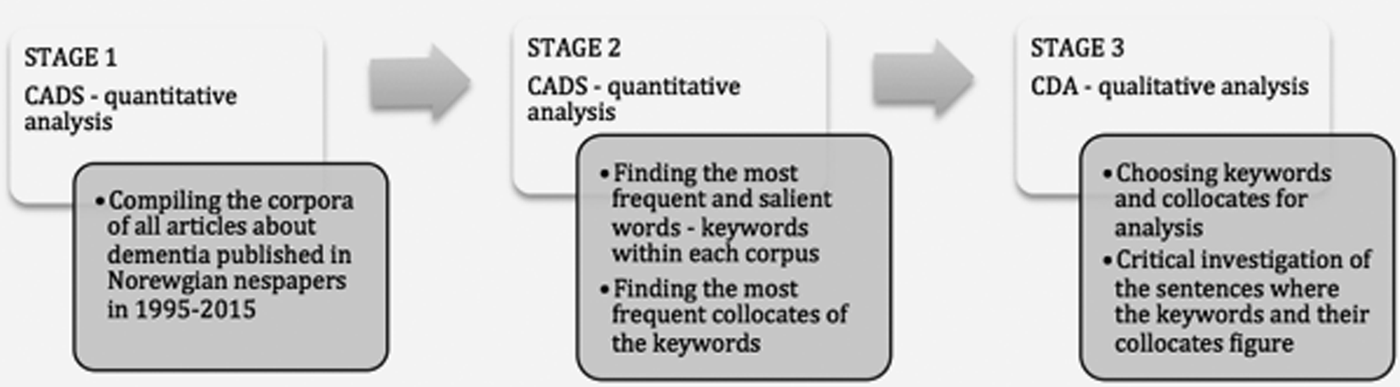
The combination of CADS and CDA, in effect a corpus-assisted critical discourse study, has been proved to be useful before in the analysis of media discourses (Baker et al. Reference Baker, Gabrielator, Khosravinik, Krzyzanowski, McEnery and Wodak2008). Baker et al. (Reference Baker, Gabrielator, Khosravinik, Krzyzanowski, McEnery and Wodak2008) also outline possible stages in corpus-assisted CDA, and suggest starting with corpus building and a CADS analysis of the most frequent words or keywords and then proceeding to a qualitative CDA of a smaller representative set of data. I have followed the same formula in my analysis and the model of my research design with methods and corresponding actions can be seen in Figure 1.
The three stages of analysis with corresponding methods.

Corpus-assisted discourse studies
CADS as a method maps lexical patterns in large bodies of texts, assisted by computer software to find co-occurring regularities among many millions of words (Partington Reference Partington, Partington, Morley and Haarman2004). With its roots in corpus linguistics, CADS is also inherently a comparative tool, since corpus linguistics studies the linguistic typicality of a text as compared to another (Stubbs Reference Stubbs and Hoey2007). The corpus analysed can be broad, gathered from a broad variety of sources and thus representative of this language at that time. A corpus can also consist of texts containing a specific word or phrase, in our case dementia and its synonyms, when it is called a specialised corpus (Flowerdew Reference Flowerdew, Connor and Upton2005). Unlike a general and representative corpus for a particular language at a given period, a specialised corpus is built to be representative for a specific purpose (Partington Reference Partington2010). The corpus linguistics software used in CADS offers different options for the analysis of how a word ‘behaves’. This can be done by analysing how often the word occurs in the corpus (frequency), which words co-occur with it most often (collocates), indicating the textual context that gives meaning to the word, and which words (keywords) are in general most frequent in the corpus and thus significant to that specific corpus. The list of keywords created is seen in CADS as characteristic of the corpus under investigation, pointing towards the ‘keyness’ or ‘aboutness’ of it (Baker et al. Reference Baker, Gabrielator, Khosravinik, Krzyzanowski, McEnery and Wodak2008).
These keywords are then interpreted ‘by hand’ in the context of the texts where they appear (concordance lines), making it possible to detect central themes (Baker Reference Baker2010) or in relation to the broader, extra-linguistic societal context (Wodak Reference Wodak2001). The objectivity in the initial stages of CADS is gained by the computerised search for keywords, but the subjective researcher input cannot be avoided in compiling the corpus and in the choice of keywords to be analysed further. A wide variety also exists in relation to corpus linguistics methodologies (Baker et al. Reference Baker, Gabrielator, Khosravinik, Krzyzanowski, McEnery and Wodak2008), depending on what is analysed and what corpora are assembled. In this case, I have combined CADS with CDA, which provides tools for analysing dominance, power and control in language use, as the language of the media is to be scrutinised in particular as a site of power and struggle (Wodak and Meyer Reference Wodak, Meyer, Wodak and Meyer2009). In a country with a free press like Norway, media institutions claim to be neutral, providing space for public opinion and discussion. However, the CDA researcher Fairclough's (Reference Fairclough2000) analysis has revealed the unavoidability of the mediating and constructing role of media.
Critical discourse analysis
CDA is a problem-oriented and hands-on method, where the researcher chooses the focus and examples are collected and analysed by hand (Fairclough and Wodak Reference Fairclough, Wodak and van Dijk1997). CDA has no specific methodology characteristic of research, but is rather a school or paradigm that investigates critically semiotic data in its narrow textual and broader intertextual or societal context in order to reveal ideologies functioning as mechanisms to preserve or subvert power-relations. In analyses combining corpus linguistics methods with CDA, there is a risk that these two methods are not balanced (Baker et al. Reference Baker, Gabrielator, Khosravinik, Krzyzanowski, McEnery and Wodak2008), which is why it is important to make explicit how one's study does justice to both (Baker and McEnery Reference Baker and McEnery2005). CDA is relevant for the present study as a method informed by social theories that are oriented towards analysing social problems, i.e. how the problem is constructed and presented in a broader intertextual and socio-political (con-)text, consisting of historical, social and institutional frames. In CDA, language gains power when people use it, and the power of words also depends on the discursive power and agency of those people, which in turn depends on their position within society or an institution. CDA studies language use in terms of revealing inclusion–exclusion patterns. Powerlessness is related to both a lack of voice or a lack of participation in debates (Fairclough and Wodak Reference Fairclough, Wodak and van Dijk1997). The CDA approach in my analysis is thus based on the focus of powerful versus powerless agents defining dementia and on how the changes in dementia discourse reflect the changes in the welfare society in Norway.
Compiling the corpora of newspaper texts for analysis
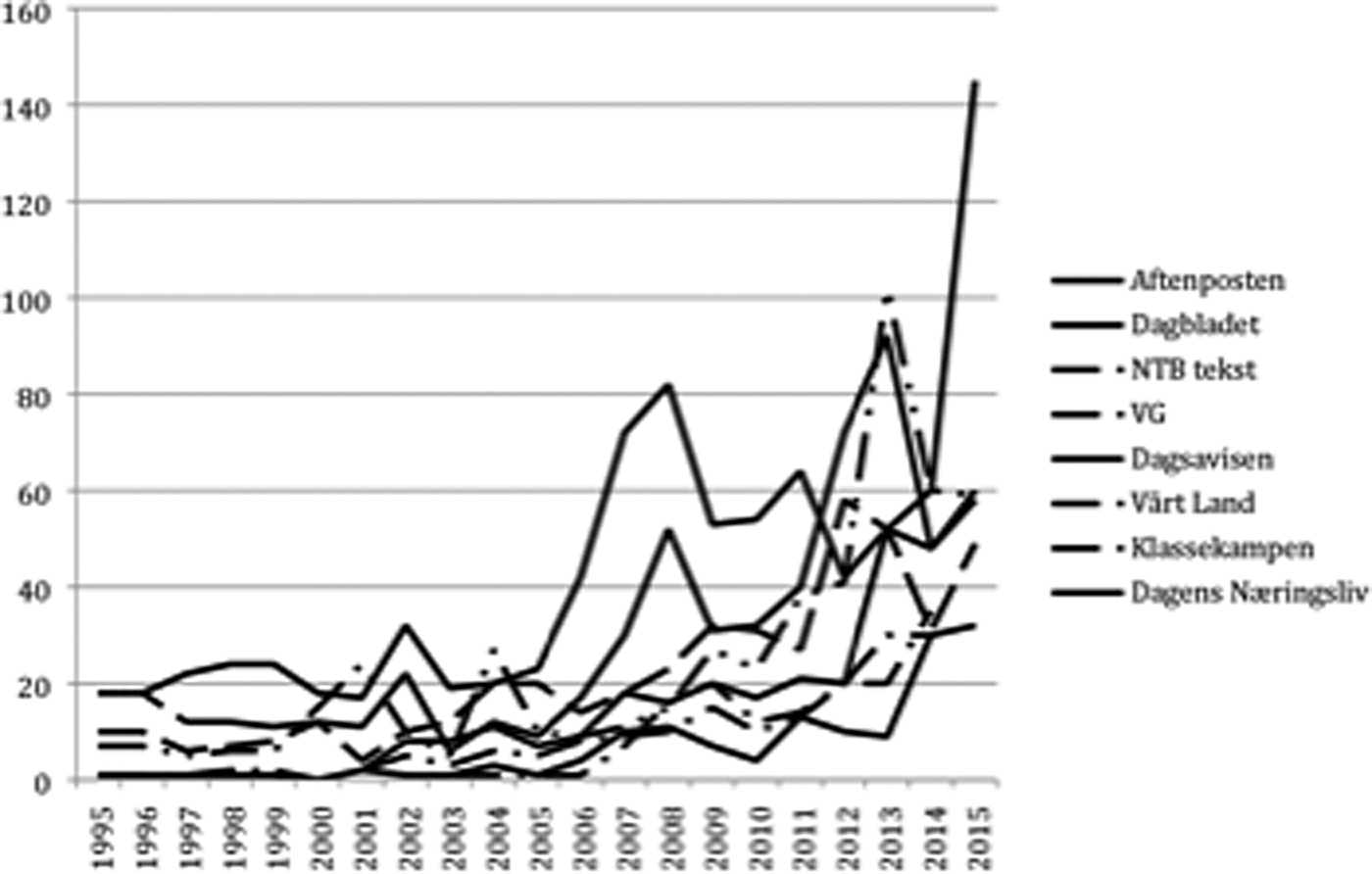
In more frequently used languages like English, a large variety of corpora exist that are freely available for analysis. Researchers of discourses in other languages, on the other hand, often need to compile corpora themselves (these are called DIY – do it yourself corpora; Fitzsimmons-Doolan Reference Fitzsimmons-Doolan, Hult and Johnson2015). This is also the case in the present study, where a dementia corpus had to be compiled in order to study representations of the condition in the Norwegian media. I searched for the word dementia and its most frequent synonyms (outlined below) in articles published in the period 1995–2015 in the Norwegian national and regional paper press.Footnote 1 To find all versions of dementia and compound words containing dementia, I used the ‘wild card’ search for *demen* (excluding the Norwegian verb ‘dementere’ or ‘disavow’ with the same word stem). The articles retrieved were compiled into 16 corpora, one for each year, and combined corpora for the years 1995–1999 and 2000–2015, due to the small number of articles containing dementia published in these years. The total size of the 16 corpora was 6,960,000 words, increasing from 135,000 words in the corpus for 1995–2000 to more than two million words in the 2015 corpus. Also the number of newspapers writing about dementia jumped from five newspapers in 1995 to 182 newspapers in 2015. As can be seen in Figure 2, the number of dementia articles published in the eight largest dailies increased and dementia was written about almost on a daily basis by 2015.
An example of the diachronic increase in the number of articles containing the word dementia within the same newspaper, using the eight largest national daily newspapers in Norway.

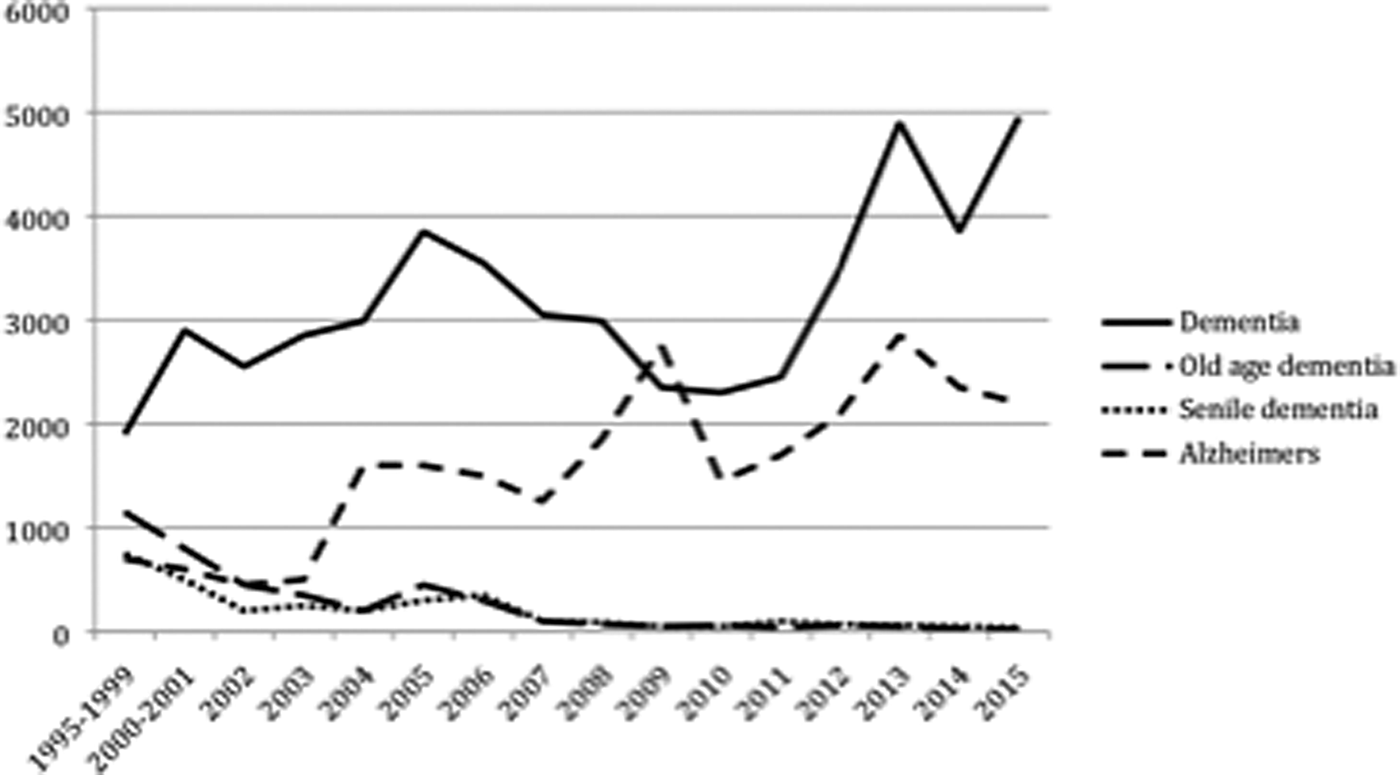
Dementia has a number of synonyms in Norwegian with different connotations. One of the oldest synonyms alderssløvsinn (the stupor or stupidity of old age), used in newspapers until the beginning of the 1990s, has clear connotations of insanity. The term was used in psychiatry for complications related to age that led to a state where the person with dementia was either dangerous to others, or could cause damage to him- or herself (Nygård Reference Nygård and Krüger2006). The previously used synonym of dementia, senil demens (senile dementia), has a strong connotation in Norway of mental decline as an inevitable feature of growing old and is after medicalisation of the senility discourse (Fox Reference Fox, Whitehouse, Maurer and Ballenger2000) no longer perceived as a neutral term (Fox Reference Fox, Whitehouse, Maurer and Ballenger2000) and is mostly avoided in public discourse. The clear decline in the use of the term senile or senility in Norwegian newspapers (Figure 3) further proves that it is no longer a publicly acceptable term for dementia conditions. While the total number of news items on dementia is increasing, the use of senile dementia is decreasing and occurs 376 times per million words in the corpus for 1995–1999 as compared to only 16.89 times per million words in the corpus for 2015. The same applies to the synonym aldersdemens (old age dementia) with similar connotations of ageing as a disease. The most frequently used synonym for dementia in the beginning of the 21st century is Alzheimer's.
Changes in occurrence of the words ‘dementia’, ‘Alzheimer's’, ‘old age dementia’ and ‘senile dementia’ in Norwegian newspapers in the period 1995–2015.

Findings
Quantitative changes in dementia corpora – keywords and central agents
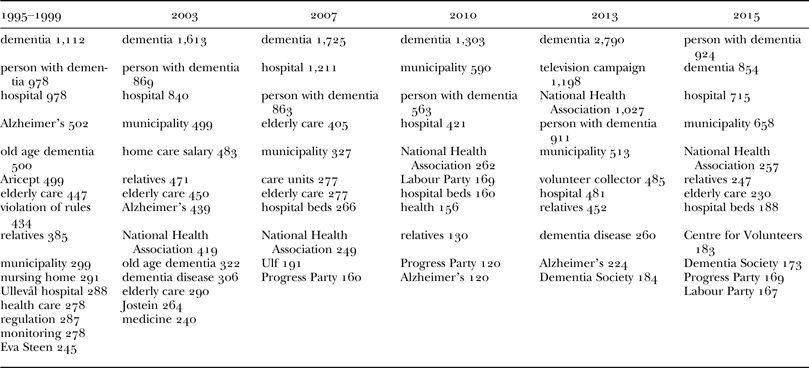
How often the media chooses to cover a topic plays a key role in making an issue politically salient, and is thus consequential for forming public opinion (Camaj Reference Camaj2014). As outlined above, there is a remarkable increase in the number of articles containing dementia in Norwegian newspapers, although the number is not increasing evenly. In the distribution of the news items through the two decades, there are two spikes, one in the year 2008 and the other in 2013 (Figure 2). The first spike is related to the launching of the Government's Dementia Plan (Demensplan, 78.95 occurrences per million words) as a sub-plan of Care Plan 2007 and a follow-up of Report Number 25 (2005–2006) to improve services for people with dementia (care or Omsorg in different constellations, 1,783.26 occurrences per million words). The spike in 2013 can be related to the television fundraising campaign TV-aksjonen (2,272 hits in 2013 or 1,514.76 per million), the revenues of which go to different causes, and in 2013 the funds raised went to the National Health Association (Nasjonalforeningen for folkehelsa, 1,583 hits in 2013 or 1,055.40 per million) for its work with dementia. For further analysis of this correlation, the CADS tool keyness analysis was carried out to detect the aboutness of the different corpora. As my aim was to map central agents, I looked for nouns on the top 100 keyword lists to start with (Table 1). Baker (Reference Baker2010: 125) sees frequency changes as an indicator of markedness that can indicate a bias or the emergence of a certain type of discourse. Many researchers applying CADS have found the keywords function a useful technique for preliminary investigations of specialised corpora (Baker et al. Reference Baker, Gabrielator, Khosravinik, Krzyzanowski, McEnery and Wodak2008; Koteyko Reference Koteyko2014) or for comparing different corpora (Partington Reference Partington2010).
Nouns on the top 100 keywords list for selected corpora 1995–1999, 2003, 2007, 2010, 2013 and 2015 (with logDice score)

As Table 1 indicates, the same nouns appeared on the top of all keyword lists from 1995 to 2015: kommune – local municipality, sykehjem – nursing home for older people, eldreomsorg – municipal care for older people, Nationalforeningen – National (Health) Association and Demensforeningen – The Dementia Society, indicating that these institutions are the most powerful agents setting the agenda in the dementia discourse. As mentioned above, CADS makes it possible to reveal both change and lack of change in diachronic corpora. To do so, Partington, Duguid and Taylor (Reference Partington, Duguid and Taylor2013: 130) differentiate between two types of presence: absolute (new words appear and old ones disappear) and relative (gradual increase/decrease). What the keyness analysis of dementia corpora from 1995 to 2015 indicates is an absolute presence of health-care institutions, indicating a status quo, but a relative or increasing presence of non-governmental organisations towards 2015. This reflects a habitual expectation in Norwegian society that the municipalities and health-care institutions will solve the problems related to dementia: in the Nordic welfare model, the welfare provisions and welfare rights are linked to the individual to support individualism and individual autonomy and agency (Vidje Reference Vidje2013), leading to the institutionalisation of welfare solutions. Collocation analysis of these words furthermore revealed that dementia discourse is increasingly about institutional capacity (e.g. number of hospital beds and care staff). These concerns were uttered most often by representatives of the two parties that are most concerned with the sustainability of the welfare model, the Progress Party and the Labour Party. This indicates that dementia discourse continues to be controlled by medico-political elements, as already described by the sociologist Lyman in 1989 (Lyman Reference Lyman1989: 602).
This is understandable in the case of dementia, since the people most affected by the condition can have problems with functioning as credible spokespersons (Beard Reference Beard2004) and need somebody to speak up for them. However, it was interesting to see that the word pårørende – relatives, next of kin – also appeared high on the keyword list throughout the period, but a closer look at the concordance lines revealed that this was because of the frequent use of the noun in third-person plural as part of the phrase ‘people with dementia and their relatives’. The use of the term in the first-person plural ‘us, relatives’ was used only six times out of 89 times; the term appeared in the corpus 1995–1999 and in 12 cases out of the 119 occurrences of ‘relatives’ in the 2015 corpus. The institutional solutions increased not only in number but also in variety over time. The municipal resource and information centres, Ressurssenter for demens were founded in 2004, offering activities for people with dementia who are cared for at home, a specific help meant to relieve relatives of some of their burdens; however, the municipal courses for next of kin offered by hospitals, pårørendeskole, were not established until 2012. This illustrates the municipal understanding that dementia is a disease affecting families (Engedal Reference Engedal, Nygård, Utne, Anfinnsen and Eek2009) and that families need relief and support as well. However, these solutions increasingly lump relatives in as part of the problem to be solved, rather than part of the solution. Furthermore, ‘I’ or ‘me’ (jeg, meg) appear for the first time as collocates of the word dementia in 2010; in 2014, they occur 15 times as collocates and in the 2015 corpus 148 times. Of these 148 occurrences, ‘I’ or ‘me’ only occur three times directly related to persons with dementia talking about themselves. These were: ‘I find my life with dementia a lot easier if everybody around me knows why I am asking four times about exactly the same thing, she laughs’; ‘I have dementia, but still have resources left and would like to live my life as normally as possible’; ‘This is really a good service for me as a person with dementia’. The picture that emerges from CADS of dementia discourse depicts persons with dementia and their families only to a minimal extent as individuals in charge of their own situation.
By depicting them as belonging to a generic group, it is not easy for the reader to feel empathy with them. In CDA terms, collectivisation is used as a dehumanising tool.
However, a few personal names also appeared on the keyword list (Table 1) and an examination of concordance lines revealed that these belonged to people with dementia, whose shocking stories of ‘lost selves’ (Leibing Reference Leibing, Leibing and Cohen2006) were used to give this devastating condition ‘a face’ (Kessler and Schwendler Reference Kessler and Schwendler2012). In the 1995–1999 corpus, Eva (Steen), a prominent gynaecologist, managed to conceal her Alzheimer's until her seventies and continued to work ‘thanks to her vast vocabulary and gift of blarney’. When her condition was finally discovered and her medical practice closed down, the previously so ‘lively’, ‘well-educated’, ‘cultivated’, ‘good-natured’ and ‘strong-minded’ doctor was within a year turned into a ‘confused’, ‘absent-minded’, ‘restless’ and ‘emotion-less’ hag. When she died of a fall during one of her escapes from the institution, everybody agreed that she was lucky to die before she reached the late stage of Alzheimer's disease. In addition, the 2003 corpus keyword list features Jostein, an older man whose dementia was discovered when he was caught stealing food. His dementia had caused an obsession with food and obesity, and he could be aggressive when stopped. He had to be followed around by security guards to prevent people in town from further assaults from Jostein. All in all, Jostein was described as an increasing economic burden for the municipality and a disgrace for the whole community.
(Ulf) Halln also featured high on the list of keywords for the 2007 corpus. He was a draper whose dementia was discovered when he had sold his townhouse in central Oslo to a total stranger for almost no money. Using a name and personal stories can in CDA terms function as a nomination tool that can have different effects. Using a name can make a story more personal and relevant, but the descriptions of loss (of face and dignity) can also function the opposite, to cause horror. The moral of the striking stories is similar – dementia can hit anyone, no matter what their social status or previous life has been, and the consequences are personally and financially devastating. The stories were not told by their relatives, but by the municipal agents like the police or social authorities, for whom Eva, Jostein and Ulf constituted a danger to the existing (moral) order.
The qualitative changes in dementia discourse – from disease to personhood
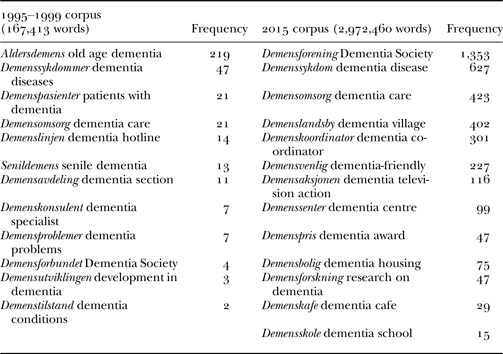
Although the central voices or agents of dementia discourse remained the same throughout the period studied, the focus of their concern changed. There is an increased focus on home care and support to next of kin, as indicated by the rise in the number of non-governmental organisations and volunteer centres offering support to persons with dementia and their families (cf. keywords in the 2015 corpus, Table 1). The rationale behind the home-care solution, combined with stimulating activities at the municipal dementia day-centres, is both to decrease the institutional costs, and to increase the quality of life with dementia (Regjeringen 2010: 9). The increasing presence of dementia as a topic in the media indicates the popularisation of dementia or the dementia boom (Swinnen and Schweda Reference Swinnen, Schweda, Swinnen and Schweda2015) in the Norwegian media by 2015 (Figure 2). While keywords in the dementia discourse remain the same, there is an interesting increase in the variety of compound words containing dementia (Table 2). While the compound words in the period 1995–1999 correlate to condition, the compound words that occur in the 2015 corpus are related to the life (quality) of those affected by the condition: dementia village, dementia coffee shop, dementia-friendly, dementia housing, etc. Dementia is thus increasingly about the self (Kaufman Reference Kaufman, Leibing and Cohen2006), personhood and lifestyle.
The most frequent compound words including dementia in the 1995–1999 versus in the 2015 corpus

‘Dementia-friendly’ appears for the first time in 2009, ‘dementia flagship’ in 2008 when the Norwegian Directorate for Health appointed three nursing homes to develop special treatment and care for people with dementia, and ‘sensory garden’ or ‘dementia garden’ for the first time in 2000 as an alternative treatment for people with dementia; however, the term is not actively debated in the media until 2010. Although this change in word behaviour indicates that a certain dementia culture or folklore is emerging, this ‘living well with dementia’ agenda is set by the same agents: non-governmental organisations, municipal health authorities and care administrators, and politicians who argue for a more dementia-friendly society within the same politically determined discourse, e.g. ‘Health Minister Bent Høie believes the philosophy behind dementia villages is in line with the Government's vision that health and care services should be tailored to the individual patient’ (example from 2015). This indicates both that the dementia boom is driven by political and institutional concerns and that political agents are needed as vehicles to drive dementia discourse and prime the issue in the media.
Critical discourse analysis of dementia discourse – a need for a conceptual free space
Figure 3 demonstrated that in the Norwegian media, there is an ‘agreement’ to use dementia as an umbrella term to describe the syndrome and a collection of symptoms, which have different causes (Hughes Reference Hughes2011). However, an agreement about this denotation does not solve the conceptual problem of dementia, which remains torn between its material (neuroscientific) and symbolic (socio-ethical) conceptualisations, leaving dementia discourse subjectless (Commisso Reference Commisso, Swinnen and Schweda2015). The popularity of the term also leads to its ambiguity: dementia seems to be increasingly an empty or floating signifier that can mean different things to different people or mean nothing at all (Mehlman Reference Mehlman1972). My analysis revealed that in spite of the increased focus on living well with dementia, neither the voices of people with dementia nor of their relatives had a prominent position within the dementia discourse. In other words, the subject of dementia is missing (Commisso Reference Commisso, Swinnen and Schweda2015: 390) and other, often institutional, agents have control defining the term. But is this because of the difficulties of narrating the subjective experiences with the condition or is the absence discursively constructed by mechanisms of domination and normativity? As part of the CADS, I carried out a collocation analysis of the four most used synonyms for dementia (Figure 3). The strongest collocates (words appearing most often in association with it) for the word Alzheimer's remained throughout the 20-year span, the word ‘disease’, followed by the words describing the symptoms of the condition, ‘cure’ and ‘medicine’. The slight decline in the use of the term after 2013 can be explained by the end of the faith-in-science discourse: when medical science fails to produce an explanation or a cure for the enigma of dementia, the focus changes from diagnosis (Alzheimer's) to a life with the condition (Van Gorp and Vercruysse Reference Van Gorp and Vercruysse2012).
As Figure 3 demonstrates, the use of the term ‘senile’ decreases remarkably during the period 1995–2010 for the reasons mentioned above. But most remarkable are the qualitative changes in the meaning and role of the term senility towards 2015. By 2015, the term facilitates both acts of stigmatisation and empowerment. Something similar happened to the term ‘anorexia’, as analysed by Hunt and Harvey (Reference Hunt, Harvey, Baker and McEnery2015). In the 1995–1999 corpus, people with ‘senile dementia’ are depicted as powerless victims, i.e. they are ‘forcibly medicated to calm them down’, they need to be sent to ‘detoxification’ since they have been ‘over-medicated’ and they ‘lack legal rights that could protect them against it’. They are housed either in homes for older people or in hospitals and disturb other patients with their outbursts of anger and their tendency to wander about at all times of the day and night. In some cases, as in the three stories about Eva, Ulf and Jostein mentioned above, the senile people pose a real danger to their surroundings; they are also dehumanised, and thus agency has to be taken from them. In the 1995–1999 corpus, all concordance lines containing the term senile referred to all senile people as a homogenous group. In 120 cases, homes for the older people or hospitals are depicted as the best institutional solutions for senile people. In 12 cases, the discussion was about a possible medical cure for the condition. In the attempts to find the biological cause for rapid decline, senility was increasingly perceived as a medically inaccurate term with a negative connotation. While it occurred 376 times per million words in the 1995–1999 corpus, in 2015 it appeared just 16.82 times per million.
However, once low in frequency, the word ‘senile’ continued to appear in the media with remarkable regularity with between approximately 100 occurrences per year from 2010 to 2015. ‘Senile’ is an old-fashioned word mainly used by the older generation (Nygård Reference Nygård and Krüger2006). I carried out a qualitative and critical analysis of the changes in senility discourse in 2015 as compared to the 1995–1999 corpus. The picture was totally different in the 2015 corpus, where ‘senile’ was clearly a ‘we’ term: it is mainly used by the older generation and appears in contexts where older people talk about themselves or other older people (50 lines out of 115). Also, the use of the term is, as a rule, in relation to a personal experience, sometimes even being used sarcastically (in 20 cases): ‘I asked my son to let me know when I have become senile, so I can quit politics [in time]’ or ‘I remember when you smiled when an old lady approached us, telling us we should be careful, because she was senile; “but so am I” you said “good to have something to blame it on!”’ or ‘I am senile, but not old yet’. The compound words too containing the word senile reflect a self-ironic attitude to cognitive decline: ‘Uncle Seniliussen’ is used about older relatives who have their age-related idiosyncrasies. The older people themselves refer to items or places for the old as senile: ‘we used to gather at the senile table’ (senilbordet) or the stairs installed at the beach to make it easier to access for older people are senile stairs (seniltrappe). In the articles published in 2015 where ‘senile’ occurs, in 42 cases the term is used meaning ‘crazy, mentally disturbed’, but most often in the context of having the right to act unconventionally, like the crazy old lady in the comedy sketch ‘Dinner for One’.
Senility discourse in 2015 versus that in the period 1995–1999 thus seems to offer a therapeutic and conceptual space that is missing in the over-politicised and institutionalised dementia discourse. The therapeutic aspect of using the term senile about oneself lies in the fact that by comparing oneself to those whose situation is relatively worse, one can continue to keep up a positive self-identification, an act also called a ‘relative deprivation of expectations’ (Daatland Reference Daatland, Nygård, Utne, Anfinnsen and Eek2009: 48). It also offers space for alternative views on going grey versus ageing successfully, ‘Let me grow old and senile in peace’. One characteristic example of senility discourse being an agentive counter-discourse to the dementia discourse dates from 2015. The newspaper Morgenbladet brought a feature article with the title ‘From Fitcoin to senile pruritus’, in which the journalist argued for a need to reconceptualise ageing and disease: we fail to see ageing as qualitatively different from adolescence and adulthood, because we are blinded by the ideal of successful ageing, institutionalised as normal ageing. Senility discourse can be interpreted as an attempt to rearticulate one's identity by positioning oneself into the free space of the unconventional (Carpentier Reference Carpentier2016). In CDA, humour is seen as a tool of struggle, making use of stereotypes and exaggerating them to subvert the status quo of power relations (Holmes and Marra Reference Holmes and Marra2002). Senility discourse creates a conceptual free space where the older people can breathe and move in their own space.
Discussion
The ‘greying of society’, leading to among other things an increase in age-related diseases, is putting pressure on politicians in welfare societies to pass public health and care policies (Fox Reference Fox, Whitehouse, Maurer and Ballenger2000), forcing them to address the issue of ageing as a societal burden (Zeiling Reference Zeiling2013). The policy of Active Ageing, originally put forward by the World Health Organization in 2002, aims to maintain full functional capacity throughout a person's lifecourse. It has had a strong influence on the public policies and discourses about ageing in welfare societies, as was also illustrated in this article. The ‘new gerontology’ emerged, introducing a model that regards success in ageing as a personal responsibility: if you modify your behaviour, you can avoid the detriments and losses of ageing (Rowe and Khan Reference Rowe and Kahn1998). Within this discourse, diseases, including dementia, are looked at as obstacles to overcome. Bauman (Reference Bauman1992) noted already several decades ago that ageing as a process leading to death and its contingent cause, disease, have been kept off the public agenda in post-modern societies. The ambiguity of dementia diagnosis has fuelled the discussions of personal agency, i.e. what a person can do to delay the onset of symptoms (Beard Reference Beard2004; Van Gorp and Vercruysse Reference Van Gorp and Vercruysse2012) versus collective responsibility for successfully coping with the condition (Fox Reference Fox, Whitehouse, Maurer and Ballenger2000; Holstein Reference Holstein, Whitehouse, Maurer and Ballenger2000). This has left little space for making meaning of suffering and decline and for personal and problematic experiences of loss. As my analysis of the Norwegian dementia discourse demonstrates, the issue of care for older people is framed as an institutional concern, with municipalities and municipal care institutions defining both the problems to be solved and the solutions. Since the conceptual space of post-modern health care in Norway is preoccupied with productivity, cost reduction and time-saving, the financial, rather than the personal, cost of the condition is at the core of debates on dementia.
Some authors have pointed at the potentially negative consequences of the dementia boom in the media. Kinzer and Suhr (Reference Kinzer and Suhr2016) analysed how different types of dementia exposure from personal contact (as a care-giver) to genetic (having relatives with dementia) can cause heightened awareness of age-related cognitive changes among older adults and can lead to dementia-specific health worries and anxiety about unsuccessful ageing. The gravity of the condition does not lie in the devastating symptoms, but more so in the fact that it appears increasingly at a time when political and economic discourses in welfare societies have constructed a new consumer segment consisting of older people. These people are preferably depicted as ageing gracefully and living independently from the demands of the labour force, free from physical frailty, financial hardship or needing to be cared for by their children (Cohen Reference Cohen, Leibing and Cohen2006: 7). In contrast, dementia which causes gradual loss of memory and language, increases dependency. Since the dementia discourse is preoccupied by others’ concerns or concerns defined by others, there is a need for a conceptual free space for personal stories that in my analysis were offered by the senility discourse. The new Norwegian governmental dementia action plan, currently under preparation, Demensplan 2020, also calls for increasingly including persons with dementia into mainstream society and inviting them to take agency in designing dementia services (Regjeringen 2015: 8–10). The plan indicates concern for the loss of voice of persons with dementia in the public arena, citing one of the persons with dementia interviewed: ‘Do not talk down to us. We still have the right to put our foot down’ (Regjeringen 2015: 7). The question remains: how to combine the conflicting institutionalised discourse on dementia as, on the one hand, a problem to be overcome through an active lifestyle with, on the other hand, the personal discourse of unsuccessful ageing because you are living with a devastating condition.
The role of humour in interaction and discursive power struggles has been investigated in a number of studies. Humour can be used as a levelling tool (Basu Reference Basu2007) but also a tool for handling ambiguities and tensions (Adelswärd Reference Adelswärd1989) and disagreements in situations where power is divided unevenly (Habib Reference Habib2008). In discourse analysis, humour and laughter has been investigated mostly as a boundary negotiation tool, i.e. an attempt to give value to something that is in general perceived as having a negative value or being valueless (Davies Reference Davies2010). The most important aspect here is the symmetry of humour. If the laughter is mutual it can bring some release, but if it is one-sided it can function as a therapeutic tool – joking about one's own situation may function as a protection against abuse or public ridiculing (McCreaddie Reference McCreaddie2010). This seems also to be the case here. Using the senility term in the Norwegian dementia discourse is a way of handling an unbearable situation of personal struggle and loss.
Conclusion
This paper has outlined the central findings of a corpus-assisted CDA of the representations of dementia in Norwegian newspapers in the period 1995–2015. My analysis revealed both a status quo of institutional agents setting the agenda for successful ageing in the dementia discourse and of a qualitative change in the function of the discourse from being about the disease (including the dehumanising scare stories about the social and personal consequences of the disease) to being about personhood. This duality has caused a paradox, where the discourse about empowering the sick through lifestyle solutions has led to the opposite – a discursive disempowerment of these persons. The use of the previously humiliating term ‘senile’ by older people seems to function as a way of resisting the normative view of ageing and a requirement to age gracefully. My study also revealed that in the case of an asymmetric power division, using harsh humour and sarcasm about one's own situation is a tool of handling an unbearable situation and a way of offering a therapeutic and conceptual free space.
One of the strengths of using a corpus-based discourse analysis is that the researcher does not need to evaluate their findings critically to the same extent as they would if employing only qualitative discourse analysis. Even if the emerging meaning-making patterns may seem expected and leave the reader with a feeling of ‘so what?’, the special value of a corpus-assisted discourse study is that it serves as an historical and archaeological account for future generations of a ‘shared knowledge’ specifically associated to a particular culture and time period. However, it is important to underline that any such analysis combining quantitative and qualitative tools does still not tell the full story. Neither does my analysis paint a picture with all details of the presentations of dementia in Norwegian newspapers. A specific feature about CADS is that it makes it possible to work with large corpora containing a myriad of narratives and patterns. Baker and McEnery (Reference Baker, McEnery, Baker and McEnery2015: 8) pointed out that CADS is about choices and two independent researchers would most likely have produced two different interpretations of the same keyword list. The place where the researcher's fingerprints become visible is during the transition from stage 2 to stage 3 in the analysis (Figure 1) when specific keywords and collocations are chosen for close qualitative study. Further investigations of the keyword list are thus needed to map other discourses present. This is needed to give a more nuanced picture of the reasons for and consequences of the general institutionalisation of the dementia discourse.
Acknowledgements
The Research Council of Norway, through its Centers of Excellence funding scheme (project number 223265), supported this work. The financial sponsor played no role in the design, execution, analysis and interpretation of the data, or writing of the study. I hereby certify that I have no affiliations with or involvement in any organisation or entity with any financial interest or non-financial interest in the subject matter or materials discussed in this paper.