1. Introduction
Between the 1970s and 1990s, many Western societies promoted early labour market exit through (institutional) pathways (Kohli and Rein, Reference Kohli, Rein, Kohli, Rein, Guillemard and van Gusteren1991) that included state-financed monetary incentives, state-sponsored early retirement initiatives (Blossfeld et al., Reference Blossfeld, Buchholz and Hofäcker2006) and/or occupational pension schemes (Ebbinghaus, Reference Ebbinghaus2006), and guaranteed a sufficient standard of living throughout retirement. Therefore, government and employers used these routes to manage job attrition resulting from industrial transformation by shifting older workers out of work (Walker, Reference Walker1998), particularly men in blue-collar jobs (Hirsch, Reference Hirsch2003). While, in 1960, around 75 per cent of men aged 60 to 64 were in active employment across Western industrialised countries, this declined to less than 50 per cent by the mid-1990s, though with notable cross-national differences (OECD, 2005).
Given population ageing and predicted labour shortages, early retirement was increasingly considered unsustainable due to concerns about its affordability and impact on economic growth (Blossfeld et al., Reference Blossfeld, Buchholz and Kurz2011). Early retirement was furthermore criticised because of its negative effects on the income security of the older population (Walker, Reference Walker1980) and its role in intensifying negative stereotypes about the productivity of older workers (Walker, Reference Walker2005). The latter resulted from a downward redefinition of when ‘old age’ begins, which exacerbated existing age discrimination in employment (Walker and DLitt, Reference Walker and DLitt2000). The mid- to late-1990s were therefore marked by conflicting trends: while institutionalised early retirement persisted, governments and employers in OECD countries had started to reassess its usefulness (Walker, Reference Walker1998). Therefore, since the 1990s due to economic and social pressures and later to implement the European Union (EU) Lisbon Protocol, European national governments (including the United Kingdom (UK) and Germany), have introduced measures to discourage early retirement and to promote longer working lives (Phillipson, Reference Phillipson, Field, Burke and Cooper2013). Such measures are considered a part of ‘active ageing’, a policy framework covering health, eldercare, inclusion and work (Walker, Reference Walker2002). In Japan, due to low birthrates and limited migration, the government has been promoting extended working life since the 1960s (Williamson and Higo, Reference Williamson and Higo2009), but has recently sought to reduce the contingency in which most older workers find themselves by investing heavily in special job-placement services and by compelling employers to retain their workers beyond their firm-level mandatory retirement age, which is often age 60, until they reach the new national pension age of 65 (Flynn et al., Reference Flynn, Schröder, Higo and Yamada2014). However, even though employment rates of older individuals have generally increased markedly since the late-1990s (OECD, 2013), not all individuals are equally able to prolong their employment due to intra-group heterogeneities (Bennett and Möhring, Reference Bennett and Möhring2015). Lower-educated workers face particular difficulties in remaining in or finding new employment, and are thus at a higher risk of being ‘pushed’ out of the labour market before reaching pension ages (Blossfeld et al., Reference Blossfeld, Buchholz and Kurz2011).
While there is literature on early retirement and its drivers (see: Kohli and Rein, Reference Kohli, Rein, Kohli, Rein, Guillemard and van Gusteren1991; Walker, Reference Walker1985; OECD, 2011), there has been little focus on its recent reversal. This applies especially to whether retirement transitions are perceived as an individual choice or whether, for example, employer practices favouring younger workers force older workers into retirement (Wood et al., Reference Wood, Wilkinson and Harcourt2008). This paper has two aims. First, we chart the development in the timing of retirement in three countries. Second, we investigate individual retirement motives. Here, we determine who is disproportionately at risk of being permanently ‘pushed’ out of employment involuntarily before reaching pension age, and how this has changed over time. Our particular focus lies in establishing a longitudinal perspective that allows us to trace developments in timing, and motives across time, as welfare and labour market institutions have gradually shifted from a policy of early retirement to promoting longer working life (see above).
We selected Germany, the UK and Japan because they all face population ageing (Christensen et al., Reference Christensen, Doblhammer, Rau and Vaupel2009) but diverge regarding the labour market participation of those aged 50 or over (OECD, 2014). Literature has related these cross-national differences to different institutional configurations that mould employment participation (Ebbinghaus, Reference Ebbinghaus2006, Blossfeld et al., Reference Blossfeld, Buchholz and Hofäcker2006), as postulated in the ‘Varieties of Capitalism’ (Hall and Soskice, Reference Hall and Soskice2001) literature. The selected countries differ in their incentives for early retirement (Blöndal and Scarpetta, Reference Blöndal and Scarpetta1999) and in the degree to which labour market regulation, industrial relation systems and firm policies impede or foster employment at old-age (Ebbinghaus, Reference Ebbinghaus2006; Ebbinghaus and Hofäcker, Reference Ebbinghaus and Hofäcker2013; Flynn et al., Reference Flynn, Upchurch, Müller-Camen and Schröder2013). We investigate how such configurations affect individual retirement decisions, the degree of choice they afford and whether there are differences between labour market groups. Due to data restrictions, we cannot analyse UK data but focus on England, even though we acknowledge that public policy changes have affected the entire UK. Section 2 outlines theoretical concepts and establishes hypotheses. Following the presentation of data and methods, we provide empirical evidence. A discussion and summary conclude the paper.
2. Comparing institutional contexts
Various approaches attempt to explain cross-national variations in retirement patterns (Hofäcker, Reference Hofäcker2010). Mostly, retirement is conceptualised as an individual decision under given opportunity structures defined by national, workplace and socio-demographic factors. Literature categorises these contextual backgrounds into three groups (Ebbinghaus, Reference Ebbinghaus2006; Ebbinghaus and Hofäcker, Reference Ebbinghaus and Hofäcker2013): ‘pull’, ‘push’ and ‘retention’ factors. Pull factors are (economic) incentives in welfare state systems that provide financially-attractive labour market exit opportunities. Blöndal and Scarpetta (Reference Blöndal and Scarpetta1999) show that countries that provide actuarial incentives for early retirement also tend to exhibit low old-age employment ratios. Occupational pensions exert additional incentives. These incentives may reinforce each other, leading to strong retirement stimuli (Dorn and Sousa-Poza, Reference Dorn and Sousa-Poza2010). Push factors, in contrast, assume that work-retirement decisions are not simply taken under given financial constraints, but that certain factors force workers from employment against their deliberate preferences. Recently, policies to retain older workers in employment have gained importance. These retention factors (Ebbinghaus and Hofäcker, Reference Ebbinghaus and Hofäcker2013), or activation policies (van Berkel et al., Reference van Berkel, Borghi, Carmel, Hamblin and Papadopoulos2007), include lifelong learning and active labour market policies that aim to enhance (older) workers’ employability. Yet, not all older workers benefit similarly from such policies (Blossfeld et al., Reference Blossfeld, Buchholz and Kurz2011). This is because of significant biases in access to and participation in lifelong learning which concentrates on those with a higher initial education, especially where the incidence of lifelong learning is low (OECD, 1999). Furthermore, although the opportunity to change jobs or work routine might keep older workers motivated, actual take-up is low mainly because of worries about the impact on the security of retirement income (Maitland, Reference Maitland2010). Finally, while attention has been paid to employer interventions to prevent ill-health-related retirement, such programmes have been difficult to implement for those in manual jobs (Weyman and Buckingham, Reference Weyman and Buckingham2013).
This paper compares Germany, the UK and Japan because they reflect distinct combinations of pull, push and retention factors, both in their institutional heritage and in their recent policy developments. These configurations shape retirement patterns and affect the nature of intra-national inequalities. In Japan, retirement ages are traditionally high and employment rates have remained above those of most Western economies. Japan is therefore considered a late exit regime (Ebbinghaus, Reference Ebbinghaus2006). Since the 1950s, a main macro-economic challenge has been the supply and retention of skilled labour. Employers´ Human Resource Management (HRM) practices therefore included the provision of long-term job security, age-based pay systems and mandatory retirement rules. Employers could set a mandatory retirement age of 55 until 1994 when this rose to 60, and will gradually rise to 65 by 2025 (Oka, Reference Oka and Taylor2013). While employers worry about losing skills, they are also reluctant to retain older workers without government assistance to offset high seniority-based labour costs (Seike and Yamada, Reference Seike and Yamada2004). Employers thus frequently use redeployments to move workers after their mandatory retirement ages within and between workplaces (Flynn et al., Reference Flynn, Schröder, Higo and Yamada2014). Furthermore, small and medium-sized enterprises seek older displaced workers to offset skills shortages (Casey, Reference Casey2005). Nevertheless, these practices are regularly accompanied by significant salary cuts, demotions and loss of job security (Oka, Reference Oka and Taylor2013, Yamada and Higo, Reference Yamada and Higo2011). Since the 1960s, workers could draw their pensions while staying in work, allowing the government to hold down pension costs without creating old-age poverty, despite low replacement rates (OECD, 2011). Therefore, while Japanese governments have not institutionalised and financed early retirement schemes, firm-level mandatory retirement rules caused a de-facto ‘early exit’ culture. Current public policies attempt to extend working lives by enabling workers to remain employed until at least 65 years of age.
In contrast, Germany has a history of institutionalised early retirement, which has only recently started to reverse (Hofäcker and Naumann, Reference Hofäcker and Naumann2015). Until 2000, labour market participation among those aged 50 or over was low, partly due to labour market and welfare state policies that aimed to reduce youth unemployment and provide organisations with socially-acceptable means to lay-off staff (Trampusch, Reference Trampusch, Streeck and Thelen2003). During these years, a strong internal labour market system, high employee involvement and job security, and a front-loaded education system created a labour market structure in which younger workers with recent qualifications and lower wages were favoured over older unemployed individuals (Blossfeld et al., Reference Blossfeld, Buchholz and Hofäcker2006). Lower-skilled workers in particular thus used incentives to retire early, mostly at financially-acceptable terms. Only recently, these push and pull forces were mediated by a change in political climate towards ‘active ageing’. Pension and welfare systems were reformed to reduce the financial attractiveness of early retirement and to close off state-financed early retirement pathways (Müller-Camen et al., Reference Müller-Camen, Croucher, Flynn and Schröder2011). The government also implemented active labour market measures targeting older individuals. Nonetheless, Germany does not yet place much emphasis on lifelong learning measures and, where it does, lower-skilled employees are often excluded (Schröder, Hofäcker and Müller-Camen, Reference Schröder, Hofäcker and Müller-Camen2009).
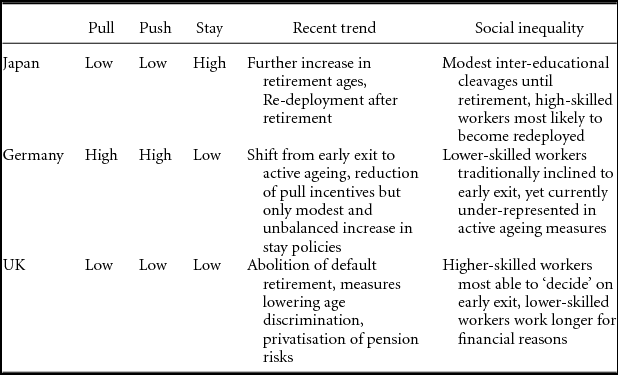
Unlike other parts of Europe, the UK has not featured state-sponsored early retirement since the Job Release Scheme was phased out for new claimants in 1988 (Banks et al., Reference Banks, Blundell, Bozio and Emmerson2008). However, occupational pension schemes are still used to pay for early retirement, though only for a select group of highly-educated individuals with full work histories (Fasang, Reference Fasang2010) and for specific occupational groups such as in the steel sector (Flynn et al., Reference Flynn, Upchurch, Müller-Camen and Schröder2013). The government takes a minimal role in social provision and workplace regulation (Schröder et al., Reference Schröder, Müller-Camen and Flynn2014). As a result, the labour market itself and the acquisition of work-specific skills is flexible, allowing for adaptations to changing market demands across age groups. Furthermore, the 2006 Employment Equality (Age) Regulation (now: Single Equality Act 2010), that was discussed and implemented based on EU directive 2000/78/EC from 2000, prohibits workplace age discrimination. Since 2011, compulsory retirement is only lawful in occupations in which job specifications justify it and, from 2006, the government had been preparing employers for managing without a compulsory retirement age (Flynn, Reference Flynn2010). The State Pension Age (SPA) is currently being equalised to 65 and is projected to rise further. Yet, only modest activation measures have been introduced. The UK is therefore not an early exit regime as is Germany. However, its comparatively high retention of older workers in employment results less from explicit public or employer-led retention policies as seen in Japan. It is rather an individual-level financial necessity to remain employed, since the state pension only accounts for 42 per cent of pension expenditure, with most of the remaining pensions coming from occupational pension schemes (OECD, 2011). Particularly for low-skilled workers, who often only have access to public pension schemes, this creates financial pressures to remain employed; a trend that is expected to increase as public pension eligibility ages rise further (Lain, Reference Lain2012). Table 1 compares institutional characteristics, their developments, and patterns in social inequality.
Institutional characteristics – Japan, Germany, UK

Source: Own illustration
It is difficult to directly measure the significance of push, pull and retention factors in explaining retirement transitions. Many studies therefore focus on the retirement transition per se, and establish its characteristics indirectly by assessing the effects of covariates. If, for example, low-qualified workers retire early, this is taken as an indication of the prevalence of high labour market pressures, i.e., push factors (Blossfeld et al., Reference Blossfeld, Buchholz and Hofäcker2006). However, the meaning of determinants may be ambiguous. The higher likelihood of older workers with low qualifications retiring early might equally be due to the relative financial attractiveness of early retirement pathways (pull factors). The true retirement reason thus cannot be ascertained by the effect of explanatory variables on exit behaviour. Furthermore, early retirement is often a result of a combination of push and pull factors (Reeuwijk et al., Reference Reeuwijk, de Wind, Westerman, Ybema, van der Beek and Geuskens2013). From a public policy perspective, it therefore has to be acknowledged that the elimination of corresponding incentives may not necessarily lead to older workers delaying retirement since people who are in physically demanding or stressful work may still try to retire early even without financial incentives (DePreter et al., Reference DePreter, Van Looy and Mortelmans2013). Moreover, conclusions about retirement transitions do not necessarily correspond with the perspectives of individuals themselves. Individuals who retired early based on financially generous opportunities may not consider this a free decision, if no acceptable alternative existed (Quine et al., Reference Quine, Wells, De Vaus and Kendig2007).
To assess the nature and drivers of retirement transitions, more knowledge is required about actual motives of individuals for making their retirement transition. However, relevant measurements have only recently become available, such as the Survey of Health, Ageing and Retirement in Europe, which includes an indicator that distinguishes between retirement reasons. Using this indicator, Koenen et al. (Reference Koenen, Reichert, Zapf and Engelhardt2009) establish categories of voluntary and involuntary retirement. Voluntary retirement refers to personal or health reasons, and includes those who reached pensionable ages and exited employment despite the opportunity to continue working. In contrast, involuntary retirees are individuals who were dismissed or offered early retirement, and who retired after reaching an age limit without opportunities for work continuation.
Building on the cross-national overview, which showed that differences exist in the institutions promoting respectively restricting early retirement, we hypothesise that there will be differences between Germany, England and Japan regarding the retirement transition timing. Japanese workers are expected to retire latest, given the overall supportive context, followed by English workers and then, despite recent reforms, German workers (Hypothesis H1a). Furthermore, we expect the degree of choice in making the transition to be highest in Japan (where individual redeployment contracts mostly allow for a flexible retirement transition according to personal preferences) and to be lowest in Germany (where a comparatively rigid labour market still provides obstacles to continued employment). England is expected to take an intermediate position (H1b).
We further assume that individual factors influence retirement transitions. These include human capital, gender, and birth cohort. Their effects may, however, vary within countries, as institutional configurations may create differential conditions for retirement decisions for specific groups. Using formal educational qualificationsFootnote 1 as a proxy for human capital, we anticipate that, in Germany, those with low and medium-level qualifications are most prone to involuntary retirement, given their disadvantages in a rigid labour market system. This trend might be weaker in England where lower-skilled employees in particular have had better opportunities to adapt to changing labour market demands, and to work longer, if needed (McNair et al., Reference McNair, Flynn, Owen, Humphreys and Woodfield2004). Nonetheless, their stronger financial necessity to work might lead to higher levels of involuntary retirement when compared with higher-skilled employees, because of the latter's greater freedom to navigate their retirement transition by combining different old-age income sources. For Japan, we anticipate that low- and medium-qualified individuals profit from redeployment opportunities until pension age. However, we expect that differences between educational groups will increase after individuals have reached formal retirement age (H2).
We further anticipate gender differences (H3) in the retirement timing, given that women can frequently draw their pensions earlier (Germany and England) and often display a more marginal labour market attachment than men (Germany and Japan) (Blossfeld et al., Reference Blossfeld, Buchholz and Hofäcker2006; Abe, Reference Abe2011). Given this differential labour market attachment, we expect the degree of voluntariness will vary, with higher levels of voluntary retirement for women (relative to men) in Germany and Japan than in England. Germany and Japan are traditionally known as ‘male breadwinner’ societies (Blossfeld et al., Reference Blossfeld, Buchholz and Hofäcker2006; Abe, Reference Abe2011) and women are more often expected to retire for personal/family reasons and to be less affected by company-led retirement schemes.
We anticipate differences in retirement transitions over time, where transitions occur later for those retiring in the 2000s, given the institutional re-orientation towards later retirement (as compared to those retiring in the 1990s where early retirement policies were dominant) (H4). Furthermore, we expect that, over time, the incidence of involuntary retirement will decline, as institutional reforms allow individuals to work up to higher ages and to exert more individual choice in their retirement decisions. We expect that this effect will be strongest in Germany, where institutionalised early retirement has been most entrenched and where the change in public policy has been most pronounced. England and Japan did not offer institutionalised and state-financed early retirement to the same degree.
Lastly, we test for cross-level interactions between socio-demographic characteristics and time. Because not all workers are similarly able to benefit from ‘active ageing’ measures (Blossfeld et al., Reference Blossfeld, Buchholz and Kurz2011), we assume that social inequalities have increased over time (H5). This effect may especially occur for education. For Germany, we assume that individuals with low rather than medium-level education might increasingly be forced to continue working for financial reasons. Simultaneously, opportunities to do so might be restricted, given the disproportionate concentration of lifelong learning measures on the more highly educated. We thus expect that, particularly among lower-educated German workers, the rising expectation to work longer and the only modest increase in opportunities to do so will result in a higher risk of involuntary retirement. Given the tradition of lifelong learning in the UK (McNair, Reference McNair2010) and the more supportive policy of the Japanese government (Flynn et al., Reference Flynn, Schröder, Higo and Yamada2014), no such effects are expected in these two countries.
3. Data and Methods
We use three national surveys focusing on the employment and living conditions of the older population. For Germany, we use the Survey of Health, Ageing and Retirement in Europe (SHARE)Footnote 2, a longitudinal panel survey of the population aged 50 or over in 20 European countries, providing representative information on employment decisions. We use pooled data from the baseline wave (2004/5) and the first longitudinal wave (2006/7). For England, we use the English Longitudinal Study of Ageing (ELSA)Footnote 3, a representative longitudinal survey of the population aged 50 or over. We use the first three waves (2002, 2004, 2006) as some individual information was not available for the 2008 wave. The Japanese Study of Health, Ageing and Retirement (JSTAR)Footnote 4 covers older individuals in five Japanese municipalities. Wave 1 was conducted in 2007, with a follow-up in 2009. Since the item exploring retirement motives was changed in 2009, we restrict our analyses for reasons of analytical parsimony to the 2007 wave. Generally, we have restricted our analysis to data collected before the 2008 global financial crash, after which there has, in Europe at least, been a resurgence in the use of early retirement (EUROFOUND, 2012).
The main dependent variables are the retirement age, and self-reported reasons for retirement. Since the surveys started relatively recently, retirement transitions that took place during the survey period cannot cover the entire period within which public policy changed from ‘early retirement’ to ‘active ageing’ (the change in political climate for the UK and Germany being manifested in the publication of the EC 2001 Lisbon Protocol and globally the 2002 United Nations Madrid International Action Plan on Ageing). Retrospective information on retirement timing and motives is thus used for transitions before the survey started. To reduce memory errors, we only include respondents who had retired throughout the 15 years prior to the interview, which nevertheless allows us to analyse retirement transitions in the 1990s and the 2000s. We are thus able to observe cross-national differences in retirement transitions and their developments over time. Even though we cannot capture the most recent years due to problems of data availability and comparability of the latest waves, this approach allows us to go well beyond existing literature, which often focuses on transitions under just one institutional regime (i.e., Blossfeld et al., Reference Blossfeld, Buchholz and Hofäcker2006, Reference Blossfeld, Buchholz and Kurz2011), by comparing the significance of institutional policy shifts across three countries. The drawback of this retrospective approach is that there is no information on time-varying covariates. We thus only use time-constant covariates (gender; age), factors that are largely time-invariant (highest education attained) and information about the last employment relationship prior to entering full-time retirement (firm characteristics) as explanatory variables. These selections lead to unweighted sample sizes of 5172 respondents (2617 men, 2555 women) for ELSA, 1549 (909 men, 640 women) for SHARE and 892 (468 men, 424 women) for JSTAR.
We define retirement timing based on self-reported permanent cessation of employment. This seems more appropriate than the ‘year of first pension receipt’, which may reflect national regulations rather than actual withdrawal from employment. Self-reported assessment of employment exit avoids the difficulty of having to define retirement externally which has become difficult in times when phased retirement or working while being retired have become widespread. Self-assessment therefore helps to identify effective labour market withdrawal. However, it does not allow us to determine whether retirees re-entered employment after the interview. The variable age at retirement is therefore the self-reported employment exit age in ELSA and JSTAR, and is reconstructed based on the year in which the last job ended and the respondent´s birth year in SHARE. To exclude extreme cases of early/late withdrawal, we only consider retirement transitions between age 50 and 70.
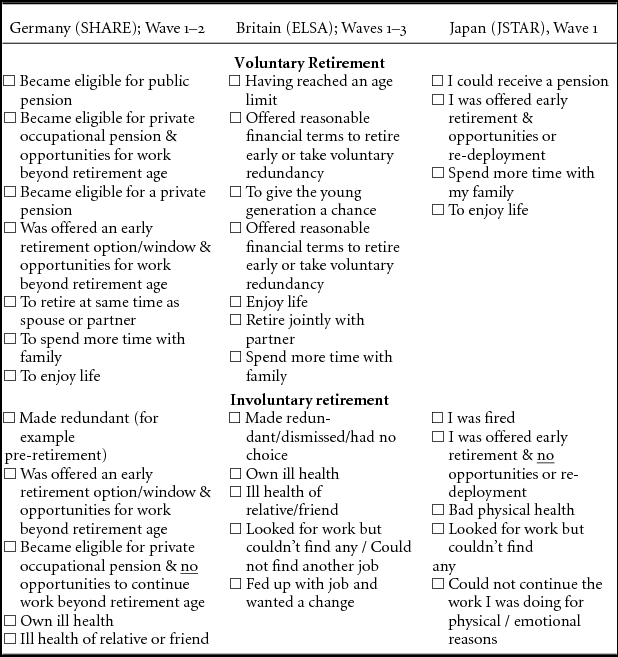
Reasons for retirement are constructed based on a retrospective question. The reasons are divided into ‘voluntary’ and ‘involuntary’ categories. Categorisations employed by the surveys mostly allowed for identical coding. However, some country-specific peculiarities necessitated a case-specific differentiation. Overall, we assume that reaching the eligibility for drawing a pension reflects a voluntary transition because individuals are expected to have left employment although they had the choice to stay. Only the German dataset explicitly differentiates between cases in which individuals had the opportunity to continue working (voluntary), and those where this opportunity did not exist (involuntary). A similar logic is applied for German employment exits based on firm-level early retirement plans and for the Japanese practice of redeployment (Casey, Reference Casey2005). Retirement due to personal reasons is considered voluntary, while retirement due to ill-health, redundancy, dismissal or plant closure is considered involuntary (compare: Koenen et al., Reference Koenen, Reichert, Zapf and Engelhardt2009). For England and Japan, those who were not able to find employment despite search efforts, and therefore took retirement, are also considered ‘involuntary’ retirees. Table 2 summarises these categorisations.
Reasons for retirement and classification into voluntary/involuntary retirement
Source: Own illustration
We investigate social inequalities in retirement transitions by differentiating individuals according to socio-demographic characteristics. To account for age-specific differences, we introduce four dummy variables reflecting 5-year time bands from age 50 to 69 (50–54, 55–59, 60–64, 65–69). These groups reflect typical age bands in which individuals could access pensions. In the UK, until 2010, the earliest ages men and women could claim their full state pension were 65 and 60, respectively. In Germany, generous early retirement options in the 1990s allowed for employment exits for those already in the mid- to late-50s. In Japan, however, exits before age 60 have been rare which led us to collapse the two dummies for the 50s age groups in the Japanese analyses.
Dummies for highest educational attainment controlled for differences in social capital: lower secondary education or less (International Standard Classification of Education (ISCED) 0–2); upper secondary education (ISCED 3–4) and tertiary education (ISCED 5 and higher). Gender is controlled for by a dummy. Furthermore, time period dummies differentiate between retirement transitions in the 1990s and 2000s to account for retirement changes throughout the gradual policy shift from early exit policies in the 1990s to active ageing in the 2000s. Even though these decades only offer very broad reflections of concrete policy changes, they may serve as valuable proxies of more general shifts in political strategies across time. Interaction effects between the period dummies and the aforementioned characteristics are introduced to investigate whether effects changed over time. Finally, in order to account for cross-country differences in economic structure, we include variables at the firm-level. We use number of employees at the workplace to differentiate between small (0–24 employees), medium-sized (25–199) and large companies (200 plus). For Germany, data on sector of employment differentiates between firms in the primary, secondary or tertiary sector. Lastly, a dummy differentiates private from public sector organisations.
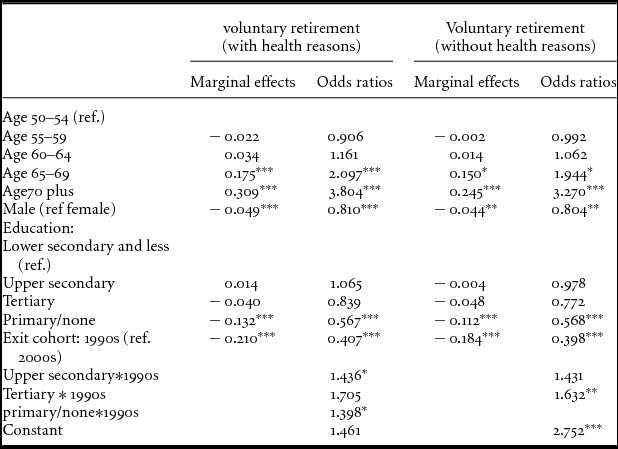
We first present descriptive country-level results of retirement timing and the incidence of voluntary/involuntary retirement. We account for social inequalities by disaggregating results by socio-demographic characteristics. We consider relationships between these dimensions by estimating multinomial logistic regression models predicting the likelihood of voluntary versus involuntary retirement. To compare results across samples (Mood, Reference Mood2010), we report marginal effects which provide quantified measures on how much the dependent variable is expected to change for a unit change in an independent variable for the control variables (though not for the interaction terms). The marginal effect of the interaction term is the cross-partial derivative of the expected value of the dependent variable with respect to an independent variable. However, in non-linear models, this is not the same as the first derivative of the dependent variable on the product of two independent variables. Thus the methods used to compute marginal effects do not apply to interaction terms. Odds ratios are reported instead, which indicate the ratio by which the dependent variable changes for a unit change in an explanatory variable. It therefore shows the effect of independent variables on the expected number of people having voluntary retirement for every person with involuntary retirement. In Tables 4–6, if an odds ratio equals 1, this signifies that a change in the independent variable does not affect the likelihood of voluntary retirement. If an odds ratio is larger (smaller) than 1, a change in the independent variable will increase (decrease) the likelihood of voluntary retirement.
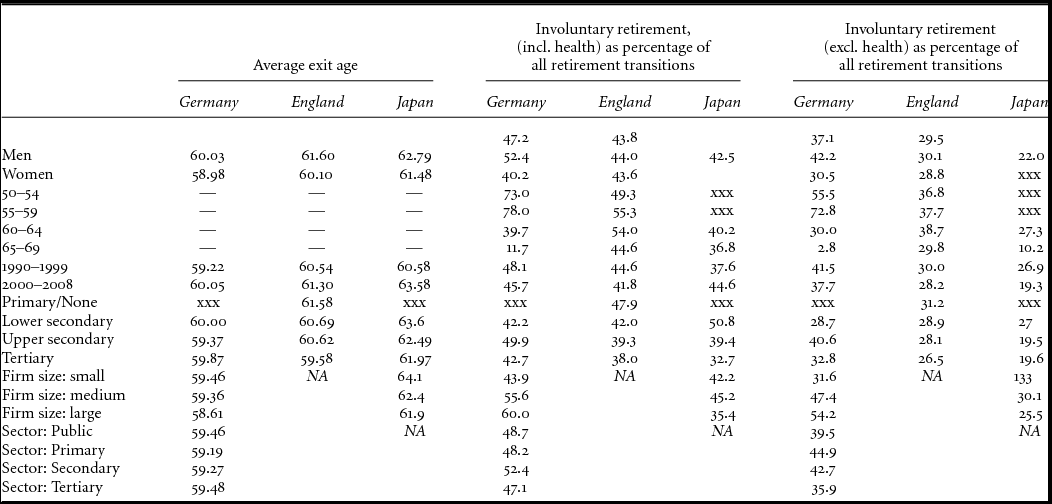
Average Exit Age and Incidence of Involuntary Retirement in Germany, England and Japan
Source: ELSA waves 1–3, SHARE wave 1–2, JSTAR wave 1 (own calculations) xxx = not calculated due to small sample size; NA = Not Available
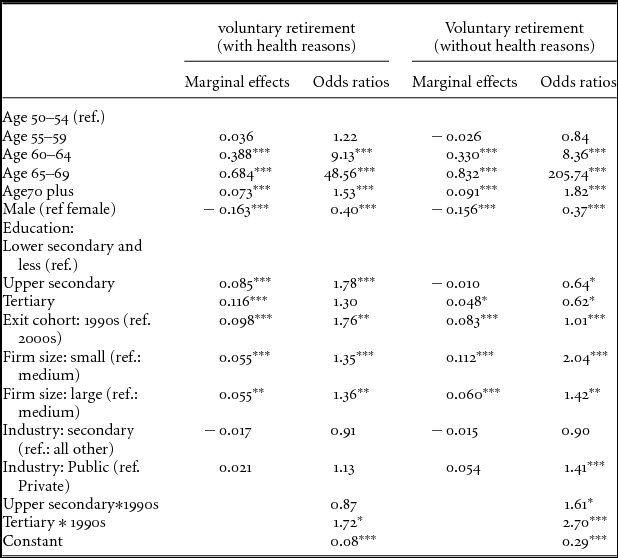
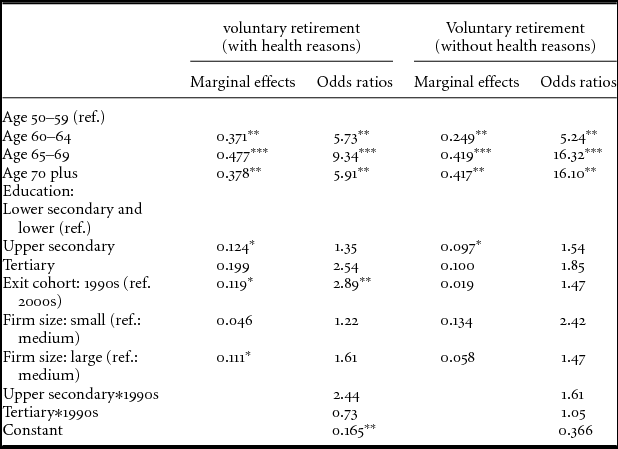
Likelihood of voluntary exit in Germany 1990–2006, logistic regression
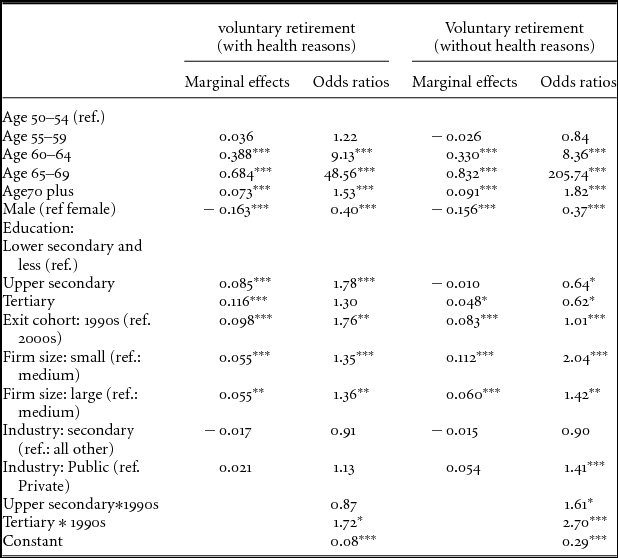
Source: SHARE Waves 1 and 2 (own calculations)
note: SHARE also provides information on type of industry (e.g., public and private). A regression including type of industry shows insignificant effect of it on likelihood of voluntary exit.
*** p<0.01, ** p<0.05, * p<0.1
Likelihood of voluntary exit in England 1990–2006. logistic regression
Source: ELSA Waves 1–3 (own calculations)
note: ELSA does not provide information on firm size and sector.
*** p<0.01, ** p<0.05, * p<0.1
Likelihood of voluntary exit in Japan 1990–2007 (men only), logistic regression
Source: JSTAR Wave 1 (own calculations)
note: only males are included for the analysis of Japan because the number of Japanese women aged 50 and over in the labour market is too small to give feasible results; controlled for missing values; JSTAR does not provide information on sector
*** p<0.01, ** p<0.05, * p<0.1
4. Results
4.1. Descriptive results
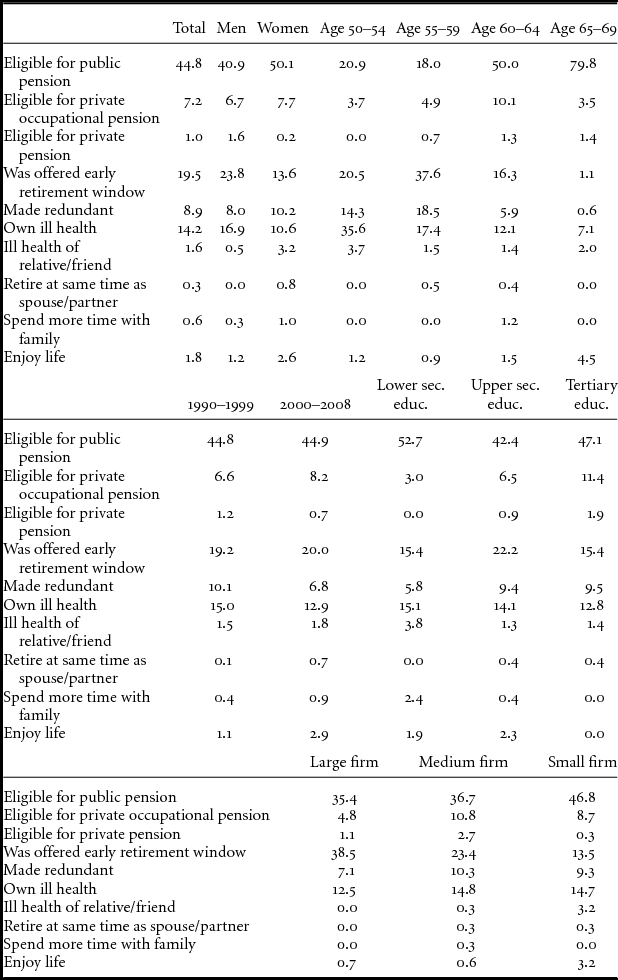
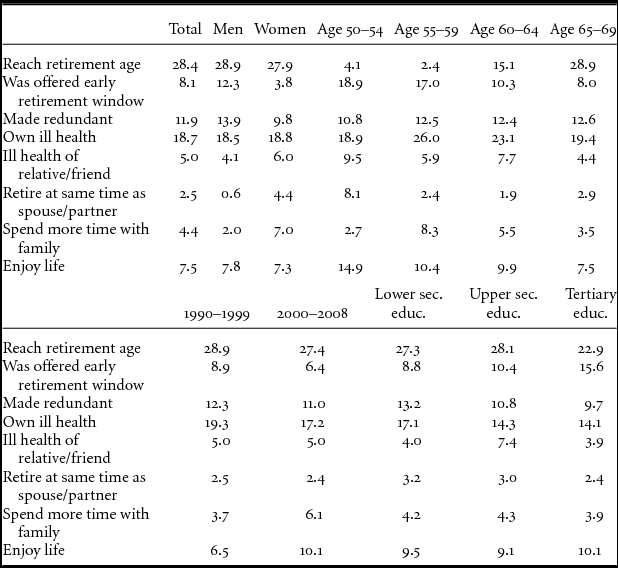
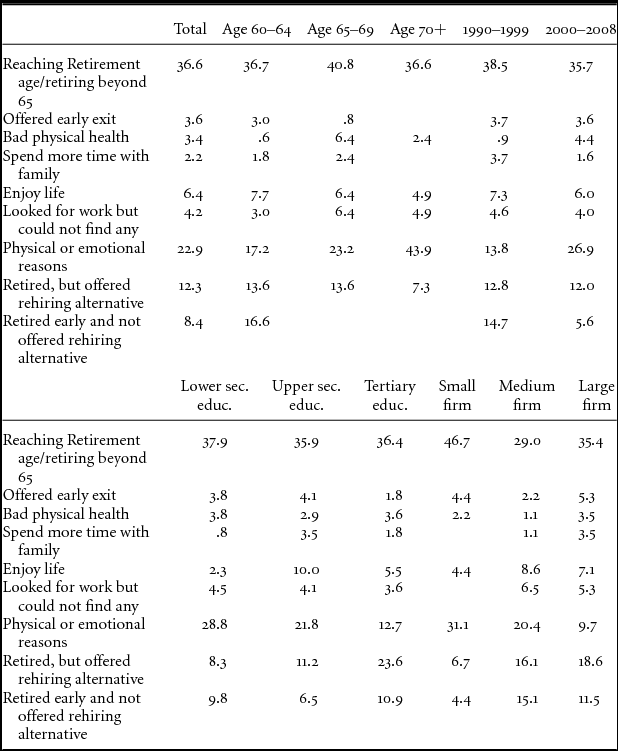
Table 3 provides an overview of the average retirement age, the incidence of involuntary retirement on an aggregate level, and breakdowns by socio-demographic groups. Tables A1–A3 show the actual retirement reasons.
Detailed Reasons for Retirement (Germany)
Source: SHARE wave 1–2 (own calculations)
Detailed Reasons for Retirement (England)
Source: ELSA waves 1–3 (own calculations)
Detailed Reasons for Retirement (Japan, men only)
Source: JSTAR wave 1 (own calculations)
Involuntary retirement is a widespread phenomenon in Germany (Dorn and Sousa-Poza, Reference Dorn and Sousa-Poza2010). Looking at all retirement transitions since the 1990s, involuntary retirement in Germany occurs mainly among those in their 50s (Table 3). This is due to a high incidence of ill-health-related retirement (Table A1). Furthermore, it is also around this age that most employer-led retirement transitions, for example through dismissals, are reported. This indicates the long-lasting German early retirement tradition at the time of data collection, where public early retirement pathways were often supplemented through occupational pensions. The persistent importance of such occupational programmes across the entire observation period suggests that the public policy shift has not yet sufficiently affected firm-level policy.
In line with our hypotheses, gender-specific figures indicate that involuntary retirement in Germany is largely a male phenomenon (Table 3), reflecting that men are more often subject to institutionalised early retirement plans. Furthermore, given their higher retirement ages throughout the past 20 years (men: 65; women: practically 60) and their more frequent employment in physically-demanding jobs, men face higher ill-health-related retirement risks. In contrast, women exit more often through the public pensions pathway, which is available to them at an earlier age (Table A1).
No simple pattern emerges regarding educational background. Highly-educated individuals work longest and have a higher likelihood of retiring due to eligibility for public or occupational pensions. Individuals with lower levels of education, as expected, face higher work-related health risks and are more likely to leave earlier. A high number of individuals with lower levels of education also claim to exit via eligibility to public pensions, which may be because they have accumulated necessary pension contribution years at a younger age, given their shorter educational history. Involuntary retirement is highest among workers with an upper secondary education. This may be because they lack transferable human capital compared to tertiary graduates, but have not yet accumulated necessary contribution years to exit via public pension pathways. This group might therefore be most strongly affected by firm-based measures to ‘push’ workers into retirement.
Results for firm-level control variables show that involuntary retirement is particularly common in larger German firms, possibly because these firms face higher rationalisation demands and are more likely to implement early retirement schemes. Finally, the incidence of involuntary retirement indeed decreased between the 1990s and the 2000s, suggesting that under the ‘active ageing’ regime in combination with overall favourable economic conditions, older employees are more likely to reach public/occupational pension eligibility ages and to retire voluntarily.
Results for the ELSA data indicate that notable differences exist between England and Germany concerning the retirement timing and its causes. As expected, retirement in England occurs later for men and women. Furthermore, the incidence of involuntary retirement is around 10 per cent lower than in Germany, reflecting the liberal market orientation with more flexible labour market policies. As in Germany, English women exit employment earlier than men, given their (then) lower SPA (60 compared to 65). However, there is no gender difference in the incidence of involuntary retirement, which averages around 40 per cent for both sexes. Nevertheless, the analysis of retirement reasons points to gender inequalities: while men are more likely to exit via employer-provided pre-retirement schemes, women frequently retire for personal reasons, suggesting that, even within the UK model, women follow a less market-dependent retirement logic than men.
Differences between Germany and England also emerge across age groups. Unlike the German inverse U-shaped pattern, involuntary retirement in England shows fewer age differences. Even for those who are beyond public pension eligibility age, a substantial proportion report involuntary retirement. This is because public retirement ages are less important in structuring life course transitions than in Germany (Leisering, Reference Leisering, Mortimer and Shanahan2003). Instead, retirement timing in England depends on when it becomes financially affordable to the individual. Notably, those in their 50s more often retired for personal reasons, while health was a concern for those in their late-50s and early-60s. This latter group particularly faces hardship as they are prevented from working due to health reasons despite having a financial need to remain in the labour market. Average retirement age declines with higher education in England, while such workers more often retire voluntarily, especially through occupational pension schemes. In contrast, lower-educated workers are more likely to face labour market risks, including redundancies and ill-health. Retirement therefore depends on having financial resources rather than on institutionalised pension requirements. This creates greater choice for those who can afford retirement. However, those with fewer financial resources are faced with a continuing need to work, even if labour market or health conditions create obstacles. Finally, a comparison across time periods reveals that, similar to Germany, the incidence of involuntary retirement has decreased for the younger cohort, although in England, the effect remains rather modest.
For Japan, a problem for the analysis arises from gender differences in the reporting of labour market exits. While men predominantly claim to have transitioned from employment into retirement, women reported having transitioned into ‘housekeeping’ (compare: Ichimura and Shimizutani, Reference Ichimura, Shimizutani, Smith and Majmundar2012), even when having been employed in their 50s. These results reflect the overall weak labour market attachment of women, who are largely excluded from the lifetime employment system (Abe, Reference Abe2011). This differential response behaviour entails that, due to questionnaire filtering, most Japanese women were not asked the follow-up questions concerning ‘retirement reasons’ (Table 2), but received alternative, ‘housekeeping-related’ answer categories that are not comparable with work-related motives. To increase the cross-national comparability, we therefore only refer to Japanese men.
Our results point to notable differences in Japanese retirement behaviour compared to Germany and England. With an average retirement age of 62.8, Japanese men retire latest. Virtually no retirement occurs prior to age 60, with peaks at 60 and 65. Around 20 per cent work beyond age 65. In line with our hypotheses, retirement transitions are more voluntary than in Germany and England. Intra-national differences are, however, observed. Japanese men with tertiary education retire earlier and more often voluntarily than those with lower education levels. An explanation might be that higher-educated men are better able to afford retirement and are more frequently offered redeployment/rehiring alternatives after age 60, thus experiencing more choice in their retirement decisions. Those with a lower level of qualification may need to work longer for financial reasons. Yet, they are more likely to experience ill-health, restricting their degree of choice.
Average retirement age is highest in small firms: almost a third of employees retired due to ill-health, leading to a relatively high share of involuntary exits. Yet, when excluding ill-health, retirement is mostly voluntary. In large firms, older workers retire earlier and more voluntarily, the latter possibly because they more frequently receive redeployment/rehiring offers. Trends over time indicate that retirement increasingly occurs at later ages (Shimizutani, Reference Shimizutani2011). Yet, this trend is accompanied by higher levels of ill-health-related, and thus involuntary, retirement (Table A3).
4.2. Multivariate results
Although the descriptive analyses provide insights into the nature of retirement transitions and their differential spread across socio-demographic groups, their bivariate nature restricts an assessment of social inequality patterns over time. We therefore conduct multivariate logistic regressions on the relative likelihood of being affected by involuntary retirement.
Table 4 presents the marginal effects and odds ratios of the logistic regression for Germany. These results are consistent with findings from the descriptive analysis. Voluntary retirement is most widespread among those in their 60s who were subjected to firm-level rationalisation measures. Also, involuntary retirement is more frequent among men than women, and among workers with lower levels of education. However, the latter effect decreases once ill-health-related retirement is excluded from the analysis. If lower-educated workers’ health allows them to work longer, they enjoy a higher level of choice, given their then higher likelihood to retire through regular pension pathways. However, even if low-educated workers retire involuntarily due to ill-health, these exits are financially shielded given the comparative generosity of German disability benefits. This, however, may change, because pension reforms have closed disability-related early retirement routes. Interaction effects between time period and education suggest that the advantage of higher-educated workers has weakened, as the likelihood of involuntary exit has increased since the 1990s. Firm-level determinants are less important. Employees in small firms retire voluntarily as do employees in larger firms. Notably, this positive effect only emerges once controlling for education (own analyses, not shown here), indicating that the high share of involuntary retirement in large firms might be due to firm-specific non-transferrable skills.
Table 5 shows the results from England. Again, these mostly confirm the descriptive findings. Age-graded patterns are less pronounced than in Germany, and it is only when a person is in their late-60s or beyond, and when sufficient resources for retirement have been secured, that retirement becomes more voluntary. Similarly, gender differences are small, especially when considering health-related reasons. Unlike in Germany, lower-educated workers experience involuntary retirement, even when excluding ill-health. This reconfirms the conflict within the liberal pension system between the financial need to continue working and possibly limited health and human capital resources to do so. Trends over time suggest that the likelihood of retiring voluntarily has increased. Yet, contrary to our expectations, differences between education groups have decreased. This effect disappears once ill-health-related retirement is excluded, suggesting a decrease in ill-health across the two labour market cohorts.
Finally, Table 6 presents Japanese results. Due to the small sample size (resulting from the exclusion of women), results are less pronounced. However, they reconfirm the picture of a peak of voluntary retirement when reaching the (late-)60s. Although the effect reaches only marginal statistical significance, results corroborate the disadvantaged position of lower-educated workers who more often exit involuntarily.
5. Conclusions
Using comparable surveys for England, Germany and Japan to investigate the timing of and motives for work-retirement transitions, we focus on whether this transition occurs voluntarily or involuntarily. We suggest that institutional contexts influence individuals´ degree of choice over, and the timing of, this transition. As these countries belong to different types of institutional regimes, we expect the findings to differ.
Although nation-specific trends are observed, average retirement ages have increased in all three countries between the 1990s and the 2000s. While this may reflect the economic boom in the mid-2000s, the occurrence of major policy reforms in all three counties suggests that these trends may equally be due to a shift from early exit policies in the 1990s to an active ageing paradigm in the 2000s. Yet, despite this policy re-orientation, we find considerable cross-national differences concerning the average retirement age. Although Germany abandoned most state-financed early retirement pathways, retirement transitions on average occur at an earlier age than in England and Japan. Furthermore, we find cross-national differences regarding the nature and quality of this transition. In Germany, at the time of the data collection, firms still used early retirement schemes, resulting in a considerable share of involuntary exits due to a lack of alternative employment options. In England, the share of involuntary exits is only modestly lower: a considerable proportion retire involuntarily due to redundancies and ill-health. In Japan, the incidence of involuntary retirement is the lowest, especially when controlling for health, reflecting the institutional context which prescribes that Japanese employers provide employment up until pension age.
Furthermore, we find intra-national differences, suggesting that individuals from different socio-economic groups have different degrees of choice over retirement. For those with low education levels, we find that Germans have long been in an advantageous position as they could still use financially-attractive early retirement options. In contrast, lowly-educated Japanese and English workers are disadvantaged, as they have to continue working for financial reasons, but often experience ill-health. Furthermore, Japanese low-qualified workers have a lower chance of being redeployed/rehired after age 60, while English low-qualified workers face a higher risk of being made redundant compared to their higher-qualified peers. Consequently, in England and Japan, lower-educated individuals tend to retire involuntarily. Thus, social welfare in terms of state pension provision has an impact on the degree of choice over retirement, especially for those on low income.
We find little difference in the degree of choice experienced among English men and women. Contrary to this, German men exit the labour market involuntarily more often than women. Similarly, Japanese data indicates that retirement is not a likely transition experienced by women, who, instead, consider the transition as an increasing focus on homemaking. Concerning firm size, our results suggest that individuals in small organisations have more choice than workers in medium-sized and large organisations. They are more likely to work longer but tend to exit involuntarily because of ill-health. In comparison, workers in larger firms retire earlier than workers in smaller firms, but can count on formalised early retirement schemes in Germany, and have higher chances of being redeployed/rehired in Japan. Finally, trends over time suggest an improvement with regard to choice as the incidence of voluntary retirement increased in England and Germany. Yet in Japan, where actual retirement ages were high already in the 1990s, the shift to longer employment apparently comes at the cost of higher ill-health-related involuntary retirement. This suggests that there may be limits to the extension of working lives.
This study has limitations, such as the data, as discussed above. Also, by using self-reported complete work cessation as the work-retirement transition timing, we cannot account for the increasing heterogeneity and fluidity of this transition. Nevertheless, we show how national-specific institutions mediate both retirement transitions and variations in the degree of choice regarding retirement decisions. This allows us to identify specific problem groups under varying institutional conditions. Yet, retirement patterns might still be changing as the current political move towards ‘late retirement’ continues, even if employers and some governments are reverting back to early retirement during periods of recession. Nevertheless, previously-sheltered groups may be exposed to higher risks. As discussed, in Germany lower-qualified workers, who were able to retire early under financially favourable conditions in the 1990s, will increasingly be unable to do so under the ‘active ageing’ paradigm. Furthermore, it remains to be seen under which conditions younger cohorts of women, often with an increasing labour force attachment, will retire in Germany and Japan. There thus remains a need for further research.