INTRODUCTION
Community-based coastal resource management (CBCRM), constituting both a philosophy and a strategy designed to address the deteriorating state of coastal resources, is more widespread in Oceania than in any other tropical region in the world (Johannes Reference Johannes2002; Bartlett et al. Reference Bartlett, Pakoa and Manua2009; Govan Reference Govan2009; Maliao et al. Reference Maliao, Pomeroy and Turingan2009). Traditional forms of marine tenure have been successfully applied in Pacific islands to establish conservation initiatives such as marine protected areas (for example Russ & Alcala Reference Russ and Alcala1999; Aswani & Hamilton Reference Aswani and Hamilton2004a; Aswani Reference Aswani2005; Aswani et al. Reference Aswani, Albert, Sabetian and Furusawa2007; Christie & White Reference Christie and White2007; Brunnschweiler Reference Brunnschweiler2010). Together with traditional marine tenure, traditional knowledge and customary law form the three pillars of what is referred to as traditional resource management, which is increasingly recognized as a key tool for sustainable management of natural resources in certain areas such as parts of the South Pacific (Caillaud et al. Reference Caillaud, Boengkih, Evans-Illidge, Genolagani, Havemann, Henao, Kwa, Llewell, Ridep-Morris, Rose, Nari, Skelton, South, Sulu, Tawake, Tobin, Tuivanuavou and Wilkinson2004; Cinner & Aswani Reference Cinner and Aswani2007).
Traditional ecological knowledge (TEK) is the cumulative body of knowledge, practice and belief that pertains to the relationship of living beings with one another and with their environment (Berkes Reference Berkes2008). It is qualitative, intuitive and holistic rather than quantitative, analytical and reductionist, and is handed down through generations by cultural transmission. TEK differs from local ecological knowledge (LEK), which lacks the temporal depth of cumulative cultural transmission and has been used to obtain information on the presence or qualitative and quantitative abundance of species or to identify population trends (Berkes et al. Reference Berkes, Colding and Folke2000; Huntington Reference Huntington2000; Moller et al. Reference Moller, Berkes, Lyver and Kislalioglu2004; Gilchrist et al. Reference Gilchrist, Mallory and Merkel2005; Wilson et al. Reference Wilson, Raakjær and Degnbol2006; Chapman Reference Chapman2007; Anadón et al. Reference Anadón, Giménez, Ballestar and Pérez2009; Gerhardinger et al. Reference Gerhardinger, Hostim-Silva, Medeiros, Matarezi, Bertoncini, Freitas and Ferreira2009). Ecological research and the collective understanding of species’ natural history can be improved by using site specific knowledge of local people and combining it with scientific information (Huntington et al. Reference Huntington, Suydam and Rosenberg2004; Moller et al. Reference Moller, Berkes, Lyver and Kislalioglu2004). Ecological knowledge, including biological information relevant to conservation efforts such as species presence, distribution and abundance in focus habitats, is particularly useful when researching wildlife populations that occur in remote locations (Poizat & Baran Reference Poizat and Baran1997; Huntington Reference Huntington2000; Aswani & Hamilton Reference Aswani and Hamilton2004b; Silvano & Valbo-Jørgensen Reference Silvano and Valbo-Jørgensen2008; Fahmi & Adrim Reference Fahmi and Adrim2009). The application of traditional and local knowledge and customary ecological management practices to conservation issues has re-emerged in recent years and, complemented with scientific information, expands the knowledge base on the status of marine resources (Drew Reference Drew2005; Ainsworth et al. Reference Ainsworth, Pitcher and Rotinsulu2008).
The alarming loss of ecosystems and biodiversity owing to increasing human population and associated pressures on the environment can have severe consequences (Jackson et al. Reference Jackson, Kirby, Berger, Bjorndal, Botsford, Bourque, Bradbury, Cooke, Erlandson, Estes, Hughes, Kidwell, Lange, Lenihan, Pandolfi, Peterson, Steneck, Tegner and Warner2001; Lotze et al. Reference Lotze, Lenihan, Bourque, Bradbury, Cooke, Kay, Kidwell, Kirby, Peterson and Jackson2006; Worm et al. Reference Worm, Barbier, Beaumont, Duffy, Folke, Halpern, Jackson, Lotze, Micheli, Palumbi, Sala, Selkoe, Stachowicz and Watson2006; Myers et al. Reference Myers, Baum, Shepherd, Powers and Peterson2007). Apex predatory sharks are found in many coastal ecosystems, including estuaries, mangroves and rivers (Martin Reference Martin2005). Shallow coastal areas are important habitats for the early life stages of many elasmobranch species and often qualify as nurseries (Heupel et al. Reference Heupel, Carlson and Simpfendorfer2007). Because of their accessibility, studies in such habitats have contributed substantially to the understanding of the general biology, life history and behavioural ecology of various shark species (Bush & Holland Reference Bush and Holland2002; Feldheim et al. Reference Feldheim, Gruber and Ashley2002; Heupel et al. Reference Heupel, Simpfendorfer and Hueter2003, Reference Heupel, Simpfendorfer and Hueter2004; Pillans & Franklin Reference Pillans and Franklin2004; Heithaus et al. Reference Heithaus, Delius, Wirsing and Dunphy-Daly2009). The bull shark (Carcharhinus leucas) is a good example. The biology of this widespread euryhaline species has been studied in a number of populations around the world and is best known from neonate, young-of-the-year and juvenile individuals in estuarine and river habitats (Snelson et al. Reference Snelson, Timothy, Mulligan and Williams1984; Pillans & Franklin Reference Pillans and Franklin2004; Neer et al. Reference Neer, Thompson and Carlson2005; Simpfendorfer et al. Reference Simpfendorfer, Freitas, Wiley and Heupel2005; Heupel & Simpfendorfer Reference Heupel and Simpfendorfer2008; Thorburn & Rowland Reference Thorburn and Rowland2008; Heithaus et al. Reference Heithaus, Delius, Wirsing and Dunphy-Daly2009; Ortega et al. Reference Ortega, Heupel, Van Beynen and Motta2009).
Fiji is the most populous Pacific island country and its population is made up of native Fijians (Melanesians) and Indo-Fijians. Fijian society has traditionally relied heavily on marine resources for subsistence and livelihoods. Aside from farming root crops and vegetables for the bulk of the food supply, selling locally caught seafood is a major source of income for villages situated at or near rivers near the coasts (Teh et al. Reference Teh, Teh, Starkhouse and Sumaila2009). Fiji possesses a well-established system of traditional fishing ground management known as qoliqoli (officially referred to as customary fishing rights areas), which applies to all waters, enjoys legal recognition and is protected by customary marine tenure agreement (Ruddle Reference Ruddle1995; Cooke et al. Reference Cooke, Polunin and Moce2000; Muehlig-Hofmann Reference Muehlig-Hofmann2007). The qoliqoli is fished by inhabitants of specific villages.
In Fiji, adult bull shark behaviour and ecology have been studied on the southern coast of Viti Levu at the Shark Reef Marine Reserve, where the number of individuals decreases over the course of a calendar year with fewer sightings between October and December each year (Brunnschweiler & Earle Reference Brunnschweiler and Earle2006; Brunnschweiler Reference Brunnschweiler2010). Anecdotal evidence indicates bull shark absence from the site is associated with reproduction, since local fishers see and catch sharks later in the year in nearby rivers where the presence of sharks has long been known (MacDonald Reference MacDonald1857). For example, De Ricci (Reference De Ricci1875) reported that ‘there is a species of shark (Qio), which infests some parts of the Rewa River to an unpleasant extent’. Similarly, Brewster (Reference Brewster1922) reported that ‘the big navigable rivers were infested with small freshwater sharks, and I have known a good few incidents of men, women, and children being killed by them, yet it never stopped their using the streams for highways’. These may well have been bull sharks, a species that is known to penetrate far into freshwater systems, including in Fiji (Ryan Reference Ryan1980), and for which mating is thought to occur in offshore marine waters, with females entering estuarine and inshore waters to give birth (Montoya & Thorson Reference Montoya and Thorson1982; Compagno Reference Compagno1984; Pillans & Franklin Reference Pillans and Franklin2004; McCord & Lamberth Reference McCord and Lamberth2009).
To date, the extent to which sharks of any species inhabit rivers in Fiji has not been documented in the scientific literature and it remains unknown whether these habitats serve as nursery grounds, particularly for bull sharks. In this qualitative study, our aims were to (1) document LEK of local people living along the major rivers and collect data on the occurrence of sharks in rivers in Fiji, (2) learn how locals regard and use sharks and (3) capture ancestral legends and myths (TEK) that shed light on the relationship between local people and these animals.
METHODS
Viti Levu and Vanua Levu are the two major islands of the country of Fiji, which lies on the border of between the Polynesian and Melanesian regions of the Pacific. The three longest rivers on Fiji are the Rewa river, the Sigatoka river and the Navua river, all on Viti Levu. The deepest Fijian river is the Dreketi river on Vanua Levu.
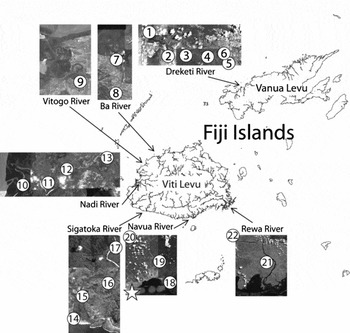
In June and July 2009, E. Rasalato and V. Maginnity interviewed single individuals or small groups of locals associated with 22 villages, settlements and fishing communities (collectively referred to as ‘villages’ from here on) situated on or near seven riverine systems, namely the Ba, Vitogo, Nadi, Sigatoka, Navua and the Rewa rivers on Viti Levu and the Dreketi river including one of its tributaries (Batiri) on Vanua Levu (Fig. 1). One interview was conducted in each visited village in both English and the Fijian language with the chief or headman of the respective village. These village representatives were chosen as interview partners because they are well informed about everyday life in a Fijian village and were thus considered a fair representation of the LEK and TEK held by the whole community. During some of the interviews additional persons were present upon invitation of the chief or headman, and in these cases multiple villagers contributed to the interview (Table 1). Two interviews (Kulukulu fishing community and Moala village) were conducted with fishers who regularly fished in the respective rivers. Women contributed to the interviews in five cases (namely Nabavatu village, Apia settlement, Batiri village, Nawaimagi village and Nacokaika village).
The Fiji Islands and their rivers. Interviews were conducted with representatives from 22 villages (for village names see Table 1) associated with six riverine areas on Viti Levu and one on Vanua Levu (insets). The star on the southern coast of Viti Levu (Navua river inset) denotes the location of the Shark Reef Marine Reserve (Brunnschweiler Reference Brunnschweiler2010).

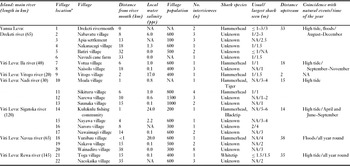
Shark observations obtained from interviews in the 22 villages (*numbers refer to the location of the village in Fig. 1) situated at or near the seven targeted rivers on Vanua Levu and Viti Levu, June–July 2009. For each village, the approximate population of the village, the number of people that contributed to the interview, the shark species mentioned during the interview and the usual and maximum size of the sharks the locals reported to see in the rivers, as well as the largest distance upstream from the river mouth where shark sightings were reported and times when sharks were seen or caught in the respective river are supplied. NA = not available.

The method used to document ecological knowledge included semi-directive interviews and a questionnaire (Huntington Reference Huntington2000). The village representatives were asked specific questions that were outlined in the questionnaire, but were also allowed to talk about any issue. The three-part questionnaire (Appendix 1, see supplementary material at URL Journals.cambridge.org/ENC) was designed to identify and document details related to the presence of sharks in the rivers, the location and timing of shark sightings by villagers in their respective qoliqoli, biological and ecological characteristics, any interactions between local people and sharks and conservation issues.
RESULTS
Shark knowledge
All interviewees reported shark sightings from their respective river qoliqoli (Table 1). They saw sharks as catch, observed the fins of single or multiple sharks on the water surface or saw them during the collection of kai (freshwater mussels Batissa violacea). Except for one village (Vunibau village situated at the mouth of the Navua river), all interviewees reported seeing single sharks. With the exception of the Vitogo river from which no such data are available, villagers reported seeing sharks primarily during floods and high tides. Sharks were reported to be seen at all times of the year in the Navua and Rewa rivers, but only at specific times, such as during whitebait (young fish) season in April or in the second half or last quarter of the year, in other rivers sampled (Table 1).
None of the interviewees could say for sure what species were seen or caught in the rivers. With the exception of the Rewa river, hammerhead sharks (Sphyrna spp.) were reported near the river mouths of all rivers sampled where local villagers saw and caught them at high tide in brackish water (Table 1). Interviewees living along the rivers further inland reported seeing and catching small sharks of unknown species in low salinity water or freshwater. They referred to them as qio or naiko (shark), bulubulu or matabulubulu (small shark or baby shark) or qio taukei (resident shark) and described them as having a rounded snout and being grey-brown in colour with a white belly. Based on the presence or absence of claspers, representatives from only four villages could say whether the sharks they saw or caught were males or females, two of them reporting to have seen mostly males. The size of the sharks the locals usually saw close to their village was reported to be small, their size was approximately one metre long further up river, but some claimed to have seen much larger individuals of up to 6 m in length nearer to the river mouths (Table 1).
Interactions with people
Asked what they did when they saw a shark, interviewees’ answers included ‘nothing’, ‘stay away from it’, ‘feel frightened’, ‘yell and warn people’ or ‘try to catch it’. Representatives from eight villages (36%) reported they never caught sharks, while the others either locally targeted sharks or took them as bycatch. In the Nayawa village on the Sigatoka river, it is forbidden to catch sharks, local residents believing that if anybody from the village caught a shark they must throw it back or they would get a skin disease or scabies. Apart from fishing, interactions with sharks were reported to occur during the collection of kai by local women. Representatives from four villages (18%) reported that dogs got bitten by sharks when crossing the river.
Shark meat was reportedly consumed in 68% of the villages visited. Interviewees reported eating the meat and occasionally the heart and the liver. Representatives from five villages (23%) reported selling shark meat or other parts of locally caught sharks. If they did so, villagers sold meat on the local market, teeth to hotels and handicraft outlets or fins to Chinese buyers and restaurants.
Ancestral legends and myths, and traditional medicine
Representatives from four villages (18%) on Viti Levu agreed that there had been a relationship between villagers and sharks, and told ancestral stories (Appendix 2, see supplementary material at URL Journals.cambridge.org/ENC). Two interviewees (Naroro village on Viti Levu and Nabavatu village on Vanua Levu) who stated that there was no relationship between villagers and sharks nevertheless also told stories related to sharks. With the exception of representatives from four villages (18%), all interviewees responded that they lived in harmony with sharks, although at least one of them nevertheless caught sharks. Interviewee responses included for example, ‘no one has lost his life or got bitten so we live well with sharks’ (Narewa village on the Nadi river), ‘we leave them alone’ (Naroro village on the Sigatoka river) and ‘we are living in harmony with sharks but I do catch them when I want to eat the meat’ (Waimagi village on the Sigatoka river). Representatives from two villages on the Sigatoka river reported using a stick with a single shark tooth as a traditional medical tool to cut the skin and remove ‘bad blood’ from an infected area.
Conservation awareness
The majority (86%) of those interviewed affirmed the protection of sharks, mainly because they were a source of protein to them. Other reasons given for shark protection included an ancestral relationship or the belief that sharks were Vu (ancestral gods), or that sharks indicated the presence of other fish that could be caught, were good for ecotourism, kept the ecosystem in balance or simply that they were living creatures. Examples of responses supporting this last statement included, ‘the sharks have always been there so they deserve respect as do other creatures’ (Nabavatu village on the Dreketi river) and ‘sharks are God's creation so they are there for a purpose’ (Narewa village on the Nadi river). Interviewees that denied the protection of sharks did so because ‘they can bite’. All interviewees, without exception, would welcome decisions by the Fijian government to protect sharks nationwide. Representatives from four villages (18%) had ideas about the function of sharks in the river and/or the ocean; for example, ‘they eat other fish and anything’ (Kulukulu fishing community on the Sigatoka river mouth) or ‘they chase the smaller fish from the sea into the shallower waters so we can catch the fish’ (Sikituru village on the Nadi river). When asked if they knew what a fish nursery ground was, representatives from 10 villages (45%) answered ‘yes’.
DISCUSSION
Reliability of LEK depends strongly on characteristics of the target taxa, which should be easily recognizable and its detection should not need any particular skills (Anadón et al. Reference Anadón, Giménez, Ballestar and Pérez2009). Sharks are unmistakable animals with a strong cultural dimension in local communities of the study area and qualify as cultural keystone species (D'Arcy Reference D'Arcy2006; Garibaldi & Turner Reference Garibaldi and Turner2004). Interviews with village representatives, some of them fishers themselves, confirmed that village representatives could describe the presence of sharks in the rivers and thus could provide reliable information about shark occurrence. All of them confirmed that they encountered sharks of varying, but mostly small, size in the rivers up to 38 km from the river mouth in the Navua river on Viti Levu and up to 33 km from the river mouth in the Dreketi river on Vanua Levu, but were unable to provide precise information enabling reliable species identification. Named species were reported from brackish waters close to the ocean. For example, hammerhead sharks were reported from all river mouths except the Rewa river. Swamy (Reference Swamy and Shotton1999) listed three hammerhead shark species that occur in Fijian waters (Sphyrna lewini, S. mokkaran and S. zygaena) and some Sphyrna spp. use coastal estuarine environments as nursery grounds (Lowe Reference Lowe2002; Ubeda et al. Reference Ubeda, Simpfendorfer and Heupel2009). A fisher from Moala village on the Nadi river reported catching hammerhead sharks, tiger sharks (Galeocerdo cuvier) and unknown species up to a few hundred metres upstream from the river mouth. Given the tiger shark's unmistakable colouration and stripe pattern, it is likely that this is a valid species identification. Similarly, blacktip and whitetip sharks were only reported from at or near river mouths, but such species designations must be interpreted with caution. Both the blacktip reef shark (C. melanopterus) and whitetip shark (Triaenodon obesus) occur in Fiji (Swamy Reference Swamy and Shotton1999; Brunnschweiler & Earle Reference Brunnschweiler and Earle2006), but it remains unknown if local fishers see and catch these species; other species that occur locally also have white or black colouration patterns on their fins (for example C. albimarginatus, C. amblyrhynchos, C. longimanus and C. obscurus). Access to teeth, jaws or tissue samples from sharks would have allowed for definitive species identification, but none of the interviewees had any such material available for further investigation at the time of the interviews.
Bull sharks are known to penetrate freshwater and use river systems and estuaries as nursery grounds (Compagno Reference Compagno1984; Heithaus et al. Reference Heithaus, Delius, Wirsing and Dunphy-Daly2009; McCord & Lamberth Reference McCord and Lamberth2009; Ortega et al. Reference Ortega, Heupel, Van Beynen and Motta2009). In addition to simply confirming the presence of sharks of any species in rivers on Fiji, our prediction was that if female bull sharks encountered at the Shark Reef Marine Reserve on the southern coast of Viti Levu swim into rivers and use these habitats as nursery grounds, large and possibly even pregnant females would be caught more often during the time when they are absent from the site, whereas large adult males would be caught less often in the rivers. We found no convincing support for this hypothesis, although some locals described sharks caught or observed as being very large, they did not know of what species and/or sex they were or if larger individuals are seen at only specific times of the year. Local people from areas visited along the rivers and especially further inland reported having seen and caught small (c. 1 m) sharks that they consistently described as being grey-brown in colour with a white belly and a rounded snout, which they referred to as small sharks (bulubulu) or baby sharks (matabulubulu). These morphological characteristics match juvenile bull sharks. Bull sharks are born at a size of 56–81 cm (Cruz-Martínez et al. Reference Cruz-Martínez, Chiappa-Carrara and Arenas-Fuentes2005) and data from the northern hemisphere suggest that they spend their first year within riverine nursery areas in lower salinity waters further upriver before they move towards the river mouths and out into coastal areas (Simpfendorfer et al. Reference Simpfendorfer, Freitas, Wiley and Heupel2005). Based on the villagers’ descriptions and information on bull shark occurrence in similar habitat types elsewhere (Pillans & Franklin Reference Pillans and Franklin2004; Heupel & Simpfendorfer Reference Heupel and Simpfendorfer2008; Thorburn & Rowland Reference Thorburn and Rowland2008; Heithaus et al. Reference Heithaus, Delius, Wirsing and Dunphy-Daly2009; McCord & Lamberth Reference McCord and Lamberth2009; Ortega et al. Reference Ortega, Heupel, Van Beynen and Motta2009), the hypothesis that juvenile and possibly adult bull sharks occur in and use riverine waters in Fiji cannot be rejected and warrants further investigation.
Animals and ecosystems can become embedded in a people's cultural traditions and narratives when local people depend upon them to meet their needs (Garibaldi & Turner Reference Garibaldi and Turner2004; Allen Reference Allen2007). Sharks play an important role in thoughts and beliefs of many native Fijians (D'Arcy Reference D'Arcy2006), and the consumption of shark meat is an important source of protein for many of the villages. Although only one-third of all interviewees reported targeting sharks directly for consumption, other villagers reported taking them as bycatch. Given the severe threats that sharks are facing globally and the important role these animals play in the marine ecosystem, management of this natural resource must be envisaged not only at the industrial, but also at the subsistence and artisanal fisheries level (Martin Reference Martin2005; Robbins et al. Reference Robbins, Hisano, Connolly and Choat2006; Myers et al. Reference Myers, Baum, Shepherd, Powers and Peterson2007; Teh et al. Reference Teh, Teh, Starkhouse and Sumaila2009). To achieve this, local communities must be involved and local people's knowledge used in devising conservation strategies and subsequent implementation (Sáenz-Arroyo et al. Reference Sáenz-Arroyo, Roberts, Torre and Cariño-Olvera2005; Brunnschweiler Reference Brunnschweiler2010). For example, knowledge about the location of nursery grounds is paramount when devising a conservation strategy that encompasses all stages of a shark species’ life cycle. Even if only a fraction of the interviewees admitted they knew what a fish nursery ground was, to what extent they are familiar with the definition of the term remains unknown (Heupel et al. Reference Heupel, Carlson and Simpfendorfer2007); such knowledge is most reliably accurate from local people who have been interacting closely with their environments (Aswani & Hamilton Reference Aswani and Hamilton2004b; Silvano et al. Reference Silvano, MacCord, Lima and Begossi2006). At the same time, in situations where species have an economic value or are an important food source, interviewees may be reluctant to share their knowledge because the information might be used against them (Grant & Berkes Reference Grant and Berkes2007). Although the identification of rivers as nursery grounds and important habitats for sharks might eventually lead to fishing restrictions and regulations, we have no evidence for underreporting of local shark sightings, catches and processing. Instead, the importance of shark meat as a source of protein seems to motivate local villagers’ support for shark conservation measures and might signify conservation awareness.
Fiji's well-established qoliqoli system of traditional fishing ground management (Cooke et al. Reference Cooke, Polunin and Moce2000; Muehlig-Hofmann Reference Muehlig-Hofmann2007), which includes not only marine, but also freshwater fishing grounds such as rivers and estuaries, supports community-based conservation (Berkes Reference Berkes2004; Brunnschweiler Reference Brunnschweiler2010). CBCRM empowers communities to manage resources for long-term social, economic and ecological benefits, and one of its policy objectives is to initiate conservation strategies that are ecosystem wide in perspective and local in approach, including natural resource monitoring and management programmes to ensure species and ecosystem health (Phuthego & Chanda Reference Phuthego and Chanda2004). The key benefits of incorporating a LEK component into conservation initiatives are the identification of areas and issues of common interest for research projects, the collection of biological samples, environmental information and observational data on key life history traits from a current and historic perspective, and the building of cooperative relationships between scientists and local people. This is particularly useful during the initial development of recovery plans for inadequately studied endangered or threatened species. Although traditional monitoring methods may often be imprecise and qualitative, they are still valuable complements to science-based approaches because they are founded on observations over long time periods, are inexpensive, invite the participation of local people as researchers, and sometimes incorporate subtle and multivariate cross checks for resource and ecosystem change (Huntington et al. Reference Huntington, Suydam and Rosenberg2004; Moller et al. Reference Moller, Berkes, Lyver and Kislalioglu2004; Ainsworth et al. Reference Ainsworth, Pitcher and Rotinsulu2008; Gerhardinger et al. Reference Gerhardinger, Hostim-Silva, Medeiros, Matarezi, Bertoncini, Freitas and Ferreira2009; Léopold et al. Reference Léopold, Cakacaka, Meo, Sikolia and Lecchini2009).
Critical issues in applying TEK are reliability and validity (Kimmerer Reference Kimmerer2002; Maurstad et al. Reference Maurstad, Dale and Bjørn2007). Without empirical support it is impossible to corroborate or calibrate the oral tradition, and therefore it can be too easily dismissed as ‘fishermen's tales’ (Silvano & Valbo-Jørgensen Reference Silvano and Valbo-Jørgensen2008). Future investigations into Fijian riverine habitats regarding the occurrence of sharks should therefore include close collaborations with local fishers, as well as market surveys for access to caught sharks or tissue samples allowing for definitive species identification. The lack of species’ determination limits the potential applications of our survey. An alternative procedure to increase the reliability of species identifications is to show photographs or drawings of sharks of known species to interviewees in order to verify the species or genera that were mentioned (Silvano et al. Reference Silvano, MacCord, Lima and Begossi2006). Additionally, selected rivers with shark sightings, such as the Navua river, which is close to Shark Reef (Fig. 1), could be equipped with acoustic monitoring equipment. This would enable the tracking of acoustically tagged sharks from the Shark Reef Marine Reserve into the rivers to establish whether and how much they penetrate these waters (Brunnschweiler Reference Brunnschweiler2009).
CONCLUSIONS
The interviews were a rich source of information that confirmed the presence of sharks of different species in riverine waters on Fiji. Hammerhead sharks (Sphyrna spp.) and larger sharks were reported close to the river mouths, and an unknown species of small size with a rounded snout was reported > 30 km upstream of the river mouths. We also obtained insight into local villagers’ perceptions and use of sharks. To our knowledge, our data currently constitute the largest data set of its kind for Fiji and provide the foundation for future investigations into Fijian shark river habitats. These results encourage consideration of ecological knowledge as an important source of information in data-poor areas. They can advance community-based coastal resource management by making a valuable contribution to the body of knowledge concerning critical habitats and their fauna, and offer insight into how conservation measures can best be implemented, taking into account local people's needs, traditional values and beliefs.
ACKNOWLEDGEMENTS
We thank the villagers whose knowledge constitutes the basis of this work. This research was funded and supported by Beqa Adventure Divers and a grant from the Shark Foundation Switzerland to Eroni Rasolato. Juerg Brunnschweiler is supported by the Save Our Seas Foundation and the Shark Foundation Switzerland. John Earle, Mike Neumann and two anonymous reviewers are acknowledged for their constructive comments and reviews.