Past research on child bilingualism has provided a large body of evidence that strongly supports the claim that simultaneous acquisition of two or more languages can justly be qualified as an instance of multiple “first language” (L1) acquisition (see de Houwer, 1995; and Meisel, 2004, for state-of-the-art summaries). The most crucial findings on which this assessment is based are that (a) linguistic systems are differentiated from early on, (b) grammatical development proceeds through the same developmental sequences as in monolingual acquisition, and (c) grammatical knowledge ultimately attained in each of the languages of bilingual children is identical in nature to that of their respective monolingual counterparts. It is plausible to assume that all three properties can be attributed to capacities made available by the innate human language faculty. Within the theoretical framework of universal grammar (UG), one can thus conclude that multilingual as well as monolingual acquisition is guided by principles of UG.
The fact that multiple L1 development can be achieved by mere exposure to more than one language, without specific coaching or other types of additional support by caretakers, strongly supports the idea that the human language making capacity is indeed an endowment for multilingualism; see also Genesee (2001). Obviously, this does not necessarily mean that all children will be successful in developing such knowledge. Much of the evidence for successful acquisition of multilingualism stems, in fact, from children who perform approximately equally well in both languages, that is, from so-called “balanced” bilinguals. Whether the same conclusions are warranted in cases where one of the languages appears to be significantly weaker than the other is a question to be addressed in more detail in what follows. To frame the question differently, now that it has been established beyond reasonable doubt that the language acquisition device (LAD) is laid out for the simultaneous development of more than one grammatical system, it seems reasonable and perhaps necessary to ask whether there are instances where bilingual acquisition fails and to aim at a deeper understanding of what makes bilingual L1 acquisition possible, by exploring the limits of the capacity for multilingualism.
In the literature on bilingualism at least two scenarios have been reported to allegedly result in only partial success in grammatical development: (a) settings in which one of the languages of a multilingual person appears to be the weaker language (WL) and (b) successive acquisition of two or more languages. In both cases, it has been argued that the course and results of acquisition resemble adult second language (L2) acquisition. If successive acquisition of bilingualism leads to major differences in grammatical knowledge, compared to monolingual L1 and simultaneous balanced bilingual L1 (2L1), it is plausible to hypothesize that age and/or maturation play an important role as causes of this type of development. If, however, similar effects are also found in what is considered to be the WL of children acquiring two or more languages simultaneously from birth, maturational constraints can clearly not be the only cause for incomplete acquisition of grammatical knowledge. This is a particularly important issue whose significance has not yet been acknowledged, as is evidenced by the scarcity of research on this issue. Investigations concerned with maturational effects in language development have focused on the age of onset of acquisition and on the question of whether delayed onset occurring after the hypothesized sensitive period will result in at least partial acquisition failure (see Hyltenstam & Abrahamsson, 2003, for a critical survey of this research). However, if the development of native competence by mere exposure to the primary linguistic data during the optimal age period fails in certain cases, it may be necessary to conclude that onset of acquisition during the sensitive phases for language development is a necessary but not sufficient condition for native language acquisition. That this is not an implausible assumption is suggested by studies on L1 acquisition with severely reduced input that claim that this can result in incomplete acquisition of syntax (see Hyltenstam & Abrahamsson, 2003; Ruben, 1997). In other words, partial acquisition failure in one of the simultaneously acquired languages can be an indicator of an additional type of constraint on the acquisition device. It suggests that exposure to the primary linguistic data must not only happen during the appropriate developmental phases but it must also reach a certain threshold. Assuming that this is indeed the case, it reveals that the quantity and quality of input imposes limitations on the language making capacity.
L1 AND L2 ACQUISITION: FUNDAMENTAL DIFFERENCES?
The two types of possible limitations on the capacity for multilingualism are closely related. As has been mentioned above, the development of the WL has been compared to L2 acquisition, implying that both the WL in 2L1 and the L2 differ substantially from an L1 acquired in either a monolingual or a bilingual setting. In other words, the WL hypothesis (WLH) is based on the hypothesis of fundamental differences between L1 and L2 acquisition. Whether the fundamental difference hypothesis (FDH; Bley-Vroman, 1989) is indeed well motivated is a question that goes well beyond the scope of the present discussion. Much of this controversy concerns the issue of whether L2 learners continue to have unlimited access to the language making capacity, especially to principles of UG, and are thus able to develop the same kind of knowledge that constitutes grammatical competence in native L1 speakers. It is interesting that most researchers agree that L1 and L2 acquisition do differ in a number of ways, some of which are rather substantive in nature, as is evidenced by the following nonexhaustive list (Meisel, 1991).
- Initial state: L2 utterances are longer, possibly more complex, compared to early L1 utterances, and contain functional elements that are typically lacking in early (2)L1 speech.
- Course of acquisition: Invariant developmental sequences characterize both (2)L1 and L2, but they are not identical.
- Rate of acquisition: 2L1 happens relatively fast, whereas the rate of L2 development is typically protracted.
- Uniformity: One finds a significantly broader range of variation in L2, across individuals and within learners across time.
- Ultimate attainment: Only few L2 learners reach native competence, possibly none at all, although this is a controversial point.
The main controversy concerns the question of whether these observable differences reflect fundamental differences in the underlying knowledge of the learners or not. Without debating, at this point, the nature of the underlying knowledge acquired by the various types of learners, it is still possible to discuss the WLH in a meaningful fashion by focusing on observable differences between first, the WL and the stronger language in 2L1, and second, the WL and monolingual development. From these comparisons, particularities of the WL will emerge, not only indicating different types of language use but also reflecting differences in the underlying grammatical knowledge. A decision on the controversial issue of whether such knowledge differences are indeed of a kind to support the FDH, however, can be postponed.
LANGUAGE DOMINANCE AND THE WL
We now turn to the discussion of the WL of children growing up bilingually. Because the goal of this paper is to search for an answer to the question of whether acquisition failure does indeed happen in the simultaneous acquisition of two or more languages since birth, it is crucial to keep in mind the distinction just mentioned between particularities of bilingual language use and properties, which can be argued to indicate acquisition failure.
The idea that bilinguals may not be equally proficient in both or all of their languages is certainly not a new or original proposal. Rather, it appears to be common wisdom. In fact, in discussions of this subject, it is frequently asserted that “balanced” bilingualism is impossible to achieve, and that one language will always be the dominant one. I am not aware, however, of any principled explanation of why this should be the case, and this debate may very well reflect terminological confusion rather than a substantive problem. My suspicion is motivated by the fact that preponderant use of one language in a given situation is accounted for either by referring to language dominance. Empirical justifications for qualifying a language as “weak” or as “nondominant” commonly refer to one or more of the following observations: (a) the language in question is rarely actively used, (b) the other language is strongly preferred over an extended period of time, and (c) the development of the allegedly WL is less advanced than that of the other language(s). Note, however, that none of these criteria unambiguously reflects the nature of the underlying knowledge of the speakers. In fact, all three are quantitative in nature, and they can plausibly be argued to be effects of, as well as causes for, particular acquisition settings. In other words, what is perceived as the strength of a language may be related to its stronger presence in the given learning environment rather than to qualitative differences in the children's linguistic knowledge. That this debate is confounded by a lack of terminological and conceptual clarity is also suggested by findings of Arias, Kintana, Rakow, and Rieckborn (2005). These authors show in a detailed discussion of language dominance and related notions that the term “dominance” is used to refer to grammatical knowledge as well as to particular types of language use, and even to both simultaneously.
It is therefore necessary to distinguish between three phenomena that should preferably also be distinguished terminologically. These are (a) the communicative and learning environment, especially with respect to presence and accessibility of the two (or more) languages; (b) the use that bilinguals make of their languages in specific contexts; and (c) the development of linguistic knowledge in the individual. In this article, I reserve the term dominance to refer to the predominant of the ambient languages in a given setting (Meisel, 2001). In contrast, when bilinguals regularly prefer to use one language over the other(s), notwithstanding contextual variables that ordinarily guide code switching and language choice, I will refer to this as language preference. These two phenomena are undoubtedly closely related because dominance is likely to result in the child's increased exposure to the dominant language, and this, in itself, can result in a greater preference for a particular language. Moreover, it might also lead to a higher quantity and possibly also a better quality of input, thus possibly enhancing the learning process, which in turn, would lead to a more developed knowledge of one of the child's languages, and the better knowledge might favor the use of this particular language. This is why some authors, such as Lanza (1993), Nicoladis and Genesee (1996), or Taeschner (1976), refer to the predominant language as the dominant language of the child, assuming that more exposure to one of the languages normally does have these kinds of effects. I, nevertheless, believe that it is preferable to make a distinction between “dominance” and “preference,” because the hypothesized causality remains to be corroborated, and also because dominance is certainly not the only factor motivating preference or avoidance of a language in multilingual settings. Sociopsychological factors, like attitudes toward a language or their speakers, for example, can exert important influences on an individual's preferences. I will thus distinguish between dominance and preference, and I maintain that neither of them refers to properties characterizing the nature of the learner's linguistic knowledge. With respect to the latter, however, it seems to be appropriate to speak of strength: only if children develop incomplete knowledge in one of their languages, will I refer to it as to the weaker as opposed to the stronger language. It is important not to confound this type of asymmetrical development of grammatical knowledge with the rate of acquisition of each of the languages.
Concluding this terminological commentary, let me add that it is indeed plausible to assume that one language will typically be dominant, and that bilinguals tend to prefer one of their languages at any given moment. In this sense, balanced bilingualism may well be the exception. As has frequently been observed, however, dominance as well as preference can change repeatedly over the life span of a multilingual individual (e.g., Lanza, 1993; Leopold 1939, 1947; Nicoladis & Genesee, 1996; Taeschner, 1976). Whether one language can be considered to be weaker, as defined here, still remains an open question, and it is this problem that will be addressed in the remainder of this paper.
ACQUIRING AN L1 AS AN L2?
Some researchers indeed report that one of the languages of bilinguals may exhibit properties that appear to differ markedly from what is known of monolingual development, although this is not always referred to as characterizing a “weaker” language; see, for example, Döpke (1998, 2000a, 2000b). In many cases, however, claims about the nature of such differences remain rather opaque. The most explicit and, in my view, most interesting hypothesis on this issue is offered by Schlyter and her associates (e.g., Bernardini & Schlyter, 2004; Schlyter, 1993; Schlyter & Håkansson, 1994), who discuss related aspects of the development of the WL. In her seminal paper, Schlyter (1993, pp. 305) states that “the stronger language exhibits all the characteristics of normal L1 development, as regards the central grammatical phenomena such as finiteness, word order, and placement of negation; whereas the WL exhibits great variation in these respects, from complete nonexistence of the grammatical phenomena mentioned to a lower occurrence of them in a corresponding sample of the stronger language.” The latter observation is, in fact, interpreted as suggesting similarities between the WL and L2 acquisition. “This variation is similar to what has been observed for L2 acquisition, as opposed to L1 acquisition” (Schlyter, 1993, pp. 295).
The WLH thus makes two claims that deserve careful discussion, namely, that a fundamental difference exists between L1 and L2 acquisition, and that this is what distinguishes the weaker from the stronger language of a bilingual individual. It is this latter claim that places the WLH at the core of the search for possible instances where the language making capacity fails. The ensuing discussion will focus on the search for possible instances of acquisition failure. This task is, however, complicated by the fact that the WLH does not provide a principled explanation of which aspects of grammar are predicted to represent “vulnerable domains” (Meisel, 2001, p. 36). Face to face with this complication, I see two ways to proceed. The first consists of examining the grammatical development of children who use “unusual” constructions (Döpke, 2000a, 2000b) in one language, which might qualify as the weaker one. The second is to tackle the problem from a grammar-external perspective, analyzing the language use of children whose development in one language is delayed or who tend to avoid using one of their languages, searching for developmental patterns or constructions that are typically not found in the language of the respective monolingual or of balanced bilingual children. In the remainder of this section I will follow the former path and examine some constructions that might reflect incomplete acquisition, paying special attention to the word order phenomena. In the following section I will then look at the nonpreferred and arguably nondominant language of bilingual children to detect possible indications of acquisition failure.
Analyzing grammatical properties of the WL: In search of acquisition failure
Three types of phenomena are repeatedly reported in the literature which might qualify as properties of the WL: (a) the omission of obligatory elements, (b) problems with inflectional morphology, and c) deviant word order patterns. In specific, I will focus on the latter, commenting only briefly on the other two.
Omission of subjects, objects, or articles in contexts where the target languages require their presence has been observed by several authors, and omissions of this type are claimed to be more frequent and more persistent than in the language of balanced bilingual or monolingual children. Schlyter (1993), for example, found that in the speech of Swedish–French bilinguals, the subject position tends to be left empty or to be filled with lexical items from the stronger language. Pfaff (1992), in a study on successive acquisition of Turkish–German bilingualism during early childhood, reported not only that the proportion of null articles in German (age of onset of acquisition before age 2 years, 0 months [2;0]) is much higher than in monolingual German, but also that such usage can be observed for a more extended period of time. These and similar observations clearly capture quantitative, not qualitative properties of the language of these children. Of more importance, the elements in question are never omitted systematically. In other words, the required grammatical knowledge has clearly been acquired, but the children seem to encounter problems when putting it to use. Note that the same kinds of omission are attested to in the speech of monolingual and balanced bilingual children as well, although at a lower frequency and over a shorter period of time.
Pfaff (1992) and Schlyter (1993) also both mentioned deficiencies in the use of morphological markings. They detected problems in the acquisition of verb inflection in the allegedly WL, evidenced by the use of uninflected verb forms, lacking, for example, the present tense ending -r on Swedish verbs combined with overt subjects by Swedish–French children (Schlyter, 1993), or finiteness markers on German verbs in the German of Turkish–German learners (Pfaff, 1992). Pfaff (1992) further reported that copulas and auxiliaries (agreement on thematic verbs is not analyzed in this publication) appear almost exclusively as third person forms, mostly in the singular. In the speech of one learner, one example each of first person singular haben “to have” and sein “to be” is attested at ages 4;02 and 3;08, respectively. This was similar in the data from another learner who produced first person singular forms of haben at 4;08 and 5;03. The fact that children use only third person forms during a period preceding productive use of agreement markings has, in fact, also been observed (Meisel, 1994) with monolingual as well as bilingual L1 learners across a range of languages. What is unusual is the rather long period of time during which these children remained in this phase, although they did use subject–verb agreement productively in Turkish during the same time span. It is nevertheless important to take into account the fact that the children in this study did not make person agreement errors in German, as far as one can tell from Pfaff's (1992) analysis. She mentioned only a few number agreement errors, such as when third singular forms were supplied in contexts where plural forms were required, but there were no instances of overt person markings that did not agree in grammatical person with the subject. In this respect the children studied by Pfaff (1992) differ from L2 learners who have been reported to make errors of this sort. It thus seems that the grammatical development of these children is extremely delayed, compared to their acquisition of Turkish and also in comparison to simultaneous bilingual children. However, whether or not this reflects a permanent acquisition failure cannot be determined on the basis of the available evidence. It is interesting that acquisition of case marking does not seem to differ essentially in these children from what is known about monolingual German children. Pfaff (1992, p. 286) points, however, to one phenomenon that suggests a knowledge deficit in what appears to be the WL, namely, grammatical gender. She comments that German gender did not seem to be “present as an underlying grammatical category at all for the Turkish children.” This should therefore be retained as a possible case of acquisition failure.
The most extensively discussed phenomenon that qualifies as a likely candidate for incomplete acquisition in a WL is word order. Schlyter (1993) reported that Swedish–French bilingual children occasionally fail to place Swedish finite verbs in second position if Swedish is the WL; that is, violating the requirements of the target grammar for verb-second (V2) constructions, finite verbs follow the subject after an initialized adverb. Schlyter and Håkansson (1994) offered a more detailed analysis of this kind of usage. In my view, this is a particularly interesting study, and I will therefore discuss it in more detail. It investigated word order patterns in the language of three groups of children acquiring Swedish, comprising (a) five monolinguals, (b) five child L2 learners (onset of acquisition between age 4 and 5), and (c) six bilinguals acquiring Swedish and French since birth. Focusing on constructions in which the finite verb (V) either follows or precedes the subject (SV/VS), they observed different patterns of usage in L1 compared to child L2 learners. The L1 learners used targetlike V2 constructions in which the subject is placed after the verb when an element other than the subject appears in clause-initial position. The L2 learners, conversely, sometimes used SV order in this context, thus exhibiting ungrammatical XSV verb-third (*V3) order. Among the bilingual children, they observed that the three whose WL was Swedish behaved more like the L2 learners, whereas the three bilinguals with Swedish as the stronger language resembled Swedish L1 children. They concluded that the WL is acquired as an L2.
Let us take a closer look at these facts and their interpretation. The authors of this study offered two main types of empirical evidence in support of their WLH, namely, the number of occurrences of *V3 patterns and the frequency of SV and VS constructions. Looking first at the former, they reported that the Swedish monolingual L1 children exhibited a total of 10 occurrences of *V3 (0 for one child, 2 to 3 each for the other four), amounting to less than 2% of all VS and SV constructions. It thus seems that they have acquired the V2 phenomenon from early on, no later than at a point of development of approximately 2.0, in terms of values of mean length of utterance (MLU). Schlyter and Håkansson (1994, p. 52) concluded, in fact, that the V2 parameter is “immediately” set correctly. In contrast, the L2 children used *V3 more frequently, that is, in virtually every recording, representing between 3 and 11.8% of all SV and VS constructions for individual children, and an average of 7.5% for all five children. One might add that this is all the more significant because the L2 learners strongly preferred SV constructions (83–100%, except for one child), thus avoiding possible contexts for *V3. The three bilingual children for whom Swedish was identified as the stronger language behaved like the monolingual L1 learners; they used contexts requiring VS order more frequently, but they hardly ever failed to place the verb in presubject position. The frequency of *V3 never exceeded 2%, just as with monolinguals. The picture was less clear for the three children who seem to acquire Swedish as their WL. Their use of the word order patterns under discussion was much more variable, across the three children as well as in the speech of each of them across time. This is why the authors of this study, in comparing these bilinguals with the other two groups of learners, focused only on those recordings where Swedish appears to be weaker than French. They observed that, during the respective periods, possible VS contexts appeared less frequently than in the speech of monolinguals, and at the same time *V3 orders occur more frequently. Based on this information, Schlyter and Håkansson (1994) concluded that Swedish as the WL of bilinguals resembles an L2. However, it is precisely this selective use of the data that makes it difficult to follow the authors' conclusions. In fact, L2 properties that had emerged at one time actually disappeared at another time. This makes it implausible to claim that the children had no knowledge of such grammatical forms, because this would oblige us to claim that acquired knowledge is lost and reacquired repeatedly over the course of acquisition.
The other important piece of evidence in support of the WLH is that, in addition to placing the finite verb in target-deviant third position, bilingual children strongly prefer SV constructions in their WL. In fact, Schlyter and Håkansson (1994) calculated a ratio of SV to VS patterns and state that this normally amounts to 60 to 40% in adult speech. They found across all the recordings of their children that the monolingual Swedish children behaved much like the adults with a proportion from 64 to 36%, whereas the L2 children exhibited a proportion of 92 to 8%. Applying this criterion to bilinguals, they again resembled L1 children if Swedish was the stronger language (proportion of 67 to 34%), whereas they looked more like L2 children if Swedish was their WL (proportion of 90 to 10%). Although this apparently supports the hypothesis according to which the WL resembles an L2, doubts remain as to whether this conclusion is indeed warranted.
To begin with, it is by no means obvious what the SV/VS ratios can tell us about language acquisition. Do they reflect specific properties of the acquired linguistic knowledge, acquisition failure, grammatical reanalysis, or the use of cognitive principles not constrained by UG? In my judgment, the available evidence does not support any of these possibilities. Note that all three children whose Swedish qualified as the WL, Anne, Mimi, and Dany, used both SV and VS order from early on and in virtually every recording, that is, as of Anne's second recording at MLU (Swedish) 1.7, Mimi's first recording at MLU 2.0, and Dany's second recording at MLU 1.8. Although the number of VS constructions was occasionally rather low, one may assume that these data are evidence of the successful acquisition of the V2 phenomenon, especially because the developmental period (in terms of MLU values) and the frequency of use of such constructions during this period are largely the same as for the monolingual Swedish children. I might add that French–German children have also been shown to acquire V2 between MLU of 1.75 and 2.25 (Meisel, 1986, p. 150). Assuming that the bilingual children have successfully acquired the grammatical means underlying V2 phenomena in Swedish, it is not clear what the frequency of occurrence of such constructions can reveal, other than that they are used productively. The SV/VS ratio, however, does not even reveal the productivity of V2 constructions, because examples with SV surface order include cases where the verb has been moved to the typical V2 position, that is, the head of CP. In other words, V2 constructions did not necessarily exhibit OV surface order. Consequently, the productivity of these constructions can only be determined by relating the frequency of VS order to the number of possible contexts where V2 is appropriate and empirically identifiable.
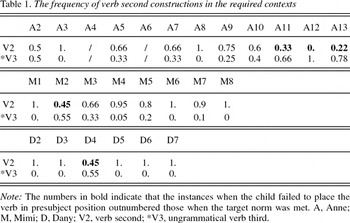
This brings us back to the other phenomenon investigated by Schlyter and Håkansson (1994), namely, examples where the subject preceded the verb, although the target grammar requires postverbal position. To understand whether the frequency of surface SV order and, more importantly, of ungrammatical *V3 constructions can indeed be interpreted as failed acquisition of the grammar of the V2 phenomenon, I have recalculated the frequencies provided by Schlyter and Håkansson (1994), relating the number of uses of V2 and *V3 to the total number of contexts where V2 is required by the target grammar. The results displayed in Table 1 list the recordings where, according to Schlyter and Håkansson (1994), Swedish is the WL of the three bilingual children Anne (A), Mimi (M), and Dany (D).

The numbers in bold in Table 1 indicate that the instances when the child failed to place the verb in presubject position outnumbered those when the target norm is met. Clearly, this was only the case during the last three recordings with Anne and during one recording each with Mimi and Dany. In fact, Dany only used *V3 order during a single recording. It is of interest that this happened at a point when his MLU value in Swedish (2.9) was markedly lower than in French (4.4), whereas in all other recordings this difference never exceeded 0.2, and as of D6 it was, in fact, higher in Swedish than in French. Similar observations apply to Anne and Mimi; their French MLU rose significantly at A10 and M2, whereas it remained more or less constant in Swedish at this point. This confirms the correlation between low MLU values and use of *V3 observed by Schlyter and Håkansson (1994). However, it also strongly suggests that what causes these target-deviant patterns to appear is not a lack of grammatical knowledge. The fact that these children initially used V2 correctly, in some recordings even categorically, and that they continued to place the verb correctly after the period when Swedish is the WL, clearly supports the claim that they have set the V2 parameter to the correct value. What remains to be explained is why they temporarily did not seem to be able to perform correctly.
Let me briefly return to the SV/VS ratio. It should be noted that one finds considerable variation in this ratio over time for individual children, both those who are monolingual and bilingual. Occasionally it dropped to 50/50% and even lower, and it rose to 80/20% for monolinguals. In addition, children who are said to develop Swedish as the WL also attained values close to the L1 average, for example, 69/31% for D6. This kind of variability over time suggests that, just as *V3 has been shown not to be the predominant pattern indicating acquisition failure, the SV/VS ratio also reflects a particular kind of use of the acquired knowledge rather than a lack thereof. It is true that the overall frequency of SV is higher in the WL of bilinguals than in the other types of acquisition studied here, but this may simply result from the fact that contexts requiring V2 are rare. However, one might speculate that it reveals avoidance behavior. Sticking rigidly to one word order pattern, for example, SVO, has indeed been explained as a kind of simplification strategy in that it avoids the necessity of moving elements to the left periphery. Whether this speculation is on the right track or not, I do not think the SV/VS ratio can possibly provide insights into the learners' grammatical knowledge. In fact, Schlyter and Håkansson (1994, pp. 55–56) themselves remark that it may not be an appropriate criterion for evaluating success in parameter setting, but that we may instead be dealing with “a question of lack of control.”
To conclude this discussion of Schlyter (1993) and Schlyter and Håkansson (1994), one can certainly say that they have demonstrated that one of the languages of bilinguals may develop more slowly in terms of MLU values, as well as a number of other, more refined measurements. Moreover, they have drawn our attention to the fact that the WL may exhibit types of usage that are uncommon in the speech of the respective monolinguals or of bilinguals who acquire this language as the stronger one. The claim, however, that the WL is acquired as an L2 and, more specifically, that the V2 parameter is set to the wrong value in “weak Swedish,” as argued by Schlyter and Håkansson (1994, p. 55), does not seem warranted by the analyses presented thus far.
“Unusual” constructions in the WL: Competing processing mechanisms?
These last remarks already sum up much of what has been achieved thus far; the WL of bilingual children may indeed exhibit constructions that are otherwise uncommon or that are used more frequently and more persistently than in monolingual acquisition. Admittedly, rejecting the claim that such kinds of use indicate acquisition failure still leaves us without a satisfactory account of what causes such patterns to emerge in bilingual child language.
Let me first recapitulate briefly some reasons why these constructions do not constitute evidence in support of the claim that parameters have been set to different values compared to the target grammar. The crucial observation, in this respect, is the variability of the word order patterns in the Swedish–French corpus. It should be noted, however, that similar observations have occasionally also been made in other studies. Döpke (1998, 2000a, 2000b), for example, in her research on German–English bilinguals, found what she refers to as “unusual structures.” These include word order patterns in which the finite verb follows the negator, that is, *NEG Vfin instead of German Vfin NEG; an example is given in Example 1.
1. *Hund nicht kommt rein
dog not come in
“(the) dog doesn't come in”
It is interesting that this construction is neither in accordance with German nor with English grammar. Because the finite verb precedes its particle (P), it must have been raised above VP; but it does not precede NEG and has thus not been moved above NEG. In English, it would not have moved out of VP, whereas in German it should have gone to CP. It is of importance that already before the children started using such constructions, the V2 effect was well attested in their use of German, and V2 structures were also used simultaneously with the incriminated patterns. These data thus exhibit variability in that the “unusual structures” occur simultaneously with target structures in individual learners. Moreover, the problematic constructions appear only temporarily and subsequent to a period during which the target structures are used productively. In fact, the problematic ones emerged at a point in development when longer and more complex utterances began to be used, and they later disappeared again.
These observations are interpreted as constituting strong evidence against the assumption that the target-deviant structures indicate a failure in acquiring the target grammar system, and certainly against the claim of target-deviant settings of the respective parameters. Not only is the idea of repeated resetting, for example, from +V2 to −V2 and back to +V2 in German, highly improbable for principled reasons (Meisel, 1995; Müller, 1994), but also setting a parameter to a specific value should lead to abrupt changes in use, not to alternating use of two options. Instead, the observed kind of variable use of certain constructions at different moments in the course of development and in different contexts favors an explanation relating to particular problems of bilingual language use. This, of course, is reminiscent of the proposal by Schlyter and Håkansson (1994, pp. 55–56), who accounted for the SV/VS ratio in terms of a “lack of control.” It is also compatible with Döpke's own explanation of her findings.
A particularly interesting proposal that can contribute to a better understanding of the phenomena under discussion was put forth by Hulk (2000) as an explanation of “deviant word orders” in the simultaneous acquisition of Dutch and French reported on by Hulk and van der Linden (1996) and Hulk (2000). Their observation refers to the use of French by Anouk, a bilingual child whose first multiword utterances exhibited variable order, including OV patterns. Because, at this point, the child did not yet show evidence indicating that functional projections were activated in her grammar of French, the authors concluded that, “nothing interesting can yet be said about word order” (Hulk, 2000, p. 62). During the next phase, SVO became the predominant pattern, although Anouk continued to use OV in her French, with finite as well as nonfinite verbs. Hulk and van der Linden raised the question of whether this was due to influence from Dutch. It is interesting that their review of studies on the acquisition of French revealed that constructions of this type appear in monolingual child French as well, possibly a reflection of adult patterns with a fronted constituent, for example, O-subject clitic (SCL)-V, except that the SCL is omitted, as is frequently the case in child language during this developmental phase. According to these authors, OV patterns appeared more frequently in the speech of the bilingual child than in the language of monolinguals. Hulk and van der Linden (1996) took this difference in frequency as evidence for an indirect influence of Dutch. According to Hulk (2000, p. 74), this means “that the XP_V orders in bilingual French–Dutch children are not an example of transfer of basic Dutch OV-orders nor of missetting of a parametric value on the basis of the Dutch input.” Rather, she proposed an explanation in terms of specific processing mechanisms in bilingual language use where “one language is activated whereas the other is inhibited. However, inhibition is never complete” (Hulk, 2000, p. 75). This, of course, supports my previous suspicion that the “unusual structures” can most likely be accounted for as bilingual language use, that is, as a kind of ‘covert code-switching’ by which structural properties of the other language are activated, but no lexical material from that language is inserted. Although this proposal clearly needs to be elaborated in more detail, there can be no doubt that it covers the empirical observations summarized here more completely and more adequately than the hypothesis which characterizes the WL as the result of incomplete acquisition.
SIGNS OF WEAKNESS IN THE NONPREFERRED LANGUAGE?
Having examined some constructions that had been attributed to acquisition failure in what is supposed to be the WL of bilingual children, let us now look at the nonpreferred and arguably nondominant language of bilingual children to detect possible signs of incomplete acquisition. With this goal in mind, I briefly summarize some analyses of data from two French–German children in the DuFDE (Deutsch und Französisch—Doppelter Erstspracherwerb/German and French—Simultaneous First Language Acquisition) corpus who avoided speaking French for an extended period of time; see Schlyter (1990) for more details concerning methods of data collection and analysis of this corpus.
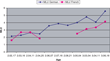
Christophe is the second child of a French mother and a German father growing up bilingually in Northern Germany. His mother consistently addressed him in French. He interacted with his brother and his father in German. When he was about 2;6, his mother temporarily abandoned speaking French to him because he responded mostly in German, and at around age 3;0 recordings were discontinued because he hardly spoke any French. Three months later, recordings were resumed at the request of the parents, because after visits to his grandparents in France, he used French again. When Christophe, at approximately age 3;10, started to avoid speaking French once again, the frequency of the recordings was reduced to one every 3 months, rather than every second week. Of interest, it is in the recordings immediately after the interruption that his French MLU exceeds the value of 3.0 for the first time. In other words, his MLU values had not dropped after his period of silence in French, but they instead become consistently lower than in German, as is shown by Figure 1, taken from Rieckborn (2006) and based on the MLU values calculated by Schlyter (1990).

The development of Christophe's mean length of utterance values. [A color version of this figure can be viewed online at www.journals.cambridge.org]
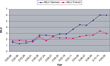
François was also his parents' second child. His mother addressed him in French, and he interacted with his sister and with his father in German. During the age period ranging from 2;8 through 4;3 he spoke very little French, and his mother temporarily gave up addressing him in this language. When, at around age 4;0, he began to attend a monolingual German kindergarten, he, in fact, refused to speak French altogether. During virtually this entire period, his MLU values stayed below 3.0 in French, whereas they steadily increased in German and reached 6.0 at the age of 3;10. After a stay in France, however, he resumed speaking French again at age 4:03, and his French MLU values remained consistently above 3.0, from then on. Several other visits in France seem to have continued to foster this development. The development of his MLU values up to age 4;0 is shown in Figure 2, also taken from Rieckborn (2006).

The development of François' mean length of utterance values. [A color version of this figure can be viewed online at www.journals.cambridge.org]
As is evident from these short biographical notes, as well as from the MLU values, German was indeed the dominant and the preferred language, as defined above, for both children, at least after an initial period ending for Christophe at around age 2;4 and for François at approximately age 2;6. This is, in fact, confirmed by a comparison of the development of the verbal lexica in the two children, carried out by Rieckborn (2006). She argued that the number of verb types is a more reliable criterion for strength and dominance than utterance length; see Arias et al. (2005) for a discussion of this claim. The question now is whether this asymmetry between the two languages is reflected in the grammatical development of these two children.
In view of our previous discussion of the WL, word order is clearly a prime candidate for possible fundamental differences between the weaker and the stronger languages. Bonnesen (2005) therefore studied the linguistic development of these two children, to discover whether their use of French word order revealed significant differences when compared to monolinguals or balanced bilinguals. The unambiguous result of his analysis is that neither of the two children used word order patterns deviant from the target norm. There was no evidence, for example, that German I-to-C movement of finite verbs had transferred into French. Rather, both children used French V3 constructions in contexts where German requires V2. Similarly, both children placed finite verbs before and nonfinite verbs after the French negative element pas, indicating that finite elements had been raised out of VP and confirming that the acquisition of finiteness or of the respective verb morphology is not dissociated from the acquisition of verb movement, as has been argued to be the case in L2 acquisition. Moreover, Bonnesen (2006) examined two further phenomena that have been argued to reveal differences between L1 and L2 acquisition, namely, the use of French subject clitics and the rate of omission of subjects. Apart from the fact that grammatical development in French appeared to be delayed in at least some cases, the only “unusual” fact detected was that Christophe used clitic subject pronouns together with nonfinite verb forms in four utterances. Bonnesen's (2006) detailed analysis of clitics in this child's language leaves no doubt that these are indeed clitic elements in the developing grammar. In sum, this study did not find any evidence suggesting qualitative difference between these children's acquisition of French when compared to monolingual or balanced bilingual children.
The same conclusion is drawn by Rieckborn (2006), who studied the acquisition of grammatical aspect and tense in French by these children. The particular interest of this investigation stems from the fact that tense and aspect represent a notoriously difficult area even for advanced L2 learners. This study, however, demonstrated that Christophe and François proceeded through exactly the same developmental phases as the respective monolingual children. It is important that this parallelism was not limited to the emergence of semantic notions but extends to the availability of grammatical structures, that is, the respective functional projections, in the course of acquisition of tense and aspect. Again, what was unusual about the two boys' acquisition of French was that their rate of acquisition is delayed, in comparison to monolinguals or balanced bilinguals, especially in the case of Christophe who, at the age of 5 still did not use futur simple, imparfait, or plus-que-parfait. In other words, the analysis of this grammatical domain confirms that the acquisition of French, the language that both children avoided speaking during an extended period of time, proceeded more slowly than habitually, but it showed no signs of being acquired as an L2.
In sum, then, although it is hardly possible, if at all, to find empirical evidence for the nonexistence of a phenomenon that is hypothesized to exist, the absence of the predicted empirical evidence of this phenomenon is undoubtedly telling. My tentative conclusion therefore is that investigations of the nonpreferred language in the simultaneous acquisition of bilingualism suggest that the WLH cannot be maintained.
DISCUSSION AND OPEN QUESTIONS
At the outset of this paper, I stated that previous research had shown that the human language making capacity is an endowment for multilingualism, and I raised the question of whether the LAD was sufficiently robust to make native language acquisition by mere exposure possible, even if the child avoids using the target language and if another language is dominant in the learning environment. More specifically, the question is whether acquisition of the WL might fail in at least some domains of grammar under such circumstances and, if yes, whether this might resemble second language acquisition.
In brief, the foregoing discussion suggests that the rate of development can indeed be delayed, in some cases quite seriously. Whether this can ultimately lead to incomplete acquisition in that certain phenomena that are typically acquired late will not be acquired anymore, is a question that cannot be answered, based on the available research results. For the time being, delay must be regarded as a quantitative modification of the process of acquisition. As for possible qualitative effects, my conclusion is that the WL is certainly not acquired as an L2. Apparent evidence in support of this hypothesis has not stood up to scrutiny. As should have become evident, for example, with respect to word order regularities, learners did have the relevant grammatical knowledge, and they used it before, after and simultaneously with target-deviant constructions. This kind of pattern over time constitutes strong evidence against the claim of wrongly set parameters or failed acquisition. Rather, it suggests that these children encountered problems in putting their knowledge to use.
In other words, and picking up on the initial question, the robustness of the LAD has thus far been confirmed in an impressive manner. What appears to be more easily affected by unfavorable acquisition conditions is the capacity to put the acquired knowledge to use. Reference to a “lack of control” or to “insufficient inhibition of the other language” gives, of course, only a vague idea of what is at stake here and calls for further investigations. As a first approximation, one can say that children acquiring two languages simultaneously are obviously capable of differentiating two grammatical systems from early on, even under less than favorable conditions. However, in a situation where one language is strongly dominant, it appears to be difficult for some children to cope with the task of establishing and developing the sets of mechanisms required for bilingual language use. The latter include the ability to switch into the other language or, conversely, to inhibit inappropriate switches. Note that normally both languages may be activated, at various levels of representation, but only one is put to use, the other one being temporarily inhibited (Grosjean, 1999). Failure to inhibit morphosyntactic activation of the dominant language could thus account for the unusual constructions observed in the literature (even where the semantics or the phonology of an utterance are targetlike, which is important). However, such failures might also be viewed positively, if, for example, they serve as a relief strategy. This is, in fact, what Gawlitzek-Maiwald and Tracy (1996) and Bernardini and Schlyter (2004) have suggested. They hypothesize that bilingual children resort to knowledge from the “stronger” language if grammatical development in the other language is considerably delayed. To the extent that such claims can be corroborated and sentence structures underlying bilingual utterances can indeed be shown to contain functional layers from both languages, this could count as indirect evidence for the possibility of simultaneously resorting to two knowledge systems, especially when demands increase and exceed the possibilities of the language that ordinarily tends to be avoided in use.
Let me emphasize that the tentative conclusion that the available evidence does not support the WLH obviously does not exclude the possibility of acquisition failure. In fact, one may plausibly expect that the LAD must fail at some point as acquisition conditions deteriorate. What is unsatisfactory about the WLH is that it does not explain what the minimal conditions are, thus making it virtually impossible to falsify its claims. The discussion of causal factors, for example, has focused almost entirely on the quantity of exposure to languages or what I refer to as dominance. One can, of course, assume that multilingual settings lead to reduced input in each language, if only because, trivially, the amount of daily interaction is distributed over two languages (Paradis & Genesee, 1995). However, this does not cause problems for early grammatical differentiation, and it can, at best, be part of the answer to the question of what might cause acquisition failure, because virtually every study on this subject shows that only some of the children exhibit “weaknesses” in one language, despite significant similarities in learning contexts. To my knowledge, no satisfactory account of this fact has as yet been proposed, but one can speculate that the children themselves reduce the quantity of input, for example, by avoiding interaction in that language, thus further limiting the basis for acquisition. Even if this speculation is on the right track, it leads again to the causality problem. Do some, but not all, learners exhibit this behavior because of different attitudes toward the particular language (community), toward bilingualism, and so forth? Speculating further, is it also possible that some learners cope more easily than others with the task of becoming bilingual, fostered by their neuropsychological makeup? At any rate, amount of exposure is unlikely to suffice as an account of the phenomena discussed here. If what has been reported at the beginning of this paper is correct, concerning incomplete acquisition during very early phases of monolingual L1 development, the role of input depends crucially on the learner's sensitivity to specific kinds of input at certain points during the course of acquisition, that is, we have to do with an interplay between amount of exposure and sensitive phases of the acquisition device. Conversely, Sorace (2005) suggested that quantitative differences, compared to monolinguals, will only cause a delay in acquisition, whereas qualitative differences in the input may indeed result in representation problems, at least for interface phenomena.
This last remark leads to a final point I would like to make. For the WLH to be empirically testable, it is necessary to state in a principled fashion exactly which areas of grammar are likely to be affected. It is fairly obvious, from what we know thus far, that not every domain of grammar is vulnerable. However, as should be evident from the previous discussion, it is by no means clear whether grammatical theory or a theory of acquisition can define vulnerable domains. A number of recent studies, stimulated by a suggestion by Platzack (2001), explored the possibility that the C-domain of sentence structure, serving as the interface between computation and interpretation of structures, might provide the defining criteria. Unfortunately, this has turned out not to be correct; see Bonnesen (in press) for a more detailed discussion of this issue. Remember also that one of the most likely candidates for acquisition failure identified in our review of some possibilities suggested in the literature was grammatical gender, undoubtedly not related to the C-domain. Hulk and Cornips (2006) also identify gender as a vulnerable domain in acquisition and attempt to explain this as a result of it being a phenomenon at the interface between syntax and pragmatics, similar to Sorace (2005). At this point, this issue cannot be pursued further. What the remarks in this last section suggest, however, is that the WLH can only be fruitfully explored if its proponents formulate theoretically motivated and empirically testable claims about the grammatical domains affected and the external factors causing such effects.
This study was carried out as part of the research project Simultaneous and Successive Acquisition of Bilingualism. It is one of several projects funded by the DFG (Deutsche Forschungsgemeinschaft) within the Collaborative Research Center on Multilingualism established at the University of Hamburg. The DFG also funded the research project DuFDE through several research grants (1986–1992) to me. Financial support by the DFG is gratefully acknowledged. I also thank my coresearchers on the current research team for their valuable contributions: Matthias Bonnesen, Noemí Kintana, Susanne Rieckborn, and Claudia Stöber. I am furthermore indebted to an anonymous reviewer and to those who have discussed with me the issues dealt with in this paper, especially Susanne E. Carroll, Gisela Håkansson, Esther Rinke, and Suzanne Schlyter. Parts of this paper were presented at the 17th Workshop on Theoretical and Applied Linguistics (Thessaloniki, 2005), at the 10th Congress of the International Association for the Study of Child Language (Berlin, 2005), and at the conference on Language Acquisition and Bilingualism (Toronto, 2006). I thank the various audiences for their feedback.