INTRODUCTION
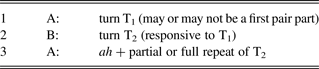
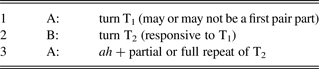
This article deals with a practice in French talk-in-interaction that is formally characterized as other-repetition prefaced by the particle ah. This particle has often been treated as comparable to English oh in many of its uses, including those where it constitutes or forms part of a receipt. Although the linguistic form [ah + other-repeat] is occasionally used for other purposes in other sequential positions,Footnote 1 it overwhelmingly appears in postexpansions. In this position, ah-prefaced repeats can be characterized as doing the work of a receipt, specifically receipt of turns conveying responsive actions. The structure in Table 1 can be taken to represent, very generally, the sequences in question.
Schematised representation of sequences involving ah-prefaced repeats.
For a first illustration of how the practice may be deployed, consider the extract in (1).
(1) (UBS.187_000000BC.0:00)
(C is calling her mother M who works at UBS, a university)

A few simple initial observations are in order. First, when C does a turn (line 3: oui c'est moi::) explicitly dedicated to securing identification (relying on her voice), she displays the understanding that M is not aware of who is calling, judging by M's initial institutional greeting. The focal turn at line 5 (ah c'est toi:::) does the job of marking receipt, claiming that M has heard, understood, and taken in what C's turn was doing. Second, the focal turn does more than that: it claims that while M is informed now, she did not know that it was her daughter calling when she answered the phone with the institutional greeting. Thus M retrospectively casts her first turn as less than optimal for launching a conversation that has now turned out to be between herself and her daughter. Third, it can be noticed that the work done by the receipt implicates not only the receipted turn (line 3), but also the turn to which that turn responds (line 1). These initial remarks are some indications of issues that the focal practice deals with, and that the remainder of this article explores more in depth.
The article is organized as follows. After some short remarks on the data and the methodology, previous research on various types of recipiency tokens and other-repeats is reviewed. In the analytic section which follows next, the phenomenon is more precisely delimited and its sequential environments of occurrence explored, before the analysis turns to so-called attendant activities, undertaken later in the same sequences as the ah-prefaced repeats. Next, the focal practice is contrasted and compared with other types of receipts, and with alternative practices in contexts where an ah-prefaced repeat would seem to be a relevant option. Two phonetically differentiated variants of the practice are then investigated, along with the sequential organization of each variant. Finally, a concluding discussion draws out some implications.
DATA AND METHOD
This study is undertaken within a conversation analytic framework (cf. e.g. Heritage Reference Heritage1984b; Schegloff Reference Schegloff2007; Sidnell & Stivers Reference Sidnell and Stivers2013). Where phonetic aspects of talk are considered, the approach taken is along the lines of Local & Walker (Reference Local and Walker2005).
The study is based on a core collection of fifty-three instances of the target practice (in addition to instances of nonoccurrence, cf. the section discriminability), collected from naturally occurring French talk-in-interaction. Data include both ordinary conversations and interactions in various different institutional settings, originating from several different corpora recorded under varying circumstances. While no claims of universality are made, the heterogeneity of the data suggests a widespread use. The majority (about 75%) of the examined recordings are telephone conversations, but some audio recordings of co-present interaction have been included.
The transcriptions and translations have been made by the author (see the appendix for conventions and some remarks on these).
Pitch traces were produced with the Praat software (retrieved from http://www.praat.org), and manually verified by comparison of tracked pitch and perceived pitch. Impressionistic phonetic transcriptions were made in accordance with the IPA (2005 version).
PREVIOUS RESEARCH
Previous work within various traditions has explored particles (such as ah/oh) as well as repeats from the point of view that they may constitute less-than-full turns at talk. Given the composition of our focal practice, such research is worth considering. At least since Yngve (Reference Yngve and Campbell1970), researchers have investigated tokens such as mm-hm, uh-huh, yeah, right, oh, I see, collaborative completions, requests for clarification, and other types of short utterances, as well as some bodily movements, as instances of back-channels or feedback (Sinclair & Coulthard Reference Sinclair and Coulthard1975:42; Duncan & Fiske Reference Duncan and Fiske1977:201–202; for a more thorough review, see Gardner Reference Gardner2001). In many cases, repeats have also been included in the back-channels category (e.g. Clancy, Thompson, Suzuki, & Tao Reference Clancy, Thompson, Suzuki and Tao1996), and in fact the precise delimitation of the category has not always received much attention (Gardner Reference Gardner2001:15). The main function of back-channels has holistically been taken to be the display of attention and/or understanding, and the contribution of individual back-channel utterances has often been deemed difficult to analyze (Ward & Tsukahara Reference Ward and Tsukahara2000:1184). Hence, many studies have focused not so much on detailed analysis of particular occurrences, but on the (quantitative) characterization of the distribution of back-channel objects (Clancy et al. Reference Clancy, Thompson, Suzuki and Tao1996; Koiso et al. Reference Koiso, Horiuchi, Tutiya, Ichikawa and Den1998; Ward & Tsukahara Reference Ward and Tsukahara2000; Edlund & Heldner Reference Edlund and Heldner2005), and this holds for research on back-channels in French as well (Laforest Reference Laforest1992, Reference Laforest and Drescher2006; Bertrand, Ader, Blache, Ferré, Espesser, & Rauzy Reference Bertrand, Ader, Blache, Ferré, Espesser and Rauzy2009; several of the contributions to Cosnier & Kerbrat-Orecchioni Reference Cosnier and Kerbrat-Orecchioni1987).
Within conversation analytic research, these tokens have been treated not as something to be studied separately from what goes on in the main channel, but as part of the same flow of interaction. Consequently, they have been shown to be used by interactants in specific and orderly ways, thus enabling the analytic distinction of different tokens (in given sequential positions) as discriminable interactional objects, and the teasing apart of different items in the tentative class back-channel (Schegloff Reference Schegloff and Tannen1982; Heritage Reference Heritage, Atkinson and Heritage1984a; Jefferson Reference Jefferson1984, Reference Jefferson1993; Mazeland Reference Mazeland, Conein, de Fornel and Quéré1990; Zimmerman Reference Zimmerman1993). As Schegloff (Reference Schegloff and Tannen1982) remarks on the subject of uh-huh, while it is one way in which a speaker may display attention or understanding, it is but one way among many. In fact, such a holistic analysis does not explain why, in any particular situation, a speaker would choose uh-huh rather than any other talk or behavior that would also signal attention or understanding. In analyzing some instances of uh-huh as continuers, Schegloff (Reference Schegloff and Tannen1982) provides an illustration of how careful sequential analysis can reveal the systematic and rational use of such tokens, while at the same time questioning the usefulness of the category back-channels. Indeed, it seems unreasonable to include in one catch-all category such different things as, on the one hand, continuers, which pass on an occasion to initiate repair, and on the other hand, requests for clarification, which may be thought of as (a paraphrase for) repair initiation (Schegloff Reference Schegloff and Tannen1982:87–88).
Various other types of short utterances, elsewhere treated as back-channels, have since received action-sequentially based accounts. These include, for instance, assessments (Goodwin Reference Goodwin1986), the receipt token oh (Heritage Reference Heritage, Atkinson and Heritage1984a), news receipts (Local Reference Local1996), collaborative completions (Lerner Reference Lerner and Lerner2004), and many others. One general finding that may be noted from such research, is that other (and arguably more interesting) things may be learned about these objects if they are studied case by case on a micro-level, focusing on their role in the moment-by-moment unfolding of particular instances of interaction, as opposed to a macro-level, where discoveries and explanations are sought and warranted in the aggregate of many instances (cf. Zimmerman Reference Zimmerman1993:190; Schegloff Reference Schegloff1993:117; Sacks Reference Sacks1995:27–28, 65). The investigated objects may differ in many respects relevant to the emerging structure of interaction, for example the degree to which they claim incipient speakership (cf. Jefferson Reference Jefferson1984, Reference Jefferson1993; Beach Reference Beach1993; Drummond & Hopper Reference Drummond and Hopper1993), the degree to which they treat preceding talk as a completed unit (cf. Schegloff Reference Schegloff and Tannen1982; Heritage Reference Heritage, Atkinson and Heritage1984a; Goodwin Reference Goodwin1986; Gardner Reference Gardner1997, Reference Gardner1998), or the degree to which they mobilize response, such as a confirmation or a topical development (cf. Heritage Reference Heritage, Atkinson and Heritage1984a; Maynard Reference Maynard1997).
A brief and selective survey of research on other-repeats is also due here (self-repeats are not discussed here, but see Curl Reference Curl2002). Repeats (sometimes termed echo utterances) have long been studied within both linguistics and more discourse-oriented approaches (e.g. Bolinger Reference Bolinger1957; Quirk, Greenbaum, Leech, & Svartvik Reference Quirk, Greenbaum, Leech and Svartvik1985; Halliday & Hasan Reference Halliday and Hasan1976; Norrick Reference Norrick1987; Tannen Reference Tannen1987), but it is conversation analytic research that has contributed the most to our current knowledge of the work repeats can do in talk-in-interaction. Schegloff (Reference Schegloff1996:177–79) describes three general sequential positions in which repeats appear, and the consequential differences in terms of function. First, repeats may be used sequence-initially, typically initiating repair (some relevant references are Jefferson Reference Jefferson and Sudnow1972; Selting Reference Selting1996; Sorjonen Reference Sorjonen, Ochs, Schegloff and Thompson1996; Schegloff Reference Schegloff1997; Drew Reference Drew2003; Wu Reference Wu2006; Svennevig Reference Svennevig2008; Robinson Reference Robinson2009, Reference Robinson, Hayashi, Raymond and Sidnell2013; Robinson & Kevoe-Feldman Reference Robinson and Kevoe-Feldman2010; Benjamin & Walker Reference Benjamin and Walker2013). Second, repeats may be used responsively, in second position, to do an answer (cf. Schegloff Reference Schegloff1996; Sorjonen Reference Sorjonen2001a:72–80, Reference Sorjonen, Selting and Couper-Kuhlen2001b; Svennevig Reference Svennevig2003; Heritage & Raymond Reference Heritage, Raymond and de Ruiter2012) or otherwise (Couper-Kuhlen Reference Couper-Kuhlen1996; Schegloff Reference Schegloff1997:531–36; Bolden Reference Bolden2009). Third, repeats sometimes do the work of sequence-closing thirds, registering and receipting previous talk (Goldberg Reference Goldberg1975:276–78; Sorjonen Reference Sorjonen, Ochs, Schegloff and Thompson1996; Schegloff Reference Schegloff1997:527–31; Svennevig Reference Svennevig2004). In particular, Robinson (Reference Robinson2009) shows that repeats may serve to register a correction proposed by a coparticipant, independently of the acceptance of that correction (Robinson Reference Robinson2009:570). To the best of my knowledge, Robinson (Reference Robinson2009) is as close as previous research has come to a treatment of oh-prefaced repeats in English (or ah-prefaced repeats in French). Robinson (Reference Robinson2009) describes a practice whereby a speaker repeats a counter-informing to challenge it, while at the same time providing the counter-informer with an opportunity to modify the counter-informing. One variation of this practice involves prefacing the repeat with oh, which ‘tends to laminate [a] stance of tentative acceptance onto the focal practice, and can begin to transform it into more of a “newsmark”’ (Robinson Reference Robinson2009:581; cf. also Heritage Reference Heritage, Atkinson and Heritage1984a:312). We may note, then, that this kind of receipt is sequentially sensitive not only to the repeated turn (the counter-informing), but also to the turn before that.
The present article takes into account phonetic aspects of the investigated phenomenon. Space considerations here prohibit a full review of the research strand dealing with the phonetics and prosody of talk-in-interaction, but see Selting (Reference Selting, Barth-Weingarten, Reber and Selting2010) for a fairly recent overview. Suffice to say here that studies of various types of receipts, continuers, and particles (often in German: Golato & Fagyal Reference Golato and Fagyal2008; Betz & Golato Reference Betz and Golato2008; Golato Reference Golato2012; Barth-Weingarten Reference Barth-Weingarten2011; but also in English: Local Reference Local1996; Gardner Reference Gardner2001; and in Italian: Müller Reference Müller1996) have demonstrated that participants use the phonetic and prosodic design of these objects as resources for handling such things as (dis)affiliation, epistemic issues, and sequence organization. Thus, assuming a participants’ perspective necessitates considering phonetic and prosodic design.
ANALYSIS
A few short remarks on the delimitation of the examined practice are in order. First, the particle ah is not separated from the repeat by a pause (the absence of a pause is essential for an instance of the practice to be recognizable as such to participants, since each of the two components is—by itself—a form of receipt). Second, the repeat may be a partial or a complete recycling of lexical material from the previous turn. Third, the repeat may incorporate certain transformations, such as deictic changes due to the speaker shift, and pronominalization of nouns (for more details, see Persson Reference Persson2014:119). It should be noted that this delimitation is an outcome of the process of collecting and excluding cases, rather than a part of the research design a priori (cf. Schegloff Reference Schegloff1997).
Any interactional practice has generic and recurrent (context-free)Footnote 2 properties, by means of which it can be deployed and understood in always new and ultimately unique situations, in relatively stable ways. Practices also have potential for particularization (context-sensitivity), that is, they take on particularized meanings and functions in each situated instantiation. The argument made and warranted in this article is that the work generically accomplished through the focal practice involves claiming receipt of the other's turn, while at the same time retrospectively indexing one's own previous action as inadequate or inapposite. Importantly, this is not the ‘sum’ of the effects of two separate receipt elements (change-of-state particle and repeat), but the effect of a practice involving both elements. The expressions inadequate/inapposite are intentionally vague in order to cover the wide range of ‘failures’ that speakers recognizably index as such by deploying the target practice. Returning to extract (1), we can see that M deploys the target practice (line 5) to claim receipt of C's self-identifying informing (line 3), while also indexing her own previous action (the initial greeting at line 1) as inadequate, in this case for reasons related to recipient design.
Sequential environments
One way of showing that a conversational practice is systematically and purposefully deployed by participants is to examine the particular sequential environments in which it regularly appears, and to demonstrate how the practice is responsive to certain concerns that arise in such sequential environments, that is, how the practice is a solution to practical problems apparent in those environments. This article discusses the two most frequent sequential environments for the target practice, as well as a less frequent one. For clarity, it can be pointed out that the sequential position of the ah-prefaced repeat in relation to its immediate context is constant to a certain degree—it is always in a receipt position—so what is examined here are rather the wider sequential environments in which the receipt is used and, relatedly, which type of turn is being receipted.
The first of the two frequent sequential environments is after third position repairs (Schegloff Reference Schegloff1992). In short, a third position repair is one that is initiated and effected not in the same turn as the trouble source, nor in the next turn, but in the turn that is responsive to the next turn. Consider the concise example given in (2) (reproduced here as given by Kitzinger Reference Kitzinger, Sidnell and Stivers2013:247).
(2) (Holt corpus – X(C):1:2:7)

Line 2, being in second position and responsive to the turn in first position at line 1, reveals an understanding that Mum treats as problematic at line 4. This turn at line 4, then, is the repair done in third position, upon discovery of how the turn in first position was analyzed (in second position) by Les.
The extract in (3) illustrates the focal practice as deployed in receipt of a third position repair.
(3) (OTG.1PF0491.0:00)
(Interaction in a tourist information office, between the clerk A and the customer C.)

The customer C's elliptic inquiry, in the second part of line 2, is responded to by A at line 3 (line 5 seems to reconfirm that response). After a next-turn repair initiation at line 7 (concerning the response), the response is redone at line 9 and then at line 11. This repaired response is thus a sequential next to the inquiry made at line 2. As it turns out, C treats the repaired response as warranting a third position repair, clarifying how the initial inquiry should be understood, and the third position repair is done at lines 12–13. While not serially third, due to the interfering next-turn repair sequence, the third position repair is in fact sequentially third, by reference to the initial inquiry. The third position repair is composed of a rejection component (notably the part pas les TAG) and the repair proper (line 13). The clerk A responds to the repair with an ah-prefaced repeat (a::h les VFD), followed by a renewed response to the inquiry made in first position.
The focal practice lends itself well to managing two relevancies that systematically arise after third position repairs. First, it serves to acknowledge receipt of the third position repair, which may now be treated as successful—no further efforts being necessary to establish the reference. Second, it acknowledges the claimed inadequacy of the previous attempts to respond to the trouble source turn (the inquiry). In doing so, it is a way for A to align with C's representation of A's displayed understanding as problematic. The aforementioned two relevancies seem to be the basis for the recurrence of ah-prefaced repeats in this particular sequential environment.
The second sequential environment, where the focal phenomenon is frequently found, is after turns that challenge the presuppositions or assumptions of the previous turn. Consider extract (4).
(4) (TCOF.Reunion_LUC_08.11:36)
(Informal meeting between two business associates.)

While A's turn that takes up lines 1–3 and 6 is designed as a news telling about a common acquaintance, B does not accept this telling as news (line 7). Thus, B's response is challenging, in that it rejects one basic assumption of A's news telling: that B does not already know. This is also lexically conveyed via the turn-initial particle ben, roughly ‘well’, which enacts some form of resistance to the appositeness of the turn responded to. Two relevancies in this context (for A) are registering B's informing and acknowledging the implicated inadequacy of A's news telling. The ah-prefaced repeat that A produces at line 10 is a way of dealing with both of these relevancies. After the focal turn (line 10), B reconfirms (ben oui ‘well yeah’) and then accounts for his knowledge.
The two types of sequential environments explicated above are similar to some extent, in that one participant indicates some misconception on the part of another. The essential difference between the two environments is that while third position repairs are aimed at providing another opportunity to respond to the ‘misunderstood’ turn, the ‘challenging’ turns are not as clearly produced in search of a renewed response to something prior to the challenged turn. In both environments, ah-prefaced repeats serve to claim that intersubjectivity has been re-established after a breakdown in understanding, or after a discrepancy of background assumptions, respectively.
It is illuminating to also consider the deployment of the focal practice in less frequent sequential environments. Extract (5) is one such case.
(5) (OTG.3AP0272.0:00)
(Interaction at a tourist information office, between the clerk H and the customer C.)

At line 2, C produces a three-part request, to which H replies with a first response part at lines 3–4. A second part of the response (concerning hotels) is begun at line 5. At that point, C renews the ‘campsites’ part of the request (line 7), and H responds to that (lines 9, 11), with C acknowledging the response at line 12. Beginning in overlap with C's acknowledgment, H returns to the ‘hotels’ part of the response (at the end of line 11 and at line 13). An adjacency pair concerning the hotel guide follows (line 14 and the first part of line 15).
The second part of line 15 (et après les locations ‘and then the rentals’) mentions another type of accommodation. As indicated by the increment subsequently added at line 17, this part is closer to a volunteered offer than a response part directly prompted by C's request, and line 19 shows that C accepts the offer. C's delayed response to all of this begins with the ah-prefaced repeat at line 20 (ah les locations). Similarly to the more frequent sequential environments discussed above, here the target practice serves to acknowledge receipt of the repeated expression les locations (apparently unfamiliar to C), and to index C's sequentially previous action as inadequate: the request that yielded H's responses and the more volunteered part about the rentals. The remainder of C's turn at line 20 provides evidence of C orienting more explicitly to the specifics of the indexed inadequacy of the request: les locations is something that the request should have mentioned, since that turns out to be what C was putatively after.
Extract (5) illustrates the deployment of the focal practice in a less frequent sequential environment (the collection does not contain any similar cases), and the type of sequential environment itself might be a less recurrent one (a volunteered offer following a prior request for something related). However, the focal receipt turn, constituted by the ah-prefaced repeat, appears to do the same type of interactional work here as in the two more frequent sequential environments.
It should be noted that in the two more frequent environments (cf. extracts (3) and (4)), the turn prior to the receipt is where the inadequacy or inappositeness of the receipt-speaker's turn is first brought up. In those cases, by using the ah-prefaced repeat, the receipt-speaker aligns with the interlocutor's portrayal of the turn that is treated as problematic. The inadequacy, however, is not always first introduced by the interlocutor: as extract (5) shows, the ah-prefaced repeat can be used by receipt-speakers themselves to acknowledge the inadequacy of a prior turn, without any indications to that effect in the interlocutor's talk.
Attendant activities
Further insight into the work of the target phenomenon can be gained by examining other actions conveyed later in the same turn, as well as in the wake of the target turn. In fact, the phenomenon recurrently appears together with what has been termed attendant activities, typically found where correction is involved. These attendant activities include for instance instructing, complaining, admitting, forgiving, accusing, apologizing, and ridiculing—that is, behaviour ‘specifically addressing lapses in competence and/or conduct’ (Jefferson Reference Jefferson, Button and Lee1987:88). Extract (6), which bears a resemblance to extract (1), illustrates several of these activities (or actions).
(6) (UBS. 390_00000187.0:00)
(C is calling her mother M at work.)

After M's institutional greeting (line 1), C does not immediately self-identify, but instead produces, in between laughter tokens, a very high-pitched greeting at line 3 (f 0 between 500 and 700 Hz), which might complicate voice identification. M does not display having recognized C's voice, but returns the greeting (line 4), providing an opportunity to state the reason for the call. Relying on her ‘normal’ voice for self-identification, C does so while prefixing mais ‘but’ to her informing at line 5, lending the turn an objecting character—unlike in extract (1). The ah-prefaced repeat (line 6) that receipts the informing is M's first acknowledgment of the ‘mistake’, indexing her previous move as inadequate. In overlap with C's ensuing laughter, M follows this up with an account (lines 8–9) indicating that the ‘mistake’ was to respond as if it was a regular call to the institution, not knowing that it was her daughter calling. The account does not, by contrast, indicate that the inadequacy had to do with failed voice recognition.
Repeating her greeting at line 10 (at even higher pitch: f 0 between 700 and 1000 Hz), C once more manifests its nonordinary character. After some intervening business, C makes another effort to expose, or even ridicule, M's mistake: at lines 13–14, C quotes her own greeting in a nonordinary (potentially nonserious) voice, and M's ordinary response in a ‘serious’ voice, including an imagined ordinary follow-up (c'est pour qui ‘who do you want to speak to’). The inadequate behaviour, as it is retrospectively portrayed here by C, is slightly different from what M's account indicated: it has to do with M's not recognizing a nonserious call opening. M responds to C's reconstruction of the call opening with an objecting, multiple mais non (line 15) (cf. Stivers Reference Stivers2004), and another account (line 16), lexically designed as such (c'est pour ça ‘that's why’), which justifies M's failure to respond adequately to C's jocular greeting, by claiming ‘not being in the mood’ (arguably also representing C's ridiculing as coming at a bad time). Note that this second account is more suitable than the first (lines 8–9) with respect to the fault exposed by C at lines 13–14.
Extract (6) shows how the retrospective indexing works indexically indeed: it points to the presence of a prior inadequacy, the specifics of which may be further negotiated subsequently. Attendant actions and activities may thus provide further (and diverging) indications of the nature of the indexed inadequacy. Where attendant activities are present, they always follow (and never precede) the ah-prefaced repeat, whereas there appears to be no natural ordering among different attendant activities, explicit acceptances, and other elements co-occurring with the focal practice. A reason for the ordering of ah-prefaced repeats and attendant activities may be that the former indexes some inadequacy, thus minimally acknowledging it, whereas attendant activities bring it to the interactional foreground. The participants’ strategy would then be to begin, as a first step, with the minimal and possibly sufficient acknowledgment, and only as a second step, subject to interactional contingencies, resort to foregrounding and more explicitly dealing with the inadequacy.
Discriminability
One essential way of showing that the target practice does some characteristic, discriminable work is to demonstrate that other, similar practices (such as other ah-prefaced receipts, or repeats without any preface) achieve different things. This discovery and proof procedure is used in two ways here. First, the analytic account covers some ‘ineligible’ contexts, that is, environments that favor some form of receipt, but do not warrant the use of an ah-prefaced repeat because of the action(s) it would convey. Second, the deployment of alternative practices in ‘eligible’ contexts, that is, contexts of potential relevance, is considered. Thus, one can get a clearer sense of the deployment of the focal practice as a possible outcome among others, as a strategy used for certain interactional purposes, rather than a mere reaction, mandated by the context alone.
Concerning ineligible contexts, a simple, perhaps self-evident, observation to begin with is that other types of receipts are relevant where there is no previous action close at hand that the receipt-speaker could index as inadequate, such as when a volunteered, sequence-initiating informing is receipted. Some receipt tokens regularly used in such situations are for instance ah ouais ‘oh yeah’, ah bon ‘oh really’, and c'est vrai, roughly ‘really’.
One may continue by noting that second pair parts that align with and accept the presuppositions and assumptions of a first pair part do not in general make relevant a receipt in the form of an ah-prefaced repeat. An illustrative case, where a solicited informing is receipted by two different speakers, is extract (7).
(7) (CLAPI.chez_les_logeurs.5:13)
(German student S is spending a semester in France. Here, she is talking to her landlords, the couple E and F.)

E and F both contribute to soliciting the informing (lines 1 and 2), and S delivers it at line 4. E receipts it with ah oui ‘oh yeah’, and F with an unprefaced partial repeat (lines 5 and 6). The informing is extended by S (line 7), and E and F both receipt this with ah oui (lines 9 and 10), the latter in overlap with S's reaffirmation at line 11. While S's informing is apparently ‘news’ to both E and F, nothing about it warrants treating the soliciting as inadequate, and an ah-prefaced repeat is not relevant here.
Thus, even where a responsive action is putatively informative or unexpected, this does not warrant the deployment of the target practice; something else, or something ‘more’ is required for an ah-prefaced repeat to be relevant. This can for instance be that the initiating action failed to take into account some possibility that the responsive, to-be-receipted action brings up. Compare extract (8) with extract (4).
(8) (CORAL.FFAMCV03.5:50)
(S has just described an annual manifestation taking place in Leipzig, where S's sister used to live.)

Unlike the news telling in extract (4), here M builds into his telling (lines 1–2) the possibility that S already knows. This turns out to be the case (line 4), and while (at line 6) this is treated as news, or even arguably as unexpected, it is not relevant to retrospectively treat the news telling as inadequate, since the telling did not presuppose that S was unaware.
Turning from ineligible contexts to nonoccurrences in contexts of potential relevance, the focus next is on alternative actions after turns challenging the presuppositions or assumptions of the prior turn.
While it may seem strange to speak of a context of relevance for repair (which is potentially relevant anywhere), initiating repair, for example with a repeat, is indeed one option for responding to challenging turns. This is for example demonstrated in Robinson's (Reference Robinson2009) work on counter-informings, which challenge the appositeness of a prior turn in terms of its veracity.
Another way of responding (in third position) to challenging turns (in second position) that treat the initiating action as inapposite is to claim only-now-remembering, as shown by Koivisto (Reference Koivisto2013). While this type of receipt is similar to ah-prefaced repeats in one sense—they align with the challenging turn's stance toward the putatively inapposite initiating action—a crucial difference is that claiming only-now-remembering does not involve acknowledging receipt of something new. On the contrary, it relies on claiming that one already knew something, and failed to take it into account in the initiating action. Koivisto (Reference Koivisto2015) identifies another type of receipt, the Finnish particle aa, which claims now-understanding something previously available. Again, this seems to differ from French ah-prefaced repeats in that the Finnish particle aa does not involve treating the receipted turn as something new.
Another option is to minimize rather than acknowledge the inadequacy, as in extract (9).
(9) (CORAL.FPUBDL08.0:10)
(Interaction in a bakery between the employee A and the customers F and H, presumably a couple.)

At lines 6 and 8, F challenges the assumptions of A's question (line 3). Line 10 is an attempt to claim only-now-remembering, but it is unsuccessful (cf. line 11). Note that once the correction is completed (lines 15, 17), a mere, unprefaced repeat is the first step in A's work to minimize the claimed inadequacy of the question (cf. lines 18 and 21) and reclaiming some epistemic authority (line 19). While receipting the correction as such, A portrays the inadequacy as inconsequential, and her prior guess(es) as ‘close enough’. As made obvious by line 21, minimizing the inadequacy is hearable as dismissing the correction as ‘quibbling’ (particularly uncooperative since F first withholds the ‘correct’ toponym twice, after rejecting Martinique and Guadeloupe at lines 8 and 11). In this perspective, the sequential progressivity would have been less hindered if the putatively unimportant inadequacy were let pass, or remedied through embedded correction (Jefferson Reference Jefferson, Button and Lee1987) or in some other, less cumbersome way.
A final possibility considered here is to overtly and fully acknowledge the inadequacy, for example, with an apology, without first indexing it with an ah-prefaced repeat. This is further considered in the concluding discussion.
As a caution, it should be underscored that the consideration of nonoccurrences in this section is a mere heuristic device. It is useful in the process of characterizing contexts of potential relevance, and for showing that the focal phenomenon is an achieved outcome among other possibilities. Importantly, there is no claim that any of these nonoccurrences are cases of relevant absence of the focal practice.
Two distinct variants of the practice
A systematic investigation of the phonetic design of the focal turns shows that participants mobilize phonetics as a resource for projecting specific sequential trajectories after the ah-prefaced repeat (beyond its generic, retrospective work). Participants (at the least) distinguish between two variants of the practice, which can be termed (a) ‘problematizing’ (or disaligning) and (b) ‘accepting’ (or aligning). The former (a) serves to treat the receipted turn as not-yet-fully accepted or problematic to take into account in the course of action underway, and to topicalize the receipted talk, making further sequence expansion relevant, often involving reconciliatory information (Robinson Reference Robinson2009). The latter (b) involves treating the receipted turn as unproblematic, and implies a fully accomplished acceptance (sometimes accompanied by an acceptance token like d'accord/oké). In ‘accepting’ cases, any further sequence expansion treats the correction or repair as already accomplished and not requiring further interactional work. Attendant activities are seemingly undertaken only after acceptance has been demonstrably accomplished.
Phonetically, ‘problematizing’ cases are characterized by:
(i) tighter articulatory settings, and more peripheral (more ‘full’) vowels, corresponding to an impressionistically more distinct, ‘careful’ enunciation,
(ii) increasing or maintained loudness, and
(iii) relatively wide rising or rising-falling pitch movements associated with syllables carrying primary (final) accentuation.
‘Accepting’ cases, by contrast, involve:
(i) laxer articulatory settings (in particular near the end of the repeat) going as far as syllable deletion, and less peripheral (more ‘reduced’, more schwa-like) vowels, corresponding to an impressionistically less distinct enunciation,
(ii) decreasing or maintained loudness, and
(iii) typically an accentuation early in the TCU followed by a stretch of falling pitch, with falling or virtually flat pitch during the final accented syllable.
Extract (10) illustrates the problematizing variant.
(10) (MOUV. 2011-04-14.1: 40:53)
(Radio phone-in show. After the discussion with a previous caller from Québec has ended on the topic of the evaluation of teachers’ success (independently of students’ achievements), the host E encourages listeners to call in and discuss this topic. Another (separate) topic discussed with other callers on this evening's show is the island of Reunion, as an example of a place where people of different cultures and religions manage to live together harmoniously.)

(Some thirteen minutes later, the caller A, from France, has now come on the air, right before the end of the show. A has just agreed to continue the discussion the following day, before she has announced her reason-for-the-call.)


After confirming E's assumption that A wanted to discuss the Reunion issue (o::h oui:: sur la Réunion), A extends her turn (lines 8–9: et puis juste te dire…) to also respond to E's distant call for opinions on teacher evaluation (lines 1–4). By asserting that teachers are evaluated in actuality (line 9), A challenges one assumption of E's call for opinions: that it is a matter of discussion whether teachers can be evaluated. E's ah-prefaced repeat (line 11) does receipt of A's assertion and indexes as inadequate the (distant) turn which embodied the problematic assumption.
The phonetic design of the ah-prefaced repeat is characterized by a final accent carrying a rather wide (7.5 st) rise to high in the speaker's range (slightly higher than the nonfinal accents), and by more or less maintained loudness throughout the utterance. Comparison with the vowels of the first saying gives that the repeat has a fronter /i/ (represented as [ɪ̟] vs. [ɪ]), a more open /a/ ([ɐ] vs. [ε]), and a more rounded /õ/ ([õ̹] vs. [õ]). Analysis of segmental durations and formant movements also corroborate the auditory impression that [õ̹e] is less diphthongal (more disyllabic) than [õẽ] (with nasality spread), and the full vowel [ʉ] in the repeat is more fully articulated than the (canonical) approximant [ɥ] in the first saying. Overall, the repeat has relatively fully articulated vowels.
The phonetic design of the focal turn is subsequently oriented to as displaying some measure of resistance to the assertion: at line 12, A makes a further attempt at convincing E, and failing an observable acceptance (cf. line 13), another attempt at line 14 (this time unambiguouslyFootnote 4 implicating the speaker as a teacher herself). The acceptance is then explicitly produced (line 17), however with considerable delay (lines 15–16).
Extract (11) illustrates the accepting variant.
(11) (MOUV.2011-04-11.0:23:00)
(Radio phone-in show. Discussion between the host E and the caller A, a part of an ongoing discussion about animal welfare and about halal and kosher slaughter.)

In the course of characterizing A's concern for animals as emotional (lines 1–2), E initiates self-repair on the expression droits des animaux ‘animal rights’ (lines 2–3), asking A whether such a term is warranted (ils ont des droits les animaux) and providing a candidate (negative) answer (non ils ont pas de droits non). At lines 4–5, A attempts a contrasting answer, with a dispreference-marking turn-initial stretched b::e:::::n. This attempt is overlapped by E's comment at line 6, which jokingly (or with resignation) trades on the assumption that animals do not have ‘real’ rights. Next, A makes a renewed attempt to do the dispreferred answer stating that animals do have rights (lines 9–12), which disconfirms E's candidate answer and sequentially deletes the comment at line 6. A's answer is hearable as possibly complete after obligatoire at line 12, at which point E delivers the ah-prefaced repeat (line 13), followed by explicit acceptance (d'accord). Besides acknowledging receipt of A's informing, E's ah-prefaced repeat indexes his own previous action as inadequate. Rather than the question by itself, the action closest at hand as being inadequate is E's candidate answer, which he ‘enforces’ and assumes acceptable to A: he produces the comment at line 6 in a slot where A's answer is expectable, and that comment also assumes the definitive answer to be negative.
Prosodically, the ah-prefaced repeat has a pitch prominence early in the word obligatoire (see the pitch trace in (11)), from which point the pitch falls to very low, and loudness decreases over the repeat, to a low level. Compared with the near-canonical first saying, the lax articulation of the repeat is unmistakable. The vowels of c'est o- are rendered as a gradual labialization of the preceding fricative (here transcribed as [ssʷ]), and instead of a complete closure for [b], the lips are brought close together without making a full closure (yielding the approximant [β]), that is, a more open, laxer articulation is produced. Furthermore, the lateral /l/ is dropped, and the /i/ vowel is centralized ([ɪ]). The subsequent velar stop [ɡ] (in the first saying) is ‘reduced’ to a (fronted) velar approximant ([ɰ̟]) in the repeat, and the labializing gesture in the last syllable of the first saying (cf. [tʷ] and [w]) is absent from the repeat. The vowels of the two final syllables ([ə] and [ə̯ɐ]) are also centralized (less peripheral) in the repeat. The explicit acceptance (d'accord) is produced with equally lax articulation, and the last syllable is fully devoiced, almost as if whispered.
The phonetic design of E's receipt, congruently with the subsequent explicit acceptance, specifies the receipt as the variant involving acceptance and alignment. Consequently, A next goes on to respond to E's earlier portrayal of A as emotional and strangely moved by animal rights issues (see lines 1–2), by claiming that concern for animals is not some new or western civilization-specific idea (lines 14–18). In doing so, A also treats the counter-informing, and the fact that animals do have legal rights, as fully accepted by E.
To recapitulate, phonetic design is used to differentiate between two variants of the target practice, which make relevant different sequential trajectories after the receipt.Footnote 5 The trajectory after the problematizing variant is typically expansion, involving reconciliatory information (as in extract (10), also clearly illustrated in extract (4)). It may also project some trouble with taking the receipted turn into account in the course of action underway (see extract (3)). The accepting variant is closure-relevant, treats the receipted turn as a completed informing, and does not make relevant any further expansion.
The two variants are also distinguished on other levels, which we can mention only briefly here. First, they exhibit different types of co-occurring objects in the same turn as the receipt: explicit acceptance only occurs with the accepting variant, and the problematizing variant may co-occur with items such as tu crois ‘you think’. Second, they differ in turn-taking aspects, where the beginning and/or the end of the accepting receipts often are produced in noncompetitive overlap, much like continuers (Goodwin Reference Goodwin1986), and the problematizing ones may be somewhat delayed, not unlike repair initiations. Third, the accepting variant is not uncommonly left incomplete, that is, cut-off and abandoned before recognizable completion. It is tempting to think of this as an extreme form of the lax and ‘de-emphasized’ delivery of the accepting variant. This incompletion does not seem to happen in ah-prefaced repeats recognizable as developing instances of the problematizing variant.
The problematizing variant of the target phenomenon in many ways seems to approach a repair initiator, though always involving issues of acceptability (as opposed to understanding or hearing). However, ah-prefaced repeats always communicate some degree of tentative acceptance or uptake, unlike, for example, mere repeats functioning as repair initiators. This has sequential correlates: while ah-prefaced repeats can displace and delay acceptance (cf. extract (10)), they do not appear to function as pre's to straight-out rejections or disagreements, unlike repair initiators (cf. Schegloff Reference Schegloff2007:102–104). This once again shows that the change-of-state particle preface is essential to the practice (cf. Robinson Reference Robinson2009:581).
CONCLUDING DISCUSSION
In contrast to what research on back-channels may lead to think, this study has shown that ah-prefaced repeats do specific and discriminable interactional work. This article thus contributes to a body of research demonstrating that utterances such as those examined here are not discursively neutral displays of attention and understanding, but intricate and systematic interactional doings within sequential structure. Several types of data-internal evidence, grounded in sequential analysis, have been used to support the claims made about the generic work of the focal practice, while also recognizing its particularization in and through situated deployment, and its indexical relation to the sequential context. Ah-prefaced repeats play a part in the sequential organization of re-establishment and ratification of intersubjectivity, as shown by the investigation of frequent sequential environments. Ah-prefaced repeats also serve to manage issues related to interactants’ accountability for producing adequate and appropriate actions. Comparison with other practices shows that participants systematically employ practices of talking, based on linguistic and phonetic resources, for closely attending to, and negotiating, issues such as having produced an inadequate, or on the contrary a ‘good enough’, contribution to talk-in-interaction. This underlines the social significance of such concerns.
Previous conversation analytic work has demonstrated that there are different respects in which turns can do several things simultaneously. One sense in which turns can convey multiple actions is through double-barreled actions, where one action is a vehicle for another, for example, questions used as vehicles for offers, and where recipients can respond to both actions (Schegloff Reference Schegloff2007:73–76). Another sense in which a turn can implement several actions is illustrated by the indexing work that ah-prefaced repeats do when used as receipts. Indexing an inadequacy may be thought of as the unofficial, off-record work of these turns—acknowledging receipt being their official job. This can be compared with previously examined practices for indexing something about the current turn's relation to previous talk or conduct. For instance, Schegloff (Reference Schegloff1996) shows that doing confirmation by repetition indexes the repeated talk as having been previously alluded to or hinted at. Furthermore, Ogden, Hakulinen, & Tainio (Reference Ogden, Hakulinen, Tainio, Couper-Kuhlen and Ford2004) describe a stylized pitch figure in Finnish, used mostly in second pair parts and other closing implicative turns, which indexes what is said as already known or self-evident in light of one's own or co-participants’ talk. These are some layers of nuance that can be added to the official job of a turn, involving connections to talk before the just prior turn. Levinson terms this type of work second-order actions, and compares this level of action to an undercurrent (2013:107, 122–23). Second-order actions ‘do not change the nature of the sequential action type’ due next (Levinson Reference Levinson, Sidnell and Stivers2013:107; emphasis in original) – one would hardly be able to respond to an ah-prefaced repeat with a forgiving turn, as one would in the case of an apology or other attendant activities. Thus, it is clear that ah-prefaced repeats do not convey double-barreled actions, and in this sense, indexing an inadequacy is more subtle than bringing it to the interactional surface, for example, by apologizing or explicitly admitting the fault, which would be first-order actions different from claiming receipt (cf. the end of the section discriminability). Levinson (Reference Levinson, Sidnell and Stivers2013:123) cautions analysts against focusing too much on second-order actions and their finer granularity, recommending an analytic focus on the official business of turns. What this article has shown might perhaps be taken as a demonstration of how participants’ concerns include both orders of action, which are indeed intertwined: as previously mentioned, the second-order action of indexing an inadequacy may be a lead-up to its on-record recognition, or as it were stand in for that recognition, by only minimally acknowledging the inadequacy. Mapping the inventory of first-order social actions is clearly a task of the utmost importance, but given that second-order actions indeed are participants’ concerns, and apparently can blend into the stream of first-order actions, researchers should not set them aside as a matter of principle.
Lastly, one can note that his article contributes to, and expands, the strand of research documenting how the phonetic design of turns is inextricably linked to sequence and social action. Much like previous research has found for English (Curl Reference Curl2002; Local & Walker Reference Local and Walker2005, Reference Local and Walker2012; Ogden Reference Ogden2012), we find for French that particular sets of various prosodic, phonatory, and articulatory features can form distinct clusters that correspond to contrasting communicative functions, at particular places in interactional-sequential structure. In particular, evidence of participants’ orientation to phonetic detail in the two variants of our target phenomenon shows that participants employ concurrently both prosodic and nonprosodic resources in the phonetic design of turns, in order to form and recognize social actions embedded within sequential organization.
APPENDIX: TRANSCRIPTION CONVENTIONS
- (.)
silence < 0.2 s
- (0.4)
silence measured in seconds
- eu:::h
stretching of the sound preceding the colon, each colon representing 0.1 s
- .hh
audible oral inbreath, each ‘h’ representing 0.1 s
- hhh
audible oral outbreath, each ‘h’ representing 0.1 s
- .ouais
ingressive speech
- .p, .t, .k
sound of ingressive release of an occlusion, with the letter indicating the place of articulation
- !p, !t, !k
click sound, produced through release of occlusion involving suction, with the letter indicating the place of articulation
- je-
the ‘-’ indicates an audible cut-off
- ha ha
laughter tokens
- ou@ais
laughter coinciding with the syllable ouais
- (ouais)
uncertain transcription
- (beh/mais)
alternative transcriptions
- (* *)
unintelligible verbal production, the number of asterisks corresponding to estimated number of syllables
- [voilà]
talk in overlap with a co-participant, the square brackets vertically aligned with those of adjacent lines to indicate the boundaries of the overlapping talk
- (( ))
author's descriptions, comments, and explanations
- < >
delimitation of a phenomenon described between (( ))
- PCL
untranslatable particle (throughout the article, the particle ah in the focal practice is not translated but simply glossed as AH)
As others have pointed out (Curl Reference Curl2002:45–47; Walker Reference Walker, Sidnell and Stivers2013:469–72), the Jefferson transcription conventions satisfactorily capture many aspects of talk, especially its temporal organization, while it suffers from limitations in terms of the intonational features it captures. In this article, pitch features therefore are not represented in the transcripts. Nor should these transcripts be considered to be a full rendering of the data, but only a readable partial representation of it, standing in for the recording without claiming to capture interactionally relevant phonetic or prosodic details. Such details may be provided on separate lines where analytically relevant, as in extracts (10) and (11). All analyses were performed on the actual recordings, with the transcripts serving as an aide-memoire only.