


INTRODUCTION
Host exposure and susceptibility to a pathogen are fundamental determinants of infection (Poulin, Reference Poulin2011). Infection dynamics driven by differential exposure and susceptibility among host individuals may manifest as variation in prevalence, which represents the proportion of infected individuals in a host population. The prevalence of infection may be influenced by ecological attributes of a host species, and biologists have used these relationships to test predictions that relate pathogen pressure to host evolutionary ecology. For instance, infectious disease prevalence of different host species has been linked to development rates (Ricklefs, Reference Ricklefs1992; Tella et al. Reference Tella, Blanco, Forero, Gajón, Donázar and Hiraldo1999), behaviour and sociality (Nunn et al. Reference Nunn, Gittleman and Antonovics2000; Nunn and Heymann, Reference Nunn and Heymann2005; Fecchio et al. Reference Fecchio, Lima, Silveira, Braga and Marini2011, Reference Fecchio, Lima, Svensson-Coelho, Marini and Ricklefs2013; Krebs et al. Reference Krebs, Anderson, Goldberg, Hamer, Kitron, Newman, Ruiz, Walker and Brawn2014; Lutz et al. Reference Lutz, Hochachka, Engel, Bell, Tkach, Bates, Hackett and Weckstein2015), colouration and ornamentation (Hamilton and Zuk, Reference Hamilton and Zuk1982; Scheuerlein and Ricklefs, Reference Scheuerlein and Ricklefs2004) and habitat use (Mendes et al. Reference Mendes, Piersma, Lecoq, Spaans and Ricklefs2005; Krama et al. Reference Krama, Krams, Cīrule, Moore, Rantala and Krams2015).
Avian Haemosporida comprise a suitable system to explore the relationships between host species traits and infection rates, owing to the substantial variation in prevalence among host species (Fallon et al. Reference Fallon, Bermingham and Ricklefs2003a , Reference Fallon, Bermingham and Ricklefs2005; Latta and Ricklefs, Reference Latta and Ricklefs2010), even within the same ecological community (Ricklefs et al. Reference Ricklefs, Swanson, Fallon, Martinez-Abrain, Scheuerlein, Gray and Latta2005; Svensson-Coelho et al. Reference Svensson-Coelho, Blake, Loiselle, Penrose, Parker and Ricklefs2013). Exposure to avian Haemosporida is mediated by biting dipteran vectors that transmit the parasites between hosts. The taxonomic family of competent dipteran vectors varies among parasites (Valkiūnas, Reference Valkiūnas2005). For example, Haemoproteus parasites are vectored by biting midges (Ceratopogonidae), while avian Plasmodium is transmitted by mosquitoes (Culicidae).
Variation in haemosporidian prevalence among avian host species has been linked to numerous host traits. For instance, Hamilton and Zuk (Reference Hamilton and Zuk1982) suggested that bright plumage and elaborate secondary sexual characters evolved under parasite-mediated sexual selection. Here, costly plumage and displays demonstrate individual resistance among highly parasitized host species, thus driving a positive association between haemosporidian prevalence and plumage coloration. In addition, Ricklefs (Reference Ricklefs1992) proposed that the prolonged embryonic development periods of some host species permit the development of more competent immune systems, thus lowering infection rates of blood parasites including Haemosporida. Ecological attributes of host species have also been assumed to influence exposure rates to suitable vectors, driving a positive correlation with haemosporidian prevalence. Association with habitats that may harbour more vectors is related to higher haemosporidian prevalence among host species (van Riper et al. Reference van Riper, van Riper, Goff and Laird1986; Super and van Riper, Reference Super and van Riper1995; Tella et al. Reference Tella, Blanco, Forero, Gajón, Donázar and Hiraldo1999; Mendes et al. Reference Mendes, Piersma, Lecoq, Spaans and Ricklefs2005; González et al. Reference González, Matta, Ellis, Miller, Ricklefs and Gutiérrez2014; Krama et al. Reference Krama, Krams, Cīrule, Moore, Rantala and Krams2015). Larger body size may be related to increased prevalence (Scheuerlein and Ricklefs, Reference Scheuerlein and Ricklefs2004), potentially because larger bodied birds attract more vectors. In addition, nesting traits such as nest height in the canopy and nest type may also mediate exposure to vectors (Fecchio et al. Reference Fecchio, Lima, Silveira, Braga and Marini2011; González et al. Reference González, Matta, Ellis, Miller, Ricklefs and Gutiérrez2014; Lutz et al. Reference Lutz, Hochachka, Engel, Bell, Tkach, Bates, Hackett and Weckstein2015).
Apparent relationships between host traits and haemosporidian prevalence may be confounded, leading to uncertainty over the mechanisms that drive these correlations. For instance, studies relating parasite prevalence to host traits associated with susceptibility often fail to control directly for variation in exposure to potentially infectious vectors (Ricklefs, Reference Ricklefs1992; Tella et al. Reference Tella, Blanco, Forero, Gajón, Donázar and Hiraldo1999). Other studies have focused on host traits assumed to influence exposure to a parasite vector, but fail to directly link those host traits to variation in contacts with vectors (Scheuerlein and Ricklefs, Reference Scheuerlein and Ricklefs2004; Mendes et al. Reference Mendes, Piersma, Lecoq, Spaans and Ricklefs2005; Fecchio et al. Reference Fecchio, Lima, Silveira, Braga and Marini2011, Reference Fecchio, Lima, Svensson-Coelho, Marini and Ricklefs2013; Krama et al. Reference Krama, Krams, Cīrule, Moore, Rantala and Krams2015; Lutz et al. Reference Lutz, Hochachka, Engel, Bell, Tkach, Bates, Hackett and Weckstein2015). The paucity of studies that explore patterns of Plasmodium prevalence with respect to variation in host–vector interactions is particularly concerning since some avian Plasmodium vectors are known to obtain blood meals at rates disproportionate to the host's relative abundance (Kilpatrick et al. Reference Kilpatrick, Daszak, Jones, Marra and Kramer2006; Hamer et al. Reference Hamer, Kitron, Goldberg, Brawn, Loss, Ruiz, Hayes and Walker2009). Over-utilized hosts (more vector encounters than predicted by relative abundance) may receive more vector bites than under-utilized species, thus providing more opportunities for infection and greater selective pressures on parasites to evolve mechanisms to surmount specialized defences of these particular hosts.
A few studies have related the distribution of haemosporidian parasites directly to host–vector encounter rates (Gager et al. Reference Gager, Del Rosario Loaiza, Dearborn and Bermingham2008; Hellgren et al. Reference Hellgren, Bensch and Malmqvist2008; Medeiros et al. Reference Medeiros, Hamer and Ricklefs2013; Carlson et al. Reference Carlson, Walther, TroutFryxell, Staley, Tell, Sehgal, Barker and Cornel2015). Both Gager et al. (Reference Gager, Del Rosario Loaiza, Dearborn and Bermingham2008) and Medeiros et al. (Reference Medeiros, Hamer and Ricklefs2013) suggested that associations with different vector species do not modulate the distribution of Plasmodium species among avian host species. Rather, host compatibility mechanisms involving differential susceptibility to various putative parasite species likely play a larger role. However, neither of these studies focused explicitly on Plasmodium prevalence, but instead compared the relative similarity of Plasmodium assemblages amongst host species (Medeiros et al. Reference Medeiros, Hamer and Ricklefs2013) and between host species and vector species (Gager et al. Reference Gager, Del Rosario Loaiza, Dearborn and Bermingham2008; Medeiros et al. Reference Medeiros, Hamer and Ricklefs2013). Here, we analyse patterns of host utilization by known Plasmodium vectors and relate these patterns explicitly to variation in avian Plasmodium prevalence among a community of avian host species. We find that vector-biting rates are associated with the overall prevalence of Plasmodium parasites in host species, but that individual parasite lineages exhibit a variety of host distribution patterns that likely reflect specialized, coevolved host–pathogen interactions.
METHODS
We studied the relationship between host utilization by vectors and Plasmodium prevalence among a community of birds in suburban Chicago, IL, USA. The study site included 17 separate sampling locations within residential areas, city parks and gardens, and urban wilderness areas (characterized by small patches of natural habitat surrounded by an urban matrix). The site is inhabited by a bird community typical of urban landscapes of the Midwestern region of the USA. Previous work has indicated that ornithophilic Culex mosquitoes are the primary vectors of avian mosquito-borne pathogens in the area (Hamer et al. Reference Hamer, Kitron, Goldberg, Brawn, Loss, Ruiz, Hayes and Walker2009), including Plasmodium parasites (Medeiros et al. Reference Medeiros, Hamer and Ricklefs2013). Moreover, Culex species may vector similar suites of avian Plasmodium taxa (Valkiūnas, Reference Valkiūnas2005; Kimura et al. Reference Kimura, Darbro and Harrington2010). Culex pipiens represents roughly 95% of the ornithophilic mosquitoes on the site, with Culex restuans accounting for 5% (Chaves et al. Reference Chaves, Hamer, Walker, Brown, Ruiz and Kitron2011). Culex salinarius was rare (<1% of blood meals), but present in our sample, as well.
Resident birds were captured in mist nets throughout the study site during 2006 and 2007 from May to September. Blood (generally <50 µL) was obtained and stored at −20 °C for later analysis. DNA from the blood was extracted with a 5 m ammonium acetate solution, and purified through a standard alcohol precipitation. We used polymerase chain reaction (PCR) and DNA sequencing to diagnose Haemosporida infections and assign putative parasite species (see Fallon et al. Reference Fallon, Ricklefs, Swanson and Bermingham2003b ; Ricklefs et al. Reference Ricklefs, Swanson, Fallon, Martinez-Abrain, Scheuerlein, Gray and Latta2005; Fecchio et al. Reference Fecchio, Lima, Svensson-Coelho, Marini and Ricklefs2013; Svensson-Coehlo et al. Reference Svensson-Coelho, Blake, Loiselle, Penrose, Parker and Ricklefs2013 for more details). Bird surveys (point counts modelled with distance sampling) were conducted across 30 nearby sites in 2010 to estimate host species abundances. Surveys were conducted from approximately 15 min before sunrise to 2 h after sunrise during June–September. Abundances were estimated in the package distance in program R. Key functions were selected based on Akaike information criteria and goodness of fit tests. Individual species densities were estimated when ⩾30 detection events were recorded. For species with fewer than 30 detections, we estimated a detection function for similar species that fell within a group of birds of similar size and behaviour. For example, small arboreal passerines such as New-World warblers (family Parulidae) and black-capped chickadees (Poecile atricapillus, Paridae) were pooled, as were tree and barn swallows (Tachycineta bicolor, Hirundo rustica, respectively). The density of each species was estimated as the density of all birds in the group multiplied by the proportion of that species within that group. Density estimates were similar to those of surveys conducted in 2005 and 2006 in the same general area (Loss et al. Reference Loss, Hamer, Walker, Ruiz, Goldberg, Kitron and Brawn2009).
Blooded mosquitoes were sampled from the same or nearby sites during 2005–2012 with standard centers of disease control and prevention (CDC) light traps, CDC gravid traps and backpack aspirators (Hamer et al. Reference Hamer, Kitron, Goldberg, Brawn, Loss, Ruiz, Hayes and Walker2009). Mosquitoes were sexed, identified to the species level, and stored at −80 °C for later processing. The vertebrate sources of blood meals from blood-fed mosquitoes were determined through molecular protocols that included DNA extraction, selective amplification of vertebrate DNA through PCR and sequencing of the amplicon. The blood meal analysis for samples collected between 2005 and 2008 followed previously published protocols involving PCR targeting the vertebrate cytochrome b (cyt b) gene (Hamer et al. Reference Hamer, Kitron, Goldberg, Brawn, Loss, Ruiz, Hayes and Walker2009). For blood-fed mosquitoes collected between 2009 and 2012, we used a modified approach that involved PCR primers for the vertebrate cytochrome c oxidase 1 (COI) and cyt b gene. Briefly, we initially screened extracted DNA from the blooded abdomen with the vertebrate primer cocktail PCR targeting a 648 base pair (bp) region of the cytochrome c oxidase 1 (COI) gene utilizing the Epicenter Failsafe PCR kit (Epicentre, Madison, Wisconsin) (Ivanova et al. Reference Ivanova, Zemlak, Hanner and Hebert2007; Kent, Reference Kent2009a ). Forward primers VF1_t1, VF1d_t1 and VF1i_t1 and reverse primers VR1d_t1, VR1_t1 and VR1i_t1 were each mixed at a ratio of 1:1:2 (Ivanova et al. Reference Ivanova, Zemlak, Hanner and Hebert2007; Kent et al. Reference Kent, Juliusson, Weissmann, Evans and Komar2009b ). Thermo-cycling conditions were as follows: 94 °C for 1 min, five cycles of 94 °C for 30 s, 50 °C for 40 s, and 72 °C for 1 min, followed by 35 cycles of 94 °C for 30 s, 54 °C for 40 s, and 72 °C for 1 min, with a final extension at 72 °C for 10 min (Ivanova et al. Reference Ivanova, Zemlak, Hanner and Hebert2007). PCR products were visualized on a 2% agarose gel and samples producing a 648 bp amplicon were purified with ExoSAP-IT for PCR product clean-up (Affymetrix USB, Cleveland, Ohio) before sequencing. Following the sequencing of the COI amplicon, we either accepted the result ending the blood meal analysis, or we continued with a subsequent PCR targeting a different gene. Criteria for continued PCR-sequencing included (1) no PCR amplicon, (2) poor sequence quality, (3) evidence of mixed DNA (double-nucleotide peaks in chromatograph), and (4) human basic local alignment search tool (BLAST) match. If the results of the vertebrate cocktail PCR yielded one of these four outcomes, we continued with a second blood meal PCR targeting a 358 bp region of the cyt b gene (Boakye et al. Reference Boakye, Tang, Truc, Merriweather and Unnasch1999; Hamer et al. Reference Hamer, Kitron, Goldberg, Brawn, Loss, Ruiz, Hayes and Walker2009). Then, based on the same decision criteria, we either accepted the PCR results and finished the analysis, or continued with a third and final PCR (‘herp’ primers) targeting a 228 bp region of the cyt b gene (Cupp et al. Reference Cupp, Zhang, Yue, Cupp, Guyer, Sprenger and Unnasch2004; Hamer et al. Reference Hamer, Kitron, Goldberg, Brawn, Loss, Ruiz, Hayes and Walker2009). The hierarchical use of two genes and two different cyt b primer sets was done to maximize efficiency and minimize the number of unidentified blood meals, as primer efficacy can vary between vertebrate taxonomy. In addition, sequentially smaller amplicon targeted by the cyt b primers aided in identifying more digested blood meals that had greater DNA degradation. All blooded Culex mosquitoes (including Cx. pipiens, Cx. restuans, Cx. salinarius) were differentiated molecularly based on an established PCR technique using the same template DNA used in the blood meal analysis (Crabtree et al. Reference Crabtree, Savage and Miller1995).
To analyse whether utilization by Culex vectors was random across avian hosts, we used rmultinom from the stats package in program R to simulate the total number of avian blood meals collected from 2005 to 2012 (N = 1221) and construct random distributions of the expected number of blood meals based on relative host abundance estimated from the point-count surveys. Simulations were repeated 100 000 times across the 32 bird species included in this analysis, from which we extracted the resulting 99% confidence intervals of the expected number of blood meals for each host species.
We estimated vector utilization in three, related ways: (1) the log10-transformed total number of Culex blood meals observed from 2005 to 2012; (2) the residual number of Culex blood meals after regressing the log10-transformed total number of blood meals against the log10-transformed host density; (3) a host selection ratio (proportion of blood meals from species i divided by the proportion of species i in the avian community), which is a common metric in many mosquito-feeding studies (Kilpatrick et al. Reference Kilpatrick, Daszak, Jones, Marra and Kramer2006; Hamer et al. Reference Hamer, Kitron, Goldberg, Brawn, Loss, Ruiz, Hayes and Walker2009). Bird species that were detected in blood meals, but were not recorded during bird surveys, were given a default density of 0·01 individuals per hectare, equal to the least dense recorded species in the analysis. We added 1 to all counts of blood meals before log10-transformation of the data. We used a generalized linear model in R, assuming a quasibinomial error distribution, to test the effect of vector utilization on Plasmodium prevalence. We used the cbind function to input the number of infected and uninfected individuals for each host species in the analysis. Models were weighted by the log10 of the sample size for each species. In the text, effect estimates for various models are denoted by ‘β’. We included 32 summer-resident avian host species that had at least two blood samples. These results were similar to more restrictive analyses that included summer-resident host species with 10 blood samples or more. Birds that migrate through the site but do not breed were not included in any analysis.
All fieldwork was conducted with the permission from the Illinois Department of Works. Bird sampling was conducted under approvals for animal use from the University of Illinois Animal Use Protocol no. 03034 and Institutional Animal Care and Use Committee at Michigan State University, Animal Use Form no. 12/03-152-00 and conformed to generally accepted standards of animal use.
RESULTS
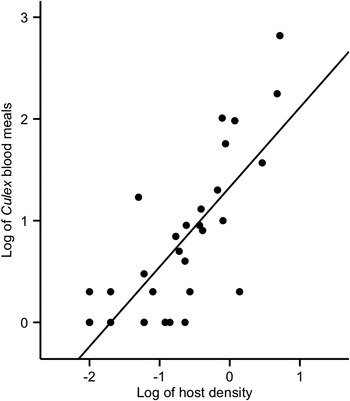
A total of 1221 identified Culex blood meals were derived from avian hosts included in this analysis. The number of Culex blood meals varied among avian hosts, from 0 (several species) to 658 (54% of the total) from American robins (Turdus migratorius). Culex blood meals from a particular host were directly related to the host density (linear regression, β = 0·78, P < 0·001, R 2 = 0·60; Fig. 1).
Relationship between Culex blood meals and host density. Both blood meals and host density are log10-transformed.

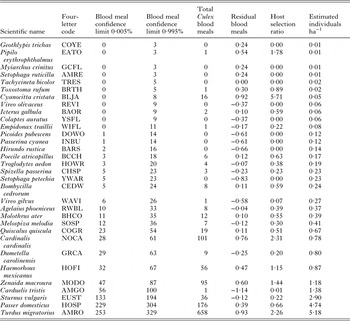
Random feeding by the Culex vectors of Plasmodium, which would result in an encounter rate proportional to the host's relative density, could be rejected for several summer-resident host species. We obtained more blood meals from American robin, blue jay (Cyanocitta cristata), mourning dove (Zenaida macroura), and northern cardinal (Cardinalis cardinalis) than expected by chance, and fewer blood meals from American goldfinch (Carduelis tristis), barn swallow, chipping sparrow (Spizella passerina), common grackle (Quiscalus quiscula), downy woodpecker (Picoides pubescens), European starling (Sturnus vulgaris), grey catbird (Dumetella carolinensis), house sparrow (Passer domesticus), indigo bunting (Passerina cyanea), red-winged blackbird (Agelaius phoeniceus), song sparrow (Melospiza melodia), warbling vireo (Vireo gilvus), and yellow warbler (Setophaga petechia). We could not reject an encounter rate proportional to abundance for other species in the analysis, which included the relatively common black-capped chickadee, brown-headed cowbird (Molothrus ater), cedar waxwing (Bombycilla cedrorum), and house finch (Haemorhous mexicanus). Results of the feeding simulations are summarized in Appendix Table A1, along with the quantitative measures of vector utilization used below.
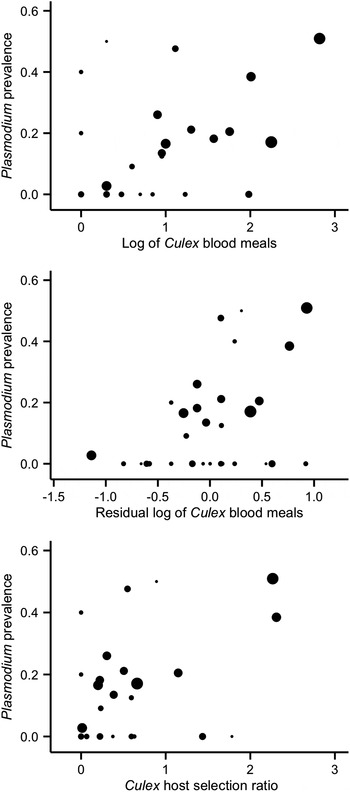
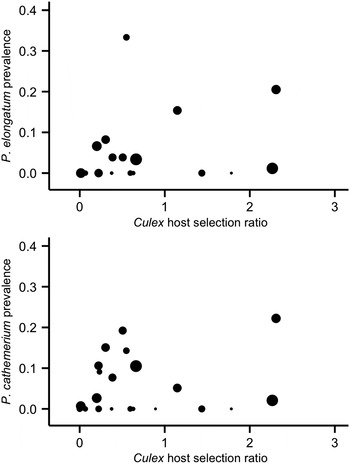
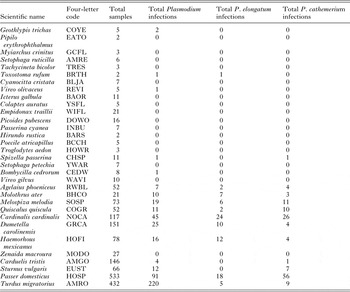
Overall, 1887 individuals of 32 avian host species were screened for malaria parasites. Plasmodium prevalence varied strongly among species in the analysis (logistic regression, P < 0·001), ranging from 0 to a high of 0·51 in American robins (Appendix Table A2). Prevalence of Plasmodium parasites across all host species included in this analysis was positively related to both log10-transformed total Culex blood meals (β = 1·0, P < 0·001; Fig. 2), residual log10-transformed Culex blood meals (β = 1·8, P < 0·001; Fig. 2), and the host selection ratio (β = 0·88, P < 0·001; Fig. 2), indicating that hosts that are fed upon more often by Culex mosquito vectors have a higher probability of infection with avian malaria parasites. Prevalence of Plasmodium elongatum and Plasmodium cathemerium, two well-sampled generalist parasites, was not significantly associated with the log10-transformed total Culex blood meals (β P.elon = −0·18, P = 0·53; β P.cath = 0·03, P = 0·87), residual log10-transformed Culex blood meals (β P.elon = 0·25, P = 0·57; β P.cath = 0·18, P = 0·53), or the selection ratio (β P.elon = 0·14, P = 0·60, β P.cath = −0·11, P = 0·55; Fig. 3).
Relationship between total Plasmodium prevalence and total Culex blood meals (top), residual Culex blood meals regressed against host density (middle), and the host selection ratio (bottom). Total Culex blood meals are log10-transformed. Blue Jays, with an outlying selection ratio of 5·7, are not portrayed on the host selection ratio plot. Dot size is proportional to host sample size for prevalence and thus, weight in the logistic regression models.

Relationship between the host selection ratio and Plasmodium elongatum (top) and Plasmodium cathemerium (bottom). Blue Jays, with outlying selection ratio of 5·7, are not portrayed on the plots. Dot size is proportional to host sample size for prevalence and thus, weight in the logistic regression models.

Plasmodium parasites did not occur in the non-passerine hosts in our sample, including the downy woodpecker (N = 16), northern flicker (N = 5) and the mourning dove (N = 27), despite the last species being over-utilized by local Plasmodium vectors for blood meals.
DISCUSSION
Our results demonstrate a general association between exposure to mosquitoes and Plasmodium prevalence in an assemblage of avian hosts. Plasmodium prevalence across host species was correlated with the number of vector blood meals that were derived from that species. The number of vector blood meals is related to the likelihood of a vector-borne pathogen encountering a particular host species, and this may drive the association between total blood meals and Plasmodium prevalence. Indeed, if mosquito-host relationships are stable over evolutionary timescales, an increase in encounters with specific host species may provide strong selective pressures on Plasmodium parasites to evolve mechanisms to circumvent specialized host defences.
Plasmodium prevalence was also correlated with the residuals of vector blood meals after regressing vector blood meals against host density and the host selection ratio. Both these metrics control for abundance, and may be proportional to the average number of mosquito bites an individual of a particular host species receives. Simple theoretical models of multi-pathogen vector-borne disease dynamics (such as the Ross–Macdonald model [Ross, Reference Ross1911; Macdonald, Reference Macdonald1957]) and several empirical investigations (Snow et al. Reference Snow, Lindsay, Hayes and Greenwood1988; Nevill et al. Reference Nevill, Some, Mung'ala, Mutemi, New, Marsh, Lengeler and Snow1996; Charlwood et al. Reference Charlwood, Smith, Lyimo, Kitua, Masanja, Booth, Alonso and Tanner1998; Martínez-de la Puente et al. Reference Martínez-de la Puente, Martínez, Rivero-de-Aguilar, Del Cerro and Merino2013) suggest that these associations between prevalence and the frequency of blood meals relative to host abundance may arise from an increase in infection probability with more vector encounters. Alternatively, the association may result from mosquitoes being attracted to individual birds that are infected with malaria. In one experimental study, Cx. pipiens were more attracted to canaries that had chronic Plasmodium relictum infections (Cornet et al. Reference Cornet, Nicot, Rivero and Gandon2013). If this effect occurred broadly across different host and Plasmodium species in the wild, Plasmodium parasites might alter vector-feeding patterns and the transmission of many mosquito-borne zoonotic diseases. However, another study (Lalubin et al. Reference Lalubin, Bize, van Rooyen, Christe and Glaizot2012) showed Cx. pipiens were less attracted to wild great tits (Parus major) with naturally acquired Plasmodium infections, calling the generality of these patterns into question. Further research is necessary to discriminate between these alternate hypotheses.
Our results are consistent with the level of overall Plasmodium prevalence being related to vector utilization, with processes including parasite–parasite competition and host–parasite coevolution determining more restricted host breadths of individual parasite species. We identified 17 putative avian Plasmodium species based on cyt b lineages. The distributions of these putative Plasmodium species vary starkly across hosts within this community (Medeiros et al. Reference Medeiros, Hamer and Ricklefs2013, Reference Medeiros, Ellis and Ricklefs2014). Previous analyses suggested that host compatibility plays a larger role in delimiting the host ranges of individual avian Plasmodium taxa than a mosquito-imposed encounter rate (Medeiros et al. Reference Medeiros, Hamer and Ricklefs2013). Given constraints of sample sizes and the distributions across host species for individual lineages, we did not directly relate the prevalence of all individual lineages to vector-utilization estimates. However, the prevalence of two well-sampled, generalized Plasmodium parasites varied independently of vector utilization across local hosts. This may be associated with the scarcity of these parasites on American robins (Medeiros et al. Reference Medeiros, Hamer and Ricklefs2013), which are the most frequent source of avian blood meals in the area, and which are generally over-utilized by blood-seeking Culex mosquitoes in this study site (Hamer et al. Reference Hamer, Kitron, Goldberg, Brawn, Loss, Ruiz, Hayes and Walker2009) and elsewhere (Kilpatrick et al. Reference Kilpatrick, Daszak, Jones, Marra and Kramer2006) relative to their abundance. While American robins maintain a low prevalence of generalized Plasmodium parasites despite being over-utilized by Plasmodium vectors, they are infected locally with up to five apparently specialized Plasmodium species (Medeiros et al. Reference Medeiros, Ellis and Ricklefs2014). Three of these specialized Plasmodium species occur at relatively high prevalence within this robin population (Medeiros et al. Reference Medeiros, Hamer and Ricklefs2013, Reference Medeiros, Ellis and Ricklefs2014). Robins, with their relatively high-density and vector-mediated encounter rate, likely represent a stable resource for avian Plasmodium, promoting the evolution of specialization. Specialized parasites may be more proficient than generalists on shared host species (Medeiros et al. Reference Medeiros, Ellis and Ricklefs2014), potentially outcompeting generalists on local robins.
Our results, question the practice of relating avian malaria prevalence to species traits without controlling for differences in vector exposure. Mosquitoes feed heterogeneously across host species, and our analysis suggests that this may influence the probability of Plasmodium infection. Host traits such as sociality (Fecchio et al. Reference Fecchio, Lima, Svensson-Coelho, Marini and Ricklefs2013), habitat preference (Tella et al. Reference Tella, Blanco, Forero, Gajón, Donázar and Hiraldo1999; Mendes et al. Reference Mendes, Piersma, Lecoq, Spaans and Ricklefs2005), night roosting behaviours (Garvin and Remsen, Reference Garvin and Remsen1997), nesting characteristics (González et al. Reference González, Matta, Ellis, Miller, Ricklefs and Gutiérrez2014; Lutz et al. Reference Lutz, Hochachka, Engel, Bell, Tkach, Bates, Hackett and Weckstein2015) and body size (Scheuerlein and Ricklefs, Reference Scheuerlein and Ricklefs2004) are often assumed to influence exposure to parasite vectors and the prevalence of vector-transmitted pathogens. Additional studies relating these traits directly to vector-utilization patterns while integrating vector prevalence would improve our understanding of the ecological drivers of variation in infection rates of vector-borne pathogens across host species.
ACKNOWLEDGEMENTS
We thank many private homeowners in suburban Chicago for permission to conduct this study on their properties. Scott Loss, Tim Thompson, Diane Gohde, Mike Goshorn, Seth Dallmann and Jon-Erik Hansen provided logistical support for this work. Walter Marcisz collected the bird survey data.
FINANCIAL SUPPORT
This study was funded by the National Science Foundation grants EF-0429124 and EF-0840403 to Uriel Kitron, Tony Goldberg, Jeffrey Brawn, Marilyn Ruiz and Edward Walker, the Whitney Harris World Ecology Center, the St. Louis Audubon Society, the Curators of the University of Missouri, and a University of Missouri-St. Louis Dissertation Fellowship awarded to M. C. M.
Appendix
Estimates of vector utilization

Plasmodium prevalence

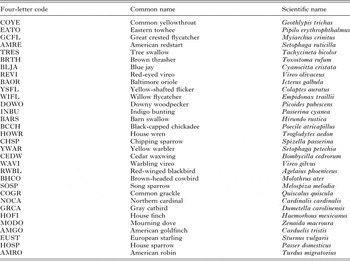
Species common names, scientific names and four-letter codes