




No CrossRef data available.
Article contents
- Abstract
- The War of 1812—Policy Changes and New Issue Regimes
- The War with Mexico—A Policy Change and a New Issue Regime
- The Civil War—Policy Changes and New Issue Regimes
- World War I—Policy Changes and New Issue Regimes
- World War II—Policy Changes and Issue Regimes
- In General—Policy Changes and New Issue Regimes
- Shakeups of Electoral Coalitions
- Major Changes in Party Ideologies
- Events as Causes
- References
Wars and American Politics
Published online by Cambridge University Press: 26 August 2005
Article contents
- Abstract
- The War of 1812—Policy Changes and New Issue Regimes
- The War with Mexico—A Policy Change and a New Issue Regime
- The Civil War—Policy Changes and New Issue Regimes
- World War I—Policy Changes and New Issue Regimes
- World War II—Policy Changes and Issue Regimes
- In General—Policy Changes and New Issue Regimes
- Shakeups of Electoral Coalitions
- Major Changes in Party Ideologies
- Events as Causes
- References
Abstract
Wars have been underexamined as causal factors in American political history. The nation's freestanding hot wars seem to have generated at least four kinds of major effects: policy changes of lasting consequence, new issue regimes, durable changes in electoral alignments, and durable changes in party ideologies. Considered here are the War of 1812, the War with Mexico, the Civil War, World War I, and World War II.David R. Mayhew is Sterling Professor of Political Science at Yale University (david.mayhew@yale.edu). His publications include Party Loyalty among Congressmen; Congress: The Electoral Connection; “Congressional Elections: The Case of the Vanishing Marginals”; Placing Parties in American Politics; Divided We Govern; America's Congress: Actions in the Public Sphere, James Madison through Newt Gingrich; and Electoral Realignments: A Critique of an American Genre. The author thanks Alan Gerber, Matthew Green, Jacob Hacker, Sonam Henderson, Rogan Kersh, Philip Klinkner, Heinz Kohler, Joseph LaPalombara, Bruce Russett, Abbey Steele, and anonymous reviewers for their helpful comments.
Information
- Type
- Research Article
- Information
- Copyright
- © 2005 American Political Science Association
Since its founding in 1789, the United States government has conducted hot wars for some 38 years,1
Porter 1994b, 58. Porter's total is thirty-four years as of 1994.
Yet, in general, political scientists who study American domestic politics have underappreciated these effects. That is true of “American political development” specialists as well as others.2
Notable recent exceptions to this neglect include Bensel 1990, Sparrow 1996, Klinkner and Smith 1999, Mettler 2002, and Katznelson and Shefter 2002. In the comparative analysis of the effects of wars on state building, Tilly (1975) has of course pioneered.
Some work in political science does point to the relative autonomy of sectors of the American national state, notably Skowronek 1982, but this scholarship does not center on wars.
At a conceptual level, John Kingdon has offered a refreshing amendment to the above account, at least in the sphere of policy making, through the metaphor of “windows” of opportunity during which policy change becomes possible. Even if an eager candidate, senator, interest group, or bureaucrat—or perhaps a Socialist Party platform a century ago—has promoted a policy idea, that advocacy is irrelevant unless the idea comes to enjoy the joint good fortune of a favorable political environment (such as an election result) and a perceived public “problem” (such as inflation, railroad insolvency, or terrorism). Happenstance rules, at least partly. If the conditions are fortuitously satisfied, a “window” may open. In particular, in Kingdon's view, the explanatory balance tilts away from a long-term interest-based determinism toward a jerky timestream of “problem perception.”4
Enter wars. Unsurpassed as producers of problems, wars may offer the best case imaginable for a conceptual tilt toward the idea of windows that are opened up by problems. For some decisive instances, consider the passage of the Freedmen's Bureau Act of 1865, the Current Tax Payment Act of 1943 (which began the now routine government practice of withholding income-tax payments paycheck by paycheck),5
or the USA Patriot Act of 2001. These enactments were triggered by problems that were triggered by wars. I will depend on Kingdon's central insight throughout this essay. Yet the effects of wars cut even deeper. Wars seem to be capable of generating whole new political universes. They can generate new problems and open up policy windows, thus often fostering new policies, but they can also generate new ideas, issues, programs, preferences, and ideologies and refashion old electoral coalitions—thus permanently altering the demand side of politics. Certainly, by strengthening the national state, wars can alter the supply side of politics.
These are strong claims. I will try to substantiate them by documenting certain effects of five major American wars from 1789 through 1945—the War of 1812, the War with Mexico, the Civil War, World War I, and World War II. This omits the obviously consequential, although distantly so by 1789, Revolutionary War. It omits the Spanish-American War, which was brief (ten weeks), required little mobilization, and seems to have affected domestic politics little.6
In the policy realm, it did help to spur the professionalization of the U.S. Army. See Skowronek 1982, 112–18, 212–16. And it brought the annexation of Puerto Rico and the Philippines and, in a side move, Hawaii. Did the Spanish-American War trigger a new “issue regime” centering on, say, imperialism? Probably not. The American imperialist impulse of that era dates to the early 1890s. It is probably better to see the war as a yield of, or a moment in, an already existent issue regime rather than the cause of a new one.
I would guess that the kinds of arguments I make, and the kinds of conclusions I arrive at, in this paper will not be especially surprising to historians (including economic historians), who tend to be at home with events and contingency. The overall patterns I argue for might engage that audience. Yet the chief audience I am aiming for here is political scientists, who have tended to underplay events and contingency—and notably wars—in addressing American history.
By the effects of wars I mean, more precisely, the effects of wars and their immediate induced aftermaths. If a war causes a runaway inflation for a year or two after it ends, and the society reacts to the inflation, then that reaction counts as a war effect. The effects of demobilizations can count. This aftermath license needs to be used with caution. For example, it is probably best to steer clear of anything to do with the cold war as an effect of World War II; there is a time gap, and too many additional ingredients had gotten poured into the mix by 1947.
For evidence of causal relations I rely on expert testimony by historians, economists, and political scientists that includes, where possible and appropriate, the presentation of a plausible causal logic. By that term I mean a causal account featuring intuitively plausible reasons why an effect may have come about.7
In the instances of several dozen alleged effects, I invite readers to test the soundness of the causal logics by consulting the cited sources, which are referenced in detail. In most cases I have tried to pinpoint short stretches of pages that supply particularly apt documentation.
Dray 1964, 19.
Ibid., 42–43; Nagel 1961, 582–83.
In this article I investigate four kinds of effects. First, there can be policy changes, including changes in rules, institutional structure, and national boundaries as well as in ongoing administered policies. I am interested in changes that proved to be long-lasting, that is, changes extending at least a decade yet in most cases a generation or longer beyond the wars themselves. Not to be considered are such short-term policy initiatives as price controls or the Fair Employment Practices Committee during World War II or the temporary income tax of the Civil War era.10
In this analysis, I have skirted one evident ratchet effect of short-term wartime policy moves. In the wake of American wars, military personnel levels, and military spending as a share of the federal budget, have ordinarily continued on above prewar levels. See Russett 1970, 2–4.
A word is in order about the connection between the policy changes and the new issue regimes. They are distinct in principle and ordinarily unrelated in practice. Over two-thirds of the policy changes identified here were not followed by long-lasting postwar contestation about whether the changes in question should have been made in the first place. Basic policy questions were settled—in the sense (to cite a non-war-related instance) that the Louisiana Purchase was not followed by a quarter century of debate about whether to sell the territory back to France. Also, most of the new issue regimes identified here were not continuing arguments about the advisability of already achieved war-driven policy changes. Rather, they came about somehow otherwise through war-related circumstances. Nevertheless, there is an overlap. In some instances, an actual policy change blended into a new issue regime. That is, a war-induced policy change occurred in a specified policy area, yet a new highly public controversy (perhaps accompanying more change) persisted regarding the advisability of the already achieved policy change for a considerable time also. In such instances, a relevant policy area can be listed here under both the “policy change” and “new issue regime” rubrics. The boundaries around these matters are perhaps blurry but I hope workable.
A third kind of effect can be shakeups in electoral coalitions. By this I mean substantial changes in patterns of party voting in presidential elections that persisted for a considerable time—a decade or a generation rather than just a few years. Fourth, there can be major changes in party ideologies. With this rubric, I draw particular attention to the twentieth century.
These four categories of war effects are not exhaustive. Wars can be cataclysms. In a general sense, their effects can obviously be horrific and astounding as were, for example, those of World War I in Europe: “It is hard now to appreciate how overwhelming an event and how crushing in its aftermath the conflict must have seemed.”11
Stevenson 2004, 486.
Skocpol 2003, chap. 2.
See Putnam 2000, 54, 81, 84, 103, 267–76.
First, I jointly consider policy changes and new issue regimes war by war. I then evaluate electoral shakeups for all five wars and party ideological changes for the twentieth-century wars. This is a somewhat dissonant plan, but the joint treatment of the first two effects is probably justified by their frequent overlap of issue terrain. To cover the territory outlined above, I need to proceed by way of sketches that are brief to the point of being telegraphic. Also, I have made choices of emphasis. This is a what, when, and why analysis and centrally not a who and how analysis. I take it as given that in many, if not all, the historical instances cited below, political entrepreneurs did imaginative work through resourceful use of processes. But most of those stories will not be told here. It is true that a why analysis is incomplete without taking account of entrepreneurs, but the why analysis I undertake here centers on the circumstances in which the entrepreneurs might have operated. My main aim is to place the whats and whens in relief and point to plausible causal logics.
The War of 1812—Policy Changes and New Issue Regimes
The War of 1812 could serve as a model for the case that wars can have major effects. Two major policy changes emerged quickly after the armistice. Congress established the Second Bank of the United States—a reaction to the near-bankruptcy, currency disorder, and debt brought on by the war14
Rockoff 2000, 647–48; Watts 1987, 278.
Bauer, Pool, and Dexter 1963, 13–14; Baxter 1995, chap. 2; Binkley 1962, 101–2.
Babcock 1906, 247; Wiltse 1961, 27–28.
Wiltse 1961, chap. 3; Baxter 1995, chap. 2.
Binkley 1962, 101. See also Schoen 2003, 200; Sylla 2000, 519.
Watts 1987, 276.
Binkley 1962, 101. The postwar issue terrain is discussed in three parallel chapters on the bank, the tariff, and internal improvements in Babcock 1906, chaps. 13–15.
The War with Mexico—A Policy Change and a New Issue Regime
The war with Mexico of the 1840s brought one striking policy change—the acquisition of today's American Southwest, extending from Texas through California (in geographic terms, an area larger than today's Britain, France, Italy, Germany, and Spain combined).21
Texas had been annexed just before the war, but it took U.S. military action against Mexico to place the annexation beyond dispute. The rest of the Southwest was a direct prize of the war.
That is, all the new territory west of Texas.
Potter 1976, 23. See also Foner 1969. It is sometimes argued that the Whigs “played the antislavery card” in the 1840s to steer politics away from economic issues and thus upset the hegemony of the Democrats. See, for example, Riker 1982, chap. 9. But that does not seem to be what happened. David Wilmot, who presented the killer amendment in 1846, was representative of a sizable faction of northern Van Burenite Democrats committed to free-soil doctrine. A generation earlier, another northeastern Democrat had presented the relevant killer antislavery amendment during the brief but intense Missouri controversy.
Potter 1976, 17. In general, see Potter 1976, chaps. 1–5; Freehling 1990, chaps. 26–31.
The Civil War—Policy Changes and New Issue Regimes
The broad effects of the Civil War are well known. Beyond its changes in race policies, the war brought “a spirit of national economic activism unprecedented in the antebellum years,” engendering “what might be called the birth of the modern American state.”25
Foner 1988, 21, 23. In general, see Bensel 1990.
- Extension of rights to African Americans. This was
legislated through the Emancipation Proclamation; the Thirteenth
Amendment, abolishing slavery; the Fourteenth Amendment, nationalizing
rights in general; and the Fifteenth Amendment, extending the
suffrage.26
Foner 1988, 1–11, 66–67, 251-61, 444–48.
- A high protective tariff. Originating—at least in
large part—as an emergency revenue source, “the so-called war
tariff became permanent, both in the statute books and in the minds of the
public and of the protected industries.”27This is a leading instance of a party—the Republicans—getting a chance to do what they would have wanted to do anyway. Suddenly in 1861, tariff revenue emerged as a solution to a problem—a desperate shortage of government revenue as war loomed. Once in place, through the usual operations of path dependence, revenue streams tend to stay in place. (Of course, it is quite possible that a ruling Republican Party would have generated a high protective tariff somehow at some point anyway without the stimulus of the war. But that is speculation. We do not know what a ruling Republican Party would have amounted to, or whether one could have existed in any stable sense, absent the Civil War and Reconstruction.)
Bauer, Pool, and Dexter 1963, 14–15. See also Sylla 2000, 527; Brownlee 1996, 44–45; Hansen 1990.
- Taxes on alcohol, tobacco, and certain luxuries. As of the
early twentieth century, over a third of federal revenue came from these
sources.28
Brownlee 1996, 44–48. See also Sylla 2000, 527–29; Porter 1994a, 260.
- Nationwide banking. “The beginning of a nationwide
banking system,” was enabled by passage of the National Banking Act
of 1864.29The war economy needed better organization.
North 1966, 25. See also Sylla 2000, 531; Rockoff 2000, 651–52; Porter 1994a, 261.
- Congressional redesign. Creation of the House and Senate
Appropriations Committees in 1865 and 1867, a major innovation in
governmental structure, resulted from “pressures spawned by economic
burdens produced by the long years of war.”30
Wander 1982, 25–28, quotation at 27.
- A transcontinental railroad. The Pacific Railway Act of
1862 and the following two initiatives, the kinds of policy moves once
favored by Whigs and now by Republicans, were made possible by the absence
from Capitol Hill of Southerners opposed to the policies—a
coalitional distortion brought on by the war. The railroad also had a
military rationale: “The Far West had to be defended.”31
Sylla 2000, 533; Foner 1988, 21.
- Aid to higher education. The Land Grant College Act of 1862
benefited from coalitional distortions and may have also been helped by a
war-related rationale: “The land-grant colleges would offer military
training.”32
Sylla 2000, 533; Foner 1988, 21.
- Free Western homesteading. Through the Homestead Act of
1862.33
Sylla 2000, 533; Foner 1988, 21.
The Civil War also deposited a number of new long-lived issue regimes. Again, under scrutiny is the content of highly public issue controversy during the ensuing decades. It is not clear what to list, but the following four entries seem plausible. They did not exhaust the agenda of public controversy during the late 1860s, 1870s, and 1880s (other chronic issues of that era, such as civil service reform and regulation of the railroads, did not have Civil War origins), but they contributed to it. The relevant new regimes centered on:
- Civil rights and Reconstruction. These issues of the late 1860s and 1870s persisted, albeit sporadically, into the early 1890s.
- The Republican high-tariff system. The system stirred
controversy for several ensuing generations.34
Previously, the tariff had not figured as a prominent issue between the mid-1840s and the Civil War.
- Currency. In the wake of the Legal Tender Act of 1862,
currency issues remained prominent through the close of the nineteenth
century.35
Porter 1994a, 260; Foner 1988, 23.
- Veterans' pensions. Amid chronic controversy, Civil
War pensions started small, but grew into a major version of a
welfare-state program during succeeding decades.36
Skocpol 1992, chap. 2; Holcombe 1999.
World War I—Policy Changes and New Issue Regimes
At least eight major long-lasting policy changes can be credited to World War I:
- Progressive taxation. World War I brought “a shock to
government finances that dramatically and permanently affected the
internal revenue system”37as well as “a vast expansion of the Treasury's administrative capacity.”38
Witte 1985, 79–87, quotation at 87.
Through the Revenue Act of 1916, a stiff preparedness measure enacted in uneasy awareness of the then two-year-old European war, the government “broke the dominion of the tariff over the federal revenue system, transformed the experimental income tax [enacted initially during peacetime in 1913] into the primary instrument of federal taxation, introduced federal estate taxation [now under siege in the twenty-first century],39 initiated the first significant taxation of corporate incomes, and contributed [along with the Revenue Acts of 1917 and 1918] to the nation's most dramatic departure toward progressive redistributional taxation.”40Brownlee 2000, 1030.
As one indicator, the personal income-tax rate paid by the highest income bracket rose from 7 percent in 1913 to 77 percent in 1918 and has not fallen below 25 percent since. This overall progressive shift was not inevitable. A Progressive-oriented left wing ascendant on Capitol Hill during the Wilson administration insisted on it as a condition of funding preparedness and then the war. In the judgment of tax historian W. Elliot Brownlee, “Without the wartime crisis, the growth of the federal government almost certainly would have been slower and reliant on some combination of tariff revenues, sales taxes, and low-rate taxation of personal and corporate incomes or spending.”41Brownlee 1985, 173.
Brownlee 1996, 60–72, quotation at 71. See also Higgs 1987, chap. 7.
- A record high protective tariff. As in 1815, an
“intense nationalistic feeling” abetted a drive to shield
industries nourished during the war, this time notably a new chemical
industry.42Also, metals and ores were now seen to need protection for defense reasons. A new universe of war-kindled trade associations ready with proposals existed in the national capital. Farm interests signed on as postwar conditions ruined crop prices. These pressures ensured passage of the Emergency Tariff Act of 1921 and the Fordney-McCumber Tariff of 1922. In general, despite spirited wrangling over particulars in the legislative process of the early 1920s, “the necessity of protection was hardly challenged.”43
Kaplan and Ryley 1994, chap. 5, quotation at 100.
Hicks 1960, 57. Eichengreen (1989) does not specifically connect the rise of the trade associations to the 1921 and 1922 enactments (his concern is the later Smoot-Hawley tariff) but he has the groups in place. There is a whiff of corporatism: “The sudden rise to prominence of trade associations was attributable to World War I. The war effort required closer ties between government and industry, but upon attempting to establish them the authorities found it difficult to deal with individual enterprises and requested that associations be formed. If the war occasioned the formation and growth of trade associations, the armistice by no means signaled their demise. Once formed into an association the process of marshalling a constituency was no longer so difficult.” A result was “to promote effective representation of industrial interests in Washington” (pp. 4–5).
- A national budgeting system. The Budget and Accounting Act
of 1921 and a centralization of congressional appropriations sought to
accommodate officials who had found themselves “ill-equipped to
address the budgetary problems that stemmed from the war.”44
Farrar-Myers, Renka, and Ponder 2000, 1; Wander 1982, 31–35.
- Prohibition. It is true that the dry cause was advancing on
its own in the early to mid-1910s, but the Eighteenth Amendment and the
Volstead Act might never have succeeded absent the war. New justifications
arose. According to one account, “The entry of the United States
into World War I, which was accompanied by a spirit of patriotic
self-denial and the reviling of all things German, including beer and
schnapps, swelled the dry ranks.”45“Most important,” according to another account, “[the war] brought into the movement such non-prohibitionists as Theodore Roosevelt and Herbert Hoover, who advocated Prohibition to save grain.”46
Kyvig 1996, 218–26, quotation at 224.
Another account maintains that “[w]hile the years of antidrink agitation had paved the way, it was the politics of wartime mobilization that provided the impetus for the speedy approval of the [Eighteenth] amendment by the states.”47Ferrell 1985, 188–90, quotation at 189.
Kerr 1985, 185. See also Cooper 1990, 307.
- Women's suffrage. No doubt this reform, effected by
the Nineteenth Amendment, would have succeeded sooner or later, but
energetic contributions by women to wartime mobilization seem to have
brought the proximate winning argument. Suffrage extension was
“necessary to the successful prosecution of the war,”48President Wilson argued; “We have made partners of the women in this war.”49
Kyvig 1996, 226–39, quotation at 234.
The United States was not alone. Women won the vote in many other countries during World War I or its near aftermath, evidently through a logic of wartime contribution or various other democratizing impulses associated with war. The instances include Britain (for women over thirty), Canada, Germany, Austria, Poland, Czechoslovakia, Sweden, Belgium, and the Netherlands. Women in France, Italy, Hungary, and Japan had to wait until the close of World War II, when a comparable logic seems to have obtained.50Keyssar 2000, 214–18, quotation at 216. See also Cooper 1990, 307–8; Wynn 1986, 148–52; Behn 2005.
Lewis 2004, plus scattered sources on individual countries. The list for World War I includes neutrals, but there could be spillover effects. As of 1914, women had had the vote in New Zealand, Australia, Finland, Norway, and certain American states.
- Immigration restriction. After failing for decades, this
cause now triumphed through a literacy test and other barriers imposed in
1917. The war atmosphere brought a fear of radicals, pressure for
Americanization, and a discrediting of powerful anti-restrictionist
nationality groups—notably the German-American Alliance. After the
war and its ensuing politicized strikes, Red Scare, and deportations of
alleged radicals during 1919–20, a resort to national-origins quotas
in 1921 and 1924 bolstered the move of 1917.51
Tichenor 2002, 138–46; LeMay 1987, 70–72.
- Domestic intelligence. In the wake of the Espionage Act of
1917 and the Sedition Act of 1918, the Federal Bureau of Investigation
created a General Intelligence Division that functioned during the Red
Scare of 1919–20. J. Edgar Hoover started the compiling of files on
individuals in 1919, a practice that he continued into the Nixon
administration.52
Goldstein 1978, chaps. 4, 5; Ungar 1976, chap. 3.
- Cartelization of the railroads under tight government
management. By way of direct government control during the war and
the Transportation Act of 1920, a prominent issue regime centering on
railroad regulation that dated to the 1880s ended. Henceforth, the rail
corporations more or less dropped out of American public life as powerful
or controversial entities.53
Klein 1990; Higgs 1987, 152–53; Skowronek 1982, 283.
Beyond these policy changes, World War I was a fertile source of new issue regimes. Five of them, in addition to the chronic tariff issue (which figured prominently both before and after the war), came close to exhausting the public agenda during the 1920s:
- Enforcement of Prohibition—a perennial subject of dispute until 1933.
- Cuts in the corporate and individual income taxes established
during the war. Led by Secretary of the Treasury Andrew Mellon, the
Republicans pursued this cause for most of a decade.54
Witte 1985, 88–96; Brownlee 1996, 67–72
- Hydroelectric power. The government had operated a power
plant at Muscle Shoals, Alabama, during the war. The question of how to
dispose of it stirred a chronic controversy that culminated in the
creation of the Tennessee Valley Authority (TVA) in 1933.55
Leuchtenburg 1969, 66–67.
- Agricultural crop supports. The war had brought government
support of crop prices, prosperity on the farms, and a crystallization of
new agricultural interest groups. Once the postwar prices plummeted as
they did in 1921, “the experience of price supports was there to be
appealed to.” In short order, the so-called McNary-Haugen plan for
crop supports came to preoccupy public attention and Capitol Hill and to
incur vetoes by Coolidge and Hoover. The way was paved for a somewhat
different crop-support plan, the Agricultural Adjustment Act of 1933.
Nothing like either of these government-centered plans had had any
prominence before World War I.56
Karl 1983, quotation at 43; Hansen 1991, chap. 2; Olmstead and Rhode 2000, 730; Benedict 1953, chaps. 8–12; Eichengreen 1989, 5.
- Veterans' bonuses. Accompanied by chronic commotion,
at least five veterans' bonus bills became law over Coolidge, Hoover,
and Roosevelt vetoes. Surprisingly, those of 1931 and 1936 are good
candidates for the most effective countercyclical spending moves by the
government during the Depression years.57
Key 1943; Brown 1956, 863–69; Lee and Passell 1979, 384–86.
World War II—Policy Changes and Issue Regimes
As in the locution “postwar era,” we still regard World War II as a dividing line, and that makes sense in domestic as well as in foreign affairs. At least nine substantial policy changes can plausibly be credited to the war:
- Mass-based progressive taxation. For lasting effects on the
federal revenue structure, nothing has ever surpassed the financing of
World War II. The personal income tax was “dramatically
expanded” through widening its reach (the share of the workforce
paying taxes rose from 7 percent before the war to 64 percent afterwards),
raising marginal rates (the top-bracket rate peaked at 94 percent and
stayed high), and pay-as-you-go withholding.58Before the war, revenue from the personal income tax never exceeded 1.5 percent of GNP; since the war, it has dipped only once (around 1950) below 7 percent.59
Wallis 2000, quotation at 73; Murphy 1996; Brownlee 1996, 88–101; Witte 1985, chap. 6; Campbell and Allen 1994.
Corporate taxes mushroomed also. “The country emerged from the war with a completely different revenue structure.”60Witte 1985, 124.
In general, the government has lived off World War II's lucrative tax design for the six ensuing decades. For a while, at any rate, there seems to have been a progressive redistributive effect, as was argued by Douglass C. North in 1966: “It is not at all clear that New Deal measures provided any significant redistribution of income…. The really significant fall [in income inequality] is clearly related to the high progressive tax rates imposed during World War II.”61Wallis 2000, 73.
North 1966, 178.
- Fiscal policy to stabilize the economy and ensure full
employment. These policy desiderata were expressed in the Employment
Act of 1946 and the creation of the Council of Economic Advisors.
According to Herbert Stein, “The great weight assigned to full
employment as a postwar goal certainly resulted from the achievement of
full employment during the war against the background of ten years of
depression.”62For one thing, the war showed that deficits could work; in the words of Brownlee, it “institutionalized structural Keynesianism.”63
Stein 1969, chaps. 8, 9, quotation at 171.
Brownlee 2000, 1050. The experience of the war seems to have brought a similar result in Britain: “There must be some doubt if an administrative Keynesian revolution (that is, the adoption of Keynesian goals as well as Keynesian instruments) would have occurred had it not been for the Second World War…. The key to the institutionalization of the new paradigm was the shock of war—the decisive factor in forcing the Treasury radically to reappraise its ideas on economic policy.” Oliver and Pemberton 2004, 423–24.
- Curbs on labor unions. Repeated, crippling strikes during
the war and its ensuing demobilization phase soured public opinion on
unions. An “almost hysterical hostility toward unions” greeted
a rail walkout in 1946, for example.64For many, John L. Lewis, of the United Mine Workers, became a national villain. Hence the promanagement revisions of labor law by way of the Smith-Connally Act of 1943 and the Taft-Hartley Act of 1947. The latter has remained largely in effect ever since.65
Patterson 1972, 306.
Lee 1966, chaps. 1–3; Amenta and Skocpol 1988, 114–15; Young 1956, 63–67; Sparrow 1996, chap. 3; Wynn 1996, 470. Spirited controversy over the Taft-Hartley Act carried into 1949 but then died down as the Democrats retreated. The question of whether it had been wise to curb the unions proved to be unpromising material for a long-lasting new issue regime, just as continuing opposition to the principles of the Employment Act of 1946 was unpromising terrain for the Republicans. These matters were largely settled.
- Progress in voting rights for southern African Americans.
The Soldier Voting Act of 1942 and a Supreme Court ban of the white
primary (a move that is said to have indexed the country's opinion
change regarding race during the war) in 1944 made possible small but real
progress in this area. According to Alexander Keyssar, “The
equilibrium in voting laws was decisively disrupted by World War
II.”66
Keyssar 2000, 244–55, quotation at 244. See also Klinkner and Smith 1999, chap. 6.
- Science policy. “The war provided the transforming
event from which the modern research system emerged.”67The idea of government support for basic research in universities through peer review was in place by 1945, as were corresponding practices and connections to industry, although it took until 1950 to establish the National Science Foundation (NSF).68
Smith 1990, 34.
Ibid., 1–3, 34–52; Polsby 1984, 35–55.
- Atomic energy policy. Wartime development of the atomic
bomb and the Atomic Energy Act of 1946 necessitated this new policy
area.69
Green and Rosenthal 1963, chap. 1; Balogh 1991, chap. 2.
- Curbs on the executive branch. Policies limiting executive
power were manifested in the Administrative Procedure Act of 1946,
regulating bureaucratic practices; the Legislative Reorganization Act of
1946, strengthening the congressional committee system for, among other
things, executive oversight; and the Twenty-Second Amendment, sent by
Congress to the states in 1947, establishing a two-term limit for
presidents. World War II, coming as it did on top of the New Deal, stirred
considerable nervousness about executive power.70
Wander 1982, 35–38; Rosenbloom 2001; Brazier 1996; Davidson 1990. The term-limit restriction on presidents was the sixth constitutional amendment evidently stimulated by war conditions. A seventh came with the Twenty-Sixth Amendment providing for teenage voting as the Vietnam War wound down. Little has been written about the Twenty-Second Amendment. One safe conclusion seems to be the following: in the 1940s, President Roosevelt would very likely not have become a third- and fourth-term president absent the imminence of war in 1940 and its continuation in 1944. In that case, no term-limiting drive would have arisen. On the elections of 1940 and 1944, see Divine 1974, chaps. 1–4.
- A new national security structure. Reflecting a new
“doctrine of national security” developed during the war, the
National Security Act of 1947 integrated the military services (thus
providing a suitable housing for the Joint Chiefs of Staff created in
1942) and established the Central Intelligence Agency (a successor to the
wartime Office of Strategic Services).71
Yergin 1977, chap. 8, quotation at 193; Huntington 1964, 429–33.
- GI Bill of Rights. The program funded higher education for
over two million returning veterans as well as home mortgages and other
benefits. According to one assessment, “The transition toward a
prosperous, middle-class society was accelerated by decades.”72
Perrett 1989, 439. See also Olson 1974, chaps. 1–3.
As in the cases of earlier wars, World War II brought about policy changes but also transformed the national policy agenda. Four major issue regimes lasting into the 1960s seem to have stemmed from the war:
- Civil rights. If the term “New Deal” is
restricted to the 1930s, civil rights—entailing voting rights, fair
employment, and access to public accommodations—was not a New Deal
issue.73It emerged in 1943 and 1944. On the home front, the war's crusade against Nazism is said to have “eroded the moral and intellectual respectability of the claim for racial supremacy.” In general, a pronounced spirit of democracy is said to have set in. For their part, African Americans aiding the war effort demanded better treatment, not least as assertive returning veterans. President Truman embraced the cause of civil rights in 1946, inaugurating a long-running controversy that bore fruit in the 1960s, yet has persisted since that time.74
Antilynching was a legislative cause of the 1930s, although the White House and the leadership of the Democratic Party took little interest, and the drive failed.
Klinkner and Smith 1999, chaps. 6, 7, quotation at 200; Keyssar 2000, 244–53; Hart 2004; Collins 2002.
- General aid to education. Across-the-board subsidies to
elementary and secondary schools was not a New Deal issue. It emerged in
1943 as word of failed draft exams circulated, and the implications of
halted school construction hit home. A postwar teacher shortage loomed.
Senate Republican leader Robert A. Taft signed on to the cause in 1945. In
general, “World War II proved to be the major force propelling
education into the national political arena as a major issue.” It
stayed there for two decades.75
Thomas 1975, 20–22, quotation at 20; Patterson 1972, 320–26. In 1943, “for the first time in over fifty years, a federal aid to education bill was debated and acted upon in the United States Senate” (Munger and Fenno 1962, 8; see also 7–10, 16). Bills had been introduced and won committee assent in previous Congresses, but 1943 brought an attention breakthrough.
- National health insurance. This was another non–New
Deal issue that emerged in 1943. The poor health of the draft pool was
noted. Britain's Beveridge Report of 1942, itself a product of the
war, drew attention and praise. Senator Robert F. Wagner and others
introduced an unprecedentedly ambitious bill. Presidents Roosevelt and
Truman signed on to the cause (Roosevelt had not taken any such stand
before the war). Thus was launched an issue regime that, with certain
detours and discontinuities, emanated in Medicare in 1965.76
Starr 1982, 280–81; Hirshfield 1970, chap. 5; Derickson 1994, 1340–42; Hacker 2002, 217, 223; Derthick 1979, 317–19.
- Public housing and slum renewal. This (public housing, at
least) had been briefly and secondarily a New Deal issue, but the cause
came into its own in 1944 and 1945. “The war acted as a catalyst
… and produced a widespread, conscious interest in postwar
housing.” Construction had largely halted. An immense postwar
housing shortage loomed. Taft and Truman signed on. Thus began a durable
issue regime that would see the enactment of significant statutes in 1949,
1954, 1961, 1965, 1966, and 1968.77
Davies 1966, xi–xiv, quotation at xiii; Patterson 1972, 315–20; Keith 1973, 13–14, chap. 2.
Note that another bundling pattern appears here. Civil rights, education, housing, and health insurance, along with a full-employment thrust, formed the core of what we remember as Truman's “Fair Deal” program.78
On the Fair Deal in general, see Neustadt 1954.
The New Deal era of the 1930s had plenty of issues or causes—relief, recovery, social security, labor-management relations, antimonopoly, banking reform, regulation of various industries, the minimum wage, tariff reduction, fair trade laws, mortgage insurance, reforming the Supreme Court, the TVA, rural electrification, agricultural crop supports. But civil rights (aside from the antilynching cause), federal aid to education, and national health insurance were not on the list, and public housing was not high ranked.
In General—Policy Changes and New Issue Regimes
See table 1 for a summary of the foregoing material. At least four observations or reflections seem warranted. First, the Civil War and the two world wars obviously outpaced the two earlier wars in generating entries to the table. No doubt one reason is the scale of the three large wars—the cost in money, mobilization, and lives. In particular, the War with Mexico pales in comparison as a cheaper, easier, one-sided contest more akin to the Spanish-American War. Another likely reason is that the federal government in its early decades was functionally specialized: it was not designed to undertake programs of domestic policy initiatives in good times or bad, and on balance it did not.80
Lasting policy changes and new issue regimes in the United States deriving from wars

Even so, it is well to realize that certain entries in table 1 are more important than others. In particular, an unweighted entry count underrates the War with Mexico. Few policy moves have ever exceeded the annexation of the American Southwest in importance. Possibly no American issue regime has ever exceeded the free-soil versus slavery-expansion controversy of the late 1840s and 1850s in intensity, public engagement, and eventual policy effects. Also, Americans have lost a sense of the War of 1812. The casualties may have been low, but even so—the British invasion of the Detroit area and Maine? The American invasion of Ontario? The battles of New Orleans and Baltimore? The American seizure of Indian territories? The burning of the White House? A secession move in New England? Near national bankruptcy? Perhaps we underrate both the war's amplitude and its effects—the latter being a blend of nation building (as seen in the postwar burst of nationalism) as well as state building that is perhaps thinly captured in table 1. Not considered here yet is the war's impact on the party system.
Second, on the evidence here, the country's hot, freestanding wars have left more of a mark in some policy areas than others. What is missing? In the familiar Progressive or New Deal–liberal interpretation of American history, attention centers on adversarial regulation of industry (as in taming the late-nineteenth-century railroads, busting trusts, setting a minimum wage, and policing such areas as occupational safety, securities fraud, consumer affairs, and environmental protection) and on establishing welfare-state entitlements. These topics make at best a faint appearance in the war-related lists of table 1. The only solid exception is veterans' benefits. In general, wartime governments may see fit to make use of industries rather than to confront them, and to allocate their expenditures otherwise. It is not surprising that Progressive and liberal accounts tend to skimp on the wars.
Amply represented in the checklists, by contrast, is a collection of concerns that Alexander Hamilton might feel at home with. The wars have nourished state building and economic management, that is, systems of revenue extraction, the crafting of government institutions, tariff duties for revenue and protection, the banking systems of the nineteenth century, as well as—this seems to fit the pattern—the Keynesian managerial thrust of the mid-1940s. Yet that is not all. Policy moves as diverse as immigration restriction, prohibition of alcohol, curbs on unions, and a transcontinental railroad have appeared at various times in the mixed bag of war legacies. There are some general patterns. Until the 1960s, the federal government's main efforts to shape higher education drew from wars—the land grant colleges of the 1860s as well as the GI Bill and science policy (including the NSF) deriving from World War II. Three of the hot wars—the War with Mexico, the Civil War, and World War II—revolutionized American race policy, either immediately or by spurring new issue regimes that proved consequential. The Civil War and World War I brought unsurpassed instances, and World War II a lesser but still notable one, of suffrage expansion—for, respectively, blacks, women, and blacks again. (Later, the Vietnam War also left a deposit of teenage voting.)81
Keyssar 2000, 277–81.
Third, note the extraordinary power of these wars—all five of them—as agenda setters. The second column of table 1 has the relevant entries. In all five cases, new issue regimes that absent the wars might not have come into existence at all captured public attention for a generation or more. Why, it seems worthwhile to stand back and ask, did politically aware Americans of the 1850s come to dwell on free-soil versus slavery expansion, their descendants of the 1920s on Prohibition enforcement, tax cuts, and crop-support plans, their descendants of the late 1940s and 1950s on civil rights, federal housing programs, and federal aid to education? War legacies have provided a surprisingly prominent answer to the question, What is American politics about?
A fourth and related point is that one comes to appreciate the sheer noninevitability of much of American history by sifting through the materials in table 1. This raises the risky topic of counterfactuals, but serious historical explanation does not seem possible without doing that, at least implicitly.82
A logic of “windows” of opportunity in Kingdon's sense, and then some, pervades the content of table 1. Reverse the close election of 1844, thus possibly skirting the war with Mexico, and who can say what the policies and issue regimes of the 1850s and 1860s would have looked like? Would the Civil War have been averted?83 Locate World War I in the 1920s, or at least somewhere else if at all, and what would today's federal revenue system amount to? A rather different tax mix could have been chosen as in, say, Sweden.84 Cancel the world wars and American women might have waited a considerable time for the suffrage—perhaps even until 1971 as in Switzerland. Greatly magnify the American need and shared sacrifice associated with World War II and this country might have reached for national health provision as a consequence then, as did apparently Britain and Japan, despite the cost.85Counterfactual speculation is relatively easy on topics such as veterans' benefits, where one can readily conclude that without a war, there would have been no benefits (although the shape of the various veterans' payouts of American history is a complicated matter). Heavier going occurs in areas where a preexisting policy impulse allows a claim that a result might have happened anyway, war or no war. One response here is philosophical: I do not see any reason why in principle a long-term allegedly “underlying” cause of a policy effect should be considered more real, basic, important, interesting, or successfully explanatory than a short-term, contingent cause. This is to step away from, among other things, a commitment that I believe is unwarranted to various social or economic determinisms.
A second response is ad hoc and empirical: There does not seem to be any escape from assessing the causal backgrounds of past phenomena one by one with counterfactual ideas in mind. In general, in apprehending the American past, I would guess that we impute far too much inevitability to what has in fact happened. Our explanations tend to overfit. Of the entries in table 1, which were inevitable, war or no war, sooner or later? (This relaxes for the moment any requirement of temporal immediacy—although note that when something happens is not necessarily a minor concern; consider the Thirteenth Amendment.) Suffrage for American women was extremely likely, although that judgment does not settle the question of when. Slavery would have come to end, but, absent the Civil War, at what cumulative human cost and when? A transcontinental railroad would almost certainly have been built, although possibly by the states, on private resources, or later or differently. But the near certainties run out quickly. For a century, Whigs, Republicans, and their industrial backers supplied powerful support for high tariffs, but we do not know what would have happened on that policy front absent the wars. After all, it had proven possible for a stable American low-tariff regime of nearly constitutional standing to persist for a full generation leading up to the Civil War.86
Whittington 1999, 93–112.
Exclusion of East Asians beginning in the 1880s has been the other major constraint placed on immigration during American history.
The American past is a cemetery of failed impulses and movements. It is news when events assist one to succeed. In general, it is probably a mistake to invest in grand schematic explanations of American history that underplay contingency, and wars are hard to beat as bearers of contingency.
Shakeups of Electoral Coalitions
Policy changes can be popular or unpopular, in a general sense, and they can beget both winners and losers. New issue regimes can crystallize electorates in new ways. Disagreement can mount and last about whether a war should have been fought in the first place. By way of these various routes, all in the realm of “position issues,” it is easy to see how wars and their near aftermaths might spur significant, possibly long-lasting, shakeups in electoral coalitions. There is also the route of “valence issues.”90
On position and valence issues, see Stokes 1966.
This is a jumble of possible causal paths that cannot be sorted out through available historical data. But clues can be sought on the general question of whether wars have been associated with significant and long-lasting electoral change. For this purpose, an apt dataset was provided by Jerome Clubb, William Flanigan, and Nancy Zingale in 1980 (although the authors did not emphasize the question of wars in their own analysis).91
Clubb, Flanigan, and Zingale 1980, chap. 3. See also the discussion in Mayhew 2002, 44–50.
For all thirty-three presidential elections from 1836 through 1964, table 2 documents the realignment changes of various kinds that the authors considered ample enough to report.92
Clubb, Flanigan, and Zingale 1980, table 3.1a at 92–93.
This means Democrats and Whigs back then. In 1836 the Democrats refashioned their regional base in nominating Martin Van Buren, a northerner. His party predecessor, Andrew Jackson, a southerner, had run in the three preceding elections, losing once and winning twice.
Surge and interactive realignment in U.S. presidential elections, 1836–1964

This is complicated material, but it yields some simple results. After the 1830s, the seven elections associated with the highest change values in table 2 all occurred during or after major crises. Three of them were the first presidential elections to take place after the country's three worst depressions struck—in 1876, after the crash of 1873 (those years also brought a crisis centering on Reconstruction); in 1896, after the crash of 1893; and in 1932, after that of 1929. The other four were the first elections to take place after hot wars ended—and in all four cases volatile war aftermaths had had time to occur and war-induced issue regimes had had time to take hold. Those were the elections of 1848, after the War with Mexico; 1868, after the Civil War; 1920, after World War I; and 1948, after World War II. All four occasions seem to have brought sizable lasting penalties in the 5 to 8 percent range to the incumbent presidential parties (or, more or less the same thing, durable bonuses of that size to the opposition parties). This is in the neighborhood of a recent 4 percent penalty estimated through a different methodology for the Korean War in 1952 and the Vietnam War in 1968.94
Bartels and Zaller 2001, 16. This is a one-shot penalty for the incumbent party, not a lasting penalty.
Lest an ironclad law be spotted here, let it be said that measurement of this sort is not easy and that different techniques can yield different results. One similar analysis has not found such results for 1868 and 1948.95
See Bartels 1998, 313–17, which covers the twenty-seven elections from 1868 through 1972. Still, the Bartels study ranks two war-impacted elections among the top four in long-term realigning consequences—the contests of 1920 after World War I (ranked third) and of 1972 as the Vietnam War wound down (ranked fourth). Ranked first and second are the elections of 1932 and 1880, the latter evidently owing to delayed coalitional changes associated with the end of Reconstruction.
In one way a striking violation, yet in another way a striking confirmation of the pattern in table 2 is the election of 1816, held in the wake of the War of 1812. Although that election occurred too early to earn a place in mass voting studies, it seems to showcase the idea that wars can bring lasting coalitional change, yet the then-incumbent Democratic-Republican Party reaped a bonus in 1816 rather than a penalty. Here is the story. Earlier in 1812, a few months into the war, the Federalist candidate had fallen only one state short of winning that year's presidential election through an able blend of position and valence appeals (the war shouldn't have been fought in the first place; why are the British occupying Detroit?). The Federalists were doing well.96
But then they dragged their feet on the war effort to the point of near treason, the war closed in a surprising burst of victory and nationalistic enthusiasm, and the discredited Federalists performed dismally in the election of 1816 and never ran a candidate again.97Binkley 1962, 94–97; Watts 1987, 282.
Turner 1971, 299.
Lipset and Marks 2000, 184–92, 244–60; Foner 1984, 60, 71–72.
World War I, looked at more generally, seems to have affected American voting behavior a good deal.100
Clubb, Flanigan, and Zingale 1980, 92–93; Bartels 1998, 315.
The 1920s is often seen as a replay or continuation of the McKinley era. President McKinley defeated the Democratic candidate in 1896 and 1900 by margins of 4 percent and 6 percent.
Creighton 1959, 216–17; McNaught 1970, 230–31.
MacIntyre 1986, 190.
Butler and Stokes 1974, 172–74; Wilson 1966. Another causal account goes: “Between 1914 and 1921 trade-union membership doubled and between 1918 and 1924 Labour displaced the Liberals as the largest anti-Conservative party, as a consequence of the Asquith-Lloyd George split [that is, the war-induced fracture of the ruling Liberal party], the widening of the franchise in 1918, and the heightened class consciousness of British workers—all factors that could be attributed to the war.” Stevenson 2004, 440.
Wilson 1966, 18.
The costs of World War I mounted far higher for, especially, Britain than for the United States. Still, even leaving aside the U.S. postwar turmoil of 1919–20, the war itself was not a minor undertaking for this country. It brought a government-directed economy, the country's “first real taste of truly large-scale government spending,” restrictions on civil liberties more serious than anything experienced since September 2001, repression approaching devastation of German-American culture, five million participants in the armed forces, two million troops (42 divisions) deployed in France, 114,000 war deaths (many through disease), and over 200,000 military wounded. See Cooper 1990, 279–80, 288–91, 297–305, quotation at 291; Stevenson 2004, 405, 442; Luebke 1974. Note also that World War I could affect even resolute neutrals through spillover effects. Swedish politics seems to have been revolutionized in 1918 as the fall of Germany's monarchy sent a democratizing impulse across the Baltic. See Berman 1998, chap. 5.
Overall, whatever the precise causal paths may have been, there is a suggestive case on the statistical evidence for the War with Mexico and World War II as electoral levers, a suggestive as well as commonsense case for the Civil War—how could it not have made a difference?107
It is difficult to analyze electoral continuity in the 1860s and 1870s, given the Democratic party schism in the 1860 election, the wartime subtraction of the South from the electoral universe, the staggered readmission of the Southern states, and the various moves enfranchising blacks and disfranchising southern whites.
Major Changes in Party Ideologies
A fourth probe into the consequences of wars is made possible by John Gerring's recent work on party ideologies, which is based on a coding of campaign speeches and party platforms of the major American parties from 1828 through 1996.108
Ideologies are conceived by Gerring to be broader and more basic than issues such as civil rights or than time-specific programs such as the New Deal. In one feature of the study, he looks for hinge-point changes in party ideologies and finds a few (for example, the Democrats' switch to Bryan-style economic populism in the 1890s). The era of the 1810s could not be reached by the study—party platforms were not yet being written then—although perhaps the Democratic-Republicans of that time would be accorded a hinge point following the War of 1812 if they could somehow be coded. That party shifted then to new concerns and a new model of political economy; there was a “liberal [in the classical sense] revision of Republican principles.”109Watts 1987, 281–82.
Gerring's most interesting and surprising ideological hinge points came in the twentieth century. There were only two. In the mid-1920s, the Republican Party abandoned its century-long stance (in ideological terms, the party is taken to be a continuation of its predecessor, the Whigs) as a party of state building, government activism, reverence for public institutions, and, in general, authoritative order as a guard against the menaces of disorder, insurrection, and anarchy. The Republicans had been the party of state. Now, in swept a new emphasis, still abundantly prominent in our own day, on free-market and anti-statist themes that often flare into populist-style assaults against Washington, DC.110
Gerring 1998, 15–16, chaps. 3, 4.
Ibid., 140.
Ibid., 158.
The Democrats' twentieth-century hinge point came around 1950. Then, that party shook off its longstanding antimonopoly, anticapitalist, anti–Wall Street rhetoric well captured in the phrase “the people versus the interests” that had infused the campaigns of Bryan around 1900 through Wilson, Franklin Roosevelt, and in a last hurrah in 1948, Truman. Out the window went assaults against capitalism. In swept a new configuration of emphases on civil rights, social welfare, redistribution, and inclusion. The party “discarded its abrasive, class-tinged ethos in favor of a Universalist perspective—the extension of rights to all aggrieved claimants and a general rhetoric of inclusion.” In general for the Democrats after 1950 or so: “Oppression and injustice were out; peace, harmony, and community were in…. It was a far cry from the Populist blame game.”113
Ibid., 15–18, chaps. 6, 7, quotations at 17, 18 (italics in original), 247.
Ibid., 235, 245–50.
The following is speculation. It is not clear why these twentieth-century hinge points occurred,115
Ibid., 157–58, 250–53, 274–75, for the author's own speculation on the matter.
Higgs 1987, chap. 7, quotation at 123. See also Gerring 1998, 157.
One of the most detested moves, an excess-profits tax, was only temporary, but a precedent was set.
Brownlee 1996, 63.
Gerring 1998, 152–55.
The Democrats' shift around 1950 had a complicated background, but World War II and its aftermath seem to have supplied both a moral jolt and a cognitive jolt. In highlighting the shame of American race relations, the war spurred the Democrats into a new ethic of “rights-based liberalism” that would cascade into multiculturalism in succeeding decades.120
See, for example, Brinkley 1995, 170.
Ibid., 171.
Higgs 1999, 606.
Events as Causes
We tend to assume that interests or preferences are the basic building blocks of an analytic political science. That is sensible, yet it risks analysis that is either unhelpfully truistic or unhelpfully abstract. Where do interests or preferences—or the agendas, programs, ideologies, movements and parties that ordinarily accompany them in the real world of politics—come from? One answer is events, of which wars and their aftermaths supply spectacular, although of course not the only, kinds of instances.123
On the idea of wars creating interests, see Wood 2000.
With both interests and preferences, it is difficult to proceed further without noting that wars can generate new, widely accepted causal stories. Such stories supply roadmaps to the achievement of old or new interests or preferences, or else new reasons to adopt new preferences. The new stories derive from the experience of the wars. Consider, for example, a story from the mid-1810s: The best way to shake free of the alarming national vulnerability just experienced is to build a stronger U.S. political economy, and the best route to that is the “American System.” From the late 1910s: Immigrants cause destabilizing political trouble. Among farmers after World War I: Government crop supports can cause prosperity. During and after World War II: Expensive scientific research is a key to national strength; racial discrimination at home causes trouble for the United States abroad;124
Keynesian-style economic management works; a globalist strategy is needed for U.S. defense policy.Another route to war effects is the engendering of new organizations—which often champion new interests or preferences or implement the lessons of new causal stories. Such new units can be directly governmental institutions such as the House and Senate Appropriations Committees, the FBI's General Intelligence Division, the Bureau of the Budget, the Council of Economic Advisors, or the Central Intelligence Agency. They can be units chartered by the government, such as the Second Bank of the United States, or fostered by the government, such as the new universe of trade associations during World War I. New organizations, which, like new statutes, tend toward stickiness, are particularly good at rendering the effects of wars long-lasting. Yet path dependency can apply in the cases of interests, preferences, and causal stories also.125
As instances of causal stories, consider the lessons drawn from Munich and Pearl Harbor that were carried forward from World War II.
In the realm of primitive building blocks, there is a case for ranking events as the equals of interests and preferences in a seriously explanatory political science.126
An elaboration of this argument appears in Mayhew 2004.
To take events seriously is to aim for longitudinal analysis, but also for comparative analysis. Any specialist of American politics might realize, for example, that most of the country's wars and all of its depressions have been transnational, not just national, events. As a result, cross-national, not just United States–specific, evidence can help to illuminate their causes, characteristics, and effects. Possibly this point is obvious to non-American scholars, but research by Americans about American politics can be insular. In writing this paper, I found the transnational patterns of women winning the vote and certain Allied ruling parties incurring electoral devastation in connection with World War I especially illuminating. I did not come across well-developed comparative literatures on subjects like these. There may be an opening.
Since 2001 the United States has been engaged in a war—or at least warlike circumstances—that could have long-lasting effects. Those might include a durable policy change regarding civil liberties, a new issue regime centering on terrorism, and the Republicans' reversion to their nineteenth-century stance as a state-centered party of order.
References
Amenta, Edwin, and
Theda Skocpol.
1988.
Redefining the New Deal: World War II and the development of social
provision in the United States. In
The politics of social policy in the United States, ed.
Margaret Weir,
Ann Shola Orloff, and
Theda Skocpol,
81–122.
Princeton:
Princeton University Press.
Babcock, Kendric Charles.
1906.
The rise of American nationality, 1811–1819.
New York:
Harper and Brothers.
Balogh, Brian.
1991.
Chain reaction: Expert debate and public participation in American
commercial nuclear power, 1945–1975.
New York:
Cambridge University Press.
Bartels, Larry M.
1998.
Electoral continuity and change, 1868–1996.
Electoral Studies
17 (3):
301–26.Google Scholar
Bartels, Larry M., and
John Zaller.
2001.
Presidential vote models: A recount.
PS: Political Science and Politics
34 (1):
9–20.Google Scholar
Bauer, Raymond A.,
Ithiel de Sola Pool, and
Lewis Anthony Dexter.
1963.
American business and public policy: The politics of foreign
trade.
New York:
Atherton.
Baxter, Maurice G.
1995.
Henry Clay and the American system.
Lexington:
University Press of Kentucky.
Behn, Beth A.
2005.
Woodrow Wilson's conversion experience: The president, woman
suffrage, and the extent of executive influence.
Paper presented at the annual conference of the Midwest
Political Science Association, Chicago, April 7–10.
Benedict, Murray R.
1953.
Farm policies of the United States, 1790–1950.
New York:
Twentieth Century Fund.
Bensel, Richard Franklin.
1990.
Yankee leviathan: The origins of central state authority in America,
1859–1877.
New York:
Cambridge University Press.
Berman, Sheri.
1998.
The social democratic moment: Ideas and politics in the making of
interwar Europe.
Cambridge:
Harvard University Press.
Binkley, Wilfred E.
1962.
American political parties: Their natural history.
4th ed.
New York:
Alfred E. Knopf.
Brazier, James E.
1996.
An anti–New Dealer legacy: The administrative procedure
act.
Journal of Policy History
8 (2):
206–26.Google Scholar
Brinkley, Alan.
1995.
The end of reform: New Deal liberalism in recession and war.
New York:
Alfred A. Knopf.
Brown, E. Cary.
1956.
Fiscal policy in the 'thirties: A reappraisal.
American Economic Review
46 (5):
857–79.Google Scholar
Brownlee, W. Elliot.
1985.
Woodrow Wilson and financing the modern state: The Revenue Act of
1916.
Proceedings of the American Philosophical Society
129 (2):
173–210.Google Scholar
Brownlee, W. Elliot.
1996.
Tax regimes, national crises, and state-building in America.
In
Funding the modern American state, 1941–1995, ed.
Brownlee,
37–104.
New York:
Cambridge University Press.
Brownlee, W. Elliot.
2000.
The public sector. In
The Cambridge economic history of the United States, vol. 3, The
twentieth century, ed.
Stanley L. Engerman and
Robert E. Gallman,
1013–60.
New York:
Cambridge University Press.
Bunzl, Martin.
2004.
Counterfactual history: A user's guide.
American Historical Review
109 (3):
845–58.Google Scholar
Butler, David, and
Donald Stokes.
1974.
Political change in Britain: The evolution of electoral
choice.
London:
Macmillan.
Campbell, John L., and
Michael Patrick Allen.
1994.
The political economy of revenue extraction in the modern state: A
time-series analysis of U.S. income taxes, 1916–1986.
Social Forces
72 (3):
632–69.Google Scholar
Clubb, Jerome M.,
William H. Flanigan, and
Nancy H. Zingale.
1980.
Partisan realignment: Voters, parties, and government in American
history.
Beverly Hills:
Sage.
Collins, William J.
2002.
The political economy of state-level fair employment laws,
1940–1964.
Explorations in Economic History
40 (1):
24–51.Google Scholar
Cooper, John Milton Jr.
1990.
Pivotal decades: The United States, 1900–1920.
New York:
W. W. Norton.
Creighton, Donald.
1959.
The story of Canada.
Toronto:
Faber and Faber.
Davidson, Roger H.
1990.
The advent of the modern Congress: The Legislative Reorganization
Act of 1946.
Legislative Studies Quarterly
15 (3):
357–73.Google Scholar
Davies, Richard O.
1966.
Housing reform during the Truman administration.
Columbia:
University of Missouri Press.
Derickson, Alan.
1994.
Health security for all? Social unionism and universal health
insurance, 1935–1958.
Journal of American History
80 (4):
1333–56.Google Scholar
Derthick, Martha.
1979.
Policymaking for Social Security.
Washington, DC:
Brookings.
Deudney, Daniel H.
1995.
The Philadelphian system: Sovereignty, arms control, and balance of
power in the American states-union, circa 1787–1861.
International Organization
49 (2):
191–228.Google Scholar
Divine, Robert A.
1974.
Foreign policy and U.S presidential elections, 1940-1948.
New York:
New Viewpoints.
Dray, William H.
1964.
Philosophy of history.
Englewood Cliffs, NJ:
Prentice-Hall.
Dryzek, John, and
Robert E. Goodin.
1986.
Risk-sharing and social justice: The motivational foundations of the
post-war welfare state.
British Journal of Political Science
16 (1):
1–34.Google Scholar
Eichengreen, Barry.
1989.
The political economy of the Smoot-Hawley tariff.
Research in Economic History
12:1–43.Google Scholar
Farrar-Myers, Victoria A.,
Russell Renka, and
Daniel Ponder.
2000.
Institutionalization in a critical period: Presidency, congress, and
the development of the executive budget.
Paper presented at the annual conference of the American
Political Science Association, Washington, DC.
Fearon, James D.
1991.
Counterfactuals and hypothesis testing in political science.
World Politics
43 (2):
169–95.Google Scholar
Ferrell, Robert H.
1985.
Woodrow Wilson and World War I, 1917–1921.
New York:
Harper and Row.
Fogel, Robert W.
1992.
Problems in modeling complex dynamic interactions: The political
realignment of the 1850s.
Economics and Politics
4 (3):
215–54.Google Scholar
Foner, Eric.
1969.
The Wilmot Proviso revisited.
Journal of American History
56 (2):
262–79.Google Scholar
Foner, Eric.
1984.
Why is there no socialism in the United States?
History Workshop
17 (1):
57–80.Google Scholar
Foner, Eric.
1988.
Reconstruction: America's unfinished revolution,
1863–1877.
New York:
Harper and Row.
Freehling, William W.
1990.
The road to disunion, vol. 1, Secessionists at bay,
1776–1854.
New York:
Oxford University Press.
Gerring, John.
1998.
Party ideologies in America, 1828–1996.
New York:
Cambridge University Press.
Goldstein, Robert J.
1978.
Political repression in modern America: From 1870 to the
present.
New York:
Schenkman.
Graetz, Michael, and
Ian Shapiro.
2005.
Death by a thousand cuts: The fight over taxing inherited
wealth.
Princeton:
Princeton University Press.
Green, Harold P., and
Alan Rosenthal.
1963.
Government of the atom: The integration of powers.
New York:
Atherton.
Hacker, Jacob S.
2002.
The divided welfare state: The battle over public and private social
benefits in the United States.
New York:
Cambridge University Press.
Hansen, John Mark.
1990.
Taxation and the political economy of the tariff.
International Organization
44 (4):
527–51.Google Scholar
Hansen, John Mark.
1991.
Gaining access: Congress and the farm lobby, 1919–1981.
Chicago:
University of Chicago Press.
Hart, Justin.
2004.
Making democracy safe for the world: Race, propaganda, and the
transformation of U.S. foreign policy during World War II.
Pacific Historical Review
73 (1):
49–84.Google Scholar
Hicks, John D.
1960.
Republican ascendancy, 1921–1933.
New York:
Harper and Row.
Higgs, Robert.
1987.
Crisis and leviathan: Critical episodes in the growth of American
government.
New York:
Oxford University Press.
Higgs, Robert.
1999.
From central planning to the market: The American transition,
1945–1947.
Journal of Economic History
59 (3):
600–23.Google Scholar
Hirshfield, Daniel S.
1970.
The lost reform: The campaign for compulsory health insurance in the
United States from 1932–1943.
Cambridge:
Harvard University Press.
Holcombe, Randall G.
1999.
Veteran interests and the transition to government growth:
1870–1915.
Public Choice
99 (3–4):
311–26.Google Scholar
Huntington, Samuel P.
1964.
The soldier and the state.
New York:
Random House.
Kaplan, Edward S., and
Thomas W. Ryley.
1994.
Prelude to trade wars: American tariff policy,
1890–1922.
Westport, CT:
Greenwood.
Karl, Barry D.
1983.
The uneasy state: The United States from 1915 to 1945.
Chicago:
University of Chicago Press.
Katznelson, Ira, and
Martin Shefter, eds.
2002.
Shaped by trade and war: International influences on American
political development.
Princeton:
Princeton University Press.
Keith, Nathaniel S.
1973.
Politics and the housing crisis since 1930.
New York:
Universe Books.
Kerr, K. Austin.
1985.
Organized for prohibition: A new history of the Anti-Saloon
League.
New Haven:
Yale University Press.
Key, V. O. Jr.
1943.
The veterans and the House of Representatives: A study of a pressure
group and electoral mortality.
Journal of Politics
5 (1):
27–40.Google Scholar
Keyssar, Alexander.
2000.
The right to vote: The contested history of democracy in the United
States.
New York:
Basic Books.
Kingdon, John W.
1984.
Agendas, alternatives, and public policies.
Boston:
Little, Brown.
Klein, Maury.
1990.
Competition and regulation: The railroad model.
Business History Review
64 (2):
311–25.Google Scholar
Klinkner, Philip A., and
Rogers M. Smith.
1999.
The unsteady march: The rise and decline of racial equality in
America.
Chicago:
University of Chicago Press.
Kornblith, Gary J.
2003.
Rethinking the coming of the Civil War: A counterfactual
exercise.
Journal of American History
90 (1):
76–105.Google Scholar
Kyvig, David E.
1996.
Explicit and authentic acts: Amending the U.S. Constitution,
1776–1995.
Lawrence:
University Press of Kansas.
Lee, R. Alton.
1966.
Truman and Taft-Hartley: A question of mandate.
Lexington:
University of Kentucky Press.
Lee, Susan, and
Peter Passell.
1979.
A new economic view of American history.
New York:
W. W. Norton.
LeMay, Michael C.
1987.
From open door to Dutch door: An analysis of U.S. immigration policy
since 1820.
New York:
Praeger.
Leuchtenburg, William E.
1969.
The impact of the war on the American political economy. In
The impact of World War I, ed.
Arthur S. Link,
57–70.
New York:
Harper and Row.
Lewis, Jone Johnson.
2004.
Winning the vote: International woman suffrage timeline.
http://womenshistory.about.com/library/weekly/aa091600a.htm.
Lipset, Seymour Martin, and
Gary Marks.
2000.
It didn't happen here: Why socialism failed in the United
States.
New York:
W. W. Norton.
Luebke, Frederick C.
1974.
Bonds of loyalty: German-Americans and World War I.
De Kalb:
Northern Illinois University Press.
MacIntyre, Stuart.
1986.
The Oxford history of Australia, vol. 4, 1901–1942: The
succeeding age.
New York:
Oxford University Press.
Mayhew, David R.
2002.
Electoral realignments: A critique of an American genre.
New Haven:
Yale University Press.
Mayhew, David R.
2004.
Events as causes: The case of American politics.
Paper presented at the conference Contingency and Politics, Yale
University, December 3–4.
http://pantheon.yale.edu/∼dmayhew/
McNaught, Kenneth.
1970.
The history of Canada.
New York:
Praeger.
Mettler, Suzanne.
2002.
Bringing the state back in to civic engagement: Policy feedback
effects of the G.I. Bill for World War II veterans.
American Political Science Review
96 (2):
351–65.Google Scholar
Munger, Frank J., and
Richard F. Fenno Jr.
1962.
National politics and federal aid to education.
Syracuse:
Syracuse University Press.
Murphy, Kevin.
1996.
Child of war: The federal income withholding tax.
Mid-America
78 (2):
203–29.Google Scholar
Nagel, Ernest.
1961.
The structure of science: Problems in the logic of scientific
explanation.
New York:
Harcourt, Brace, and World.
Neustadt, Richard E.
1954.
Congress and the Fair Deal: A legislative balance sheet. In
Public policy, vol. 5, ed.
Carl J. Friedrich and
John Kenneth Galbraith,
351–81.
Cambridge:
Harvard Graduate School of Public Administration.
North, Douglass C.
1966.
Growth and welfare in the American past: A new economic
history.
Englewood Cliffs, NJ:
Prentice-Hall.
Oliver, Michael J., and
Hugh Pemberton.
2004.
Learning and change in 20th-century British economic policy.
Governance
17 (3):
415–41.Google Scholar
Olmstead, Alan L., and
Paul W. Rhode.
2000.
The transformation of northern agriculture, 1910–1990.
In
The Cambridge economic history of the United States, vol. 3, The
twentieth century, ed.
Stanley L. Engerman and
Robert E. Gallman,
693–742.
New York:
Cambridge University Press.
Olson, Keith W.
1974.
The G.I. Bill, the veterans, and the colleges.
Lexington:
University Press of Kentucky.
Patterson, James T.
1972.
Mr. Republican: A biography of Robert A. Taft.
Boston:
Houghton Mifflin.
Perrett, Geoffrey.
1989.
A country made by war: From the Revolution to Vietnam—The
story of America's rise to power.
New York:
Random House.
Polsby, Nelson W.
1984.
Political innovation in America: The politics of policy
initiation.
New Haven:
Yale University Press.
Porter, Bruce D.
1994a.
War and the rise of the state: The military foundations of modern
politics.
New York:
Free Press.
Potter, David M.
1976.
The impending crisis, 1848–1861.
New York:
Harper and Row.
Putnam, Robert D.
2000.
Bowling alone: The collapse and revival of American
community.
New York:
Simon and Schuster.
Riker, William H.
1982.
Liberalism against populism: A confrontation between the theory of
democracy and the theory of social choice.
Prospect Heights, IL:
Waveland.
Risjord, Norman K.
1971.
Election of 1812. In
History of American presidential elections, 1789–1968, vol.
1, ed.
Arthur M. Schlesinger Jr.,
249–72.
New York:
McGraw-Hill.
Rockoff, Hugh.
2000.
Banking and finance, 1789–1914. In
The Cambridge economic history of the United States, vol. 2, The
long nineteenth century, ed.
Stanley L. Engerman and
Robert E. Gallman,
643–84.
New York:
Cambridge University Press.
Rosenbloom, David H.
2001.
“Whose bureaucracy is this, anyway?” Congress' 1946
answer.
PS: Political Science and Politics
34 (4):
773–77.Google Scholar
Russett, Bruce M.
1970.
What price vigilance? The burdens of national defense.
New Haven:
Yale University Press.
Schoen, Brian.
2003.
Calculating the price of union: Republican economic nationalism and
the origins of Southern sectionalism, 1790–1828.
Journal of the Early Republic
23 (2):
173–206.Google Scholar
Skocpol, Theda.
1992.
Protecting soldiers and mothers: The political origins of social
policy in the United States.
Cambridge:
Harvard University Press.
Skocpol, Theda.
2003.
Diminished democracy: From membership to management in American
civic life.
Norman:
University of Oklahoma Press.
Skowronek, Stephen S.
1982.
Building a new American state: The expansion of national
administrative capacities, 1877–1920.
New York:
Cambridge University Press.
Smith, Bruce L. R.
1990.
American science policy since World War II.
Washington, DC:
Brookings.
Sparrow, Bartholomew.
1996.
From the outside in: World War II and the American state.
Princeton:
Princeton University Press.
Starr, Paul.
1982.
The social transformation of American medicine.
New York:
Basic Books.
Stein, Herbert.
1969.
The fiscal revolution in America.
Chicago:
University of Chicago Press.
Steinmo, Sven.
1993.
Taxation and democracy: Swedish, British and American approaches to
financing the modern state.
New Haven:
Yale University Press.
Stevenson, David.
2004.
Cataclysm: The First World War as political tragedy.
New York:
Basic Books.
Stokes, Donald E.
1966.
Spatial models of party competition. In
Elections and the political order, ed.
Angus Campbell,
Philip E. Converse,
Warren E. Miller, and
Donald E. Stokes,
161–79.
New York:
Wiley.
Sylla, Richard.
2000.
Experimental federalism: The economics of American government,
1789–1914. In
The Cambridge economic history of the United States, vol. 2, The
long nineteenth century, ed.
Stanley L. Engerman and
Robert E. Gallman,
483–541.
New York:
Cambridge University Press.
Thomas, Norman C.
1975.
Education in national politics.
New York:
David McKay.
Tichenor, Daniel J.
2002.
Dividing lines: The politics of immigration control in
America.
Princeton:
Princeton University Press.
Tilly, Charles, ed.
1975.
The formation of national states in Western Europe.
Princeton:
Princeton University Press.
Turner, Lynn W.
1971.
Elections of 1816 and 1820. In
History of American presidential elections, 1789–1968, vol.
1, ed.
Arthur M. Schlesinger Jr.,
299–321.
New York:
McGraw-Hill.
Ungar, Sanford J.
1976.
FBI: An uncensored look behind the walls.
Boston:
Little, Brown.
Wallis, John Joseph.
2000.
American government finance in the long run: 1790 to 1990.
Journal of Economic Perspectives
14 (1):
61–82.Google Scholar
Wander, W. Thomas.
1982.
Patterns of change in the congressional budget process,
1865–1974.
Congress and the Presidency
9 (2):
23–49.Google Scholar
Watts, Steven.
1987.
The republic reborn: War and the making of liberal America,
1790–1820.
Baltimore, MD:
Johns Hopkins University Press.
Whittington, Keith E.
1999.
Constitutional construction: Divided powers and constitutional
meaning.
Cambridge:
Harvard University Press.
Wilson, Trevor.
1966.
The downfall of the Liberal Party, 1914–1935.
London:
Collins.
Wiltse, Charles M.
1961.
The new nation, 1800–1845.
New York:
Hill and Wang.
Witte, John F.
1985.
The politics and development of the federal income tax.
Madison:
University of Wisconsin Press.
Wood, Elisabeth Jean.
2000.
Forging democracy from below: Insurgent transitions in South Africa
and El Salvador.
New York:
Cambridge University Press.
Wynn, Neil A.
1986.
From progressivism to prosperity: World War I and American
society.
New York:
Holmes and Meier.
Wynn, Neil A.
1996.
The “Good War”: The Second World War and postwar
American society.
Journal of Contemporary History
31 (3):
463–82.Google Scholar
Yamagishi, Takakazu.
2003.
War and the health of the state: The critical war years for national
health insurance in twentieth-century Japan and the United States.
Paper presented at the annual conference of the American
Political Science Association, Philadelphia.
Yergin, Daniel.
1977.
Shattered peace: The origins of the cold war and the national
security state.
Boston:
Houghton Mifflin.
Young, Roland.
1956.
Congressional politics in the Second World War.
New York:
Columbia University Press.

Lasting policy changes and new issue regimes in the United States deriving from wars
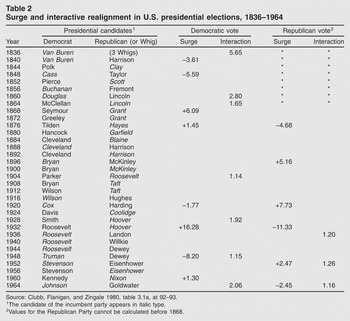
Surge and interactive realignment in U.S. presidential elections, 1836–1964
 You have
Access
- 42
- Cited by