INTRODUCTION
The role of pedagogic tasks has received increasing attention from instructed SLA researchers over the past two decades. This growing interest has been inspired partly by theoretical proposals suggesting that tasks have the capacity to generate optimal conditions for the cognitive and social processes hypothesized to facilitate SLA, and partly by the rising popularity of task-based language teaching (TBLT) in a variety of educational settings. A large part of the existing empirical research has set out to test the predictions of two task-based models: Skehan’s (Reference Skehan1998, Reference Skehan2009) limited capacity model and Robinson’s (Reference Robinson and Robinson2001a, Reference Robinson2007, Reference Robinson2011) cognition hypothesis. These cognitive-interactionist models are primarily concerned with how manipulating task factors may affect second language (L2) learning opportunities, performance, and development. Thus far, the bulk of empirical studies evaluating these models has focused on the impact of task complexity—that is, the cognitive-attentional demands posed by the tasks—on the linguistic complexity, accuracy, and fluency (CAF) of L2 performance.
Recently, concerns have been raised regarding the adequacy of the research methods utilized in researching the relationship between task complexity and linguistic performance, questioning whether CAF (Housen & Kuiken, Reference Housen and Kuiken2009) and cognitive task complexity (Norris, Reference Norris2010; Norris & Ortega, Reference Norris, Ortega, Doughty and Long2003; Révész, Reference Révész2014) are appropriately operationalized and measured. In response, researchers have begun to dedicate enhanced effort to identifying and exploring methodological procedures that permit valid examinations of the predictions of the cognition hypothesis, the limited capacity model, and other theoretical proposals (e.g., Levelt, Reference Levelt1989) relevant to explaining links between task factors and SLA. By now, some useful guidelines have been produced on how to arrive at valid representations of the multidimensional and dynamic nature of CAF constructs (e.g., Norris & Ortega, Reference Norris and Ortega2009), to which researchers increasingly adhere. Recommendations have also been put forward for evaluating the validity of cognitive task complexity manipulations (Révész, Reference Révész2014). So far, however, only a few studies have made an explicit attempt to provide independent validity evidence for operationalizations of task complexity (Baralt, 2013; Malicka & Levkina, Reference Malicka, Levkina, Shehadeh and Coombe2012; Révész, Sachs, & Hama, Reference Révész, Sachs and Hama2014; Sasayama, Reference Sasayama2013), beyond the use of posttask questionnaires to confirm learners’ perceptions of task difficulty (e.g., Gilabert, Reference Gilabert and Mayo2006, Reference Gilabert2007; Gilabert & Barón, Reference Gilabert, Barón, Mackey and McDonough2013; Gilabert, Barón, & Levkina, Reference Gilabert, Barón, Levkina and Robinson2011; Gilabert, Barón, & Llanes, Reference Gilabert, Barón and Llanes2009; Kim, Reference Kim2009; Kim & Tracy-Ventura, Reference Kim, Tracy-Ventura and Robinson2011; Levkina & Gilabert, Reference Levkina, Gilabert, Housen, Vedder and Kuiken2012, Reference Levkina, Gilabert, Baralt, Gilabert and Robinson2014; Michel, Reference Michel and Robinson2011; Révész, Reference Révész2009, Reference Révész2011; Robinson, Reference Robinson2001b, Reference Robinson2007).
The aim of this study was to help address this gap by utilizing three methods—dual-task methodology, self-ratings, and expert judgments—in an attempt to assess task-generated cognitive demands and thereby explore the relative efficacy of each in tapping the cognitive complexity of tasks. Our study is among the first to triangulate data obtained through these three techniques, and it is unique in that it investigated the effects of task complexity manipulations on cognitive demands for three rather than a single task type.
LITERATURE REVIEW
Key Constructs and Models
To begin with, it is useful to clarify some key concepts and theoretical models pertinent to the exploration of how task factors may influence L2 learners’ cognitive operations. As mentioned previously, the two frameworks that have informed much of the previous research on the links between task characteristics, cognitive processes, and L2 performance are Skehan’s limited capacity model (1998, 2009) and Robinson’s cognition hypothesis (2001a, 2007). In the limited capacity model, the primary independent variable is task demands, which are defined as having three components: code complexity, cognitive complexity, and communicative stress. In his most recent formulation, Skehan (Reference Skehan2009) invokes Levelt’s (1989) model of speech production to explain the effects of manipulating task demands on task processes and outcomes. It is suggested that task factors may exert more or less pressure at the speech production stages of conceptualization and/or formulation, and the quality of the resulting linguistic performance will depend on the extent to which the cognitive demands imposed on conceptualization and formulation processes can be handled against working memory or attentional limitations. The dependent variables in the model are specified in terms of the linguistic performance measures of complexity, accuracy, and fluency.
In the cognition hypothesis, the main independent variable is task complexity—or the inherent cognitive demands of tasks—which is similar to Skehan’s cognitive complexity. In explaining how task complexity may affect L2 outcomes, Robinson (Reference Robinson, Doughty and Long2003) draws on Wickens’s (Reference Wickens2007) multiple-resources account of attention. Wickens assumes the existence of multiple cognitive resource pools, which differ along three dichotomous dimensions: processing stage (perception vs. response), modality (auditory/vocal vs. visual/manual), and processing code (verbal vs. spatial). Each dimension is responsible for a distinct aspect of task performance, and the complexity of a task is seen as a consequence of the interference (i.e., confusion and cross talk) between similar codes or the competition for the same types of codes (e.g., verbal or visual), rather than as the result of limitations in attentional capacity, as Skehan assumes. For instance, carrying out two auditory tasks (e.g., listening to music and to an interlocutor) is more likely to result in interference and/or competition than performing a visual and an auditory task simultaneously (e.g., watching TV). Building on this and Levelt’s (Reference Levelt1989) speech production model, Robinson (e.g., 2001a, 2003) claims that making tasks more cognitively complex along certain task dimensions will impact, in predictable ways, processes such as conceptualization and formulation of speech, and allocation of attentional and memory resources to input and output. The dependent variables that these processes are expected to affect include quality of linguistic performance defined in terms of general and specific indices of CAF, patterns of uptake and interaction, retention of input, and automatization. Although the two models predict partly different linguistic outcomes for particular task dimensions, the major difference between them lies in the explanatory processes invoked.
It is important to point out here that the aim of this study was not to assess the predictions of these two task frameworks. Rather, our intention was to explore and identify methodological procedures that may assist, in future TBLT investigations including but not limited to tests of the limited capacity and cognition hypotheses, in adequately operationalizing cognitive task demands and tapping task-generated cognitive processes.
Issues in Measuring Task-Generated Cognitive Demands and Processes
A methodological shortcoming in many existing studies of task complexity lies in the fact that researchers have rarely sought separate evidence for the validity of their task complexity manipulations (see, however, Baralt, 2013; Malicka & Levkina, Reference Malicka, Levkina, Shehadeh and Coombe2012; Révész et al., Reference Révész, Sachs and Hama2014; Sasayama, Reference Sasayama2013). Operationalizing task complexity has typically involved creating a simple and complex version of a given task along a dimension that was assumed to influence the cognitive demands entailed in performing it. For example, a task may have been designed to lead to more or less reasoning, the expectation being that the resulting complex/simple task version would exert more/less pressure on cognitive operations. Until recently, it mostly remained unassessed whether this intended impact was in fact achieved. It was usually presumed rather than proved that the task version constructed to be more complex was truly more cognitively challenging (Norris, Reference Norris2010; Révész, Reference Révész2014). However, as Norris and Ortega (Reference Norris, Ortega, Doughty and Long2003) rightly emphasize, when testing theoretical constructs, it is vital that they are measured clearly and independently. As regards task complexity, this means that researchers need to establish independently whether their task complexity manipulations have indeed resulted in the anticipated changes in cognitive demands (Norris & Ortega, Reference Norris, Ortega, Doughty and Long2003; Norris, Reference Norris2010; Révész, Reference Révész2014).
It is worth noting that cognitive demand or cognitive load is a multidimensional construct that reflects the interaction among task-generated processing demands and learner abilities (Bachman, Reference Bachman2002; Paas & van Merriënboer, Reference Paas and van Merriënboer1994). In other words, any measurement of cognitive load will be affected by the extent of challenge learners encounter during task completion depending on their individual characteristics, thereby capturing certain aspects of what Robinson (Reference Robinson and Robinson2001a) terms as task difficulty (see subsequently, however, for a discussion of potential differences between perceived cognitive load/mental effort and task difficulty). Thus, cognitive load assessment does not permit pure measurement of task complexity. Instead, it enables gauging the amount of cognitive effort that was induced by a certain task complexity manipulation.
Drawing on research from applied cognitive science, Révész (Reference Révész2014) outlines several types of methods that may enable researchers to measure the amount of cognitive load or mental effort generated by intended changes in task complexity, including subjective self-ratings, subjective time estimations, dual-task methodology, and psychophysiological techniques. From among these, the current study employed two methods: dual-task methodology and self-ratings. In addition, we obtained expert judgments to gain further insights about the success of our task complexity manipulations. This selection of methods was motivated by our intention to use a combination of different types of techniques—empirical (dual-task methodology and self-ratings) versus analytical (expert opinions) and subjective (self-ratings and expert opinions) versus objective (dual-task methodology) (Paas & van Merriënboer, Reference Paas and van Merriënboer1994; Paas, Tuovinen, Tabbers, & van Gerven, Reference Paas, Tuovinen, Tabbers and van Gerven2003). Now we turn to a description of these techniques and a brief review of the instructed SLA research that has so far utilized them.
Dual-Task Methodology as a Measure of Cognitive Load
Dual-task methodology involves carrying out a secondary task parallel with the primary task. Secondary tasks normally take the form of simple activities that require continual attention, such as detecting a simple visual (Cierniak, Scheiter, & Gerjets, Reference Cierniak, Scheiter and Gerjets2009) or auditory (Brünken, Plass, & Leutner, Reference Brünken, Plass and Leutner2004) stimulus. The underlying rationale of the procedure is that the amount of cognitive load imposed by the primary task is reflected in the performance on the secondary task. Secondary-task performance is typically assessed in terms of reaction time and accuracy, slower or more inaccurate performance being taken to indicate more consumption of cognitive resources by the primary task. Dual-task methodology is considered in cognitive psychology as a reliable and sensitive methodology, and it has the advantage over self-report measures that it constitutes a concurrent measure of processing load.
DeKeyser (Reference DeKeyser1997) was one of the first studies to employ dual-task methodology in SLA research. In a longitudinal study of automatization, DeKeyser employed both single-task and dual-task conditions to assess participants’ developing knowledge of explicitly taught morphosyntactic rules. As part of the dual-task procedure, participants were presented with a number between 100 and 1,000 on the computer screen before a picture related to the target linguistic item appeared. They additionally heard beeps at irregular intervals while they were subsequently working on production and comprehension items targeting the morphosyntactic rules. The secondary task involved memorizing the number, counting the beeps, and calculating the difference between the original number and the number of beeps. DeKeyser predicted that, as the morphosyntactic rules are increasingly automatized, there will be less interference from the secondary task. He observed, however, a faster and less gradual decline in the difference between the single and dual conditions than expected, probably, he speculates, because the secondary task was not sufficiently demanding.
More recently, Declerck and Kormos (Reference Declerck and Kormos2012) used dual-task methodology to examine encoding mechanisms and lexical selection processes in L2 speech production. The participants performed a parallel finger-tapping task while carrying out an oral production task. The finger-tapping task asked participants to press 1 out of 10 keys every second as randomly as possible. The authors found that participants’ finger-tapping behavior became less random when they also had to perform a speaking task simultaneously. Thus, in this research, quality of performance on the finger-tapping secondary task was affected by the presence of the primary task to the predicted degree.
Finally, of particular relevance here are two recent studies of task complexity by Révész et al. (Reference Révész, Sachs and Hama2014) and Sasayama (Reference Sasayama2013). Révész et al. employed dual-task methodology, besides eye-tracking and expert judgments, to measure the levels of cognitive load posed by the simple versus complex versions of two computer-delivered experimental tasks. The experimental tasks, which served as the primary tasks, required participants to choose between two past events to produce a past counterfactual statement orally about a famous person’s life. The events were presented on the computer screen by the means of corresponding pictures and key phrases. The secondary task involved, following Cierniak et al. (Reference Cierniak, Scheiter and Gerjets2009), the color of the computer background screen changing to red or green at random intervals. The participants’ task was to respond as quickly and as accurately as possible to changes to one color (red) while ignoring changes to the other color (green). Although no difference emerged in secondary-task reaction times depending on intended task complexity, participants, as anticipated, were less accurate on the secondary task when carrying out the complex version of the primary task. These results for accuracy were found to be well aligned with the data obtained from expert judgments (see subsequently) and eye-tracking, attesting to the validity of the task complexity manipulation.
Sasayama also triangulated results from dual-task methodology with two other techniques (time estimation and self-ratings) to assess cognitive load on a series of computer-delivered narrative tasks. The study design featured four versions of a narrative task involving an increasing number of elements, with the intention to generate increasing cognitive effort on the part of the participants. As part of the secondary task, participants were asked to react as quickly and accurately as possible to changes in the color of the capital letter A, which was projected above the picture story eliciting the narrative on the computer screen. Specifically, participants were instructed to respond when the color of the letter changed from black to red but to ignore changes from red to black. Sasayama found increased reaction times, as predicted, on the most complex narrative as compared to the least complex narrative, but, contrary to expectations, no effects were observed for accuracy. Importantly, the results for reaction times were largely parallel to those obtained via time estimation and self-ratings, although dual-task methodology appeared to be a less sensitive technique than self-ratings and time estimation because it was not able to distinguish the intermediate-complexity versions from the most simple and complex narratives. As in Révész et al. (Reference Révész, Sachs and Hama2014), the author took the corresponding patterns on the three measures as evidence for the validity of the task manipulation.
The results of Sasayama (Reference Sasayama2013) and Révész et al. (Reference Révész, Sachs and Hama2014) suggest that dual-task methodology is a viable way to tap task-generated cognitive load. Nevertheless, given the small amount of research available and the conflicting findings for accuracy and reaction times, more research is warranted evaluating the sensitivity of dual-task methodology in detecting differential task-induced cognitive load.
Self-Rating Scales as Measures of Cognitive Load
So far, the most common method to determine cognitive load in educational psychology (Brünken, Seufert, & Paas, Reference Brünken, Seufert, Paas, Plass, Moreno and Brünken2010) as well as in SLA has been the use of subjective self-rating scales or self-report questionnaires. The use of self-rating scales in assessing cognitive load builds on the assumption that people can assign a numerical value to the amount of mental effort they spent during a particular cognitive activity. Indeed, it has been demonstrated that ratings of perceived mental effort can provide valid and reliable measures of cognitive load (e.g., Paas, Reference Paas1992).
Self-rating scales of cognitive load usually involve requesting learners to judge their perceived cognitive load in response to a semantic differential scale worded as follows: “This task required . . . mental effort,” with options ranging from “no” to “extreme” on a 7- to 9-item scale. In addition, learners are frequently asked to provide ratings of variables such as perceived task difficulty and anxiety, resulting in a multidimensional scale. Importantly, although perceived mental effort or cognitive load often correlates highly with these factors, it is not isomorphic with them (Brünken et al., Reference Brünken, Seufert, Paas, Plass, Moreno and Brünken2010). To give an example, an expert might rate both a simple and a complex version of an activity as easy (a simple math problem—2 + 2—and a more complex math problem—11 × 11) on a 9-point scale, resulting in little or no difference in task difficulty ratings. Still, the more complex version might be evaluated by the same expert as requiring the investment of somewhat greater cognitive effort than the simple version on the same scale. It is not surprising, therefore, that unidimensional scales, which solely assess perceived mental effort in the absence of scales tapping related but distinct constructs, have been shown to provide valid and reliable measurement of cognitive load (Paas & van Merriënboer, Reference Paas and van Merriënboer1994).
Self-rating scales have been employed in a growing number of L2 task complexity studies (Baralt, Reference Baralt2013; Gilabert, Reference Gilabert and Mayo2006, Reference Gilabert2007; Gilabert & Barón, Reference Gilabert, Barón, Mackey and McDonough2013; Gilabert et al. Reference Gilabert, Barón, Levkina and Robinson2011; Gilabert et al., Reference Gilabert, Barón and Llanes2009; Kim, Reference Kim2009; Kim & Tracy-Ventura, Reference Kim, Tracy-Ventura and Robinson2011; Levkina & Gilabert, Reference Levkina, Gilabert, Housen, Vedder and Kuiken2012, Reference Levkina, Gilabert, Baralt, Gilabert and Robinson2014; Malicka & Levkina, Reference Malicka, Levkina, Shehadeh and Coombe2012; Michel, Reference Michel and Robinson2011; Révész, Reference Révész2009, Reference Révész2011; Robinson, Reference Robinson2001b, Reference Robinson2007; Sasayama, Reference Sasayama2013), most of which have adopted or adapted a multidimensional scale introduced by Robinson (Reference Robinson2001b). Robinson’s original questionnaire included items tapping perceptions of task difficulty, stress, ability to complete the task successfully, interest in the task, and task motivation but had no items tapping perceived mental effort. Among existing task complexity studies, so far only Sasayama’s (Reference Sasayama2013) previously mentioned study has utilized both a mental effort and task difficulty scale. She found that, among the four task versions she created, the one intended to be the most complex was indeed rated as more difficult and as requiring more mental effort than two of the three versions that were designed to be of lower complexity. Thus, in Sasayama’s research, the two scales have yielded convergent findings, which patterned, for the most part, with those obtained from the dual-task method. Clearly, however, more research is needed to test the utility of these scales in tapping cognitive load.
Expert Judgments as a Way to Evaluate Expected Cognitive Load
An analytic, subjective method to obtain information about task-generated cognitive demands is to ask experts to judge the mental effort that a task complexity manipulation is expected to create. In the area of language testing, expert judgments are often utilized to analyze the content and difficulty of test items as part of test development and/or validation processes. In a large-scale study of task-based performance assessment, Brown, Hudson, Norris, and Bonk (Reference Brown, Hudson, Norris and Bonk2002) used expert judgments as a means of eliciting evaluations of the cognitive operations anticipated to be induced by task manipulations. Inspired by Skehan’s task framework, cognitive operations were categorized in terms of two characteristics: (a) the extent to which the input/output needed to be organized or reorganized as part of the task and (b) the degree to which the examinee was required to search for the information that had to be utilized to complete the task. The raters were experienced English as a second language (ESL) teachers who were familiar with the relevant test-taker population. Altogether they evaluated 103 tasks based on the task prompts and descriptions of task realia/materials. They were requested to assign a plus or minus for several task factors, including input/output organization and input availability, based on whether they thought that a particular task was likely to be above or below the average ability of the learner population with respect to the task factor in question. Interrater agreement was found to be in the moderate range for both cognitive factors (input/output organization: .75; input availability: .62).
Within the area of instructed SLA, expert judgments have also been employed to assess the expected mental effort presented by task complexity manipulations. As mentioned previously, Révész et al. (Reference Révész, Sachs and Hama2014) utilized expert judgments to measure the levels of cognitive load posed by the simple versus complex versions of the experimental tasks. Two applied linguistics doctoral students with a background in task-based language learning and teaching were asked to evaluate the items in both experimental tasks in terms of task complexity on a 5-point Likert scale, with higher ratings indicating greater complexity. The versions designed to be more complex were rated as higher in complexity by the two raters. Interrater reliability was adequate (ρ = .75, p < .01). The authors interpreted these results—triangulated with data from eye-tracking and dual-task methodology (see previously)—as suggesting that their task complexity manipulation was successful. Although these results suggest that expert judgments provide a valid assessment of task-generated cognitive load, further research is needed to confirm the validity of this measure.
RESEARCH QUESTIONS
The following research questions and hypotheses were formulated:
-
1. Do task manipulations designed to result in different levels of cognitive complexity indeed lead to different levels of cognitive load as measured by dual-task methodology?
-
2. Do task manipulations designed to result in different levels of cognitive complexity indeed lead to different levels of perceived cognitive load as measured by self-ratings?
-
3. Do task manipulations designed to result in different levels of cognitive complexity indeed result in different levels of cognitive load, as judged by experts?
On the basis of previous research in the areas of applied cognitive psychology and second language acquisition, it was hypothesized that task versions designed to be more complex would result in slower reaction times and lower accuracy rates on a visual secondary task, would be perceived as requiring higher mental effort by participants, and would be judged as generating greater cognitive load by experts.
METHODOLOGY
Design
The participants were 96 students and 61 ESL teachers. Out of the 96 students, 48 were native speakers (NSs) of English and 48 were ESL speakers. Of the 48 ESL speakers, 24 were Spanish and 24 were German students. All 96 participants carried out simple and complex versions of three oral tasks: a picture narrative, a map task, and a decision-making task. Task type and task complexity were counterbalanced across the participants. Half of the NSs (n = 24) and half of the ESL speakers (n = 24) completed the tasks under a dual-task condition. The remaining half performed the tasks under a single-task condition without an added secondary task. Participants in the single condition were asked to rate their perceived mental effort and task difficulty on a 9-point Likert scale immediately after completing a task version. Participants were randomly assigned to the single- and dual-task conditions at each data collection site. The ESL teachers provided expert judgments of anticipated mental effort and task difficulty and explanations for their ratings via an online questionnaire.
Participants
The 48 NS student participants were enrolled at a UK university, whereas the 24 German ESL speakers were studying at a university in Germany, and the 24 Spanish ESL speakers were studying in Spain. The German and Spanish participants were equally distributed across the dual and single groups. Except for first language background, the participants had similar demographic characteristics across the three contexts. The mean age was 22.86 (SD = 3.50) with a range of 18–35 (NSs: M = 23.08, SD = 3.73; German ESL speakers: M = 22.88, SD = 3.59; Spanish ESL speakers: M = 21.61, SD = 3.12), and the majority of the participants were female (NSs: 83.3%; German ESL speakers: 66.7%; Spanish ESL speakers: 66.7%). The proficiency levels of the ESL learners were in the B1–B2 bands according to the Common European Framework of Reference (CEFR), as determined by the Oxford Placement Test (Dave, Reference Dave2004), which was administered to the ESL participants. For the purposes of this study, the German and Spanish ESL learners were treated as one group, given that L1 background was not relevant to the focus of the research.
The age of the 61 ESL teachers ranged from 22 to 67 with a mean of 38.20 (SD = 10.80). Most of the teachers were female (68.9%). All teachers held at least an English language teaching certificate, and almost half had a master’s degree in TESOL or applied linguistics (47.5%). The majority were native speakers of English (65.6%), and a smaller number of the teachers had German (7.8%), Catalan (6.5%), Spanish (6.5%), or other first language backgrounds (13.6%). The teachers’ experience varied widely, ranging from 1 to 30 years of English language teaching (median = 10, mean = 10.33, SD = 8.36). On a 5-point Likert scale, the teachers’ mean rating of their knowledge of TBLT and task complexity was 3.59 (SD = 1.23) and 2.93 (SD = 1.44) respectively, with higher ratings indicating greater familiarity.
Instruments and Procedures
Tasks and Task Complexity Manipulations.
In order to increase the probability of detecting differences in task-generated cognitive load between the simple and complex versions of our experimental tasks, we decided to use task versions that have been found to differ in task difficulty based on self-ratings in previous research.
Inspired by Robinson (Reference Robinson2007), the narrative tasks were adopted from the picture arrangement subtest of the Wechsler Adult Intelligence Scale, third revised version (WAIS-III). We selected Story 3 (LAUNDRY), one of the narratives with lesser complexity, and Story 11 (SHARK), the most complex narrative. The simple narrative required participants to describe a sequence of routine activities that were completed by a single character when doing his laundry. This task version was expected to impose little cognitive load on the participants, as it depicted simple and familiar events organized in a highly predictable sequence. The complex narrative, on the other hand, involved narrating an unusual story of a surfer playing a prank on a crowded beach. It was hypothesized that this task version would pose more cognitive demands, because the story entailed an unpredictable set of unfamiliar events and required reasoning about the psychological state of the main character and his perceptions about other people’s beliefs and intentions. Unlike in the original Wechsler test, participants were not asked to put the stories in order; they were presented with the pictures in the correct sequence and were asked to narrate the story.
The map tasks were adapted from Gilabert and colleagues’ work (Gilabert, Reference Gilabert2007; Gilabert et al., Reference Gilabert, Barón and Llanes2009). They required participants to leave a voice mail message giving detailed directions on how to get to the city center in order to carry out some errands. In the simple version of the task, participants were asked to give directions to a newsstand to buy a newspaper, to the post office to post a letter, and to a flower shop to purchase a bunch of flowers, before going back to a subway station. To accomplish the task, participants had to describe a path along a single lateral axis (i.e., left, right, and straight) and involving unique reference points that were easy to distinguish. In the complex version, the participants’ task was to explain where to pick up a dog from the veterinary surgeon and where to purchase dog food from a department store, before returning to a subway station. Compared to the simple version, the complex map task entailed many and similar points of reference. Also, participants needed to describe more complicated directions, moving along not only the lateral (i.e., left, right, and straight) but also the vertical (i.e., up and down) and sagittal (i.e., front and back) axes, creating greater demands on landmark identification and path selection.
The decision-making tasks were also adapted from Gilabert and colleagues’ work (Gilabert, Reference Gilabert2007; Gilabert et al., Reference Gilabert, Barón and Llanes2009). Participants were asked to imagine that they had volunteered for the university’s fire emergency team, and the tasks involved explaining which actions they would take and in what order to save as many people as possible in case of an emergency. They were presented with a drawing of a building that was on fire and that contained a number of people who were trapped and needed to be rescued. In the simple version, people in the building were similar and were not part of vulnerable groups, there was sufficient equipment available (i.e., three fire trucks and a helicopter), and participants only had to take into account a few unrelated factors (i.e., people in safe places, the static nature of fire, and smoke moving away from the building). In contrast, the complex version required participants to rescue several vulnerable individuals (e.g., an elderly man, a pregnant woman with children, and a severely injured person). There were also fewer resources available (i.e., a single fire truck), and participants needed to consider closely related and dynamic factors generating different levels of danger when reaching decisions (e.g., fire moving toward the people and smoke blowing into the building). As a result, the complex version was expected to impose more reasoning demands on the speakers.
Dual-Task Methodology.
In the current study, the simple and complex versions of the narrative, map, and decision-making tasks served as the primary task. The secondary task was adopted from Révész et al. (Reference Révész, Sachs and Hama2014). The color of the computer background screen changed to red or green for 250 ms at random during each interval of 2,500 ms. The participants were asked to react as fast and as accurately as possible to changes to green while ignoring changes to red. Accuracy and reaction times were obtained by E-Prime 2.0 (Schneider, Eschman, & Zuccolotto, Reference Schneider, Eschman and Zuccolotto2002). Accuracy was calculated by dividing the number of times participants correctly reacted to changes to green and ignored changes to red by the total number of changes to green and red. Reaction times were only considered for correct hits. The rationale for adopting this particular secondary task was that it was found to be sensitive to detecting differences in task-generated cognitive load in Révész et al. (Reference Révész, Sachs and Hama2014), a study that also investigated a computer-delivered speaking task.
In the practice phase, participants first performed a practice task under the single condition without the added visual stimulus, similar to the tasks assigned to the participants in the single group. Then, baseline reaction times and accuracy rates were additionally collected. In the baseline phase, the participants saw the same visual prompts as under the single condition. Unlike the single group, however, they only performed the secondary task; that is, they responded to color changes but did not need to speak. In the final stage, participants carried out the primary task and secondary task simultaneously, performing the practice task while also responding to color changes.
Next, as part of the actual dual-task experiment, participants performed the simple and complex versions of the narrative, map, and decision-making tasks (primary tasks) while responding to color changes (secondary task). The order of tasks (narrative, map, or decision-making) and task complexity versions (simple or complex) were counterbalanced across participants.
Self-Rating Scales.
The perception questionnaire included six computer-delivered statements; the single group participants were asked to judge each statement on a 9-point Likert scale after completing a task version. Out of the six items, only two are relevant to and discussed in the present article. These assessed participants’ perceptions of (a) the mental effort required by the task and (b) overall task difficulty. The items were worded as follows:

The questionnaire items were administered to the participants in English, but care was taken to word the items in simple language.
Expert Judgments.
The expert judgments were obtained via an online questionnaire. For each task type, the simple and complex task versions were presented on one page. Before rating a particular task version, the teachers were asked to read the task instructions and consider the relevant visual prompts. Next, they assessed on a 9-point Likert scale (a) the overall difficulty of the task version and (b) the mental effort required by it. Once the teachers had completed the Likert-scale items for both the simple and complex task versions, they were asked to explain, in response to an open-ended item, why they gave the same or different ratings for mental effort/task difficulty for the two tasks. The aim of the open-ended items was to investigate the rationale for the teachers’ judgments. The order of the simple and complex versions was randomized across the three task types.
Data Collection.
The student participants took part in one individual session. First, informed consent was obtained, followed by the administration of a paper-and-pencil background questionnaire. The ESL participants were also asked to complete the paper-and-pencil version of the Oxford Placement Test (Dave, Reference Dave2004), which took 40 min at maximum. The rest of the experiment was delivered via the psycholinguistic software E-Prime (Schneider et al., Reference Schneider, Eschman and Zuccolotto2002). First, participants were familiarized with the task instructions and experimental procedures in a practice phase. This involved reading the task instructions, listening to a sample practice task performance, performing the practice task, and completing the task perception questionnaire. During the practice phase, participants were encouraged to ask any questions they had regarding the procedures. Next, participants moved on to completing the six experimental tasks. Participants had 30 s planning time to look at the prompt for each task before they were asked to start speaking. The completion of the practice and experimental tasks took between 40 and 60 min.
The researchers used e-mail and social media to invite teachers to participate in the task complexity questionnaire. The message specified the purpose of the study, the types of questions included, and the time commitment involved in completing the questionnaire (15 min). The questionnaire was administered via SurveyMonkey.
Data Analyses
Statistical Analyses.
First, descriptive statistics were calculated for the accuracy and reaction time data, the self-ratings, and the expert judgments. To examine the effects of task complexity on the dual-task data and self-ratings, a series of ANOVAs was conducted. Dependent-samples t tests were utilized to compare the teachers’ expert judgments of mental effort and task difficulty across the simple and complex task versions. Standard diagnostic procedures were used to ensure the appropriateness of all statistical models. The alpha level was set at p < .05, and we employed partial eta-squared (ηp 2) and Cohen’s d to measure effect sizes. Following Cohen (Reference Cohen1988), ηp 2 values of .01, .06, and .14 and d values of .20, .50, and .80 were considered small, medium, and large, respectively. Prior to submitting the data to these statistical procedures, we performed statistical power analysis for all tests using GPower 3.1 (Faul, Erdfelder, Lang, & Buchner, Reference Faul, Erdfelder, Lang and Buchner2007). The sample sizes were found to be adequate to detect medium effect sizes for all factors of interest with an α = .05 and power = .80.
Analysis of Open-Ended Questionnaire Items.
The analysis of the open-ended questionnaire items included four phases. First, all three researchers reviewed the teachers’ comments individually and identified emergent categories by annotating the data. Intercoder percentage agreement for category identification was found to be high for each pair of the three coders across the three task types (.80–.94). Second, the coding categories were finalized through discussion among the researchers. Third, the first author coded all of the teacher comments by annotating the data using the agreed coding scheme, and the second and third authors both blind-coded a different and nonoverlapping half of the dataset. In this way, all the data were double-coded. Intercoder agreement was high for both pairs of coders for all three tasks (narrative: coder 1–coder 2: .89, coder 1–coder 3: .94; map: coder 1–coder 2: .88, coder 1–coder 3: .97; decision-making: coder 1–coder 2: .84, coder 1–coder 3: .85). The coding of the first author was included in further analyses. Finally, a frequency count of all the annotations for each task version was obtained by adding up the annotations falling into a specific category.
RESULTS
Dual-Task Methodology
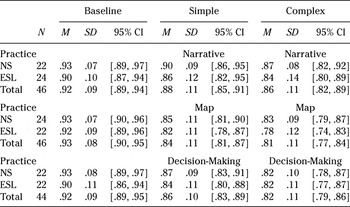
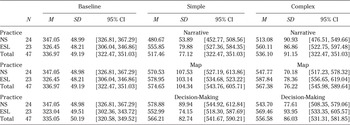
Tables 1 and 2 summarize the descriptive statistics for accuracy and reaction time on the secondary task under the baseline, simple, and complex task conditions for the three tasks after outliers were removed. For each task, outliers were identified considering the difference scores in accuracy and reaction time between each pairing of task conditions (simple-complex, baseline-simple, and baseline-complex). Outliers were defined as having difference score values more than three standard deviations away from the mean.
Accuracy rates for the baseline and dual tasks on the narrative, map, and decision-making tasks

Reaction times in milliseconds for the baseline and dual tasks on the narrative, map, and decision-making tasks

To determine whether participants’ accuracy in reacting to the correct color differed across the baseline, simple, and complex task conditions, a separate mixed-model ANOVA was conducted for each task using task condition (baseline, simple, or complex) as the within-subjects variable and NS/ESL speaker status as the between-subjects factor. Each of the three analyses yielded a significant and large effect for task condition, narrative: F(2, 88) = 8.29, p = .001, ηp² = .16; map: F(2, 88) = 29.81, p < .001, ηp² = .40; decision-making: F(2, 84) = 21.30, p < .001, ηp² = .34. However, no significant effects were detected for NS/ESL speaker status, narrative: F(1, 44) = 1.40, p = .243, ηp² = .03; map: F(1, 44) = 1.74, p = .194, ηp² = .04; decision-making: F(1, 42) = 0.78, p = .381, ηp² = .02, or the interaction, narrative: F(2, 88) = 0.11, p = .896, ηp² = .02; map: F(2, 88) = 0.82, p = .445, ηp² = .02; decision-making: F(2, 84) = 0.48, p = .621, ηp² = .01.
Next, a series of post hoc mixed-model ANOVAs was carried out. In each analysis, the within-subjects factor was defined as a pairing of the three task conditions (simple-complex, baseline-simple, and baseline-complex), and NS/ESL speaker status was kept as the between-subjects factor. As expected, on each task, participants produced significantly higher mean accuracy rates on the secondary task when carrying out the simple, as compared to the complex, versions of the primary tasks, narrative: F(1, 44) = 5.41, p = .025, ηp² = .11; map: F(1, 44) = 5.70, p = .021, ηp² = .12; decision-making: F(1, 42) = 9.21, p = .004, ηp² = .18. The effect sizes had medium to large values. Participants also performed the secondary task significantly more accurately under the baseline condition than under either the simple dual-task condition, narrative: F(1, 44) = 4.27, p = .045, ηp² = .09; map: F(1, 44) = 22.96, p < .001, ηp² = .34; decision-making: F(1, 42) = 18.44, p < .001, ηp² = .31, or the complex dual-task condition, narrative: F(1, 44) = 13.77, p = .001, ηp² = .24; map: F(1, 44) = 56.71, p = .001, ηp² = .56; decision-making: F(1, 42) = 27.41, p < .001, ηp² = .40. The effect sizes were, again, in the medium to large range. These results for the baseline-simple and baseline-complex comparisons indicate that, for accuracy, the secondary task, in combination with the primary tasks, constituted a sufficiently sensitive measure of cognitive load.
For reaction times, the same types of overall mixed-model ANOVAs were carried out. Task condition (baseline, simple, or complex) emerged as a significant and strong predictor of secondary-task performance on each of the three tasks, narrative: F(2, 90) = 224.92, p < .001, ηp² = .83; map: F(2, 90) = 205.24, p < .001, ηp² = .82; decision-making: F(2, 90) = 213.53, p < .001, ηp² = .83. For the narrative task, NS/ESL speaker status, F(1, 45) = 4.13, p = .048, ηp² = .08, and the interaction, F(2, 90) = 11.17, p < .001, ηp² = .20, were also identified as significant but considerably weaker predictors of reaction times. On the map and decision-making tasks, however, no significant effects were found for either NS/ESL speaker status, map: F(1, 45) = 0.29, p = .594, ηp² = < .01; decision-making: F(1, 45) = 0.25, p = .619, ηp² < .01, or the interaction, map: F(2, 90) = 2.58, p = .082, ηp² = .05; decision-making: F(2, 90) = 2.68, p = .074, ηp² = .06.
In contrast to our expectations, post hoc mixed-model ANOVAs detected no significant effect for task complexity for any of the three tasks, narrative: F(1, 45) = 2.69, p = .108, ηp² = .06; map: F(1, 45) = 0.216, p = .644, ηp² < .01; decision-making: F(1, 45) = 0.50, p = .484, ηp² = .01. Large and significant differences, however, were found between the baseline and simple conditions, narrative: F(1, 45) = 360.53, p < .001, ηp² = .89; map: F(1, 45) = 291.02, p < .001, ηp² = .87; decision-making: F(1, 45) = 376.10, p < .001, ηp² = .89, and the baseline and complex conditions, narrative: F(1, 45) = 366.05, p < .001, ηp² = .89; map: F(1, 45) = 447.11, p < .001, ηp² = .91; decision-making: F(1, 45) = 301.75, p < .001, ηp² = .87. Notably, NS/ESL speaker status only emerged as a significant predictor on the narrative when the simple and complex dual conditions were compared, that is, native speakers reacted significantly faster to the color changes than ESL speakers, baseline-simple: F(1, 45) = 3.63, p = .063, ηp² = .08; baseline-complex: F(1, 45) = 0.53, p = .470, ηp² = .01; simple-complex: F(1, 45) = 9.16, p = .004, ηp² = .17.
In sum, the reaction time data offer no evidence in support of the validity of our task complexity manipulations. Participants, however, achieved higher mean accuracy rates on the secondary task when carrying out the simpler versions of the primary tasks. This suggests that, as intended, the complex task versions generated greater cognitive load than the simple task versions.
Self-Ratings
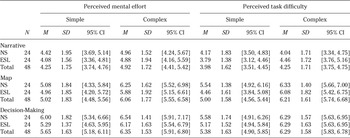
Table 3 presents the descriptive statistics for the self-ratings of perceived mental effort and task difficulty for the simple and complex task versions of the three tasks under the single condition. For each task, the data were first detected for outliers, defined as values more than three standard deviations away from the mean. No outliers were identified using these criteria. Spearman rank correlations revealed strong but not perfect correlations between perceived mental effort and difficulty, suggesting that the two scales were assessing related but not identical constructs (simple narrative: ρ = .66, p < .001, CI [.43, .87]; complex narrative: ρ = .69, p < .001, CI [.43, .88]; simple map: ρ = .72, p < .001, CI [.47, .89]; complex map: ρ = .79, p < .001, CI [.60, .93]; simple decision-making: ρ = .79, p < .001, CI [.64, .87]; complex decision-making: ρ = .68, p < .001, CI [.43, .87]).
Self-ratings of perceived mental effort and task difficulty for the narrative, map, and decision-making tasks

Note. The values represent ratings on a 9-point Likert scale (1 = lowest, 9 = highest).
To examine whether participants’ self-ratings of mental effort were different for the simple and complex task conditions, separate mixed-model ANOVAs were carried out for each task using task complexity as the within-subjects variable and NS/ESL speaker status as the between-subjects factor. Each of the three analyses found that, in line with the intended task manipulations, participants rated the more complex task versions as requiring significantly more mental effort, narrative: F(1, 46) = 5.28, p = .026, ηp² = .10; map: F(1, 46) = 13.52, p = .001, ηp² = .23; decision-making: F(1, 46) = 7.26, p = .010, ηp² = .14, with effect sizes ranging from medium to large. No significant effects were found for NS/ESL speaker status, narrative: F(1, 46) = 0.25, p = .618, ηp² < .01; map: F(1, 46) = 0.32, p = .572, ηp² < .01; decision-making: F(1, 46) = 2.16, p = .148, ηp² = .05, or the interaction, narrative: F(1, 46) = 0.19, p = .669, ηp² < .01; map: F(1, 46) = 0.20, p = .661, ηp² < .01; decision-making: F(1, 46) = 0.40, p = .529, ηp² < .01.
A series of the same type of mixed-model ANOVAs was also conducted to assess the effects of task complexity on the task difficulty ratings across the three tasks. As predicted, participants perceived the more complex versions of the map task, F(1, 46) = 17.75, p < .001, ηp² = .28, and decision-making task, F(1, 46) = 17.25, p < .001, ηp² = .27, as more difficult. The effect sizes were also found to be large for both analyses. Contrary to expectations, however, there was no significant difference in task difficulty ratings between the simple and complex versions of the narrative, F(1, 46) = 0.90, p = .348, ηp² = .02. None of the analyses found a significant effect for NS/ESL speaker status, narrative: F(1, 46) < 0.01, p = .957, ηp² = < .01; map: F(1, 46) = 3.65, p = .062, ηp² = .07; decision-making: F(1, 46) = 0.26, p = .615, ηp² < .01, or the interaction, narrative: F(1, 46) = 1.92, p = .172, ηp² = .04; map: F(1, 46) = 2.11, p = .153, ηp² = .04; decision-making: F(1, 46) = 0.89, p = .350, ηp² = .02.
Taken together, the results for self-ratings confirm the validity of our task manipulations. As anticipated, the more complex task versions were rated as involving more mental effort and posing more difficulty. The only exception to this pattern was the lack of difference between participants’ ratings of the task difficulty of the simple and complex narratives.
Expert Judgments
The descriptive statistics for the expert judgments of mental effort and task difficulty are presented in Table 4. No outliers were detected utilizing the same criteria as for the self-ratings. Spearman rank correlations, which were computed to assess the strength of the relationships between the expert judgments of required mental effort and task difficulty, yielded very high coefficients (simple narrative: ρ = .84, p < .001, CI [.70, .92]; complex narrative: ρ = .92, p < .001, CI [.85, .96]; simple map: ρ = .96, p < .001, CI [.93, .99]; complex map: ρ = .82, p < .001, CI [.63, .95]; simple decision-making: ρ = .89, p < .001, CI [.63, .95]; complex decision-making: ρ = .89, p < .001, CI [.81, .94]). This could be interpreted as suggesting that the teachers perceived the two constructs as closely linked.
Expert judgments of mental effort and task difficulty for the narrative, map, and decision-making tasks

Note. The values represent ratings on a 9-point Likert scale (1 = lowest, 9 = highest).
To assess whether the teachers judged the simple and complex task conditions as involving more mental effort and/or posing more difficulty, a series of dependent-samples t tests was conducted. In each of the six analyses, task complexity served as the independent variable, and the ratings of mental effort and task difficulty served as the dependent variables. The t tests confirmed that, across all three task types, the more complex task version was judged by the teachers as necessitating significantly more mental effort, narrative: t(60) = 6.49, p < .001, d = .76; map: t(60) = 6.58, p < .001, d = .92; decision-making: t(60) = 7.04, p < .001, d = 1.01, and as presenting greater difficulty, narrative: t(60) = 5.25, p < .001, d = .68; map: t(60) = 7.07, p < .001, d = .97; decision-making: t(60) = 6.22, p < .001, d = .91. Effect sizes were high overall. In other words, the expert judgments indicate that our task complexity manipulations were successful.
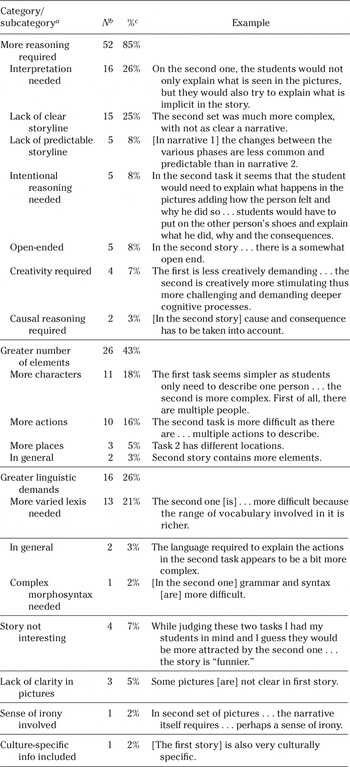
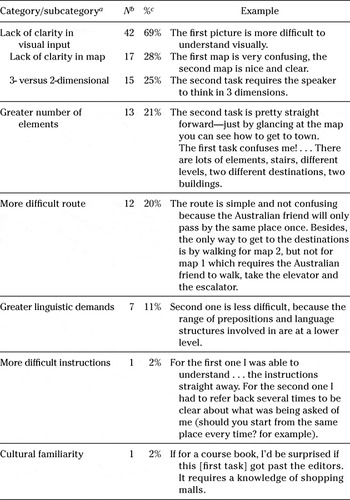
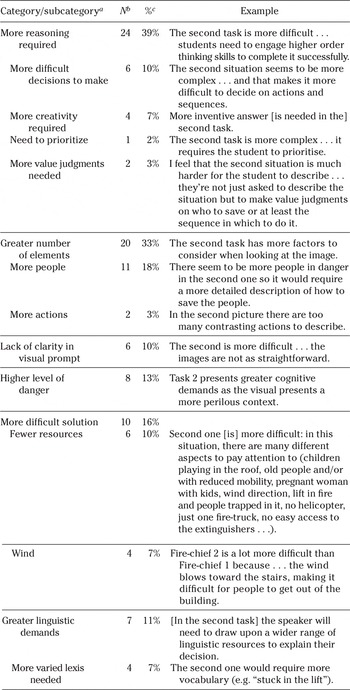
Tables 5–7 present a list of the categories that emerged from the content analysis of the open-ended questionnaire comments. Examples and frequency counts for each category are provided separately for the three task types. Given that the teachers did not make a distinction between task difficulty and anticipated mental effort in their comments, the constructs are not distinguished in the remainder of the section.
For the narrative, the content analysis of the open-ended questionnaire item generated 103 annotations, ranging from 0 to 5 annotations per teacher. As shown in Table 5, teachers most frequently (85%) explained the differential difficulty between the two narratives according to the varied amount of reasoning required. A number of more specific reasoning-related subcategories also emerged from the teachers’ comments. The teachers thought that the narratives differed in the extent to which they required interpretation (26%), intentional reasoning (8%), creativity (7%), and causal reasoning (3%); whether their storyline was clear (25%) and predictable (8%); and whether they were more or less open-ended (8%). Number of elements in the narratives was the second most frequently mentioned factor determining task difficulty. Nearly half of the teachers (43%) referred to this general factor. Several teachers further specified that the rationale for their decision lay in the varied number of characters (18%), actions (16%), and places (5%). Differential linguistic demands was the third most frequently reported factor, with more than a quarter of the teachers (26%) making reference to it. Some also mentioned complexity of lexis (21%) or morphosyntax (2%) as potential variables distinguishing the narratives. Four additional categories emerged from the content analysis (story not interesting, lack of clarity in pictures, sense of irony involved, and culture-specific information). These were raised by only a small number of the participating teachers (2%–7%).
Teacher comments on the sources of difficulty/mental effort for the narrative task

a The value in general categories may be higher than the sum of the comments in the subcategories, as some teachers only referred to the more general category.
b N = the number of teachers who mentioned a certain category/subcategory.
c % = the percentage of teachers who mentioned a certain category/subcategory.
Turning to the map task, the coding of the open-ended responses resulted in 76 annotations, ranging from 0 to 4 annotations per teacher. As Table 6 demonstrates, the most oft-cited factor (69%) differentiating the two versions of the map task was the clarity of the visual information presented. Some teachers further explained that the difference in their difficulty/mental effort rating was a reflection of the extent of clarity in the maps (28%) and the three- versus two-dimensional nature of the diagrams (25%). The second and third most frequently mentioned factors were the number of elements and the difficulty of the route in the two map task versions. These were referred to by considerably fewer teachers (21% and 20%, respectively) than the clarity of the visual prompt. Varied linguistic demands was found to be the next most frequent category, with slightly more than ten percent of the participants (11%) raising it as a characteristic explaining task difficulty. The remaining two factors—difficulty of task instructions and cultural familiarity—were mentioned by only one teacher each (2%).
Teacher comments on the sources of difficulty/mental effort for the map task

a The value in general categories may be higher than the sum of the comments in the subcategories, as some teachers only referred to the more general category.
b N = the number of teachers who mentioned a certain category/subcategory.
c % = the percentage of teachers who mentioned a certain category/subcategory.
Finally, the coding of the comments on the decision-making task generated from 0 to 4 annotations per teacher, or 79 annotations in total (see Table 7). Teachers most often (39%) attributed the difference in difficulty between the decision-making tasks to the differential reasoning demands posed by them. Several subcategories were also identified based on the teachers’ comments, including the difficulty of the decisions that had to be made (10%), how much creativity was required (7%), how much need there was to prioritize (2%), and the extent to which a value judgment was necessary (3%). Number of elements was the second most frequently (33%) mentioned factor, with two subcategories emerging from the data. Several participating teachers referred to the varied number of people (18%) and varied number of actions (3%) when explaining their difficulty/mental effort ratings. The next most oft-cited factor was the difficulty involved in finding a solution. Availability of resources (10%) and wind direction (7%) were identified as subcategories associated with this general factor. The rest of the categories—level of danger, linguistic demands, and clarity of visual input—were reported as perceived sources of difficulty by relatively few teachers (13%, 11%, and 10%, respectively).
Teacher comments on the sources of difficulty/mental effort for the decision-making task

a The value in general categories may be higher than the sum of the comments in the subcategories, as some teachers only referred to the more general category.
b N = the number of teachers who mentioned a certain category/subcategory.
c % = the percentage of teachers who mentioned a certain category/subcategory.
In summary, the expert teacher judgments were found to be well aligned with our intended task manipulations. The task versions that were designed to be more complex were perceived by the teachers as more difficult and requiring more mental effort. The teachers’ qualitative comments further revealed that what the teachers saw as potential sources of difficulty were in line with the rationale underlying our original task manipulations.
DISCUSSION
Our first research question asked whether task manipulations designed to result in different levels of cognitive complexity do indeed lead to different levels of cognitive load as measured by dual-task methodology. As discussed earlier, the assumption underlying the dual-task technique is that an increased amount of cognitive load imposed by the primary task will be reflected in slower reaction times and lower accuracy rates on participants’ performance on the secondary task. In light of this rationale, the results from the dual-task experiment provided a partially affirmative answer to our research question. As anticipated, participants achieved higher mean accuracy rates on the visual secondary task (responding to color changes) when carrying out the simple as compared to the complex versions of the three types of primary tasks, suggesting that the more complex versions of the primary task indeed posed greater cognitive demands. Contrary to expectations, however, no difference was observed in secondary-task reaction times depending on the task complexity manipulation for any of the primary tasks. Notably, the same trends were observed in Révész et al.’s (Reference Révész, Sachs and Hama2014) study, in which an identical secondary task was utilized in combination with a different type of primary task, also a computer-delivered oral task. Taken together, the results of this research and those of Révész et al. (Reference Révész, Sachs and Hama2014) indicate that secondary-task accuracy rates are more sensitive measures of cognitive load than secondary-task reaction times when the dual-task condition is operationalized as this particular type of color-changing task.
A possible explanation for the lack of secondary-task effects for reaction times in our and Révész et al.’s (Reference Révész, Sachs and Hama2014) studies may lie in the nature of the secondary task employed. Stronger secondary-task effects might have emerged if there had been more competition present for attentional resources between the primary tasks and the secondary task. As explained earlier, Wickens (Reference Wickens2007), in his multiple-resource framework, posits that the relative ease or difficulty of a task will depend on the extent of interference and/or competition within three dichotomous dimensions: processing stage (perception vs. response), modality (auditory/vocal vs. visual/manual), and processing code (verbal vs. spatial). In the current study, the primary task required participants to engage in both perceiving and responding to input (processing stage), to rely on vocal as well as visual channels (modality), and to deal with both verbal and spatial information (processing code). Although the secondary task also called for perception (noticing color changes) as well as provision of a response (reacting to certain color changes), it only involved the use of the visual/manual modality and the spatial code. Perhaps activities like recall of letters or words at certain intervals (e.g., Chandler & Sweller, Reference Chandler and Sweller1996) would have led to clearer and more pronounced secondary-task effects, because these types of activities, similar to the primary task, would also have entailed the use of the auditory/vocal channel and the processing of verbal material, thereby resulting in greater interference along the modality and code-of-processing dimensions. In light of the fact that Sasayama (Reference Sasayama2013) did not find simultaneous effects for accuracy and reaction times either, it would also appear that simply presenting verbal material (like the letter A in her study) without requiring the processing and vocalization of that material via the verbal channel (e.g., by recall) may be insufficient to create the required level of interference.
The second research question addressed the issue of whether task manipulations designed to result in different level of cognitive complexity would be perceived as posing differential cognitive demands as measured by self-ratings. The results for the self-ratings revealed that, in line with our task complexity manipulation, participants rated the more complex task versions as requiring more mental effort. The same patterns were found for task difficulty on the map and decision-making tasks, but, contrary to our prediction, no significant difference emerged between the participants’ ratings of task difficulty on the narratives. The absence of a complete correspondence between the results for the two scales was also evident in the strong but not perfect correlations between the task difficulty and mental effort self-ratings. It is not unexpected that the results for the two scales do not entirely overlap. Findings from previous research in educational psychology (Brünken et al., Reference Brünken, Seufert, Paas, Plass, Moreno and Brünken2010) suggest that task difficulty and mental effort are related but not isomorphic constructs. As discussed earlier, task difficulty ratings appear to depend more on learners’ level of expertise or prior domain-specific knowledge than on judgments of mental effort. In light of this, it might have been due to the participants’ greater familiarity with the narrative task type that they, overall, perceived the difference in task difficulty between the simple and complex narratives to be considerably smaller than the difference in mental effort between the two narrative versions, unlike for the map and decision-making tasks, in which there was somewhat greater correspondence between students’ ratings on the two Likert scales. This possibility is supported by the lower overall difficulty ratings awarded by participants for the narrative as compared to the map and decision-making tasks (see Table 3).
It is also worth highlighting that the results obtained for the mental effort scale are more closely aligned with the findings of the dual-task experiment and the expert judgments. This raises the issue of whether ratings of mental effort may provide a more valid measurement of task-generated cognitive demands than ratings of task difficulty. The validity of the mental effort scale as a measure of cognitive load is supported by research in cognitive psychology. Researchers have consistently shown (e.g., Paas & van Merriënboer, Reference Paas and van Merriënboer1994) that rating scales eliciting judgments of mental effort can successfully differentiate between different levels of mental effort when participants are asked to provide ratings for instructional conditions that are expected to affect cognitive load. More research is needed to clarify this issue.
The third research question was concerned with whether our intended task complexity manipulations were reflected in experts’ judgments of required mental effort and task difficulty. The teachers, who served as expert judges, rated the complex version of each of the three task types as involving both more effort and more difficulty. The correlations were also found to be very high between the mental effort and task difficulty ratings, indicating that, unlike the student participants, the teachers considered the two constructs to be closely linked. The open-ended questions revealed that the rationales for the teachers’ judgments largely overlapped with the rationales for our task complexity manipulations. Following Robinson (Reference Robinson2007), we hypothesized that the complex narrative would impose greater reasoning demands on learners than the simple version of the task. Likewise, the teachers referred to differential reasoning demands most frequently (85%) when accounting for the difference in difficulty between the simple and complex narratives. As for the map task, we anticipated that the more complex version would be more cognitively taxing because it would require reference to a greater number of (Robinson, Reference Robinson and Robinson2001a) and more similar reference points and description of a more complicated route involving directions along not only the lateral but also the vertical and sagittal axes. In line with this, the teachers most often mentioned the clarity of the visual information as a factor determining task difficulty (69%), making specific reference to the clarity of the map (28%) and the two- versus three-dimensional nature of the diagrams (25%). The teachers also identified the number of elements (28%) and the difficulty of the route (20%) in the maps as determinants of expected mental effort expanded. Turning to the decision-making tasks, the more complex version was intended to create a greater need to engage in reasoning on the part of the participants by requiring decisions about vulnerable people under more difficult conditions with fewer resources available. The expert comments reflected this rationale: the teachers most often referred to reasoning demands (39%) and number of elements (33%) in describing sources of difficulty. In sum, the data obtained from the expert judgments, both quantitative and qualitative, appear to confirm the validity of our task complexity manipulations.
CONCLUSION
In response to recent calls to increase the internal validity of research designs testing cognitive-interactionist models of task-based learning (Robinson, Reference Robinson and Robinson2001a; Skehan, Reference Skehan1998, Reference Skehan2009), the aim of this study was to explore methods that researchers can use to establish the validity of cognitive task complexity manipulations, that is, to provide independent evidence that tasks that were designed to be more complex do, in fact, place greater cognitive demands on research participants. In particular, this study intended to examine the extent to which three methods—dual-task methodology, subjective self-ratings, and expert judgments—were useful for this purpose. The novelty of our study lay in that we investigated whether these three methods would lead to parallel results for three task types—a narrative, a map, and a decision-making task. Although some researchers have already begun to utilize subjective and/or objective measures of task-generated cognitive load to validate manipulations of task complexity, studies have so far tended to focus on a single task type, thus not permitting generalizations across different task types.
Our study was successful in providing confirmation of the validity of our task complexity manipulations, because the data collected largely converged on the finding that the task versions we considered to be more complex required greater cognitive effort. For all three task types, both native and nonnative speakers achieved lower accuracy rates on a secondary task when carrying out the complex versions of the primary tasks, both native and nonnative speakers perceived the high-complexity task versions as more cognitively demanding and most of the time more difficult, and experts judged the complex tasks to demand more mental effort and to be more difficult. Only the secondary reaction times and student difficulty self-ratings for the narratives yielded no significant difference between the simple and complex task versions, suggesting that these indices were not sufficiently sensitive measures of cognitive load in this context.
One finding that is particularly worth highlighting is that our objective measure (accuracy rates) and subjective measures (self-ratings and expert judgments) yielded parallel results. This suggests that subjective ratings and judgments constitute potentially valid research tools to estimate task-generated cognitive load. This result, if replicated in further research, also has important practical implications. Given that subjective measures are easy to administer, nonintrusive, and inexpensive and have high face validity with both teachers and second language learners, they potentially lend themselves well to use by second language practitioners when making task-grading and sequencing decisions in task-based and task-supported instructional contexts.
In addition to replicating this research using the same three methods, in future research it would also be worthwhile to triangulate the results obtained here with data gathered via other research techniques. One limitation of the present study is that a single objective measure—one type of dual-task methodology—was employed. It would be interesting to explore different forms of dual-task methodology, especially the use of secondary tasks that are more likely to be encountered in real-life language use situations (e.g., changing a radio channel). It would also be worth exploring the value of additional objective measures—such as physiological measures, including the assessment of heart rate variability (Fredericks, Choi, Hart, Butt, & Mital, Reference Fredericks, Choi, Hart, Butt and Mital2005), neuroimaging techniques (Murata, Reference Murata2005), and the recording of eye movements (Révész et al., Reference Révész, Sachs and Hama2014)—in assessing cognitive load. Another limitation concerns the lack of detailed information about students’ cognitive processes during task performance and their perceptions about sources of task difficulty. In future research, introspective methodology could prove useful in gaining more in-depth insights into students’ thought processes and perceptions and could thereby lead to a more thorough understanding of what specific task parameters are responsible for causing increased mental effort during task work. A further limitation of the study lies in the fact that the three tasks differed along several task features, making it impossible to attribute any differences in task-generated cognitive demands to specific task dimensions across the three tasks. This limitation could be addressed in future research by manipulating different task types and versions of the same task type along the same task feature(s) (e.g., number of elements or reasoning demands). Finally, given that the present research only focused on native speakers and L2 users with intermediate proficiency level and that they carried out a limited number of task types, future studies are also needed to examine whether the results found here would transfer to other proficiency levels and other task types.
This research was supported in part by the Autonomy Fund from the University of Mannheim; the GRAL group at the University of Barcelona, Ministerio de Ciencia e Innovación (FFI2010–21478) and Generalitat de Catalunya (2014SGR1089); and Lancaster University’s Small Grants Scheme and LAEL Research and Development Fund. We would like to thank all of the participants as well as the following individuals for their assistance in data collection and analysis: Jing Gao, Diana Mazgutova, Fernando Moresi, Charis Stefanou, Laura Stiefenhöfer, and Lena Vasylets. We would also like to thank the anonymous reviewers for their helpful suggestions on the manuscript.