1. Introduction
Institutional economics seeks to understand the evolution of economic institutions. Why are some economic institutions resilient and others fragile? Which institutions create better economic performance? How and why do institutions governing important dimensions of behavior change? Society prospers when organizations have incentive to overcome agency costs and other obstacles to efficiency (Posner, Reference Posner2010) and invest in productive outputs and innovations (North, Reference North2005). Yet organizations and the broader incentive structures within which they are embedded often exhibit strong path dependence, with innovations constrained by inherited norms and beliefs.
Health care provides a fascinating laboratory for studying such issues of institutional evolution because of the confluence of three characteristics: (a) cultural norms and beliefs strongly influence health and medical care decisions; yet (b) medicine has experienced rapid technological change that disrupts traditional norms and beliefs; and (c) market failures are rife in health care financing and delivery (Arrow, Reference Arrow1963). Health and appropriate medical systems are not only inherently valuable, but also increasingly important for economic performance. The stark human consequences of market and government failures in health care raise the stakes for institutional design and adaptation. The health sector may be one of the few remaining sectors of market-based economies where a lively debate continues about the relative merits of the state and the market in delivering better performance. Moreover, many elements of health systems (including the one studied in this paper) have been adopted or imposed from abroad in some countries, allowing study of institutional transplantation. Finally, health policies provide a useful microcosm for studying resilience of institutions during system transformation during socialist and post-socialist transitions (Kornai and Eggleston, Reference Kornai and Eggleston2001). The institution focused on in this paper, for example, survived from pre-modern China through socialist governance during the Mao era through to today's market-based economy. Understanding why physician dispensing persisted across China's economic system transformations of 1949 and 1979, but then became one of the central targets of China's 2009 health reform plan, can shed light on how and why institutions change.
Some scholars have pointed out the importance and analytic usefulness of applying institutional and evolutionary perspectives to study health systems (Davis, Reference Davis2001; Hodgson, Reference Hodgson2008). Health and medical care-seeking behaviors exhibit a number of features that fit uneasily within the traditional utilitarian rational choice framework. Moreover, the conventional apparatus of neoclassical theory has limitations for studying institutional adaptation of a service so vital to human needs and desires, yet so complex, heterogeneous and rapidly changing as medical care (Culyer, Reference Culyer1995; McMaster, Reference McMaster2003; Hodgson, Reference Hodgson2008). Few scholars have applied comparative institutional economics to understand specific subcomponents of health systems, such as the phenomenon of physician prescribing.
International differences in physician-dispensing policies have been noted as a puzzle (e.g., ‘why physician dispensing has remained low in the United States while it become a major source of revenue in Japan is uncertain’; Rodwin and Okamoto, Reference Rodwin and Okamoto2000: 355). This paper applies the economic approach of comparative and historical institutional analysis (Aoki, Reference Aoki2001; Greif, Reference Greif2006) to health policy by developing a theory of physician dispensing and reforms separating prescribing from dispensing, motivated by the experience of East Asia.
According to Greif (Reference Greif2006), an institution is a system of rules, beliefs, norms and organizations that together generate a regularity of social behavior. I seek to explain physician dispensing as a social institution, or a regularity of physician–patient behavior. I define physician dispensing as physician control over revenues from drug dispensing. Under what conditions were (the rents from) diagnosis and evaluation, on the one hand, and dispensing of medication, on the other, integrated within a single provider rather than separated between a physician and an independent apothecary or pharmacy? With this way of framing the question, it is natural to seek conceptual answers in the literature on the boundaries of the firm. In particular, I modify the theory of asset ownership and relational contracting developed by Baker et al. (Reference Baker, Gibbons and Murphy2002).
Relational contracts are ‘informal agreements sustained by the value of future relationships’ (Baker et al., Reference Baker, Gibbons and Murphy2002: 39). This paper focuses on relational contracts between patients and physicians. Relational contracts provide incentives for non-contractible commitments (diagnosis and prescription efforts by doctors, future business and referrals of patients) if the parties sufficiently value their reputations and the future benefits associated with the physician–patient relationship.
The focus on reputations and relational contracting appears warranted by the unusual confidence that many societies place in the self-regulatory ability of physicians, compared with other professions, occupations and interest groups. Within the health sector and the supply chain for pharmaceuticals, physicians certainly occupy a unique position. In no market-based economy of which I am aware do laws prohibit for-profit corporate ownership of drug-manufacturing firms. But several capitalist societies – including Japan and Taiwan – allow individual physicians to own for-profit clinics and hospitals, while prohibiting for-profit corporate ownership of healthcare delivery organizations. Such a legal pattern suggests that societies have specific expectations about the medical profession and its ability to self-regulate to restrict fraudulent profiteering in the physician–patient relationship.
The parsimonious theory developed in this paper illustrates institutional evolution and points to several determinants of the social institutions governing the physician–patient relationship. I argue that physician dispensing was a persistent institution because physician interests coalesced around this arrangement and patients came to associate receiving a drug with an effective physician visit. As a result, the greater the number of generations who lived in a society with physician dispensing, the higher the associated costs of physician-induced demand could be before separation became the efficient self-enforcing social institution. Physician dispensing may also provide efficient incentive for investment in drug quality assurance in societies where drug quality is a problem, mitigating the inducement cost.
By contrast, separation of prescribing from dispensing removes the incentive for physician-induced demand for drugs, but requires costly enforcement – including overcoming physician interest groups – as well as additional (perceived) travel costs for patients to separate pharmacies. My central proposition is that technological change and adoption of universal coverage both increase the loss of social surplus associated with inducement under physician dispensing and are therefore likely to trigger separation reforms. Support for the theory comes from the history of separation reforms in East Asia compared with other parts of the world.
The paper proceeds as follows. After providing some historical background, I develop a model of physician dispensing that helps elucidate the path dependence of health system incentive structures. Subsequent sections discuss extensions of the basic model to encompass regulation and heterogeneity, and present evidence on the history of separation reforms in East Asia compared with Europe, the UK and USA. The conclusion returns to the question of how the analysis provides an example of institutional evolution.
2. Background
The legacy of history and culture
Analysis of physician dispensing is related to several strands of literature. In part it is an application to health care of the economic theory of expert–client interactions when information is asymmetric (Darby and Karni, Reference Darby and Karni1973; Wolinsky, Reference Wolinsky1993; Taylor, Reference Taylor1995; Hubbard, Reference Hubbard2002; Afendulis and Kessler, Reference Afendulis and Kessler2007). In part it represents an inquiry into what Abbott (Reference Abbott1988) calls ‘the ecology of professions’ in comparative sociology, exploring the professional boundaries between physicians and pharmacists, and the counterpart exploration in economics of boundaries between professions (Savage, Reference Savage1994) and occupations (Kleiner and Park, Reference Kleiner and Park2010). Most centrally, however, it is an inquiry applying to health systems the method of comparative and historical institutional analysis (Aoki, Reference Aoki2001; Greif, Reference Greif2006).
The cultures of healing and professions of medicine in the east and the west differed in many important ways, and each is itself a heterogeneous collection of many schools of thought. In the west, prescribing and dispensing of medications has often been ancillary to the primary expected outcomes of a physician visit, diagnosis and explanation. In herbal medical traditions as dominated in East Asia, the dispensing of medicine came to be seen as the most critical outcome of the physician–patient interaction. In traditional Chinese medicine and counterpart herbal traditions developed in Japan and Korea, it was considered improper for doctors to charge patients for the humane service of diagnosis, so that doctors primarily made a living by selling medications (Campbell and Ikegami, Reference Campbell and Ikegami1998).
Defining physician dispensing
Consider two primary institutional arrangements governing clinical reality in a given society at a given time: (1) financial integration of diagnosis and dispensing functions (‘physician dispensing’); and (2) strict enforcement of patients’ property rights to a prescription, so that the patient may have a prescription filled at any pharmacy and the provider does not receive dispensing revenues (‘separation of prescribing and dispensing’).
Since separation is defined to occur only when the provider does not receive dispensing revenues, physician dispensing includes all organizational and property rights arrangements in which physicians have control over revenues from drug dispensing. Thus, physician dispensing encompasses not only a physician preparing drugs for patients in a back counter of the office, but also any arrangements in which physicians and outpatient clinics ‘buy’ drugs on the open market at one price and ‘sell’ them to patients and their insurers at a higher price (common in Japan, South Korea before 2000, and also true of US oncologists; see Jacobson et al., Reference Jacobson, Earle, Price and Newhouse2010). Physician dispensing also includes a physician hiring a pharmacist for on-site dispensing or owning a free-standing pharmacy (a common arrangement in Taiwan); or hospital-based physicians earning substantial income from hospital outpatient pharmacy revenues, often linked to individual prescribing (a typical situation in China).Footnote 1
Physician dispensing should be distinguished from pure economies of scale and scope. Classification into physician dispensing versus separation is not based on the scale of the organizations producing the diagnoses and receiving the dispensing revenues. The provider can span the gamut from a solo practice to a large multi-specialty clinic; a pharmacy can achieve considerable scale and still be financially linked or owned by physicians.
Physician dispensing as a social institution
Physician dispensing can arise in a society in which no legal or contracting institutions enforce restrictions on the physician–patient interaction or the property rights to dispensing revenues. Doctors choose whether to specialize in diagnosis or to integrate diagnosis and dispensing; patients choose to buy drugs any place where they were marketed. Initially, there often was no distinction between prescription and over-the-counter drugs, and few if any licensing and accreditation standards for providers. The developer of an effective new medical formulation had no enforceable property rights. Others could expropriate the innovation unless the originator kept it secret by, for example, dispensing the medication directly to the patient.
In contrast, some societies have adopted restrictive laws that enforce a division of labor between physicians and pharmacists, including legal restrictions over physician or hospital ownership of dispensing revenues. Such a distinction may be reinforced by the organization of separate guilds or professional associations for physicians and pharmacists (Sonnedecker, Reference Sonnedecker1986; Savage, Reference Savage1994; Cochran, Reference Cochran2006). Other aspects of separation that usually follow from proscribing physician income from dispensing include enforcement of property rights over drug discovery and a legal distinction between prescription-only and over-the-counter medications. Kickbacks from pharmaceutical firms to doctors are made illegal (although enforcement may be difficult). Only when a society has invested in such laws and enforcement institutions can genuine separation prevail.
I denote all contracting costs associated with separation as Ω. These contracting costs may be closely linked to the political economy of professional organizations in a society. In Europe, for example, contracting costs of separation in the modern era were relatively low because enforcement did not require overcoming the political and economic interests of strong physician-dispensing interest groups. By contrast, contracting costs of separation are high in societies in which the medical profession organized to protect dispensing rents. In such a case, development of interest groups or lobbying organizations representing the interests of dispensing physicians reinforces physician dispensing as an institution. I therefore index contracting costs with time, Ωt, to denote that political interests of providers will coalesce into more powerful interest groups as a function of the length of time a society has experienced physician dispensing.
An arrangement prevails as a social institution, for the purpose of this analysis, when both parties – the upstream provider and the downstream purchaser – find the value of future interactions under the current institutional arrangement outweighs the temptation to renege on the relationship (and resort to the spot market or, eventually, change the social institution).
The model seeks to explain when parties will find physician dispensing to be the preferable self-enforcing structure governing the physician–patient relationship. To move from physician dispensing to separation requires paying Ωt > 0: overcoming the political, contracting and enforcement costs of removing dispensing revenues from physicians.
Separation also requires that patients separately visit both the physician and an independent pharmacy, making two (or more) trips instead of one for each treatment episode. Let patients’ perception of the differential travel cost associated with separation, at time t, be Tt. The perceived cost is likely to be largest if consumers have lived with integration for many generations and therefore consider it unnatural and wasteful to make two separate visits.
In sum, the model assumes that Ωt + Tt increases with the length of time under physician dispensing. Inertia in consumer expectations and the political economy of supply, subsumed in these two factors (Ωt + Tt), suggest that societies will continue physician dispensing until change of some other factor, alternatives for which are discussed next.
Why separate prescribing from dispensing? Alternative hypotheses
Several economies of East Asia have recently implemented policies to separate prescribing from dispensing, often closely upon the heels of increased public financing and health insurance expansion. Other Asian economies such as Singapore have not separated prescribing from dispensing. This section previews several alternative hypotheses about what can explain such a pattern of separation reforms.
One hypothesis might be that physician dispensing is determined by culture. Both theoretical and empirical evidence shows how cultural traits are transmitted inter-generationally (Cavalli-Sforza and Feldman, Reference Cavalli-Sforza and Feldman1981; Bisin and Verdier, Reference Bisin and Verdier2010) and can shape incentives for innovation (Gorodnichenko and Roland, Reference Gorodnichenko and Roland2010). Yet separation reforms have not coincided with large changes in the use of herbal medications or other specific clinical manifestations of culture in East Asia, and Singapore shares a similar cultural background yet has not separated prescribing from dispensing. Thus it would appear that to explain the observed pattern of institutional change, culture must interact with other factors.
Another explanation is rent-seeking among closely affiliated professions, such as pharmacists and physicians. The hypothesis that separation is determined by a power struggle among guilds has appeal for explaining separation in pre-modern Europe (as discussed further in the final section of this paper). However, it has less success in explaining the fact that nowhere in East Asia have pharmacist associations or pharmaceutical firms played a decisive role in separation reforms, whereas physician groups remain quite powerful. Moreover, the rent-seeking hypothesis does not present a compelling explanation for the timing of separation reforms, such as why separation followed closely in the footsteps of expanded insurance in South Korea, Taiwan and China. Of course, rent-seeking logically does shape the contested borders of professions (and as we argue below, rent-seeking is closely tied to physician-induced demand, since inducement creates and expands rents); but sans interaction with other forces, the rent-seeking theory is incomplete.
Technological change is another obvious candidate for explaining institutional change in medicine. Once pharmaceutical firms became the primary producers of research and development as well as manufacturers of medications, and the processes of verifying the chemical content and purity of medications became too complex for a community doctor or pharmacist, then the integration of prescribing and dispensing increasingly became a relic of a by-gone era (Savage, Reference Savage1994).
However, the technological change hypothesis cannot explain why a country like Singapore – as affected by modern biomedicine and forces of globalization as any country – has never separated prescribing from dispensing. Furthermore, since separation does not merely rearrange organizational boundaries but also redefines ownership of dispensing revenues, technological change by itself cannot fully explain separation reforms. For example, in China, medication inventories and dispensing functions may have moved from individual physician offices to the hospital pharmacy, but hospitals are still legally allowed to charge a dispensing mark-up to cross-subsidize other medical services, and the average government-owned hospital in China by the mid-2000s earned close to half its revenues from dispensing medications; physicians, as employees of hospitals, often received bonuses linked to hospital profitability (Sun et al., Reference Sun, Santoro, Meng, Liu and Eggleston2008). Thus the integration of diagnosis and dispensing persists as a legally legitimized form of physician compensation despite technological change.
I explore the logical implications of an alternative hypothesis: that separation reforms are directly linked to physician command over expanding medical care resources and the incentive for wasteful over-use associated with physician dispensing. Continuing to allow physician dispensing avoids the contracting and interest group costs (Ωt) and the transaction costs (Tt) of enforcing separation, but it also gives incentive for inefficient physician behavior, such as over-prescribing and dispensing medications according to profitability. I denote the potential social welfare loss from ‘physician-induced demand’ using notation P.
According to the Handbook of Health Economics, ‘physician-induced demand exists when the physician influences a patient's demand for care against the physician's interpretation of the best interest of the patient’ (McGuire, Reference McGuire, Culyer and Newhouse2000: 504). That physician-induced demand for pharmaceuticals may significantly make an impact on drug use and spending patterns is clear from several recent studies (Iizuka, Reference Iizuka2007; Chen et al., Reference Chen, Gertler and Yang2011; Currie et al., 2011) discussed in more depth in the final section. Arguing that physician-induced demand may play a large role in decisions to prohibit physician dispensing does not deny the power and influence of technological change in medicine. To the contrary, physician-induced demand is elevated to a large social issue primarily thanks to advances in technology that add a wide array of medical resources to the physician's armamentarium and enlarge the social costs from prescribing according to profitability rather than clinical indication.
Separation reforms, I argue, flow directly from a change in how health systems control physician-induced demand. Prior to the modern era, physician-induced demand arguably was a minor factor in overall health spending, given the limitations of medical technology. Moreover, patient ability to pay constrains health spending in most low-income societies (and, in a different format, in contemporary Singapore). However, when the constraint on induced demand from patient demand-side cost sharing is removed – through expansion of insurance and increased public financing for health care – the social costs associated with wasteful over-use increase and strain government budgets; it is these forces, in the model, that spur separation reforms.
It is not clear a priori that eliminating incentives for physician-induced demand is the socially efficient institutional structure under all parameter values or historical contexts. Encouraging an unproductive action such as excessive prescribing reduces total surplus but may also reduce the reneging temptation in the physician–patient relationship enough to make it worthwhile (for a similar argument, see Baker et al., Reference Baker, Gibbons and Murphy2002: 67). Moreover, committing to reward physician prescribing, even with prices reflecting market power, can serve as a relational incentive for quality effort, such as assurance of pharmaceutical quality.
Baker et al. note that ‘the key question in our analysis is whether choosing appropriate asset ownership (integration or non-integration) can make a given promise self-enforcing’ (Baker et al., Reference Baker, Gibbons and Murphy2002: 41). Here, the key question is whether physician or patient ownership of the prescription ‘asset’ (rights to where to fill the prescription and the associated revenue) can make two promises self-enforcing: (a) the purchaser promise not to expropriate the mifang of a physician-inventor or ‘defect’ from the physician–patient relationship to self-diagnose (perhaps with pharmacists ‘quasi-prescribing’ thereafter); and (b) the physician promise of not (excessively) inducing demand. The ‘temptation to renege’ is important because while physician dispensing may be an institutional equilibrium in the overall society, the meeting of any one patient with any one physician may be infrequent. The physician's ability to induce demand will vary across encounters. As the model developed in the next section shows, when many physician–patient interactions lead to temptation to renege on the relational contract upholding physician dispensing, then that institution governing the physician–patient relationship begins to break down and is no longer self-enforcing. Separation reforms ensue.
3. A simple theory of physician dispensing and separation
The upstream party, the physician, produces services which, combined with the filled prescription, treat the downstream patient's medical condition. If the physician owns the prescription asset, then physician dispensing prevails; Baker, Gibbons and Murphy call this ‘relational outsourcing’. If the downstream patient owns the prescription asset, then separation prevails; Baker, Gibbons and Murphy call this ‘relational employment’. I modify the model to fit institutional evolution of physician dispensing and separation, including induced demand, demand-side liquidity constraints, insurance coverage, incentives for drug discovery, and regulation.
Each period, the physician chooses two actions, quality-related effort and effort to induce demand, with an associated effort cost. No one except the physician herself can observe the actions. In this ‘unproductive multitasking’ setting, the value of the physician–patient relationship would be highest if the physician invested only in quality-improvement effort and never induced demand. The provider's actual effort choices depend on both who owns the prescription ‘asset’ and whether the patient–provider interaction is either (1) relational – with provider commitments to high effort and limited physician-induced demand rewarded by loyal patient consumers willing to pay a premium for quality – or (2) a ‘spot market’ exchange without hope or commitment to future interactions. The focus is on comparing relational physician dispensing and relational separation. Whether or not the patient has property rights over where to fill a prescription will affect the provider's temptation to overprescribe and thus whether physician dispensing will be self-enforcing.
Relational governance of physician dispensing
First consider physician dispensing: the patient ‘outsources’ diagnosis and prescription services so that revenues from both services flow to a single provider. In an ongoing relationship, the patient agrees to pay the physician in three components: a fixed payment for the contractible minimum quality; a bonus for high quality; and another payment that depends on physician effort to induce demand. The patient does not want to pay for physician-induced demand, but is unable to distinguish required from unnecessary services, and may be willing to pay the physician a premium or monopoly price (β > 0) to assure quality. The bonus payment represents the premium that patients are willing to pay when receiving medication as part of the physician–patient encounter.
The patient may come to realize that the physician is prescribing excessive drugs to increase net revenue, and will be tempted to renege unless the benefits of a continued relationship outweigh the costs of paying for the excessive prescriptions. The physician may be tempted to induce demand as far as possible, but has to weigh the short-term benefit against the loss of reputation and future patronage. These temptations to renege on the relational contract depend on what happens when the relationship breaks down. Assume that in a one-time physician–patient interaction, the spot market price is determined by [John] Nash bargaining and trigger strategy equilibria: the parties honor the relational contract as long as the other party does, and revert to spot market transactions forever after if the other party reneges (see the appendix of Eggleston, Reference Eggleston2011).
For a given discount rate, the physician will honor the relational contract when the current payment plus the present value of the future relationship exceeds the spot market payment in this period and forever after. The patient will honor the relational contract when the current net benefit and the present value of the future relationship exceed the alternative, the net benefit from paying the spot market price and forever after having spot market interactions. For physician dispensing to emerge in equilibrium, the maximum ability to induce demand must not be too large, so that patient out-of-pocket spending does not exceed the patient's ability to pay.
When patients lack insurance coverage, ability to pay is likely to be the binding constraint on physician-induced demand. An increase in coverage generosity, such as adopting social health insurance, enables patients to buy more health care, relaxing the ability-to-pay constraint on both quality (classic moral hazard) and physician-induced demand (supply-side moral hazard). In addition, as the capabilities of medicine grow, the social opportunity costs from physician-induced demand also grow.
Separation of prescribing and dispensing
Under separation, the patient must incur higher travel costs to visit both a physician and a separate pharmacy. When will it be socially efficient to require patients to pay these extra travel costs and to invest in the contracting institutions to uphold separation? The benefit of separation is that the physician has no incentive to induce demand because all dispensing revenues flow to independent pharmacies. The physician also has limited ability to charge a monopoly price, since the patient and perhaps pharmacist can see the prescription and how it is matched to symptoms and ‘defect’ from the physician–patient relationship to engage in self-diagnosis or pharmacist ‘quasi-prescribing’. The physician may also have little incentive to invest in quality-improvement effort.
Under separation, the patient ‘employs’ the physician as his or her agent to diagnose the medical condition and prescribe a remedy. Under ‘relational employment’, the fall-back spot market transaction is that the physician provides only minimum contractible quality. The purchasers (patients and their insurers) must pay for the transaction costs of enforcing separation, as well as bear travel costs Tt. These costs will be greater, the longer the time period over which provider interest groups have coalesced around the rent stream associated with physician dispensing and the more generations of patients have become accustomed to receiving medication as the ‘payoff’ from visiting a physician.
The patient honors the relational contract if the maximum promised bonus for quality is less than the incremental benefit of relational contracting compared with spot market contracting. The physician chooses whether to honor the relational contract or refuse the bonus as too low for the requisite effort, instead reverting to one-time interactions and minimum contractible effort. The physician will honor the relational contract if the incremental value of continuing the relationship exceeds the minimum expected ‘pay for performance’ bonus.
Separation removes physician-induced demand from the patient out-of-pocket burden and thus may relax the ability-to-pay constraint. In effect, separation substitutes a payment to enforcement institutions for the extra payment to the provider, allowing patient payments at time of service use to be better targeted on increasing the value of treatment.
Physician-dispensing and separation reforms
The theory predicts that physician dispensing dominates separation if and only if
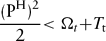
The higher the contracting, political economy, and perceived travel costs of separation, the wider the range of parameters over which physician dispensing is self-enforcing.
Since Ωt and Tt increase in the number of periods a society has been under physician dispensing, the institution is self-reinforcing (Greif, Reference Greif2006). If, as seems likely, players are unaware of the reinforcement mechanism, then at time t they imagine that the costs of switching to separation will remain the same into the future, although in fact it will increase if physician dispensing continues. Thus Ωt + Tt is not a fixed parameter, nor an endogenous variable; it is a ‘quasi-parameter’ (Greif, Reference Greif2006). The longer a society remains under physician dispensing, the higher the associated costs of physician-induced demand (PH) can be before implementing separation becomes the efficient self-enforcing social institution.
The potential for physician-induced demand in any given period – PH – is also itself a function of insurance and technology, and is thus another quasi-parameter. The efficient form varies with the discount rate r and the magnitude of PH. For high discount rates, neither patient nor physician cares much about the future, and therefore spot market interactions prevail. At very low discount rates, both institutional arrangements can achieve socially efficient outcomes. Probably most interesting and policy-relevant is the intermediate range of moderate discount rates, where the purchaser and provider agree to cooperate in an ongoing relationship, with physician dispensing dominating for low PH and separation dominating for high PH.
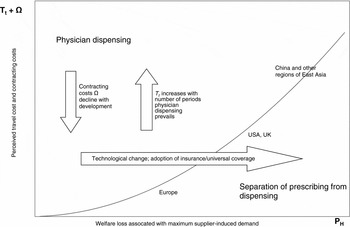
This theory predicts that separation can be an efficient response to increases in PH, the potential loss in social surplus from maximum physician-induced demand. Figure 1 illustrates how the quasi-parameters Tt, Ωt and PH make an impact on the range over which physician dispensing and separation are self-enforcing institutions, assuming an intermediate range of discount rates that can support relational contracting. The horizontal axis graphs the potential loss in social surplus from maximum physician-induced demand, PH. The vertical axis shows the costs associated with enforcing separation, Ωt + Tt. The upper left-hand side, with high Ωt + Tt and low PH, represents a range of over which physician dispensing is the efficient equilibrium institution. The lower right-hand side illustrates the range of over which separation is the efficient self-enforcing institution. The dividing curve illustrates when the social surplus associated with physician dispensing exceeds that of separation, as given by equation (1).
Physician dispensing and separation of prescribing from dispensing as self-enforcing institutions

All else equal, separation is more likely to prevail as physician recommendations influence utilization of a wider range of expensive health care technologies. A second critical determinant of PH is the generosity of health insurance or healthcare coverage, such as through national health insurance (NHI) or the National Health Service as in the UK. Adoption of universal coverage portends a significant one-time increase in PH: reducing the patient burden of out-of-pocket spending will relax the ability-to-pay constraint on physician-induced demand.
A political mechanism may also link technological change to reductions in patient out-of-pocket burden when technological advances imply that access to healthcare becomes more unequal and has more significant impacts on life chances. Consider a certain level of social solidarity, manifest as a political threshold of acceptance for disparities in access to healthcare. Technological change will typically increase health spending and strain the poor's ability to pay, increasing disparities in medical care. Once those disparities breach the political threshold of acceptability, they will trigger political reform to adopt or extend risk pooling for medical expenses (captured in the model by a decrease in out-of-pocket spending; Eggleston, Reference Eggleston2011).
In sum, technological change directly increases PH (because technology tends to increase spending) and indirectly increases PH through an induced increase in coverage. Therefore separation policies are more likely when there has been (i) rapid technological change in healthcare, and/or (ii) a significant increase in generosity of insurance coverage.
Societies could be arrayed in Figure 1 in different ways, with many European countries toward the southwest (early separation) and the USA and UK towards the middle (later separation). The theory predicts that for societies with high contracting costs and low potential for physician-induced demand historically, physician dispensing was a self-reinforcing institution. Over a long period of time, these societies moved from southwest to northeast on Figure 1: physician dispensing was self-reinforcing as patients and doctors came to believe that dispensing was the natural outcome of any effective physician–patient encounter and the political authority of providers grew to be able to block reforms. On net, arguably Ωt + Tt increased in these societies (until recently). Technological change raised the social opportunity costs of wasteful over-use (PH) ever higher. Together these forces pushed East Asian societies upward and left in Figure 1, perhaps close to but only recently crossing over the boundary between physician dispensing and separation as self-enforcing institutions.
Regulation
The contracting costs Ω embody numerous costs of regulating and enforcing strict separation of prescribing from dispensing. Yet a society may also use regulation within the physician-dispensing institutional framework to mitigate physician-induced demand. One advantage of such an approach is avoiding the costs of switching to separation, especially the patient perceived travel cost Tt. Moreover, hospitals and doctors have incentive to combat counterfeit drugs and invest in quality assurance when they earn substantial revenues from drug dispensing. When physician dispensing offers a quality-assurance advantage over independent pharmacies, physician dispensing dominates separation up to a higher threshold of physician-induced demand.
Consider a regulatory structure that with probability π can detect if the physician induced demand and impose a fine of X > 0. Following Glaeser and Shleifer (Reference Glaeser and Shleifer2003), X denotes the maximum fine that can be enforced. Mechanisms might include claims review and investigation of doctors’ financial relationships with pharmaceutical firms and pharmacies, with enforcement costs of Ω(πX). Regulation of prescribing practices can reduce doctors’ expected benefits from induced demand by πX, making physician dispensing sustainable over a longer period of time.
A second important avenue of regulation involves reimbursement, such as moving toward ‘pay for performance’ and/or bundled prepayment for all medical care including drugs. Thailand's ‘30 baht’ public insurance program is a good example of the latter.
Heterogeneity
Physician dispensing is more efficient than separation when transaction costs of separate visits are sufficiently high. This arguably explains why hospitals dispense medications to inpatients, even when they are prohibited from dispensing to outpatients (as in South Korea). A related case arises when physician treatment is inextricably linked to dispensing medication. For example, oncology has been a fertile area for integration because the technology of administration for chemotherapy drugs justifies integration even when separation prevails in other medical specialties.
Probably the most common exception to separation arises when separation is prohibitively costly because of insufficient human resources relative to high travel costs, such as in rural areas. Sometimes pharmacists are allowed to prescribe medications because of scarcity of physicians (such as a royal ordinance in France in 1724 [Sonnedecker, Reference Sonnedecker1976: 71], rural UK today, and many developing countries). Alternatively, physicians have been allowed to dispense directly to patients when pharmacies appear inadequate (such as in some Swiss cantons).
Furthermore, when a patient has a chronic disease, the travel costs associated with frequent adjustment of prescriptions may also weigh in favor of integrating some diagnosis and dispensing functions.
4. Evidence on historical episodes of separation
Separation reforms in East Asia
Both South Korea and Taiwan adopted separation policies soon after extending health insurance coverage to their entire populations. Japan had tried to impose western medicine and pharmacy on Korea during colonial rule, but largely failed (Eggleston and Yang, Reference Eggleston, Yang and Eggleston2009). It was not until after South Korea achieved universal coverage (in 1989) that it implemented a strict – and very politically contentious – separation of prescribing from dispensing in 2000. Physicians went on strike nationwide three times to protest separation reforms. The South Korean government granted concessions that included raising physician fees and indefinitely postponing provider payment reform (Kwon and Reich, Reference Kwon and Reich2005; Kim and Prah Ruger, Reference Kim and Prah Ruger2008; Eggleston and Yang, Reference Eggleston, Yang and Eggleston2009).
Taiwan implemented NHI in 1995, and initiated separation reforms only two years later. In 2002 Taiwan implemented a further reduction in payment for drugs dispensed in physician clinics. Although Taiwan attempted to legislate full separation, the achieved level of separation is probably lower than that of Japan under a more incremental approach. Taiwanese hospitals could retain their outpatient pharmacies; the majority of physician clinics hired on-site pharmacists; and ‘gateway pharmacies’ (with ownership links to physicians) fill about 80% of prescriptions dispensed by Taiwan's pharmacies (Chou et al., Reference Chou, Yip, Lee, Huang, Sun and Chang2003; Hsieh, Reference Hsieh and Eggleston2009). Physician-dispensing incentives also shape prescribing of generic compared with brand-name drugs (Liu et al., Reference Liu, Yang and Hsieh2009). Analysis by Chen et al. (Reference Chen, Gertler and Yang2011) implies that drug expenditures are inflated (at least) 30% by physician dispensing in Taiwan, because that is how far expenditures fell after enforcement of separation, without an increase in observable adverse health events (Chen et al., Reference Chen, Gertler and Yang2011).
Compared with Taiwan, Japan's incremental separation policies probably have achieved greater removal of dispensing revenues from physician control. Separation, as measured by the share of prescriptions filled at pharmacies rather than dispensed by physicians, increased from only 20% in 1996 (Rodwin and Okamoto, Reference Rodwin and Okamoto2000: 353) to 60% in 2007 (Tomita, Reference Tomita and Eggleston2009). Japanese policy well illustrates the regulatory approach, with policy allowing physicians and patients to self-sort between integration and separation. Incremental separation reforms began in earnest after Japan attained universal coverage (1961) and healthcare technologies and total spending grew rapidly (1970s and 1980s). Earlier separation attempts – during the Meiji reforms in 1874 and under the Allied occupation in 1951 – both failed (Tomita, Reference Tomita and Eggleston2009). Those earlier reform failures are consistent with the theoretical proposition that physician dispensing was a self-reinforcing institution prior to the confluence of universal coverage with rapid technological change in the latter decades of the 20th century. Regulations of the 1980s and 1990s included reduction in the allowed mark-up for drug dispensing; higher prescribing fees if the physician did not dispense; regulatory encouragement of independent pharmacies; and penalties for self-referral to ‘gateway pharmacies’, regulated as a form of double billing (Fujii and Reich, Reference Fujii and Reich1988; Rodwin and Okamoto, Reference Rodwin and Okamoto2000). The dynamic pricing formula introduced in 1992 imposes larger reductions in retail prices for drugs that earn doctors higher margins between wholesale and retail prices (Iizuka, Reference Iizuka2007, Reference Iizuka and Eggleston2009). Adjustment of the medical and pharmaceutical fee schedules within a global budget (Campbell and Ikegami, Reference Campbell and Ikegami1998) also moderates the incentive and opportunity for physician-induced demand in Japan. Combined, these policies have moved Japan incrementally from a physician-dispensing equilibrium toward separation as the dominant social institution.
In China, prescribing and dispensing have long been integrated. Soon after the communist revolution brought Mao Zedong to power, policymakers chose to allow physicians and hospitals to sell medications directly to patients at a mark-up of 15% above acquisition cost. The choice to make the profit margin on dispensing drugs positive seemed logical and appropriate, the theory would suggest, because it reflected an institutional element defining clinical reality for centuries in China, and the low levels of technology and per capita ability to pay left little scope for over-use. The allowed margin of 15% for drug dispensing had little effect on behavior prior to the 1980s because physicians were salaried public servants and hospitals were government-budget financed. Since then, however, physicians and hospitals have come to rely on drug dispensing revenues from charging patients mark-ups over acquisition costs. Social dissatisfaction with perceived over-charging and over-treatment has increased. ‘Supporting medical services through drug sales’ (yi yao yang yi) has been widely criticized amongst mounting evidence that such financial incentives distort prescribing and contribute to rising expenditures. In one excellent recent study, Currie et al. (2011) found that Chinese physicians prescribe antibiotics for a startlingly high proportion of patients (averaging 62%), even when patients report symptoms that do not warrant antibiotics; and 39% of physicians still prescribed antibiotics when the simulated patients signaled to doctors that they knew that taking antibiotics would be inappropriate. These results provide strong evidence of physician-induced demand in China, with adverse consequences not only for medical spending but also for patient health and development of antibiotic resistance.
Alongside expanded insurance and improved public health, separation was one of the stated objectives of China's 2009 national health reform plan (Standing Conference of the State Council of China, 2009), for which the government committed 850 billion RMB (renminbi; about 125 billion US$). Specifically, government-owned primary care (‘grassroots’) providers must sell drugs on the essential medications list without a mark-up, and pilot reforms of public hospitals are encouraged to include separation.
The theory developed in this paper suggests that this newfound interest in separation stems in part from China's expanding insurance coverage, itself spurred by rapid technological change and income growth. Government-subsidized health insurance for rural residents and urban non-employees, added to pre-existing insurance for urban employees, has dramatically increased coverage: the number of uninsured in China fell from 77.9% in 2003 to only 12.9% in 2008, according to the National Health Services Surveys.Footnote 2 The propositions above predict that China will adopt more rigorous separation policies as it replaces demand-side constraints with supply-side constraints on health spending. However, the theory also suggests several reasons why some integration of prescribing and dispensing may be a self-enforcing institution in China for a longer period than in Japan or Korea. Limits on regulatory effectiveness suggest high transaction costs of enforcing separation policies in China. In addition, concerns about fake and low-quality pharmaceuticals suggest that there might be a non-trivial value of holding a physician or hospital accountable for the quality of medications dispensed, as was the case under the institution of physician dispensing (through reputation effects).
Empirical evidence from Japan (Iizuka, Reference Iizuka2007), Taiwan (Liu et al., Reference Liu, Yang and Hsieh2009) and Switzerland (Rischatsch and Trottmann, Reference Rischatsch and Trottmann2009) confirms that integrated physicians take into account patient co-payments when prescribing medications, and thus are less likely to prescribe expensive medications when such a choice increases the financial burden on their patients. For example, Iizuka's estimates suggest that to save a non-elderly patient 28 cents in co-payment, a Japanese physician in the 1990s was willing to give up one dollar of profit.
The evidence that patient out-of-pocket burden constrains physician prescribing also helps to explain the otherwise puzzling case of Singapore. Although in many ways similar to Taiwan and South Korea in terms of cultural roots and economic development, Singapore differs from those economies in continuing to integrate prescribing and dispensing. My hypothesis for this discrepancy is that Singapore lacks the NHI systems of Taiwan and South Korea, instead relying heavily on patient cost sharing (in the form of payments from medical savings accounts or cash). Although per capita health spending is virtually the same in Singapore ($1,643) as in South Korea ($1,688), patient out-of-pocket health expenditure as a percentage of total health expenditure was 63.3% in Singapore compared with 35.7% in South Korea in 2007, and an even lower percentage in most other OECD countries.Footnote 3 Singapore has never felt the pressure to disrupt patient and provider satisfaction with integration to constrain physician-induced demand. Thus, Singapore can be considered the exception that proves the rule: few high-income countries choose to have such high levels of out-of-pocket financing, because of equity considerations that Singapore has addressed in other ways.
Weighing competing theories of separation
The theory developed in this paper represents only one among several possible explanations for separation reforms. For example, culture strongly shapes physician–patient interactions. Nevertheless, culture alone appears unable to explain the pattern of separation reforms, such as why South Korea enforced separation but Singapore has not.
Technological change clearly plays a large role in explaining institutions. However, technological change is perhaps best viewed as a necessary but not sufficient condition for separation. The pure theory of technological change, divorced from considerations of insurance and physician-induced demand, can explain neither the timing of separation reforms within countries (i.e. when South Korea chose to implement separation) nor the pattern of such reforms across countries (why Taiwan separated but Singapore did not).
A third hypothesis is that integration or separation are determined by the political economy of guilds and other physician and pharmacist interest groups vying for dispensing revenues. This hypothesis focuses exclusively on the political power of physician interest groups, which in my model is only one factor (Ω) in the costs of enforcing separation, balanced against the social costs of physician-induced demand.
The professional rent-seeking hypothesis has several strengths in explaining the historical experience of Europe, where separation dates back at least to the Edict of Palermo in 1231. Several European states began regulating separation fairly early, indicating that costs of overcoming interest groups to enforce separation (Ω) were low. Since at that early date neither technology nor the economic costs of its wasteful over-use were very large, separation policies that spread across continental Europe would appear to be better explained by the dynamics of guilds and rent-seeking behavior over the control of dispensing revenues (Sonnedecker, Reference Sonnedecker1986; Savage, Reference Savage1994; Anderson, Reference Anderson2005). While there is substantial evidence that the role of guilds in China (huiguan or gongsuo) differed substantially from that of Europe,Footnote 4 it is less clear that guild dynamics can explain the inertia of physician dispensing through to the modern era in China and elsewhere in East Asia. Mao Zedong's health policymakers, newly installing a communist government for China and expropriating hospitals for government ownership, did not appear to be concerned with physician or pharmacist associations when they officially sanctioned a 15% mark-up on drugs for hospitals. Moreover, there is no evidence to suggest that weakening of physician interest groups triggered later separation reforms. In fact, physician interest groups continue to be strong in most of East Asia, and they have repeatedly played a powerful role in delaying separation and extracting concessions from regulators when separation was enforced. South Korea's reforms are particularly instructive on this point (Kwon and Reich, Reference Kwon and Reich2005), since physicians blocked separation reforms for a long time, and constituted a more powerful interest group than the pharmaceutical industry, pharmacists or patients.
Other separation reforms in East Asia illustrate the continuing influence of physician organizations in shaping policy. In Taiwan, physicians extracted concessions so that they were able to hire on-site pharmacists, and physicians increased orders for other profitable services, emasculating the reform's objective to control expenditures (Chen et al., Reference Chen, Gertler and Yang2011). Japan incrementally reformed dispensing practices, since attempts to legislate strict separation failed, arguably because physician interest groups opposed more stringent reforms. In China since 2009, separation reforms have only been imposed (with some difficulty) on the weakest providers, the grassroots clinics and community health centers in rural and urban areas, rather than on the major players, the hospitals. Importantly, in none of these cases have pharmacist associations played a significant political role. Thus, in modern East Asia, separation has been associated less with physician–pharmacist professional jockeying over dispensing revenues than with a confluence of forces overpowering physician interests to impose separation. The theory developed in this paper – emphasizing the interplay between cultural expectations (Tt), interest groups (Ω), technological change, insurance expansion and government financing (PH) – appears to offer a plausible explanation of separation reforms in Asia. Expansion of insurance and government financing play the trigger role in overcoming the inertia of the old physician-dispensing regime: insurance coverage reduces the demand-side constraint on over-prescribing, and since government budgets now bear a substantial fraction of the associated expenditures, government officials develop ways to encourage (Japan) or impose (South Korea) separation.
In the UK and the USA, separation came later than in Europe, presumably at least in part because of larger contracting and travel costs despite weaker guilds. Interestingly, the English apothecary ‘understood that he was not permitted to charge for his consultation, and was quite prepared to rely on the sale of drugs and medicines for his profit’ (Worling, Reference Worling and Anderson2005: 60); these apothecaries developed into the general practitioners of today. As the theory suggests, insurance coverage did help to spur separation: the National Insurance Bill of 1911 and the insurance scheme implemented two years later separated prescribing and dispensing for insured patients, becoming nationwide after the establishment of the National Health Service (Hunt, Reference Hunt and Anderson2005). At least four elements of the theory suggest that separation would have come later in the USA, as indeed it did: low organizational power of guilds was offset by relatively smaller capacity and willingness to impose regulation, high travel costs, and lack of universal coverage. Even so, the US experience with Medicare revising reimbursement policies for chemotherapy drugs clearly illustrates the nexus between government insurance, regulatory oversight, and suspicions of over-prescribing when physicians directly dispense medications to patients (Jacobson et al., Reference Jacobson, Earle, Price and Newhouse2010). Further evidence that integrated diagnosis and treatment give rise to physician-induced demand comes from Afendulis and Kessler (Reference Afendulis and Kessler2007), who econometrically show that diagnosis of an elderly American by a heart specialist who also provides surgical treatment (‘integrated cardiologist’), compared with a non-integrated cardiologist, increases health spending without improving health outcomes. Thus physician-induced demand and moral hazard from insurance arrangements appear to be health policy concerns in many parts of the world, as well as central determinants of separation reforms.
5. Conclusion
Why did policymakers throughout East Asia systematically choose to legitimize drug sales as the profit center for doctors and hospitals until recently? Important institutional elements from the past – especially shared beliefs about the proper form of a physician–patient encounter and legitimate source of revenue for providers – shaped the options available. In the words of Greif (Reference Greif2006), there is a ‘fundamental asymmetry’ between the structure inherited from the past and the technologically feasible alternatives. The costs of enforcing separation will be greater, the longer the time period over which provider interest groups have coalesced around the rent stream associated with physician dispensing and the more generations of patients have come to expect receiving a medication as the ‘payoff’ from visiting a physician.
Nevertheless, eventually the expanding capabilities of medicine undermined the physician-dispensing institution by increasing the social opportunity costs of induced demand, one example of how shifts of ‘quasi-parameters’ can render long-standing practices self-undermining. The rise of the welfare state and third-party payers tended to remove demand-side constraints on health spending and prompt governments to search for social coalitions to overcome the interests of physician dispensers and impose separation. Although remolding patient and provider beliefs and norms often takes time, these potent forces led to new institutions governing the patient–physician relationship even in societies with long traditions of physician dispensing, like those of East Asia.
This study of physician dispensing serves to illustrate that health systems provide a rich field for testing hypotheses of institutional economics. Patterns of incentives are not random. The incentive structures of current healthcare delivery systems have deep historical and cultural roots, yet must cope with rapid technological change as well as market and government failures. Understanding the evolution of health sector institutions can thus provide valuable illustrations of how and why some institutions are more tenacious or resilient than others, and how these qualities are associated with economic performance.
Physician dispensing also teaches about institutional transplantation (Acemoglu et al., Reference Acemoglu, Johnson and Robinson2001; Yoo and Steckel, Reference Yoo and Steckel2010). Governments have tried to impose separation in East Asia (as Japan attempted in colonial Korea) or to import the practice. Japan readily adopted western ideas and technologies during the Meiji era and after The Second World War, so why did the separation efforts in both Meiji Japan (1871) and under the Allied occupation (1951) fail? These aborted efforts at institutional transplantation show the importance of understanding the historic context of social institutions.