In this article, we argue that digital publishing that exploits the communicative and community-building potential of Web 2.0–based technologies enables researchers in ethnomethodological conversation analysis (CA) to develop standards of intellectual accountability that surpass those that have been historically possible in the realm of conventional, paper-based publishing, and also those that are currently reasonably widespread in Web 1.0–based publishing technologies. We begin this article with (1) a brief account of what ethnomethodological CA is and how CA researchers develop analyses of talk-interaction; (2) we then discuss the question of empirical accountability in CA work; (3) next, we explain what Web 1.0 and emerging Web 2.0–based technologies are; (4) we then go on to illustrate how paper-based transcripts have evolved into electronic Web 1.0–based documents, and how this one-way electronic environment is itself evolving into the two-way, community-building environment of Web 2.0; and (5) we conclude with a discussion of some important caveats that must be taken into account when—as we must—we make the final transition to electronic publishing as the default medium of publication for CA work.
Conversation Analysis
Conversation analysis (CA) is a form of microsociology, which originally emerged from the ethnomethodological work of Harold Garfinkel in the 1960s, who was interested in understanding how participants made sense of their every day activities (see Garfinkel, Reference Garfinkel1967). Based on the seminal early work of (among others), Jefferson (Reference Jefferson and Sudnow1972, Reference Jefferson1973); Sacks (Reference Sacks1992); Sacks, Schegloff, and Jefferson (Reference Sacks, Schegloff and Jefferson1974); Schegloff (Reference Schegloff1968); Schegloff and Sacks (Reference Schegloff and Sacks1973); and Schegloff, Jefferson, and Sacks (Reference Schegloff, Jefferson and Sacks1977), CA has since established itself as a largely autonomous discipline, which seeks to explain how members achieve a broad range of social actions in and through talk-in-interaction. In addition, the use of conversation analytic techniques has spread to other disciplines, including applied linguistics (Schegloff, Koshik, Olsher, & Jacoby, Reference Schegloff, Koshik, Olsher and Jacoby2002), and second language acquisition (see Firth & Wagner, Reference Firth and Wagner1997, Reference Firth and Wagner2007; Kasper, Reference Kasper2006, Reference Kasper2007, Reference Kasper, Cenoz and Hornberger2008; Markee, Reference Markee, Tarone, Gass and Cohen1994, Reference Markee2000, Reference Markee2004, in press).
Using recordings and transcripts of naturally occurring conversational data, conversation analysts seek to show how, despite initial impressions that talk-in-interaction may seem chaotic and unstructured, the ways in which participants take turns, repair breakdowns of various kinds, and develop extended sequences of talk in both ordinary conversation and institutional talk are in fact characterized by an astonishingly high degree of underlying order. For example, in Fragment A below, we can see how the participants identified as Desk and Caller parse each other's unfolding turns in real time to project when it is sequentially appropriate for each speaker to start talking; how Desk and Caller repair trouble; and how they construct sequences of actions:
Fragment A: Identification sequence

In line 1, Desk asks Caller for her last name. As we can see from the evidence in line 2, Caller parses Desk's unfolding turn and observably projects that Desk's turn will end at the end of the WH clause turn construction unit (TCU). In line 2, Caller therefore answers Desk's question in a place that is sequentially and grammatically appropriate.
However, it turns out that Desk had not finished his or her turn in line 1. Desk in fact continues by producing another increment in line 1, the lexical TCU “Loraine,” which completes the turn. This increment causes Caller's answer in line 2 to be achieved as an overlap. As a result of this overlap, it seems that Desk does not hear Caller's name. In line 3, Desk therefore produces a repair that is in second position in relation to the turn in which the trouble source (here, the overlap in line 2) initially occurs. This type of repair in line 3 may also be characterized as an other-initiated repair, in that it is produced by an Other (in this case, Desk) as opposed to Self (in this case, Caller).Footnote 1 The recipient design of the observed repair invites Caller to do a self-completed repair, which she does in line 4 by repeating her last name “Dinnis.”Footnote 2 Although we would need to see the next few turns to confirm the analysis that follows, it is likely that this final turn clears up the trouble produced by the overlap in line 2 and allows the speakers to proceed with the main topic(s) of their ongoing transaction.
In summary, we can see how tightly organized this apparently unremarkable piece of talk actually is. Turn-taking is achieved by participants who closely monitor each other's talk to project when they may start their own talk. If (and, as in this case, when) trouble occurs, this is resolved on the fly through the use of an appropriate repair practice. And in terms of sequence organization, we can see that what seems to be a routine service transaction involves an orientation by members to a question-and-answer adjacency pair structure that is endemic in all talk. More specifically, Desk's question in line 1 (which functions as a first pair part, or FPP) makes an answer by Caller relevant in line 2. Caller duly produces an answer as the second pair part (SPP) of this adjacency pair in line 2. However, because of the overlap that occurs in lines 1 and 2, Desk initiates a clarification sequence in line 3, which consists of another question-and-answer adjacency pair sequence (i.e., the FPP in line 3 and the SPP in line 4). Furthermore, this preliminary work clears the way for further talk which is geared to resolving whatever problem Caller is experiencing. We can therefore observe on the basis of these empirical materials that, far from being chaotic, talk-in-interaction functions as a remarkably efficient and self-regulating system of behavior.
A Matter of Accountability
A key feature of the intellectual discourse of CA has always been that analysts make their primary and secondary data (i.e., the original audio/video recordings, and fragments from the transcripts of the data being studied, respectively) available to consumers for public inspection, discussion, and criticism (see, e.g., Heritage, Reference Heritage, Atkinson and Heritage1984; Sacks et al., Reference Sacks, Schegloff and Jefferson1974; Schegloff et al., Reference Schegloff, Jefferson and Sacks1977). In this way, critical readers of CA research may judge for themselves whether the data and analyses that are proposed by the original researchers are technically adequate and interactionally grounded. This methodological practice further allows readers to develop alternative, empirically based interpretations of the primary data if they disagree with the initial analyses.
But in conventional, print-based publishing, transcripts (however sophisticated they may be in and of themselves)Footnote 3 are necessarily the most widely available forms of published data. To be sure, analog recordings and transcripts of well-known interactions (such as Two Girls) have always been available through informal professional networks to CA specialists and their students. Furthermore, it has also long been standard practice for researchers who conduct face-to-face data sessions or who present their work at conferences to play original recordings to audiences. Nonetheless, it is indisputable that readers of CA work that is published in a print medium who are not part of these networks, who have not participated in data sessions, or who have not seen conference presentations of published data, have to take the accuracy of paper-based transcripts on trust. This situation is ultimately untenable, as it fundamentally undermines the methodological tenet with which we began this section: that critical readers should have the means independently to critique researchers' interpretations of primary data. So how can Web 1.0–based and Web 2.0–based electronic publishing go beyond conventional print publishing and help us achieve an increased level of empirical and interpretive accountability in CA?Footnote 4 We first explain how Web 1.0 and Web 2.0 technologies differ from each other and then address this question in the sections that follow.
What Are Web 1.0 and 2.0?
Following Warschauer and Grimes (this volume), the distinction between Web 1.0 and Web 2.0 technologies has more to do with the way the Web is now used than with the technical capabilities of these two forms of electronic communication:
Though the term suggests a new version of Web technology, it refers instead to changes in the communicative uses of the underlying Web platform. O'Reilly, who popularized the term in 2003, used a series of examples to characterize what he saw as the differences between the first- and second-generation Web (O'Reilly, Reference O'Reilly2007). Probably the key distinction among these is that between publication and participation. The earlier Web allowed people to publish content, but much of that online material ended up in isolated information silos. The new Web's architecture allows more interactive forms of publishing (of textual and multimedia content), participation, and networking through blogs, wikis, and social network sites. These participatory sites enable and rely on user-generated tagging of content, which itself can be aggregated into a user-generated taxonomy known as a folksomony. Sites such as Flickr, Napster, and Wikipedia thus allow users to generate, link, evaluate, and share a wide variety of online content.
It is for this reason that, in the context of this special issue on the role of technology in research and teaching in applied linguistics, we argue that for CA work, at least, Web 2.0–based electronic publishing is a medium that is demonstrably superior not only to traditional print-based publishingFootnote 5 but also to Web 1.0 versions of electronic publishing.
More specifically, we believe that Web 1.0 versions of electronic publishing are superior to traditional print-based publishing because electronic transcripts enable readers to view or listen to the original audio or video recordings as well as to read the transcripts that are developed from these primary sources in a single, integrated environment. Furthermore, the ability to view original recordings becomes particularly important when moving behaviors that are inherently difficult to transcribe transparently—such as eye gaze, gesture, and embodied actions—are incorporated into an analysis.Footnote 6 We further argue that Web-based analyses of talk that use Web 1.0 technologies are likely to be more elegant and accessible than paper-based transcripts. This is because information about eye gaze, gesture, and embodied actions, which is normally included in the body of paper-based transcripts, may now be conveyed in separate windows through the use of simple hyperlinking technologies. As a result, these new hyperlink-enabled transcripts are both more legible and more sophisticated than the highly detailed paper transcripts that are still the norm today in paper-based publishing.
However, we also believe that Web 2.0–based technologies are even more important for ongoing development in CA and applied linguistics than Web 1.0 technologies are, because they take us into territory that is largely still uncharted in these disciplines. Highly interactive programs such as Segueway—an example of a user-friendly, Web 2.0 technology that allows members to publish multimedia documents and to comment on these documents through asynchronous chat—can be used to extend the genre of face-to-face data sessions into an electronic medium that can complement and, in some cases, may transcend face-to-face data sessions by (1) potentially engaging a large, physically distributed membership and (2) providing a discussion medium in which all discussions are permanently archived.
The issue of transforming how data sessions are conducted is crucial to the intellectual community of CA. Data sessions are a methodological practice in which experts and novices discuss and critique each others' primary and secondary data and their ongoing analyses of these data during informal discussions. And this practice is widely used to induct novices into the discourse community of CA. This article therefore sets out to exemplify how these trends are likely to play out by developing a conversation analysis of exophoric deictic reference that is based on data that are best organized and presented in a native electronic format. We have also set up a Web site at https://segue.atlas.uiuc.edu/index.php?&action=site&site=virtualdata, which is designed to illustrate how electronically based data sessions might be conducted in a Web 2.0 environment.
The Data and the Participants
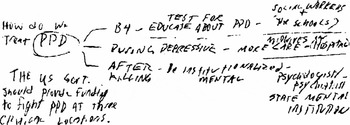
The data analyzed here are drawn from an office hour interaction between J, a rhetoric teacher at an American community college, and Em, one of his students, who has come to discuss a preliminary draft of a writing assignment. Both J and Em are native speakers of English. The fragment we analyze in detail here (Fragment 1) is part of a larger data set, which includes Fragment 1: “Em communicates the nature of her problem” (lines 1–24); Fragment 2: “J and Em converge on an understanding of the diagram” (lines 25–94); Fragment 3: “The Breakthrough Sequence” (lines 95–147); and Fragment 4: “Em explains the diagram and her plans to use it” (lines 148–254). More specifically, in Fragment 1, Em is having trouble understanding Text 1 below, which represents J's abstract conceptualization of how Em should reorganize her essay on postpartum depression (PPD) syndrome.
J's original organization diagram

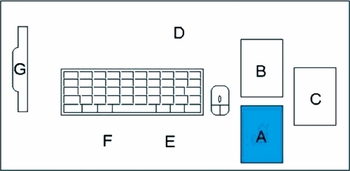
Through this conceptual diagram, J suggests that Em's essay should ask the general question “How do we treat PPD?” J also proposes that the thesis of the paper should be that the U.S. government should provide funding to fight PPD at three critical stages of the disease: Before (B4) PPD occurs, by providing testing and education; During a depressive episode (DURING DEPRESSIVE); and After a mother has killed her child (AFTER KILLLING), in which case the mother should be institutionalized and provided with medical care rather than being sent to jail. In addition, J and Em orient to Stacks A and B (source texts that Em is using in her paper) as being relevant to their discussion in this fragment. The layout of these stacks on the physical desktop in J's office is reproduced in Figure 1 below:
Layout of desk with three stacks of sources and two articles
Position A–Em's “work area,” set off by a 1-inch blue three-ring binder
1. The first 8 pages of Em's draft (text #2)–moves to position F after fragment 1
Stack B–Em calls them “examples” and “my media cases” 1. Women Who Kill, Part Two (The Crime Library © courttv.com)
2. Outcomes Vary in Trials of Mothers Who Kill Kids (The Associated Press)
3. Mommy, I Don't Want to Die Today (Chicago Sun-Times)
4. Punishing the Unfathomable (ABC News)
Stack C–Em labels this stack “cures”
1. Information on Postpartum Depression (peaceandhealing. Com)
2. Mothers Who Kill Often Give Warnings (womensenews.org)
3. Postpartum Depressed Women's Explanation (Journal of Nursing Scholarship)
4. Effect of bee Venom Treatment in Sows (American Journal of Chinese Medicine)
5. Half of New Mothers Never Screened for Depression (Mental Health Weekly)
6. Postnatal Depression: The Symptoms (Practice Nurse)
Position D–“Discard” pile
Position E–J's “work” area
1. Why Women Kill Their Children (The American Anthropological Association)
On the back of this document, J draws his organization outline (text #1).
Position F–J's “reading” area–where Em's draft (text #2) ends up
Position G–The computer monitor, now blank, where previously they read: 1. Postpartum Depression, Anxiety, and Psychosis, by Veronica Barnes http://www.thelaboroflove.com/forum/karena/

Note, however, that the way exophoric deictic reference (i.e., reference that points to physical objects outside the talk) is achieved by J and Em in this fragment is through gesture, not talk. So, the question “What is the most elegant and accessible way of transcribing this behavior?” immediately becomes crucially relevant to an analysis of how this kind of reference works in this particular piece of talk-in-interaction.
Transcripts and Analysis
We begin our discussion by providing a version of Fragment 1 (Fragment 1a) that is suitable for the print version of this article. More specifically, this print version includes all the video frame grabs (though not Text 1 nor Stacks A and B, which have already been provided above) as an integral part of the transcript:
Print-Based Transcripts
Fragment 1a: Em communicates the nature of her problem (lines 1–38).
As we have already noted, Em achieves the exophoric deictic reference in this talk through various waving, pointing, circling, and touching gestures in lines 11–12, 14–15, 17, 19, 25, 27, 32, and 34–35. These gestures are deployed as resources to set up a contrast between J's suggested revisions and Em's evolving understanding of what her essay was about. Thus, in lines 10–15, the waving and pointing gestures Em deploys in lines 11–12 and 14–15, respectively, are used in conjunction with her assessment of J's outline in Text 1 that “you've got >a [great little plan this is [great this is awesome<,.” In lines 16–20, Em then admits that she doesn't understand what J is trying to tell her, and deploys two touching and smacking gestures on Stacks A and B in lines 17 and 19, respectively.
These deictic gestures occur in a larger context of embodied actions by Em in lines 2–3, 5–6, and 21, in which, in turn, Em appears dejected, confused, and puzzled. For his part, in line 9, J smiles slightly, perhaps, even, somewhat ruefully, as it becomes clear that Em has not understood his outline. Finally, in lines 22–38, Em develops her explanation of why she doesn't understand J's outline. During this spate of talk, her gestures invoking Text 1 (line 25) and Stack A (lines 27, 32, 34–35) help to construct an ongoing sense of contrasting understandings. More specifically, this sense of contrasting understandings is achieved through the gestures that have just been identified and Em's use of contrastive word stress, as shown in lines 24, 31, 33, and 36, and also by her iconic gesture in line 30, which is deployed as she says “I'm doing”:
Fragment 1a, lines 22–38
Finally, notice how Em's gesture of flipping the palm of her hand up in line 37, which iconically suggests that something in the ongoing talk is open-ended, co-occurs with her production of the sentence “what [I thought had in my head.” Thus, it is clear that the gestures and embodied actions that co-occur with the talk in this fragment do a great deal of work, whose orderly details would be lost if this information were not included in the transcript. However, when we contrast this video-based transcript with the earlier telephone-based transcript reproduced as Fragment A, it is clear that Fragment 1a is more difficult to read. Furthermore, due to the inclusion of the frame grabs—which could arguably be omitted, as in the partial version of Fragment 1a aboveFootnote 7—it is more difficult to follow the details of the analysis, because we constantly have to switch back and forth between the transcript and the analysis. There is, then, a sense in which it would be advantageous to be able to write a transcript which evokes the simplicity of Fragment A while also including the detail that is necessary to understand how Fragment 1 is achieved. But how to do this? It is to this question that we now turn.
Web 1.0–Based Transcripts
We now reproduce Fragment 1 in a version which exploits the technical possibilities of Web-based dissemination of talk-in-interaction.
Fragment 1b: Em communicates the nature of her problem (lines 1–24)

(BB)
(CM)
Notice, first of all, that in Fragment 1b, which is designed to be viewed online, we are able to view the original video recording of the interaction. This is a crucial improvement in terms of providing a more accountable version of the raw data than is possible in a print-only medium. Readers can now determine for themselves whether the transcript provides an adequate rendition of the original raw behavior. Furthermore, we are able to disseminate the video at two different resolutions, which enable readers to use either a high resolution, broadband (BB) connection, or a lower resolution, cable modem (CM) connection. And last, but not least, this information is conveyed in color, not black and white, which contributes to its psychological impact.
Second, it is instantly apparent that Fragment 1b is physically shorter (24 lines of text instead of 38) and more readable than Fragment 1a. Instead of incorporating the frame grabs into the body of the text, we simply use hyperlinks to link the frame grabs to the talk. By convention, the hyperlinked video frame grabs are highlighted in yellow, while other kinds of texts (such as Text 1 or Figure 1) are highlighted in blue. Furthermore, talk reproduced in a bold font in Fragment 1b shows when and where the action described in the immediately following gloss occurs. Again, this use of color to represent different types of text is usually not possible in print based publishing, which is overwhelmingly rendered in black and white. The result is a much more elegant transcript. That is, Fragment 1b is easier to read than Fragment 1a, while at the same time packing in the same, and in some cases, even more, information about gestures and embodied actions than could be put into the denser, more complex transcript of Fragment 1a.
Web 2.0–Based Communities of Scholars
Let us now finish our discussion of the advantages of Web-based transcripts over print-based transcripts with a brief consideration of how we can take advantage of the ease of use of software programs like Segueway not only to disseminate information but also to build communities of scholarly practice. If readers will now point their browsers to https://segue.atlas.uiuc.edu/index.php?&action=site&site=virtualdata, we will show how they can interact with the data discussed in this article as members of an electronic data session community.
The site contains a number of different sections. For our purposes, the most important include the How to use Segueway section, which provides instructions on how to use the software and basic technical support. The Technical tips section provides basic instruction in how to prepare transcripts that include video frame grabs (such as Fragment 1a), how to capture video using Adobe Premiere™ how to make streaming videos using Easy Real Converter™ and how to use Adobe Photoshop™ for basic editing of graphic elements. The Sample data section includes the video recording and Fragment 1b. When members go to the Discussion section, they can engage in asynchronous chat to critique the quality of the transcription and analysis offered in this article, and most importantly, to offer their own alternative versions of the data. To support this electronic data session environment, the Sample data section also provides members with the opportunity to download Fragment 1 as a Microsoft Word document with none of the hyperlinked frame grabs and texts inserted into the transcript. All of the raw materials for inserting the relevant hyperlinks (i.e., the JPEG frame grabs and Microsoft Word versions of Text 1 and Figure 1) are also available for download, so that members can construct their own versions of Fragment 1 from scratch and upload this information to the Discussion section for public discussion and scrutiny.
Some Important Caveats
Before we conclude this article, it is important to take note of some important caveats. The first caveat we wish to raise is that it is important for Web sites that use data such as these to have all the requisite institutional review board permissions to display such data. Second, just because we are technically able to upload a broad range of different types of data does not mean that we should necessarily do so. Internet copyright law is an emerging and still very murky business, so proper caution must be exercised in this area as well. For example, Figure 1 contains a list of the articles that Em downloaded from the Internet, and it would be very easy to upload these to the electronic data session site. Indeed, it would be very interesting to display these data, because Em copiously annotated these materials during the course of her work. But these materials are under copyright, and we judge that it is not worth the time and above all the expense that would be incurred to secure the permissions that would be required for such a purpose.
Conclusions
We have argued in this article that, for CA, the advent of the digital publishing era is not an intellectual luxury—it is a necessity. More specifically, digital publishing using Web 1.0 and Web 2.0 technologies enables CA researchers to develop standards of intellectual accountability that are even more rigorous than those that are currently possible in the realm of conventional paper-based publishing. Readers of CA research may now expect to have access to primary as well as secondary data. That is, as electronic journals become the norm in academic publishing, readers will be able to view or listen to the original recordings as well as read the transcripts that are developed from primary sources. This ability to view original recordings is particularly important when behaviors that are difficult to transcribe transparently—such as eye gaze, gesture, and embodied actions—are incorporated into an analysis. We also suggest that readers will be able to engage in electronic data sessions that complement, possibly transcend what can be achieved by their older, face-to-face siblings as a means of building electronic communities of scholars. We therefore conclude this article by inviting our colleagues to continue this discussion by joining us in the electronic data session environment we have set up at https://segue.atlas.uiuc.edu/index.php?&action=site&site=virtualdata.
Appendix 1: Transcription Conventions
CA transcription conventions (based on Jefferson, Reference Jefferson, Atkinson and Heritage1984).