When learning a second language (L2), individuals bring with them the cognitive–linguistic skills learned from exposure to their first language (L1). Research on bilingual children has shown that the compatibility of the L1 and L2, in terms of phonology and orthography, determines how children process the L2 (Caravolas & Bruck, Reference Caravolas and Bruck1993; Durgunolu & Oney, Reference Durgunoglu and Oney1999; Rickard Liow & Poon, Reference Rickard Liow and Poon1998), yet recent research suggests that the factors involved in the learning of English as a second language (ESL) may actually be similar to those for English monolinguals (Lesaux, Rupp, & Siegel, Reference Lesaux, Rupp and Siegel2007; McBride-Chang & Kail, Reference McBride-Chang and Kail2002; Yeong & Rickard Liow, Reference Yeong and Rickard Liow2011). For English monolinguals, learning to read and spell in English requires a variety of cognitive and metalinguistic processes (Ehri, Reference Ehri, Perfetti, Rieben and Fayol1997; Vellutino, Tunmer, Jaccard, & Chen, Reference Vellutino, Tunmer, Jaccard and Chen2007). Among these processes, phonological processing ability is known to be heavily relied on by young children (Caravolas, Hulme, & Snowling, Reference Caravolas, Hulme and Snowling2001, Rayner, Foorman, Perfetti, Pesetsky, & Seidenberg, Reference Rayner, Foorman, Perfetti, Pesetsky and Seidenberg2001; Wagner & Torgesen, Reference Wagner and Torgesen1987), while other factors such as orthographic knowledge and morphological awareness become more important for older children and adults (Cunningham, Perry, & Stanovich, Reference Cunningham, Perry and Stanovich2001; Nagy, Berninger, & Abbott, Reference Nagy, Berninger and Abbott2006; Ouellette & Senechal, Reference Ouellette and Senechal2008; Roman, Kirby, Parrila, Wade-Woolley, & Deacon, Reference Roman, Kirby, Parrila, Wade-Woolley and Deacon2009). Despite the increase in research on bilingual children's L2 literacy skills, which offers insights into the cognitive and metalinguistic processes needed for successful L2 literacy development, much less is known about how bilingual adults read and spell in the L2: whether the underlying processes identified in childhood are also important in adulthood or whether the skills involved differ for those with ESL relative to those who only know English and those who learned English as a L1 with another language as L2. Understanding how bilingual adults, who have English as an L1 or L2, approach English can help us understand the long-term influence of early linguistic environments, if any, and the implications of such an influence in terms of the reliance on underlying skills. The present study examined whether English monolingual adults, English-L1–Chinese-L2 adults and Chinese-L1–English-L2 adults, who were proficient English readers and spellers, differed in their phonological and orthographic processing skills. In addition, we compared the importance of such skills for English literacy, specifically reading and spelling, for each of these three language background groups.
CHARACTERISTICS OF THE ENGLISH AND CHINESE LANGUAGES
Comparing the English and Chinese languages is interesting because the two languages contrast in various ways that may influence the strategies learners use to approach reading and spelling. English uses an alphabetic script and has a complex syllable structure, with a high frequency and variety of consonant clusters in word-initial and word-final positions. Because English is written alphabetically, to read requires one to know how symbols, or graphemes, relate to sounds, or phonemes (e.g., B is pronounced as /b/), and to write and spell in English requires the reverse, knowledge of how the units of sounds relate to visual symbols (e.g., /b/ is written as B). However, these letter–sound relationships are highly inconsistent in English: a letter can be pronounced in different ways, and a phoneme can be spelled in various ways (Bosman & Van Orden, Reference Bosman, Van Orden, Perfetti, Rieben and Fayol1997; Ziegler & Goswami, Reference Ziegler and Goswami2005). These features are in contrast to the characteristics of Chinese, which is morphosyllabic and has a logographic script. The smallest unit of meaning is the syllable, which maps onto a Chinese character (e.g., 停/tiŋ2/ meaning <stop> /stɒp/). It also has a simpler syllable structure than English (i.e., syllable form of consonant–vowel–consonant or consonant–vowel–vowel or consonant–vowel–vowel–consonant with only two legitimate final consonants /n/ or /ŋ/), with mostly open syllables and no onset or coda consonant clusters, resulting in syllables being highly salient in the language (Hua, Reference Hua2002). In addition, the Chinese written script consists of characters that are made up of strokes with different visual patterns and structure (Li, Reference Li1993).
PHONOLOGICAL AND ORTHOGRAPHIC SKILLS IN ENGLISH MONOLINGUALS
Given the alphabetic script and complex phonological structure in English, knowledge of the alphabetic principle (how individual sounds map onto letters) is vital. Hence, it is no surprise that phonological processing skills are important for the attainment of English reading and spelling (Wagner & Torgensen, Reference Wagner and Torgesen1987). Phonological processing refers to the ability to process the sounds of the language (Wagner et al., Reference Wagner, Torgesen, Rashotte, Hecht, Barker and Burgess1997), and is composed of multiple component skills. Among these skills, phonological awareness, which is the ability to recognize, identify, and manipulate sound units in the spoken language (Gillon, Reference Gillon2004), is most strongly related to English word reading and spelling ability in young monolingual children (Rack, Hulme, Snowling, & Wightman, Reference Rack, Hulme, Snowling and Wightman1994; Swanson, Trainin, Necoechea, & Hammill, Reference Swanson, Trainin, Necoechea and Hammill2003). Explicit training in phonological awareness can have positive effects on children's learning of the alphabetic principle (Bradley & Bryant, Reference Bradley and Bryant1983; Lundberg, Frost, & Peterson, Reference Lundberg, Frost and Petersen1988), and children showing a lack of phonological awareness usually have difficulties in reading and writing (de Jong & van der Leij, Reference de Jong and van der Leij2003; Vellutino, Fletcher, Snowling, & Scanlon, Reference Vellutino, Fletcher, Snowling and Scanlon2004). In particular, difficulties in phonological awareness can manifest as problems with word decoding, which requires the application of grapheme–phoneme rules to sound out and blend sounds together, thereby hindering the process of reading new and unfamiliar words. Measures of phonological skills include tasks that involve the manipulation of phonemes within a word (e.g., segmentation or deletion) and the ability to read nonwords (e.g., bote-boaf; Hagiliassis, Pratt, & Johnston, Reference Hagiliassis, Pratt and Johnston2006).
However, phonological processing skills are not sufficient for the successful acquisition of English. Most reading models propose a shift from phonological processing skills to orthographic processing skills as children get older and have greater exposure to the language (see Ehri, Reference Ehri1995). Orthographic processing refers to the ability to process the visual attributes of the writing system and the recognition of individual word-specific forms (Hagiliassis et al., Reference Hagiliassis, Pratt and Johnston2006). The increasing reliance on larger orthographic units (i.e., rimes, syllables, morphemes, and even whole words in a more lexical approach) as children get older helps to overcome the inaccuracies of relying solely on phonological skills (e.g., grapheme–phoneme recoding) because grapheme–phoneme correspondences in English are inconsistent (e.g., a letter can be pronounced in multiple ways). For example, Roman et al. (Reference Roman, Kirby, Parrila, Wade-Woolley and Deacon2009) found that older children (age 9 years) shifted to using orthographic skills, as measured with an orthographic choice task (e.g., hert vs. hurt; Olson, Forsberg, Wise, & Rack, Reference Olson, Forsberg, Wise, Rack and Reid1994), and not phonological skills, when reading real words. Orthographic skills tend to be measured using tasks that tap recognition of real words, such as knowledge of homophones in a homophone verification task (e.g., eight vs. ate), or awareness of the legality of sublexical clusters (e.g., two letter sequences), such as in a nonlexical choice task (e.g., filv vs. filk; see Olson et al., Reference Olson, Forsberg, Wise, Rack and Reid1994).
PHONOLOGICAL AND ORTHOGRAPHIC SKILLS IN MANDARIN–ENGLISH BILINGUALS
Due to the relatively simpler phonological structure and complex logographic script in Chinese, Chinese learners rely less on phonological information and more on orthographic information when learning to read and write in Chinese (Wang, Koda, & Perfetti, Reference Wang, Koda and Perfetti2003). Because distinct characters map onto morpheme-level syllables, this promotes specific item learning and a whole character approach to reading (Perfetti & Dunlap, Reference Perfetti, Dunlap, Koda and Zehler2008). This holistic visual–lexical strategy builds up an understanding of the conventions used in written language, hence strengthening orthographic skills (Roman et al., Reference Roman, Kirby, Parrila, Wade-Woolley and Deacon2009). Tong, McBride-Chang, Shu, and Wong (Reference Tong, McBride-Chang, Shu and Wong2009) found that orthographic skills, but not phonological skills, predicted later Chinese word reading in kindergarten children. Similarly, using structural equation modelling, Yeung et al. (Reference Yeung, Ho, Chik, Lo, Luan and Chan2011) found a significant independent contribution of orthographic skills, among other skills, to Chinese word reading in 6-year-old children from Hong Kong (see also Siok & Fletcher, Reference Siok and Fletcher2001). Given that research has shown that exposure to a language influences the learning of skills underpinning literacy (Caravolas & Bruck, Reference Caravolas and Bruck1993; Cheung, Chen, Lai, Wong, & Hills, Reference Cheung, Chen, Lai, Wong and Hills2001; Durgunoglu & Oney, Reference Durgunoglu and Oney1999; Rickard Liow & Poon, Reference Rickard Liow and Poon1998), it is possible that Chinese-L1 bilinguals, English-L1 bilinguals, and English monolinguals will differ in terms of their phonological and orthographic skills due to differences in the phonological structures and orthographies of the Chinese and English languages.
Mandarin–English bilingual children
Evidence of differences in phonological skills between Chinese-L1 and English-L1 or English monolingual groups comes mostly from studies on children examining phoneme awareness in these groups. For example, Cheung et al. (Reference Cheung, Chen, Lai, Wong and Hills2001) found that preliterate English monolingual children from New Zealand performed significantly better than preliterate Chinese children on a sound-matching task. This was attributed to their early spoken language experience, which differed in terms of the salience of the phoneme in the language they were first exposed to (i.e., the phoneme is less salient in Chinese but more prominent in English), and suggests that Chinese-L1 children may have difficulty with phoneme awareness. Further evidence is provided by Yeong and Rickard Liow (Reference Yeong and Rickard Liow2012), who followed English-L1 and Chinese-L1 children over a year and consistently found the Chinese-L1 children to have poorer phoneme awareness (at three time points) compared to the English-L1 children, even though both groups of bilingual children were attending the same kindergartens and following similar set curricula (see McBride-Chang, Bialystok, Chong, & Li, Reference McBride-Chang, Bialystok, Chong and Li2004; Yeong, Fletcher, & Bayliss, Reference Yeong, Fletcher and Bayliss2014).
With the focus on phonological skills, orthographic skills have received relatively less attention. Because orthographic skills appear to be particularly important for the acquisition of Chinese, Chinese-L1 children and adults might be expected to develop a whole-word lexical approach to English or heightened sensitivity to visual/orthographic patterns in English. This approach suggests that Chinese-L1 children and adults may pick up larger orthographic units in English such as syllables and morphemes easily, which is a strategy consistent with English monolinguals at an advanced reading stage, resulting in better English orthographic processing skills than their same-aged English-L1 or English monolingual peers. Again, research supporting this has been conducted predominantly with bilingual children. Wang and Geva (Reference Wang and Geva2003b) compared the spelling performance of 7-year-old Chinese-L1 and English monolingual children on four types of stimuli: real words and pseudowords (presented auditorily, e.g., pseudoword <poth> pronounced as /pɑθ/), and orthographically legitimate and illegitimate strings (presented visually, e.g., <poth> vs. <pcth>). The Chinese-L1 children were better at spelling the illegitimate letter strings than pseudowords, suggesting that they had stronger orthographic skills, because only orthographic skills can ensure correct spelling on the orthographically illegitimate strings (e.g., <pcth>), whereas phonological skills are required to spell pseudowords (e.g., <poth>). In contrast, English monolingual children performed better at pseudowords, suggesting stronger phonological skills. The authors concluded that Chinese-L1 children apply their stronger orthographic skills gained from their L1 to aid them in English L2 learning. Supporting evidence was produced by Leong, Tan, Cheng, and Hau (Reference Leong, Tan, Cheng and Hau2005), whose structural equation analysis of performance on tasks assessing the orthographic and phonological skills of 10-year-old Cantonese-L1 children found a greater contribution of orthographic skill than phonological skill to English reading and spelling in these children (see also Wang et al., Reference Wang, Koda and Perfetti2003). They concluded that this could be due to transfer effects from the influence of learning Chinese, or due to the meaning-based English curriculum of the children.
Mandarin–English bilingual adults
In contrast to the myriad of studies conducted to examine English L2 acquisition in childhood, only a few studies have looked at adult bilinguals’ underlying skills and their relationships to English literacy. For example, Holm and Dodd (Reference Holm and Dodd1996) compared university students from China, Hong Kong, Vietnam, and Australia on a series of phonological awareness tasks and found that the Cantonese-L1 undergraduates from Hong Kong had poorer phonological awareness compared to the other undergraduates. This was attributed to the Cantonese-L1 students’ exposure to a nonalphabetic first language literacy background, hence limiting their development in phonological awareness. In addition, Jackson, Lu, and Ju (Reference Jackson, Lu, Ju and Berninger1994) assessed Taiwanese Chinese-L1 graduate students on both orthographic (i.e., homophone verification task, e.g., eight vs. ate; orthographic choice task, e.g., rain vs. rane) and phonological tasks (i.e., pseudoword reading and silent phonological choice task, e.g., nite vs. kile vs. hote) and showed that their speed and accuracy on the orthographic tasks were as expected based on their reading performance, while their accuracy was poor on the phonological tasks (see also Wang et al., Reference Wang, Koda and Perfetti2003). This is consistent with findings from studies on Chinese-L1 children showing that exposure to Chinese affects proficiency in phonological and orthographic skills.
Other studies show that Chinese-L1 adults continue to rely less on phonological abilities than on orthographic abilities for English word recognition. Haynes and Carr (Reference Haynes, Carr, Carr and Levy1990) had Chinese-L1 and English monolingual undergraduates make visual same–different judgments on pairs of pronounceable pseudowords (e.g., /biθ/), unpronounceable letter strings (e.g., <bcth>), and real words (e.g., /baθ/). They found that Chinese-L1 adults were no faster at judging the pseudowords than the unpronounceable letter strings because they did not benefit from being able to decode them phonologically, unlike the English monolingual adults who were faster when presented with pseudowords than letter strings. In another study, Wang et al. (Reference Wang, Koda and Perfetti2003) compared Korean-L1 (Korean is alphabetic) and Chinese-L1 adults on a semantic category judgment task and found that while the Korean-L1 adults showed significant homophone interference (e.g., whether “rows” is “a flower”), the Chinese-L1 adults only had significant confusion when words were orthographically similar (e.g., whether “creak” is “a small stream”). In addition, a neuroimaging study by Nelson, Liu, Fiez, and Perfetti (Reference Nelson, Liu, Fiez and Perfetti2005) found that Chinese-L1 adults showed a bilateral activation for both English and Chinese reading, unlike the pattern of left hemispheric dominance seen for alphabetic scripts.
Though these few studies suggest that adults may apply a lexical (i.e., whole-word/ orthographic) strategy gleaned from their L1 to the learning of English as an L2, the Chinese-L1 bilingual adults recruited for these studies either had less exposure to English than their English monolingual counterparts or their literacy abilities were not comparable, which could potentially explain the differences found. Hence, the question remains as to whether Chinese-L1 adults who have been exposed to English for a similar length of time, compared to English-L1 and English monolingual adults and who are as skilled in English literacy, continue to have poorer phonological skills and to rely more on orthographic skills.
In addition, research on bilingualism shows that bilinguals may have cognitive and linguistic advantages, such as better executive functioning (Poulin-Dubois, Blaye, Coutya, & Bialystok, Reference Poulin-Dubois, Blaye, Coutya and Bialystok2011) and a better understanding of the structure of languages (Galambos & Goldin-Meadow, Reference Galambos and Goldin-Meadow1990). Over time, this may lead to differences between bilinguals and monolinguals in terms of how bilinguals read and spell, and the developmental trajectory bilinguals follow in acquiring literacy. Though Yin, Anderson, and Zhu (Reference Yin, Anderson and Zhu2007) suggest that Chinese-L1 children follow similar stages as English monolingual children when learning to read English, it remains to be seen if the skills used by bilingual adults are comparable to English monolingual adults. Hence, learning a L2 from childhood, even for the English-L1 adults, may influence the skills they use in English word reading and spelling.
THE PRESENT STUDY
The current study investigates the extent to which phonological and orthographic skills are important for English reading and spelling for three groups of adults with differing language backgrounds (Chinese L1-English L2 vs. English L1-Chinese L2 vs. English monolingual) but with equal proficiency in word reading and spelling in English. The focus on single word reading and spelling provides insight into how proficient bilingual adults approach the simplest task that ESL learners have to face in acquiring English as an L2. Because the adults were equally proficient in English reading and spelling, this ensures that any differences in the skills relied upon by the three groups can be attributed to early linguistic exposure instead of their English literacy abilities. In addition, if bilingual adults rely on different skills than English monolinguals, yet are able to achieve similar levels of proficiency in English reading and spelling, this could suggest that the developmental stages that bilinguals follow in acquiring English literacy are different and thus have implications for understanding how they approach other more complex tasks such as reading comprehension. This has potential practical implications for ESL learners. The two groups of bilingual adults have contrasting early linguistic experience that has led them to be more dominant in one language, but both groups have been exposed to English and Chinese for a similar length of time, and have relatively similar educational experiences. Hence, comparing these two groups of bilinguals with dissimilar languages (i.e., English and Chinese) may clarify if early linguistic experience has a long-lasting influence on how bilingual adults approach English literacy. Furthermore, comparing the English-L1 adults with the English monolingual group can address if and how learning a L2 from a young age (i.e., Chinese) affects English reading and spelling despite having English as a L1. Hence, comparison of the three language background groups allowed us to discern the effects of Chinese as an L1 or L2 on English literacy.
The first objective of this study was to compare the three language background groups on their phonological and orthographic skills. Because the English monolingual and English-L1 adults were exposed to a greater amount of aural and written English from an early age, they were predicted to have better phonological skills than the Chinese-L1 adults. However, because orthographic skills are important for reading and writing in both English and Chinese, the Chinese-L1 adults were expected to perform either better or similarly on tasks of orthographic skills compared to the English monolingual and English-L1 adults. The second objective was to evaluate the separate contributions of phonological and orthographic skills in predicting English reading and spelling. Given that the English monolingual and English-L1 adults should have progressed to using a more orthographic strategy for English reading and spelling (Ehri, Reference Ehri1995) and that Chinese-L1 adults have been shown to rely on their more proficient orthographic L1 skill (Haynes & Carr, Reference Haynes, Carr, Carr and Levy1990; Jackson et al., Reference Jackson, Lu, Ju and Berninger1994), it was expected that orthographic, but not phonological, skills would be a significant predictor of reading and spelling for all three groups of adults.
METHOD
Participants
Eighty-three undergraduate students participated in the study for course credit or were offered reimbursement for their time and travel expenses. Because this study was conducted in a country where the predominant language and medium of language instruction is English, participants were divided into the three language background groups based on a Language Background Questionnaire (LBQ; see below). No participants reported any language, speech, or reading impairment. Because low intellectual functioning or difficulties with English reading and spelling may potentially lead to differences in task performance (see review by Vellutino et al., Reference Vellutino, Fletcher, Snowling and Scanlon2004), 2 participants were excluded due to below average standard scores (<80) on a measure of nonverbal reasoning. Another 8 were excluded because of below average standard scores (<80) on the English literacy measures. Two additional participants were excluded as univariate outliers (>2 SD from language group sample mean) on the English word spelling measure. Hence, the final sample of 71 participants, with a mean age of 20.2 years, was composed of 28 English monolingual adults (22 female, age M = 19.1 years, SD = 1.73), 21 English-L1 adults (16 female, age M = 20.9 years, SD = 1.89), and 22 Chinese-L1 adults (13 female, age M = 20.9 years, SD = 2.16). English monolingual adults were found to be significantly younger than both bilingual groups, F (2, 68) = 7.58, p = .001, but no significant differences were found when groups were further compared on their years of education, F (2, 68) = 2.40, p = .099 (English monolinguals: M = 13.1, SD = 1.58; English-L1: M = 14.3, SD = 2.55; Chinese-L1: M = 13.6, SD = 1.65).
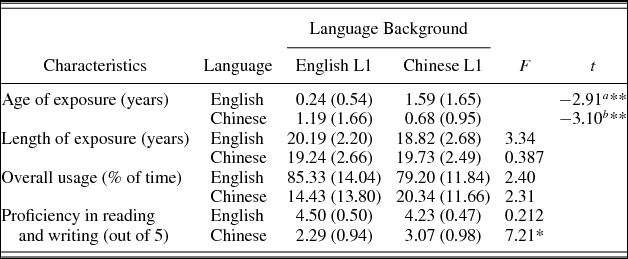
Based on the self-report LBQ, the English monolinguals lived in Australia from birth and reported English as their only language with no exposure to any other languages at home. The bilingual participants were foreign international students of Chinese descent from Singapore, China, and Hong Kong. They were exposed to English and Chinese at home from a young age (see Table 1), and had formal English and Chinese language and literacy education from primary school (about age 6–7 years) to secondary school (about age 17–18 years). The bilingual groups were not significantly different in their length of residency in Australia, F (1, 41) = 0.519, p = .476; English-L1: M = 3.6 years; Chinese-L1: M = 4.3 years. Table 1 shows both the English-L1 and the Chinese-L1 participants were exposed to their first language significantly earlier than their L2, English-L1: t (20) = –2.91, p = .009; Chinese-L1: t (21) = –3.10, p = .005. Though both groups were exposed to English, F (1, 41) = 3.34, p = .075, and Chinese, F (1, 41) = 0.387, p = .537, for similar lengths of time, length of exposure is not indicative of amount of exposure to the L1. The amount of exposure to the L1 differed between the groups in the early years because language exposure at home during childhood was dominated by one language as indicated by responses to the LBQ that asked participants to provide the language spoken most at home by parents from infancy. Further evidence of this comes from the current use of the L1 with family and friends. For example, averaged data of current language usage from the English-L1 participants showed a trend of using English more often compared to the Chinese-L1 participants, with all English-L1 participants using only English with parents and friends. Chinese-L1 participants showed a trend of using Chinese more often than English-L1 participants, with about 63.6% of them currently using only Chinese with parents and friends. However, the overall current usage of either English, F (1, 41) = 2.40, p = .129, or Chinese, F (1, 41) = 2.31, p = .136, was nonsignificant between the English-L1 and Chinese-L1 groups. This bias toward the use of English in both bilingual groups could be attributed to English being the main medium of instruction at university and the participants living in a predominantly English-speaking country. This could also be the reason for the finding that English-L1 and Chinese-L1 adults did not differ in terms of self-ratings of proficiency in English reading and writing proficiency, F (1, 41) = 0.212, p = .647, though the proficiency scores were in the expected direction (English-L1 > Chinese-L1). However, the Chinese-L1 adults rated themselves as having better proficiency in Chinese than the English-L1 adults, F (1, 41) = 7.21, p = .010.
Means (standard deviations) of language background characteristics of English-L1 and Chinese-L1 groups

Note: All language background characteristics, except for age of exposure, were compared between English-L1 and Chinese-L1 groups using one-way analyses of variance. For age of exposure, paired samples t tests were used to determine any differences within language background groups. L1, First language.
a The t value obtained for the English-L1 group.
b The t value obtained for the Chinese-L1 group.
*p < .05. **p < .01.
In addition, due to the differences in the education system across the countries, information on early alphabetic exposure through phonics and/or hanyu pinyin (phonic coding system for Mandarin characters) was collected with the LBQ. Chi-square analyses showed that there were no significant differences across language background groups in alphabetic exposure, χ2 (2, N = 71) = 0.746, p = .689.
Materials
LBQ
This questionnaire required participants to provide information on the languages they knew, the age at which they were first exposed to each language, the language used most at home from infancy, and the current amount of time (%) spent using particular languages. Participants who reported only knowing English were assigned to the English monolingual group. The rest of the participants, who reported knowing both English and Mandarin/Cantonese, were allocated to the English-L1 or Chinese-L1 groups based on two factors (see Li, Sepanski, & Zhao, Reference Li, Sepanski and Zhao2006): (a) age of exposure to L1 was earlier or at the same time as the L2; and (b) L1 was the language used most at home by parents from infancy. Participants had to satisfy both factors to be classified as either English-L1 or Chinese-L1.
Nonverbal reasoning
The matrices subtest from the Kaufman Brief Intelligence Test—Second Edition (Kaufman & Kaufman, Reference Kaufman and Kaufman2004) was used to assess participants’ nonverbal reasoning. Participants were required to select one from six choices to complete the missing part of a given abstract design. This task was administered and scored according to standard procedures in the manual. The reliability estimate of this task as obtained from the manual was 0.88.
Receptive vocabulary
The Peabody Picture Vocabulary Test—Fourth Edition (Dunn & Dunn, Reference Dunn and Dunn2007) was administered as a measure of receptive vocabulary. Participants had to select one from four pictures that matched the target word spoken by the experimenter. This task was administered and scored according to standard procedures in the manual. The reliability estimate of this task as obtained from the manual was 0.95.
Word reading and spelling
The word reading and spelling subtests from the Wechsler Individual Achievement Test—Second Edition: Australian Adaptation (Wechsler, Reference Wechsler2007) were used as measures of single word reading ability and single word spelling ability, respectively. For word reading, participants were required to read as many words as possible from a list of words of increasing difficulty. For spelling, single words of increasing difficulty were presented orally to participants, who were required to spell as many words correctly as possible. Both tasks were administered and scored according to standard procedures in the manual. The reliability estimates for word reading and spelling, as published in the manual, were 0.93 and 0.95 respectively.
Phonological processing measures
Three tasks were used to tap two components of phonological processing: phonological awareness and phonological recoding. Phonological awareness was measured using the nonword segmentation and phoneme reversal subtests from the Comprehensive Test of Phonological Processing (Wagner, Torgesen, & Rashotte, Reference Wagner, Torgesen and Rashotte1999). These two supplementary subtests from the Comprehensive Test of Phonological Processing were chosen to avoid possible ceiling effects because they are relatively more difficult for adult participants than the other subtests. In the nonword segmentation task, participants were presented aurally with nonwords of increasing difficulty and were required to segment each nonword into its respective phoneme components (e.g., say /mæ/ one sound at a time to get /m/ and /æ/). In the phoneme reversal task, participants had to say the real word they would get after reversing the order of phonemes in aurally presented nonwords (e.g., /n(ə)ves/ backward is seven). Each task was stopped after three consecutive incorrect items. The coefficient α values obtained from the manual for each task were 0.88 and 0.85, respectively. The third phonological processing task was the silent phonological choice task used by Olson et al. (Reference Olson, Forsberg, Wise, Rack and Reid1994), which assesses phonological recoding. Participants were presented with three nonwords side by side on the computer screen (e.g., nite vs. kile vs. hote) and chose, via button press, the nonword that sounded most like a real English word (e.g., nite). Because nonwords were used, participants had to apply grapheme–phoneme conversion rules to decode the nonwords phonetically to derive the correct response. The stimuli used were those developed by Olson et al. (Reference Olson, Forsberg, Wise, Rack and Reid1994), and comprised 5 practice trials and 60 experimental trials. A Cronbach α of 0.90 was calculated for this task. Accuracy scores on each phonological measure were standardized within the whole sample to obtain z scores for each participant.
Orthographic processing measures
Two components of orthographic processing, word-specific knowledge and general orthographic knowledge, were measured using three tasks. Word-specific orthographic knowledge was assessed using the orthographic choice task and homophone verification task. In the orthographic choice task adapted from Olson et al. (Reference Olson, Forsberg, Wise, Rack and Reid1994), participants heard a word and were presented with a letter string on the computer screen. Presented letter strings were either real words (e.g., bloom) or their pseudohomophones (e.g., blume), and participants had to decide if the letter string presented was the correct real English word that matched the target word heard. Stimuli used were gathered from Manis, Custodio, and Szeszulski (Reference Manis, Custodio and Szeszulski1993; 22 items), Manis, Seidenberg, Doi, McBride-Chang, and Petersen (Reference Manis, Seidenberg, Doi, McBride-Chang and Petersen1996; 12 items), Olson et al. (Reference Olson, Forsberg, Wise, Rack and Reid1994; 66 items), and Sloboda (Reference Sloboda and Frith1980; 8 items). There were 5 practice trials and 103 experimental trials. A Cronbach α value of 0.86 was calculated for this task. The homophone verification task was adapted from Manis et al. (Reference Manis, Custodio and Szeszulski1993). Participants listened to a sentence (e.g., “The man bought eight books”) and had to respond appropriately to whether the word presented on the screen was either the correct word for the sentence (e.g., “eight”) or an incorrect homophone (e.g., “ate”). Stimuli for this task were taken from Manis et al. (Reference Manis, Custodio and Szeszulski1993; 28 items) and Stanovich and West (Reference Stanovich and West1989; 14 items). Three new items (e.g., knight/night, sum/some, sole/soul) were included to make a total of 5 practice trials and 40 experimental trials in this task. The Cronbach α calculated for this task was 0.89. Finally, the nonlexical choice task was used to assess general orthographic knowledge. Participants were presented with a pair of nonwords on the computer screen, one of which contained letter sequences/positions that were legal and/or common in words. They had to indicate which nonword “looked” most like a real English word (e.g., bei vs. bey). Items in this task were taken from Siegel, Share, and Geva (Reference Siegel, Share and Geva1995; 17 items) and Wang, Perfetti, and Liu (Reference Wang, Perfetti and Liu2005; 16 items). Five new items were added as practice trials before the 33 experimental trials. Cronbach α calculated for this task was 0.92.
Because of the low number of errors made on the three orthographic measures, a composite score for each task was calculated using the speed and accuracy scores for each participant. The median correct reaction time and number of errors obtained on each task were converted to standardized scores within the whole sample and then averaged to form the composite score. Other studies investigating orthographic skills have calculated composite scores in a similar manner (see Stanovich & West, Reference Stanovich and West1989).
Procedure
Participants were tested individually in a session that took 1.5 to 2 hr to complete. Each session was divided into two blocks. One block consisted of the nonverbal reasoning task, word reading, and orthographic processing measures, whereas the receptive vocabulary, word spelling, and phonological processing measures were administered in the other block. The order of the two blocks was counterbalanced across participants.
Analytic plan
Before addressing the objectives of the study, we compared the English monolingual, English-L1 bilingual, and Chinese-L1 bilingual adults on measures of English word reading and spelling, English receptive vocabulary, and nonverbal reasoning ability. These analyses were carried out to determine the cognitive ability and English language and English literacy proficiencies of the three groups (all of which are factors that may affect skills in phonological and orthographic processing). Next, to address our first objective in comparing the phonological and orthographic skills of the English monolingual, English-L1 bilingual, and Chinese-L1 bilingual adults, we conducted separate multivariate analyses of covariance (MANCOVAs) on the z scores derived for the phonological processing tasks and the composite scores calculated for the orthographic processing tasks, with language background as a between-subject factor. This allowed us to determine if the groups were different on phonological and orthographic skills. Subsequent pairwise comparisons using multivariate analyses of variance helped to determine where group differences were evident. Finally, to examine the relationships between phonological and orthographic processing skills and English word reading and spelling, correlations among the above variables were conducted for each language background group, then multiple regression analyses were performed to ascertain the unique contribution of each skill type to English word reading and spelling.
RESULTS
Preliminary analysis
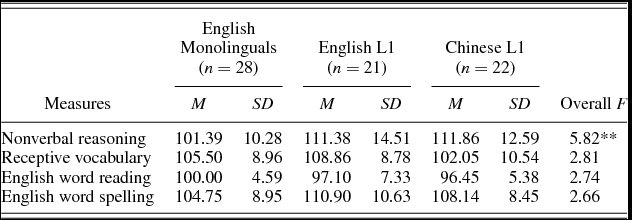
Raw scores obtained on the standardized tasks were converted to standard scores using reported normative data before conducting further analyses. Table 2 displays the descriptive statistics for these standardized tasks organized by language background group. A one-way analysis of variance was conducted to ensure that the groups were similarly proficient in the English literacy achievement measures. The results showed that there were no significant differences among the groups on the measures of English word reading, F (2, 68) = 2.74, p = .072, or English word spelling, F (2, 68) = 2.66, p = .077. Post hoc Scheffé comparisons confirmed that there were no significant differences between any of the language groups (all ps > .081) despite group differences on word reading and spelling approaching significance. English receptive vocabulary was measured to account for possible oral language differences among the groups because past research has shown that bilinguals tend to have poorer vocabulary than monolinguals (e.g., Bialystok, Luk, Peets, & Yang, Reference Bialystok, Luk, Peets and Yang2010). Though we found group differences to be in the expected direction (Chinese-L1 bilinguals < monolinguals), these differences did not reach significance, F (2, 68) = 2.81, p = .067. However, the groups were significantly different on nonverbal reasoning, F (2, 68) = 5.82, p = .005, with the English monolingual adults performing significantly lower than the bilingual adults (vs. English-L1: Scheffé = 7.83, p = .025, vs. Chinese-L1: Scheffé = 8.84, p = .016), while the bilingual groups were not significantly different from each other (p = .992). This is consistent with previous research that has found cognitive advantages attributed to bilingualism (Bialystok & Craik, Reference Bialystok and Craik2010).
Descriptive statistics for standardized tasks organized by language background group

Note: L1, First language.
**p < .01.
Group differences in phonological and orthographic processing skills
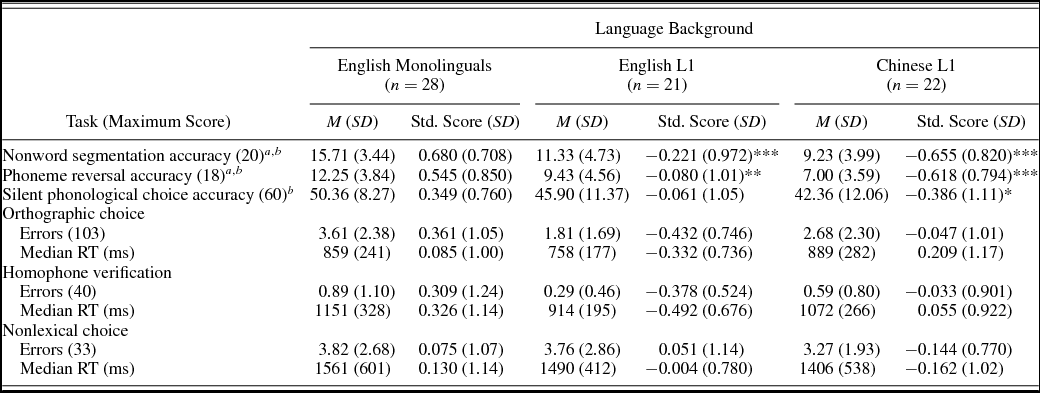
To investigate group differences on phonological and orthographic processing skills, separate MANCOVAs, with language background as a between-subject factor, were conducted using the z scores for the phonological processing tasks and the composite scores calculated for the orthographic processing tasks. Because there were group differences on nonverbal reasoning and the group differences on receptive vocabulary were approaching significance, these scores were entered as covariates in the MANCOVAs. Subsequent pairwise comparisons between language background groups were performed using multivariate analyses of variance with α = 0.017 (0.05/3 after Bonferroni correction). Table 3 shows the mean performance on these tasks for each language background group.
Means (standard deviations) of phonological and orthographic processing tasks organized by language background group

Note: L1, First language; RT, response time.
a Means differed significantly between English monolingual and English-L1 groups.
b Means differed significantly between English monolingual and Chinese-L1 groups.
*p < .05. **p < .01. ***p < .001.
A significant main effect of language background group was found for the phonological processing tasks, F (6, 128) = 6.86, p < .001, η2 Mult = 0.43. The English monolingual adults performed significantly better on the phonological processing tasks than both English-L1, F (3, 43) = 8.68, p < .001, η2 Mult = 0.38, and Chinese-L1 adults, F (3, 44) = 14.90, p < .001, η2 Mult = 0.50, but the bilingual groups were not significantly different from each other, F (3, 37) = 1.29, p = .291, η2 Mult = 0.09. The English monolingual group performed significantly better than the English-L1 group on the phoneme reversal, F (1, 45) = 12.7, p = .001, and nonword segmentation tasks, F (1, 45) = 23.3, p < .001, but not on the silent phonological choice task, F (1, 45) = 2.55, p = .117. The English monolingual group performed significantly better than the Chinese-L1 group on all three phonological processing tasks: phoneme reversal: F (1, 46) = 31.6, p < .001; nonword segmentation tasks: F (1, 46) = 38.6, p < .001; silent phonological choice task: F (1, 46) = 4.54, p = .038. Consistent with our hypothesis, the Chinese-L1 group performed poorly on the phonological processing tasks compared to the English monolingual group. However, the finding that the English-L1 adults performed similarly to the Chinese-L1 adults and poorer than the English monolingual adults was unexpected. In terms of performance on the orthographic processing tasks, as expected, there were no significant language background differences, F (6, 128) = 2.02, p = .067, η2 Mult = 0.17. However, given that this difference was marginal, pairwise comparisons were investigated, and no significant differences between groups were found: English monolingual vs. English-L1: F (3, 43) = 3.89, p = .018, η2 Mult = 0.20; English monolingual vs. Chinese-L1: F (3, 44) = 0.538, p = .659, η2 Mult = 0.03; English-L1 vs. Chinese-L1: F (3, 37) = 2.06, p = .122, η2 Mult = 0.14.
Relationships between phonological and orthographic processing skills and English word reading and spelling
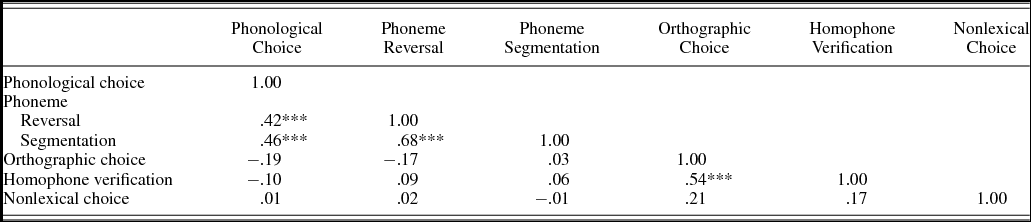
Before examining the relationships between phonological and orthographic processing skills and English word reading and spelling, we reduced the number of predictor variables to obtain an overall score representing phonological processing skills by averaging the standardized scores of the three phonological tasks, and similarly, an overall score representing orthographic processing skills was obtained by averaging the composite scores of the three orthographic tasks. The creation of the composite scores was supported by medium to strong correlations within the phonological tasks (r = .42–.68), a strong correlation between the orthographic choice and homophone verification task (r = .54), and low correlations between the phonological and orthographic tasks (all rs < .19; see Table 4). Because orthographic processing is a multidimensional construct consisting of word-specific and general orthographic knowledge, the nonlexical choice task was included in this study, despite its low correlations with the other orthographic tasks, so that both components of orthographic processing were measured (Conrad, Harris, & Williams, Reference Conrad, Harris and Williams2013). Hence, the low correlations between the nonlexical choice task, which measures general orthographic knowledge, and the other two orthographic tasks, which measure word-specific knowledge, may be a reflection of the two separate components of orthographic skill. The low correlations obtained are consistent with other studies that have also found lower correlations between the nonlexical choice task and the other orthographic tasks compared to correlations between other orthographic tasks (r = .37–.42 vs. .69; Hagiliassis et al., Reference Hagiliassis, Pratt and Johnston2006) and studies showing the nonlexical task to have lower factor loadings than other tasks on orthographic factors identified in factor analyses (.47–.49; Hagiliassis et al., Reference Hagiliassis, Pratt and Johnston2006; Yeong et al., Reference Yeong, Fletcher and Bayliss2014). An investigation of the distribution of these overall scores showed that they were neither skewed nor had excessive kurtosis and that they were normally distributed (all Shapiro–Wilk tests of normality p > .14).
Correlations among phonological processing tasks and orthographic processing tasks

***p < .001.
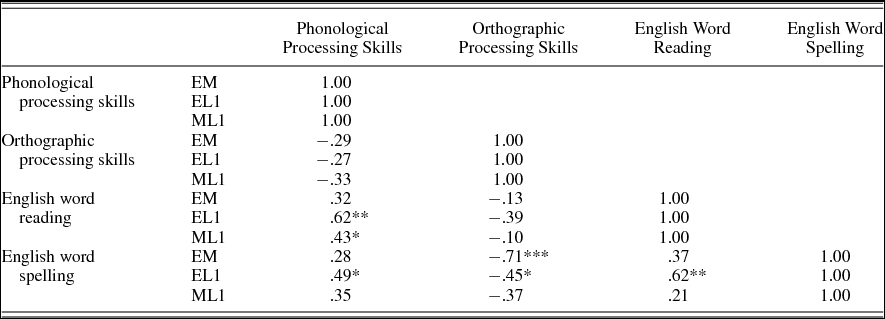
Table 5 shows the bivariate correlations between phonological and orthographic processing skills, and English word reading and spelling for each language background group. The pattern of associations suggests that language background affects the relationships between underlying skills and word reading and spelling.
Correlations of phonological processing skills, orthographic processing skills, and English word reading and spelling as a function of language background group

Note: EM, English monolinguals; EL1, English-L1 bilinguals; ML1, Mandarin-L1 bilinguals.
*p < .05. **p < .01. ***p < .001.
For English-L1 and Chinese-L1 adults, phonological, but not orthographic, skills were significantly correlated with word reading. Neither phonological nor orthographic skills correlated significantly with word reading for the English monolingual adults. Both phonological and orthographic skills were significantly correlated with spelling for the English-L1 adults; however, only orthographic skills correlated significantly with spelling for the English monolingual adults. Neither phonological nor orthographic skills correlated significantly with spelling for the Chinese-L1 adults.
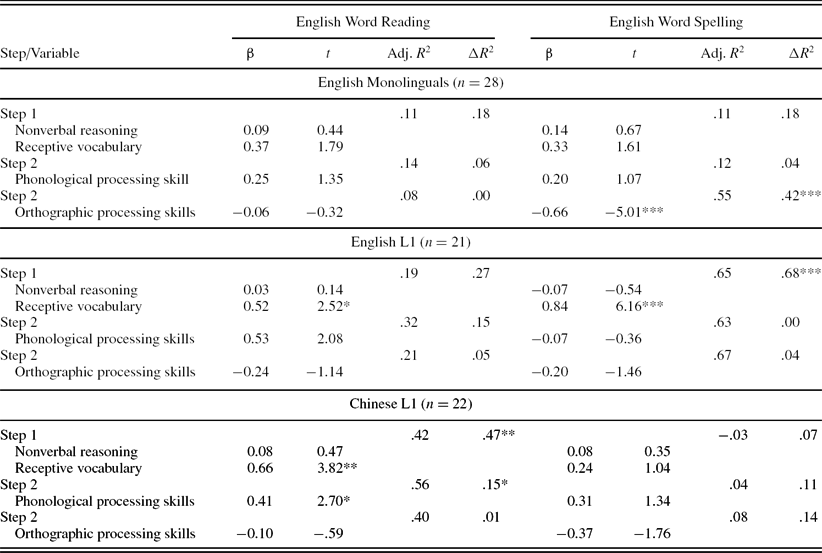
To determine the contribution of each skill type to both English word reading and spelling, multiple regression analyses were conducted. However, because the total sample size in this study was considered to be too small (<100) to detect a moderating effect of group (Aguinis, Reference Aguinis2004; see also Aiken & West, Reference Aiken and West1991), separate regression analyses for each language background group were considered to be more appropriate (see Table 6). Other studies have investigated group differences in a similar manner (e.g., Chiappe, Siegel, & Wade-Woolley, Reference Chiappe, Siegel and Wade-Woolley2002; Geva & Zadeh, 2006; Jongejan, Verhoeven, & Siegel, Reference Jongejan, Verhoeven and Siegel2007; McBride-Chang et al., Reference McBride-Chang, Bialystok, Chong and Li2004). Nonverbal reasoning and receptive vocabulary abilities were entered first, followed by either the overall phonological or orthographic score. Due to the small subgroup sample sizes, it was not considered appropriate to include phonological and orthographic processing skills in the same analysis; therefore, the following analyses examine the unique contribution of each skill set over and above the contribution of nonverbal reasoning and receptive vocabulary. The degree of collinearity for all regression analyses was found to be acceptable (tolerance > 0.52, variance inflation factor < 1.91).
Hierarchical regression predicting English word reading and spelling from phonological and orthographic processing skills as a function of language background group

*p < .05. **p < .01. ***p < .001.
Predicting word reading
For word reading, phonological processing skills accounted for an additional 15% of variance, F (1, 18) = 7.30, p = .015, over and above nonverbal reasoning and receptive vocabulary, for Chinese-L1 adults (β = 0.41, p = .015). Phonological skills also accounted for 15% of variance in word reading scores for English-L1 adults, F (1, 17) = 4.31, p = .053; however, this was only marginally significant (β = 0.53, p = .053). In contrast, phonological skills did not explain any unique variance, F (1, 24) = 1.81, p = .19, in word reading for the English monolinguals (β = 0.25, p = .19). Orthographic processing skills were not significant for English word reading for any of the three groups: English monolinguals: F (1, 24) = 0.10, p = .76, β = –0.59, p = .76; English-L1: F (1, 17) = 1.31, p = .27, β = –0.24, p = .27; Chinese-L1: F (1, 18) = 0.34, p = .57, β = –0.10, p = .57. These findings were unexpected because we hypothesized orthographic skills to be the only significant predictor for all three groups.
Predicting word spelling
For spelling, orthographic processing skills were the only significant predictor, contributing an additional 42% of variance, F (1, 24) = 25.13, p < .001, over and above nonverbal reasoning and receptive vocabulary, for the English monolingual group (β = –0.66, p < .001). Phonological processing skills was not a significant predictor, F (1, 24) = 1.14, p = .30, β = 0.20, p = .30, for this group. Neither phonological nor orthographic processing skills contributed significant additional variance to spelling for the English-L1: phonological: F (1, 17) = 0.13, p = .72, β = –0.068, p = .72; orthographic: F (1, 17) = 2.14, p = .16, β = –0.20, p = .16, or the Chinese-L1 adults: phonological: F (1, 18) = 2.37, p = .14, β = 0.35, p = .14; orthographic: F (1, 18) = 3.10, p = .10, β = –0.37, p = .10. Our hypothesis that orthographic skills would be a significant predictor for all three groups was only partially supported because this was only found for the English monolingual group, and not the bilingual groups.
The results of the regression analyses suggest that phonological processing skills were important for the bilingual groups, especially the Chinese-L1 group, but only for English word reading, while orthographic processing skills were important for the English monolinguals, but only for English word spelling. This suggests that different skills may be important depending on language background and on the task requirements of word reading and spelling.
DISCUSSION
The influence of early home language exposure in shaping how an individual learns a L2 has been demonstrated in children (Caravolas & Bruck, Reference Caravolas and Bruck1993; Cheung et al., Reference Cheung, Chen, Lai, Wong and Hills2001; Durgunoglu & Oney, Reference Durgunoglu and Oney1999; Rickard Liow & Poon, Reference Rickard Liow and Poon1998), but it has not been ascertained whether this influence is also apparent in bilingual adults, or if the skills relied upon by bilingual adults who have successfully learned to read and spell in English are the same as those for English monolinguals. In this study, we compared three groups of adults with differing language backgrounds (English monolinguals vs. English L1-Chinese L2 bilinguals vs. Chinese L1-English L2 bilinguals) on their phonological and orthographic processing skills, and evaluated the contributions of these skills to the adults’ concurrent English word reading and spelling abilities. This study is unique in that it compared adults who were equally proficient in English word reading and spelling, but had contrasting early linguistic exposure. This allowed us to determine the influence of Chinese as an L1 or L2 on English literacy.
Group differences in phonological and orthographic skills
One key finding from this study was that performance on the phonological and orthographic processing tasks was dependent on language background. As expected, the Chinese-L1 adults demonstrated the poorest phonological processing, but not orthographic processing, of the three groups. This result is consistent with previous research showing that Chinese-L1 children and adults have poorer phoneme awareness compared to English monolingual (Cheung et al., Reference Cheung, Chen, Lai, Wong and Hills2001; Holm & Dodd, Reference Holm and Dodd1996; Wang & Geva, Reference Wang and Geva2003b) or English-L1 (Bialystok, McBride-Chang, & Luk, Reference Bialystok, McBride-Chang and Luk2005; Yeong & Rickard Liow, Reference Yeong and Rickard Liow2012; see also Wang et al., Reference Wang, Koda and Perfetti2003) children and adults. It also extends previous research by showing that this effect cannot be attributed to differences in reading ability. Instead, the poorer phonological processing of the Chinese-L1 bilinguals appears to be due to the influence of the nature of the Chinese language, which has a simpler phonological structure and a more complex logographic script, compared to the English language. These characteristics encourage word-specific knowledge and promote a lexical approach to the writing system, but not the understanding of sound units in the language (McBride-Chang & Chen, Reference McBride-Chang and Chen2003). In addition, the lack of differences between the groups in terms of orthographic skills suggests that, despite the fact that Chinese-L1 adults have poorer phonological skills, the holistic visual–lexical (whole word) approach encouraged by the Chinese writing system promotes a similar approach to English, hence allowing them to develop their English orthographic processing skills to a similar extent to the English-L1 and English monolingual adults. Though studies have suggested that Chinese-L1 children may have better orthographic skills than English monolinguals or English-L1 children (Wang & Geva, Reference Wang and Geva2003b), exposure to English over time would, arguably, have allowed English monolinguals and English-L1 adults to develop their orthographic skills, building up their store of whole sight words and understanding of visual/orthographic patterns in English (see Ehri, Reference Ehri2005). Hence, it is not surprising that adults from the three language background groups demonstrated similar proficiencies in orthographic skills.
Although the Chinese-L1 adults were significantly poorer in phonological processing than the English monolinguals, the group difference between the Chinese-L1 and the English-L1 adults was not significant. This suggests that given exposure over time, the Chinese-L1 adults were able to reach the same level of proficiency as the English-L1 adults, but not the English monolingual adults. Chen, Xu, Nguyen, Hong, and Wang (Reference Chen, Xu, Nguyen, Hong and Wang2010) compared children in a regular English program with those from an intensive program and found that receiving additional English instruction improved English phonological awareness. Yeong and Rickard Liow (Reference Yeong and Rickard Liow2012) also showed that Mandarin-L1 children continued to show improvements in phoneme awareness over the course of a year while attending preschool with instruction in English. Because the Chinese-L1 adults had English language lessons from the primary school level and were immersed in an English only environment at university, this may have allowed them to acquire and improve their phonological processing skills with continued exposure to the alphabetic language through the years. This implies that L2 learners may attain new skills that are critical for the L2 (Wang et al., Reference Wang, Koda and Perfetti2003). Although it may be surprising that the English-L1 adults did not perform as well as the English monolinguals on phonological processing, Nguyen-Hoan and Taft (Reference Nguyen-Hoan and Taft2010) found a similar result with adult bilinguals, who referred to English as their dominant language. The Cantonese bilinguals in their study performed poorly on phonological tasks, particularly those involving nonwords. However, unlike the English-L1 bilinguals in our study, the Cantonese bilinguals in the Nguyen-Hoan and Taft (Reference Nguyen-Hoan and Taft2010) study learned Cantonese before English and considered Cantonese as their dominant language in childhood, suggesting they may be more similar to the Chinese-L1 bilinguals in the current study. The continued exposure to and usage of the L2 in English-L1 bilinguals could have led to lower exposure to, and usage of, English than English monolinguals (as reflected in the LBQ), hence resulting in some interference with the development of the L1, despite the English-L1 adults being exposed to English from birth and their exclusive use of English with parents and friends. Based on the performance of the three groups on the phonological processing and orthographic processing tasks, the results suggest that having two contrasting languages with differing linguistic properties has an impact on the individual's underlying processing skills, even if English is the L1.
Group differences in skills predicting English word reading and spelling
A second important finding was that different skills contribute to English word reading and spelling for each language background group. With regard to the processes underlying reading, an unexpected finding was that the contribution of phonological processing skills was important for both English-L1 and Chinese-L1 adults. Despite their poorer phonological skills, these bilingual groups continued to rely on such skills for reading even in adulthood. These findings are similar to studies conducted with Chinese-L1 children showing that the strongest predictor of English word reading is phonological awareness (McBride-Chang & Kail, Reference McBride-Chang and Kail2002). Gottardo, Yan, Siegel, and Wade-Woolley (Reference Gottardo, Yan, Siegel and Wade-Woolley2001) also showed that phonological processing in both the L1 and L2 contributed unique variance to English reading for Cantonese-L1 children. Our results suggest that bilingual adults also rely on decoding strategies through grapheme–phoneme correspondences. For English monolinguals in the current study, neither phonological nor orthographic processing predicted unique variance for word reading. According to Ehri's (Reference Ehri2005) and Seymour, Aro, and Erkine's (Reference Seymour, Aro and Erskine2003) models of reading development, advanced readers move on to emphasize large units such as morphemes and syllables. This is supported by evidence from studies with older primary school-aged English monolingual children showing morphological (Carlisle, Reference Carlisle2003) and grammatical awareness (Muter & Snowling, Reference Muter and Snowling1998) to be unique predictors of word reading. Hence, an important question for future research will be to examine whether these other processes are important for word reading in English monolingual adults.
For spelling, the current study showed that orthographic processing skills were important for the English monolingual adults only. Spelling in English is known to be more difficult than reading because there are more ways to spell a given word than to read it (i.e., phoneme-to-grapheme mappings are more inconsistent than grapheme-to-phoneme mappings; e.g., /saɪt/ can be spelled as sight, site, or cite; Bosman & Van Orden, Reference Bosman, Van Orden, Perfetti, Rieben and Fayol1997). Hence, it may be necessary to learn whole-word strategies or acquire sublexical attributes of the English writing system in addition to applying phoneme–grapheme correspondences to manage the inconsistency of phoneme–grapheme patterns for the English monolingual adults. It is surprising that while phonological skills remained important for reading, neither phonological nor orthographic skills were implicated for spelling in the bilingual adults. Orthographic skills accounted for more variance in spelling than phonological skills for the bilingual adults, suggesting that the bilingual adults were sensitive to the different task demands of spelling, similar to the English monolingual adults. However, orthographic skills were not a significant predictor of spelling, which indicates that other processes were involved for the bilingual adults. For example, vocabulary was a significant predictor for the English-L1 adults, suggesting that vocabulary knowledge may be an important factor for bilinguals. The influence of vocabulary for bilinguals’ literacy has not been explored widely, but findings from Spanish-English bilingual children suggest that English vocabulary proficiency may be associated with better English nonword spelling performance and more orthographically plausible English spellings (San Francisco, Mo, Carlo, August, & Snow, Reference San Francisco, Mo, Carlo, August and Snow2006). More research needs to be done to examine the other processes that may be involved for bilingual individuals.
Implications
Given that phonological skills reflect the quality of phonological representations (Goswami, Reference Goswami2000; Snowling, Reference Snowling2001), the relatively poorer phonological skills in Chinese-English bilinguals could suggest a poorer quality of phonological representations compared to the English monolinguals. The emphasis on different phonological unit sizes (i.e., phoneme in English and syllable in Chinese) in Chinese and English may have led to a lack of distinctness and/or segmental specificity in phonological representations in English. That is, the phonological representations of Chinese–English bilinguals may not be at the precise phonemic level required for English. Furthermore, speech perception has been found to predict the development of phonological awareness (Cheung et al., 2010); hence, differences in speech perception (e.g., ESL learners vs. native English speakers; Chiappe, Glaeser, & Ferko, Reference Chiappe, Glaeser and Ferko2007) and phonological skills may influence the quality of phonological representations in Chinese–English bilinguals. However, given that Chinese–English bilinguals have similar proficiencies in English word reading and spelling to the English monolinguals, other compensatory processes must have contributed to the development of English literacy skills in the Chinese–English bilinguals. The similarities in underlying skills between English-L1 and Chinese-L1 adults suggest that early or long exposure to a L2 as an L1 (i.e., in Chinese-L1 adults) or L2 (i.e., in English-L1 adults) may influence phonological and orthographic representations in English. Further research into the relationships between speech perception, vocabulary, phonological and orthographic skills, and literacy skills in Chinese–English bilinguals is needed to shed light on the development and quality of phonological and orthographic representations in bilinguals.
In addition, the group differences in the contribution of skills for different literacy tasks may be due to bilingual learners following a different developmental trajectory for English literacy, or following a similar developmental path but at a different rate. Though Wang and Geva (Reference Wang and Geva2003a) and Yin et al. (Reference Yin, Anderson and Zhu2007) suggested that the stages that Chinese children progress through when learning English word reading and spelling were similar to that of monolinguals, the rate of development may depend on the extent to which skills from the L1 can be applied to the L2 (Figueredo, Reference Figueredo2006). Hence, because of the distinct structural differences between the Chinese and English languages, the transfer effect from L1 to L2 may only take place in the early stages of learning English, with the importance of phonological skills increasing with improved proficiency in English (Wang et al., Reference Wang, Koda and Perfetti2003). This suggestion is borne out by Yin et al. (Reference Yin, Anderson and Zhu2007), who showed that orthographic skills were used concurrently by young Chinese-L1 children who were just starting to learn alphabetic skills.
Furthermore, Yeong et al. (Reference Yeong, Fletcher and Bayliss2014) found phonological skills, not orthographic skills, to be the only significant predictor of English word reading in 8- and 11-year-old Chinese-L1 children, suggesting that Chinese ESL learners may rely on phonological skills for a longer period of time as they move from a language with a relatively simple phonological structure (i.e., Chinese) to one that has a complex phonological structure and inconsistent grapheme–phoneme correspondences (i.e., English). Hence, this may account for why Chinese-L1 adults in the current study continue to rely on phonological skills for reading. Alternatively, the reliance on phonological skills for word reading may be due to a smaller sight vocabulary in bilinguals compared to English monolinguals, which would make them less able to rely on automatic memory retrieval processes (Ehri, Reference Ehri2005).
Despite the adult bilinguals being as proficient in English word reading and spelling as the English monolinguals, the differences in performance on the orthographic and phonological tasks, as well as the reliance on different skills for reading and spelling, lead one to question if adult bilinguals are relying on the most efficient strategy or whether they require more cognitive resources to achieve a similar level of proficiency. If we assume the English monolingual adults to be using the most efficient strategy, which is to rely on phonological and orthographic processing in the early years to build up a sight word vocabulary such that they do not need to rely on such skills later in adulthood, young bilinguals could be helped to establish their underlying skills so that they, in turn, do not need to rely on such strategies when they are older. For example, an explicit phonics training program coupled with teaching of the links between phonemes and graphemes could enhance young bilinguals’ phonological processing skills (see Hatcher, Hulme, & Snowling, Reference Hatcher, Hulme and Snowling2004). This in turn would allow a greater exposure to a variety of orthographic forms, hence improving sight word vocabulary. In addition, because the groups in this study were equally proficient in English word reading and spelling, we would expect greater differences with regard to proficiencies in skills and their reliance on them in other bilingual individuals who have not achieved similar levels of English word reading and spelling. Consideration of both the proficient and efficient use of skills is essential to understanding how bilinguals achieve English literacy competency and could aid the design of interventions aimed at strengthening the foundation of such skills at an early developmental stage.
Limitations and future directions
One limitation of the current study is the small sample size within each group, which limits the strength of the conclusions regarding group differences in the types of skills that contributed to reading and spelling. The relatively small sample-to-variable ratios for the regression analyses would have limited the power of the current study to find significant effects, and the results from these analyses should be interpreted with this in mind. Future studies designed with a power analysis to determine sample size prior to data collection are warranted. Furthermore, it is important to note that measures of single word reading and spelling accuracy may not be the most sensitive type of measure because the participants were proficient adult readers and spellers of English. It would be useful in future studies to examine how underlying phonological and orthographic processing skills impact on other aspects of reading such as fluency and meaning access (Share, Reference Share2008) in adults proficient in word reading and spelling accuracy. Research in this area is rare for bilingual individuals and deserves further investigation. In addition, due to the high levels of accuracy found in the orthographic tasks, we combined participants’ error scores and reaction times to obtain composite orthographic scores, which may reflect more than proficiency in orthographic skills. Hagiliassis et al. (Reference Hagiliassis, Pratt and Johnston2006) suggested that accuracy and speed measures may not be equivalent and that response times from phonological or orthographic tasks may include variation due to the speed with which an individual makes choices. This makes it difficult to ascertain the relationship between orthographic skills, which were based on a combination of accuracy and speed, and word reading and spelling. The low error rates on the orthographic tasks also suggest that more complex tasks assessing orthographic tasks should be developed and used with participants who have become skilled and proficient in English. Perhaps with more complex measures, we can discern the contributions of accuracy and speed components on an orthographic task to English word reading and spelling.
Conclusions
This study is unique in that it investigates phonological and orthographic processing skills of proficient adult readers and spellers of English from three language backgrounds. The key finding, that Chinese-L1 bilinguals and even English-L1 bilinguals approach English literacy differently than the English monolinguals, suggests that the influence of linguistic exposure in the home from the early years may continue through to adulthood despite these bilinguals being acquainted with and having used English for a long period of time. Though bilingual Chinese–English adults may have attained similar levels of proficiency in English word reading and spelling as English monolinguals, we cannot assume that phonological and orthographic skills are equally important for literacy in both groups. Hence, an understanding of how bilingual individuals approach an L2 and the skills they bring can shed light on the different ways individuals learn and the possible ways in which we can help those who may have difficulties with learning the language.
ACKNOWLEDGMENTS
This research was carried out as part of Stephanie H. M. Yeong's doctoral work, with support from an International Postgraduate Research Scholarship and an Australian Postgraduate Award.