


Among the destructive consequences of civil conflict, two cause particular concern for the international community: fighting directly harms civilians and leads some to flee across borders to escape violence. Increasingly, the donor countries who mobilize in response to conflict link these issues together, adopting policies focused on providing aid and avoiding major refugee crises. To illustrate, the United Kingdom recently announced a significant funding package to “build resilience to conflict … to help bring down migration figures whilst improving lives for the world’s most vulnerable people.”Footnote 1
Donors argue that these objectives are complementary—by reducing violence and mitigating the consequences of conflict, they can eliminate civilians’ need to flee. The track record of policy tools intended to reduce civilian harm suggests a more complicated reality. Humanitarian aid sometimes leads to increased violence,Footnote 2 while promises of direct intervention can, but do not always, mitigate the destructiveness of conflict.Footnote 3 These mixed effects are often the result of strategic responses by governments.
What are the effects of policies aimed at reducing harm for civilians and refugee flows in the face of strategic government violence? Can linking aid and migration policies help donors push governments to reduce violence and displacement? Answering these questions requires understanding how governments and civilians respond not only to donors but also to each other. While previous work has studied the effects of refugee policies on civilian migration patterns,Footnote 4 or foreign assistance on conflict processes,Footnote 5 the literature does not offer a clear picture of how these policies interact, and whether they complement or undermine each other. Moreover, existing work typically assumes, implicitly or explicitly, a single objective for a donor, either protecting civilians or preventing migration. This inhibits a clear evaluation of donors’ arguments that such goals can be achieved in tandem.
An important potential impediment for donors is the governments engaged in conflicts. An embattled government’s primary aim is to defeat any challengers, a goal that may be in conflict with donors’ concerns over repression or refugee flows. To achieve the goals of reducing repression and migration, therefore, donors must compel governments to change how they fight. I develop a model to evaluate the effectiveness of a donor who is concerned with repression and migration at changing government behavior, studying the cumulative effects of their policies on the conduct of war and the flow of refugees.
In my framework, a government aims to defeat a (un-modeled) rebel group by minimizing its capacity, which I proxy with revenue generated from economic activity.Footnote 6 This brings the government into conflict with civilians, whose labor supports the rebels. To undermine rebel capacity, the government can fight the rebels and repress civilians. Civilians choose whether to flee as refugees, comparing the costs and benefits from fleeing abroad with their expected gains from remaining at home. I capture rebel economic capacity, and civilians’ material benefits from remaining, with a partial equilibrium model of the labor market. Refugee migration and the intensity of state violence are determined endogenously and are linked because they together determine the rebels’ remaining capacity. Therefore, whether donor policies are directed at civilians or combatants, they jointly affect conflict and displacement.
I evaluate the effects of several common donor policies: short-term humanitarian relief, restrictions on asylum, access to benefits in receiving communities, and aid conditionality, where aid is conditioned on reductions in repression and in refugee flows. Because individual donors have idiosyncratic concerns that affect their policy choices, I abstract from any particular strategic foreign actor. Instead, I assess the effects of exogenous changes in policy,Footnote 7 and contrast two types of donors: those who prioritize reducing migration and those who prioritize reducing repression.
Together, my results make two primary contributions to the study of aid, migration, and conflict. First, consistent with the empirical literature, I find donor policies that affect migration incentives can directly reduce civilian flight,Footnote 8 but also can increase conflict intensity.Footnote 9 I extend this literature by bringing existing results together in a common framework and showing how changes in violence arise by two interrelated mechanisms: donor leverage and donor priorities.
To see how these mechanisms influence conflict outcomes, in the model, changes in refugee policies, like increasing barriers to asylum, directly push against civilians’ incentives to flee. But, in reducing migration, these policies indirectly bolster rebel capacity by leaving their support base intact. Intuitively, when donors lack leverage, they cannot constrain the government from then increasing its efforts to undermine a stronger rebel group. Novel to my framework, even when donors have sufficient leverage, the government may get away with fighting harder when donors are inconsistent or prioritize reducing migration. Under restrictive refugee policies, more intense violence is less likely to generate large enough refugee flows to engender significant punishment from donors.
I also consider a policy that directly affects government incentives—conditioning aid. Policymakers routinely suspend or withdraw aid in response to increases in repression, often to avoid blow-back from their own constituents for supporting a repressive regime.Footnote 10 Yet many donors increasingly tie aid to governments’ management of migration flows. I find conditioning aid can produce some of the worst unintended consequences and some of the best outcomes for donors through the same mechanisms of leverage and priorities. For a government dependent on foreign assistance, donors can use their leverage to reduce both fighting and repression. This requires, however, conditioning aid on reductions in migration and repression but imposing more severe penalties for violence against civilians. Penalizing violence is effective when donors are consistent in their demands.Footnote 11 If, instead, donors prioritize migration management, the government, expecting limited repercussions from the donor, may increase conflict intensity and repression of civilians, serving its own aim of countering the rebels.
My second main contribution is identifying how donor policies have distinct effects on different types of violence governments use to undermine rebel groups. This builds on work that disaggregates violence to study internal displacement in conflictFootnote 12 and generates novel empirical implications. For a state not particularly dependent on foreign aid, and a donor who prioritizes repression, I show that an increase in donor leverage (perhaps as a result of a financial crisis) can cause the government to substitute fighting and repression, which can lead to a reduction in violence against civilians. In contrast, for a state already dependent on foreign assistance, an increase in donor leverage reduces fighting and repression when the donor prioritizes repression, but increases the government’s use of repression when the donor prioritizes migration. This not only runs counter to the donor’s interest in reducing civilian suffering but also may increase need in the long run for humanitarian support for victims. Finally, I show how donor leverage and priorities interact with underlying characteristics of the conflict. Both the direction and magnitude of donors’ effects on government violence depend on rebels’ baseline capacity.
My model highlights that, rather than the complementary relationship articulated by donors, there is often a trade-off between protecting civilians at home and providing for them abroad. Donor policies do not force the government to perpetrate violence but instead can indicate that it will face limited consequences from choosing a fighting strategy that maximizes its own battlefield gains. Though I set aside additional, general equilibrium effects that influence migration, like labor market conditions in receiving states, and narrow the focus to certain kinds of donors willing to condition aid, my results underscore that additional factors pushing against the government’s incentives to fight must overcome strong incentives to target the rebels to avoid increases in violence. Still, I show that high donor leverage and a consistent commitment to punishing repression can together produce reductions in both conflict intensity and violence against civilians.
Related Literature
Civilians’ migration calculus depends on many factors: violence, which drives refugee flightFootnote 13 and affects civilians’ destinations,Footnote 14 travel costs,Footnote 15 and economic opportunity at home and abroad.Footnote 16 Scholars have identified many policies that affect rates of refugee arrivals. Physical barriers deter some migrants,Footnote 17 though sometimes migration instead shifts to less fortified crossings.Footnote 18 Policies that make access to asylum more difficult are associated with fewer applications,Footnote 19 and can have spillover effects, leading to fewer arrivals in neighboring countries.Footnote 20 Liberalizing policies have the opposite effect; making asylum easier to attain increases applications.Footnote 21 Many refugees choose destinations accounting for policy differences across receiving states.Footnote 22 Others, though less informed, seek refuge in places they suspect will be hospitable.Footnote 23
States’ willingness to accept refugees depends on factors including domestic attitudes, international pressure, and economic conditions.Footnote 24 Donors also provide aid strategically to conflict-affected states,Footnote 25 hoping development will reduce migration.Footnote 26 However, even targeted aid can create conflict between groups in recipient communities, potentially leading aid to be diverted from those most in need.Footnote 27
I build on models that link economic activity and conflictFootnote 28 and similarly find economic opportunity can motivate migration.Footnote 29 My model is closely related to Sun which studies internal displacement and, in an extension, how violence affects civilians’ choice to remain, migrate internally, or flee abroad.Footnote 30 I depart from that work in focusing on the effects of donor influence on civilian flight and government tactics. Using a richer model of civilians’ migration decisions, I show how different policies that affect civilians determine refugee flows. These features allow me to derive policy implications that could not be studied in previous work. Further, I find that migration can result in more repression because donor pressure changes the government’s incentives. This contrasts with Sun, which finds that increases in refugee flight reduce violence against civilians.Footnote 31 In this model, as in Sun, if the government is only concerned about a domestic conflict, it benefits from refugee flight, relying on displacement as a substitute for repression. I go beyond these results and show that when the government also responds to a foreign donor, outside pressure can instead complement its own incentive to repress as a means to deny resources to a rebel group.
The Model
I study civil conflict where a government combats an opponent by minimizing its economic capacity. Fighting may push civilians to flee as refugees. Government tactics and civilians’ migration choice depend on each other, and on constraints created by foreign donors.
Government
Prior to the start of the game, a conflict emerges exogenously in a country,
 $H$
, between the government of
 $H$
and a (un-modeled) rebel group. The government aims to undermine the rebels’ capacity, which it can do in two ways. First, the government exerts effort fighting to reclaim control over territory, choosing
 $x \in \left[ {0,1} \right]$
, where
 $x$
reflects the proportion of
 $H$
(or contested areas of
 $H$
) under government control and
 $1 - x$
captures territory controlled by the rebels. More fighting effort therefore corresponds to more favorable conflict outcomes.
Second, the government can target the civilian population to deny support to the rebels, choosing a level of repression
 $v \in \left[ {0,1} \right]$
. Repression,
 $v$
, is similar to one-sided violenceFootnote
32
and it can represent the government’s deliberate acceptance of collateral damage or an explicit strategy of violence against civilians.Footnote
33
Repression affects civilians at random, implying the government does not target individuals based on their migration costs (the only characteristic distinguishing individual civilians).
The government minimizes the revenue of the rebel group, which is given by
 $\left( {1 - x} \right){\tau _r}Y\left( {L\left( {v,\mu } \right)} \right)$
, where
 $\mu $
is the migration rate, defined formally in what follows. Economic activity produces output
 $Y\left( {L\left( {v,\mu } \right)} \right)$
, where rebels’ share,
 $1 - x$
, corresponds to territory they control and the group extracts rents at a rate
 ${\tau _r} \in \left[ {0,1} \right]$
. Economic activity depends on civilians’ participation in the labor force and therefore is impacted by repression. Both fighting and repression are costly, captured by cost functions
 $a\left( x \right)$
and
 $z\left( v \right)$
, which are both strictly increasing and strictly convex. I also assume
 ${\rm{li}}{{\rm{m}}_{v \to 1}}z\left( v \right) {=} \infty\! $
, meaning that at extreme levels of repression, the cost of violence against civilians is prohibitively high.
Finally, the government receives its own revenue from foreign assistance
 $f\left( {\mu ,v} \right)$
, which may represent aid, loans, or any other type of revocable assistance provided by an external third-party. I make a few key assumptions about this assistance. First, it is responsive to changes in migration;
 $f\left( {\mu ,v} \right)$
is strictly decreasing and concave in
 $\mu $
. Second, donors dislike repression, such that
 $f\left( {\mu ,v} \right)$
is strictly decreasing and concave in
 $v$
and
 ${\rm{li}}{{\rm{m}}_{v \to 1}}\ {f_v}\left( {\mu ,v} \right) = {-}\! \infty\!$
. Because repression and migration are often handled by different actors within a government (or attract different types of donors), I assume
 ${{{\partial ^2}\ f} \over {\partial v\partial \mu }} = 0$
. This means that foreign assistance does not depend on complex interactions of repression and migration. A parameter
 $\alpha \in {{\mathbb {R}}_ + }$
captures the weight the government places on foreign assistance where, for large
 $\alpha $
, the government is more dependent on aid, giving the donor greater leverage.
Civilians
At the outset of the game, a unit mass of civilians, normalized to
 $1$
, reside in the area of
 $H$
under rebel control and therefore are affected by the conflict. Each civilian, indexed by
 $i$
, can choose to remain in
 $H$
or flee abroad and has an individual migration cost,
 ${\theta _i}$
, distributed uniformly from
 $\left[ {0,1} \right]$
. Lower values of
 $\theta $
indicate lower costs of leaving
 $H$
, and therefore a higher likelihood of fleeing. I denote the choice to flee abroad as
 ${m_i} = 1$
. Civilians who remain in
 $H$
choose
 ${m_i} = 0$
. Victims of repression may be killed, detained, or disappeared and can neither migrate nor participate in economic activity; their payoff is normalized to
 $0$
.
Civilians who are not victims of repression care about their own security as well as economic opportunities. Those electing to remain in
 $H$
engage in economic activity, earning a wage,
 $w\left( \cdot \right)$
. They also pay a cost from conflict, which captures damage to infrastructure or the breakdown of social order. This cost is represented by the linear function
 $c \cdot x$
.
Refugees who have fled
 $H$
earn a fixed benefit
 $b$
, capturing economic opportunity abroad. In Appendix E, I consider two alternative specifications—accounting for uncertainty over the value of benefits and allowing benefits to decrease with migration. Results are consistent with the main model. The total cost of flight is
 $\gamma {\theta _i}$
, where the parameter
 $\gamma \in {{\mathbb {R}}_ + }$
captures how destination states can affect the cost of migration. Some potential hosts are easier to reach geographically or more (or less) amenable to granting asylum. A small
 $\gamma $
represents a host state that eases barriers to entry while a large
 $\gamma $
captures additional barriers for refugees.
Economic Outcomes and Rebel Capacity
Civilians and the government are both concerned about economic outcomes, civilians because they care about wages and the government because it aims to deny rents to the rebels. To bridge these concerns, I incorporate fighting, repression, and migration in a partial equilibrium model of the economy of the contested areas in
 $H$
. Thus wages for civilians who remain in
 $H$
and revenue for the rebels are determined endogenously. The economy is characterized by production technology
 $Y\left( L \right)$
.Footnote
34
I assume the production function is Cobb-Douglas,
 $Y\left( L \right) = A{L^\beta }$
with
 $\beta \in \left( {0,1} \right)$
, where
 $A$
is total factor productivity,
 $L$
is the labor input, and
 $Y\left( 0 \right) = 0$
.Footnote
35
Production then features decreasing returns to scale and
 $Y\left( \cdot \right)$
is strictly increasing and strictly concave. Labor is demanded at a rate
 $L \le 1$
. Wages,
 $w\left( L \right) = {Y_L}$
, are the marginal revenue product of labor, which is strictly decreasing, where
 ${Y_L} \equiv {{\partial Y} \over {\partial L}}$
denotes the derivative of the production function with respect to labor. Throughout, beyond identifying civilians,
 $i$
, and rebels,
 $r$
, I use subscripts to denote derivatives of functions, so
 ${Y_{LL}}$
is the second derivative of the production function. Rebels earn
 $\left( {1 - x} \right){\tau _r}Y\left( L \right)$
, while private firms earn remaining revenue,
 $\left( {x + \left( {1 - x} \right)\left( {1 - {\tau _r}} \right)} \right)Y\left( L \right)$
. I microfound this model of the economy in Appendix A and show how markets clear to pin down the equilibrium wage.
Utilities
A civilian’s expected utility, accounting for their individual migration cost,
 ${\theta _i}$
, is
 $${U_i}\left( {{m_i},x,v;{\theta _i}} \right) = {m_i}\left[ {\left( {1 - v} \right)\left( {b - \gamma {\theta _i}} \right)} \right] + \left( {1 - {m_i}} \right)\left[ {\left( {1 - v} \right)\left( {{Y_L}\left( {\left( {1 - v} \right)\left( {1 - \mu } \right)} \right) - cx} \right)} \right].$$
Civilians who remain in
 $H$
are indirectly affected by those other civilians who choose to migrate; economic prospects depend on the refugee migration rate,
 $\mu = \mathop \int \nolimits_0^1 {m_i}di$
, which endogenously determines wages. At the end of the game, civilians comprise three groups: (1) refugees; (2) civilians who remain in
 $H$
by choice; and (3) victims of repression, given by
 $v$
.
The government minimizes rents that accrue to the rebel group while maximizing its own returns from foreign aid. It chooses levels of fighting effort and repression that solve,
 $$\mathop {{\rm{min}}}\limits_{x \in \left[ {0,1\left] {,v \in } \right[0,1} \right]} \left( {1 - x} \right) \cdot {\tau _r}\left( {Y\left( {\left( {1 - v} \right)\left( {1 - \mu } \right)} \right)} \right) - \alpha f\left( {\mu ,v} \right) + a\left( x \right) + z\left( v \right).$$
I refer to the government’s objective in Equation (1) as
 $g\left( {x,v} \right)$
, with subscripts denoting partial derivatives (for example,
 ${g_{xv}}\left( {x,v} \right)$
is the cross-partial).
The timing of the game is as follows:
-
1. The government chooses levels of fighting effort,
 $x \in \left[ {0,1} \right]$
, and repression,
$v \in \left[ {0,1} \right]$
.
-
2. Civilians decide whether to remain,
${m_i} = 0$
, or flee as refugees,
${m_i} = 1$
where the refugee migration rate is
$\mu = \mathop \int \nolimits_0^1 {m_i}di$
.


The solution concept is subgame perfect equilibrium. Civilians’ strategy is captured by a cutoff in
 $\theta $
, which determines the proportion of civilians who flee abroad. The government’s strategy comprises levels of fighting effort and repression that account for refugee flight.
Comments on the Model
Before proceeding to the analysis, I offer brief comment on some features of the model. First, I deliberately black box some aspects of the conflict, notably by omitting the rebel group whose revenue the government minimizes. Governments’ motivations for controlling territory and denying rents to rebels are well studied,Footnote 36 and other models consider competition between states and rebels over a civilian labor pool.Footnote 37 In line with the experimental perspective in Paine and Tyson, I deliberately exclude certain factors—like rebels’ actions—from the model in favor of carefully explicating the mechanisms of interest—the effects of donor leverage and priorities on violence and refugee flight.Footnote 38 In omitting the rebel group, I can focus on clearly defining how governments that value foreign aid respond to donor pressure, incentives that sit alongside concerns about fighting rebels.
I make no assumption about civilians’ ideological alignment with the rebels or the government and civilians see no direct benefits from the government retaking contested areas. The government may privilege elites in redistributing recaptured territory, and any increases in public goods following the reassertion of state control may come too late to affect civilians’ migration choice.Footnote
39
In Appendix C, I allow the government to directly value controlling territory, modifying its objective so that instead of minimizing rebel revenue, it instead maximizes its own rents from controlling
 $H$
. I find the effects of this alternative specification on refugee flight depend on whether civilians can freely move from rebel to government-controlled land, in addition to fleeing abroad.
By studying the effects of violence in partial equilibrium, I can clearly trace the impact of donor policies on migration through their effect on violence. This reduced-form representation of civilians’ economic incentives captures an important feature of their migration calculusFootnote 40 and reflects, intuitively, how civilians become more valuable to a rebel group as its support base shrinks. Given my findings are largely consistent with past empirical studies, which mostly estimate general equilibrium effects, the mechanisms I identify as driving violence likely complement other mechanisms identified in the literature.
Foreign Assistance and Refugee Flows
I first evaluate how donor policies affect the flow of refugees from
 $H$
, holding fixed levels of fighting and repression. These benchmark results show how donor incentives endogenously drive migration and contrast with outcomes when the government fights strategically. The comparison then highlights the challenges facing donors intervening to aid civilians in conflict.
Civilians flee when the expected benefits are greater than the costs, reflecting an assessment of both their well-being in
 $H$
and prospects abroad. The civilian indifferent between remaining and fleeing has migration cost that solves
 $b - \gamma {\theta _i} = {Y_L}\left( {\left( {1 - v} \right)\left( {1 - \mu } \right)} \right) - cx$
, where repression drops out of this calculus because victims of repression cannot choose to flee. Rearranging, the threshold below which civilians flee and above which they remain is represented by
 ${\theta ^{\rm{*}}} = {1 \over \gamma }\left( {b - {Y_L}\left( {\left( {1 - v} \right)\left( {1 - \mu } \right)} \right) + cx} \right)$
. This characterizes the unique equilibrium migration rate, as well as labor force participation in
 $H$
. Given the uniform distribution over migration costs, the equilibrium migration rate is,
 $${\mu ^{\rm{*}}} = {1 \over \gamma }\left( {b - {Y_L}\left( {\left( {1 - v} \right)\left( {1 - {\mu ^{\rm{*}}}} \right)} \right) + cx} \right).$$
The proportion of civilians who choose to remain in
 $H$
determines wages and thus affects this threshold and who decides to flee. Lemma 1 restates civilians’ equilibrium choices.
Lemma 1
For fixed levels of government violence
 $\left( {x,v} \right)$
, civilians for whom
 ${\theta _i} \le {\theta ^*}$
leave as refugees, where
 ${\theta ^*}$
is characterized by a unique refugee migration rate,
 ${\mu ^*}\left( {x,v} \right)$
.
Proof of this, and all other results, are in Appendix A. Intuitively, civilians with relatively low migration costs are those who flee. How do donor policies influence civilians’ decisions?
Among the tools available to policymakers, policies affecting the gains of migration most directly impact refugee flows. By increasing barriers to asylum or restricting access to social services, a potential host state endeavors to become a less appealing destination. Providing humanitarian relief, on the other hand, mitigates the cost of conflict for civilians remaining in
 $H$
, which may discourage migration. I find these policies have their intended effects.
Lemma 2
Refugee flight is increasing in
 $b$
, the value of benefits abroad, increasing in
 $c$
, the cost of conflict, and decreasing in
 $\gamma $
, or barriers to resettlement.
This mirrors how liberal policies allowing asylum seekers to work attracted large numbers of refugees to South Africa after the end of apartheid.Footnote 41 In contrast, recent changes to restrict work permits and limit asylum claims have seemingly worked to reduce immigration to Sweden.Footnote 42 Evidence from Europe suggests labor market conditions may have limited effect on asylum applications but, consistent with my model, easing access to asylum increases migration.Footnote 43
Strategic Government Violence
I next establish the government’s optimal strategy to contest the conflict in
 $H$
and return to the effects of donor policies in the next section. Proceeding backwards, the equilibrium migration rate follows from Lemma 1. Now, however, the government strategically chooses levels of fighting and repression. How does the intensity of conflict affect refugee flight?
Lemma 3
Refugee flight is increasing in fighting effort,
 $x$
, and decreasing in repression,
 $v$
.
Lemma 3 highlights a core tension in the model. When the government directly fights the rebels, this increases costs borne by civilians who elect to remain in
 $H$
. More intense fighting, therefore, increases refugee migration. Repression, on the other hand, reduces migration for two reasons. First, as the government increases repression, since victims cannot flee, mechanically the number of civilians who leave
 $H$
decreases. Second, repression indirectly affects economic opportunity for civilians who choose to remain in
 $H$
. Victims of repression also cannot participate in the economy, making an individual’s labor more valuable—in the face of repression, each civilian is more instrumental to the rebel economy. Remaining civilians see marginal wage increases resulting from a tighter labor market, which may be sufficient for some with relatively high migration costs to elect to remain.
While some evidence suggests wages decrease during conflict,Footnote 44 others find, closer to my result, that labor markets help absorb conflict shocks, such that violence shocks have no statistically significant effect on household consumption.Footnote 45 Repression also has economic repercussions in terms of land or property. For example, land owned or occupied by conflict victims in Colombia was often redistributed by paramilitaries, creating opportunities for private gain.Footnote 46 The indirect migration-reducing effect of repression suggests that some civilians, when they become more valuable to the rebels, are deterred from fleeing abroad, though they may be unwitting beneficiaries rather than deliberately seeking to create these economic effects.
Figure 1 visualizes how fighting increases refugee flight and repression decreases migration. Figure 1(c) also highlights the relationship between fighting and repression, where as the level of repression increases, more intense fighting moderates the deterrent effect of repression.
Effects of violence on refugee migration
Note: I fix
 $\gamma=3.25$
,
 $b=1.5$
,
 $Y = 1.65{L^{{2 \over 3}}}$
and
 $c=.35$
.

Figure 1 Long description
The image contains three line graphs analyzing the effects of violence on refugee migration. The first graph on the left shows the effect of fighting effort on migration rate, with three lines representing different levels of repression (v = 0.25, v = 0.5, v = 0.75). The migration rate increases with higher fighting effort for all levels of repression. The second graph on the right illustrates the effect of repression on migration rate, with three lines representing different levels of fighting effort (x = 0.25, x = 0.5, x = 0.75). The migration rate decreases as repression increases, with higher fighting effort showing a more pronounced decline. The third graph at the bottom shows the effect of repression on the size of refugee outflow, with three lines representing different levels of fighting effort (x = 0.25, x = 0.5, x = 0.75). The refugee outflow decreases as repression increases. All values are derived from numerical solutions to parameterized versions of the model.
Turning to the government’s strategy, its aim is to defeat the rebel group by undermining its capacity, fighting and repressing civilians to compromise its ability to generate revenue. To understand how these incentives are amplified or constrained by donor pressure, I first show the government’s optimal use of force in the absence of foreign aid.
Lemma 4
If the government is not concerned about foreign aid, that is, when
 $\alpha = 0$
, there exist exogenous parameters and bounds on the marginal costs,
 $a'\left( 0 \right) \lt \underline a $
,
 $a'\left( 1 \right) \gt \bar a$
, and
 $z'(0) \lt \underline z $
such that it chooses unique levels of fighting effort,
 ${x^*} \in \left( {0,1} \right)$
, and repression,
 ${v^*} \in \left( {0,1} \right)$
, and fighting and repression are substitutes.
If the cost of fighting is low,
 $a'\left( 1 \right) \le \bar a$
, then the government chooses maximal fighting effort,
 ${x^*} = 1$
. It is never optimal for the government to choose maximal repression,
 ${v^*} = 1$
.
Lemma 4 shows that a government concerned only with domestic conflict intuitively balances the marginal gains, in terms of revenue denied to the rebels, with the marginal cost of employing each tactic. Fighting denies rents to the rebels directly while repression hurts them indirectly by eliminating their civilian support base. The rebels rely on civilian labor to generate revenue they can expropriate, and repression destroys part of this labor force.Footnote 47
The final feature of this benchmark is the relationship between fighting and repression. These tactics are substitutes, meaning that governments trade off fighting for repression, or vice versa. In the absence of concerns about foreign aid, the government cares only to minimize rebel capacity, which can be achieved with either tactic. Because both accomplish the same goal, the government substitutes whichever tactic has better returns relative to its cost.
With this understanding of civilians’ and the government’s baseline incentives, Proposition 1 characterizes the game’s equilibrium. Equilibrium violence depends on the donor’s relative prioritization of migration versus repression, where
 $\overline {{f^\mu }} $
and
 $\overline {{f^v}} $
denote threshold values on the marginal responsiveness of aid to migration and repression and define the donor’s priorities.
Proposition 1
Given refugee migration rate,
 ${\mu ^*}\left( {x,v} \right)$
, there exist exogenous parameters such that the unique subgame perfect equilibrium takes one of three forms:
-
(a) fighting,
${x^{\rm{*}}} \in \left( {0,1} \right)$
, and repression,
${v^{\rm{*}}} \in \left( {0,1} \right)$
, for low to intermediate
$\alpha $
; -
(b) no fighting,
${x^{\rm{*}}} = 0$
and a positive level of repression,
${v^{\rm{*}}} \in \left( {0,1} \right)$
, if
$\alpha $
is large and the donor prioritizes migration,
$\left| {{f_\mu }\left( {{\mu ^{\rm{*}}},v} \right)} \right| \gt \overline {{f^\mu }} $
; -
(c) zero violence,
$\left( {{x^{\rm{*}}},{v^{\rm{*}}}} \right) = \left( {0,0} \right)$
, if
$\alpha $
is large and the donor prioritizes repression,
$\left| {{f_v}\left( {{\mu ^{\rm{*}}},v} \right)} \right| \gt \overline {{f^v}} $
.


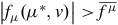



The unique equilibrium depends on the donor’s leverage and priorities.Footnote 48 A donor who prioritizes migration more readily withdraws aid when refugee flows increase.Footnote 49 In this case, fighting is both costly and, because it drives civilian flight, results in a loss of aid. An aid-dependent government then has no incentive to exert effort. However, because the donor prioritizes migration, a government under pressure to limit refugee flows may increase repression, crudely arresting migration.
When a donor prioritizes repression, the immediate threat of punishment prevents the government from repressing. The donor still penalizes migration as well (though not as intensely) and when the government is highly dependent on aid, this can lead it to also forego fighting, minimizing displacement. Finally, when the donor has low to moderate leverage, regardless of whether it prioritizes repression or migration, the equilibrium features both fighting and repression, which drives some civilians to flee as refugees. I focus on this equilibrium because it characterizes most conflict scenarios, where governments are not so concerned about foreign aid to avoid fighting but express concern when aid is suspended.
From a donor’s perspective, conflict in
 $H$
produces two types of negative consequences. First, fighting increases the flow of refugees, increasing the burden on host states. Second, repression directly harms civilians, and fighting imposes costs on those remaining in
 $H$
. Under the threat of conditional aid, the government is responsive to incentives created by donor policy. Some of these incentives, like the donor’s distaste for high levels of migration, compete with the government’s baseline interest in fighting the rebels while complementing its baseline incentives to repress. Then, because fighting and repression have countervailing effects on migration, the government employs both. Whether it substitutes fighting and repression or employs each to mitigate the externalities of the other, depends on the donor’s priorities.
Consequences of Donor Policies
Turning to the effects of donor interventions with strategic government violence, it is not immediately apparent that targeted humanitarian assistance or asylum policies in host countries would impact the government’s choices. After all, these kinds of policies are directed only at civilians. Yet because civilians’ migration choice affects rebel capacity, and therefore the government’s incentives to fight, policies designed to affect migration also impact violence.
I capture states’ imposition of barriers to seeking asylumFootnote
50
by examining the effect of increasing
 $\gamma $
on state violence.Footnote
51
Proposition 2
The effects of increasing barriers to asylum, that is, increasing
 $\gamma $
, on
 ${x^*}$
and
 ${v^*}$
are ambiguous and may be non-monotone.
When barriers to asylum deter migration, the rebels maintain more of their support base. This incentivizes the government to fight harder and, because civilians face high costs of flight, it may do so without producing large refugee flows or triggering harsh punishment from the donor. However, when civilians are already inclined to flee, increasing
 $\gamma $
can lead the government to decreases fighting effort. In this case, barriers to asylum are insufficient to deter large refugee flows, pushing the government to reduce its effort to avoid driving more displacement. This outcome is less likely if benefits abroad,
 $b$
, decrease in the volume of arrivals, just like wages in
 $H$
. As shown in Appendix E, when lower benefits abroad make migration less appealing, the migration rate may be low enough that imposing barriers to asylum leads to an increase in conflict intensity.
To establish existence of the effects of
 $\gamma $
on violence and provide intuition for the impacts of changing asylum policies, I utilize two parameterized versions of the model that represent hypothetical countries which differ only in the rebel group’s economic capacity. In one country, the rebels’ economic output is more labor intensive and in the other, the rebels’ economic output is less labor intensive, that is, they control lootable resources like oil or minerals.Footnote
52
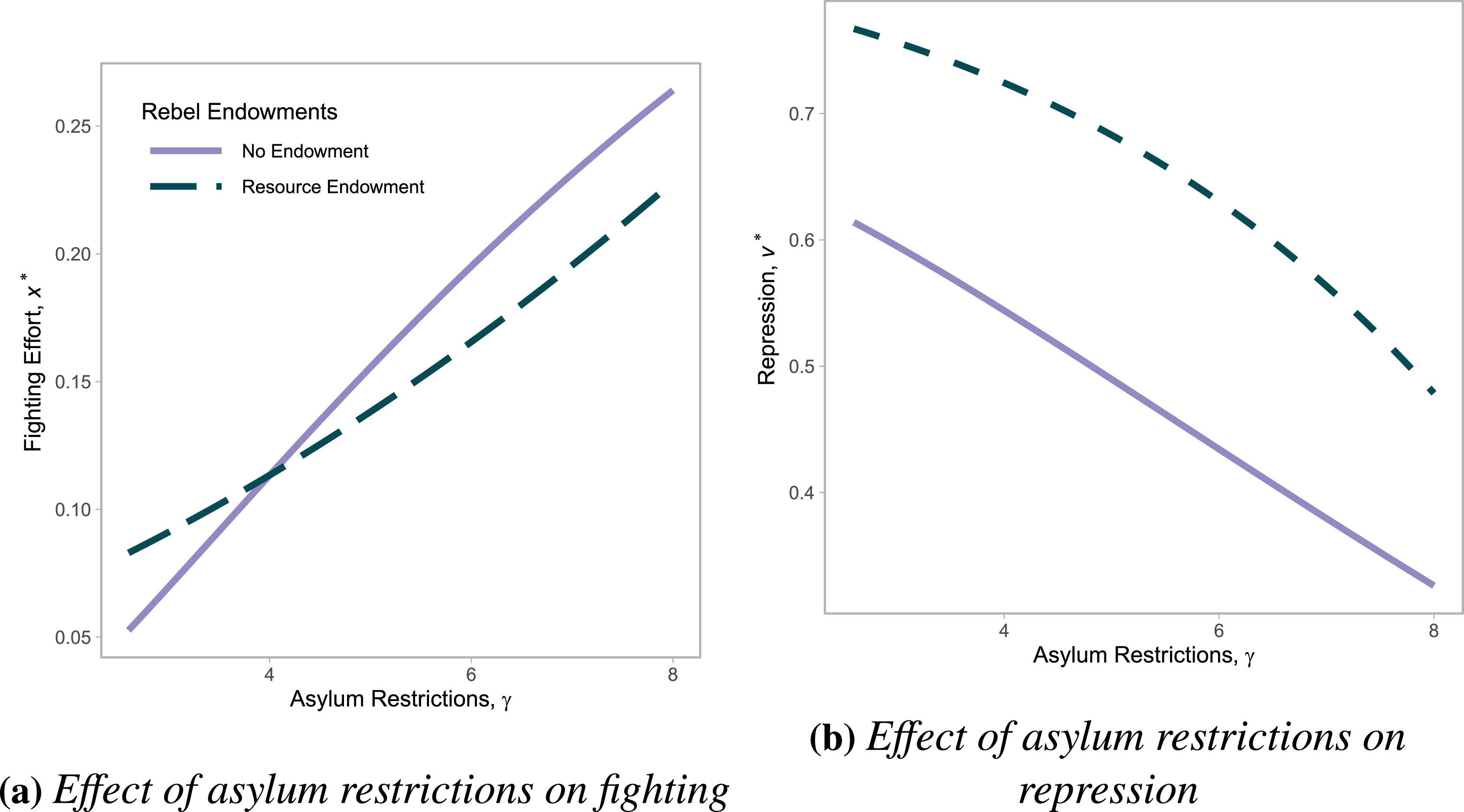
Figure 2 considers the effects of changing
 $\gamma $
across these countries.Footnote
53
The left panel, Figure 2(a), shows changes in equilibrium fighting while the right panel, Figure 2(b) plots the equilibrium level of repression.
Effects of asylum restrictions,
 $\gamma $
, on state violence
Note: I fix
 $\alpha=.95$
,
 $b=1.5$
,
 $c=.35$
,
 $\tau_r=.9$
,
 $f(\mu ,v) = 10 - {1 \over {{{(1 - \mu )}^7}}} - {{.5} \over {1 - v}}$
,
 $Y = 1.65{((1 - v)(1 - \mu ))^{{1 \over 3}}} $
when rebels have resource endowments, and
 $Y = 1.65{((1 - v)(1 - \mu ))^{{2 \over 3}}}$
without resource endowments.

Figure 2 Long description
The image contains two line graphs showing the effect of increasing asylum restrictions, gamma, on equilibrium fighting effort, x star, and repression, r star, for two different kinds of rebel groups. One rebel group has access to natural resources and the other has no resource endowment. The first graph on the left shows the effect of asylum restrictions on equilibrium fighting effort. The x-axis represents asylum restrictions, gamma. The y-axis represents fighting effort, x star. Two lines are plotted: a solid purple line representing fighting effort for a rebel group without resource endowments and a dashed green line representing fighting effort for a group with resource endowments. For both types of rebel group, increasing asylum restrictions increases equilibrium fighting. The second graph on the right shows the effect of asylum restrictions on repression, where the y-axis is now r star. A solid purple line plots equilibrium repression when rebels lack resource endowments, and a green dashed line shows repression for a group with resource endowments. The curve for rebels that lack resources is always below the curve for rebels with resource endowments.
Figure 2 shows the effects of increasing asylum restrictions depend on conditions in
 $H$
. When the rebels lack lootable resources, they are reliant on their civilian support base, whose wages are generally higher than when the rebels have resource endowments. Then, because civilians are sensitive to new barriers to asylum, the government can fight harder without triggering a significant increase in migration. When the rebels have meaningful resource endowments, they are less dependent on civilian support and civilians’ wages are lower regardless of government violence. They are thus more likely to flee even in the face of increasing barriers to asylum. Then, to curb the flow of refugees and sustain aid from the donor, the government chooses a substantially higher level of repression and a lower level of fighting effort. The effects of increasing
 $\gamma $
are in the same direction but of different magnitudes due to the differences in civilians’ underlying propensity to flee abroad.
Humanitarian relief can directly improve circumstances for civilians and has the perhaps desirable second-order effect of reducing refugee outflows, relieving pressure on refugee-hosting states. An increase in relief aid, however, may also embolden the government.Footnote 54 Knowing relief efforts will mitigate the cost of fighting for civilians, Proposition 3 shows that humanitarian relief can sometimes increase conflict intensity.
Proposition 3
The effects of reducing the cost of conflict, that is, decreasing
 $c$
, on
 ${x^*}$
and
 ${v^*}$
are ambiguous and may be non-monotone.
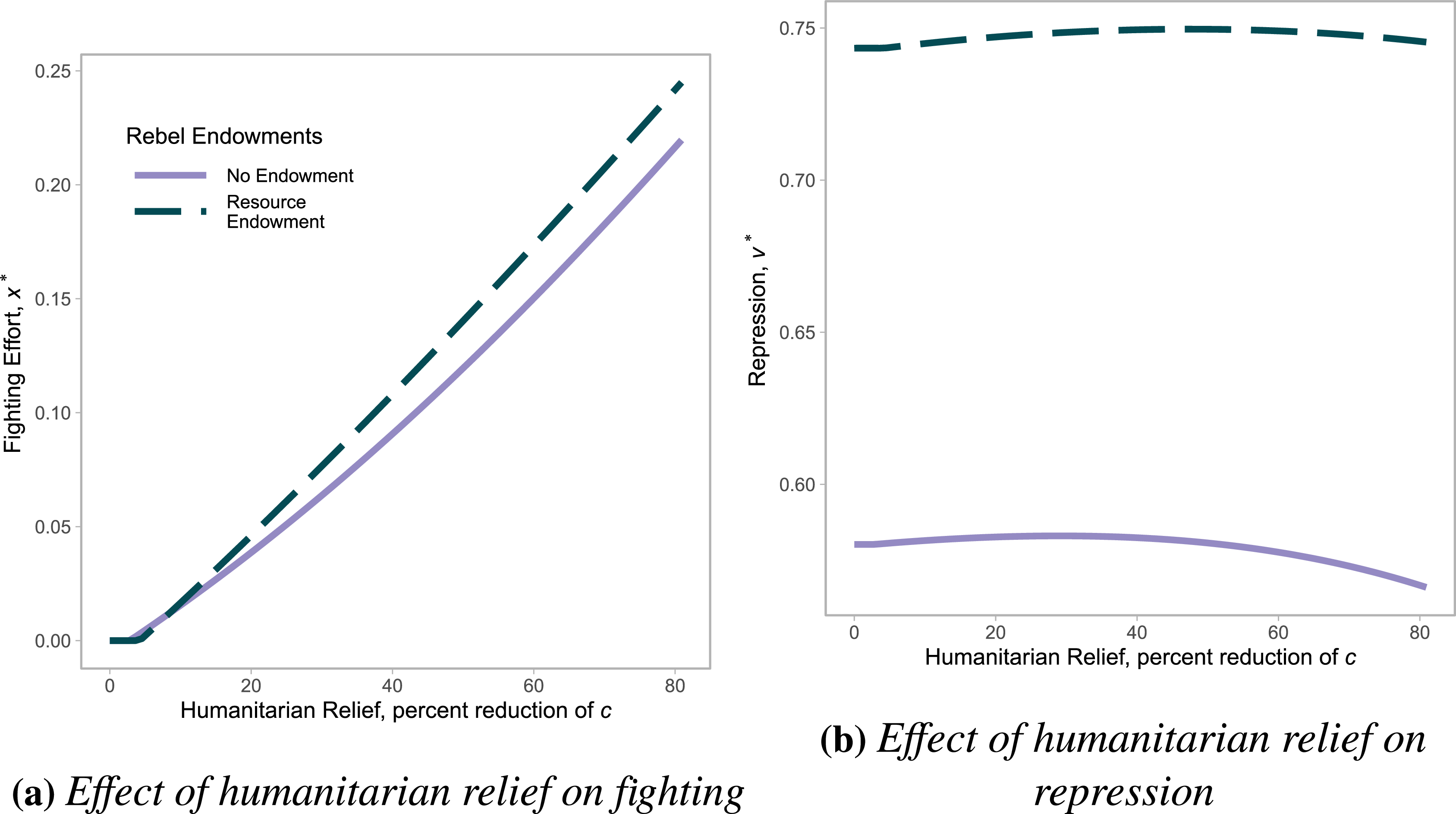
Figure 3 illustrates this. Figure 3(a) shows optimal fighting increases as humanitarian relief reduces costs for civilians of remaining in
 $H$
. Consistent with findings that aid can prolong or intensify conflicts,Footnote
55
the government fights with less restraint because aid can insulate it from some repercussions of conflict.
Effects of humanitarian relief,
 $c$
, on state violence
Note: Parameters are fixed at the same values from Figure 2, with
 $\gamma=3.25$
.

Figure 3 Long description
The image contains two line graphs showing the effect of increasing humanitarian relief, or reducing c, on equilibrium fighting effort, x star, and repression, r star, for two different kinds of rebel groups. One rebel group (plotted with a solid green dashed line) has access to natural resources and the other has no resource endowment (plotted with a solid purple line). The first graph on the left shows the effect of increasing humanitarian relief on equilibrium fighting effort. The x-axis represents a percentage reduction in c and the y-axis represents fighting effort, x star. Both lines show an upward trend, indicating that fighting effort increases with more humanitarian relief, with the resource endowment scenario showing a steeper increase. The second graph on the right shows the effect of increasing humanitarian relief on repression, where the y-axis is now r star. Both curves are non-monotone. They are increasing for low levels of humanitarian relief and decreasing for high levels of humanitarian relief. The solid purple curve for rebels that lack resources is always below the green dashed curve for rebels with resource endowments.
The effect of humanitarian relief on repression is more ambiguous, which is also consistent with extant literature.Footnote 56 Figure 3(b) shows the effect of aid on repression depends on both underlying conditions, in this case the rebel’s resource endowment, and can be non-monotone. When substantial humanitarian relief reduces civilians’ costs from conflict, the government substitutes fighting for repression, limiting violence against civilians to avoid sanction by the donor. On the other hand, the government increases repression at moderate levels of humanitarian relief. In this case, the government initially substitutes repression for fighting effort. When the rebels are resource endowed, civilians’ baseline propensity to flee is higher and without substantial humanitarian relief, intense fighting would lead to large refugee outflows. By increasing repression, and choosing a higher level of repression than when rebels lack resources, the government undermines the rebels’ capacity without increasing migration. As greater levels of humanitarian relief counteract civilians’ incentives to flee, the government shifts to fighting more and repressing less, effectively countering the rebels with less severe penalty from the donor.
Conditioning Aid
Donors have another tool to directly affect the government, rather than civilians, as they try to stop both migration and violence: conditioning assistance. Importantly, not all governments rely on foreign aid, which means some should be more responsive to conditions on aid than others. To capture how donor leverage affects violence, I evaluate the effect of the parameter,
 $\alpha $
. I contrast donors who are more sensitive to the level of repression and donors who prioritize reducing refugee flows.
Proposition 4
As
 $\alpha $
increases,
-
(a) if the donor prioritizes migration, fighting,
${x^*}$
, decreases and repression,
${v^*}$
, increases if
$x$
and
$v$
are substitutes. If
$x$
and
$v$
are complements
${x^{\rm{*}}}$
decreases if and only if
${{{g_{vv}}\left( {{x^{\rm{*}}},{v^{\rm{*}}}} \right)} \over {\left| {{g_{xv}}\left( {{x^{\rm{*}}},{v^{\rm{*}}}} \right)} \right|}}\left|\ {{f_\mu }\left( {{\mu ^{\rm{*}}},{v^{\rm{*}}}} \right)\mu _x^{\rm{*}}} \right| \gt {f_\mu }\left( {{\mu ^{\rm{*}}},{v^{\rm{*}}}} \right)\mu _v^{\rm{*}} + {f_v}\left( {{\mu ^{\rm{*}}},{v^{\rm{*}}}} \right)$
while
${v^{\rm{*}}}$
increases if and only if
${{{g_{xx}}\left( {{x^{\rm{*}}},{v^{\rm{*}}}} \right)} \over {\left| {{g_{xv}}\left( {{x^{\rm{*}}},{v^{\rm{*}}}} \right)} \right|}}\left( {{f_\mu }\left( {{\mu ^{\rm{*}}},{v^{\rm{*}}}} \right)\mu _v^{\rm{*}} + {f_v}\left( {{\mu ^{\rm{*}}},{v^{\rm{*}}}} \right)} \right) \gt \left|\ {{f_\mu }\left( {{\mu ^{\rm{*}}},{v^{\rm{*}}}} \right)\mu _x^{\rm{*}}} \right|$
. -
(b) if the donor prioritizes repression, both
${x^{\rm{*}}}$
and
${v^{\rm{*}}}$
decrease when
$x$
and
$v$
are complements. When
$x$
and
$v$
are substitutes,
${x^{\rm{*}}}$
decreases if and only if
${{{g_{vv}}\left( {{x^{\rm{*}}},{v^{\rm{*}}}} \right)} \over {\left| {{g_{xv}}\left( {{x^{\rm{*}}},{v^{\rm{*}}}} \right)} \right|}}\left|\ {{f_\mu }\left( {{\mu ^{\rm{*}}},{v^{\rm{*}}}} \right)\mu _x^{\rm{*}}} \right| \gt \left|\ {{f_\mu }\left( {{\mu ^{\rm{*}}},{v^{\rm{*}}}} \right)\mu _v^{\rm{*}} + {f_v}\left( {{\mu ^{\rm{*}}},{v^{\rm{*}}}} \right)} \right|$
while
${v^{\rm{*}}}$
decreases if and only if
${{{g_{xx}}\left( {{x^{\rm{*}}},{v^{\rm{*}}}} \right)} \over {{g_{xv}}\left( {{x^{\rm{*}}},{v^{\rm{*}}}} \right)}}\left|\ {{f_\mu }\left( {{\mu ^{\rm{*}}},{v^{\rm{*}}}} \right)\mu _v^{\rm{*}} + {f_v}\left( {{\mu ^{\rm{*}}},{v^{\rm{*}}}} \right)} \right| \gt \left|\ {{f_\mu }\left( {{\mu ^{\rm{*}}},{v^{\rm{*}}}} \right)\mu _x^{\rm{*}}} \right|$
.








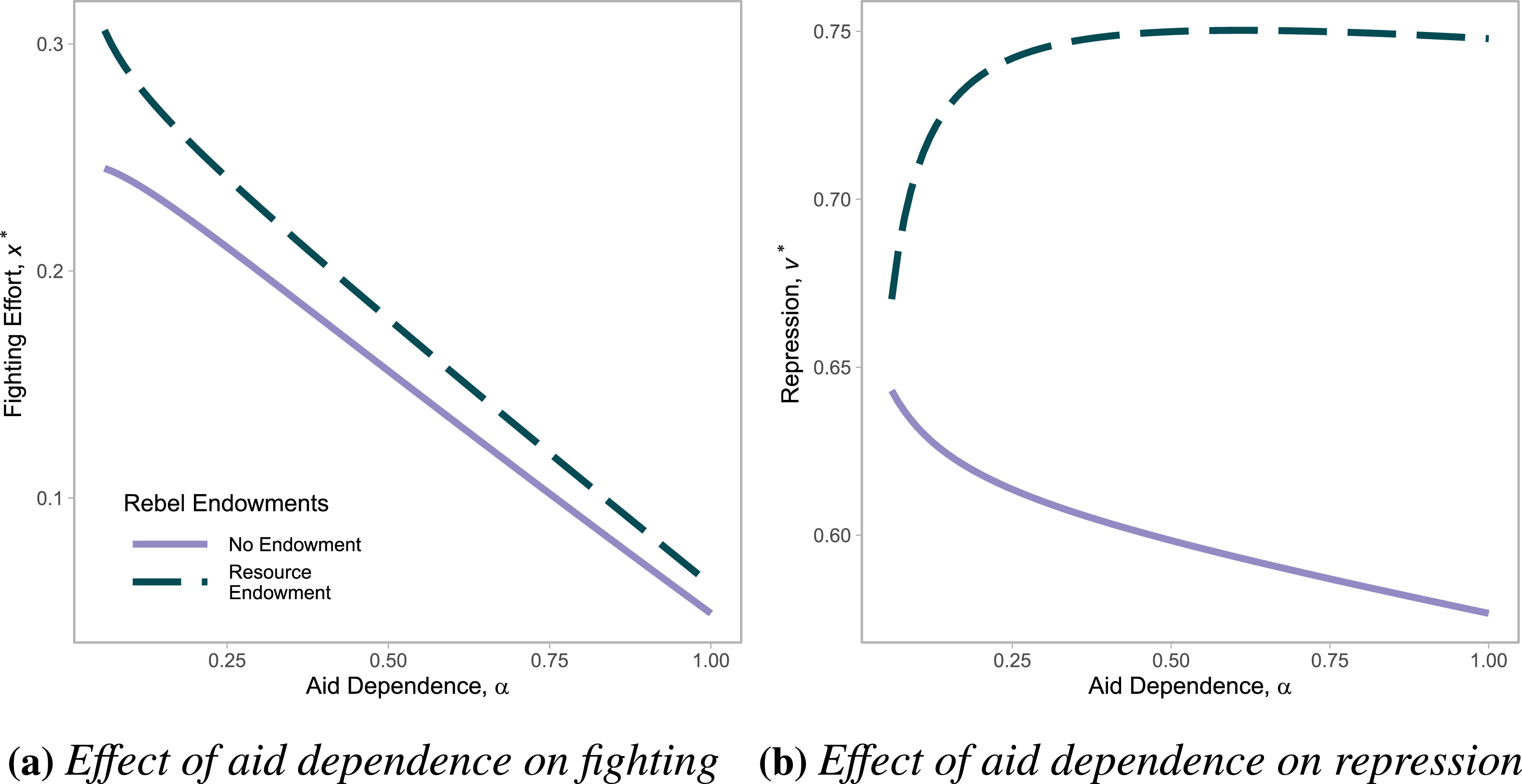
Proposition 4 highlights how governments’ responses to aid conditionality depend on donor priorities and features of the conflict environment, which affect the government’s optimal strategy for countering the rebels. Figure 4 illustrates all four cases. Given a donor who prioritizes migration, as the government becomes more responsive to aid withdrawal, it will generally increase repression. This is shown in Figure 4(b) when rebels have resource endowments. Repression is a crude means of preventing migration while targeting the rebels’ base of support. As
 $\alpha $
increases, the consequences of driving migration by choosing a high level of fighting effort are more severe. When repression and fighting are substitutes, the government employs a higher level of repression to avoid increasing migration and incurring donor sanction; this holds in Figure 4 for low
 $\alpha $
. If instead repression and fighting are complements, the government, loath to cede control of territory to the rebels, does not want to totally forego
 $x$
. When the government expects substantial aid losses due to migration, that is, when the magnitude of
 ${f_\mu }\left( {{\mu ^{\rm{*}}},{v^{\rm{*}}}} \right)$
is large, then in order to keep fighting the government increases repression. This holds in Figure 4(b) for intermediate
 $\alpha $
. Only when donor leverage is great enough that the consequences of repression also bite does the government reduce
 ${v^{\rm{*}}}$
, illustrated for the largest values of
 $\alpha $
.
Effects of donor leverage,
 $\alpha $
, on state violence
Notes: Parameters are fixed at the same values from Figures 2 and 3.

Figure 4 Long description
Two line graphs illustrate the effects of aid dependence on fighting effort and repression. The first graph on the left shows fighting effort, x star, on the y-axis and aid dependence, alpha on the x-axis. Two lines are present: a solid purple line representing a rebel group without resource endowments and a dashed green line representing a rebel group with resource endowments. Both lines show a downward trend, indicating that as aid dependence increases, fighting effort decreases. The line for rebels that lack resources is always below the line for rebels with resource endowments. The second graph on the right shows repression, r star, on the y-axis and aid dependence, alpha, on the x-axis. Again, two lines are present: a solid purple line representing rebels without resource endowments and a dashed green line representing rebels with resource endowments. The dashed green line shows an upward trend, indicating that as aid dependence increases sharply for low alpha, then increases slowly for moderate alpha, and decreases for higher alpha. The solid purple line shows a downward trend, indicating that as aid dependence increases, repression decreases. All values are derived from numerical solutions to parameterized versions of the model.
When a donor prioritizes repression, if
 $x$
and
 $v$
are substitutes, ex ante, the government prefers to employ whichever tactic is more effective against the rebels rather than accommodate the donor. As
 $\alpha $
increases, because the donor still prefers lower levels of migration, donor pressure may lead the government to reduce fighting effort, yielding lower refugee flows. But this can come at a cost. To maximize assistance while still undermining the rebels, the government may instead increase repression. On the other hand, Figure 4 illustrates how the government may reduce both fighting and repression. This is shown in Figure 4 when
 $\alpha $
is low and rebels lack resources, and occurs when the migration rate is low and violence has limited effect on civilians’ decision to flee. Then, expecting substantial loss of aid and with little ability to undermine rebel support, the government reduces violence.
Proposition 4 also highlights an optimistic case in which donors can achieve their aims. Governments that employ high levels of fighting and repression together are particularly troubling for donors. But when these governments are aid-dependent, if the donor commits to withdrawing aid in response to repression, it can induce reductions in both fighting and violence against civilians. Figure 4 illustrates this when rebels lack resources and
 $\alpha $
is high. This requires, however, that the donor strictly prioritize reducing repression over minimizing refugee flows and must condition its aid accordingly. This highlights the primary tension a strategic government exploits: the donor may care more about its own domestic concerns and prioritize minimizing refugee arrivals. A donor who prioritizes migration creates a tacit permission structure for the government to maximize its damage to the rebels by choosing high levels of both fighting and repression. Only when the donor is prepared to make significant investments in protecting civilians in
 $H$
can it reduce effort spent providing for those civilians abroad, after they have fled conflict.
Problems of Leverage and Competing Priorities
The 2020 to 2022 war in Ethiopia illustrates the limits of donor intervention outlined in Proposition 4. Over the course of the conflict, the government launched major offensives to take territory from the Tigray People’s Liberation Front, and fighting is estimated to have killed hundreds of thousands and displaced millions.Footnote 57 Within months of the war’s outbreak, the EU suspended EUR 90 million in aid to Ethiopia, citing concerns about the humanitarian situation.Footnote 58 This did not seem to stymie government efforts to control Tigray or curb violence against civilians.
Why did conditioning aid on reducing repression fail to constrain the Ethiopian government? Previous scholarship suggests this should have affected the government’s decision making, given the EU and Ethiopia’s long-standing partnership and that suspended aid was specifically budget support.Footnote
59
Indeed, the EU hoped its prior EUR 815 million investments in development cooperationFootnote
60
and threat to withhold future budget supportFootnote
61
would increase its leverage and compel the government to deescalate. Proposition 4 points to two potential explanations for underwhelming results. First, it is likely the EU had less leverage than it hoped because it was not the only source of foreign support. Ethiopia had also consistently received assistance or investment from countries like China and the United Arab Emirates.Footnote
62
Limited donor leverage can cause failures of aid conditionality. The Ethiopian government, prior to the aid suspension, had been increasing efforts to retake Tigray and violence against civilians, suggesting a complementary relationship between these tactics. Despite the EU conditioning its aid on repression, Proposition 4 shows both fighting and repression can increase when
 $\alpha $
decreases, like when the target government has access to alternative donors.
Low donor leverage does not necessarily result, however, in more fighting and repression. This makes the EU’s failure in Ethiopia more puzzling. While the EU hoped to push the government to cease fighting altogether, some of the primary conditions for the reinstatement of aid were tied to reducing violence against civilians.Footnote
63
As Proposition 4 highlights, if aid suspensions in response to repression are substantial, in particular relative to any foreign assistance tied to migration, increasing
 $\alpha $
may increase
 ${x^{\rm{*}}}$
, but reduce
 ${v^{\rm{*}}}$
. However, if donors do not strictly prioritize punishing repression over deterring migration, Proposition 4 shows this can create a tacit permission structure for the government to also increase repression in its efforts to defeat the rebel group.
Not every EU member was enthusiastic about using the bloc’s financial resources to condemn human rights abuses. Some southern European states preferred a more pragmatic approach, in part because of concerns over migration.Footnote 64 Moreover, Germany continued some of its bilateral development cooperation with Ethiopia despite the EU aid suspension.Footnote 65 If the Ethiopian government perceived European donors as prioritizing migration, or at least did not see a strict ranking of these priorities, the model expects an increase in violence against civilians. Ethiopia’s Ambassador to the European Parliament, in response to the aid suspension, reminded MEPs that Ethiopia is “the beacon of stability in the Horn of Africa … and the host to close to 1 million refugees. Hence, we urge our partners to look [at] things in the right context and perspective.”Footnote 66 This explicit invocation of refugees suggests Ethiopia may have recognized the tension between EU members around aid suspension and migration support, and increased hostilities in Tigray expecting limited repercussions.
Conclusion
Donors who seek to mitigate the consequences of civil conflict intervene upon a complex strategic interaction between civilians and the combatants whose fighting pushes them to flee as refugees. The interdependence of government violence and refugee flight means that policies intended to affect migration have indirect effects on how governments fight, just as policies intended to curb violence indirectly effect migration. As donors try to craft policies that balance their interests in curbing repression with concerns over migration, they can create tacit permission structures that allow governments to intensify conflicts and increase violence against civilians. I find that in isolation, many common policies intended to reduce harm to civilians and the flow of refugees have their intended effects. However, accounting for how such policies affect violence, I find governments subvert donor efforts to achieve their own conflict objectives. Policies like providing humanitarian assistance or deterring migration by increasing barriers to asylum can backfire, resulting in greater repression or more intense fighting, driving more displacement. Donors may then fail to reduce either the humanitarian costs of conflict or conflict-induced migration.
Further, in identifying two mechanisms by which suspending aid failed to restrain violence in Ethiopia, I highlight a gap between the academic literature and policymakers’ understanding of the effects of their policies. The literature on aid conditionality typically focuses on violence as an independent variable,Footnote 67 and studies the impacts of donor leverage and inconsistency in the context of fiscalFootnote 68 or democratic reforms.Footnote 69 I build on this work on conditionality failure, identifying how these mechanisms affect a new outcome—governments’ use of force in civil conflict. Previous work linking conflict, migration, and aid has studied whether donors give aid in response to refugee flows.Footnote 70 Policymakers, on the other hand, often see migration concerns as a determinant of the decision to suspend aid. In response to disagreements about whether to reinstate aid to Ethiopia, an Irish MEP asked “Do [people] have to be run out of the place as refugees … before we actually react to it?”Footnote 71 As policymakers increasingly link their responses to civil conflict with their concerns about migration, my model offers expectations of how policies will affect the intensity of conflict and its impact on refugee flight. I also highlight two factors—lack of donor leverage and inconsistent prioritization—that suggest where policymakers’ efforts are most likely to fail, and the negative consequences for civilians that can follow.
My results suggest that future empirical research should account for how donor leverage moderates the effect of foreign aid on violence, or how donor priorities mediate the impact of aid sanctions. Further, I show that aid and policies affecting migration incentives have different effects on fighting and repression. Changing civilians’ migration incentives can increase the intensity of fighting (unless ex ante displacement is high) and decrease repression, while increasing the leverage of a donor concerned with migration can have the opposite effect. Future work that disaggregates violence, separating repression from attacks that target rebels can offer a more nuanced understanding of foreign actors’ impact on civil conflict.Footnote 72
More promisingly, the model suggests one avenue for policymakers to reduce both costly conflict and violence against civilians. For governments that rely on foreign assistance, aid conditionality may effectively constrain violence. But this alone is not sufficient. Donors must punish violence against civilians more readily. This raises a practical concern that may limit the viability of this kind of policy. Citizens are often wary of giving aid to perpetrators of repression, though evidence is mixed that merely withdrawing aid will assuage their concerns.Footnote 73 Further, donors may feel pressure to prioritize reducing the flow of refugees. This may explain why, beginning in 2014, the EU gave aid to Sudan through the EU Horn of Africa Migration Route Initiative despite ongoing rights violations by the Bashir regime.Footnote 74 Developing effective strategies for using aid to reduce the harms of civil conflict requires creative strategies from policymakers to account for governments’ strategic response. This leaves an open question of whether concerned states can craft such policies in the face of public pressure to prioritize domestic concerns rather than providing humanitarian assistance abroad.
Supplementary Material
Supplementary material for this research note is available at <https://doi.org/10.1017/S0020818326101416>.
Acknowledgments
I thank Kara Camarena, Madeline Fleishman, Danielle Jung, Jack Paine, John Patty, Maggie Penn, Burcu Savun, and Scott Tyson, as well as participants at the 2024 Peace Science Society (International) Rising Scholars Workshop for helpful comments and suggestions. AI tools (refine.ink) were used to copyedit this manuscript and the supplementary appendix. Any errors remain my own.


 γ=3.25
 b=1.5
 Y=1.65L23
 c=.35
 γ
 α=.95
 b=1.5
 c=.35
 τr=.9
 f(μ,v)=10−1(1−μ)7−.51−v
 Y=1.65((1−v)(1−μ))13
 Y=1.65((1−v)(1−μ))23
 c
 γ=3.25
 α


 Open access

