


Introduction
The post-war period saw an increase in numbers of women in the workforce. However, whilst the post-war years have been seen as revolutionary in women's roles, women's work was often framed in limited terms – as ‘the wife's little job’. The historiography on women's work is vast and developed, but one key dimension has been omitted from this discussion, and it is a dimension that framed and influenced the understanding of women's labour and roles every single day – the attitudes of husbands and partners. Without understanding how men valued women's work, or failed to see it as important, we cannot fully interrogate how and why gender roles were and were not changing in this period. Re-engaging with decades old debates about the family as a potential source of oppression for women, and society's continued undervaluing of women's paid and unpaid labour,Footnote 1 this article makes a new contribution to feminist and historical scholarship through a reconsideration of the nuclear family as both a network of emotional and practical support, and an inhibitor of gender equality. It considers the multiple nature of women's work, including ‘kinship work’ and emotional labour of family life.Footnote 2 The article examines men and women as individual actors, thereby engaging with Hartmann's argument against seeing the family as a unit.Footnote 3 However, by focusing on how emotional relationships and different perceptions of the value of women's paid and unpaid labour interacted, alongside how authority and expertise were understood by men and women, it moves beyond thinking about the family as a locus of struggle towards understanding deep historical continuities in gendered inequalities. As such, I draw on a growing scholarship on the history of emotions, and use this perspective to examine older historical debates about women's paid and unpaid labour, and its place within the family, society, economy and politics. In doing so, and bringing to the fore men's attitudes, the article argues that strong conservative and patriarchal forces were at work to reinforce a hierarchy of work between men and women, positioning women's paid labour as of lesser value than men's, and women's unpaid work as more important than their paid work but still less meaningful that men's. Whilst many men truly appreciated their wives’ and partners’ skills and contribution, this hierarchy of value persisted.
The lens of value is useful here, to unpick the notably different ways in which men and women framed women's work, within a hierarchical framework. By re-examining older debates about family, women and work from the perspective of men as fathers and husbands, whilst using a multi-faceted understanding of marital relationships as defined by power and conflict but also negotiated responsibility, expertise, emotion and respect, we can better understand why critiques and challenges to the family and gendered roles with regards to work have had a limited impact. Whilst women and men's work are understood within family life as holding particular social, cultural and economic value within a gender hierarchy, the extent of change in women's lives was limited and the idea of a breadwinner model of family life continued, and continues today.
The post-Second World War period in Great Britain was a crucial one in understandings of the value of women's work, a time when there was a huge increase in the numbers of married women working.Footnote 4 Large numbers of women had worked during the war; the government had for the first time formally conscripted women into work from 1941, and this experience had a major impact on women's lives.Footnote 5 Yet as Braybon and Summerfield outline, there was resistance to such a development at all levels, from employers to husbands, in part because of fears about the impact it would have on marital life.Footnote 6 Indeed, women often deferred to husbands’ wishes in regard to their war work. Furthermore, as Higonnet and Higonnet's ‘double helix’ model of gender relations captures, though women's paid wartime work did challenge accepted gender hierarchies, this must be understood in the context of the simultaneous elevation of men's status through military service.Footnote 7 The impact of war work on women's lives and their wishes for post-war life have been much debated by historians.Footnote 8 Understandings of women's unpaid labour in the home were also changing: motherhood became a privileged category after the war as a means to re-establish gendered hierarchies, in which women's primary role was at home;Footnote 9 yet working-class women's skills of household management and budgeting were also being undermined by growing incomes and the availability of cheap consumer goods.Footnote 10 As Langhamer notes, the changing meanings of women's paid and unpaid work following the war ‘led some women to feel cheated of the value that had been placed on their work’ previously.Footnote 11
In 1945 family allowances were finally introduced in the United Kingdom, after years of campaigning for the ‘endowment of motherhood’ by feminists, notably Eleanor Rathbone. This followed their introduction in France, Germany, Italy and Spain in the 1930s, often part of states’ efforts to encourage women to have more children.Footnote 12 The British campaign had centred on the idea of separate payments to mothers and children, and it was this challenge to the male breadwinner model that had been so unpalatable to policymakers previously. Despite challenges to it, the idea of the male provider remained central to both understandings of the family and adult masculinity throughout the century.Footnote 13 Yet, by the 1940s numerous politicians and newspapers supported not only the introduction of family allowances, but also their payment to women, which they argued would recognise women's unpaid labour, particularly in child-rearing. Churchill himself was not so sure, retorting in a Cabinet meeting ‘wages will be paid to the mother next!’Footnote 14 Yet newspapers like The Times suggested that the nation's housewives ‘are in need of some clear recognition by the community of their services and of encouragement in their work of home-making and family-rearing’.Footnote 15 The value of women's paid and unpaid labour was up for renegotiation in this period.
As Judith Butler argued over twenty-five years ago, ‘woman’ is not an unproblematic or singular category.Footnote 16 This article examines largely white, mostly heterosexual couples, from various income backgrounds and political persuasions, and the way they understood women's labour between the 1940s and 1980s. It uses this opportunity to think through how men and women understood their lives, as conforming to, or in a few cases in opposition to, a hegemonic gender order which placed great emphasis on a nuclear, breadwinner family model. In doing so, it cannot represent or analyse differences along racial or ethnic lines, or consider the experiences of those outside a heteronormative ideal. Yet the article is mindful of how such ideals affect individuals’ lives in uneven ways, through various axes of power and privilege, in intersectional ways. Such research is needed for much wider range of women, and beyond the United Kingdom.
This article, then, turns our attention to this familiar debate in three new ways: firstly, by exploring men's framing of women's work; secondly, by focusing on what this looked like within the very everyday fabric of family life rather than at a societal or political level; and thirdly, by using the lens of value to understand the nuance of how women's roles were being negotiated in this period. In doing so, it argues that the seemingly substantial changes occurring in women's uptake of work and the cultural valuing of women as workers as well as housewives and mothers were much more gradual at the family and individual level.Footnote 17 Change was occurring, and couples worked hard to make their lives different from previous generations, and more equal and shared. Yet, the undervaluing of women's labour in relation to men's slowed the pace of change within everyday life, and the gendered hierarchies of value in understanding gendered labour roles put a ceiling on how rapid and substantial that change could be.
Methodology
This article uses 126 archived interviews and twenty original oral history interviews conducted by the author. The archived interviews were conducted in the mid-1980s for the ‘100 Families’ study, led by Paul Thompson and Harold Newby.Footnote 18 The original interviews were part of a study about men and family life, involving interviews with fifty men in 2013–4. These were very different periods and this affected the way interviewees responded; it is highlighted below where this was particularly relevant. These interviews were semi-structured, inspired by Summerfield's model, and were typically one to two hours long.Footnote 19 To enable informed consent the aims of the research were explained to potential respondents before the interview, and interviewees were able to specify restrictions they wished to make on their contributions. A unique identifying pseudonym is used for each interviewee. The sample was self-selecting: all men volunteered to be interviewed. Together, these collections involve 159 people: eighty-five men (twenty original/sixty-five archived interviews) and seventy-five women four original/seventy-one archived interviews), in which seventy-two men and sixty-two women were interviewed alone, and thirteen couples were interviewed together. The vast majority had been married or had a long-term partner and had children, though not all, and the focus of both studies was largely on heterosexual participants. Collectively, the studies involve participants from a wide range of occupations, from unskilled manual to professional work, and from regions across England and Wales, with a small number from Scotland, though this part of Britain is under-represented here. There were a minority of Black and Minority Ethnicity (BME) participants, a group much under-represented despite the growing levels of migration throughout this period.Footnote 20 The interviewees were born between 1899 and 1954:
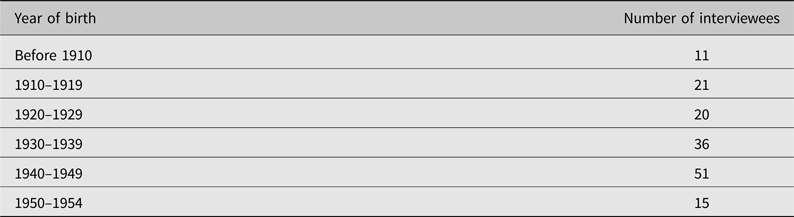
Due to the later date of my own study, those interviews involved participants born between 1924 and 1952. Both sets of interviews were framed around family life, affecting the way that interviewees responded; a study about work explicitly might have given different results.
Throughout this article, I consider men's attitudes to the value of women's work across two to three generations (in some cases within the same family), different occupational groups and social backgrounds, exploring the difference between those interviewed in the mid-1980s (the end of the period considered here) and more retrospectively, from the mid-2010s. This article asks how men, principally husbands, perceived and valued women's work and with what consequences, and so the focus is on women and men in relationships. Interviews are as such a valuable methodological tool, as, in the words of Portelli, ‘oral sources tell us not just what people did, but what they wanted to do, what they believed they were doing, and what they now think they did’.Footnote 21 These interviews are important in not only their discussion of women's work and its value, but also in how this is placed and negotiated within changing patterns of female employment and cultural understandings of women's roles over the period of study (mid-1940s to mid-1980s) and between the two periods of interviewing (mid-1980s and mid-2010s). As Gallwey notes, applying a historical methodology in secondary analysis of qualitative research data provides a ‘means of establishing trends over time’.Footnote 22 The nature of the interview, in which participants mix discussion of past and present, and their own as well as previous and subsequent generations’ behaviour, means the use of two collections of interviews conducted at different times is particularly valuable. Overall, this article argues that though the acceptability and commonality of women's work changed from the Second World War to the 1980s, the way male partners valued that work did not shift substantially. Even in highly companionate, loving relationships, in which husbands held their wives in high regard, men continued to place their own paid work and their wives’ unpaid labour as superior to women's paid employment.
Practices and Languages of Women's Work
Most women in this study worked outside the home at some point; almost all female interviewees or female partners of male interviewees were in paid work before having children, and often returned after a break, an increasingly common pattern of bimodal paid work. This matched a national picture in which the number of married women working increased from 10 per cent in 1931 to 51.3 per cent in 1971, and the number of part-time workers quadrupled in the 1950s/1960s.Footnote 23 Whether women worked outside the home remained dependent on class, location and ethnicity.Footnote 24 What changed in this period was the increasing tendency to give up paid work during pregnancy rather than immediately on marrying. This reflected changing regulations on married women's employment, with new part-time options for work in non-conventional hours, such as ‘twilight’ factory shifts, and the changing acceptability of formal employment after marriage.Footnote 25 Historically, many men valued their wives not working, and sometimes daughters too.Footnote 26 Whilst previously keeping a wife at home was an important signifier of adult masculinity, for most men (and women) in this sample, children's needs rather than those of husbands were the principal reason why men valued women not working outside the home from pregnancy until their children were attending school or older. The most usual pattern of work for women in this sample was a full-time paid job before having children, a break of approximately three to five years (sometimes longer) and a return to paid employment, often in a more casual, poorly paid and unstable sector than previously. As Dex and Bukodi's longitudinal analysis demonstrates, the part-time work that grew increasingly common from the 1950s ‘quickly became synonymous with low paid jobs, increasingly in the service sector, occupied primarily by women with children’. Part-time work usually meant downward occupational mobility.Footnote 27
Whilst many women and men described this shift in employment, there was little explicit recognition of or complaint about the changed status of women's work post-motherhood. Kathleen Murray, born in 1948, was unusually outspoken about her own changed status as a worker as well as that of other women, likely because she had been involved in women's groups through her trade union, the National Union of Public Employees. She described her changing understanding of her mother's work: ‘before, I thought me mum was an office cleaner out of ignorance and not being able, or capable, of doing any other sort of work, but now I'm a mum myself I know it's because you're restricted.’ She reflected, ‘women get stuck in lower grade jobs because their skills are not recognised by men’.Footnote 28 Returning to formal work became more possible for such women, compared to their grandmothers and even mothers, as family size decreased.Footnote 29 In the ‘100 Families’ study, interviewers asked whether women gave up paid work on marrying. Interviewees often corrected this assumption. Jean Bates, born in 1940, was a factory worker before marrying in 1958. When asked whether she ceased paid employment on marriage, she replied, ‘I was expecting [my first child]’.Footnote 30 This decision was as much about social norms as employers’ expectations by the post-war period; Margaret Beckwith, born in 1942, described why she left her office job:
Subject: 'cos I was pregnant. I was married then.
Interviewer: You had to leave when you were pregnant?
Subject: Oh no, you didn't have to. But I – me mother said women didn't work. You looked after your family.Footnote 31
Women's work constituted both paid employment and domestic labour, including housework, childcare and caring for other relatives, and the emotional labour of family life. Indeed, women could throughout this period see their marriage and motherhood as a ‘career’.Footnote 32 As McCarthy notes, ‘progressive’ narratives around the value of women's roles in the home offered a self-consciously modern sense of partnership between husband and wife in both labour and the emotional relationship itself.Footnote 33 But, significantly when considering how women's work has been valued, ‘work’ was often equated to paid employment, reflecting a male-centric model of understanding labour and its worth. In the ‘100 families’ study, interviewers sometimes carefully resisted this, yet participants tended to revert to a definition of ‘work’ as paid employment. An interviewer and Elizabeth Arnold, born in 1935, agreed that domestic labour was real work, but in Elizabeth's own words ‘not as far as the men are concerned’.Footnote 34 Many interviewees discounted female labour in this way. George Hindley, a factory worker born in 1940, noted of his grandmother: ‘all she ever was a housewife. She never worked.’ Within the context of his grandmother's life in the early twentieth century, his own relationship with her in the 1940s and 1950s and in the contemporary period of the interview in the mid-1980s, for George housewifery was not ‘work’ as it was not paid.Footnote 35 Michael Cudmore, an engineer born in 1949, was asked about his aunt's occupation:
Subject: Occupation – I don't think she – she never worked as far as I. …
Interviewer: Housewife?
Subject: Housewife – yeah.Footnote 36
The valuing of women's unpaid labour as equivalent to paid employment was more common amongst those interviewed in 2013–4. Ben, born in 1943, said that his mother ‘never had a proper job’ but qualified this, adding ‘my mother's job was basically to look after the family’.Footnote 37 Henry, born in 1942, went further, categorising his wife as ‘a worker’ through her domestic labour in the 1960s and 1970s, using terminology often more associated with male work, describing how ‘she's been the, the, the provider – she's been the worker, providing this, she's been the person at home doing the work – the homemaker’.Footnote 38 Women's work in the home was often recognised as difficult, and this was particularly so in the later interviews; yet the slippage in language between categorising female domestic labour alongside paid employment, a job or occupation, or something different, in the same sentence, illustrates its liminal status and lack of concrete value within family life. Even if they greatly appreciated women's work, men often simply struggled to articulate their wives’ labour and roles.
The rhetoric of bringing in ‘extras’ also debased the economic value of women's work; men often used terms such as women having ‘a little job’, which was a ‘bit of a help’, reflecting both its perceived economic value, and when it took place, such as in the evening.Footnote 39 Indeed, historically, the economic value of women's work has been buried in the family economy.Footnote 40 Though women's income could significantly increase living standards, men consistently undervalued the economic and other value associated with women's work. For some men, the value of women's work could be acknowledged as long as it did not interfere with their breadwinner status.Footnote 41 Phyllis Lane described her husband's attitude: ‘he didn't mind what I did. He didn't depend on me because he – you know, he was quite well-off really’.Footnote 42 This was as true for the men who spoke about contemporary family life in the 1980s as for those discussing an earlier period. Ian Crewe described his wife's recent return to work, noting that ‘any money she earns, is entirely her own anyway’ and returned repeatedly to what his wage paid for, adding, ‘the kids clothes [sic] and all that sort of thing I look after anyway’, and ‘the big bills … I'll pay for anyway’.Footnote 43 Colin Osbourne noted they had ‘struggled’ previously on his sole wage, yet described his wife's wages in the 1970s as ‘I suppose actual pin money, that's all’.Footnote 44 Other men, such as Martin Curd and Terence Walter, described their wives’ work as ‘a little part-time job’, for their wives’ social benefit.Footnote 45 Even in the context of the interview in the late 1980s or 2010s, men positioned their work as of greater significance than their partners’.
Men's Attitudes to Women Working
In Klein's 1965 study, 32 per cent of husbands disapproved and 23 per cent unconditionally approved of wives working outside the home. She found a distinct class difference in husbands’ attitudes, with those from a ‘higher’ social class more likely to ‘approve’.Footnote 46 Though there was a significant likelihood of men in professional occupations discussing positively their wives’ paid employment, reactions were mixed, diverse, highly personal and affected by family circumstances. Indeed, as Roper found, in certain professions, normative masculinity relied on a strong sense of superiority to women and difference in skills and contribution.Footnote 47 Those who actively identified with left-wing or feminist thought were more likely to critically appraise their valuing of women's paid work, and value it more highly. Yet the interview with Harry Tillett and his wife exemplifies the continued resistance of men to their wives working, the value placed on motherhood and the effect men's attitudes had on women's actions. Harry, a carpenter, was born in 1929 and his wife, who contributed to the interview significantly but remained unnamed, worked in a factory until having children in 1953, returning when the eldest was sixteen. The interviewer asked if she wanted to work outside the home before then:
Wife: Yes. He said no, when I had Stephen. I said to him when he goes to school, I'm going to work and he says you're bloody not!
Interviewer: Why did you say that?
Subject: 'Cos she wanted to be at home when the kids come home from school.
Wife: He wanted me at home, you see.
The interviewer probed further:
Interviewer: So, why did you think it was so important for her to be at home when the children came home from school?
Subject: Because I think that's what it should be. The mother should be there, or somebody should be – the parent should be at home when the kids come home from school.
Interviewer: And you wouldn't have been able to?
Subject: No, I was working. My job was important to keep the family.
Harry valued his wife's presence in the home, and the conversation suggested that it was his decision about whether she should take up paid employment (‘he says you're bloody not!’), but interestingly he instinctively ascribed this wish to his wife rather than himself (‘she wanted to be at home’). Even in the context of the 1980s interview, the idea of Harry significantly sharing childcare responsibilities was immediately discounted.Footnote 48
Numerous men (interviewees and partners of interviewees) disapproved, resisted or even prevented their partners working in formal employment at specific times in their life cycle. Some men, particularly those born in the mid-1920s or earlier, disagreed with married women working on principle.Footnote 49 For many women and men, the ultimate say in whether a married woman worked was still her husband's. Though her children were adults, when asked whether she might like a job by a potential employer, Mrs Roy, born in 1911, replied ‘ooh, I don't think [my husband would] let me go to work’.Footnote 50 Mrs Fell, born in 1930, said: ‘I used to work, but I mean I haven't worked now for a while, ‘cos he just likes me here when he come home.’Footnote 51 Harry, born in 1924, who married his wife Rose in 1944, described being demobilised with no job, and though Rose had a job with ‘a good salary’, she resigned as ‘we'd decided it wasn't, money didn't matter – it was to be a wife and mother’. Harry and Rose were both pleased they had taken this decision. Rose said being a housewife and mother ‘was all I wanted’, and Harry deeply valued her contribution in this sense.Footnote 52
The reasoning for women not working outside the home shifted. Whilst those who reached adulthood before the 1950s were as likely to mention men's comfort and women's roles as wives specifically, from around the 1950s/1960s there was a growing emphasis on children's wellbeing. Indeed, children were resituated at the heart of family life in the post-war period, and their needs were prioritised as male breadwinners’ had been previously.Footnote 53 Margaret Corner, born in 1926, described differing attitudes of her first husband, who she married in 1945, and her second, who she married in 1956. The first ‘didn't like it at all’ that she worked outside the home, as he ‘often said I married you, I'll keep you’. Her second husband reasoned differently. She quoted him as saying, ‘you can get a job, long as you're here for the boy to go to school and you're here when he comes home from school’.Footnote 54 These changing attitudes were reflected in different generations of the same family. Henry and Elsie Curd married in 1938, and Elsie described how she continued her office work after marriage, until she got lost in a fog returning home, at which point ‘he said no more’, and she stopped working until 1972.Footnote 55 In contrast, their son, Martin, described ‘[when] we decided we'd start a family, I didn't want her to work. I feel that when you've got a family they should be at home, ‘specially when they're very small’.Footnote 56 Most men born after around 1935 and reaching adulthood and marrying from the late 1950s who preferred their wives to stay at home focused on their children's needs rather than their own.Footnote 57 Alf and Mary, born in 1933 and 1934, respectively, both agreed that Mary should be at home when the children were growing up, even though she got ‘bored’. Alf added, ‘what I'm really saying is that they had the benefit of having a mother at home’.Footnote 58 If there was an important shift in the thinking and reasoning around women's work, this should be seen more through the lens of continuity than change. Though the way women's priorities were articulated by men had changed, the focus on children ensured a continuing predominance of family and home within women's roles.
Many working-class women had no choice about working, though basic survival was a less prominent reason for married women entering the workforce by 1970.Footnote 59 Some women, separated from or even abused by their partners, relied solely on their own earnings.Footnote 60 Even where women's wages were central to the family's survival, men often wished the situation were different. Ella Carey, married in 1937, recalled working outside the home when her husband was ill, and then continuing to work by taking in dressmaking, as ‘I wanted to educate both the children’. Yet, her husband disliked this: ‘I don't think he really approved of me going to work, but – he liked to think that he was earning sufficient to keep me’.Footnote 61 As above, the terminology of extras could allow men to position their earnings as more important, even if their wives’ wages were very significant. Michael, born in 1949, said that he ‘would prefer to be in a position where she didn't have to work or if she did work, then the money would be purely to spend on pleasure or what you wanted to spend it on, but unfortunately it never seems to work that way’.Footnote 62
The nature of women's work could matter more to husbands than women themselves. Christine Boyle, born in 1942, was asked whether her second husband disliked her working on principle or her job in a school kitchen. She replied ‘he doesn't like me doing the job I'm doing. It's a bit degrading, he thinks, I mean, I disagree, I thoroughly enjoy it’.Footnote 63 Other men disliked the hours their wives worked.Footnote 64 Men's resistance to and undervaluing of women's paid employment therefore took various forms: to uphold the principle of male breadwinning and maintenance of dependents, and increasingly on the basis that mothers should look after small children, but also only if women's wages were for ‘extras’ and if that work was ‘appropriate’. This could be a difficult barrier because women often took on lower status work after having children to fit with childcare. The valuing of women's labour as mothers (even if it was rarely acknowledged as ‘real’ labour) affected the decisions women took about paid employment, and, accordingly, that paid employment was often of lower economic and status value than their previous jobs.
The Value of Women Working
Numerous interviewees gave the impression that husbands had the ultimate say in whether their wives worked in paid employment, particularly those interviewed in the 1980s. Interestingly, in the 100 Families study, interviewers almost always asked something like ‘how did your husband feel about you working?’ or ‘how did you feel about your wife working?’ Yet, they did not ask what male interviewees/husbands thought about women's work if the woman in question did not work. There was an assumption that men might ‘mind’ and could stop women working outside the home. This could clearly affect the interview dynamic; the production of these interviews in a particular context of the 1980s when traditional industry was in decline is important, and could frame how interviewees responded. Margaret Beckwith, born in 1942, worked in an office and advertising. She said her husband, a miner, ‘didn't mind’, but when asked what she would have done had he minded, she replied ‘I would've just stayed at home. I mean I liked working fair enough, but if he'd wanted us to stay at home I would’.Footnote 65 Indeed, when asked a relatively open question about what they or their husband felt about their work, interviewees often interpreted this as checking whether men disapproved; this was so throughout the period. Allean Cleveland, born 1907, was asked ‘what did your husband think about it?’ and replied, ‘he didn't mind’.Footnote 66 Mrs Schlarmann, born in 1946, was asked ‘how did your husband feel about you working? Starting work again?’ and replied ‘well, he approved it’.Footnote 67 Derek Benjamin, born in 1947, was asked ‘How did you feel about her working after your marriage?’ and replied, ‘Well, I didn't mind – really’.Footnote 68 Both interviewers and interviewees frequently assumed that men might mind their wives working, and furthermore, that they could have a substantial degree of control over wives’ decisions.
Female interviewees were more likely to suggest their husbands valued their income than male interviewees were to directly discuss the financial benefits of their wives’ work. Office manager Norah Austin, born in 1927, thought her husband valued her earnings: ‘his attitude was well if you're working, you're bringing in, so we buckle in and we do everything, we share all the work’.Footnote 69 Women cited the social benefits of work, and many enjoyed their jobs. Yet, unlike male interviewees, they were much more likely to highlight financial benefits even when discussing their husband's attitude to their work.Footnote 70 Indeed, the rhetoric of ‘extras’ returned repeatedly. Kate Porter, born in 1911, described her husband's response to her paid employment: ‘he didn't mind, he said if that's what you want to do, it will make a little extra’.Footnote 71 Here again we can find the interviewees using the language of the interviewer, of whether husbands might ‘mind’ their working outside the home.
Smith-Wilson describes the post-war renegotiation of women's roles, in which ‘many women tried to establish a new image of motherhood by citing the benefits employment provided for their families’, including the provision of extra goods and encouragement of self-reliance through their absence.Footnote 72 Yet, many male interviewees’ accounts used here are in direct tension with such a positioning of women's work; whilst women focused on benefits for their families, men focused on the direct benefits of work for the women themselves. Here we can see that for all the more public discussion normalising a dual role for women, and in the latter part of the period, the questioning of normative gender roles from the Women's Liberation Movement, men's ways of framing their partners’ work reiterated the idea that paid work was men's role within the family. In Klein's study, men were most likely (56 per cent) to cite financial reasons for being in favour of married women working.Footnote 73 This was not the case in this sample of interviewees, perhaps because they were discussing their own personal circumstances rather than married women in general, as in Klein's study. Whilst attitudes to married women's work were changing, on an individual level the resistance of men was arguably higher, in accordance with their prioritisation of their wives’ mothering roles. Ascribing in general to particular societal attitudes did not necessarily translate into different behaviours at an individual and family level.
Whatever men felt, many husbands cited the sociability and stimulation of working as the primary advantage – to help avoid their wives and partners turning into ‘a cabbage’. As McCarthy notes, ‘the idea that working women made better, more interesting wives’ was common in contemporary social surveys and women's magazines.Footnote 74 Mathew Meret, born in 1931, was asked how he felt about his wife working, and replied ‘I can't say grateful. It's just something that she wanted to do and it's far better than becoming a vegetable’.Footnote 75 John Buck, born in 1935, remembered they discussed ‘could she cope, run a home, children, me and do a job for four or five hours a day. She said – yes. Because she felt she was getting like a cabbage’.Footnote 76 John Burrell, married in the early 1970s, wished his wages could meet the family's needs. He did not mind his wife working, but rather she ‘didn't need to work. If she chose to work, then yes, that would be her choice.’ He generalised:
I'm not trying to be a male chauvinist pig or anything – but, I think it's lovely that women should work and be mentally occupied and have something that stretches their minds. Because I suppose an awful lot of women end up on the gin bottle and you get the most fearful bloody family messes, don't you?Footnote 77
Men whose wives did not work had similar views. Mr Chrissafis had young children at the time of interview, and said ‘I keep telling her that she does not have to if she does not want to’, but reflected in the context of her potentially seeking paid employment that ‘the good thing about her is she does find things to occupy herself with’.Footnote 78 Ceridwen Brook's husband went so far as ‘nagging’ her to find a job when her children had started school in the mid-1970s: ‘he nagged me. I nagged him so much, I said, “I am so fed up of having nothing to do.”’Footnote 79 Positioning partners’ paid work as for women themselves, to avoid becoming vegetable-like to use the most common parlance, allowed men to position themselves as attentive to their partners’ needs whilst containing the value of that work to merely a social one, for only the woman involved rather than her family.
Negotiating Domestic Labour
Despite men's diverse views about their wives working outside the home, the most common understanding of women's paid work was that it was secondary to their labour as wives and, increasingly, mothers. Partly because of this, and despite the rise in married women's paid employment, the gendered division of domestic labour shifted little in this period. Though men's roles as fathers became increasingly culturally visible and men were often involved in family life, their contribution to the physical tasks of childcare and domestic work remained limited.Footnote 80 Whilst women in full-time work were more likely to share labour with their husbands, part-time workers did the most housework of all women, often because they had young children.Footnote 81 That men were often entitled to rest in the evenings whilst their wives continued to work amply illustrates the persisting gendered division of labour; women faced a ‘double burden’ of work.Footnote 82 Even if a rhetoric of children's welfare emerged as a priority, men's comfort was still crucial. Kathleen Murray spoke about gendered inequalities, describing:
I was working all day and he was working all day, and I didn't see why I should come home, cook the meal, wash up and do everything else. And after about a fortnight I found myself sitting there in the evening, after I'd washed up from cooking the tea and doing everything else, and he'd say turn the tele over, and I'd be getting up turning the tele over. And it took a while for the penny to drop.Footnote 83
Similarly, David Roy's second wife, who he had married ten years prior to the interview, was present and contributed intermittently. When discussing the sharing of work and family life, she reminded him:
The thing is, though, when a man is finished at work, he finishes at five o'clock, he comes home and that is him finished, but a woman, no, from when they get up in the morning, till when they go to bed at night, more or less, when you've got house and a job, yeah, there's always something to do, or something to think of.
His wife switched between suggesting this was unfair and agreeing that it was ‘my job to do it’.Footnote 84 Even where women recognised double standards and the lack of fairness of how work was shared, perhaps in the light of the Women's Liberation Movement, the idea that housework was ‘women's work’ was hard to shake.
A small minority of interviewees found ways to share domestic and paid labour more flexibly. Norah Austin described:
that was one of the bargains, that was one of the things we did say when I said I was getting a job, well I'm not coming home – I'm not being one of these that comes home and has everything to do when they come home after doing a day's work, and he agreed and he's kept it and we've always done it together.Footnote 85
Kate Morrissey, Norah's daughter, born in 1951, similarly discussed her husband's positive attitude to her working, and this was linked to the fact he ‘helped in the house … the chores are shared’, demonstrating how parental attitudes could influence children's practices in later life.Footnote 86 Sharing work was, proportionately, reported as more common in interviews conducted in 2013–4. This could reflect a growing valuing of domestic work alongside paid employment, in which interviewees claimed they did uphold values seen as important within the contemporary period of the interview; narratives about men's help in the home had changed significantly by the 2010s. This could also be attributed to a relatively high number of interviewees who identified themselves as politically left-wing and/or feminist within the interview sample. Alex, born in 1950, did not have a job when their first child was born in 1979, so his wife worked part-time, and ‘I stayed at home and looked after the kids. It was without any shadow of a doubt the hardest thing I've ever done’. Alex and his wife ‘swapped’ roles, and in doing so demonstrated that a flexible sharing of unpaid and paid work could lead to a different way of valuing what was traditionally ‘women's work’. Indeed, the couple continued a shared approach to paid and domestic work throughout their family life.Footnote 87 Malcolm and his partner lived in a commune when raising their children in the 1970s and 1980s, and worked hard to create a non-traditional version of family life, switching between part- and full-time work, and childcare.Footnote 88 For a small minority, shifting ideas about gendered roles in the wake of second-wave feminism meant they could embrace a more flexible approach in which domestic and paid work were equally valued. Yet it was only a minority who even alluded to Women's Liberation in the 1970s and 1980s, or feminism as a movement more broadly; this was a strikingly absent theme in the majority of interviews.
For the most part, even where there was evidence of greater companionship in marriage and some sharing of childcare and breadwinning duties, this was still couched in a belief that ultimately women were responsible for home and children. Many men were very involved in family life, and there was plenty of evidence of the emotional caring and sharing Szreter and Fisher identified as prominent and even expected by this period.Footnote 89 Roy Barrow had a great deal of respect for his wife as ‘a grafter’. He reflected, recognising a shift in his own attitude subsequently:
I just left her to buy the food, do the cleaning. ‘cos this was how we were brought up. I don't see it that way now. But she stayed at home and looked after the kid while I went to work. To me I think it were the wrong sorta attitude, but it were the one I'd been brought up with. And perhaps she had the same sorta attitude.Footnote 90
Indeed, there could be a sense of equality between wife and husband even in their different roles. Brian Huston, born in 1931, was unusual in that he explicitly recognised the labour his wife did as equating to his paid work. His father gave his mother a ‘set amount’ each week, and the interviewer asked why he did things differently. He replied, ‘well, I thought it were only right. Even though she's not at work, she's entitled to a wage the same as what I am ‘cos she's working in the home’.Footnote 91 When women restarted paid employment when children were older, many men did take on childcare. Mike contrasted his parents’ work with his and his wife's careers; his wife became a successful business analyst, but did not work when they had young children, as ‘we decided between us consciously that she was going to give up work to bring the kids up’. She did evening bar work when the children were young, ‘and we used to literally cross each other on the path’, signifying a change in responsibility between paid and domestic work.Footnote 92
As part of a ‘double burden’, however, housework remained women's responsibility to be delegated if they had a ‘good’ husband who might ‘help’. Sheila Barlow, born in 1942, praised her husband: ‘there's many a time I've come home and he's hoovered all the way through for me’.Footnote 93 This kind of familial, domestic and emotional labour continued to be not only accepted as women's ultimate responsibility – as men remained responsible for the family income – but often valued less highly too. Domestic work was not only unpaid, but often underestimated in its difficulty and the time it took, even amongst couples who had a high degree of emotional sharing, respect and companionship. Couples who both took on paid and unpaid domestic labour were more likely to emphasise the value of unpaid domestic work and childcare.
Conclusions
In social and cultural terms, men frequently valued women's contribution to the home more highly than paid work. Despite the changing levels of female participation in the workforce in this period, women's paid work remained secondary, inferior and undervalued within wider cultural frameworks of men and women's roles. This was particularly so at the level of the family and individual. This helps explain the lack of change in terms of men's contribution to domestic labour, and the continuation of the double burden for women. Those interviewed in the 2010s were more likely to aspire to and/or report a sharing of unpaid and paid labour between men and women; yet for the most part, women's roles in the home remained valued more highly than their paid work. Men continued to value their wives’ work as mothers, even as women were undertaking paid work in greater numbers, and this tension between the way women's work was valued and what women were doing led to a consistent undermining of female labour. Analysing the impact of Bowlbyist thought in this period, Thomson argues that few believed that women's place was only in the home.Footnote 94 As McCarthy highlights, paid employment could enhance women's position in family life, and hold great meaning and significance for them.Footnote 95 Yet, using the perspective of value, it is clear that women's other roles were subsumed under the continued prioritisation of their domestic labour in the eyes of their male relatives. The language of work reinforced this, with female paid labour defined as ‘extras’ and men's domestic labour as ‘help’.
Furthermore, it is clear that whilst women's work and roles were being renegotiated at a societal level, from their labour in the Second World War and the awarding of family allowances to the deep questioning of gender roles through the Women's Liberation Movement, this did not play out at a family level except for a minority who actively engaged with feminist thought. This was not often, then, a case of men intentionally or unintentionally undermining their partners’ work, but increasingly valuing their contributions as mothers more highly than anything else. Many men clearly loved and valued their wives, and they appreciated their contribution to home life. During my own interview with Harry and Rose, for example, the love and respect between the couple was extremely clear, with Harry valuing highly Rose's commitment and labour as a wife and mother: ‘mum's been mum, of course’, he simply summarised.Footnote 96 Like Alf, quoted above, many men, particularly those interviewed in the 2010s, strongly highlighted and valued the ‘benefit’ to children of a mother at home. Even though women's domestic work was often regarded as less important than male paid labour, men could have deep respect and appreciation for their partners’ contributions to the home, often a positive dynamic in their relationships.
This article suggests several things. First, that men's attitudes to and valuing of women's work had a substantial impact on women's lives and perceptions of their labour. Second, that men's permission and wishes remained crucial, though there were signs of a more consensual approach in the latter part of this period. Third, that although the acceptability and commonality of women working outside the home changed substantially, the value of that work remained low in private as well as public life. Fourth, that whilst women positioned their paid work as for their families, men focused on the social benefits for women themselves – as ensuring they did not become ‘a cabbage’. Finally, that if there was a diversity of male opinion and women's reaction to it, across class and region, the undervaluing of women's labour was widespread, and it was only a minority of men/couples who really challenged this norm.
Overall, this period was one of significant change, from the rise in married women working to the debates about women's roles as part of the Women's Liberation Movement. Examining what went on within family life demonstrates change was happening there too, from the couples who actively sought to remodel family life to the subtle shifts towards more emotionally intimate relationships that could contribute to much broader changes.Footnote 97 Furthermore, women's paid work could be a positive dynamic in family life, and husbands did frequently deeply value, respect, love and appreciate their wives. However, a framework of gendered relative value of work effectively placed a ‘glass ceiling’ on how highly women's work could be valued. Because women's paid work was almost always viewed as of secondary importance to both their partners’ paid work and their own unpaid family labour, and that domestic labour was unpaid and therefore seen as of inferior value to (male) paid work, the changes of this period were offset by deep continuities. The increased sharing and caring and emphasis on companionship within marriage in the post-war period therefore contributed to the persistence of gendered inequalities within family life, as women were valued for their gendered labour, and not as equals.Footnote 98 Here, recent work on the history of emotions, and love particularly, can help us rethink the everyday emotional dynamics of how families work, and how gendered roles were negotiated.Footnote 99 For, whilst there is no doubt of the deep love and companionship many couples shared across this period, men's love for their wives was often framed around their contribution to family life and childcare. When we consider a hierarchy of value of men and women's work, and women's paid and unpaid labour, it is clear this is a period of deep continuity. Indeed, paying greater attention to the emotions at play in men and women's relationships, and by using value as a framework, scholars of work and gender roles can better interrogate the relative change and continuity in the relationship between how women's work was perceived at a societal level and a familial level. Men's attitudes mattered, and remained constant both because of long-rooted economic and cultural forces which prioritised male paid labour, and because of more recent social changes which, whilst emphasising a loving relationship between a man and a woman, were still based on different roles ascribed to the sexes.


