Neurodevelopmental impairment, recognised as one of the major morbidities associated with complex CHDs,Reference Marino, Lipkin and Newburger1 can be present as cognitive impairments, impaired social interaction and communication skills, as well as inattention and impulsive behaviour, and executive dysfunctions.Reference Marino, Lipkin and Newburger1–Reference Bellinger, Newburger, Wypij, Kuban, duPlesssis and Rappaport3 Previous studies have suggested that attention and hyperactive symptoms are more frequent in children with CHDReference Shillingford, Glanzman, Ittenbach, Clancy, Gaynor and Wernovsky4,Reference Hansen, Poole and Nguyen5 and the risk of fulfilling the diagnostic criteria of attention-deficit/hyperactivity disorder is 3–4 times higher than in the general population.Reference DeMaso, Labella and Taylor6
Attention-deficit/hyperactivity disorder is one of the most common mental health disorders and is characterised by a persistent and age-inappropriate pattern of inattention and/or hyperactivity/impulsivity causing significant impairments throughout life.Reference Yamada, Porter and Conway7 During childhood, adolescence, and adulthood, attention-deficit/hyperactivity disorder is associated with increased risk of other psychiatric disorders, educational and work failure, accidents, social problems, addictions, and early death.Reference Wang, Hay, Clarke and Menahem8 If undiagnosed and untreated, the prognosis later in life may worsen.Reference DeMaso, Labella and Taylor6 Attention-deficit/hyperactivity disorder symptoms arise early in childhood and 3–5% of Danish pre-schoolers in the background population show significant attention-deficit/hyperactivity disorder symptoms and impairments in cognitive, social, and family functioning.Reference Szomlaiski, Dyrborg, Rasmussen, Schumann, Koch and Bilenberg9
International studies have investigated the prevalence of attention-deficit/hyperactivity disorder in different subtypes of CHDReference Shillingford, Glanzman, Ittenbach, Clancy, Gaynor and Wernovsky4,Reference Hansen, Poole and Nguyen5,Reference Yamada, Porter and Conway7 and the risk for attention-deficit/hyperactivity disorder may be 3–4 times higher in children with complex CHD compared with the prevalence in the general population.Reference Shillingford, Glanzman, Ittenbach, Clancy, Gaynor and Wernovsky4 However, the aforementioned studies are either based on relatively minor groups of children or focused on a single cardiac lesion.Reference Shillingford, Glanzman, Ittenbach, Clancy, Gaynor and Wernovsky4–Reference DeMaso, Labella and Taylor6,Reference Holland, Cassidy and Stopp10
The primary aim of this study was to investigate the occurrence of attention-deficit/hyperactivity disorder symptoms in a mixed group of children with biventricular cardiac repair, including Ventricular Septal Defect, Transposition of Great Arteries, and Tetralogy of Fallot, compared with community controls. The secondary aims were to compare severity of attention-deficit/hyperactivity disorder symptoms across the three subgroups of CHD and finally to characterise the attention-deficit/hyperactivity disorder presentation in each of the three CHD diagnostic groups.
Methods
Patients
All children who underwent surgery for simple Ventricular Septal Defect closure, Transposition of Great Arteries, or Tetralogy of Fallot from 1 January, 2001 to 31 December, 2007 in two tertiary paediatric cardiac surgery centres at Aarhus University Hospital, Denmark and at Rigshospitalet, Copenhagen University Hospital were recruited to the study. Children were identified by means of the Danish National Patient Register. Inclusion criteria were surgically corrected Ventricular Septal Defect, Transposition of Great Arteries, or Tetralogy of Fallot in Denmark, aged 10–16 years at the time of the completion of the questionnaire, and Danish-speaking parents. Exclusion criteria were presence of syndromes, genetic, or neurological abnormalities or other chronic diseases. Patients were either contacted by mail or asked to participate in the survey at a routine follow-up visit at the outpatient paediatric cardiac clinic at Aarhus University Hospital or at Rigshospitalet, Copenhagen University Hospital. All families received a letter with two identical (parent and school teacher) Attention-Deficit/Hyperactivity Disorder-Rating Scale,Reference Szomlaiski, Dyrborg, Rasmussen, Schumann, Koch and Bilenberg9 and a total of 159 questionnaires were returned by parents in a pre-stamped envelope enclosed in the invitation letter, including the school teacher’s evaluation. The project was approved by the Danish Data Protection Agency (j. no. VD-2018-46).
Control group
A control group of 317 community sample children and adolescents was acquired from an existing national Attention-Deficit/Hyperactivity Disorder-Rating Scale dataset from the Department of Child and Adolescent Mental Health Odense. This dataset was part of previously published data from the Danish Attention-Deficit/Hyperactivity Disorder-Rating Scale standardisation study.Reference Szomlaiski, Dyrborg, Rasmussen, Schumann, Koch and Bilenberg9All control subjects with a completed parent and a school questionnaire were selected and randomly matched 2:1 with respect to sex and age (10–16 years) to the individual patient in the CHD group. In the control group, the school questionnaires were returned directly to the Department of Child and Adolescent Mental Health, Odense, Denmark and not via parents.
Attention-Deficit/Hyperactivity Disorder-Rating Scale
The Attention-Deficit/Hyperactivity Disorder-Rating Scale is a behaviour rating scale and has favourable psychometric properties as reliability and validityReference DuPaul, Morgan, Farkas, Hillemeier and Maczuga11 and widely applied to measure attention-deficit/hyperactivity disorder symptoms as well as symptoms of oppositional defiant disorder in school-aged children (6–16 years).Reference Reid, DuPaul and Power12 The Attention-Deficit/Hyperactivity Disorder-Rating Scale consists of 26 items rated by parents and teachers and scored across three separate subscales: the inattention subscale (nine items), the hyperactivity/impulsivity subscale (nine items), and the behaviour problem subscale (eight items). The questionnaire is valid and clinically feasible in a Danish setting.Reference Szomlaiski, Dyrborg, Rasmussen, Schumann, Koch and Bilenberg9,Reference Poulsen, Jorgensen, Dalsgaard and Bilenberg13 The Attention-Deficit/Hyperactivity Disorder-Rating Scale includes the 18 attention-deficit/hyperactivity disorder symptoms as defined in the DSM-514 to be rated on a four-point Likert scale ranging from 0 (the symptom is never/rarely present) to 3 (the symptom is very often present).Reference DuPaul, Morgan, Farkas, Hillemeier and Maczuga11 The eight additional items cover oppositional defiant disorder symptoms. The scale is designed to generate an inattention score (0–27 points), a hyperactivity/impulsivity score (0–27 points), and a total attention-deficit/hyperactivity disorder score (0–54 points), which is the sum of the inattention and hyperactive/impulsive scores. The present study included the parents and school teacher version of the Danish Attention-Deficit/Hyperactivity Disorder-Rating Scale-IV.Reference Makransky and Bilenberg15 The raw scores of all patients were transformed to T-scores with the usage of Danish normative data of 781 children, stratified on age and sex.Reference Poulsen, Jorgensen, Dalsgaard and Bilenberg13 A T-score of 50 is the normative mean (considering their age and sex) with a standard deviation (SD) of 10 points. A T-score of 40–60 indicates a normal score, a T-score of 61–70 (>+1 SD) indicates a moderate risk of attention-deficit/hyperactivity disorder, and a T-score >70 (>+2 SD) indicates a high risk of attention-deficit/hyperactivity disorder presentation.Reference DuPaul, Power and Anastopoulos16 Based on the T-score, if a child presented with a high risk of attention-deficit/hyperactivity disorder, the child was grouped into only one of the three high-risk attention-deficit/hyperactivity disorder presentations: inattention, hyperactivity/impulsivity, or combined.14
Quality of life
The Paediatric Quality of Life (PedsQL™) version 4.0 generic core module surveys in Danish were applied to investigate the quality of life of the children with CHD.Reference Uzark, Jones, Slusher, Limbers, Burwinkle and Varni17,Reference Varni, Seid and Kurtin18 The survey is composed of parallel Child Self-Report (8–12 years) and Adolescent Self-Report (13–16 years). The survey contains 23 items that contribute to four subscales in physical, emotional, social, and school functioning. A five-point Likert scale from 0 to 4 estimates the degree to which the patients (child/adolescent) have experienced difficulties in the last month. The points were reversed and transformed to a 0–100 scale as previous described.Reference Hall, Guo and Valentine19
Statistical analyses
The attention-deficit/hyperactivity disorder ratings from the CHD groups were analysed as follows. if one item in a subscale of the Attention-Deficit/Hyperactivity Disorder-Rating Scale questionnaire was missing, the mean value of all the remaining items was imputed. If more than one item was missing in a subscale, the respective subscale score and the total score for the specific individual were omitted from the analysis. Data from the Attention-Deficit/Hyperactivity Disorder-Rating Scale questionnaires were treated as continuous variables with ordinal numbers. Continuous variables were summarised as mean ± SD. Categorical variables were summarised by percentage.
All non-normally distributed variables were pursued to approximate a normal distribution with equal variances by data transformation (logarithm, square root, cube root). The homogeneity and variance of all non-transformed and transformed data were visually inspected for variance and tested with the Levene’s test for equal variances (“car” package v.3.0-2). A p-value < 0.05 in the Levene’s test for equal variances was interpreted as a significant difference in variance. The normal distribution was inspected visually by histograms and QQ-plots. If normal distribution and equal variance were achieved after data transformation, data were analysed with unpaired t-test or ANOVA/regression analysis models between group comparisons as appropriate. A statistically significant ANOVA test was subsequently followed by a post hoc Tukey Honest Significant Difference (HSD) test. Binomial data were analysed with Chi-square/Fisher’s exact test. All non-normally distributed data or data with unequal variances were analysed with non-parametric test such as Mann–Whitney U-test or Kruskal–Wallis H-test in group comparisons; significant intergroup differences in the Kruskal–Wallis H-test were explored with stepwise Mann–Whitney U-test. All analyses were two-tailed and were performed separately for the parent and the school teacher’s version.
A p-value < 0.05 was considered statistically significant in all primary outcomes due to the usage of post hoc Tukey in the analysis. Equally, p-values < 0.05 in all secondary outcomes were considered statistically significant. Analyses were performed using R studio 1.1.4 and R studio 3.4.4.20
Results
Demographics
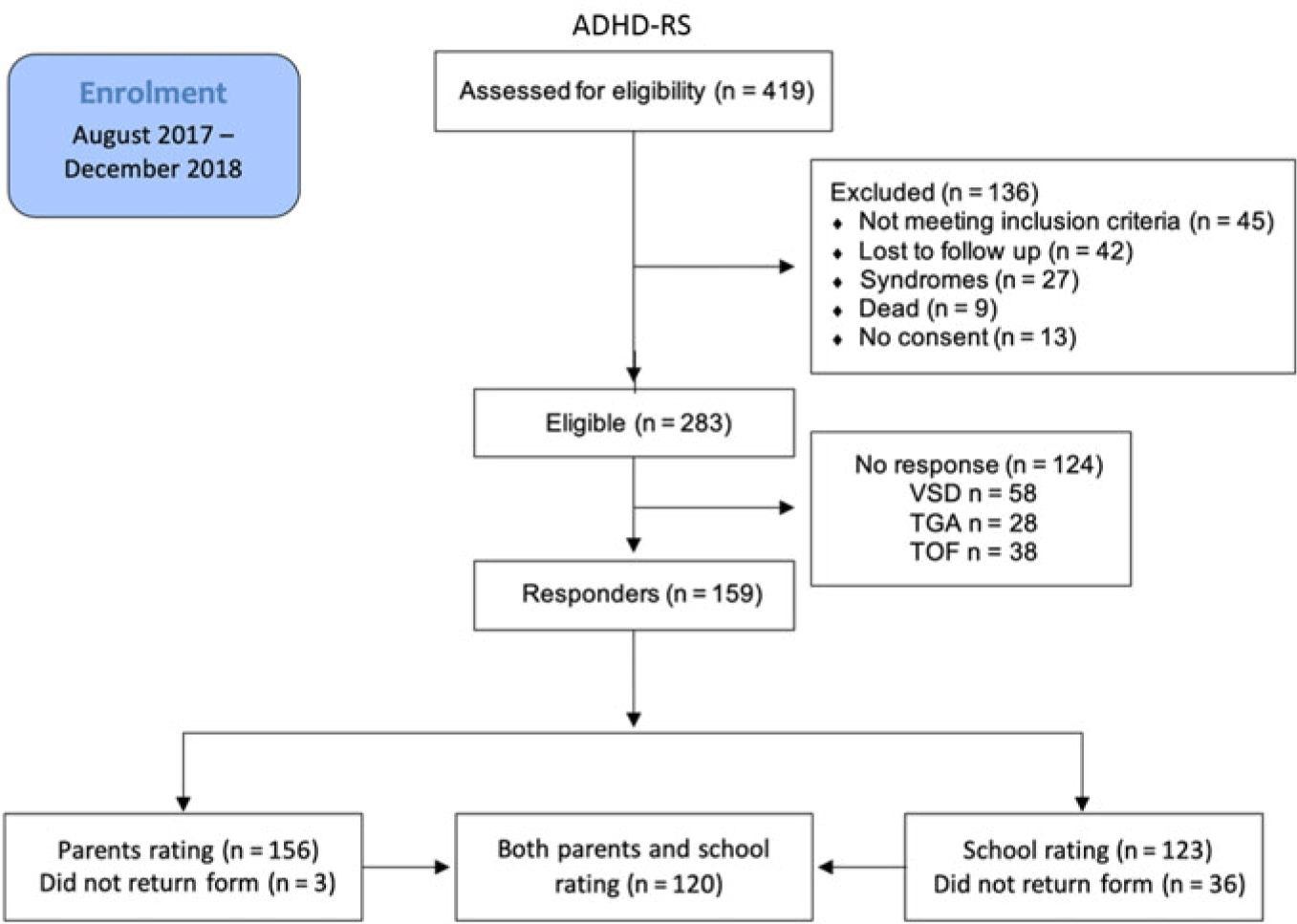
Of the 419 children with surgically corrected Ventricular Septal Defect, Transposition of Great Arteries, and Tetralogy of Fallot, 283 were eligible for inclusion. Forty-five children did not meet the inclusion criteria, 27 were excluded due to syndromes, 42 were lost due to emigration, 13 did not consent, and 9 children had died. Parents of 159 children (56%) responded on the Attention-Deficit/Hyperactivity Disorder-Rating Scale questionnaire, whereas only 123 teachers of the CHD children (43%) responded (Fig 1).
CONSORT of the inclusion and exclusion of the patients with CHD in the study. Lost to follow-up = Emigrated. TGA = Transposition of Great Arteries; TOF = Tetralogy of Fallot; VSD = Ventricular Septal Defect.

The CHD group comprised 159 children, 55% male, with a mean age of 13.0 ± 1.8 years, and they were compared with 317 age- and sex-matched controls. Demographics on individual CHD subgroups (Ventricular Septal Defect, Transposition of Great Arteries, and Tetralogy of Fallot) and controls are shown in Table 1.
The patient’s characteristics

CHD = congenital heart defect; NA = not available; TGA = Transposition of Great Arteries; TOF = Tetralogy of Fallot; VSD = Ventricular Septal Defect.
All data are shown as mean ± SD.
Attention-deficit/hyperactivity disorder
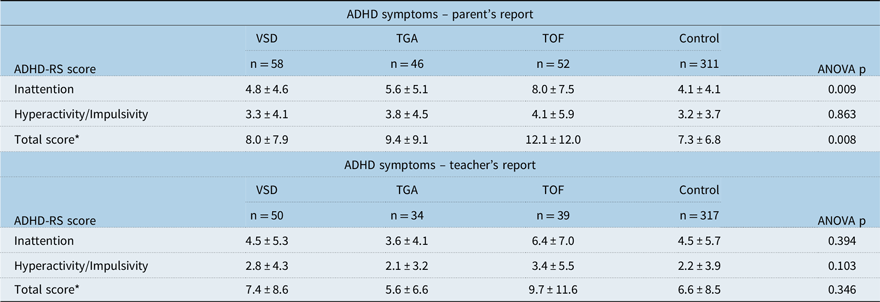
The parental Attention-Deficit/Hyperactivity Disorder-Rating Scale ratings of the CHD and the control groups showed an overall statistically significant difference in the total attention-deficit/hyperactivity disorder mean score (p = 0.008) (Table 2). Post hoc analysis showed that the difference between CHD children and background population was primarily driven by the difference in severity of inattention symptoms. The mean scores were significantly higher in the Tetralogy of Fallot group than controls with a mean score difference of 3.90 (SD difference = 3.4), as shown in Table 2 (p = 0.005). The Tetralogy of Fallot group also had significantly higher mean scores in inattention symptoms than children in the Ventricular Septal Defect group (p = 0.043) (data not shown). Equally, the Tetralogy of Fallot group had a significantly higher total attention-deficit/hyperactivity disorder mean score than the control group (p = 0.004) (data not shown). The school teacher ratings of CHD children and controls were comparable without any significant differences between groups (Table 2).
Parent (upper) and teacher rating (lower) of two ADHD symptom dimensions in the CHD children and the controls

RS = rating scale.
All data are shown as mean ± SD.
* Total score is the sum score of inattention and hyperactivity/impulsivity sub-scores
The oppositional defiant disorder subscale mean scores based on both the parent and school teacher ratings were not significantly different between the CHD group and controls (Table 3).
The behavioural scores from parents (upper) and teacher (lower) of the Ventricular Septal Defect, Transposition of Great Arteries, Tetralogy of Fallot – and control group

Data are shown as means ± SD.
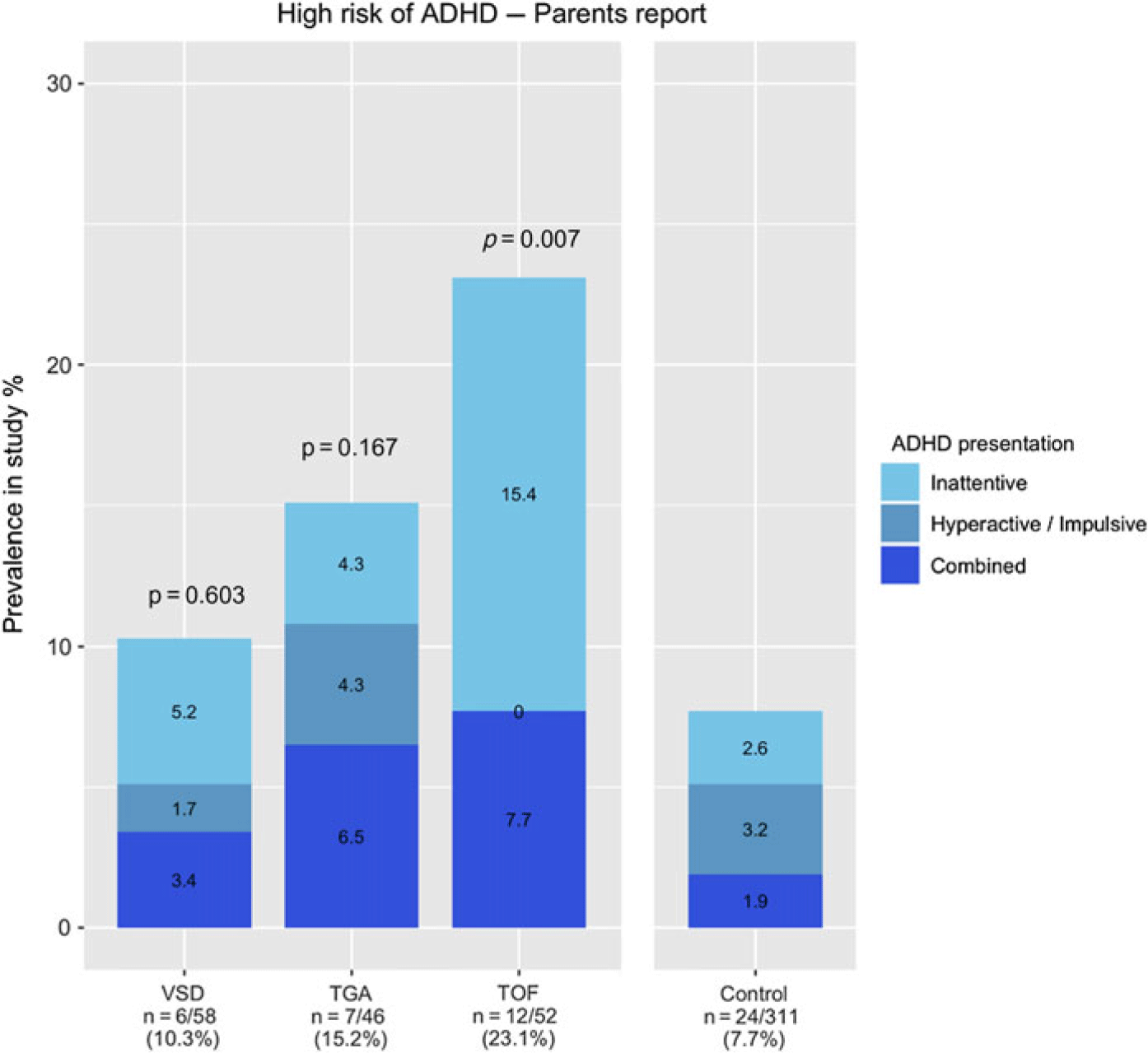
The frequency of individuals with an attention-deficit/hyperactivity disorder score in the clinical range (i.e. a T-score > 70) is shown in Figure 2. In children with Tetralogy of Fallot, the rate of scores in the clinical range of inattention was almost 6 times more frequent than in the controls and the occurrence was 3 times higher than in children with Transposition of Great Arteries and Ventricular Septal Defect, respectively. In contrast, clinical range of hyperactive/impulsivity scores was comparable in children with Transposition of Great Arteries and Ventricular Septal Defect as well as controls, whereas high hyperactivity/impulsivity scores were completely absent in children with Tetralogy of Fallot (Table 4). Severe combined attention-deficit/hyperactivity disorder symptoms were mainly seen in children with Transposition of Great Arteries and Tetralogy of Fallot. Consequently, clinical range of attention-deficit/hyperactivity disorder symptoms occurred almost 3 times more frequently in children with Tetralogy of Fallot compared with controls (p = 0.007). The occurrence of high scoring individuals was not statistically significantly different between the remaining two CHD groups and controls.
Parent rated attention-deficit/hyperactivity disorder T-scores >70 points (clinical range of attention-deficit/hyperactivity disorder) of the three different CHD subgroups and the controls.

Number (rates) of children rated in the clinical range (T-score > 70 points) of attention-deficit/hyperactivity disorder presentation (parent rating).

The children with combined attention-deficit/hyperactivity disorder presentation are not included in the inattentive or hyperactive/impulsive presentation.
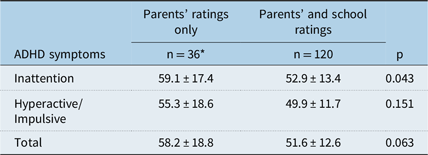
When comparing ratings by parents who returned only their own rating (n = 36) with parents who returned both their own and teacher’s rating (n = 120), the first group reported significantly worse mean inattention symptoms T-score (p = 0.043). No significant inter-group differences were found in hyperactivity/impulsivity symptoms severity (Table 5).
Parent’s rating of attention-deficit/hyperactivity disorder symptoms shown in T-scores.

T-scores are calculated from a normative Danish sample stratified on age and sex.
* Ten parents of the CHD children in high risk of attention-deficit/hyperactivity disorder symptoms did not return the teacher’s rating.
Quality of life and attention-deficit/hyperactivity disorder
To explore if clinical range of attention-deficit/hyperactivity disorder scores were associated with lower quality of life, we analysed previously published quality of life dataReference Hall, Guo and Valentine19 for associations with the attention-deficit/hyperactivity disorder scores. Among children with Tetralogy of Fallot, a high attention-deficit/hyperactivity disorder symptom score (a T-score > 70) was significantly associated with lower scores in quality of life within each sub-score (physical, emotional, social, school, and total) within the group of Tetralogy of Fallot children (p < 0.029) (Supplementary material). Similar correlations were seen in the Transposition of Great Arteries group (p < 0.008), whereas in children with Ventricular Septal Defect less clear associations were present (Supplementary material).
Discussion
Children with surgically corrected CHD had significantly increased inattention- and total attention-deficit/hyperactivity disorder symptom scores compared with controls. Children with Tetralogy of Fallot had significantly increased total attention-deficit/hyperactivity disorder symptom scores as well as worse inattention symptoms compared with the control group and children with Ventricular Septal Defects. Our findings confirm previous observations, showing a higher occurrence of predominantly the psychometrically defined attention-deficit/hyperactivity disorder inattentive presentation in children with complex CHD.Reference Marino, Lipkin and Newburger1,Reference Shillingford, Glanzman, Ittenbach, Clancy, Gaynor and Wernovsky4,Reference Hansen, Poole and Nguyen5 However, we did not observe significantly worse hyperactivity/impulsivity symptoms among children with CHD compared with controls, which previously has been reported in children with various complex CHDs.Reference Shillingford, Glanzman, Ittenbach, Clancy, Gaynor and Wernovsky4,Reference Hansen, Poole and Nguyen5 These diverging observations may relate to the fact that the children with single ventricular physiologyReference Hansen, Poole and Nguyen5 were not included in the present study and that we included older children between 10 and 16 years, while previous studies focused on children in the age span between 5–10 yearsReference Shillingford, Glanzman, Ittenbach, Clancy, Gaynor and Wernovsky4 and 7–15 years,Reference Hansen, Poole and Nguyen5 respectively. Finally, it is important to emphasise that the severity of hyperactivity/impulsivity symptoms in general decreases with age.Reference Szomlaiski, Dyrborg, Rasmussen, Schumann, Koch and Bilenberg9
There is accumulating evidence that the behavioural changes observed in children with CHD are related to hypoxic–ischemic white matter injury seen on brain MRI.Reference Lynch, Ko and Busch21 In children with Transposition of Great Arteries, the risk of developing white matter injury has been shown to increase with time between birth and surgery.Reference Petit, Rome and Wernovsky22 The underlying pathophysiology is likely related to the fact that cerebral oxygen extraction increases during the preoperative period in neonates with Transposition of Great Arteries, but without a concomitant increase in the oxygen delivery.Reference Lynch, Ko and Busch21 Whether this is the same in children with Tetralogy of Fallot has to be explored, but overall it is well known that children with cyanotic CHD have an increased risk of impaired neurodevelopmental outcome through school age and into adolescence.Reference Marino, Lipkin and Newburger1,Reference Shillingford, Glanzman, Ittenbach, Clancy, Gaynor and Wernovsky4,Reference Bellinger, Wypij and Rivkin23 Of importance, it has been described that preoperative hypoxemia in infancy due to cyanotic CHD is likely to be associated with impaired attention functioning compared with acyanotic CHD and healthy children.Reference Hansen, Poole and Nguyen5 Hypoxemia can cause injury to the prefrontal cortex and corpus striatum of the brain.Reference Hovels-Gurich, Konrad, Skorzenski, Herpertz-Dahlmann, Messmer and Seghaye24 These regions are highly oxygen sensitive and have been associated with impaired executive control network of attention.20 Children both with Tetralogy of Fallot and Transposition of Great Arteries have prenatally been exposed to lower cerebral oxygen levels compared with healthy fetuses. A study on brain MRI has shown a lower cerebral tissue oxygenation in fetuses with complex CHD (including Transposition of Great Arteries and Tetralogy of Fallot) compared with healthy fetuses.Reference Lauridsen, Uldbjerg and Henriksen25
Children with Tetralogy of Fallot have postnatally a varying intensity of cyanosis based on the degree of blood flow obstruction to the lungs.Reference Bailliard and Anderson26 Children with Ventricular Septal Defects, Transposition of Great Arteries and Tetralogy of Fallot all carry a risk of perioperative brain injury due to circulatory instability and the associated occurrence of acidosis, hypoxemia, and hypoxic–ischemic injury, but perioperative events have not shown any strong association with neurodevelopmental outcome, indicating that the prenatal and preoperative periods are stronger determinants for neurodevelopmental outcome.Reference Petit, Rome and Wernovsky22,Reference Bailliard and Anderson26
We found that parents of the Tetralogy of Fallot children reported significantly more inattention symptoms than parents of Ventricular Septal Defect children. In line with our findings, it has been shown that Tetralogy of Fallot children with preoperative cyanosis had increased risk for attention dysfunction in the field of executive control compared with acyanotic children with Ventricular Septal Defect.Reference Hovels-Gurich, Konrad, Skorzenski, Herpertz-Dahlmann, Messmer and Seghaye24 However, we did not observe any statistically significant difference in parent-rated attention-deficit/hyperactivity disorder symptoms severity between the other cyanotic CHD (Transposition of Great Arteries) in the present study and the controls. Nevertheless, children with Transposition of Great Arteries presented a markedly higher inattention symptom load and almost twice as many children with Transposition of Great Arteries (15%) were in the clinical range of attention-deficit/hyperactivity disorder symptoms compared to the controls, although the difference was not statistically significant. In accordance, DeMaso et al found by clinical evaluation a similar proportion (16%) of children with surgically repaired Transposition of Great Arteries fulfilled the diagnostic criteria for attention-deficit/hyperactivity disorder.Reference DeMaso, Labella and Taylor6
It has been shown that the children with a prenatal diagnosis of Transposition of Great Arteries have less preoperative brain injury and more robust microstructural brain development than children with a postnatal diagnosis.Reference Peyvandi, De Santiago and Chakkarapani27 In children with Transposition of the Great Arteries, who undergo CHD surgery later than 2 weeks after birth, it has been shown they have impaired brain growth and delayed development of language skills compared with children who undergo surgery during the first 2 weeks of life. The underlying mechanisms are uncertain, but the prolonged period of cyanosis combined with pulmonary overcirculation may contribute to the impaired growth of the brain and thereby delayed neurodevelopment.Reference Lim, Porayette and Marini28 The prenatal screening programme was introduced in 2004 in Denmark with more than 95% of women scanned in their pregnancy, increasing the number prenatal diagnosis of CHD from 4.5% in 1996 to 71% in 2013.Reference Lytzen, Vejlstrup and Bjerre29 This may have led to an optimised management with planned delivery at a specialised cardiac centre, enabling prompt administration of prostaglandin and balloon atrial septostomy (if required) for the Transposition of the Great Arteries, thereby minimising the risk of preoperative circulatory collapse and risk of cerebral damage. Our study cohort was born between 2001 and 2007, indicating that the majority have been diagnosed prenatally,Reference Lytzen, Vejlstrup and Bjerre29 which may have contributed to the less prominent attention-deficit/hyperactivity disorder symptoms in these children.
It is well known that attention-deficit/hyperactivity disorder carries a high rate of psychiatric comorbidities like oppositional defiant disorder,Reference Wilens and Spencer30 delinquency, and poor educational achievement.Reference Marino, Lipkin and Newburger1,Reference Barkley31 It has previously been described that up to 39% of Tetralogy of Fallot children with 22q11 deletion syndrome have attention-deficit/hyperactivity disorder and an increased prevalence of other psychiatric disorders.Reference Holland, Cassidy and Stopp10 We did not identify any significant differences in oppositional defiant disorder symptoms between the CHD children and the controls. In particular, we did not observe an increased occurrence of oppositional defiant disorder in the Tetralogy of Fallot group, which may be related to the fact that children with a 22q11 deletion syndrome were excluded from the present study. The different pattern of comorbidity in children with CHD and attention-deficit/hyperactivity disorder symptoms could implicate that the pathogenesis of their attention-deficit/hyperactivity disorder is different from children with idiopathic attention-deficit/hyperactivity disorder.Reference Holland, Cassidy and Stopp10,Reference Kasmi, Bonnet and Montreuil32
The marked discrepancy between parents and teachers’ rating was seen both in children with CHD and among controls, although the difference was less obvious in controls due to the overall lower attention-deficit/hyperactivity disorder symptoms scores. It is evident that levels of attention-deficit/hyperactivity disorder symptoms perceived by parents are above the levels by teachers as previously reported in both children with idiopathic attention-deficit/hyperactivity disorderReference Hall, Guo and Valentine19,Reference Murray, Kollins and Hardy33 and in children with CHD with attention-deficit/hyperactivity disorder.Reference Shillingford, Glanzman, Ittenbach, Clancy, Gaynor and Wernovsky4,Reference Hansen, Poole and Nguyen5,Reference Bellinger, Wypij and Rivkin23,Reference Marin-Mendez, Borra-Ruiz, Alvarez-Gomez and Soutullo Esperon34
The inattention symptoms are, among others, increased distractibility, forgetfulness, and reduced sustained attention.Reference Wilens and Spencer30,Reference Maedgen and Carlson35 As children with CHD predominantly had the DSM-5 attention-deficit/hyperactivity disorder inattentive presentation in the present study, it could indicate that the symptoms may easily have been ignored or misinterpreted in a teaching setting. In contrast, children with hyperactivity/impulsivity symptoms, who display more negative behaviour in a teaching setting, are easier to discover.Reference Maedgen and Carlson35 Teachers may have had a higher threshold for deviant attention functioning than the parents, or the inattention symptoms may have been less noticeable in a class room setting to teachers as suggested by another group.Reference Hansen, Poole and Nguyen5 Parents, who only returned their own ratings, scored their children’s attention-deficit/hyperactivity disorder inattentive symptoms higher than parents who returned both their own and the teacher’s rating, which could either indicate that the parents deliberately avoided to involve the teacher or that the teacher of the child with more severe attention-deficit/hyperactivity disorder symptoms did not respond. Unfortunately, we cannot discriminate between the two causes.
Attention-deficit/hyperactivity disorder can impair accomplishment in school, education, or work functioning and disturb the quality of life.Reference Herman, Lambert, Ialongo and Ostrander36 We have recently investigated the quality of life in children with CHD and found that all three subgroups of CHD had decreased quality of life scores compared with healthy controls.Reference Holst, Kronborg and Idorn37 A clear association between clinical range of attention-deficit/hyperactivity disorder symptoms load and lower quality of life scores was seen in all sub-scores in the Tetralogy of Fallot group, and to some degree a similar association was seen in the Transposition of Great Arteries group. These findings are in line with other studiesReference Robson, Stopp and Wypij38,Reference Neal, Stopp and Wypij39 and highlight the importance of early identification and treatment of attention-deficit/hyperactivity disorder in CHD, in order to improve quality of life for these children and their families.Reference Sistino, Atz, Simpson, Ellis, Ikonomidis and Bradley40
The Attention-Deficit/Hyperactivity Disorder-Rating Scale measures attention-deficit/hyperactivity disorder in children from 6 to 16 years and is feasible to be used in a clinical setting as a screening tool,Reference Lim, Poh and Fung41 for example, in a CHD population.Reference Shillingford, Glanzman, Ittenbach, Clancy, Gaynor and Wernovsky4,Reference DeMaso, Labella and Taylor6,Reference Holland, Cassidy and Stopp10,Reference Gaynor, Nord and Wernovsky42 As symptoms of attention-deficit/hyperactivity disorder often become clinically evident at 5–6 years, it could be recommendable to screen at this time-point also in the CHD population to have the possibility to intervene both in the family and in school setting at this early stage. If the child comes up with a score in the clinical range (a T-score > 70), it is recommended to refer for a clinical assessment by a school psychologist or in the child and adolescent psychiatric services. Attention-Deficit/Hyperactivity Disorder-Rating Scale has a high correct classification proportion in distinguishing attention-deficit/hyperactivity disorder cases from non-cases, as shown in resent Japanese studies.Reference Takayanagi, Yoshida and Yasuda43,Reference Okumura, Yamasaki and Ando44 If a child scores in the sub-threshold range (T-scores 60–70), one would recommend screening the child again 1 year later or observe the child for attention-deficit/hyperactivity disorder symptoms.
Limitations
Attention-deficit/hyperactivity disorder is a clinical DSM-5 diagnosis, requiring thorough clinical assessment. Therefore, evaluation based solely on questionnaire data (i.e. a purely psychometric definition of attention-deficit/hyperactivity disorder) must be cautiously interpreted.
Combined parent and teacher’s scores on attention-deficit/hyperactivity disorder rating scales gave a lower number of CHD children with clinical range attention-deficit/hyperactivity disorder scores than solely based on parents’ rating. We cannot exclude selection bias in the present study. Parents who had a suspicion of attention-deficit/hyperactivity disorder potentially were more compelled to complete the questionnaire or it may have been the other way around. The response rate was 56%, which preferentially should have been higher. Fewer school teachers than parents participated, which may be a consequence of the study design, because the teacher questionnaires were sent to families with a child having undergone CHD surgery and not directly to the school. As we were unable to retrieve further response, despite several mails, we cannot rule out that the non-responders may have been a potential source of bias as well. It would have been preferable to investigate if the CHD responders were representative in terms of perioperative courses, but unfortunately, the Danish Patient’s Act does not permit us to track information from the medical records without informed consent from the parents, which still only would be available from the parents returning the questionnaires.
Conclusion
In conclusion, children with surgically corrected CHD had significantly increased attention-deficit/hyperactivity disorder scores compared with controls; the difference in inattention symptoms was mainly driven by the Tetralogy of Fallot group.
In children with CHD presenting cognitive and/or self-regulatory concerns, a neurocognitive -– and psychiatric assessment is recommended to assess the neurocognitive – and psychiatric signature of an individual child. It is important to screen children with CHD because inattention symptoms are more likely to be misinterpreted and overlooked.
The intervention possibilities are many depending on age and health, ranging from academic or school interventions, parent/family skills training, psycho-education, and medication.Reference Marino, Lipkin and Newburger1 The value of early intervention in this vulnerable group remains to be evaluated in future clinical studies.Reference Marino, Lipkin and Newburger1
Acknowledgements
The authors acknowledge the efforts of Morten Helvind, Rebekka M. T. Lytzen, and Jane Lund Møller for their assistance in collecting the data for this work.
Financial Support
This work was funded by grants from the Jascha Foundation, the Ville Heises grant, the Elsass Foundation, the Hede Nielsen Foundation, and the Candys Foundation.
Conflicts of Interest
None.
Ethical Standards
The authors assert that all procedures contributing to this work comply with ethical standards of the relevant Danish national guidelines on human questionnaires and with the Helsinki Declaration of 1975, as revised in 2008, and has been approved by the Danish Data Protection Agency (j. no. VD-2018-46) at Copenhagen University Hospital Rigshospitalet, Denmark.
Supplementary material
To view supplementary material for this article, please visit https://doi.org/10.1017/S1047951119003184