

1. Introduction
Coordination problems are ubiquitous in economic environments with strategic uncertainty. They have been extensively studied in a range of applications including bank runs (Diamond and Dybvig, Reference Diamond and Dybvig1983), currency crises (Obstfeld, Reference Obstfeld1996) and technology adoption (Katz and Shapiro, Reference Katz and Shapiro1986). A key theme is that the optimal decisions of individual players are inextricably tied to the anticipated decisions of others, as the latter ultimately influences the individual’s payoffs. Moreover, even when there is an equilibrium that all players prefer, they may fail to coordinate on it. After a bank run, for example, society as a whole is worse off than before. However, given that a bank run is occurring, the best option for any depositor is to join the run. As a result, there are multiple equilibria—one in which everybody withdraws and another where banking activity continues as normal.
In this paper, we argue that models of coordination failure also offer a useful lens with which to think about the political economy of populism. A large game-theoretic literature has examined ‘regime change’ and the spontaneous nature of protests, as well as economic populism—defined by Dornbusch and Edwards (Reference Dornbusch and Edwards1991) as a situation where a significant proportion of voters support policies which ultimately harm their economic interests.Footnote 1 However, rather less attention has been devoted to two topics in particular: (a) why is it that incumbents often refuse to readily cede office following a democratic election? and (b) why do democratically elected politicians sometimes gamble with radical policy shifts, whose ultimate effect on both the size and redistribution of the ‘economic pie’ is uncertain?
President Trump’s refusal to depart gracefully following the 2020 U.S. presidential election and the willingness of the U.K. government to proceed with Brexit ‘come what may’, brings these questions into sharp relief. By stoking doubt over the integrity of the election outcome, Mr Trump aimed to ward off widespread protest and denouncement that usually disciplines elected leaders. Brexit was a leap into the dark voted upon by an electorate concerned over the distribution of output vis-à-vis a wealthy elite. Both episodes featured sudden, unexpected switches from one outcome to another, in a manner characteristic of models of self-fulfilling behaviour. For example, betting markets placed the probability of Remain being successful at 81 per cent, and 19 per cent for Leave ahead of the Brexit referendum. Models of coordination failure can, thus, frame collective behaviour by agents as a rudder shaping populist behaviour. We describe recent research that builds on new developments in global games (Morris and Yildiz, Reference Morris and Yildiz2019) and policy experimentation (Callander, Reference Callander2011) to show how a coordination game perspective helps us understand the key drivers of such events.
We highlight two main takeaways. First, the ability of citizens to coordinate ex post on protest is an important discipline on the willingness of politicians to adhere to electoral rules ex ante. However, election results serve as a coordination device for protest—signalling the popularity of the incumbent and allowing a citizen to judge how her attitude towards the regime differs from those of other citizens. In this regard, the fidelity of the election process matters a great deal. Shadows over the election result due to gerrymandering, foreign interference or litigation over electoral processes weaken the disciplining role of protest and embolden incumbents to subvert electoral rules.
Second, policy gambles arise from three fundamental forces: the inability of politicians to commit to a status quo, a conflict between elites and citizens over the distribution of economic output and the unpredictability of the mapping from policy to outcomes. Rational voters are driven to vote for policy gambles, even though these are detrimental to their ex ante welfare, in an attempt to redress the division of output. Furthermore, the beliefs held by elites about the future course of policy play a pivotal role in shaping the outcome. Institutional frameworks that enable the political class to credibly commit to a status quo regime may help eliminate the possibility of policy gambles and enhance social welfare.
2. Departing gracefully
Although many elections in democratic countries result in a peaceful transfer of power, there are instances when losing incumbents refuse to depart gracefully and try to hold on to their positions. The refusal by President Trump to cede office following the 2020 presidential election is, perhaps, the most egregious example. However, other leaders around the world have similarly rejected democratic election results and refused to leave office, doing so only after widespread protest by citizens.Footnote 2
Ex post coordination on mass protest plays an important disciplining role in ensuring ex ante compliance with electoral rules by incumbent politicians (Fearon, Reference Fearon2011). Such protest is most effective when election results are sufficiently accurate. By serving as a public signal of the incumbent’s popularity and ensuring approximate common knowledge among citizens, the election result serves as a focal point, allowing citizens to coordinate on multiple strategies that make it possible to oust the incumbent.Footnote 3 As a result, in well-functioning democracies, there is a range of strongly enforceable electoral rules that ensures a smooth transfer of power (Little et al., Reference Little, Tucker and LaGatta2015).
However, the link between the informativeness of elections and the enforceability of electoral rules depends crucially on the fidelity of the electoral process. If there are mistrust in electoral institutions, concerns about voting arrangements or meddling by foreign powers, then citizens may doubt the integrity of the electoral process. Uncertainty about the true data-generating process behind the election result impinges on their ability to coordinate on protest.Footnote 4 Citizens may be unsure both about the true popularity of the incumbent and about what others believe. With less common knowledge about where her sentiment sits in relation to others’ sentiments, a citizen is less able to accurately predict the size of protests. By diminishing citizens’ ability to threaten costly, large-scale protests, concern over electoral probity may thus embolden an incumbent to subvert electoral rules.
The U.S. presidential election of 2020 underscores the importance of electoral integrity and its consequences for enforceability of electoral rules. In the weeks leading up to the election, President Trump repeatedly indicated that he might not accept the results of the election. Following his claim of victory and the filing of lawsuits to stop vote counting, protests erupted across the major cities in the United States as supporters of both parties pushed their interpretation of electoral rules. Some citizens said that they were simply unsure whom they would trust to tell them the legitimate results of the election (The Guardian, 2020). Systemic weaknesses allowing state legislatures to alter electoral arrangements without federal approval, district boundaries that discriminated against minority groups, widespread litigation over processes concerning the receipt of postal ballots during the pandemic, reports of foreign powers seeking to interfere with the election and the President’s own claims of fraud all served to undermine perceptions about the integrity of the U.S. electoral process.Footnote 5
Duley and Gai (Reference Duley and Gai2021) develop an electoral turnover model where there is doubt about the electoral process. Drawing on insights from the recent ‘second-generation’ global game framework of Morris and Yildiz (Reference Morris and Yildiz2019), they allow for ‘fat tails’ in the distribution of election results. Citizens who observe only small differences between their sentiments and the election result attribute the difference to idiosyncratic noise. From their perspective, the protest size is indeterminate, and the publicly observed election result provides a focal point for coordination that disciplines the incumbent. A citizen’s rank belief—the probability she assigns to the event that another citizen’s sentiment towards the incumbent is lower than her own—provides the basis for thinking about the payoff from protesting. When election results deviate markedly from her sentiment, the citizen ascribes the discrepancy to the election process. Her rank beliefs become diffuse, and she considers herself the median citizen. The decision to refrain from protest is, thus, uniquely rationalisable if it is a risk dominant action, opening a window of opportunity for the incumbent to reject the election outcome.Footnote 6
Figure 1 depicts the timing of events in the model. Although the incumbent does not know his true popularity, he can infer it from the outcome of the election. The election result, e, is a noisy public signal of the true popularity of the leader,
 $ \omega \hskip0.35em \in \hskip0.35em R $
, drawn by Nature at the start of the game (
 $ t\hskip0.35em =\hskip0.35em 0 $
). Thus,
 $$ e\hskip0.35em =\hskip0.35em \omega +{\nu}_e, $$
where
 $ {\nu}_e $
is fat-tailed noise in the electoral process. In addition to the election result, each citizen receives a private signal about public sentiment towards the incumbent,
 $$ {x}_j\hskip0.35em =\hskip0.35em \omega +{\nu}_j, $$
where the idiosyncratic noise term,
 $ {\nu}_j $
, captures the extent to which citizen j is inclined towards the politician, that is, her ‘own sentiment’. In contrast to the noise in the electoral process, idiosyncratic sentiments follow a thin-tailed distribution and, conditional on ω, are independently and identically distributed in the population. Equations (1) and (2) imply
 $ {x}_j\hskip0.35em =\hskip0.35em e+{z}_j $
, where
 $ {z}_j\hskip0.35em =\hskip0.35em {\nu}_j-{\nu}_e $
is the noise component that informs citizens’ expectations about ω and the sentiments of others. Citizens unfavourably disposed to the incumbent (
 $ {x}_j<0 $
) are more willing to protest in order to remove him from office, whereas those with positive sentiments (
 $ {x}_j>0 $
) do not denounce the politician.
Sequence of events in the elections game.

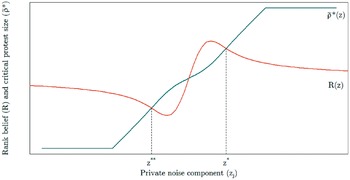
Figure 2 illustrates the citizen’s rank belief function,
 $ R(z) $
. It is the posterior that a citizen has over the event that another citizen observes a lower sentiment and, accordingly, reflects each citizen’s expected protest size if she believes that her own sentiment,
 $ {x}_j\hskip0.35em =\hskip0.35em e+{z}_j $
, to be the median sentiment in the population. Figure 2 also shows the expected critical protest size,
 $ {\overset{\sim }{\rho}}^{\ast }(z) $
, conditional on citizens’ observing signal
 $ {x}_j $
. Multiple equilibria emerge in such a model. Protesting is uniquely rationalisable when the election result deviates markedly from a citizen’s sentiment, whereas staying silent is uniquely rationalisable when the election results differ only slightly from her idiosyncratic assessment of the leader’s popularity. In between these two extremes, both actions are rationalisable.
Protesting is uniquely rationalisable when
 $ z\hskip0.35em \le \hskip0.35em {z}^{\ast \ast } $
and staying silent is uniquely rationalisable when
 $ z>{z}^{\ast }. $
Both actions are rationalisable in the interval
 $ \left({z}^{\ast \ast },{z}^{\ast}\right] $
, which is smaller than the range of the dominance bounds.

Unlike regime change models that utilise ‘first-generation’ global games (e.g., Morris and Shin, Reference Morris, Shin, Dewatripont, Hansen and Turnovsky2003), where the distributions from which regime sentiments and election results are drawn are ‘thin-tailed’ and there is a unique equilibrium at which successful protest takes place, the presence of fat tails increases a citizen’s fundamental uncertainty. As a result, there is a range of strongly enforceable electoral rules over which an incumbent is willing to step down. However, this range of enforceable rules is much smaller than the range that obtains under common knowledge (e.g., Obstfeld, Reference Obstfeld1996). This reflects how doubt over electoral integrity unravels the focal point that election results provide, as citizens instead choose their risk dominant action. The key insight is the following—once there is genuine uncertainty about the data-generating process behind election results, incumbents in advanced democracies may be less willing to step aside than suggested by standard models of electoral turnover (e.g., Little et al., Reference Little, Tucker and LaGatta2015).
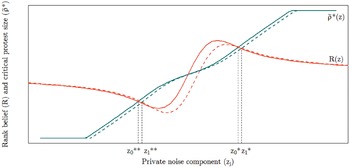
The model also provides helpful insight on what can happen if there are negative shocks to sentiment that are independent of the electoral process so that, for any given election result, each citizen expects the popularity of the incumbent to be lower (figure 3). Social media platforms are one possible public trigger for such sentiment shifts. In January 2017, a joint report by the CIA, FBI and NSA concluded that Russia had interfered significantly in the 2016 U.S. presidential election by manipulating information on social media platforms. Russian-controlled fake accounts and social bots disseminated false or distorted stories among as many as 126 million American Facebook users, with 6 out of 470 Russian saboteur accounts generating at least 340 million shares on the platform (Mayer, Reference Mayer2018). The content of the stories was predominantly inflammatory towards the incumbent-party candidate, Hillary Clinton, and supportive of the winning candidate, Donald Trump (Ziegler, Reference Ziegler2018).
A negative shift in sentiment towards the incumbent induced by a social media campaign manifests as a decrease in the prior over the incumbent’s true average popularity. This shifts both cut-off points
 $ {z}^{\ast \ast } $
and
 $ {z}^{\ast } $
rightwards and corresponds with a new set of strongly enforceable rules.

Clinton’s acceptance of defeat, despite her outpacing Trump by 2.1 per cent in the popular vote, seems consistent with figure 3. If doubts over the veracity of the 2016 election process were material (Norris and Grömping, Reference Norris and Grömping2017), then our model suggests that citizens’ protesting ability would be weakened, and Clinton may have had an opportunity to dispute Trump’s victory. However, a shock to sentiment which lowers the expected popularity of the incumbent (in this example, the Russian campaign) shifts the range of enforceable rules rightwards, making citizens more likely to discipline an aberrant politician. As a result, the incumbent’s equilibrium strategy is to ‘follow’ the electoral rule and accept a reported defeat.
The noise in signals that citizens receive is exogenous. However, because the incumbent benefits from fundamental uncertainty and tail risk, he has an incentive to strategically introduce, or amplify, doubts over electoral integrity. Future work could explore the interaction between the manipulation of election transparency and the rejection of electoral protocols when there is genuine doubt over the veracity of the election process.
3. Policy gambles
Democratically elected politicians sometimes gamble with bold policy shifts, discarding a well-understood status quo in favour of a new blueprint whose ultimate effects on both the size and the distribution of the ‘economic pie’ are uncertain. Recent examples include the United Kingdom’s exit from the European Union on 31 January 2020, and President Trump’s decision to sanction tariffs and repudiate free trade agreements in 2018. In both cases, politicians exploited a high level of voter discontent with business elites to pursue fundamental departures from well-understood policy frameworks and institutions in favour of untested regimes with unpredictable outcomes. Empirical evidence highlights how inequality and distributional conflicts were central to support for ‘Brexit’ (Goodwin and Heath, Reference Goodwin and Heath2016; Green et al., Reference Green, Hellwig and Fieldhouse2021) and the election of President Trump (Autor et al., Reference Autor, Dorn, Hanson and Majlesi2017; Baccini and Weymouth, Reference Baccini and Weymouth2021).
Anand et al. (Reference Anand, Gai and König2021) examine the three-way strategic interaction between politicians, voters and elites in a setting that highlights the role of coordination failure and self-fulfilling beliefs. In their model, a policy gamble is the vehicle through which the elected politician, on behalf of the median voter, alters the way in which output is divided in society. Crucially, rational voters are willing to support the gamble even if, at times, the policy is detrimental to their welfare from an ex ante perspective. Policy gambles are, thus, ‘populist’ in the sense of Dornbusch and Edwards (Reference Dornbusch and Edwards1991) and can emerge suddenly—the same fundamental factors that support the status quo also underpin the populist policy.
The Anand et al. model consists of two political parties and two groups of risk averse agents—‘elites’ and ‘voters’. Elites own the means of production and decide whether to invest domestically in risky projects or relocate offshore in a project offering a sure return. In exchange for investing in the domestic economy, they receive claims to future output. Voters, who have no capital, are thus residual claimants to the economic pie. Central to the model is a political friction. When elites invest, the incumbent government cannot pre-commit to maintaining the prevailing status quo policy into the future. The economic pie, thus, depends on the future policy choice of the government. This is set by competing political parties vying to win elections by attracting voters who have preferences over consumption as well as heterogeneous ideological leanings over the policy stance. In equilibrium, the policy choice and election outcome correspond to the policy preference of the median voter.
To capture the unpredictability of policy outcomes, the mapping from policies into outcomes is taken to be the realisation of a stochastic process that is drawn by ‘Nature’ (Callander, Reference Callander2008). However, only a single point on this mapping—the ‘status quo’—is known to all parties. As policy deviates away from the status quo, the expected outcome and its variance scale proportionally with the size of the policy shift. Thus, larger policy shifts create greater uncertainty over the outcome than smaller shifts. A policy choice affects all domestic projects in the same way, and so acts like an aggregate shock to domestic output.
Figure 4 illustrates the timing of events. The model is solved by first deriving the policy platform chosen by the political parties to attract voters, and then by determining the distribution of output that ensures participation in domestic projects by foreign investors. A politico-economic equilibrium of the model, where political choices and economic outcomes are mutually consistent, is defined such that at t = 1, the incumbent and the opponent choose their policy platforms to maximise their probabilities of winning the election, given the shares of project output that accrue to investors; and at t = 0, competition among elites drives down their project share to a level where they are just indifferent between investing in the domestic project or the safe foreign project. Since an incumbent government cannot commit to the status quo policy when output shares are determined at
 $ t\hskip0.35em =\hskip0.35em 0 $
, elites form rational expectations about the policy that is chosen in equilibrium. Therefore, the share of the output that they require in order to invest depends on the policy that they expect voters to vote for.
Sequence of events in the policy gambles game.

Marginal policy departures away from the status quo elicit three effects on voters: (i) how attracted they are to the prospect of greater output (a growth effect); (ii) their aversion to changes in the size of output (a risk effect) and (iii) their antipathy towards marginal policy changes that are misaligned with their ideals (an ideology effect). The relative magnitude of these three forces on voters’ utility depends on voters’ share of output. If voters’ stake in domestic output is large, the growth effect dominates because voters benefit more from marginal increases in domestic output. At the same time, the risk effect is also bigger since voters have more to lose when the stakes are significant. The winning policy thus crucially depends on the relative magnitude of risk versus growth effects which, in turn, depends on the beliefs of the elite about the future policy choices. The reason is that the share of output accruing to the elite must compensate them for the risk of adverse outcomes following a policy gamble.
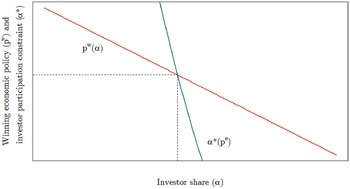
When the mapping from policy into outcomes is known to all, that is, policy outcomes are predictable, voters’ policy preferences are determined only by the interaction between the growth effect and the ideology effect. In this deterministic setting, there is a unique equilibrium in which the compensation sought by the elites does not adversely impact on the subsequent efforts of political parties to propose policies that satiate the median voter. Figure 5 illustrates. The schedule
 $ {\alpha}^{\ast } $
reflects the participation constraint of the elite since for them, the payoff from investing domestically in risky ventures must be the same as the sure payoff from investing abroad in a safe project. This schedule depends on the winning policy under rational expectations,
 $ {p}^e $
, and is downward sloping. The policy schedule chosen by the winning party is given by the downward sloping schedule
 $ {p}^W $
.Footnote
7
Equilibrium with predictable policy outcomes.

However, when policy outcomes become unpredictable, the risk effect takes hold. Compared to the case with predictable policy outcomes, voters become less inclined to favour policy departures from the status quo and a voting bloc emerges—biasing policy in favour of the status quo. Since the relative weights of the growth and risk effects depend on voters’ share in domestic output, the equilibrium policy choice is a direct response to the distribution of output between the elite and voters. The beliefs held by elites about the claims of others play a pivotal role in determining the split of output between voters and the elite.
When the elite are sufficiently risk-averse, multiple equilibria may arise. For example, if a member of the elite believes that all others are expecting the future government to pursue a policy gamble, then her individual response is to demand greater compensation. If all members of the elite share this belief, then, in aggregate, the elite obtains a relatively larger share of output and the voters’ share is lowered. Since a smaller share of output dilutes the voters’ risk effect, they respond by voting for a policy gamble, thereby validating the elite’s initial beliefs. Conversely, if any single elite member believes that others are acting on the belief that the future government will retain the status quo, their required compensation is smaller, leading to a larger share of output that accrues to voters, which increases their relative weight on the risk effect and induces them to support the status quo in line with the elite’s initial beliefs.
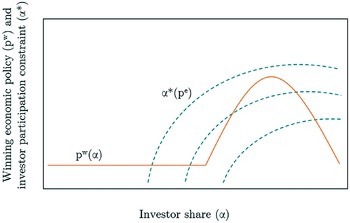
In figure 6, the solid curve depicts the winning policy schedule as a function of aggregate claims of elites, whereas the upward sloping dashed curves show the combinations of policy expectations and elite claims along which the representative elite member breaks even. This schedule shifts to the right as the returns on the foreign project increase. There are three cases. First, when returns on the foreign outside option are small, elites only require a relatively small share of output as compensation. Since voters obtain a correspondingly large share of output, the growth effect of a marginal policy shift is small relative to the risk effect. In this case, the status quo policy is campaigned upon by both parties. In a second case, when the foreign return is very large, elites demand a much larger share of project output in return for investing. Voters, who must therefore contend with a relatively small share, are less inhibited by the risk effect of policy shifts and vote for risky gambles.
The emergence of policy gambles. As investors’ outside option, ω, increases, the α* (pe) curve shifts to the right.

In the third case, the return on the safe foreign option lies in an intermediate range and begets multiplicity. In one equilibrium, elites’ beliefs coordinate on the status quo policy. If each elite member believes that all other members act on the belief that the median preferred policy is at the status quo, they adjust their claims on output share accordingly. This leaves voters with a sufficiently large share of aggregate output under the status quo policy and the median preferred policy is indeed the status quo, vindicating initially held beliefs. However, if all elite members believe that all others expect a policy shift, then their individually optimal response is to demand greater compensation. Since this lowers the aggregate stake for voters, the relative impact of the risk effect on their policy preferences is reduced. Voters vote in favour of policy shifts, thereby vindicating the elites’ initial beliefs.
The multiplicity of equilibria helps explain why rational voters may sometimes be driven to vote for policy gambles that are detrimental to their ex ante welfare. Depending on the beliefs held by elites over the future course of policy, the median voter can shift from being in the status quo voting bloc to support the policy gamble. In particular, when elites anticipate a policy gamble and, as a consequence, demand a larger share of output, it is a best response for the median voter to support the policy gamble. However, from an ex ante point of view, the gamble equilibrium leads to lower welfare. Therefore, when policy outcomes are unpredictable, elites have an incentive to strategically reduce uncertainty over the policy mapping.Footnote 8 Political consensus, whereby opposing politicians commit credibly to sticking with the status quo policy, can help eliminate the policy gamble and improve welfare.
Although stylised, the model helps explain why democratic countries sometimes implement untried, possibly radical, economic policies. As already noted, the Trump ‘tariff war’ is one example. International trade emerged as a key theme during the 2016 U.S. presidential election. Hillary Clinton, the candidate of the incumbent Democratic party, made clear her dissatisfaction with the status quo, namely the North American Free Trade Agreement (NAFTA) and the Obama administration’s support of the Trans-Pacific Partnership (TPP).Footnote 9 The challenger, Donald Trump, went further, vowing to scrap NAFTA, withdraw from the TPP and introduce retaliatory tariffs against both China and the European Union. Warning against ‘the false song of globalism’, Trump appealed to the distributional struggle between workers and investors noting ‘Globalisation has made the financial elite … very wealthy. But it has left millions of our workers with nothing but poverty and heartache’ (The Guardian, 2016). On the eve of the election, betting markets attached probabilities ranging from 70 per cent to 83 per cent on a Clinton victory.
Upon winning the election, President Trump dispensed with both the NAFTA and the TPP and, between July 2018 and August 2019, increased the average tariff rate on imports from China from 2.7 per cent to 17.5 per cent and threatened tariffs on European carmakers. A major consequence of the trade war was to heighten uncertainty, with many businesses opting to either wait for the dispute to play out or shelving plans to invest (Debelle, Reference Debelle2019). For example, in a June 2018 letter to the Commerce Department, the carmaker BMW warned that it would cut investment and production in its South Carolina plant if selling American-made sport-utility vehicles overseas became too expensive for it (The New York Times, 2018). Volvo and Ford were quick to respond with similar statements (CNBC News, 2018). Taken together, it suggests that large international firms were averse to policy risks and, given the culture of requiring ‘sweeteners’ to invest in states like South Carolina, open to greater compensation from the authorities (Post and Courier, 2015). Such anecdotal evidence is consistent with the notion of strategic complementarities of business elites’ actions in our model.
Autor et al. (Reference Autor, Dorn, Hanson and Majlesi2017) document how rising import competition from China was associated with a significant increase in the vote share for Trump in 2016, with districts most affected by import penetration more likely to elect conservative Republicans. However, in voting for Trump, voters appear to have opted for a policy gamble despite it being inimical to their welfare. Amiti et al. (Reference Amiti, Redding and Weinstein2019, Reference Amiti, Redding and Weinstein2020) find that the costs of the Trump tariff war have been borne almost entirely by U.S. consumers and firms, whereas Fetzer and Schwarz (Reference Fetzer and Schwarz2021) show that Chinese retaliatory tariffs were strategically targeted towards electoral constituencies that swung towards Trump in the 2016 election. Nevertheless, the subsequent election of Democrat Joe Biden to the Presidency in 2020 suggests that voters may be willing to continue to back the gamble. Biden campaigned on a ‘Made in America’ policy that was not entirely different from the ‘America First’ plan espoused by Trump, including the promise to ‘use tariffs when needed but backed by a strategy and plan’ (Forbes, 2020).
The self-fulfilling equilibrium can, of course, be eliminated if the elite can be convinced that future policy will not deviate from the status quo. If both political parties were to agree at the outset on the policy to be pursued after the election, taking into account the effects of policy on the claims of elites, they would commit to the status quo policy. In practice, achieving political consensus requires government decision-making bodies to be non-adversarial and civil institutions to protect minority rights. Endowing electoral losers with the rights to participate in government decision-making, including electoral rules based on proportional representation, is one way forward (e.g., Anderson and Guillory, Reference Anderson and Guillory1997).
4. Concluding remarks
Although stylised, models of coordination failure shed useful light on populist behaviours. When citizens develop doubts about the integrity of the electoral process, they have less common knowledge about where their sentiment sits in relation to others and their beliefs about what other citizens are thinking becomes diffuse. This weakens the disciplining role of protest, emboldening incumbents to subvert electoral rules—even in advanced democracies. The fidelity of the electoral process, thus, matters a great deal. Civic society should guard against efforts to gerrymander, or otherwise corrupt, the data-generating process of elections.
When the policy environment is particularly complex, a simple political friction—the inability of an incumbent politician to commit to a policy stance—interacts with distributional conflict over output to generate policy gambles that are driven by self-fulfilling beliefs about the future direction of policy. This highlights the importance of developing institutions that facilitate policy consensus within the political class. Following the Brexit referendum, for example, there were calls for national-unity governments and citizens’ assemblies to facilitate a workable compromise between the two parties on policy towards the European Union (Brown, Reference Brown2019; Powell, Reference Powell2019). Although beyond the scope of this essay, the decline of ethics has been a key factor eroding faith in consensus-building institutions—the rise of Thatcher-style conviction politics may be one reason for this (Edgerton, Reference Edgerton2018; Harrison, Reference Harrison1999). The increasing professionalism of politics, with politicians becoming more unwilling to take actions that might jeopardise the political careers upon which their livelihoods depend, is another compounding influence. Conceivably, such forces may have set the scene for the sudden lurch to a populist equilibrium of the kind described in this paper.
Acknowledgements
This paper is partly based on joint work with Kartik Anand and Philipp König. We are grateful to them for many useful conversations and discussions. We also thank participants at the NIESR Workshop on the Political Economy of Populism, London, 10 September 2021, for helpful comments.