Oppositional–defiant and conduct problems (CPs) in childhood are a reliable precursor of most adult mental health problems (Copeland, Shanahan, Costello, & Angold, Reference Copeland, Shanahan, Costello and Angold2009; Kim-Cohen et al., Reference Kim-Cohen, Caspi, Moffitt, Harrington, Milne and Poulton2003). Among children with CPs, high callous–unemotional (CU) traits (lack of concern for others' feelings, lack of guilt/remorse) specify the developmental precursor to psychopathy and indicate a distinct etiology (Frick & White, Reference Frick and White2008). Dysfunctional parenting is associated with the development and treatment of common CPs in children (Patterson, DeBaryshe, & Ramsey, Reference Patterson, DeBaryshe and Ramsey1989); however, CPs with high CU traits appear to develop relatively independently of parenting styles typically associated with the development of CPs (Kroneman, Hipwell, Loeber, Koot, & Pardini, Reference Kroneman, Hipwell, Loeber, Koot and Pardini2011; Oxford, Cavell, & Hughes, Reference Oxford, Cavell and Hughes2003; Pasalich, Dadds, Hawes, & Brennan, Reference Pasalich, Dadds, Hawes and Brennan2011; Wootton, Frick, Shelton, & Silverthorn, Reference Wootton, Frick, Shelton and Silverthorn1997). As such, much attention is being paid to more accurately specifying the CU phenotype in terms of responsiveness to precise forms of parenting and its core biological characteristics. Of the latter, high CU traits are associated with lower levels of fear (Frick, Lilienfeld, Ellis, Loney, & Silverthorn, Reference Frick, Lilienfeld, Ellis, Loney and Silverthorn1999), decreased responsiveness to negative emotional stimuli (Blair, Morris, Frith, Perrett, & Dolan, Reference Blair, Morris, Frith, Perrett and Dolan1999; Dadds et al., Reference Dadds, Perry, Hawes, Merz, Riddell and Haines2006), and dampened amygdala reactivity to emotional stimuli (De Brito et al., Reference De Brito, McCrory, Mechelli, Wilke, Jones and Hodgins2011; Deeley et al., Reference Deeley, Daly, Surguladze, Tunstall, Mezey and Beer2006; Jones, Laurens, Herba, Barker, & Viding, Reference Jones, Laurens, Herba, Barker and Viding2009; Viding et al., in press). Twin studies also show relatively high genetic loadings for CU traits and CP in the presence of high CU traits (Viding, Blair, Moffitt, & Plomin, Reference Viding, Blair, Moffitt and Plomin2005; Viding, Frick, & Plomin, Reference Viding, Frick and Plomin2007).
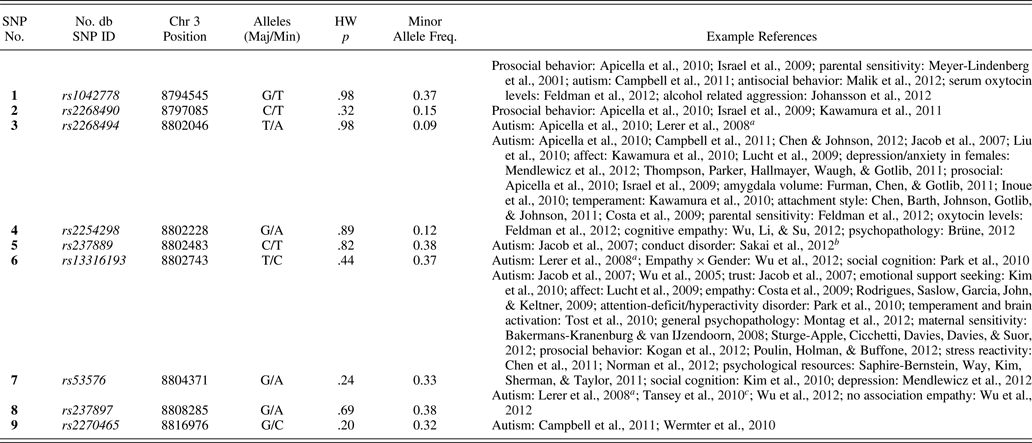
A candidate system that is related to the quality of social attachments, including parent–child interactions, and to the core characteristics of psychopathy is the oxytocin (OXT) system. OXT is a neuropeptide synthesized in hypothalamic cells that plays crucial roles in parturition and lactation (Gopal Rao, Loffler, Battey, & Hansmann, Reference Gopal Rao, Loffler, Battey and Hansmann1992), as well as in affiliative/prosocial behavior; it can be studied via circulating levels, via polymorphisms in the receptor gene (OXTR), and by manipulating endogenous levels via nasal sprays/injections. Evidence from each of these shows that OXT function is likely to characterize aspects of psychopathy: circulating blood levels are associated with affiliative/prosocial behavior; administration of OXT impacts perception of emotion, trust and generosity, and amygdala function, all known to be impaired in psychopathy (Meyer-Lindenberg, Domes, Kirsch, & Heinrichs, Reference Meyer-Lindenberg, Domes, Kirsch and Heinrichs2011). Some of the strongest evidence comes from genetic studies whereby several common polymorphisms of OXTR are reliably associated with phenotypic variations in sensitive parenting and parental bonding, social affiliation, empathy, trust, and their associated neural systems (Ebstein, Knafo, Mankuta, Chew, & Lai, Reference Ebstein, Knafo, Mankuta, Chew and Lai2012; see also Table 1).
OXTR SNPs used in this study and selected references
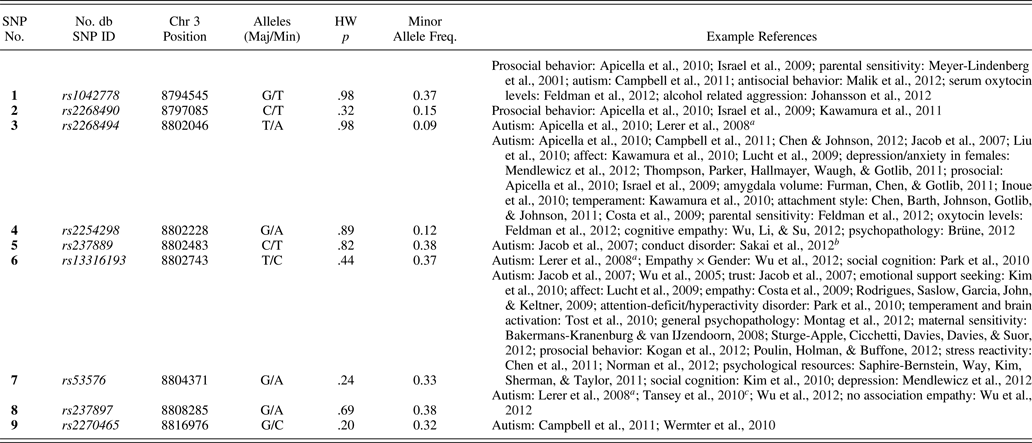
Note: OXTR, Oxytocin receptor gene; SNP, single nucleotide polymorphism; HW, Hardy–Weinberg equilibrium.
aThe haplotype for autism is rs237897-rs13316193-rs237889-rs2254298-rs2268494 according to Lerer et al. (Reference Lerer, Levi, Salomon, Darvasi, Yirmiya and Ebstein2008).
bSakai et al. (Reference Sakai, Crowley, Stallings, McQueen, Hewitt and Hopfer2012) found no relationship of 10 OXTR SNPS to conduct disorder, except the trend for rs237889.
cNull findings of OXTR SNPs and autism were found by Tansey et al. (Reference Tansey, Brookes, Hill, Cochrane, Gill and Skuse2010).
A number of authors have hypothesized a specific role for OXT in psychopathy (Bora, Yucel, & Allen, Reference Bora, Yucel and Allen2009; Dadds & Rhodes, Reference Dadds and Rhodes2008), and we recently proposed a model of psychopathy in which its common cognitive and affective deficits are associated with a differential activation of the central versus basolateral amygdala, in part driven by localized imbalanced operations of OXT and serotonin, respectively (Moul, Killcross, & Dadds, Reference Moul, Killcross and Dadds2012). Direct evidence of a role for OXT in psychopathy is scarce, however, and only recently have studies looked at associations of OXTR and CU traits or the genetics of CU traits more broadly. Viding et al. (Reference Viding, Hanscombe, Curtis, Davis, Meaburn and Plomin2010) conducted a genomewide scan on pooled DNA of 7-year-olds with low- versus high-psychopathic traits; several candidate single nucleotide polymorphisms (SNPs) were identified; however, none survived rigorous criteria for statistical significance, and none were related to known phenotypic characteristics of psychopathy. Using a targeted candidate gene approach, a study comparing CPs with healthy adolescents found no association between CPs and 10 SNPs of OXTR; however, the sample was not stratified by CU or psychopathic traits (Sakai et al., Reference Sakai, Crowley, Stallings, McQueen, Hewitt and Hopfer2012). Malik, Zai, Abu, Nowrouzi, and Beitchman (Reference Malik, Zai, Abu, Nowrouzi and Beitchman2012) compared three OXT and five OXTR SNPs across CPs and control children and found that CPs were associated with OXTR SNPs rs6770632 and rs1042778; however, no associations were found with levels of CU traits. Using the same sample, Beitchman et al. (Reference Beitchman, Zai, Muir, Berall, Nowrouzi and Choi2012) reported genotype and allele associations of high CU traits with the OXTR rs237885 AA variant and with the rs237885 A-rs2268493 A haplotype.
Thus, the Beitchman et al. (Reference Beitchman, Zai, Muir, Berall, Nowrouzi and Choi2012) analyses provide preliminary support that variations in OXTR are involved in developmental psychopathy; however, overall the results are mixed. This is not surprising given a number of methodological issues. First, CU traits covary with other indices of psychopathology, such as levels of CPs, hyperactivity, and autism, which is also characterized by disturbances of empathy and affiliation (Blair, Reference Blair2008), OXT serum levels (Modahl et al., Reference Modahl, Green, Fein, Morris, Waterhouse and Feinstein1998), polymorphisms of the OXTR (Gregory et al., Reference Gregory, Connelly, Towers, Johnson, Biscocho and Markunas2009; cf. Tansey et al., Reference Tansey, Brookes, Hill, Cochrane, Gill and Skuse2010), and behavioral changes following OXT infusion or ingestion (Bartz & Hollander, Reference Bartz and Hollander2008). Although frank diagnoses, such as autism, are often excluded (e.g., Beitchman et al., Reference Beitchman, Zai, Muir, Berall, Nowrouzi and Choi2012; Malik et al., Reference Malik, Zai, Abu, Nowrouzi and Beitchman2012), subclinical levels of autism have not been controlled in previous studies and may influence the results. Second, there is evidence that the OXTR allele frequencies vary considerably across ethnic groups (Ebstein et al., Reference Ebstein, Knafo, Mankuta, Chew and Lai2012); thus, rigorous specification of family ethnicity is critical. Third, the neural distribution and binding of the mammalian OXTR system is sensitive to regional regulation by gonadal steroids, and thus may be altered significantly across age, especially puberty (Insel, Young, Witt, & Crews, Reference Insel, Young, Witt and Crews1993). In similar fashion, the meaning and measurement of the CU traits construct is likely to vary across age and gender; thus, stratification by these variables may be important. Fourth, genetic association studies of complex traits have been notoriously difficult to replicate; therefore, testing the hypothesis across independent samples is crucial.
We tested the association of nine OXTR SNPs to CU traits, incorporating these methodological improvements in mind. Confirmation of this association could progress the scientific understanding of developmental aspects of psychopathy by (a) allowing our understanding of the development of CU traits in children to benefit from the growing scientific understanding of OXT function, (b) confirming the worth of pursuing measurement of OXT function with respect to the specific cognitive and affective impairments in psychopathy reviewed above, (c) improving the precision with which risk and protective environmental factors (e.g. parenting styles) can be identified for specific biological vulnerabilities, and (d) suggesting novel pathways to early intervention by linking the development of CU traits to the blossoming literature on OXT administration as an intervention to promote prosocial psychological functions. We hypothesized that in children with clinical level CPs, CU traits would be uniquely associated with OXTR polymorphisms, previously shown to be associated with deficits in empathic, prosocial skills, and circulating OXT levels.
Study 1: CBRC Sample of Urban Children
Methods
Participants
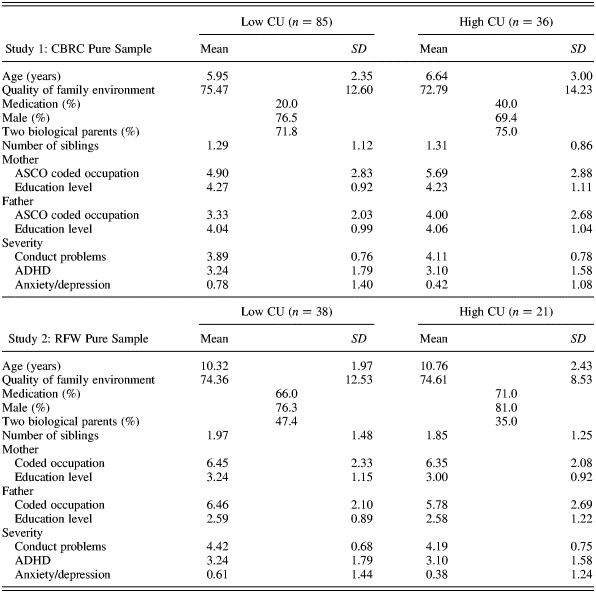
Ethics approval was from the University of New South Wales. Participants were N = 220 children referred to the University of New South Wales Child Behaviour Research Clinic (CBRC) in Sydney, Australia, for emotional and behavior problems. A subsample selected for analysis (n = 121) met the following criteria: (a) referral for assessment and management of disruptive behavior problems; (b) aged from 4 to 16 years; (c) no major neurological/physical illness; (d) IQ > 70; (e) meets formal criteria for DSM-IV diagnosis and severity rating (0–6, where >3 = frank diagnosis) of CPs (oppositional–defiant disorder [ODD], conduct disorder [CD]) using the Diagnostic Interview Schedule for Children, Adolescents, and Parents structured interview; (f) no clinical diagnosis or subclinical features of autism spectrum disorder; and (g) all known grandparents (≥3) of Caucasian background. Table 2 shows diagnostic and demographic data for this subsample.
Descriptive data on Study 1 CBRC and Study 2 RFW samples split by high versus low CU groups
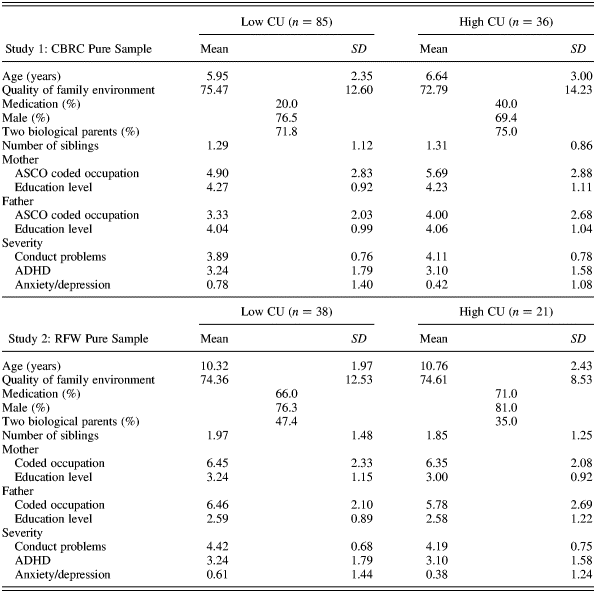
Note: Education level: 1 = primary school, 5 = university; ASCO coded occupation: 1 = highest professional, 10 = lowest. CBRC, University of New South Wales Child Behaviour Research Clinic; RFW, Royal Far West specialist health provider; CU, callous–unemotional traits; ASCO, Australian Standard Classification of Occupations; ADHD, attention-deficit/hyperactivity disorder.
Diagnostic procedures and measure
Diagnoses were made using DSM-IV criteria by the assessing psychiatrist/psychologist using the Diagnostic Interview Schedule for Children, Adolescents, and Parents (Holland & Dadds, Reference Holland and Dadds1997) with parents, and the child for those older than 8 years. Diagnoses were checked by having a second diagnostic team make an independent diagnosis. Kappa agreements on primary and secondary diagnoses were 0.772 and 0.770, respectively.
Level of CU traits was measured using the Antisocial Process Screening Device (Frick & Hare, Reference Frick and Hare2001) and the prosocial subscale of the Strengths and Difficulties Questionnaire (Goodman, Reference Goodman1997). This system produces reliable indices and has been extensively validated; more important, this system produces valid and stable measures of CU traits that predict the growth of CPs in children as young as 4 years (Dadds, Frost, Fraser, & Hawes, Reference Dadds, Frost, Fraser and Hawes2005; Dadds & Hawes, Reference Dadds and Hawes2006; Dadds & Rhodes, Reference Dadds and Rhodes2008). The measure is weighted toward the “callous” end of the CU spectrum, with a focus on items such as “unkind,” “lacks empathy,” and “doesn't care about other's feelings.” The DSM-5 proposal for a CU specifier to the diagnosis of CD (Frick & Moffitt, Reference Frick and Moffitt2010) suggests that CU traits be evident across settings; thus, we collected reports from mothers, fathers, teachers, and for children >9 years (mothers 92.4%, fathers 39.0%, teachers 51.1%, and youth 27.2%). All of these had good reliability (range α = 0.77–0.90), and correlations of mothers to other raters were father, r = .570, p < .001; teacher, r = .219, p < .001; and youths, r = .344, p < .01. There is considerable evidence to support the use of high versus low CU traits as a categorical variable, and the established cutoff for high CU traits in CP samples (Frick & Moffitt, Reference Frick and Moffitt2010) corresponds to the top one-third of CU traits scores in this sample and was used to designate “high CU” (Dadds, Cauchi, Wimalaweera, Hawes, & Brennan, Reference Dadds, Cauchi, Wimalaweera, Hawes and Brennan2012).
Adversity for the child was measured using the Quality of the Family Environment (Rey et al., Reference Rey, Singh, Hung, Dossetor, Newman and Plapp1997), a clinician rating scale of the lowest quality of family environment to which the child was exposed during a substantial period (at least 1 year) before the age of 12. Ratings were made by a second naive clinician on a subset of cases (r = .96).
Participants gave blood (52.5%) or saliva (or both for a smaller reliability check sample) via Oragene saliva collection kits (http://www.dnagenotek.com/). DNA extraction rates were >95% for both methods. Samples were genotyped for nine OXTR SNPS reported to be associated with CU-related traits from a literature search in early 2010 (see Table 1). Little is known about the functional significance of common SNPs of the OXTR system, and we were unable to develop a theoretical model about the individual or interactive contributions of any particular SNPs. Thus, we chose the SNPs based on those showing significant associations with cognate constructs to psychopathy (empathy, prosociality) and circulating OXT levels (Feldman et al., Reference Feldman, Zagoory-Sharon, Weisman, Schneiderman, Gordon and Maoz2012) in the existing literature. Genotypes were determined using iPLEX Gold™ primer extension followed by mass spectrometry analysis on the Sequenom MassARRAY system (Sequenom, San Diego, CA) by the Australian Genome Research Facility (http://www.agrf.org.au/).
Results
The associations of high versus average to low CU traits to genotype were tested with chi square for three-group and Fisher's exact test for two-group tests. We restricted the analyses to “per-genotype,” which test differences across the genotype groups without making any assumptions about the direction of the effect or the genetic model. Where occurrences of the minor homozygote were less than 5%, genotype analyses were conducted both with three groups and with the minor homozygote and the heterozygote combined into one group. Statistical significance levels for the testing of multiple comparisons were Bonferroni adjusted to maintain p = .05 across comparisons; thus, each of the nine SNPs was tested at .05/9 = .006, and each of the six haplotypes at .05/6 = .008. Effect sizes were calculated using phi and Cohen criteria (Cohen, Reference Cohen1992). All SNPs were in Hardy–Weinberg equilibrium (Table 1). We checked the equivalence of the high and low CU groups, and Table 2 shows data split by CU traits. There were no significant differences between the groups on these sociodemographic and adjustment measures.
Relationship of CU traits to individual SNPs and haplotype
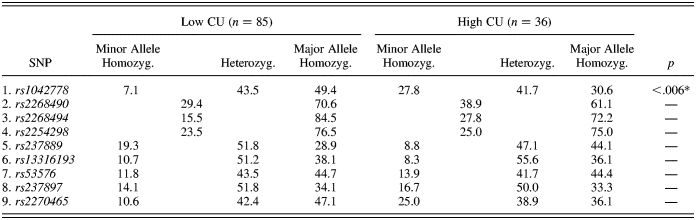
Table 3 shows frequencies of candidate SNP alleles across high and low CU groups. SNP1 (rs10427778) showed an association at Bonferroni adjusted levels, χ2 (2) = 10.38, p < .006, ϕ = 0.292, with the minor homozygote TT associated with high CU traits.
Percentages of specific alleles in Study 1 UNSW CBRC sample (n = 121) of the nine OXTR SNPs

Note: The number of single nucleotide polymorphisms (SNPs) for which the minor allele homozygotes and heterozygotes were combined to create adequate cell sizes for chi-squared analyses. UNSW CBRC, University of New South Wales Child Behaviour Research Clinic; OXTR, oxytocin receptor gene; CU, callous–unemotional traits.
*Significant using Bonferroni adjusted for nine chi-square tests.
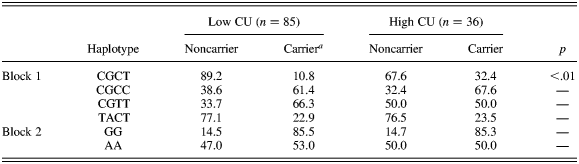
We determined the linkage disequilibrium (LD) block structure of OXTR with Haploview 4.2, using all SNPs with a minor allele frequency of >0.1 as input (SNP 3 omitted). We inferred haplotypes using the algorithm implemented by PHASE 2.1.1 for the two LD blocks with a D′ of > 0.8 observed in the gene. Figure 1a shows the LD blocks. Block 1 (SNPs 2, 4, 5, and 6) resulted in four haplotypes of sufficient frequency for analyses: CGCT, CGCC, CGTT, and TACT. Block 2 (SNPs 7 and 8) resulted in two haplotypes of sufficient frequency for analyses: GG and AA. Chi-squared tests in Table 4 show the frequency of haplotypes across high and low CU and gender. Block 1 haplotype CGCT showed a nominal association with CU traits at p = .01. Given that this haplotype block included SNPs in high LD with the SNP found to associate with CU traits in the Beitchman et al. (Reference Beitchman, Zai, Muir, Berall, Nowrouzi and Choi2012) study (Figure 1b), we carried it forward for testing in Study 2.
(Color online) (a) Linkage disequilibrium (LD) map for the oxytocin receptor gene single nucleotide polymorphisms (SNPs) after exclusion of marker 3. The left-hand panel shows the physical position of the SNPs with their LD structure below. Boxes are shaded according to the D′ values of the corresponding SNPs (red, D′ = 1; white, D′ = 0). The numbers in the boxes refer to D′ values × 100. The right-hand panel shows the haplotypes in LD Blocks 1 and 2 and their frequencies. (b) An LD map for the 14 oxytocin receptor gene SNPs for the current study plus Beitchman et al. (Reference Beitchman, Zai, Muir, Berall, Nowrouzi and Choi2012) and Malik et al. (Reference Malik, Zai, Abu, Nowrouzi and Beitchman2012) using genotype data from Northwestern European and British populations accessed via the 1000 Genomes Browser (http://browser.1000genomes.org/index.html).
Haplotype percentages for Study 1 UNSW CBRC sample split by high and low CU groups
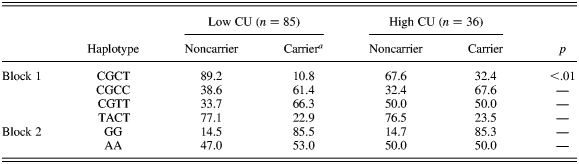
Note: UNSW CBRC, University of New South Wales Child Behaviour Research Clinic; CU, callous–unemotional traits. The p value indicates the probability significance from Fisher's exact test.
aCarrier indicates those subjects with at least one copy of the haplotype.
Study 2: Royal Far West (RFW) Sample of Rural Children
The replication sample was N = 175 children referred for emotional and behavioral problems to RFW, a specialist health provider for rural children from western New South Wales, the most populous state of Australia. Selection criteria and assessment procedures were exactly as described for Study 1 and, when applied, reduced the sample for testing to n = 59. Table 2 shows diagnostic and demographic data for this sample. Compared to those from Study 1, the children are older and more economically deprived. We checked the equivalence of the high and low CU groups. Apart from a trivial difference in the number of siblings, there were no differences between the groups.
Relationship of CU traits to individual SNPs and haplotypes
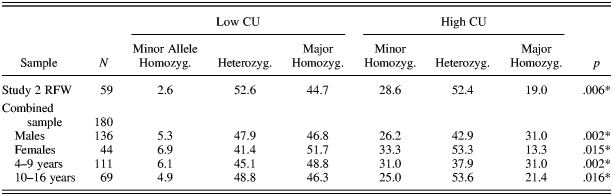
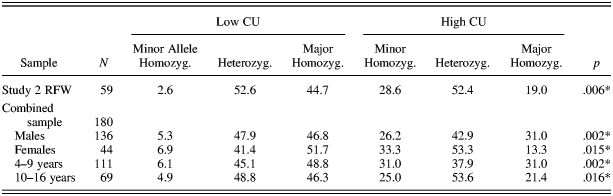
Table 5 shows frequencies of rs1042778 SNP alleles across high and low CU groups. There was a significant association, χ2 (2) = 10.18, p < .006, ϕ = 0.415, and, similar to Study 1, the minor homozygote TT was associated with high CU traits. We were unable to replicate the finding from Study 1 of an association between Block 1 haplotype CGCT and CU traits (p > .1).
Percentages of specific alleles of rs1042778 in the Study 2 Royal Far West (RFW) replication sample and combined Study 1 and Study 2 sample (n = 180) split by gender and age group
Note: CU, callous–unemotional traits.
*p < .05.
The Combined Sample: Generalizability of the Association
Given replication of the association between rs1042778 and high CU traits in both urban and rural samples, we combined the samples to give sufficient power to confirm the generalizability of the association across gender and age groups. This produced a total sample of N = 180 with all diagnostic and ethnic restrictions described above in place. We examined the distribution of puberty by age in the combined sample using the Pubertal Development Scale (Petersen, Crockett, Richards, & Boxer, Reference Petersen, Crockett, Richards and Boxer1988). Few children reported any pubertal development prior to 8 years; however, substantial numbers of the sample reported signs of pubertal development at 9+ years, so the sample was split into two groups: 4–9 years (n = 111) and 10–16 years (n = 69).
Table 5 shows rs1042778 allele frequencies for the combined sample broken down by gender and age group. The significant association between the minor homozygote and high CU traits remained across gender (ϕ male = 0.305, female = 0.438) and age (ϕ younger = 0.334, older = 0.342) subgroups.
Relationship of the Current Findings to Previous Studies
Our selection of SNPs for analysis predated the Beitchman et al. (Reference Beitchman, Zai, Muir, Berall, Nowrouzi and Choi2012) and Malik et al. (Reference Malik, Zai, Abu, Nowrouzi and Beitchman2012) studies, and thus, our choices only partially overlap. In order to help interpret patterns across samples, we determined the linkage structure of SNPs analysed in this study in relation to those analysed by Malik et al. (Reference Malik, Zai, Abu, Nowrouzi and Beitchman2012) and Beitchman et al. (Reference Beitchman, Zai, Muir, Berall, Nowrouzi and Choi2012) using genotype data from Northwestern European (CEU) and British (GBR) populations accessed via the 1000 Genomes Browser (http://browser.1000genomes.org/index.html). Figure 1a shows the LD structure for the eight SNPs used in the current study and Figure 1b shows the LD structure for OXTR gene SNPs from all three studies combined using the CEU and GBR populations.
Discussion
Early-onset behavioral problems are a robust predictor of a range of adult problems. The presence of high CU traits, a developmental analogy of adult psychopathy, specifies a relatively homogenous subgroup. High CU traits appear to be associated with relatively low or more circumscribed environmental susceptibility, and much attention has been drawn to the biological aspects of core characteristics, such as low empathy and poor emotion recognition. There are good reasons to hypothesize that disturbances in OXT function may characterize these traits, and the differential amygdala activation model (Moul, Killcross, & Dadds, Reference Moul, Killcross and Dadds2012) specifies that low OXT function in the central amygdala may be associated with the cognitive and affective impairments in psychopathy. Evidence exists that variations in the OXTR system may characterize children with high CU traits; however, the results are mixed. As with so many genetic association findings, replication of any association is lacking.
We tested the association in two samples of CP children. The rs1042778 genotype TT was associated with high levels of CU traits in both samples. After pooling the samples to increase power to test subgroups, this genotype was associated with high CU traits in both genders and age groupings. This variant has previously been shown to be associated with a range of traits relevant to psychopathy, including prosociality, autism, interpersonal sensitivity, aggressive/antisocial behavior, and serum OXT levels (Campbell et al., Reference Campbell, Datta, Jones, Lee, Sutcliffe and Hammock2011; Feldman et al., Reference Feldman, Zagoory-Sharon, Weisman, Schneiderman, Gordon and Maoz2012; see Table 1). This SNP is located in the 3′ untranslated region of the OXTR gene. As noted by Israel et al. (Reference Israel, Lerer, Shalev, Uzefovsky, Riebold and Laiba2009), these untranslated regions often contain regulatory elements that control spatial and temporal expression of a messenger RNA. They suggest that this SNP may play an important regulatory role in OXTR transcription and translation. It is important that Feldman et al. (Reference Feldman, Zagoory-Sharon, Weisman, Schneiderman, Gordon and Maoz2012) found that the risk allele of this SNP was associated with lower circulating OXT levels.
The association of this SNP with high CU traits broadly replicates previous findings showing this variant is associated with prosocial and aggressive behavior (Table 1). With regard to the development of psychopathy specifically, the results replicate the findings of Beitchman et al. (Reference Beitchman, Zai, Muir, Berall, Nowrouzi and Choi2012) that polymorphisms of OXTR characterize CU traits in children with behavior problems. The specific polymorphisms found to associate with CU traits, however, differ across these studies and warrant some discussion. Beitchman et al. (Reference Beitchman, Zai, Muir, Berall, Nowrouzi and Choi2012) found an association of CU to rs237885, which we did not test. Using the same sample as Beitchman et al. (Reference Beitchman, Zai, Muir, Berall, Nowrouzi and Choi2012) and Malik et al. (Reference Malik, Zai, Abu, Nowrouzi and Beitchman2012) found no association of rs1042778 to CU traits, but found that this SNP differentiated the aggressive group from controls; contrary to expectations however, the major allele was associated with more aggression. Our finding that the minor homozygote is associated with CU traits is consistent with Israel et al. (Reference Israel, Lerer, Shalev, Uzefovsky, Riebold and Laiba2009), where it was associated with lower levels of prosocial behavior.
To help integrate our findings with these previous studies, we determined the LD structure of all SNPs used in this and the studies by Malik et al. (Reference Malik, Zai, Abu, Nowrouzi and Beitchman2012) and Beitchman et al. (Reference Beitchman, Zai, Muir, Berall, Nowrouzi and Choi2012) using genotype data from CEU and GBR populations accessed via the 1000 Genomes Browser. The combined LD structure helps clarify these discrepancies. Recall that Beitchman et al. (Reference Beitchman, Zai, Muir, Berall, Nowrouzi and Choi2012) reported an association of high CU traits with OXTR rs237885; this SNP is in strong LD with 4 SNPs included in our Block 1 haplotype in the current study, from which one haplotype differentiated low and high CU trait groups in Study 1. Second, rs237885 is in moderate LD (D′ = 0.71) with rs1042778, the significantly associated SNP from the current study, and indicates that common variance may underlie their individual association with CU traits.
Given the rather primitive state of knowledge about LD patterns and the functional significance of these common polymorphisms of OXTR, we are cautious about making more precise interpretations. Until more is known about the functionality of the specific polymorphisms, we are inclined to emphasize associations at the level of gene or its substructures (promoter, intron, exon, and untranslated regions; Ebstein et al., Reference Ebstein, Knafo, Mankuta, Chew and Lai2012; Gimpl & Fahrenholz, Reference Gimpl and Fahrenholz2001) rather than specific SNPs. We, thus, offer the conclusion that the existing evidence shows that polymorphic variations of OXTR, both within intron (rs237885) and 3′ untranslated regions (rs1042778), differentiate both aggressive versus control samples of children and the presence of high CU within the aggressive group.
Phi effect sizes for the chi square of the association between rs1042778 and high versus low CU traits varied from 0.292 using the Study 1 urban sample to a maximum of 0.438 for the females in the combined sample. These phi values correspond to moderate to large effect sizes using Cohen criteria. Large effect sizes are inconsistent with the growing consensus that common variations in genetic structures are likely to contribute only small amounts of variance to complex phenotypes such as CU traits (Crow, Reference Crow2011; McCarthy et al., Reference McCarthy, Abecasis, Cardon, Goldstein, Little and Ioannidis2008). Thus, the effect sizes detected here are likely to be an overestimate of the “true” contribution of the SNP to CU traits.
The effect size of the contribution of rs1042778 to CU traits is also illustrated by the relative occurrence of the minor homozygote in low versus high CU groups: on average 1 in 20 of the low CU group versus 1 in 4 in the high CU group. Although this is a large effect size, it shows that there is still much variation within the high CU trait group, and the presence of the minor homozygote is by no means a necessary condition for high CU traits. We interpret this as showing that the CU traits phenotype still contains much variance as measured and that variations in this SNP are likely to be one of a number of variations in the OXT and other neural systems that can infer risk.
Limitations
There are several limitations of this study that should be noted. The sample size (largest N = 180) is small for genetic association studies and precludes the detection of small effect sizes that may have been present for other SNPs, or interactions between SNPs. There was incomplete overlap of our SNP selection with the previous studies of OXTR and CU traits that came out last year (Beitchman et al., Reference Beitchman, Zai, Muir, Berall, Nowrouzi and Choi2012; Malik et al., Reference Malik, Zai, Abu, Nowrouzi and Beitchman2012), and although our use of a third database that contained all common SNPs helped clarify the LD structure of the SNPs that were analyzed in these studies, this makes conclusions about exact replication difficult. Inconsistent selection of SNPs from the total available OXTR variants could be improved by future researchers comprehensively assessing the OXTR gene in larger samples. CU traits were measured using mother reports; these were shown to converge with father, teacher, and youth reports. However, the final reliance of mother groupings into high versus low CU groups should be noted. Population stratification is a common problem for genetic case-control methods. We were relatively rigorous by measuring ethnicity in grandparents and only including cases where all known (≥3) grandparents were Caucasian. This minimizes likely problems of stratification but cannot entirely remove them, as some stratification may still occur within the Caucasian samples.
Finally, the vast majority of this CP sample had ODD; only 10% met full criteria for CD. Thus, the association of the OXT SNP to CU traits reliably held for ODD children; however, we were underpowered to analyze for those specifically with CD. We would argue that this is not a critical issue. The sample showed considerable overlap in these diagnoses, such that many children with ODD had features of CD, and almost all children with CD met criteria for ODD. Further, CU traits is a moderator of etiological and treatment outcome in a range of samples where diagnoses are many and varied. For example, Dadds et al. (Reference Dadds, Cauchi, Wimalaweera, Hawes and Brennan2012) showed that CU moderates treatment outcomes across a range of psychiatric diagnoses. A recent review also covered the growing evidence for the broad applicability of CU as a moderator of etiology and treatment outcomes, especially in ODD (Herpers, Rommelse, Bons, Buitelaar, & Scheepers, Reference Herpers, Rommelse, Bons, Buitelaar and Scheepers2012). Notwithstanding, it is a limitation of the study that we were unable to test the association specifically for children with frank diagnoses of CD.
Conclusion
In conclusion, there has been interest in using exogenous OXT for improving trust, emotion recognition, empathy, and related skills for various psychiatric conditions (Ebstein et al., Reference Ebstein, Knafo, Mankuta, Chew and Lai2012; Meyer-Lindenberg et al., Reference Meyer-Lindenberg, Domes, Kirsch and Heinrichs2011). The current results are broadly supportive of a role for targeting the OXT system in interventions for psychopathy, although this needs to be offered cautiously. First, OXT has specific central effects; for example, exogenous OXT decreases amygdala responsiveness (Meyer-Lindenberg et al., Reference Meyer-Lindenberg, Domes, Kirsch and Heinrichs2011), and it has been argued that this might propel behavior in the same direction as some of the core deficits in psychopathy (Blair, Reference Blair2011). By our differential amygdala activation model (Moul, Killcross, & Dadds, Reference Moul, Killcross and Dadds2012), however, OXT-mediated reductions in central amygdala activity would reduce cognitive impairments associated with psychopathy. Second, the current data show CU traits are associated with a risk allele of the OXTR system, previously shown to be associated with low circulating OXT (Feldman et al., Reference Feldman, Zagoory-Sharon, Weisman, Schneiderman, Gordon and Maoz2012). It is impossible to know at this point how artificial increases in peripheral or central OXT, for example as delivered by nasal spray, would affect the relevant neural systems given these receptor differences. Notwithstanding this caveat, the current data suggest the possibility that pharmacogenetic, behavioral, and social attachment strategies that impact the OXT system may be worthy of investigation as means of remediating some of the negative emotional/empathic traits associated with the development of psychopathy.