Introduction
Subjective memory impairment (SMI) refers to conditions in which people complain about memory problems in the absence of cognitive impairment. Previous studies have reported that 20–50% of community-dwelling older adults complain memory problems (Jonker et al., Reference Jonker, Launer, Hooijer and Lindeboom1996; Park et al., Reference Park, Min, Min, Lee, Lee and Song2007). The prevalence of memory complaints appears to increase sharply with advancing age. In a community sample, memory complaints increased from 43% in people aged 65–74 years to 88% in those aged over 85 years (Larrabee and Crook, Reference Larrabee and Crook1994).
Early research on SMI grew out of clinical concern that SMI might be an early sign of ongoing cognitive decline resulting from neurodegeneration. Indeed, there have been reports that people with SMI showed more cognitive decline during the follow-up period than those without SMI (Schmand et al., Reference Schmand, Jonker, Hooijer and Lindeboom1996; Geerlings et al., Reference Geerlings, Jonker, Bouter, Ader and Schmand1999). In addition, according to Edwards et al. (Reference Edwards, Lindquist and Yaffe2004), 65% of 182 patients who visited the Alzheimer's Disease Research Center in California with memory complaints but were found to have normal neuropsychological function had progressed to mild cognitive impairment (MCI) or dementia at follow-up (average time to follow-up: 1.9 ± 1.3 years). Autopsy studies also reported significant correlations between SMI and the pathological findings of Alzheimer's disease (AD; Barnes et al., Reference Barnes, Schneider, Boyle, Bienias and Bennett2006), further supporting the hypothesis that SMI is an early sign of cognitive decline or dementia.
Researchers have also explored the role of psychological factors in subjective memory complaints among older adults. Even though depressive mood in older adults is frequently related with deficits of cognitive functions such as executive function, speed of information processing, and memory, depression or negative affect has been mentioned as a key factor in SMI (Kahn et al., Reference Kahn, Zarit, Hilbert and Niederehe1975; Smith et al., Reference Smith, Petersen, Ivnik, Malec and Tangalos1996; Jorm et al., Reference Jorm2004). For instance, Kahn et al. (Reference Kahn, Zarit, Hilbert and Niederehe1975) reported that the relationship between depressive mood and subjective memory complaints was stronger than that between objective memory performance and subjective memory complaints. Fischer et al. (Reference Fischer2008) also reported that elderly people who were diagnosed with major depressive disorder complained more severely about memory decline and language errors than those without depression, even though there were no significant differences between the two groups in objective memory performance.
Certain psychological characteristics, such as neuroticism, conscientiousness, and self-esteem, have also been found to be associated with SMI (Hanninen et al., Reference Hanninen1994; Pearman and Storandt, Reference Pearman and Storandt2004). High levels of neuroticism and low levels of conscientiousness, for example, have been reported to be related to more severe complaints of memory problems (Pearman and Storandt, Reference Pearman and Storandt2004). Another psychological characteristic that might be involved in SMI is self-focused attention, which is defined as “awareness of self-referential and internally generated information” (Ingram, Reference Ingram1990). Self-focused attention has been reported to be related to the intensification and persistence of affective disorders such as depression (Wood et al., Reference Wood, Saltzberg, Neale, Stone and Rachmiel1990; Watkins and Teasdale, Reference Watkins and Teasdale2004). It has also been known to be related to both complaints and chronicity of medically unexplained physical symptoms (Brown, Reference Brown2004). Thus, it is possible that self-focused attention contributes to memory complaints in a similar way, that is, by bringing attention to experiences of memory failures.
To summarize, it appears that both real cognitive change due to aging or neurodegeneration and psychological factors are likely to be involved in subjective memory complaints. However, so far very little research attention has been paid to the specific mechanisms of the interactions between cognitive change and psychological factors that produce the subjective experience of memory complaints. It is likely that people with subjective memory complaints might represent a heterogeneous group with varying degrees of cognitive impairment and psychological vulnerability. For some people, the subjective memory complaints might primarily reflect actual memory decline due to aging or neurodegenerative processes, while for others psychological factors play a major role with minimal actual memory decline.
The primary objective of the present study was to examine the role of psychological factors in SMI. Specifically, it was hypothesized that self-focused attention and depressive symptomatology would significantly contribute to the severity of memory complaints, and that their contribution would remain significant even after objective memory performance was statistically controlled. In addition, it was also hypothesized that the interaction between objective memory performance and psychological factors would be significant so that the effect of self-focused attention or depressive symptomatology on SMI would be stronger in those patients with little actual memory decline.
Methods
Participants
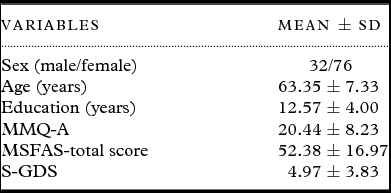
A total of 108 patients with normal cognitive function who visited a memory disorder clinic in a general hospital located in Seoul, Korea between December 2009 and March 2011 were recruited to participate in the study. All participants were over 50 years old and met the following inclusion criteria: (1) memory problems as their chief complaint, (2) normal cognitive functioning confirmed by comprehensive neuropsychological testing, (3) no history of medical diseases likely to affect cognitive function, (4) no evidence of obvious structural brain damage on MRI, and (5) no significant impairments in activities of daily living assessed by the Seoul-Instrumental Activities of Daily Living (Ku et al., Reference Ku2004). Participants with fewer than six years of education were excluded from the sample because participation in the study required filling out self-report inventories. We did not exclude the participants who were above the cut-off score on the Geriatric Depression Scale. Demographic characteristics of the sample are presented in Table 1.
Mean scores of demographic and psychological variables

Note: MMQ-A: Multifactorial Memory Questionnaire-Ability; MSFAS: Maladaptive Self-Focused Attention Scale; S-GDS: Short version of Geriatric Depression Scale.
Measurements
Subjective memory complaints
The modified Multifactorial Memory Questionnaire-Ability subscale (MMQ-A; Troyer and Rich, Reference Troyer and Rich2002) was used to assess self-appraisal of memory function. The original MMQ consists of 57 items divided into the following three subscales: (1) contentment with current memory function (MMQ-C), (2) self-appraisal of current memory ability in everyday life (MMQ-A), and (3) usage of memory strategies for compensation (MMQ-S). The MMQ-A subscale, which consists of 20 items assessing memory lapses in everyday life such as forgetting appointments, names of people, and locations of items, was used as a measure of subjective memory complaints. A lower score on the MMQ-A subscale indicates more severe subjective memory complaints. In this study, the MMQ-A response scale was modified from the original 5-point scale to a 3-point scale in order to make the questionnaire more accessible to elderly respondents (Chin et al., Reference Chin, Oh, Seo, Shin and Na2010). Cronbach's α for MMQ-A in the present study data was excellent (α = 0.928).
Neuropsychological tests
Since delayed recall has been known to be the most sensitive measure of early memory decline (Welsh et al., Reference Welsh, Butters, Hughes, Mohs and Heyman1992), delayed recall score on the Seoul Verbal Learning Test (SVLT; Kang and Na, Reference Kang and Na2003) was used as a measure of participants’ objective memory performance. Participants were also assessed for other neuropsychological functions, including attention, language, visuoconstructive function, and frontal-executive function. Attention was evaluated with the digit span test (forward and backward), language was assessed with the Korean version of the Boston Naming Test (K-BNT; Kim and Na, Reference Kim and Na1999), and visuospatial function was measured with the Rey Complex Figure Test (RCFT; Rey, Reference Rey1941). Finally, frontal-executive function was assessed using the Controlled Oral Word Association Test, the semantic generative naming test (animal item), and the color reading task (112 items in two minutes) on the Korean Color-Word Stroop test (Lee et al., Reference Lee, Kang and Na2000).
Self-focused Attention
The Maladaptive Self-Focused Attention Scale (MSFAS; Jung and Oh, Reference Jung and Oh2004) was used to assess self-focused attention. The scale comprises 23 items with three subscales: rumination, consciousness of others, and self-absorption. Each item was rated on a 5-point scale. A high score indicates a high level of maladaptive self-focused attention. In this study, Cronbach's α for the scale was 0.947.
Depressive symptomatology
The Korean version of the Geriatric Depression Scale-Short Form (S-GDS; Cho et al., Reference Cho1999) was used to evaluate depressive mood. Respondents answered each of the 15 items with a “Yes” or “No” response. A high score signifies a more severe depressive mood. Internal consistency using Cronbach's α was 0.86 in this study.
Statistical analyses
First, correlation analyses were conducted to examine how the severity of subjective memory complaints is related to the actual cognitive performance on neuropsychological tests and psychological variables such as self-focused attention and depressive symptomatology. Second, hierarchical multiple regression analyses were conducted to examine whether self-focused attention and depressive symptomatology account for the severity of subjective memory complaints (total score on the MMQ-A subscale) after controlling demographic variables and objective memory performance, and whether these variables moderate the relationship between objective memory performance and the severity of SMI. In model 1, demographic data such as age, education, and sex were entered. The SVLT delayed recall Z-score representing objective memory performance was added in model 2. In model 3, self-focused attention (MSFAS) and depressive symptomatology (S-GDS) variables were added as independent variables. In model 4, interaction terms between the MSFAS and the SVLT delayed recall Z-score and between the S-GDS and the SVLT delayed recall Z-score were added in the model.
Results
Neuropsychological performances of SMI patients
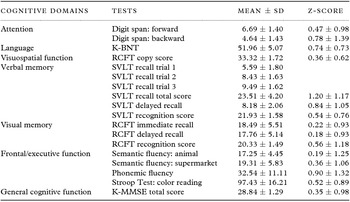
All participants performed within the normal range on all neuropsychological tests, scoring higher than the demographically corrected mean score minus 1 SD. Participants’ performances were converted to Z-scores using the Korean norms for these tests (Kang and Na, Reference Kang and Na2003). Mean raw scores and Z-scores of all neuropsychological tests are presented in Table 2.
Mean scores and standard deviations of raw scores and Z-scores of neuropsychological tests

Note: K-MMSE: Korean version of Mini-Mental State Examination; K-BNT: Korean version of Boston Naming Test; RCFT: Rey Complex Figure Test; SVLT: Seoul Verbal Learning Test.
Correlation between subjective memory complaints and study variables
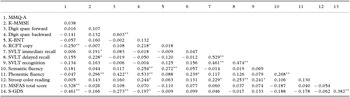
In the correlation analysis with all 108 SMI patients, the MMQ-A score was not significantly correlated with any of the neuropsychological test results except for the copy of the RCFT (r = −0.250, p < 0.01). On the other hand, the MMQ-A showed a significant negative correlation with the MSFAS (r = −0.328, p < 0.01) and the S-GDS (r = −0.461, p < 0.01). The delayed recall of the SVLT, a measure of objective verbal memory performance, was not significantly correlated with the MSFAS and the S-GDS. The MSFAS did not have a significant correlation with any neuropsychological tests, whereas the S-GDS had a significant correlation with the digit span forward (r = −0.273, p < 0.01) and backward (r = −0.197, p < 0.05). The correlation between the MSFAS and the S-GDS was also significant (r = 0.382, p < 0.01). Results of the correlation analysis are presented in Table 3.
Correlation between MMQ-A, neuropsychological tests, and psychological scales

Notes: *p < 0.05, **p < 0.01.
MMQ-A: Multifactorial Memory Questionnaire-Ability; K-MMSE: Korean version of Mini-Mental State Examination; K-BNT: Korean version of Boston Naming Test; RCFT: Rey Complex Figure Test; SVLT: Seoul Verbal Learning Test; MSFAS: Maladaptive Self-Focused Attention Scale; S-GDS: Short version of Geriatric Depression Scale.
Hierarchical regression analysis
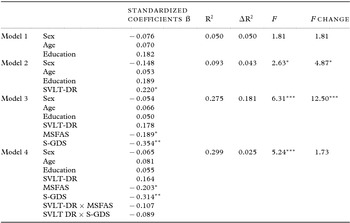
The regression coefficients of variables and the model summaries of the hierarchical regression analysis are presented in Table 4. In model 1, where the demographic variables such as age, sex, and years of education were entered as independent variables, neither the model nor any of the independent variables came out significant, F(3, 103) = 1.81, ns. Model 2 with a Z-score of delayed recall of the SVLT accounted for an additional 4% of variance in the MMQ-A score, F(1, 102) = 4.87, p < 0.05, with a total of 9% of variance of the MMQ-A accounted for, F(4, 102) = 2.63, p < 0.05. In model 3, the MSFAS and the S-GDS were added as independent variables, and the model accounted for an additional 18% of variance of the MMQ-A, F(2, 100) = 12.50, p < 0.001, with a total of 27.5% of variance of the MMQ-A score accounted for, F(6,100) = 6.31, p < 0.001. When the MSFAS × SVLT and S-GDS × SVLT interactions were added in model 4, there was no significant increase in the variance of the MMQ-A accounted for, F(2, 98) = 1.73, ns, with a total of 29.9% of variance of the MMQ-A score accounted for, F(8, 98) = 5.24, p < 0.001.
Regression coefficients and model summary of hierarchical regression analysis

Notes: *p < 0.05; **p < 0.01; ***p < 0.001.
SVLT-DR: Seoul Verbal Learning Test delayed recall; MSFAS: Maladaptive Self-Focused Attention Scale; S-GDS: Short version of Geriatric Depression Scale.
Discussion
The results of our study showed that self-focused attention and depressive symptomatology were important predictors of subjective memory complaints. The correlation analysis revealed that the MMQ-A score, representing the severity of SMI, showed significant association with the MSFAS and S-GDS scores, but not with most neuropsychological test scores. Even though the correlation between the MMQ-A and the copy of the RCFT was significant, this correlation revealed that scores on the RCFT became higher as memory complaints grew more severe. Hierarchical multiple regression analysis revealed that the predictive values of the MSAFS and S-GDS scores were significant over and above the contribution of demographic variables and objective memory performance. Objective memory performance did add a small but significant contribution to SMI over and above demographic factors, but its predictive value became insignificant when self-focused attention and depressive symptomatology variables were added in models 3 and 4. Self-focused attention and depressive symptomatology contributed about 18% of variance in memory complaints compared with only 4% unique variance attributed to the objective memory performance in model 3. These results are consistent with the findings of previous studies supporting the importance of psychological factors in SMI (Kahn et al., Reference Kahn, Zarit, Hilbert and Niederehe1975; Hanninen et al., Reference Hanninen1994; Smith et al., Reference Smith, Petersen, Ivnik, Malec and Tangalos1996; Jorm et al., Reference Jorm2004; Pearman and Storandt, Reference Pearman and Storandt2004).
Depression has received considerable research attention as an important factor in determining the severity of SMI (Kahn et al., Reference Kahn, Zarit, Hilbert and Niederehe1975; Schofield et al., Reference Schofield, Jacobs, Marder, Sano and Stern1997; Fischer et al., Reference Fischer2008), and various possibilities have been suggested for the specific causative mechanism. For instance, the elderly individuals might become depressed and start complaining about their memory problems as a result of actual memory decline due to either natural aging or pathological reasons (Sinoff and Werner, Reference Sinoff and Werner2003). In the present study, depressive symptomatology was significantly correlated with certain neuropsychological tests assessing attention (digit span), suggesting that actual cognitive decline might have preceded depression. Furthermore, when we did supplemental comparison between the neuropsychological performances of the patients whose GDS scores were above the suggested cut-off point (8) (n = 21) and those of the patients whose GDS scores were below the cut-off score (n = 87), the patients with upper GDS scores showed significantly lower performances on the digit span forward, F(1, 105) = 10.07, p < 0.01, RCFT immediate recall, F(1, 105) = 5.308, p < 0.05, and phonemic generative naming test, F(1, 105) = 4.380, p < 0.05, after controlling the years of education. The result of further analysis also suggested that patients with depressive mood could show worse cognitive function in attention, memory, and executive functions. Conversely, it is also possible that depressive symptomatology contributed to the negative appraisal of memory performance. Therefore, the future study is necessary to figure out the specific causal relationship between depressive mood and subjective memory complaints.
Another important predictor of SMI that emerged in the present study is self-focused attention. Psychological characteristics such as neuroticism, conscientiousness, and self-esteem have been found to be associated with SMI (Hanninen et al., Reference Hanninen1994; Jorm et al., Reference Jorm2004; Pearman and Storandt, Reference Pearman and Storandt2004), but very few studies have examined self-focused attention as a psychological characteristics related to SMI. However, Jorm et al. (Reference Jorm2004) analyzed a personality characteristic similar to self-focused attention, the ruminative style, defined as the tendency to passively focus on negative emotions and their meaning, and reported its association with people with memory complaints in a community sample aged 60–64 years. They suggested that individuals who had a ruminative style tended to dwell on and misinterpret memory lapses that were due to natural aging processes and came to mistake themselves as having memory problems. Maladaptive self-focused attention might also be involved in a consolidation process of negative self-appraisal of memory function in a manner similar to the negative feedback loop explaining depression (Carver and Scheier, Reference Carver and Scheier1990). Furthermore, maladaptive self-focused attention might also prompt the overgeneralization of negative autographical memory (Watkins and Teasdale, Reference Watkins and Teasdale2004), that is, people with higher maladaptive self-focused attention might overgeneralize common experiences of memory lapses as consistent and repetitive memory problems.
It was hypothesized that people with subjective memory complaints might represent a heterogeneous group with varying degrees of cognitive impairment and psychological vulnerability. For some people, the subjective memory complaints might primarily reflect actual memory decline due to aging or neurodegenerative processes, while for others psychological factors play a major role with minimal actual memory decline. Therefore, it could be hypothesized that actual memory decline and psychological factors interact with each other to determine the severity of subjective memory complaints. Specifically, it was hypothesized that depressive symptomatology and self-focused attention would have a greater impact on SMI in the patients with little decline in objective memory performance compared with the patients with greater decline in objective memory performance. However, contrary to our expectation, neither the SVLT × S-GDS interaction nor the SVLT × MSFAS interaction was significant. Thus, the predictive power of depressive symptomatology and self-focused attention for the severity of SMI appears to be similar regardless of the range of objective memory performance. However, it should be noted that participation in the present study was limited to those with neuropsychological functioning in the normal range, and as a result the spectrum of objective memory performance is likely to have been fairly limited. With a more heterogeneous sample in terms of objective memory performance, we might have obtained significant results for depressive symptomatology × objective memory performance and/or self-focused attention × objective memory performance, as hypothesized. Further research is necessary to clarify these issues.
To summarize, the findings from the present study highlight the important roles of self-focused attention and depressive symptomatology in subjective memory complaints. Such information will provide useful insight into the developmental process of subjective memory complaints. It will also prove valuable in the process of designing effective intervention strategies for those distressed with SMI. Subjective concern over memory failures is a fairly common experience shared by clinical patients and community samples. Since participation in the current study was restricted to patients with SMI who visited the memory clinic of a general hospital, it is not clear whether these findings can be generalized to community samples. Further study with a community sample will be necessary to answer this question. In addition, in the present study we could not differentiate between the patients who visit the memory clinic spontaneously and the patients directed by significant others. Patients who were directed to a clinic by relatives or family members could have worse cognitive performance than patients who visited on their own, even though their baseline performances were within normal range. If we are be able to perform the prospective future study with the information about referral, we can figure out more valuable findings about specific characteristics of SMI. Furthermore, other possible factors like anxiety level should be included in the future study to make a more comprehensive model for SMI.
Conflict of interest
None
Description of authors’ roles
Juhee Chin designed the study, carried it out, analyzed the data, and wrote the paper. Kyung Ja Oh designed the study, supervised the data analysis, and wrote the paper. Sang Won Seo and Duk L. Na supervised the data collection.