THE TEA PARTY STEEPING
In the popular imagination, the Tea Party was born in February of 2009 when Rick Santelli chastised economic bailouts. “How many of you want to pay for your neighbor’s mortgage that has an extra bathroom, and can’t pay their bills?” he asked (Santelli Reference Santelli2009). Based on opposition to stimulus packages, and on growing economic angst, Santelli’s rant vent viral. Soon thereafter Tea Party protests were held in 40 states while the movement claimed 300,000 members. Though formal membership numbers remain low, some claim that close to a quarter of the US electorate supports the movement or evaluates the Tea Party warmly (Barreto et al. Reference Barreto, Cooper, Gonzalez, Parker and Towler2011; Maxwell and Parent Reference Maxwell and Parent2013).
THE MOTIVATION FOR MEMBERSHIP: ECONOMICS, OBAMA, RACE, AND RELIGION
While the stated mission of the Tea Party emphasizes fiscal responsibility and traditional interpretations of the Constitution, some argue that these public positions are masks for racial animus (Enck-Wazner Reference Enck-Wazner2011; Hofstader Reference Hofstader1964, Reference Hofstader1965; Parker and Barreto Reference Parker and Barreto2013, Stan Reference Stan2010). To many, the timing of initial Tea Party protests suggest a racial backlash against President Obama (Maxwell and Parent Reference Maxwell and Parent2012). Williamson and Skocpol (Reference Williamson and Skocpol2013) suggest that Obama is emblematic of Tea Party fears that society is changing. The mantra, “Take our Country Back,” reverberates from a sense of cultural defeat (see also Pease Reference Pease2010 and Abramowitz Reference Abramowitz2014; Parker and Barreto Reference Parker and Barreto2013; Tope, Pickett, and Chiricos Reference Tope, Pickett and Chiricos2015). Others argue that Tea Party activists often define themselves “in opposition to categories of non-workers they perceive as undeserving of government assistance” (Williamson, Skocpol, and Coggin Reference Williamson, Skocpol and Coggin2011, 32). If Tea Party membership is motivated by racial fears, recent scholarship suggests that racial stereotypes, or “old-fashioned racism,” may be a factor. Tesler (Reference Tesler2013) demonstrated that stereotypes of African Americans as lazy, untrustworthy, and unintelligent returned in the post-Obama era.
In addition to economic, racial, and anti-Obama motivations, some have suggested that religion factors prominently into the Tea Party ideology. Brody (Reference Brody2012), for example, identifies key issues on which Tea Party members and Christian fundamentalists make close bedfellows. For example, numerous biblical passages support fiscal responsibility while rhetoric about protecting the Constitution is understood as support for religious freedom. Similarly, affirmations of the principles espoused by the founders is code for reclaiming America’s Judeo-Christian heritage (Wilson and Burack Reference Wilson and Burack2012).
THE REASON FOR REGION
While the relationships between the Tea Party, racism, and religiosity have received some scholarly attention, the role of region remains largely unexamined, despite the South’s ongoing distinctive political landscape (Valentino and Sears Reference Valentino and Sears2005). Weigel (Reference Weigel2014) and Enck-Wazner (Reference Enck-Wazner2011), however, argue that the Tea Party’s racially coded language plays particularly well in the South. Others argue that the Tea Party serves as a contemporary manifestation of public anger and distrust of government, which also play well in the South (Rasmussen and Shoen Reference Rasmussen and Schoen2010). Similarly, defining themselves in “opposition to others” is a motivation very similar to how “Southerners” have historically defined themselves in opposition to a pantheon of enemies (Killian Reference Killian1985, 112; Maxwell Reference Maxwell2014; Pease Reference Pease2010; Reed Reference Reed1972). Consequently, to the extent the Tea Party functions as an “identity politics of the Right,” the South may play a prominent role.
DATA, METHODS, AND EXPECTATIONS
Data used in this analysis are from a national survey conducted immediately after the November 2012 elections. Administered by Knowledge Networks, the survey relies on a large proprietary database forming a representative sample of Americans including the roughly 30% of US households that do not have Internet access. The poll includes 3,606 individuals, all of whom were at least 18 years old, including 1,653 White, Non-Hispanic respondents; 1,110 Latinos; and 843 African Americans—as well as a regional oversample of 1,792 respondents living in the South. National, regional, and racial weights are applied in the analysis of these oversamples. Given the arguments above, it is expected that the Tea Party will have a clear southern accent; that southern Tea Party members will be demographically and politically different from their non-southern counterparts; and that the individual level predictors of Tea Party membership will vary across region.
FINDINGS
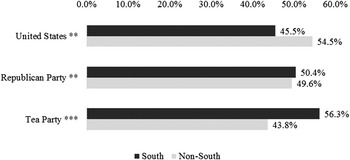
Looking first at the percentages of Tea Party members who live in the South, figure 1 shows percentages of respondents who are from the South, who identify with the Republican Party, and who are Tea Party members.
Percent of Nation, the Republican Party, and Tea Party Members in the South and Non-South
Note: n=2510 for US, n=1116 for Republicans, and n=224 for Tea Party Members.
*p≤.10, **=p<=.05, ***p<=.01,

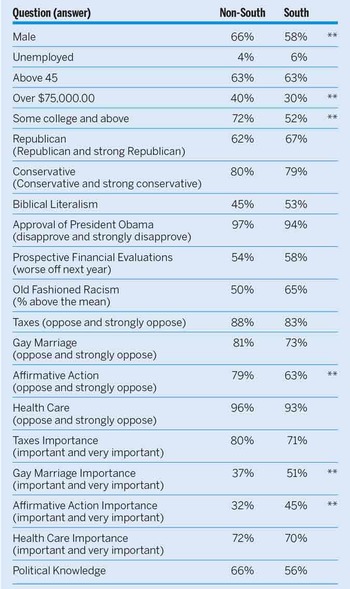
While Southern respondents comprise less than half of the entire sample (approximately 46%), half of the Republican Party reported that they live in the South and over 56% of the Tea Party members indicated that they live in a southern state. Clearly, the Tea Party is heavily “Southern.” Do these southern Tea Party members differ from their non-southern counterparts? Table 1 presents percentages of Tea Party members in both regions across several demographic and issue positions.
While Southern respondents comprise less than half of the entire sample (approximately 46%), half of the Republican Party reported that they live in the South and over 56% of the Tea Party members indicated that they live in a southern state.
Comparing Southern and Non-Southern Tea Party Members

Source: 2012 Blair Center Clinton School Poll
n=98 for Non-South and n=124 for South ***p ≤ .001; **p ≤ .05; *p ≤ .10
Sixty-six percent of non-southern Tea Party members are male compared to only 57% of their southern counterparts. While 40% of non-southern Tea Party members have household incomes over 75k, only 30% of southern Tea Party members have incomes that high. While 73% of non-southern Tea Party members have some college education, only 53% of southern Tea Party members are similarly educated. In terms of party identification, southern Tea Party members are slightly more Republican (67%) compared to non-southern Tea Party members (62%) but this difference was not statistically significant. I find a similar pattern with ideology with 79% of southern Tea Party members identifying as conservative compared to 80% of non-southern Tea Party members. There is, however, a significantly greater percentage of respondents in the South who are biblical literalists (52%) compared to the non-south (44%). Also, a greater percentage of southern respondents think they will be worse off next year (58% versus 54%) and there was a greater percentage of southern Tea Party members who scored above the mean for old-fashioned racism (65%) compared to non-southern members (51%).
In terms of attitudes toward taxes, gay marriage and health care, there were no statistically significant differences across region. There was, however, a significant difference on affirmative action, but not in the expected direction, with 79% of non-southern Tea Party members opposed compared to 63% of southern Tea Party members. There are significant differences in the importance that respondents placed on these issues with 51% of southern Tea Party members reporting that gay marriage was very important to them, compared to 37% of non-southern members. Finally, 45% of southern members reported that affirmative action was very important to them compared to 32% in the non-south.
While comparing demographic and attitudinal differences across regional membership illuminates compositional differences between southern and non-southern Tea Party members, the individual level predictors of Tea Party membership are explored below.
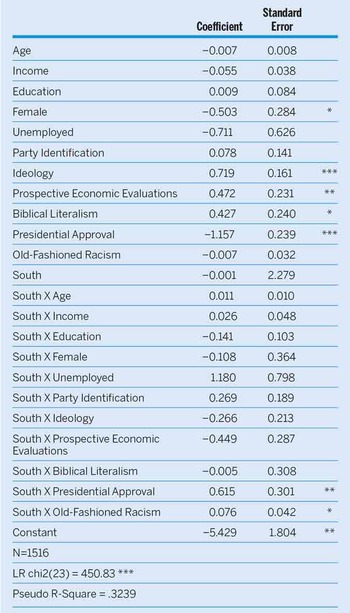
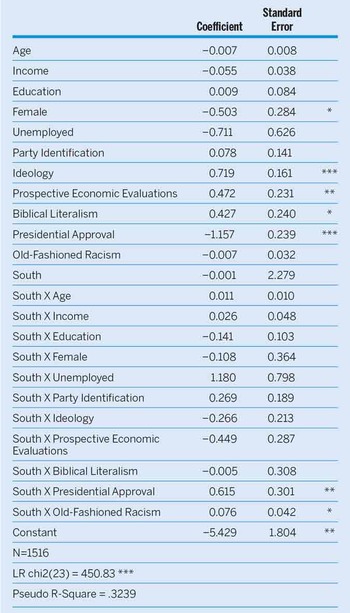
Table 2 presents the results of a logistic regression predicting Tea Party membership. Looking at the main effects of the model predicting Tea Party membership in the non-South, I find that the being female is a significant and negative predictor; being conservative is significant and positive; pessimistic economic forecasts and biblical literalism are significant and positive; and approval of President Obama is significant and negative. Other factors, however, were insignificant main effects, including age, family income, education, unemployment, party identification and old-fashioned racism. Looking next at the interactive variables, testing to see if there are statistically significant differences in the effects of the predictors among southern respondents, one can see that presidential approval and old fashioned racism are significant, indicating that the effects of these variables are significantly different among southern Tea Party members. In the figures below, I show the predicted probability of being a Tea Party member across the range of old-fashioned racism, and presidential approval, in both regions.
These findings suggest that when Tea Party activists argue that they are motivated by economic concerns, these claims may be true, albeit largely in the non-South. In the South, the motivations for Tea Party membership continue to follow historic white animosity toward African Americans.
Predicting Tea Party Membership
*** p ≤ .001; **p≤.05; *p≤.10
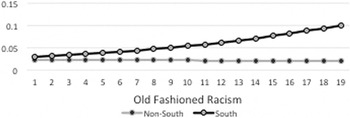
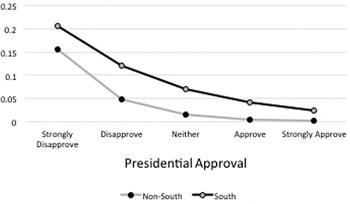
Holding other variables in the model at their mean and modal values, figures 2 and 3 present the predicted probability of being a Tea Party member across the range of values for old fashioned racism and presidential approval among both southern and non-southern members. While the probabilities of being a Tea Party member are low for both groups, the probability of being a member increases among southern Tea Party members who embrace very negative stereotypes of African Americans. Similarly, in figure 3, one sees see that predicted probability of being a Tea Party member in the South increases if the respondent strongly disapproves of President Obama.
Predicted Probability of Tea Party Membership over Racism

Predicted Probability of Tea Party Membership over Obama Approval

DISUCSSION
Following the historic 2008 presidential election, the Tea Party became a considerable force in American politics and scholars have argued that the motivations of the movement potentially include concerns ranging from economic fear, racial animosity, religious fundamentalism, and dislike of President Obama. The evidence here suggests that the Tea Party has a substantial majority of members who live in the South and that these southern Tea Party members are younger, less educated, and more female. In addition, the effects of presidential evaluations and old fashioned racism are a significantly greater motivation of southern Tea Party members. While economic fears are a significant predictor of Tea Party membership, old fashioned racism and presidential approval have a significantly greater influence among southern Tea Party membership. These findings suggest that when Tea Party activists argue that they are motivated by economic concerns, these claims may be true, albeit largely in the non-south. In the South, the motivations for Tea Party membership continue to follow historic white animosity toward African Americans.
APPENDIX