Introduction
We present the case of a patient with severe hearing loss and concomitant paranoid schizophrenia who was successfully rehabilitated with direct acoustic cochlear stimulation.
The concept of direct acoustic cochlear stimulation was developed by Häusler et al.Reference Häusler, Stieger, Bernhard and Kompis1 The system consists of a retroauricular external processor with a radiofrequency transmitter, and an implantable part consisting of a receiver, transducer (actuator) and fixation system. The transducer transforms electrical energy into mechanical vibrations via a coupling rod, with a conventional stapes prosthesis attached to it. The stapes prosthesis then vibrates cochlear perilymph, leading to acoustic stimulation.Reference Lenarz, Zwartenkot, Stieger, Schwab, Mylanus and Caversaccio2–Reference Schwab, Kludt, Maier, Lenarz and Teschner6
Direct acoustic cochlear implants enable acoustic stimulation with high energies, which cannot be achieved by conventional hearing aids. Candidates for direct acoustic cochlear implants include patients with severe mixed hearing loss usually due to advanced otosclerosis or severe sensorineural hearing loss. Candidates would have problems using hearing aids because of gain limitations, mainly in higher frequencies, and hearing feedback and distortion because of high amplification, thus rendering the sound ‘unnatural’. Candidacy for implantation is established in patients with bone conduction between 40 dB and 90 dB, with an air–bone gap of at least 30 dB. Contraindications for surgery include unstable or unmeasurable bone conduction thresholds, speech recognition score below 30 per cent with amplification, retrocochlear hearing impairment, or sudden hearing loss.
Paranoid schizophrenia is a chronic mental disorder. The core symptoms consist of (mainly paranoid) delusions, auditory hallucinations, mood oscillations, lack of volition, difficulties in carrying out daily tasks, and speech disorders with difficulties in expression and maintenance of thought. In the acute phase of schizophrenia, the patient is affected by a reality normally perceived as irrational by healthy people. Such thoughts are called delusions. The patients are usually so invested in these thoughts that even most logical explanations fail to persuade them of the contrary. Paranoid schizophrenia is treated with antipsychotics and education with psychotherapy.7
Case report
Our patient, a 47-year-old male, had a 15-year history of hearing impairment due to advanced otosclerosis and suffered from paranoid schizophrenia. The first symptoms of schizophrenia appeared at the age of 32 years, with persecutory delusions, delusions of reference, thought insertions and withdrawals, severe auditory hallucinations, and mild visual hallucinations. The patient suffered from threatening, maltreating and commanding auditory hallucinations in the acute phase, and with noise, cracks, whistles and human voices in the phases of partial remission. The consequence was a change of mood, with bitterness, sadness and anxiety. Admissions to a hospital were required seven times. His medication consisted of olanzapine 20 mg, quetiapine 200 mg and antidepressant duloxetine 60 mg, without a remission.
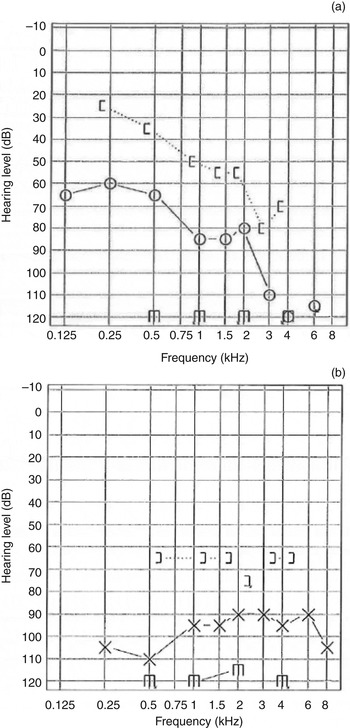
Initially, the patient received a hearing aid for his right, better ear, which proved insufficient. In order to make his left ear viable for hearing aid use, we decided to perform a stapedotomy on his left ear. Subsequently, the hearing threshold was at 75 dB in his left ear, and between 90 dB and 110 dB in his right ear. With hearing aid amplification in his right ear, his speech recognition score at 90 dB was only 10 per cent.
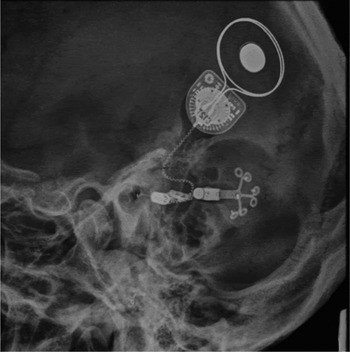
Despite such poor speech recognition and a psychiatric disorder, we decided to offer the patient a procedure for direct acoustic cochlear stimulation. Surgery proceeded without complications, although his incus was removed for anatomical reasons. The actuator was set to maximal length, and, following stapedotomy, a stapes prosthesis of 6 mm in length was inserted and attached to an artificial incus (Figure 1).
Control radiograph after implantation of a direct acoustic cochlear stimulation device.

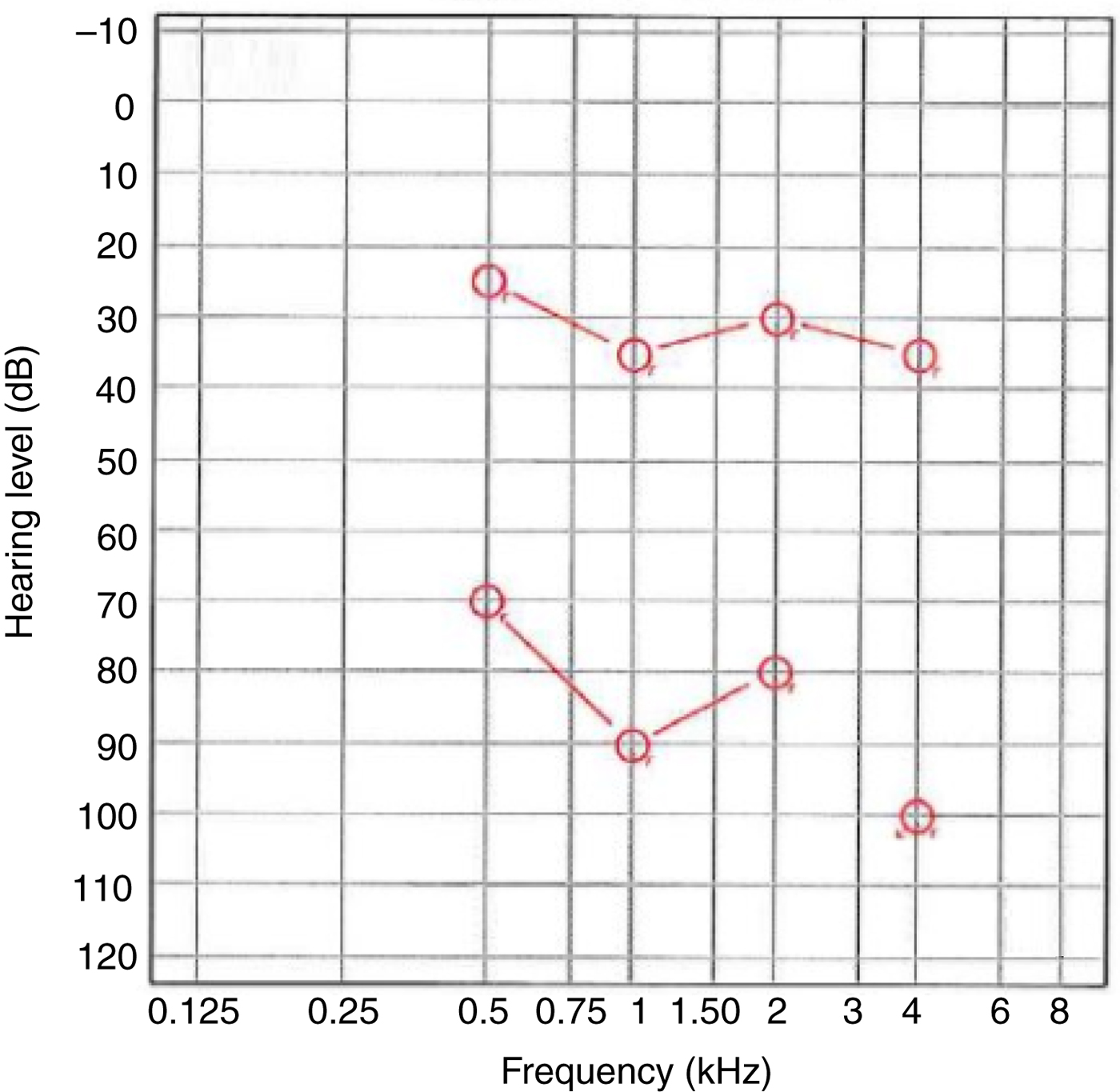
Post-operatively, we observed persistent ear canal secretion due to chronic myringitis, which eventually subsided with local therapy. Nevertheless, the patient's hearing improved significantly. His free field threshold was at the level of 30 dB (Figures 2 and 3). His speech recognition score was 100 per cent at 65 dB and 70 per cent at 55 dB.
Pre-operative pure tone audiogram for (a) right ear/free field testing 1 and (b) left ear/free field testing 2 (symbols around the 120 dB HL mark indicate uncomfortable loudness level). [ = bone conduction (masked) right ear; ○ = air conduction (unmasked) right ear; ] = bone conduction (masked) left ear; × = air conduction (unmasked) left ear

Free field audiogram with the Codacs™ Direct Acoustic Cochlear Implant System device (upper line). Lower line presents post-operative hearing threshold, which is similar to the pre-operative threshold. ○ = air conduction (unmasked) right ear

Two months after surgery, the patient communicated well. His persecutory delusions and delusions of reference, thought insertions and withdrawals disappeared, while auditory hallucinations diminished to noise, cracks, whistles and indistinct human voices. His mood stabilised such that quetiapine and duloxetine were withdrawn from therapy.
Three years post-implantation surgery, the patient has total control over his auditory hallucinations. He successfully uses a technique of positive thinking, and is free from delusions, and thought insertions and withdrawals.
Discussion
From the clinical course, we can conclude that hearing restoration was the main reason for the significant reduction in auditory hallucinations. By hearing actual sounds, the patient started to learn to differentiate between auditory hallucinations and real auditory signals. He also learned how to identify and accept auditory illusions caused by severe hearing loss as normal signals. In his previous state, the auditory illusions were a driving force of new persecutory delusions and delusions of reference, and he therefore interpreted them as hostile and threatening. The auditory hallucinations were his reality and truth, rendering any attempt to educate him otherwise as unsuccessful. His antipsychotic medications were also relatively ineffective because of his auditory deprivation and isolation.
The association between hearing loss and psychotic symptoms and disorders is often overlooked, although it seems well established in literature. In their meta-analysis, Linszen et al. (2016) found a significantly increased risk for psychosis, delirium and schizophrenia in patients with hearing loss.Reference Linszen, Brouwer, Heringa and Sommer8 That study suggested several factors caused by hearing impairment that could lead to psychosis. Hearing impairment frequently leads to feelings of social isolation and loneliness, which are often associated with the development of psychosis. Communication difficulties and an overall decrease in cognitive capacity can hinder the ability to interpret others’ thoughts and behaviours. Additionally, auditory hallucinations could be caused or worsened by sensory deprivation (deafferentation).Reference Linszen, Brouwer, Heringa and Sommer8 Furthermore, patients with hearing loss miss important information about the external world, making it difficult to differentiate between internally and externally generated events, thus increasing the error rate in source discrimination.Reference Sommer, Roze, Linszen, Somers and van Zanten9 In a study by Gevonden et al., patients with severe hearing impairment were found to have a hypersensitive dopaminergic system compared with healthy controls, which could partially explain the psychosis on neurobiological grounds.Reference Gevonden, Booij, van den Brink, Heijtel, van Os and Selten10
• Direct acoustic cochlear implants enable acoustic stimulation with high energies, which cannot be achieved by conventional hearing aids
• A 47-year-old male had hearing impairment due to advanced otosclerosis and suffered from paranoid schizophrenia
• Two months after direct acoustic cochlear implant surgery, he communicated well
• Persecutory delusions, delusions of reference, thought insertions and withdrawals disappeared, and auditory hallucinations diminished
• His mood stabilised such that quetiapine and duloxetine were withdrawn from therapy
• Direct acoustic cochlear implants can be effective for patients in a vulnerable mental state
In conclusion, we want to underline the importance of hearing assessment and treatment; these can potentially reverse risk factors for psychosis. However, a proper evaluation of candidacy for a procedure such as cochlear implant surgery is crucial, in our opinion. In this specific case, the patient was highly motivated to undergo implantation, and his psychiatric state was stable enough for him to understand and complete the training process and to trust the medical team. We also believe that a direct acoustic cochlear implant was the optimal solution in this case. Compared to the obvious alternative of a cochlear implant, the direct acoustic cochlear implant provides a natural sound, which is easier to accept, especially for a patient in a vulnerable mental state.
Competing interests
None declared