Introduction
Cerebral palsy is not a progressive disease but causes progressive and permanent motor impairments throughout development (Wright & Wallman, Reference Wright, Wallman, Campbell, Palisano and Orlin2012). Hemiplegic cerebral palsy accounts for approximately 30% of diagnoses (Delacy, Reid, & Australian Cerebral Palsy Register, Reference Delacy and Reid2016). Most people with hemiplegic cerebral palsy have no intellectual impairments (Delacy, et al., Reference Delacy and Reid2016) and are capable of employment (Michelsen, Uldall, Kejs, & Madsen, Reference Michelsen, Uldall, Kejs and Madsen2005). On the other hand, four physical impairments (i.e., loss of coordination, weakness, spasticity and contracture) have been found to explain 63% of the variance in upper limb activity in people with hemiplegic cerebral palsy (Chiu, Ada, Butler, & Coulson, Reference Chiu, Ada, Butler and Coulson2010). Furthermore, coordination, measured as single-joint movement, made the largest independent contribution to upper limb activity. This raises the question of how best to train coordination in order to improve motor performance at the level of activity limitation.
Interactive computer games have the potential to be a promising intervention since they provide an opportunity for practicing whole-limb tasks that require spatial and temporal accuracy within a virtual environment (Galvin, McDonald, Catroppa, & Anderson, Reference Galvin, McDonald, Catroppa and Anderson2011). Children often have little or no interest in conventional therapy by late childhood. Virtual reality systems utilise diverse options to create interactive environments that embed and engage the user in real life situations. The use of virtual reality for motor rehabilitation has been primarily focused on adults with stroke and there is evidence that virtual reality improves motor outcomes compared to conventional therapy in this population (Lohse, Hilderman, Cheung, Tatla, & Van der Loos, Reference Lohse, Hilderman, Cheung, Tatla and Van der Loos2014).
However, research findings in adults do not inevitably transfer to children. The fact that children with cerebral palsy are still undergoing growth and maturation may result in a different effect to adults with neurological conditions. For example, a systematic review included five randomised trials investigating the effect of interactive computer games in cerebral palsy, three trials of upper limb activity and two trials of lower limb activity (Chiu & Kuo, Reference Chiu and Kuo2015). One high quality trial of upper limb games showed no effect in terms of upper limb activity (Chiu, Ada, & Lee, Reference Chiu, Ada and Lee2014), and the remaining four moderate quality trials showed non-significant and clinically small positive effects. This raises the question of whether it is possible to improve joint coordination in children with cerebral palsy, in order to improve activity. Therefore, the aim of the current study was to investigate whether it is possible to train coordination by targeting one joint, i.e., training coordination at one joint and measuring the outcome at that joint, thereby avoiding the extra demands imposed by multi-joint movement.
Coordination was trained using a computerised tracking task. Tracking tasks are used to measure coordination rather than train it. They have only been used once before to train coordination in a child with ataxia (Ada, Sherrington, Canning, Dean, & Scianni, Reference Ada, Sherrington, Canning, Dean and Scianni2009), where 2 weeks of tracking practice resulted in visible improvements in speed and smoothness of movement (Ada et al., Reference Ada, Sherrington, Canning, Dean and Scianni2009). Tracking tasks reflect coordination in real life since they demand that the person analyses the input, plans and executes a motor response and monitors performance. Successful tracking requires both spatial and temporal accuracy. The specific research questions for this case series were the following:
1. Is 2 weeks of computerised tracking training at the elbow effective at improving elbow coordination and does it generalise to upper limb activity?
2. Is any benefit maintained 2 weeks beyond the period of intervention?
Methods
Design
A case series A–B–C multiple baseline design was carried out according to Portney and Watkins (Reference Portney and Watkins2009). The duration of the baseline phase varied across participants. Thus, this design included a between-participant control (randomly staggered duration of the baseline between 10 and 20 days) and within-participant control (from Phase A to Phase B). After a baseline observation (Phase A), a 2-week intervention of coordination training (Phase B) was conducted and followed by a 2-week follow-up (Phase C). The assessor was blind to the aim, design and phase of the study but it was not possible to blind participants or therapists to phase. This study was approved by National Cheng Kung University Governance Framework for Human Research Ethics and informed consent was obtained from parents of all participants.
Participants
Children with cerebral palsy were included if they had been diagnosed with cerebral palsy before 5 years of age, were aged between 6 and 12 years and categorised as having spastic hemiplegia (i.e., one side of body was affected more than the other). They were excluded if they had severe cognitive or visual problems as judged by relatives or at screening.
Intervention
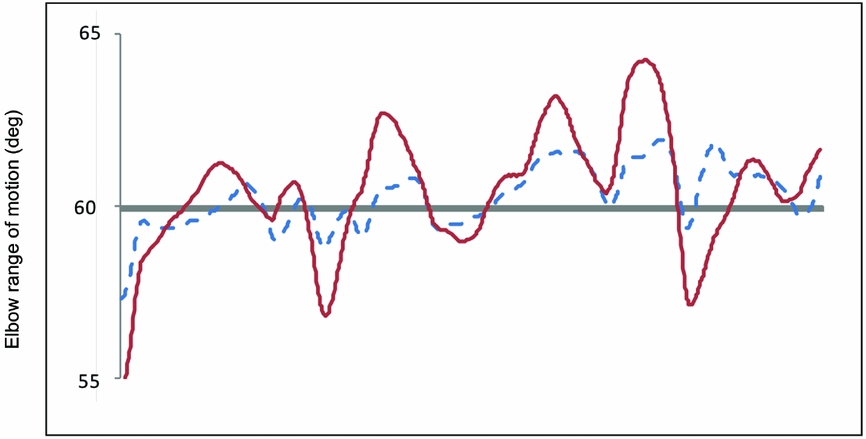
Ten sessions of computerised coordination training were carried out in the participant's home over 2 weeks, supervised by one of three therapists with at least 1 year of work-related experience. Computerised coordination training involved visual pursuit tracking, which required the participants to track a moving target on a computer screen using elbow joint flexion and extension of the affected upper limb. The participant sat with the affected forearm supported on a table with an electrogoniometer under the elbow joint (Figure 1). The target moved irregularly back and forth across the computer screen with a frequency between either 0–0.6 (moderate speed) or 0–0.8 Hz (fast speed). The signal from the electrogonimeter during elbow flexion and extension drove the response cursor through 55–65 degrees of elbow flexion (Chiu et al., Reference Chiu, Ada and Lee2014) (Figure 2). A maximum of 10 × 1-min trials covering both target frequencies were practiced each session.
Experimenal set-up for computerised training through visual pursuit tracking. The height of the arm frame was adjustable, so the shoulder was forward flexed to 90° and the elbow joint was aligned directly over the joint of the arm frame containing the electrogniometer.

Example of tracking performance for 10 seconds. The target is the solid line and the participant's response is the dashed line. The coherence between the target and response for this participant is .58.

Outcome Measures
Coordination was measured at the elbow joint of the affected limb through tracking performance, using the same procedure as the intervention but using a target with a different semi-random movement with a frequency between 0–0.8 Hz. Participants practised the tracking task for 1 minute to become familiar with the tracking task, and then performed the actual task for 1 minute. Tracking performance was scored as the ratio of overall coherence between the target and the response where a perfect score is 1.00 (Figure 2). The overall coherence is defined as the ratio of the correlated response to the total response variance at all frequencies and is analogous to the square of the Pearson correlation coefficient in a regression analysis (Neilson & Neilson, Reference Neilson and Neilson1980). For example, low coherence indicates that the participant fails to reproduce the waveform, so the response signal is largely unrelated to the target. This task has been used previously to measure coordination in children with hemiplegic cerebral palsy (Chiu et al., Reference Chiu, Ada and Lee2014).
Upper limb activity was measured using the 9-Hole Peg Test and reported as peg/s. The 9-Hole Peg Test is a timed test that involves picking up and placing nine dowels in nine holes, taking them out again and putting them down (Kellor, Frost, Silberberg, Iversen, & Cummings, Reference Kellor, Frost, Silberberg, Iversen and Cummings1971) and which has been found to have test-retest reliability (r = .81 and .79), interrater agreement (r > .99) and correlations (r = −.80 and −.74) with the Purdue Pegboard Test at all tested ages indicated adequate concurrent validity in the use with children (Smith, Hong, & Presson, Reference Smith, Hong and Presson2000). Participants practised once prior to the actual measure to become familiar with the task. Eighteen pegs were divided by the time taken in order to report the rate of pegs manipulated per second.
Measures of coordination and upper limb activity were collected seven times in the baseline phase and nine times in both the intervention and follow-up phases. The measures were recorded by the physiotherapist using a digital video camera and randomly re-ordered at the end of study for assessment purposes so that the assessor could be blind to phase. Performances were then scored from the videotaped records by one trained assessor who was a therapist with 1 year of work-related experience.
Data Analysis
Data were analysed visually and statistically. First, visually the baseline data tended to cluster around a mean with no appreciable slope. Therefore, the intervention phase was compared to the baseline phase and follow-up phase was compared to the intervention phase using the mean level of the data, rather than the trend or slope. Second, statistical analysis was performed using the 2-SD band method. The mean and standard deviation of the baseline phase were calculated and the 2-SD band extended from baseline to the intervention phase. If more than two consecutive data points in the intervention phase fell outside the 2-SD band, changes from baseline to intervention were considered statistically significant (Portney & Watkins, Reference Portney and Watkins2009). If more than two consecutive data points in the follow-up phase fell outside the 2-SD band, then changes were considered as being maintained after the withdrawal of intervention.
Results
Characteristics of the Participants
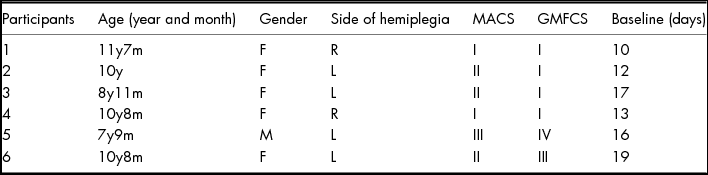
Six children from main stream schools with hemiplegic cerebral palsy, five females and one male (mean age 119 months, SD 17 months), participated in the study. Characteristics of participants in terms of age, gender, side of hemiplegia and level of disability according to the Manual Ability Classification System or the Gross Motor Function Classification System and the duration of the baseline are presented in Table 1. None of the participants were undergoing any specific upper limb training at the time of recruitment.
Characteristics of Participants

MACS: Manual Ability Classification System (Eliasson et al., Reference Eliasson, Krumlinde-Sundholm, Rosblad, Beckung, Arner, Ohrvall and Rosenbaum2006); GMFCS: Gross Motor Function Classification System (Palisano et al., Reference Palisano, Rosenbaum, Walter, Russell, Wood and Galuppi1997). (Level of MACS and GMFCS indicates the indenpendece or need for assistance to perform everyday activities. Level I: independently, Level II: independently but slowly, Level III: independently but using specific equipment, Level IV: requires assistance from a care giver.)
Compliance with Training
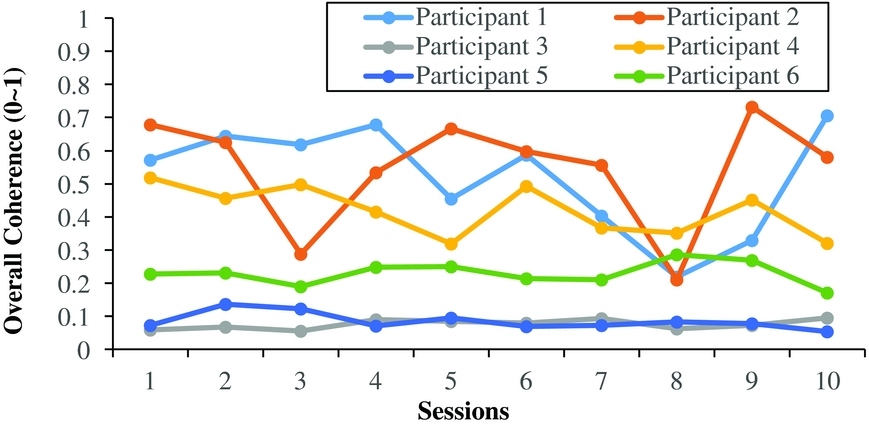
Each participant should have completed 10 × 1-min trials for 10 sessions over 2 weeks in the intervention phase, so the 6 participants should have completed 600 trials of computerised tracking. Since the results of 596 trials were recorded on the computer, compliance was 99%. Five of the participants generally enjoyed carrying out the tracking; only Participant 3 was not enthusiastic about undertaking the tracking. Although performance fluctuated across trials and sessions, overall, performance at the end was similar to the beginning of the intervention phase (Figure 3).
Mean session overall coherence of computerised tracking training over 10 sessions for each participant.

Effect on Coordination
None of the participants appeared to score higher on tracking performance (overall coherence) during the intervention phase compared with the baseline phase (Figure 4) and this was verified using the 2-SD band method. Neither did the participants appear to score higher during the follow-up phase compared with the baseline phase (Figure 4). Data were missing for Participant 6 because it failed to save to the computer.
Coordination during baseline, intervention and follow-up phases for Participants 1–6. Solid lines indicated the mean level. Shaded area represented the 2-SD band above and below the mean of baseline phase. A statistically significant (p < .05) change had occurred when two successive points fell outside 2-SD band.

Effect on Upper Limb Activity
Only Participant 1 appeared faster on the 9-Hole Peg Test during the intervention phase compared with the baseline phase, but this improvement was not statistically significant using the 2-SD band method (Figure 5). Participant 1, 4 and 5 appeared faster during the follow-up phase compared with the baseline phase, but this improvement was not statistically significant using the 2-SD band method (Figure 5). Data were missing for Participants 2 and 3 because data were not collected.
9-Hole Peg Test during baseline, intervention and follow-up phases for Participants 1 and 4–6. Solid lines indicate the mean level. Shaded area represented the 2-SD band above and below the mean of baseline phase. A statistically significant (p < .05) change had occurred when two successive points fell outside 2-SD band.

Discussion
This study found that 2 weeks of targeted computerised tracking training was not effective at improving coordination or upper limb activity limitation. There was no benefit maintained beyond the period of intervention.
These negative findings are not the result of low compliance. There was a very high level of compliance during the intervention period (99%) demonstrating that the computerised tracking was well tolerated by the children. Neither were the findings the result of the severity of loss of coordination precluding a possibility of improvement. There was a range of ability across the six children ranging from very poor (Participants 3 and 5) to quite good coordination (Participants 1 and 2). But even the children with mild impairment showed no improvement in coordination. This suggests that either children with cerebral palsy cannot improve coordination or a larger dose of training is needed.
It is worth exploring the question of dose of practice further in upper limb training studies for children with cerebral palsy. Two hours of practice per week was not effective in two randomised trials of interactive computer games (Chiu et al., Reference Chiu, Ada and Lee2014; James, Ziviani, Ware, & Boyd, Reference James, Ziviani, Ware and Boyd2015). However, 3 hours per week was effective in one pre–post study of goal directed arm movement (Sandlund, Domellof, Grip, Ronnqvist, & Hager, Reference Sandlund, Domellof, Grip, Ronnqvist and Hager2014). In two systematic reviews of over 20 randomised trials, constraint induced movement therapy was found to be effective, yet it was no more effective than the same dose of upper limb therapy without restraint (Chen, Pope, Tyler, & Warren, Reference Chen, Pope, Tyler and Warren2014; Chiu & Ada, Reference Chiu and Ada2016). This suggests that the mechanism of the effect is the dose of practice, rather than the constraint-induced movement itself. The dose of constraint was about 35 hours a week and at least 50% of this constraint (i.e., 16 hours a week) was spent in supervised practice of upper limb tasks (Chiu & Ada, Reference Chiu and Ada2016). This is a much larger amount of practice than was carried out in the current study and in the two ineffective trials. It raises the question of whether a large amount of practice of computerised tracking would have a different result. However, increasing the amount of practice is very demanding for the children with cerebral palsy and their families.
This study has both strengths and limitations. Its main strength is in the multiple baseline design. This ensured that the stability of the variable was known and that any improvements in coordination or upper limb activity were the result of the computerised tracking rather than natural change or familiarity with the measurement tool. On the negative side, there were a lot of missing data. However, examination of coordination across the 10 training sessions, i.e., performance with a familiar target, where there were no missing data, confirmed that there was no effect of training. Finally, even though the sample size in this study was small, participants represented the full range of upper and lower limb ability.
Conclusions
The findings showed that an intervention involving a daily 10 minute intervention using computerised upper limb tracking did not improve coordination in six children with cerebral palsy. Perhaps children with cerebral palsy cannot improve coordination or maybe a larger dose of training is needed.
Acknowledgements
The authors would like to acknowledge the participation of the children and their parents.
Financial Support
This research received no specific grant from any funding agency, commercial or not-for-profit sectors.
Conflict of Interest
None.
Ethical Standards
The authors assert that all procedures contributing to this work comply with the ethical standards of the relevant national and institutional committees on human experimentation and with the Helsinki Declaration of 1975, as revised in 2008.