By the turn of the nineteenth century, many villagers in Quechula, Chiapas, had come to loathe Tiburcio Pamplona.Footnote 1 Pamplona had bewitched Feliciana Gómez, plaguing her with sores on her “orifice,” from which secreted little white worms.Footnote 2 As he could no longer bear to see his wife in agony, Julián Castillejo, indio natural, denounced Pamplona to Fray Pascual Aparicio on December 20, 1801.Footnote 3 Subsequent testimony revealed that Pamplona had taken some naguas (garments) from Feliciana's house on September 14 of that year.Footnote 4 Determined to retrieve her property, Feliciana found Pamplona in the chapel of Saint Peter, where she took back the naguas that Pamplona had tucked under his shirt. In response, Pamplona then placed a hex on Feliciana to humiliate her. Twenty-four hours after the altercation, Feliciana began to feel an itch on her backside. Two weeks later, Feliciana felt a burning sensation in her anus, leading her to conclude that Pamplona was to blame.Footnote 5 Fray Pascual subsequently opened an investigation, questioning other villagers about Pamplona's reputation. Unfortunately for Pamplona, several locals denounced him as a sorcerer and “nagualista.”Footnote 6
On December 21, Pamplona confessed that his power as a nahualista derived from the devil himself. Satan had first appeared to Pamplona ten years earlier (c. 1791), near a site dedicated to Saint Peter the Apostle.Footnote 7 Shortly thereafter, Pamplona made a pact with the devil, who became Pamplona's “nagual.”Footnote 8 After quarreling with locals, Pamplona would ask Satan to afflict his rivals with sores and other ailments.Footnote 9 Pamplona described the devil as commonly portrayed in colonial paintings—a horrible figure with horns that was gendered male (el Diablo). Pamplona also indicated that he had a second nahual, which was a snake (una culebra).Footnote 10 This serpentine nahual had been Pamplona's companion since birth and communicated with him in his dreams. With the devil and a snake by his side, Pamplona roamed Quechula freely at night, making him a powerful ritual specialist in the eyes of his contemporaries.Footnote 11
Although Pamplona was eventually arrested for witchcraft, engaging in sorcery elevated his standing locally.Footnote 12 As a nahualista, Pamplona harnessed the power of the animal kingdom. The ability to see at night made him immune to surprise attack and better able to assault his rivals. When he inflicted diseases on the villagers of Quechula, locals would beg him to provide a cure. Pamplona complied on occasion; other times, he refused. Nevertheless, this medicinal knowledge made Pamplona an intellectual within his community. In many ways, the nahualli continued to engender awe among village peoples, as it had before the conquest of Mexico. However, having the devil as a nahual demonstrates a change from how this figure was perceived in pre-Hispanic times. Pamplona's description of the devil as an ugly male figure with horns highlights the influence of Christian iconographic representations. Pamplona had, even if inadvertently, created a hybridized nahualli, which maintained its liminal status between ethnic, political, and spiritual spheres. The primary sources analyzed in this article reveal that the nahualli continued to transform its shape, meaning, and function throughout the colonial era.
This study first examines early colonial Castilian and Nahuatl terms used to describe nanahualtin to show the wide range of powers that ritual specialists possessed, which included the ability to transform into animals, elemental forces such as wind, lighting, and thunder, and spirit companions.Footnote 13 Historically, European colonizers took a dim view of shapeshifting because of its connection to the Witches’ Sabbat and the devil in the Old World.Footnote 14 For many Catholic colonizers, the nahualli was merely a ploy created by the devil to lure errant souls to perdition. From the pulpit to the confessional, bishops, priests, and other clergy sought to extirpate the nahualli from popular culture by linking this figure to idolatry and sin. If Catholic colonizers could just lay the nahual to rest, so the thinking went, indigenous and mixed-race peoples could finally become true Christians.
In analyzing 11 criminal and Mexican Inquisition cases spanning over 200 years (1599 to 1801), this article seeks to exhume the nahualli from the discursive internment that Catholic colonizers imposed on commoners. To achieve this goal, this study links ritual specialists and their ability to shapeshift to divination and healing more broadly. Although Mexican Inquisition officials derided popular magic as superstitious foolishness, testimony analyzed in this article shows that local clergy believed in the magical powers of ritualists when they appeared to threaten the community.Footnote 15 Belief in the supernatural persisted because both commoners and colonial officials acknowledged the efficacy of miracles and certain magical rituals.Footnote 16 Testimonies from these cases show that New Spain remained enchanted throughout the colonial era.
Peoples such as the Nahua formed around the concept of the altepetl, meaning community or ethnic state, and relied on local leaders to appease the gods with ritual offerings to ensure prosperity in the terrestrial realm.Footnote 17 The most important ideological principle “covered by the altepetl was the belief in a human-supernatural covenant.”Footnote 18 The ability to commune with the divine made ritual specialists influential figures at the local level. Magic, such as shapeshifting, could be used to help or harm the community because ritualists endowed with this capability harnessed the power of the natural world. Therefore, nanahualtin used animals and elements such as wind, lighting, and thunder to increase the perceived efficacy of their magic, thereby elevating their status.
Popular magic threatened the clergy when it drew potential converts away from the Church by offering alternative interpretations of the cosmos.Footnote 19 Yet, for peoples such as the Nahua, the nahualli was not superstitious drivel but part of everyday life.Footnote 20 Sightings of shapeshifters could be interpreted as ominous, because Nahuas, along with other indigenous peoples, associated these figures with sickness and death.Footnote 21 After seeing a nahualli, locals consulted ritual specialists to counteract bad omens.Footnote 22 However, the very same ritualist who chose to heal the community one day might harm it the next, revealing that the capacity to do good and evil resided within a single individual. Significantly, many ritualists shapeshifted into animals or were associated with animal companions, suggesting that their power, in part, derived from the natural world.Footnote 23 The inability to integrate the nahualli into an orthodox framework explains why certain Nahuatl terms were encoded by Catholic colonizers as Western concepts imbued with negative connotations.Footnote 24
The ability to shapeshift further elevated ritual specialists’ standing within local communities, which explains in part why parish clergy took nanahualtin seriously while high-ranking Inquisition officials mocked nahualistas as ridiculous. Parish priests interacted with villagers daily, enabling them to appreciate the efficacy of the nahualli's magical power. In contrast, inquisitors residing in Mexico City scoffed at the nahual due to their physical and social distance from the cases brought before them. Because ritual specialists’ standing enabled them to direct, organize, and educate members within their own societies, they mediated the relationship between domination and discourse, meaning that they operated as intellectuals at the local level.Footnote 25
The Nahualli in Colonial New Spain
Early modern Castilian-Nahuatl sources reveal a freighted understanding of shapeshifting, due to the good-evil binary espoused by the Catholic Church. For instance, Fray Bernardino de Sahagún's Historia general de las cosas de Nueva España (hereafter Historia general; completed in 1575) defines nahual as “a male witch who scares people at night and sucks [the blood] of children.”Footnote 26 Related to the nahual are the astrologer and the necromancer.Footnote 27 According to Sahagún, the skilled astrologer uses a cosmic calendar to predict the future because he understands his “art” well. However, the unskilled astrologer is a liar and a charlatan who deceives people with his sorcery. Necromancers could transform into animals because they made a pact with the devil. However, due to their wickedness, necromancers could not prosper in the terrestrial realm. They remained destitute, without even a morsel of bread to eat. Sahagún further demonstrates his Christian worldview, stating that necromancy was actually a hoax because the death of Jesus Christ rendered all auguries ineffective.Footnote 28 Sahagún thus linked the nahualli to the Old World, where concepts such as shapeshifting, necromancy, and witchcraft had been vilified for centuries.
Likewise, in Vocabulario en lengua castellana y mexicana y mexicana castellana (hereafter Vocabulario; published in 1571), Fray Alonso de Molina translated “naualli” as “bruxa,” meaning female witch.Footnote 29 Although Nahuatl does not assign gender to nouns nor require gender agreement, both Sahagún and Molina disregarded native grammatical conventions by translating “nahualli” as either a male or female witch.Footnote 30 In particular, Molina's use of bruja underscores the legacy of misogyny in Europe. From a European standpoint, the ability to transform themselves into animals proved that sorcerers had made a pact with the devil. Women were viewed as susceptible to making such pacts due to the alleged weakness of their sex.Footnote 31
Since classical times, European commoners believed “women could transform themselves at night into flying screech owls or strigae who would devour infants.”Footnote 32 Because the process of physical metamorphosis into animals involved “the operation of some magical or supernatural power, it readily became associated with witchcraft, and the claim that witches transformed themselves (or others) into animals … appears in many witchcraft confessions.”Footnote 33 Catholic friars in the New World described the nanahualtin negatively due to shapeshifting and witchcraft's historical trajectory in Europe proper, thus contextualizing Molina's definition of the nahualli as a female witch and Sahagún's mention of a male bloodsucking monster.
Spanish colonizers continued to depict the nahualli negatively well into the seventeenth century. Hernando Ruiz de Alarcón, in his Tratado de las supersticiones y costumbres gentilicias que hoy viven entre los indios naturales de esta Nueva España (hereafter Tratado, 1629), linked the nahualli to Mesoamerican astrological calendars, noting what happened when a child was born:
The Devil, by the express or tacit pact that its parents have with him, dedicates or subjects the animal which the child is to have as a nahual—which is like saying, as owner of his birth and master of his actions, or what the gentiles used to call fate. And by virtue of this pact, the child remains subject to all the dangers and travails that the animal may suffer until its death. And on the other hand, the Devil makes the animal always obey the command of the child, or else the Devil carries it out, using the animal as instrument.Footnote 34
Ruiz de Alarcón thus conflated pre-Hispanic concepts and beliefs into a singular, pejorative worldview. According to him, Satan had deceived indigenous peoples, leading them to believe that rituals with pre-Hispanic elements remained efficacious.Footnote 35 The devil's ruse imperiled those who refused to see the error of their ways when they died impenitent. Ruiz de Alarcón's mention of animal companions assigned at birth reveals the interconnectedness of time, nature, and the sacred realm.
Those ritual specialists who correctly interpreted day signs and astronomical phenomena could predict the best time to harvest crops, the destiny of newborns, and whether a particular day would bring good or bad fortune.Footnote 36 For example, Sahagún observes that those born on Two Rabbit were inclined to excessive drinking, gorging themselves on wine.Footnote 37 Similarly, those born under the sign of Four Dog would be able to raise dogs well because of their association with canines, directly connecting humans to the animal world.Footnote 38
Once a person was assigned an animal spirit companion, the earthly fate of the animal became tied to that of the person. In Tratado, Ruiz de Alarcón records that a large bat entered the cell of two Dominican priests at night, prompting them to chase it away. The next day, an old Indian woman came to the convent, annoyed that these priests had nearly killed her in their efforts to rid themselves of this bat—it was actually the old woman in animal form.Footnote 39 Father Andres Giron informed Ruiz de Alarcón that his companions had once fired two lethal harquebus shots at a caiman. As they returned to the city of Guatemala to hear mass, however, there was an uproar. Apparently, an Indian woman at the mass “who, being among the other women in the catechism, had fallen down dead at the time that they had shot the caiman in the river.”Footnote 40 As this woman had been in good health until that day, the townsfolk concluded that the killing of the caiman was the cause of her death—the caiman was, clearly, her animal companion. Thus, by interpreting the ancient calendars to link the nahual at birth, ritual specialists brought their devotees into close contact with nature and the spiritual realm.
Following the conquest of Mexico, however, the spiritual realm became the official responsibility of the clergy. Although churchmen usurped the role fulfilled by indigenous high priests, many pre-Hispanic traditions persisted at the local level, but in hybridized forms.Footnote 41 The inability to eliminate non-orthodox practices frustrated Catholic officials well into the seventeenth century. In his Carta Novena Pastoral (1698), Bishop Francisco Núñez de la Vega lamented that Indians in Chiapas continued to call on such “infernal teachers” to assign “nahuales” and prognosticate the fortunes of their unborn children, using the superstitious calendars dictated to them by the devil.Footnote 42 De la Vega further critiqued ritual specialists’ methods of healing, stating that they appeared to be doctors and healers but in reality were sorcerers. Because of the pact they had made with the devil, native ritualists only appeared to heal their patients by blowing on them, using their “infernal words,” or some plant material.Footnote 43 De la Vega noted that ritual specialists used animals such as toads, snakes, and centipedes to give their victims fevers, piles, or sores in their “hidden parts,” or in the abdomen, head and throat, nose, arm, or any other part of the body.Footnote 44
Although the bishop acknowledged that ritual specialists could provide a cure, healing the sick did not cast such specialists in a positive light. For de la Vega, providing a cure was merely a method to “undo the sorcery” already performed.Footnote 45 Rather than permit use of the “infernal words” of ritual specialists to effect cures, de la Vega mandated that the infirm recite the Our Father, Hail Mary, the Credo, and Salve Regina.Footnote 46 Because the good-evil binary as embraced by the Catholic Church precluded colonial officials from viewing ritual specialists in a positive light, clergymen grew frustrated with the persistence of non-orthodox practices. De la Vega noted that despite having given natives the “light of the gospel” for nearly 200 years, “those wretched Indians” preserved in their hearts the roots of their ancient “nagualismo,” due to explicit and implicit pacts made with the devil.Footnote 47 Even as Christian iconographic images became integrated with local practices, many Catholic officials interpreted native rituals negatively, viewing them as a superficial cover for the paganism that lay underneath.Footnote 48
In part, “nahualli” remains difficult to define because of its broad usage in New Spain. Nanahualtin can be found in historical cases ranging from Nicaragua in the south to Durango in the north of Mexico.Footnote 49 Although contemporary observers such as Ruiz de Alarcón defined nahualli as “a sorcerer who has the power to transform himself into an animal,” or one that “has an animal as an alter ego,” some anthropologists and historians have narrowed the scope of the nahualli, suggesting that it operates solely as an animal companion.Footnote 50 Patricia Lopes Don writes that “this strict association with an animal spirit companion was more typical of cultural groups farther south in the Yucatan or Guatemala.”Footnote 51 Both Alfredo López Austin and Zeb Tortorici note the nahualli's wide array of powers, stating that this figure could transform into animals as well as natural phenomena.Footnote 52 Lisa Sousa applies a broader definition still, noting that the nahualli “had the ability to shape-shift into animals or natural phenomena and transform other people and things as well.”Footnote 53 Much to the chagrin of colonial officials, the various magical feats that nanahualtin performed made them impossible to excise from the body politic.
A local following posed a threat to high-ranking colonial officials, who often justified their punitive actions against nahualistas for reasons of political expediency. In 1599, in San Luis Potosí, Captain Gabriel Ortiz de Fuenmayor defended the execution of an elderly Guachichil woman accused of witchcraft, breaking crosses, and shapeshifting, citing her ability to incite rebellion among the Indians.Footnote 54 Denunciators claimed that this unnamed woman shapeshifted into a female coyote as well as “other abominable things.”Footnote 55 An Indian man named Andrés accused the woman of transforming him into a male coyote against his will. Andrés was confident this had occurred because he saw his own tail while in animal form.Footnote 56 Although testimony from Ortiz de Fuenmayor does not indicate whether he feared this woman's magic or merely her ability to incite revolt, her summary execution reveals the anxiety surrounding this nahualli's influence among commoners.
Tracing the gender of nanahualtin's animal companions provides insight into the language used by Spanish-speaking colonial officials, who translated the nouns of indigenous languages into either masculine or feminine equivalents. In the case above, the Spanish-language testimony reveals that the unnamed woman transformed into a female animal and transformed men into male animals. Yet, as mentioned previously, indigenous languages were not gendered.Footnote 57 Therefore, it is entirely plausible that the testimony of non-Spanish-speaking indigenous peoples did not specify the gender of the nahualli's animal transformations. In such cases, the official interpreter translated indigenous-language terms referring to animals into gendered nouns, thus distorting the original context. In this way, colonial officials imposed linguistic conventions on indigenous subjects, and at the same time sought to align the gender of the nanahaultin's human and animal transformations.
Running in tandem to the extirpation of non-orthodox beliefs from popular culture was the use of Spanish as the preferred mode of communication. The mediated nature of colonial testimonies obscured terminologies and classifications spoken by commoner declarants, obscuring locution of the first instantiation.Footnote 58 Because the majority of denunciations were recorded only in the colonizing language, extant testimonies remain deprived of many native words and native worldviews. This process of obfuscation and erasure can be seen in the use of terms that refer to fauna native to the Old World but are nonetheless cited in colonial Mexican shapeshifting cases.
In Historia general, Sahagún describes the animal kingdom of New Spain using contemporary European terms. When writing about the Nahua calendar and the animal signs therein, Sahagún states, “Ocelotl, which means tiger . . . is a sign of bad luck.”Footnote 59 Similarly, in Tratado, Ruiz de Alarcón writes that when naming newborn babies, Nahuas took inspiration from their calendars, using animal names such as “Ocelotl, Tigre; Quauhtli, Aguila; Cuetzpalli. Caiman; Coatl, Culebra.”Footnote 60 In Chapters 9 and 10 of the first treatise, Ruiz de Alarcón adds lions to the mix, but, significantly, refrains from providing a Nahuatl translation of ‘lion,’ effacing the Nahuatl term altogether.Footnote 61 Bishop Francisco Núñez de la Vega contributed to this discursive effacement in the late seventeenth century, noting that those within the hellish sect of “nagualistas” transformed into the figure of a “tiger, lion, bull, etcetera,” neglecting to include translations for tigre, león, and toro.Footnote 62 Although tigers, lions, and bulls are not native to the Americas, those terms were used to describe the animals into which the nahualli transformed.Footnote 63 Identifying the layers of mediation thus helps to forestall the complete erasure of indigenous beliefs and practices by illuminating meaning that has, heretofore, been concealed.
For example, the juxtaposition of Spanish- and Nahuatl-language testimony in an eighteenth-century shapeshifting case from Tlaxcala reveals differing interpretations of the natural world. On August 2, 1701, Diego Phelipe and Juan Domingo accused Francisco Martín of sorcery, stating that Francisco had placed a hex on Diego, causing him to become sick.Footnote 64 While convalescing, Francisco frightened Diego on several occasions and, one time, frightened Diego's wife, appearing in the form of a male goat and a bull. Spanish-language testimony clearly states chivato and toro, indicating that Francisco maintained his gender when shapeshifting. Intriguingly, the next statement, that Francisco's “hands [were] all hairy,” suggests that Francisco transformed into a type of were-animal rather than assume his animal form completely.Footnote 65 According to Tortorici, this denunciation shows “the extent to which indigenous narratives of shapeshifting could be recast in Christian terms.”Footnote 66 The notions of a creature that is half human and half goat, and a creature that is half human and half bull evokes the devil, highlighting the influence of iconography from the Old World.
However, the Nahuatl provided in this case illuminates a slightly different understanding of the human-animal divide. Nahuatl testimony contains the words “matentzon” and “cuacuahue,” which correspond to the general thrust of the Spanish text but in subtle ways. Molina cites tentzone as a bearded person and tentzone michin as a bearded fish. Additionally, Molina cites goat as “quaquauhtentzone.”Footnote 67 “Tentzon” thus refers to the hair men grow on their faces and, as Molina shows, this feature can be transposed onto the animal kingdom. As maitl refers to one's hand, “matentzon” can be translated as the hairy hand of a goat, that is, the hoof, revealing a permeable linguistic boundary between humans and animals.Footnote 68
Molina lists cuacuahue both as a bull (toro) and, more generally, as a horned animal, leaving its gender ambiguous.Footnote 69 In Nahuatl, the verb “cua” means to eat. The reduplicative cuacua indicates chewing or biting.Footnote 70 When deconstructing cuacuahue for a horned animal, one can see that Nahuatl emphasizes the animal's propensity to chew or, plausibly, to nip at its keeper. Nahuatl terms for goat and horned animal foreground the features and the behaviors of domesticated animals that most impressed native peoples.
The Nahualli and a Nahuatl-Speaking Community
This section draws from two shapeshifting cases (1678 and 1685) in Pueblo Nuevo de la Pita and the pueblo of Jiquipilas, both in Chiapas. These cases do not contain corresponding Spanish translations of the Nahuatl phrases, thus revealing the continued use of Nahuatl as a vehicular language.Footnote 71 The testimony analyzed here highlights how Spanish terminologies became infused with Nahuatl in the late seventeenth century.
Diego de Vera
On March 26, 1678, don Diego de Lambarri y Escobar opened an investigation against Diego de Vera, indio natural, from Pueblo Nuevo de la Magdalena for charges of sorcery.Footnote 72 Don Pedro Rodríguez, tribal leader and governor (cacique principal y gobernador), served as the interpreter.Footnote 73 Apparently, when de Vera argued with locals, he bewitched them, plaguing their bodies with aches, pains, and sores that covered their skin. Four years previously, Domingo Juárez had “words and discord” with de Vera, which prompted de Vera to say that he would pray to God to give Juárez some type of illness.Footnote 74 One month later, Juárez fell ill, suffering from crippling pain in his hands and feet for four months. Although Juárez went to de Vera's house on two occasions to ask for a cure, de Vera refused to alleviate Juárez's pain, highlighting his power as a ritualist with medicinal knowledge.Footnote 75
Domingo Jiménez, indio natural of Pueblo Nuevo denounced de Vera on March 26, 1678. Jiménez stated that four years earlier he had argued with Diego de Vera over a skein of pita yarn that each brother (cofrade) made for Saint Lorenzo's feast day. Shortly after their argument, Jiménez experienced a swelling in his stomach and intestines so severe that it seemed as if something were alive inside of him. Jiménez also testified that at night, while he was sick, de Vera came to his house in the form of an old woman (vieja), a male cat (gato), and a male lion (león).Footnote 76 These sightings prompted Jiménez to visit de Vera personally, pleading with him to provide a cure. Unsurprisingly, de Vera refused Jiménez's request.Footnote 77 Since the case mentions that don Pedro Rodríguez served as an interpreter, it is reasonable to assume that Jiménez used an indigenous term similar to that of ocelot or jaguar but that his testimony was translated into Spanish as león.
Jiménez's statement that de Vera entered his house at night, and in animal form, is a theme found in another shapeshifting case from 1624. Accordingly, in Michoacán, some wandering Indians from around Metztitlán arrived at a local hacienda to stay the night.Footnote 78 While they were sleeping, a male tiger (tigre) entered their room, awaking one of them who screamed so loudly that everyone else awoke. The men chased the tiger away with sticks and stones. However, the following day, an Indian named Pablo, who had met these men the night before, arrived covered in bruises, leading everyone to conclude that Pablo was the nahualli.Footnote 79 The ability to journey through the night bestowed additional power upon the nahualli because agriculturalists feared predation from large animals.Footnote 80
Due to the charges brought against Diego de Vera, Judge Lambarri y Escobar ordered the alcaldes (municipal judges) to confiscate his goods and place de Vera in prison. The compliance with Lambarri y Escobar's orders was recorded in Nahuatl, demonstrating its use as a vehicular language. The alcaldes stated:
Ypan nican tunali 28 tunali de marzo de 1678 años ypa ymandado señor beneficiado don Diego de Lambarri y Escobar comisario y ascan señor obispo u nicchigua notificar nican auto ispan alcaldes y regidores y asca nican chilla milygua quituque quichigua obedece ygua niman yagui quichigua ynbentario ypal mopia muchi ten quipia tepa tlacat y[to]ca Diego de Vera picqui u quichigua responder ygua calaqui firma
Domingo Martín alcalde Pedro Sanches alcalde
Ispan navintin cabildos
Ne ispan Pedro López escribano, don Rodríguez, interpreteFootnote 81
[On this day, the 28th day of March in the year 1678 regarding his mandate, the beneficed lord don Diego de Lambarri y Escobar commissioner and now bishop, I did notify [the people of] this decree in the presence of the alcaldes and regidores and now here they wait for the cornfields that he planted, that he had obeyed and promptly will go to make an inventory of everything that the detained person named Diego de Vera had, [who was] made to respond and put his signature.]
Domingo Martín alcalde, Pedro Sánchez alcalde
In the presence of the four cabildos
In front of me, Pedro López, don Rodríguez, interpreter]
The following day, the alcaldes confirmed the arrest of Diego de Vera stating:
Ascan 29 de marzo de 1678 años ipa ymandado señor don Diego de Lambarri y Escobar comisario, comisario y ascan señor obispo ascan u nicchihua prender dicho Diego de Vera u nictali y ticpreso u nictali grillos u quichigua obedecer justicia teguan tialcaldes yguan yspan no cabildos iuqui u tichigua que obedecer y mandado señor comisario iuqui u nicchihua notificar yni auto teguan tialcaldes y regidores nican altepel Santiago Tacguacintepeque iuqui motalis tofimra
Matías de Santa Cruz, alcalde, Baltasar Moreno, alcalde,
Yspan naguin ticabildos = yguan moyspan neuatl don Agustín escribano
don Alonso de Feria, interpreteFootnote 82
[Today 29 March in the year 1678, regarding his mandate, the incumbent lord don Diego de Lambarri y Escobar commissioner, commissioner and now bishop, now I made the arrest of the said Diego de Vera, I have put you in prison, I placed you in shackles, they did obey the law of our alcaldes and, in the presence of my cabildos, thusly we did obey the señor comisario's mandate. Thus, I did notify this decree to our alcaldes and regidores here in the town of Santiago Tacuazintepeque (Opossum Hill), hereby we put our signature.]
Matias de Santa Cruz alcalde, Balthasar Moreno alcalde
In the presence of the four cabildos = and in front of the person don Agustín notary
don Alonso de Feria, interpreter
The Nahuatl in this case reveals important linguistic adaptations that, most likely, did not conform to the Nahuatl used in the central valley of Mexico. The historian James Lockhart researched the ways in which Nahuatl speakers adapted to Spanish throughout the colonial period, prompting him to divide the entire process into four stages.Footnote 83 The Nahuatl in this case (1678) falls into Lockhart's third stage, which Lockhart maintains was fully formed after 1650. Lockhart describes the third stage as one in which Nahuatl “began to borrow Spanish verbs and particles” as “Nahuatl speakers acquired the Spanish sounds missing in Nahuatl, pronouncing new loans as in Spanish.”Footnote 84 Much of the Nahuatl written above confirms Lockhart's outline of stage three. Words such as inventario, justicia, grillos, obispo, and regidores were integrated into the testimony above.
However, the term notificar operates only in Spanish, which does not conform to Lockhart's process of nahuatlization for stage three. According to Lockhart, the Spanish “notificar, ‘to notify,’ was borrowed as notificaroa; ‘I notify him’ would be nicnotificaroa (‘I-him-notify),” and so on, enabling Nahuatl speakers to conjugate any Spanish verbs into a grammatical form of Nahuatl.Footnote 85 Yet, in this case, notificar operates only in Spanish—nicnotificaroa or some variation thereof is entirely absent—suggesting that those indigenous peoples who used Nahuatl as a vehicular language had developed a unique written variety of Nahuatl in places such as in Chiapas.Footnote 86
De Vera's defense lawyer, Diego de Santiago, claimed that de Vera was an honorable and God-fearing Indian and that these accusations were false and motivated by personal enmity. Santiago noted that plagues came to the village every year and that both native-born Indians (naturales) and foreigners perished from these epidemics.Footnote 87 Nevertheless, Nicolás Fernández de Montes de Oca found de Vega guilty of witchcraft and sentenced him to 50 lashes and two years of forced exile. During his exile, de Vera could not enter Pueblo Nuevo de la Magdalena. For one year, de Vera was to serve the sacristan in the cathedral in order to learn the tenets of Catholicism.Footnote 88 The next case also highlights the use of Nahuatl in Chiapas.
Nicolás de Santiago
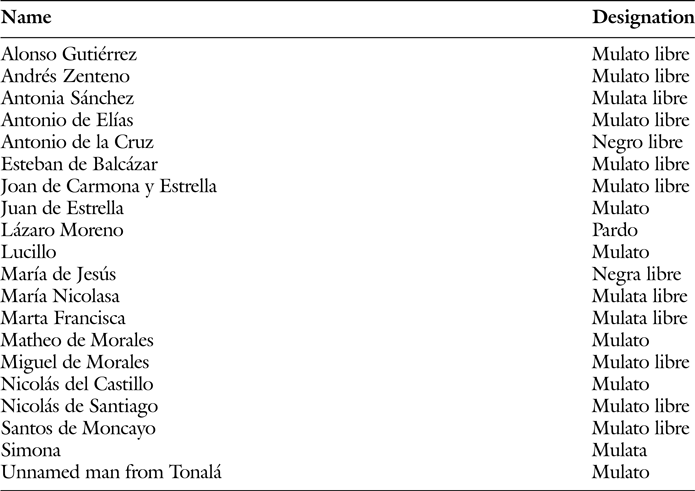
In 1685, an ecclesiastical judge named Andrés de Sotomayor wrote to Bishop Francisco Núñez de la Vega because he had received numerous complaints against a mulato sorcerer named Nicolás de Santiago.Footnote 89 Nicolás's testimony offers biographical information, noting that his father was a free mulatto and that his mother was an Indian.Footnote 90 Testimony in this case also provides the names and castas of 19 people of African descent—mulata/o, negra/o, and pardo—and one unnamed mulatto in the environs of Jiquipilas, Chiapas (see Table 1).Footnote 91 That mixed-race peoples resided in Chiapas by 1685 is not surprising, given the fact that more than “one hundred thousand slaves arrived in Mexico from the time of the conquest until 1640.”Footnote 92 As miscegenation ensued, African and indigenous peoples shared ideas about magic and rituals.Footnote 93 In the case below, Nicolás de Santiago claimed to have been taught magic by his godfather (padrino), an indigenous leader named Juan Sánchez.
People of African Descent in the Environs of Jiquipilas, Chiapas, 1685

Source: AHDC, Folder 268, exp. 1, Jiquipilas III A 1, Episcopal, Provisorato, 1685, fols. 1r-58r.
On July 21, 1685, Antonio de Obando, indio natural of Jiquipilas, testified that he knew Nicolás de Santiago had made a pact with the devil because Antonio, in the form of his nahual, had secretly followed Nicolás, and the missionary priests who accompanied him, to San Lorenzo—a cavern in a mountainous area in which idolatry was alleged to have occurred. Inside, Obando saw a figure with deer's antlers who spoke to the elder of the two priests in the “Mexican tongue,” asking him “ten tiguala ticchigua?” Footnote 94 The meaning is translated as “What have you come to do?”Footnote 95
According to Obando, the elder priest replied to the devil, stating that he had come to take the contract that Nicolás de Santiago signed with his blood.Footnote 96 Since Satan refused, the missionary father took the contract by force.Footnote 97 Although this was the only Nahuatl phrase included in this case, it shows that the devil spoke Nahuatl to a Spanish priest, rather than the colonizing language. Moreover, Obando's claim that Nicolás accompanied Spanish priests to a cave where Nahuatl was spoken suggests that Nicolás also knew this language. Another corroborating factor is that Nicolás was taught magic by his padrino, Juan Sánchez, a tribal elder whose daughter María had sought a Nahuatl-speaking interpreter to record her testimony in the case brought against Nicolás de Santiago because she could not speak Castilian well.Footnote 98
By the time María Sánchez testified on February 20, 1686, Bishop Francisco Núñez de la Vega had come to Jiquipilas to investigate the case, revealing that local officials took allegations of sorcery seriously.Footnote 99 María stated that Nicolás was a nahual who could take the form of anything that he wanted, “be it a serpent, an ass [male], etc.”Footnote 100 However, the most frequent form that he took was a “ball of air” into which Nicolás would disappear.Footnote 101 The Spanish-language testimony makes it appear that Nicolás maintained his gender when transforming into large mammals. However, because María testified in Nahuatl to Luis de Villalobos, it is likely that she did not convey the gender of Nicolás's animal transformations. Nevertheless, Nicolás's multiple transformations elevated his status in the community because doing so displayed superior spiritual power.Footnote 102
María testified that Juan Sánchez, her father, was a well-known sorcerer (brujo) who took her to San Lorenzo on several occasions.Footnote 103 During each visit, Juan attempted to teach María more and more about magic, revealing that certain women could become ritual specialists.Footnote 104 On the first nocturnal visit to San Lorenzo, María saw a shape that looked like the kind of figure painted at the feet of Saint Michael, seated in a golden chair with a tail that extended to its feet, that is, the devil. This figure said, “Come here, girl. Sit down. Don't be afraid. Embrace me.”Footnote 105
On her third visit, María saw a Spaniard seated in a different golden chair deep inside the cave. The Spaniard showed María a room filled with coins and silver jewelry, candlesticks, and spoons.Footnote 106 The Spaniard told María that she could obtain these riches if she got rid of her fear.Footnote 107 María highlighted the cave's religious import to the community stating that Nicolás de Santiago, along with her father, took dead persons to this site as an offering to the devil and that other mayordomos took offerings of incense, candles, and flowers every Monday, Tuesday, Holy Thursday, Eve of Corpus Christi, New Year's Eve, and All Saints’ Day.Footnote 108 Because María eventually rejected her father's teachings, Juan taught magic and shapeshifting to Nicolás de Santiago instead.Footnote 109
María Sánchez's testimony adds complexity to the concept of the nahual since it shows that the ability to shapeshift could be passed from parent to child and that ritual specialists taught apprentices of their choosing. The testimony also supports a broad definition of the nahualli: Nicolás de Santiago transformed into elements, such as a ball of air, as well as animals. Finally, María's statements reveal how caves, places removed from the purview of the Spanish state, continued to hold religious import for Nahua and mixed-race peoples well into the seventeenth century.Footnote 110 Traditionally, indigenous peoples revered geological formations such as mountains, hills, and bodies of water. However, Spanish clerics often derided native topographies and practices as deviant and morally suspect.Footnote 111 Colonial officials attempted to excise commoners’ belief in popular magic by denigrating it as idolatrous devil worship. Yet, this incommensurability remained part and parcel of the Spanish colonial project. Catholic colonizers, even if unwittingly, arrived at a theological impasse once they favored any, or all, of the seven sacraments of the Church over non-European forms of popular magic.Footnote 112 The derision they directed at the shapeshifter belies the fear that colonial officials shared regarding the subversive power of ritual specialists, whose magical powers parish clergy adjudged to be efficacious when members of their flock fell ill. The purported ability to heal or harm members of the community increased the likelihood of commoners believing in ritual specialists’ magical powers.
On May 20, 1696, in the town of Tecpatán, Chiapas, Jacinto López testified before local authorities that Esteban de Mesa bewitched him after he became angry with Jacinto for abandoning him along a remote road. Afterwards, Jacinto felt a burning sensation in his ear and part of it began to rot, which prompted him to blame Esteban. Jacinto also testified that it was well known that Esteban had placed a curse on Catalina Pérez's hand and that Esteban had cursed several Christians in the town.Footnote 113 In Soconusco, Chiapas, sorcery was suspected to be the cause of outbreaks of disease in 1721.Footnote 114 On March 20, Sebastían Díaz, an upper-class Indian (indio principal) testified that he witnessed a young woman named María Gálvez suffer with agonizing pain as she vomited black blood and a ball of corn husks. Villagers suspected foul play because María's symptoms were similar to those that had recently afflicted ten other adults and children: stomach pains, black blood, and death around midnight without any signs of fever. A pardo man named Lázaro Moreno testified that Pedro Gerónimo was known to be a healer of bewitched patients and that he was simultaneously feared and respected for being a sorcerer and nahual.Footnote 115 Villagers had seen Pedro Gerónimo with another figure at odd hours of the night, and, because of this, local priests took them for “nahualistas.”Footnote 116
Negotiating Geography in the Colonial Era
Labels used to describe topographies were laden with ethnocentric interpretations.Footnote 117 When non-orthodox forms of rituals were purported to have occurred in indigenous zones such as mountains, isolated roads, and bodies of water, Catholic colonizers discursively subordinated these spaces by depicting them as dangerous, uncivilized, and even queer.Footnote 118 For the Nahua, caves represented an important geological formation imbued with cultural and religious significance. Since Nahuas understood hills and mountains to be hollow and full of life-giving water, caves were seen as sources of sustenance. Inside these spaces, ritualists communicated with the deities of the underworld; caves were both necessary for life and dangerous.Footnote 119
Caverns, and caves in general, retained their importance to local communities because they enabled indigenous peoples to cross into an underworld. The gods or owners (dueños) of the mountains provided for their followers when they were sufficiently appeased with offerings of food, tobacco, alcohol, and money.Footnote 120 However, when the owners of these geological formations became displeased, they punished the community with natural disasters. Famine and catastrophe, which revealed the gods’ displeasure, prompted locals to consult ritual specialists so as to appease local deities and restore equilibrium in the cosmos.Footnote 121
Thus, the Spaniard in a cavern with deer's antlers seated on a golden chair that appeared in the visions of Antonio de Obando and María Sánchez could be interpreted as a local mountain deity imbued with Christian iconography. Inside this space, an inversion to centuries of colonialism occurred, since the devil, often depicted in submission at the feet of St. Michael, sat triumphantly on his throne.Footnote 122 Since friars venerated warrior saints as a means of conversion, the presence of the devil in lieu of Michael suggests that Satan held more power than orthodox saints. Local peoples who sought the devil's assistance, such as Juan Sánchez and Nicolás de Santiago, reduced the importance of orthodox symbols in favor of what the Church would label minions of evil. This colonial reality reveals an irony of Spanish imperialism since, for most Catholic believers, Michael signified the “celestial force that defeated the Devil, idolatry, and the ancient gods.”Footnote 123 Michael was often pictured with “crown, shield, sword, military tunic, chains and standing victoriously over the demon.”Footnote 124 However, inside caves such as San Lorenzo, the devil sat triumphant on his throne while Michael was nowhere to be seen. Rather than lying at St. Michael's feet in submission, the devil tempted commoner peoples, such as María Sanchez and Nicolás de Santiago, to join him, by offering them the riches of “Jerusalem.”Footnote 125
That indigenous and mixed-race peoples continued to revere these landscapes did not escape the attention of the Catholic friars who sought to indoctrinate them. Some clerics opined that orthopraxy would lead to changes in neophytes’ thinking. Significantly, these clerics diagnosed true repentance through the perceived contrition of the confessant. External signifiers such as the tone of voice or the tears of those interrogated could impact the innermost thoughts of colonial officials.Footnote 126 On April 5, 1686, Bishop de la Vega ordered Roque Martin, a Nahuatl-speaking Indian accused of fraternizing with the devil, to be absolved for his sins, as he had distanced himself from such “superstitions with which the Devil had deceived him” for over a year and a half.Footnote 127 The bishop believed Martin to be sincerely repentant due to “the exterior signs” that he had seen.Footnote 128 De la Vega thus recommended that the idolatrous shrine inside San Lorenzo be officially dedicated to St. Michael, suggesting that he believed external practices would, in time, change internal beliefs. The final punishment came in the form of a fine, 200 tostones, that would go toward the construction of a chapel dedicated to Saint Michael, thereby safeguarding the purity of the Catholic faith in San Lorenzo.Footnote 129
In contrast, other clergy believed that the best way to safeguard the faith was to raze idolatrous sites to the ground. In 1778, don Joseph Ordóñez y Aguiar inspected a remote cave located atop a hill near the town of San Andrés Tuxtla, Chiapas, which locals called Sacumchen.Footnote 130 Inside Sacumchen, don Joseph found a “poorly formed cross,” candles, wicks, cinders, and boxes used for incense, similar to the offerings made at San Lorenzo.Footnote 131 Surrounding the cross was an arc made of liquidambar (sweetgum) branches and leaves. At the base of the arc, don Joseph saw bones that he feared were human.
To his horror, Ordóñez y Aguiar unearthed one cadaver after another, including an infant's skull with some of the skin still attached. Having found a poorly formed cross, signs of rituals removed from the Church, and multiple cadavers, Ordóñez y Aguiar concluded that within the confines of Sacumchen lay an idolatrous sepulcher in which the people of Tuxtla sacrificed themselves to Satan.Footnote 132 The curate, alongside Ordóñez y Aguiar, lamented that the incense used in Sacumchen, which could only be acquired in the mountains, “showed greater veneration for caves than the churches as they [Indians] spend money on good incense for those [caves] and not for these [churches].”Footnote 133 Churchmen continued to associate indigenous topographies with idolatry and sin in the late eighteenth century.
Due to the threat that Sacumchen posed to the clergy, Fray Thomas Luis Roca demanded that the idolatrous sepulcher be demolished with picks, mattocks, and, if necessary, gunpowder, thereby imposing his version of orthopraxy.Footnote 134 To his dismay, indigenous locals failed to comply with his orders, as they “put little efficacy into fulfilling the orders received from their superiors.”Footnote 135 Fray Thomas also stated that the substantial costs of demolition, due to the size of the cave, made it difficult to destroy. Additionally, Mother Nature thwarted Fray Thomas when the rainy season began, forcing him to defer demolition until the dry season. Even when two months of good weather had passed, Fray Thomas could not gather enough men to execute his plan, prompting him to remit the case to his superiors.Footnote 136 The frustration that Fray Thomas experienced shows both the financial constraint placed on New Spain's coffers and the ability of indigenous peoples to negotiate the terms of colonization in the eighteenth century.Footnote 137 Evidently, indigenous locals dragged their feet because the cave of Sacumchen, like that of San Lorenzo, held significant cultural value. The delay caused by the rains, coupled with the size of the cave, shows how difficult it was for Spaniards to maintain their dominion over nature.
Spanish clerics deliberately concealed non-orthodox interpretations to maintain the alleged purity of the Catholic faith. On March 26, 1778, Bishop Francisco Polanco ordered that the cadavers found in Sacumchen be secretly transported in a locked trunk and taken to the royal hospital. Here, the remains of the deceased would be buried in the “most intimate part of the cemetery.”Footnote 138 The bishop's concern for a proper burial highlights his belief in an afterlife and his wish to—literally—inter signs of idolatry.
The association of water with caves also highlights the significance of natural bodies of water among indigenous peoples. Johanna Broda states that “the mountain cult was intimately connected to the cult of rain, water, and the earth,” making it “one of the oldest elements of pre-Hispanic religion, the roots of which go back to Preclassic times.”Footnote 139 In the minds of Spanish colonizers, native interpretations of water competed with that of the Church, whose ministry emphasized its hallowed nature in the sacrament of baptism.Footnote 140 In 1734, Pedro Joseph, a black slave (negro esclavo) testified that he witnessed a baptism on a night in which a local tlatoani (Nahuatl for tribal leader) came to the house where Pedro stayed to baptize a newborn baby.Footnote 141 Working in tandem with a midwife, the tlatoani asked whether “a lizard, tiger, or another animal from the mountains” should be associated with the baby, thus revealing the continued association between day signs and animal companions.Footnote 142 Pedro Joseph's testimony highlights another way that one could acquire the ability and power of the nahual—through ritual ablution. Invariably, this form of baptism conflicted with the sacrament of baptism as espoused by the Catholic Church.Footnote 143
Bodies of water could also facilitate the transformations of adult nahualli. On November 8, 1786, don Juan Joseph Montoya, notary and church elder in the town of Rivas, Nicaragua, appeared before the Holy Office to denounce doña Manuela de Ibarra for shapeshifting.Footnote 144 Montoya stated that late one night he heard the sound of women's laughter coming from the street. But, when he went outside, he only saw two mares (yeguas) nuzzling each other. Having piqued his interest, Montoya followed the mares to a river where he witnessed them transform into women. At this point, Montoya recognized one of the women as Manuela de Ibarra, who pleaded with Montoya to keep quiet about what he had seen.Footnote 145
A few days later, when Montoya passed by the same river late at night, he encountered a lioness (leona) so fierce that he had to dismount his horse to defend himself. When he placed his hand on his sword, however, the lioness transformed into Manuela de Ibarra. When Montoya asked Ibarra why she tried to harm him even though he had kept her secret, she replied that she wanted to see whether he was a “man of valor.”Footnote 146 Harnessing the power of nature enabled Manuela to briefly invert colonial gender relations as she intimidated Montoya and mocked his courage. According to the Spanish-language testimony, Manuela clearly maintained her gender when shapeshifting. Perhaps Manuela neglected to cross the gender divide so as to further emasculate Montoya as a mare and a lioness.
Intriguingly, Manuela's slave, María Joseph Ibarra, could also shapeshift. Don Joseph Martínez testified that María's husband, Joseph Mercedes Romero, had told him he had seen María shapeshift into a bird. Allegedly, Romero was angered that María refused to accompany him to the village festival on Christmas Eve (Nochebuena).Footnote 147 So, on the night in question, Romero left the house as if he were going to attend the festival but, instead, hid himself nearby. From this vantage point, Romero saw three big birds flying in the sky over his house around two o'clock in the morning. Romero saw one bird go inside his house, and when he reentered the house, he found his wife in human form, leading him to conclude that she was a nahualli.Footnote 148
Despite these accusations, Inquisition officials based in Mexico City, dismissed this case outright. Neither Manuela de Ibarra nor María Ibarra was summoned to testify. On March 11, 1787, the prosecuting attorney (fiscal) stated that the testimony from locals was so unbelievable and ridiculous that from it one could deduce such absurdities, inconsistencies, and contradictions as to reject the accounts as “old wives’ tales” (cuentos de viejas) and deny them all credibility.Footnote 149 Indeed, the prosecuting attorney admonished the local commissary, don Thomas Antonio Martínez de Fleytas, for his foolishness in bringing the case to the Holy Office. The fiscal stated that don Thomas, as a priest and official purger (expurgador) of the Inquisition, should admonish villagers for their credulousness rather than entertain it.Footnote 150
Social Divisions among Churchmen
In part, this chastisement stems from a disparity in status between the prosecuting attorney and the local commissary. In New Spain, the post of fiscal was the second most important position in the Holy Office of the Inquisition.Footnote 151 The prosecuting attorney received a handsome salary of 3,000 pesos from the Inquisition and his “service in the position of fiscal often led to an eventual promotion to inquisitor.”Footnote 152 Pending final approval from the viceroy and the crown, inquisitors had the power to nominate local commissaries, demonstrating their heightened status.Footnote 153
As a commissary in Rivas, Nicaragua, don Thomas Antonio Martínez de Fleytas served the Inquisition by receiving denunciations, investigating cases related to crimes against the faith, publishing and announcing edicts of faith in his parish and, potentially, scrutinizing the genealogies and lifestyles of those hoping to become ministers of the tribunal.Footnote 154 Parish priests interacted with locals regularly. For instance, the church elder don Juan Joseph Montoya informed don Thomas that he first heard rumors about Manuela de Ibarra while administering the sacraments in the village of Guanacaste. Montoya was informed by two unnamed women and a mulato vecino named Juan López that Ibarra had bewitched individuals in their community.Footnote 155 Witnessing the maladies of their parishioners undoubtedly increased the perceived efficacy of ritual specialists in the minds of local clergy. Thus, parish ecclesiastics were more likely to take accusations of sorcery seriously, while their social superiors, who resided in large cities, viewed popular magic with skepticism.Footnote 156
Two additional examples of parish clergy believing in the efficacy of ritualists’ supernatural powers can be inferred from the case brought against Nicolás de Santiago in 1685. On February 10, don Andrés Joseph de Sotomayor, the resident priest of Ocozocoautla, Chiapas, testified that many times late at night he heard disturbing noises in his house, which sounded like someone slapping a table. Sotomayor stated that on December 23, 1684, at around two in the morning, a noise, which sounded like chairs and tables banging about, was so loud that he got out of bed to wake his servants. This incident resulted in his servants falling ill. After Sotomayor conversed with the Indians of Ocozocoautla about these occurrences, they replied that it was well known among them that something similar had happened to his predecessor, Juan de Monjarraz.Footnote 157 Around six in the evening on December 30, Sotomayor reported that he returned home from having administered the “sacrament of extreme unction” and later heard terrifying noises coming from his room and elsewhere in the house.Footnote 158 When he entered his room, he found the chairs in disarray, the walls damaged, and his clothing in a mess, and, worst of all, he caught wind of a horrible stench emanating from the room. Footnote 159
Because these incidents terrified everyone in his house, Sotomayor packed up and moved to another residence. A Spaniard named don Diego Contreras took pity on Sotomayor and provided him with safe haven. Don Diego arranged for Sotomayor to meet a resident mulatto of Jiquipilas, the aforementioned Nicolás de Santiago. Nicolás told Sotomayor that he would eliminate these apparitions by using “the art that God had given him.”Footnote 160 This proposition made Sotomayor uneasy because he knew that the other mulattos in the community called Nicolás de Santiago “the renegade,” and because Nicolás provided remedies and cures that locals said were cursed.Footnote 161 Sotomayor testified that many people in the village believed Nicolás to be a diviner since he was able to guess who stole missing items in the village and because Nicolás often found things that had gone missing.Footnote 162 Sotomayor overheard Jacinto González state that God made Nicolás a wise fortune-teller and, for this reason, the Indians of the pueblo revered him.Footnote 163 Finally, in this case, the bishop of Chiapas revealed that Catholic officials believed in the magical capabilities of indigenous ritualists. On February 20, 1686, Francisco Núñez de la Vega stated that after hearing María Sánchez's testimony—which detailed her nocturnal visits to San Lorenzo, sightings of the devil, and flying through the air with her nahual—there could be no doubt that María spoke the truth since she recounted the events that had transpired with such specificity.Footnote 164
When the sacraments appeared to have no effect, some priests sought the assistance of local ritualists as a means to counteract the sorcery that was afflicting them. Ritual specialists such as the nanahualtin competed with Catholic priests once locals solicited their help to cure diseases and resolve disputes in lieu of turning to the Church.Footnote 165 Catholicism encouraged a mutually exclusive ideology that operated within the polarized binary of good and evil.Footnote 166 Since pious Catholic parishioners believed that God was present in their daily lives, chance, as an explanatory concept, was exceedingly hard to justify. Due to the belief in an omnipotent, omnipresent, and omnibenevolent God, chance did not exist for devout Catholics in New Spain.
Orthodoxy in the Archives
The Mexican Inquisition, which had taken root in New Spain by 1571, imposed its authority on Spanish vassals with the objective of extirpating heretical beliefs and practices to entrain orthodoxy. Crimes against the faith could be rectified only through use of the sacraments. A true confession, one of the seven sacraments, would enable repentant believers to enter heaven. On February 15, 1721, Juan de Santander, dean of the Church, ordered Pedro Gerónimo, who was suspected of sorcery, to cleanse his conscience with a “true and painful confession in the Holy Sacrament of Penance.”Footnote 167 Similarly, Santander ordered the brothers of Augustín Díaz, who engaged in “superstitious” acts of curation, to detest all superstition and cleanse their conscience with the holy sacrament of confession.Footnote 168 In this respect, the concept of an afterlife linked directly to the health of the community in the temporal world.
On November 23, 1798, after receiving news of heresy among the Indians in Magdalena Coalpitan, the prosecuting attorney wrote that he had succeeded in correcting idolaters and “nahualistas” by placing them in religious convents, where they were “catechized, indoctrinated,” and persuaded to confess their sins.Footnote 169 The prosecuting attorney exposed his benevolent paternalism, noting that these Indians committed such sins out of ignorance rather than malice. He further stated that the “diabolical” and “abominable” sect of “nagualismo” was the legitimate daughter of idolatry and that such crimes destroyed the purity of the holy faith.Footnote 170 The prosecuting attorney also noted that the vice of “nahualismo” was spread through the “flesh and blood inherited from native-born [indigenous peoples] in both Americas,” which, he asserted, could be proven by consulting the testimony of various illustrious prelates in the Church whose many writings fill the “archives.”Footnote 171
That evidence of the “diabolical” sect of nahualismo could be found in archives in the Americas directly links official records to pejorative tropes, discursively rendering Indians as socially inferior to Iberians. These negative stereotypes support the notion of archival epistemology, a process of knowledge production that facilitated the legal discrimination between justified and unjustified beliefs.Footnote 172 Thus, by the late colonial era, Catholic colonizers could link shapeshifting to the entire Spanish-American empire, which made nanahualtin a threat to the state.
Returning to the case of Tiburcio Pamplona that opened this article, we see that on December 28, 1801, Governor Ordóñez ordered that Pamplona be placed in prison and reiterated the importance of investigating those dogmatizers of the “diabolical sect of Nagualismo” and of discovering their calendars, reports, papers, annals, cosmological books and other superstitions.Footnote 173 Even in the nineteenth century, colonial officials attempted to root out the nahualli, but the figure persisted.
The case does not state whether Pamplona called on Satan after he had been arrested. Nevertheless, on January 4, 1802, Fray Pascual Aparicio wrote to the governor that Tiburcio Pamplona escaped from prison on December 31, 1801. Eventually, the alcaldes seized Pamlona in the mountains. The case ends by noting that Pamplona had been transferred to the royal jail in Tuxtla, Chiapas, and that Fray Pascual would await further instructions from his superiors as to how he should proceed.Footnote 174 Undoubtedly, Pamplona remained socially isolated in another village and, likely, held less standing locally.
Conclusion
Governor Ordóñez's comments show that even as late as the nineteenth century, inquisitors acknowledged the subversive power of nanahualtin. Contrast this example to the case of Manuela de Ibarra, in which the officials chastised villagers for listening to idle gossip. The difference between the verdicts in the cases analyzed here reveals internal divisions among the clergy. Moreover, when the well-being of the community was at stake, local officials took accusations of sorcery seriously. Because no one fell ill from Manuela de Ibarra's magic, inquisitors viewed the case against her as a waste of time.
Labels such as ‘superstition’ and ‘idolatry’ operated as a type of colonizing discourse because Spanish officials tried to extirpate pre-Hispanic practices and beliefs. This article has shown that belief in popular magic continued throughout the colonial era while also noting changes over time, such as the use of Christian iconography and the grammatical imposition of gendered animals in Spanish-language testimonies. By analyzing indigenous terms closely, historians can begin to identify more precisely how this process of obfuscation and erasure occurred as part of an ongoing effort to excavate the archives.
As they populated the Americas, Iberian colonizers grew anxious about the continued presence of deities worshiped by indigenous and African peoples. The counterpart to the process of subordination described above was that Spanish colonial officials, all of whom were Catholic, derided non-orthodox beliefs as heretical and superstitious. The colonial Other—Indians and peoples of African descent—held the potential to disrupt Spain's imperial project by accessing the supernatural in locations removed from the purview of the state. Notwithstanding Catholic officials’ efforts to extirpate the nahualli, the viceroyalty of New Spain remained enchanted.