Introduction
The evolutionary history and biogeography of the sub-Antarctic islands have long been the topics of both interest and controversy. Since the biotas of the region were first described in the 1800s, many hypotheses have been proposed concerning the origins thereof and the biogeographic relationships among the various islands in the region (e.g. Gressitt Reference Gressitt1970, Chown Reference Chown1990, Reference Chown1994, Michaux & Leschen Reference Michaux and Leschen2005, Van der Putten et al. Reference Van Der Putten, Verbruggen, Ochyra, Verleyen and Frenot2010). More generally, the geological history of the Kerguelen Plateau and the role it might have played in influencing distributions among the continents has also featured prominently in debates about the biogeographic history of the Southern Hemisphere.
Much of the discussion of sub-Antarctic biogeography has, to date, centred on assessments of species distributions based primarily on either phylogenetic analyses or presence/absence data using morphological or anatomical species delimitations (e.g. Gressitt Reference Gressitt1970, Kuschel & Chown Reference Kuschel and Chown1995). Indeed, even the most recent assessments, though clearly providing modern geological interpretations and contexts (e.g. Craig et al. Reference Craig, Currie and Vernon2003, Michaux & Leschen Reference Michaux and Leschen2005, Van der Putten et al. Reference Van Der Putten, Verbruggen, Ochyra, Verleyen and Frenot2010) still rely heavily on such approaches. Whilst these works have provided a range of important insights (Chown et al. Reference Chown, Gremmen and Gaston1998, Craig et al. Reference Craig, Currie and Vernon2003) they are also limited, and modern, molecular approaches have shown how misleading interpretations, founded solely on morphologically-based distributional data, may be. In particular, they have demonstrated that dispersal across the Southern Hemisphere has been much more common than previously thought (e.g. De Queiroz 2005). In addition to providing a means for dating significant biogeographic events, molecular studies also bring additional data to bear on hypotheses of relationships among taxa and areas. Such information is particularly useful where analyses of morphological variation might be confounded by cryptic species or substantial environmental influences (see De Wever et al. Reference De Wever, Leliaert, Verleyen, Vanormelingen, van der Gucht, Hodgson, Sabbe and Vyverman2009, Torricelli et al. Reference Torricelli, Carapelli, Convey, Nardi, Boore and Frati2010).
Despite the benefits that molecular approaches bring to investigations of biogeography and evolutionary history of any region and its biota, few such investigations have focussed on terrestrial taxa. The most common investigations are those of relationships among marine species and populations across the region (Thornhill et al. Reference Thornhill, Mahon, Norenburg and Halanych2008, Fraser et al. Reference Fraser, Nikula, Spencer and Waters2009, Wilson et al. Reference Wilson, Schrödl and Halanych2009), and for terrestrial groups among plant taxa from New Zealand and its sub-Antarctic islands (see Michaux & Leschen Reference Michaux and Leschen2005). Several studies have also sought to explore the phylogeography of particular species typically on a single island or archipelago (Grobler et al. Reference Grobler, van Rensburg, Bastos, Chimimba and Chown2006, Myburgh et al. Reference Myburgh, Chown, Daniels and van Vuuren2007, McGaughran et al. Reference McGaughran, Convey, Stevens and Chown2010a) or relationships among populations or species on the Antarctic Peninsula and Scotia Arc islands (Allegrucci et al. Reference Allegrucci, Carchini, Todisco, Convey and Sbordoni2006, McGaughran et al. Reference McGaughran, Torricelli, Carapelli, Frati, Stevens, Convey and Hogg2010b). By contrast, investigations of terrestrial taxa across one or more sub-Antarctic archipelagos are limited to springtails (Stevens et al. Reference Stevens, Greenslade, Hogg and Sunnucks2006), ameronothroid mites (Mortimer et al. Reference Mortimer, Jansen van Vuuren, Lee, Marshall, Convey and Chown2010), and the Antarctic hair grass (Van de Wouw et al. Reference Van de Wouw, van Dijk and Huiskes2007). This situation is particularly concerning given the considerable change in perspective on the evolution and biogeography of both Antarctic and sub-Antarctic groups that has resulted from molecular approaches (reviewed in Chown & Convey Reference Chown and Convey2007), and the controversy surrounding the origins of many of the groups endemic to the sub-Antarctic islands (Jeannel Reference Jeannel1964, Chown Reference Chown1994, Van der Putten et al. Reference Van Der Putten, Verbruggen, Ochyra, Verleyen and Frenot2010).
Such controversy about origins and species relationships has been a feature of investigations of the Ectemnorhinus group of genera, a monophyletic unit of weevils (Kuschel & Chown Reference Kuschel and Chown1995) restricted to the South Indian Ocean Province (or Kerguelen Biogeographic Province) of the sub-Antarctic (reviewed in Chown Reference Chown1992, Reference Chown1994). Although the group is small by comparison with other taxa in the Curculionidae, it is one of the most speciose monophyletic taxa in the South Indian Ocean Province (Chown Reference Chown1989), providing an ideal group with which to investigate biogeographic hypotheses in the region. Thus, we provide an analysis of phylogenetic relationships among species from the genera Palirhoeus, Bothrometopus and Ectemnorhinus, based on the material available from Heard Island in the east to the Prince Edward Islands in the west. Whilst this study does not comprise a complete analysis of the six genera and 36 species of the group (= Ectemnorhinini (Kuschel & Chown Reference Kuschel and Chown1995, Alonso-Zarazaga & Lyal Reference Alonso-Zarazaga and Lyal1999, Grobler et al. Reference Grobler, van Rensburg, Bastos, Chimimba and Chown2006)), it does provide a strong argument for reconsideration of the species in the group and its evolution, and, as a consequence the need for additional molecular-based investigations of taxa endemic to the sub-Antarctic.
Materials and methods
Study animals and sites
The Ectemnorhinus group of genera (Kuschel & Chown Reference Kuschel and Chown1995) is confined to the South Indian Ocean Province Islands, and is thought to be most closely related to the genera Oclandius and Heterexis from the New Zealand sub-Antarctic islands (Kuschel & Chown Reference Kuschel and Chown1995). The systematics of the group has been controversial, especially the status of species within the genera, the genera that are valid, and the evolutionary and biogeographic relationships among these taxa (Kuschel Reference Kuschel1971, Dreux & Voisin Reference Dreux and Voisin1987, Reference Dreux and Voisin1989, Kuschel & Chown Reference Kuschel and Chown1995). All of this work has been based on morphological assignments of individuals to species and subsequent assessments of the ecological characteristics and geographic distributions of these species (reviewed in Chown Reference Chown1994). However, the systematic complexity of the group given its morphological variability suggests that interpretations of the systematic, biogeography and evolutionary history of the group would benefit considerably from, and likely be substantially altered by, the inclusion of molecular data.
One recent approach of this kind has shown that this is indeed the case, demonstrating that the genus Ectemnorhinus on the Prince Edward Islands does indeed comprise two species, though not as originally envisaged (cf. Kuschel Reference Kuschel1971). Ectemnorhinus similis (= E. marioni junior synonym) is found on both islands, whereas E. kuscheli Grobler et al. is found on Prince Edward Island only (Grobler et al. Reference Grobler, van Rensburg, Bastos, Chimimba and Chown2006). Such complexity is perhaps not unexpected given the extent of variation within the genus Ectemnorhinus, and the intricacy of the ecological situation on the Prince Edward Islands, where individuals of the genus Ectemnorhinus are a preferred prey item of introduced house mice present on Marion, but not on Prince Edward Island (Chown & Smith Reference Chown and Smith1993). However, both a revision of the Bothrometopus species on Possession Island (Chown & Kuschel Reference Chown and Kuschel1994) and a recent assessment of the phylogeography of the species found on the Prince Edward Islands (Grobler et al. Reference Grobler, van Rensburg, Bastos, Chimimba and Chown2006, Reference Grobler, Bastos, Chimimba and Chown2011) suggested that cryptic species and complicated evolutionary relationships may also be a feature of other genera in the Ectemnorhinus group. We explore this question here.
The geological and glacial histories of the South Indian Ocean Province islands have been summarized (e.g. Hall Reference Hall2002, Boelhouwers et al. Reference Boelhouwers, Meiklejohn, Holness and Hedding2008, Van der Putten et al. Reference Van Der Putten, Verbruggen, Ochyra, Verleyen and Frenot2010) and their contemporary climatic characteristics (generally cool and oceanic) and nature of their ecosystems have also been reviewed in a range of studies (e.g. Chown et al. Reference Chown, Gremmen and Gaston1998). The islands vary in age from 0.5 million years (m.y.) for Marion Island to c. 40 m.y. for the Kerguelen archipelago, with substantial variation within archipelagos in terms of age, history and extent of glaciation. Perhaps the most enigmatic of the groups in terms of its biogeography is the Crozet archipelago (Jeannel Reference Jeannel1964, Chown Reference Chown1994, Van der Putten et al. Reference Van Der Putten, Verbruggen, Ochyra, Verleyen and Frenot2010), owing to a complex geological history.
Taxon sampling, genetic characterization and phylogenetic analysis
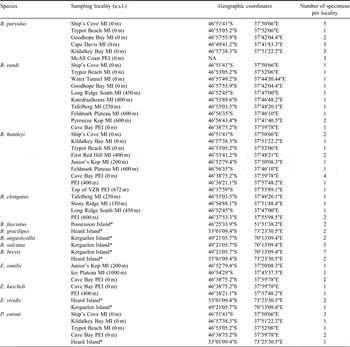
For this study we focussed on the genera Palirhoeus Kuschel, Bothrometopus Jeannel, and Ectemnorhinus G.R. Waterhouse. Whilst material of the genera Canonopsis C.O. Waterhouse and Christensenia Brinck were available, we were unable to obtain DNA in condition that was suitable for sequencing. We obtained sequence data from approximately half of the total number of species in the three genera and what we thought initially was 12 species and 20 populations representing all of the major archipelagos, but which following analysis turned out to be 13 species from 22 populations (Table I). The most comprehensive sampling was undertaken on the most readily accessible Prince Edward Islands (see also Grobler et al. Reference Grobler, van Rensburg, Bastos, Chimimba and Chown2006, Reference Grobler, Bastos, Chimimba and Chown2011). For an outgroup, we used two COI gene sequences from Sitona discoideus (Curculionidae: Etiminae; Genbank accession numbers EF118292 and EF118299) from Norfolk Island, Australia (Vink & Phillips Reference Vink and Phillips2007).
Summary of the sampling localities from which the genetically characterized specimens included in this study were collected.

VZB = Van Zinderen Bakker Peak, * = geographic coordinates given for the scientific stations on Kerguelen and Possession Islands, and for Atlas Cove on Heard Island.
DNA from each individual was extracted from a leg which, following removal from ethanol was washed and rehydrated in distilled water for ten minutes prior to being frozen in liquid nitrogen and ground in individual Eppendorf tubes using an Eppendorf pestle. DNA was extracted using the High Pure PCR Template Preparation Kit (Roche Applied Science) using the supplier's procedure for isolation of nucleic acids from mammalian tissue with modification to the proteinase K tissue lysis incubation step which was performed for 24 h instead of the recommended 1 h for mammalian tissue.
Taxon-specific COI primers, GF5-1940 and GR5-2935 (Grobler et al. Reference Grobler, van Rensburg, Bastos, Chimimba and Chown2006), were used to amplify a 996 bp PCR product under previously described reaction conditions (Grobler et al. Reference Grobler, van Rensburg, Bastos, Chimimba and Chown2006) using a thermal cycling profile comprising an initial denaturation step at 94°C for 90 s, followed by 40 cycles of 94°C for 22 s, 46°C for 30 s and 72°C for 1 min and concluding with a final extension step of 1 min at 72°C. PCR products of the correct size were purified directly from the tube using a Roche High Pure PCR Product Purification Kit. DNA sequences were determined by automated cycle sequencing reactions run on an ABI PRISM™ 3100 Analyser and generated using the ABI PRISM Big Dye™ Terminator V3.0 sequencing standard (Applied Biosystems). The sequences were viewed, edited and aligned using the alignment explorer function incorporated within the MEGA4 programme (Tamura et al. Reference Tamura, Dudley, Nei and Kumar2007).
Neighbour-Joining (NJ) and Minimum Evolution (ME) algorithms in MEGA4 (Tamura et al. Reference Tamura, Dudley, Nei and Kumar2007) were used to construct distance trees. Bayesian inference (BI) using MrBayes version 3.1.2 (Ronquist & Huelsenbeck Reference Ronquist and Huelsenbeck2003) was performed with the model and parameters estimated in jModelTest 0.1.1 (Guindon & Gascuel Reference Guindon and Gascuel2003, Posada Reference Posada2008) under the Akaike Information Criterion (AIC). The analysis was initiated with random starting trees with four parallel runs for 10 000 000 generations using one cold and three heated Markov chains using the default heating setting. The Markov chains were sampled every 1000 generations. Tracer plots were visually inspected and tracer diagnostics (standard deviation of split frequencies, effective sample size), as implemented in MrBayes and Tracer v1.4 (Drummond & Rambaut Reference Drummond and Rambaut2007) were checked to ensure that the Markov chain had reached stationarity. Of the 10 000 trees obtained 2000 were discarded as “burn-in” and the trees were summarized using an ‘all-compatible’ consensus. Maximum parsimony (MP) analyses were performed in PAUP* (Swofford Reference Swofford2003). Starting trees were obtained by closest stepwise addition and heuristic searches were performed using the tree-bisection reconnection (TBR) branch swapping algorithm. Characters were unordered and assigned equal weights in the initial analysis, and subsequently reweighted using the rescaled consistency (RC) index as detailed previously by Farris (Reference Farris1969). Nodal support was assessed by 100 bootstrap replicates.
Haplotype (h) and nucleotide diversities (π) were estimated in DNASP 5.00.07 (Librado & Rozas Reference Librado and Rozas2009). To obtain more accurate divergence estimates for the older splits, the standard 2.3% nucleotide sequence divergence per million years estimate (Brower Reference Brower1994) was used in combination with a model of sequence evolution that corrects for multiple hits and accounts for rate heterogeneity (Papadopoulou et al. Reference Papadopoulou, Anastasiou and Vogler2010). We therefore retained and imposed the original 2.3% estimate as it was shown to correspond well with the mean mtDNA divergence rate obtained for Aegean tenebrionids (2.23% and 2.39% m.y-1) when using the GTR+Γ+I model under a strict and relaxed clock, respectively (Papadopoulou et al. Reference Papadopoulou, Anastasiou and Vogler2010). BEAST 1.5.3 (Drummond & Rambaut Reference Drummond and Rambaut2007) was used to obtain an ultrametric tree using Bayesian MCMC analysis orientated towards rooted, time-measured phylogenetics. Well supported nodes identified following NJ, ME, MP and BI analyses were constrained to be monophyletic and the HKY+I+Γ model identified in jModelTest 0.1.1 (Posada Reference Posada2008, Guindon & Gascuel Reference Guindon and Gascuel2003) under the AIC was enforced using a strict molecular clock model. The results of two independent runs were merged and analysed with Tracer v1.4 and TreeAnnotator v1.4.7 (Drummond & Rambaut Reference Drummond and Rambaut2007).
Results
Genetic characterization and phylogenetic analyses
All sequences used in our final dataset were 885 bp in length and correspond to nucleotide positions 514 to 1399 of the COI gene. All novel sequences have been deposited in the Genbank database under accession numbers: GQ856478-80, GQ856482-8, GQ856490-1, GQ856493–GQ856500 and GU947664–GU947703, and were complemented with nucleotide sequence entries from two other studies, viz. AY762278, AY762285, AY762298-9, AY762317-20 (Grobler et al. Reference Grobler, van Rensburg, Bastos, Chimimba and Chown2006) GQ131943, GQ131946, GQ131952, GQ131954-5, GQ131961, GQ131967, GQ131979, GQ131997, GQ131999, GQ132004, GQ132006, GQ132009, GQ132012-4 (Grobler et al. Reference Grobler, Bastos, Chimimba and Chown2011).
Of the 885 sequenced sites 592 were conserved across all 86 specimens in the dataset. Of the 293 variable sites 277 sites were parsimony informative and 159 of the latter were assigned weights other than one after rescaled consistency index (RCI) character reweighting. Parsimony analyses with equal weighted characters recovered 92 trees with a length of 779 and homoplasy indexes of: CI = 0.485, RI = 0.898 and RCI = 0.435. The analysis in which characters were RCI reweighted also recovered 92 trees, all 342.97 in length, with homoplasy indexes of: CI = 0.672, RI = 0.935 and RCI = 0.629.
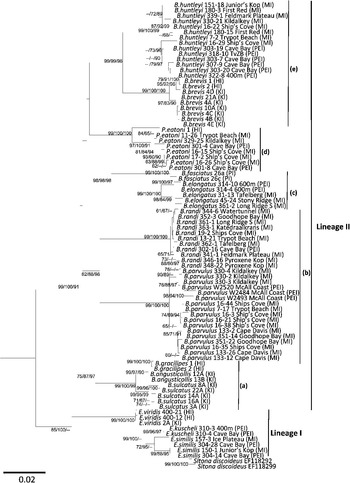
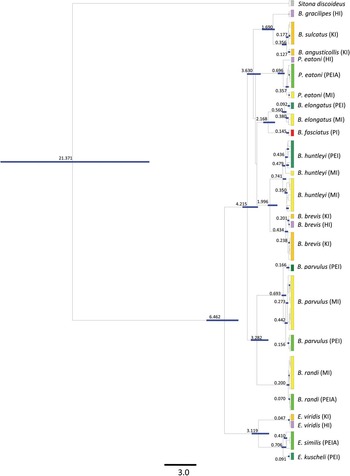
The HKY+I+Γ model of sequence evolution selected under the AIC in jModelTest 0.1.1 (Guindon & Gascuel Reference Guindon and Gascuel2003, Posada Reference Posada2008) recovered a transition transversion ratio of 4.4317, a gamma distribution shape parameter (Γ) of 1.000, proportion of invariable sites (I) = 0.6020 and base frequencies of A = 0.3462, C = 0.1528, G = 0.1012 and T = 0.3998 (% AT = 74.60%). The molecular phylogenies obtained with the different inference methods were topologically similar and recovered two main evolutionary lineages (denoted I and II in Fig. 1) for the Ectemnorhinus group of genera. Pairwise uncorrected p-distance comparisons of each monophyletic lineage/species within these lineages revealed mean inter-specific sequence divergence values of between 1.8 and 13.1%, and mean intra-specific diversity values ranging from 0.1 to 1.2% (see supplementary table S1 at www.journals.cambridge.org/jid_ANS). Lineage I (85% bootstrap support from ME and 100% from MP) which contains all of the Ectemnorhinus species characterized in this study is basal to the lineage II (99% and 100% bootstrap support from ME and MP, respectively) containing representatives of the genera Palirhoeus and Bothrometopus. Of the three Ectemnorhinus species characterized, E. viridis is basal to E. similis and E. kuscheli and intra-specific divergence for this species is low despite the fact that the E. viridis individuals are from different (Heard and Kerguelen) islands. According to the age estimates in Fig. 2, E. viridis last shared a common ancestor with the Ectemnorhinus species from the Prince Edward Archipelago approximately 3.12 million years ago (m.y.a.). Ectemnorhinus kuscheli from Prince Edward Island is basal to E. similis that occurs on both Marion Island and Prince Edward Island, and they shared their last common ancestor c. 0.71 m.y.a. (Fig. 2).
Minimum Evolution (ME) tree of 13 species from the Ectemnorhinus group of genera based on 885 nucleotides of the mitochondrial cytochrome oxidase I (COI) gene. Each taxon label contains the species designation, sample number, sampling locality, and island of origin. Nodal support values obtained from 10 000 bootstrap replications (ME), 100 bootstrap replications from Maximum Parsimony (MP) and posterior support from Bayesian Inference (BI) analyses, expressed as percentages and denoted ME/MP/BI on each node. ‘- -’ indicates support values < 65 (for ME and MP) and < 90 (for BI). The scale indicates the number of nucleotide substitutions. Islands are abbreviated as follows: Marion Island (MI), Prince Edward Island (PEI), The Prince Edward Island Archipelago (PEIA), Heard Island (HI), Kerguelen Island (KI) and Possession Island (PI).

Ultrametric tree obtained with BEAST with a clock rate of 2.3% sequence divergence per million years. The topology was constrained to retain monophyletic lineages recovered across all methods of inference (i.e. NJ, MP and BI). The numbers in the nodes correspond to the estimated age in million years, and the blue bars to the 95% confidence interval. The scale indicates change in million years. Islands are abbreviated as follows: Marion Island (MI), Prince Edward Island (PEI), The Prince Edward Island Archipelago (PEIA), Heard Island (HI), Kerguelen Island (KI) and Possession Island (PI).

Lineage II comprises five monophyletic lineages (labelled a–e in Fig. 1) that coalesced approximately 4.22 m.y.a. These clades contain all nine Bothrometopus species characterized in this study as well as Palirhoeus eatoni (Fig. 1, clade d) suggesting that the monotypic genus Palirhoeus should be synonymized with Bothrometopus pending confirmation from nuclear gene analyses. Within the Palirhoeus lineage, which is estimated to have arisen c. 0.696 m.y.a., the P. eatoni specimen from eastern Heard Island, is basal to the western Prince Edward Islands’ specimens. Bothrometopus gracilipes, B. angusticollis and B. sulcatus group together in a monophyletic clade (Fig. 1, clade a) with 75–91% nodal support. The Heard Island B. gracilipes lineage is estimated to have diverged from the remaining species approximately 1.69 m.y.a. The sister taxa B. angusticollis and B. sulcatus, represented by specimens from Ile Kergeulen, diverged c. 0.356 m.y.a.
Bothrometopus fasciatus from Possession Island, groups with, and is basal to, B. elongatus from the Prince Edward Islands (Fig. 1, clade c). The estimated time to B. fasciatus and B. elongatus lineage coalescence is c. 2.2 m.y.a. Individuals of B. elongatus from Prince Edward Island are distinct from those from Marion Island, diverging c. 0.56 m.y.a. Additional B. elongatus specimens would need to be examined to determine the extent of gene flow between Prince Edward and Marion Islands.
When examining the remaining two clades (Fig. 1b & e) it became clear that both clades contain individuals from the Prince Edward Islands archipelago, identified morphologically as B. parvulus, but which are not sister taxa. One of these clades is sister to B. randi from the Prince Edward Islands, having diverged from this sister taxon approximately 3.3 m.y.a., whilst the other morphologically similar counterpart, groups with B. brevis from the Kerguelen and Heard islands, constituting a lineage which is estimated to have arisen c. 2.0 m.y.a. (Fig. 2).
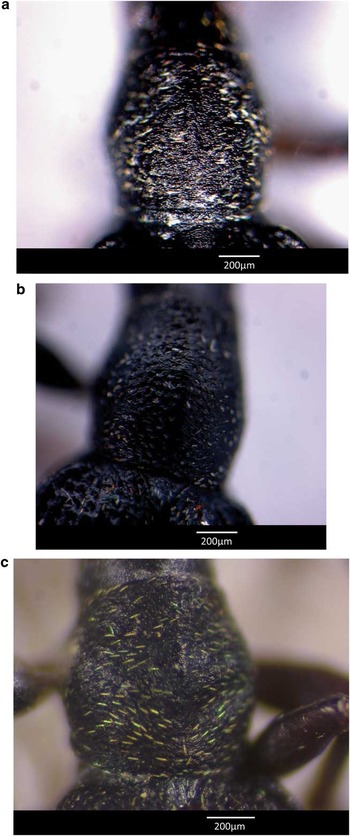
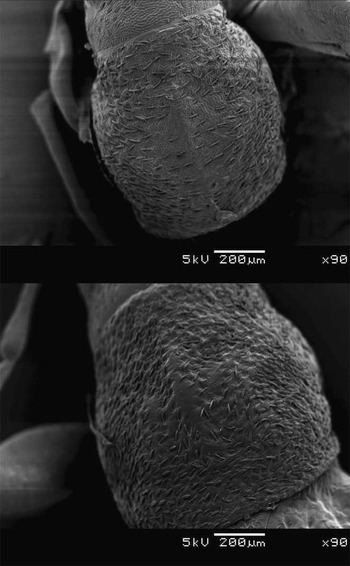
Detailed external morphological examination of these two species, and comparison with images of the holotype of B. parvulus held by the Natural History Museum, London, revealed considerable similarity, with the exception of the microsculpture of the pronotum, which provides a reliable means of distinguishing between them (and also between some species on Possession Island, see Chown & Kuschel Reference Chown and Kuschel1994). In the case of the holotype of B. parvulus, and indeed all material henceforth assigned to that species, the pronotal microscuplture appears pointillistic under a light microscope with granular microsculpture (Fig. 3a & c), and alutaceous when examined using scanning electron microscopy (Fig. 4). By contrast, the other species, which we describe formally below, has a smoother appearance under both light (Fig. 3b) and electron microscopy (Fig. 4), with distinct large punctations. No other completely reliable means exist to distinguish morphologically between these two species, but the characters are 100% reliable, as assessed via two independent approaches. First, morphology-based, in which one of us (SLC) with no advance knowledge of specimen identity, visually matched all specimens to the sequence data determinations with 100% congruence. Second, based on morphology, additional material from Prince Edward Island was identified by one of us (AMT) and then provided to another author (GCG) who sequenced the material without prior knowledge of morphological assignment. The assignment match was 100%. We also noted that the individuals that correspond to B. parvulus appear to be restricted to coastal regions whereas the new species is distributed island-wide. The new cryptic species, Bothrometopus huntleyi, initially identified as B. parvulus based on morphology, is formally described below and compared to B. parvulus.
Light micrographs of the pronota of a. B. parvulus, b. B. huntleyi, and c. B. parvulus type specimen from the National History Museum, London. Both the type specimen and B. parvulus show granular microsculpture on the pronotum. The pronotum of B. huntleyi is smoother in appearance.

Scanning electron microscopic comparison of the thorax of B. parvulus (top) and that of B. huntleyi (bottom) using scanning electron microscopy (SEM). No distinct setal patterning can be discerned, however the B. parvulus specimen appears to have a more granular surface and fewer scales than B. huntleyi. This feature can be observed with a standard, light microscope and can be used to readily distinguish B. parvulus from B. huntleyi.

Bothrometopus huntleyi n. sp.
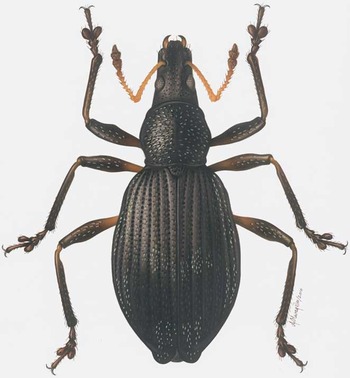
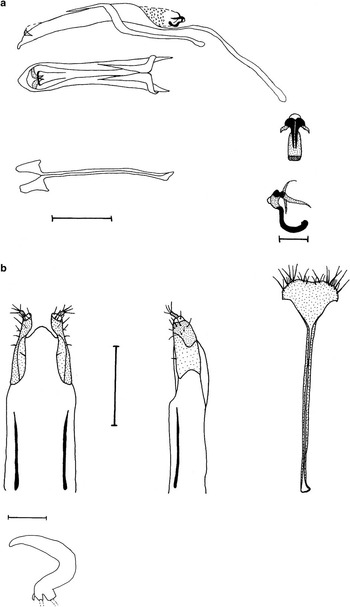
Description: Length (anterior of eyes to posterior of elytra): Overall: 3.1–5.5 mm; males: mean ± S.E. = 4.1 ± 0.03 mm (n = 156); females: 4.4 ± 0.04 mm (n = 136). Body dark brown to black with a variable covering of green to blue scales on the dorsal surface; the ventral surface is black (Fig. 5). The density of scales is highest on the elytra, most variable on the prothorax and sparse on the head and femora. The tibiae and tarsi lack scales, with the former having stiff, spine-like setae. On the elytra the scales occasionally form an anchor-shaped pattern, or two spots, one on each of the elytra. Where the scale density is high the scales are not imbricate. Occasionally, on the lateral margins of the elytra, small, fine and transparent to golden-brown to green erect hair-like scales may be present. These do not resemble the stiff, marked erect spines found on the elytra of species in the genus Ectemnorhinus. Antennae with light-brown to reddish-brown scape, reddish-brown funicle and dark-brown to almost black club. The first three funicle segments typically have the ratio 0.94:1:0.61 (Fs1:Fs2:Fs3) (n = 10). Epistome symmetric, sometimes with pronounced lobes, but also with a straight margin. Mandibles reddish-brown, each one asymmetric, with the dorsal tooth more pronounced than the ventral tooth, except after substantial wear. Labial palps three-segmented. Ommatidia coarse. Prothorax with an indistinct to distinct dorsal carina which can occasionally be entirely absent; where present it tends not to run the full length of the prothorax. Dorsal surface of the prothorax with pronounced punctations with an otherwise smooth surface between them. No granular microsculpturing is present. Elytra obovate each with a humeral carina which is moderately to well developed. Striations are pronounced as a consequence of deep punctations that are virtually contiguous. Legs reddish-brown to black with lighter colouration towards the base of the femora. Third tarsal segment with a ventral surface of densely packed white setae forming a brush. Tarsal claw segment shorter than the other three segments combined. Aedeagus as in Fig. 6a with a unique basal sclerite. Female genitalia as in Fig. 6b.
Dorsal habitus of B. huntleyi n. sp. male (length from anterior of eyes to posterior of elytra = 4.7 mm).

Bothrometopus huntleyi n. sp. a. Male genitalia with the aedeagus in lateral and dorsal views (scale bar = 0.5 mm) with the genital armature to the right (scale bar = 0.1 mm). b. Female genitalia in dorsal and lateral view (scale bar = 0.5 mm). The spermatheca is shown below (scale bar = 0.2 mm).

Etymology: This new species is named in honour of the youngest biologist on the first biological and geological expedition (1965/1966) to the Prince Edward Islands: Brian John Huntley.
Remarks: Bothrometopus huntleyi is a medium-sized Bothrometopus species – the genus varies from c. 2–10 mm in length (Chown & Kuschel Reference Chown and Kuschel1994, Kuschel & Chown Reference Kuschel and Chown1995). It is morphologically very similar to B. parvulus (C.O. Waterhouse) from the Prince Edward Islands and B. brevis (C.O. Waterhouse) from Kerguelen and Heard islands. Adults of B. huntleyi can be separated from B. parvulus based on the former species’ deep punctations and lack of granular microsculpture on the prothorax, dorsal carina which does not stretch from end to end of the prothorax, and typically lighter funicle segments of the antennae by comparison with the general body colouration. The most reliable distinguishing feature is the difference in microsculpture on the prothorax of the two species (as described above and shown in Figs 3 & 4). No characters have yet been found to distinguish the larvae.
Distribution: Island-wide (coastal rocks and inland areas, see Chown Reference Chown1989, Reference Chown1992) on both Marion Island and Prince Edward Island. This contrasts with B. parvulus, which thus far has only been found on coastal rocks at both Marion Island and Prince Edward Island. The phylogeography of this new species is discussed in detail in Grobler et al. (Reference Grobler, Bastos, Chimimba and Chown2011).
Material examined
Holotype:
♂, South Africa, Marion Island, 400 m a.s.l., First Red Hill, 46°53.412′S, 37°48.21′E, Genbank no. GQ131999, voucher no. 180-15, collected April 2001, collector G.C. Grobler. Deposited in the Iziko South African Museum, Cape Town, South Africa.
Paratypes:
♀, South Africa, Marion Island, 0 m a.s.l., ‘Ship's Cove’, 46°51′41″S, 37°50′66″E, Genbank no. GQ132012, voucher no. 16-22, collected April 2001, collector G.C. Grobler. Deposited in the Iziko South African Museum, Cape Town, South Africa.
♂, South Africa, Marion Island, 200 m a.s.l., Junior's Kop, 46°52.794′S, 37°50.083′E, Genbank no. GQ131946, voucher no. 151-18, collected April 2001, collector G.C. Grobler. Deposited in the Iziko South African Museum, Cape Town, South Africa.
♀, South Africa, Marion Island, 600 m a.s.l., Feldmark Plateau, 46°56′35″S, 37°46′10″E, Genbank no. GQ131952, voucher no. 339-1, collected April 2002, collector G.C. Grobler. Deposited in the Iziko South African Museum, Cape Town, South Africa.
♂, South Africa, Marion Island, 400 m a.s.l., First Red Hill, 46°53.412′S, 37°48.21′E, Genbank no. GQ131967, voucher no. 180-3, collected April 2001, collector G.C. Grobler. Deposited in the Natural History Museum, London, United Kingdom.
♀, South Africa, Marion Island, 0 m a.s.l., ‘Ship's Cove’, 46°51′41″S, 37°50′66″E, Genbank no. GQ131943, voucher no. 16-29, collected April 2001, collector G.C. Grobler. Deposited in the Natural History Museum, London, United Kingdom.
♂, South Africa, Prince Edward Island, 0 m a.s.l., Cave Bay, 46°38.752′S, 37°59.780′E, Genbank no. GQ131954, voucher no. 303-19, collected April 2003, collector G.C. Grobler. Deposited in the Iziko South African Museum, Cape Town, South Africa.
♀, South Africa, Prince Edward Island, 672 m a.s.l., Top of van Zinderen Bakker, 46°37.590′S, 37°55.891′E, Genbank no. GQ131961, voucher no. 318-10, collected April 2003, collector G.C. Grobler. Deposited in the Iziko South African Museum, Cape Town, South Africa.
♂, South Africa, Prince Edward Island, 0 m a.s.l., Cave Bay, 46°38.752′S, 37°59.780′E, Genbank no. GQ131955, voucher no. 303-20, collected April 2003, collector G.C. Grobler. Deposited in the Iziko South African Museum, Cape Town, South Africa.
♀, South Africa, Prince Edward Island, 400 m a.s.l., 46°38.211′S, 37°57.482′E, Genbank no. GQ132006, voucher no. 307-9, collected April 2003, collector G.C. Grobler. Deposited in the Iziko South African Museum, Cape Town, South Africa.
♂, South Africa, Prince Edward Island, 400 m a.s.l., 46°38.211′S, 37°57.482′E, Genbank no. GQ132004, voucher no. 322-8, collected April 2003, collector G.C. Grobler. Deposited in the Natural History Museum, London, United Kingdom.
♀, South Africa, Prince Edward Island, 0 m a.s.l., Cave Bay, 46°38.752′S, 37°59.780′E, Genbank no. GQ131997, voucher no. 303-7, collected April 2003, collector G.C. Grobler. Deposited in the Natural History Museum, London, United Kingdom.
Additional material was examined for the morphometric analysis on which the length measurements used in the description are based (A. Treasure and S.L. Chown, unpublished data).
Molecular comment
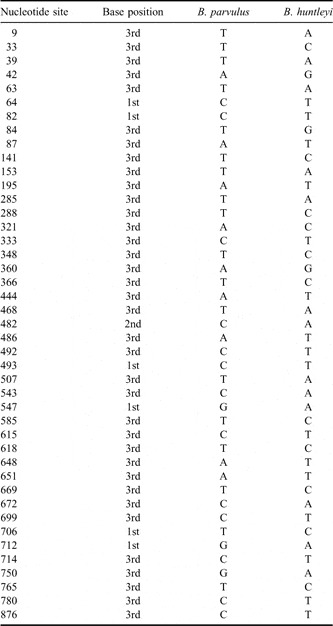
DNA barcoding, its recognized flaws notwithstanding (Rubinoff Reference Rubinoff2006), was considered here as a complementary tool for the unequivocal differentiation of B. parvulus from B. huntleyi. The 43 nucleotide sites that are conserved within species, and consistently different between the two morphologically indistinct species occurring on PEIA are summarized in Table II. When comparing the partial amino acid COI gene sequences of the thirteen species of the Ectemnorhinus group of genera generated in this study, 17 non-synonymous amino acid substitutions were observed in the 84 ingroup taxon dataset. These non-synonymous amino acid substitutions revealed several consistent and therefore possibly diagnostic differences between species and include the following positions in our dataset: Codon 7 (I in B. elongatus and M in all other species, except for two B. sulcatus specimens which have a V at this position); Codon 19 (V in E. viridis and I in all other species); Codon 41 (all species within the genus Ectemnorinus have an I at this position, whereas a V is present in all species of the genera Bothrometopus and Palirhoeus); Codon 161 (T in B. parvulus and N in all other species); Codon 183 (V in B. parvulus and I in all other species); Codon 241 (M in B. gracilipes, and either a V or a L in all other species). As some of the species in this study are only represented by two specimens, additional data will need to be generated to determine the consistency and species-exclusivity of some of these characters.
Summary of the 43 nucleotide sites in the COI gene region characterized in this study, that are consistently different between B. parvulus and B. huntleyi.

Discussion
The phylogenetic analyses revealed three major points. First, the monotypic genus Palirhoeus is not readily distinguishable, on a mtCOI sequence basis, from the genus Bothrometopus, thus questioning the retention of the species P. eatoni in a separate genus, Palirhoeus, created by Kuschel (Reference Kuschel1971), and its position in Kuschel & Chown's (Reference Kuschel and Chown1995) phylogeny as basal to the genera Bothrometopus and Ectemnorhinus. Nonetheless, limited taxon and gene sampling means that we refrain from proposing formal generic synonymy. Second, the two species groups in the genus Bothrometopus (fasciatus group and gracilipes group), identified on the basis of absence or presence of dorsal wall vaginal spicules, by Kuschel & Chown (Reference Kuschel and Chown1995) are not supported by the COI gene phylogeny. Bothrometopus gracilipes and B. angusticollis fall into the gracilipes group of Bothrometopus species (Kuschel & Chown Reference Kuschel and Chown1995) while B. sulcatus falls in the fasciatus group of Bothrometopus species (Kuschel & Chown Reference Kuschel and Chown1995). The sister taxon relationship of B. elongatus, which is assigned to the gracilipes group, with B. fasciatus from the fasciatus group of Bothrometopus species (Kuschel & Chown Reference Kuschel and Chown1995) in the COI gene tree also raises questions regarding the phylogenetic utility of these two major groups. Third, what was previously considered a single species on the Prince Edward Islands, B. parvulus Jeannel, is clearly two species that are certainly not sister taxa, but rather share relationships with different species from our sample taxa. Identification of this cryptic species increases the number of species within the Ectemnorhinus group of genera from 36 to 37.
Despite being a partial analysis of this group of weevils endemic to the South Indian Ocean Province Islands, the current study has important implications for interpretation of biogeographic and evolutionary dynamics in the region more generally. Perhaps the most significant point to emerge is that colonization of the Prince Edward Islands is likely to have taken place repeatedly from other islands in the South Indian Ocean Province. Thus, although B. parvulus and B. randi are sister species in the current tree (Fig. 1), the molecular clock based on a 2.3% nucleotide sequence divergence per million years estimate obtained from an arthropod mtDNA survey of Brower (Reference Brower1994), which has proven useful for studies of this group (see Grobler et al. Reference Grobler, van Rensburg, Bastos, Chimimba and Chown2006), indicates that divergence must have taken place approximately c. 3.3 m.y.a. (Fig. 2). This could not have happened on the Prince Edward Islands because the oldest date for the islands is c. 0.5 m.y., and there is no geological evidence to suggest that they are very much older than this (Boelhouwers et al. Reference Boelhouwers, Meiklejohn, Holness and Hedding2008). The date of the divergence between B. huntleyi and B. brevis, c. 2.0 m.y.a., also suggests that an early colonization of the Prince Edward Islands is unlikely. Instead, the dated phylogeny suggests that dispersal to the Prince Edward Islands must have occurred from elsewhere, sometime after the islands emerged, and on at least two separate occasions. Because we were unable to sample all taxa in the genus Bothrometopus (see Chown & Kuschel Reference Chown and Kuschel1994, Kuschel & Chown Reference Kuschel and Chown1995 for review) it seems likely that the colonization has been from species on the Crozet archipelago. Bothrometopus randi (the sister species of B. parvulus, based on this analysis) is known from Possession Island and other Bothrometopus species are widespread across Iles Crozet (Chown & Kuschel Reference Chown and Kuschel1994). Such an hypothesis of colonization against the prevailing west wind drift is not new, and was in fact proposed by Dreux and Voisin in a series of works on the group (e.g. Dreux & Voisin Reference Dreux and Voisin1987, Reference Dreux and Voisin1989). Thus, unlikely as their hypotheses may have seemed initially, they cannot, on present evidence, be rejected. Indeed, it also appears that P. eatoni colonized the Prince Edward Islands relatively recently (Figs 1 & 2) and that dispersal between Marion Island and Prince Edward Island has been quite common since their emergence.
Several independent lines of evidence support this proposal of repeated colonization across the region. Using a molecular phylogenetic approach, Stevens et al. (Reference Stevens, Greenslade, Hogg and Sunnucks2006) demonstrated that repeated colonizations across the sub-Antarctic islands probably took place from the late Miocene (c. 7 m.y.a.) to approximately 0.3 m.y.a. Likewise, recent investigations of the ameronothroid mite genera Halozetes and Alaskozetes have shown colonization of the islands by species in these genera over the last ten million years (Mortimer et al. Reference Mortimer, Jansen van Vuuren, Lee, Marshall, Convey and Chown2010). These dates also correspond closely with those for dispersals among populations of the springtail Cryptopygus antarcticus in the Scotia Arc and Antarctic Peninsula region (McGaughran et al. Reference McGaughran, Torricelli, Carapelli, Frati, Stevens, Convey and Hogg2010b), and trans-Drake Passage dispersal of the nudibranch Doris kerguelenensis (Wilson et al. Reference Wilson, Schrödl and Halanych2009). However, the divergence times differ substantially for those estimated for the bull kelp Durvillaea antarctica, which apparently recolonized the South Indian Ocean Province Islands after its removal during the last glacial maximum, c. 16 000 years ago (Fraser et al. Reference Fraser, Nikula, Spencer and Waters2009).
These dispersal dates indicate that for the terrestrial species much of the diversification considerably preceded the last glacial maximum and many events date to either the Pliocene–early Pleistocene, or as soon as a particular island group (such as the Prince Edward Islands) emerged. Thus, it appears likely that the groups survived several glacial cycles in refugia on the islands, and are certainly not post-glacial colonists. Such proposals have been made previously for various groups (see discussions in Chown Reference Chown1990, Van der Putten et al. Reference Van Der Putten, Verbruggen, Ochyra, Verleyen and Frenot2010). Indeed for the Ectemnorhinus group of genera, Chown (Reference Chown1989, Reference Chown1994) suggested that the species typical of the epilithic biotope, (i.e. those in the genera Bothrometopus, Palirhoeus and Disker) probably radiated since the end of the Pliocene in the epilithic biotopes that must have come to predominate as a consequence of cooling (for revised climatic histories see Turner et al. Reference Turner, Bindschadler, Convey, di Prisco, Fahrbach, Gutt, Hodgson, Mayewski and Summerhayes2009). The divergence times calculated on the basis of an arthropod mtDNA survey of Brower (Reference Brower1994) certainly support such a proposal. Whether the groups more typical of vegetated areas will show an equally deep history is not clear. However, the deep divergence time, approximately 6.46 m.y.a., found here between Ectemnorhinus (a genus in which species are typical of vegetated areas - Chown Reference Chown1989, Reference Chown1994) and Bothrometopus (restricted to epilithic biotopes) and the fairly substantial divergence dates among species within this genus (see also Grobler et al. Reference Grobler, van Rensburg, Bastos, Chimimba and Chown2006), suggests that they may well do so. That recent studies have supported the persistence of vascular plants on the South Indian Ocean Province Islands through several glacial periods (e.g. Van der Putten et al. Reference Van Der Putten, Verbruggen, Ochyra, Verleyen and Frenot2010) also suggests that survival during these periods is likely. In consequence, the proposal that the genus Ectemnorhinus diversified following the last glacial maximum (Chown Reference Chown1994) must be rejected. Similar hypotheses of recolonization of terrestrial areas from refugia, such as marine refugia in the case of the ameronothroid mites have also been rejected on the grounds of new molecular evidence (Mortimer et al. Reference Mortimer, Jansen van Vuuren, Lee, Marshall, Convey and Chown2010). However, within particular species it remains clear that volcanic and glacial cycles and refugia on particular islands have played important roles in population structuring. Such structure has thus far been identified for indigenous springtails, mites, and weevils (Grobler et al. Reference Grobler, van Rensburg, Bastos, Chimimba and Chown2006, Myburgh et al. Reference Myburgh, Chown, Daniels and van Vuuren2007, Grobler et al. Reference Grobler, Bastos, Chimimba and Chown2011), and seems also to apply to a vascular plant species and to other insects. Significantly, though, in a sub-Antarctic context such details are available only for the Prince Edward Islands, and to a lesser extent for Macquarie and Heard islands.
These results clearly indicate the need for further comprehensive molecular phylogenetic analyses of the biogeography of the region including a range of taxa. Only in this way will clearer reconstructions of the history and evolutionary relationships of the endemic and frequently enigmatic taxa in the region be established, and the hypotheses concerning the origins of the group (e.g. Jeannel Reference Jeannel1964) assessed on a sounder basis. Moreover, they suggest that hypotheses concerning the historical biogeography of the region based solely on distributional data are perhaps no longer as useful as they once were. The distributional data must be accompanied by modern phylogenetic analyses for two reasons. First, the phylogenetic approach can reveal divergence times and relationships more straightforwardly than other approaches (acknowledging that a match with earth history must still be sought), thus helping to resolve biogeographic interpretation. Second, molecular evidence has been instrumental in revealing the presence of cryptic species, the existence of which can change interpretation substantially (Stevens et al. Reference Stevens, Greenslade, Hogg and Sunnucks2006, Torricelli et al. Reference Torricelli, Carapelli, Convey, Nardi, Boore and Frati2010). Given enhanced scientific cooperation across the Antarctic within a variety of scientific programmes, the development of comprehensive molecular phylogenies is likely to be achieved readily, and will almost certainly change current perspectives on the biogeography and biodiversity of the region, as this initial study has demonstrated.
Acknowledgements
Two referees provided useful comments on a previous version of the manuscript. We thank the South African National Antarctic Programme and the Australian Antarctic Division for supporting our work at the Prince Edward Islands and Heard Island, respectively. Lewis Davies provided access to material from Possession Island via the donation of several specimens to SLC, whilst material from Iles Kerguelen was collected by Jacques Deere during a Scientific Committee on Antarctic Research (SCAR) exchange activity supported by the French Polar Institute (IPEV) and specifically Yves Frenot. We are indebted to Chris Lyal of the Natural History Museum, London for providing light micrographs of the B. parvulus holotype and to Helene Brettschneider for sample sorting and SEM photography of specimens. This work forms part of the SCAR Evolution and Biodiversity in Antarctica programme.
Supplemental material
A supplemental table will be found at www.journals.cambridge.org/jid_ANS.