“It is indeed most wonderful to witness such desolation produced in three minutes of time.”
(Charles to Caroline Darwin, 10 March 1835)While on an expedition in the forest near Valdivia, Chile, Darwin felt the ground tremble. The movement made him giddy, like skating across thin ice. Two weeks later, he arrived in the harbor of Concepción and learned of the complete destruction of seventy villages, the beaches strewn with timber like the wreckage of a thousand great ships. On entering the town, he saw the extent of the devastation. Not a building was left standing, the people full of uncertainty and heavy with misfortune, the labor of centuries swept away in an instant. “To my mind since leaving England,” he remarked in his Beagle diary, “we have scarcely beheld any one other sight so deeply interesting” (Keynes Reference Keynes1988, 302). The Concepción earthquake was one of several experiences that Darwin highlighted as the most powerful and affecting on his five-year voyage. Others included the Brazilian rain forest with its luxuriant and impenetrable vegetation, the lofty peaks of the Cordillera and the more desolate mountains of Tierra del Fuego, veiled in mist. What marked these out from other rare and wonderful experiences that Darwin had on the voyage, was their sublimity. In each case, Darwin's reason and imagination were overwhelmed, and language (he wrote) was powerless to represent the experience.
These sublime moments, in which understanding was disabled, quickly gave way to natural historical observation and reflection. In the case of the earthquake, shock waves were isolated, their direction traced through the fissuring of the ground, cracks in walls, and other patterns of destruction. Measurements were taken, diagrams drawn, and a singular cataclysmic event inscribed in a theory of continental uplift and denudation. This was a research program that would occupy Darwin for nearly a decade. But it was the initial form of the experience, registered only at the personal and emotional level, and defying any norms of description or objectification, that rendered the earthquake so powerful and ultimately, so curious and noteworthy.
In this paper, I will examine the status of the earthquake as a sublime experience and as an object of geological enquiry and theory in the early nineteenth century. Earthquakes in this period were often interpreted through a combination of frameworks: sacred, Providential, and geo-physical (Clark Reference Clark1965; Guidoboni Reference Guidoboni and Good1988). Darwin's narrative shows the importance of a different structure of experience – the aesthetic of the sublime – for rendering nature's most powerful and exceptional phenomena in geological terms. Discourses on the sublime and the picturesque, encompassing travel writing, landscape painting, and aesthetic theory were important both for the field experiences of geologists and for the articulation of those experiences to different audiences. In looking at Darwin we have the advantage of seeing the different stages of practice that constituted the earthquake as a geological event: the diary of a witness, subsequent observations and speculations in notebooks and correspondence, and then various forms of publication – the Beagle narrative written for a general learned audience, and a series of papers and extended monograph for geological specialists and enthusiasts. Scientific description and explanation unfold within an aesthetic framework that enables Darwin to manage the emotions of fear, excitement, and wonder that the earthquake inspired, and to place the awful event within a larger process of change, producing a new moral landscape, a sense of interconnectedness with the deep past, and of humility before the power and age of the earth.
1. The Emotional Register
Darwin's Beagle experience can be located in a tradition of scientific travel that called for the recording of minute facts of all kinds, the emotional depiction of landscapes and peoples, and the imaginative work of generalization and speculation. His model here was above all Alexander von Humboldt. He had been urged to read Humboldt while at Cambridge by his mentor, the botanist John Stevens Henslow. Before the prospect of the Beagle voyage arose, Darwin had planned a more modest expedition to the Canary Islands, and in preparation for this trip, he made regular visits to the botanic garden in Cambridge to breathe in the tropical climate, returning to his room to absorb the pages of Humboldt's Personal Narrative. “My head is running about the Tropics,” he wrote to his sister Caroline in April 1831, “in the morning I go and gaze at Palm trees in the hot-house and come home and read Humboldt: my enthusiasm is so great that I cannot. . .sit still on my chair” (Burkhardt Reference Burkhardt1985–2010, 1:122). The invitation to accompany Robert Fitzroy to South America, the main setting of Humboldt's travels, strengthened the connection. “I formerly admired Humboldt,” he wrote to Henslow in 1832, “I now almost adore him.” “He alone gives any sense of the feelings which are raised in the mind on first entering the Tropics” (ibid. 1:237).
The significance of Humboldt for natural historical travel and his impact on Darwin have been widely discussed. Mary Louise Pratt has argued that Humboldt's writings on South America, especially the Personal Narrative and the Ansichten der Natur (Aspects of Nature, Humboldt Reference Humboldt1808 and Reference Humboldt and Sabine1849) reinvented the continent for European readers as a spectacle of “wild and gigantic nature” that dwarfed humans and defied their perceptions (Pratt Reference Pratt1992, 120–7). Humboldt extended the ethos of the European grand tour and picturesque landscape to wilder and more exotic terrain, to the living history of the earth and its peoples. Like many of Humboldt's readers, Darwin was particularly captivated by the descriptions of the rain forest in which the naturalist was engulfed by vegetation, his passions aroused and his perception stymied. As Nigel Leask has shown, Darwin experienced the South American landscape through Humboldt's vivid descriptions, in which privileged geographical sites were selected for “aesthetic evocation” (Leask Reference Leask, Small and Tate2003, 22–3). On St. Jago in the Cape de Verde Islands, Darwin remarked on the “gracefulness of [tropical] forms. . .the novel richness of their colours. . .the numberless & confusing associations that rush together on the mind” (Keynes Reference Keynes1988, 23). The scenery that he found most wonderful, the stormy sea with its confused mass of breakers, the tropical forests of Brazil, the majestic mountains of the Andes, had all been marked out by Humboldt and other travel writers as deserving rapturous description. The emotion that Darwin expressed most frequently in his diary and in letters home was extreme delight: “My mind [is] in a perfect hurricane of delight & astonishment,” “moments of glorious enthusiasm. . .everything new everything sublime,” “I never experienced such intense delight.”Footnote 1
From such passages we might conclude that Humboldt's importance for Darwin was primarily as a “romantic” writer, one who shaped Darwin's vision of nature as vibrant, super-abundant, and delightful, who licensed an emotional engagement with nature and an authorial style in which such passions could flow freely. Indeed, Darwin sent portions of his Beagle diary home at intervals during the voyage, and he was rebuked by his sister Caroline for adopting Humboldt's “poetical language” and “flowery French expressions. . .instead of [his] own simple straight forward & far more agreeable style” (Burkhardt Reference Burkhardt1985–2010, 1:345). In Darwin scholarship, there has been a tendency to regard Humboldt as primarily a tropical stylist and aesthete, or a romantic visionary whose presentation of nature as dynamic, vital, and interconnected inspired Darwin's species theory.Footnote 2 But this view of Humboldt and his influence as “romantic” does not explain one of the most extensive uses that Darwin made of him on the Beagle voyage and in his later geological writing, namely, as a scrupulous observer. Humboldt's descriptions of mineral deposits and mountain chains, his tables of distribution, temperature gradients, and records of volcanic activity – all are cited repeatedly as established matters of fact. This aspect of Humboldt's work is especially evident in the lengthy discussions of earthquakes in volumes two and four of the Personal Narrative which are among the most extensively annotated pages of Darwin's copy (Humboldt Reference Humboldt and Williams1814–29, 2:208–31, 4:1–55; Di Gregorio and Gill Reference Di Gregorio and Gill1990, 415–16).
I will suggest another way in which Humboldt was instrumental for Darwin, one that draws on Michael Dettlebach's substantial revision of our understanding of Humboldt's romantic science as a program of precision measurement (Dettlebach Reference Dettelbach, Jardine, Secord and Spary1996a, Reference Dettelbach, Miller and Reill1996b, Reference Dettlebach1999).Footnote 3 Dettlebach has shown how Humboldt urged the traveler to go beyond surface description and collection: to map rock formations, to trace patterns of vegetation and animal life on a global scale, to calculate the elevation of continents and assess primitive societies. To accomplish this exhaustive endeavor, Humboldt not only employed an unprecedented number and variety of scientific instruments (barometers, eudiometers, chronometers and so forth), he also demonstrated how the naturalist himself could become a refined and delicate instrument, his feelings and emotions a scientific register of landscape. For Humboldt, then, aesthetic sensibility was a rigorous scientific practice, a way of affectively recording otherwise hidden features and forces of nature. Darwin had been schooled in observation and measurement by his Cambridge professors. He received some practical training in field geology from Adam Sedgwick in north Wales, where he learned how to assess a landscape through its fossil and mineral deposits, and to map its outcrops, estimating uplift, subsidence, and the orientation of cleavage. Henslow provided hands-on instruction in the use of geological instruments such as the clinometer, as well as advice on the collection and preservation of specimens (Secord Reference Secord1991). It was also Henslow who gave Darwin a copy of Humboldt's Personal Narrative for the voyage.Footnote 4 That books formed part of the equipment of the naturalist is a familiar notion, but Darwin's diary suggests that he used the Narrative as he might a scientific instrument, one that was particularly sensitive to nature's affects: a device for measuring emotions in the field, and for calibrating his own emotional experience against that of the heroic traveler.
In a series of entries describing his first encounter with the Brazilian forest, Darwin rhapsodized about Humboldt's “glorious descriptions,” while at the same time using the text to mark powerful emotional moments that exceeded language. On leaving the bay of San Salvador, he remarks on the inadequacy of imagination and pictorial representation: “it would be difficult to imagine, before seeing the view, anything so magnificent. – It requires, however, the reality to make it so.” Nor, once seen, could the reality be convincingly depicted: “if faithfully represented in a picture, a feeling of distrust would be raised in the mind, as I think is the case in some of Martins views” (Keynes Reference Keynes1988, 41–2). Darwin referred here to John Martin, whose historical and landscape paintings had prompted new discussion about the role of the visual arts in relation to language, a topic widely debated in eighteenth- and early nineteenth-century writing on picturesque and sublime landscape.Footnote 5 Many argued that powerful feelings and associations of ideas could not be rendered in the “static” medium of oil and canvas, and that poetry was the more suitable form of expressing the impact of sublime nature on the human subject. It was fitting then that Darwin turned to Humboldt's “rare union of poetry with science,” which he had first gauged against the hothouse palms in Cambridge botanic garden, and now was able to measure against the “reality” of tropical nature. He found the language wanting: “I believe from what I have seen Humboldts glorious descriptions are & will for ever be unparalleled: but even he. . .falls far short of the truth” (ibid., 42). Darwin did not try to improve upon Humboldt's language, but gestured instead to an experience that could be registered only physically and emotionally, a “delight” that “bewilders the mind”:
If the eye attempts to follow the flight of a gaudy butter-fly, it is arrested by some strange tree or fruit; if watching an insect one forgets it in the stranger flower it is crawling over. – If turning to admire the splendour of the scenery, the individual character of the foreground fixes the attention. The mind is a chaos of delight, out of which a world of future & more quiet pleasure will arise. – I am at present fit only to read Humboldt; he like another Sun illumines everything I behold. (Ibid.)
Darwin's bewilderment turned on the richness of detail, and his inability either to attend, as a scientific observer should, to individual objects, or to provide a unifying topography or geography of the scene. The subjection of landscape to rational assessment, involving detailed observation, the analysis of parts in relation to whole, judgments of form, proportion, and harmony, had been addressed in early picturesque painting through framing devices and hierarchies of composition typified by Claude Lorrain and extended to landscape tourism through the “Claude” glass (Andrews Reference Andrews1989, 24–30, 67–73). Darwin referred several pages later in his diary to the shortcomings of Lorrain, and stated his preference for late picturesque artists, Johann Moritz Rugendas and Charles Clarac, whose depictions of the Brazilian forest were characterized by density and entanglement; though again, Darwin was “at an utter loss how sufficiently to admire the scene” (Keynes Reference Keynes1988, 53).Footnote 6 It is perhaps surprising then, that Darwin returned to Humboldt with renewed praise after pronouncing his descriptions inadequate. How did Humboldt illuminate, while yet falling short of, what Darwin saw? Humboldt's text, first of all, provided an index for the sublime. The disruption of imagination and language that Darwin experienced was itself part of a highly theorized set of responses to nature that characterized the refined European traveler. Where and when one might, as a man of cultivated sensibility, expect to be overwhelmed – the climate, the time of day, the quality of light, the kinds of geographic features and natural forces that could elicit powerful feelings – these were elaborately specified in treatises and travel narratives, and by the late eighteenth century, in guidebooks (Andrews Reference Andrews1994). But more than this, Humboldt's descriptions, though not in themselves sublime, could nonetheless conjure these powerful feelings in Darwin's memory once he had experienced them in situ. The text played upon his emotions, reviving them. Like his own field books and other recording instruments, it was a tool of reflection.
Finally, Humboldt provided a series of ambitious formula for converting the personal experience of the traveler into universal knowledge. The Personal Narrative displayed a remarkable array of visual and rhetorical techniques for moving between feeling, observation, imagination, and theory: the heroic narrative of ascent, the panoramic view, the numerical table, the isothermal line, all conjoined in the famous illustration in the sixth volume of the work, showing Mt. Chimborazo in the Ecuadorean Andes encircled by clouds, the snow-covered peak sliced at one side to reveal the geography of plants, and straddled by tables of measurements, showing temperature, humidity, and barometric pressure recorded at different altitudes.Footnote 7 By his own account, Darwin “read & reread” Humboldt, “over and over again,” copying out passages so that they would be “everpresent in [his] mind” (Burkhardt Reference Burkhardt1985–2010, 3:140, 2:240). It was not just a “romantic” travel book, full of flowery and inspiring descriptions of a vital, pulsating nature. It was a standard of measurement and an instrument of conversion that Darwin applied both to the tropical landscape and to himself. Humboldt's text authenticated his own emotions as products of scientific sensibility, and enabled him to assess his powers and progress as a naturalist. As Darwin indicated, this “illumination” came later, after he had left the forest, in a space of “future & quiet pleasure,” in his cabin on the Beagle, or back home; it was a space of memory, imagination, and theory.
2. Witness to Devastation
The earthquake, which took place on 20 February 1835, just over three years after the Beagle's departure, provided an opportunity for Darwin to practice his synthetic powers in an extended and dramatic fashion. He described the event in a series of daily entries in his diary over a two-week period, from the initial experience near Valdivia to the time in Concepción. Typically, Darwin would compose his observations and reflections in narrative form at intervals of several days or a week, using large sheets of paper and ink. Much of the diary was based on brief pencil entries in pocket-sized field notebooks that he carried with him on land. There are no field book entries for the earthquake, however, possibly because Darwin was not away from the Beagle long enough (Chancellor and van Wyhe Reference Chancellor and van Wyhe2009, xvii–xxi). The initial description of the event is layered with reflections, moving in Humboldtian fashion from the personal to the general. He begins in the style of a chronicler, “This day has been remarkable in the annals of Valdivia,” and then reports his physical experience in the forest: “I was on shore & lying down in the wood to rest myself. It came on suddenly & lasted two minutes (but appeared much longer). The rocking was most sensible. . .the motion made me giddy. – I can compare it to skating on very thin ice or to the motion of a ship in a little cross ripple” (Keynes Reference Keynes1988, 292). This disrupted sense of space and time is immediately accompanied by the shattering of assumptions: “an earthquake like this at once destroys the oldest associations; the world, the very emblem of all that is solid, moves beneath our feet like a crust over a fluid; one second of time conveys to the mind a strange idea of insecurity, which hours of reflection would never create.” The view of the earth's crust as a thin layer over fluid was widely debated through the 1830s. Darwin did not believe that the world was “solid,” and so the feeling of movement served rather to confirm his assumptions than to unsettle them. But it was rare for a European, trained in geology, to experience a strong earthquake, and in his later publications Darwin would repeatedly refer to this bodily experience as evidence of the nature of the structures and forces at work. In referring to the power of “one second of time” he quickly established himself as an eye-witness and participant in fundamental debates about the figure of the earth and the role of actual or present causes, debates that had been greatly enriched by New World expeditions, and by the first volume of Charles Lyell's Principles of Geology (Rudwick Reference Rudwick2008, 89–103, 315–21).
Yet despite the importance that Darwin attached to his first-hand experience of the tremor, the fullness of the event was not registered until he witnessed its effects on others, and measured the force in emotional terms: “I felt the earth tremble, but saw no consequence from it.” He then observed the expressions of the local townspeople in Valdivia. There had been little actual damage, but homes were violently shaken, and their occupants lived in constant expectation of calamity: “I feel sure it is these accompaniments & the horror pictured in the faces of all the inhabitants, which communicates the dread that every one feels who has thus seen as well as felt an earthquake. In the forest it was a highly interesting but by no means awe-exciting phenomenon” (Keynes Reference Keynes1988, 292). Horror, dread, awe, and excitement were all hallmarks of the sublime and it is striking that Darwin rendered the earthquake a sublime experience only insofar as it was linked to human loss. The purely seismic event that he witnessed in the forest, detached from human history, was partial and incomplete. In order to observe an earthquake fully, to “see” it, one had to witness its effects on human life and emotion.
Feelings of horror, and the role of tragedy, death, and destruction, were of central concern in the literature on the sublime. Edmund Burke, perhaps more than any other writer, identified the sublime with extreme fear or terror. He traced the origin of these feelings to the desire for self-preservation, and so, in effect, to the fear of death. The most sublime forces of nature, therefore, were those that had the power to destroy life: violent storms, raging seas and mountain torrents, earthquakes and volcanic eruptions. But the sublime was also delightful. The feelings of fear, Burke wrote, could not be too immediate: “when danger or pain press too nearly, they are incapable of giving any delight” (Burke [1759] Reference Burke1958, 40; Boime Reference Boime1987, 213–18; Lamb Reference Lamb, Nisbet and Rawson1997). Authors debated about whether the excitement and pleasure of the sublime derived from the fact that one actually felt quite safe, and yet could vividly imagine the danger: the view from a precipice after ascending a great height, paintings in which tiny figures were sheltered from a raging storm or escaping from an avalanche, the vicarious thrill of gothic fiction. What could keep the terror of an earthquake at a distance? In Valdivia, Darwin reported the horror of others, and how their fear registered in him. It was not the locals who found the creaking of timber overhead and the shaking of foundations “awe-exciting.” How then was Darwin, the cultivated European and scientific observer – and perhaps only him – able to experience the earthquake as sublime?
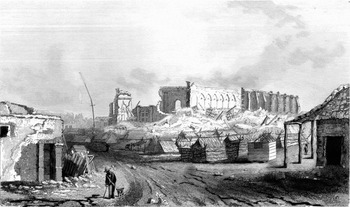
The Beagle sailed from Valdivia on 22 February, arriving at the island of Quiriquina, at the entrance to the Bay of Concepción, on 4 March, where Darwin observed the timber-strewn coast and the fissured ground. He then landed at the port of Talcahuano, and rode to Concepción: “the two towns presented the most awful yet interesting spectacle I ever beheld” (Keynes Reference Keynes1988, 296). Darwin described the devastation in some detail. Using the repertoire of the picturesque, and the prominence often given to ruins, he compared the scenes to “Ephesus. . .the drawings of Palmyra and & other Eastern towns.” Talcahuano on the coast had been almost entirely swept away by huge waves, and so lacked the appropriate picturesque monuments of devastation. But Concepción, where “each house or row of houses stood by itself a heap or line of ruins. . .was the more terrible, & if I may so call it, picturesque site.” The meaning of ruins in landscape aesthetics had undergone substantial changes from the Georgian culture of civility and improvement (Andrews Reference Andrews1989, 50–1, 225–6). In narratives of the grand tour, ruins might signify the fall of great civilizations in a historical cycle or line of progress. Erected on a gentleman's property, they might serve as emblems of decay and dereliction to set off the well-ordered and prosperous estate. The norms of picturesque scenery broadened and shifted over the course of the eighteenth century, with new value attached to novelty, sharp contrasts, wildness, and disorder: Mont Blanc, the Scottish Highlands, the Peak District of Derbyshire (Felsch Reference Felsch2009). Another current in picturesque descriptions was the naturalization of ruins, especially in mountain landscapes – massive figures broken and worn by the ages (Nicolson Reference Nicolson1959); and there was a complementary taste for buildings that gradually merged with nature, entwined in branches, embedded in roots, shrouded in ivy and moss. Darwin had already described the Andes as ruins, and the great forests of Patagonia as sites of death and decay (Keynes Reference Keynes1988, 125–6, 219, 309). Darwin thus extended the framework he had applied to the tropical forests and mountains, assessing the earthquake according to a picturesque code of destruction. Darwin's effort to beautify the scene was akin to that of the Beagle artist, whose illustration prepared for Fitzroy's Narrative shows the ruined Cathedral of Concepcion in an almost tranquil state of desolation (see fig. 1).Footnote 8
Remains of the Cathedral of Concepción (Fitzroy Reference Fitzroy1839).

But the picturesque, Darwin's first distancing device, was insufficient. The “ruins” had been produced in an instant. There was no covering of vegetation to soften and layer the destruction. The landscape had been shattered like bones, not withered away by time. Darwin turned then from a beautification to an intensification of the scene. He returned to the human loss, and even magnified it. The streets were clogged with people in panic and confusion, searching for loved ones and salvaging possessions. How much more dreadful would the slaughter have been, he asked, if it had happened at night, with three quarters of the population killed rather than several thousand? He recounted the experience of the British consul, blinded and choked by dust and consumed by helplessness and bewilderment as his house collapsed, fire swept through the town, and the fate of friends and relations remained unknown: “can a more miserable and fearful scene be imagined?” To further heighten the calamity, Darwin shifted the setting to England, describing the power of an earthquake to destroy the wealth of nations.
If beneath England a volcanic focus should reassume its power; how completely the whole country would be altered. What would become of the lofty houses, thickly packed cities, the great manufactories, the beautiful private & public buildings? . . . what a horrible destruction there would be of human life. – England would become bankrupt; all papers, accounts, records, as here would be lost: & Government could not collect the taxes. – Who can say how soon such will happen? (Ibid., 297)
In composing this event, Darwin clearly drew on the large literature that had been produced following the Lisbon disaster, which marked the demise of the earthquake as an object of Enlightenment curiosity and wonder (Braun and Radner Reference Braun and Radner2005). Burke, writing in the year after the Lisbon earthquake, had also invited readers to imagine the destruction of London, but had traced the destructive power of nature ultimately to God: “a force which nothing can withstand. . .before which we shrink into the minuteness of our own nature, and are. . .annihilated (Burke [1759] Reference Burke1958, 68). Burke quoted from the book of Psalms in which God caused the earth to shake and tremble in his presence; he imposed a theodicy of fallen man, ignorant of the ways of the Lord. It is useful here to compare Darwin's account of the earthquake with that of the more pious Fitzroy. While in Concepción and the surrounding territory, Fitzroy took frequent measurements, recording the uplift of land, and the number and direction of aftershocks over several days. In his official Narrative of the Beagle voyage, this information was interwoven with a torrid depiction of the catastrophe: “ghastly and sepulchral was the sight. Had the graves opened and given up their dead, their appearance could scarcely have been more shocking. Pale and trembling, covered with dust and perspiration, [the survivors] ran from place to place, calling for relations and friends; and many seemed to be quite bereft of reason.” He went on:
The stunning noise of falling houses; the horrible cracking of the earth, which opened and shut rapidly and repeatedly in numerous places; the desperate heart-rending outcries of the people; the stifling heat; the blinding, smothering clouds of dust; the utter helplessness and confusion; and the extreme horror and alarm, can neither be described nor fully imagined. (Fitzroy Reference Fitzroy1839, 1:403–4)Footnote 9
Fitzroy's narrative was more graphic, verging on gothic melodrama. But Darwin made his own language darker when he revised the diary for publication, leaving no doubt that the government that failed to collect taxes would also fail “to maintain its authority, the hand of violence and rapine would go uncontrolled. In every large town famine would be proclaimed, pestilence and death following in its train” (Darwin Reference Darwin1839, 373). Both narratives evoked an apocalyptic sublime. Such Biblical and Miltonic depictions of deluge and calamity were increasingly current in popular geological writing, museums, and exhibitions. As Ralph O'Connor has shown, geology in this period was a highly mixed culture, composed not only of different literary and artistic genres (biblical exegesis, aesthetics, antiquarianism, picturesque landscape painting), but also of theatre and public amusements. A constant feature of this culture was wonder and spectacle. Accounts of the deluge in biblical geology often combined a scientific precision of detail (often of fossil flora and fauna) with bursts of epic narration. Such geology was associated with the popular gallery depictions of the flood and other biblical scenes by artists such as Martin, who were in turn commissioned to illustrate primeval scenes of newly discovered giant fossil quadrupeds, cast as antediluvian monsters. Yet secular or non-scriptural geologists also used spectacular displays and literary devices to dramatize “deep time.” Such works reproduced the aesthetic of the sublime for growing audiences in Britain from the 1820s. Urban publics could take in new entertainments such as dioramas, panoramas, cycloramas (and more), featuring ruined cathedrals, great fires, avalanches, volcanic eruptions, and a recreation of the Lisbon earthquake with sound effects and orchestra (O'Connor Reference O'Connor2007, 263–82, 301–323; see also Dean Reference Dean2007).
Darwin's account of the Concepción earthquake did not invoke providential explanations or use a rhetoric of moral reform. But it made a sublime spectacle of geology through its picturesque imagery and apocalyptic allusion. Darwin's final maneuver was to shift the focus of spectacle from human devastation to the process of geological enquiry itself. This was achieved partly by describing the ruin of London as the resumption of a “volcanic focus.” In calling upon English readers to contemplate their own destruction, he compelled those who had never experienced a violent earthquake to consider the power of active geological causes. Although reports of earthquakes appeared occasionally in English newspapers, the real devastation was always far away and foreign. Thus 1835 brought the Chile earthquake with its “confusion and terror,” while tremors in Lancashire merely resulted in a single chimney being thrown down (Annual Register 1835, 128, 143). After staging the London debacle, Darwin's narrative abruptly turned to a lengthy analysis of the earthquake as a purely physical phenomenon: patterns in the ruins that enabled the directionality of the waves to be determined, the scope of the disturbance in surrounding territories and the probable locus of the original shock, details of volcanic activity in the region. He speculated on volcanoes as apertures in a thin crust that overlay molten rock: eruptions triggered an undulation that radiated outward beneath the earth's surface, or earthquakes represented abortive eruptions, with fluid mass injected into “inferior strata” from below, causing the surface to rock and fissure.
Then, at the conclusion of this four-page analysis, he broke off to reflect on the strange confluence of emotions in the observer, surrounded by the suffering of others and yet propelled by a thrilling enthusiasm for discovery:
I have not attempted to give any detailed description of the appearance of Concepción, for I feel it is quite impossible to convey the mingled feelings with which one beholds this spectacle. – Several of the officers visited it before me; but their strongest language failed to communicate a just idea of the desolation. – It is a bitter & humiliating thing to see works which have cost men so much time & labour overthrown in one minute; yet compassion for the inhabitants is almost instantly forgotten by the interest excited in finding that state of things produced at a moment of time which one is accustomed to attribute to a succession of ages. – To my mind since leaving England we have scarcely beheld any one other sight so deeply interesting. (Keynes Reference Keynes1988, 298)
Darwin's account of the earthquake thus closed with another sublime experience, or rather its aftermath, as productive of the scientific observer whose feelings were wholly removed from those of his fellow man and who was therefore able to study nature with (excited) detachment. Dwelling on loss was distinctly un-Humboldtian. Humboldt had sternly criticized accounts of earthquakes that focused on human devastation to the neglect of natural phenomena. His own lengthy discussions in the Personal Narrative took the form of historical and geographical surveys, with only the first sentence positioning the traveler in place and time: “We left Caraccas on the 7th of February, in the cool of the evening. . . .” There followed an ever expanding synthesis of earthquake data, in which the perspective of the narrator spanned old and new world continents, centuries past, and the geo-history subsequent to the voyage: “all epochs approach each other in the immensity of time comprehended in the history of nature” (Humboldt Reference Humboldt and Williams1814–29, 4:1, 3). But Darwin used his experience of human destruction to dramatize the earthquake as a geological event, and to show the ability of the scientific traveler to surmount the immediate feelings of fear that ran undiluted through the townspeople. His ability to manage the emotional extremes of fear, horror, and astonishment, and to make these a starting point for imagination and reason, is reminiscent of Kant's description of the Alpine explorer Horace Bénédict de Saussure, who risked his life so that he might later describe a terrifying scene with pathos. What is called sublime by men of culture, Kant wrote, is to others “merely repellent. . . . In all the evidence of nature's destructive force, and in the large scale of its might, in contrast to which his own is nonexistent, he will see only the hardship, danger and misery that would confront anyone forced to live in such a place” (Kant [1790] Reference Kant and Pluhar1994, 124–125).
3. Speculating in Public
The Concepción earthquake was indeed followed by a burst of geological speculation on Darwin's part. Using the books on the Beagle, which included works of geology and travel, Darwin compared and collated his earthquake experience with others recorded in various settings: Acapulco, Calabria, Córdoba, Demerara, Quito, Antarctica, Sumatra, St. Helena. His daily field book entries for this period of the voyage stopped just prior to the earthquake, and the remaining pages contain a discussion of geological theory. It is the only notebook (known as the Santiago Notebook) to contain extended theoretical discussion. The early pages in this theoretical section can be dated to March 1835, contemporaneous with the earthquake; the later pages were probably written toward the end of the voyage, when Darwin also began another notebook (the Red Notebook), his first devoted solely to theory (Chancellor and van Wyhe Reference Chancellor and van Wyhe2009, 381; Herbert Reference Herbert1980). He digested the literature on volcanic activity, continental uplift and erosion, and began to formulate a global theory outside of the more composed and semi-public space of the diary. The vast sublimity of the mountains and volcanoes were reduced to points on a geo-physical map.
Though so immense to short breathed traveller, mountains, which in size are grains of sand, in this view sink into their proper insignificance.
Read geology of N. America, India – remembering S. Africa, Australia. . .Oceanic Isles. Geology of whole world will turn out simple. (Barrett Reference Barrett1987, 35, 44)
Some of this theorizing would be added to the Beagle diary when he revised it for publication. When Darwin returned to England, Fitzroy suggested that his diary appear as the third part of the official Beagle narrative. It was also issued separately by the same publisher, Henry Colburn, under the title Journal of Researches into the Geology and Natural History of the Countries visited during the Voyage of H. M. S. Beagle round the World. From fairly early on in the voyage, Darwin had written his shipboard diary with a view to publication, but still the editing process was considerable. The earthquake sections were compressed in points of detail. For example, the “boat load of ladies” who visited the Beagle and the ball that was thrown in Valdivia on the evening following the earthquake were omitted. The most substantial change was the expansion of theory. To the original diary entries, Darwin added five pages of reflections, explaining some of the physical activity that had accompanied the shock: the patterns of waves along the shore, the permanent uplift of land, the volcanic outbursts in the surrounding country. He alluded to other work in which these different events would be shown to be “parts of one great phenomenon.” The discussion removed some of the awfulness and wonder from the violent calamity, for it was part of a long series of changes, one of many “lesser and insensible steps” by which the shape of the earth had been formed. But despite this normalization of earthquakes and volcanoes in the theoretical discussion, there was a curious transference of fear (and its overcoming), to geological speculation. Readers were driven to “the fearful conclusion” that beneath a thin crust of land lies a vast lake of molten matter, subject to continual disturbance, a theory that the geologist must “fearlessly maintain” (Darwin Reference Darwin1839, 379).
The life of geological speculation could be quite perilous. Darwin's earthquake theory extrapolated from controversial arguments of Lyell on continental elevation and was explicitly keyed through footnotes to Lyell's gradualism and plea for present causes. Lyell's Principles of Geology was one of Darwin's other great resources on the Beagle voyage, and it was a continuous point of reference from his first field studies in the Cape de Verde Islands, where he underwent a Lyellian conversion to gradual uplift (Rhodes Reference Rhodes1991; Secord Reference Secord1991). Lyell's own status within the geological community in Britain, and especially his reputation as a theorist, was carefully managed. As James Secord and others have shown, geological knowledge was presided over by an elite body within the Geological Society of London, and the relationship of fact to theory was tightly controlled, with certain topics such as the age of the earth considered out of bounds. Within the arena of the Society's meetings, open only to members and invited guests, debate was lively, but such controversy was rarely aired in public. The content of discussions could not be revealed in print, and the papers published in the Proceedings and Transactions were for the most part descriptive and exhaustive in detail (Secord Reference Secord1986, 14–24). Lyell's reputation within this circle rested largely on such empirical work, and on the huge amounts of evidence that he marshaled in support of his larger claims (Herbert Reference Herbert2005, 82–3). Alistair Sponsel has recently shown that Lyell was important not only as a theorist for Darwin, but as a mentor in theory. He worked closely with Darwin on his early geological publications, crafting his style of speculation so as to achieve credibility for the young naturalist, and maximum support for his own general views on elevation and subsidence (Sponsel Reference Sponsel2009). Within the confines of the Geological Society meetings and its Transactions, points of theory were subject to intense scrutiny and often allowed to appear in print only if they were identified as the views of the author. Thus Sedgwick's referee report on Darwin's earthquake paper encouraged a clarification, but not a curtailing, of the theoretical claims: “for only he is responsible for them” (Burkhardt Reference Burkhardt1985–2010, 2:88; Herbert Reference Herbert2005, 95–6). Darwin followed protocol by using a carefully graduated vocabulary to distinguish truth from opinion: “from these circumstances I am strongly inclined to believe,” “the opinion is much strengthened by the fact,” “the following considerations, it appears to me, lead to one conclusion” (Darwin [1838] Reference Darwin1840, 68).
The personalizing of speculation could also confer superiority on those who performed it admirably. Herschel's influential Discourse on Natural Philosophy, another of Darwin's sacred texts, had presented scientific inquiry in the manner of an aesthetic accomplishment. It was a “taste” for novelty, beauty, and wonder, for “pure and exciting contemplations,” for “general laws and causes” which filled the mind “as if from an inward spring, with a sense of nobleness and power” (Herschel Reference Herschel1830, 14–16). Those who supported Darwin's candidacy for the Geological Society and who helped him to advance quickly to the inner circle as Secretary – especially Lyell and William Whewell – were men who had established themselves as theorists, and who actively promoted a hierarchical view of science as observation crowned by theory. Darwin's “fearless” manner of speculation was lionized by Whewell in his Presidential Address to the Geological Society in 1839:
Those who aspire to the felicity of knowing the causes of things, must not only trample underfoot the fears of a timid unphilosophical spirit, which the poet deems so necessary a preparation, but they must look with a steady eye on difficulty as well as violence. They must regard the terrors of the volcano and the earthquake. . .the wildest rush of the fluid mass, the latent powers which give solidity to the rock, – as operations of which they have to trace the laws and measure the quantities with mathematical exactness. (Whewell Reference Whewell1839)
Thus Whewell provided a Kantian aesthetic for geology, a sublime of pure reason, in which the mind triumphed over wild and fearful forces of nature, bringing lawfulness and precision (Bowie Reference Bowie1990). There was an appropriation not only of the poet's power to form and order nature; the destructive force of nature itself was converted into self-command. Whewell also echoed the founding statement of the Society in 1808, which described geology as a “sublime and difficult science” whose highest achievements – the “general and grand arrangements of nature” – could “be performed only by Philosophers” (Rudwick Reference Rudwick1963; Geological Inquiries [1808] 2009).
Lyell had set a precedent for such heroic theorizing. He had devoted three long chapters in the first volume of the Principles to earthquakes, giving an exhaustive catalogue of previous upheavals in reverse chronological order from 1829 to 1692. It was one disaster story after another: great waves and shocks at sea, large tracts of land engulfed, huge landslips, villages violently thrown down, plains vomiting black mud and sea water. Though Lyell had no first-hand experience to communicate, he reported the experiences of numerous witnesses vividly. The “horror” of the phenomena, and the “obscurity” and “mystery” of the causes (further hallmarks of the sublime), had to be confronted in the course of investigation. Through geological inquiry, the terrible human loss and persistent uncertainty wrought by nature's powers were resolved in a global vision of “the economy of the whole terrestrial system.” The conclusion of Lyell's three earthquake chapters offered a redemptive reading of nature's destructiveness. The elevating and depressing power of earthquakes, Lyell wrote, brought “constant repair to the dry land, and the subserviency of our planet to the support of terrestrial as well as aquatic species. . . . This cause, so often the source of death and terror. . .which. . .fills the earth with monuments of ruin and disorder, is, nevertheless, a conservative principle in the highest degree, and above all others, essential to the stability of the system” (Lyell Reference Lyell1830–33, 1:479). The power of earthquakes proved the magnitude of the forces at stake, and helped to make geology an epic conjoining the history of civilization with the history of the earth.
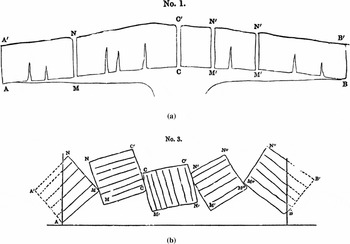
Darwin not only extended Lyell's earthquake theory, but followed his example of conveying the awesome spectacle of the earthquake through its human consequences, using the Concepción tragedy to set the scene for a still larger drama: the unveiling of geological laws. In his notebooks and geological publications, Darwin shrank mountains into insignificance and rendered nature's most cataclysmic forces “secondary effects,” “subsidiary and attendant phenomena” to the formation of continental elevations. In his 1838 earthquake paper, Darwin applied recent calculations on the process of equable elevation by the Cambridge mathematician William Hopkins to the whole of the Andes. He conceived a long meridional portion of the earth's crust as a nascent mountain chain, raised by repeated injection of fluid that cooled to a solid, causing the ground to fissure, lift, and finally break into pieces, like a series of blocks (see fig. 2). He thus suggested, in far more detail than in the Beagle narrative, how monumental and awe-inspiring formations could result from “an almost infinite series of small movements” (Darwin [1838] Reference Darwin1840, 623, 627). The technical discussion was complemented by mapping and measurement on a large scale, incorporating and occasionally correcting Humboldt's tabulations, correlating uplift, volcanic activity, and earthquakes along the mountain chains of the Americas. In the course of his unifying explanation, the attributes of the sublime – height, vastness, even obscurity – were transferred to the “one great cause,” “the grandeur of the one motive power,” which yet remained unknown (ibid. 630). Feelings of sublimity—awe, reverence, wonder – were thus recreated for readers, now witnesses to the process of geological speculation.
Schematic diagrams showing uplift, fissuring, and the formation of mountain chains as a gradual result of earthquake activity (Darwin Reference Darwin1840).

4. Conclusion: What Is an Earthquake?
Darwin's method of witnessing disaster, and the form in which he theorized about it in print, spoke to the concerns of elite geologists to measure nature precisely, to control the production of knowledge, and to widen its appeal in popular culture. But as Darwin's diary and notebooks show, the aesthetic of the sublime was not just a form of presenting geology to a popular audience. It structured the experience of the traveler from the beginning, both the immediate emotional experience of natural disaster, and the scientific work that came after. In comprehending the most powerful and destructive forces of nature, Darwin (following Lyell and others) made a spectacle of human suffering, while distancing himself from it, referring in passing to what was lost: “compassion for the inhabitants is almost instantly forgotten” (Keynes Reference Keynes1988, 298). One of the criticisms often leveled at the “popular” sublime – the gothic novels, the lurid stage plays and visual amusements – was their debasing of sensibility, taking delight in animal appetites for carnage and blood, raising the passions without giving pause for reflection. When Burke invited readers to imagine London destroyed by an earthquake, he did so in order to show how much more affecting a real tragedy was than an imaginary one. He also argued that the delight taken in the misfortune of others was in fact a spur to sympathy. If witnessing disaster was simply painful, we would all flee from it, and leave the suffering to die. From within his Providentialist framework, Burke thus linked the victims of the earthquake with the spectator by making the sublime productive of sympathy. Modern philosophers from Adorno to Lyotard have also looked to the sublime as a resource for art and theory to bring distance, relief, and reflection to the most painful and traumatic experiences of human life (Crother Reference Crowther1995; Lyotard Reference Lyotard, Bennington and Bowlby1991; Ray Reference Ray2004). The sublime allows for fear, feelings of helplessness and subjugation to be overcome, not by rendering them pleasing or delightful, but by transcending them, and ultimately by understanding their source. What then happens to human loss, suffering, and trauma, when disaster becomes an object of science? For Darwin and his geological contemporaries, the sublime was a form of excitement that drove speculation. It made the cries and human suffering recede into the background of a larger quest for earth history. Would the earthquake remain a sublimely human event for future geologists?
In 1846, one of the founders of modern seismology, Robert Mallet, presented a paper to the Royal Irish Academy which promised “to bring the phenomena of the earthquake within the range of exact science,” surpassing all previous accounts, including those of Humboldt, Darwin, and Lyell, which suffered from imprecision, an exclusive reliance upon the senses, and the production of “loose narratives” and “fanciful and figurative language.” In the absence of any geological field work, but drawing on his extensive experience as an engineer, Mallet redefined the earthquake as a purely mechanical phenomenon: “the transit of a wave of elastic compression . . . through the solid substance and surface of the disturbed country” (Mallet Reference Mallet1846a, 56, 75–6; Dean Reference Dean1991). The wave theory was not new, but Mallet's approach was different. In a second paper presented in the same year, he described new instruments for recording the time, direction, and amplitude of the shock waves, improving upon earlier devices – the first “seismometers” – which lacked the “power of self-registration,” and were subject to inner movements and vibrations of their own (Mallet Reference Mallet1846b, 107). With its mercury column, galvanic battery, pencils and ruled sheet attached to a cylindrical barrel, Mallet's device was similar to other machines that were being developed in physiological laboratories to record the inner movements of the body without the presence of a human observer (Chadarevian Reference Chadarevian1993). Mallet thus applied some of the methods and tools of the experimental laboratory, with its ethos of mechanical objectivity, to the most sublime of phenomena, even attempting to simulate the shockwave of an earthquake with explosives (Mallet Reference Mallet1850, Reference Mallet1851).Footnote 10
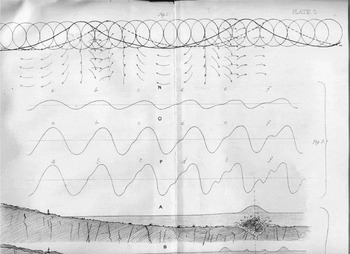
Darwin corresponded with Mallet about his new apparatus for registering earth tremors, encouraging him to set up a seismic network through the installation of the devices in remote regions: “How wonderful it would be, if you could have your instrument worked in Chili: in Lima, there was or is a merchant. . .with a strong taste for Natural History, & earthquakes are frequent there” (Burkhardt Reference Burkhardt1985–2010, 3:335). For Darwin, Humboldt, and other scientific travelers who drew upon the aesthetic of the sublime, the earthquake was observed and comprehended through a series of registers: numerical, emotional, visual, and narrative. The human body was itself a delicate instrument, its inner movements and sympathies able to respond to nature's most imponderable features, and most obscure and destructive forces. The experience of the individual in the landscape was likewise crucial, the individual who might be profoundly shaken, even overwhelmed, but who could then recover, and in tranquility reflect and reason on nature's laws and causes. Mallet's new machines would replace the sensible body and emotional register of the witness with a quantitative scale (see fig. 3). As the heirs of this trust in numbers, we assume an earthquake is measured by its size, and perhaps its death toll.Footnote 11
Diagrams showing the motions of a fluid wave and a graphic register of the magnitude of the wave (Mallet Reference Mallet1846a).

Yet, perhaps ironically, the conversion of the earthquake into a purely seismic event entailed its own heroic, personal narrative. In 1857, partly through recommendations by Darwin and Lyell, Mallet led an elaborate expedition to study a devastating earthquake in Italy. The resulting report, issued in two lengthy volumes, presented a new “observational seismology” based on extensive quantitative measures and calculations, mathematical formula of the mechanics of the waves, detailed analyses of building structures and materials, schematic diagrams of ruins as registers of shock, and so forth. It also read, in places, like a voyage account, charting the progress of the author as he traveled from valley to village, surmounting difficult and dangerous terrain. Colorized photographs and woodcuts showed landscapes and townscapes in a picturesque style. Sectional maps charted the discovery of new territory: the deep interior of the earth. Mallet, the building engineer, offered a Lyellian redemption of earthquakes as “part of a beneficient machinery.” He also made the secular and modern promise to save lives through “forethought and knowledge,” “skill and labour,” namely, the better construction of houses and cities (Mallet Reference Mallet1862, 1:7, 2:385). Readers of the report stood at the dawn of a new science, the geologist would be the “‘light bearer’ in the rising palace of cosmical truth” (ibid. xvi). Mallet's seismology, in bringing mechanical and quantitative precision, but also beauty, wonder, and power, the subjugation of evil, and the banishment of superstition and fear, was not only ambitious, it was positively messianic.
Acknowledgments
For their helpful comments on a draft of this paper, I am grateful to Deborah Coen, Ralph O'Connor, Jim Secord, Phillipa Simpson, Alistair Sponsel, and Daniel Williams.