Introduction
Delirium is an acute neurocognitive disorder commonly seen in patients with advanced illness, characterized by disturbances in consciousness or attention, and cognition. Typically, delirium is characterized by an abrupt onset and fluctuating course (American Psychiatric Association, 2013).
The etiology of delirium is complex and usually multifactorial, resulting from a combination of risk factors, typically termed either “predisposing” or “precipitating” factors (Inouye et al., Reference Inouye, Westendorp and Saczynski2014). Predisposing factors are medical conditions and comorbidities that preexist in a patient, like male gender, older age, and hearing, visual, or cognitive impairment. Conversely, precipitating factors, which often are modifiable, refer to contributing risk factors that are critical activators of a delirium episode, like the consumption of sedative medications, infections, surgery, and abnormalities in various laboratory results (e.g., electrolyte imbalance, metabolic abnormalities) (Bush et al., Reference Bush, Lawlor and Ryan2018). Generally, these predisposing and precipitating factors increase the risk of developing delirium (Boettger et al., Reference Boettger, Jenewein and Breitbart2015; Seiler et al., Reference Seiler, Schubert and Hertler2019; Zipser et al., Reference Zipser, Deuel and Ernst2019). Furthermore, patients with multiple predisposing risk factors are more susceptible to precipitating factors than patients with only one predisposing factor (Laurila et al., Reference Laurila, Laakkonen and Tilvis2008).
The prevalence of delirium in palliative-care patients is high, ranging from 35% to 55% at the time of admission (Hosie et al., Reference Hosie, Davidson and Agar2013; Ryan et al., Reference Ryan, O'Regan and Caoimh2013; Lawlor et al., Reference Lawlor, Davis and Ansari2014; de la Cruz et al., Reference de la Cruz, Ransing and Yennu2015; Mercadante et al., Reference Mercadante, Adile and Ferrera2017) and from 88% to 93% in the terminally ill (Hosie et al., Reference Hosie, Davidson and Agar2013; Bush et al., Reference Bush, Tierney and Lawlor2017; Seiler et al., Reference Seiler, Schubert and Hertler2019). Delirium is frequently underdiagnosed, particularly the hypoactive form, which is the most common manifestation in palliative-care patients (Friedlander et al., Reference Friedlander, Brayman and Breitbart2004). Delirium in palliative-care patients has negative consequences for both short- and long-term prognosis, including significant morbidity and mortality, increased health and personal care requirements, elevated healthcare costs, and the need for institutionalization (Lawlor and Bush, Reference Lawlor and Bush2014; Dani et al., Reference Dani, Owen and Jackson2017; Tosun Tasar et al., Reference Tosun Tasar, Sahin and Akcam2018; Seiler et al., Reference Seiler, Schubert and Hertler2019).
Elderly patients, by definition, those ≥65 years old, as well as patients suffering from dementia, are particularly vulnerable to developing delirium (Witlox et al., Reference Witlox, Eurelings and de Jonghe2010; Inouye et al., Reference Inouye, Westendorp and Saczynski2014; Fong et al., Reference Fong, Inouye and Jones2017). Reasons for this are the high prevalence of comorbid conditions, like cancer, hypertension, coronary artery disease, diabetes, malnutrition, bladder dysfunction, constipation, sensory impairment, or substance abuse (Thakur et al., Reference Thakur, Banerjee and Nikumb2013; Inouye et al., Reference Inouye, Westendorp and Saczynski2014). In the geriatric population (i.e., patients ≥65), the prevalence of delirium ranges between 25.5% and 70% with highest rates occurring in intermediate and intensive care units and within the palliative-care settings (Fong et al., Reference Fong, Tulebaev and Inouye2009; González et al., Reference González, Martínez and Calderón2009; McCoy et al., Reference McCoy, Hart and Perlis2017; Tosun Tasar et al., Reference Tosun Tasar, Sahin and Akcam2018).
Despite major advances in delirium research, specifically involving geriatric populations, delirium is largely under-researched in the context of palliative care, with relatively few studies having systematically assessed key aspects of delirium in elderly palliative-care patients. Although age and dementia are among the most frequently reported risk factors for developing delirium, their association in palliative-care patients remains elusive. The overall purposes of this study were, therefore, (1) to examine age as a risk factor for delirium in palliative-care patients; (2) to assess group differences with respect to predisposing and precipitating factors among delirious palliative-care patients <65 vs. ≥65 years old; and (3) to identify the most relevant predisposing and precipitating risk factors for delirium in elderly patients in palliative care.
Methods
Study design, patients, and procedures
The present study is based on previous work by Seiler et al. (Reference Seiler, Schubert and Hertler2019), which investigated the predisposing and precipitating risk factors for delirium in palliative-care patients. This study is a sub-analysis of “Delir-Path”, a large prospective observational project aiming to enhance the prevention, early detection, and management of hospital-acquired delirium in surgical and intensive care patients (Schubert, Reference Schubert2013–2015). Details regarding the study design and methods of the Delir-Path project can be found elsewhere (Schubert et al., Reference Schubert, Schurch and Boettger2018; Seiler et al., Reference Seiler, Schubert and Hertler2019; Zipser et al., Reference Zipser, Deuel and Ernst2019).
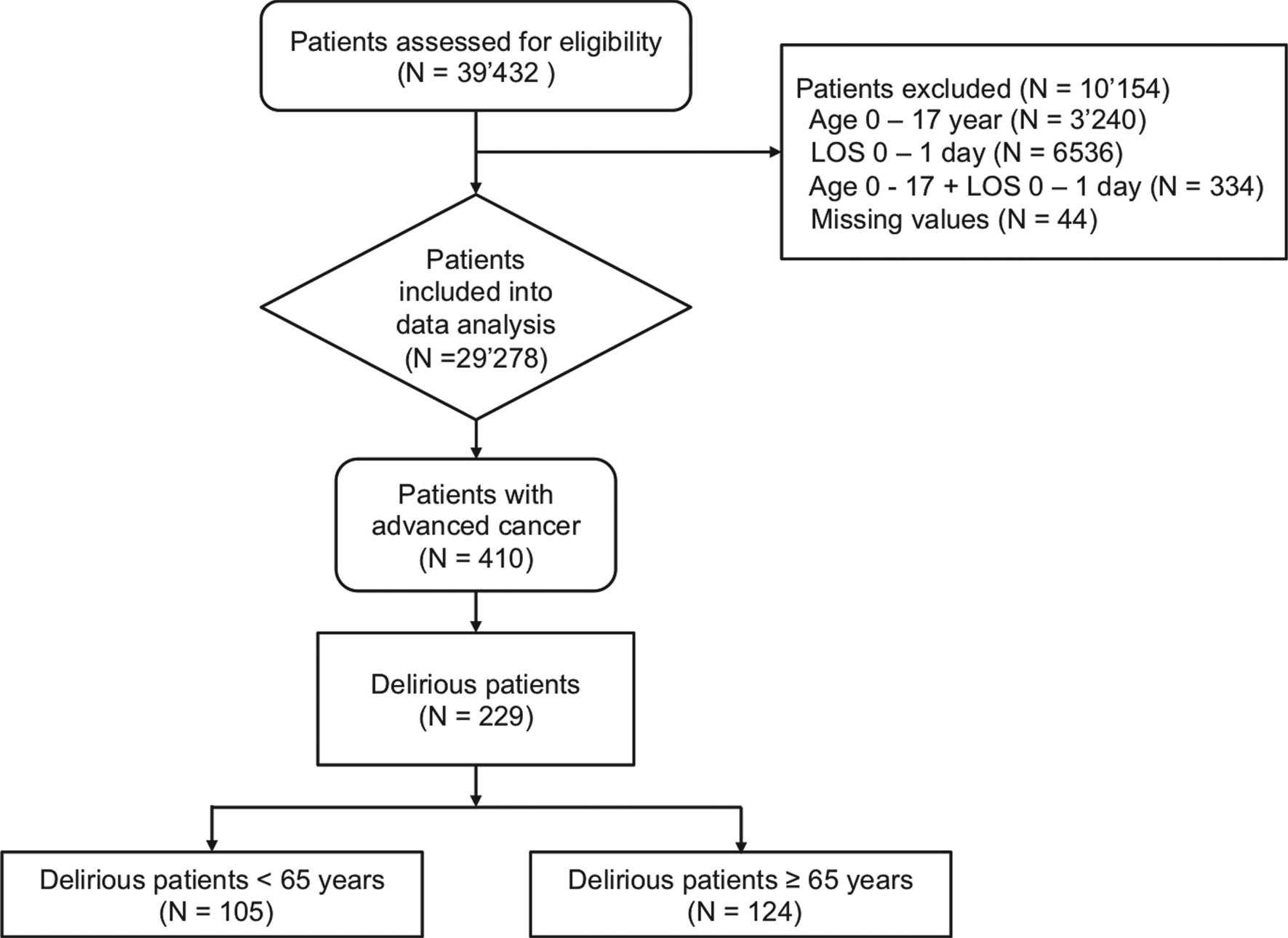
The Delir-Path enrolled 29’278 eligible patients, out of these, 410 were managed at the Competence Center for Palliative Care. In this study, only delirious palliative-care patients (N = 229) were included in the analyses (Figure 1). For the purpose of this study, the term ‘palliative-care patients’ refers to patients with terminal illnesses that are unlikely to be controlled with treatment, having a prognosis of weeks to 6 months (Hui et al., Reference Hui, Nooruddin and Didwaniya2014; National Cancer Institute, 2019).
Screening algorithm for the Delir-Path.

All study procedures were in accordance with the World Health Organization's 2013 Declaration of Helsinki. The study was reviewed and approved by the Ethics Committee of the Canton of Zurich (KEK), Switzerland (KEK-ZH-Nr. 2012-0263). A waver of informed consent was obtained from the KEK. Data were collected and reported in accordance with guidelines in the STROBE (Strengthening the Reporting of Observational Studies in Epidemiology) statement (Strobe, Reference Strobe2009). Demographic and medical information was retrieved via the electronic medical chart (Klinikinformationssystem, KISIM, CisTec AG, Zurich).
Determination of delirium
For the determination of delirium, both the Delirium Observation Screening (DOS) scale and a delirium construct based on the delirium criteria of disturbances in alertness, attention, and cognition as described in the Diagnostic and Statistical Manual of Mental Disorders, 5th edition (DSM-5) (European Delirium Association & American Delirium Society, 2014) and the electronic Patient Assessment-Acute Care (ePA-AC), a daily nursing assessment (Hunstein et al., Reference Hunstein, Sippel and Rode2012) were used. This delirium construct in combination with the DOS accurately detected 97% of patients diagnosed with delirium, as specified by the DSM-IV-TR (Seiler et al., Reference Seiler, Schubert and Hertler2019).
The DOS was administered thrice daily over the first three days of hospitalization to all patients ≥65 years and to patients <65 years upon clinical suspicion of incident delirium. Once delirium was verified, DOS screening was continued three times per day until remission. In addition, medical and functional parameters were assessed with the ePa-AC daily (Hunstein et al., Reference Hunstein, Sippel and Rode2012). Study nurses were specifically trained in applying the DOS through lectures on epidemiology and diagnostic criteria for delirium, in conjunction with case reports, eLearning, literature research, and an assessment of training success.
Characterization of predisposing and precipitating factors for delirium
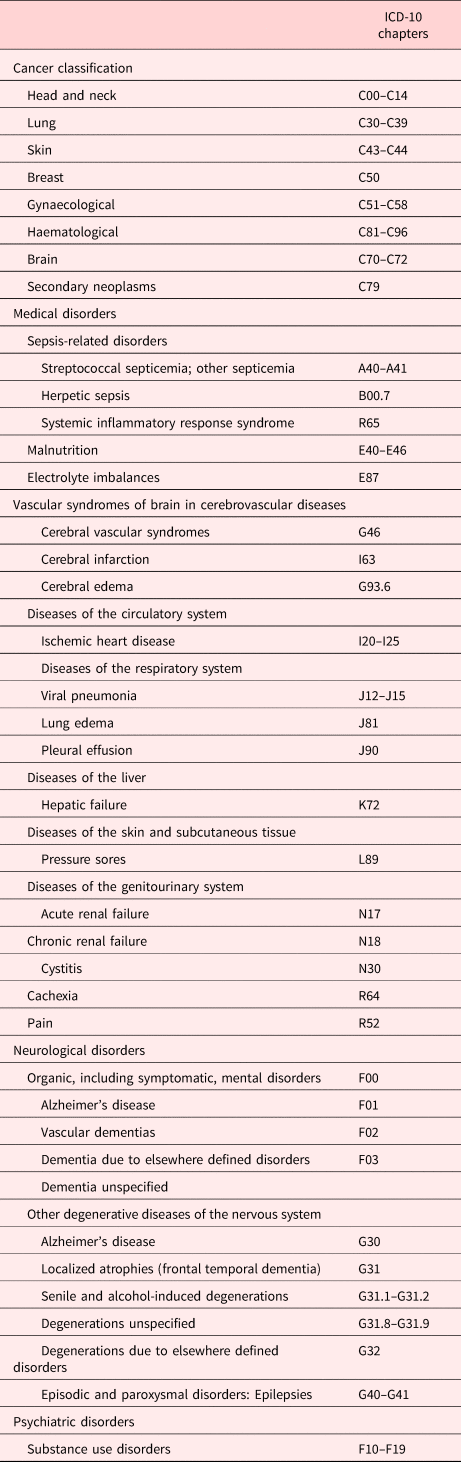
A number of predisposing and precipitating factors have been described for palliative-care patients (Kang et al., Reference Kang, Shin and Bruera2013; Inouye et al., Reference Inouye, Westendorp and Saczynski2014; Hosker and Bennett, Reference Hosker and Bennett2016; Bush et al., Reference Bush, Lawlor and Ryan2018; Schubert et al., Reference Schubert, Schurch and Boettger2018; Zipser et al., Reference Zipser, Deuel and Ernst2019). The characterization of the predisposing and precipitating factors for delirium utilized in this study (Table 1) can be found elsewhere (Seiler et al., Reference Seiler, Schubert and Hertler2019).
Diagnostic clusters with their respective included diagnoses according to the International Statistical Classification of Diseases and Related Health Problems 10th Revision (ICD-10)

Measures
The delirium observational screening scale
The 13-item DOS scale was used to screen for delirium (Schuurmans et al., Reference Schuurmans, Shortridge-Baggett and Duursma2003). This scale was originally developed to facilitate the early detection of delirium based on DSM-IV criteria (American Psychiatric Association, 2000). The following items are included in the questionnaire: disturbances of consciousness (item 1), attention (items 2–4), thought processes (items 5 and 6), orientation (items 7 and 8), memory (item 9), psychomotor behavior (items 10, 11 and 13), and affect (item 12). Each item is rated as a binary variable: normal (0) or abnormal (1). A total score is computed by aggregating the items throughout recordings; the cut-off score for delirium was ≥3.
Comorbidities
The Charlson Comorbidity Index (CCI) was used to assess multimorbidity and frailty (Charlson et al., Reference Charlson, Pompei and Ales1987). The CCI aggregates patient age and multiple medical conditions, including myocardial infarction, congestive heart failure, peripheral vascular disease, cerebrovascular disease, dementia, chronic pulmonary disease, rheumatic disease, diabetes mellitus, renal disease, liver disease, peptic ulcer disease, malignancy, hemiplegia, or paraplegia, and AIDS/HIV. Medical conditions are scored on a scale from 1 to 6. The total comorbidity score derives from the weighted conditions, with higher scores indicating greater comorbidity. The CCI has displayed good reliability and is strongly correlated with mortality and progression-free survival (Williams et al., Reference Williams, Mackenzie and Magnuson2016).
Statistical methods
All analyses were performed using the Statistical Package for the Social Sciences (SPSS) version 26.0 software (IBM Corp., Released, 2017). Descriptive statistics were summarized using means and standard deviations or medians and interquartile ranges for continuous variables or as counts and percentages for categorical variables. Dichotomizations were chosen for the CCI (<2 vs. ≥2), frailty (mobility impaired vs. not impaired), residence status prior to admission (institution vs. home), and cerebral edema (presence or absence of edema was defined as hypodensity on CT scans or as T2/FLAIR hyperintensity on MRI scans). All continuous variables were tested with the Shapiro–Wilk's test to determine normal distribution. Age-group differences in continuous outcomes were determined with either Student's t-test or Mann–Whitney U test for parametric and non-parametric data, respectively, and categorical variables with the Pearson's χ 2 or Fisher's exact test, as appropriate. All inferential tests were two-tailed and the criterion for statistical significance was set at P < 0.05.
For the purpose of this study, a subgroup of delirious palliative-care patients was selected. Subsequently, data were dichotomized into two age groups: patients <65 years (referenced with 0) and patients ≥65 years old (referenced with 1). Odds ratio (OR) >1 indicate a strong association with the patient age group ≥65 years (when compared with the variable reference level) whereas ORs <1 represent strong associations with the patient age group <65 years (when compared with the variable reference level). Simple logistic regression models were used to determine effect sizes of sociodemographic and medical characteristics among delirious palliative-care patients expressed as OR with 95% confidence intervals (CIs). As a last step, multiple logistic regression models were used to identify predisposing and precipitating risk factors in delirious in palliative-care patients. Multiple regression models were computed with their respective ORs and CIs, based on the results of the simple logistic regressions models, by entering variables with a P-value <0.15. The model was verified using Cox–Snell's and Nagelkerke's r 2 tests.
Results
Demographics and clinical characteristics of delirious palliative-care patients
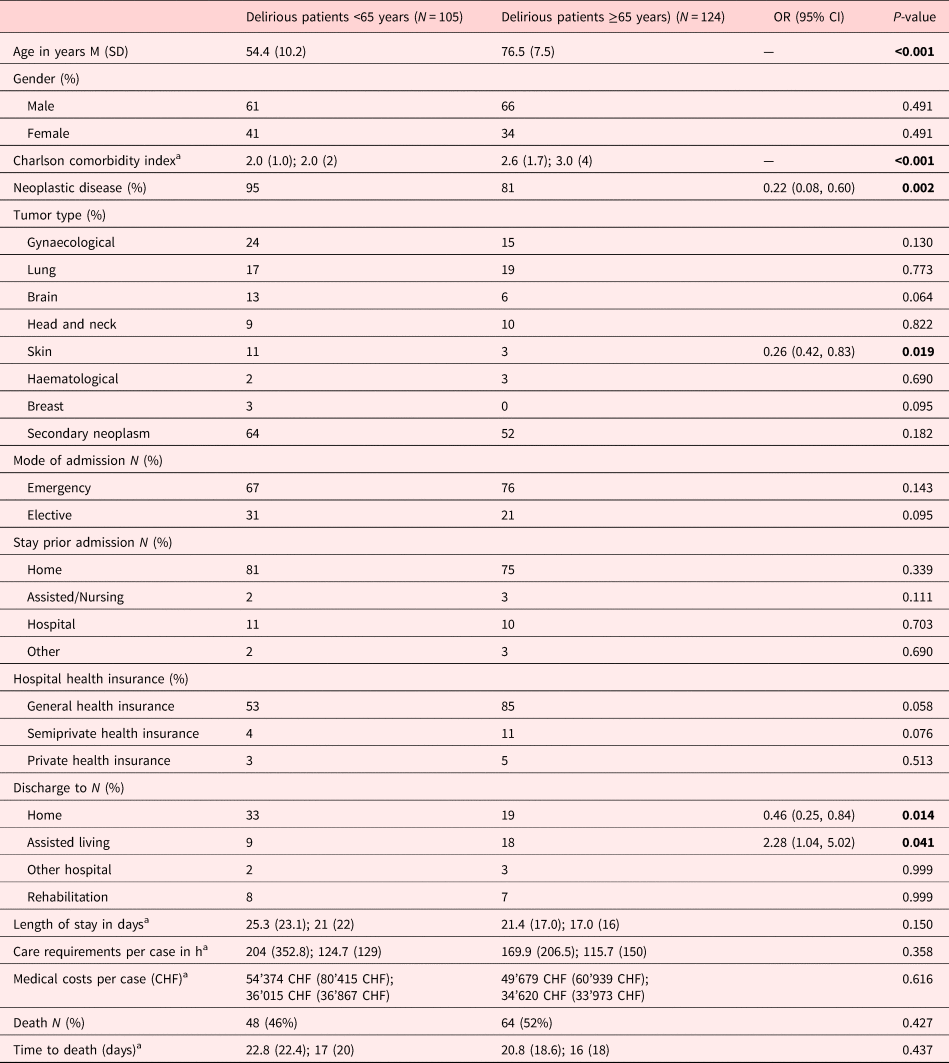
Detailed patient demographics and clinical characteristics are summarized in Table 2. Out of 410 palliative-care patients, 105 (46%) were delirious patients <65 years and 124 (54%) were delirious patients ≥65 years.
Sociodemographic and medical characteristics of delirious palliative-care patients younger 65 years vs. 65 years and older

Abbreviations: M, mean; SD, standard deviation; N, number; CHF, Swiss Franc.
a Mean, standard deviation; median, interquartile range.
Bold values indicated significant results.
Overall, 88% of the delirious palliative-care patients had cancer as an underlying diagnosis. Relative to delirious patients <65 years, delirious patients ≥65 years had more comorbidities (CCI P < 0.001) and were more likely to be discharged to assisted living (OR 2.28). Of note, death in delirious palliative-care patients occurred irrespective of patient age and median time to death was comparable. There were no inter-group differences with respect to gender, mode of admission, hospital health insurance, length of hospital stay, care requirements, or medical costs in delirious patients.
Determination of predisposing and precipitating factors
Simple logistic regression identified the following predisposing factors as relevant for delirious patients ≥65 years vs. those <65 years: hearing impairment (OR 3.41), hypertonia (OR 4.02), ischemic heart disease (OR 4.40), cardiac insufficiency (OR 18.82), valvular heart disease (OR 10.12), chronic kidney disease (OR 7.74), chronic pneumonitis (OR 4.29), and diabetes mellitus (OR 2.28). No significant inter-group differences were found in the presence of frailty, cachexia, malnutrition, or substance use disorder.
By simple logistic regression, no relevant precipitating factors were identified for patients ≥65 years. The strongest precipitating factor among patients <65 years was the presence of cerebral edema (OR 0.09). No significant inter-group differences were found for the presence of sepsis, electrolyte imbalances, pneumonia, lung edema, pleural effusion, liver failure, pressure sores, cystitis, or pain.
Multiple regressions analysis for predisposing and precipitating factors for delirium
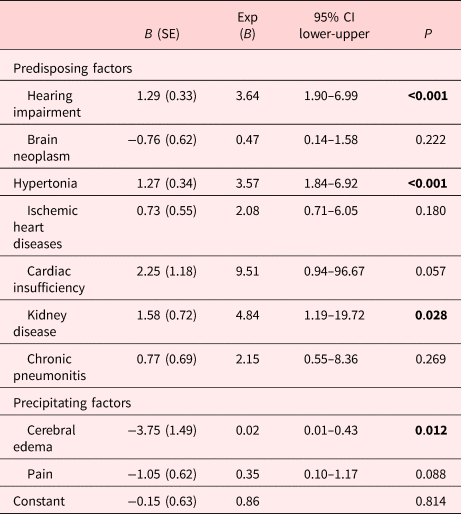
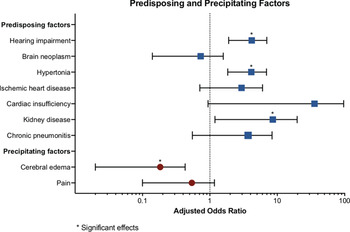
Table 3 summarizes the multiple regression analyses performed to identify predisposing and precipitating risk factors in delirious patients < and ≥65. The strongest predisposing risk factors among patients ≥65 years vs. those <65 years were kidney disease (OR 4.84), hearing impairment (OR 3.64), and hypertonia (OR 3.57). No associations were identified for neoplastic disease, brain metastases, ischemic heart disease, cardiac insufficiency, chronic pneumonitis, or diabetes mellitus. For patients ≥65 years, no relevant precipitating factor was identified. The only relevant precipitating factor among patients <65 years was cerebral edema (OR 0.02)
Summary of multiple regression model for the predisposing and precipitating factors of the delirious palliative-care patients between those younger than 65 years vs. those 65 years and older

Notes. The variable age was dichotomized into two groups: patients <65 years (referenced with 0) and patients ≥65 years (referenced with 1). Odds ratios (OR) >1 indicate a strong association with the patient age group ≥65 years (when compared with the variable reference level) whereas ORs <1 represent strong associations with the patient age group <65 years (when compared with the variable reference level). Cox–-Snell and Nagelkerke r 2 = 0.307 and r 2 0.410. Displayed are estimated coefficients (B, SE), 95% confidence intervals, and P-values.
SE, standard error; CI, confidence interval.
Bold values indicated significant results.
Predisposing and precipitating factors for delirious palliative care among delirious patients <65 and ≥65 years are depicted in Figure 2.
Forest plots of predisposing and precipitating factors for delirium. Odds ratios and 95% confidence intervals are reported for each delirium risk factor. The edges of the polygon represent 95% confidence limits.

Discussion
This study evaluated and compared predisposing and precipitating factors for delirium in palliative-care patients <65 and ≥65 years old. Interestingly, most of the predisposing and precipitating factors that we identified in patients <65 years resembled those we found in the more elderly (≥65 years). There were no age-group-related differences for most of the examined predisposing and precipitating factors. The only risk factors detected specifically in patients ≥65 years were chronic kidney disease, impaired hearing, and hypertonia.
Importantly, death in delirious palliative-care patients with varying preexisting diagnoses occurred irrespective of age. Furthermore, the length of stay, care requirements, and medical costs did not differ between groups. Our findings agree with previous results from a meta-analysis in which delirium in hospitalized older patients was associated with increased mortality, regardless of age, sex, and comorbidities (Witlox et al., Reference Witlox, Eurelings and de Jonghe2010).
Several studies have identified risk factors for the development of delirium in the general medical population, as well as in elderly patients; albeit, with inconsistent results (Inouye and Charpentier, Reference Inouye and Charpentier1996; Pisani et al., Reference Pisani, Murphy and Van Ness2007; Mehta et al., Reference Mehta, Cook and Devlin2015; Oh et al., Reference Oh, Sieber and Leoutsakos2016; Schubert et al., Reference Schubert, Schurch and Boettger2018; Seiler et al., Reference Seiler, Schubert and Hertler2019; Zipser et al., Reference Zipser, Deuel and Ernst2019). Generally, age and cognitive impairment are the most prevalent risk factors for delirium and its sequelae across all patient populations (Ljubisavljevic and Kelly, Reference Ljubisavljevic and Kelly2003; Korevaar et al., Reference Korevaar, van Munster and de Rooij2005; Inouye et al., Reference Inouye, Westendorp and Saczynski2014; Bellelli et al., Reference Bellelli, Morandi and Di Santo2016; Maldonado, Reference Maldonado2017). However, contradicting the current literature, we were unable to confirm the contribution of age to delirium in palliative-care patients. In our study, death in the delirious occurred irrespective of age. Of note, cognitive dysfunction can also manifest in palliative-care patients <65 years, caused by pathologies like primary and secondary brain tumors, which can result in neurological damage and, thereby, induce delirium (Stiefel and Holland, Reference Stiefel and Holland1991; Zimmerman et al., Reference Zimmerman, Rudolph and Salow2011). In addition, hepatorenal or metabolic dysfunction, infections, other comorbidities, and certain medications all may reduce a terminally ill patient's ability to preserve homeostasis, resulting in neurotoxic effects, regardless of the patient's age (Zimmerman et al., Reference Zimmerman, Rudolph and Salow2011).
Interestingly, only a small number of predisposing factors were characteristic for delirious palliative-care patients ≥65 years. Elderly palliative-care patients with delirium suffered more often from chronic kidney failure, sensory impairment, and hypertonia than those <65 years. These results confirm previous findings identifying metabolic dysfunction as the causative mechanism for delirium in 44% of terminal cancer patients ≥65 (Morita et al., Reference Morita, Tei and Tsunoda2001). Furthermore, sensory impairment, either preexisting or iatrogenic, is prevalent in the elderly and may weaken sensory input to the brain, leading to confusional states (Zimmerman et al., Reference Zimmerman, Rudolph and Salow2011; Seiler et al., Reference Seiler, Schubert and Hertler2019) and increased mortality (Schubert et al., Reference Schubert, Fischer and Pinto2016). Finally, hypertension is highly prevalent in elderly patients, affecting nearly half of patients 65 years old or older (Rigaud and Forette, Reference Rigaud and Forette2001). Hypertension in patients ≥65 years also is associated with increased incidence rates for both cardiovascular and cerebrovascular complications and is, for this reason, a robust risk factor for increased mortality (Kostis et al., Reference Kostis, Sargsyan and Mekkaoui2019). Lastly, we identified cardiac insufficiency as a potential predisposing risk factor in our study cohort, though the effect was not significant. This association concurs well with previous findings that report on cardiac toxicity of some cancer therapies (Hamo and Bloom, Reference Hamo and Bloom2017). In fact, according to the Centers for Disease Control and Prevention (CDC), cancer and cardiovascular disease account for almost half of the deaths in the US (Centers for Disease Control and Prevention (CDC), 2017)
Multiple risk factors for delirium have been identified in advanced and terminally ill cancer patients. Moreover, it is assumed that patients already at high risk of delirium, due to the presence of multiple predisposing factors, require fewer precipitating factors to develop delirium (Inouye, Reference Inouye1998; Inouye et al., Reference Inouye, Westendorp and Saczynski2014). It has been estimated that the total number of risk factors in delirious terminally ill cancer patients ranges between one and six, with a median of two (Morita et al., Reference Morita, Tei and Tsunoda2001). In our study, predisposing risk factors were exclusively contributing to delirium in delirious patients ≥65 years whereas precipitating factors alone were sufficient to cause delirium in patients <65 years. Cerebral edema was the strongest factor for delirium in patients <65 years. Importantly, cerebral edema occurred in only one delirious patient ≥65 years, i.e., cerebral edema was 98% less present in elderly patients. Cerebral edema can arise from a number of complications, including head trauma, vascular ischemia, intracranial lesions with devastating, even fatal consequences when untreated (Nehring et al., Reference Nehring, Tadi and Tenny2020). Furthermore, the pain was a potential precipitating risk factor (barely missing significance) for delirium in patients <65 years. In fact, pain can impact on the incidence of delirium (Sampson et al., Reference Sampson, West and Fischer2020). This effect is possibly moderated through the treatment with analgesics, opioids, or other anticholinergic or sedative drugs (e.g., benzodiazepines), which can result in a longer episode of or more severe delirium (Pisani et al., Reference Pisani, Murphy and Araujo2009; Bush et al., Reference Bush, Lawlor and Ryan2018).
Clinical implications
Given that delirium is an independent predictor of adverse outcomes and mortality in palliative-care patients, the implementation of primary and secondary prevention strategies to reduce the incidence of delirium — strategies that incorporate best clinical practices for delirium management — is of considerable clinical importance in this vulnerable population (Wass et al., Reference Wass, Webster and Nair2008). Delirium in the palliative-care setting is often underdiagnosed (Friedlander et al., Reference Friedlander, Brayman and Breitbart2004). Furthermore, delirium also generates high levels of distress in patients and their family members or caregivers; and interferes with communication between patients and their relatives as patients near the end of their life (Bush et al., Reference Bush, Tierney and Lawlor2017). Implementing some standardized delirium-screening process is an important step towards enhancing the effectiveness of delirium treatment. A number of screening tools exist, like the DOS, which has demonstrated 97% sensitivity in palliative-care settings (Seiler et al., Reference Seiler, Schubert and Hertler2019). Delirium management in palliative-care patients entails assessing and treating causative factors and potentially reversible causes, discontinuing any medication that might cause delirium, using symptom-oriented medication, and enacting environmental changes (re-orientation, early and recurrent mobilization, hearing and visual aids, pain management, adequate nutrition and hydration, etc.) (LeGrand, Reference LeGrand2012).
Delirium can be managed successfully, even in terminally ill patients (Lawlor et al., Reference Lawlor, Fainsinger and Bruera2000a, Reference Lawlor, Gagnon and Mancini2000b). Evidence suggests that delirium is reversible in approximately 50% of palliative-care patients (Lawlor et al., Reference Lawlor, Gagnon and Mancini2000b). Reversible causes of delirium mainly include precipitating factors like dehydration, opioid toxicity, the adverse effects of other psychoactive drugs, poor nutrition, immobilization, sleep deprivation, and complications from medical interventions or procedures (de Stoutz et al., Reference de Stoutz, Bruera and Suarez-Almazor1995; Maddocks et al., Reference Maddocks, Somogyi and Abbott1996; Fong et al., Reference Fong, Tulebaev and Inouye2009). Analgesics, opioids, and anticholinergic drugs are prevalent causes of acute confusional states, particularly in elderly patients (Casarett and Inouye, Reference Casarett and Inouye2001; Friedlander et al., Reference Friedlander, Brayman and Breitbart2004). However, delirium can develop secondary to multiple pathologies, including electrolyte imbalance, infections, major organ failure, and central nervous system malignancies (Lawlor et al., Reference Lawlor, Gagnon and Mancini2000b; Breitbart and Friedlander, Reference Breitbart, Friedlander, Bruera, Higginson, Ripamonti and von Gunten2006). In some cases, delirium can result in irreversible damage, including hypoxic encephalopathy, major organ failure, refractory hypercalcemia, and/or death (Lawlor et al., Reference Lawlor, Gagnon and Mancini2000b).
Delirium management in terminally ill patients who develop delirium in the last days of life is unique and creates several ethical and clinical dilemmas for healthcare professionals, frequently resulting in large deviations from the desired outcome, due to the process of dying (Akechi, Reference Akechi2020). In delirious terminally ill patients, the overall desired outcome is usually to provide comfort, which is often achieved using sedating drugs like analgesics and anxiolytics, at the risk of reducing alertness (Friedlander et al., Reference Friedlander, Brayman and Breitbart2004).
Study strengths and limitations
Among palliative-care patients, research is challenging due to terminally ill patients’ vulnerability as they near the end of life, difficulties with patient accrual, and high attrition rates. Strengths of our study include the careful examination and utilization of a relatively large sample of delirious palliative-care patients to conduct our analyses. A second strength is that the sociodemographic and medical characteristics of our study population were described comprehensively. Third, we employed rigorous methodology, which included an innovative delirium-screening approach: combining the DOS score and DSM-5 diagnostic criteria for delirium. A final strength is the analysis of both predisposing and precipitating factors, stratified by age. Despite these study strengths, certain limitations must be acknowledged. First, patients were enrolled at a single tertiary care center, which might limit the generalizability of results to other settings. Second, not all potential risk factors for delirium, like endocrine disorders, were examined, and brain imaging was not routinely conducted. Third, the clinical features of delirium were only evaluated cross-sectionally. A prospective cohort study would better delineate the delirium trajectories of palliative-care patients. Given attrition challenges in this population, multicenter collaborations could be key to recruiting cohorts large enough to allow for more comprehensive analyses.
Conclusions
Patients with terminal illnesses are at high risk of developing delirium; particularly those with multiple predisposing and precipitating risk factors. Importantly, delirium in palliative-care patients appears linked to an increased risk of death, irrespective of patients’ age. Physicians need to, therefore, be aware of the multifactorial nature and adverse outcomes of delirium across all ages and recognize potentially reversible factors early enough to either prevent or reduce delirium and its poor survival outcomes.
Conflict of interest
The authors have no conflicts of interest to declare.