

The first year of a 4-year longitudinal project utilised the SSiS to improve social skills at a low socioeconomic status (SES), low academic achievement Queensland school. With guidance officer support and training, 16 teachers completed the SSiS Performance Screening Guide for 374 students across preparatory year to Year 3. Students judged to have low levels of prosocial behaviour were assessed using the SSiS Rating Scale. These data informed the social skills goals targeted by the class teacher, and subsequently the skills were explicitly taught to the students. Indicators of the intervention's effectiveness included change in prosocial behaviour, academic achievement, problem behaviours, and attendance. Of the 374 students, 18 had verified disabilities, but 204 (55%) were identified as having additional needs that required specialised services.
By the end of this first year of the project both students with and without additional needs achieved improvement in social skills and other outcomes. Teacher feedback also informed the program evaluation. This paper provides an initial evaluation of a comprehensive classroom approach to improving social skills in line with the Personal and social capability of the Australian Curriculum for students with additional needs in a challenging, low SES, mainstream setting.
Introduction
Social Skills and Social–Emotional Learning
Social skills and social–emotional learning (SEL) are well-established concepts despite some changes to nomenclature, definitions and understandings over the past century. Thorndike identified ‘social intelligence’ in the 1920s. Since then, many researchers and educators have explored and advanced this concept. These include Wechsler in the 1940s, Gardner's intrapersonal and interpersonal intelligence in the 1980s, and Goleman's (Reference Goleman2006) emotional intelligence and social intelligence in the 21st century.
Current understandings of this domain indicate that SEL is a process of acquiring core competencies (Durlak, Weissberg, Dymnicki, Taylor, & Schellinger, Reference Durlak, Weissberg, Dymnicki, Taylor and Schellinger2011) across ‘cognitive, affective, and behavioural’ domains that include ‘self-awareness, self-management, social awareness, relationship skills, and responsible decision making’ (p. 406). The first four competencies are drawn from Goleman's (Reference Goleman2006) conceptualisation of emotional intelligence that has become popularised in educational discourse. When learned and applied, these core competencies can assist individuals to handle interpersonal situations constructively (Elias et al., Reference Elias, Zins, Weissberg, Frey, Greenberg, Haynes and Shriver1997). Social skills are generally considered to be a subset of SEL (Davies & Cooper, Reference Davies, Cooper, Knight and Zwan2013) and have been defined as socially acceptable learned behaviours that enable an individual to interact effectively with others and to avoid or escape negative social interactions with others (Gresham & Elliott, Reference Gresham and Elliott1990). According to Elliott and Gresham (Reference Elliott and Gresham2007), key categories of social skills include communication, cooperation, assertion, responsibility, empathy, engagement, and self-control.
The development of social skills and other components of SEL is essential for young children and youth to be able to function effectively in our society. More specifically, these skills and understandings facilitate the development of mutually supportive relationships with others, and in so doing, enable academic skills and positive emotional growth for all students (Caprara, Barbaranelli, Pastorelli, Bandura, & Zimbardo, Reference Caprara, Barbaranelli, Pastorelli, Bandura and Zimbardo2000). As a result, social skills and social–emotional understanding are significant predictors of school achievement, problem behaviours, and school attendance (Guerra & Bradshaw, Reference Guerra and Bradshaw2008).
Social Skills and Children at Risk
Studies have shown that children who live in situations of poverty, family dysfunction, abuse and neglect are more at risk of developing behavioural, social, academic and mental health issues (Doll & Lyon, Reference Doll and Lyon1998). These children are also more likely to have language and learning difficulties that make access to the learning environment more problematic (Voegler-Lee & Kupersmidt, Reference Voegler-Lee, Kupersmidt, Smith and Hart2010). Generally, they demonstrate poorer social and emotional outcomes, which are likely due to language difficulties in receiving and processing information presented, particularly when information is presented as whole group instruction, problems with working memory, and in expressing themselves verbally (Voegler-Lee & Kupersmidt, Reference Voegler-Lee, Kupersmidt, Smith and Hart2010). Incidents of trauma and other stressful events also tend to be more frequent in low SES communities (Hatch & Dohrenwend, Reference Hatch and Dohrenwend2007).
Social Skills and Students With Disabilities/Additional Needs
Impairment in social functioning is a central feature of many disabilities and has been well documented in the literature (Davies, Reference Davies and Foreman2011). Individuals with a range of disabilities may have specific social skills deficits, such as difficulty communicating with others (initiating interactions, maintaining reciprocity, sharing enjoyment, taking another person's perspective, and inferring the interests of others), processing and integrating information from the environment, and participating in new environments. Social skills deficits may impede a child's ability to establish meaningful social relationships, which often leads to withdrawal and social isolation. Social skills deficits in children may result in more detrimental outcomes, such as poor academic achievement, social failure and peer rejection, anxiety, and depression, among other problems (Bellini, Reference Bellini2006; Welsh, Parke, Widaman, & O’Neil, Reference Welsh, Parke, Widaman and O’Neil2001). Social skills are critical to successful social, emotional, and cognitive development. As such, effective social skills programming should be an integral component of educational programming for children with a range of disabilities, as well as many other children who can benefit from increased opportunities to use and practise their social skills (Becker, Brandt, Stephan, & Chorpita, Reference Becker, Brandt, Stephan and Chorpita2014; Bohlander, Orlich, & Varley, Reference Bohlander, Orlich and Varley2012; Corkum, Corbin, & Pike, Reference Corkum, Corbin and Pike2010; Khalid, Javed, & Arshad, Reference Khalid, Javed and Arshad2012).
Inclusive practices expose students with disabilities to a range of social situations and opportunities for developing social relationships within a mainstream setting, but many students with additional needs do not have the capacity to develop social skills without extra support and increased opportunities to practise such skills. Failure in this setting can deepen social anxiety and peer rejection, and the expected social benefits of inclusion negated or even reversed. In these cases, social skill training becomes a critical curriculum component (Walker, Ramsay, & Gresham, Reference Walker, Ramsay and Gresham2004).
Researchers have documented meaningful and predictive relationships between children's social behaviours and their long-term academic achievement (DiPerma & Elliott, Reference DiPerna and Elliott2002; Malecki & Elliott, Reference Malecki and Elliott2002; Wentzel, Reference Wentzel, Rubin, Bukowski and Laursen2009). Specifically, it has been documented that children who have positive interactions and relationships with their peers have greater academic engagement, better school attendance, and higher levels of academic achievement (Wentzel, Reference Wentzel, Rubin, Bukowski and Laursen2009). The importance of social skills as academic enablers evolved from this work (Gresham & Elliott, Reference Gresham and Elliott1990; Wentzel, Reference Wentzel, Elliot and Dweck2005, Reference Wentzel, Rubin, Bukowski and Laursen2009; Wentzel & Watkins, Reference Wentzel and Watkins2002).
Whereas social skills or prosocial behaviours function as academic enablers, it has been documented that children with problem behaviours, particularly externalising behaviour patterns, have difficulty with the acquisition and performance of both social and academic skills (Gresham, Reference Gresham, Shinn and Walker2010; Gresham & Elliott, Reference Gresham and Elliott2008; Walker, Irvin, Noell, & Singer, Reference Walker, Irvin, Noell and Singer1992). Thus, these competing problem behaviours seem to be associated with decreases in academic performance, hence they function as academic disablers. Children with externalising behaviours such as aggression, noncompliance, and/or teacher defiance often have moderate to severe academic skill deficits that are reflected in below-average academic achievement (Coie & Jacobs, Reference Coie and Jacobs1993; Hinshaw, Reference Hinshaw1992; Offord, Boyle, & Racine, Reference Offord, Boyle and Racine1989). Technically, we do not know whether these academic problems are primarily the correlates (moderators), causes (mediators), or consequences of problem behaviours; however, there is little doubt that they greatly exacerbate problem behaviours. The nature of this relationship should be expected to vary across children. However, as these children progress through their school careers, their academic deficits and achievement problems often become even more severe unless social–behavioural interventions are implemented (Walker et al., Reference Walker, Ramsay and Gresham2004).
In their recent and comprehensive overview of systems for improving social skills, Elliott et al. (in press) reported on reviews and meta-analyses of social skills interventions. In relation to students with disabilities, a number of meta-analyses outline the need for social skills for students with a range of additional needs, before then detailing interventions with students with autism spectrum disorder (ASD; Bellini, Peters, Benner, & Hopf, Reference Bellini, Peters, Benner and Hopf2007; Buettell, Reference Buettel2007; Wang, Cui, & Parrila, Reference Wang, Cui and Parrila2011; Wang & Spillane, Reference Wang and Spillane2009), emotional and behavioural disorders (Cook et al., Reference Cook, Gresham, Kern, Barreras, Thornton and Crews2008; Quinn, Kavale, Mathur, Rutherford, & Forness, Reference Quinn, Kavale, Mathur, Rutherford and Forness1999), or learning disabilities (e.g., Forness & Kavale, Reference Forness and Kavale1996).
Social skills interventions generally have been found to be effective in increasing the social skills of children and adolescents, with and without disabilities, but significant variability in findings have been noted. In a recent meta-analysis examining school-based social skills interventions with preschoolers, Frey and Kaiser (under review) found significant differences on reported measures for children with disabilities, children classified as at risk due to poverty-related risk factors, and children without disabilities. Specifically, the greatest intervention effects were observed in studies involving children with disabilities, followed by studies of children without disabilities. Studies including children classified as at-risk were not statistically significant. The literature therefore supports the effectiveness of social skills interventions with students with disabilities and additional needs. However, it would seem that few children with additional needs receive adequate social skill intervention programs, even when social skills deficits are a central feature of their disability, as is the case with children with ASD (Hume, Bellini, & Pratt, Reference Hume, Bellini and Pratt2005). If educational systems specifically identify social skills as a core element of curriculum, then it is hoped that social skills will receive the attention that is warranted.
Social Skills and the New Australian Curriculum
Australia continues to refine a national curriculum that all educational authorities and schools are expected to implement (see http://www.australiancurriculum.edu.au). The Australian Curriculum is guided by the 2008 Melbourne Declaration on Educational Goals for Young Australians (Ministerial Council for Education, Early Childhood Development and Youth Affairs [MCEECDYA], 2008), which emphasises the importance of knowledge, skills and understandings of learning areas, general capabilities and cross-curriculum priorities as the basis for a curriculum designed to support 21st century learning. The Australian Curriculum sets out the core knowledge, understanding, skills and general capabilities important for all Australian students from the foundation year to Year 10 (F–10). It describes the learning entitlements of students as a foundation for their future learning, growth and active participation in the Australian community and clarifies what all young Australians should learn as they progress through schooling.
Within the Australian Curriculum a set of seven general capabilities has been defined: Literacy, Numeracy, Information and communication technology (ICT), Critical and creative thinking, Personal and social capability, Ethical understanding, and Intercultural understanding. These capabilities provide an integrated and interconnected set of knowledge, skills, behaviours, and dispositions that overlay the curriculum content in each learning area, and other cross-curriculum priorities, to assist students to live and work successfully. Students develop capability when they apply knowledge and skills confidently, effectively, and appropriately in complex and changing circumstances, both in their learning at school and outside school.
The Personal and social capability (PSC) learning continuum is based on an SEL framework derived from the Collaborative for Academic, Social, and Emotional Learning (CASEL, 2014). Founded in 1994, CASEL has led the world in advancing understandings, research, networks, curriculum, and school practice in the area of personal and social learning. The CASEL framework, based on the emotional intelligence (EQ) model provided by Goleman (Reference Goleman2006), includes the four interrelated and nonsequential organising elements previously outlined: self-awareness, self-management, social awareness, and social management. Specific skills and capabilities expected to be achieved by students across these elements at the foundation year and at Years 2, 4, 6, 8 and 10 are outlined, as well as how these might be embedded within other more traditional curriculum areas. Teachers are expected to assess and teach PSC skills and incorporate them within each learning area. Teachers are also expected to find further opportunities to explicitly teach PSC skills. Since the teaching of PSC skills has not previously been identified as a universal area of teaching, many teachers are unlikely to have the knowledge or skills to assess and teach in this area, or to be aware of the effective available systems to improving social skills or SEL.
Effective Assessment and Intervention Systems
In their review of various studies and recommendations provided by reviews and meta-analyses of social skills interventions, Elliott et al. (in press) suggested three key factors that influence the effectiveness of social skills interventions. First, that assessment results, observations, and cultural and developmental expectations should drive the selection of socially valid skills to target in the intervention. Second, teachers implementing social skills intervention programs should receive training and support that is pre-planned and based on evidence-based professional development and coaching practices. Third, intervention implementation should be monitored and measured to ensure treatment fidelity. Each of these factors will now be reviewed.
Assessment
Methods for assessing children's social skills include direct observations, interviews, role-plays, and rating scales. Over the past two decades, however, the most frequently used method for assessing social skills has been rating scale measures (Crowe, Beauchamp, Catroppa, & Anderson, Reference Crowe, Beauchamp, Catroppa and Anderson2011; Humphrey et al., Reference Humphrey, Kalambouka, Wigelsworth, Lendrum, Deighton and Wolpert2011). Rating scales are relatively efficient tools for representing summary characterisations of individuals’ observations of other people or their own behaviour (Elliott et al., in press). Two major reviews of measures of social and emotional skills for children and youth have been recently completed. Humphrey et al. (Reference Humphrey, Kalambouka, Wigelsworth, Lendrum, Deighton and Wolpert2011) identified 189 measures, whereas Crowe et al. (Reference Crowe, Beauchamp, Catroppa and Anderson2011), using more restrictive search criteria, identified 86 measures, all of which were identified by Humphrey et al. Of these measures, the Humphrey team selected 12 measures based on the criterion of ‘used in four or more articles in peer-reviewed academic journals’ (p. 625). Only three measures had been used in 10 or more research articles: the Diagnostic Analysis of Nonverbal Accuracy (DANVA), Scale of Competence and Behavior Evaluation (SCBE), and the Social Skills Rating Scale and the newer version Social Skills Improvement System Rating Scale (SSRS/SSiS-RS). The Crowe team identified the SSRS/SSiS-RS as the measure with the most citations — 1300 from 1988 to 2010 — of any published measure. Elliott et al. (in press) provide a table summary of these 12 measures, along with key technical dimensions.
The SSRS/SSiS-RS (Gresham & Elliott, Reference Gresham and Elliott2008) is the only social skills rating scale that has the capacity to yield information from three key rating sources: teachers, parents, and students. The instrument(s) have three forms reflecting three developmental age ranges: preschool (ages 3–5 years), elementary (grades K–6), and secondary (grades 7–12). All forms of the SSiS-RS include common social skills across seven subdomains: Communication, Cooperation, Assertion, Responsibility, Empathy, Engagement, and Self-Control. The SSiS-RS has strong psychometric properties in terms of internal consistency and test–retest reliability estimates. An examination of the SSiS subscales and items reveals it measures almost all the components of CASEL's SEL model that drives the Australian Curriculum Personal and social capability. Specifically, self-awareness as defined by CASEL is analogous to Self-Control items on the SSiS-RS; self-management as defined by CASEL is virtually synonymous with the Self-Control Scale on the SSiS-RS; social awareness in the CASEL model is well represented by items from both the Empathy and Engagement Scales on the SSiS-RS; relationship management skills as defined by the CASEL model is a broad construct and is measured by items on the SSiS-RS's Communication, Cooperation, and Assertion Scales; and finally, CASEL's responsible decision-making construct is very similar to Responsibility items on the SSiS-RS.
The SSiS assessment to intervention system provides a comprehensive set of tools to realise these three key factors so that educators are more likely to increase the prosocial behaviour of preschoolers through to young adults. The family of SSiS rating scales informs the intervention methods. These intervention methods, along with the target behaviours assessed by the rating scales, are part of two intervention manuals. The SSiS Classwide Intervention Program (CIP; Elliott & Gresham, Reference Elliott and Gresham2007) focuses on the top 10 social skills identified by teachers and designed for an entire class of students. The SSiS Intervention Guide (IG; Elliott & Gresham, Reference Elliott and Gresham2008) focuses on students who are either nonresponsive to the CIP or have more serious co-occurring problem behaviours that interfere with their social skills development.
Training and Support of Teachers
Effective methods for teaching social skills include modelling correct behaviour, eliciting imitative responses, providing corrective feedback and reinforcement, and arranging opportunities to practise new skills (Elliott & Gresham, Reference Elliott and Gresham2007, Reference Elliott and Gresham2008). A recent meta-analysis of school-based social skills interventions for preschoolers (Frey & Kaiser, under review) found that children learned social skills through observing adult models, practising the target skill, receiving immediate feedback, and discussing their experiences after practising the target skill. This training regime is embedded into the SSiS intervention model.
Durlak et al. (Reference Durlak, Weissberg, Dymnicki, Taylor and Schellinger2011) summarised the recommended procedures and practices necessary to achieve effectiveness in skill training. They indicated that there is broad agreement on four recommended practices, and that these practices form the acronym SAFE: Sequenced, step-by step training using Active forms of learning that Focus time and attention to achieve Explicit goals. Teachers often need support to effectively teach social skills, particularly to students with additional needs. The keys to teaching social skills are clearly defined skills and a structure for engaging students in understanding and practising the skills. Based on a review of the effective teaching literature, Elliott and Gresham (Reference Elliott and Gresham2007) identified a six-step process for teaching social skills. The steps are Tell → Show → Do → Practice → Monitor Progress → Generalise. To carry out this six-step process in a class of 20 to 25 students, it is desirable that a teacher be supported by a counsellor or another colleague in managing small groups of students, keeping all students engaged, and providing constructive feedback to students as they try out new skills or new ways of using existing skills.
Briefly, in the Tell Phase, the teacher or counsellor (a) provides a learning objective for a social skill they are teaching, (b) introduces the skill via questions, (c) defines a specific skill and stresses keywords that help to further advance understanding of the skills, (d) discusses why the skill is important, and (e) specifies steps for doing the behaviour. In the Show Phase, the teacher or counsellor (a) models the behaviour, both a positive behaviour model and a negative behaviour model, (b) models discretely each of the major steps for enacting the featured social skill, (c) then, with a student helper, directs a role-play of a typical situation, and (d) leads a discussion of alternative behaviours to accomplish the social behaviour objective. In the Do Phase, the teacher or counsellor (a) asks students to define the skill, (b) asks students to state the steps required to accomplish the skill, (c) asks students about the importance of using the skill, (d) repeats critical steps for enacting the behaviour, (e) asks students to model the skill in role-plays, and (f) asks other students to provide feedback for the students using the skill in the role-plays. In the Practice Phase, the teacher or counsellor has students complete activities where they can practise the skill with a classmate. The teacher's role is to prompt the use of the desired social skill at the beginning of several daily class sessions and then naturally observe and publicly reinforce students who are exhibiting the desired social skill. In the Monitor Progress Phase, the teacher or counsellor (a) asks students to think about how well they are doing with the social skill and (b) then complete a self-evaluation of their skill performance. Finally, in the Generalise Phase, the teacher or counsellor asks students to use the skill outside of the classroom with the support of a parent or sibling. Specifically, some interventionists (a) give homework assignments so that students can practise using the skill in other settings or with other students, (b) have students share information with a parent or older sibling about the social skill they are working on, and (c) have students complete the practice activities with other students outside the classroom.
Evaluation and Monitoring
In their review of social skills systems, Frey and Kaiser (under review) evaluated the methodological quality of the studies included in their meta-analysis. They reported that the majority of studies provided little information on specific targeted behaviours, intervention training procedures, intervention social validity, procedural fidelity, or treatment integrity. These evaluative components of intervention are necessary to monitor the validity and integrity of the interventions. The integrity of the evaluative process is strengthened if there is alignment between the social skills measurement tools and the intervention goals. As previously outlined, the SSiS assessment to intervention system provides a comprehensive set of tools for initial assessments that then inform the targets of the intervention and the method of intervention, either classwide or individual student based. The screening tool and family of SSiS rating scales then provide post-treatment assessment to evaluate the intervention outcomes. Additionally, intervention outcomes can include levels of achievement and behavioural indicators.
The Current Study
The current study investigated the application of the SSiS social skills training system to a cohort of young students with and without additional needs, and the value of the system to the teaching of social skills identified by the Personal and social capability of the Australian Curriculum. This study reports on the first year of a 4-year comprehensive assessment and intervention program in a low SES school in eastern Australia. Students at this school from preparatory (foundation) year to Year 3 were identified as being at risk in terms of poor achievement levels in numeracy and literacy on national achievement tests. For many students with additional needs, it is hoped that development of social skills will enable increased connectedness and a greater sense of inclusion. Teacher perceptions on the application of the SSiS in this setting were also to be gathered.
Method
Setting
The school setting is a low SES National Partnership school in southeast Queensland, Australia, which had a student population of 649 in 2012. School data over a number of years had indicated that many students from preparatory year to Year 3 had additional needs. Recent data from the 2011 NAPLAN Performance Measures indicated that 86.8% of Year 3 students at this school achieved the National Minimum Standard (NMS), compared to 93.9% of Year 3 students Australia wide. Similarly, 16.2% of Year 3 students at this school achieved results within the top two bands of reading, whereas 45% achieved this same standard Australia wide. Results for this school on the Year 2 Diagnostic Net, conducted statewide by Education Queensland, indicated that up to 45% of students were consistently identified for extra support in reading. Additionally, following the application of a range of screening tools, 33% of preparatory students at this school were referred for speech and language support and developmental delays.
A number of whole-school initiatives that focused on social skills, behaviour, and learning, with student wellbeing and mental health as a priority, had been implemented. School-wide positive behaviour support (SWPBS) was introduced into the school in 2007 as a system-based approach to managing behaviour. Although some improvements in behaviour were realised, the school community acknowledged that more fundamental social skills needed to be targeted if further gains were to be achieved. In 2011 an agreement was reached to target social and emotional learning as a key initiative of a 4-year National Partnership Plan that aimed to support the mental health and academic learning of students (Davies & Cooper, Reference Davies, Cooper, Knight and Zwan2013).
After a review of alternative programs and systems, the school guidance officer (GO) identified the SSiS as a comprehensive, best practice and sustainable program that would also fit well with other school initiatives. The school leadership committed to providing resources, materials and training to assist teachers in the delivery and integrity of the program. The behaviour specialist (student welfare officer, SWO) was also engaged to manage targeted support for more challenging behaviours and as a key resource in training class teachers. The GO was employed for an extra 2 days a week to assist in the implementation of this process, and an experienced offline curriculum team was also made available to assist teachers in embedding social skills into the differentiated curriculum.
The school also had a strong commitment to professional development for staff and for funding research. Current research and best practice around SEL, its relationship to both academic performance and behaviour problems, and an overview of the SSiS and the project aims were presented to staff in an information session (see Davies & Cooper, Reference Davies, Cooper, Knight and Zwan2013, for further details). The project aimed to broaden the social, emotional, and behavioural repertoires of preparatory to Year 3 students by providing proven and instructional intervention methods that help students learn and apply social skills across a range of contexts.
Procedure
The SSiS program was chosen because of its comprehensiveness and connectedness across the three key areas of assessment, teacher training and intervention, and program evaluation. The assessment tools had also been successfully used in a recent Australian study (Kettler, Elliott, Davies, & Griffin, Reference Kettler, Elliott, Davies and Griffin2012). In early 2012, the GO and SWO led information sessions and training on the SSiS assessment tools and interventions, and teaching social skills. During this training, all teachers of preparatory to Year 3 (n = 15) were supported to complete a classwide SSiS Performance Screening Guide (SSiS-PSG) to evaluate all students in their class on prosocial behaviour and other key motivational and academic skills against criteria using five levels. The screener took approximately 25 minutes per class. Students who registered at Level 1 and 2 indicating significant performance and acquisition difficulties in prosocial behaviour were identified for administration of the Rating Scales Teacher Report. Almost 11% were judged to be at lowest Level 1 and more than 21% at Level 2, and so, for this third of students, the Rating Scale (SSiS-RS) was completed with assistance from the school GO to support rater reliability. Appointments were made with class teachers before or after school to complete the Rating Scales. Each child required approximately 20 minutes. The most frequently occurring social acquisition deficits and corresponding targeted interventions reported by teachers on the Rating Scales were mapped and evaluated to inform the design of the universal intervention to be delivered by the class teacher to the whole class. Targeted students were readministered the Rating Scale at the end of the year to evaluate the effectiveness of the intervention. Teachers also completed the classwide screening tool at year's end (Time 2) to ascertain the change in the profile of all students in their class. Other indicators of the impact of this targeted intervention were academic achievement (across a range of measures), problem behaviours, and attendance.
Participants
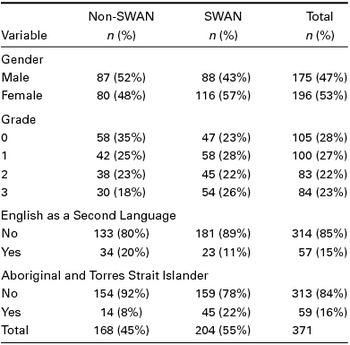
All students at the school (n = 371) in the preparatory year to Year 3 in 2012 were involved in the study. Information regarding the gender, numbers in each of the four grade levels and those with English as an additional second language and dialect (ESL) and Aboriginal and Torres Strait Islander (ATSI) students are provided in Table 1.
Demographic Information by Disability Group

Note. SWAN = students with additional needs. Non-SWAN = students who have no additional needs.
While the total number of students with a verified disability among this cohort of students numbered only 18, it was evident that there were many more students with additional needs (SWANs). Defining students with a disability in Australian schools has been fraught with difficulty (Davies & Dempsey, Reference Davies, Dempsey, Elliott, Kettler, Beddow and Kurz2011) and a lack of consistency (Dempsey & Davies, Reference Dempsey and Davies2013). Moreover, the strict adherence to verification processes to define numbers of students with disabilities belies the fact that many more students have additional educational needs and require specialised services. These ‘grey students’ need to be identified to provide a clearer picture of student needs and the demands on school personnel and educational systems. Students who received additional educational assistance were identified using the Department of Education and Training OneSchool information management system as receiving assistance in the following categories: learning difficulty in reading; learning difficulty in maths; emotional and behavioural issues; English proficiency; and developmental delays. The Longitudinal Study of Australian Children (LSAC; Australian Institute of Family Studies, 2011) provides a similar categorical method to identifying SWANs. Using secondary data on the LSAC Year 3 sample, Dempsey and Davies (Reference Dempsey and Davies2013) identified that 12.3% of these children required specialised services or assistance with their school program because of a diagnosed disability or special need. Using the department's information management system, more than half of the students (55%) were identified as a SWAN, to separate them from those who had no additional needs (Non-SWANs).
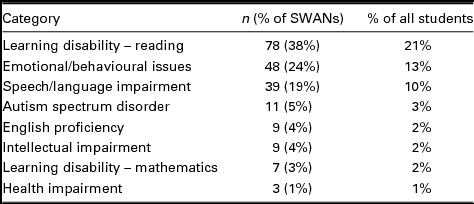
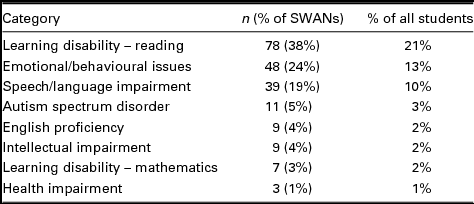
Based on the department's information management system, categories of need in order of most to least common were learning difficulties in reading, learning difficulties in mathematics, emotional or behavioural problems, ASD, English proficiency, intellectual disability, speech and language disability, vision disability, hearing disability, and physical disability. Table 2 provides the frequency profile for this school cohort.
Disability Category for SWANs in Order of Frequency
Note. SWAN = students with additional needs.
Among the SWAN subsample, 85 students (42%) qualified as having a learning disability in either reading or mathematics, 48 students (24%) qualified as having emotional/behavioural issues, 39 students (19%) qualified as having a speech/language impairment, and 32 students (16%) qualified in one of four other categories.
Data Analyses
The main treatment effect was tested using paired samples t-tests, comparing scores at Time 1 and Time 2, across the seven scores (four PSGs and three Rating Scales) yielded by the SSiS. A parallel set of t-tests was subsequently run on the two subsamples defined by disability status. Because the same tests were run on overlapping samples, a one-directional alpha of .025 was used for each test. For all main effect t-tests, Cohen's d was calculated by subtracting the Time 1 mean from the Time 2 mean, and dividing the difference by the Time 1 standard deviation. Treatment by disability status interactions were tested using independent samples t-tests on the difference scores (Time 2 – Time 1) for each disability status group. A one-directional alpha of .05 was used for the interactions. For all interaction effect t-tests, Cohen's d was calculated by subtracting the mean for SWANs from the mean for Non-SWANs, and dividing by the pooled standard deviation.
Teacher Survey
As described in Davies and Cooper (Reference Davies, Cooper, Knight and Zwan2013), teacher perspectives on the project and need for the project to provide feedback to further training and support were surveyed. Many questions were drawn from a comprehensive survey outlined in Buchanan, Gueldner, Tran, and Merrell (Reference Buchanan, Gueldner, Tran and Merrell2009). Classroom teachers of students in preparatory year to Year 3 involved in presenting social skill modules to their students for approximately four weeks all consented to complete the survey. Survey materials were disseminated to participants and completed surveys confidentially returned to the university researcher. Fourteen teachers (five in preparatory, four in Year 1, two in Year 2, and three in Year 3) completed the survey consisting of twelve 5-point Likert scale (not at all, a little, somewhat, much and a great deal) questions, along with some open-ended questions.
Ethical Considerations
Ethical approval for this study was obtained through Griffith University, Brisbane, Australia. Relevant teachers and administrators of the school provided consent for the data-gathering procedures in the study.
Results
Full Sample
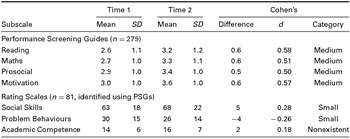
The current sample of Australian students was rated lower than a national representative sample from the United States (US; Gresham & Elliott, Reference Gresham and Elliott2008) on both the PSGs and the Rating Scales. At Time 1, the full sample was rated lower across the PSGs than was the standardisation sample from the US. Mean scores on the PSGs ranged from 2.6 to 3.0 in the full sample, compared to a range of 3.5 to 3.7 in the normative sample from the US. This represents a difference of about a half standard deviation on each PSG.
The sample of students evaluated using the Rating Scales was restricted, based on identification using the PSGs. This subsample was lower on Social Skills (63) at Time 1 compared to the standardisation sample (95) by about one and a half standard deviations. The subsample mean for Social Skills at Time 1 was at the Below Average level, as defined by the SSiS-RS. The subsample was rated higher on Problem Behaviours (30) at Time 1 compared to the standardisation sample (14) by more than a standard deviation. The subsample mean for Problem Behaviours at Time 1 was rated to be at the Average level. The subsample was rated lower on Academic Competence (14) at Time 1 compared to the standardisation sample (18) by more than a half standard deviation. The subsample mean for Academic Competence at Time 1 was also rated at the Average level. Table 3 includes means and standard deviations for all scores at Time 1.
Means and Difference Scores for the Full Sample

Note. PSGs = Performance Screening Guides. All differences were significant at α = .025, one-tailed.
All scores on the Rating Scale (except for Problem Behaviour) increased from Time 1 to Time 2. These changes were significant for all scores. The increase was in the medium range for all scores from PSGs, and was in the small or nonexistent range for all scores from rating scales. Table 2 also includes means and standard deviations for all scores at Time 2, as well as difference scores, Cohen's d, and the category of the effect size.
Non-SWAN Sample
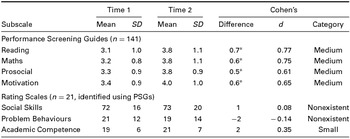
At Time 1, the Non-SWAN sample was rated lower across the PSGs than was the standardisation sample from the US. Mean scores on the PSGs ranged from 3.1 to 3.4 in the Non-SWAN sample, compared to a range of 3.5 to 3.7 in the normative sample. This represents a difference of about a third of a standard deviation on each PSG.
The sample of students evaluated using the Rating Scales was restricted, based on identification using the PSGs. This Non-SWAN subsample was rated lower on Social Skills (72) at Time 1 compared to the standardisation sample (95) by about a standard deviation. The Non-SWAN subsample mean for Social Skills at Time 1 was at the Below Average level. The Non-SWAN subsample was rated higher on Problem Behaviours (21) at Time 1 compared to the standardisation sample (14), by about a half a standard deviation. The Non-SWAN subsample mean for Problem Behaviours at Time 1 was at the Average level. The Non-SWAN subsample was rated similarly on Academic Competence (19) at Time 1 to the standardisation sample (18), with both means at the Average level. Table 4 includes means and standard deviations for all scores from Non-SWANs at Time 1.
Means and Difference Scores for the Non-SWAN Sample

Note. Non-SWAN = students who have no additional needs. PSGs = Performance Screening Guides.
*Differences significant at α = .025, one-tailed.
Among Non-SWANs, all scores (except for Problem Behaviour) increased from Time 1 to Time 2. These changes were only significant on the PSGs. The increase was in the medium range for all scores from PSGs. Table 3 also includes means and standard deviations for all scores from Non-SWANs at Time 2, as well as difference scores, Cohen's d, and the category of the effect size.
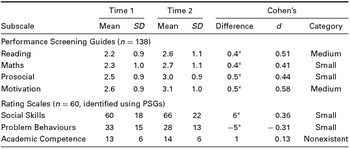
SWAN Sample
At Time 1, the SWAN sample was rated lower across the PSGs than was the standardisation sample from the US. Mean scores on the PSGs ranged from 2.2 to 2.6 in the SWAN sample, compared to a range from 3.5 to 3.7 in the normative sample. This represents a difference of more than one standard deviation on each PSG.
The sample of students evaluated using the Rating Scales was restricted, based on identification using the PSGs. This SWAN subsample was rated lower on Social Skills (60) at Time 1 compared to the standardisation sample (95), by about one and a half standard deviations. The SWAN subsample mean for Social Skills at Time 1 was at the Below Average level. The SWAN subsample was rated higher on Problem Behaviours (33) at Time 1 compared to the standardisation sample (14), by about one and a half standard deviations. The SWAN subsample mean for Problem Behaviours at Time 1 was at the Above Average level. The SWAN subsample was rated similarly on Academic Competence (13) at Time 1 to the standardisation sample (17), with the difference being less than a half standard deviation. The SWAN subsample mean for Academic Competence at Time 1 was at the Average level. Table 5 includes means and standard deviations for all scores from SWANs at Time 1.
Means and Difference Scores for the SWAN Sample

Note. PSGs = Performance Screening Guides.
*Differences significant at α = .025, one-tailed.
Among SWANs, all scores (except for Problem Behaviour) increased from Time 1 to Time 2. These changes were significant for all scores except Academic Competence. The increase was at the high end of the small range or the low end of the medium range for all scores from PSGs. Difference scores were in the small range for both Social Skills and Problem Behaviours. Table 4 also includes means and standard deviations for all scores from Non-SWANs at Time 2, as well as difference scores, Cohen's d, and the category of the effect size.
Treatment by Disability Status Interaction
No significant interactions were found between Treatment and Disability Status.
Teacher Survey Results
Teachers (n = 14) from across the year levels (five in preparatory, four in Year 1, two in Year 2, three in Year 3) completed the survey. Most (n = 12) had achieved a bachelor degree as their highest qualification, with two achieving a postgraduate qualification. In terms of years of teaching experience, the mean number of years teaching was 8.4.
As reported in Davies and Cooper (Reference Davies, Cooper, Knight and Zwan2013), data from teachers in this study replicated those reported by Buchanan et al. (Reference Buchanan, Gueldner, Tran and Merrell2009) on his larger sample of 264 teachers. All teachers reported a belief that social skills enhance academic outcomes, and that social skills should be taught in the classroom by classroom teachers. All indicated high levels of motivation to implement social skills training in their classrooms and all were doing so. They were generally satisfied with their current knowledge and skills to implement the SSiS social skills training in their classroom, and believed they had the ability to effectively implement the SSiS social skills training program. They regarded that they had been trained to implement the SSiS in a SAFE way, that is, sequenced, active, focused, and with explicit goals.
In terms of support, the majority were strongly willing to receive one-on-one consultation and mentoring during the implementation of the SEL program, and some were somewhat willing and a few were not at all willing. A similar range of responses were recorded in relation to teacher willingness to be observed while teaching a lesson and receive feedback from either the GO or the behaviour specialist, or to team teach with either of these professional supporters.
In relation to implementation, teachers had a broad range of responses to the feasibility of devoting three 30-minute lessons per week to the SSiS program, with the majority indicating that this was somewhat and much feasible. In terms of barriers to implementing the SSiS in their classroom, time available to teach these lessons was perceived to be the main barrier, followed by current level of training in SSiS, time available to prepare for teaching the lessons, and the number of students in the teacher's classroom. When asked what they had to give up in terms of curriculum to fit in social skills, teachers indicated that all areas of curriculum were adjusted, with the most common areas reduced being literacy, numeracy, society and environment, and physical activity.
Some commentary indicated that the current program did not suit students with low or very low social skills as many of these students ‘often don't respond to the worksheet, or sit long enough to listen and take in the talk’ and ‘comment on how boring it is’. Inappropriate behaviour was identified by many respondents as a barrier to getting through the content. A number of respondents suggested that the program needs more role-plays and other strategies to make teaching the SSiS more fun and engaging. Another commented that worksheets were tricky to complete with one teacher in a multi-age classroom.
Discussion
School-wide intervention programs can be both effective and sustainable; however, low SES schools that may have students with low levels of SEL and other complex needs provide more of a challenge. The literature indicates that at-risk students have complex and multifaceted needs. Students who live in families challenged by poverty, family dysfunction, abuse and neglect are more at risk of developing behavioural, social, academic and mental health issues, are also more likely to have language and learning difficulties related to receiving and processing information, and also more often demonstrate poor social and emotional skills. Anecdotal evidence based on observations by the intervention team (GO, literary coach and SWO) of students in this study support these findings. More than half of students in this study were categorised as a SWAN (compared to 12.3% in a national study reported by Dempsey & Davies, Reference Dempsey and Davies2013), and almost a third of all students had low levels of prosocial behaviour. These numbers indicate the considerable challenge that teachers and the school system faced. As such, the application of the SSiS program at this school with the majority of students having additional and complex needs was a challenge.
Despite these challenging circumstances, the SSiS realised success over the first 12 months of this intervention. Students showed moderate levels of improvement across the four measures of the PSG screening tool. For the students with lowest prosocial behaviour, the rating scale assessments of social skills and problem behaviours indicated only small improvements in the first year. When the SWANs were separated from the Non-SWANs, the Non-SWANs generally performed at a higher level across all of the PSG subscales, and indicated similar levels of improvement. The SWANs were rated at a lower level, and although reading and motivation improved at a medium level, maths and prosocial behaviour improved to a small extent. Almost half of them (n = 60) were assessed with the Rating Scale, but only small improvements in social skills and behaviour problems were evident by year end. These results are consistent with the meta-analysis of Frey and Kaiser (under review) that indicated that although studies involving students with disabilities observed the greatest intervention effects compared to studies with students without disabilities, studies involving ‘at-risk children’ did not result in any significant improvement. The complex needs of this study cohort involve disability, additional needs and at-risk family circumstances, and so the moderate success of the social skills intervention with this cohort is generally supported by the findings of the meta-analysis. Results of the first year of the study reported in this article are constrained by the size of the survey sample and that the intervention took place in only one school. Additional data will be gathered at the end of the second year as students in Years 1, 2, and 3 will have received 2 years of social skill training and focus in their classrooms. Analysis of the 2-year dataset is likely to provide further insight into the impact of social skills intervention on the development of prosocial behaviour of students, with and without additional needs, in each of the grade levels. Ideally, it would be beneficial to conduct a similar study in at least one further school to help determine if school-related factors might be involved in the results obtained, and to extend generalisability of findings.
Survey responses with teachers of this complex group of students, combined with observations of the intervention team shed some light on the reasons for the intervention not gaining the success that was hoped. A central reason is that the language of the social and emotional curricula presented in the group setting may have been too complex for many of the children. Children with learning difficulties or who exhibited problem behaviours seemed to struggle with the amount of language presented in the program and generally had difficulty finding the oral language to express themselves, or to use the language required for the self-talk or problem-solving presented in the lessons. As a result, these children were observed to be acting out and disengaged from the process. As noted by teachers in feedback, these children were the ones that most needed the teaching of social and emotional skills and yet were the most detached. Students identified with more complex needs, SWANs, tended to have more limited communication skills, and tended to demonstrate poorer social and emotional outcomes and benefited less from the classwide social skill instruction. These students are likely to need more intensive, small group interventions in addition to the classwide efforts used in this study.
In seeking to develop a sustainable program to respond to the complex needs of the children, the school-based researchers in this project actively participated in the initial design and implementation of this classroom-based intervention and then refined the intervention strategies and practices through teacher feedback, peer consultation, and observations. In response to concerns raised in the teacher feedback process, and classroom observations, the classwide program was revised and the following modifications were made and modelled for implementation of the second cycle of research in 2013.
Centrally, it was considered important to simplify the linguistic structures of verbal material, reducing processing demands and restructuring multi-step tasks into separate independent steps, supported by memory aids. In effect, the number of words used in the delivery was reduced; the repetition of keywords was increased and connected to action through increased role-play and visual cues and supports. A number of other modifications were made to how the SSiS was presented:
• To respond to lack of engagement, children were moved from desks to the floor and were engaged through the use of the smartboard.
• Lesson format was converted to a PowerPoint® format so that teachers weren't reading from script — with the result that students increased eye contact and expression and were more engaged.
• Visual cues were used to trigger recall to assist the many children with working memory or learning difficulties.
• The steps poster was replaced with individual words so that children were sequencing steps during retell and role-plays during the week.
• Students retold their experiences of using the steps in different contexts to the teacher to record on a whole class table.
• Teachers nominated areas in the room that indicated levels of knowing and using a skill. Children were then asked to go to that area that best represented their current state in knowing and using the skill. This exercise provided teachers with the opportunity to discuss with the students their perceptions of their skill development in comparison to what they demonstrated daily.
• Frequency of role-plays was increased.
• Role-plays used explicit scaffolding over three steps: adults modelling only and demonstrating use of language for steps; then students working with an adult; and then later students working with one another.
• The workbook was discarded for this group.
Preliminary data on student social skill development in this first year of the research program, along with teachers’ reflections, provide evidence of the efficacy of the SSiS as a classroom intervention program in this setting. The SSiS is well accepted by the teachers as a complete and comprehensive program that can be used to assess and provide a targeted intervention with students in a classwide setting. This intervention model of training classroom teachers to assess and then deliver social skills to their students with support from school psychologists is reviewed as a potential strategy to meet the requirements of the Personal and social capability domain of the Australian Curriculum. When applied to classroom settings that have a high proportion of students with additional and complex needs, it seems clear that the SSiS needed several refinements. Such adjustments seem reasonable and not outside of the scope of changes that educators are expected to apply with students with disabilities and additional needs.
Conclusions
The SSiS provides a most comprehensive approach for classroom teachers to be able to apply an effective assessment-based intervention approach to assist their students to meet the year-level expectations posed by the Personal and social capability domain of the Australian Curriculum. However, when applied to a school setting with a large proportion of students with additional needs (SWANs) and complex at-risk needs, the SSiS needed adjustment. The research project demonstrated that with effective training, appropriate tools, and the capacity to adjust the intervention program where needed, teachers can assess, effectively target and deliver social skills training to their students in line with the development of Personal and social capability.